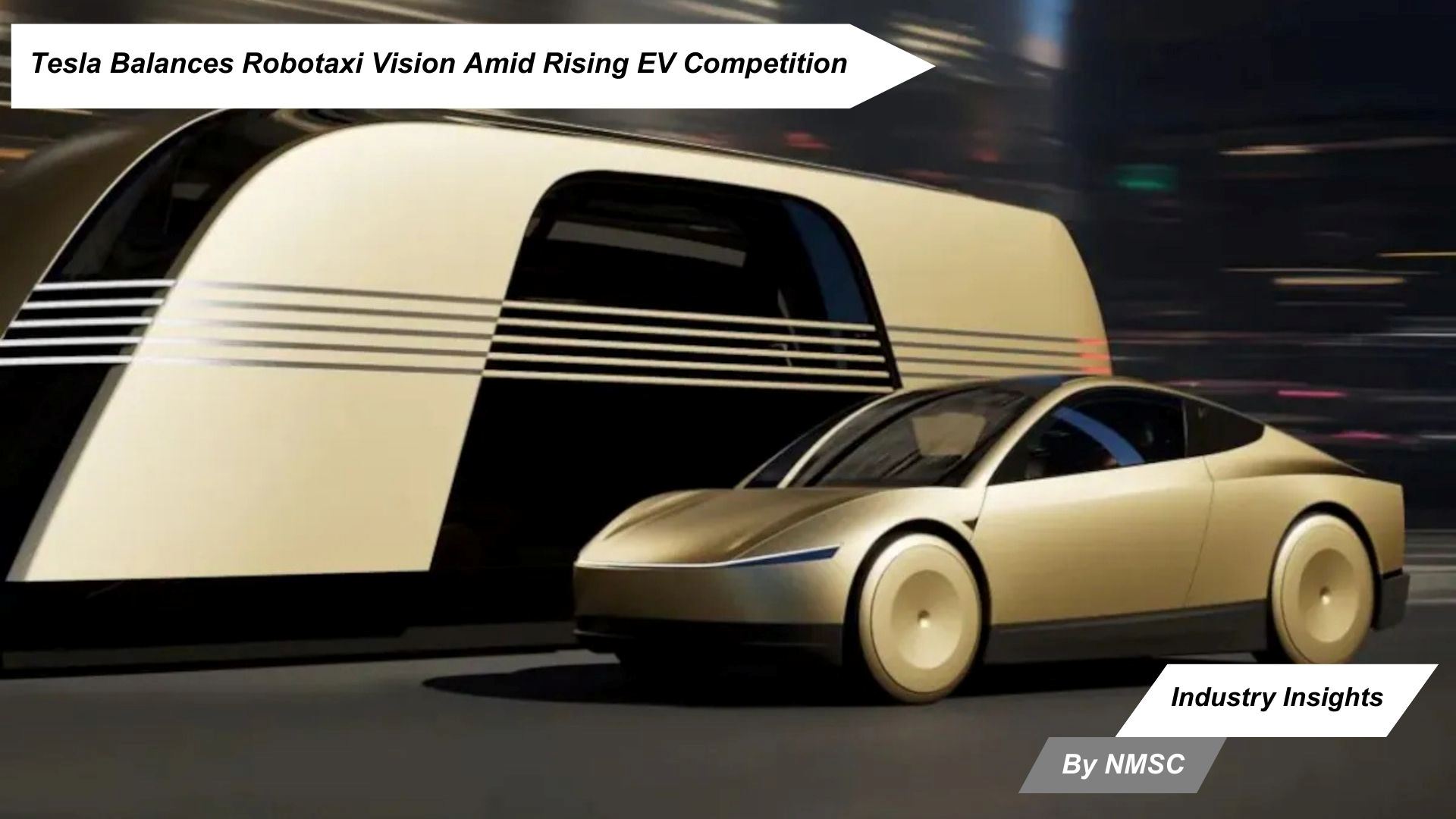
Tesla Balances Robotaxi Vision Amid Rising EV Competition
Industry Insights from Next Move Strategy Consulting
As competition intensifies in the European electric vehicle market, Tesla is navigating a complex strategic landscape where its long-term autonomy ambitions particularly the Robotaxi initiative are drawing increasing attention. The company now faces the challenge of balancing pressure in its core EV markets with continued investment in advanced artificial intelligence and robotics programs.
The evolving situation reflects two parallel narratives shaping Tesla’s trajectory: declining sales momentum in certain European regions and the company’s pursuit of transformative technologies such as Robotaxi and the Optimus robotics platform.
Intensifying Competition Across the European EV Market
European electric vehicle markets are witnessing rapid expansion from Chinese manufacturers. Automakers such as BYD, along with newer commercial vehicle entrants like Windrose, are steadily increasing vehicle registrations across several countries including the United Kingdom, Italy, Denmark, Sweden, and Germany.
This expanding presence has coincided with noticeable declines in Tesla’s sales in the United Kingdom and other European markets where the company previously maintained strong performance. As rival manufacturers scale their operations and broaden product portfolios, Tesla’s share in key EV segments is encountering growing competitive pressure.
Meanwhile, competition is also emerging in the heavy-duty vehicle segment. Chinese truck manufacturers are preparing to challenge Tesla’s Semi truck, signaling broader competition not only in passenger EVs but also in commercial transportation.
Robotaxi and Optimus Projects Take Center Stage
While market pressures rise in Europe, Tesla continues to focus on long-term innovation initiatives. The company’s high-profile Robotaxi program and Optimus robotics project are increasingly viewed as potential future growth drivers.
These initiatives highlight Tesla’s ambition to expand beyond traditional vehicle manufacturing into autonomous mobility and advanced robotics. However, execution timelines and development milestones remain under scrutiny as the company allocates resources between defending its EV market position and advancing these transformative technologies.
The situation places strategic importance on how Tesla manages spending on artificial intelligence, autonomy, and robotics while addressing competitive pressures in existing automotive markets.
Market Performance and Investor Perspective
Tesla’s stock recently closed at $398.68, reflecting a 79.5% return over one year, 128.5% over three years, and 68.9% over five years. Current expectations surrounding Tesla’s long-term technological ambitions are already reflected in the company’s valuation.
However, pressure from European competition has highlighted the degree to which Tesla’s market narrative relies on its ability to sustain automotive market share while simultaneously delivering on emerging technology initiatives such as Robotaxi and robotics.
Short-term momentum also shows signs of strain, with a roughly 3% decline in the past 30 days, reflecting investor sensitivity to intensifying competition headlines.
Key Strategic Considerations
Several factors remain central to Tesla’s evolving position:
-
Rising competition from Chinese EV and truck manufacturers in European markets
-
Increasing investor focus on execution milestones for Robotaxi and robotics initiatives
-
Valuation metrics that significantly exceed industry averages
-
Declining profit margins, which have shifted from 7.3% to 4%, alongside shareholder dilution over the past year
These dynamics emphasize the delicate balance Tesla must maintain between defending its automotive market position and investing in long-term innovation platforms.
Next Move Strategy Consulting Perspective on the Robotaxi Market
According to Next Move Strategy Consulting, the Robotaxi market represents a pivotal frontier in the future of mobility. Autonomous ride-hailing systems have the potential to reshape transportation economics by reducing reliance on human drivers while improving operational efficiency and scalability for mobility providers.
The firm notes that companies investing in autonomous mobility platforms are positioning themselves for a structural shift in urban transportation. However, successful commercialization depends on consistent technological progress, regulatory alignment, and the ability to integrate autonomous systems into existing transportation ecosystems.
For companies like Tesla, the Robotaxi initiative represents more than a technological experiment it reflects a strategic attempt to expand the role of software, autonomy, and AI-driven mobility within the broader automotive value chain.
A Defining Moment for Tesla’s Strategic Direction
As Tesla navigates rising competition in Europe and new challengers in commercial vehicles, the company’s focus on Robotaxi and robotics initiatives will remain a central component of its long-term narrative.
The intersection of escalating EV competition and ambitious autonomous mobility projects is likely to shape investor sentiment and strategic discussions around Tesla in the coming years. How effectively the company balances near-term market pressures with long-term technological ambitions may ultimately define the next phase of its growth story.
Prepared By: Next Move Strategy Consulting
Source: Simplywall
About the Author
 Sanyukta Deb
— Sanyukta Deb is Digital Marketing Team Lead at Next Move Strategy Consulting, where she has led content strategy and technical SEO for the firm's B2B market research publications for over 2 years. Her editorial process translates NextMSC's primary and secondary research — spanning technology, industrial, and consumer sectors — into commercial narratives, backed by search-intent, keyword, and competitive analysis. She brings 5 years of overall experience in digital marketing and content strategy.
Sanyukta Deb
— Sanyukta Deb is Digital Marketing Team Lead at Next Move Strategy Consulting, where she has led content strategy and technical SEO for the firm's B2B market research publications for over 2 years. Her editorial process translates NextMSC's primary and secondary research — spanning technology, industrial, and consumer sectors — into commercial narratives, backed by search-intent, keyword, and competitive analysis. She brings 5 years of overall experience in digital marketing and content strategy.
About the Reviewer
 Debashree Dey
— Debashree Dey is Assistant Manager at Next Move Strategy Consulting, where she supports cross-vertical market content and communications across diverse industries for 6 years. Her professional background includes senior content writing, communications, and published manuscript authorship, with experience developing audience-focused business narratives and maintaining clear, consistent messaging. Her role supports research-led content development and editorial quality across NextMSC publications.
Debashree Dey
— Debashree Dey is Assistant Manager at Next Move Strategy Consulting, where she supports cross-vertical market content and communications across diverse industries for 6 years. Her professional background includes senior content writing, communications, and published manuscript authorship, with experience developing audience-focused business narratives and maintaining clear, consistent messaging. Her role supports research-led content development and editorial quality across NextMSC publications.
















Add Comment