UK Battery Market is expected to reach USD 54.60 billion by 2035
Growing Renewable Energy Sector in UK Fuels Energy Storage Expansion and Battery Market Surge, Which is Driving Up Demand for the UK Battery Market During the Forecast Period.
UK Battery Market was valued at USD 8.18 billion in 2025 and is estimated to reach USD 10.76 billion in 2026. The industry is projected to expand significantly, reaching USD 54.60 billion by 2035, registering a robust CAGR of 19.77% from 2026 to 2035. In terms of volume, the market recorded 104.97 million units in 2025, with forecasts indicating growth to 156.71 million units by 2026 and further to 1,233.38 million units by 2035, reflecting a strong CAGR of 25.76% over the same period.
The United Kingdom's rapidly expanding renewable energy sector, coupled with supportive government policies and incentives for Energy Storage Systems (ESS), is driving significant advancement in the field of energy storage. This progress is also positively impacting the growth of the battery market. Battery technology plays a crucial role in ESS by efficiently storing energy. Among the array of battery options, lithium-ion batteries stand out in ESS due to their impressive energy storage capabilities relative to their compact size, along with the capacity to undergo numerous charge and discharge cycles over their operational lifespan.
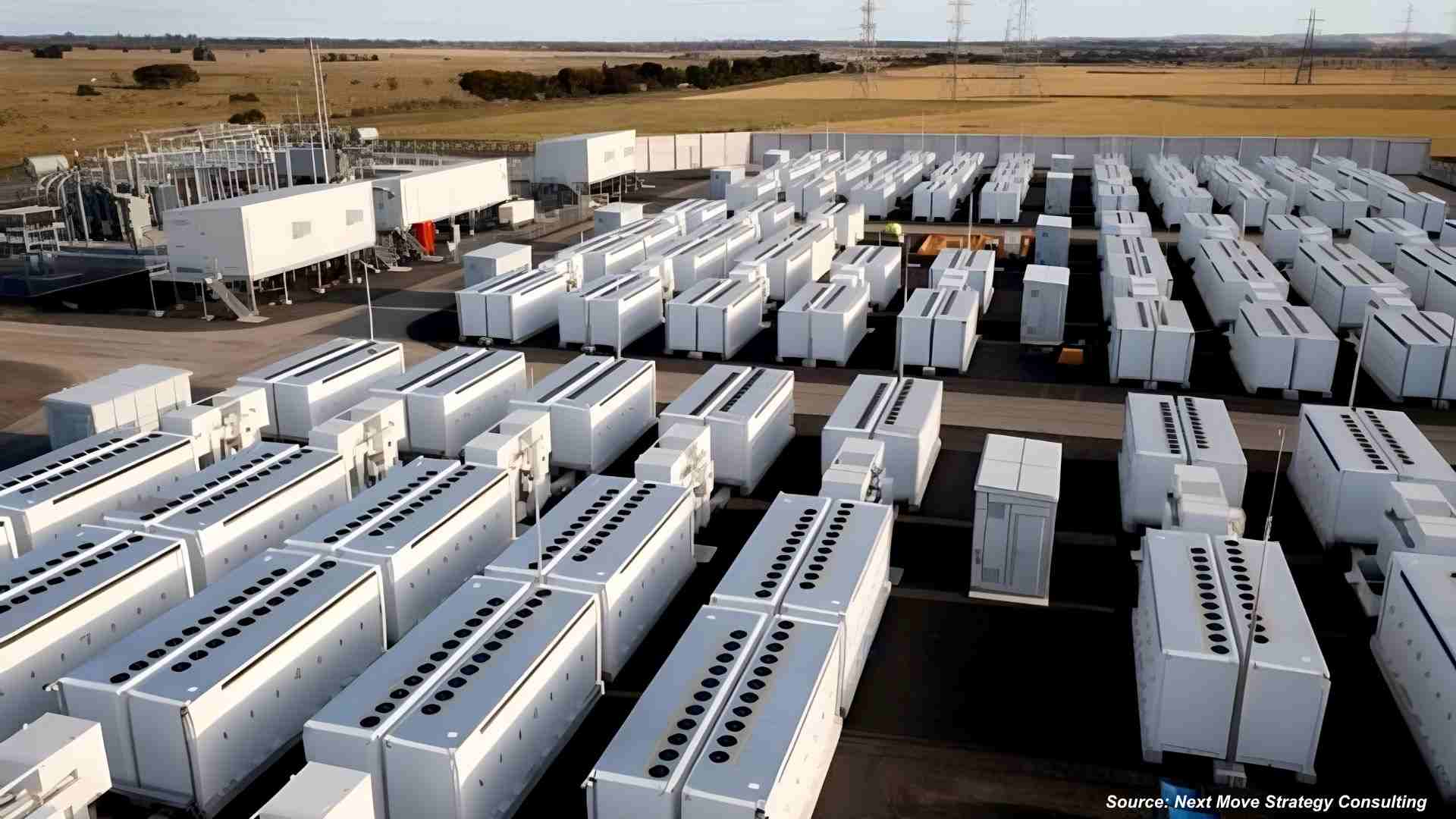
According to insights from the International Trade Administration, the UK boasts an impressive battery storage capacity of over 16.1 GW. This capacity is distributed across 729 ongoing or operational projects throughout the nation. A prime illustration of this momentum is seen in the December 2020 approval granted to InterGen.
The UK’s Department for Business, Energy and Industrial Strategy (BEIS) authorized InterGen's ambitious battery energy storage endeavor. Situated within the gateway energy center development along the banks of the River Thames in Essex, this lithium-ion battery energy storage project commands a staggering USD 300 million investment. Envisioned to deliver a baseline capacity of 320 MW/640 MWh, the project exhibits potential for expansion to a massive 1.3 GWh. At full charge, it holds the capability to provide power to around 300,000 households for a duration of 2 hours, positioning it as one of the globe's largest energy systems. These compelling factors collectively shape a landscape that is poised to galvanize the battery market within the country.
However, poor handling of batteries can lead to various hazards for both individuals and the environment. Often, used or discarded batteries find their way into landfills, where they break down and release harmful substances. Over time, these batteries corrode, enabling their chemical components to seep into the soil, thereby polluting both underground and surface water reservoirs. This contamination presents a significant threat to our ecosystem, impacting numerous aquatic plants and animals due to the presence of hazardous battery elements like mercury, cadmium, lithium, and lead. Thus, it is expected to restrain the growth of the battery market in UK.
On the other hand, the growing adoption of NDBs in various industries, including automotive, aerospace, and electronics, is expected to create future opportunities for the battery market in UK. NDB represents a groundbreaking energy generation and storage solution that reimagines and transforms traditional battery technology. These innovative systems, known as NDBs, boast exceptional durability, a characteristic bolstered by harnessing the energy generated from the radioactive decay of nuclear waste. The enticing attributes of NDB, including its compactness, modularity, cost-effectiveness, and ability to scale seamlessly from small-scale chipsets to extensive industrial applications, serve as a pivotal driver for fostering growth within the battery market. Functioning as a high-power battery utilizing diamond-based alpha, beta, and neutron voltaic principles, NDB emerges as a lasting source of eco-friendly energy for diverse applications, effectively surmounting the limitations associated with conventional chemical batteries.
Request for a Sample PDF on the UK Battery Market
According to the report, leading players in the YD (U.K.) CO., LTD., TESLA ENERGY VENTURES LIMITED, TOSHIBA INTERNATIONAL LIMITED, PANASONIC ENERGY EUROPE NV, SAMSUNG SDI LTD., ENERSYS LTD., ESPEX BATTERIES LIMITED, BMZ INNOVATION GROUP LTD, ZF AUTOMOTIVE UK LIMITED, AESC UK PLANT 2 LIMITED, TDK UK LIMITED, INVINITY ENERGY LIMITED, HYPERBAT LIMITED, ILIKA TECHNOLOGIES LTD, and ACEON BATTERY SOLAR TECHNOLOGY LTD.
Key Insights from the UK Battery Market Report:
-
The information related to key drivers, restraints, and opportunities and their impact on the UK battery market is provided in the report.
-
The value chain analysis in the market study provides a clear picture of the roles of each stakeholder.
-
The market share of players in the UK battery market is provided in the report along with their competitive analysis.
About the Author
 Tushmi Dutta
— a
Tushmi Dutta
— a
About the Reviewer
 Supradip Baul
— a
Supradip Baul
— a















Add Comment