Used Lead-Acid Battery Recycling Hits 97.7% in U.S. as Export Gap Persists
BCI's 97.7% Lead Recycling Rate Across 2020–2024 Leaves a 2% Gap Blamed on Exports, While Brussels Keeps Its 2031 Lead Recovery Target and ILZSG Sees a Wider Refined Surplus
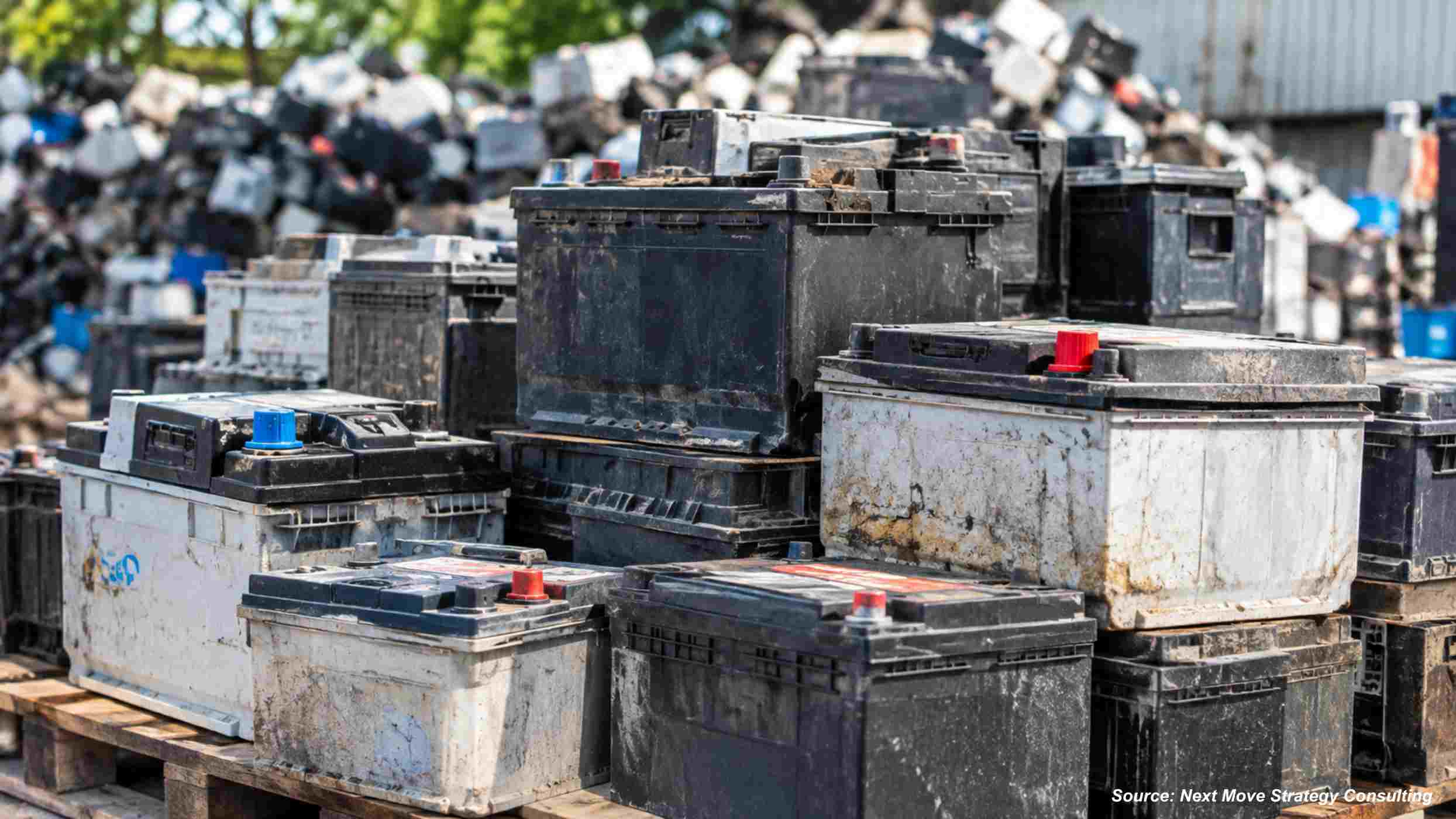
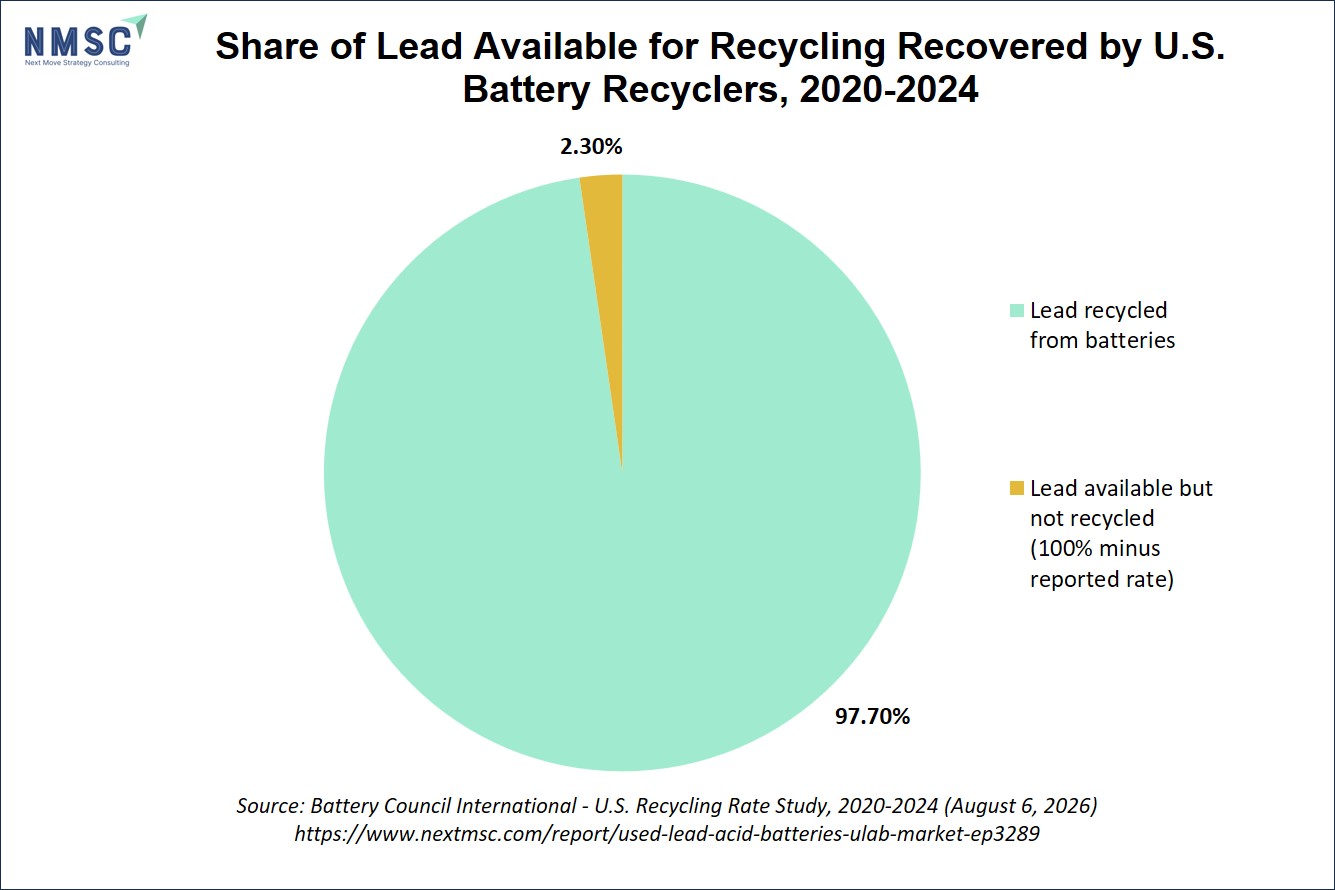
On August 6, 2026, Battery Council International (BCI) released its U.S. Recycling Rate Study, which puts the recycling rate for lead batteries at 97.7% across 2020–2024, a figure the association describes as the highest of any consumer product in the United States. BCI commissioned the study, and it reports that U.S. recyclers recovered 11,050,891,844 pounds of lead from spent batteries over the five-year period. The release arrived one week after The White House issued a Presidential Determination on recoverable critical minerals and materials under Section 101 of the Defense Production Act of 1950, dated July 30, 2026, and it attributes the remaining 2% gap to potentially illicit or unreported exports of spent batteries.
According to Next Move Strategy Consulting's Used Lead Acid Batteries (ULAB) Market report, the market is analysed by battery type (flooded, sealed and deep cycle lead acid batteries), by processing method (collection and segregation, hydrometallurgical treatment, pyrometallurgical treatment and neutralisation of acid) and by end-user industry (industrial, commercial and transportation), across North America, Europe, Asia-Pacific and the rest of the world. The report covers 28 countries and profiles 15 companies. The developments below bear most directly on the collection, regulation and trade-flow dimensions of that framework.
For More Information: Download FREE Sample on Used Lead Acid Batteries (ULAB) Market Report
What the BCI Study Measured, and Why the Export Line Matters
BCI's recycling rate is lead recycled from batteries divided by lead available for recycling. Lead available for recycling is the lead in batteries reaching end of life in the United States, plus battery scrap lead imports, minus battery scrap lead exports. For 2020–2024, the study records 18,203,931,617 pounds of lead in end-of-life batteries, 244,205,671 pounds of scrap lead imports and 7,142,366,331 pounds of scrap lead exports, which leaves 11,305,770,957 pounds available for recycling against 11,050,891,844 pounds actually recycled. BCI cautions that these components should not be used to derive a rate for an individual year or for a single battery type, so the 97.7% is a five-year aggregate rather than an annual trend.
BCI Recycling Rate Worksheet, United States, 2020–2024
|
Component |
Pounds of lead, 2020–2024 |
|
Lead in batteries reaching end of life in the United States |
18,203,931,617 |
|
Plus: battery scrap lead imports |
244,205,671 |
|
Less: battery scrap lead exports |
7,142,366,331 |
|
Equals: lead available for recycling |
11,305,770,957 |
|
Lead recycled from batteries |
11,050,891,844 |
|
Recycling rate (recycled divided by available) |
97.7% |
The export line carries the most analytical weight. Because exports are deducted from the denominator, spent batteries that leave the country without appearing in trade statistics stay in the denominator and lower the measured rate. The study attributes the remaining 2% gap to potentially illicit or unreported exports and notes that U.S. export classification is recognised to under-report export volumes, although it does not quantify the shortfall. Spent-battery exports go to smelters in Canada, Mexico and elsewhere, and BCI counts Canadian and Mexican recyclers within a North American system that meets more than 83% of the region's lead demand.
“Our task now is to protect that system and to close that remaining gap.”
— Roger Miksad, President and Executive Director, Battery Council International, BCI press release on the U.S. Recycling Rate Study, August 6, 2026.
Secondary Lead Carries the U.S. Supply Chain
The U.S. Geological Survey's Mineral Commodity Summaries 2026, published in February 2026, shows how much of the U.S. lead supply depends on this recovery loop. Secondary lead production from old scrap, which comes mostly from lead acid batteries, reached 1,030 thousand metric tons in 2024 and was put at 1,000 thousand metric tons for 2025. Recycled scrap supplied about 70% of apparent domestic lead consumption in 2025, and the lead acid battery industry accounted for an estimated 67% of that consumption.
U.S. Secondary Lead and Battery Dependence
|
Indicator |
2024 |
2025 |
|
Secondary lead production from old scrap, thousand metric tons |
1,030 |
1,000 (USGS estimate) |
|
Share of apparent domestic lead consumption met by recycled scrap |
Not stated |
About 70% |
|
Lead acid battery industry share of apparent domestic lead consumption |
Not stated |
67% (USGS estimate) |
BCI's figures describe the physical scale of the collection network behind those tonnages. More than 174 million lead batteries are recycled in the United States each year, returning over 2.2 billion pounds of lead to battery manufacturing, through more than 300,000 spent-battery collection sites and 15 recycling facilities across North America, according to the August 6, 2026 release. The release also states that domestic recycling supplies roughly 70% of annual U.S. lead demand, a share consistent with the U.S. Geological Survey's figure for recycled scrap in 2025.
Policy Signals on Both Sides of the Atlantic
The White House's July 30, 2026 Presidential Determination on recoverable critical minerals and materials, issued under Section 101 of the Defense Production Act of 1950, forms the policy backdrop that BCI cites alongside the designation of lead as a critical mineral by the U.S. Geological Survey in late 2025. In Europe, the European Commission's report COM(2026) 470 final, dated September 11, 2026, reviewed the recycling efficiency and material recovery targets in Annex XII of Regulation (EU) 2023/1542 and concluded that revising them is not appropriate. The next assessment is due by August 18, 2031.
For lead acid batteries, the existing targets stand at 75% recycling efficiency by December 31, 2025 and 80% by December 31, 2030, while lead is among the materials with a 90% recovery target by December 31, 2027 and a 95% target by December 31, 2031. The Commission noted that the 2031 lead target is close to the technical limit, so raising it would add pressure without much effect on supply, and it found no technological or circularity failure that would justify lowering it. Delegated Regulation (EU) 2025/606 lets recyclers exclude certain fractions, such as carbon, iron, and phosphorus, from their calculations until the end of 2029, and the Commission considers the calculation method robust.
EU Battery Regulation Targets Left Unchanged for Lead
|
Target |
Deadline |
Level |
|
Lead acid battery recycling efficiency |
December 31, 2025 |
75% |
|
Lead acid battery recycling efficiency |
December 31, 2030 |
80% |
|
Lead material recovery |
December 31, 2027 |
90% |
|
Lead material recovery |
December 31, 2031 |
95% |
Global Balance: Refined Lead Heads Toward Surplus
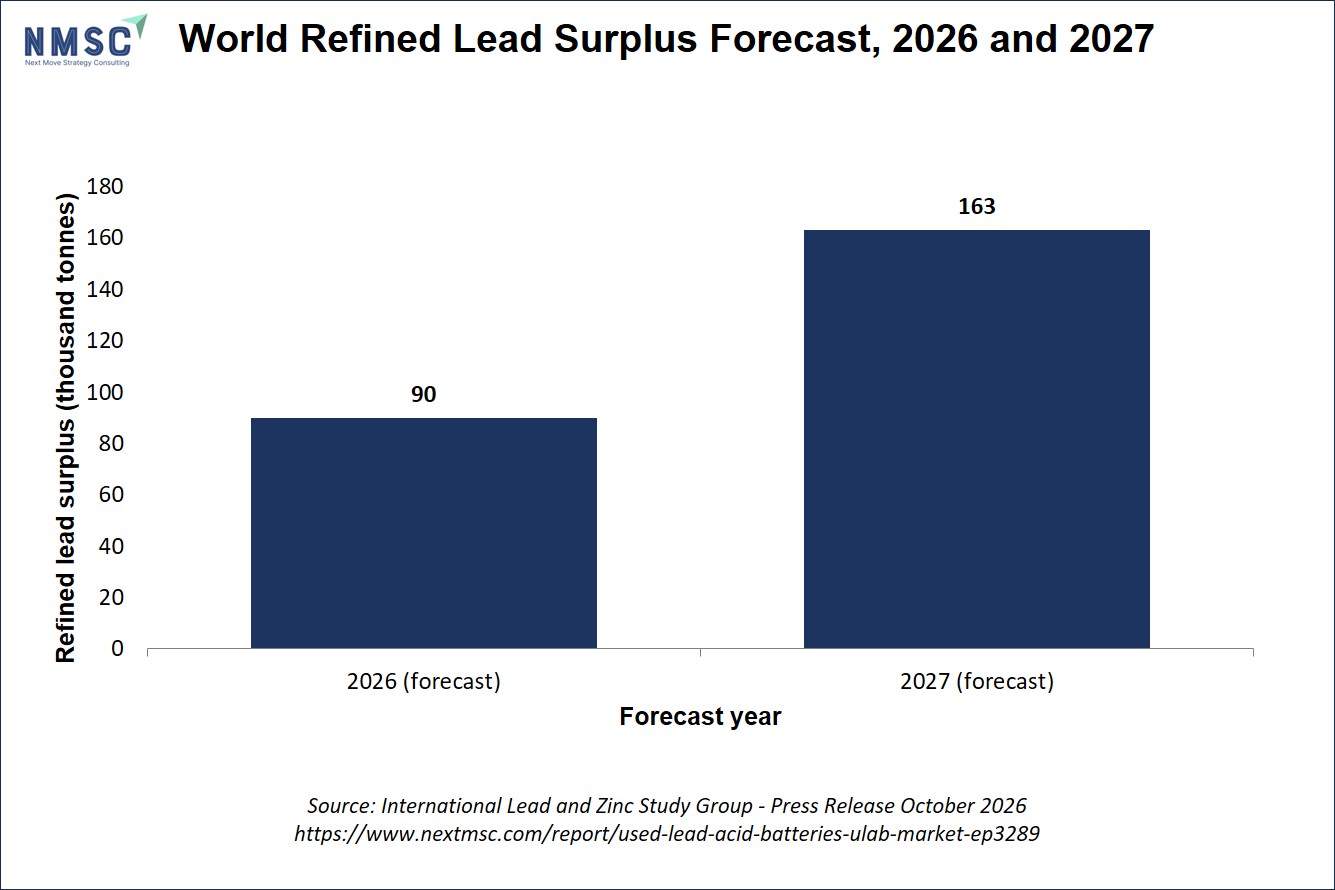
The International Lead and Zinc Study Group issued its October 2026 press release on October 19, 2026, following its session in Lisbon on October 15–16. It forecasts world refined lead usage of 13.79 million tonnes in 2026, up 0.9%, and 13.92 million tonnes in 2027, up 1%. Refined lead production is forecast at 13.88 million tonnes in 2026, up 1%, and 14.08 million tonnes in 2027, up 1.5%, which leaves a surplus of 90,000 tonnes in 2026 and 163,000 tonnes in 2027.
Secondary capacity is part of the supply story. The study group expects refined output to rise in India, South Korea, Türkiye and Brazil in 2026, with Brazil's increase reflecting new secondary capacity commissioned in 2025, while a decline in China's refined output partly offsets those gains. On the demand side, Chinese usage grows by only 0.2% in 2026 because stable replacement battery demand is offset by lower lead acid battery exports and lower vehicle production, and it is forecast to decrease in 2027.
Key Dated Developments
Four dated events between July and October 2026 frame the evidence above, and each is recorded by a named institution.
Dated Developments Shaping ULAB Recovery, July–October 2026
|
Date |
Development |
Institution |
|
July 30, 2026 |
Presidential Determination on recoverable critical minerals and materials under Section 101 of the Defense Production Act of 1950 |
The White House |
|
August 6, 2026 |
U.S. Recycling Rate Study reports a 97.7% lead battery recycling rate for 2020–2024 |
Battery Council International |
|
September 11, 2026 |
Report COM(2026) 470 final finds that revising EU battery recycling and recovery targets is not appropriate |
European Commission |
|
October 19, 2026 |
Refined lead surplus forecast at 90,000 tonnes for 2026 and 163,000 tonnes for 2027 |
International Lead and Zinc Study Group |
Regional Outlook
In North America, BCI reports that U.S., Canadian and Mexican recyclers together meet more than 83% of regional lead demand, and the International Lead and Zinc Study Group forecasts that U.S. lead usage will rise in both 2026 and 2027. The open question for the region is the destination of exported spent batteries rather than the capacity of its collection system.
In Europe, targets are fixed through 2031 and measured under a harmonised method. The International Lead and Zinc Study Group expects European lead demand to rise 1.3% in 2026, led by Germany, Greece, Poland, Slovenia and Spain, which more than offsets declines in France and the United Kingdom, and it forecasts continued growth in 2027.
In Asia-Pacific and the rest of the world, supply is the moving variable. India is forecast to raise both refined output and usage, China's refined output declines while its usage growth slows, and Brazil's gain in refined output reflects new secondary capacity. These shifts change where used batteries are converted back into lead rather than how much lead the world uses.
NMSC Strategic Perspective: Traceability Now Sets the Pace
NextMSC primary research and analysis reads the evidence from August to October 2026 as a change in the central question facing ULAB participants, from how much used battery lead is collected to where the collected lead ends up. A 97.7% five-year recovery rate leaves little room for further gains from collection effort alone. The contestable ground is the 7,142,366,331 pounds of scrap lead exported between 2020 and 2024 and the 2% gap that BCI attributes to unreported exports. In the collection and segregation method that anchors the report's segmentation, traceability rather than volume is therefore the variable that now limits further improvement.
Regulation is converging on measured recovery rather than collection mandates. Europe has fixed lead recovery targets of 90% by 2027 and 95% by 2031 under a harmonised calculation method, and the Commission's finding that the 2031 level is close to the technical limit indicates that future compliance pressure will fall on documentation and yield accounting. In the United States, the July 30, 2026 determination and BCI's study place recoverable lead inside a critical-minerals frame. NextMSC primary research and analysis treats documented recovered-lead yield as a likely commercial qualification for recyclers, in addition to a compliance duty.
Pressure on recyclers also comes from the supply side. The study group's forecast of a refined surplus of 90,000 tonnes in 2026 and 163,000 tonnes in 2027, together with new secondary capacity in Brazil, India, South Korea and Türkiye, means that smelters will have more refined supply behind them while Chinese usage growth slows to 0.2%. NextMSC primary research and analysis points to feedstock security and recovery yield as the variables on which recyclers can still differentiate, which favours participants with controlled collection networks over those that buy scrap on the open market.
For investors and technology vendors, the practical implication is to screen ULAB exposure by processing method and region instead of by headline recycling rates. The report's segmentation by battery type, method, end-user industry and region provides the structure for that screen.
Bottom Line
Used lead acid battery recovery in the United States has reached a level at which additional collection effort yields little, and the evidence from August to October 2026 shows attention moving to traceability and trade flows. BCI's study measures a 97.7% recycling rate for 2020–2024 against 7,142,366,331 pounds of scrap lead exported, and it attributes the remaining 2% gap to potentially illicit or unreported exports. The European Commission's September 11, 2026 report keeps lead recovery targets at 90% by 2027 and 95% by 2031, which fixes the compliance benchmark for European recyclers. The International Lead and Zinc Study Group forecasts a refined lead surplus of 90,000 tonnes in 2026 and 163,000 tonnes in 2027, as new secondary capacity in Brazil, India, South Korea and Türkiye offsets slower Chinese usage. NextMSC primary research and analysis concludes that recovery yield, documented feedstock origin and export traceability will separate ULAB participants more than collection volume.
About Next Move Strategy Consulting
Next Move Strategy Consulting is a premier market research and management consulting firm that has been committed to provide strategically analysed well documented latest research reports to its clients. The research industry is flooded with many firms to choose from, what makes NMSC different from the rest is its top-quality research and the obsession of turning data into knowledge by dissecting every bit of it and providing fact-based research recommendation that is supported by information collected from over 500 million websites, paid databases, industry journals and one on one consultations with industry experts across a diverse range of industry sectors. The high-quality customized research reports with actionable insights and excellent end-to-end customer service help our clients to take critical business decisions that enables them to move beyond time and have competitive edge in the industry.
We have been servicing over 1000 customers globally that includes 90% of the Fortune 500 companies over a decade. Our analysts are constantly tracking various high growth markets and identifying hidden opportunities in each sector or the industry. We provide one of the industry’s best quality syndicate as well as custom research reports across 10 different industry verticals. We are committed to deliver high quality research solutions in accordance to your business needs. Our industry standard delivery solutions that ranges from the pre consultation to after-sales services, provide an excellent client experience and ensure right strategic decision making for businesses.
For more information, please contact:
Next Move Strategy Consulting
5th Floor 867 Boylston St, STE 500,
Boston, MA 02116, U.S.
E-Mail: [email protected]
Direct: +1-217-650-7991
Website: www.nextmsc.com
About the Author
 Priyanshu Das
— Priyanshu Das is SEO Executive at Next Move Strategy Consulting, where he has led on-page and off-page SEO, keyword research, and SEO audits for the firm's B2B market research publications for 2 years. His audit process combines technical crawl analysis, backlink profile review, and competitor keyword gap mapping — using tools including Screaming Frog and Google Search Console — to prioritize fixes by organic search-visibility impact, informed by his own prior in-house and agency SEO experience.
About the Reviewer
 Sanyukta Deb
— Sanyukta Deb is Digital Marketing Team Lead at Next Move Strategy Consulting, where she has led content strategy and technical SEO for the firm's B2B market research publications for over 2 years. Her editorial process translates NextMSC's primary and secondary research — spanning technology, industrial, and consumer sectors — into commercial narratives, backed by search-intent, keyword, and competitive analysis. She brings 5 years of overall experience in digital marketing and content strategy.














Add Comment