US Grid Batteries Grew 70% a Year as Global Storage Added a Record 108 GW
EIA Data Put U.S. Utility-Scale Storage Near 52 GW With 54 GW More Planned, While Saudi Arabia, Cambodia and New Zealand Commission Grid-Forming Systems
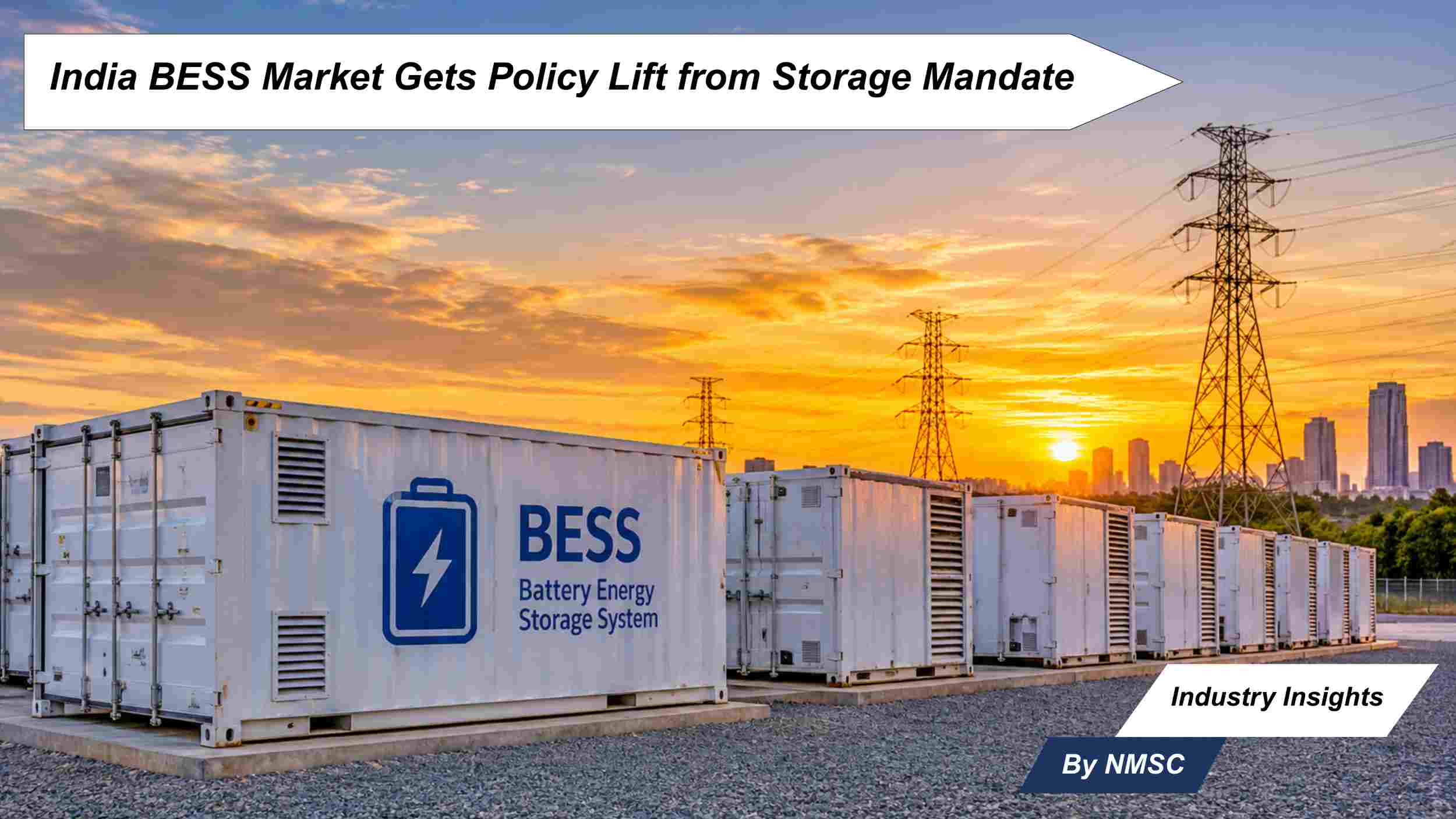
On August 7, 2026, the U.S. Energy Information Administration (EIA) reported in its EIA Today in Energy brief that utility-scale battery storage capacity in the United States has grown at an annual average rate of 70% over the last three years. The U.S. power system ended 2025 with 43.6 gigawatts (GW) of operational battery storage, operators added 8.3 GW in the first six months of 2026, and nameplate capacity reached nearly 52 GW. Operators told the agency they plan to bring another 54 GW online over the next two and a half years. The International Energy Agency (IEA) had already set the U.S. result inside a record global year: worldwide battery additions reached 108 GW in 2025, up around 40% from 2024 and above the historical peak for gas-fired capacity additions.
According to Next Move Strategy Consulting's Grid Scale Battery Market report, the global grid scale battery market was valued at USD 158.57 billion in 2026 and is projected to reach USD 784.40 billion by 2035, growing at a CAGR of 19.44% from 2026 to 2035. NextMSC primary research and analysis attributes the trajectory to renewable energy integration requirements and to the procurement of long-duration storage by utilities and independent power producers.
For More Information: Download FREE Sample on Grid Scale Battery Market Report
The Financial Logic: Solar Hosts, Price Spreads and a 54 GW Pipeline
The economics behind the build-out are visible in where the batteries sit. The EIA states that solar photovoltaic plants host the largest battery storage units in the United States, which allows operators to store output when wholesale electricity prices are low and discharge it when prices are high. The Bellefield Solar and Energy Storage Farm, which began operating in December 2025, couples 500 megawatts (MW) of photovoltaic capacity with 500 MW of storage for the California Independent System Operator, and its owners plan to double both by November, a step that would make it the largest power storage facility in the country if completed. The Manatee Solar Energy Center in Florida pairs 75 MW of solar with 409 MW of battery capacity, and the Gemini Solar Hybrid in Nevada pairs 690 MW of photovoltaic capacity with 380 MW of storage.
The wider capacity plan is built around solar. In its February 20, 2026 analysis, the U.S. Energy Information Administration reported that developers planned 86 GW of new utility-scale capacity for the year, a record if realized, with solar at 51%, battery storage at 28% and wind at 14%. That compares with 53 GW added in 2025, the largest single-year installation since 2002. On batteries specifically, developers planned 24 GW in 2026 against a record 15 GW in 2025, and the agency noted that more than 40 GW of battery capacity had been added over the previous five years.
The EIA Today in Energy brief of August 7, 2026 shows the plan peaking in 2027: operators reported 14 GW for the second half of 2026, 26 GW for 2027 and 14 GW for 2028. These are intentions reported to the agency, not completed capacity.
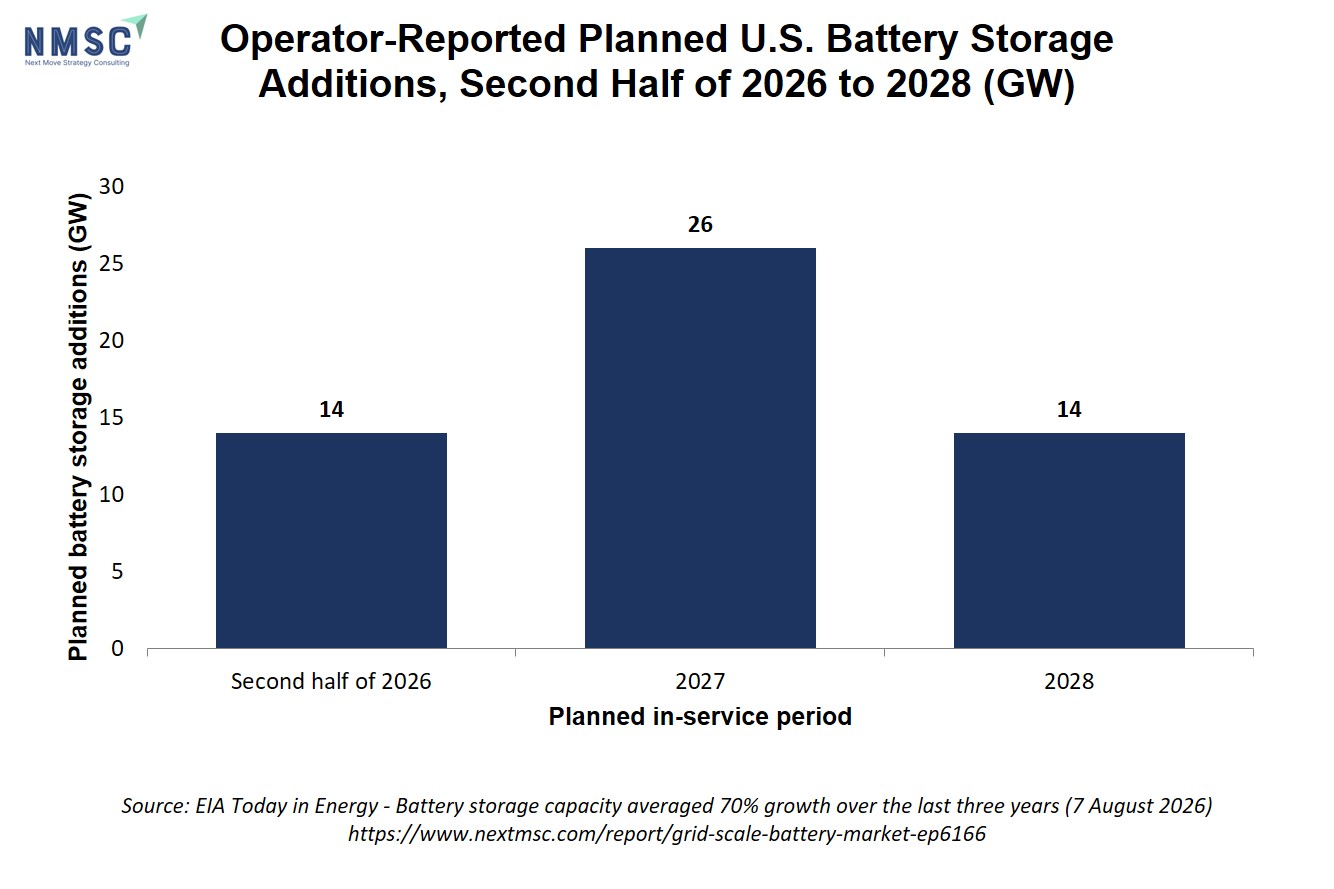
Operators report 54 GW of planned battery additions across the three periods, with the largest block of 26 GW scheduled for 2027.
U.S. Utility-Scale Battery Storage Capacity: Operating and Operator-Planned
|
Measure |
Capacity (GW) |
Status |
|
Operational capacity at the end of 2025 |
43.6 |
Reported |
|
Capacity added in the first half of 2026 |
8.3 |
Reported |
|
Nameplate capacity by June 2026 |
Nearly 52 |
Reported |
|
Planned additions, second half of 2026 |
14 |
Operator plans |
|
Planned additions, 2027 |
26 |
Operator plans |
|
Planned additions, 2028 |
14 |
Operator plans |
|
Total planned additions over the next two and a half years |
54 |
Operator plans |
Three states carry most of the 2026 battery plan. The U.S. Energy Information Administration put Texas at 53%, or 12.9 GW, California at 14%, or 3.4 GW, and Arizona at 13%, or 3.2 GW, together about 80% of planned U.S. battery additions. Three of the four largest battery projects scheduled for 2026 are in Texas: the 621 MW Lunis Creek BESS, the 600 MW Clear Fork Creek Solar and BESS and the 418 MW Tehuacana Creek 1 Solar and BESS. The fourth, Bellefield 2 in Kern County, California, is rated at 500 MW.
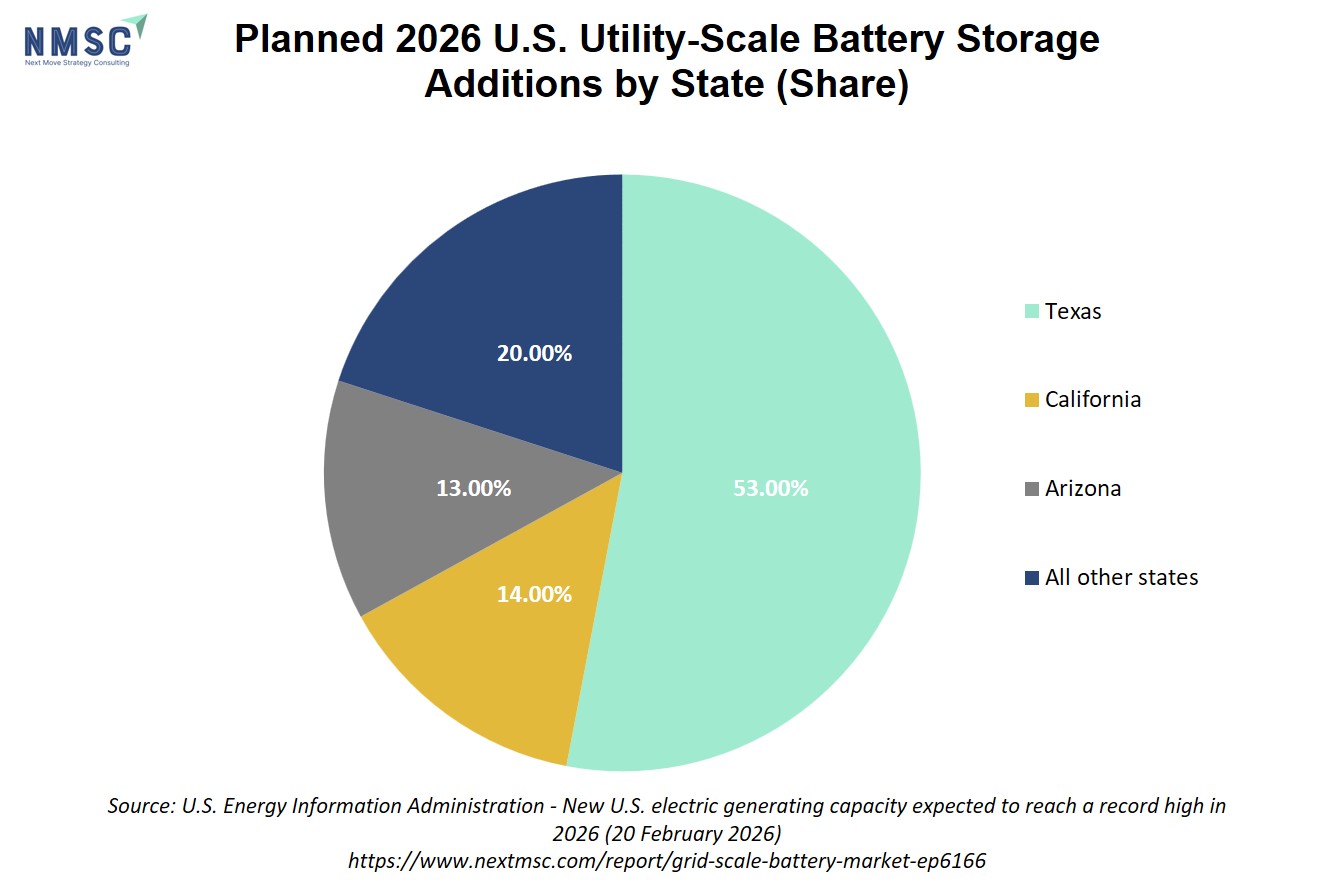
The agency reports Texas, California and Arizona as the three states making up about 80% of planned 2026 battery additions; the remaining 20.0% is 100% minus those three reported shares.
Global Deployment: Energy Shifting Becomes the Core Use Case
The IEA's May 29, 2026 commentary, Battery storage is scaling up and taking on a larger system role, places the U.S. figures inside a global record. Total additions reached 108 GW in 2025, up around 40% from 2024, which exceeds the roughly 107 GW peak for gas-fired capacity additions set in 2002. Utility-scale systems supplied around 87 GW of the total, about four-fifths, and around 24 GW of those utility-scale additions were co-located directly with renewables.
The application mix explains the shift. According to the IEA, energy shifting accounted for more than 90% of new battery projects in 2025, up from around 40% in 2015, while projects primarily targeting ancillary services fell from around 45% to about 7%. The average duration of projects commissioned rose to three hours in 2025 from around two hours in 2023, and system costs fell by more than 90% between 2010 and 2025.
Growth is also broadening geographically. Australia's additions surged to nearly 8 GW, almost nine times the prior year, which lifted batteries to around 18% of installed dispatchable capacity, ahead of China at 7%, the United States at 5% and Europe at 4%. In the Middle East, additions topped 3 GW, more than three times the 2024 level, driven almost entirely by Saudi Arabia, and Chile's additions approached 1 GW.
Battery Storage Capacity Additions by Market, 2025
|
Market |
Total additions (GW) |
Utility-scale (GW) |
Battery share of dispatchable capacity |
|
Global |
108 |
Around 87 |
Not reported |
|
China |
Just over 63 |
Around 55 |
7% |
|
United States |
19 |
Over 16 |
5% |
|
Australia |
Nearly 8 |
Around 4.2 |
18% |
|
Europe |
Around 6.2 |
About 4.6 |
4% |
Operational data show what that capacity now does. The IEA reported that California's battery capacity grew from less than 1 GW in 2019 to over 17 GW, that batteries covered more than 40% of the state's power load on the evening of March 29, 2026, and that their contribution to hourly ramping rose from under 1% to above 60% in the first quarter of 2026. In April, batteries contributed more than 40% of ramping in the ERCOT market, and in South Australia they provided more than 30% of hourly ramping in February and March.
Key Industry Developments: Commissioning Milestones Across Three Regions
On June 5, 2026, MEED reported that Saudi Energy, formerly Saudi Electricity Company, had commissioned a 2.5 GW battery storage programme serving the grids of Riyadh, Rabigh, Dawadmi, Jouf and Qassim. According to MEED, the programme is rated at up to 12.5 gigawatt-hours (GWh) and completed its grid-tied charging and discharging tests at the end of May, as NR Electric stated. Alfanar served as engineering, procurement and construction contractor, and BYD Energy Storage handled design, supply, supervision of installation, testing and commissioning. MEED described it as the world's largest grid-scale energy storage deployment, requiring 2,364 system cabinets, and listed load shifting, black start, frequency regulation and voltage support among its applications.
On September 29, 2026, Sungrow announced grid connection and full acceptance testing of the Electricité du Cambodge Kandal Stueng station, a 108.4 MW/215.6 MWh grid-forming system in Takmao, Kandal Province. Sungrow said the trials covered black start, 240 kilometers of grid restoration and 3.5 hours of islanded operation, with the system supporting the start-up and synchronization of the 60 MW Kamchay Hydropower Plant before operating alongside a 135 MW coal-fired plant. Sungrow stated that hot commissioning and three rounds of performance tests were completed within 20 days. Energy-Storage.News added that Cambodia's first grid-forming system, a 500 MW/1,000 MWh project co-located with solar in Pursat province, entered commercial operation in March 2026.
On October 15, 2026, Genesis Energy opened its first grid-scale battery at Huntly Power Station, a 1,200 MW plant that Energy-Storage.News identified as New Zealand's largest thermal power station. The 100 MW/200 MWh system has a two-hour duration and uses 70 lithium iron phosphate container units supplied by Saft, the battery maker owned by TotalEnergies. In April 2026, Saft signed a 200 MWh extension contract with Genesis, according to Electric & Hybrid Vehicle Technology International. Saft's Vincent Le Quintrec commented on the extension at the time.
“…demonstrates what utility-scale storage can deliver when backed by proven technology and end-to-end execution.”
- Vincent Le Quintrec, Energy Storage System Sales Director, Saft, Electric & Hybrid Vehicle Technology International, 30 April 2026.
Dated Grid-Scale Battery Commissioning Milestones, 2026
|
Date |
Project and location |
Scale |
Reported role |
|
5 June 2026 |
Saudi Energy storage programme across five regions, Saudi Arabia |
2.5 GW, up to 12.5 GWh |
Load shifting, black start, frequency regulation, voltage support |
|
29 September 2026 |
Electricité du Cambodge Kandal Stueng station, Cambodia |
108.4 MW/215.6 MWh |
Grid-forming operation, black start, grid restoration |
|
15 October 2026 |
Genesis Energy battery at Huntly Power Station, New Zealand |
100 MW/200 MWh |
Two-hour grid-scale storage beside a thermal plant |
NextMSC primary research and analysis shows lithium-ion holding approximately 82% of the market, or USD 73.01 billion, in 2025, while sodium-ion is the fastest-growing chemistry at a 41.0% CAGR from 2026 to 2035 and flow batteries are advancing at 35.0%. By duration, medium-duration systems led with approximately 42%, or USD 37.40 billion, in 2025, and long-duration systems are the fastest-growing at a 33.0% CAGR. That pattern is consistent with the IEA's observation that the average duration of newly commissioned projects is lengthening.
By connection type, NextMSC proprietary research and estimates place front-of-meter systems at approximately 74%, or USD 65.89 billion, in 2025. By ownership, utility-owned assets led at approximately 46%, while third-party-owned structures are expanding at a 29.0% CAGR. Renewable energy integration was the largest application at approximately 34%, or USD 30.27 billion, and retrofit installations are the fastest-growing installation type at a 29.9% CAGR.
Regional Outlook
Asia-Pacific accounted for approximately 42% of 2025 revenue, according to NextMSC primary research and analysis, with China at approximately USD 19.45 billion. The IEA's deployment data corroborate China's scale, with just over 63 GW added in 2025. NextMSC proprietary research and estimates identify Middle East & Africa as the fastest-growing region at a 30.6% CAGR from 2026 to 2035, and name India and Argentina as the fastest-growing countries at approximately 31.5%.
For the United States, NextMSC primary research and analysis puts the market at approximately USD 22.97 billion in 2025, rising to USD 168.02 billion by 2035 at a 24.7% CAGR. For Saudi Arabia, it puts the market at approximately USD 1.44 billion in 2025 and USD 16.18 billion by 2035 at a 30.8% CAGR, a trajectory that the 2.5 GW Saudi Energy commissioning and the IEA's account of Middle East additions above 3 GW in 2025 both support.
Growth Drivers and Restraints
The evidence for the main drivers and constraints comes from agency data published in 2026, summarized below without any NextMSC-derived impact estimates.
Grid-Scale Battery Growth Catalysts and Constraints: External Evidence Matrix
|
Factor |
Type |
Evidence |
Geography |
|
Solar build-out requiring storage |
Driver |
EIA: solar is 51% of planned U.S. capacity additions for the year, at 43.4 GW of 86 GW |
United States |
|
Falling system costs |
Driver |
IEA: costs declined by more than 90% between 2010 and 2025 |
Global |
|
Shift to energy shifting and longer duration |
Driver |
IEA: energy shifting exceeded 90% of new projects in 2025; average duration rose to three hours from around two hours in 2023 |
Global |
|
Fast construction versus alternatives |
Driver |
IEA: median build time of around 275 days for utility-scale batteries, against over two years for gas and more than six for nuclear |
Global |
|
Grid connection and permitting delays |
Restraint |
IEA: non-construction phases often exceed half of project timelines; two to two-and-a-half years to operation |
Europe, United States, Japan |
|
Regulatory uncertainty |
Restraint |
IEA: regulatory frameworks shape deployment, and uncertainty is a named barrier to faster growth |
Global |
NMSC Strategic Perspective: Procurement Is Moving Toward Accountable Systems
NextMSC primary research and analysis reads the August 7 EIA data and the 2026 commissioning wave as evidence that grid-scale storage has moved from a reliability hedge to a planned capacity asset. The 54 GW figure is a set of operator plans, and the IEA's finding that permitting and grid connection, not construction, set the pace means that realization will depend on interconnection queues more than on equipment supply.
NextMSC primary research and analysis finds developers increasingly pairing storage procurement directly with renewable generation contracts. That favors integrators with proven multi-gigawatt-hour delivery records over component-only suppliers, because utilities and independent power producers prioritize single-source accountability for performance guarantees. The Saudi Energy programme, in which an engineering contractor, a battery supplier and a controls supplier each carried a named scope, is consistent with that procurement pattern.
Chemistry choice is the second variable. NextMSC primary research and analysis finds utilities specifying non-lithium chemistries for durations beyond four hours, where lithium-ion's cost structure becomes less competitive, which is why flow and sodium-ion systems are growing fastest from a small base. For investors, NextMSC primary research and analysis sizes the absolute dollar opportunity at USD 625.83 billion between 2026 and 2035, with the highest relative growth in Middle East & Africa and in long-duration and sodium-ion categories.
The main restraints identified by NextMSC primary research and analysis are critical mineral supply constraints, interconnection queue backlogs and fire-safety and permitting complexity, each weighing on the period through 2032. The IEA's emphasis on grid connection and permitting as pacing barriers is consistent with that assessment.
Competitive Landscape
NextMSC primary research and analysis characterizes the market as moderately consolidated, with vertically integrated cell manufacturers competing alongside system integrators and diversified energy groups on delivery scale, system energy density and warranty-backed performance guarantees, and it profiles 20 companies. The 2026 commissioning record shows how roles divide in practice. BYD Energy Storage supplied the Saudi Energy plants, Alfanar acted as engineering, procurement and construction contractor and NR Electric supplied grid-forming controls. Sungrow delivered the Cambodian project for Electricité du Cambodge. Saft, a TotalEnergies subsidiary, supplied the Huntly containers for Genesis Energy.
Bottom Line
The August 7, 2026 EIA data confirm that grid-scale batteries have become planned capacity in the United States, with utility-scale storage at nearly 52 GW, a 70% average annual growth rate over three years and operators reporting 54 GW more through 2028. The IEA's global figures, 108 GW of additions in 2025 and energy shifting above 90% of new projects, show the same shift outside the United States, while commissioning milestones in Saudi Arabia, Cambodia and New Zealand extend it to new grids and to roles such as black start and grid restoration. The principal constraints sit in connection and permitting rather than in construction or cost. For equipment suppliers, integrators and utilities, the evidence favors longer-duration systems, solar co-location and delivery partners able to carry system-level performance risk. NextMSC primary research and analysis projects the global grid scale battery market to grow from USD 158.57 billion in 2026 to USD 784.40 billion by 2035 at a 19.44% CAGR.
About Next Move Strategy Consulting
Next Move Strategy Consulting is a premier market research and management consulting firm that has been committed to provide strategically analysed well documented latest research reports to its clients. The research industry is flooded with many firms to choose from, what makes NMSC different from the rest is its top-quality research and the obsession of turning data into knowledge by dissecting every bit of it and providing fact-based research recommendation that is supported by information collected from over 500 million websites, paid databases, industry journals and one on one consultations with industry experts across a diverse range of industry sectors. The high-quality customized research reports with actionable insights and excellent end-to-end customer service help our clients to take critical business decisions that enables them to move beyond time and have competitive edge in the industry.
We have been servicing over 1000 customers globally that includes 90% of the Fortune 500 companies over a decade. Our analysts are constantly tracking various high growth markets and identifying hidden opportunities in each sector or the industry. We provide one of the industry’s best quality syndicate as well as custom research reports across 10 different industry verticals. We are committed to deliver high quality research solutions in accordance to your business needs. Our industry standard delivery solutions that ranges from the pre consultation to after-sales services, provide an excellent client experience and ensure right strategic decision making for businesses.
For more information, please contact:
Next Move Strategy Consulting
5th Floor 867 Boylston St, STE 500,
Boston, MA 02116, U.S.
E-Mail: [email protected]
Direct: +1-217-650-7991
Website: www.nextmsc.com
About the Author
 Sanyukta Deb
— Sanyukta Deb is Digital Marketing Team Lead at Next Move Strategy Consulting, where she has led content strategy and technical SEO for the firm's B2B market research publications for over 2 years. Her editorial process translates NextMSC's primary and secondary research — spanning technology, industrial, and consumer sectors — into commercial narratives, backed by search-intent, keyword, and competitive analysis. She brings 5 years of overall experience in digital marketing and content strategy.
About the Reviewer
 Debashree Dey
— Debashree Dey is Assistant Manager at Next Move Strategy Consulting, where she supports cross-vertical market content and communications across diverse industries for 6 years. Her professional background includes senior content writing, communications, and published manuscript authorship, with experience developing audience-focused business narratives and maintaining clear, consistent messaging. Her role supports research-led content development and editorial quality across NextMSC publications.











Add Comment