Video Games Market: Sovereign Capital Reshapes Industry

Saudi Arabia's $55 Billion EA Acquisition Closes, Marking the Largest Take-Private Deal in Gaming History and Accelerating a New Era of Sovereign Wealth-Backed Consolidation Across the Global Video Gaming Landscape
On August 3, 2026, Electronic Arts Inc. announced the completion of its acquisition by a consortium comprising Saudi Arabia's Public Investment Fund (PIF), private equity firm Silver Lake, and Affinity Partners—the investment vehicle of Jared Kushner—in an all-cash transaction valued at approximately USD 55 billion. Shareholders received USD 67.40 per share, and EA's common stock was simultaneously delisted from the Nasdaq Global Select Market, ending the company's three-decade run as a publicly traded entity. PIF holds approximately 93% of the consortium's equity stake, making the Kingdom of Saudi Arabia the effective controlling owner of one of the world's most recognized video game publishers—a company with access to an estimated 700 million players worldwide.
The transaction, first announced on September 29, 2025, and financed through approximately USD 36 billion in equity and USD 20 billion in committed debt financing from JPMorgan Chase Bank, represents the largest all-cash sponsor take-private transaction in corporate history. Its completion fundamentally redefines the ownership architecture of the global Video Gaming Market, introducing sovereign wealth capital as a direct, controlling force in major publisher operations—a structural shift with far-reaching implications for competitive dynamics, content strategy, and long-term investment horizons across the industry.
For More Information: Download FREE Sample on Video Gaming Market Report
A Geopolitical and Commercial Inflection Point
The EA acquisition does not exist in isolation. It is the most visible expression of a broader strategic posture by Gulf sovereign wealth funds, which have been systematically deploying capital across the global gaming ecosystem for several years. Saudi Arabia's Public Investment Fund had previously acquired significant stakes in Nintendo, Activision Blizzard, Electronic Arts, and Take-Two Interactive through its public equity portfolio before pursuing direct ownership through the EA consortium.
The geopolitical dimensions of the transaction have drawn scrutiny from consumer advocacy groups and policymakers in the United Kingdom and European Union, who have raised questions regarding data access, content governance, and the concentration of gaming intellectual property under sovereign ownership. These concerns are likely to shape the regulatory environment for future sovereign wealth-backed gaming transactions, particularly in jurisdictions with established foreign investment screening mechanisms.
For the broader industry, the transaction's completion signals that established gaming franchises—with their recurring revenue streams, global player bases, and multi-decade intellectual property portfolios—are now viewed by institutional capital as durable long-term assets comparable to infrastructure or media rights. This revaluation of gaming intellectual property is already influencing how publicly traded publishers assess their own strategic alternatives.
Investment Activity Accelerates Across the Ecosystem
The EA acquisition's completion coincides with a broader acceleration of capital deployment across the video gaming sector. According to Drake Star's Global Gaming Report Q2 2026, published on July 16, 2026, the second quarter of 2026 generated over USD 2.5 billion across 96 private financing rounds—the strongest quarter by disclosed financing value in the past 12 months and the second-highest in the last three years.
Standout transactions in Q2 2026 included a USD 1.0 billion funding round for mobile marketing analytics platform AppsFlyer, a USD 320 million round for General Intuition, USD 300 million for AI gaming company Decart, USD 200 million for Tripo AI, and USD 145 million for Palmer Luckey's ModRetro. The quarter also saw the IPO of Liftoff Mobile at USD 502 million and the announcement of MTG's PlaySimple Games IPO at USD 350 million. M&A activity remained robust, with 51 announced transactions in Q2 2026 alone, primarily involving smaller to mid-sized platform and tools companies alongside PC, console, and mobile game studios.
Drake Star projects that gaming M&A momentum will continue through year-end, with investor interest in gaming equities expected to build as Grand Theft Auto VI—widely anticipated to be the largest game launch in history—approaches its November 2026 release.
Market Size, Growth Trajectory, and Structural Dynamics
According to analysis by Next Move Strategy Consulting, the global video games market was valued at USD 188.8 billion in 2025 and is estimated at USD 201.6 billion in 2026, with a forecast to reach USD 319.4 billion by 2035, expanding at a compound annual growth rate of 5.25% between 2026 and 2035. This trajectory is corroborated by independent market intelligence from Newzoo, which reported global games market revenue of USD 188.8 billion in 2025—a 3.4% year-on-year increase—and projects the market to reach USD 206.5 billion by 2028 at a 3.0% CAGR.
The U.S. International Trade Administration reported the video game industry's global value at USD 184 billion in 2023, with over 3.2 billion gamers worldwide, underscoring the scale of the addressable market that sovereign and institutional capital is now targeting.
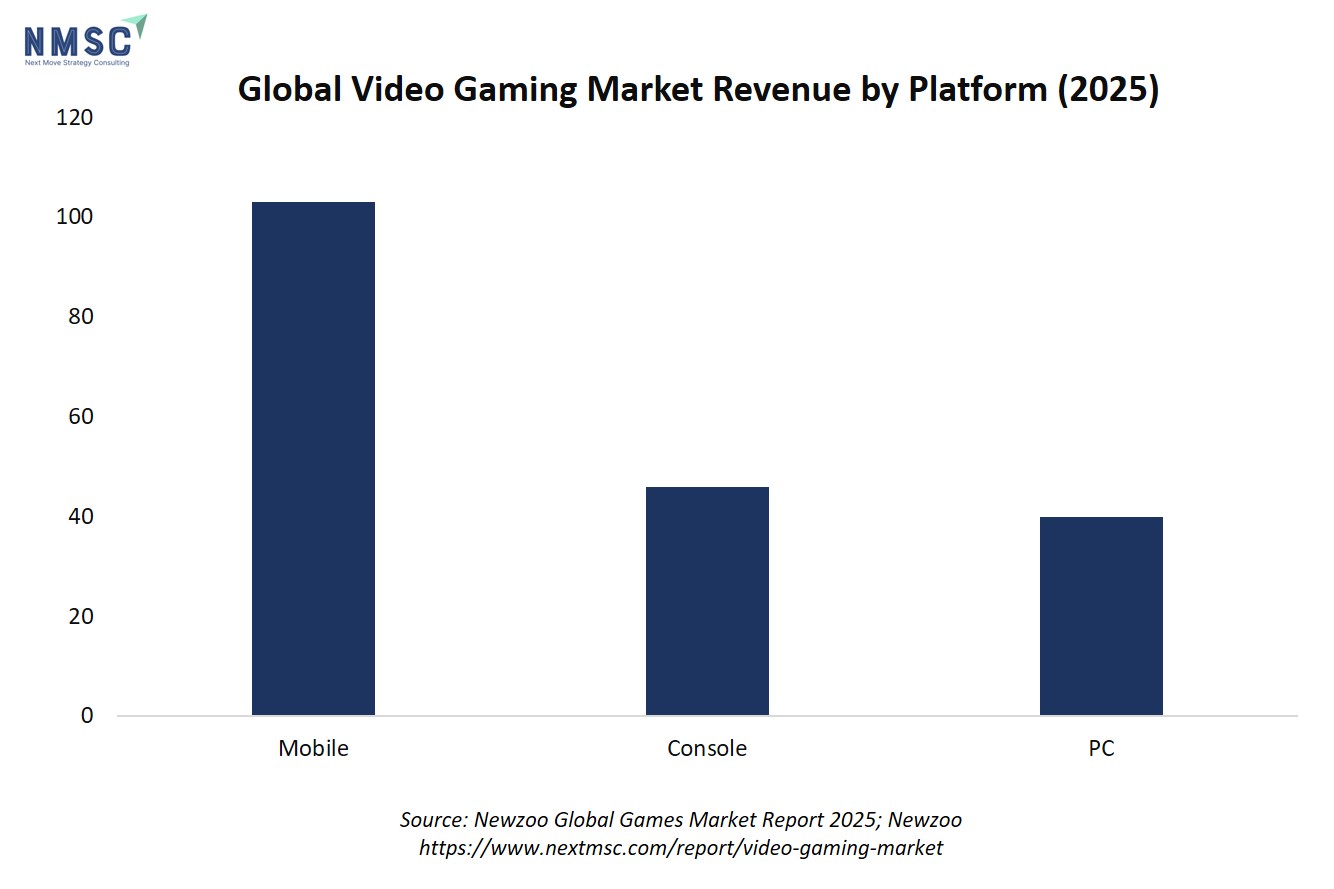
The platform breakdown reveals a market in structural transition. Mobile gaming generated USD 103.0 billion in 2025—representing 55% of total market revenue—driven by the global penetration of affordable smartphones and the dominance of free-to-play monetization models across emerging markets. Console gaming, boosted by the Nintendo Switch 2 launch in June 2025, higher software prices, and a stronger release calendar, generated USD 45.9 billion—a 5.5% year-on-year increase and the fastest-growing platform in 2025. PC gaming contributed USD 39.9 billion, with stable growth driven by momentum in China and Japan.
The NMSC report identifies cloud gaming as the fastest-growing platform segment, projecting a 15.6% CAGR from 2026 to 2035, as infrastructure investment reduces hardware access barriers and enables high-fidelity gaming on lower-cost devices. Boston Consulting Group's Video Gaming Report 2026 corroborates this trajectory, projecting cloud gaming revenues to grow from approximately USD 1.4 billion in 2025 to roughly USD 18.3 billion by 2030—a compound annual growth rate exceeding 50%. BCG's Global Gaming Survey of approximately 3,000 gamers found that 60% of players had tried cloud gaming, with 80% reporting a positive experience.
Regional Dynamics: Asia-Pacific Dominates, Middle East Accelerates
Asia-Pacific remains the dominant regional market, accounting for approximately 46% of global gaming revenues in 2025, anchored by China's large-scale mobile gaming ecosystem led by Tencent Holdings Limited and NetEase, Inc., alongside Japan's established console and role-playing game heritage. In 2025, China and the United States together accounted for approximately half of all global consumer games spending, with China generating USD 49.8 billion and the United States USD 49.6 billion.
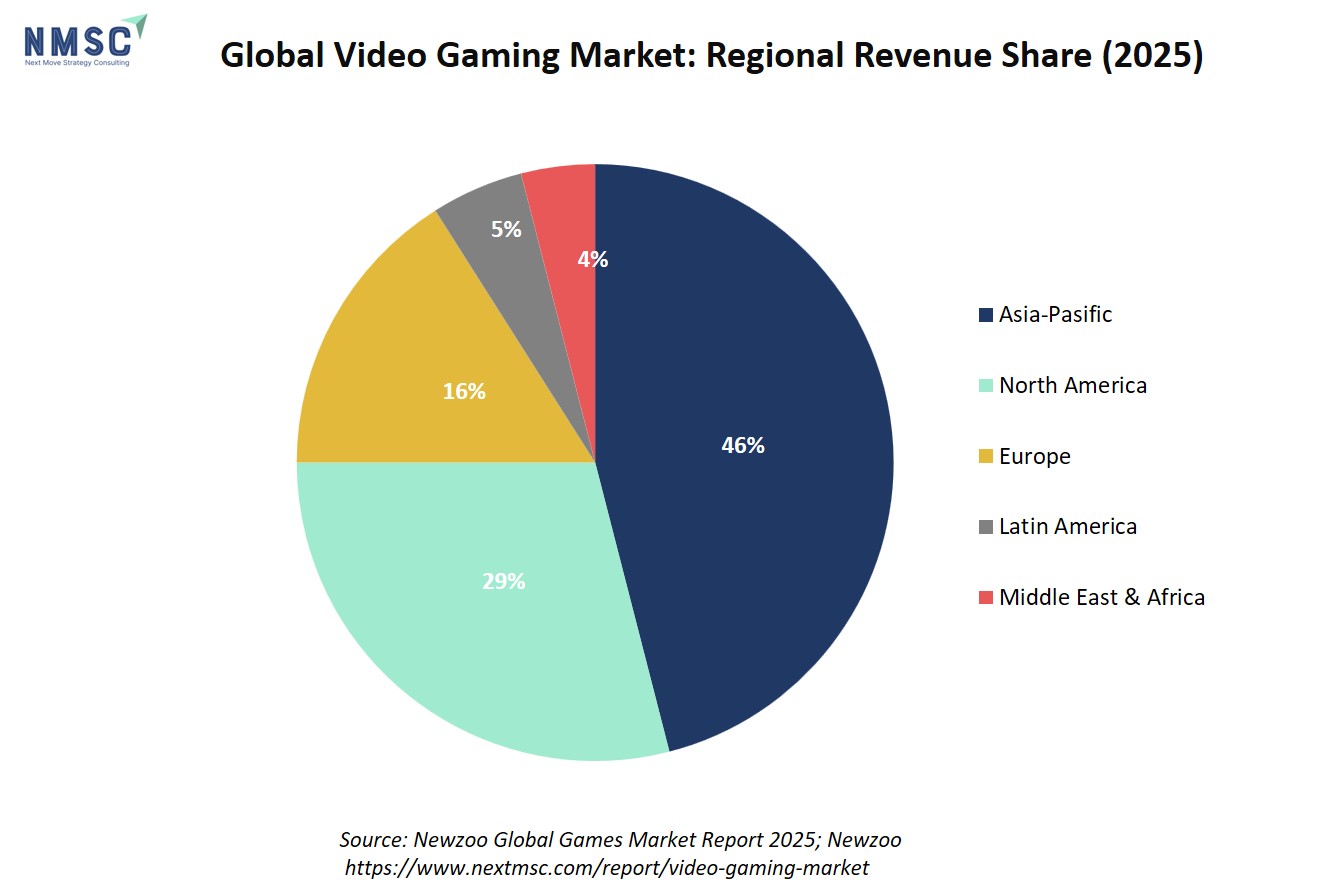
The Middle East and Africa region, while the smallest in absolute revenue terms, is the fastest-growing, with the NMSC report projecting an 8.5% CAGR from 2026 to 2035. Saudi Arabia specifically is forecast to be the fastest-growing individual country market at a 10.4% CAGR—a trajectory directly linked to the PIF's strategic deployment of sovereign capital into gaming publisher ownership, esports infrastructure, and domestic gaming ecosystem development. Latin America is projected to expand at a 9.7% CAGR over the same period, driven by expanding mobile gaming adoption and growing esports viewership in Brazil and Argentina.
Newzoo projects that the global player base will reach 3.9 billion by 2028, up from 3.58 billion in 2025, with mobile accounting for 3.0 billion players and PC surpassing one billion players for the first time.
Technology Transformation: AI, UGC, and the App Store Revolution
Beyond ownership consolidation, the video gaming industry is undergoing a simultaneous technological transformation across four structural dimensions identified by BCG's Video Gaming Report 2026: generative AI adoption, user-generated content expansion, cloud gaming infrastructure scaling, and the regulatory opening of mobile app store distribution.
BCG's analysis of Steam metadata found that approximately 20% of new games on the platform disclosed the use of AI as of mid-2025—double the figure of a year earlier—with an estimated 50% of studios now using AI in some capacity. The user-generated content economy is expanding rapidly: payouts from Roblox and Fortnite alone exceeded USD 1.5 billion in 2025, up from USD 1.275 billion in 2024 (Roblox: USD 923 million; Fortnite: USD 352 million).
The regulatory opening of mobile app stores—driven by the EU's Digital Markets Act and Epic Games' landmark U.S. court victory over Apple—is creating new distribution pathways that could reduce developer platform fees from approximately 30% to as low as 5%, with BCG estimating that mobile in-app purchases in 2025 totaled approximately USD 130 billion, representing nearly half of global industry revenue.
The NMSC report identifies the subscription business model as the fastest-growing monetization category, projecting a 13.0% CAGR from 2026 to 2035, as console and cloud streaming subscription services expand their content libraries and cross-platform reach. Free-to-play remains the dominant model, generating USD 109.50 billion in 2025—representing approximately 58% of total market revenue.
Major M&A and Investment Transactions in the Global Video Gaming Market (2025–Q2 2026)
|
Date |
Company / Transaction |
Type |
Value |
Key Detail |
|
September 29, 2025 |
Electronic Arts Inc. — PIF, Silver Lake, Affinity Partners |
Take-Private Acquisition (Announced) |
USD 55 billion |
Largest all-cash sponsor take-private in corporate history; PIF holds ~93% equity stake |
|
August 3, 2026 |
Electronic Arts Inc. — PIF, Silver Lake, Affinity Partners |
Take-Private Acquisition (Completed) |
USD 55 billion |
EA delisted from Nasdaq; shareholders received USD 67.40/share |
|
Q2 2026 |
Playstack — TPG (via IMC) |
Acquisition |
Undisclosed |
Mid-market studio acquisition; part of broader PE-driven consolidation |
|
Q2 2026 |
Metacore — Supercell |
Acquisition |
Undisclosed |
Mobile game studio consolidation |
|
Q2 2026 |
AppsFlyer |
Private Financing Round |
USD 1.0 billion+ |
Gaming AdTech; largest single financing in Q2 2026 |
|
Q2 2026 |
General Intuition |
Private Financing Round |
USD 320 million |
Gaming AI infrastructure |
|
Q2 2026 |
Decart |
Private Financing Round |
USD 300 million |
AI gaming company |
|
Q2 2026 |
Liftoff Mobile |
IPO |
USD 502 million |
Mobile marketing platform; public market debut |
Competitive Landscape and Segmentation Analysis
The NMSC report identifies 15 key market participants shaping competitive dynamics across the global video gaming market, including Sony Interactive Entertainment LLC, Tencent Holdings Limited, Microsoft Corporation, Nintendo Co., Ltd., NetEase, Inc., Electronic Arts Inc. (now privately held), Epic Games, Inc., Take-Two Interactive Software, Inc., HoYoverse (Cognosphere Pte. Ltd.), Roblox Corporation, Nexon Co., Ltd., Embracer Group AB, Square Enix Holdings Co., Ltd., Bandai Namco Holdings Inc., and Ubisoft Entertainment SA.
Competition is organized around two dominant archetypes: hardware-platform holders that compete on ecosystem control and first-party exclusive titles, and live-service publishers that compete on franchise depth and cross-platform monetization breadth. The EA acquisition introduces a third archetype—sovereign wealth-backed private ownership—that operates with fundamentally different capital structure constraints and time horizons than either public market publishers or traditional private equity.
Embracer Group AB's 2025 structural separation into distinct standalone entities—unwinding a multi-year acquisition strategy that had assembled dozens of studios under a single corporate umbrella—illustrates the opposite end of the consolidation spectrum, reflecting industry recognition that diversified studio conglomerates face challenges coordinating creative direction across unrelated franchises.
By game genre, Action remains the leading category at USD 37.77 billion in 2025, while Adventure is the fastest-growing genre at a 7.1% CAGR through 2035, as narrative-driven titles increasingly incorporate live-service content updates. By age group, Adults aged 20–39 represent the largest segment at approximately 42% of market revenue (USD 79.30 billion in 2025), while Older Adults aged 40 and above represent the fastest-growing demographic at a 10.1% CAGR—a trend corroborated by BCG's survey finding that 40% of baby boom gamers and 50% of Gen X gamers report spending five hours or more per week playing video games.
Regulatory Environment and ESG Considerations
The regulatory landscape governing the video gaming industry is evolving on multiple fronts simultaneously. In October 2025, European Parliament Members of the European Parliament adopted a report urging the European Commission to harmonize loot box rules and consider banning them in games accessible to minors—a development that directly affects the monetization design of free-to-play titles across the EU's 450 million consumer market. The NMSC report identifies regulatory scrutiny of loot box and in-game purchase mechanics as a restraint estimated to reduce the market's CAGR by approximately 0.5 percentage points through 2032.
China's national content approval and playtime requirements for minors continue to shape the operating environment for Tencent Holdings Limited and NetEase, Inc., the two dominant players in the world's largest individual gaming market. Publishers with transparent in-game purchase disclosure practices are better positioned to navigate evolving consumer protection requirements across both European and Asia-Pacific jurisdictions.
The EA acquisition itself has introduced a new dimension of ESG scrutiny, with advocacy groups in the United Kingdom raising concerns about the concentration of gaming data and intellectual property under sovereign ownership. These concerns are expected to inform the development of foreign investment screening frameworks specifically applicable to digital entertainment assets in multiple jurisdictions over the coming legislative cycle.
BCG's analysis notes that approximately 75% of survey respondents indicated that game prices will impact their purchase choices, reflecting broader cost-of-living pressures that are reshaping monetization strategy across the industry. Publishers are responding through tiered pricing strategies, windowing approaches that stagger releases across platforms and price points, and expanded in-game advertising—a revenue stream that BCG identifies as significantly underexplored on larger screens relative to mobile.
Bottom Line
The global video gaming market is entering a structurally transformed era, defined by the convergence of sovereign wealth-backed ownership consolidation, accelerating cloud and AI technology adoption, and a regulatory environment that is simultaneously opening new distribution pathways while tightening monetization constraints. The completion of Electronic Arts' USD 55 billion take-private transaction on August 3, 2026—the largest all-cash sponsor acquisition in corporate history—establishes a new precedent for how institutional and sovereign capital values established gaming intellectual property, with implications that will reverberate across competitive positioning, content strategy, and public market valuations for years to come.
For investors and strategic planners, the market's most compelling opportunities are concentrated in cloud gaming infrastructure (projected CAGR exceeding 50% through 2030 per BCG), subscription platform expansion (13.0% CAGR through 2035 per NMSC), and the Middle East and Africa region (8.5% CAGR), where sovereign capital is actively building both publisher ownership and esports infrastructure. The anticipated November 2026 release of Grand Theft Auto VI represents a near-term catalyst for public market gaming equities. Key risks include regulatory tightening of in-game purchase mechanics across Europe and Asia-Pacific, integration complexity following large-scale ownership transitions, and the potential for AI-generated content saturation to erode discoverability and brand differentiation for premium publishers.
About Next Move Strategy Consulting
Next Move Strategy Consulting is a premier market research and management consulting firm that has been committed to provide strategically analysed well documented latest research reports to its clients. The research industry is flooded with many firms to choose from, what makes NMSC different from the rest is its top-quality research and the obsession of turning data into knowledge by dissecting every bit of it and providing fact-based research recommendation that is supported by information collected from over 500 million websites, paid databases, industry journals and one on one consultations with industry experts across a diverse range of industry sectors. The high-quality customized research reports with actionable insights and excellent end-to-end customer service help our clients to take critical business decisions that enables them to move beyond time and have competitive edge in the industry.
We have been servicing over 1000 customers globally that includes 90% of the Fortune 500 companies over a decade. Our analysts are constantly tracking various high growth markets and identifying hidden opportunities in each sector or the industry. We provide one of the industry's best quality syndicate as well as custom research reports across 10 different industry verticals. We are committed to deliver high quality research solutions in accordance to your business needs. Our industry standard delivery solutions that ranges from the pre consultation to after-sales services, provide an excellent client experience and ensure right strategic decision making for businesses.
For more information, please contact:
Next Move Strategy Consulting
5th Floor 867 Boylston St, STE 500,
Boston, MA 02116, U.S.
E-Mail: [email protected]
Direct: +1-217-650-7991
Website: www.nextmsc.com
About the Author
 Sanyukta Deb
— Sanyukta Deb is Digital Marketing Team Lead at Next Move Strategy Consulting, where she has led content strategy and technical SEO for the firm's B2B market research publications for over 2 years. Her editorial process translates NextMSC's primary and secondary research — spanning technology, industrial, and consumer sectors — into commercial narratives, backed by search-intent, keyword, and competitive analysis. She brings 5 years of overall experience in digital marketing and content strategy.
Sanyukta Deb
— Sanyukta Deb is Digital Marketing Team Lead at Next Move Strategy Consulting, where she has led content strategy and technical SEO for the firm's B2B market research publications for over 2 years. Her editorial process translates NextMSC's primary and secondary research — spanning technology, industrial, and consumer sectors — into commercial narratives, backed by search-intent, keyword, and competitive analysis. She brings 5 years of overall experience in digital marketing and content strategy.
About the Reviewer
 Debashree Dey
— Debashree Dey is Assistant Manager at Next Move Strategy Consulting, where she supports cross-vertical market content and communications across diverse industries for 6 years. Her professional background includes senior content writing, communications, and published manuscript authorship, with experience developing audience-focused business narratives and maintaining clear, consistent messaging. Her role supports research-led content development and editorial quality across NextMSC publications.
Debashree Dey
— Debashree Dey is Assistant Manager at Next Move Strategy Consulting, where she supports cross-vertical market content and communications across diverse industries for 6 years. Her professional background includes senior content writing, communications, and published manuscript authorship, with experience developing audience-focused business narratives and maintaining clear, consistent messaging. Her role supports research-led content development and editorial quality across NextMSC publications.
















Add Comment