AC Charger Market Global Industry Analysis and Forecast (2026–2035)

AC Charger Market size was USD 11.26 Billion in 2025, projected to reach USD 126.88 Billion by 2035, growing at a CAGR of 27.4% from 2026 to 2035. Key drivers include rising electric vehicle ownership, building code requirements for EV readiness, fleet electrification programs, with North America leading the global market.

Download Free Sample PDF
Base Year (2025)
$11.26 Billion
Forecast (2035)
$126.88 Billion
CAGR (2026-2035)
27.4%
Top Region
North America

What Is the AC Charger Market Size?

The global AC Charger Market reached USD 11.26 Billion in 2025 and is estimated at USD 14.35 Billion in 2026, forecast to reach USD 126.88 Billion by 2035 at a CAGR of 27.4% between 2026 and 2035. North America leads with approximately 34% revenue share in 2025, while Single-Phase AC Chargers (up to 7.4 kW) are the dominant charging power rating, holding approximately 56% of total market revenue.

We observed that within the AC charger market, technological shifts are increasingly centered on power electronics, thermal management, and compact housing materials that allow higher reliability in outdoor conditions. Manufacturers are adopting more robust printed circuit boards, corrosion-resistant aluminum and polymer enclosures, and improved residual current protection to meet demanding installation environments. Operational scale is also rising as component suppliers consolidate volumes, which lowers unit costs and supports wider rollout across apartment complexes, office campuses, and municipal car parks.

AC Charger Market Global Industry Analysis and Forecast (2026–2035) Revenue Forecast
Values in USD Billion

2025 $11.26 Billion
2025
2026 $14.35 Billion
2026
2027 $18.28 Billion
2027
2028 $23.29 Billion
2028
2029 $29.67 Billion
2029
2030 $37.80 Billion
2030
2031 $48.16 Billion
2031
2032 $61.36 Billion
2032
2033 $78.17 Billion
2033
2034 $99.59 Billion
2034
2035 $126.88 Billion
2035

Key Takeaways

By Charging Power Rating: Single-Phase AC Chargers (up to 7.4 kW) held the largest share, expanding from USD 6.35 Billion in 2025 to USD 35.56 Billion by 2035; Three-Phase AC Chargers segment is the fastest-growing at 34.69% CAGR from 2026–2035.

By Installation Type: Fixed / Hardwired Installation held the largest share, expanding from USD 6.35 Billion in 2025 to USD 42.35 Billion by 2035; Portable Installation is the fastest-growing at 33.54% CAGR from 2026–2035.

By End User: Residential held the largest share, expanding from USD 5.70 Billion in 2025 to USD 35.62 Billion by 2035; Public Charging Networks is the fastest-growing at 36.35% CAGR from 2026–2035.

By Distribution Channel: Direct Institutional Sales held the largest share, expanding from USD 4.94 Billion in 2025 to USD 36.92 Billion by 2035; E-Commerce / Digital Platforms is the fastest-growing at 34.03% CAGR from 2026–2035.

Dominant Region: North America dominated the market with approximately 34% revenue share (USD 3.83 Billion) in 2025, anchored by mature commercial infrastructure, robust customer demand, and high concentrations of established industry participants.

Fastest-Growing Region: Asia-Pacific is expected to register the highest CAGR of 31.15% during 2026–2035, driven by expanding commercial adoption, rising private investments, and growing domestic consumer and business demand.

Dominant Country: The U.S. led the market with an estimated USD 2.91 Billion in 2025 (~76% of North America), supported by extensive commercial demand, established supplier networks, and strong domestic buyer participation.

Fastest-Growing Country: India is among the fastest-growing major countries, projected to expand from USD 0.61 Billion in 2025 at a CAGR of approximately 32.95%, driven by growing regional adoption, expanding domestic distribution networks, and increasing local market demand.

The AC charger market presents an absolute dollar opportunity of USD 112.53 billion between 2026 and 2035, reflecting the projected increase in annual market revenue from USD 14.35 billion in 2026 to USD 126.88 billion in 2035. Residential retrofits, multifamily housing upgrades, and employer-sponsored charging programs collectively expand the addressable base beyond traditional public networks. Suppliers that secure installation partnerships and streamline permitting support can capture a growing share of this expansion as charging points move into everyday living and working environments.

Competitive positioning in the AC charger market is shaped by partnerships between electrical equipment manufacturers, EV charging specialists, automotive OEMs, and software providers. These collaborations support product integration, distribution reach, and charging management capabilities. Manufacturers with reliable component sourcing, established installation networks, and integrated production capabilities can strengthen their ability to serve expanding residential and commercial demand.

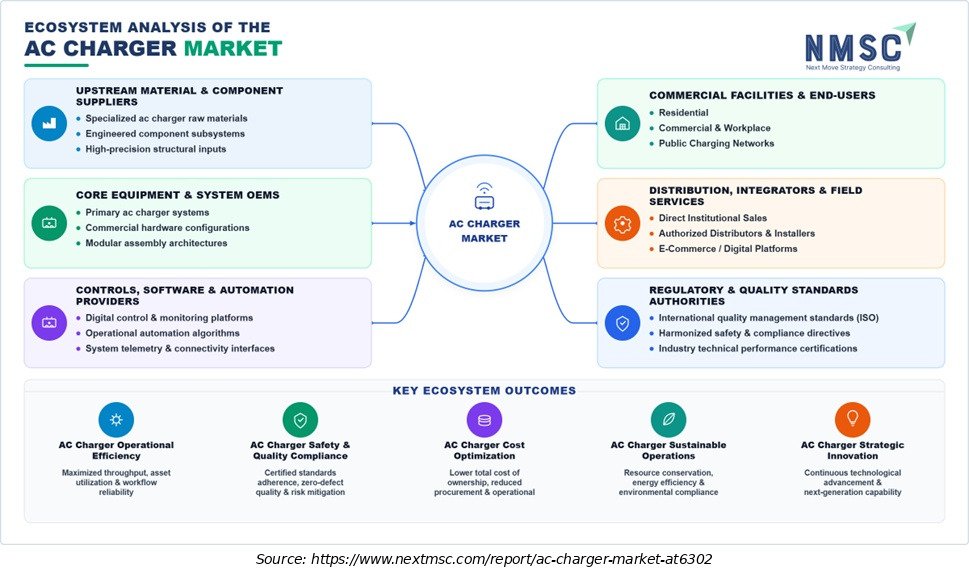
Ecosystem Analysis of the AC Charger Industry

The infographic presents the AC Charger market ecosystem in a structured format, focusing on six core stakeholder groups: upstream material & component suppliers, core equipment & system oems, controls, software & automation providers, commercial facilities & end-users, distribution, integrators & field services, regulatory & quality standards authorities. It shows how these participants support operations while contributing to operational efficiency, safety, cost optimization, sustainability, and technological innovation across diverse operating environments.

What Does the AC Charger Market Encompass?

The AC charger market encompasses wall-mounted and pedestal units that deliver alternating current from the electrical grid to an onboard charger within a vehicle. Product types range from single port residential wallboxes to multi port commercial stations with communication and access control modules. Core technologies include contactors, residual current monitoring, control pilot signaling, and metering components that govern charging speed and safety. These elements together define how power is delivered, measured, and interrupted during each charging session.

Within the AC charger market, design specifications typically address ingress protection ratings, operating temperature ranges, cable length, and connector standards suited to regional vehicle fleets. Material innovations focus on flame retardant polymers, UV stable finishes, and heat dissipating aluminum housings that extend service life in exposed locations. Product design and testing are guided by applicable requirements under the IEC 61851 series, including IEC 61851-1, which specifies operating characteristics, vehicle connection requirements, and electrical safety provisions for EV supply equipment. Manufacturers must also comply with applicable regional electrical approval and conformity-assessment requirements before commercial deployment.

Market Drivers & Dynamics

Interactive Dataset
Rising Electric Vehicle Ownership driver High Immediate
Building Code Requirements for EV Readiness driver High Immediate
Fleet Electrification Programs driver Medium Medium-term
Grid Capacity Constraints restraint High Immediate
Installation Labor Shortages restraint Medium Medium-term
Competition From DC Fast Charging restraint Low Long-term
Source: Next Move Strategy Consulting

Growth Drivers

What Is the Primary Growth Driver in the AC Charger Industry?

The principal catalyst for the AC charger market is the steady conversion of residential and workplace parking into dedicated charging locations. Households and employers prefer alternating current units because they integrate with existing electrical panels and support slow overnight charging at lower installation cost. Our assessment indicates that this everyday charging pattern anchors recurring hardware and installation demand across multiple building categories and vehicle segments.

How Are Industry Standards and Directives Driving the Market?

Within the AC charger market, governing directives on electrical safety and vehicle charging interfaces shape product acceptance for AC chargers in most major markets. IEC 61851 and related connector standards provide technical requirements for EV supply equipment and vehicle interfaces, while applicable regional electrical approvals and conformity-assessment requirements determine product compliance in individual markets. Building regulations requiring EV-ready parking spaces further influence charger procurement.

Growth Inhibitors

What Is Restraining the AC Charger Market?

Within the AC charger market, the most significant commercial restraint is the cost and time required to prepare electrical infrastructure for new charging points. Many existing buildings lack spare panel capacity, forcing owners to commission load studies and service upgrades before installation. Supply chain pressure on power semiconductors and copper conductors can also lengthen delivery schedules, which discourages some buyers from committing to larger multi unit projects.

Segmentation Analysis

2025 (USD Billion)
2035 (USD Billion)
Single-Phase AC Chargers (up to 7.4 kW) 2025: $6.35 Billion | 2035: $8.09 Billion
Single-Phase
Three-Phase AC Chargers (11 kW to 22 kW) 2025: $4.91 Billion | 2035: $6.26 Billion
Three-Phase
Single-Phase AC Chargers (up to 7.4 kW) $6.35 Billion $8.09 Billion USD 35.56 Billion
Three-Phase AC Chargers (11 kW to 22 kW) $4.91 Billion $6.26 Billion USD 91.32 Billion

Which Charging Power Rating Segment Dominates the Market?

The Single-Phase AC Chargers segment dominated the charging power rating category, generating USD 6.35 billion and accounting for approximately 56% of market revenue in 2025. Meanwhile, the Three-Phase AC Chargers segment (11 kW to 22 kW) is projected to grow at the fastest rate, registering a 34.69% CAGR through 2035, supported by increasing demand for higher-capacity charging solutions in commercial applications.

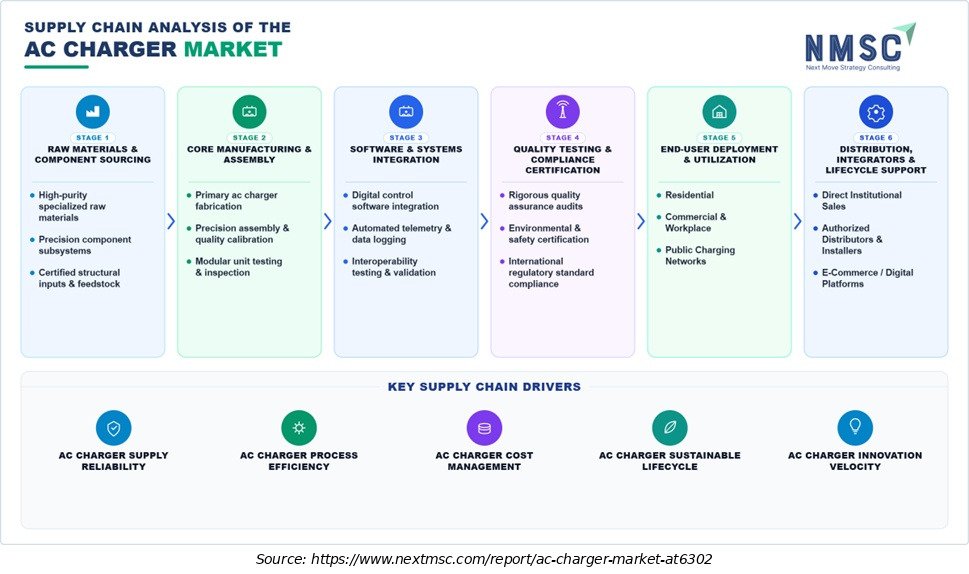
Supply Chain Analysis of the AC Charger Industry

Supply Chain Analysis of the AC Charger Industry
The above infographic maps the AC Charger market supply chain across six sequential stages: stage 1: raw materials & component sourcing, stage 2: core manufacturing & assembly, stage 3: software & systems integration, stage 4: quality testing & compliance certification, stage 5: end-user deployment & utilization, stage 6: distribution, integrators & lifecycle support. It illustrates how these stages connect to ensure component reliability, manufacturing precision, supply stability, cost control, and rapid technological deployment across end-user environments.

Growth Opportunities

Our analysis shows that three structural whitespace opportunities are positioned to generate disproportionate commercial returns in the AC Charger Market through 2035:

Can Multifamily Housing Capture High-Density Deployments?

Apartment complexes and condominium developments represent a concentrated opportunity where dozens of parking spaces can be equipped within a single project. Shared load management systems allow building owners to distribute available capacity among residents without overbuilding service connections. Developers that bundle AC chargers with billing and access platforms can capture recurring service revenue while simplifying installation for property managers.

How Is Mid-Tier and Regional Facility Adoption Unlocking New Market Volume?

Hotels, regional hospitals, universities, and municipal car parks in secondary cities are beginning to install AC charging points to serve visitors and staff. These facilities often lack the dedicated capital budgets of large metropolitan operators, which favors modular units that can be phased in over time. Regional installers with local electrical licensing and responsive field service are well placed to win these projects.

Can Specialized Vertical Implementations Become Distinct Premium Markets?

Specialized applications such as taxi fleets, car sharing depots, and ride hailing hubs demand ruggedized units with extended warranties and rapid replacement commitments. Vendors offering tailored mounting solutions, high-cycle connectors, and preventive maintenance contracts can command premium pricing. Such vertical focus creates differentiated revenue streams distinct from general residential and commercial installations.

Regional Outlook

2025 (USD Billion)
2035 (USD Billion)
North Americ
Europe
Asia-Pacific
Latin Americ
Middle East
Region 2025 (USD Billion) 2035 (USD Billion) CAGR (%)
North America $10.0 USD Billion $40.0 USD Billion 9.0%
Europe $17.1 USD Billion $51.1 USD Billion 27.0%
Asia-Pacific $24.2 USD Billion $62.2 USD Billion 25.0%
Latin America $31.3 USD Billion $73.3 USD Billion 23.0%
Middle East & Africa $38.4 USD Billion $84.4 USD Billion 12.0%

Regional data is locked

Unlock complete regional numbers for this market.

Unlock Full Data

Competitive Landscape

The AC charger market features a mix of established electrical equipment groups and specialized charging manufacturers. ABB Ltd, Schneider Electric SE, Siemens AG, and Eaton Corporation PLC leverage broad electrical distribution portfolios and installation networks. Specialist firms including ChargePoint Holdings, Inc., EVBox B.V., Ohme Technology Ltd, and Webasto SE compete on connected software, user experience, and targeted product categories. This structure rewards companies that combine hardware reliability with cloud-based energy management capabilities.

How Do Companies Compete in the AC Charger Market?

Manufacturers differentiate primarily through connectivity features, load balancing, payment integration, and compliance with metering and security requirements. Pricing strategies vary between premium hardwired systems and cost-optimized single-phase units aimed at residential buyers. Distribution approaches also diverge, with institutional sales teams serving fleet and commercial accounts while digital channels and authorized installers reach homeowners. Successful players align pricing, service coverage, and channel design with the specific deployment environments their products target.

Which Competitive Archetypes Dominate the AC Charger Market?

Market participants fall into three verified archetypes. Diversified electrical equipment groups, including ABB Ltd, Schneider Electric SE, Siemens AG, Eaton Corporation PLC, and Legrand S.A., supply AC chargers alongside broader power distribution portfolios. Dedicated EV charging specialists, including ChargePoint Holdings, Inc., EVBox B.V., Ohme Technology Ltd, and Delta Electronics, Inc., focus primarily on charging hardware and networked services. Automotive supplier participants such as Webasto SE extend their vehicle-adjacent expertise into residential and workplace AC charging solutions.

What Innovation and Differentiation Strategies Are Companies Pursuing?

Sustainable advantage in the AC charger market stems from proprietary firmware, secure metering integration, and dependable field performance across diverse installation sites. Companies with extensive installer networks and multi-year service agreements build switching barriers that protect recurring revenue. Interoperability with energy management platforms and utility programs further strengthens customer retention. Brands that maintain consistent certification compliance and long product lifecycles accumulate trust that newer entrants find difficult to replicate.

What M&A and Partnership Activity Is Shaping the Market?

Strategic partnerships in the AC charger market focus on integrating charging hardware with payment systems, connectivity platforms, and energy management solutions. Such collaborations can improve product interoperability, expand distribution networks, and strengthen service capabilities. Further consolidation may create opportunities for companies seeking complementary software and charging technology capabilities.

Key Market Players

Based on research conducted by NMSC, the following 20 companies represent key participants covered in the AC Charger industry, including equipment manufacturers, EV charging specialists, and solution providers:

ABB Ltd Schneider Electric SE Siemens AG Delta Electronics, Inc. Ohme Technology Ltd ChargePoint Holdings, Inc. EVBox B.V. Webasto SE Eaton Corporation PLC Legrand S.A. Leviton Manufacturing Co., Inc. Hager Group SAS Enel X Way S.r.l. Autel Intelligent Technology Corp., Ltd. BYD Company Ltd Tesla, Inc. Phoenix Contact GmbH & Co. KG Alfen N.V. Easee AS ZD Energy, Inc.

Latest Developments

During our market evaluation, we noticed that recent commercial activities, platform introductions, and partnerships within the industry reflect the latest market developments:

Date Event
November 2026 ZD Energy announced plans to expand annual AC charger production capacity at its Thailand manufacturing facility to 200,000 units. The announcement accompanied the launch of its smart energy solutions and charging robot products in Thailand.
March 2026 STMicroelectronics launched its STM32C5 microcontroller series, which Circontrol identified as an enabling component for the development of cost-efficient next-generation AC chargers for public and private applications.

Investment Opportunities

Where Are Capital Inflows Concentrating in the AC Charger Market?

Capital inflows into the AC charger industry are concentrating in power electronics design, secure connectivity modules, and networked software platforms. Investors favor companies that combine hardware manufacturing with recurring service revenue streams. Funding also supports expansion of production capacity for three-phase units, where growth potential is strongest. Such allocation reflects confidence in long-term demand from residential, workplace, and public charging operators.

How Is Infrastructure Investment Shaping Market Capacity?

Infrastructure investment is reshaping market capacity through expanded assembly lines, automated testing facilities, and regional distribution hubs. Manufacturers are localizing production in key regions to reduce lead times and meet installation schedules for large commercial projects. Automated equipment improves consistency in firmware loading and safety verification. These operational upgrades enable suppliers to scale output while maintaining certification quality across growing AC charger volumes.

What ESG Considerations Are Influencing Market Investment?

Environmental and safety considerations increasingly shape investment decisions across the AC charger ecosystem. Energy efficiency in power conversion, reduced standby consumption, and responsible sourcing of enclosure materials are becoming standard evaluation criteria. Compliance with electrical safety and metering standards also influences procurement among utilities and property owners. Companies demonstrating credible sustainability practices are better positioned to secure long-term institutional contracts.

Key Benefits for Stakeholders

How Does This Report Benefit Industry Leaders and Enterprise Operators?

Operational executives, procurement directors, and commercial operators gain empirical benchmarks for planning AC charger deployments across residential, workplace, and public settings. Segment analysis clarifies where single-phase and three-phase demand is concentrating, supporting more precise inventory and capacity decisions. Forecast visibility helps enterprise buyers structure multi-year procurement programs. Such insight reduces uncertainty when evaluating vendors and installation partners.

How Does This Report Benefit Investors and Financial Analysts?

Investors and financial analysts can benchmark the AC charger industry expansion from USD 11.26 billion in 2025 to USD 126.88 billion by 2035. The forecast framework supports valuation modeling for hardware manufacturers, software platform providers, and installation networks. Regional and segment growth rates allow analysts to identify companies positioned within the fastest-growing categories. Comparative competitive structure assists in assessing margin resilience and consolidation potential.

How Does This Report Benefit Technology Vendors and Solution Platform Teams?

Technology vendors and solution platform teams can use the segmentation findings to prioritize product roadmaps for AC charger development. Demand for three-phase units and portable configurations suggests distinct engineering requirements that merit dedicated investment. Insight into distribution channel dynamics guides decisions on direct sales versus digital commerce strategies. Competitive benchmarking highlights opportunities to differentiate through connectivity, security, and user experience.

Key Market Segments Evaluated

By Charging Power Rating

  • Single-Phase AC Chargers (up to 7.4 kW)
  • Three-Phase AC Chargers (11 kW to 22 kW)

By Installation Type

  • Fixed / Hardwired Installation 
    • Wall-Mounted Units
    • Pedestal-Mounted Units
  • Portable Installation 
    • Cable-Based Portable Units
    • Plug-In Mobile Units

By End User

  • Residential 
    • Single-Family Homes
    • Multi-Dwelling Units
  • Commercial & Workplace 
    • Office Campuses
    • Fleet Depots
  • Public Charging Networks 
    • Municipal Parking
    • Retail & Hospitality Sites

By Distribution Channel

  • Direct Institutional Sales 
    • Utility Programs
    • Fleet Contracts
  • Authorized Distributors & Installers 
    • Electrical Contractors
    • Regional Distributors
  • E-Commerce / Digital Platforms 
    • Brand Online Stores
    • Third-Party Marketplaces

By Region

  • North America 
    • U.S.
    • Canada
    • Mexico.
  • Europe 
    • UK
    • Germany
    • France
    • Italy
    • Rest of Europe.
  • Asia-Pacific 
    • China
    • India
    • Japan
    • South Korea
    • Australia
    • Rest of APAC.
  • Latin America 
    • Brazil
    • Argentina
    • Colombia
    • Rest of Latin America.
  • Middle East & Africa 
    • UAE
    • Saudi Arabia
    • South Africa
    • Rest of MEA.

Conclusion & Recommendations

What Is the Long-Term Outlook for the AC Charger Market?

The long-term outlook for the AC Charger industry is strongly positive, with revenue expanding from USD 14.35 billion in 2026 to USD 126.88 billion by 2035 at a 27.4% CAGR. Growth is underpinned by durable commercial demand expansion, the structural shift toward high-performance specialized solutions, and continuous technological innovation across core operational workflows. Stakeholders that align product development with evolving installation and connectivity requirements are well placed to capture sustained value.

What Strategic Positioning Recommendations Does NMSC Offer?

Market participants should prioritize three-phase AC charger platforms and networked public charging solutions, where growth rates are highest. OEMs should invest in secure metering integration and cost-efficient controller architectures that support both residential and commercial deployments. Distributors should combine authorized installer networks with digital ordering channels to serve diverse buyer groups. Employer-sponsored

How Attractive Is the AC Charger Industry for Investment?

Investment attractiveness is high, supported by the USD 112.53 billion absolute growth opportunity between 2026 and 2035. Recurring service revenue, software-enabled differentiation, and expanding installed bases create favorable margin profiles for well-positioned manufacturers. Demand drivers including residential adoption, fleet electrification, and public network expansion reinforce the investment case. Selective exposure to specialist and diversified electrical groups allows investors to balance growth and stability.

What Are the Key Market Shifts and Risks in the AC Charger Market?

Structural shifts in the AC charger industry include the move toward networked units with integrated payment and load management features. Supply chain exposure to power semiconductors and microcontrollers remains a key operational risk for hardware manufacturers. Installation capacity constraints, particularly for three-phase connections, may slow deployment timelines. Companies that secure component supply and build flexible installation partnerships are better positioned to manage these pressures.

What Are the Primary Growth Pathways Through 2035?

The most attractive growth pathways within the USD 112.53 billion absolute growth opportunity center on three-phase AC chargers and public charging networks. Expansion into destination charging at hospitality and retail sites offers substantial volume potential. Digital commerce channels provide access to the fastest-growing residential and light commercial buyers. Companies combining hardware scale with software-enabled services can capture a disproportionate share of this expansion.

Delivered Customizations

We have successfully delivered the following deep-dive customizations:

Client Request Customization Delivered Value Adds
Historical Market Growth Analysis
  • Historical global and regional AC charger shipments, installed base, and revenue, split by charging power rating tier.
  • Shows which power tiers are driving volume growth and where the market is shifting, supporting product roadmap and capacity planning.
Country-Level Trade Assessment
  • Country-wise import and export analysis of AC charger units under relevant HS codes, mapped to power rating where trade data allows.
  • Identifies sourcing hubs, import dependence, and export opportunities to guide manufacturing location and supply chain decisions.
Power Tier Market Share Analysis
  • Company-level share analysis of AC charger product lines across charging power rating tiers.
  • Reveals competitor strength in each power tier and highlights white-space segments for portfolio and positioning decisions.
Vehicle Onboard Charger Compatibility Mapping
  • Mapping of AC charging power ratings against EV onboard charger limits and the installed EV base by vehicle segment.
  • Shows where oversized or undersized AC units deliver little benefit, guiding rating choices for residential, workplace, and fleet sites.
Grid Connection Suitability by Power Tier
  • Assessment of single-phase versus three-phase supply availability and connection requirements by country, linked to each charging power tier.
  • Pinpoints markets where higher-rated AC chargers are deployable without grid upgrades, supporting geographic expansion and tier-specific targeting.
Regulatory Mandate and Incentive Mapping by Power Tier
  • Mapping of building codes, EV-ready installation mandates, and public incentives by minimum charging power rating across major markets.
  • Shows which power tiers are required or subsidized in each market, enabling compliance-led product positioning and tender targeting.

FAQs

About the Author

Mihul Sharma

Mihul Sharma

Mihul Sharma is Research Associate at Next Move Strategy Consulting, where he has covered technology, industrial, and healthcare markets for 3 years. His work applies structured business research, market analysis, and secondary-source review to assess market trends, competitive developments, and growth opportunities. He supports report development by fully synthesizing industry data, company information, and market signals into concise findings for strategy and investment-focused research teams.

About the Reviewer

Supradip Baul

Supradip Baul

Supradip Baul is an accomplished business consultant and strategist with over a decade of rich experience in market intelligence, strategy, technology, and business transformation. His work has included rigorous qualitative and quantitative analysis across multiple industries, helping clients shape investment decisions and long-term roadmaps. Earlier in his career, he was associated with Gartner, where he contributed to industry-leading reports and market share analyses. He has worked with leading global companies and holds an MBA with a dual specialization in Marketing and Finance.

Download Free Sample

Rishabh Jogani

RISHABH JOGANI

Strategy Analyst

Accenture Japan

We are incredibly impressed with the market report on the real estate market in India provided by Next Move Strategy Consulting. The report was thorough, insightful, and well-structured, offering deep analysis and actionable recommendations. It not only captured the current trends and dynamics but also provided a forward-looking perspective that has been invaluable for our strategic planning. Their team demonstrated exceptional professionalism, attention to detail, and a profound understanding of the industry. The data-driven insights and clarity of presentation exceeded our expectations, making complex market trends easy to understand. We highly recommend Next Move Strategy Consulting to anyone looking for reliable and comprehensive market research services. Their expertise has given us the confidence to navigate the complexities of the Indian real estate market with clarity and foresight.

Melanie Samko

MELANIE SAMKO

Director of Marketing

TOSOH BIOSCIENCE, INC.

The information provided by NMSC is incredibly valuable, thank you so much for such a excellent work. I really appreciate it. I will make sure to reference all of it, in my summary document.

Semih Kavaklioglu

SEMIH KAVAKLIOGLU

Co-Founder & Sales Manager

Decortie

I work a lot in the marketing industry and I know that research is an essential part of any campaign. I have used Market research reports for my own products and I found them to be very informative and well-researched. The team here produces insightful reports for a good price

Kishu Kanda

KISHU KANDA

Strategy Analyst

Accenture

We purchased the AI Consumer Market Report from this company. Not only did they customize the report to meet our specific requirements, but they also showed great flexibility in accommodating our budget. The report we received fully met our expectations. Additionally, they provided prompt and thorough responses to both our pre-purchase and follow-up questions. We look forward to working with this company again in the future.

Gustaf Hummel Burstrom

GUSTAF HUMMEL BURSTROM

Founder

Revline Tools AB

Joseph and the team at Next Move Strategy Consulting have been excellent to work with, in supplying us with relevant market data and forecasts for our specific category. We had some special requirements and they were able to do a custom package to suit our needs. We would definitely recommend them to any other company needing market data and forecasts

Custom Market Research Services

We will customize the research for you if the listed report does not fully match your requirements.

Get 30% Free Customization

Select License

This website uses cookies to ensure you get the best experience on our website. Learn more

✖