Ride Hailing Services Market Global Industry Analysis and Forecast (2026–2035)

The global Ride Hailing Services Market size was valued at USD 62.40 billion in 2025 and is estimated at USD 70.26 billion in 2026, forecast to reach USD 204.44 billion by 2035, expanding at a 12.6% CAGR from 2026 to 2035. Key drivers include rising urbanization and worsening traffic congestion in megacities, accelerating autonomous vehicle deployment, and expanding regulatory frameworks for commercial robo-taxi operations, with Asia-Pacific leading the global market.

Download Free Sample PDF
Base Year (2025)
$62.40 Billion
Forecast (2035)
$204.44 Billion
CAGR (2026-2035)
12.6%
Top Region
Asia-Pacific

What Is the Ride Hailing Services Market Size?

The global ride hailing services market size was valued at USD 62.40 billion in 2025 and is estimated at USD 70.26 billion in 2026, forecast to reach USD 204.44 billion by 2035, expanding at a 12.6% CAGR between 2026 and 2035. Asia-Pacific leads with approximately 34% share, while e-hailing dominates all other service types with approximately 62% share.

We observed that growth is broad-based across every segmentation axis, with robo-taxi commercialization and two-wheeler hailing adoption driving the dominant structural shifts through 2035.

Ride Hailing Services Market Global Industry Analysis and Forecast (2026–2035) Revenue Forecast

Values in USD Billion

2025 $62.40 Billion
2025
2026 $70.26 Billion
2026
2027 $79.12 Billion
2027
2028 $89.08 Billion
2028
2029 $100.31 Billion
2029
2030 $112.95 Billion
2030
2031 $127.18 Billion
2031
2032 $143.20 Billion
2032
2033 $161.25 Billion
2033
2034 $181.56 Billion
2034
2035 $204.44 Billion
2035

Key Takeaways

By Service Type: E-Hailing held the largest share of approximately 62% (USD 38.69 billion) in 2025; Robo-Taxi is the fastest-growing sub-segment at 20.3% CAGR from 2026-2035.

By Vehicle Type: Passenger Cars held the largest share of approximately 58% (USD 36.19 billion) in 2025; Vans, Shuttles and Buses is the fastest-growing sub-segment at 16.8% CAGR from 2026-2035.

By Application: Personal and Individual Use held the largest share of approximately 64% (USD 39.94 billion) in 2025; Intercity Travel is the fastest-growing sub-segment at 14.6% CAGR from 2026-2035.

Dominant Region: Asia-Pacific dominated with approximately 34% revenue share (USD 21.22 billion) in 2025.

Fastest-Growing Region: Middle East and Africa is projected to register the highest CAGR of 15.4% during 2026-2035.

Dominant Country: U.S. led with approximately USD 12.17 billion in 2025.

Fastest-Growing Country: Saudi Arabia is the fastest-growing country at approximately 16.7% CAGR from 2026-2035.

Market Opportunity: The ride hailing services market is projected to create an absolute dollar opportunity of USD 134.18 billion between 2026 and 2035, presenting significant investment potential across autonomous fleet deployment, two-wheeler hailing infrastructure, and corporate mobility procurement channels.

According to NMSC analysis, platforms that combine four-wheeler, two-wheeler, and shuttle-based hailing within a single super-app are capturing disproportionate rider retention, a structural advantage that is reshaping competitive positioning as robo-taxi commercialization accelerates through 2035.

What Does the Ride Hailing Services Market Encompass?

The ride hailing services market encompasses digital platforms that connect passengers with drivers of passenger cars, two-wheelers, three-wheelers, and shuttles through mobile applications for on-demand, point-to-point transportation. We found that the scope spans e-hailing, bike and auto-rickshaw hailing, ride sharing and carpooling, and emerging robo-taxi services supplied to individual riders, corporate travel programs, and airport transfer operators across urban and intercity corridors worldwide. The category has evolved from a niche urban convenience into core transportation infrastructure, driven by rising smartphone penetration, urban traffic congestion, and the gradual commercialization of autonomous vehicle fleets.
Regulatory frameworks established by U.S. state and local transportation authorities for transportation network companies and the European Union's Platform Work Directive shape driver classification and data-transparency requirements, while city-level licensing authorities increasingly influence fleet electrification mandates. We observed that technology adoption is shifting toward AI-based dynamic pricing, driver-partner matching, and autonomous dispatch systems. NMSC's analysis indicates that this structural shift, combined with super-app consolidation across mobility and logistics, is redefining competitive positioning across the market.

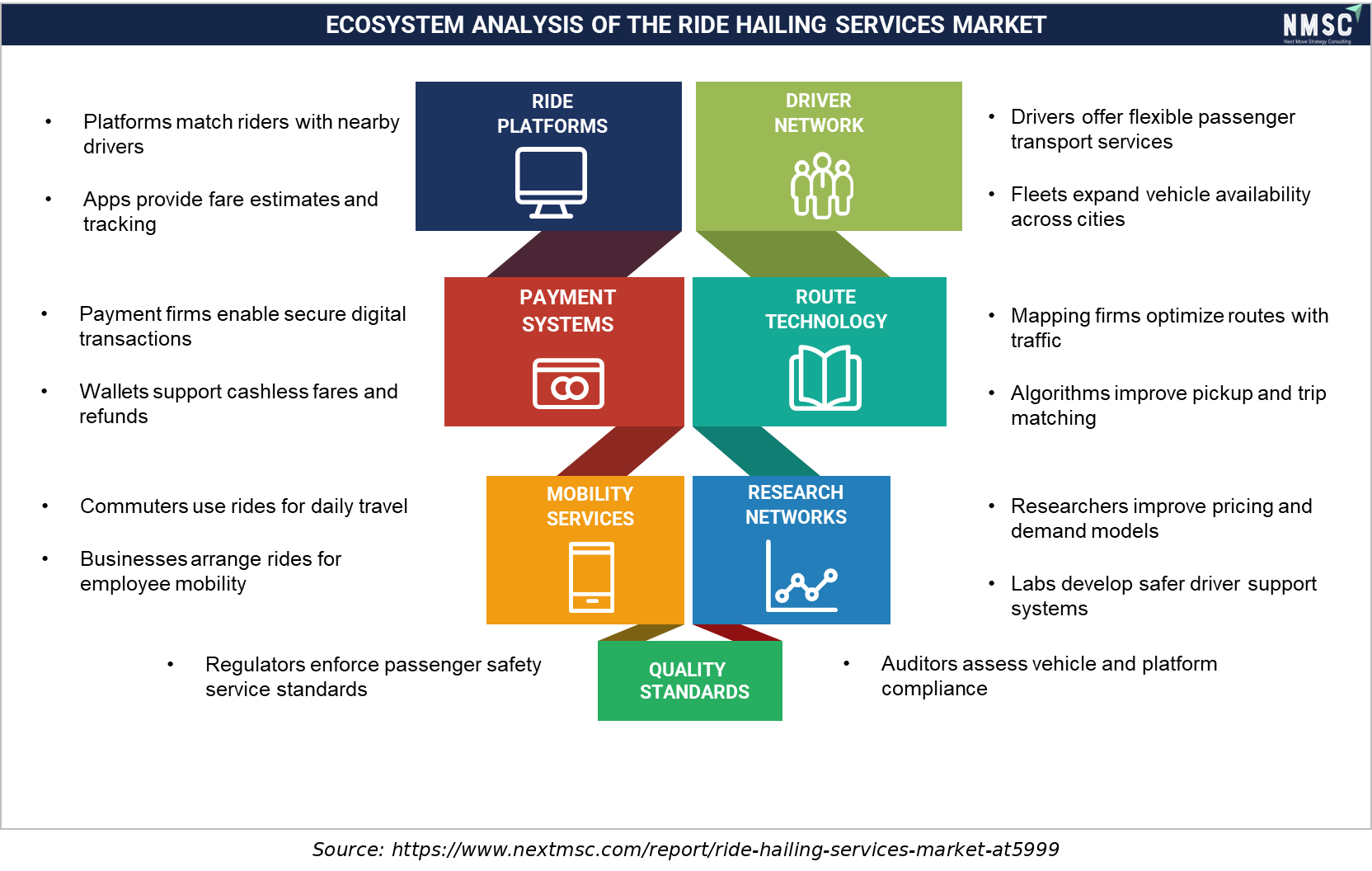
Ecosystem Analysis

Market Drivers & Dynamics

Interactive Dataset
Rising urbanization and traffic congestion in megacities driver +2.4% Global 2026-2035
Smartphone and mobile internet penetration growth driver +2.0% Asia-Pacific, MEA, LATAM 2026-2035
Expansion of autonomous and robo-taxi pilot fleets driver +1.7% North America, China 2026-2032
Growth of two-wheeler and auto-rickshaw hailing in dense Asian cities driver +1.5% Asia-Pacific 2026-2035
Government ride-hailing licensing reforms in emerging markets driver +1.3% MEA, Asia-Pacific 2026-2035
Corporate mobility-as-a-service adoption driver +1.1% North America, Europe 2026-2035
Driver classification and gig-worker labor regulation restraint -1.4% North America, Europe 2026-2035
Rising insurance costs and commission-cap regulation restraint -0.9% Europe, Asia-Pacific 2027-2035
Intense fare-based competition compressing take rates restraint -0.7% Global 2026-2032
Source: Next Move Strategy Consulting

Growth Drivers

What Is the Primary Growth Driver of the Ride Hailing Services Market?

Rising urbanization and worsening traffic congestion in megacities is the primary driver of the market. The United Nations Department of Economic and Social Affairs projects that more than two-thirds of the global population will live in urban areas by 2050, sustaining structural demand for on-demand mobility over private vehicle ownership. We observed that this urbanization trend, reinforced by parking scarcity and rising vehicle-ownership costs, continues to anchor baseline consumption of e-hailing and two-wheeler hailing services across developed and emerging economies alike.

How Is Autonomous Vehicle Deployment Driving Ride Hailing Market Growth?

Autonomous vehicle policy frameworks are accelerating commercial robo-taxi deployment across permitted U.S. metropolitan corridors. The U.S. National Highway Traffic Safety Administration maintains an Automated Vehicle Transparency and Engagement for Safe Testing initiative that tracks on-road autonomous deployments. Our assessment indicates that this regulatory visibility, combined with expanding municipal permitting in Texas, California, and Arizona, is compressing commercialization timelines for autonomous ride-hailing fleets across North America.

Growth Inhibitors

What Is Restraining Ride-Hailing Services Market Expansion?

Tightening driver classification and gig-worker labor regulation restrains margin stability across the market. The California Public Utilities Commission and equivalent European labor authorities continue to evaluate minimum-earnings and benefits requirements for platform-based drivers. We found that compliance costs disproportionately affect smaller regional operators, as limited scale reduces their ability to absorb higher driver-partner compensation compared with larger, diversified mobility platforms.

What Are the Growth Opportunities?

What Opportunity Does Robo-Taxi Licensing Expansion Create for Technology Providers?

Expanding municipal robo-taxi licensing in the United States and China creates opportunity for autonomous-driving technology providers and fleet-orchestration platforms. As permitting broadens beyond pilot corridors, software and sensor suppliers integrated with incumbent ride-hailing platforms stand to capture recurring per-mile licensing revenue from fleet operators scaling autonomous deployments.

How Does Corporate Mobility-as-a-Service Procurement Create Opportunity for Platforms?

Rising corporate adoption of centralized ground-transportation procurement creates opportunity for platforms offering integrated expense, safety, and duty-of-care reporting. Enterprise travel programs favor consolidated vendor relationships, positioning platforms with dedicated business-travel products to capture higher-margin, recurring corporate and business-travel segment revenue over the forecast period.

What Opportunity Does Two-Wheeler Hailing Present in Emerging Asian and African Markets?

Underpenetrated two-wheeler and auto-rickshaw hailing infrastructure across emerging Asian and African cities creates opportunity for platforms and fleet operators targeting first-mile and last-mile commuter segments. Localized fleet-partnership models with lower capital intensity than passenger-car fleets position regional operators to capture underserved, price-sensitive commuter demand across dense, congestion-constrained urban corridors.

Segmentation Analysis

2025 (USD Billion)
2035 (USD Billion)
E-Hailing (Car and Taxi) 2025: $38.69 Billion | 2035: $111.42 Billion
E-Hailing (C
Bike and Auto-Rickshaw Hailing 2025: $9.98 Billion | 2035: $35.78 Billion
Bike and Aut
Ride Sharing and Carpooling 2025: $8.74 Billion | 2035: $25.55 Billion
Ride Sharing
Robo-Taxi (Autonomous Ride-Hailing) 2025: $4.99 Billion | 2035: $31.69 Billion
Robo-Taxi (A
E-Hailing (Car and Taxi) $38.69 Billion $111.42 Billion 11.2%
Bike and Auto-Rickshaw Hailing $9.98 Billion $35.78 Billion 13.6%
Ride Sharing and Carpooling $8.74 Billion $25.55 Billion 11.3%
Robo-Taxi (Autonomous Ride-Hailing) $4.99 Billion $31.69 Billion 20.3%

Which Service Type Segment Dominates the Ride Hailing Services Market?

E-Hailing, encompassing standard car and taxi-hailing formats, led the market with USD 38.69 billion in 2025, supported by near-universal app availability and broad vehicle-fleet compatibility across urban corridors. We observed that Robo-Taxi is the fastest-growing service type, expanding at a 20.3% CAGR from 2026 to 2035, as autonomous fleet permitting broadens across North American and Chinese metropolitan markets and per-trip operating costs decline with scale.

2025 (USD Billion)
2035 (USD Billion)
Passenger Ca
Two-Wheelers
Three-Wheele
Vans
Shuttles and
Segment Item 2025 (USD Billion) 2035 (USD Billion) CAGR
Passenger Cars $10.0 USD Billion $40.0 USD Billion 26.0%
Two-Wheelers $17.1 USD Billion $51.1 USD Billion 16.0%
Three-Wheelers $24.2 USD Billion $62.2 USD Billion 18.0%
Vans $31.3 USD Billion $73.3 USD Billion 8.0%
Shuttles and Buses $38.4 USD Billion $84.4 USD Billion 27.0%

Segment-wise data is locked

Unlock complete segment-wise numbers for By Vehicle Type.

Unlock Full Data

Which Vehicle Type Segment Leads Ride Hailing Market Demand?

Passenger Cars remained the leading vehicle type within the market, valued at USD 36.19 billion in 2025 on sustained standard and premium e-hailing demand across metropolitan and airport-transfer corridors. Our findings suggest that Vans, Shuttles and Buses is the fastest-growing vehicle type, registering a 16.8% CAGR from 2026 to 2035, as corporate mobility programs and pooled airport-shuttle services increasingly specify higher-capacity vehicles to reduce per-passenger trip costs.

2025 (USD Billion)
2035 (USD Billion)
Personal and
Corporate an
Airport Tran
Intercity Tr
Segment Item 2025 (USD Billion) 2035 (USD Billion) CAGR
Personal and Individual Use $10.0 USD Billion $40.0 USD Billion 18.0%
Corporate and Business Travel $17.1 USD Billion $51.1 USD Billion 16.0%
Airport Transfers $24.2 USD Billion $62.2 USD Billion 22.0%
Intercity Travel $31.3 USD Billion $73.3 USD Billion 12.0%

Segment-wise data is locked

Unlock complete segment-wise numbers for By Application.

Unlock Full Data

Which Application Segment Leads Ride Hailing Market Demand?

Personal and Individual Use remained the leading application within the market, valued at USD 39.94 billion in 2025 on sustained daily commuting and discretionary urban travel. Our analysis shows that Intercity Travel is the fastest-growing application, registering a 14.6% CAGR from 2026 to 2035, as platforms extend pooled and premium intercity routes to compete with rail and bus operators across densely connected metropolitan corridors.

2025 (USD Billion)
2035 (USD Billion)
North Americ
Europe
Asia-Pacific
Middle East
Latin Americ
Segment Item 2025 (USD Billion) 2035 (USD Billion) CAGR
North America $10.0 USD Billion $40.0 USD Billion 11.0%
Europe $17.1 USD Billion $51.1 USD Billion 25.0%
Asia-Pacific $24.2 USD Billion $62.2 USD Billion 15.0%
Middle East and Africa $31.3 USD Billion $73.3 USD Billion 25.0%
Latin America $38.4 USD Billion $84.4 USD Billion 10.0%

Segment-wise data is locked

Unlock complete segment-wise numbers for By Region.

Unlock Full Data

Growth Opportunities

We found that three forward-looking opportunities stand out for stakeholders positioning ahead of the market's structural shift toward autonomous and multi-modal mobility.

What Opportunity Does Robo-Taxi Licensing Expansion Create for Technology Providers?

Expanding municipal robo-taxi licensing in the United States and China creates opportunity for autonomous-driving technology providers and fleet-orchestration platforms. As permitting broadens beyond pilot corridors, software and sensor suppliers integrated with incumbent ride-hailing platforms stand to capture recurring per-mile licensing revenue from fleet operators scaling autonomous deployments.

How Does Corporate Mobility-as-a-Service Procurement Create Opportunity for Platforms?

Rising corporate adoption of centralized ground-transportation procurement creates opportunity for platforms offering integrated expense, safety, and duty-of-care reporting. Enterprise travel programs favor consolidated vendor relationships, positioning platforms with dedicated business-travel products to capture higher-margin, recurring corporate and business-travel segment revenue over the forecast period.

What Opportunity Does Two-Wheeler Hailing Present in Emerging Asian and African Markets?

Underpenetrated two-wheeler and auto-rickshaw hailing infrastructure across emerging Asian and African cities creates opportunity for platforms and fleet operators targeting first-mile and last-mile commuter segments. Localized fleet-partnership models with lower capital intensity than passenger-car fleets position regional operators to capture underserved, price-sensitive commuter demand across dense, congestion-constrained urban corridors.

Regional Outlook

2025 (USD Billion)
2035 (USD Billion)
Asia-Pacific
North Americ
Europe
Middle East
Latin Americ
Region 2025 (USD Billion) 2035 (USD Billion) CAGR (%)
Asia-Pacific $10.0 USD Billion $40.0 USD Billion 9.0%
North America $17.1 USD Billion $51.1 USD Billion 27.0%
Europe $24.2 USD Billion $62.2 USD Billion 25.0%
Middle East and Africa $31.3 USD Billion $73.3 USD Billion 23.0%
Latin America $38.4 USD Billion $84.4 USD Billion 12.0%

Regional data is locked

Unlock complete regional numbers for this market.

Unlock Full Data

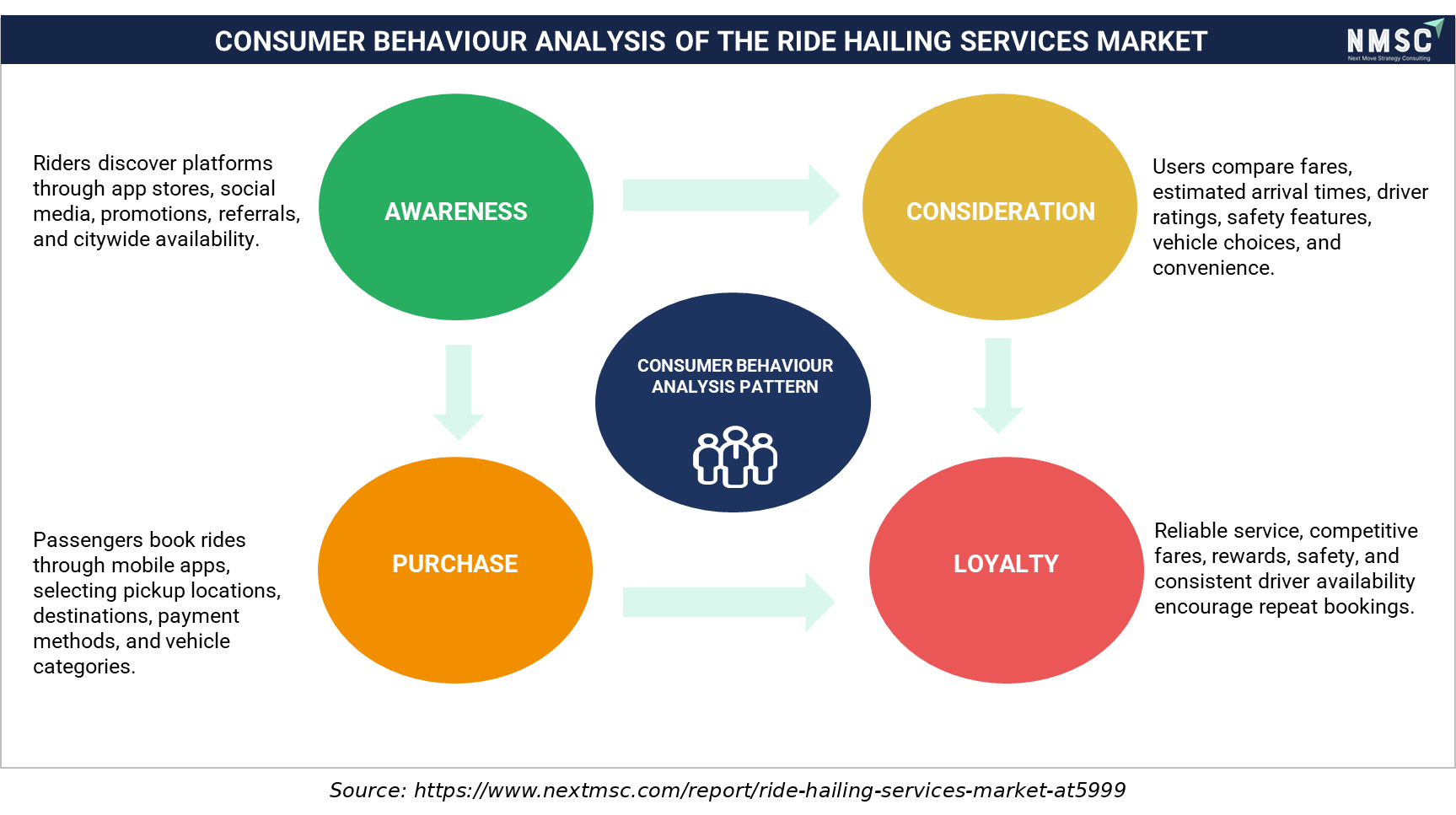
Consumer Behaviour Analysis of the Ride Hailing Services Industry

Consumer Behaviour Analysis of the Ride Hailing Services Industry

Based on our market evaluation, we noticed that consumer decisions across the Ride Hailing Services Industry progress through awareness, consideration, purchase, and loyalty stages. Initially, promotions, referrals, and app stores drive user discovery. Subsequently, passengers evaluate fare estimates, arrival times, and safety ratings before booking rides via mobile applications. Ultimately, reliable service, competitive pricing, rewards, and consistent driver availability encourage repeat bookings across the Ride Hailing Services Industry.

Competitive Landscape

We observed that the ride hailing services market remains moderately consolidated at the global level while individual countries are typically dominated by one or two licensed platforms, reflecting the localized, regulation-intensive nature of transportation network company operations. Key Takeaways

Dimension Description
Market Structure Regionally consolidated with country-level leaders and select global multi-market operators
Innovation Focus Autonomous dispatch, AI-based dynamic pricing, super-app integration
M&A Activity Cross-border taxi-network acquisitions and unresolved regional merger discussions

How Do Companies Compete in the Ride Hailing Services Market?

Companies compete primarily on driver-partner supply density, fare competitiveness, and wait-time reliability within licensed metropolitan corridors. Industry is structured such that scale advantages in one city rarely transfer automatically to adjacent countries, requiring platforms to rebuild driver networks and regulatory relationships market by market, which sustains a larger number of viable regional competitors than in most digital-platform categories.

Which Competitive Archetypes Dominate the Ride Hailing Services Market?

Three competitive archetypes dominate the ride hailing services market: global multi-country operators leveraging cross-border technology platforms, regional super-apps bundling mobility with delivery and financial services, and domestic specialists focused on two-wheeler or taxi-integration niches. We observed that domestic specialists retain durable advantages in markets with restrictive private-hire licensing, where local regulatory relationships outweigh global platform scale.

What Is the Innovation and Differentiation Strategy Across the Market?

Innovation is concentrated in autonomous dispatch integration, AI-based dynamic pricing, and super-app bundling that combines ride-hailing with delivery and financial services within a single application. Our findings suggest that platforms increasingly differentiate through business-travel expense integration and multi-modal routing that blends passenger cars, two-wheelers, and shuttle services, rather than through fare price alone, as commission-cap regulation compresses pure price-based differentiation.

What M&A Activity Is Shaping the Ride Hailing Services Market?

M&A activity is concentrated in cross-border taxi-network acquisitions and unresolved regional consolidation discussions among Southeast Asian super-app operators. We found that Lyft, Inc. completed its acquisition of FREENOW in 2025 to enter established European taxi markets, while PT GoTo Gojek Tokopedia Tbk has publicly disclosed board evaluation of acquisition offers amid recurring merger speculation with a regional competitor, reflecting industry-wide pressure to consolidate driver-incentive spending.

Key Market Players

Our assessment indicates that the following companies represent the leading providers of ride hailing services globally, ranked by verifiable market-specific scale of operations.

Uber Technologies, Inc. DiDi Global Inc. Lyft, Inc. (including FREENOW) Grab Holdings Limited PT GoTo Gojek Tokopedia Tbk ANI Technologies Private Limited (Ola) Bolt Technology OÜ SUOL Innovations Ltd. (inDrive) Cabify (Maxi Mobility Spain, S.L.) Via Transportation, Inc. Roppen Transportation Services Private Limited (Rapido) Curb Mobility, LLC BlaBlaCar SA Kakao Mobility Corp. GO Inc. Be Group Joint Stock Company T3 Chuxing Technology Co., Ltd. Yassir Inc. Addison Lee Group SWVL Holdings Corp.

Latest Developments

We found that recent corporate activity across the ride hailing services market has centered on cross-border acquisitions, autonomous fleet expansion, and unresolved regional consolidation talks.

Date Event
August 2026 Uber and Baidu launched fully driverless Apollo Go autonomous ride-hailing on the Uber platform in Dubai, marking the first realized deployment under their multi-year partnership. The service launched in select areas of Dubai, with New Horizon operating the fleet, and supports broader expansion of autonomous ride-hailing across Uber's global network.
July 2026 Lyft and Curb expanded their strategic partnership into New York City, enabling eligible Lyft riders to be matched with licensed taxis through Curb Flow directly in the Lyft app. The deployment gives Lyft access to Curb’s network of thousands of New York taxis and expands integrated taxi supply
January 2026 Grab partnered with GAC to deploy an initial 20,000 electric vehicles across Southeast Asia. The collaboration covers Singapore, Malaysia, Indonesia, the Philippines, Vietnam and Thailand, while integrating the companies’ systems to enhance the in-vehicle experience for Grab driver-partners.
July 2025 Lyft completed its acquisition of FREENOW, a European multimodal platform centered on taxi services. The transaction expanded Lyft into European markets and combined Lyft’s ride-hailing platform with FREENOW’s established taxi network, customer base and local expertise across multiple European countries

Expert Insights

Dara Khosrowshahi

CEO | Uber

"Autonomous technology has remarkable potential to make transportation safer and more affordable."

Analyst Interpretation

The comment highlights the potential of autonomous technology to reshape the ride-hailing services market through improvements in safety and affordability. As autonomous vehicles become more commercially viable, their potential to reduce operating costs could support more affordable ride-hailing services, while advances in autonomous driving technology could improve the safety and reliability of passenger transportation. This indicates that the adoption of autonomous vehicles is an important potential driver of future market development and could significantly influence the economics and consumer accessibility of ride-hailing services.

Investment Opportunities

What Capital Inflows Are Supporting the Ride Hailing Services Market?

Capital inflows into the market are increasingly directed toward autonomous vehicle technology integration and regional platform consolidation rather than pure driver-incentive subsidies. We observed that public-market operators are reallocating capital expenditure toward software and sensor-integration partnerships, reflecting investor preference for capital-efficient growth over historical subsidy-driven rider acquisition strategies across mature metropolitan markets.

How Is Infrastructure Investment Shaping the Ride Hailing Services Market?

Infrastructure investment is concentrated in dedicated pickup and drop-off zones at airports and transit hubs, alongside charging infrastructure supporting electric-vehicle fleet transitions. Our findings suggest that municipal authorities in North America and Europe are increasingly funding curb-management infrastructure specifically for transportation network companies, reducing congestion externalities while formalizing platform operations within existing urban transportation planning frameworks.

What ESG Considerations Are Relevant to the Ride Hailing Services Market?

Environmental, Social, and Governance considerations center on fleet electrification, driver-partner earnings transparency, and data-privacy governance. We found that the European Union's evolving platform-work and emissions regulations are pushing operators toward electric-vehicle fleet targets and standardized driver-earnings disclosures, while investors increasingly weight labor-relations risk alongside traditional growth metrics when evaluating platform operators.

Key Benefits for Stakeholders

How Does This Report Benefit Industry Leaders?

Industry leaders benefit from this report's segmentation analysis, verified competitive landscape, and country-level forecasts that support fleet-investment prioritization and market-entry sequencing. Our data-backed regional outlook and growth-catalyst matrix provide the strategic evidence needed to align capital allocation with the fastest-growing service types, vehicle formats, and geographies through 2035.

How Does This Report Benefit Investors and Financial Analysts?

Investors and financial analysts benefit from consistent, triangulated market-sizing methodology, verified company profiles, and a growth-catalyst matrix quantifying driver and restraint impact on CAGR. This analytical foundation supports valuation modeling, competitive benchmarking, and risk assessment across a market characterized by fragmented country-level regulation and evolving autonomous-vehicle commercialization timelines.

How Does This Report Benefit Technology Vendors and Product Teams?

Technology vendors and product teams benefit from the report's segmentation by service type and vehicle type, which identifies where autonomous-dispatch, AI-based pricing, and multi-modal routing capabilities create the greatest commercial opportunity. Regional regulatory context further supports prioritization of markets where technology integration can be commercialized fastest under existing licensing frameworks.

Key Market Segments Evaluated

By Service Type

  • E-Hailing (Car and Taxi)
  • Bike and Auto-Rickshaw Hailing
  • Ride Sharing and Carpooling
  • Robo-Taxi (Autonomous Ride-Hailing)

By Vehicle Type

  • Passenger Cars
  • Two-Wheelers
  • Three-Wheelers
  • Vans, Shuttles and Buses

By Application

  • Personal and Individual Use
  • Corporate and Business Travel
  • Airport Transfers
  • Intercity Travel

By Region

  • North America
  • Europe
  • Asia-Pacific
  • Middle East and Africa
  • Latin America

Conclusion & Recommendations

The long-term outlook remains structurally positive, with the market projected to expand from USD 62.40 billion in 2025 to USD 204.44 billion by 2035 at a 12.6% CAGR. We observed that growth will increasingly be driven by autonomous fleet commercialization and two-wheeler hailing penetration rather than pure driver-partner network expansion, reshaping the capital intensity and margin profile of leading platforms through the forecast period.

What Strategic Positioning Should Companies Pursue?

Companies should prioritize localized fleet-partnership models in underpenetrated Asia-Pacific and Middle East and Africa markets while investing selectively in autonomous-technology integration within permitted North American and Chinese corridors. Our assessment indicates that operators balancing regional regulatory relationships with centralized technology platforms will outperform peers pursuing either purely global or purely local strategies.

How Attractive Is the Market for Investment?

The market presents an absolute dollar opportunity of USD 134.18 billion between 2026 and 2035, positioning it among the more attractive digital-platform categories for growth-oriented capital. We found that investment attractiveness is strongest in robo-taxi technology integration and corporate mobility procurement, both of which offer higher-margin revenue relative to traditional consumer e-hailing trips.

What Market Shifts and Key Risks Should Stakeholders Monitor?

Stakeholders should monitor tightening driver-classification regulation in North America and Europe, alongside commission-cap policy in Asia-Pacific markets, both of which restrain near-term margin expansion. Our findings suggest that unresolved regional merger discussions among Southeast Asian super-app operators represent an additional structural risk, given the potential for abrupt competitive realignment across overlapping markets.

What Are the Key Growth Pathways Through 2035?

Key growth pathways include autonomous fleet scaling in permitted metropolitan corridors, two-wheeler and auto-rickshaw hailing expansion across dense Asian and African cities, and corporate mobility-as-a-service procurement in mature Western markets. We observed that platforms combining these three pathways within a single super-app architecture are best positioned to sustain above-market growth through 2035.

FAQs

About the Author

Saista Faiyaz

Saista Faiyaz

Saista Faiyaz is Research Associate at Next Move Strategy Consulting, where she has covered consumer markets and healthcare technologies for 3 years. Her work includes primary interview review, secondary-source validation, market sizing, and structured analysis of company and industry data. She supports research by comparing evidence across sources, organizing findings into market narratives, and documenting assumptions used in analysis. Her scope includes cross-market benchmarking, and reports.

About the Reviewer

Supradip Baul

Supradip Baul

Supradip Baul is an accomplished business consultant and strategist with over a decade of rich experience in market intelligence, strategy, technology, and business transformation. His work has included rigorous qualitative and quantitative analysis across multiple industries, helping clients shape investment decisions and long-term roadmaps. Earlier in his career, he was associated with Gartner, where he contributed to industry-leading reports and market share analyses. He has worked with leading global companies and holds an MBA with a dual specialization in Marketing and Finance.

Download Free Sample

Ross J Mckenzie

ROSS J MCKENZIE

Business Insight Manager

Staysure Group

“Next MSC have been incredibly helpful in providing detailed & robust information on our market, alongside quantifying growth by different segments. The process to procure was simple and easy, with sample reports and regular contact to ensure we had what we needed. Succinct detail on their sources & methodologies is also greatly received, allowing transparency in this respect helps build trust in the detail you pay for. Joseph in particular was fantastic, and helped ensure efficient provision of the insight pack – thank you NMSC!”.

Kishu Kanda

KISHU KANDA

Strategy Analyst

Accenture

We purchased the AI Consumer Market Report from this company. Not only did they customize the report to meet our specific requirements, but they also showed great flexibility in accommodating our budget. The report we received fully met our expectations. Additionally, they provided prompt and thorough responses to both our pre-purchase and follow-up questions. We look forward to working with this company again in the future.

Nishant Awate

NISHANT AWATE

Business Development Global Sales

Zehnder Group Deutschland GmbH

Our experience working with Next Move Strategy Consulting was positive. The team was responsive, professional, and open to incorporating our specific requirements throughout the project. The India AHU market study was comprehensive and well structured, covering market value and volume forecasts, product and application segments, and key industry trends. The inclusion of both AHU and residential MVHR market insights made the study particularly relevant for our strategic market assessment. Overall, the report provides a solid foundation for evaluating market potential, identifying priority segments, and supporting business-development decisions in India.

Rishabh Jogani

RISHABH JOGANI

Strategy Analyst

Accenture Japan

We are incredibly impressed with the market report on the real estate market in India provided by Next Move Strategy Consulting. The report was thorough, insightful, and well-structured, offering deep analysis and actionable recommendations. It not only captured the current trends and dynamics but also provided a forward-looking perspective that has been invaluable for our strategic planning. Their team demonstrated exceptional professionalism, attention to detail, and a profound understanding of the industry. The data-driven insights and clarity of presentation exceeded our expectations, making complex market trends easy to understand. We highly recommend Next Move Strategy Consulting to anyone looking for reliable and comprehensive market research services. Their expertise has given us the confidence to navigate the complexities of the Indian real estate market with clarity and foresight.

Mohit Agarwal

MOHIT AGARWAL

Chief Manager

DryChem India Pvt. Ltd.

Next Move Strategy Consulting is an amazing team of consultants. We required a market study report for our investors on top priority and the team went above and beyond our expectations to deliver the same with ample supporting data within a short time span enabling us to secure the investments and keep our project timeline maintained. Their professionalism, attention to detail, and timely delivery of actionable recommendations have left a lasting impression on our organization.

Custom Market Research Services

We will customize the research for you if the listed report does not fully match your requirements.

Get 30% Free Customization

Select License

This website uses cookies to ensure you get the best experience on our website. Learn more

✖