
Agricultural Biotechnology Market Size, Share, Trends and Growth Analysis, By Product Category (Plant Biotechnology, Animal Biotechnology, and Agricultural Biotechnology Services), By Technology Platform (Genetic Engineering, Gene Editing, RNA Technologies, Molecular Breeding, Synthetic Biology, Microbial Fermentation, and others), By Application, By Revenue Model, By Customer Type, By Sales Channel, and Region — Global Industry Report and Forecast, 2026–2035
Industry: Agriculture | Publishing Date: July 28, 2026 | Last Updated: September 30, 2026 | No of Pages: N/A | No. of Tables: N/A | No. of Figures: N/A | Format: PDF | Report Code: AG5448
What Is the Agricultural Biotechnology Market Size?
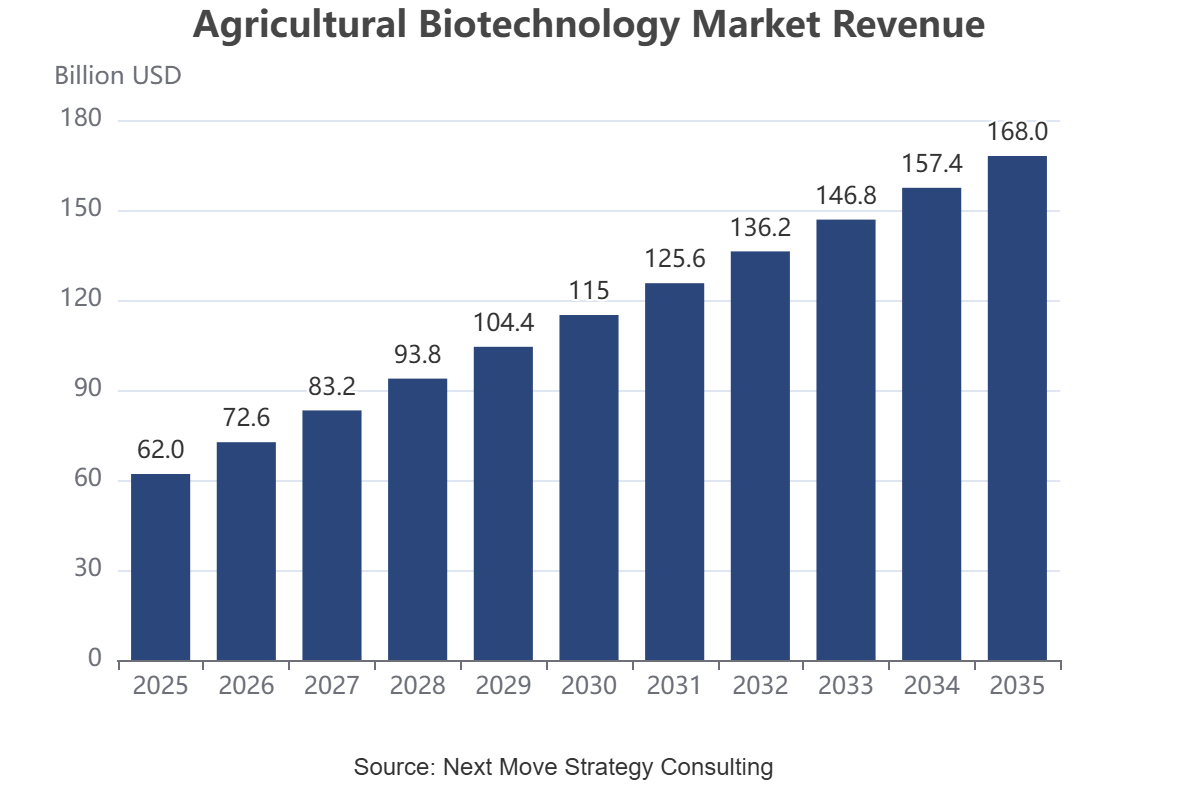
The global agricultural biotechnology market size was valued at USD 62.0 Billion in 2025 and is estimated at USD 67.5 Billion in 2026, forecast to reach USD 168.0 Billion by 2035, expanding at a 10.7% CAGR between 2026 and 2035. North America leads with approximately 34% share, while Plant Biotechnology dominates all other product categories with approximately 60% share.
We observed that growth is broad-based across every segmentation axis, with gene editing platforms and animal biotechnology applications driving the dominant structural shifts through 2035.
|
Key Takeaways |
|
By Product Category: Plant Biotechnology held the largest share of approximately 60% (USD 37.20 Billion) in 2025; Agricultural Biotechnology Services is the fastest-growing sub-segment at 12.6% CAGR from 2026–2035. |
|
By Technology Platform: Genetic Engineering held the largest share of approximately 20% (USD 12.50 Billion) in 2025; Gene Editing is the fastest-growing sub-segment at 18.9% CAGR from 2026–2035. |
|
By Application: Crop Production held the largest share of approximately 64% (USD 39.50 Billion) in 2025; Forestry is the fastest-growing sub-segment at 15.8% CAGR from 2026–2035. |
|
By Revenue Model: Product Sales held the largest share of approximately 45% (USD 27.90 Billion) in 2025; Trait Licensing is the fastest-growing sub-segment at 14.5% CAGR from 2026–2035. |
|
By Customer Type: Commercial Crop Producers held the largest share of approximately 30% (USD 18.60 Billion) in 2025; Contract Research Organizations is the fastest-growing sub-segment at 15.5% CAGR from 2026–2035. |
|
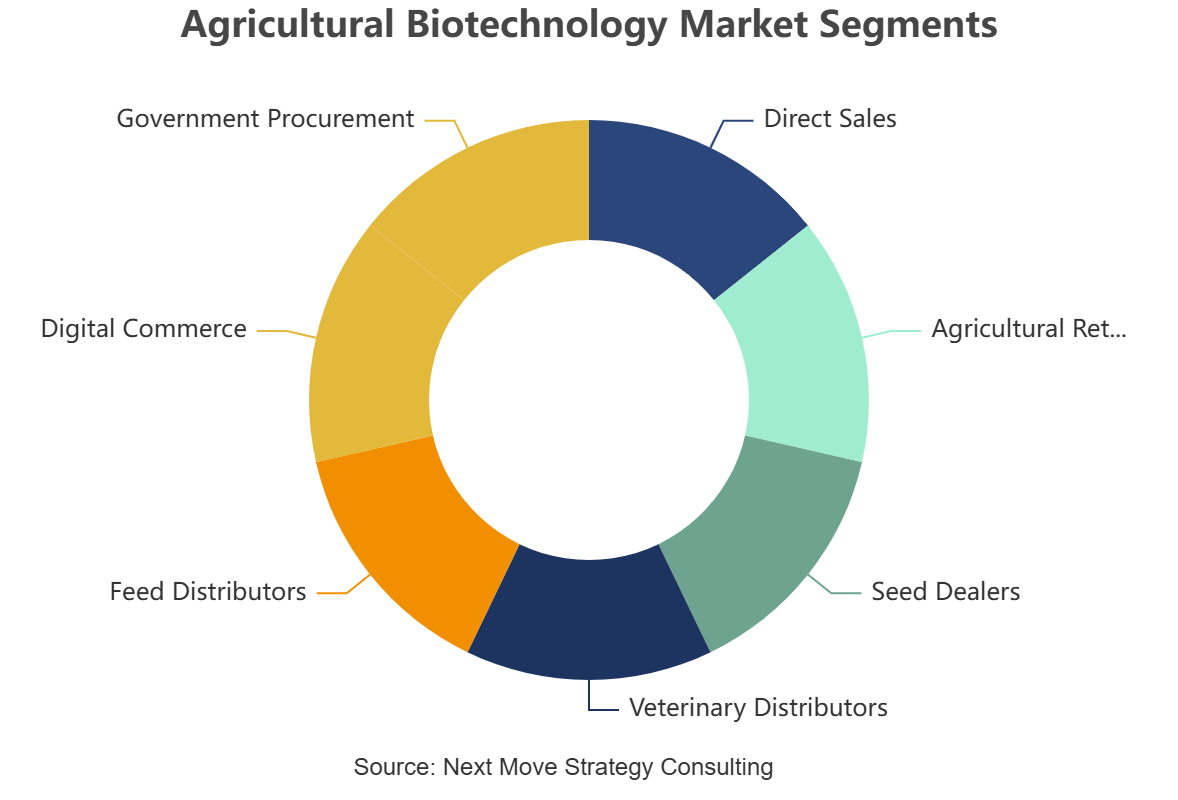
By Sales Channel: Agricultural Retailers held the largest share of approximately 32% (USD 19.80 Billion) in 2025; Digital Commerce is the fastest-growing sub-segment at 16.8% CAGR from 2026–2035. |
|
Dominant Region: North America dominated with approximately 34% revenue share (USD 21.10 Billion) in 2025. |
|
Fastest-Growing Region: Asia-Pacific is expected to register the highest CAGR of 14.0% during 2026–2035. |
|
Dominant Country: U.S. led with approximately USD 16.90 billion in 2025. |
|
Fastest-Growing Country: India is the fastest-growing country at approximately 16.1% CAGR from 2026–2035. |
Market Opportunity: The agricultural biotechnology market is expected to create an absolute dollar opportunity of USD 100.5 billion between 2026 and 2035, presenting significant investment potential across the biotech seed, animal health, and agricultural services value chain.
According to Next Move Strategy Consulting analysis, gene editing platforms that shorten trait-development timelines relative to conventional transgenics are becoming the primary differentiator seed companies and animal-genetics vendors use to defend premium pricing as generic biotech traits face growing competitive pressure.
What Does the Agricultural Biotechnology Market Encompass?
The agricultural biotechnology market encompasses biotech seeds, plant and animal biologicals, feed biotechnology, animal vaccines, genetic testing, and contract research services that apply genetic engineering, gene editing, and molecular breeding to improve crop yield, disease resistance, and livestock productivity. Our assessment indicates that the scope spans transgenic and gene-edited seeds, biofertilizers and biocontrols, recombinant animal vaccines, and trait-discovery and genomics services supplied to seed companies, commercial crop producers, livestock producers, and government agencies worldwide.
Regulatory frameworks such as the U.S. Department of Agriculture's biotechnology regulations administered through APHIS and the European Union's reform of novel genomic technique rules shape how gene-edited products reach commercial approval, while the European Food Safety Authority increasingly governs risk-assessment protocols for biotech traits. We observed that technology adoption is shifting toward CRISPR-based gene editing platforms that reduce development timelines relative to conventional transgenics. Next Move Strategy Consulting's analysis indicates that this structural shift, combined with growing demand for climate-resilient crop traits, is redefining competitive positioning across the Agricultural Biotechnology Market.
|
Field |
Details |
|
Market Size in 2025 |
USD 62.0 Billion |
|
Market Size in 2026 |
USD 67.5 Billion |
|
Revenue Forecast in 2035 |
USD 168.0 Billion |
|
Growth Rate |
CAGR of 10.7% from 2026 to 2035 |
|
Analysis Period |
2025–2035 |
|
Base Year Considered |
2025 |
|
Forecast Period |
2026–2035 |
|
Market Size Estimation |
Revenue (USD Billion) |
|
Companies Profiled |
20 |
|
Countries Covered |
33 |
|
Market Share |
Available for Top 10 Companies |
Key Emerging Trends in the Agricultural Biotechnology Market
Based on research conducted by Next Move Strategy Consulting, we found that four structural trends are reshaping product development, regulatory strategy, and stakeholder engagement across the industry.
How Is Gene Editing Transforming Trait Development Timelines?
CRISPR-based gene editing is compressing trait-development timelines from a decade or more under conventional transgenics to a few years, enabling faster response to emerging pest and climate pressures. We observed that Corteva has expanded its CRISPR-Cas licensing platform to accelerate proprietary trait pipelines. This shift is prompting seed companies to reallocate R&D spending toward gene-edited product lines ahead of transgenic development.
Why Are Biologicals Gaining Ground Alongside Synthetic Inputs?
Plant biologicals such as biofertilizers, biostimulants, and biocontrols are gaining adoption as growers seek to reduce synthetic input dependency while maintaining yield. Bayer's Biologics division has expanded its microbial seed-treatment portfolio across major row crops. This trend is creating new revenue streams for companies historically focused on chemical crop protection alone.
How Is Regulatory Reform Reshaping Gene-Edited Product Approval?
The European Union's ongoing reform of novel genomic technique regulation is easing the historically stringent approval pathway that treated gene-edited crops identically to transgenics. The U.S. Department of Agriculture's biotechnology rule similarly exempts many gene-edited products from full regulatory review when no foreign DNA is introduced. This trend is accelerating commercialization timelines across Europe and North America.
What Role Is Animal Genomics Playing in Livestock Productivity?
Animal genomics and gene-edited genetics are expanding beyond research settings into commercial livestock breeding programs targeting disease resistance and feed efficiency. Genus and other livestock genetics specialists have advanced gene-edited pig lines resistant to porcine reproductive and respiratory syndrome. This trend is deepening adoption among livestock producers seeking measurable productivity gains.
Ecosystem Analysis of the Agricultural Biotechnology Industry

Based on our ecosystem assessment, we identified that agricultural biotechnology companies, research institutes, seed and input suppliers, regulatory authorities, investors, and agribusinesses collectively strengthen the agricultural biotechnology market. Furthermore, our industry analysis indicates that collaboration across research, commercialization, funding, and regulatory ecosystems accelerates biotechnology innovation, enhances product adoption, and supports sustainable agricultural productivity worldwide.
Growth Drivers & Restraints
|
Factors |
Type |
(+/−) % Impact on CAGR |
Geographic Relevance |
Impact Timeline |
|
Rising global food-security demand |
Driver |
+2.8% |
Global |
2026–2035 |
|
Regulatory easing for gene-edited crops |
Driver |
+2.4% |
North America, Europe |
2026–2032 |
|
Expansion of CRISPR trait-development platforms |
Driver |
+3.1% |
North America, Asia-Pacific |
2027–2035 |
|
Growing biological input adoption |
Driver |
+2.0% |
Latin America, North America |
2026–2032 |
|
Climate-resilient trait demand |
Driver |
+2.2% |
Asia-Pacific, Middle East & Africa |
2026–2035 |
|
Public perception and labeling requirements |
Restraint |
−1.6% |
Europe |
2026–2030 |
|
High cost of regulatory field trials |
Restraint |
−1.9% |
Global |
2026–2033 |
|
Intellectual-property and trait-licensing disputes |
Restraint |
−1.3% |
North America, Latin America |
2027–2032 |
What Is the Primary Growth Driver of the Agricultural Biotechnology Market?
Rising global food-security demand is the primary growth driver, as the Food and Agriculture Organization projects global agricultural output must expand substantially to meet demand from a growing population. This outlook is accelerating investment in biotech seeds and biofertilizers and biostimulants that improve yield without proportional increases in arable land, directly benefiting Plant Biotechnology providers.
How Is Gene Editing Driving Agricultural Biotechnology Market Growth?
Gene editing platforms are expanding the addressable market by enabling trait development for crops and livestock that were previously commercially unviable under conventional transgenic timelines. Our analysis shows that USDA APHIS's streamlined review pathway for many gene-edited products is shortening time-to-market by several years relative to historical transgenic approval. This capability is projected to contribute the largest single share of incremental CAGR through 2035.
What Is Restraining Agricultural Biotechnology Market Growth?
Public perception concerns and mandatory labeling requirements restrain growth, particularly across the European Union where the European Food Safety Authority mandates extensive risk assessment before commercial approval. We found that these requirements disproportionately affect smaller biotechnology vendors lacking the regulatory infrastructure of larger diversified agrochemical incumbents.
Segmentation Analysis
Segment Sizing: By Product Category
|
Segment |
2025 (USD) |
2035 (USD) |
CAGR% (2026–2035) |
|
Plant Biotechnology |
USD 37.20 Billion |
USD 96.00 Billion |
11.1% |
|
Animal Biotechnology |
USD 18.60 Billion |
USD 54.00 Billion |
12.6% |
|
Agricultural Biotechnology Services |
USD 6.20 Billion |
USD 18.00 Billion |
12.6% |
|
Total |
USD 62.00 Billion |
USD 168.00 Billion |
— |
Which Product Category Dominates the Agricultural Biotechnology Market?
Plant Biotechnology dominated the product-category segment with USD 37.20 billion in 2025, reflecting entrenched biotech seed adoption across major row crops including corn, soybean, and cotton. We found that Agricultural Biotechnology Services is the fastest-growing sub-segment at a 12.6% CAGR from 2026 to 2035, driven by rising demand for outsourced trait discovery, genomics, and field-trial services among seed companies expanding gene-edited product pipelines.
Segment Sizing: By Technology Platform
|
Segment |
2025 (USD) |
2035 (USD) |
CAGR% (2026–2035) |
|
Genetic Engineering |
USD 12.50 Billion |
USD 24.00 Billion |
7.5% |
|
Gene Editing |
USD 8.00 Billion |
USD 38.00 Billion |
18.9% |
|
RNA Technologies |
USD 5.50 Billion |
USD 19.00 Billion |
14.8% |
|
Molecular Breeding |
USD 9.50 Billion |
USD 21.00 Billion |
9.2% |
|
Synthetic Biology |
USD 6.00 Billion |
USD 20.00 Billion |
14.3% |
|
Microbial Fermentation |
USD 10.00 Billion |
USD 24.00 Billion |
10.2% |
|
Cell and Tissue Culture |
USD 5.50 Billion |
USD 12.50 Billion |
9.6% |
|
Molecular Diagnostics |
USD 5.00 Billion |
USD 9.50 Billion |
7.4% |
|
Total |
USD 62.00 Billion |
USD 168.00 Billion |
— |
Which Technology Platform Leads the Agricultural Biotechnology Market?
Genetic Engineering led the technology-platform segment with USD 12.50 billion in 2025, as transgenic trait insertion remains the most commercially mature platform underlying decades of established biotech seed sales. Our findings suggest that Gene Editing is the fastest-growing platform at an 18.9% CAGR from 2026 to 2035, as CRISPR-based tools shorten development cycles and expand into applications transgenics could not commercially address.
Segment Sizing: By Application
|
Segment |
2025 (USD) |
2035 (USD) |
CAGR% (2026–2035) |
|
Crop Production |
USD 39.50 Billion |
USD 98.00 Billion |
10.6% |
|
Animal Production |
USD 15.00 Billion |
USD 44.00 Billion |
12.7% |
|
Aquaculture |
USD 4.50 Billion |
USD 15.50 Billion |
14.7% |
|
Forestry |
USD 2.00 Billion |
USD 7.50 Billion |
15.8% |
|
Turf and Landscape |
USD 1.00 Billion |
USD 3.00 Billion |
13.0% |
|
Total |
USD 62.00 Billion |
USD 168.00 Billion |
— |
Which Application Generates the Most Revenue in the Agricultural Biotechnology Market?
Crop Production generated the highest application revenue at USD 39.50 billion in 2025, reflecting the scale of global row-crop cultivation dependent on biotech seed and biological inputs. We observed that Forestry is the fastest-growing application at a 15.8% CAGR from 2026 to 2035, as gene-edited disease-resistant tree varieties gain early commercial traction in reforestation and plantation programs.
Growth Opportunities in the Agricultural Biotechnology Market
Next Move Strategy Consulting's analysis identifies three forward-looking whitespace opportunities positioned to shape competitive advantage through 2035.
How Can Gene-Edited Trait Pipelines Unlock New Licensing Revenue?
Companies that scale gene-edited trait pipelines can unlock new technology-licensing revenue among seed companies seeking faster alternatives to conventional transgenic development, directly benefiting Technology Licensing and Trait Licensing revenue models.
Where Does Animal Genomics Create Opportunity for Livestock Producers?
Expanding disease-resistant and feed-efficient gene-edited livestock genetics create opportunity for Animal Genetics vendors, whose products directly benefit livestock producers and feed manufacturers seeking measurable productivity and sustainability gains.
How Can Emerging-Market Food Security Needs Expand Biological Input Adoption?
Food-security priorities across Asia-Pacific and Middle East & Africa create opportunity for biofertilizer and biocontrol vendors to serve commercial crop producers seeking yield gains without proportional land expansion, benefiting Plant Biologicals providers with regional distribution capability.
Regional Outlook
|
Region |
2025 (USD) |
2035 (USD) |
CAGR% (2026–2035) |
Key Driver |
|
North America |
USD 21.10 Billion |
USD 53.80 Billion |
11.0% |
Deep biotech seed and gene-editing adoption |
|
Europe |
USD 10.85 Billion |
USD 25.90 Billion |
10.2% |
Regulatory harmonization under EU novel-genomic-technique reform |
|
Asia-Pacific |
USD 12.40 Billion |
USD 40.30 Billion |
14.0% |
Rising gene-edited crop approvals and animal-genetics adoption |
|
Middle East & Africa |
USD 4.65 Billion |
USD 11.60 Billion |
10.7% |
Food-security-driven biotech seed investment |
|
Latin America |
USD 13.00 Billion |
USD 36.40 Billion |
12.1% |
Large-scale biotech seed and biological input adoption |
|
Total |
USD 62.00 Billion |
USD 168.00 Billion |
— |
— |
North America Agricultural Biotechnology Market
North America's agricultural biotechnology market remains the most mature globally, anchored by decades of biotech seed adoption across corn, soybean, and cotton production. The U.S. Department of Agriculture's streamlined gene-editing review pathway is accelerating commercialization. We observed that regulatory clarity and dense seed-company infrastructure support continued premium trait monetization, with the region's strategic outlook favoring gene-editing platform differentiation over conventional transgenic expansion.
Europe Agricultural Biotechnology Market
Europe's market is shaped decisively by the European Union's ongoing reform of novel genomic technique regulation, which is gradually easing the historically stringent approval pathway for gene-edited crops. Technology adoption is concentrated among plant biologicals and animal vaccine providers navigating European Food Safety Authority risk-assessment requirements. Our assessment indicates the region's strategic outlook favors compliance-first platforms capable of scaling across evolving member-state regulatory regimes.
Asia-Pacific Agricultural Biotechnology Market
Asia-Pacific combines the highest regional growth rate with expanding gene-edited crop approvals and rising animal-genetics adoption across China and India. Regulatory bodies are increasingly establishing dedicated gene-editing approval frameworks distinct from transgenic review. We found that intense competitive intensity among domestic and multinational seed companies is driving rapid trait innovation, positioning the region as a primary engine of incremental market value through 2035.
Middle East & Africa Agricultural Biotechnology Market
The Middle East & Africa market remains earlier-stage but is expanding on the back of food-security-driven biotech seed investment across the Gulf states and Sub-Saharan Africa. Regulatory support from national agricultural ministries is improving technology adoption among commercial crop producers. Our analysis shows the region's strategic outlook favors drought-tolerant biotech seed and biological input models suited to arid growing conditions.
Latin America Agricultural Biotechnology Market
Latin America's market is expanding on large-scale biotech seed and biological input adoption across Brazil and Argentina, among the world's largest adopters of genetically modified row crops. Regulatory modernization of biosafety frameworks is improving approval timelines for new traits. We observed that technology adoption is concentrated in Crop Production applications, with strategic outlook favoring platforms combining trait performance with cost-competitive input pricing.
U.S. Agricultural Biotechnology Market
Based on our estimates, U.S.'s agricultural biotechnology market was valued at approximately USD 16.90 billion in 2025 and is projected to reach USD 41.90 billion by 2035, expanding at a 10.6% CAGR from 2026 to 2035. Demand is anchored by mature biotech seed and gene-editing platforms, with high technology penetration, intense competitive intensity, and a strategic outlook favoring trait-pipeline differentiation under active USDA APHIS oversight.
Canada Agricultural Biotechnology Market
The market in Canada was valued at approximately USD 3.10 billion in 2025 and is projected to reach USD 7.90 billion by 2035, expanding at a 11.0% CAGR from 2026 to 2035. Demand structure mirrors the U.S. market with strong biotech canola and gene-edited crop adoption, moderate competitive intensity, and a strategic outlook shaped by the Canadian Food Inspection Agency's plants-with-novel-traits framework.
UK Agricultural Biotechnology Market
As per our estimate, UK's agricultural biotechnology market was valued at approximately USD 1.85 billion in 2025 and is projected to reach USD 4.30 billion by 2035, expanding at a 9.8% CAGR from 2026 to 2035. Adoption is advancing under the UK's Precision Breeding Act, which eases approval for gene-edited crops outside the EU framework, with growing technology penetration and a strategic outlook favoring domestic gene-editing platform investment.
Germany Agricultural Biotechnology Market
According to our analysis, Germany's agricultural biotechnology market was valued at approximately USD 2.55 billion in 2025 and is projected to reach USD 5.90 billion by 2035, expanding at a 9.8% CAGR from 2026 to 2035. Demand is concentrated among plant biologicals and animal vaccine providers navigating evolving EU novel-genomic-technique rules, with moderate competitive intensity and a strategic outlook favoring partnerships between agrochemical incumbents and biotech specialists.
France Agricultural Biotechnology Market
Based on our estimates, France's agricultural biotechnology market was valued at approximately USD 2.30 billion in 2025 and is projected to reach USD 5.30 billion by 2035, expanding at a 9.7% CAGR from 2026 to 2035. Adoption reflects steady biological-input penetration under evolving EU regulatory reform, with technology adoption accelerating through biocontrol and biostimulant registration and a strategic outlook favoring sustainable-input positioning.
China Agricultural Biotechnology Market
The market in China was valued at approximately USD 4.35 billion in 2025 and is projected to reach USD 16.20 billion by 2035, expanding at a 15.7% CAGR from 2026 to 2035. Demand is driven by expanding gene-edited crop approvals and rising biotech seed adoption in corn and soybean production, with high technology penetration, intense competitive intensity, and a strategic outlook favoring domestic trait-development consolidation.
India Agricultural Biotechnology Market
As per our estimate, India's agricultural biotechnology market was valued at approximately USD 2.55 billion in 2025 and is projected to reach USD 9.80 billion by 2035, expanding at a 16.1% CAGR from 2026 to 2035. Demand structure benefits from government-backed food-security initiatives and expanding gene-edited crop field trials, with rising competitive intensity among domestic seed companies and a strategic outlook favoring drought-tolerant and pest-resistant trait platforms.
Japan Agricultural Biotechnology Market
According to our analysis, Japan's agricultural biotechnology market was valued at approximately USD 1.65 billion in 2025 and is projected to reach USD 3.70 billion by 2035, expanding at a 9.4% CAGR from 2026 to 2035. Adoption is more gradual, reflecting cautious consumer perception and Ministry of Agriculture, Forestry and Fisheries oversight, with moderate technology penetration and a strategic outlook favoring animal biotechnology over crop-trait expansion.
South Korea Agricultural Biotechnology Market
Based on our estimates, South Korea's agricultural biotechnology market was valued at approximately USD 1.05 billion in 2025 and is projected to reach USD 2.80 billion by 2035, expanding at a 11.5% CAGR from 2026 to 2035. Demand is supported by growing animal genomics and feed-biotechnology adoption under Ministry of Agriculture, Food and Rural Affairs guidance, with moderate competitive intensity and a strategic outlook favoring livestock-productivity-focused biotechnology.
Australia Agricultural Biotechnology Market
The market in Australia was valued at approximately USD 1.20 billion in 2025 and is projected to reach USD 3.50 billion by 2035, expanding at a 12.6% CAGR from 2026 to 2035. Adoption is shaped by the Gene Technology Regulator's streamlined framework for certain gene-edited products, with rising technology penetration among grain producers and a strategic outlook favoring drought-tolerant trait development.
UAE Agricultural Biotechnology Market
As per our estimate, UAE's agricultural biotechnology market was valued at approximately USD 0.55 billion in 2025 and is projected to reach USD 1.45 billion by 2035, expanding at a 11.4% CAGR from 2026 to 2035. Demand structure is supported by national food-security strategies promoting controlled-environment and biotech-enabled agriculture, with rising technology penetration and a strategic outlook favoring biological input and precision-agriculture partnerships.
Saudi Arabia Agricultural Biotechnology Market
According to our analysis, Saudi Arabia's agricultural biotechnology market was valued at approximately USD 0.70 billion in 2025 and is projected to reach USD 1.85 billion by 2035, expanding at a 11.4% CAGR from 2026 to 2035. Adoption benefits from Vision 2030-aligned agricultural diversification initiatives administered by the Ministry of Environment, Water and Agriculture, with growing competitive intensity and a strategic outlook favoring drought-tolerant biotech seed platforms.
South Africa Agricultural Biotechnology Market
Based on our estimates, South Africa's agricultural biotechnology market was valued at approximately USD 0.90 billion in 2025 and is projected to reach USD 2.20 billion by 2035, expanding at a 10.4% CAGR from 2026 to 2035. Demand structure reflects established genetically modified maize adoption alongside emerging gene-editing field trials, with moderate technology penetration and a strategic outlook favoring cost-competitive biotech seed models suited to smallholder and commercial producers alike.
Brazil Agricultural Biotechnology Market
The market in Brazil was valued at approximately USD 8.60 billion in 2025 and is projected to reach USD 24.30 billion by 2035, expanding at a 12.2% CAGR from 2026 to 2035. Adoption is among the most advanced globally, with the Ministry of Agriculture and Livestock's biosafety framework supporting rapid new-trait approval, strong competitive intensity among domestic and multinational seed companies, and a strategic outlook favoring soybean and corn trait expansion.
Argentina Agricultural Biotechnology Market
As per our estimate, Argentina's agricultural biotechnology market was valued at approximately USD 3.10 billion in 2025 and is projected to reach USD 8.60 billion by 2035, expanding at a 12.0% CAGR from 2026 to 2035. Demand structure reflects extensive biotech soybean and corn adoption under the National Advisory Commission on Agricultural Biotechnology framework, with moderate technology penetration and a strategic outlook favoring cost-efficient trait licensing models.
Regulatory Framework Impacting the Agricultural Biotechnology Industry

Based on our regulatory assessment, we observed that biotechnology policies, biosafety standards, field testing requirements, quality assurance regulations, and environmental sustainability frameworks collectively shape the agricultural biotechnology industry. Moreover, our industry evaluation indicates that robust regulatory compliance enhances product safety, strengthens stakeholder confidence, and accelerates the commercialization of innovative agricultural biotechnology solutions across global markets.
Competitive Landscape
Next Move Strategy Consulting's analysis indicates that the competitive landscape spans large diversified agrochemical and animal-health corporations, specialist seed companies, and emerging synthetic-biology platforms competing across overlapping trait and service categories.
|
Key Takeaways |
|
Market Structure: Moderately consolidated, with diversified agrochemical incumbents and specialist biotechnology vendors competing for trait leadership. |
|
Innovation Focus: Gene editing platforms, biological input development, and animal genomics. |
|
M&A Activity: Concentrated around large incumbents acquiring gene-editing and synthetic-biology capability. |
How Do Companies Compete in the Agricultural Biotechnology Industry?
Companies compete primarily on trait performance, regulatory-approval speed, and breadth of intellectual-property portfolios, with diversified incumbents leveraging scale distribution against specialist vendors relying on gene-editing platform differentiation. Our analysis shows that geographic expansion and cross-selling into biological inputs increasingly determine long-term competitive positioning across this Industry.
Which Competitive Archetypes Dominate the Market?
Diversified agrochemical incumbents dominate through integrated seed, trait, and crop-protection portfolios, while animal-health specialists differentiate through recombinant vaccine and genomics pipelines. Emerging synthetic-biology and gene-editing specialists compete on faster trait-development cycles, positioning them as acquisition targets for incumbents seeking to accelerate proprietary platform capability.
What Innovation and Differentiation Strategies Are Companies Pursuing?
Companies are pursuing CRISPR-based gene editing, microbial biological inputs, and gene-edited animal genetics as core differentiation strategies. We found that vendors investing early in gene-editing regulatory pathways are commanding faster commercialization timelines relative to competitors still reliant on conventional transgenic development.
What M&A Activity Is Shaping the Competitive Landscape?
M&A activity is concentrated around large agrochemical and animal-health corporations acquiring gene-editing and synthetic-biology startups to accelerate proprietary trait-platform capability, alongside consolidation among mid-tier biological input vendors seeking scale. This pattern is expected to continue as gene-editing capability becomes a defining competitive requirement through 2035.
Key Market Players
Next Move Strategy Consulting's analysis indicates that the following companies represent the leading validated participants shaping competitive dynamics in the agricultural biotechnology market.
-
Bayer AG
-
Corteva, Inc.
-
Syngenta AG
-
Groupe Limagrain
-
KWS SAAT SE & Co. KGaA
-
Zoetis Inc.
-
Boehringer Ingelheim International GmbH
-
Elanco Animal Health Incorporated
-
Merck & Co., Inc.
-
Novonesis A/S
-
Sumitomo Chemical Co., Ltd.
-
UPL Limited
-
Ceva Santé Animale SA
-
Bioceres Crop Solutions Corp.
-
Nufarm Limited
-
Koppert B.V.
-
Lallemand Inc.
-
Pivot Bio, Inc.
-
Ginkgo Bioworks Holdings, Inc.
Latest Developments in the Agricultural Biotechnology Market
|
Date |
Event |
|
May 2026 |
Corteva announced that the independent entity comprising its advanced seed and genetics business following its upcoming corporate split will be officially named Vylor, Inc., anchored by its portfolio of over 2,000 biotechnology patents and leadership in plant gene editing. |
|
April 2026 |
The International Institute of Tropical Agriculture (IITA) and Bayer announced a comprehensive research collaboration agreement through 2028, combining IITA's expertise in tropical crop improvement with Bayer's advanced global breeding and biotechnology technologies to develop climate-resilient, high-yielding crop varieties for smallholder farmers. |
|
March 2026 |
Resurrect Bio and Corteva Agriscience joined forces in a strategic partnership to restore corn's natural disease resistance by leveraging cutting-edge, AI-driven genetic discovery and screening tools. |
Expert Insights
 “Gene editing is one of the most transformative technologies our industry has seen in the past half century. This technology could, with wide adoption, change the very way we farm, and importantly, meaningfully address the world's food security and climate challenges.”
— Chuck Magro, Chief Executive Officer, Corteva
Statement made while discussing the transformative role of gene editing in advancing agricultural innovation, improving crop productivity, and addressing global food security and climate challenges through next-generation biotechnology solutions.
Market Interpretation
The statement highlights gene editing as a pivotal innovation driving the evolution of the agricultural biotechnology market. By enabling the rapid development of crops with improved yield potential, enhanced resistance to pests and diseases, and greater tolerance to climate-related stresses, gene-editing technologies are accelerating agricultural innovation. As regulatory frameworks continue to evolve and investment in biotechnology research increases, the commercialization and adoption of gene-edited crops are expected to expand, supporting sustainable farming practices and strengthening global food security while creating significant growth opportunities for the market.
Investment Opportunities
Where Are Capital Inflows Concentrated in the Market?
Capital inflows remain concentrated in gene-editing and synthetic-biology platform vendors, reflecting investor preference for technology-licensing revenue models with faster commercialization pathways than conventional transgenic development. We observed continued venture and strategic investment activity targeting animal-genomics and biological-input startups.
What Infrastructure Investment Is Required to Scale the Market?
Scaling the Agricultural Biotechnology Market requires sustained investment in field-trial infrastructure, regulatory-compliance capability, and microbial fermentation manufacturing capacity to support biological input production. Vendors offering contract research organization services to seed companies and animal-genetics developers are positioned to capture disproportionate value from this build-out.
How Do ESG Considerations Shape Investment Decisions?
Environmental, Social, and Governance considerations increasingly shape investment decisions through a sustainable-agriculture lens, with investors favoring platforms demonstrably reducing synthetic input dependency through biological alternatives. Governance scrutiny of gene-editing transparency and labeling, particularly under evolving European Union rules, is also becoming a differentiating investment criterion.
Key Benefits for Stakeholders
How Does This Report Benefit Industry Leaders?
Industry leaders gain access to reconciled market-sizing data, segmentation analysis, and competitive benchmarking that inform product roadmap and R&D allocation decisions. Our analysis shows the report's regional and country-level forecasts help executives prioritize market-entry sequencing and regulatory-strategy planning across the agricultural biotechnology landscape.
How Does This Report Benefit Investors and Financial Analysts?
Investors and financial analysts benefit from reconciled 2025–2035 forecasts, CAGR analysis by segment, and a validated competitive-landscape assessment that support investment thesis development. The report's Consolidated Source Table enables analysts to trace every reconciled figure back to a verifiable primary source.
How Does This Report Benefit Technology Vendors and Product Teams?
Technology vendors and product teams gain visibility into emerging trends such as gene-editing platform adoption and biological input growth, alongside growth-opportunity analysis that informs feature and trait prioritization. Our findings suggest this data supports go-to-market strategy for vendors serving Plant Biotechnology, Animal Biotechnology, and Agricultural Biotechnology Services customer segments.
Key Market Segments
By Product Category
-
Plant Biotechnology
-
Biotech Seeds
-
Transgenic Seeds
-
Gene-Edited Seeds
-
-
Plant Biologicals
-
Biofertilizers
-
Biostimulants
-
Biocontrols
-
Nitrogen-Fixing Microbials
-
Soil Microbial Products
-
Silage Inoculants
-
Composting Microbials
-
Other Plant Microbials
-
-
Plant Propagation
-
Tissue Culture Plants
-
Micropropagation Inputs
-
-
Plant Diagnostics
-
Molecular Diagnostics
-
Genetic Testing
-
Laboratory Testing Services
-
-
-
Animal Biotechnology
-
Animal Vaccines
-
Recombinant Vaccines
-
Vector Vaccines
-
DNA Vaccines
-
RNA Vaccines
-
-
Animal Biopharmaceuticals
-
Monoclonal Antibodies
-
Recombinant Proteins
-
Immunomodulators
-
-
Feed Biotechnology
-
Feed Enzymes
-
Direct-Fed Microbials
-
Probiotics
-
Functional Feed Ingredients
-
-
Animal Genetics
-
Genomic Testing
-
Embryo Technologies
-
Artificial Insemination Biotechnology
-
Gene-Edited Genetics
-
-
Animal Diagnostics
-
Molecular Diagnostics
-
Immunodiagnostics
-
Laboratory Testing Services
-
-
-
Agricultural Biotechnology Services
-
Trait Discovery
-
Gene Editing
-
Genomics
-
Bioinformatics
-
Microbiome Analytics
-
Regulatory Studies
-
Field Trials
-
Contract Research
-
By Technology Platform
-
Genetic Engineering
-
Transgenics
-
-
Gene Editing
-
CRISPR
-
TALEN
-
Zinc Finger Nuclease
-
Base Editing
-
Prime Editing
-
-
RNA Technologies
-
RNA Interference
-
RNA Crop Protection
-
-
Molecular Breeding
-
Marker-Assisted Selection
-
Genomic Selection
-
-
Synthetic Biology
-
Microbial Fermentation
-
Cell and Tissue Culture
-
Molecular Diagnostics
By Application
-
Crop Production
-
Cereals
-
Oilseeds
-
Pulses
-
Fiber Crops
-
Sugar Crops
-
Fruits
-
Vegetables
-
Plantation Crops
-
Ornamentals
-
-
Animal Production
-
Cattle
-
Swine
-
Poultry
-
Sheep and Goats
-
Companion Animals
-
-
Aquaculture
-
Forestry
-
Turf and Landscape
By Revenue Model
-
Product Sales
-
Trait Licensing
-
Technology Licensing
-
Research Contracts
-
Diagnostic Testing
-
Subscription Software
-
Royalties
By Customer Type
-
Seed Companies
-
Crop Protection Companies
-
Biological Input Companies
-
Commercial Crop Producers
-
Livestock Producers
-
Feed Manufacturers
-
Aquaculture Producers
-
Government Agencies
-
Academic Institutions
-
Contract Research Organizations
By Sales Channel
-
Direct Sales
-
Agricultural Retailers
-
Seed Dealers
-
Veterinary Distributors
-
Feed Distributors
-
Digital Commerce
-
Government Procurement
By Region
-
North America: U.S., Canada, Mexico
-
Europe: UK, Germany, France, Italy, Spain, Sweden, Denmark, Finland, Netherlands, Rest of Europe
-
Asia-Pacific: China, India, Japan, South Korea, Taiwan, Indonesia, Vietnam, Australia, Philippines, Malaysia, Rest of APAC
-
Middle East & Africa: Saudi Arabia, UAE, Egypt, Israel, Turkey, Nigeria, South Africa, Rest of MEA
-
Latin America: Brazil, Argentina, Chile, Colombia, Rest of LATAM
Conclusion & Recommendations
What Is the Long-Term Outlook for the Agricultural Biotechnology Market?
The long-term outlook remains strongly positive, with the market projected to expand from USD 67.5 billion in 2026 to USD 168.0 billion by 2035 at a 10.7% CAGR. Our assessment indicates that gene-editing capability will increasingly determine which providers capture the largest share of this growth, as faster trait-development cycles become the primary basis for premium licensing revenue.
What Strategic Positioning Should Providers Pursue?
Providers should prioritize gene-editing platform investment and biological-input diversification while pursuing regulatory-compliant approval strategies across major growing regions to secure long-term customer relationships. Our assessment indicates that vendors combining trait licensing with integrated seed distribution will be best positioned to capture premium pricing within the market.
How Attractive Is the Market for New Investment?
The agricultural biotechnology industry presents an attractive investment case, supported by a USD 100.5 billion absolute dollar opportunity between 2026 and 2035 and above-average growth in Asia-Pacific and gene-editing technology categories. We found that investment attractiveness is highest for platforms combining regulatory-approval speed with scaled distribution, positioning them to serve both commercial crop producers and livestock producers simultaneously.
What Market Shifts and Key Risks Should Stakeholders Monitor?
Stakeholders should monitor public perception and labeling requirements, high regulatory field-trial costs, and intellectual-property licensing disputes as key risks to the Agricultural Biotechnology Market. Our analysis shows that vendors unable to differentiate through gene-editing capability risk losing share to diversified incumbents offering integrated trait and crop-protection portfolios.
What Are the Key Growth Pathways for the Market?
Key growth pathways include scaling gene-editing trait pipelines, expanding animal-genomics licensing, and deepening biological input penetration into food-security-driven markets across Asia-Pacific and Middle East & Africa. Next Move Strategy Consulting's analysis indicates that providers pursuing these pathways while maintaining regulatory-compliant development practices will be best positioned to capture the market's projected growth through 2035.
About the Author
 Saista Faiyaz
— Saista Faiyaz is Research Associate at Next Move Strategy Consulting, where she has covered consumer markets and healthcare technologies for 3 years. Her work includes primary interview review, secondary-source validation, market sizing, and structured analysis of company and industry data. She supports research by comparing evidence across sources, organizing findings into market narratives, and documenting assumptions used in analysis. Her scope includes cross-market benchmarking, and reports.
Saista Faiyaz
— Saista Faiyaz is Research Associate at Next Move Strategy Consulting, where she has covered consumer markets and healthcare technologies for 3 years. Her work includes primary interview review, secondary-source validation, market sizing, and structured analysis of company and industry data. She supports research by comparing evidence across sources, organizing findings into market narratives, and documenting assumptions used in analysis. Her scope includes cross-market benchmarking, and reports.
About the Reviewer
 Supradip Baul
— Supradip Baul is an accomplished business consultant and strategist with over a decade of rich experience in market intelligence, strategy, technology, and business transformation. His work has included rigorous qualitative and quantitative analysis across multiple industries, helping clients shape investment decisions and long-term roadmaps. Earlier in his career, he was associated with Gartner, where he contributed to industry-leading reports and market share analyses. He has worked with leading global companies and holds an MBA with a dual specialization in Marketing and Finance.
Supradip Baul
— Supradip Baul is an accomplished business consultant and strategist with over a decade of rich experience in market intelligence, strategy, technology, and business transformation. His work has included rigorous qualitative and quantitative analysis across multiple industries, helping clients shape investment decisions and long-term roadmaps. Earlier in his career, he was associated with Gartner, where he contributed to industry-leading reports and market share analyses. He has worked with leading global companies and holds an MBA with a dual specialization in Marketing and Finance.
At Next Move Strategy Consulting, we understand that insightful market research is the cornerstone of successful business decisions. That's why we employ a robust and multifaceted approach, combining various methodologies to deliver the most accurate and actionable data for our clients.

Research Landscape
We navigate the world of research with two primary approaches:
Qualitative Approach
Our qualitative research methodologies involve immersive techniques such as in-depth interviews, focus groups, and observational studies. By engaging directly with individuals and stakeholders, we uncover valuable insights that quantitative data alone may overlook.

Quantitative Research
In tandem with qualitative methodologies, NMSC leverages the power of Quantitative Research to provide a robust foundation of numerical insights. Through systematic data collection and analysis, we quantify patterns, preferences, and market trends, offering a comprehensive view of the business landscape.
Our quantitative research approach employs diverse tools, including surveys, experiments, and statistical modelling. These methodologies enable us to gather data from a large and representative sample, ensuring the statistical significance of our findings. By employing structured questionnaires and standardized data collection methods, we guarantee the reliability and validity of the information we present to our clients.
Quantitative research is particularly effective in measuring the prevalence of trends, assessing market size, and gauging the impact of various factors on consumer behavior. The numerical precision attained through this approach equips our clients with actionable insights, facilitating data-driven decision-making and strategy formulation.


Our Specialized Toolbox for Industry-Specific Market Research
We deploy a specialized arsenal of techniques tailored to meet your unique requirements. Here's a glimpse into our comprehensive toolbox:

Information Procurement
The stage entails acquiring market data or relevant information through various sources and methodologies.


Market Research Approach
We utilize both top-down and bottom-up approaches in market research analysis to achieve a comprehensive understanding of the market dynamics, leveraging the broad perspective of industry trends and macroeconomic factors alongside detailed insights from specific segments and individual companies.

Porters Five Forces Analysis
We conduct Porter's Five Forces analysis to evaluate the competitive landscape of an industry, providing us with insights into factors that affect profitability and strategic positioning.

SWOT Analysis

Forecasting
We utilize a forecasting model to predict future consumption by considering parameters like population, economics, regulations, market competition, drivers, constraints, technology, and pricing. We also employ statistical techniques such as multilinear regression, exponential smoothing, moving average, ARIMA, and Monte Carlo simulations for accurate predictions. In econometric forecasting, we analyzed short-term and long-term event impacts, attributing values based on regulatory frameworks, economic factors, and market events.





 Speak to Our Analyst