Artificial Intelligence in Military Operations Market Global Industry Analysis and Forecast (2026-2035)

Artificial Intelligence in Military Operations Market size was USD 22.3 billion in 2026, projected to reach USD 104.8 billion by 2035, growing at a CAGR of 18.9% from 2026 to 2035. Key drivers include expanding defense AI procurement and enterprise contract consolidation, rising autonomous systems investment amid geopolitical tensions, and growing space-based defense programs, with North America leading the market.

Download Free Sample PDF
Base Year (2025)
$18.60 Billion
Forecast (2035)
$104.80 Billion
CAGR (2026-2035)
18.9%
Top Region
North America

What Is the Artificial Intelligence in Military Operations Market Size?

The global artificial intelligence in military operations market size was valued at USD 18.6 billion in 2025 and is estimated at USD 22.3 billion in 2026, forecast to reach USD 104.8 billion by 2035, expanding at an 18.9% CAGR between 2026 and 2035. North America leads with approximately 41% share, while intelligence, surveillance and reconnaissance dominate with approximately 27% share of applications.

We observed that growth is broad-based across every segmentation axis, with autonomous systems and space-based platform adoption driving the dominant structural shifts through 2035.

Artificial Intelligence in Military Operations Market Global Industry Analysis and Forecast (2026-2035) Revenue Forecast

Values in USD Billion

2025 $18.60 Billion
2025
2026 $22.12 Billion
2026
2027 $26.30 Billion
2027
2028 $31.27 Billion
2028
2029 $37.17 Billion
2029
2030 $44.20 Billion
2030
2031 $52.55 Billion
2031
2032 $62.49 Billion
2032
2033 $74.30 Billion
2033
2034 $88.34 Billion
2034
2035 $104.80 Billion
2035

Key Takeaways

By Application: Intelligence, Surveillance and Reconnaissance held the largest share of approximately 27% (USD 5.02 billion) in 2025; Autonomous Systems and Robotics is the fastest-growing sub-segment at approximately 23.1% CAGR from 2026–2035.

By Technology: Machine Learning held the largest share of approximately 40% (USD 7.44 billion) in 2025; Autonomous Navigation is the fastest-growing sub-segment at approximately 21.3% CAGR from 2026–2035.

By Platform: Land held the largest share of approximately 34% (USD 6.32 billion) in 2025; Space is the fastest-growing sub-segment at approximately 23.9% CAGR from 2026–2035.

By Deployment: Cloud-Based held the largest share of approximately 50% (USD 9.30 billion) in 2025; Edge is the fastest-growing sub-segment at approximately 25.7% CAGR from 2026–2035.

By End User: Army held the largest share of approximately 30% (USD 5.58 billion) in 2025; Space Force is the fastest-growing sub-segment at approximately 26.6% CAGR from 2026–2035.

Dominant Region: North America dominated with approximately 41% revenue share (USD 7.63 billion) in 2025.

Fastest-Growing Region: Asia-Pacific is expected to register the highest CAGR of approximately 22.9% during 2026–2035.

Dominant Country: U.S. led with approximately USD 7.20 billion in 2025.

Fastest-Growing Country: India is the fastest-growing country at approximately 27.3% CAGR from 2026–2035.

Market Opportunity: The artificial intelligence in military operations market is expected to create an absolute dollar opportunity of USD 82.5 billion between 2026 and 2035, presenting significant investment potential across the autonomous systems and space-based platform value chain.

According to Next Move Strategy Consulting analysis, defense ministries are increasingly consolidating fragmented AI pilot programs into enterprise-wide procurement agreements spanning autonomy, command and control, and intelligence analysis, a shift that favors software-defined defense technology companies with proven government contract track records over single-application specialists as venture-backed defense technology valuations accelerate through 2035.

What Does the Artificial Intelligence in Military Operations Market Encompass?

The artificial intelligence in military operations market encompasses software, platforms, and embedded systems that apply machine learning, computer vision, and autonomous navigation to defense functions spanning intelligence analysis, autonomous systems, command and control, cybersecurity, and logistics. Our assessment indicates that the scope spans land, naval, air, space, and cyber platforms deployed by army, navy, air force, space force, and defense intelligence organizations, reflecting the sector's evolution from experimental pilot programs into large-scale, enterprise-level Cybersecurity and autonomy procurement agreements.
Regulatory developments, including the U.S. Department of Defense's Chief Digital and AI Office procurement initiatives and expanding foreign military sales approvals for autonomous systems, continue to shape platform acquisition and deployment. We observed that technology adoption is shifting toward agentic AI systems capable of autonomous mission planning and edge-based inference in contested, low-connectivity environments rather than relying solely on cloud-connected decision support. Next Move Strategy Consulting's analysis indicates that this structural shift, combined with surging venture and public-market valuations for defense technology companies, is redefining competitive dynamics across the artificial intelligence in military operations market.

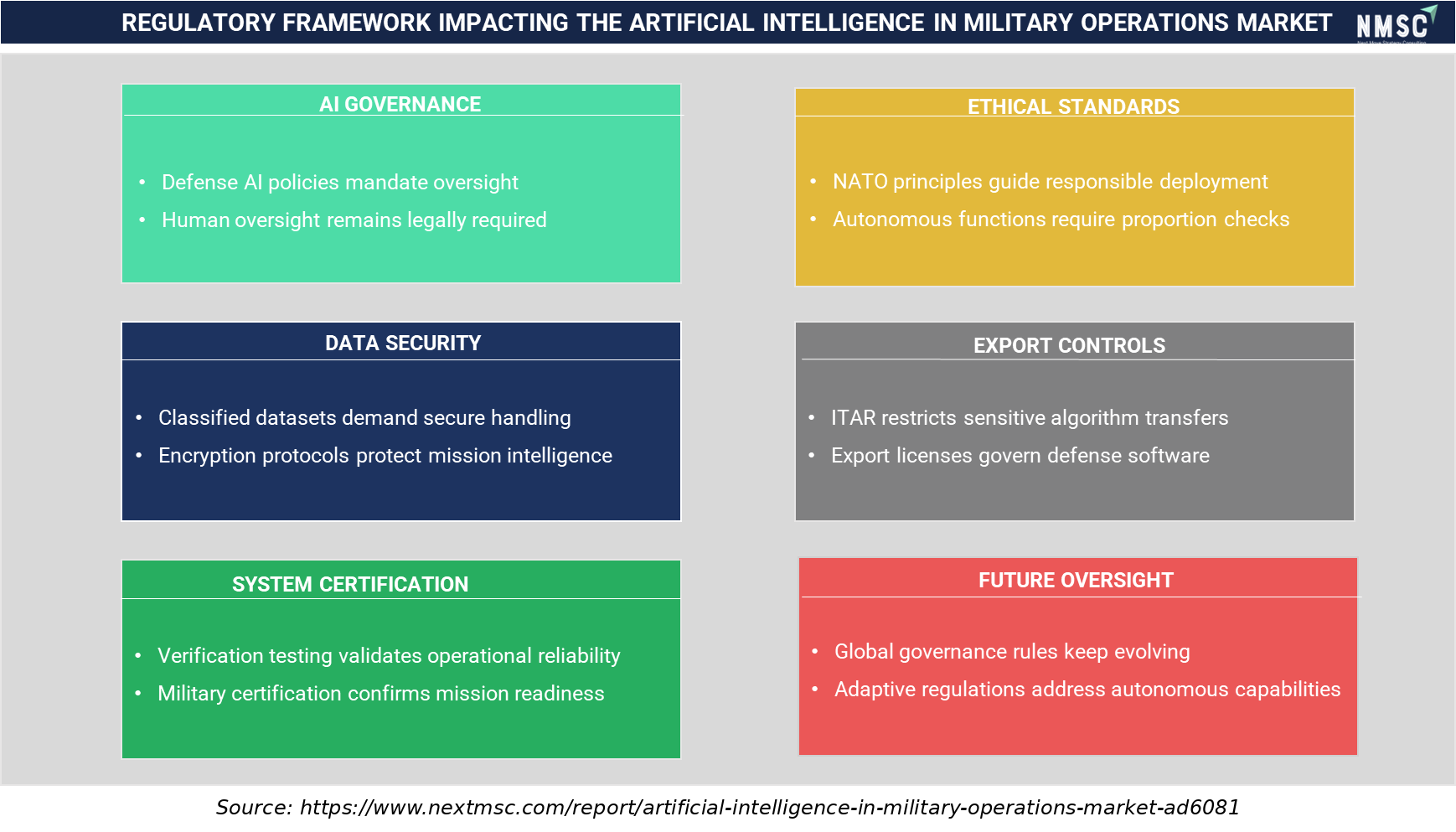
REGULATORY FRAMEWORK IMPACTING THE ARTIFICIAL INTELLIGENCE IN MILITARY OPERATIONS MARKET

This infographic outlines the key regulatory areas shaping the Artificial Intelligence in Military Operations Market. It highlights AI governance and human oversight, ethical standards for responsible and proportionate autonomous functions, stringent data security for classified information, export controls such as ITAR, and system certification requirements. It also emphasizes the evolving nature of global oversight, with adaptive regulatory frameworks expected to address emerging autonomous military capabilities and ensure operational reliability, security, and accountability.

Market Drivers & Dynamics

Interactive Dataset
Expanding defense AI procurement budgets and enterprise contract consolidation driver +3.4% North America 2026–2035
Rising geopolitical tensions accelerating autonomous systems investment driver +2.8% Europe, Asia-Pacific 2026–2035
Growing space-based platform connectivity and satellite defense programs driver +2.1% North America, Asia-Pacific 2026–2035
Expanding venture and public-market capital for defense technology companies driver +1.6% North America, Europe 2026–2032
Growing demand for edge-based inference in contested electronic warfare environments driver +1.2% Global 2026–2035
Expanding defense modernization budgets in Asia-Pacific economies driver +0.9% Asia-Pacific 2026–2035
ITAR and export control constraints limiting cross-border vendor competition restraint −1.4% Global 2026–2035
Long defense procurement cycles slowing technology refresh rates restraint −1.0% Global 2026–2032
Ethical and regulatory scrutiny of autonomous weapons systems restraint −0.7% Europe, North America 2028–2035
Source: Next Move Strategy Consulting

Growth Drivers

What Is the Primary Growth Driver of the Artificial Intelligence in Military Operations Market?

Expanding defense AI procurement budgets and enterprise contract consolidation is the primary driver of the market. The U.S. Army's consolidation of more than 120 prior contracts into a single USD 20 billion enterprise agreement with Anduril Industries, Inc. reflects a structural shift toward large-scale, multi-year AI procurement rather than fragmented pilot programs. We observed that this consolidation trend, reinforced by the Department of Defense's approximately USD 140 billion planned AI spending through 2028, continues to anchor baseline demand for autonomy, intelligence-analysis, and command-and-control software.

How Is Venture Capital Investment Driving Artificial Intelligence in Military Operations Market Growth?

Surging venture and public-market capital for defense technology companies is accelerating market growth beyond traditional defense-contractor procurement cycles. Our assessment indicates that Anduril Industries, Inc.'s USD 61 billion valuation and Palantir Technologies Inc.'s market capitalization exceeding USD 325 billion reflect investor conviction that software-defined defense technology commands durable, enterprise-software-like growth. This capital availability, combined with expanding government contract awards, is compressing commercialization timelines for autonomous systems and intelligence-analysis platforms across major markets.

Growth Inhibitors

What Is Restraining Artificial Intelligence in Military Operations Market Expansion?

International Traffic in Arms Regulations and export control constraints restrain cross-border vendor competition, limiting non-U.S. companies from bidding on classified Department of Defense contracts. Long defense procurement cycles continue to slow the pace at which new AI capability reaches deployed military systems compared with commercial technology refresh rates. We found that smaller allied defense ministries face particular exposure, as ethical and regulatory scrutiny of autonomous weapons systems in Europe adds compliance complexity that can delay procurement timelines.

Segmentation Analysis

2025 (USD Billion)
2035 (USD Billion)
Intelligence, Surveillance and Reconnaissance 2025: $5.02 Billion | 2035: $24.00 Billion
Intelligence
Autonomous Systems and Robotics 2025: $3.35 Billion | 2035: $26.00 Billion
Autonomous S
Command and Control 2025: $3.16 Billion | 2035: $19.00 Billion
Command and
Cybersecurity 2025: $2.42 Billion | 2035: $14.50 Billion
Cybersecurit
Logistics and Predictive Maintenance 2025: $2.05 Billion | 2035: $11.50 Billion
Logistics an
Training and Simulation 2025: $1.49 Billion | 2035: $6.80 Billion
Training and
Other Applications 2025: $1.12 Billion | 2035: $3.00 Billion
Other Applic
Intelligence, Surveillance and Reconnaissance $5.02 Billion $24.00 Billion 18.4%
Autonomous Systems and Robotics $3.35 Billion $26.00 Billion 23.1%
Command and Control $3.16 Billion $19.00 Billion 19.9%
Cybersecurity $2.42 Billion $14.50 Billion 19.9%
Logistics and Predictive Maintenance $2.05 Billion $11.50 Billion 19.3%
Training and Simulation $1.49 Billion $6.80 Billion 17.8%
Other Applications $1.12 Billion $3.00 Billion 11.9%

Which Application Dominates the Artificial Intelligence in Military Operations Market?

Intelligence, Surveillance and Reconnaissance led the market with USD 5.02 billion in 2025, supported by AI-powered data fusion platforms including Palantir Technologies Inc.'s Gotham and Foundry software that process large-scale multi-domain intelligence data. We observed that Autonomous Systems and Robotics is the fastest-growing application, expanding at a 23.1% CAGR from 2026 to 2035, as unmanned aerial and ground platforms scale rapidly across land, naval, and air combat programs.

2025 (USD Billion)
2035 (USD Billion)
Machine Lear
Computer Vis
Natural Lang
Autonomous N
Other Techno
Segment Item 2025 (USD Billion) 2035 (USD Billion) CAGR
Machine Learning $10.0 USD Billion $40.0 USD Billion 25.0%
Computer Vision $17.1 USD Billion $51.1 USD Billion 11.0%
Natural Language Processing $24.2 USD Billion $62.2 USD Billion 25.0%
Autonomous Navigation $31.3 USD Billion $73.3 USD Billion 11.0%
Other Technologies $38.4 USD Billion $84.4 USD Billion 16.0%

Segment-wise data is locked

Unlock complete segment-wise numbers for By Technology.

Unlock Full Data
2025 (USD Billion)
2035 (USD Billion)
Land
Naval
Air
Space
Cyber
Segment Item 2025 (USD Billion) 2035 (USD Billion) CAGR
Land $10.0 USD Billion $40.0 USD Billion 27.0%
Naval $17.1 USD Billion $51.1 USD Billion 9.0%
Air $24.2 USD Billion $62.2 USD Billion 19.0%
Space $31.3 USD Billion $73.3 USD Billion 17.0%
Cyber $38.4 USD Billion $84.4 USD Billion 18.0%

Segment-wise data is locked

Unlock complete segment-wise numbers for By Platform.

Unlock Full Data

Which Platform Leads the Artificial Intelligence in Military Operations Market?

Land remained the dominant platform, reaching USD 6.32 billion in 2025 given the scale of ground sensor networks, armored vehicle autonomy, and soldier-system AI deployed across established army modernization programs. Our findings suggest that Space is the fastest-growing platform at a 23.9% CAGR from 2026 to 2035, as protected satellite communication and space sensor network programs extend AI-enabled defense infrastructure into orbital environments.

2025 (USD Billion)
2035 (USD Billion)
Cloud-Based
On-Premises
Edge
Segment Item 2025 (USD Billion) 2035 (USD Billion) CAGR
Cloud-Based $10.0 USD Billion $40.0 USD Billion 14.0%
On-Premises $17.1 USD Billion $51.1 USD Billion 24.0%
Edge $24.2 USD Billion $62.2 USD Billion 22.0%

Segment-wise data is locked

Unlock complete segment-wise numbers for By Deployment.

Unlock Full Data
2025 (USD Billion)
2035 (USD Billion)
Army
Navy
Air Force
Space Force
Defense Inte
Segment Item 2025 (USD Billion) 2035 (USD Billion) CAGR
Army $10.0 USD Billion $40.0 USD Billion 24.0%
Navy $17.1 USD Billion $51.1 USD Billion 22.0%
Air Force $24.2 USD Billion $62.2 USD Billion 20.0%
Space Force $31.3 USD Billion $73.3 USD Billion 22.0%
Defense Intelligence Agencies $38.4 USD Billion $84.4 USD Billion 13.0%

Segment-wise data is locked

Unlock complete segment-wise numbers for By End User.

Unlock Full Data

Which End User Leads Artificial Intelligence in Military Operations Market Demand?

Army remained the leading end user, valued at USD 5.58 billion in 2025 as the largest branch by personnel and equipment continues to drive the broadest AI procurement volume, exemplified by the U.S. Army's enterprise-scale agreement with Anduril Industries, Inc. Based on research conducted by Next Move Strategy Consulting, we found that Space Force is the fastest-growing end user, registering a 26.6% CAGR from 2026 to 2035, as protected satellite and missile-defense programs scale rapidly from a comparatively small base.

Growth Opportunities

Our analysis shows that three forward-looking opportunities stand out for stakeholders positioning within the artificial intelligence in military operations market over the 2026–2035 forecast period.

How Can Hardware-Agnostic Autonomy Software Unlock Value Across Competing Platforms?

Hardware-agnostic autonomy software presents a whitespace opportunity for vendors seeking contracts across multiple, competing hardware platforms rather than being tied to a single manufacturer. Suppliers that commercialize portable autonomy software, following the model of Shield AI, Inc.'s Hivemind deployment on a competitor's airframe, stand to capture broader contract share across the Autonomous Systems and Robotics segment.

Where Does Space-Based Defense Infrastructure Create New Demand?

Space-based missile defense and satellite communication programs represent an underpenetrated opportunity for vendors offering AI-enabled space domain awareness and orbital sensor fusion. Vendors that secure early qualification on space defense programs can capture recurring platform revenue as space-based missile-defense initiatives expand across the Space platform and Space Force end user segments.

How Can Enterprise Contract Consolidation Benefit Established Defense AI Vendors?

Enterprise-scale contract consolidation, exemplified by the U.S. Army's USD 20 billion Project Linchpin agreement, creates an opportunity for vendors with proven government relationships to capture disproportionate long-term contract value. Vendors that demonstrate credible enterprise-scale delivery capability can differentiate with defense buyers seeking to reduce contract vehicle fragmentation across the Command and Control segment.

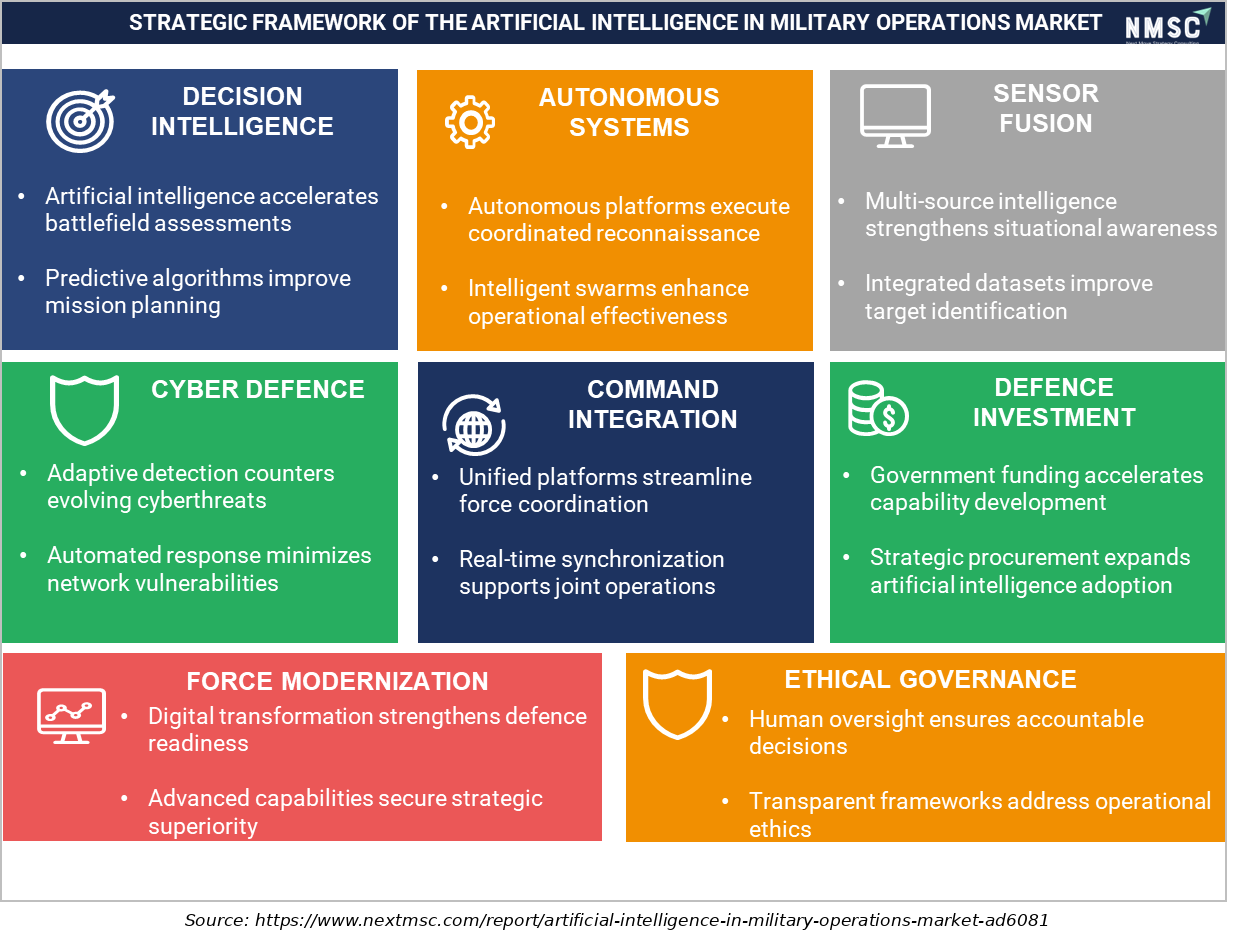
STRATEGIC FRAMEWORK OF THE ARTIFICIAL INTELLIGENCE IN MILITARY OPERATIONS MARKET

The strategic framework of the Artificial Intelligence in Military Operations Market highlights the integration of AI across critical defense functions, including decision intelligence, autonomous systems, sensor fusion, cybersecurity, and command integration. Increasing government investments are accelerating AI adoption to enhance operational readiness, battlefield awareness, and mission coordination. At the same time, force modernization initiatives and ethical governance frameworks are ensuring that AI-enabled military capabilities are deployed responsibly, securely, and in alignment with evolving defense and regulatory requirements.

Regional Outlook

2025 (USD Billion)
2035 (USD Billion)
North Americ
Europe
Asia-Pacific
Middle East
Latin Americ
Region 2025 (USD Billion) 2035 (USD Billion) CAGR (%)
North America $10.0 USD Billion $40.0 USD Billion 9.0%
Europe $17.1 USD Billion $51.1 USD Billion 27.0%
Asia-Pacific $24.2 USD Billion $62.2 USD Billion 25.0%
Middle East & Africa $31.3 USD Billion $73.3 USD Billion 23.0%
Latin America $38.4 USD Billion $84.4 USD Billion 12.0%

Regional data is locked

Unlock complete regional numbers for this market.

Unlock Full Data

Competitive Landscape

We observed that the artificial intelligence in military operations market features a bifurcated competitive landscape, with traditional defense prime contractors competing alongside venture-backed defense technology companies and hyperscale cloud providers on autonomy depth, contract scale, and government trust.

Dimension Description
Market Structure Bifurcated, with established defense primes benefiting from long-standing government relationships, while venture-backed defense technology companies are increasingly capturing large-scale AI and autonomy opportunities.
Innovation Focus Innovation is concentrated on agentic AI for mission planning, hardware-agnostic autonomy software, AI-enabled command and control, and secure platforms supporting multi-domain military operations.
M&A Activity M&A activity remains selective, with competitive dynamics increasingly shaped by strategic partnerships, technology integration, venture funding, and enterprise-scale defense procurement. Defense agencies are increasingly collaborating with commercial AI companies to accelerate the deployment of autonomy, command-and-control, and decision-support capabilities across military operations.

How Do Companies Compete in the Artificial Intelligence in Military Operations Market?

Companies compete primarily on government contract track record, autonomy and intelligence-analysis platform depth, and enterprise-scale delivery capability across the industry. Established defense prime contractors such as Lockheed Martin Corporation and Northrop Grumman Corporation leverage extensive platform integration experience, while venture-backed technology companies such as Anduril Industries, Inc. and Palantir Technologies Inc. compete on software-defined autonomy and intelligence-analysis platform depth.

Which Competitive Archetypes Dominate the Artificial Intelligence in Military Operations Market?

Two archetypes dominate the market: established defense prime contractors offering integrated hardware-software platform delivery across multiple domains, and venture-backed defense technology companies concentrated in software-defined autonomy or intelligence analysis. RTX Corporation and BAE Systems plc exemplify the prime contractor archetype through integrated platform engineering, while Palantir Technologies Inc. and Shield AI, Inc. exemplify the venture-backed archetype built around data fusion and autonomy software respectively.

How Are Companies Differentiating Through Innovation in Artificial Intelligence in Military Operations?

Innovation and differentiation strategy increasingly center on agentic mission planning and hardware-agnostic autonomy software. Shield AI, Inc.'s selection to power a competitor's aircraft platform and the Department of Defense's four-laboratory agentic AI joint contract illustrate how vendors are positioning software portability and autonomous execution as competitive differentiators. Our analysis shows that vendors unable to demonstrate credible agentic AI capability risk losing long-term specification share to platform-diversified competitors.

What M&A and Expansion Activity Is Shaping the Artificial Intelligence in Military Operations Market?

Enterprise contract consolidation and large-scale funding rounds, rather than traditional mergers and acquisitions, continue to shape capability access within the industry. Anduril Industries, Inc.'s USD 5 billion Series H round at a USD 61 billion valuation and Shield AI, Inc.'s USD 2 billion round at a USD 12.7 billion valuation illustrate continued capital deployment supporting enterprise-scale defense AI expansion ahead of major government contract awards.

Key Market Players

Our assessment indicates that the following 20 companies are actively shaping product innovation, government contract activity, and autonomy capability within the global artificial intelligence in military operations market.

Palantir Technologies Inc. Anduril Industries, Inc. Lockheed Martin Corporation Northrop Grumman Corporation RTX Corporation Booz Allen Hamilton Holding Corporation Leidos Holdings, Inc. Shield AI, Inc. BAE Systems plc L3Harris Technologies, Inc. General Dynamics Corporation Microsoft Corporation Amazon.com, Inc. Alphabet Inc. C3.ai, Inc. Helsing GmbH Saronic Technologies, Inc. Thales Group Elbit Systems Ltd. OpenAI

Latest Developments

We found that recent developments within the artificial intelligence in military operations market are concentrated on enterprise contract consolidation and record defense technology valuations, reflecting the industry's broader innovation trajectory.

Date Event
December 2024 OpenAI and Anduril announced a strategic partnership to integrate OpenAI's advanced AI models into Anduril's counter-unmanned aircraft systems (CUAS). The collaboration aims to improve the detection, assessment, and response to aerial threats, strengthening AI-enabled military operations for the U.S. and allied forces.

Expert Insights

Jim Taiclet

Chairman, President & CEO | Lockheed Martin

"Where software, AI and digital technologies will really advantage us is in getting the missions done by combining data flows, communication links and AI to make all those platforms much more effective."

Analyst Interpretation

The statement highlights the growing importance of artificial intelligence in enabling network-centric military operations by integrating data, communications, and digital capabilities across multiple defense platforms. As defense organizations increasingly invest in AI-powered command-and-control systems, autonomous platforms, intelligence fusion, and multi-domain operations, the demand for advanced AI solutions is expected to accelerate, driving sustained growth in the Artificial Intelligence in Military Operations Market.

Investment Opportunities

What Capital Inflows Are Targeting the Artificial Intelligence in Military Operations Market?

Capital inflows into the artificial intelligence in military operations market are increasingly directed toward autonomy software and space-based platform capability. Anduril Industries, Inc.'s USD 61 billion valuation and Shield AI, Inc.'s USD 12.7 billion valuation illustrate continued investor interest in software-defined defense technology. We observed that investors favor companies demonstrating validated government contract track records, viewing enterprise-scale agreements such as Project Linchpin as a proxy for long-term revenue durability.

How Is Infrastructure Investment Supporting Artificial Intelligence in Military Operations Scaling?

Infrastructure investment is expanding autonomous systems manufacturing and satellite production capacity to support growing government demand. Our findings suggest that continued Space Force satellite contract activity, including the Protected Tactical Satellite-Global program, exemplifies sustained investment in space-based AI infrastructure. Contractors are increasingly investing in scalable production architectures capable of supporting multiple military platforms and domains simultaneously.

What ESG Considerations Are Shaping Artificial Intelligence in Military Operations Investment Decisions?

Environmental, social, and governance considerations are increasingly relevant to investment decisions across the industry, with responsible AI governance and human oversight of autonomous systems as key criteria. The Department of Defense continues to enforce responsible AI guidelines that inform contractor governance disclosures. We found that investors increasingly favor contractors with validated human-in-the-loop safeguards for autonomous weapons systems, treating this as a governance indicator alongside classified data handling standards.

Key Benefits for Stakeholders

How Does This Report Benefit Enterprise and Industry Leaders?

Enterprise and industry leaders gain access to validated segmentation, competitive benchmarking, and regional demand forecasts that support portfolio and contract-positioning decisions across the artificial intelligence in military operations industry. Our analysis shows that detailed application, platform, and end user breakdowns help defense contractor leaders align investment with allied procurement requirements while identifying underserved segments for portfolio expansion.

How Does This Report Benefit Investors and Financial Analysts?

Investors and financial analysts benefit from consistent, single-point market size and CAGR estimates that support valuation and capital-allocation decisions across the artificial intelligence in military operations market supply chain. We observed that the report's regional and segment-level growth differentials help identify which contractors are best positioned to capture above-market growth in autonomous systems and Asia-Pacific categories through 2035.

How Does This Report Benefit Technology Vendors and Product Teams?

Technology vendors and product teams gain insight into emerging platform requirements, including agentic mission planning, hardware-agnostic autonomy software, and space-based platform protection, that are reshaping the industry. Our findings suggest that this analysis helps R&D teams prioritize development roadmaps around enterprise contract scalability and multi-domain security capability that are increasingly required by defense procurement evaluation processes.

Key Market Segments Evaluated

By Application

  • Intelligence, Surveillance and Reconnaissance
  • Autonomous Systems and Robotics
  • Command and Control
  • Cybersecurity
  • Logistics and Predictive Maintenance
  • Training and Simulation
  • Other Applications

By Technology

  • Machine Learning
  • Computer Vision
  • Natural Language Processing
  • Autonomous Navigation
  • Other Technologies

By Platform

  • Land
  • Naval
  • Air
  • Space
  • Cyber

By Deployment

  • Cloud-Based
  • On-Premises
  • Edge

By End User

  • Army
  • Navy
  • Air Force
  • Space Force
  • Defense Intelligence Agencies
  • Other Government Agencies

Conclusion & Recommendations

The long-term outlook for the market remains strongly positive, with global revenue projected to more than quintuple from USD 18.6 billion in 2025 to USD 104.8 billion by 2035 at an 18.9% CAGR. We observed that sustained enterprise contract consolidation, expanding autonomous systems adoption, and continued venture and public-market capital availability will continue underpinning demand across army, navy, air force, and space force segments through the forecast period.

What Strategic Positioning Should Artificial Intelligence in Military Operations Suppliers Pursue?

Suppliers should prioritize hardware-agnostic autonomy software and space-based platform capability while pursuing enterprise-scale contract relationships to secure long-term government revenue. Our assessment indicates that vendors investing early in agentic mission-planning capability and multi-domain security engineering will be best positioned to capture premium specification within the artificial intelligence in military operations market.

How Attractive Is the Artificial Intelligence in Military Operations Market for New Investment?

The artificial intelligence in military operations industry presents a highly attractive investment case, supported by an USD 82.5 billion absolute dollar opportunity between 2026 and 2035 and above-average growth in Asia-Pacific and autonomous systems categories. We found that investment attractiveness is highest for vendors combining validated government contract track records with software-defined autonomy capability, positioning them to serve both terrestrial and space-based defense segments simultaneously.

What Market Shifts and Key Risks Should Stakeholders Monitor?

Stakeholders should monitor ITAR and export control constraints, long defense procurement cycles, and ethical and regulatory scrutiny of autonomous weapons systems as key risks to the artificial intelligence in military operations market. Our analysis shows that vendors unable to demonstrate credible agentic AI and autonomy capability risk losing specification share to platform-diversified competitors as enterprise contract consolidation continues to reshape defense procurement industry-wide.

What Are the Key Growth Pathways for the Artificial Intelligence in Military Operations Market?

Key growth pathways include expanding autonomous systems and space platform capability, scaling hardware-agnostic autonomy software, and deepening penetration into Asia-Pacific defense modernization programs. Next Move Strategy Consulting's analysis indicates that suppliers pursuing these pathways while maintaining strength in core intelligence, surveillance, and reconnaissance capability will be best positioned to capture the artificial intelligence in military operations market's projected growth through 2035.

FAQs

About the Author

Liza Phukan

Liza Phukan

Liza Phukan is Research Associate at Next Move Strategy Consulting, where she has covered emerging industries and market research across sectors for 3.5 years. Her work includes analyzing industry developments, validating market data, and developing structured business content from research findings. She uses secondary research and data-validation practices to turn complex market information into clear decision-useful market analysis for business audiences and support report development and B2B.

About the Reviewer

Supradip Baul

Supradip Baul

Supradip Baul is an accomplished business consultant and strategist with over a decade of rich experience in market intelligence, strategy, technology, and business transformation. His work has included rigorous qualitative and quantitative analysis across multiple industries, helping clients shape investment decisions and long-term roadmaps. Earlier in his career, he was associated with Gartner, where he contributed to industry-leading reports and market share analyses. He has worked with leading global companies and holds an MBA with a dual specialization in Marketing and Finance.

Download Free Sample

Semih Kavaklioglu

SEMIH KAVAKLIOGLU

Co-Founder & Sales Manager

Decortie

I work a lot in the marketing industry and I know that research is an essential part of any campaign. I have used Market research reports for my own products and I found them to be very informative and well-researched. The team here produces insightful reports for a good price

Gustaf Hummel Burstrom

GUSTAF HUMMEL BURSTROM

Founder

Revline Tools AB

Joseph and the team at Next Move Strategy Consulting have been excellent to work with, in supplying us with relevant market data and forecasts for our specific category. We had some special requirements and they were able to do a custom package to suit our needs. We would definitely recommend them to any other company needing market data and forecasts

Gaurav Jaiswal

GAURAV JAISWAL

Founder & CEO

Yano Charge Private Limited

The EV Charging market research report provided by the NextMSC was exceptionally detailed and insightful. It offered a comprehensive analysis that proved to be a game-changer for our strategic planning. Truly a testament to the NextMSC’s expertise and thoroughness in EV market landscape & analysis.

Kishu Kanda

KISHU KANDA

Strategy Analyst

Accenture

We purchased the AI Consumer Market Report from this company. Not only did they customize the report to meet our specific requirements, but they also showed great flexibility in accommodating our budget. The report we received fully met our expectations. Additionally, they provided prompt and thorough responses to both our pre-purchase and follow-up questions. We look forward to working with this company again in the future.

Pratyush Kumar Das

PRATYUSH KUMAR DAS

Assistant Manager

Polycab India Limited

We would like to express our appreciation for the data and insights provided by nextmsc. We are very pleased with the quality and depth of the information, which has proven to be highly valuable and beneficial for our business decision-making.

Custom Market Research Services

We will customize the research for you if the listed report does not fully match your requirements.

Get 30% Free Customization

Select License

This website uses cookies to ensure you get the best experience on our website. Learn more

✖