Drone Market By Component (Hardware, Software, and Services), Platform Type (Multi-Rotor, Fixed-Wing, Hybrid VTOL, Single-Rotor, Tethered UAV, Loitering Munition, MALE/HALE/UCAV), Autonomy Level (Remotely Piloted, Assisted Autonomy, Advanced Autonomy), Maximum Takeoff Weight (Nano, Micro, Small, Medium, Large, Very Large/Tactical), Price/Performance Grade (Consumer, Prosumer, Enterprise, Military), and End-User (Consumer, Commercial & Industrial) – Global Analysis & Forecast 2025-2030
Industry: Aerospace & Defense | Latest Edition: September 30, 2026 | No of Pages: 1413 | No. of Tables: 1010 | No. of Figures: 911 | Format: PDF | Report Code: AD1205
Industry Outlook
The global Drone Market size was valued at USD 54.83 billion in 2024, and is expected to be valued at USD 65.14 billion by the end of 2025. The industry is projected to grow, hitting USD 117.62 billion by 2030, with a CAGR of 12.54% between 2025 and 2030. And, with volume expected to reach around 24.10 million units in 2030 and valued at 8.58 million units in 2024 and is projected to rise to 10.66 million units in 2025 with a CAGR of 17.72%.
The drone market is experiencing a rapid transformation, propelled by technological advancements, automation, and the growing integration of intelligent systems. Globally, demand for drones is surging across defense, commercial, agricultural, logistics, and infrastructure sectors, driven by the need for real-time data collection, precision operations, and cost-efficient aerial solutions. The rise of AI-powered navigation, autonomous flight systems, and IoT connectivity is revolutionizing drone capabilities, enabling smarter route planning, predictive maintenance, and enhanced mission efficiency.
Moreover, advancements in battery technology, lightweight materials, and sustainable energy sources are pushing the industry toward eco-friendly and high-performance models. The expansion of regulatory frameworks, digital mapping platforms, and remote monitoring applications is further accelerating adoption, positioning drones as indispensable tools for industrial automation, smart city development, environmental monitoring, and next-generation mobility solutions in an increasingly connected world.

In 2024, the global drone market shows a distinct regional distribution in terms of volume (thousand units). Asia Pacific leads with 3,368.10 thousand units, highlighting rapid adoption and expansion in countries such as China, Japan, and India. North America follows with 2,837.20 thousand units, supported by technological advancements and strong regulatory frameworks. Europe ranks third at 1,824.39 thousand units, reflecting steady growth and increasing use of drones across commercial and industrial sectors. The Rest of the World (RoW) records the smallest volume at 550.75 thousand units, yet still contributes meaningfully to the global market. The bar graph would depict Asia Pacific as the tallest bar, followed by North America, Europe, and RoW, clearly illustrating regional market distribution.
What are the Key Drone Market Trends?
What are the Major Technological Trends Shaping the Market?
Technological advancements are revolutionizing the market, enabling manufacturers and operators to achieve higher levels of automation, accuracy, and connectivity. The integration of Artificial Intelligence (AI) and Machine Learning (ML) is enhancing object recognition, autonomous route optimization, and predictive maintenance. 5G connectivity is enabling ultra-low latency communication, making real-time data transmission and remote operations more efficient. The adoption of IoT-enabled drone fleets allows centralized monitoring, coordination, and data sharing across industries. AR and VR technologies are being used for drone training, simulation, and mission planning, improving operational safety and efficiency. Meanwhile, innovations in 3D mapping, LiDAR scanning, and edge computing are expanding applications in construction, defense, and environmental monitoring. Furthermore, eco-friendly propulsion systems and lightweight composite materials are driving the next wave of sustainable drone design and deployment.
How is Demographic Change Influencing the Market?
Demographic and societal changes are reshaping the market as new generations embrace technology-driven lifestyles and digital solutions. The growing population of tech-savvy professionals and digital-native consumers is fueling demand for aerial imaging, delivery, and entertainment services powered by drones. Younger demographics are particularly drawn to drone-based photography, videography, and recreational flying, driving innovation in consumer-grade models. Meanwhile, urbanization and smart city development are increasing demand for drones in traffic management, surveillance, and infrastructure inspection. In developing regions, rising disposable incomes and digital inclusion are accelerating drone adoption for agriculture and small-scale logistics. Overall, demographic evolution is expanding both the consumer and commercial segments, fostering a more inclusive and technology-oriented global drone ecosystem.
What Role does Government Support Play in Driving Industry Growth?
Government support plays a crucial role in advancing the market through regulatory reforms, funding initiatives, and technology programs. Many governments are developing drone-friendly airspace policies, promoting U-space and BVLOS frameworks, and establishing certification standards to ensure safety and innovation. Investments in defense modernization, smart city projects, and public infrastructure monitoring are fueling large-scale drone deployment. Moreover, subsidies for drone startups, R&D incentives, and pilot training programs are helping build a skilled workforce and stimulate entrepreneurship. Support for digital infrastructure and 5G expansion enhances operational connectivity, while collaborations between public institutions and private companies are fostering innovation in fields like agriculture, surveillance, and environmental conservation. Strong policy backing is thus accelerating both commercial and civil adoption of drones globally.
How is Consumer Preference Changing in the Market?
Consumer preferences in the drone market are shifting toward automation, reliability, and versatility. Modern users are seeking drones that deliver longer flight times, higher image resolution, and seamless connectivity. The preference for compact, user-friendly, and AI-assisted models is driving innovation in the consumer segment, while businesses prioritize data-driven drones capable of analytics and integration with cloud platforms. There is also a rising focus on sustainable and low-noise drone technologies that align with environmental and urban regulations. Consumers increasingly value customization, modularity, and autonomous performance, reflecting a broader trend toward convenience and efficiency. Overall, the market is evolving from basic remote-controlled devices to intelligent, multifunctional aerial systems that cater to professional, commercial, and recreational needs alike.
What Are the Key Market Drivers, Breakthroughs, and Investment Opportunities that will Shape the Industry in Next Decade?
The global market is experiencing rapid growth, driven by advancements in AI, automation, and connectivity, which enable autonomous flight, real-time data analysis, and predictive maintenance across sectors like agriculture, logistics, defense, and infrastructure. Rising commercial and industrial applications, including delivery services, precision agriculture, construction monitoring, and infrastructure inspection, are further accelerating adoption by offering efficiency, cost savings, and operational optimization. However, growth is restrained by regulatory and airspace restrictions, privacy concerns, and compliance complexities. Meanwhile, the surge in e-commerce and last-mile delivery presents significant opportunities for AI-powered, scalable drone logistics solutions, integrating smart city infrastructure and transforming both operational and marketing applications globally.
Growth Drivers:
How is Advancements in AI, Automation, and Connectivity Driving the Drone Market Demand?
Advancements in AI, automation, and connectivity are major drivers of the market, transforming drones into intelligent, autonomous aerial systems. The integration of AI and machine learning enables features like obstacle detection, real-time data analysis, and predictive maintenance, allowing drones to operate with greater precision and minimal human intervention. Meanwhile, 5G and IoT connectivity enhance communication speed and reliability, supporting real-time data transmission and coordinated fleet operations. These technologies collectively boost efficiency, safety, and performance, driving widespread adoption of drones across sectors such as agriculture, logistics, defense, infrastructure, and environmental monitoring.

The pie chart depicts the global e-commerce market share by country in 2025. China dominates the market with a 52.1% share, accounting for over half of global e-commerce activity. The USA follows with 20.1%, while the UK and Japan contribute 3.4% and 3.3%, respectively. South Korea, Germany, and France hold smaller shares of 2.5%, 1.7%, and 1.4%, respectively. The remaining countries collectively represent 15.5% under the “Other” category.
E-commerce is closely related to the drone market, primarily through the growing adoption of drone-based delivery services. As online shopping volumes surge globally, companies are exploring drones to speed up last-mile delivery, reduce logistics costs, and improve customer experience with faster, contactless shipments. Retailers and logistics providers are using drones for small parcel delivery, inventory management, and warehouse operations, especially in urban areas where traffic congestion delay traditional delivery methods. Additionally, drones support marketing, product photography, and visual content creation for e-commerce platforms, enabling high-quality images and videos that enhance online product presentation. Overall, the rise of e-commerce is fueling demand for drones both as operational tools in logistics and as enablers of digital marketing strategies.
Is Growing Commercial and Industrial Applications Accelerating the Drone Market Growth?
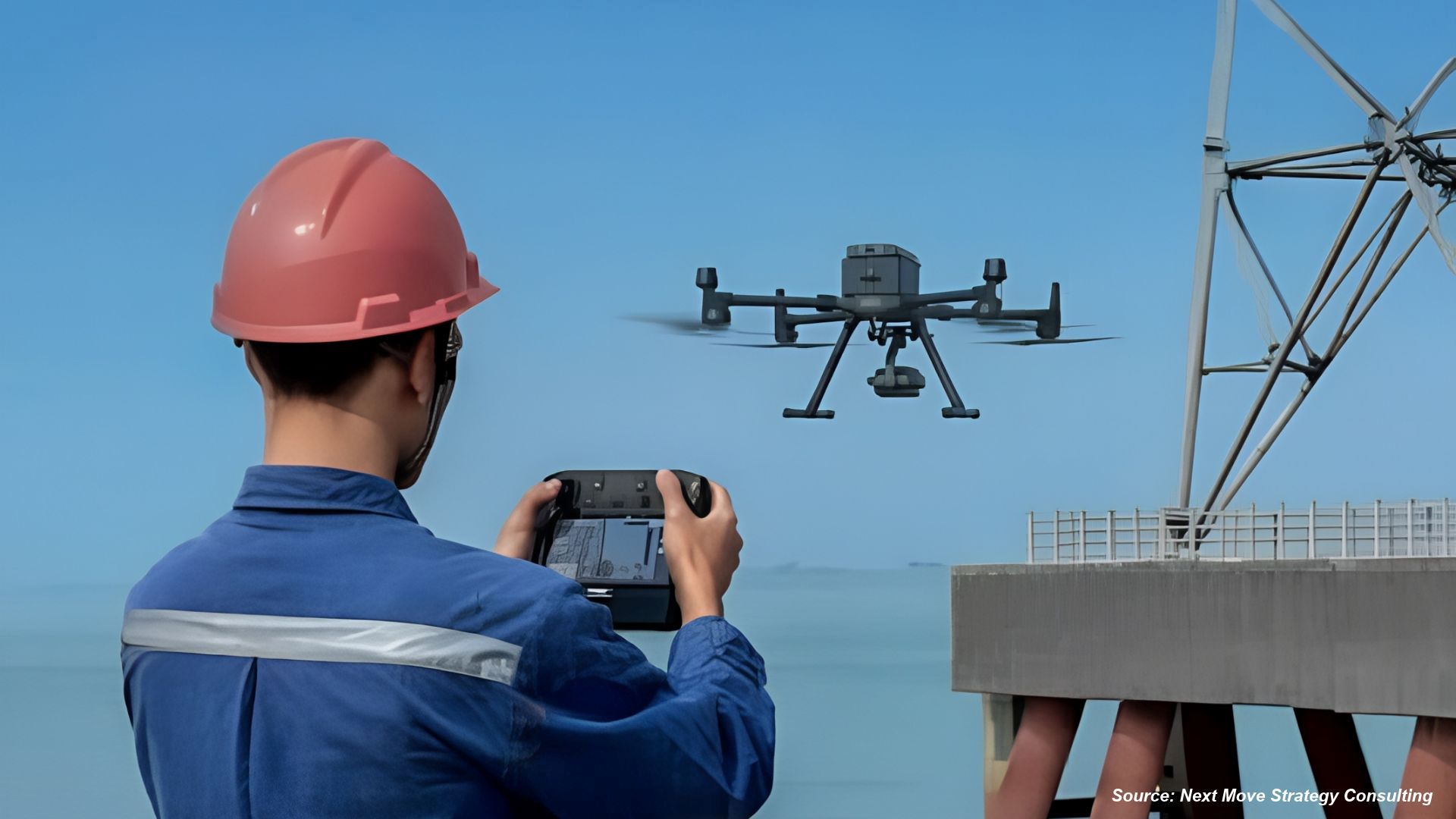
The expanding use of drones across commercial and industrial sectors is a major driver of the market. Drones are increasingly deployed for delivery services, precision agriculture, construction monitoring, mining surveys, and infrastructure inspection, offering faster, safer, and more cost-effective solutions than traditional methods. In agriculture, drones enable crop monitoring, irrigation management, and pesticide application, improving yield and efficiency. In construction and infrastructure, they support site surveying, progress tracking, and safety inspections, reducing manual labor and operational risks. The versatility and scalability of drones in these applications are driving strong market demand, as businesses seek real-time data, enhanced productivity, and operational optimization.
Growth Inhibitors:
How does Regulatory and Airspace Restrictions Limit the Growth of the Drone Market?
One major restraint in the market is regulatory and airspace restrictions. Strict government regulations on drone operations, such as limitations on Beyond Visual Line of Sight (BVLOS) flights, no-fly zones, altitude limits, and mandatory certifications, slow adoption across commercial and industrial sectors. Compliance with varying regional rules increases operational complexity and costs for manufacturers and service providers. Additionally, concerns around privacy, security, and safety further constrain widespread drone deployment, particularly in urban areas and sensitive industries.
How is Last-Mile Delivery and Logistics Automation Creating Opportunity for the Market?
A significant opportunity in the market lies in last-mile delivery and logistics automation. With the rapid growth of e-commerce and on-demand services, companies are exploring drones to speed up package delivery, reduce transportation costs, and reach remote or congested areas efficiently. Expanding drone-enabled delivery networks presents a chance for service providers to develop scalable, AI-powered logistics solutions, while also integrating with smart city infrastructure, creating a new revenue stream and driving broader commercial adoption.
How Drone Market is Segmented in this Report, and What are the Key Insights from the Segmentation Analysis?

The pie chart illustrates the share of components in the market in 2024, highlighting hardware, software, and services. Hardware dominates the market with a 70.67% share, reflecting the high demand for advanced airframes, sensors, avionics, and communication systems essential for commercial, industrial, and defense drones. Services account for 19.59%, indicating growing adoption of Drone-as-a-Service, maintenance, training, and data processing solutions. Software holds 9.74%, driven by flight control, analytics, and fleet management tools. Overall, the chart emphasizes that while hardware remains the backbone of the market, increasing reliance on software and services is creating diverse growth opportunities across sectors.
By Component Insights
Which Component is Expected to Drive the Drone Market in 2025?
On the basis of component, the market is segmented into hardware, software, and services. The market in 2025 is expected to be primarily driven by hardware, including airframes, avionics, payloads, sensors, and communication systems, as growing demand for advanced, reliable, and high-performance drones continues across commercial, industrial, and defense applications. While software, covering flight control, data analytics, and fleet management, and services, including Drone-as-a-Service (DaaS), training, maintenance, and data processing, are gaining significant traction due to the rise of autonomous operations, cloud-based solutions, and service-oriented drone offerings, hardware remains the cornerstone of drone performance and adoption. Additionally, the services segment is emerging as a high-potential category, driven by increasing interest in outsourced drone operations, managed services, and AI-enabled fleet management solutions.
By Platform Type Insights
How are Hybrid VTOLs Transforming Flexibility and Efficiency?
On the basis of platform type, the Market is segmented into multi-rotor, fixed-wing, hybrid VTOL (Vertical Take-Off and Landing), single-rotor (helicopter), tethered UAV, loitering munition, and MALE/HALE/UCAV.
Hybrid VTOL (Vertical Take-Off and Landing) drones are revolutionizing the drone market by combining the vertical lift capabilities of multi-rotors with the long-range endurance of fixed-wing platforms. This hybrid design allows for take-off and landing in confined spaces while covering larger distances efficiently, making them ideal for applications in logistics, infrastructure inspection, environmental monitoring, and remote site surveys. By reducing the need for runways and enabling longer flight durations, hybrid VTOLs enhance operational flexibility and cost-effectiveness. Their versatility, coupled with growing adoption of autonomous flight systems and AI-assisted navigation, is driving strong demand across both commercial and industrial sectors.
By Autonomy Level Insights
How are Fully Autonomous Drones Shaping the Future of UAV Operations?
On the basis of autonomy level, the market is segmented into remotely piloted, assisted autonomy, advanced autonomy, and fully autonomous. Fully autonomous drones operate independently, performing pre-programmed missions with end-to-end automation, including take-off, navigation, data collection, and landing. This autonomy supports large-scale logistics, long-duration surveillance, and smart city applications, enabling cost-effective, scalable, and highly efficient drone operations across industries.
By Maximum Takeoff Weight (MTOW) Insights
How are Different Drone Sizes Shaping Market Adoption in 2025?
On the basis of maximum takeoff weight (MTOW), the market is segmented into nano (< 250 g), micro (250 g – 2 kg), small (> 2 kg – 25 kg), medium (> 25 kg – 150 kg), large (> 150 kg – 600 kg), and very large/tactical (> 600 kg). Each category caters to distinct applications: nano and micro drones serve indoor inspections, hobbyist use, and urban monitoring; small and medium drones are preferred for commercial surveys, infrastructure inspection, precision agriculture, and logistics; while large and very large/tactical drones support cargo transport, industrial supply chains, and strategic military missions. This segmentation enables manufacturers and service providers to address diverse customer needs, driving widespread adoption across commercial, industrial, and defense sectors..
By Price/Performance Grade Insights
How are Different Price and Performance Grades Driving the Drone Market in 2025?
On the basis of price/performance grade, the market is segmented into consumer (< $1,000), prosumer ($1,000–$10,000), enterprise ($10,000–$100,000), and military (> $100,000) drones. Consumer-grade drones are widely adopted for hobbyist, recreational, and educational purposes due to their affordability and ease of use. Prosumer drones target small businesses and professional photographers seeking higher performance and better imaging capabilities. Enterprise-grade drones are employed across industries for logistics, inspections, agriculture, and infrastructure monitoring, offering advanced features, payload capacity, and durability. Military-grade drones support defense operations, including surveillance, reconnaissance, and combat missions, with sophisticated avionics and long-range capabilities. These price tiers enable tailored adoption across individual, commercial, and strategic sectors, driving overall market growth.
By End-User Insights
How are Different End-User Segments Shaping the Drone Market in 2025?
On the basis of end-user, the market is segmented into consumer drones, commercial & industrial drones, government & public safety drones, and military drones. Consumer drones market cater to hobbyists, enthusiasts, and educational users, driving adoption through affordability and ease of use. Commercial and industrial drones are deployed for applications like logistics, agriculture, surveying, infrastructure inspection, and aerial imaging, enabling operational efficiency and cost savings. Government and public safety drones support emergency response, law enforcement, disaster management, and smart city monitoring. Military drones provide intelligence, surveillance, reconnaissance, and combat capabilities with high-end autonomy and payload capacity. This segmentation ensures tailored solutions for diverse user needs, fueling market expansion across multiple sectors.

The pie chart illustrates the global market share by end-user segment. Commercial & Industrial drones dominate the market with a 41.57% share, reflecting growing adoption in sectors such as logistics, agriculture, and infrastructure inspection. Consumer drones account for 25.26%, driven by hobbyists and recreational use. Military drones market hold 18.75%, supported by ongoing defense modernization programs, while Government & Public Safety drones contribute 14.43%, highlighting their role in surveillance, disaster management, and law enforcement. Overall, the data underscores how commercial applications are now the primary driver of drone market expansion signaling a shift from recreational and defense-focused usage toward industrial and service-oriented deployment.
Regional Outlook
The market is geographically studied across North America, Europe, Asia Pacific, and the Middle East & Africa, and each region is further studied across countries.
Drone Market in North America
The North American market is driven by the increasing adoption of drones across commercial, industrial, and defense sectors, supported by advancements in AI, automation, and connectivity. Growing demand for aerial imaging, infrastructure inspection, logistics, and precision agriculture is fueling market growth. Expansion of e-commerce, smart city initiatives, and public safety applications is further boosting adoption. Companies and government agencies are investing in autonomous, connected, and AI-powered drones to improve efficiency, reduce operational costs, and enhance real-time data collection. Increasing regulatory support and technological innovation are also creating opportunities for the development of advanced drone platforms and services in the region.
Drone Market in the United States
The U.S. market is primarily fueled by widespread commercial, industrial, and defense adoption. Businesses and government agencies are leveraging drones for logistics, infrastructure inspection, precision agriculture, and emergency response. Technological advancements such as AI-assisted autonomous flight, real-time analytics, and IoT connectivity are enhancing operational efficiency and safety. Expansion of e-commerce, urban delivery solutions, and smart city projects further supports market growth. Strong government support, investment in drone R&D, and increasing consumer awareness of drone applications are contributing to steady market expansion.
Drone Market in Canada
In Canada, the market is growing due to adoption across commercial, industrial, and public safety applications. Industries including agriculture, construction, logistics, and environmental monitoring are increasingly relying on drones for efficiency and cost-effective operations. Government initiatives promoting innovation and regulatory clarity are supporting adoption, while technological advancements in AI, autonomous navigation, and aerial imaging are driving market development. Expansion of urban delivery, smart city projects, and environmental monitoring programs further boosts demand for drones in the country.
Drone Market in Europe
The European market is supported by strong adoption across commercial, industrial, and governmental sectors. Growing applications in logistics, agriculture, infrastructure inspection, public safety, and defense are driving demand. Technological trends such as AI-enabled autonomous flight, cloud-based operations, and real-time analytics are enhancing operational capabilities. Expansion of e-commerce, smart city initiatives, and environmental monitoring programs is further boosting adoption. Additionally, regulatory frameworks, funding for drone startups, and emphasis on sustainable and energy-efficient drones are creating growth opportunities across the region.
Drone Market in the United Kingdom
In the U.K., the market is driven by commercial, industrial, and governmental adoption, including logistics, public safety, infrastructure monitoring, and defense applications. Urbanization, rising digital literacy, and the growth of e-commerce are fueling demand for drone-based delivery and inspection solutions. Technological innovations such as AI-assisted autonomous flight, fleet management, and advanced sensors are enabling more efficient operations. Government initiatives promoting digital innovation, smart cities, and drone regulations further support market growth, while sustainability and energy-efficient drone designs are shaping industry trends.
Drone Market in Germany
Germany’s market is propelled by adoption across commercial, industrial, and public sectors, including logistics, infrastructure inspection, agriculture, and environmental monitoring. Companies and government agencies are leveraging AI-enabled autonomous drones, advanced sensors, and connected systems to optimize operations. Growing e-commerce, urban delivery, and smart city initiatives are creating additional demand. Emphasis on sustainability, energy efficiency, and regulatory compliance is shaping market trends, while investments in drone R&D and technological innovation continue to support steady growth across the country.
Drone Market in France
In France, market growth is driven by expanding use of drones across commercial, industrial, and governmental applications, including logistics, infrastructure monitoring, agriculture, and public safety. Technological advancements in AI, autonomous flight, real-time analytics, and aerial imaging are enhancing operational efficiency. Growth in e-commerce, urban delivery services, and smart city projects is further boosting adoption. Government support, regulatory clarity, and a focus on sustainable, energy-efficient drones are enabling market expansion, while increasing awareness of drone applications in business and public sectors continues to drive steady demand.
Drone Market in Spain
Spain’s market is witnessing steady growth driven by increased adoption in commercial, industrial, and governmental sectors. Key applications include precision agriculture, infrastructure and utility inspection, logistics and delivery, public safety, and environmental monitoring. Businesses and authorities are increasingly deploying AI-enabled drones, autonomous flight systems, and real-time data analytics to enhance operational efficiency, accuracy, and safety. The expansion of urban delivery networks and smart city initiatives is further boosting demand, while supportive government regulations and incentives are encouraging innovation and wider deployment of drones across industries.
Drone Market in Italy
Italy’s market growth is largely fueled by industrial, commercial, and public sector adoption. Drones are extensively used in agriculture for crop monitoring, construction and infrastructure surveys, logistics, emergency response, and disaster management. Technological advancements such as autonomous navigation, advanced imaging sensors, and fleet management software are enabling more precise and efficient operations. Government initiatives to streamline regulations and promote R&D in drone technology are supporting broader adoption, while businesses increasingly rely on drones to improve productivity, reduce operational costs, and enhance real-time decision-making.
Drone Market in the Nordics
The Nordic market is expanding due to strong uptake in industrial inspection, precision agriculture, logistics, emergency services, and environmental monitoring. Countries in this region are leveraging autonomous flight systems, AI-assisted navigation, and high-resolution imaging sensors to optimize operational efficiency and safety. Emphasis on sustainable and energy-efficient drone solutions is driving adoption, particularly in countries with strict environmental regulations. Public sector initiatives, such as smart city projects and disaster management programs, along with commercial applications in logistics and infrastructure, are contributing to consistent growth in the Nordic drone market.
Drone Market in Asia Pacific
The Asia Pacific market is experiencing rapid growth across China, India, Japan, South Korea, and Australia, driven by expanding commercial, industrial, and governmental applications. Key use cases include logistics and last-mile delivery, precision agriculture, infrastructure monitoring, public safety, and environmental surveillance. Technological advancements such as AI-powered autonomous drones, IoT connectivity, long-range flight systems, and real-time data analytics are enabling large-scale deployments and operational efficiency. Urbanization, smart city initiatives, and government-backed programs are creating significant growth opportunities, while the rising tech-savvy population supports innovation and adoption of drone services across the region.
Drone Market in China
China remains a leader in the regional market, driven by adoption in e-commerce delivery, industrial inspection, agriculture, surveillance, and public safety operations. The market is strengthened by extensive deployment of autonomous, AI-enabled drones capable of performing complex missions with high efficiency and reliability. Government support for innovation, regulatory clarity, and infrastructure investment is further accelerating growth. Large-scale commercial applications, including logistics networks and industrial monitoring, combined with technological advancements in fleet management and real-time analytics, continue to expand China’s drone ecosystem.
Drone Market in Japan
Japan’s market growth is fueled by applications in infrastructure inspection, disaster management, logistics, agriculture, and environmental monitoring. Businesses and public authorities are adopting autonomous drones, AI-assisted navigation, and high-resolution imaging technologies to improve accuracy, efficiency, and safety. Smart city initiatives, supportive regulatory frameworks, and government-backed programs are encouraging drone deployment in both urban and rural areas. Rising demand for automated delivery systems and real-time data collection is also boosting adoption across commercial and industrial sectors.
Drone Market in India
India’s market is rapidly expanding, driven by adoption across agriculture, logistics, infrastructure inspection, public safety, and environmental monitoring. The market benefits from AI-powered autonomous drones, connected fleet management systems, and advanced imaging and sensing technologies that enhance operational efficiency and decision-making. Regulatory reforms promoting drone usage, coupled with rapid urbanization, e-commerce growth, and increasing digital literacy, are creating strong growth opportunities. Commercial enterprises, government agencies, and startups are investing heavily in drone technology, making India a dynamic and fast-growing market in the Asia Pacific region.
Drone Market in South Korea
South Korea’s market is growing rapidly due to adoption in logistics, agriculture, industrial inspection, and public safety. The country is leveraging AI-enabled autonomous drones, IoT connectivity, and advanced imaging sensors to optimize operations and improve efficiency. Government initiatives supporting smart cities, disaster management, and drone R&D are accelerating adoption. Additionally, the rise of e-commerce and urban delivery solutions is creating opportunities for drones in last-mile logistics and commercial applications.
Drone Market in Taiwan
Taiwan’s market is driven by industrial, commercial, and governmental use cases, including infrastructure monitoring, agriculture, environmental surveillance, and emergency response. Deployment of autonomous and AI-powered drones with high-resolution imaging and real-time analytics is enhancing operational efficiency and safety. Supportive regulatory policies and government-backed initiatives for technology innovation are further enabling market growth, particularly in sectors like logistics, urban management, and industrial inspection.
Drone Market in Indonesia
Indonesia’s market is expanding due to logistics, agriculture, environmental monitoring, and infrastructure inspection applications. The market benefits from AI-assisted autonomous drones, long-range flight systems, and real-time data analytics to manage operations across both urban and remote areas. Government support for digital infrastructure and drone deployment in disaster management and smart city projects is encouraging adoption. Growth in e-commerce and rural connectivity initiatives is also creating opportunities for commercial drone applications.
Drone Market in Australia
Australia’s drone market is growing across agriculture, mining, logistics, public safety, and environmental monitoring. Adoption of autonomous flight systems, AI-powered analytics, and advanced imaging sensors enables more efficient surveying, crop monitoring, and infrastructure inspections. Government-backed programs, regulatory clarity, and investment in R&D are supporting market expansion. Additionally, the country’s vast geography and remote regions create strong demand for drone-based delivery, monitoring, and emergency response solutions.
Drone Market in Latin America
The Latin American drone market is expanding, driven by adoption in agriculture, mining, logistics, infrastructure monitoring, and public safety. Countries such as Brazil, Mexico, and Chile are increasingly deploying autonomous drones, AI-assisted flight systems, and real-time analytics for efficient operations. Regulatory development and government support for drone innovation and smart city projects are enhancing adoption. Growth in e-commerce and industrial automation is further creating opportunities for commercial drone applications across the region.
Drone Market in the Middle East & Africa
The Middle East & Africa drone market is witnessing growth across oil & gas, agriculture, infrastructure inspection, logistics, and security applications. The region is leveraging autonomous, AI-enabled drones, advanced imaging systems, and connected fleet management to improve operational efficiency and safety. Government initiatives promoting innovation, smart city development, and emergency management are supporting market expansion. Additionally, adoption in commercial sectors, such as e-commerce delivery and industrial monitoring, is driving demand across urban and remote areas.
Competitive Landscape
Which Companies Dominate the Drone Market and How do they Compete?
The global drone market is dominated by a combination of established multinational corporations, defense contractors, and specialized drone manufacturers, including DJI, Parrot, Autel Robotics, Yuneec, EHang, AeroVironment, Draganfly Inc., Skydio, Insitu, Baykar Tech, Quantum Systems, XAG Co., Tekever, Percepto, Delair, Italdron, SCR Drones, Airobotics, Ageagle Aerial Systems Inc, SkyX Aerospace, IoTechWorld, Kratos Defense & Security Solutions, Lockheed Martin, Northrop Grumman, and Airbus Defence and Space. These companies compete by offering a wide array of drone solutions, such as commercial and industrial UAVs, military drones, autonomous systems, aerial imaging, logistics and delivery drones, precision agriculture platforms, and specialized defense technologies.
Market leaders differentiate themselves through technological innovation, AI-enabled autonomous systems, advanced sensors, and integrated data analytics, while emphasizing reliability, operational efficiency, and scalability. Smaller or niche players focus on customized, mission-specific drones or specialized industrial applications, catering to unique client requirements. With rising global demand for autonomous, intelligent, and sustainable drone solutions, companies that integrate cutting-edge technology, strategic partnerships, and operational versatility are capturing significant market share and building long-term client loyalty in the drone market.
Market dominated by Drone Market Giants and Specialists
The drone market is characterized by a mix of large multinational drone manufacturers and service providers alongside regional or niche specialists. Major players compete on scale, technological capabilities, and extensive client networks, offering comprehensive solutions ranging from industrial inspection, logistics, precision agriculture, and defense applications to public safety and environmental monitoring. Smaller or specialized firms focus on customized drone solutions, specialized sensors, and niche applications, catering to specific industry needs or challenging operational environments. This dual market structure allows clients to choose between established providers for reliability and broad expertise or specialized companies for highly tailored, innovative drone solutions.
Innovation and Adaptability Drive Market Success
Leading companies in the drone market invest heavily in technological innovation, advanced flight systems, AI, autonomous navigation, and sensor technologies to deliver high-quality, efficient, and safe drone operations. Adoption of autonomous flight, AI-assisted analytics, real-time data processing, and connected fleet management enhances operational efficiency, accuracy, and scalability. Providers that adapt to trends such as smart city integration, sustainable drones, precision applications, and last-mile delivery solutions are securing stronger market presence. Continuous innovation in drone capabilities, automation, and operational versatility is crucial to maintaining a competitive edge.
Market Players to Opt for Merger & Acquisition Strategies to Expand their Presence
Mergers and acquisitions are increasingly leveraged by drone market companies to expand product portfolios, enter new geographic markets, and acquire specialized technology expertise. Leading manufacturers and service providers are acquiring smaller or niche firms to strengthen market share, diversify offerings, and integrate advanced technologies such as AI navigation, high-resolution imaging, and autonomous fleet systems. These M&A activities allow companies to access new client segments, scale operations efficiently, and respond to rising demand for innovative, automated, and customized drone solutions, enhancing their competitive positioning across both mainstream and specialized application areas.

The pie chart presents the market share of leading drone manufacturers. Insitu, Inc. leads with 26.98%, reflecting its strong presence in both commercial and defense drone segments. Lockheed Martin Corporation follows with 16.40%, supported by its advanced military and government drone solutions. The remaining 56.62% is accounted for by other companies, highlighting a highly fragmented market with numerous players competing across consumer, commercial, and specialized industrial applications. This distribution indicates that while a few key players dominate certain segments, innovation and growth opportunities remain widespread throughout the drone industry.
List of Key Drone Companies
-
Parrot
-
EHang
-
Autel Robotics
-
DJI
-
Yuneec
-
AeroVironment
-
Draganfly Inc.
-
Quantum Systems
-
Tekever
-
Ageagle Aerial Systems Inc
-
Airobotics
-
Skydio, Inc.
-
Insitu, Inc.
-
Baykar Tech
-
Percepto
-
Delair
-
DefendTex
-
Italdron
-
SCR Drones
-
XAG Co., Ltd.
-
SkyX Aerospace
-
IoTechWorld
-
Lockheed Martin Corporation
-
Northrop Grumman Corporation
-
Airbus Defence and Space
What Are the Latest Key Industry Developments?
-
September 2025 - Kratos has been selected as the exclusive U.S. manufacturer for Elroy Air's Chaparral VTOL cargo drone, marking a significant step in autonomous aerial logistics.
-
June 2025 - At the 2025 Paris Air Show, Parrot unveiled the ANAFI UKR, a compact micro-drone featuring advanced AI capabilities for autonomous operations.
-
December 2024 - Lockheed Martin has unveiled a new stealth combat drone designed to enhance U.S. air power superiority, showcasing advancements in unmanned aerial vehicle technology.
-
October 2024 - AeroVironment introduced the P550 drone, designed for the Army's Long Range Reconnaissance program, featuring modular components that be swapped in the field within minutes.
What Are the Key Factors Influencing Investment Analysis & Opportunities in the Drone Market?
The drone market is attracting significant investor interest due to the growing global demand for autonomous, AI-enabled, and technologically advanced drones across commercial, industrial, and governmental applications. Key factors influencing investment decisions include a company’s ability to develop innovative drone platforms, integrate advanced technologies such as AI, machine learning, IoT connectivity, and autonomous navigation, and deliver reliable, scalable drone services. Firms demonstrating operational efficiency, technological innovation, and adaptability in applications ranging from logistics, precision agriculture, infrastructure inspection, and public safety to last-mile delivery are particularly appealing to investors. Strategic moves such as mergers, acquisitions, partnerships, and geographic expansion further enhance growth potential, making companies with diversified drone portfolios, strong R&D capabilities, and established market presence prime targets for investment opportunities.
Key Benefits for Stakeholders:
Next Move Strategy Consulting (NMSC) presents a comprehensive analysis of the drone market, covering historical trends from 2020 through 2024 and offering detailed forecasts through 2030.
Our study examines the market at global, regional, and country levels, providing quantitative projections and insights into key growth drivers, challenges, and investment opportunities across all major drone market segments.
Report Scope
|
Parameters |
Details |
|
Market Size in 2025 |
USD 65.14 Billion |
|
Revenue Forecast in 2030 |
USD 117.62 Billion |
|
Growth Rate |
CAGR of 12.54% from 2025 to 2030 |
|
Analysis Period |
2024–2030 |
|
Base Year Considered |
2024 |
|
Forecast Period |
2025–2030 |
|
Market Size Estimation |
Billion (USD) |
|
Growth Factors |
|
|
Companies Profiled |
15 |
|
Countries Covered |
28 |
|
Market Share |
Available for 10 companies |
|
Customization Scope |
Free customization (equivalent to up to 80 analyst-working hours) after purchase. Addition or alteration to country, regional & segment scope. |
|
Pricing and Purchase Options |
Avail customized purchase options to meet your exact research needs. |
|
Approach |
In-depth primary and secondary research; proprietary databases; rigorous quality control and validation measures. |
|
Analytical Tools |
Porter's Five Forces, SWOT, value chain, and Harvey ball analysis to assess competitive intensity, stakeholder roles, and relative impact of key factors. |
Key Market Segments
By Component
-
Hardware
-
Airframe
-
Avionics & Core Systems
-
Payloads & Sensors (Cameras, LiDAR, Multispectral, etc.)
-
Communication Systems (C2 Links)
-
-
Software
-
Flight Control & Autonomy
-
Data Processing & Analytics
-
Fleet Management
-
-
Services
-
Drone-as-a-Service (DaaS)
-
Training & Certification
-
Maintenance, Repair & Overhaul (MRO)
-
Data Processing Services
-
By Platform Type
-
Multi-Rotor
-
Fixed-Wing
-
Hybrid VTOL (Vertical Take-Off and Landing)
-
Single-Rotor (Helicopter)
-
Tethered UAV
-
Loitering Munition
-
MALE/HALE/UCAV
By Autonomy Level
-
Remotedly Piloted
-
Assisted Autonomy
-
Advanced Autonomy
-
Fully Autonomous
By Maximum Takeoff Weight (MTOW)
-
Nano: < 250 g
-
Micro: 250 g - 2 kg
-
Small: > 2 kg - 25 kg
-
Medium: > 25 kg - 150 kg
-
Large: > 150 kg - 600 kg
-
Very Large/Tactical: > 600 kg
By Price/Performance Grade
-
Consumer Grade (< $1,000)
-
Prosumer Grade ($1,000 - $10,000)
-
Enterprise Grade ($10,000 - $100,000)
-
Military Grade (> $100,000)
By End-User
-
Consumer Drone
-
Commercial & Industrial Drone
-
Aerial Imaging & Cinematography
-
Surveying & Mapping (Geomatics)
-
Agricultural Applications (spraying, crop monitoring)
-
Infrastructure Inspection (energy, utilities, transport)
-
Logistics & Delivery (package transport)
-
Environmental & Scientific Monitoring
-
-
Government & Public Safety Drone
-
Emergency Response & Disaster Management
-
Law Enforcement & Security
-
Firefighting & Public Safety
-
Smart City Management
-
-
Military Drone
-
Intelligence, Surveillance & Reconnaissance (ISR)
-
Combat/Strike Operations
-
Electronic Warfare (EW)
-
Target Acquisition & Designation
-
Logistics & Resupply
-
Decoy & Countermeasure Systems
-
Geographical Breakdown
-
North America: U.S., Canada, and Mexico.
-
Europe: U.K., Germany, France, Italy, Spain, Sweden, Denmark, Finland, Netherlands, and rest of Europe.
-
Asia Pacific: China, India, Japan, South Korea, Taiwan, Indonesia, Vietnam, Australia, Philippines, Malaysia and rest of APAC.
-
Middle East & Africa (MEA): Saudi Arabia, UAE, Egypt, Israel, Turkey, Nigeria, South Africa, and rest of MEA.
-
Latin America: Brazil, Argentina, Chile, Colombia, and rest of LATAM.
Conclusion & Recommendations
Our report equips stakeholders, industry participants, investors, policy-makers, and consultants with actionable intelligence to capitalize on drone market transformative potential.
By combining robust data-driven analysis with strategic frameworks, NMSC’s drone market report serves as an indispensable resource for navigating the evolving landscape.


About the Author
 Sikha Haritwal
— Sikha Haritwal is an assistant manager with strong expertise in market research, data analysis, and cross-functional coordination. She plays a key role in leading complex research initiatives, strengthening analytical rigor, and enabling data-driven decision-making across teams. Known for her leadership mindset and structured problem-solving approach, she supports process improvement, enhances operational efficiency, and contributes to building scalable frameworks that drive long-term strategic outcomes and organizational effectiveness.
Sikha Haritwal
— Sikha Haritwal is an assistant manager with strong expertise in market research, data analysis, and cross-functional coordination. She plays a key role in leading complex research initiatives, strengthening analytical rigor, and enabling data-driven decision-making across teams. Known for her leadership mindset and structured problem-solving approach, she supports process improvement, enhances operational efficiency, and contributes to building scalable frameworks that drive long-term strategic outcomes and organizational effectiveness.
About the Reviewer
 Supradip Baul
— Supradip Baul is an accomplished business consultant and strategist with over a decade of rich experience in market intelligence, strategy, technology, and business transformation. His work has included rigorous qualitative and quantitative analysis across multiple industries, helping clients shape investment decisions and long-term roadmaps. Earlier in his career, he was associated with Gartner, where he contributed to industry-leading reports and market share analyses. He has worked with leading global companies and holds an MBA with a dual specialization in Marketing and Finance.
Supradip Baul
— Supradip Baul is an accomplished business consultant and strategist with over a decade of rich experience in market intelligence, strategy, technology, and business transformation. His work has included rigorous qualitative and quantitative analysis across multiple industries, helping clients shape investment decisions and long-term roadmaps. Earlier in his career, he was associated with Gartner, where he contributed to industry-leading reports and market share analyses. He has worked with leading global companies and holds an MBA with a dual specialization in Marketing and Finance.
At Next Move Strategy Consulting, we understand that insightful market research is the cornerstone of successful business decisions. That's why we employ a robust and multifaceted approach, combining various methodologies to deliver the most accurate and actionable data for our clients.

Research Landscape
We navigate the world of research with two primary approaches:
Qualitative Approach
Our qualitative research methodologies involve immersive techniques such as in-depth interviews, focus groups, and observational studies. By engaging directly with individuals and stakeholders, we uncover valuable insights that quantitative data alone may overlook.

Quantitative Research
In tandem with qualitative methodologies, NMSC leverages the power of Quantitative Research to provide a robust foundation of numerical insights. Through systematic data collection and analysis, we quantify patterns, preferences, and market trends, offering a comprehensive view of the business landscape.
Our quantitative research approach employs diverse tools, including surveys, experiments, and statistical modelling. These methodologies enable us to gather data from a large and representative sample, ensuring the statistical significance of our findings. By employing structured questionnaires and standardized data collection methods, we guarantee the reliability and validity of the information we present to our clients.
Quantitative research is particularly effective in measuring the prevalence of trends, assessing market size, and gauging the impact of various factors on consumer behavior. The numerical precision attained through this approach equips our clients with actionable insights, facilitating data-driven decision-making and strategy formulation.


Our Specialized Toolbox for Industry-Specific Market Research
We deploy a specialized arsenal of techniques tailored to meet your unique requirements. Here's a glimpse into our comprehensive toolbox:

Information Procurement
The stage entails acquiring market data or relevant information through various sources and methodologies.


Market Research Approach
We utilize both top-down and bottom-up approaches in market research analysis to achieve a comprehensive understanding of the market dynamics, leveraging the broad perspective of industry trends and macroeconomic factors alongside detailed insights from specific segments and individual companies.

Porters Five Forces Analysis
We conduct Porter's Five Forces analysis to evaluate the competitive landscape of an industry, providing us with insights into factors that affect profitability and strategic positioning.

SWOT Analysis

Forecasting
We utilize a forecasting model to predict future consumption by considering parameters like population, economics, regulations, market competition, drivers, constraints, technology, and pricing. We also employ statistical techniques such as multilinear regression, exponential smoothing, moving average, ARIMA, and Monte Carlo simulations for accurate predictions. In econometric forecasting, we analyzed short-term and long-term event impacts, attributing values based on regulatory frameworks, economic factors, and market events.





 Speak to Our Analyst