Artificial Intelligence (AI) Market

Artificial Intelligence (AI) Market size was USD 629.97 Billion in 2026, projected to reach USD 3,796.05 Billion by 2035, growing at a CAGR of 21.3% from 2027 to 2035. Key drivers include record AI infrastructure investments by hyperscalers and chipmakers, expanding government AI investment programs, and rising demand for AI models, applications, and professional services, with North America leading the market .

Download Free Sample PDF
Base Year (2025)
$629.97 Billion
Forecast (2035)
$3,796.05 Billion
CAGR (2026-2035)
21.3%
Top Region
North America

What Is the Artificial Intelligence (AI) Market Size?

The global Artificial Intelligence (AI) market size was valued at USD 629.97 billion in 2026 and is estimated at USD 809.24 billion in 2027, projected to reach USD 3,796.05 billion by 2035, growing at a CAGR of 21.3% from 2027 to 2035. North America led the market with an approximate 42% revenue share in 2026, while the Hardware offering segment dominated at roughly 34% share.

Our findings suggest that the following key takeaways summarize the Artificial Intelligence (AI) Market 's segment-level and geographic dynamics as of 2026.

Artificial Intelligence (AI) Market Revenue Forecast

Values in USD Billion

2025 $629.97 Billion
2025
2026 $764.15 Billion
2026
2027 $926.92 Billion
2027
2028 $1,124.35 Billion
2028
2029 $1,363.84 Billion
2029
2030 $1,654.34 Billion
2030
2031 $2,006.71 Billion
2031
2032 $2,434.14 Billion
2032
2033 $2,952.61 Billion
2033
2034 $3,581.52 Billion
2034
2035 $3,796.05 Billion
2035

Key Takeaways

By Offering: Hardware held the largest share, reaching USD 214.19 Billion in 2026 and USD 835.13 Billion by 2035, representing approximately 34% of the market; Applications and Agents is the fastest-growing sub-segment at 32.3% CAGR from 2027–2035.

By Technology Modality: Generative AI held the largest share, accounting for approximately 38% of the market and reaching USD 239.39 Billion in 2026; Reasoning and Decision Intelligence is the fastest-growing sub-segment at 44.8% CAGR from 2027–2035.

By End-Use Industry: Technology and Telecommunications held the largest share, accounting for approximately 28% of the market and reaching USD 176.39 Billion in 2026; Healthcare and Life Sciences is the fastest-growing sub-segment at 31.7% CAGR from 2027–2035.

By Deployment Model: Cloud held the largest share, accounting for approximately 64% of the market and reaching USD 403.18 Billion in 2026; Edge is the fastest-growing sub-segment at 33.4% CAGR from 2027–2035.

By Buyer Type: Large Enterprise held the largest share, accounting for approximately 38% of the market and reaching USD 239.39 Billion in 2026; Technology and Cloud Providers is the fastest-growing sub-segment at 29.8% CAGR from 2027–2035.

Dominant Region: North America dominated with approximately 38.3 % revenue share in 2026, reaching USD 241.40 Billion.

Fastest-Growing Region: Asia-Pacific is expected to register the highest CAGR of approximately 22.63 % during 2026–2035 .

Dominant Country: The U.S. led the market, reaching USD 206.09 Billion in 2026.

Fastest-Growing Country: Vietnam is the fastest-growing country, registering a CAGR of 24.21 % during 2027–2035.

Market Opportunity: The Artificial Intelligence (AI) Market presents an absolute dollar opportunity of approximately USD 3,166.08 billion between 2026 and 2035, calculated as the difference between the 2035 forecast value and the 2026 base value, an investment window favoring vendors scaling agentic applications and reasoning-capable model infrastructure.

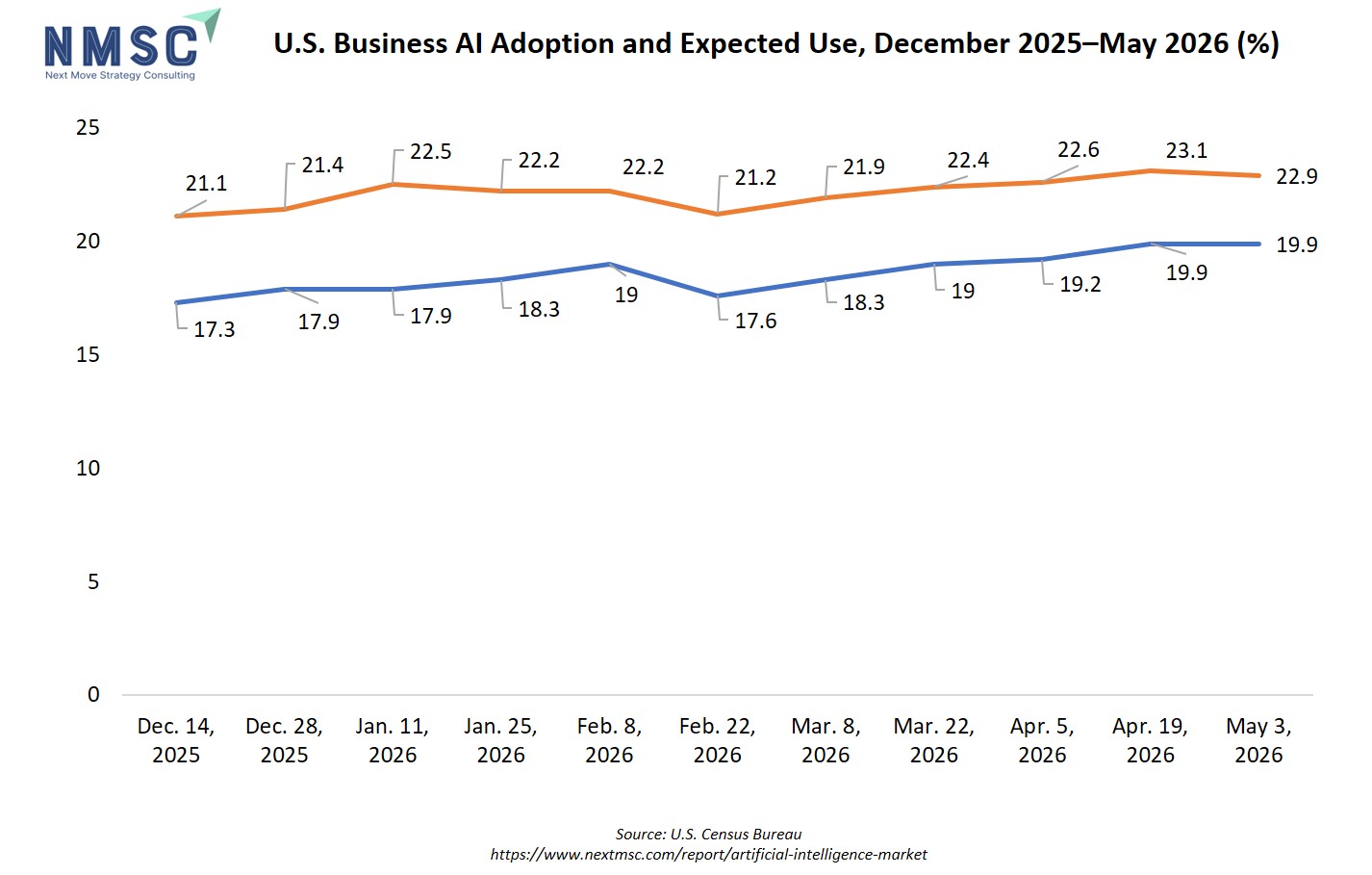
According to NMSC analysis, we found that the gap between record hyperscaler infrastructure capital expenditure and still-early enterprise AI adoption, with U.S. Census Bureau data showing only 19.8% of businesses using AI in a core function as of May 2026, is widening the addressable market for applications and professional services layers built to convert existing compute investment into measurable operational deployment.

Ecosystem Analysis of the Artificial Intelligence (AI) Industry

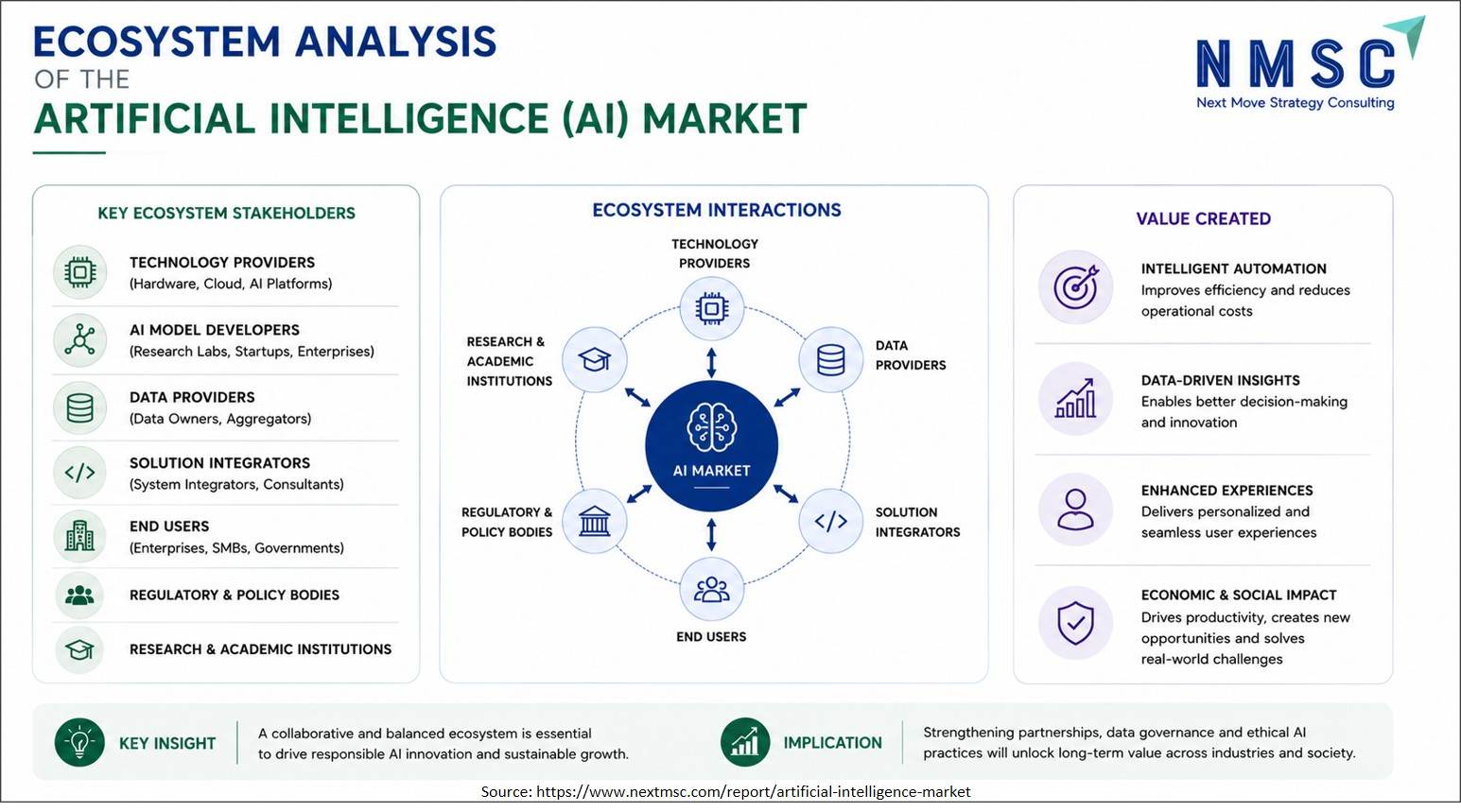
The above infographic provides a detailed ecosystem analysis of the Artificial Intelligence (AI) market, mapping out the interconnected roles of technology providers, data suppliers, model developers, and end users. It illustrates how these stakeholders interact to create significant value, including intelligent automation, data-driven insights, and enhanced user experiences. The framework further highlights the crucial involvement of regulatory bodies and research institutions in balancing innovation with responsibility. Ultimately, the analysis concludes that a collaborative ecosystem, supported by strong data governance and ethical AI practices, is essential for unlocking long-term value and sustainable growth across industries .

What does the Artificial Intelligence (AI) Market Encompass?

The Artificial Intelligence (AI) Market encompasses the hardware, cloud infrastructure, models and platforms, applications and agents, and professional services that together enable machine learning, generative, and agentic systems to perceive, reason, and act across enterprise, consumer, and government use cases. We observed that the market has structurally evolved from narrow, task-specific machine learning deployments toward foundation-model-based generative and reasoning systems, with NVIDIA reporting fiscal 2026 Data Center revenue of USD 193.7 billion, up 68% year over year, reflecting the scale of infrastructure investment underpinning this shift.

Regulatory frameworks are consolidating rapidly, with the European Union's AI Act entering full enforcement on August 2, 2026 under the European Commission's AI Office, while the Stanford Institute for Human- Centered AI's 2025 AI Index documented a ninefold increase in AI-related legislative mentions across 75 countries since 2016. During our market evaluation, we noticed that generative AI technology adoption remains dominant by revenue, while enterprise deployment of agentic and reasoning-capable systems is scaling fastest as organizations move beyond pilot programs toward production use cases.

Market Drivers & Dynamics

Interactive Dataset
Record hyperscaler and chipmaker AI infrastructure capital expenditure driver +6.8% North America, Asia-Pacific 2027–2032
Rising enterprise adoption of agentic and reasoning AI systems driver +4.5% North America, Europe 2027–2033
National AI investment programs across Asia-Pacific and the Gulf driver +3.2% Asia-Pacific, Middle East 2027–2032
Rapid generative AI enterprise integration into core software workflows driver +2.6% Global 2027–2031
Coordinated global AI governance frameworks improving enterprise trust driver +1.4% Europe, North America 2027–2030
Constrained data center power and accelerator supply restraint −2.8% North America, Asia-Pacific 2027–2030
Uneven enterprise adoption among small and mid-sized businesses restraint −1.6% Global 2027–2031
Fragmented cross-border AI regulatory compliance requirements restraint −1.1% Europe, Asia-Pacific 2027–2029
Source: Next Move Strategy Consulting

Growth Drivers

What Is the Primary Growth Driver of the Artificial Intelligence (AI) Market ?

Record hyperscaler and chipmaker AI infrastructure capital expenditure is the single largest driver of Artificial Intelligence (AI) Market growth, converting directly into hardware and cloud infrastructure revenue. NVIDIA's fiscal 2026 Data Center revenue of USD 193.7 billion, up 68% year over year, and its guided first-quarter fiscal 2027 revenue of approximately USD 78 billion illustrate the scale and continuity of this capital cycle. We observed that this infrastructure-led growth is compounding into downstream demand for models, applications, and professional services built atop expanding compute capacity.

How Is Government AI Investment Driving Market Growth?

National government AI investment programs are driving market growth outside the private sector, with Stanford HAI's 2025 AI Index documenting Canada's USD 2.4 billion pledge, China's USD 47.5 billion semiconductor fund, France's approximately USD 126.82 billion commitment, India's USD 1.25 billion pledge, and Saudi Arabia's USD 100 billion Project Transcendence initiative. Our analysis shows that the Middle East & Africa region is growing at a 30.3% CAGR from 2027 to 2035, the fastest of any region, reflecting the scale of Gulf state AI infrastructure commitments relative to the region's smaller existing base.

Growth Inhibitors

What Is Restraining the Artificial Intelligence (AI) Market Growth?

Constrained data center power and accelerator supply restrain the pace of infrastructure buildout, with NVIDIA's own SEC filings citing the availability of data centers , energy, and capital as critical dependencies for customer deployment timelines. Uneven enterprise adoption also restrains near-term revenue realization, as the U.S. Census Bureau's Business Trends and Outlook Survey found AI use below 20% among businesses with fewer than four employees as of May 2026. We found that these pressures are concentrating near-term AI spending among the largest, most capital-rich enterprises and hyperscalers .

What Are the Growth Opportunities?

How Can Vendors Capture Value from Enterprise Adoption-Gap Closure?

The gap between record AI infrastructure investment and the U.S. Census Bureau's measured 19.8% business adoption rate creates a mechanism for vendors to capture value through applications and professional services that convert existing compute capacity into deployed, measurable use cases. Vendors offering turnkey implementation and change-management services are best positioned to capture this adoption-gap opportunity.

What Opportunity Exists in Reasoning-Capable Agentic Platforms?

The architectural shift toward reasoning-capable, agentic AI systems creates a mechanism for vendors to capture premium platform revenue as enterprises move beyond single-turn generative tools toward autonomous, multi-step task execution. Vendors with proven agentic orchestration and reasoning infrastructure, aligned with platforms such as NVIDIA's Vera Rubin, are best positioned to capture this fastest-growing technology-modality opportunity.

How Can Suppliers Benefit from Sovereign and National AI Infrastructure Programs?

Sovereign AI infrastructure programs, including Saudi Arabia's USD 100 billion Project Transcendence and the EU's AI Gigafactories initiative unlocking over USD 100 billion in investment, create a mechanism for suppliers to secure large, government-anchored infrastructure and platform contracts. Vendors with established public-sector and sovereign-cloud relationships are best positioned to capture this policy-anchored regional opportunity.

Segmentation Analysis

2025 (USD Billion)
2035 (USD Billion)
Hardware 2025: $214.19 Billion | 2035: $835.13 Billion
Hardware
Cloud Infrastructure 2025: $163.79 Billion | 2035: $911.05 Billion
Cloud Infras
Applications and Agents 2025: $113.39 Billion | 2035: $1,062.89 Billion
Applications
Models and Platforms 2025: $100.80 Billion | 2035: $759.21 Billion
Models and P
Professional Services 2025: $37.80 Billion | 2035: $227.76 Billion
Professional
Hardware $214.19 Billion $835.13 Billion 18.5%
Cloud Infrastructure $163.79 Billion $911.05 Billion 23.9%
Applications and Agents $113.39 Billion $1,062.89 Billion 32.3%
Models and Platforms $100.80 Billion $759.21 Billion 28.7%
Professional Services $37.80 Billion $227.76 Billion 25.2%

Which Offering Segment Dominates the Artificial Intelligence (AI) Market ?

Hardware dominates the AI market with approximately a 34% share in 2026, valued at USD 214.19 billion, reflecting the scale of accelerator, server, and networking spending required to train and serve large models, consistent with NVIDIA's fiscal 2026 Data Center revenue of USD 193.7 billion. Applications and Agents is the fastest-growing offering segment at a 32.3% CAGR from 2027 to 2035, as enterprises shift spending from foundational infrastructure toward agentic AI systems embedded directly into business workflows.

2025 (USD Billion)
2035 (USD Billion)
Generative AI 2025: $239.39 Billion | 2035: $1,214.74 Billion
Generative A
Predictive and Prescriptive Analytics 2025: $138.59 Billion | 2035: $683.29 Billion
Predictive a
Natural Language Processing 2025: $88.20 Billion | 2035: $379.61 Billion
Natural Lang
Computer Vision 2025: $75.60 Billion | 2035: $455.53 Billion
Computer Vis
Reasoning and Decision Intelligence 2025: $31.50 Billion | 2035: $607.37 Billion
Reasoning an
Autonomous AI and Robotics 2025: $18.90 Billion | 2035: $265.72 Billion
Autonomous A
Speech and Audio Processing 2025: $37.80 Billion | 2035: $189.80 Billion
Speech and A
Generative AI $239.39 Billion $1,214.74 Billion 22.5%
Predictive and Prescriptive Analytics $138.59 Billion $683.29 Billion 22.1%
Natural Language Processing $88.20 Billion $379.61 Billion 20.0%
Computer Vision $75.60 Billion $455.53 Billion 25.2%
Reasoning and Decision Intelligence $31.50 Billion $607.37 Billion 44.8%
Autonomous AI and Robotics $18.90 Billion $265.72 Billion 39.2%
Speech and Audio Processing $37.80 Billion $189.80 Billion 22.3%

Which Technology Modality Segment Is Growing Fastest?

Generative AI leads the technology-modality segmentation with approximately a 38% share in 2026 at USD 239.39 billion, a lead consistent with Stanford HAI's 2025 AI Index finding that generative AI attracted USD 33.9 billion in global private investment in 2024 alone, an 18.7% increase from 2023. Reasoning and Decision Intelligence is the fastest-growing modality at a 44.8% CAGR, propelled by architecture shifts such as NVIDIA's Vera Rubin platform, purpose-built for agentic AI and reasoning workloads with up to tenfold lower token costs than prior-generation hardware.

2025 (USD Billion)
2035 (USD Billion)
Technology and Telecommunications 2025: $176.39 Billion | 2035: $835.13 Billion
Technology a
Financial Services and Insurance 2025: $100.80 Billion | 2035: $569.41 Billion
Financial Se
Professional and Business Services 2025: $75.60 Billion | 2035: $417.57 Billion
Professional
Healthcare and Life Sciences 2025: $50.40 Billion | 2035: $455.53 Billion
Healthcare a
Manufacturing and Automotive 2025: $50.40 Billion | 2035: $341.64 Billion
Manufacturin
Retail and Consumer Goods 2025: $56.70 Billion | 2035: $341.64 Billion
Retail and C
Government and Defense 2025: $37.80 Billion | 2035: $265.72 Billion
Government a
Media and Entertainment 2025: $37.80 Billion | 2035: $189.80 Billion
Media and En
Transportation and Logistics 2025: $25.20 Billion | 2035: $189.80 Billion
Transportati
Energy and Utilities 2025: $12.60 Billion | 2035: $113.88 Billion
Energy and U
Other Industries 2025: $6.30 Billion | 2035: $75.92 Billion
Other Indust
Technology and Telecommunications $176.39 Billion $835.13 Billion 21.5%
Financial Services and Insurance $100.80 Billion $569.41 Billion 24.2%
Professional and Business Services $75.60 Billion $417.57 Billion 23.8%
Healthcare and Life Sciences $50.40 Billion $455.53 Billion 31.7%
Manufacturing and Automotive $50.40 Billion $341.64 Billion 27.0%
Retail and Consumer Goods $56.70 Billion $341.64 Billion 25.2%
Government and Defense $37.80 Billion $265.72 Billion 27.6%
Media and Entertainment $37.80 Billion $189.80 Billion 22.3%
Transportation and Logistics $25.20 Billion $189.80 Billion 28.7%
Energy and Utilities $12.60 Billion $113.88 Billion 31.7%
Other Industries $6.30 Billion $75.92 Billion 36.5%

Which End-Use Industry Segment Leads the Artificial Intelligence (AI) Market ?

Technology and Telecommunications leads the end-use segmentation with approximately a 28% share in 2026 at USD 176.39 billion, reflecting hyperscalers ' and technology vendors' position as both the largest AI infrastructure buyers and sellers. Healthcare and Life Sciences is the fastest-growing end-use segment at a 31.7% CAGR, as regulatory clarity and clinical validation increasingly support AI deployment in diagnostics, drug discovery, and administrative automation within a sector that started 2026 with a comparatively low AI penetration base.

2025 (USD Billion)
2035 (USD Billion)
Cloud
On-Premises
Edge
Segment Item 2025 (USD Billion) 2035 (USD Billion) CAGR
Cloud $10.0 USD Billion $40.0 USD Billion 18.0%
On-Premises $17.1 USD Billion $51.1 USD Billion 24.0%
Edge $24.2 USD Billion $62.2 USD Billion 26.0%

Segment-wise data not detailed in this view

Unlock complete segment-wise numbers for By Deployment Model.

Unlock Full Data
2025 (USD Billion)
2035 (USD Billion)
Individual C
Small and Me
Large Enterp
Government a
Technology a
Segment Item 2025 (USD Billion) 2035 (USD Billion) CAGR
Individual Consumer $10.0 USD Billion $40.0 USD Billion 22.0%
Small and Medium Business $17.1 USD Billion $51.1 USD Billion 12.0%
Large Enterprise $24.2 USD Billion $62.2 USD Billion 14.0%
Government and Public Sector $31.3 USD Billion $73.3 USD Billion 12.0%
Technology and Cloud Providers $38.4 USD Billion $84.4 USD Billion 15.0%

Segment-wise data not detailed in this view

Unlock complete segment-wise numbers for By Buyer Type.

Unlock Full Data

Growth Opportunities

Beyond the core drivers shaping overall demand, three whitespace opportunities stand out for AI vendors positioning portfolios toward 2035.

How Can Vendors Capture Value from Enterprise Adoption-Gap Closure?

The gap between record AI infrastructure investment and the U.S. Census Bureau's measured 19.8% business adoption rate creates a mechanism for vendors to capture value through applications and professional services that convert existing compute capacity into deployed, measurable use cases. Vendors offering turnkey implementation and change-management services are best positioned to capture this adoption-gap opportunity.

What Opportunity Exists in Reasoning-Capable Agentic Platforms?

The architectural shift toward reasoning-capable, agentic AI systems creates a mechanism for vendors to capture premium platform revenue as enterprises move beyond single-turn generative tools toward autonomous, multi-step task execution. Vendors with proven agentic orchestration and reasoning infrastructure, aligned with platforms such as NVIDIA's Vera Rubin, are best positioned to capture this fastest-growing technology-modality opportunity.

How Can Suppliers Benefit from Sovereign and National AI Infrastructure Programs?

Sovereign AI infrastructure programs, including Saudi Arabia's USD 100 billion Project Transcendence and the EU's AI Gigafactories initiative unlocking over USD 100 billion in investment, create a mechanism for suppliers to secure large, government-anchored infrastructure and platform contracts. Vendors with established public-sector and sovereign-cloud relationships are best positioned to capture this policy-anchored regional opportunity.

Regional Outlook

North America $241.40 Billion $1,384.07 Billion 20.64%
Europe $135.32 Billion $830.55 Billion 21.56%
Asia-Pacific $179.27 Billion $1,191.41 Billion 22.63%
Middle East & Africa $28.05 Billion $146.76 Billion 19.41%
Latin America $45.94 Billion $243.25 Billion 19.57%

Strategic Analysis of the Artificial Intelligence (AI) Industry

The above infographic presents a strategic analysis of the Artificial Intelligence (AI) market, outlining the key dimensions shaping industry growth and competitive advantage. It identifies major growth drivers, such as exponential data growth and advancing computing power, alongside a central focus on sustainable AI leadership through priorities like talent development and responsible use. The framework further details actionable competitive strategies, from platform plays to vertical specialization. Ultimately, it emphasizes that combining innovation with responsible execution and agile strategy is critical for creating long-term value in the AI-driven future .

Competitive Landscape

Our assessment indicates that competitive intensity in the Artificial Intelligence (AI) Market is shaped by a concentrated group of infrastructure and hyperscale platform leaders alongside fast-scaling foundation-model developers competing across hardware, cloud, and applications layers within the broader AI infrastructure industry. Market Structure | Highly concentrated at the accelerator and hyperscale cloud tier around a small number of infrastructure leaders, fragmented at the applications and agents tier across a rapidly growing developer ecosystem. Innovation Focus | Agentic and reasoning-capable model architecture, physical AI and robotics integration, and vertically integrated hardware-to-application stacks. M&A Activity | Strategic compute-supply partnerships and licensing agreements rather than large-scale horizontal consolidation among the largest infrastructure providers. Source: www.nextmsc.com

How Do Companies Compete in the Artificial Intelligence (AI) Market ?

Companies compete primarily on compute performance per dollar, model capability benchmarks, enterprise deployment scale, and proprietary data and distribution advantages built over years of platform investment. Our analysis shows that NVIDIA competes on accelerator performance and ecosystem lock-in through platforms such as Vera Rubin, while Microsoft, Amazon, and Alphabet compete on hyperscale cloud distribution paired with proprietary and partnered foundation models.

Which Competitive Archetypes Dominate the Artificial Intelligence (AI) Market ?

Two archetypes dominate the market: vertically integrated infrastructure leaders controlling silicon, systems, and cloud distribution, and foundation-model developers competing primarily on model capability and API distribution. NVIDIA exemplifies the infrastructure-leader archetype through its end-to-end hardware and software stack, while Anthropic and OpenAI exemplify the model-developer archetype through frontier model capability distributed via cloud partnerships rather than owned infrastructure.

How Are Companies Differentiating Through Innovation?

Innovation and differentiation increasingly center on reasoning-capable architecture and physical AI integration extending beyond software into robotics and autonomous systems. NVIDIA's Vera Rubin platform, engineered for agentic AI with up to tenfold lower token costs, and its USD 6 billion in fiscal 2026 physical AI revenue spanning automotive and mobility partnerships both illustrate how infrastructure leaders are embedding proprietary capability across an expanding set of physical and digital use cases.

What M&A and Expansion Activity Is Shaping the Artificial Intelligence (AI) Market ?

Expansion activity is concentrated in compute-supply licensing agreements and strategic partnerships rather than large-format acquisitions among the leading infrastructure players. NVIDIA's non-exclusive licensing agreement with Groq to introduce the Rubin-integrated Groq 3 LPX accelerator illustrates how infrastructure leaders are securing complementary technology access through partnership rather than consolidation, preserving a competitive multi-vendor accelerator ecosystem.

Key Market Players

Our assessment indicates that the following 20 companies are actively shaping infrastructure investment, foundation-model development, and enterprise platform adoption within the global Artificial Intelligence (AI) Market .

NVIDIA Corporation Microsoft Corporation Anthropic, PBC Amazon.com, Inc. Alphabet Inc. Broadcom Inc. Alibaba Group Holding Limited Advanced Micro Devices, Inc. Oracle Corporation Dell Technologies Inc. Super Micro Computer, Inc. Huawei Technologies Co., Ltd. Cisco Systems, Inc. CoreWeave , Inc. OpenAI Group PBC Salesforce, Inc. ServiceNow, Inc. Baidu, Inc. Palantir Technologies Inc. International Business Machines Corporation

Latest Developments

We found that recent infrastructure, product, and regulatory developments within the Artificial Intelligence (AI) Market are concentrated on record capital deployment and coordinated global governance across 2025 and 2026.

Date Event
September 2026 Anthropic introduced Claude Fable 5.1 and Claude Mythos 5.1, describing them as its most advanced models for coding and knowledge work, with research capabilities aimed at scientific progress. Fable 5.1 and Mythos 5.1 share the same underlying model, while Mythos 5.1 provides more permissive safeguards for vetted cybersecurity and life-sciences research through trusted-access programs .
August 2026 Salesforce and Anthropic expanded their strategic partnership through Claudeforce , integrating Claude’s reasoning with Salesforce data, workflows, business logic, actions, and governance. The initial integration brings Salesforce functionality directly into Claude through prebuilt sales skills
August 2026 IBM and OpenAI announced a strategic partnership to help enterprises deploy AI across core operations and complex workflows. The collaboration combines OpenAI frontier models with IBM Consulting’s AI delivery capabilities and includes joint go-to-market initiatives .
May 2026 Alibaba unveiled Qwen3.7-Max, its new Zhenwu M890 AI chip, and a rebuilt cloud platform designed for autonomous AI agents. The integrated launch spans AI silicon, foundation models and cloud infrastructure, with the new platform supporting sustained agentic workloads .
May 2026 CoreWeave introduced unified capabilities connecting AI training, inference, observability, and reinforcement learning in a continuous development loop. The platform is designed to help enterprises deploy agents that improve through production data .

Expert Insights

Jensen Huang

Jensen Huang

Founder and Chief Executive Officer | NVIDIA

" We now have a new industry, an AI industry, and it’s now part of the new infrastructure, called intelligence infrastructure, that will be used by every country, every society . "

Analyst Interpretation

Thestatement highlights the structural transformation of AI from an emerging software capability into a foundational infrastructure layer supporting economies, enterprises, and public systems. Next Move Strategy Consulting’s analysis indicates that AI adoption is increasingly driving investment across computing infrastructure, accelerated processors, cloud platforms, data centers , AI models, and enterprise applications. Our findings suggest that the expansion of AI infrastructure, combined with rising deployment across industries and geographies, will remain a fundamental growth driver of the global AI market through 2035 .

Investment Opportunities

What Capital Inflows Are Targeting the Artificial Intelligence (AI) Market ?
Capital inflows are increasingly directed toward reasoning-capable infrastructure and generative AI platforms, with Stanford HAI documenting USD 33.9 billion in global private generative AI investment in 2024 alone, an 18.7% increase from 2023. We observed that investors favor infrastructure providers demonstrating sustained hyperscaler demand, viewing NVIDIA's record Data Center revenue growth as a proxy for the durability of the broader AI capital cycle.

How Is Infrastructure Investment Supporting AI Market Growth?

Infrastructure investment tied to national AI programs and sovereign initiatives continues to underwrite global AI capacity expansion, with Saudi Arabia's USD 100 billion Project Transcendence and the EU's AI Gigafactories program, which has unlocked approximately USD 34.8 billion in computing investment, both illustrating the scale of policy -anchored capital flowing into the sector. Our findings suggest that vendors with established sovereign and hyperscaler relationships are best positioned to capture this infrastructure-driven investment through 2035.

What ESG Considerations Are Shaping Investment Decisions?

Energy consumption and equitable access are central governance considerations shaping investment decisions, as AI data center power demand strains regional grid capacity and adoption gaps persist between large and small enterprises. Stanford HAI's 2025 AI Index documents that two-thirds of countries now offer or plan K–12 computer science education, twice as many as in 2019, reflecting growing attention to equitable AI-skills access. We found that investors increasingly treat energy-efficient compute design and broad-based adoption programs as governance indicators alongside conventional financial metrics.

Key Benefits for Stakeholders

How Does This Report Benefit Enterprise and Industry Leaders?

Enterprise and industry leaders gain access to validated segmentation, competitive benchmarking, and regional demand forecasts that support technology-investment and vendor-selection decisions across the AI industry. Our analysis shows that detailed offering, technology-modality, and end-use breakdowns help procurement and product teams align strategy with the fastest-growing segments, including Applications and Agents and Healthcare and Life Sciences.

How Does This Report Benefit Investors and Financial Analysts?

Investors and financial analysts benefit from consistent, single-point market size and CAGR estimates that support valuation and capital-allocation decisions across the AI supply chain. We observed that the report's regional and segment-level growth differentials help identify which vendors are best positioned to capture above-market growth in agentic applications and Middle East & Africa infrastructure expansion through 2035.

How Does This Report Benefit Technology Vendors and Product Teams?

Technology vendors and product teams gain insight into emerging design requirements, including agentic orchestration, reasoning-capable model architecture, and governance-ready deployment tooling, that are reshaping the industry. Our findings suggest that this analysis helps R&D teams prioritize development roadmaps around the Reasoning and Decision Intelligence and Edge deployment segments showing the strongest above-market growth trajectories.

Key Market Segments Evaluated

By Offering

  • Hardware
  • Cloud Infrastructure
  • Applications and Agents
  • Models and Platforms
  • Professional Services

By Technology Modality

  • Generative AI
  • Predictive and Prescriptive Analytics
  • Natural Language Processing
  • Computer Vision
  • Reasoning and Decision Intelligence
  • Autonomous AI and Robotics
  • Speech and Audio Processing

By End-Use Industry

  • Technology and Telecommunications
  • Financial Services and Insurance
  • Professional and Business Services
  • Healthcare and Life Sciences
  • Manufacturing and Automotive
  • Retail and Consumer Goods
  • Government and Defense
  • Media and Entertainment
  • Transportation and Logistics
  • Energy and Utilities
  • Other Industries

By Deployment Model

  • Cloud
  • On-Premises
  • Edge

By Buyer Type

  • Individual Consumer
  • Small and Medium Business
  • Large Enterprise
  • Government and Public Sector
  • Technology and Cloud Providers
  • Academic and Research Institutions

Conclusion & Recommendations

The long-term outlook for the AI market remains exceptionally strong, with global revenue projected to grow more than sixfold from USD 629.97 billion in 2026 to USD 3,796.05 billion by 2035 at a 21.3% CAGR. We observed that record infrastructure investment, accelerating enterprise adoption, and the shift toward agentic and reasoning-capable systems will continue underpinning demand across hardware, software, and applications layers through the forecast period.

What Strategic Positioning Should AI Vendors Pursue?

Vendors should prioritize agentic and reasoning-capable platform architecture while building governance and compliance tooling aligned with frameworks such as the EU AI Act to capture both innovation-led and compliance-driven demand. Our assessment indicates that vendors investing early in applications and professional services that close the enterprise adoption gap documented by the U.S. Census Bureau will be best positioned to capture durable, recurring revenue.

How Attractive Is the Artificial Intelligence (AI) Market for New Investment?

The AI market presents an exceptionally attractive investment case, supported by a USD 3,166.08 billion absolute dollar opportunity between 2026 and 2035 and above-average growth in Reasoning and Decision Intelligence and Middle East & Africa infrastructure investment. We found that investment attractiveness is highest for vendors combining proven infrastructure scale with expanding applications-layer distribution, positioning them to capture both capital-expenditure-driven and adoption-driven growth simultaneously.

What Market Shifts and Key Risks Should Stakeholders Monitor?

Stakeholders should monitor constrained data center power and accelerator supply, uneven enterprise adoption between large and small businesses, and fragmented cross-border regulatory compliance as key risks to the Artificial Intelligence (AI) Market . Our analysis shows that vendors unable to demonstrate compliance readiness under frameworks such as the EU AI Act risk losing access to regulated enterprise and public-sector contracts as global AI governance continues to mature.

What Are the Key Growth Pathways for the Artificial Intelligence (AI) Market?

Key growth pathways include scaling agentic and reasoning-capable infrastructure following precedents such as NVIDIA's Vera Rubin platform, deepening enterprise applications that close the documented adoption gap, and expanding sovereign AI infrastructure partnerships across the Middle East and Asia-Pacific. NMSC 's analysis indicates that vendors pursuing these pathways while maintaining regulatory compliance readiness will be best positioned to capture the market's projected growth through 2035.

FAQs

About the Author

Mayurima Roy

Mayurima Roy

Mayurima Roy is Research Analyst at Next Move Strategy Consulting, where she has spent 4 years working across the firm's full industry coverage rather than a single fixed vertical. Her work centers on structured research, ongoing trend tracking, competitive assessment, and insight-led content development, translating complex market data into clear, decision-ready narratives that support informed client decision-making across diverse global industries, market sectors, and world regions every day.

About the Reviewer

Supradip Baul

Supradip Baul

Supradip Baul is an accomplished business consultant and strategist with over a decade of rich experience in market intelligence, strategy, technology, and business transformation. His work has included rigorous qualitative and quantitative analysis across multiple industries, helping clients shape investment decisions and long-term roadmaps. Earlier in his career, he was associated with Gartner, where he contributed to industry-leading reports and market share analyses. He has worked with leading global companies and holds an MBA with a dual specialization in Marketing and Finance.

Kishu Kanda

KISHU KANDA

Strategy Analyst

Accenture

We purchased the AI Consumer Market Report from this company. Not only did they customize the report to meet our specific requirements, but they also showed great flexibility in accommodating our budget. The report we received fully met our expectations. Additionally, they provided prompt and thorough responses to both our pre-purchase and follow-up questions. We look forward to working with this company again in the future.

Amos Chang

AMOS CHANG

Strategy Consultant

Kardex Group

I have bought the intralogistics market reports from NMSC two times so far. Joseph and his team are always very helpful and flexible in responding to any customization requirements on the report. Their expertise in market reports really helps us steer the day-to-day business. I will definitely recommend and come back myself whenever there is a need.

Pratyush Kumar Das

PRATYUSH KUMAR DAS

Assistant Manager

Polycab India Limited

We would like to express our appreciation for the data and insights provided by nextmsc. We are very pleased with the quality and depth of the information, which has proven to be highly valuable and beneficial for our business decision-making.

Melanie Samko

MELANIE SAMKO

Director of Marketing

TOSOH BIOSCIENCE, INC.

The information provided by NMSC is incredibly valuable, thank you so much for such a excellent work. I really appreciate it. I will make sure to reference all of it, in my summary document.

Henri Knyphausen

HENRI KNYPHAUSEN

Partner at Singulier [Ex-BCG]

Singulier

I recently engaged NEXTMSC.com for a commercial due diligence project within the intralogistics sector, and I am pleased to provide a reference based on my experience. In utilizing NEXTMSC.com's services, I found their report to offer valuable insights into market dynamics and key industry players. The initial report provided a solid foundation for our analysis. However, as we were investigating a smaller target in the market, and I had specific customization requests requiring additional research. These requests included detailed information on product portfolios of various players and sub-market sizes, both inclusive and exclusive of certain product categories. NEXTMSC.com demonstrated commendable responsiveness and agility in accommodating these customization requests. Within a timeframe of 1-2 weeks, they delivered a revised report that met our specific needs. Furthermore, they were receptive to my follow-up inquiries, ensuring clarity and understanding of the data provided. The final deliverable significantly contributed to our due diligence efforts. One of NEXTMSC.com's notable strengths lies in their qualitative research capabilities. However, for future engagements, I would recommend the inclusion of a quantified market model in Excel format. Such a model would offer the ability to conduct in-depth analyses and explore various market segments, including country-specific data and subcomponent breakdowns. Based on my positive experience, I would not hesitate to work with NEXTMSC.com again. Their responsiveness, willingness to accommodate customization requests, and commitment to delivering actionable insights make them a reliable partner for commercial research projects.

Custom Market Research Services

We will customize the research for you if the listed report does not fully match your requirements.

Get 30% Free Customization

Select License

This website uses cookies to ensure you get the best experience on our website. Learn more

✖