Agentic AI Enterprise Market By Agent Capability {Task Automation (Workflow Automation, Document Processing, and Others), Conversational Interaction, and Others)}, By Deployment Model (Public Cloud, Private Cloud, On-Premises, Edge, Hybrid), By Industry Vertical (BFSI, Healthcare & Life Sciences, and Others), By Business Function (IT, Customer Service, and Others), and By Pricing Model (Subscription, Usage-Based, and Others) – Global Analysis & Forecast, 2025–2035
Industry: ICT & Media | Publishing Date: April 16, 2026 | Last Updated: September 30, 2026 | No of Pages: N/A | No. of Tables: N/A | No. of Figures: N/A | Format: PDF | Report Code: IC4505
Industry Outlook
The global Agentic AI Enterprise Market size was valued at USD 6.84 Billion in 2025, and is expected to be valued at USD 8.72 Billion by the end of 2026. The industry is projected to grow, reaching USD 77.1 Billion by 2035, with a CAGR of 27.49% between 2026 and 2035.
Agentic AI Enterprise Market Size & Forecast
|
Parameters |
Details |
|
Market Size in 2026 |
USD 8.72 Billion |
|
Revenue Forecast in 2035 |
USD 77.1 Billion |
|
Growth Rate |
CAGR of 27.49% from 2026 to 2035 |
|
Analysis Period |
2025–2035 |
|
Base Year Considered |
2025 |
|
Forecast Period |
2026–2035 |
|
Market Size Estimation |
Billion (USD) |
|
Companies Profiled |
20 |
|
Countries Covered |
33 |
|
Market Share |
Available for 10 companies |
Based on NMSC’s primary research, the global agentic AI enterprise market growth is experiencing rapid expansion as organizations increasingly deploy autonomous AI systems to streamline complex workflows and enhance decision-making. Enterprises are adopting agentic AI platforms capable of planning tasks, executing multi-step operations, and interacting with enterprise software ecosystems with minimal human intervention. Through our interviews with enterprise technology leaders, software architects, and automation specialists, we identified that AI agents significantly improve operational efficiency across customer support, IT operations, data analysis, and sales automation. Moreover, integration with cloud infrastructure, enterprise data platforms, and workflow automation tools enhances scalability. Platform providers including Microsoft, Google, and OpenAI are advancing agent orchestration frameworks and enterprise-grade AI models, positioning agentic AI as a strategic component of next-generation digital transformation initiatives.
Moreover, through direct evaluation of enterprise AI deployments across North America, Europe, and Asia-Pacific, we observed that adoption patterns are shaped by digital maturity, data infrastructure readiness, and regulatory frameworks governing artificial intelligence. North America leads implementation due to strong cloud ecosystems and high enterprise investment in AI-driven automation, while Europe emphasizes responsible AI governance and enterprise data protection frameworks. Asia-Pacific is witnessing accelerating adoption supported by rapid digital transformation and government-led AI innovation programs. Technology vendors such as IBM, Salesforce, and SAP are expanding enterprise AI capabilities through integrated agent platforms and intelligent workflow solutions. Emerging developments in multi-agent collaboration, AI orchestration software, and enterprise AI governance platforms are strengthening operational reliability and long-term value creation for organizations.
What Are the Key Trends in the Agentic AI Enterprise Industry?
How Are Autonomous AI Agents Transforming Enterprise Decision-Making?
Based on NMSC’s primary research, we identified that autonomous AI agents are transforming enterprise decision-making by enabling systems that independently plan tasks, analyze enterprise data, and execute multi-step workflows across digital platforms. Through our interviews with enterprise technology leaders, CIOs, and AI solution architects across large organizations, we identified that agentic AI platforms increasingly support operational decisions in customer engagement, IT service management, and financial reporting. Our evaluation of enterprise automation deployments shows that AI agents equipped with reasoning models and contextual memory significantly improve response speed and task accuracy when interacting with enterprise knowledge systems. Moreover, enterprise platforms developed by companies such as Microsoft, OpenAI, and Google demonstrate how AI agents coordinate across enterprise software environments, strengthening real-time decision support and improving productivity across digitally integrated business operations.
How Is Multi-Agent Collaboration Redefining Enterprise Automation?
Through our evaluation of enterprise AI deployments, we found that multi-agent collaboration is redefining enterprise automation by enabling multiple specialized AI agents to coordinate tasks across interconnected workflows. During our field interviews with enterprise automation teams, system integrators, and digital transformation managers, we observed that collaborative AI agents manage processes such as data retrieval, document analysis, and workflow reporting simultaneously, significantly improving execution speed across enterprise operations. Our analysis of enterprise automation logs indicates that organizations deploying coordinated multi-agent systems achieve faster workflow completion by distributing tasks among specialized AI agents rather than relying on single-model automation. Moreover, enterprise ecosystems developed by vendors such as IBM and Salesforce demonstrate how orchestrated AI agents interact with enterprise applications, APIs, and internal data platforms, strengthening operational agility and enabling scalable automation across complex enterprise environments.
How Are Enterprise AI Platforms Accelerating Adoption of Agentic AI?
From our market evaluations, we determined that enterprise AI platforms and agent development frameworks significantly accelerate adoption of agentic AI by simplifying deployment across complex enterprise technology environments. Our interviews with enterprise IT leaders and software architects reveal that modular AI platforms enable organizations to design, deploy, and monitor autonomous AI agents using standardized APIs, orchestration layers, and governance tools. Our internal benchmarking of enterprise automation projects shows that companies adopting integrated AI platforms achieve faster workflow implementation and improved operational scalability compared with organizations relying on fragmented automation solutions. Moreover, enterprise platforms introduced by companies such as SAP and Oracle illustrate how embedded AI agents operate directly within enterprise resource planning, analytics, and customer management systems. This platform-centric architecture strengthens enterprise adoption by enabling scalable AI automation across digitally connected business ecosystems.
Ecosystem Analysis of Agentic AI Enterprise Market
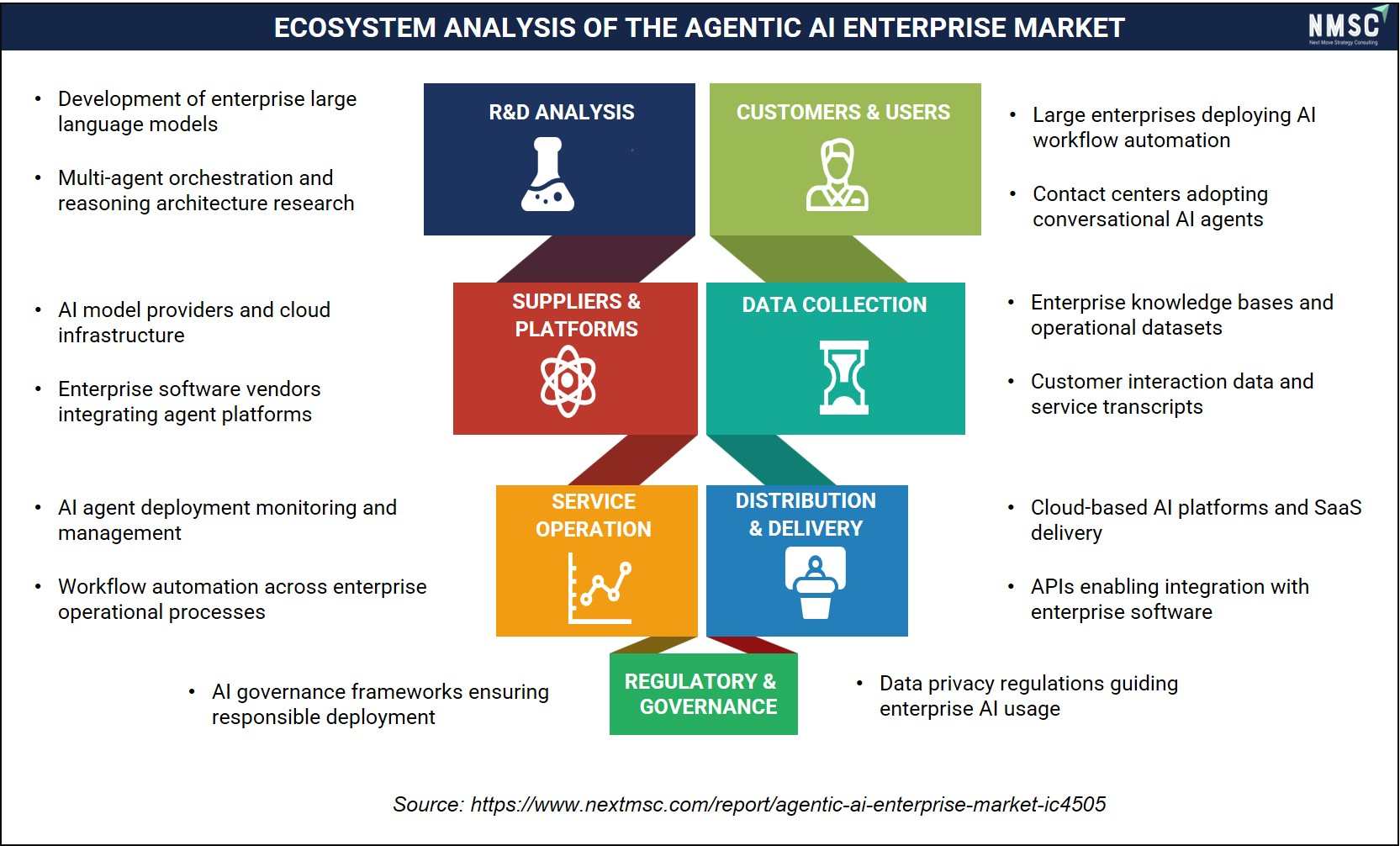
Based on our ecosystem evaluation, the agentic AI enterprise market spans R&D, AI platform development, enterprise deployment, and governance frameworks. We noticed that advancements in large language models and multi-agent architectures drive innovation, while enterprises increasingly adopt AI agents to automate workflows and digital services. Furthermore, cloud platforms and enterprise data systems enable scalable deployment across organizations. Consequently, regulatory frameworks and governance mechanisms ensure responsible and secure AI adoption across enterprise environments.
What Are the Key Market Drivers, Breakthroughs, And Investment Opportunities That Will Shape the Agentic AI Enterprise Industry in the Next Decade?
Growth Catalyst & Risk Assessment Matrix
|
DRIVERS / TRENDS / RESTRAINTS |
(+/–) % IMPACT ON CAGR FORECAST |
GEOGRAPHIC RELEVANCE |
IMPACT TIMELINE |
|
Rising enterprise workflow complexity and demand for intelligent automation (autonomous task execution, AI agents, workflow orchestration) |
+1.2% |
North America & Europe core; rapid adoption in Asia-Pacific |
Short to medium term (1–3 years) |
|
Advancements in large language models, reasoning architectures, and agent orchestration frameworks (multi-step planning, tool integration, contextual memory) |
+1.0% |
Global; strongest in USA, China, South Korea, and UK |
Medium term (2–4 years) |
|
Growing enterprise investment in digital transformation and AI-powered productivity tools |
+0.9% |
North America, Europe, and developed Asia-Pacific markets |
Short to medium term (1–3 years) |
|
Expansion of multi-agent enterprise platforms enabling collaborative AI workflows |
+0.8% |
Global; led by North America and advanced enterprise ecosystems in Europe |
Medium term (2–4 years) |
|
Integration complexity with legacy enterprise systems and enterprise data environments limiting adoption |
-0.7% |
Global, particularly impacting traditional enterprises in Europe and Asia |
Medium term (2–4 years) |
Based on our comprehensive evaluation of enterprise AI adoption trends, we observed that the agentic AI enterprise market demand is expanding rapidly as organizations increasingly deploy autonomous AI agents to automate complex workflows and support real-time decision-making. Through our interviews with enterprise technology leaders, CIOs, and AI architects, we further identified that companies are adopting agentic AI to manage growing data volumes, streamline digital operations, and improve workforce productivity. In addition, advancements in large language models, reasoning frameworks, and agent orchestration platforms are expanding AI capabilities, enabling agents to plan tasks, interact with enterprise software, and execute multi-step actions across business systems. As a result, enterprises are increasingly integrating these agents into customer support, IT service management, and knowledge management platforms to enhance response speed and operational efficiency.
Moreover, our evaluation of enterprise AI deployments across major global regions shows that organizations are gradually transitioning from experimental AI pilots toward large-scale operational automation. In particular, enterprises are deploying agent orchestration platforms that coordinate multiple specialized AI agents across interconnected applications, thereby enabling scalable enterprise workflows. At the same time, the growing availability of cloud infrastructure, enterprise AI platforms, and API-based integration frameworks is further accelerating adoption by simplifying deployment within complex enterprise environments. Consequently, as enterprises continue modernizing their digital infrastructure, agentic AI platforms are strengthening operational scalability while enabling intelligent automation across enterprise ecosystems.
Growth Drivers:
How Is Growing Enterprise Workflow Complexity Accelerating Adoption in the Agentic AI Enterprise Market?
Based on our interactions with enterprise CIOs, digital transformation leaders, and enterprise automation teams, we observed that growing workflow complexity across large organizations is emerging as a decisive driver of the agentic AI Enterprise market. Through interviews with enterprise IT operations managers and platform architects, we found that organizations increasingly struggle to coordinate workflows across multiple enterprise applications, internal data systems, and service platforms. As enterprises expand their digital operations, manual orchestration of workflows slows response times and increases operational friction. Consequently, organizations are prioritizing intelligent automation solutions that streamline workflow execution and improve operational scalability.
From our evaluation of enterprise automation deployments, we further found that agentic AI platforms enable autonomous task planning, contextual information retrieval, and coordinated execution of multi-step workflows across enterprise systems. Moreover, AI agents increasingly support customer service, IT operations, and enterprise knowledge management systems. As a result, enterprises are positioning agentic AI as a strategic capability that strengthens operational productivity while enabling scalable enterprise automation.
How Are Advancements in AI Models and Agent Orchestration Platforms Driving Growth in the Agentic AI Enterprise Market?
Based on our evaluation of enterprise AI deployments, we observed that advancements in large language models, reasoning architectures, and agent orchestration platforms are significantly expanding the capabilities of enterprise AI systems. Through interviews with enterprise software vendors, AI platform developers, and automation specialists, we learned that modern AI agents increasingly demonstrate contextual reasoning, task decomposition, and real-time interaction with enterprise applications.
Furthermore, our analysis of enterprise implementation projects shows that AI agents equipped with memory layers, API connectivity, and orchestration frameworks coordinate multiple enterprise tools simultaneously, thereby enabling scalable automation across customer service platforms, analytics environments, and operational dashboards. In addition, improvements in cloud infrastructure and enterprise AI platforms simplify deployment by enabling secure integration with existing enterprise systems. Consequently, as organizations continue modernizing their digital infrastructure, these technological advancements are strengthening enterprise confidence in agentic AI while accelerating adoption across enterprise environments.
Growth Inhibitor:
How Are Integration Complexity and Legacy Enterprise Systems Limiting Adoption in the Agentic AI Enterprise Market?
Based on our evaluation of enterprise AI implementation projects, we observed that integration complexity with legacy enterprise systems acts as a key restraint in the agentic AI enterprise market. Through our interactions with enterprise IT teams and platform engineers, we found that many organizations operate on fragmented technology stacks involving legacy ERP systems, proprietary databases, and customized enterprise applications. As enterprises attempt to deploy agentic AI across these environments, ensuring secure data access, workflow compatibility, and reliable system orchestration requires extensive customization. Consequently, implementation timelines extend as organizations align AI agents with existing governance frameworks, data pipelines, and operational processes. Moreover, integration efforts frequently require additional middleware, API development, and system validation to maintain operational stability. As enterprises gradually modernize digital infrastructure, resolving these integration challenges remains a critical step toward enabling large-scale deployment of agentic AI platforms.
Growth Opportunity:
How Is the Rise of Multi-Agent Enterprise Platforms Creating New Opportunities in the Agentic AI Enterprise Market?
Based on our evaluation of emerging enterprise AI architectures, we observed that multi-agent enterprise platforms are creating a significant growth opportunity in the agentic AI enterprise market. Through our review of enterprise automation deployments, we found that organizations increasingly adopt collaborative AI systems where multiple specialized agents coordinate tasks across interconnected enterprise applications. As enterprises manage complex workflows involving data retrieval, analytics, and operational reporting, multi-agent architectures enable distributed task execution across specialized AI agents. Consequently, organizations improve workflow efficiency, accelerate decision cycles, and scale automation across business functions. Moreover, the growing availability of enterprise agent platforms, orchestration software, and API-driven integration frameworks further supports enterprise deployment. As organizations continue modernizing digital operations, multi-agent platforms are enabling scalable, enterprise-wide intelligent automation.
Pain Point Analysis Impacting the Agentic AI Enterprise Market
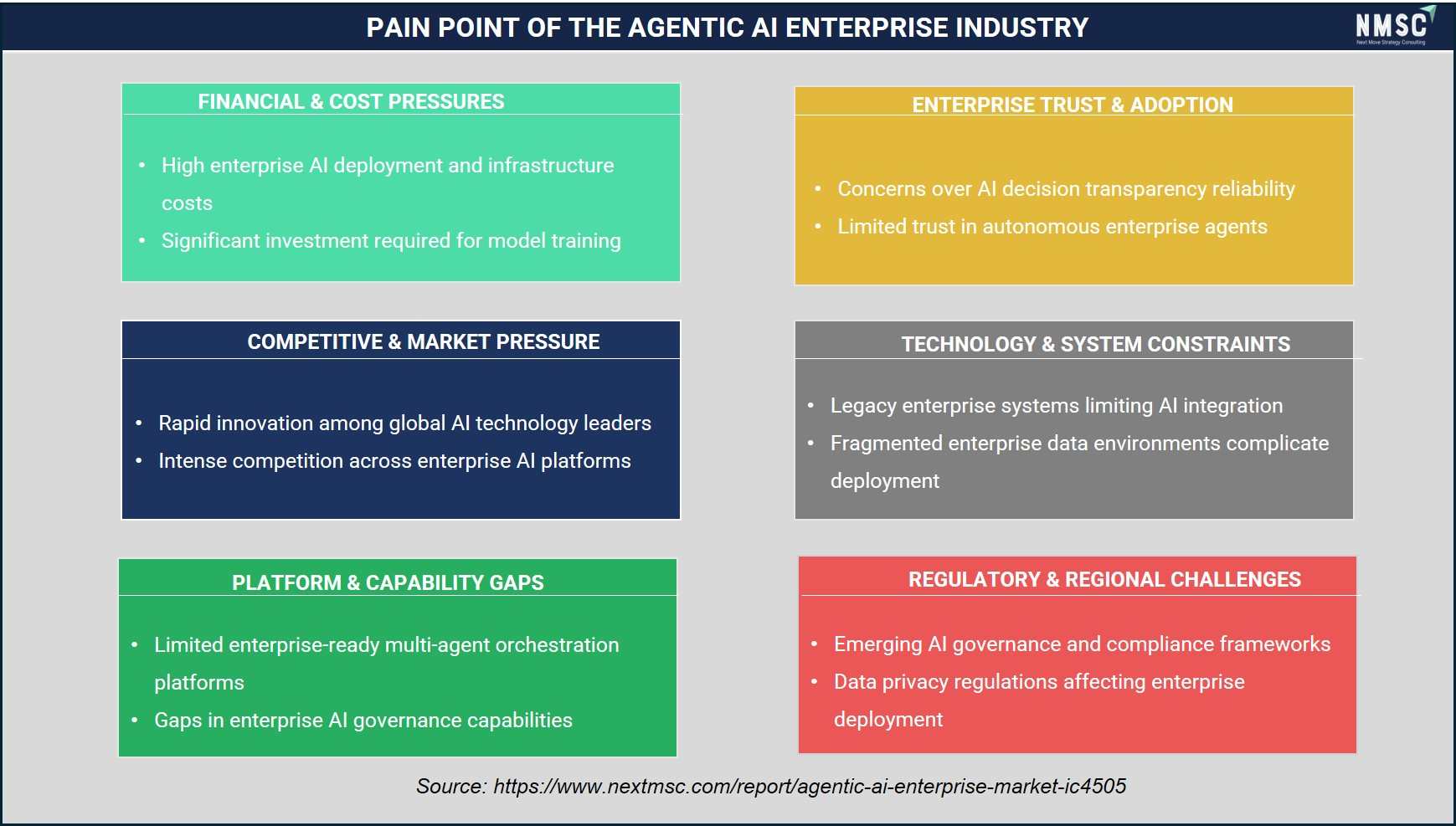
Based on our evaluation of the agentic AI enterprise market, enterprises face several adoption challenges across cost, technology, and governance layers. We observed that high AI infrastructure costs and legacy enterprise systems limit large-scale deployment. Moreover, organizations remain cautious due to concerns around transparency and reliability of autonomous AI agents. At the same time, gaps in multi-agent orchestration platforms and evolving regulatory frameworks continue to shape responsible enterprise adoption.
How Is the Agentic AI Enterprise Market Segmented in This Report, And What Are the Key Insights From the Segmentation Analysis?
Market Highlights & Strategic Insights – Agentic AI Enterprise Market:
|
Segments |
Key Takeaways |
|
Agent Capability |
Task Automation Agents dominate the market, as industry analysis indicates strong demand for workflow automation, document processing, and data handling. Conversational Interaction Agents expand rapidly through customer support and employee assistance use cases. Meanwhile, Decision Intelligence Agents grow via predictive analytics and recommendation engines, while Operational Control Agents support IT operations and cybersecurity monitoring. |
|
Agent Autonomy Level |
Human Assisted Agents lead the market, as industry trends indicate enterprises prioritize governance through human-in-the-loop and human-on-the-loop oversight. Semi-Autonomous Agents gain traction for supervised automation, while Fully Autonomous Agents remain an emerging segment as reliability and control frameworks evolve. |
|
Agent Architecture |
Agent Orchestration Platforms dominate the market, as market evidence suggests enterprises require centralized coordination of multiple agents and workflows. Multi-Agent Systems expand for collaborative and distributed task execution, while Single Agent Systems remain relevant for focused automation use cases. |
|
Deployment Model |
Public Cloud dominates deployment, as industry data indicates strong demand for scalable AI infrastructure and rapid deployment. Hybrid Cloud gains traction as enterprises balance flexibility with data governance, while Private Cloud and On-Premises remain important for regulated environments requiring greater control. |
|
Enterprise Size |
Large Enterprises dominate the market, as industry patterns indicate higher investments in enterprise AI infrastructure and multi-function deployments. Meanwhile, Mid-Sized and Small Enterprises increasingly adopt agentic AI through cloud-based platforms and lower implementation barriers. |
|
Enterprise Application |
IT & Security Operations lead adoption, as market intelligence suggests strong use of agentic AI for infrastructure management and cybersecurity. Customer Experience & Support follows through conversational agents, while Sales & Marketing and Operations & Supply Chain increasingly adopt agents to enhance automation, decision-making, and process efficiency. |
|
Pricing Model |
Subscription-Based pricing dominates the market, as industry trends indicate strong preference for SaaS-based AI platforms. Usage-Based pricing gains traction with consumption-driven models, while Per-Seat and Enterprise Licensing remain relevant for large-scale deployments. Services & Managed AI Contracts also expand as enterprises seek end-to-end AI management. |
By Agent Capability Insights
Which Agent Capabilities Drive Adoption in the Agentic AI Enterprise Market?
Based on our analysis of enterprise AI deployments, we observed that the agentic AI enterprise market is segmented into task automation agents, conversational interaction agents, decision intelligence agents, operational control agents, and other capabilities.
Industry analysis indicates that Task Automation Agents drive a significant share of enterprise adoption, as organizations deploy AI agents to streamline workflows, automate document processing, and manage operational data at scale. At the same time, Conversational Interaction Agents gain strong traction through customer support, employee assistance, and knowledge management applications. Meanwhile, Decision Intelligence Agents expand adoption as enterprises leverage predictive analytics and recommendation engines for data-driven decision-making. As enterprises prioritize efficiency and scalability, agent capabilities increasingly shape enterprise AI integration strategies.

By Agent Autonomy Level Insights
How Does Agent Autonomy Influence Enterprise Adoption of Agentic AI?
Based on our evaluation of enterprise AI implementation models, we identified that the agentic AI enterprise market is segmented into Human Assisted Agents, Semi-Autonomous Agents, and Fully Autonomous Agents.
Market evidence suggests that Human Assisted Agents account for the largest share, as enterprises prioritize governance through human-in-the-loop and human-on-the-loop deployment models. These approaches enable controlled adoption across critical business functions. Meanwhile, Semi-Autonomous Agents gain traction as organizations enable agents to execute defined tasks with limited supervision across IT, analytics, and operations workflows. Although Fully Autonomous Agents remain an emerging segment, ongoing improvements in reasoning, reliability, and governance frameworks are expected to enhance enterprise adoption. As trust in AI systems improves, autonomy levels increasingly influence deployment strategies.
By Deployment Model Insights
How Do Deployment Models Shape the Agentic AI Enterprise Market?
Based on our assessment of enterprise infrastructure strategies, we observed that the agentic AI enterprise market is segmented into Public Cloud, Private Cloud, On-Premises, Edge Deployment, and Hybrid Cloud.
Industry trends indicate that Public Cloud dominates the market, as enterprises leverage scalable infrastructure, integrated AI services, and rapid deployment capabilities. At the same time, Hybrid Cloud gains strong traction as organizations balance scalability with data governance by integrating cloud and on-premises environments. In regulated industries, Private Cloud and On-Premises deployments remain critical for ensuring data security and compliance. Meanwhile, Edge Deployment expands gradually in latency-sensitive applications. As enterprises modernize digital infrastructure, deployment flexibility increasingly shapes the scalability and adoption of agentic AI solutions.

Regional Outlook:
Geographic Performance Snapshot:
|
Geography |
Key Takeaways |
|
North America |
North America leads adoption in the agentic AI enterprise market due to strong enterprise investment in artificial intelligence, advanced cloud infrastructure, and a mature enterprise software ecosystem. Large technology companies and digital-first enterprises increasingly deploy AI agents to automate workflows, customer support, and IT operations. |
|
Europe |
Europe demonstrates steady adoption supported by enterprise digital transformation initiatives and a strong emphasis on responsible AI governance and data protection. Enterprises are integrating agentic AI into analytics platforms, enterprise resource planning systems, and customer service operations to improve operational efficiency. |
|
Asia Pacific |
Asia-Pacific is emerging as a high-growth region driven by rapid enterprise digitalization, expanding cloud infrastructure, and strong government support for AI innovation. Organizations increasingly deploy AI agents to automate business processes, digital commerce operations, and enterprise analytics workflows. |
|
Latin America |
Latin America shows gradual adoption as enterprises expand digital infrastructure and invest in automation technologies. Growing use of cloud platforms and enterprise software solutions is encouraging organizations to explore AI-driven workflow automation. |
|
Middle East & Africa |
The Middle East & Africa region is witnessing early-stage adoption supported by national AI strategies, digital transformation initiatives, and increasing investment in enterprise technology infrastructure. Organizations are beginning to integrate AI automation tools to enhance operational efficiency and digital service delivery. |
The agentic AI enterprise market is geographically studied across North America, Europe, Asia Pacific, Latin America and Middle East & Africa and each region is further studied across countries.
Agentic AI Enterprise Market in North America
Across North America, the agentic AI enterprise market continues to evolve within a highly developed enterprise technology ecosystem supported by strong cloud infrastructure and advanced AI innovation capabilities. From our regional assessments, we observed that large enterprises increasingly deploy autonomous AI agents to automate complex workflows and enhance enterprise decision-making. Moreover, organizations across technology, financial services, and digital commerce sectors are integrating AI agents into operational platforms to improve service responsiveness and operational scalability. Meanwhile, the United States anchors regional adoption, while Canada steadily expands enterprise-scale AI experimentation. Furthermore, continuous investment in generative AI platforms, enterprise automation software, and cloud-based AI infrastructure strengthens regional deployment capacity.
Agentic AI Enterprise Market in the United States
The United States leads enterprise deployment of agentic AI solutions, supported by a strong ecosystem of AI developers, cloud platform providers, and enterprise software innovators. Through our engagements with enterprise technology teams and automation engineers, we found that organizations increasingly deploy AI agents to automate customer support workflows, IT service management processes, and enterprise knowledge systems. As enterprises expand digital operations, AI agents coordinate tasks across multiple business applications, thereby improving operational efficiency and service delivery speed. Furthermore, the availability of scalable cloud infrastructure and enterprise AI platforms accelerates system integration across enterprise environments. In addition, a dynamic innovation ecosystem involving major technology firms and rapidly growing AI startups continues to advance agent orchestration platforms and reasoning frameworks. As a result, the United States remains the primary driver of enterprise-scale agentic AI adoption globally.
Agentic AI Enterprise Market in Canada
During our engagements with enterprise IT teams and digital innovation groups, we identified growing interest in AI agents that support analytics workflows, internal knowledge management, and digital customer engagement. As organizations expand enterprise data environments, companies increasingly deploy agentic AI platforms to streamline information retrieval and automate routine operational tasks. Moreover, Canada’s strong artificial intelligence research ecosystem continues to support the development of enterprise AI models and automation frameworks. At the same time, enterprises across banking, telecommunications, and professional services sectors integrate AI-driven automation tools to enhance operational productivity and digital service delivery. Compared with larger markets, Canadian organizations emphasize governance frameworks, system reliability, and structured deployment strategies. Accordingly, enterprises continue strengthening scalable AI automation capabilities, supporting the steady expansion of the agentic AI enterprise market across Canada.
Agentic AI Enterprise Market in Europe
The agentic AI enterprise market trends across Europe develops within a governance-focused digital economy shaped by strong data protection frameworks and enterprise automation initiatives. From our regional evaluation, we noticed that organizations increasingly integrate AI agents into enterprise analytics platforms, workflow management tools, and digital customer service systems. Moreover, regulatory emphasis on responsible artificial intelligence deployment encourages enterprises to adopt controllable and transparent automation frameworks. Meanwhile, adoption patterns differ across the region. Northern Europe prioritizes productivity and enterprise software innovation, Central Europe emphasizes industrial data integration, while Southern Europe focuses on service automation and operational efficiency. As a result, enterprises increasingly deploy agent orchestration platforms that coordinate enterprise workflows across multiple business systems, strengthening Europe’s role in the global enterprise AI ecosystem.
Agentic AI Enterprise Market in the United Kingdom
The United Kingdom remains one of Europe’s most dynamic environments for enterprise AI experimentation and commercialization. During our engagements with enterprise technology teams and automation engineers, we found that organizations increasingly deploy AI agents to automate customer support platforms, internal knowledge systems, and IT service workflows. Furthermore, strong digital commerce activity and advanced fintech ecosystems accelerate enterprise investment in intelligent automation tools. As enterprises scale digital platforms, AI agents coordinate information retrieval, analytics processing, and operational task execution across enterprise applications. In response, organizations across financial services, retail, and technology sectors increasingly position agentic AI as a productivity multiplier, strengthening the United Kingdom’s leadership in enterprise AI adoption.
Agentic AI Enterprise Market in Germany
Germany’s industrial digitalization strategy strongly influences the adoption of agentic AI across enterprise environments. From our evaluation of enterprise automation initiatives, we observed that organizations increasingly deploy AI agents within manufacturing analytics platforms, supply-chain optimization tools, and enterprise decision-support systems. Moreover, Germany’s engineering-driven enterprise culture prioritizes system reliability, operational transparency, and long-term efficiency when adopting AI automation technologies. As a result, AI agents frequently operate within integrated enterprise environments where operational dashboards, analytics systems, and workflow platforms interact seamlessly. Consequently, enterprise automation projects increasingly integrate agentic AI as a decision-support layer across Germany’s advanced industrial ecosystem.
Agentic AI Enterprise Market in France
Through our engagements with enterprise IT teams and digital innovation groups in France, we identified growing interest in AI agents that enhance digital service delivery and enterprise analytics capabilities. Organizations across retail, banking, and telecommunications sectors increasingly deploy AI agents to support customer interaction platforms, operational dashboards, and internal knowledge systems. Moreover, national investment in artificial intelligence research and digital innovation programs strengthens enterprise confidence in AI-driven automation technologies. As enterprises expand digital platforms, AI agents assist in information retrieval, workflow coordination, and service automation tasks. Accordingly, enterprises continue integrating agentic AI platforms to improve operational productivity and digital customer experience across France’s service-oriented economy.
Agentic AI Enterprise Market in Italy
In Italy, the agentic AI enterprise market evolves alongside broader enterprise digital modernization initiatives. Based on our review of enterprise automation deployments, we found that organizations increasingly explore AI agents to automate document processing, customer communication workflows, and enterprise data analysis tasks. Furthermore, expanding cloud adoption and enterprise software upgrades enable companies to integrate AI automation tools across operational platforms. As enterprises modernize business systems, AI agents increasingly assist in managing repetitive operational tasks and supporting decision-making processes. This trend reinforces the role of scalable AI automation platforms in strengthening enterprise productivity across Italy’s developing digital business landscape.
Agentic AI Enterprise Market in Spain
Spanish enterprises increasingly pursue intelligent automation as digital commerce platforms and enterprise data ecosystems expand. Through our interactions with enterprise technology teams and automation specialists, we observed growing deployment of AI agents that support digital customer engagement platforms, analytics environments, and operational reporting tools. Moreover, expanding cloud infrastructure enables organizations to integrate agentic systems into existing enterprise technology stacks. As companies seek operational efficiency and faster service delivery, AI agents increasingly automate routine enterprise workflows and information processing activities. Consequently, enterprises across retail, banking, and telecommunications sectors continue strengthening enterprise automation capabilities, supporting the expansion of the agentic AI enterprise market in Spain.
Agentic AI Enterprise Market in the Nordics
Across the Nordic countries-Sweden, Finland, and Norway-the agentic AI enterprise market develops within a highly digital and innovation-oriented business environment. From our regional observations, we noticed that enterprises prioritize automation solutions that enhance operational efficiency, transparency, and long-term reliability. High digital maturity, widespread cloud adoption, and strong trust in advanced technologies support the integration of AI agents into enterprise analytics platforms and operational decision systems. Moreover, organizations across financial services, telecommunications, and public sector services increasingly deploy agentic AI to streamline information processing and digital service delivery. Against this backdrop, enterprises favour scalable AI platforms, open integration frameworks, and solutions that demonstrate strong governance and system transparency, supporting steady expansion of enterprise AI automation across the Nordic region.
Agentic AI Enterprise Market in the Asia-Pacific
The Asia-Pacific region represents the most dynamic expansion environment for the agentic AI enterprise market, supported by rapid enterprise digitalization and expanding cloud infrastructure. Based on our analysis of enterprise technology investments and AI deployment initiatives, we observed strong adoption across China, Japan, South Korea, and emerging Southeast Asian markets. Rapid growth of digital commerce platforms, enterprise data ecosystems, and cloud-native applications encourages organizations to deploy AI agents that automate customer engagement, analytics processing, and enterprise workflow management. Meanwhile, regional adoption patterns differ significantly: China scales deployment through domestic technology ecosystems, Japan prioritizes reliability and structured automation, South Korea advances early adoption of enterprise AI platforms, and Southeast Asia accelerates adoption within digital service industries. In this environment, enterprise demand for scalable agent orchestration platforms continues to expand across the Asia-Pacific technology landscape.
Agentic AI Enterprise Market in China
China represents the largest enterprise AI adoption ecosystem within the Asia-Pacific region, supported by strong domestic technology platforms and large-scale digital infrastructure. From our evaluation of enterprise AI deployments, we found that organizations increasingly integrate AI agents into digital commerce platforms, enterprise analytics environments, and operational decision systems. Furthermore, the presence of major domestic cloud providers and artificial intelligence technology firms accelerates enterprise adoption of agent orchestration frameworks and automation platforms. In parallel, national initiatives promoting artificial intelligence innovation encourage enterprises to expand AI-driven productivity tools across business operations. As organizations continue scaling digital ecosystems, AI agents increasingly automate customer engagement workflows, operational analytics, and enterprise data management processes, strengthening China’s role as a major driver of enterprise AI adoption.
Agentic AI Enterprise Market in Japan
Japan’s enterprise technology landscape supports structured and reliability-focused adoption of agentic AI solutions, reflecting the country’s long-standing emphasis on operational precision and system stability. During our evaluation of enterprise automation initiatives, we observed that organizations deploy AI agents to enhance knowledge management systems, automate administrative workflows, and support enterprise analytics platforms. At the same time, demographic trends and workforce constraints encourage organizations to explore intelligent automation technologies that improve operational efficiency. Notably, enterprises prioritize reliability, transparency, and long-term service support when implementing AI automation tools. As a result, organizations increasingly adopt enterprise AI platforms that integrate seamlessly with existing enterprise systems while maintaining high standards for operational stability and system governance.
Agentic AI Enterprise Market in India
India’s enterprise technology landscape is rapidly expanding the agentic AI enterprise market, supported by accelerating digital commerce, growing enterprise data environments, and strong demand for operational automation. Based on our market interactions with enterprise technology teams and digital transformation units, we observed increasing deployment of AI agents to automate customer engagement workflows, analytics processing, and internal service management. Moreover, rapid expansion of cloud infrastructure and enterprise software platforms enables organizations to integrate AI automation tools across business operations. At the same time, national initiatives supporting digital infrastructure and artificial intelligence innovation strengthen enterprise confidence in AI adoption. As enterprises scale digital platforms and online services, AI agents increasingly streamline information retrieval, service coordination, and operational decision support across India’s expanding digital business ecosystem.
Agentic AI Enterprise Market in South Korea
The agentic AI enterprise market in South Korea develops within a highly advanced digital economy characterized by strong cloud connectivity and early adoption of enterprise technologies. From our engagements with enterprise automation specialists and technology platform teams, we found that organizations increasingly deploy AI agents within digital commerce platforms, enterprise analytics systems, and operational management tools. Furthermore, the presence of leading electronics and telecommunications companies accelerates experimentation with AI-driven productivity platforms and enterprise automation frameworks. In parallel, high broadband penetration and strong data infrastructure allow organizations to integrate AI agents seamlessly across enterprise environments. As enterprises continue advancing digital services and data-driven operations, AI agents increasingly coordinate analytics workflows and operational processes across South Korea’s technology-focused enterprise ecosystem.
Agentic AI Enterprise Market in Taiwan
Across Taiwan’s enterprise technology environment, agentic AI adoption is closely linked to the island’s strong semiconductor, electronics, and manufacturing ecosystems. During our evaluation of enterprise automation initiatives, we identified increasing deployment of AI agents that support supply-chain analytics, enterprise knowledge management, and operational reporting systems. Moreover, organizations frequently integrate AI agents into enterprise analytics platforms that support high-value manufacturing and technology supply chains. Meanwhile, strong technical expertise and advanced digital infrastructure enable enterprises to experiment with AI-driven decision-support tools across operational environments. As companies continue expanding digital operations and data platforms, AI agents increasingly assist in analyzing operational data and coordinating enterprise workflows across Taiwan’s technology-driven industries.
Agentic AI Enterprise Market in Indonesia
Indonesia represents a rapidly emerging enterprise automation environment, where digital platforms and online services continue to expand across major urban markets. Based on our regional assessment of enterprise technology adoption, we observed that organizations increasingly explore AI agents to automate customer interaction systems, digital commerce operations, and enterprise analytics processes. In addition, expanding cloud infrastructure and growing technology startup ecosystems enable businesses to integrate AI automation tools into existing enterprise platforms. At the same time, organizations prioritize solutions that offer scalable deployment and operational simplicity as digital services expand nationwide. As companies continue strengthening digital infrastructure and enterprise software capabilities, AI agents increasingly support information processing and workflow coordination across Indonesia’s growing digital economy.
Agentic AI Enterprise Market in Australia
In Australia, enterprise demand for intelligent automation is driving steady expansion of the agentic AI enterprise market across service-oriented industries and digital platforms. Through our engagements with enterprise IT teams and digital innovation groups, we found that organizations deploy AI agents to support customer service platforms, internal analytics systems, and enterprise productivity tools. Moreover, strong cloud adoption and widespread use of enterprise software environments enable seamless integration of AI automation technologies across operational workflows. Additionally, organizations prioritize solutions that enhance operational resilience and improve enterprise data utilization. As enterprises continue modernizing digital infrastructure, AI agents increasingly automate routine information processing tasks and strengthen enterprise productivity across Australia’s technology-enabled business ecosystem.
Agentic AI Enterprise Market in Latin America
Across Latin America, the agentic AI enterprise market develops alongside the rapid expansion of digital commerce platforms and enterprise cloud adoption. From our regional assessment of enterprise technology initiatives, we observed that organizations increasingly explore AI agents to automate customer engagement platforms, digital service operations, and enterprise analytics workflows. Moreover, growing enterprise reliance on digital payment systems, online retail platforms, and cloud-based enterprise applications strengthens demand for AI-driven automation tools. At the same time, companies prioritize scalable and cost-efficient AI platforms that integrate smoothly with existing enterprise software environments. As enterprises expand digital infrastructure and data-driven operations, AI agents increasingly support information processing, operational analytics, and workflow coordination across Latin America’s evolving digital business ecosystem.
Agentic AI Enterprise Market in the Middle East & Africa
The agentic AI enterprise market in the Middle East & Africa reflects two distinct enterprise technology environments, shaped by different levels of digital infrastructure and enterprise automation maturity. Based on our evaluation of regional enterprise technology adoption, we found that organizations across Gulf economies increasingly deploy AI agents within enterprise analytics platforms, digital government services, and customer interaction systems. Furthermore, large-scale digital transformation initiatives and national artificial intelligence strategies accelerate enterprise investment in intelligent automation technologies. Meanwhile, adoption across many African markets develops at an earlier stage as enterprises expand cloud connectivity, enterprise software adoption, and digital service platforms. As digital infrastructure continues to improve across the region, AI agents increasingly support enterprise productivity tools, operational analytics, and digital service delivery, strengthening long-term expansion of enterprise AI automation capabilities.
Competitive Landscape
Competitive Dynamics & M&A Landscape:
|
Key Takeaways |
|
The global agentic AI enterprise market features a combination of large technology platform providers and specialized AI agent developers. Major companies such as Microsoft, Google, OpenAI, Salesforce, and IBM provide foundational AI models, cloud infrastructure, and enterprise platforms that support large-scale deployment of agentic AI solutions. Meanwhile, specialists including Glean, Sierra, OneReach.ai, Stack AI, CrewAI, Quiq, Cognigy, Kore.ai, Amelia, Yellow.ai, interface.ai, Aisera, Moveworks, TENEO.ai, and PolyAI focus on enterprise search, conversational AI, and workflow automation agents. |
|
From our evaluation of vendor strategies, we observed that companies increasingly prioritize multi-agent orchestration, enterprise knowledge integration, and secure connectivity with CRM, ERP, and IT service platforms. Interoperability and scalable deployment capabilities are emerging as key competitive differentiators for organizations operating complex enterprise systems. |
|
Recent partnerships and platform expansions indicate a shift toward integrated enterprise AI ecosystems combining large language models, orchestration layers, and enterprise data platforms. This approach strengthens automation capabilities and supports scalable, subscription-based enterprise AI deployments. |
Which Companies Dominate the Agentic AI Enterprise Industry and How Do They Compete?
Based on our analysis, we noticed that the agentic AI enterprise market share is dominated by major technology platform providers alongside rapidly emerging AI agent specialists. Companies such as Microsoft, Google, OpenAI, Salesforce, and IBM lead large-scale enterprise deployments where model reliability, security compliance, and enterprise-grade infrastructure remain critical decision factors. From our implementation reviews, we found that these providers are frequently selected for enterprise environments requiring tight integration with cloud platforms, enterprise data systems, and workflow automation tools. Moreover, these companies leverage large language models, cloud infrastructure, and developer ecosystems to enable scalable agent deployment across enterprise applications. As a result, competition at this tier is primarily driven by model performance, enterprise integration capabilities, and global platform reach.
Market Dominated by Agentic AI Enterprise Giants and Specialists
From our evaluation, the competitive landscape is further shaped by enterprise AI specialists such as Glean, Sierra, OneReach.ai, Stack AI, CrewAI, Quiq, Cognigy, Kore.ai, Amelia, Yellow.ai, interface.ai, Aisera, Moveworks, TENEO.ai, and PolyAI. Through our enterprise interviews and pilot assessments, we found that these companies gain traction by offering multi-agent orchestration platforms, enterprise search agents, conversational AI systems, and workflow automation tools designed for rapid enterprise deployment. Furthermore, vendors such as Moveworks, Aisera, and Glean strengthen enterprise productivity automation and knowledge retrieval capabilities, while Cognigy, Kore.ai, and PolyAI focus on conversational AI for customer interaction and contact center automation. In practice, large platform providers establish the foundational AI infrastructure, while specialized vendors accelerate enterprise adoption through flexible, software-centric agent platforms.
Innovation and Adaptability Drive Market Success
Innovation remains a key determinant of competitive advantage in the agentic AI enterprise market, particularly as enterprises expand intelligent workflow automation initiatives. From our evaluation of enterprise deployments, we noticed that market leaders such as Microsoft, Google, OpenAI, IBM, and Salesforce continue advancing capabilities in reasoning models, tool integration frameworks, contextual memory, and multi-agent orchestration platforms. Moreover, vendors investing in secure enterprise data connectivity, modular AI architectures, and developer-friendly agent frameworks are better positioned to scale across complex enterprise environments. Consequently, these advancements strengthen enterprise automation capabilities and allow vendors to respond effectively to evolving operational requirements.
Market Players to Opt for Merger & Acquisition Strategies to Expand Their Presence
Our research shows that strategic acquisitions and partnerships increasingly shape the competitive landscape of the agentic AI enterprise market, as vendors seek to strengthen enterprise automation platforms. For example, in December 2025, ServiceNow acquired Moveworks, integrating its reasoning engine into the Now Assist suite to establish a unified AI Control Tower for managing multi-agent enterprise workflows. Similarly, in November 2025, Automation Anywhere acquired Aisera, combining robotic process automation (RPA) with agentic AI to launch Agentic Process Automation (APA) for automating IT and HR service operations. Consequently, vendors continue expanding integrated enterprise AI ecosystems that combine large language models, orchestration platforms, and workflow automation tools to accelerate enterprise adoption.
SWOT Analysis of the Agentic AI Enterprise Market:
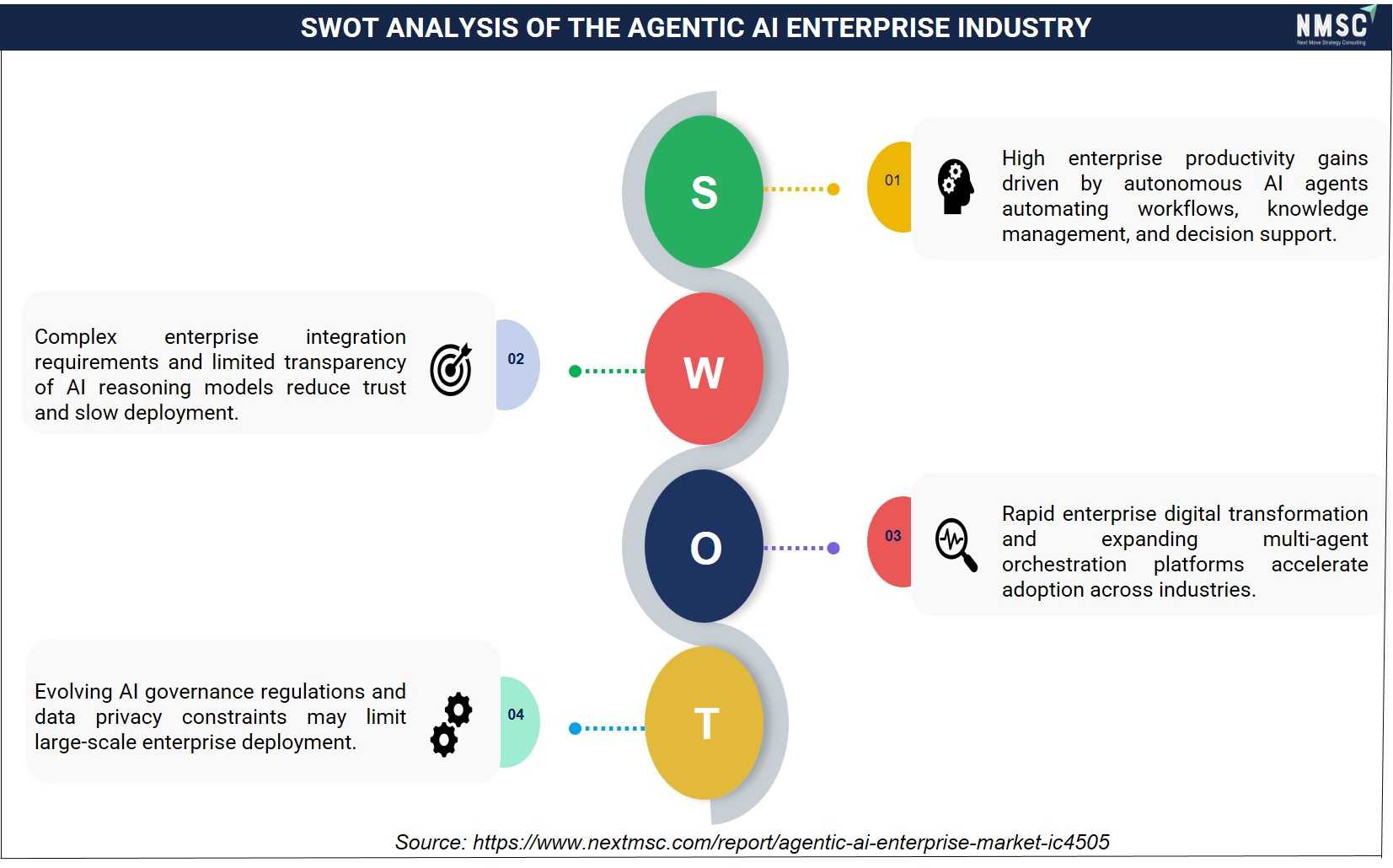
Based on our analysis, the agentic AI enterprise market shows strong growth potential as enterprises adopt autonomous AI agents to automate workflows and improve productivity. However, complex system integration and limited transparency of AI reasoning models influence deployment speed. Moreover, evolving AI governance and data privacy regulations continue to shape responsible enterprise adoption.
List of Key Agentic AI Enterprise Companies
-
Glean
-
Sierra
-
OneReach.ai
-
Stack AI
-
CrewAI
-
Cognigy
-
Kore.ai
-
Amelia
-
Yellow.ai
-
interface.ai
-
Aisera
-
Moveworks
-
TENEO.ai
-
PolyAI
-
Microsoft
-
Google
-
OpenAI
-
Salesforce
What Are The Latest Key Industry Developments?
-
March 2026 - Salesforce expanded its Agentforce capabilities within contact center solutions, enabling AI agents to handle complex customer interactions across voice and digital channels with reduced human intervention. .
-
October 2025 - IBM announced five new capabilities for watsonx Orchestrate, including an "Agent Builder" no-code studio and a catalog of 150+ pre-built agents to accelerate enterprise-wide agent adoption.
-
May 2025 - Glean moved its Glean Agents toolkit into General Availability, introducing a new "Model Hub" that allows enterprises to mix and match 15+ different LLMs (Large Language Models) within a single agentic workflow.
What Are The Key Factors Influencing Investment Analysis & Opportunities In The Agentic AI Enterprise Market?
Investment analysis in the agentic AI enterprise market increasingly reflects a shift toward platform-centric AI ecosystems and scalable enterprise automation frameworks rather than standalone AI model providers. Based on our evaluation of recent funding rounds, strategic partnerships, and enterprise AI platform investments, we noticed that investors favour companies offering recurring revenue through AI agent platforms, workflow orchestration software, enterprise analytics tools, and subscription-based AI services. Organizations demonstrating scalable multi-agent deployments, proprietary reasoning models, and seamless integration with enterprise systems such as ERP, CRM, and knowledge management platforms consistently attract higher valuations. As enterprises expand digital operations, investors increasingly prioritize vendors capable of delivering enterprise-grade AI agents that automate complex workflows while maintaining governance, reliability, and secure data integration across large organizational environments.
We also identified strong investment momentum around multi-agent orchestration platforms, autonomous task planning systems, and enterprise AI governance technologies that improve operational decision-making and large-scale workflow automation. Strategic investments increasingly complement traditional venture funding, as cloud platform providers, enterprise software vendors, and consulting firms seek to strengthen their AI ecosystems and accelerate commercialization of agent-based enterprise solutions. For investors, the most attractive opportunities emerge in companies combining advanced AI capabilities with enterprise deployment experience, scalable platform architectures, and strong integration with enterprise software environments. As organizations continue modernizing digital infrastructure, these investment patterns are reinforcing long-term growth and technological innovation across the agentic AI enterprise market.
Key Benefits for Stakeholders:
Next Move Strategy Consulting (NMSC) presents a comprehensive analysis of the Agentic Ai Enterprise Market, covering historical developments from 2020 to 2025 and providing forward-looking forecasts through 2035. The study evaluates the market at global, regional, and country levels, delivering quantitative outlooks alongside qualitative insights into key growth drivers, adoption constraints, technology evolution, and investment trends across major enterprise AI segments.
From our observation, the agentic AI enterprise industry creates measurable value across a diverse enterprise ecosystem. Investors benefit from recurring revenue opportunities enabled by AI agent platforms, subscription-based enterprise software, and scalable multi-agent deployments across large organizations. Enterprises gain productivity improvements, faster decision cycles, and operational efficiency through automation of knowledge management, customer engagement, analytics processing, and internal workflow coordination. Cloud platform providers, enterprise software vendors, and system integrators benefit from long-term service engagements, platform subscriptions, and ecosystem expansion opportunities. By aligning autonomous AI innovation with enterprise productivity and digital transformation initiatives, the market generates sustained value across enterprise technology environments while supporting long-term competitiveness and intelligent business operations.
|
Parameters |
Details |
|
Customization Scope |
Free customization (equivalent to up to 80 analyst-working hours) after purchase. Addition or alteration to country, regional & segment scope. |
|
Pricing and Purchase Options |
Avail customized purchase options to meet your exact research needs. |
|
Approach |
In-depth primary and secondary research; proprietary databases; rigorous quality control and validation measures. |
|
Analytical Tools |
Porter's Five Forces, SWOT, value chain, and Harvey ball analysis to assess competitive intensity, stakeholder roles, and relative impact of key factors. |
Key Market Segments
By Agent Capability
-
Task Automation Agents
-
Workflow Automation
-
Document Processing
-
Data Processing
-
-
Conversational Interaction Agents
-
Customer Support
-
Employee Assistance
-
Knowledge Assistance
-
-
Decision Intelligence Agents
-
Predictive Analytics
-
Recommendation Engines
-
Risk Analysis
-
-
Operational Control Agents
-
IT Operations
-
Cybersecurity Monitoring
-
Infrastructure Management
-
-
Other Capabilities
By Agent Autonomy Level
-
Human Assisted Agents
-
Human-in-the-Loop
-
Human-on-the-Loop
-
-
Semi-Autonomous Agents
-
Fully Autonomous Agents
By Agent Architecture
-
Single Agent Systems
-
Standalone Task Agents
-
Embedded Application Agents
-
-
Multi-Agent Systems
-
Cooperative Multi-Agent Systems
-
Competitive Multi-Agent Systems
-
Mixed Cooperative/Competitive
-
-
Hierarchical Agent Systems
-
Distributed Agent Systems
-
Agent Orchestration Platforms
By Deployment Model
-
Public Cloud
-
Private Cloud
-
On-Premises
-
Edge Deployment
-
Hybrid Cloud
By Enterprise Size
-
Large Enterprises
-
Mid-Sized Enterprises
-
Small Enterprises
By Pricing Model
-
Subscription-Based
-
Usage-Based
-
Per-Seat Licensing
-
Enterprise Licensing
-
Services & Managed AI Contracts
By Enterprise Application
-
IT & Security Operations
-
Customer Experience & Support
-
Sales & Marketing
-
Finance & Risk
-
Human Resources
-
Operations & Supply Chain
-
Legal, Compliance & Audit
-
R&D & Innovation
-
Sustainability & ESG
-
Others
By Industry Vertical
-
BFSI
-
Banking
-
Insurance
-
Capital Markets
-
FinTech
-
-
Healthcare & Life Sciences
-
Retail & eCommerce
-
Manufacturing
-
IT & Telecom
-
Energy & Utilities
-
Transportation & Logistics
-
Government & Public Sector
-
Media & Entertainment
-
Education
-
Professional Services
-
Other Industries
Geographical Breakdown
-
North America: U.S., Canada, and Mexico.
-
Europe: UK, Germany, France, Italy, Spain, Sweden, Denmark, Finland, the Netherlands, and the Rest of Europe.
-
Asia Pacific: China, India, Japan, South Korea, Taiwan, Indonesia, Vietnam, Australia, Philippines, Malaysia and the rest of APAC.
-
Middle East & Africa (MEA): Saudi Arabia, UAE, Egypt, Israel, Turkey, Nigeria, South Africa, and the rest of MEA.
-
Latin America: Brazil, Argentina, Chile, Colombia, and the rest of LATAM.
Conclusion & Recommendations
This report equips stakeholders, industry participants, investors, and consultants with actionable intelligence to capitalize on the structural transformation underway in the market. By combining rigorous data-driven analysis with proven strategic frameworks, NMSC’s Agentic AI Enterprise Market Report serves as a critical decision-support resource for navigating a rapidly evolving enterprise AI landscape.
The agentic AI enterprise market is positioned for sustained expansion, supported by increasing enterprise demand for intelligent workflow automation, rapid advances in large language models and reasoning architectures, and the growing need to manage complex digital operations across organizations. Key strategic insights highlight the rising importance of multi-agent orchestration platforms, enterprise AI governance frameworks, and seamless integration with enterprise software systems such as ERP, CRM, and analytics platforms. Vendors that prioritize scalable agent architectures, secure enterprise integration, and reliable automation capabilities consistently achieve stronger enterprise adoption and recurring platform revenue.
For executives and investors, capturing value requires focusing on high-impact enterprise applications such as autonomous workflow automation, AI-assisted decision support, and intelligent customer interaction systems, while continuing investments in AI model development, enterprise integration capabilities, and ecosystem partnerships. Expanding deployment across digitally advanced regions, particularly North America, Europe, and Asia-Pacific, unlocks new enterprise demand for scalable AI automation platforms. Platform scalability, governance readiness, and measurable productivity improvements further strengthen vendor credibility and accelerate enterprise adoption, creating durable value across the global agentic AI Enterprise ecosystem.
Expert Insights
 “It's an exciting time in enterprise software because I do think it will change. I think the atomic unit of the web was the website. The atomic unit of mobile was the mobile app. The atomic unit of AI is the agent”.
- Bret Taylor, Co-founder of Sierra and Chair of OpenAI
Statement made during a podcast discussion on the evolution of enterprise software and the growing role of AI agents in digital systems.
Market Interpretation
The comment highlights a fundamental shift in enterprise software architecture, where AI agents are emerging as the next core unit of digital interaction. Similar to how websites defined the early internet and mobile applications shaped the smartphone era, autonomous AI agents are increasingly expected to manage tasks, workflows, and decision-making across enterprise environments. This transition is accelerating investment in agentic AI platforms capable of orchestrating complex business processes with minimal human intervention. As organizations seek higher efficiency and intelligent automation, enterprise software vendors are rapidly integrating agent-based systems to support productivity, workflow automation, and adaptive decision intelligence across business operations.


About the Author
 Saista Faiyaz
— Saista Faiyaz is Research Associate at Next Move Strategy Consulting, where she has covered consumer markets and healthcare technologies for 3 years. Her work includes primary interview review, secondary-source validation, market sizing, and structured analysis of company and industry data. She supports research by comparing evidence across sources, organizing findings into market narratives, and documenting assumptions used in analysis. Her scope includes cross-market benchmarking, and reports.
Saista Faiyaz
— Saista Faiyaz is Research Associate at Next Move Strategy Consulting, where she has covered consumer markets and healthcare technologies for 3 years. Her work includes primary interview review, secondary-source validation, market sizing, and structured analysis of company and industry data. She supports research by comparing evidence across sources, organizing findings into market narratives, and documenting assumptions used in analysis. Her scope includes cross-market benchmarking, and reports.
About the Reviewer
 Supradip Baul
— Supradip Baul is an accomplished business consultant and strategist with over a decade of rich experience in market intelligence, strategy, technology, and business transformation. His work has included rigorous qualitative and quantitative analysis across multiple industries, helping clients shape investment decisions and long-term roadmaps. Earlier in his career, he was associated with Gartner, where he contributed to industry-leading reports and market share analyses. He has worked with leading global companies and holds an MBA with a dual specialization in Marketing and Finance.
Supradip Baul
— Supradip Baul is an accomplished business consultant and strategist with over a decade of rich experience in market intelligence, strategy, technology, and business transformation. His work has included rigorous qualitative and quantitative analysis across multiple industries, helping clients shape investment decisions and long-term roadmaps. Earlier in his career, he was associated with Gartner, where he contributed to industry-leading reports and market share analyses. He has worked with leading global companies and holds an MBA with a dual specialization in Marketing and Finance.
At Next Move Strategy Consulting, we understand that insightful market research is the cornerstone of successful business decisions. That's why we employ a robust and multifaceted approach, combining various methodologies to deliver the most accurate and actionable data for our clients.

Research Landscape
We navigate the world of research with two primary approaches:
Qualitative Approach
Our qualitative research methodologies involve immersive techniques such as in-depth interviews, focus groups, and observational studies. By engaging directly with individuals and stakeholders, we uncover valuable insights that quantitative data alone may overlook.

Quantitative Research
In tandem with qualitative methodologies, NMSC leverages the power of Quantitative Research to provide a robust foundation of numerical insights. Through systematic data collection and analysis, we quantify patterns, preferences, and market trends, offering a comprehensive view of the business landscape.
Our quantitative research approach employs diverse tools, including surveys, experiments, and statistical modelling. These methodologies enable us to gather data from a large and representative sample, ensuring the statistical significance of our findings. By employing structured questionnaires and standardized data collection methods, we guarantee the reliability and validity of the information we present to our clients.
Quantitative research is particularly effective in measuring the prevalence of trends, assessing market size, and gauging the impact of various factors on consumer behavior. The numerical precision attained through this approach equips our clients with actionable insights, facilitating data-driven decision-making and strategy formulation.


Our Specialized Toolbox for Industry-Specific Market Research
We deploy a specialized arsenal of techniques tailored to meet your unique requirements. Here's a glimpse into our comprehensive toolbox:

Information Procurement
The stage entails acquiring market data or relevant information through various sources and methodologies.


Market Research Approach
We utilize both top-down and bottom-up approaches in market research analysis to achieve a comprehensive understanding of the market dynamics, leveraging the broad perspective of industry trends and macroeconomic factors alongside detailed insights from specific segments and individual companies.

Porters Five Forces Analysis
We conduct Porter's Five Forces analysis to evaluate the competitive landscape of an industry, providing us with insights into factors that affect profitability and strategic positioning.

SWOT Analysis

Forecasting
We utilize a forecasting model to predict future consumption by considering parameters like population, economics, regulations, market competition, drivers, constraints, technology, and pricing. We also employ statistical techniques such as multilinear regression, exponential smoothing, moving average, ARIMA, and Monte Carlo simulations for accurate predictions. In econometric forecasting, we analyzed short-term and long-term event impacts, attributing values based on regulatory frameworks, economic factors, and market events.





 Speak to Our Analyst