Automotive Fuel Additives Market Global Industry Analysis and Forecast (2026-2035)

Automotive Fuel Additives Market size was USD 8.15 billion in 2026, projected to reach USD 13.10 billion by 2035, growing at a CAGR of 5.3% from 2026 to 2035. Key drivers include tightening vehicle emission and fuel quality regulations, rising ethanol and biodiesel blend mandates, and growth of gasoline direct injection engines, with Asia-Pacific leading the market.

Download Free Sample PDF
Base Year (2025)
$7.80 Billion
Forecast (2035)
$13.10 Billion
CAGR (2026-2035)
5.3%
Top Region
Asia-Pacific

What Is the Automotive Fuel Additives Market Size?

The automotive fuel additives market size was valued at USD 7.80 Billion in 2025 and is estimated at USD 8.15 Billion in 2026, forecast to reach USD 13.10 Billion by 2035, expanding at a 5.3% CAGR between 2025 and 2035. Asia-Pacific leads with approximately 40% revenue share, while deposit control additives dominate all other product categories with approximately 34% share.

We observed that growth is driven by tightening emission regulations and rising fuel efficiency mandates, with combustion and cold flow performance additives seeing the strongest incremental adoption across gasoline and diesel fuel systems through 2035.

Automotive Fuel Additives Market Global Industry Analysis and Forecast (2026-2035) Revenue Forecast
Values in USD Billion

2025 $7.80 Billion
2025
2026 $8.21 Billion
2026
2027 $8.65 Billion
2027
2028 $9.11 Billion
2028
2029 $9.59 Billion
2029
2030 $10.10 Billion
2030
2031 $10.63 Billion
2031
2032 $11.20 Billion
2032
2033 $11.79 Billion
2033
2034 $12.42 Billion
2034
2035 $13.10 Billion
2035

Key Takeaways

By Product Type: Deposit Control Additives held the largest share of approximately 34% (USD 2.65 Billion) in 2025; Cold Flow Improvers are the fastest-growing sub-segment at 7.3% CAGR from 2025–2035.

By Fuel Type: Gasoline held the largest share of approximately 46% (USD 3.59 Billion) in 2025; Biofuels are the fastest-growing sub-segment at 9.2% CAGR from 2025–2035.

By Vehicle Type: Passenger Vehicles held the largest share of approximately 52% (USD 4.06 Billion) in 2025; Commercial Vehicles are the fastest-growing sub-segment at 6.5% CAGR from 2025–2035.

Dominant Region: Asia-Pacific dominated with approximately 40% revenue share (USD 3.12 Billion) in 2025.

Fastest-Growing Region: Middle East & Africa is expected to register the highest CAGR of 6.8% during 2025–2035.

Dominant Country: U.S. led with approximately USD 1.37 Billion in 2025.

Fastest-Growing Country: India is the fastest-growing country at approximately 8.3% CAGR from 2025–2035.

Market Opportunity: The automotive fuel additives market is expected to create an absolute dollar opportunity of USD 4.95 Billion between 2026 and 2035, presenting significant investment potential across deposit control, cold flow, and lubricity additive chemistries.

According to Next Move Strategy Consulting analysis, additive formulators are increasingly bundling multi-functional packages that combine detergency, cold flow, and lubricity performance into single-dose products, a shift that reduces blending complexity for refiners while strengthening formulator pricing power as biofuel blend mandates expand across key automotive markets through 2035.

What Does the Automotive Fuel Additives Market Encompass?

The automotive fuel additives market encompasses chemical formulations blended into gasoline, diesel, and biofuels to improve combustion efficiency, engine cleanliness, cold weather performance, and fuel stability across passenger, commercial, two-wheeler, and off-highway vehicles. Our assessment indicates that the scope spans both OEM factory-fill formulations and aftermarket additive products sold through retail and workshop channels. The category has evolved from single-function octane and cetane boosters into multi-functional packages addressing emission compliance, injector cleanliness, and biofuel compatibility simultaneously.
Regulatory requirements from the U.S. Environmental Protection Agency and the European Union's fuel quality framework continue to shape additive formulation priorities around fuel quality and emissions performance. We observed that technology adoption is shifting toward biofuel-compatible lubricity and stability additives as ethanol and biodiesel blend mandates expand globally. Next Move Strategy Consulting's analysis indicates that this regulatory and blend-mandate convergence is redefining product development priorities across the automotive fuel additives market.

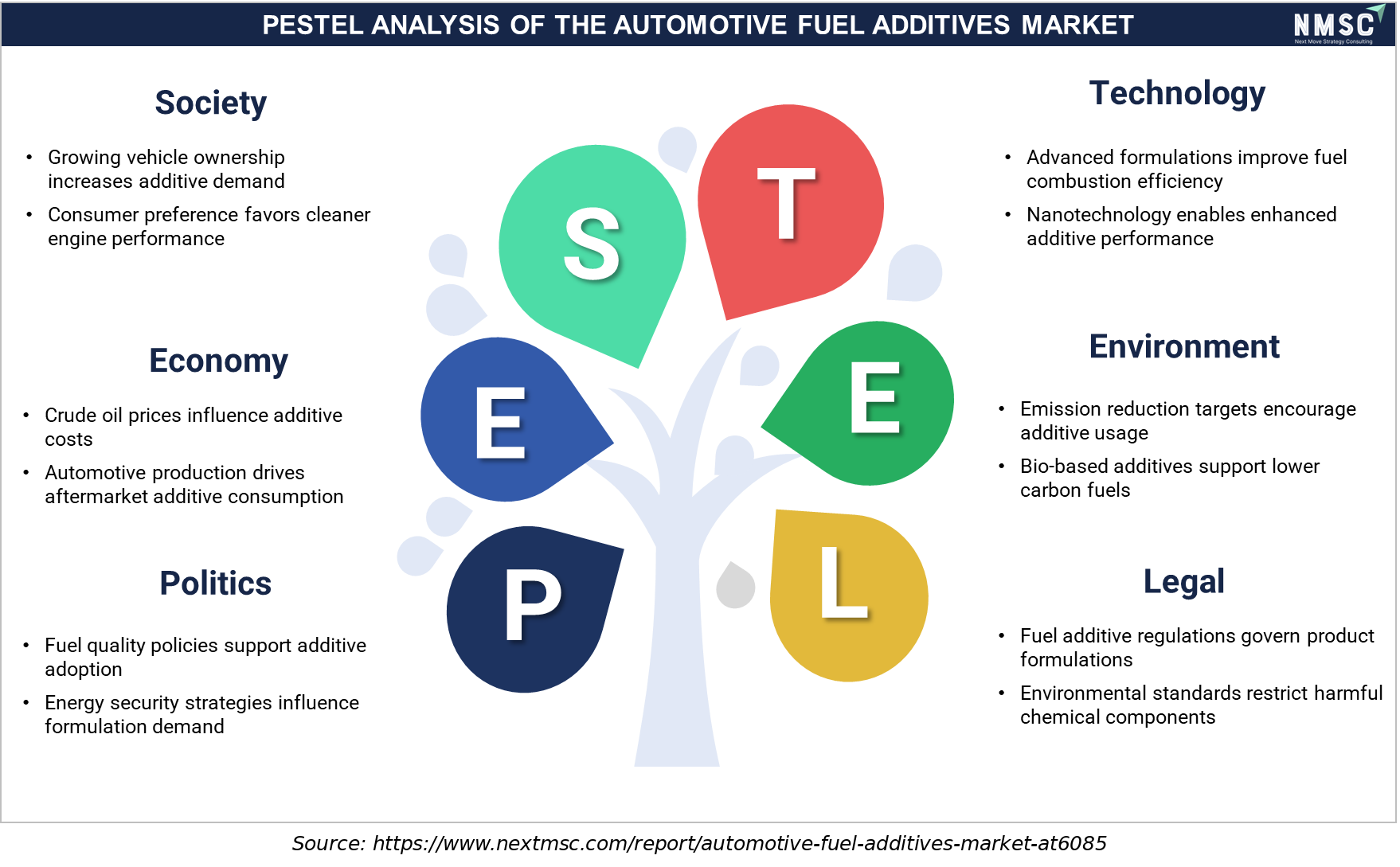
PESTEL Analysis of the Automotive Fuel Additives Market
PESTEL Analysis of the Automotive Fuel Additives Market

NMSC's analysis indicates that rising vehicle ownership, preference for cleaner engines, and automotive production drive growth in the Automotive Fuel Additives Market. Furthermore, advanced formulations and formulation technologies support combustion and deposit-control performance. Concurrently, crude oil price fluctuations impact costs, while fuel quality policies, energy security strategies, emission reduction targets, bio-based additives, and strict environmental standards govern legal and ecological compliance across the global Automotive Fuel Additives Industry.

Market Drivers & Dynamics

Interactive Dataset
Tightening vehicle emission and fuel quality regulations driver +1.6% Global 2026–2035
Rising ethanol and biodiesel blend mandates driver +1.3% Asia-Pacific, Latin America 2026–2035
Growth of gasoline direct injection engine parc driver +1.1% Global 2026–2032
Expanding commercial vehicle fleet in emerging markets driver +0.9% Asia-Pacific, MEA 2026–2035
Demand for multi-functional additive packages driver +0.7% Global 2026–2035
Accelerating electric vehicle adoption in mature markets restraint −1.2% North America, Europe 2026–2035
Volatility in specialty chemical feedstock pricing restraint −0.6% Global 2026–2032
Stringent additive registration and REACH compliance costs restraint −0.4% Europe 2026–2035
Source: Next Move Strategy Consulting

Growth Drivers

What Is the Primary Growth Driver of the Automotive Fuel Additives Market?

Tightening vehicle emission and fuel quality regulations are the primary driver of the market. The U.S. Environmental Protection Agency's Tier 3 gasoline sulfur standards and European fuel quality requirements are shaping fuel formulation and additive treatment priorities. We observed that this regulatory pressure sustains structural demand for deposit control and combustion improver additives across both developed and emerging vehicle markets.

How Is Biofuel Blending Policy Driving Fuel Additives Market Growth?

Government-mandated ethanol and biodiesel blending targets are directing growth toward biofuel-compatible additive chemistries. The U.S. Renewable Fuel Standard establishes renewable fuel volume requirements for transportation fuels, supporting demand for lubricity and stability additives engineered for biodiesel and ethanol-blended fuel systems across the vehicle parc.

Growth Inhibitors

What Is Restraining Automotive Fuel Additives Market Expansion?
Accelerating electric vehicle adoption in North America and Europe is restraining long-term internal combustion fuel volume growth, directly limiting the addressable base for fuel additive consumption. National transport agencies across the European Union continue to report rising battery electric vehicle registration shares, which is gradually offsetting internal combustion vehicle parc growth even as EV charging station infrastructure expands to support the transition.

Segmentation Analysis

2025 (USD Billion)
2035 (USD Billion)
Deposit Control Additives 2025: $2.65 Billion | 2035: $4.23 Billion
Deposit Cont
Combustion Improvers 2025: $1.72 Billion | 2035: $2.74 Billion
Combustion I
Cold Flow Improvers 2025: $1.09 Billion | 2035: $2.21 Billion
Cold Flow Im
Corrosion Inhibitors 2025: $0.94 Billion | 2035: $1.56 Billion
Corrosion In
Lubricity Improvers 2025: $0.78 Billion | 2035: $1.38 Billion
Lubricity Im
Others 2025: $0.62 Billion | 2035: $0.98 Billion
Others
Deposit Control Additives $2.65 Billion $4.23 Billion 4.8%
Combustion Improvers $1.72 Billion $2.74 Billion 4.8%
Cold Flow Improvers $1.09 Billion $2.21 Billion 7.3%
Corrosion Inhibitors $0.94 Billion $1.56 Billion 5.2%
Lubricity Improvers $0.78 Billion $1.38 Billion 5.9%
Others $0.62 Billion $0.98 Billion 4.7%

Which Product Type Segment Dominates the Automotive Fuel Additives Market?

Deposit Control Additives, which include detergents and dispersants that keep fuel injectors and intake valves clean, led the market with USD 2.65 Billion in 2025, supported by their necessity across nearly every gasoline and diesel vehicle. Our findings suggest that Cold Flow Improvers are the fastest-growing product segment, expanding at a 7.3% CAGR from 2025 to 2035, as biodiesel blend mandates increase demand for additives that prevent fuel gelling in low-temperature conditions.

2025 (USD Billion)
2035 (USD Billion)
Gasoline
Diesel
Biofuels
Biodiesel
Ethanol blen
Segment Item 2025 (USD Billion) 2035 (USD Billion) CAGR
Gasoline $10.0 USD Billion $40.0 USD Billion 13.0%
Diesel $17.1 USD Billion $51.1 USD Billion 27.0%
Biofuels $24.2 USD Billion $62.2 USD Billion 9.0%
Biodiesel $31.3 USD Billion $73.3 USD Billion 19.0%
Ethanol blends $38.4 USD Billion $84.4 USD Billion 16.0%

Segment-wise data is locked

Unlock complete segment-wise numbers for By Fuel Type.

Unlock Full Data

Which Fuel Type Segment Leads Automotive Fuel Additives Demand?

Gasoline remained the leading fuel type category, valued at USD 3.59 Billion in 2025 given the larger global gasoline passenger vehicle parc relative to diesel. Our analysis shows that Biofuels are the fastest-growing fuel type segment, registering a 9.2% CAGR from 2025 to 2035, as ethanol and biodiesel blending mandates expand across Asia-Pacific and Latin American markets, requiring dedicated stability and lubricity additive treatment.

2025 (USD Billion)
2035 (USD Billion)
Passenger ve
Commercial v
Two-wheelers
Off-highway
Segment Item 2025 (USD Billion) 2035 (USD Billion) CAGR
Passenger vehicles $10.0 USD Billion $40.0 USD Billion 26.0%
Commercial vehicles $17.1 USD Billion $51.1 USD Billion 16.0%
Two-wheelers $24.2 USD Billion $62.2 USD Billion 18.0%
Off-highway vehicles $31.3 USD Billion $73.3 USD Billion 8.0%

Segment-wise data is locked

Unlock complete segment-wise numbers for By Vehicle Type.

Unlock Full Data

Which Vehicle Type Segment Is Most Widely Served in Automotive Fuel Additives?

Passenger Vehicles remained the dominant vehicle type, reaching USD 4.06 Billion in 2025 given the sheer scale of the global passenger car parc. Based on research conducted by Next Move Strategy Consulting, we found that Commercial Vehicles represent the fastest-growing vehicle type category at a 6.5% CAGR from 2025 to 2035, as fleet operators increasingly adopt fuel additive treatment programs to reduce maintenance costs and extend engine service intervals.

2025 (USD Billion)
2035 (USD Billion)
OEM (factory
Aftermarket
Segment Item 2025 (USD Billion) 2035 (USD Billion) CAGR
OEM (factory-fill) $10.0 USD Billion $40.0 USD Billion 24.0%
Aftermarket $17.1 USD Billion $51.1 USD Billion 10.0%

Segment-wise data is locked

Unlock complete segment-wise numbers for By Sales Channel.

Unlock Full Data
2025 (USD Billion)
2035 (USD Billion)
North Americ
Canada
Mexico
Europe: UK
Germany
Segment Item 2025 (USD Billion) 2035 (USD Billion) CAGR
North America: U.S. $10.0 USD Billion $40.0 USD Billion 11.0%
Canada $17.1 USD Billion $51.1 USD Billion 25.0%
Mexico $24.2 USD Billion $62.2 USD Billion 15.0%
Europe: UK $31.3 USD Billion $73.3 USD Billion 25.0%
Germany $38.4 USD Billion $84.4 USD Billion 10.0%

Segment-wise data is locked

Unlock complete segment-wise numbers for By Region.

Unlock Full Data

Growth Opportunities

Our analysis shows that three forward-looking opportunities stand out for stakeholders positioning within the automotive fuel additives market over the 2026–2035 forecast period.

How Can Biofuel-Specific Additive Portfolios Unlock Value for Formulators?

Expanding ethanol and biodiesel blend mandates create a whitespace opportunity for formulators that develop dedicated stability, lubricity, and corrosion inhibitor packages engineered specifically for biofuel chemistries. Suppliers that commercialize biofuel-optimized additive lines stand to capture recurring revenue as blend mandates tighten across emerging markets, benefiting additive formulators serving diesel and biofuel fuel types.

Where Do Emerging Market Commercial Fleets Create New Demand?

Growing commercial vehicle fleets across Asia-Pacific and Middle East & Africa represent an underpenetrated opportunity for combustion improver and lubricity additive suppliers. Companies that establish regional blending and distribution partnerships with fleet operators can secure long-term supply contracts tied to fleet maintenance programs, benefiting the commercial vehicle segment as fleet operators prioritize total cost of ownership reduction.

How Can Detergent Chemistry Innovation Benefit OEM Factory-Fill Suppliers?

OEMs seeking to meet tightening gasoline direct injection deposit standards represent an opportunity for suppliers developing next-generation detergent chemistries with enhanced injector-cleaning performance, Early movers that secure OEM factory-fill qualification can benefit suppliers serving passenger vehicles pursuing long-term, volume-based supply agreements.

Regional Outlook

2025 (USD Billion)
2035 (USD Billion)
North Americ
Europe
Asia-Pacific
Middle East
Latin Americ
Region 2025 (USD Billion) 2035 (USD Billion) CAGR (%)
North America $10.0 USD Billion $40.0 USD Billion 9.0%
Europe $17.1 USD Billion $51.1 USD Billion 27.0%
Asia-Pacific $24.2 USD Billion $62.2 USD Billion 25.0%
Middle East & Africa $31.3 USD Billion $73.3 USD Billion 23.0%
Latin America $38.4 USD Billion $84.4 USD Billion 12.0%

Regional data is locked

Unlock complete regional numbers for this market.

Unlock Full Data

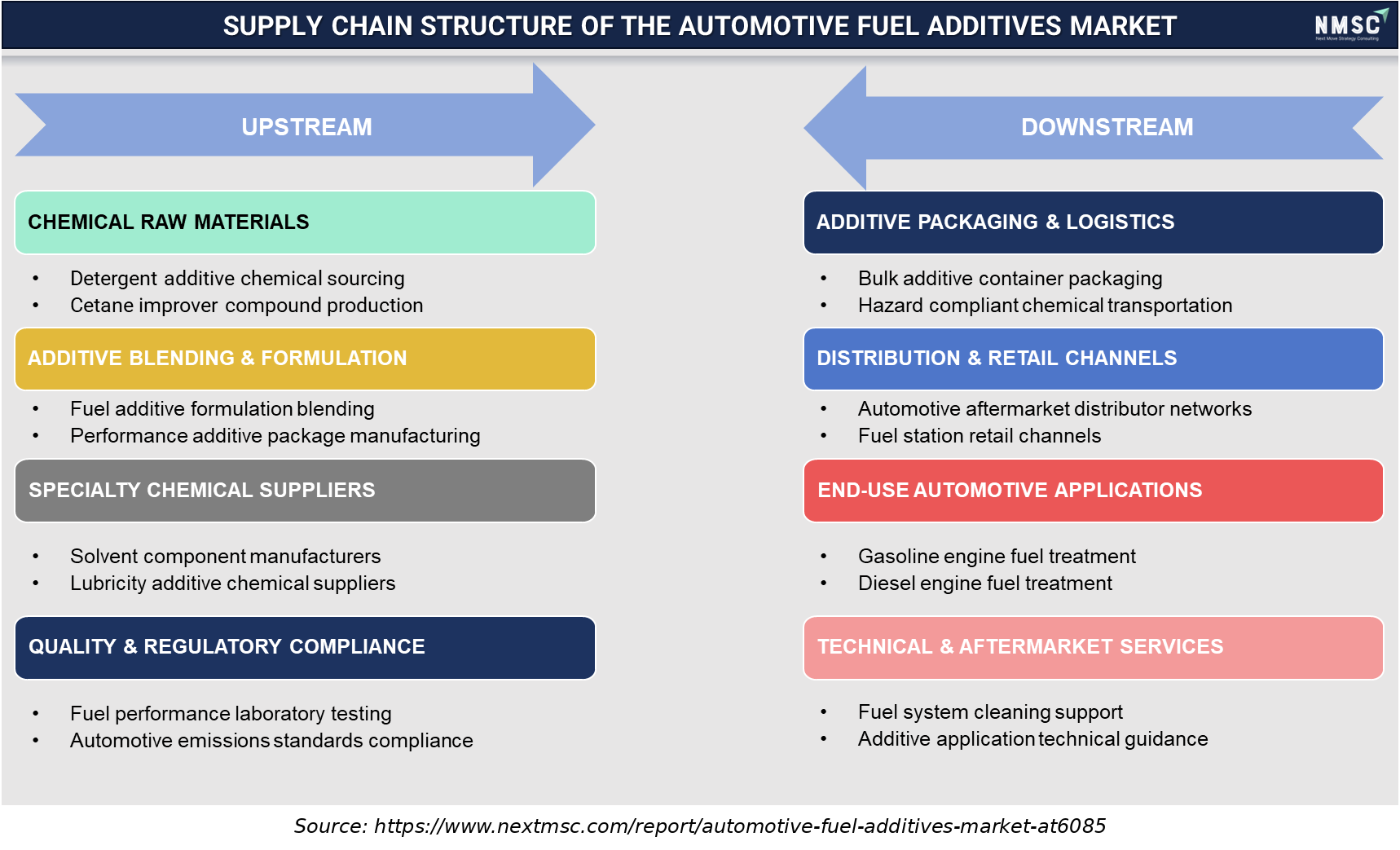
Supply Chain Structure of the Automotive Fuel Additives Market

Supply Chain Structure of the Automotive Fuel Additives Market

Based on research conducted by NMSC, our analysis shows that the supply chain structure of the Automotive Fuel Additives Market connects chemical sourcing, formulation blending, specialty solvent supply, and laboratory testing with hazard-compliant transportation. Downstream, distributor networks supply retail channels for gasoline and diesel engine fuel treatment. Ultimately, fuel system cleaning support and application technical guidance sustain long-term operational performance across the Automotive Fuel Additives Industry.

Competitive Landscape

We observed that the automotive fuel additives market features a moderately consolidated competitive landscape, with specialty chemical majors and dedicated additive formulators competing on formulation breadth, regulatory compliance capability, and OEM qualification credentials.

Dimension Description
Market Structure Moderately consolidated; leading global formulators compete across OEM and aftermarket channels, while regional suppliers serve cost-sensitive markets.
Innovation Focus Multi-functional additive packages, biofuel-compatible stability chemistries, and low-emission detergent formulations dominate current innovation pipelines across leading suppliers.
M&A Activity Selective consolidation through capacity expansion and strategic partnerships, exemplified by specialty chemical majors deepening integration with regional blending and distribution networks.

How Do Companies Compete in the Automotive Fuel Additives Market?

Companies compete primarily on formulation breadth, regulatory compliance capability, and OEM qualification credentials across the industry. Global players such as BASF SE and Chevron Corporation leverage broad specialty chemical portfolios to serve multinational refiner accounts, while dedicated formulators such as Innospec and NewMarket Corporation compete on deep additive chemistry expertise and long-standing OEM factory-fill relationships.

Which Competitive Archetypes Dominate the Automotive Fuel Additives Market?

Two archetypes dominate the market: diversified specialty chemical majors offering integrated additive and base oil portfolios, and dedicated fuel additive formulators providing deep chemistry expertise. TotalEnergies SE and Evonik Industries exemplify the diversified specialty chemical archetype, while Infineum International and The Lubrizol Corporation exemplify the dedicated formulator archetype serving OEM and refiner accounts.

How Are Companies Differentiating Through Innovation in Fuel Additives?

Innovation and differentiation strategy increasingly center on multi-functional additive packages and biofuel-compatible chemistries. Leading suppliers are advancing bio-based additive platforms and low-emission detergent systems in response to tightening emission standards. Our analysis shows that suppliers unable to demonstrate credible biofuel compatibility roadmaps risk exclusion from refiner and OEM procurement shortlists.

What M&A and Expansion Activity Is Shaping the Automotive Fuel Additives Market?

Mergers, capacity expansion, and strategic partnerships continue to consolidate additive formulation capabilities within the industry. Specialty chemical majors continue using capacity expansion and strategic partnerships to strengthen regional blending, distribution, and localized supply capabilities.

Key Market Players

Our assessment indicates that the following 20 companies are actively shaping product innovation, regulatory compliance, and formulation strategy within the automotive fuel additives market.

NewMarket Corporation Innospec Inc. BASF SE Chevron Corporation The Lubrizol Corporation Infineum International Limited TotalEnergies SE Evonik Industries AG Clariant AG Croda International Plc Baker Hughes Company Eastman Chemical Company Dorf Ketal Chemicals Pvt. Ltd. BRB International B.V. Sea-Land Chemical Company Recochem Inc. LANXESS AG Songwon Industrial Co., Ltd. Kao Corporation Solvay SA

Latest Developments

We found that recent product and capacity developments within the automotive fuel additives market are concentrated on biofuel-compatible chemistries and multi-functional formulations, reflecting the industry's broader regulatory-driven transition.

Date Event
September 2025 BASF announced its next-generation Keropur® Gasoline Performance Additive Series, including Keropur AP 225-20, certified for the revised TOP TIER+™ standard. The formulation targets injector deposits and stochastic pre-ignition while supporting engine protection, fuel economy and cleaner combustion across injection systems.
August 2025 Afton Chemical launched its HiTEC® 65522 gasoline performance additive series, approved for TOP TIER+™ gasoline. The formulation is designed for modern GDI engines, providing intake-valve and fuel-injector deposit control while addressing the revised standard's requirements for fuel cleanliness and engine performance.
August 2025 Lubrizol received TOP TIER+™ certification for its new gasoline additive technology, with its GA9110 Series designed to meet the updated TOP TIER+™ fuel performance requirements for modern gasoline engines.
April 2025 Chevron Oronite appointed ICONIC Base Oil Solutions as its official Brazilian distributor. The agreement includes OGA® aftermarket gasoline fuel additives alongside lubricant additives and PARATONE® viscosity modifiers, expanding access to Oronite’s automotive fuel-additive portfolio across Brazil.

Investment Opportunities

How Are Capital Inflows Shaping the Automotive Fuel Additives Market?

Capital inflows into the automotive fuel additives sector are accelerating as specialty chemical majors and dedicated formulators fund biofuel-compatible chemistry development. We observed that this capital deployment is concentrated in regions with expanding biofuel blend mandates, favoring investors positioned around lubricity, stability, and cold flow additive supply chains.

What Infrastructure Investment Trends Are Emerging in Fuel Additives?

Infrastructure investment is increasingly directed toward regional blending and distribution capacity that shortens supply timelines for refiner customers. Our findings suggest that investors are prioritizing suppliers with proven multi-functional product roadmaps, as refiners standardize procurement around fewer, broader-capability additive partners.

What ESG Considerations Influence Automotive Fuel Additives Investment?

Environmental, Social, and Governance considerations are shaping investment decisions as formulators pursue bio-based feedstock sourcing and REACH-compliant chemistries to meet tightening environmental regulations. Our analysis shows that biodegradability and low-toxicity formulation credentials are increasingly embedded in investment due diligence, with emission-reduction performance metrics informing capital allocation decisions across new additive product lines.

Key Benefits for Stakeholders

How Does This Report Benefit Enterprise and Industry Leaders?

Enterprise and industry leaders gain access to detailed segmentation, competitive benchmarking, and regional demand analysis that supports capacity planning and formulation strategy decisions. The report's forecasts and strategic insights help refiners and formulators anticipate regulatory compliance requirements as emission standards continue tightening through 2035.

How Does This Report Benefit Investors and Financial Analysts?

Investors and financial analysts benefit from the report's granular market sizing, CAGR analysis, and company profiling, which support capital allocation decisions across the deposit control, cold flow, and lubricity additive value chain. The report's regional and country-level data enables comparative investment analysis across key automotive fuel additive markets.

How Does This Report Benefit Technology Vendors and Product Teams?

Technology vendors and product teams gain insight into emerging trends, competitive positioning, and growth opportunities that inform product roadmap and go-to-market strategy. The report's analysis of biofuel compatibility and multi-functional formulation trends helps product teams prioritize development investment toward next-generation additive categories.

Key Market Segments Evaluated

By Product Type

  • Deposit Control Additives
  • Combustion Improvers
  • Cold Flow Improvers
  • Corrosion Inhibitors
  • Lubricity Improvers
  • Others

By Fuel Type

  • Gasoline
  • Diesel
  • Biofuels

By Vehicle Type

  • Passenger Vehicles
  • Commercial Vehicles
  • Two-Wheelers
  • Off-Highway Vehicles

By Sales Channel

  • OEM (factory-fill)
  • Aftermarket

By Region

  • North America: U.S.
  • Canada
  • Mexico
  • Europe: UK
  • Germany
  • France
  • Italy
  • Spain
  • Sweden
  • Denmark
  • Finland
  • Netherlands
  • Rest of Europe
  • Asia-Pacific: China
  • India
  • Japan
  • South Korea
  • Taiwan
  • Indonesia
  • Vietnam
  • Australia
  • Philippines
  • Malaysia
  • Rest of APAC
  • Middle East & Africa: Saudi Arabia
  • UAE
  • Egypt
  • Israel
  • Turkey
  • Nigeria
  • South Africa
  • Rest of MEA
  • Latin America: Brazil
  • Argentina
  • Chile
  • Colombia
  • Rest of LATAM

Conclusion & Recommendations

The long-term outlook remains steadily positive, with the market forecast to expand from USD 7.80 Billion in 2025 to USD 13.10 Billion by 2035 at a 5.3% CAGR. We observed that sustained regulatory tightening and expanding biofuel blend mandates, combined with continued internal combustion vehicle parc growth in emerging markets, position the automotive fuel additives market for durable, moderate growth through the forecast period.

What Strategic Positioning Should Vendors Pursue?

Vendors should prioritize multi-functional formulation capability, biofuel compatibility, and regulatory compliance breadth to align with refiner and OEM procurement priorities. Our findings suggest that suppliers combining detergency, cold flow, and lubricity chemistries into unified product lines will capture disproportionate share as refiners consolidate additive vendor relationships.

How Attractive Is the Market for New Investment?

Investment attractiveness remains moderate to high given the market's steady growth trajectory and regulatory-backed demand resilience. Our analysis shows that Asia-Pacific and Middle East & Africa offer particularly favorable investment conditions, combining expanding vehicle parc growth with rising biofuel blend mandates and refinery capacity investment.

What Market Shifts and Key Risks Should Stakeholders Monitor?

Stakeholders should monitor accelerating electric vehicle adoption in mature markets and feedstock price volatility as key risks to long-term demand. We found that these constraints are accelerating formulator diversification toward emerging markets and biofuel-compatible chemistries, a structural shift that favors suppliers with flexible, globally distributed formulation capability.

What Growth Pathways Offer the Strongest Returns?

Growth pathways centered on biofuel-compatible additive development, multi-functional product consolidation, and commercial vehicle fleet penetration offer the strongest return potential through 2035. Our assessment indicates that stakeholders aligning product development with regulatory compliance requirements and blend-mandate expansion are best positioned to capture the USD 4.95 Billion incremental opportunity created between 2026 and 2035.

FAQs

About the Author

Saista Faiyaz

Saista Faiyaz

Saista Faiyaz is Research Associate at Next Move Strategy Consulting, where she has covered consumer markets and healthcare technologies for 3 years. Her work includes primary interview review, secondary-source validation, market sizing, and structured analysis of company and industry data. She supports research by comparing evidence across sources, organizing findings into market narratives, and documenting assumptions used in analysis. Her scope includes cross-market benchmarking, and reports.

About the Reviewer

Supradip Baul

Supradip Baul

Supradip Baul is an accomplished business consultant and strategist with over a decade of rich experience in market intelligence, strategy, technology, and business transformation. His work has included rigorous qualitative and quantitative analysis across multiple industries, helping clients shape investment decisions and long-term roadmaps. Earlier in his career, he was associated with Gartner, where he contributed to industry-leading reports and market share analyses. He has worked with leading global companies and holds an MBA with a dual specialization in Marketing and Finance.

Download Free Sample

Rishabh Jogani

RISHABH JOGANI

Strategy Analyst

Accenture Japan

We are incredibly impressed with the market report on the real estate market in India provided by Next Move Strategy Consulting. The report was thorough, insightful, and well-structured, offering deep analysis and actionable recommendations. It not only captured the current trends and dynamics but also provided a forward-looking perspective that has been invaluable for our strategic planning. Their team demonstrated exceptional professionalism, attention to detail, and a profound understanding of the industry. The data-driven insights and clarity of presentation exceeded our expectations, making complex market trends easy to understand. We highly recommend Next Move Strategy Consulting to anyone looking for reliable and comprehensive market research services. Their expertise has given us the confidence to navigate the complexities of the Indian real estate market with clarity and foresight.

Gustaf Hummel Burstrom

GUSTAF HUMMEL BURSTROM

Founder

Revline Tools AB

Joseph and the team at Next Move Strategy Consulting have been excellent to work with, in supplying us with relevant market data and forecasts for our specific category. We had some special requirements and they were able to do a custom package to suit our needs. We would definitely recommend them to any other company needing market data and forecasts

Nishant Awate

NISHANT AWATE

Business Development Global Sales

Zehnder Group Deutschland GmbH

Our experience working with Next Move Strategy Consulting was positive. The team was responsive, professional, and open to incorporating our specific requirements throughout the project. The India AHU market study was comprehensive and well structured, covering market value and volume forecasts, product and application segments, and key industry trends. The inclusion of both AHU and residential MVHR market insights made the study particularly relevant for our strategic market assessment. Overall, the report provides a solid foundation for evaluating market potential, identifying priority segments, and supporting business-development decisions in India.

Amos Chang

AMOS CHANG

Strategy Consultant

Kardex Group

I have bought the intralogistics market reports from NMSC two times so far. Joseph and his team are always very helpful and flexible in responding to any customization requirements on the report. Their expertise in market reports really helps us steer the day-to-day business. I will definitely recommend and come back myself whenever there is a need.

Melanie Samko

MELANIE SAMKO

Director of Marketing

TOSOH BIOSCIENCE, INC.

The information provided by NMSC is incredibly valuable, thank you so much for such a excellent work. I really appreciate it. I will make sure to reference all of it, in my summary document.

Custom Market Research Services

We will customize the research for you if the listed report does not fully match your requirements.

Get 30% Free Customization

Select License

This website uses cookies to ensure you get the best experience on our website. Learn more

✖