
Automotive HVAC Market Size, Share, Growth & Forecast By Revenue Stream (OEM Factory Fit and Aftermarket), By Vehicle Class (Passenger Car, Light Commercial Vehicle, Heavy Commercial Vehicle, Bus and Coach, Off-Highway, Special Vehicle, and Other Vehicles), By Propulsion Type (ICE, Hybrid, Plug-in Hybrid, Battery Electric, Fuel Cell, and Others), By System Technology (Manual, Automatic Single Zone, Automatic Dual Zone, Automatic Multi Zone, Heat Pump, and Others)— Global Analysis 2025–2035
Industry: Automotive & Transportation | Publishing Date: June 18, 2026 | Last Updated: September 10, 2026 | No of Pages: N/A | No. of Tables: N/A | No. of Figures: N/A | Format: PDF | Report Code: AT4716
What Is the Automotive HVAC Market Size?
The global Automotive HVAC Market size was valued at USD 58.75 billion in 2025 and is expected to reach USD 61.04 billion in 2026. Continued growth in global vehicle production, escalating electrification of automotive powertrains, and rising consumer expectations for sophisticated cabin climate management is projected to propel the market to USD 86.18 billion by 2035, advancing at a CAGR of 3.1% from 2026 to 2035. Key growth drivers include the accelerating adoption of battery electric vehicles requiring advanced thermal management, rising regulatory standards around cabin air quality, growing demand for multi-zone automatic climate systems, and OEM commitments to energy-efficient heat pump architectures in passenger and commercial vehicles worldwide.
|
Parameter |
Details |
|
Market Size in 2025 |
USD 58.75 Billion |
|
Market Size in 2026 |
USD 61.04 Billion |
|
Revenue Forecast in 2035 |
USD 86.18 Billion |
|
Growth Rate |
CAGR of 3.1% from 2026 to 2035 |
|
Analysis Period |
2025–2035 |
|
Base Year Considered |
2025 |
|
Forecast Period |
2026–2035 |
|
Market Size Estimation |
Billion (USD) |
|
Companies Profiled |
20 |
|
Countries Covered |
36 |
|
Market Share |
Top 10 |
Automotive HVAC Market Overview
What Is the Automotive HVAC Market?
The Automotive HVAC Market encompasses the design, manufacturing, distribution, and servicing of heating, ventilation, and air conditioning systems installed in motor vehicles. These systems regulate cabin temperature, humidity, and air quality to ensure occupant comfort and safety across diverse operating environments. NMSC's analysis indicates that automotive HVAC systems range from basic manual controls in entry-level vehicles to sophisticated multi-zone automatic climate systems with advanced filtration, air ionization, and integrated thermal management functions in premium and electric vehicles.
How Has the Automotive HVAC Market Evolved?
The Automotive HVAC Market has progressed through several distinct technology generations. Initial systems relied entirely on engine-driven mechanical compressors and basic resistive heaters. Subsequent phases introduced electronically controlled automatic climate systems and cabin air filtration. From our research, we found that the current inflection point is defined by the transition to electrified vehicles, which require integrated heat pump systems and electric compressors to deliver cabin comfort without relying on waste engine heat, fundamentally restructuring the system architecture and value chain across the global automotive HVAC landscape.
How Do Regulations Influence the Automotive HVAC Market?
Regulatory mandates have become a primary structural driver shaping the Automotive HVAC Market. Refrigerant phase-down regulations under the Kigali Amendment to the Montreal Protocol are compelling OEMs and HVAC suppliers to transition toward lower-global-warming-potential refrigerants such as R-1234yf and R-744 (CO2). European Union regulations governing MAC system energy consumption and emissions, along with cabin air quality standards across North America, Europe, and China, are driving continuous investment in next-generation compressor designs, heat exchanger efficiency, and advanced air purification technologies throughout the automotive HVAC value chain.
How Is Technology Adoption Expanding Across the Automotive HVAC Market?
Technology adoption in the Automotive HVAC Market is accelerating across all vehicle segments and geographies. Heat pump systems, previously limited to premium BEVs, are now being deployed in mid-range electric vehicles to address range anxiety caused by HVAC energy draw in cold climates. Based on NMSC's research, we found that automatic multi-zone systems are expanding from premium segments into upper-mid-range passenger vehicles, while cabin air quality solutions featuring HEPA filtration and PM2.5 monitoring are becoming standard features in Chinese and European new energy vehicles, reflecting a consumer-driven shift toward health and wellness in automotive design.
Ecosystem Analysis of the Automotive HVAC Market
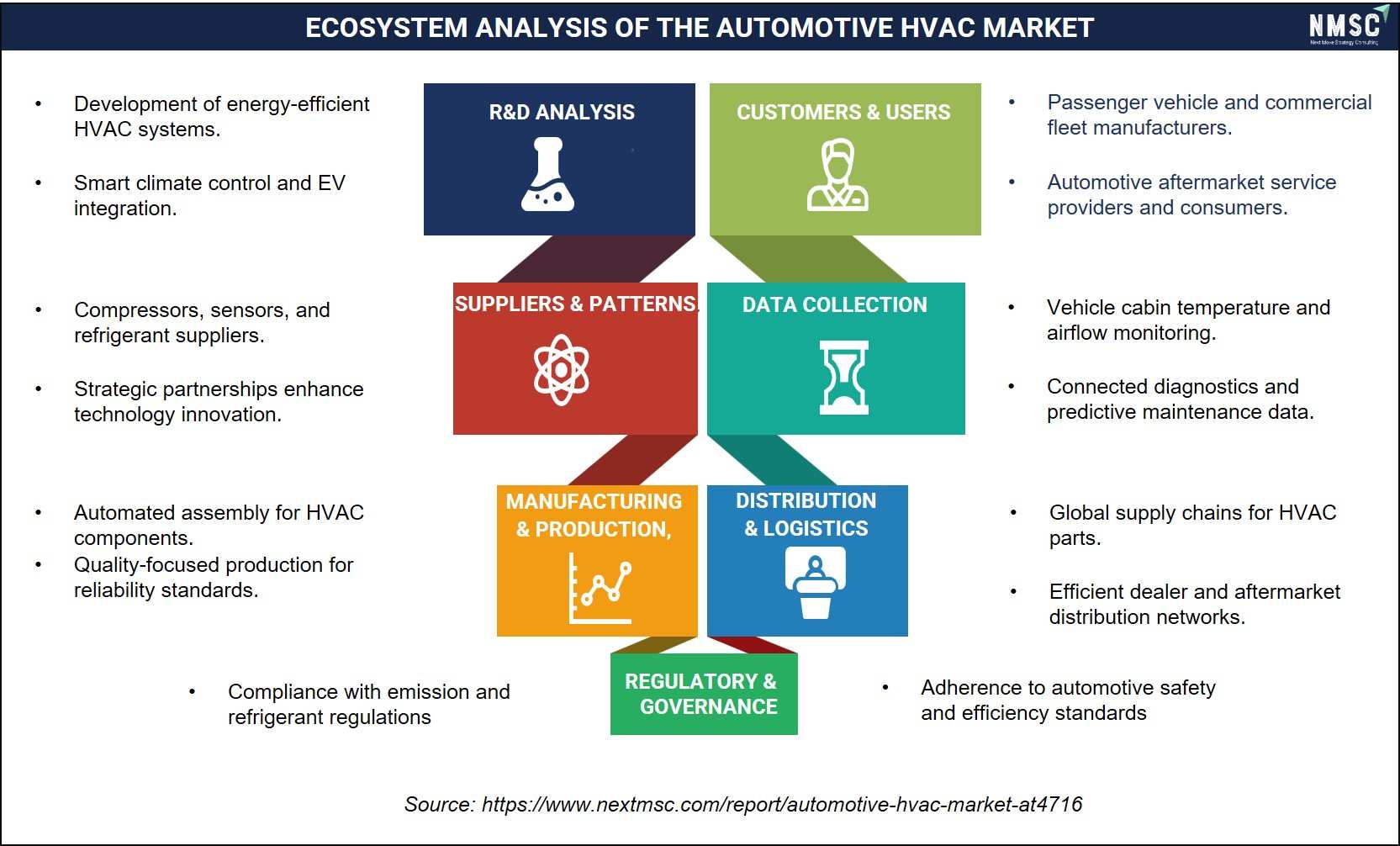
NMSC’s analysis indicates that the Automotive HVAC market is supported by a well-established ecosystem encompassing R&D, component suppliers, manufacturing, distribution, data collection, and regulatory functions. Our assessment finds that advances in energy-efficient climate control technologies, connected vehicle diagnostics, and strategic supplier partnerships are enhancing system performance. Furthermore, evolving emissions regulations and expanding vehicle production continue to support Automotive HVAC Market growth.
|
Key Takeaways |
|
By revenue stream, OEM Factory Fit held the largest share of the Automotive HVAC Market at USD 20.1 billion in 2025, led by Complete System and Component sales across global vehicle production. The Aftermarket segment is projected to grow at a CAGR of 3.8% from 2026 to 2035, supported by rising vehicle parc, longer ownership cycles, and increasing replacement demand for HVAC components. |
|
By revenue stream, Service and Repair within the Aftermarket is the fastest-growing sub-segment in the Automotive HVAC Market, anticipated to expand at a CAGR of 4.5% from 2026 to 2035, driven by growing maintenance requirements for aging vehicle fleets, increasing HVAC diagnostics complexity, and expanding service networks. |
|
By vehicle class, Passenger Car accounted for the largest share of the Automotive HVAC Market at USD 17.2 billion in 2025, representing approximately 60% of total market revenue. Bus and Coach is the fastest-growing vehicle segment at a CAGR of 4.2% from 2026 to 2035, supported by electrification initiatives, public transportation modernization programs, and growing deployment of battery-electric buses. |
|
By propulsion type, ICE vehicles commanded the largest share of the Automotive HVAC Market at USD 18.4 billion in 2025, reflecting their continued dominance in the global vehicle fleet. Battery Electric Vehicles are projected to be the fastest-growing propulsion segment at a CAGR of 9.8% from 2026 to 2035, driven by accelerating EV adoption and increasing demand for energy-efficient thermal management systems. |
|
By system technology, Automatic Dual Zone systems held the largest revenue share of the Automotive HVAC Market at USD 8.9 billion in 2025, owing to their widespread adoption in mid-range and premium passenger vehicles. Heat Pump technology is the fastest-growing segment, expected to register a CAGR of 12.4% from 2026 to 2035, supported by its ability to improve EV driving range and cabin heating efficiency. |
|
By sales channel, the Direct OEM channel held the largest share of the Automotive HVAC Market at USD 12.6 billion in 2025. The Workshop channel is forecast to be the fastest-growing distribution channel at a CAGR of 4.1% from 2026 to 2035, driven by increasing out-of-warranty vehicle servicing and rising demand for HVAC maintenance and replacement services. |
|
Asia-Pacific held the largest regional share in the Automotive HVAC Market at USD 13.8 billion in 2025 and is projected to reach USD 20.4 billion by 2035 at a CAGR of 4.0%, driven by China's automotive production leadership, rapid EV adoption, and expanding vehicle manufacturing across India, Japan, and Southeast Asia. |
|
Asia-Pacific is also the fastest-growing major region in the Automotive HVAC Market at a CAGR of 4.0% from 2026 to 2035, supported by accelerating electrification trends, increasing vehicle ownership, and growing demand for advanced thermal management systems. |
|
China is the single largest country market in the Automotive HVAC Market, generating USD 7.6 billion in revenue in 2025, underpinned by its position as the world's largest vehicle manufacturing hub and aggressive New Energy Vehicle (NEV) adoption policies. |
|
India is the fastest-growing national market in Asia-Pacific within the Automotive HVAC Market, expected to register a CAGR of 6.8% from 2026 to 2035, fueled by rising vehicle production, increasing passenger vehicle penetration, expanding EV adoption, and supportive government initiatives promoting automotive manufacturing. |
Key Emerging Trends in the Automotive HVAC Market
How Is the Electrification of Vehicles Transforming the Automotive HVAC Market?
The global shift toward battery electric vehicles is the most consequential structural trend in the Automotive HVAC Market, compelling a complete redesign of thermal management architectures. Unlike ICE vehicles that use waste engine heat for cabin warming, BEVs require dedicated electric heaters or heat pump systems that draw from the battery pack. Through our market assessment, we observed that leading suppliers such as Denso, Hanon Systems, and Valeo have launched integrated thermal management modules for BEVs that consolidate coolant circuits, refrigerant loops, and cabin HVAC into unified systems, improving energy efficiency and reducing the range penalty associated with climate control loads in cold ambient conditions.
How Is the Rise of Heat Pump Systems Reshaping the Automotive HVAC Market?
Heat pump technology is rapidly transitioning from a niche premium feature to a mainstream necessity in the Automotive HVAC Market, particularly for battery electric vehicles operating in temperate and cold climates. Heat pumps offer coefficient of performance values significantly higher than resistive electric heaters, delivering up to three units of thermal energy for every unit of electrical energy consumed. Our findings suggest that OEMs including Volkswagen Group, Hyundai-Kia, and BMW have standardized heat pump integration across their BEV platforms, with Zhejiang Sanhua Automotive Components and MAHLE GmbH emerging as key component suppliers for heat exchanger and expansion valve assemblies supporting this transition.
What Role Is Cabin Air Quality Playing in the Evolution of the Automotive HVAC Market Demand?
Growing consumer awareness of in-cabin air quality has elevated filtration and air purification from an optional accessory to a core system feature in the Automotive HVAC Market, particularly across China, South Korea, and European markets where urban air pollution concerns are highest. HEPA-grade cabin air filters, negative ion generators, and PM2.5 real-time sensors are increasingly bundled with automatic HVAC systems in premium and upper-mid-range vehicles. Based on NMSC's research, we found that Tesla, BYD, and BMW have incorporated high-efficiency biodefense-mode filtration systems as standard features, driving demand for advanced cabin air filter media and integrated sensor and switch assemblies throughout the global supply chain.
How Are Digital Controls and Connected HVAC Systems Advancing the Automotive HVAC Market?
The integration of advanced digital controls, over-the-air software updates, and connected vehicle platforms is fundamentally expanding the functional scope of automotive HVAC. Modern automatic multi-zone climate systems leverage predictive algorithms, occupant detection sensors, and navigation data to pre-condition the cabin before the vehicle is entered. Our assessment indicates that Webasto SE and Eberspacher Gruppe have developed connected pre-conditioning solutions for electric and plug-in hybrid vehicles that allow occupants to optimize cabin temperature via smartphone applications while the vehicle remains grid-connected, reducing battery draw and improving range efficiency, representing a growing value-added segment within the control unit and sensor and switch component categories.
Porter’s Five Forces Analysis of the Automotive HVAC Market
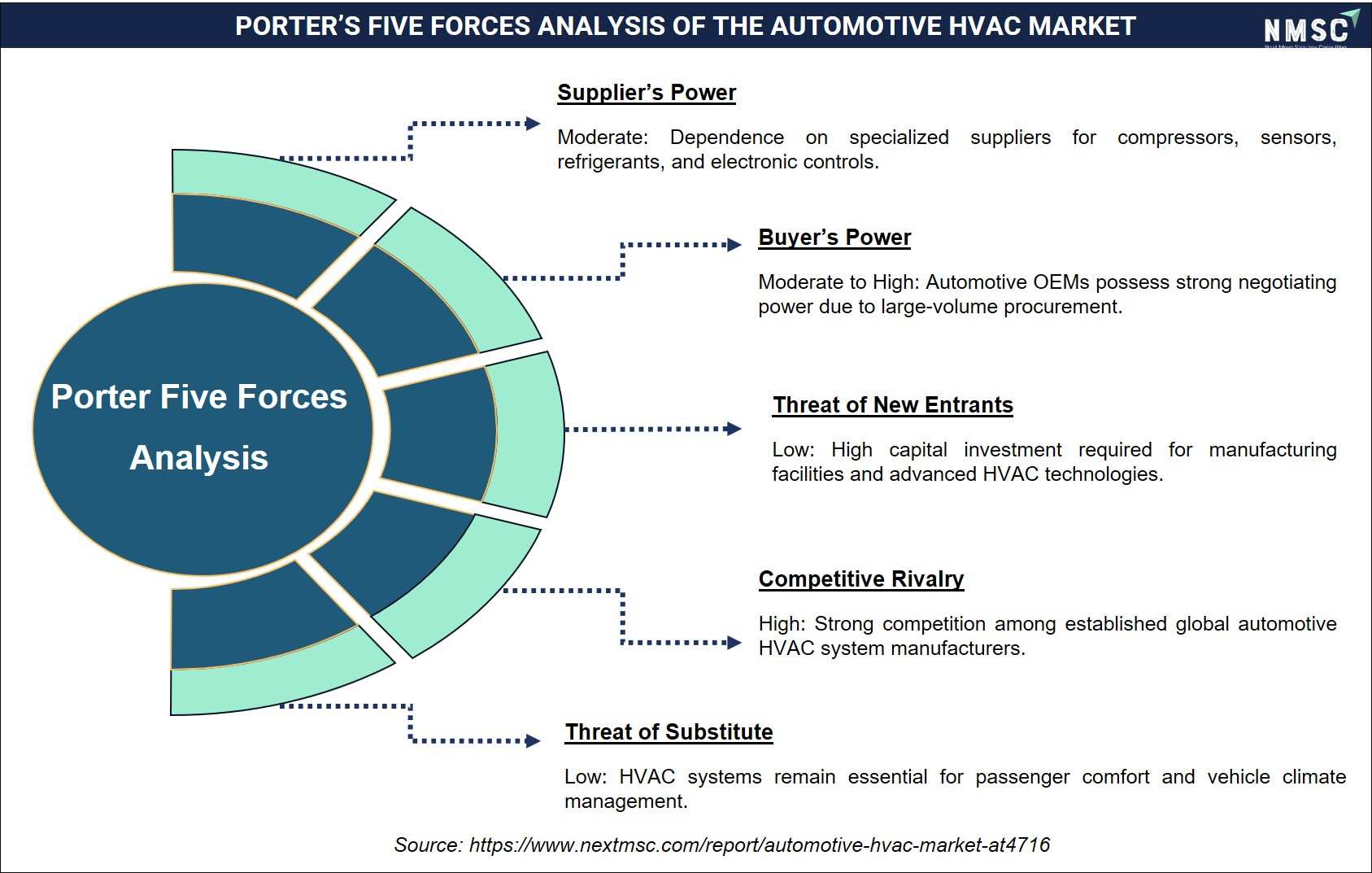
Based on NMSC’s evaluation, we found that the Automotive HVAC market exhibits moderate-to-highly competitive intensity driven by strong OEM bargaining power and the presence of established global manufacturers. Our assessment identifies that supplier influence remains moderate due to specialized component requirements, while entry barriers are elevated by technological and capital demands. Moreover, limited substitution risks reinforce the market’s long-term stability and attractiveness.
What Are the Key Market Drivers, Breakthroughs, and Investment Opportunities that Will Shape the Automotive HVAC Market Industry in the Next Decade?
|
Drivers / Trends / Restraints |
(+/-) % Impact on CAGR Forecast |
Geographic Relevance |
Impact Timeline |
|
BEV Thermal Management Demand |
+1.6% |
Global (led by China, Europe, North America) |
2025–2035 |
|
Heat Pump System Adoption |
+1.2% |
Europe, China, North America |
2025–2030 |
|
Refrigerant Transition (R-1234yf, R-744) |
+0.8% |
Europe, North America, Japan |
2025–2028 |
|
Cabin Air Quality Regulation |
+0.7% |
China, Europe, South Korea |
2026–2035 |
|
Multi-Zone Automatic System Penetration |
+0.6% |
Global |
2025–2032 |
|
ICE Vehicle Production Decline |
-0.9% |
Europe, North America |
2027–2035 |
|
Refrigerant Cost Volatility |
-0.5% |
All regions |
Ongoing |
|
OEM Consolidation Pressure on Margins |
-0.4% |
Global |
Ongoing |
|
Aftermarket Service Expansion |
+0.5% |
Asia-Pacific, Middle East, Latin America |
2026–2035 |
|
Commercial EV Fleet HVAC Demand |
+0.8% |
China, Europe, North America |
2025–2030 |
What Are the Growth Drivers of the Automotive HVAC Market?
How Is the Global Surge in Electric Vehicle Adoption Driving the Automotive HVAC Market?
The rapid global adoption of battery electric vehicles is the primary catalyst accelerating the Automotive HVAC Market, creating structural demand for high-voltage electric compressors, heat pump modules, and integrated thermal management systems that are more sophisticated and higher value per vehicle than equivalent ICE-based HVAC systems. According to the International Energy Agency, global electric car sales exceeded 17 million units in 2024, representing over 20% of total global car sales. This electrification wave is driving OEMs to redesign their entire thermal architecture, expanding the addressable component content per vehicle for HVAC suppliers and supporting sustained revenue growth across the forecast period.
How Are Rising Consumer and Regulatory Demands for Cabin Air Quality Fueling Automotive HVAC Market Growth?
Increasing regulatory and consumer focus on in-cabin air quality is creating sustained demand for advanced filtration, sensor integration, and air purification within the Automotive HVAC Market. The European Union's Euro 7 standards and China's GB18352 vehicle emission regulations indirectly promote cleaner cabin environments by restricting particulate emissions. The U.S. Environmental Protection Agency's National Ambient Air Quality Standards establish benchmarks for PM2.5 and PM10 that are motivating both OEMs and aftermarket providers to upgrade cabin air filter specifications and filtration efficiency across vehicle classes, generating durable demand for cabin air filter, sensor and switch, and blower and fan components.
How Is the Global Expansion of Commercial Vehicle Fleets Supporting the Automotive HVAC Market?
The ongoing global expansion of heavy commercial vehicle, bus, coach, and off-highway equipment fleets is providing a structurally resilient demand base for the Automotive HVAC Market beyond the passenger car segment. Global freight volumes tracked by the International Transport Forum indicate continued growth in trucking and logistics activity across Asia, Africa, and Latin America, supporting sustained demand for robust HVAC systems designed for long-haul applications. Additionally, the transition of urban bus fleets to electric propulsion across China, Europe, and increasingly Latin America is creating specialized demand for high-capacity heat pump systems and electric compressors capable of operating in heavy-duty thermal duty cycles.
What Are the Growth Inhibitors of the Automotive HVAC Market?
How Is the Declining Production of ICE Vehicles Constraining the Automotive HVAC Market?
The accelerating phase-down of internal combustion engine vehicle production across Europe and North America represents a structural headwind for traditional belt-driven compressor and heater core segment revenues within the Automotive HVAC Market. The European Union's 2035 ban on new ICE passenger car sales and analogous commitments in several U.S. states are creating transition risk for suppliers whose product portfolios remain heavily weighted toward ICE-specific HVAC components. Our analysis shows that legacy compressor and heater core revenues are projected to face sustained volume pressure from 2028 onward in mature markets, compelling suppliers to accelerate the reorientation of R&D and capital expenditure toward electrified HVAC architectures.
How Does Refrigerant Cost Volatility and Supply Chain Disruption Limit the Automotive HVAC Market?
Refrigerant supply chain volatility and the ongoing cost premium of next-generation low-GWP refrigerants such as R-1234yf represent meaningful cost pressures within the Automotive HVAC Market. R-1234yf, which has rapidly become the dominant MAC system refrigerant in regulated markets, carries a significantly higher cost per kilogram compared to the legacy R-134a it replaces. The U.S. Environmental Protection Agency's SNAP Program and European F-Gas Regulation mandate refrigerant transitions on defined timelines, creating procurement complexity and cost uncertainty for vehicle manufacturers and HVAC system assemblers operating across multiple regulatory jurisdictions with differing phase-down schedules.
What Are the Growth Opportunities in the Automotive HVAC Market?
How Does the Electrification of Heavy Commercial Vehicles and Buses Create a Structural Opportunity in the Automotive HVAC Market?
The accelerating electrification of buses, coaches, and heavy commercial vehicles is creating a substantial and underserved Automotive HVAC Market opportunity, as these platforms require purpose-engineered high-capacity HVAC systems significantly different from passenger car architectures. Bergstrom Inc., Mobile Climate Control Inc., and Spheros Germany GmbH are among the specialized suppliers positioned to capture this demand across municipal transit, school bus, and long-haul trucking applications. The U.S. Federal Transit Administration's Low and No Emission Bus Program has allocated funding to accelerate electric bus fleet deployment, directly supporting demand for high-voltage rooftop HVAC systems and heat pump modules across North American transit markets.
How Is the Automotive Aftermarket Presenting an Expanding Revenue Opportunity in the Automotive HVAC Market?
The global automotive aftermarket represents a structurally attractive and growing revenue opportunity within the Automotive HVAC Market, driven by expanding vehicle parc size, aging vehicle populations, and growing demand for HVAC system servicing in emerging markets where OEM warranty coverage has lapsed. Our assessment indicates that the global vehicle parc is approaching 1.5 billion units, with a substantial portion of vehicles in Asia-Pacific, Middle East and Africa, and Latin America requiring periodic HVAC maintenance, refrigerant recharge, cabin air filter replacement, and compressor overhaul services, supporting durable demand for replacement components, retrofit kits, and workshop service revenues across the forecast horizon.
How Do Regulatory Requirements for Next-Generation Refrigerants Create Innovation-Led Opportunities in the Automotive HVAC Market?
The regulatory-mandated transition to next-generation refrigerants, particularly CO2 (R-744) in heavy commercial vehicle applications and R-1234yf across passenger cars, is creating a significant innovation and component upgrade cycle within the Automotive HVAC Market. CO2 refrigerant systems require higher-pressure components, specialized compressors, and distinct heat exchanger designs that represent a major upgrade opportunity over legacy MAC systems. The European Commission's F-Gas Regulation review and Japan's Act on Rational Use and Proper Management of Fluorocarbons are among the regulatory drivers compelling OEMs and tier-one suppliers to invest in next-generation component engineering and production capability, creating a new competitive differentiation cycle in this established industrial market.
How Is the Automotive HVAC Market Segmented in This Report, and What Are the Key Insights from the Segmentation Analysis?
How Do OEM and Aftermarket Revenue Streams Define the Commercial Structure of the Automotive HVAC Market?
|
Revenue Stream Segment |
2025 (USD Bn) |
2035 (USD Bn) |
CAGR (%) |
|
OEM Factory Fit - Complete System |
8.4 |
11.2 |
2.9% |
|
OEM Factory Fit - Component (Total) |
11.7 |
15.6 |
2.9% |
|
Compressor |
3.2 |
4.3 |
3.0% |
|
Condenser |
1.4 |
1.8 |
2.5% |
|
Evaporator |
1.3 |
1.7 |
2.7% |
|
Heater Core |
0.9 |
1.0 |
1.1% |
|
Blower and Fan |
0.8 |
1.1 |
3.2% |
|
Expansion Valve |
0.6 |
0.9 |
4.1% |
|
Cabin Air Filter |
0.8 |
1.2 |
4.1% |
|
Other OEM Components |
2.7 |
3.6 |
2.9% |
|
Aftermarket - Replacement System |
1.6 |
2.4 |
4.1% |
|
Aftermarket - Replacement Component |
4.8 |
7.1 |
4.0% |
|
Aftermarket - Retrofit Kit |
0.8 |
1.3 |
5.0% |
|
Aftermarket - Service and Repair |
1.3 |
1.3 |
0.0% |
Through our market assessment, we observed that the Automotive HVAC Market is segmented across OEM Factory Fit and Aftermarket revenue streams, each comprising distinct sub-segments that reflect the vehicle lifecycle economics of climate systems. The OEM Factory Fit segment dominates total market revenue, with Complete System and Component sub-categories accounting for the majority of original equipment procurement value. Within component supply, the Compressor sub-segment holds the largest share, as it represents the highest-value mechanical sub-assembly in any HVAC system and is increasingly transitioning to electric scroll and variable displacement designs for BEV applications. Expansion Valve and Cabin Air Filter are among the fastest-growing OEM components, driven by increased filtration efficiency mandates and heat pump system proliferation requiring precise refrigerant flow management. In the Aftermarket, Retrofit Kits are the fastest-growing sub-segment as fleet operators upgrade older vehicles to R-1234yf-compatible systems.
How Does Vehicle Class Segmentation Reveal Demand Drivers Across the Automotive HVAC Market?
|
Vehicle Class Segment |
2025 (USD Bn) |
2035 (USD Bn) |
CAGR (%) |
|
Passenger Car |
17.2 |
23.1 |
3.0% |
|
Light Commercial Vehicle |
4.1 |
5.6 |
3.2% |
|
Heavy Commercial Vehicle |
2.6 |
3.5 |
3.0% |
|
Bus and Coach |
1.8 |
2.7 |
4.2% |
|
Off-Highway |
1.6 |
2.1 |
2.8% |
|
Special Vehicle |
0.8 |
1.2 |
4.1% |
|
Other |
0.5 |
0.7 |
3.4% |
Based on our analysis of global vehicle production trends and HVAC system content value, we observed that the Automotive HVAC Market is segmented across Passenger Car, Light Commercial Vehicle, Heavy Commercial Vehicle, Bus and Coach, Off-Highway, Special Vehicle, and other vehicle classes. The Passenger Car segment dominates, accounting for the majority of total market revenue driven by high production volumes across Asia-Pacific and Europe combined with rising HVAC system complexity in mid-range and premium vehicles. The Bus and Coach segment is the fastest-growing vehicle class, supported by the global electrification of urban transit fleets, which demands integrated high-voltage thermal management solutions distinct from traditional diesel bus HVAC. Special Vehicle applications, including military, emergency response, and mining vehicles, represent a premium-priced niche growing in step with government equipment procurement programs worldwide.
How Does Propulsion Type Influence Automotive HVAC Market Technology and Value Composition?
|
Propulsion Segment |
2025 (USD Bn) |
2035 (USD Bn) |
CAGR (%) |
|
ICE |
18.4 |
19.8 |
0.7% |
|
Hybrid |
3.6 |
5.2 |
3.7% |
|
Plug-in Hybrid |
2.4 |
4.1 |
5.5% |
|
Battery Electric |
3.5 |
8.8 |
9.8% |
|
Fuel Cell |
0.4 |
0.7 |
5.8% |
|
Other |
0.3 |
0.3 |
0.0% |
In our assessment of automotive powertrain transition trends and their impact on HVAC system architecture, we found that the Automotive HVAC Market is segmented by propulsion type into ICE, Hybrid, Plug-in Hybrid, Battery Electric, Fuel Cell, and other categories. ICE vehicles continue to represent the largest absolute revenue segment due to their dominant share of global vehicle parc and production volume, though growth in this sub-segment is structurally constrained by the ongoing electrification wave. Battery Electric is the fastest-growing propulsion segment in the Automotive HVAC Market at a CAGR of 9.8%, driven by the unique thermal management requirements of BEV platforms that demand higher-value integrated HVAC assemblies. Plug-in Hybrid and Fuel Cell vehicle segments are also growing rapidly, each requiring hybrid thermal architectures that combine elements of both ICE and pure-electric HVAC design.
How Does System Technology Segmentation Capture the Innovation Trajectory of the Automotive HVAC Market?
|
System Technology Segment |
2025 (USD Bn) |
2035 (USD Bn) |
CAGR (%) |
|
Manual |
6.2 |
5.4 |
-1.4% |
|
Automatic Single Zone |
7.8 |
9.4 |
1.9% |
|
Automatic Dual Zone |
8.9 |
13.1 |
3.9% |
|
Automatic Multi Zone |
4.2 |
7.6 |
6.1% |
|
Heat Pump |
1.2 |
3.2 |
12.4% |
|
Other |
0.3 |
0.2 |
-4.1% |
NMSC's analysis indicates that the Automotive HVAC Market is segmented by system technology into Manual, Automatic Single Zone, Automatic Dual Zone, Automatic Multi Zone, Heat Pump, and other systems. Automatic Dual Zone systems currently hold the largest revenue share, reflecting widespread adoption in mid-range and upper-mid-range passenger vehicles across Europe, North America, and China, where dual-zone comfort is now an expected standard feature. Heat Pump technology is the fastest-growing system in the Automotive HVAC Market at a CAGR of 12.4%, as OEMs electrify their vehicle platforms and seek to minimize range loss from cabin heating loads. Automatic Multi Zone systems are also growing strongly, driven by premium and large SUV segments where individualized comfort for multiple occupants is a key purchase criterion. Manual systems are in structural decline as vehicle complexity increases and entry-level vehicle prices rise to include automatic controls.
How Do Sales Channels Shape the Go-to-Market Structure of the Automotive HVAC Market?
|
Sales Channel Segment |
2025 (USD Bn) |
2035 (USD Bn) |
CAGR (%) |
|
Direct OEM |
12.6 |
17.1 |
3.1% |
|
Tier 1 |
9.4 |
12.6 |
3.0% |
|
Distributor |
3.2 |
4.4 |
3.2% |
|
Dealer |
1.8 |
2.5 |
3.4% |
|
Workshop |
1.6 |
2.3 |
4.1% |
|
Other |
0.0 |
0.0 |
— |
Through our analysis of automotive supply chain structures and aftermarket distribution dynamics, we observed that the Automotive HVAC Market is segmented by sales channel into Direct OEM, Tier 1, Distributor, Dealer, Workshop, and other categories. The Direct OEM channel holds the largest revenue share, reflecting the dominant role of vertically integrated OEM procurement for factory-installed complete HVAC systems and critical components in high-volume passenger car programs. Tier 1 suppliers including Denso, Hanon Systems, and Valeo account for the majority of system-level assembly supplied directly to vehicle assembly lines. The Workshop channel is the fastest-growing sales channel at a CAGR of 4.1%, benefiting from expanding vehicle service networks in emerging markets and the increasing complexity of HVAC diagnostics that are redirecting repair business from general mechanics to specialized HVAC service centers.
Regional Outlook
Geographic Performance Snapshot
|
Region |
2025 (USD Bn) |
2035 (USD Bn) |
CAGR (%) |
Key Driver |
|
Asia-Pacific |
13.8 |
20.4 |
4.0% |
China EV boom, India vehicle production growth |
|
North America |
6.4 |
8.8 |
3.2% |
Regulatory refrigerant transition, commercial EV fleets |
|
Europe |
5.9 |
7.6 |
2.6% |
BEV mandate, F-Gas regulation, heat pump adoption |
|
Middle East & Africa |
1.4 |
1.9 |
3.1% |
Vehicle parc expansion, fleet HVAC demand |
|
Latin America |
1.1 |
0.2 |
— |
Vehicle production recovery, aftermarket growth |
North America Automotive HVAC Market
Based on our engagements with North American OEM and tier-one supplier networks, we found that the North America Automotive HVAC Market was valued at USD 6.4 billion in 2025 and is projected to reach USD 8.8 billion by 2035 at a CAGR of 3.2%. The region benefits from high vehicle content values, strong aftermarket infrastructure, and progressive regulatory standards on refrigerant transitions and cabin air quality. Demand for heat pump systems is rising in parallel with BEV adoption commitments from General Motors, Ford, and Stellantis, reinforcing market growth across the forecast period.
U.S. Automotive HVAC Market
Based on our engagements with U.S. automotive supply chain stakeholders, we found that the U.S. Automotive HVAC Market is the largest in the North American region, accounting for approximately 78% of total regional revenue in 2025. The U.S. benefits from high per-vehicle HVAC content values, a mature aftermarket distribution network, and active regulatory transition to R-1234yf refrigerant under the U.S. EPA SNAP Program. Federal EV incentives under the Inflation Reduction Act are accelerating BEV adoption, which in turn is driving demand for electric compressor and heat pump system assemblies from domestic OEM programs.
Canada Automotive HVAC Market
Through our analysis of the Canadian automotive manufacturing landscape, we observed that the Canada Automotive HVAC Market is a mature and mid-size regional market closely integrated with U.S. OEM production networks through the Canada-U.S.-Mexico Agreement. Canada's automotive sector is anchored in Ontario, where vehicle assembly plants for Honda, Toyota, and General Motors drive stable demand for OEM HVAC components. Canadian cold climate conditions reinforce strong demand for high-performance heating systems and heat pump solutions in electric vehicles targeting the Canadian consumer market.
Mexico Automotive HVAC Market
From our assessment of Mexico's rapidly expanding automotive manufacturing base, we identified Mexico as the fastest-growing national market within North America in the Automotive HVAC Market. Mexico has emerged as a major global vehicle export hub, with OEM assembly plants for BMW, Audi, General Motors, Ford, and multiple Asian manufacturers supporting sustained HVAC component demand. The proximity to U.S. supply chains and competitive labor costs position Mexico as a growing center for HVAC system assembly and component production serving both regional and export vehicle programs.
Europe Automotive HVAC Market
Based on our engagements with European OEM and regulatory affairs stakeholders, we found that the Europe Automotive HVAC Market was valued at USD 5.9 billion in 2025, with a projected value of USD 7.6 billion by 2035 at a CAGR of 2.6%. Europe's regulatory environment, dominated by the EU's 2035 ICE phase-out commitment, the F-Gas Regulation refrigerant transition mandates, and Euro 7 emission standards, is simultaneously accelerating BEV-specific HVAC investment and compressing legacy ICE component revenues. The region is characterized by the highest adoption rate of heat pump systems globally, driven by OEM electrification strategies from Volkswagen Group, Stellantis, BMW, and Mercedes-Benz.
UK Automotive HVAC Market
Based on our engagements with UK automotive industry stakeholders, we found that the UK Automotive HVAC Market is navigating a significant structural transition driven by the government's Zero Emission Vehicle mandate requiring 22% of new car sales to be zero-emission vehicles by 2024, scaling progressively toward 100% by 2035. UK-based OEM programs from Jaguar Land Rover and Vauxhall are incorporating advanced heat pump and thermal management modules sourced from European tier-one suppliers. The UK aftermarket also remains a significant revenue contributor, supported by a large installed vehicle base requiring periodic HVAC servicing and cabin air filter replacement.
Germany Automotive HVAC Market
Through our analysis of Germany's automotive production and supplier ecosystem, we observed that Germany is the largest national market for Automotive HVAC in Europe, underpinned by the global headquarters of Volkswagen Group, BMW, and Mercedes-Benz, which drive the highest per-vehicle HVAC content values in the region. German tier-one suppliers including MAHLE GmbH and Webasto SE are at the forefront of heat pump module development and electrified HVAC system engineering. Germany's Federal Environment Agency regulations on F-Gas handling and refrigerant emissions directly shape HVAC system design and service protocol standards across the German vehicle industry.
France Automotive HVAC Market
According to evaluation of France's EV policy and automotive production data, we found that France is among Europe's most progressive markets for BEV adoption, supported by strong government incentive programs under the Plan de relance and the French Ecology Transition Ministry's automotive decarbonization strategy. Stellantis's French brands, including Peugeot, Citroën, and DS Automobiles, are scaling heat pump integration across their BEV platforms. Valeo SE, headquartered in Paris, is a global leader in automotive thermal and climate systems and benefits from a strong home market position in French OEM programs.
Italy Automotive HVAC Market
From our assessment of Italy's automotive industry structure, we identified that the Italy Automotive HVAC Market is driven by Stellantis production facilities concentrated in Turin and the broader Po Valley industrial region. Italy's national automotive strategy supports both domestic HVAC component manufacturing and vehicle electrification under the EU Green Deal framework. The country's climate variability, ranging from cold Alpine winters to hot Mediterranean summers, reinforces demand for sophisticated automatic multi-zone HVAC systems across both passenger and commercial vehicle segments in the Italian market.
Spain Automotive HVAC Market
Based on our engagements with Spanish automotive manufacturing stakeholders, we observed that Spain is among Europe's largest vehicle producing nations, with assembly plants for SEAT/CUPRA, Ford, Renault, and Volkswagen generating sustained demand for OEM Automotive HVAC components and system assemblies. Spain's Plan MOVES III incentive program supports EV adoption, driving incremental demand for heat pump and electric compressor systems. The Spanish aftermarket network is also expanding, supported by a growing vehicle parc and rising consumer awareness of cabin air quality and HVAC maintenance requirements.
Sweden Automotive HVAC Market
Through our analysis of Sweden's automotive and climate technology landscape, we found that Sweden is a technologically advanced market for Automotive HVAC, with Volvo Cars and Scania serving as key OEM demand anchors. Sweden's cold climate conditions create particularly strong demand for efficient heating solutions, making heat pump systems a high-priority technology for BEV programs targeting Nordic consumers. Volvo Cars has committed to full BEV product lineups, incorporating advanced integrated thermal management systems that represent premium HVAC content per vehicle.
Denmark Automotive HVAC Market
According to our evaluation of the Denmark Automotive HVAC Market, we noted that Denmark is a smaller but high-value national market characterized by strong consumer demand for premium vehicle HVAC features, supported by high per-capita income levels and an active EV adoption policy. Denmark's government has committed to phasing out fossil fuel vehicles by 2030, positioning the country as an early-transition market for heat pump and electric HVAC system adoption among European nations. The Danish aftermarket is well-developed, with a network of authorized dealers and workshops providing HVAC servicing for the existing vehicle parc.
Finland Automotive HVAC Market
From our assessment of Finland's unique climate demands and automotive market structure, we found that Finland presents a specialized set of requirements for Automotive HVAC systems, including robust cold-start heating performance, engine block heaters, and high-capacity cabin warm-up systems designed for sub-zero ambient conditions common across Finnish winters. The Finnish government's EV incentive programs and commitment to carbon neutrality by 2035 are gradually shifting the vehicle mix toward BEVs and PHEVs, creating demand for advanced heat pump systems capable of maintaining cabin comfort and battery thermal conditioning in extreme cold climates.
Netherlands Automotive HVAC Market
Based on our engagements with Netherlands automotive market participants, we found that the Netherlands is among the most advanced European markets for BEV and PHEV adoption, supported by a government tax incentive structure that has historically favored low-emission vehicles. The Netherlands serves as a major European logistics hub, supporting significant demand for commercial vehicle HVAC systems across its large LCV and HCV fleet operations. HVAC systems for electric vans and electric trucks are an expanding focus area for tier-one suppliers serving the Dutch commercial vehicle market.
Rest of Europe Automotive HVAC Market
Through our analysis of Central and Eastern European automotive market developments, we observed that the Rest of Europe Automotive HVAC Market encompasses Poland, Czech Republic, Hungary, Romania, and other nations that host major vehicle assembly and component manufacturing operations for European and Asian OEMs. These markets are experiencing growing HVAC demand in step with increasing vehicle production volumes and rising domestic vehicle ownership rates. Regulatory alignment with EU F-Gas and emission standards is progressively driving component upgrade cycles within this geographically diverse sub-regional market.
Asia-Pacific Automotive HVAC Market
Based on our engagements with Asia-Pacific automotive manufacturing and supply chain stakeholders, we found that the Asia-Pacific region is the global leader in the Automotive HVAC Market, accounting for USD 13.8 billion in 2025 and forecast to reach USD 20.4 billion by 2035 at a CAGR of 4.0%. The region's dominance is underpinned by China's massive vehicle production volume and accelerating NEV adoption, India's rapidly expanding passenger and commercial vehicle markets, Japan's thermal management technology leadership, and South Korea's established HVAC supplier base anchored by Hanon Systems and its OEM affiliations.
China Automotive HVAC Market
Based on our engagements with Chinese automotive OEM and supplier networks, we found that China is the world's single largest national market for Automotive HVAC, valued at USD 7.6 billion in 2025 and supported by the highest annual vehicle production volume globally. China's aggressive New Energy Vehicle policy, including the NEV dual-credit system administered by the Ministry of Industry and Information Technology, is driving BEV and PHEV production at a scale that directly accelerates demand for heat pump modules, electric compressors, and advanced cabin air quality systems. Domestic suppliers such as Zhejiang Sanhua Automotive Components and Aotecar New Energy Technology are rapidly scaling to serve local OEM programs.
India Automotive HVAC Market
Through our analysis of India's vehicle market growth dynamics, we identified India as the fastest-growing national market for Automotive HVAC in Asia-Pacific at a CAGR of 6.8%. India's passenger vehicle sales have reached record levels, supported by rising incomes, expanding credit availability, and OEM launches of feature-rich models. The Faster Adoption and Manufacturing of Hybrid and Electric Vehicles scheme and PM e-DRIVE program administered by the Ministry of Heavy Industries are supporting EV fleet electrification, including buses and three-wheelers, creating incremental demand for specialized compact HVAC systems. Subros Limited, India's leading automotive HVAC manufacturer, is a key domestic supply chain anchor.
Japan Automotive HVAC Market
From our assessment of Japan's automotive HVAC technology landscape, we found that Japan is a global innovation leader in automotive thermal management systems, home to Denso Corporation and other pioneering HVAC suppliers. Japan's Ministry of Economy, Trade and Industry regulations on fluorocarbon refrigerant management drive progressive system upgrades across the domestic vehicle fleet. Japanese OEMs including Toyota, Honda, and Nissan are at the forefront of heat pump and integrated thermal management development for their hybrid and BEV platforms, ensuring Japan remains a technology benchmark market for the global Automotive HVAC industry.
South Korea Automotive HVAC Market
According to our evaluation of South Korea's automotive supply chain structure, we found that South Korea is a significant market for Automotive HVAC, anchored by Hyundai Motor Group's global vehicle production volumes and the domestic headquarters of Hanon Systems. Hanon Systems is among the top global automotive HVAC suppliers, with deep integration into Hyundai-Kia's BEV thermal management architecture. South Korea's government has set ambitious EV adoption targets, and the country's developed consumer electronics culture is driving demand for feature-rich automatic multi-zone and connected HVAC systems in domestic new vehicle programs.
Taiwan Automotive HVAC Market
Based on our engagements with Taiwan's automotive component and electronics manufacturing sector, we observed that Taiwan is a mid-size but strategically important market within the Asia-Pacific Automotive HVAC landscape, particularly in the context of component electronics and control unit manufacturing. Taiwan-based electronics suppliers are increasingly contributing sensor, switch, and control unit components to automotive HVAC assemblies for both domestic and export vehicle programs. The island's well-developed component manufacturing infrastructure positions it as a growing source of intelligent HVAC electronics within regional supply chains.
Indonesia Automotive HVAC Market
Through our analysis of Indonesia's vehicle market expansion and tropical climate profile, we found that Indonesia represents a significant emerging market for Automotive HVAC, where high ambient temperatures and humidity create year-round dependence on vehicle air conditioning systems. Indonesia's automotive sector is supported by major OEM assembly operations from Toyota, Honda, Mitsubishi, and Daihatsu. The government's Low Cost Green Car program and expanding EV incentive framework are driving incremental demand for advanced HVAC systems in Indonesia's rapidly growing vehicle market.
Vietnam Automotive HVAC Market
From our assessment of Vietnam's automotive market development trajectory, we observed that Vietnam is an emerging market for Automotive HVAC, supported by expanding domestic vehicle assembly operations and rising consumer purchasing power. VinFast, Vietnam's domestic automotive OEM, is scaling BEV production and requires HVAC system procurement for its expanding electric vehicle lineup. Vietnam's hot and humid tropical climate creates strong baseline demand for air conditioning systems, supporting both OEM component volumes and aftermarket HVAC service revenue across the growing domestic vehicle parc.
Australia Automotive HVAC Market
Based on our engagements with Australian automotive market participants, we found that Australia is a premium-segment-weighted market for Automotive HVAC, characterized by high demand for multi-zone automatic climate systems and advanced air quality features in the large SUV and pickup truck segments that dominate Australian new vehicle sales. Australia's government has introduced EV incentive programs under the New Vehicle Efficiency Standard, gradually shifting the fleet mix toward lower-emission vehicles and generating incremental demand for heat pump systems suitable for Australia's diverse climatic zones.
Philippines Automotive HVAC Market
According to our evaluation of the Philippines automotive market, we found that the Philippines presents a growing opportunity within the Asia-Pacific Automotive HVAC Market, driven by a rapidly expanding middle class, rising vehicle ownership rates, and a tropical climate that makes air conditioning an essential vehicle feature. The Philippine government's Comprehensive Automotive Resurgence Strategy supports domestic vehicle assembly growth, creating downstream demand for HVAC system components. The aftermarket represents a particularly important revenue channel in the Philippines, where fleet operators and private vehicle owners invest regularly in HVAC servicing and replacement components.
Malaysia Automotive HVAC Market
Through our analysis of Malaysia's automotive production and consumer market, we observed that Malaysia is a significant regional market for Automotive HVAC anchored by domestic vehicle production from national carmakers Proton and Perodua. Malaysia's tropical climate makes cabin air conditioning a baseline consumer requirement across all vehicle segments. The government's National Automotive Policy and Low Carbon Mobility Blueprint are supporting EV adoption, which will drive progressive demand for advanced thermal management and heat pump systems as BEV adoption increases within the Malaysian vehicle market over the forecast period.
Rest of APAC Automotive HVAC Market
Based on our analysis of the broader Asia-Pacific region, we found that the Rest of APAC Automotive HVAC Market encompasses Thailand, Pakistan, Bangladesh, and other nations experiencing growing vehicle production and ownership. Thailand, as a major ASEAN automotive hub hosting Toyota, Honda, Ford, and Isuzu assembly plants, is a significant component demand source. Across this diverse sub-region, tropical and subtropical climate conditions reinforce strong air conditioning demand, while growing middle-class populations support rising HVAC feature expectations in new vehicle purchases.
Middle East and Africa Automotive HVAC Market
From our assessment of the Middle East and Africa Automotive HVAC Market, we identified a region characterized by extreme climatic conditions that create structurally high baseline demand for robust, high-capacity air conditioning systems across all vehicle segments. The Middle East and Africa region was valued at USD 1.4 billion in 2025, projected to reach USD 1.9 billion by 2035 at a CAGR of 3.1%. Vehicle fleet expansion across GCC nations, growing commercial vehicle demand in sub-Saharan Africa, and rising EV adoption targets in South Africa and the UAE are the primary demand catalysts over the forecast period.
Saudi Arabia Automotive HVAC Market
Based on our engagements with Saudi Arabian automotive market stakeholders, we found that Saudi Arabia is the largest national market in the Middle East and Africa Automotive HVAC region, supported by one of the world's highest per-capita vehicle ownership rates and extreme heat conditions that drive heavy-duty air conditioning use throughout the year. Saudi Arabia's Vision 2030 economic diversification strategy includes automotive sector development and EV adoption targets, creating long-term demand for advanced HVAC systems including heat pump modules for EV platforms aligned with the Kingdom's growing renewable energy infrastructure.
UAE Automotive HVAC Market
Through our analysis of the UAE's premium automotive market profile, we observed that the UAE Automotive HVAC Market is characterized by the highest average vehicle HVAC system content values in the MEA region, reflecting the predominance of luxury and premium vehicle segments in the UAE's domestic market. Extreme summer temperatures requiring continuous high-capacity cooling, combined with strong consumer demand for multi-zone automatic climate systems in large SUVs, generate premium HVAC system demand. The UAE's National Strategy for Advanced Technology and EV adoption commitments support growing demand for electric compressor and heat pump system components over the forecast period.
Egypt Automotive HVAC Market
From our assessment of Egypt's automotive market dynamics, we found that Egypt is the largest vehicle market in North Africa within the Automotive HVAC landscape, supported by both domestic vehicle assembly operations and significant vehicle import volumes. Egypt's automotive industry has benefited from government incentives under the Vehicles Industry Development Program, supporting domestic component manufacturing including HVAC system assembly. The hot and arid climate across Egypt's major population centers creates persistent demand for robust air conditioning systems across passenger, commercial, and public transportation vehicle categories.
Israel Automotive HVAC Market
According to our evaluation of Israel's automotive technology adoption patterns, we found that Israel is a relatively small but technology-forward national market within the MEA Automotive HVAC region. Israel has implemented progressive EV adoption policies, with government incentive programs supporting growing BEV market penetration. Israel's automotive HVAC demand is shaped by a Mediterranean climate with warm summers and mild winters, with air conditioning representing the primary HVAC functional demand. The growing EV fleet is creating incremental demand for efficient thermal management and heat pump systems suitable for Israeli operating conditions.
Turkey Automotive HVAC Market
Based on our engagements with Turkey's automotive manufacturing and distribution networks, we observed that Turkey is a significant automotive production center in the broader MEA region, hosting assembly plants for Ford, Renault, Toyota, Hyundai, and FIAT. Turkey's domestic vehicle production volume generates substantial direct demand for OEM Automotive HVAC components and system assemblies. Turkey also serves as an important aftermarket hub for the broader MEA region, with a well-developed distribution network for replacement HVAC components serving both domestic and neighboring country demand.
Nigeria Automotive HVAC Market
Through our analysis of Nigeria's automotive market structure, we found that Nigeria is the most significant vehicle market in sub-Saharan West Africa within the Automotive HVAC landscape. Nigeria's vehicle parc is dominated by used vehicle imports, creating a large and active aftermarket for HVAC replacement components and servicing. The National Automotive Industry Development Plan aims to expand domestic vehicle assembly, which would support incremental demand for OEM HVAC components. Nigeria's tropical climate with high ambient temperatures and humidity throughout the year creates strong baseline demand for vehicle air conditioning across all vehicle categories.
South Africa Automotive HVAC Market
From our assessment of South Africa's automotive manufacturing and market maturity, we identified South Africa as the most developed automotive market in sub-Saharan Africa within the Automotive HVAC region. South Africa hosts assembly operations for Toyota, BMW, Mercedes-Benz, Ford, and Isuzu, generating direct demand for OEM HVAC components in locally produced vehicles for both domestic and export markets. The South African government's EV White Paper and proposed EV incentives are gradually expanding BEV market penetration, supporting longer-term demand for advanced thermal management HVAC systems aligned with the country's evolving vehicle fleet composition.
Rest of MEA Automotive HVAC Market
According to our evaluation of the broader Middle East and Africa Automotive HVAC Market, we found that the Rest of MEA encompasses growing vehicle markets in Kuwait, Qatar, Bahrain, Oman, Morocco, Kenya, and Ethiopia, among others. GCC nations benefit from extreme heat conditions that sustain premium air conditioning demand, while East African markets such as Kenya are experiencing growing vehicle imports and fleet expansion. Across this diverse sub-region, aftermarket HVAC servicing and replacement component distribution represents a significant and underserved opportunity for international suppliers establishing regional distribution partnerships.
Latin America Automotive HVAC Market
Based on our engagements with Latin American automotive market stakeholders, we found that the Latin America Automotive HVAC Market was valued at USD 1.1 billion in 2025, with growth supported by vehicle production recovery in Brazil, Mexico, and Argentina. The region's hot and humid tropical climate across most major population centers creates year-round dependence on vehicle air conditioning. Aftermarket HVAC services represent a particularly important revenue segment in Latin America due to the large population of aging vehicles with periodic maintenance requirements across the regional vehicle parc.
Brazil Automotive HVAC Market
Through our analysis of Brazil's automotive industry structure, we observed that Brazil is the largest national market in Latin America for Automotive HVAC, anchored by domestic vehicle production from Volkswagen, General Motors, Stellantis, and Toyota at major industrial hubs in São Paulo and Minas Gerais states. ANFAVEA data confirms that Brazil is one of the largest vehicle producing nations in Latin America. Brazil's ProGEB program and growing EV incentive discussions are establishing the foundation for future heat pump and electric HVAC system demand as the country's BEV market gradually develops alongside its conventional vehicle production base.
Argentina Automotive HVAC Market
From our assessment of Argentina's automotive market dynamics, we found that Argentina is the second-largest vehicle market in Latin America and an important HVAC component demand center, supported by domestic production from Volkswagen, Renault, Toyota, and Ford. Argentina's economic volatility has historically created fluctuating demand conditions, but the country's well-established vehicle assembly infrastructure and strong aftermarket network provide structural HVAC market stability. The tropical and sub-tropical climate across Argentina's major population centers in Buenos Aires and Córdoba reinforces strong air conditioning demand across all vehicle categories.
Chile Automotive HVAC Market
According to our evaluation of Chile's automotive market profile, we found that Chile is the most import-dependent vehicle market in Latin America, with new vehicle sales heavily influenced by Asian and European OEM product offerings. Chile's high per-capita income levels relative to the broader Latin American region support demand for premium HVAC system features including automatic dual-zone and multi-zone climate controls. Chile's government has set ambitious EV adoption targets, including a commitment to phasing out ICE vehicle sales by 2035, which positions the country as an early adopter of heat pump and electric compressor HVAC technology in the Latin American regional context.
Colombia Automotive HVAC Market
Based on our engagements with Colombian automotive market participants, we observed that Colombia is a growing vehicle market in the northern Andean region of Latin America, with increasing domestic vehicle assembly and rising new vehicle sales supported by expanding consumer credit availability. Colombia's hot and humid climate across coastal and low-altitude regions drives strong baseline demand for vehicle air conditioning. The Colombian Ministry of Environment and Sustainable Development is progressively implementing refrigerant management regulations aligned with the Kigali Amendment, creating compliance-driven HVAC upgrade demand within the national vehicle market over the forecast period.
Rest of Latin America Automotive HVAC Market
Through our analysis of the broader Latin American automotive market, we found that the Rest of Latin America encompasses Peru, Ecuador, Bolivia, Uruguay, Paraguay, Venezuela, and Central American and Caribbean nations that collectively represent an important emerging demand base for the Automotive HVAC Market. These markets are characterized by high rates of used vehicle imports, supporting active aftermarket demand for HVAC replacement components and service, alongside growing new vehicle sales in larger economies such as Peru and Ecuador that are benefiting from infrastructure investment and rising consumer purchasing power.
Competitive Landscape
Competitive Dynamics and M&A Landscape
|
Key Takeaways |
Details |
|
Market Structure |
Moderately consolidated; top 5 suppliers account for approximately 55% of global OEM HVAC system revenue. Japanese and Korean suppliers dominate thermal system integration; European suppliers lead in innovation and premium segments. |
|
Innovation Focus |
BEV-specific thermal management modules, CO2 and R-744 refrigerant-compatible system designs, heat pump module optimization, connected climate control platforms, and cabin air quality integration. |
|
M&A Activity |
Consolidation activity focused on electrified HVAC capabilities, EV thermal management specialists, and regional market expansion across Asia-Pacific and North America supply chains. |
How Do Companies Compete in the Automotive HVAC Market?
Competition in the Automotive HVAC Market is driven by technical capability, OEM platform integration depth, supply chain scale, and the ability to deliver complete thermal management solutions for electrified powertrains. Leading suppliers compete primarily on system-level engineering competency, refrigerant transition readiness, and the ability to deliver integrated HVAC modules that reduce vehicle assembly complexity and component count. Geographic manufacturing footprint, particularly proximity to high-growth Asian OEM production hubs, represents a critical competitive parameter for tier-one system integrators seeking to grow share in BEV platform programs.
Which Kind of Companies Dominate the Automotive HVAC Market?
The Automotive HVAC Market is dominated by large tier-one automotive system integrators that combine in-house compressor, heat exchanger, and control system design capabilities with global manufacturing and logistics networks. Japanese suppliers including Denso Corporation and Sanden Holdings Corporation, Korean supplier Hanon Systems, and European suppliers Valeo SE, MAHLE GmbH, and Webasto SE represent the competitive core of the global market. Specialized players such as Bergstrom Inc. and Mobile Climate Control Inc. hold strong positions in commercial vehicle and off-highway HVAC niches. Chinese suppliers including Zhejiang Sanhua Automotive Components and Aotecar New Energy Technology are rapidly scaling to serve domestic NEV programs.
AI-Native Differentiation and Connected Systems Drive Market Success in the Automotive HVAC Market
Leading competitors in the Automotive HVAC Market are investing in connected and intelligent climate control platforms that leverage vehicle sensor data, navigation information, and cloud-based algorithms to optimize comfort and energy efficiency simultaneously. Gentherm Incorporated is advancing thermal comfort solutions that integrate seat, steering wheel, and cabin heating and cooling into unified climate management platforms. Johnson Electric Holdings Limited is expanding its motor and actuator portfolio to support advanced airflow control and multi-zone damper systems. Our assessment indicates that suppliers who successfully integrate climate control with vehicle management systems and over-the-air update capability will command premium positioning in next-generation BEV platform programs.
Market Players to Opt for Merger and Acquisition Strategies to Expand Their Presence in the Automotive HVAC Market
Consolidation through mergers and acquisitions has been an active strategic tool in the Automotive HVAC Market, particularly as suppliers seek to rapidly acquire electrified thermal management capabilities rather than developing them organically. Hitachi Astemo was formed through the merger of Hitachi Automotive Systems with Honda's Honda Lock, Keihin, Showa, and Nissin Brake businesses, creating a diversified electrified systems supplier with significant HVAC-adjacent thermal management capabilities. NMSC's analysis indicates that further M&A activity is expected in the EV thermal management component segment, including heat pump module specialists and CO2 refrigerant system engineers, as the industry continues its structural transition toward electrified architectures.
Who Are the Key Market Players in the Automotive HVAC Market?
-
Denso Corporation
-
Hanon Systems
-
Valeo SE
-
MAHLE GmbH
-
Toyota Industries Corporation
-
Sanden Holdings Corporation
-
Webasto SE
-
Eberspächer Gruppe GmbH and Co. KG
-
Marelli Holdings Co., Ltd.
-
Hitachi Astemo, Ltd.
-
Subros Limited
-
Gentherm Incorporated
-
Zhejiang Sanhua Automotive Components Co., Ltd.
-
Mitsubishi Heavy Industries Thermal Systems, Ltd.
-
Spheros Germany GmbH
-
Mobile Climate Control Inc.
-
Aotecar New Energy Technology Co., Ltd.
-
Air International Thermal Systems
-
Johnson Electric Holdings Limited
-
Bergstrom Inc.
What Are the Latest Developments in the Automotive HVAC Market Industry?
|
Date |
Event |
|
May 2026 |
Sanden launched its first customer co-creation-based advanced development project for next-generation Integrated Thermal Management Systems (ITMS) that are compatible with R290 (propane) refrigerants, specifically targeting the Chinese automotive market to enhance environmental sustainability. |
|
April 2026 |
At the 2026 Beijing International Automotive Exhibition, Valeo unveiled its 5-in-1 "Deep Integration" Module and Next-Generation Dual Inverter, which reached Start of Production (SOP) in early 2026. The company also highlighted its CES 2026 Innovation Award-winning Compact 5-Way Refrigerant Valve, designed to optimize range and reduce system complexity. |
|
February 2026 |
Webasto announced the opening of a third production facility in the Delhi region, scheduled for operation in Q4 2026. This investment supports the company’s goal to reach an annual capacity of two million roof systems in India, strengthening its supply chain proximity to major automotive clusters. |
Expert Insights
 “Securing new business with a leading global furniture brand is clear validation of the portability and scalability of our technologies beyond automotive. This award is another proof point that we can take proven thermal and pneumatic comfort technologies and bring them into new applications—moving quickly from development to production while delivering the quality, performance, and speed-to-market our partners expect.”
- Bill Presley, President & CEO, Gentherm (2025)
Statement made following Gentherm's announcement of its entry into the home furniture market through a strategic partnership with a leading global furniture brand.
Market Interpretation
Presley's statement highlights the growing trend of leveraging established thermal comfort and wellness technologies across adjacent industries to address evolving consumer demands for personalized experiences. The emphasis on scalability, portability, and rapid commercialization reflects a broader shift toward technology convergence, where innovations developed for one sector are increasingly being adapted to support health, wellness, and lifestyle-focused applications.
What Are the Investment Opportunities in the Automotive HVAC Market?
How Is Capital Flowing into BEV Thermal Management Within the Automotive HVAC Market?
Capital investment in the Automotive HVAC Market is increasingly concentrated in electrified thermal management capabilities, heat pump system development, and electric compressor manufacturing expansion. The U.S. Department of Energy's Vehicle Technologies Office has funded multiple research programs targeting EV thermal management efficiency improvements, including heat pump optimization for cold climate performance. Our findings suggest that private capital is also flowing into EV thermal component specialists, with venture-backed startups addressing next-generation heat exchanger materials, phase-change thermal storage, and solid-state cooling solutions that could disrupt conventional vapor-compression HVAC architectures within the longer forecast horizon.
What Infrastructure Investment Opportunities Exist in the Automotive HVAC Market?
Infrastructure investment opportunities in the Automotive HVAC Market include refrigerant handling and recovery infrastructure, HVAC diagnostic equipment for workshop networks in emerging markets, and manufacturing capacity expansion for heat pump components in high-growth Asian markets. Our assessment indicates that governments including China's Ministry of Industry and Information Technology and India's Ministry of Heavy Industries have created policy frameworks that incentivize domestic HVAC component manufacturing investment, creating co-investment opportunities for international suppliers seeking to establish or expand production footprints in these strategically important markets.
How Do ESG Considerations Shape Investment Decisions in the Automotive HVAC Market?
Environmental, Social, and Governance criteria are increasingly influencing investment allocation within the Automotive HVAC Market, particularly around refrigerant environmental impact, energy efficiency standards, and supply chain sustainability. The Kigali Amendment's HFC phase-down schedule and the EU F-Gas Regulation create regulatory certainty that supports ESG-aligned investment in natural refrigerant system development, including CO2-based MAC systems and hydrocarbon-based alternative cooling solutions. Suppliers with credible carbon reduction roadmaps and refrigerant transition strategies are increasingly advantaged in both OEM procurement decisions and institutional investor assessments of their long-term business sustainability.
How Is Digital Transformation Creating Investment Opportunities in the Automotive HVAC Market?
Digital transformation is creating investment opportunities in connected HVAC control platforms, over-the-air software-defined climate system updates, and data analytics for predictive HVAC maintenance across vehicle fleets. Our analysis shows that fleet operators managing large commercial vehicle populations are increasingly investing in telematics-integrated HVAC monitoring systems that can detect component degradation, optimize refrigerant charge cycles, and schedule preventive maintenance to minimize costly roadside breakdowns. This creates opportunities for software and services revenue layers atop traditional HVAC hardware businesses, improving recurring revenue profiles for suppliers that successfully commercialize connected fleet HVAC solutions.
Key Benefits for Stakeholders
For OEM Procurement Teams
OEM procurement teams gain comprehensive insights into the Automotive HVAC Market through detailed segmentation analysis across passenger vehicles, commercial vehicles, battery electric vehicles (BEVs), plug-in hybrid electric vehicles (PHEVs), and internal combustion engine (ICE) platforms. This intelligence supports evidence-based sourcing decisions, supplier evaluation, procurement planning, and long-term platform development strategies. The supplier landscape assessment enables procurement teams to benchmark vendor capabilities, optimize sourcing frameworks, and align HVAC component procurement with evolving vehicle electrification requirements.
For Tier-One Suppliers
Tier-one suppliers gain access to detailed regional demand forecasts, vehicle production outlooks, and technology adoption across the Automotive HVAC Market trends. These insights support strategic capacity expansion planning, product roadmap development, and investment prioritization for advanced climate control technologies, heat pumps, and electrified thermal management systems. Regional market assessments help suppliers identify high-growth geographies, evaluate market entry opportunities, and align manufacturing strategies with evolving OEM requirements.
For Investors and Private Equity Firms
Investors and private equity firms gain a structured assessment of the Automotive HVAC Market’s growth trajectory, competitive dynamics, and segment-level expansion opportunities. Quantified market sizing, CAGR analysis across vehicle categories and technology segments, and competitive benchmarking support investment thesis validation and valuation modeling. Detailed analysis of HVAC component manufacturers and thermal management specialists provides visibility into acquisition opportunities, emerging technology leaders, and long-term growth drivers within the automotive supply chain ecosystem.
For Aftermarket Distributors
Aftermarket distributors gain country-level demand analysis, vehicle parc insights, and replacement component demand trends across the Automotive HVAC Market. This intelligence supports inventory optimization, distribution network planning, and service channel development strategies. Market insights help distributors align product portfolios with regional demand patterns, improve parts availability, and identify opportunities for workshop network expansion and aftermarket service growth.
For Government and Regulatory Bodies
Government agencies and regulatory bodies gain structured insights into technology adoption trends, market development patterns, and regulatory influences shaping the Automotive HVAC Market. The analysis provides evidence-based perspectives for policymaking related to refrigerant transition initiatives, vehicle efficiency standards, electrification programs, and domestic manufacturing development. Technology adoption assessments support informed decisions regarding sustainability objectives, emissions reduction targets, and industrial competitiveness strategies.
For Academic and Research Institutions
Academic and research institutions gain access to a comprehensive segmentation framework, technology trend analysis, and industry development assessment of the Automotive HVAC Market. These insights provide a structured foundation for automotive thermal management research, technology innovation studies, and postgraduate academic work. Analysis of emerging HVAC technologies, energy efficiency advancements, and electrification-driven developments supports research initiatives focused on next-generation vehicle climate control and thermal management solutions.
Key Market Segments
By Revenue Stream
-
OEM Factory Fit
-
Complete System
-
Component
-
Compressor
-
Condenser
-
Evaporator
-
Heater Core
-
Blower and Fan
-
Expansion Valve
-
Receiver Drier
-
Valve and Actuator
-
Sensor and Switch
-
Control Unit
-
Hose and Pipe
-
Cabin Air Filter
-
Other Component
-
-
-
Aftermarket
-
Replacement System
-
Replacement Component
-
Compressor
-
Condenser
-
Evaporator
-
Heater Core
-
Blower and Fan
-
Expansion Valve
-
Receiver Drier
-
Valve and Actuator
-
Sensor and Switch
-
Control Unit
-
Hose and Pipe
-
Cabin Air Filter
-
Other Component
-
-
Retrofit Kit
-
Service and Repair
-
By Vehicle Class
-
Passenger Car
-
Light Commercial Vehicle
-
Heavy Commercial Vehicle
-
Bus and Coach
-
Off-Highway
-
Special Vehicle
-
Other
By Propulsion Type
-
ICE
-
Hybrid
-
Plug-in Hybrid
-
Battery Electric
-
Fuel Cell
-
Other
By System Technology
-
Manual
-
Automatic Single Zone
-
Automatic Dual Zone
-
Automatic Multi Zone
-
Heat Pump
-
Other
By Sales Channel
-
Direct OEM
-
Tier 1
-
Distributor
-
Dealer
-
Workshop
-
Other
By Region
-
North America: U.S., Canada, and Mexico.
-
Europe: UK, Germany, France, Italy, Spain, Sweden, Denmark, Finland, the Netherlands, and the rest of Europe.
-
Asia Pacific: China, India, Japan, South Korea, Taiwan, Indonesia, Vietnam, Australia, Philippines, Malaysia and the rest of APAC.
-
Middle East & Africa (MEA): Saudi Arabia, UAE, Egypt, Israel, Turkey, Nigeria, South Africa, and the rest of MEA.
-
Latin America: Brazil, Argentina, Chile, Colombia, and the rest of LATAM.
Conclusion and Recommendations
Long-Term Outlook
The Automotive HVAC Market is entering a decade of meaningful structural transformation driven by the global electrification of vehicle powertrains, progressive refrigerant regulatory mandates, and rising consumer expectations for cabin air quality and intelligent climate control. The market is forecast to grow from USD 61.04 billion in 2026 to USD 86.18 billion by 2035 at a CAGR of 3.1%. Our analysis shows that while aggregate growth rates are moderate, the internal composition of the Automotive HVAC Market is shifting dramatically toward higher-value electrified systems, heat pump modules, and multi-zone automatic climate architectures that carry substantially higher revenue per vehicle than the legacy ICE-centric components they replace.
Strategic Positioning Recommendations
Tier-one HVAC system suppliers should prioritize investment in integrated BEV thermal management module development, CO2 and R-1234yf-compatible system engineering, and connected climate control software platforms. Suppliers with deep relationships in Asian OEM programs, particularly in China and India, will capture a disproportionate share of incremental Automotive HVAC market growth through the forecast period. Aftermarket-focused businesses should develop regional distribution networks in Asia-Pacific, MEA, and Latin America, where the combination of large vehicle parcs and limited OEM authorized service penetration creates attractive margin opportunities in replacement components and HVAC service revenue streams.
Investment Attractiveness
The Automotive HVAC Market presents a selectively attractive investment environment, with the highest-conviction opportunities concentrated in heat pump system suppliers at a CAGR of 12.4%, Battery Electric vehicle segment HVAC at 9.8% CAGR, Bus and Coach vehicle class at 4.2% CAGR, and Aftermarket Retrofit Kit sub-segment at 5.0% CAGR. Our assessment indicates that the risk-adjusted investment case is most favorable for component specialists with proprietary CO2 refrigerant system expertise, EV thermal management module integrators, and aftermarket distribution platform operators in high-growth emerging market geographies where vehicle parc growth is accelerating.
Market Shifts and Key Risks
The most consequential structural shift in the Automotive HVAC Market is the transition from discrete component procurement to integrated thermal management module sourcing, which is concentrating purchasing power among tier-one system integrators at the expense of component-only suppliers. Key risks include faster-than-anticipated ICE vehicle production decline in Europe and North America compressing legacy component revenues, refrigerant supply chain disruptions constraining production timelines, and potential technological disruption from solid-state thermoelectric cooling systems that could partially displace vapor-compression HVAC architectures in BEV applications beyond 2030.
Growth Pathways
Organizations seeking to maximize value from the Automotive HVAC Market should pursue a phased strategy aligned with the powertrain transition timeline. In the near term through 2027, prioritize R-1234yf and CO2 refrigerant transition compliance and heat pump capability development to capture BEV OEM program awards. In the mid-term from 2027 to 2031, invest in integrated thermal management module engineering and connected climate software platforms to capture the system-level consolidation trend among BEV OEMs. In the long term from 2031 to 2035, position for aftermarket expansion in Asia-Pacific and MEA vehicle parcs and explore next-generation solid-state and thermoelectric cooling technology development as a disruptive opportunity in the evolving EV thermal management landscape.


About the Author

About the Reviewer

At Next Move Strategy Consulting, we understand that insightful market research is the cornerstone of successful business decisions. That's why we employ a robust and multifaceted approach, combining various methodologies to deliver the most accurate and actionable data for our clients.

Research Landscape
We navigate the world of research with two primary approaches:
Qualitative Approach
Our qualitative research methodologies involve immersive techniques such as in-depth interviews, focus groups, and observational studies. By engaging directly with individuals and stakeholders, we uncover valuable insights that quantitative data alone may overlook.

Quantitative Research
In tandem with qualitative methodologies, NMSC leverages the power of Quantitative Research to provide a robust foundation of numerical insights. Through systematic data collection and analysis, we quantify patterns, preferences, and market trends, offering a comprehensive view of the business landscape.
Our quantitative research approach employs diverse tools, including surveys, experiments, and statistical modelling. These methodologies enable us to gather data from a large and representative sample, ensuring the statistical significance of our findings. By employing structured questionnaires and standardized data collection methods, we guarantee the reliability and validity of the information we present to our clients.
Quantitative research is particularly effective in measuring the prevalence of trends, assessing market size, and gauging the impact of various factors on consumer behavior. The numerical precision attained through this approach equips our clients with actionable insights, facilitating data-driven decision-making and strategy formulation.


Our Specialized Toolbox for Industry-Specific Market Research
We deploy a specialized arsenal of techniques tailored to meet your unique requirements. Here's a glimpse into our comprehensive toolbox:

Information Procurement
The stage entails acquiring market data or relevant information through various sources and methodologies.


Market Research Approach
We utilize both top-down and bottom-up approaches in market research analysis to achieve a comprehensive understanding of the market dynamics, leveraging the broad perspective of industry trends and macroeconomic factors alongside detailed insights from specific segments and individual companies.

Porters Five Forces Analysis
We conduct Porter's Five Forces analysis to evaluate the competitive landscape of an industry, providing us with insights into factors that affect profitability and strategic positioning.

SWOT Analysis

Forecasting
We utilize a forecasting model to predict future consumption by considering parameters like population, economics, regulations, market competition, drivers, constraints, technology, and pricing. We also employ statistical techniques such as multilinear regression, exponential smoothing, moving average, ARIMA, and Monte Carlo simulations for accurate predictions. In econometric forecasting, we analyzed short-term and long-term event impacts, attributing values based on regulatory frameworks, economic factors, and market events.





 Speak to Our Analyst