Automotive Urea Market Global Industry Analysis and Forecast (2026-2035)

Automotive Urea Market size was USD 6.06 billion in 2026, projected to reach USD 9.41 billion by 2035, growing at a CAGR of 5.01% from 2026 to 2035. Key drivers include tightening nitrogen oxide emission regulations, expanding heavy-duty commercial vehicle fleets, and growing off-highway equipment SCR adoption, with Asia-Pacific leading the market.

Download Free Sample PDF
Base Year (2025)
$5.76 Billion
Forecast (2035)
$9.41 Billion
CAGR (2026-2035)
5.0%
Top Region
Asia-Pacific

What Is the Automotive Urea Market Size?

The global automotive urea market size was valued at USD 5.76 billion in 2025 and is estimated at USD 6.06 billion in 2026, forecast to reach USD 9.41 billion by 2035, at a 5.01% CAGR from 2026 to 2035. Asia-Pacific leads with approximately 34% share, while heavy duty trucks dominate all other vehicle applications with approximately 34% share.

We observed that growth is accelerating fastest in off-highway equipment and bulk delivery formats, reflecting the market's shift toward fleet-scale selective catalytic reduction adoption across construction, agriculture, and logistics operations.

Automotive Urea Market Global Industry Analysis and Forecast (2026-2035) Revenue Forecast

Values in USD Billion

2025 $5.76 Billion
2025
2026 $6.05 Billion
2026
2027 $6.35 Billion
2027
2028 $6.67 Billion
2028
2029 $7.00 Billion
2029
2030 $7.35 Billion
2030
2031 $7.72 Billion
2031
2032 $8.11 Billion
2032
2033 $8.52 Billion
2033
2034 $8.94 Billion
2034
2035 $9.41 Billion
2035

Key Takeaways

By Vehicle Application: Heavy Duty Trucks held the largest share of approximately 34% (USD 1.95 Billion) in 2025; Agricultural Machinery is the fastest-growing sub-segment at 8.4% CAGR from 2026-2035.

By Packaging Format: Bulk held the largest share of approximately 38% (USD 2.19 Billion) in 2025 and is also the fastest-growing sub-segment at 6.7% CAGR from 2026-2035.

By Sales Channel: OEM First Fill held the largest share of approximately 27% (USD 1.56 Billion) in 2025; Direct Fleet Supply is the fastest-growing sub-segment at 6.8% CAGR from 2026-2035.

Dominant Region: Asia-Pacific dominated with approximately 34% revenue share (USD 1.96 Billion) in 2025.

Fastest-Growing Region: Asia-Pacific is expected to register the highest CAGR of 6.3% during 2026-2035.

Dominant Country: China led with approximately USD 647 Million in 2025.

Fastest-Growing Country: UAE is the fastest-growing country at approximately 7.8% CAGR from 2026-2035.

Market Opportunity: The automotive urea market is expected to create an absolute dollar opportunity of USD 3.35 billion between 2026 and 2035, presenting significant investment potential across bulk distribution infrastructure, off-highway equipment supply, and emerging market fleet expansion.

According to Next Move Strategy Consulting analysis, distributors that pair bulk delivery infrastructure with direct fleet supply relationships are capturing disproportionate share as commercial operators consolidate procurement away from fragmented retail purchasing, a shift that favors integrated producer-distributors over standalone retail packagers as fleet-scale operations expand through 2035.

What Does the Automotive Urea Market Encompass?

The automotive urea market encompasses aqueous urea solutions, commonly known as diesel exhaust fluid or AdBlue, used in selective catalytic reduction systems to convert nitrogen oxide emissions from diesel engines into harmless nitrogen and water. Our assessment indicates that the scope spans on-road vehicles and off-highway equipment supplied through OEM first-fill programs, fleet distributors, and retail channels across packaging formats ranging from bulk delivery to retail bottles. The category has evolved from a niche emissions-compliance additive into an essential consumable for the global diesel vehicle parc, driven by tightening nitrogen oxide emission standards.
Regulatory frameworks such as Euro VI and the forthcoming Euro VII standards in Europe, China VI emission requirements, and U.S. Environmental Protection Agency heavy-duty engine rules mandate selective catalytic reduction adoption across new diesel vehicles, directly driving automotive urea consumption. We observed that technology adoption is shifting toward bio-based urea production using mass balance methods to reduce lifecycle emissions, alongside broader diesel exhaust fluid infrastructure expansion. Next Move Strategy Consulting's analysis indicates that this structural shift is redefining sourcing criteria across the automotive urea market as fleet operators prioritize supply reliability and product purity.

PESTEL ANALYSIS OF THE AUTOMOTIVE UREA MARKET

PESTEL ANALYSIS OF THE AUTOMOTIVE UREA MARKET
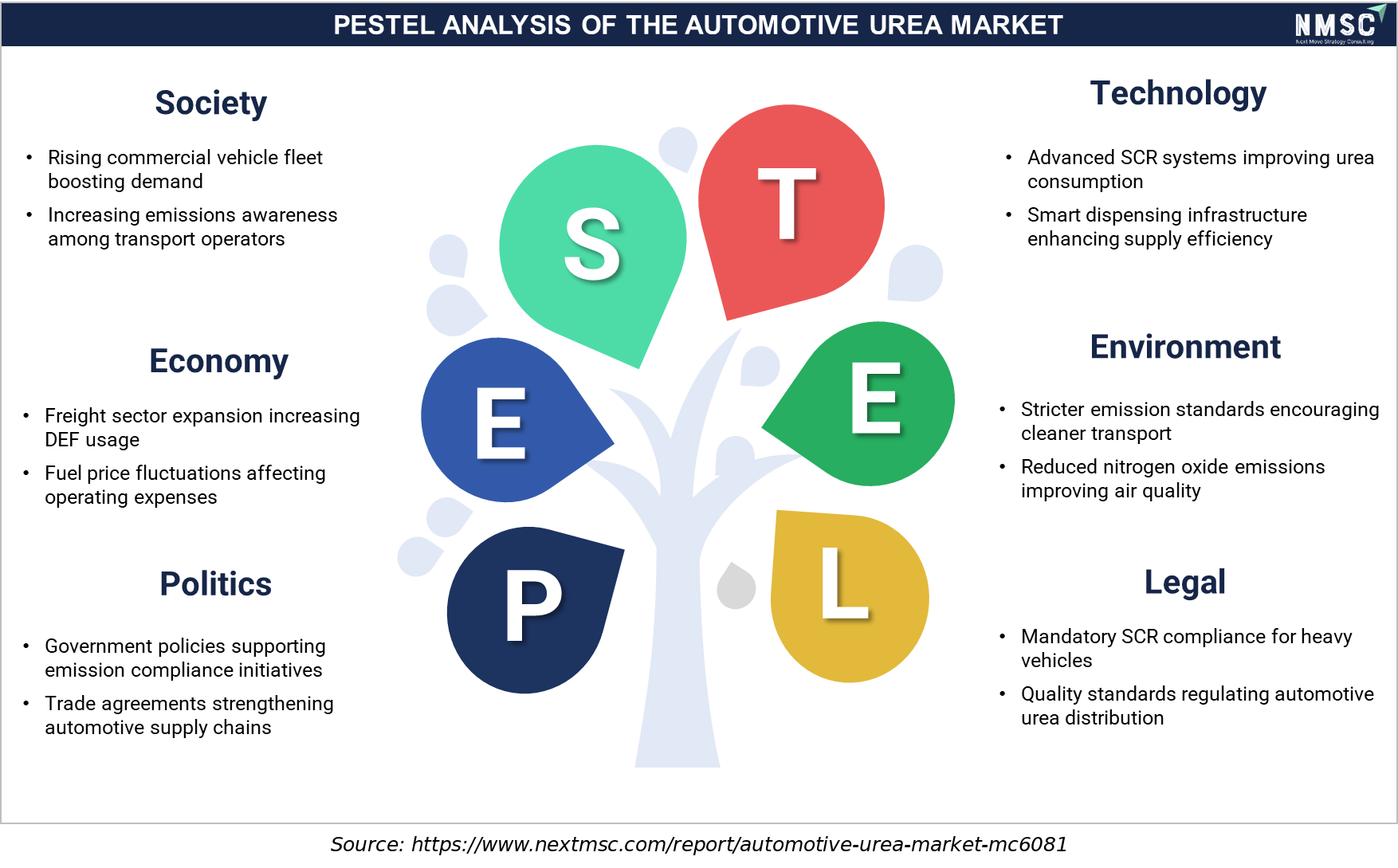
The PESTEL analysis of the automotive urea market highlights the external factors shaping industry growth. Political policies and emission regulations drive DEF adoption, while economic conditions influence production costs and demand. Social awareness of environmental sustainability supports market expansion. Technological advancements improve urea manufacturing and distribution efficiency. Environmental concerns promote cleaner diesel emissions, and legal frameworks such as Euro VI and EPA standards ensure compliance, quality, and continued market development.

Market Drivers & Dynamics

Interactive Dataset
Tightening nitrogen oxide emission regulations driver +1.8% Global 2026-2035
Growing heavy-duty commercial vehicle parc driver +1.5% Asia-Pacific, North America 2026-2035
Off-highway equipment SCR adoption expansion driver +1.2% Global 2026-2035
Bulk and fleet-scale distribution infrastructure growth driver +1.0% North America, Europe 2026-2033
Bio-based urea production and sustainability mandates driver +0.8% Europe, Asia-Pacific 2026-2035
Emerging market fleet formalization and infrastructure investment driver +0.7% Middle East & Africa, Latin America 2026-2033
Electric vehicle transition in passenger and light commercial segments restraint -0.9% Europe, North America 2028-2035
Urea and ammonia feedstock price volatility restraint -0.6% Global 2026-2032
Source: Next Move Strategy Consulting

Growth Drivers

What Is the Primary Growth Driver of the Automotive Urea Market?

Tightening nitrogen oxide emission regulations are the primary driver of the market. We observed that CF Industries continued expanding its diesel exhaust fluid production capacity through its Nitric Acid No. 3 plant upgrade, a USD 75 million investment targeting completion by the end of 2025, directly responding to sustained regulatory-driven demand. This capacity expansion continues to anchor baseline automotive urea procurement across on-road and off-highway diesel equipment manufacturers.

How Is Heavy-Duty Commercial Vehicle Growth Driving Market Growth?

Expansion of the global heavy-duty commercial vehicle parc is accelerating market growth as logistics and construction fleets scale to meet freight demand. Our assessment indicates that selective catalytic reduction systems account for a substantial majority of diesel vehicle applications globally, sustaining structural automotive urea consumption growth. This demand pattern is compressing the timeline for bulk and direct fleet supply channel expansion among distributors serving large commercial operators.

Growth Inhibitors

What Is Restraining Automotive Urea Market Expansion?

Accelerating electric vehicle adoption in passenger and light commercial vehicle segments restrains long-term automotive urea demand growth in mature markets, as electrification reduces the diesel vehicle parc requiring selective catalytic reduction fluid. Urea and ammonia feedstock price volatility further limits margin stability across the supply chain, since natural gas price swings directly affect production costs. We found that smaller regional blenders face particular exposure to these constraints, as limited procurement scale reduces their ability to hedge against feedstock cost fluctuations.

Segmentation Analysis

2025 (USD Billion)
2035 (USD Billion)
Heavy Duty Trucks 2025: $1.95 Billion | 2035: $3.00 Billion
Heavy Duty T
Light Commercial Vehicles 2025: $1.04 Billion | 2035: $1.79 Billion
Light Commer
Passenger Diesel Cars 2025: $0.81 Billion | 2035: $0.94 Billion
Passenger Di
Buses and Coaches 2025: $0.69 Billion | 2035: $1.04 Billion
Buses and Co
Agricultural Machinery 2025: $0.52 Billion | 2035: $1.13 Billion
Agricultural
Construction Equipment 2025: $0.40 Billion | 2035: $0.85 Billion
Construction
Mining Equipment 2025: $0.23 Billion | 2035: $0.47 Billion
Mining Equip
Other Off-Highway Equipment 2025: $0.12 Billion | 2035: $0.19 Billion
Other Off-Hi
Heavy Duty Trucks $1.95 Billion $3.00 Billion 4.3%
Light Commercial Vehicles $1.04 Billion $1.79 Billion 5.6%
Passenger Diesel Cars $0.81 Billion $0.94 Billion 1.2%
Buses and Coaches $0.69 Billion $1.04 Billion 4.0%
Agricultural Machinery $0.52 Billion $1.13 Billion 8.4%
Construction Equipment $0.40 Billion $0.85 Billion 8.0%
Mining Equipment $0.23 Billion $0.47 Billion 7.6%
Other Off-Highway Equipment $0.12 Billion $0.19 Billion 5.0%

Which Vehicle Application Dominates the Automotive Urea Market?

Heavy Duty Trucks led the market with USD 1.95 billion in 2025, supported by the largest installed base of selective catalytic reduction-equipped diesel engines among all covered applications. We observed that Agricultural Machinery is the fastest-growing vehicle application, expanding at an 8.4% CAGR from 2026 to 2035, as emissions regulation coverage extends further into off-highway equipment, sustaining above-market growth relative to on-road passenger applications.

2025 (USD Billion)
2035 (USD Billion)
Bulk
IBC tote
Drum
Jerrycan
Bottle
Segment Item 2025 (USD Billion) 2035 (USD Billion) CAGR
Bulk $10.0 USD Billion $40.0 USD Billion 25.0%
IBC tote $17.1 USD Billion $51.1 USD Billion 15.0%
Drum $24.2 USD Billion $62.2 USD Billion 25.0%
Jerrycan $31.3 USD Billion $73.3 USD Billion 27.0%
Bottle $38.4 USD Billion $84.4 USD Billion 16.0%

Segment-wise data is locked

Unlock complete segment-wise numbers for By Packaging Format.

Unlock Full Data

Which Packaging Format Leads Automotive Urea Distribution?

Bulk led the market, valued at USD 2.19 billion in 2025, reflecting established fleet-scale demand for tanker and terminal-based delivery among large commercial operators. Our findings suggest that Bulk is also the fastest-growing packaging format, registering a 6.7% CAGR from 2026 to 2035, as logistics and construction fleets continue transitioning away from packaged formats toward direct bulk delivery to reduce handling costs and packaging waste.

2025 (USD Billion)
2035 (USD Billion)
OEM first fi
Direct fleet
Wholesale su
Retail suppl
Institutiona
Segment Item 2025 (USD Billion) 2035 (USD Billion) CAGR
OEM first fill $10.0 USD Billion $40.0 USD Billion 24.0%
Direct fleet supply $17.1 USD Billion $51.1 USD Billion 10.0%
Wholesale supply $24.2 USD Billion $62.2 USD Billion 8.0%
Retail supply $31.3 USD Billion $73.3 USD Billion 14.0%
Institutional supply $38.4 USD Billion $84.4 USD Billion 13.0%

Segment-wise data is locked

Unlock complete segment-wise numbers for By Sales Channel.

Unlock Full Data

Which Sales Channel Leads Automotive Urea Revenue?

OEM First Fill remained the leading sales channel, valued at USD 1.56 billion in 2025 on established original equipment manufacturer supply agreements bundled with new vehicle sales. Our analysis shows that Direct Fleet Supply is the fastest-growing sales channel, registering a 6.8% CAGR from 2026 to 2035, as large commercial fleet operators increasingly negotiate direct supply contracts with producers to secure bulk pricing and delivery reliability.

2025 (USD Billion)
2035 (USD Billion)
North Americ
Canada
Mexico
Europe: UK
Germany
Segment Item 2025 (USD Billion) 2035 (USD Billion) CAGR
North America: U.S. $10.0 USD Billion $40.0 USD Billion 10.0%
Canada $17.1 USD Billion $51.1 USD Billion 8.0%
Mexico $24.2 USD Billion $62.2 USD Billion 18.0%
Europe: UK $31.3 USD Billion $73.3 USD Billion 8.0%
Germany $38.4 USD Billion $84.4 USD Billion 15.0%

Segment-wise data is locked

Unlock complete segment-wise numbers for By Region.

Unlock Full Data

Growth Opportunities

Our analysis shows that three forward-looking opportunities stand out for stakeholders positioning within the automotive urea market over the 2026-2035 forecast period.

How Can Bio-Based Urea Certification Unlock Value for Sustainability-Focused Suppliers?

Bio-based urea production using mass balance methods presents a whitespace opportunity for suppliers offering lifecycle-emissions-certified diesel exhaust fluid. Suppliers that commercialize validated bio-based product lines stand to capture recurring contracts with logistics operators pursuing corporate sustainability targets, particularly across European and Asia-Pacific markets with established mass balance certification frameworks.

Where Does Off-Highway Equipment Retrofit Create New Demand?

Retrofit and aftermarket selective catalytic reduction adoption in older off-highway equipment fleets represents an underpenetrated opportunity for suppliers offering ruggedized packaging suited to remote agricultural and mining environments. Suppliers that secure distribution partnerships with equipment dealers can access long-term supply contracts, benefiting from recurring revenue tied to expanding emissions regulation coverage in construction and mining sectors.

How Can Mobile Dispensing Infrastructure Benefit Emerging Market Fleet Operators?

Mobile dispensing infrastructure creates an opportunity for suppliers serving fleet operators in regions lacking fixed refueling networks. Early movers that validate mobile bulk delivery units can differentiate with operators pursuing operational flexibility in emerging diesel exhaust fluid markets, capturing recurring revenue tied to the segment's above-market growth through 2035.

SUPPLY CHAIN STRUCTURE OF THE AUTOMOTIVE UREA MARKET

SUPPLY CHAIN STRUCTURE OF THE AUTOMOTIVE UREA MARKET
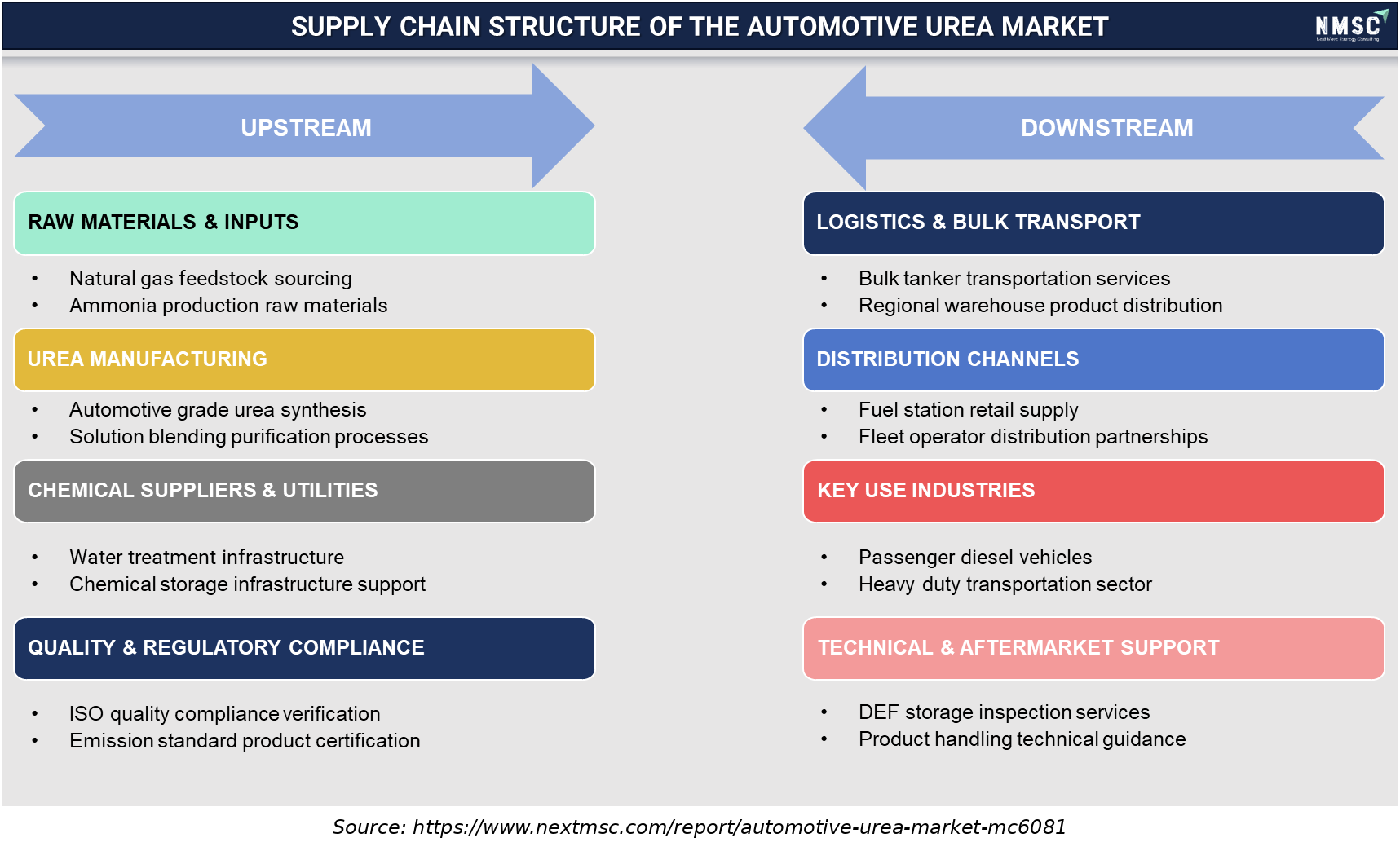
The automotive urea market supply chain begins with sourcing natural gas, ammonia, and other essential inputs, followed by high-purity urea manufacturing and strict quality compliance. Chemical suppliers and utility providers support production through water treatment and storage infrastructure. Downstream, bulk logistics and distribution networks ensure efficient product availability through OEMs, wholesalers, retailers, and fleet operators. Technical support, proper storage, and handling services help maintain product quality while meeting emission standards across commercial and passenger diesel vehicle applications.

Regional Outlook

2025 (USD Billion)
2035 (USD Billion)
Asia-Pacific
Europe
North Americ
Latin Americ
Middle East
Region 2025 (USD Billion) 2035 (USD Billion) CAGR (%)
Asia-Pacific $10.0 USD Billion $40.0 USD Billion 9.0%
Europe $17.1 USD Billion $51.1 USD Billion 27.0%
North America $24.2 USD Billion $62.2 USD Billion 25.0%
Latin America $31.3 USD Billion $73.3 USD Billion 23.0%
Middle East & Africa $38.4 USD Billion $84.4 USD Billion 12.0%

Regional data is locked

Unlock complete regional numbers for this market.

Unlock Full Data

Competitive Landscape

We observed that the automotive urea market features a moderately fragmented competitive landscape, with diversified chemical and energy conglomerates competing alongside specialized diesel exhaust fluid producers on distribution reach, product purity, and packaging breadth.

Dimension Description
Market Structure Moderately fragmented; the leading companies profiled in this report include large multinational chemical and energy groups alongside numerous regional and privately owned blending and distribution businesses.
Innovation Focus Bio-based urea production using mass balance methods, mobile bulk dispensing infrastructure, and expanded nitric acid and urea manufacturing capacity dominate current innovation pipelines across leading suppliers.
M&A Activity Limited large-scale consolidation; capital activity is concentrated in capacity expansion, exemplified by CF Industries' approximately USD 75 million investment to expand its Nitric Acid No. 3 plant and diesel exhaust fluid production unit.

How Do Companies Compete in the Automotive Urea Market?

Companies compete primarily on product purity, distribution network breadth, and supply reliability across the industry. Diversified players such as Shell plc and TotalEnergies Lubrifiants SA leverage established fuel retail and industrial distribution infrastructure to serve both retail and fleet customers, while specialized producers such as GreenChem Holding B.V. compete on packaging innovation and bulk logistics capability for large commercial fleet operators.

Which Competitive Archetypes Dominate the Automotive Urea Market?

Two archetypes dominate the market: diversified chemical and energy conglomerates offering automotive urea alongside broader fuel and lubricant portfolios, and specialized diesel exhaust fluid producers focused exclusively on emissions-compliance fluids. BASF SE and Yara International ASA exemplify the diversified archetype through integrated urea and nitrogen chemical production, while Old World Industries, LLC and GreenChem Holding B.V. exemplify the specialized archetype, concentrating on dedicated diesel exhaust fluid manufacturing and distribution.

How Are Companies Differentiating Through Innovation in Automotive Urea?

Innovation and differentiation strategy increasingly center on sustainability-certified production and distribution flexibility. CF Industries Holdings, Inc.'s Nitric Acid No. 3 plant expansion, targeting completion by the end of 2025, illustrates how producers are engineering integrated manufacturing capacity to buffer feedstock volatility while scaling output. Our analysis shows that suppliers unable to demonstrate credible bulk delivery and bio-based production capability risk losing share to more diversified, fleet-focused competitors.

What M&A and Investment Activity Is Shaping the Automotive Urea Market?

Capacity expansion and strategic product partnerships continue to reshape capability within the industry rather than large-scale mergers and acquisitions. Mitsui Chemicals and Sankyu Inc.'s August 2025 announcement of Bio AdBlue adoption across chemical tanker trucks illustrates how supply and demand-side partnerships are advancing sustainability-linked product adoption, while CF Industries' continued nitric acid and diesel exhaust fluid capacity investment reflects broader producer-side capital allocation toward supply chain resilience.

Key Market Players

Our assessment indicates that the following 19 companies are actively shaping product innovation, distribution expansion, and geographic reach within the global automotive urea market.

BASF SE TotalEnergies Lubrifiants SA Shell plc CF Industries Holdings, Inc. Old World Industries, LLC FUCHS SE Valvoline Global Operations Yara International ASA GreenChem Holding B.V. Shandong New Blue Environmental Protection Technology Co., Ltd. Noxguard Basekim Company Listoil OCI Global Grupa Azoty S.A. Anchemco India Private Limited Rosmerta Technologies Private Limited Novax Material Co., Ltd. Crown Oil Ltd

Latest Developments

We found that recent developments within the automotive urea market are concentrated on sustainable production methods and manufacturing capacity expansion, reflecting the industry's response to sustained regulatory-driven demand growth.

Date Event
January 2026 Yara highlighted its expanded global Air1 AdBlue supply network, including five production plants, 50 terminals, telemetry-monitored bulk tanks, and lower-carbon packaging innovations, demonstrating continued investment in global automotive urea supply.
March 2024 BASF launched AdBlue ZeroPCF, the world's first AdBlue with a certified near-zero Product Carbon Footprint (PCF), produced using renewable feedstocks through a mass balance approach.

Investment Opportunities

What Capital Inflows Are Targeting the Automotive Urea Market?

Capital inflows into the market are increasingly directed toward integrated nitric acid and urea manufacturing capacity that buffers feedstock cost volatility. We observed that CF Industries' approximately USD 75 million investment in its Nitric Acid No. 3 plant and diesel exhaust fluid production unit reflects producer-side capital allocation toward supply chain resilience. Investors favor producers demonstrating integrated manufacturing capability as a proxy for consistent margin performance amid feedstock price swings.

How Is Infrastructure Investment Supporting Automotive Urea Distribution?

Infrastructure investment is expanding bulk delivery and mobile dispensing capacity to serve rising fleet-scale demand. Our findings suggest that GreenChem's development of mobile AdBlue dispensing units supports operational flexibility for fleet customers operating away from fixed refueling infrastructure, reflecting broader industry investment in bulk and direct fleet supply distribution channels outside traditional retail packaging.

What ESG Considerations Are Shaping Automotive Urea Investment Decisions?

Environmental, social, and governance considerations are increasingly relevant to investment decisions across the industry, particularly regarding bio-based feedstock sourcing and lifecycle emissions reduction. Producers continue to expand mass balance-certified bio-based urea production, as demonstrated by Mitsui Chemicals' Bio AdBlue offering. We found that investors increasingly favor suppliers with transparent sustainability disclosures, treating them as governance indicators alongside product purity and supply chain traceability.

Key Benefits for Stakeholders

How Does This Report Benefit Enterprise and Industry Leaders?

Enterprise and industry leaders gain access to validated segmentation, competitive benchmarking, and regional demand forecasts that support sourcing and distribution decisions across the automotive urea industry. Our analysis shows that detailed vehicle application, packaging format, and sales channel breakdowns help procurement teams align specifications with fleet-scale delivery requirements while identifying underserved regions for distribution expansion.

How Does This Report Benefit Investors and Financial Analysts?

Investors and financial analysts benefit from consistent, single-point market size and CAGR estimates that support valuation and capital-allocation decisions across the automotive urea supply chain. We observed that the report's regional and segment-level growth differentials help identify which producers are best positioned to capture above-market growth in bulk distribution and off-highway equipment applications through 2035.

How Does This Report Benefit Technology Vendors and Product Teams?

Technology vendors and product teams gain insight into emerging design requirements, including bio-based production methods and mobile bulk dispensing infrastructure, that are reshaping the industry. Our findings suggest that this analysis helps R&D teams prioritize development roadmaps around sustainability certification and distribution flexibility increasingly required by large fleet operator procurement processes.

Key Market Segments Evaluated

By Vehicle Application

  • Heavy Duty Trucks
  • Light Commercial Vehicles
  • Passenger Diesel Cars
  • Buses and Coaches
  • Agricultural Machinery
  • Construction Equipment
  • Mining Equipment
  • Other Off-Highway Equipment

By Packaging Format

  • Bulk
  • IBC Tote
  • Drum
  • Jerrycan
  • Bottle
  • Other Pack

By Sales Channel

  • OEM First Fill
  • Direct Fleet Supply
  • Wholesale Supply
  • Retail Supply
  • Institutional Supply

By Region

  • North America: U.S.
  • Canada
  • Mexico
  • Europe: UK
  • Germany
  • France
  • Italy
  • Spain
  • Sweden
  • Denmark
  • Finland
  • Netherlands
  • Rest of Europe
  • Asia-Pacific: China
  • India
  • Japan
  • South Korea
  • Taiwan
  • Indonesia
  • Vietnam
  • Australia
  • Philippines
  • Malaysia
  • Rest of APAC
  • Middle East & Africa: Saudi Arabia
  • UAE
  • Egypt
  • Israel
  • Turkey
  • Nigeria
  • South Africa
  • Rest of MEA
  • Latin America: Brazil
  • Argentina
  • Chile
  • Colombia
  • Rest of LATAM

Conclusion & Recommendations

The long-term outlook for the market remains positive, with global revenue projected to expand from USD 5.76 billion in 2025 to USD 9.41 billion by 2035 at a 5.01% CAGR. We observed that sustained heavy-duty commercial vehicle demand, expanding off-highway equipment regulation, and bio-based production adoption will continue underpinning demand even as passenger vehicle electrification moderates growth in mature diesel markets through the forecast period.

What Strategic Positioning Should Automotive Urea Suppliers Pursue?

Suppliers should prioritize bulk and direct fleet supply distribution capability while pursuing bio-based production certification to secure long-term commercial fleet contracts. Our assessment indicates that producers investing early in integrated nitric acid and urea manufacturing capacity, alongside mobile dispensing infrastructure, will be best positioned to capture premium pricing within the automotive urea market.

How Attractive Is the Automotive Urea Market for New Investment?

The automotive urea industry presents a steady, moderate-growth investment case, supported by a USD 3.35 billion absolute dollar opportunity between 2026 and 2035 and above-average growth in off-highway equipment and Asia-Pacific markets. We found that investment attractiveness is highest for producers combining integrated manufacturing capacity with bulk distribution reach, positioning them to serve both established and emerging fleet markets simultaneously.

What Market Shifts and Key Risks Should Stakeholders Monitor?

Stakeholders should monitor accelerating passenger vehicle electrification, urea and ammonia feedstock price volatility, and regional emissions regulation harmonization as key risks to the automotive urea market. Our analysis shows that suppliers overly concentrated in passenger diesel applications risk slower growth relative to competitors diversified across heavy-duty and off-highway equipment segments, particularly across European and North American markets facing faster electrification timelines.

What Are the Key Growth Pathways for the Automotive Urea Market?

Key growth pathways include expanding bulk and direct fleet supply distribution, scaling bio-based production capacity, and deepening penetration into off-highway agricultural, construction, and mining equipment applications. Next Move Strategy Consulting's analysis indicates that suppliers pursuing these pathways while maintaining OEM first-fill relationships will be best positioned to capture the automotive urea market's projected growth through 2035.

FAQs

About the Author

Liza Phukan

Liza Phukan

Liza Phukan is Research Associate at Next Move Strategy Consulting, where she has covered emerging industries and market research across sectors for 3.5 years. Her work includes analyzing industry developments, validating market data, and developing structured business content from research findings. She uses secondary research and data-validation practices to turn complex market information into clear decision-useful market analysis for business audiences and support report development and B2B.

About the Reviewer

Supradip Baul

Supradip Baul

Supradip Baul is an accomplished business consultant and strategist with over a decade of rich experience in market intelligence, strategy, technology, and business transformation. His work has included rigorous qualitative and quantitative analysis across multiple industries, helping clients shape investment decisions and long-term roadmaps. Earlier in his career, he was associated with Gartner, where he contributed to industry-leading reports and market share analyses. He has worked with leading global companies and holds an MBA with a dual specialization in Marketing and Finance.

Download Free Sample

Ross J Mckenzie

ROSS J MCKENZIE

Business Insight Manager

Staysure Group

“Next MSC have been incredibly helpful in providing detailed & robust information on our market, alongside quantifying growth by different segments. The process to procure was simple and easy, with sample reports and regular contact to ensure we had what we needed. Succinct detail on their sources & methodologies is also greatly received, allowing transparency in this respect helps build trust in the detail you pay for. Joseph in particular was fantastic, and helped ensure efficient provision of the insight pack – thank you NMSC!”.

Melanie Samko

MELANIE SAMKO

Director of Marketing

TOSOH BIOSCIENCE, INC.

The information provided by NMSC is incredibly valuable, thank you so much for such a excellent work. I really appreciate it. I will make sure to reference all of it, in my summary document.

Kishu Kanda

KISHU KANDA

Strategy Analyst

Accenture

We purchased the AI Consumer Market Report from this company. Not only did they customize the report to meet our specific requirements, but they also showed great flexibility in accommodating our budget. The report we received fully met our expectations. Additionally, they provided prompt and thorough responses to both our pre-purchase and follow-up questions. We look forward to working with this company again in the future.

Gaurav Jaiswal

GAURAV JAISWAL

Founder & CEO

Yano Charge Private Limited

The EV Charging market research report provided by the NextMSC was exceptionally detailed and insightful. It offered a comprehensive analysis that proved to be a game-changer for our strategic planning. Truly a testament to the NextMSC’s expertise and thoroughness in EV market landscape & analysis.

Amos Chang

AMOS CHANG

Strategy Consultant

Kardex Group

I have bought the intralogistics market reports from NMSC two times so far. Joseph and his team are always very helpful and flexible in responding to any customization requirements on the report. Their expertise in market reports really helps us steer the day-to-day business. I will definitely recommend and come back myself whenever there is a need.

Custom Market Research Services

We will customize the research for you if the listed report does not fully match your requirements.

Get 30% Free Customization

Select License

This website uses cookies to ensure you get the best experience on our website. Learn more

✖