Automotive Control Cables Market Size, Share, Growth & Forecast by Cable Function (Powertrain Control, Brake and Safety Control, and Other Automotive Control Cables), Vehicle Class (Two Wheelers and Three Wheelers, Passenger Cars, Light Commercial Vehicles, Heavy Commercial Vehicles, Off-Highway and Special Vehicles), Sales Channel (OEM, Tier 1 Supplier, Aftermarket), and Cable Construction (Pull Only, Push Pull, Bowden, Other) — Global Analysis 2026–2035
Industry: Automotive & Transportation | Publishing Date: July 11, 2026 | Last Updated: September 30, 2026 | No of Pages: N/A | No. of Tables: N/A | No. of Figures: N/A | Format: PDF | Report Code: AT5093
What Is the Automotive Control Cables Market Size?
The global Automotive Control Cables Market was valued at USD 4.81 billion in 2025 and is expected to reach USD 4.95 billion in 2026. Continued expansion of global vehicle production, rising demand for aftermarket cable replacement, and sustained adoption of mechanical control systems across two-wheelers and commercial vehicle segments are projected to propel the market to USD 6.52 billion by 2035, advancing at a CAGR of 3.2% from 2026 to 2035. Key growth drivers include the expanding commercial vehicle fleet in Asia-Pacific and Africa, the persistent demand for cost-effective Bowden cable solutions in entry-level and mid-range passenger cars, sustained aftermarket replacement cycles across aging vehicle fleets in North America and Europe, and rising vehicle parc in developing economies driving OEM and Tier 1 supplier volumes.
|
Parameters |
Details |
|
Market Size in 2025 |
USD 4.81 Billion |
|
Market Size in 2026 |
USD 4.95 Billion |
|
Revenue Forecast in 2035 |
USD 6.52 Billion |
|
Growth Rate |
CAGR of 3.2% from 2026 to 2035 |
|
Analysis Period |
2025–2035 |
|
Base Year Considered |
2025 |
|
Forecast Period |
2026–2035 |
|
Market Size Estimation |
Billion USD |
|
Companies Profiled |
20 |
|
Countries Covered |
36 |
|
Market Share |
Top 10 |
Automotive Control Cables Market Overview
What Is the Automotive Control Cables Market?
The Automotive Control Cables Market encompasses the design, manufacture, and supply of mechanical cable assemblies used to transmit motion, force, and control signals across vehicle systems. These cables connect driver inputs to functional automotive mechanisms, including throttle systems, clutch assemblies, parking brakes, hood latches, seat adjusters, and HVAC controls, through engineered push-pull and bowden cable configurations. From our research, we found that automotive control cables remain an indispensable component of both internal combustion engine vehicles and, selectively, electric vehicles that retain mechanical control interfaces for cost, reliability, and safety reasons.
How Has the Automotive Control Cables Market Evolved?
The Automotive Control Cables Market has undergone structural transformation across multiple decades. Early mechanical cable systems were largely commodity products with limited customization. As vehicle platforms grew in complexity, cable assemblies evolved into precision-engineered sub-systems incorporating corrosion-resistant conduits, specialized end fittings, and multi-strand wire cores. Through our market assessment, we observed that the market has further bifurcated between OEM-driven high-volume standardized assemblies and aftermarket-focused replacement cable programs. Currently, the market faces a measured transition as full vehicle electrification progressively replaces select mechanical cable functions with electronic actuators, while simultaneously sustaining demand through growing commercial vehicle volumes globally.
How Do Regulations Influence the Automotive Control Cables Market Demand?
Regulatory developments play a meaningful structural role in the Automotive Control Cables Market. Safety regulations enforced by the U.S. National Highway Traffic Safety Administration (NHTSA), the European Parliament's General Safety Regulation for motor vehicles, and India's Automotive Industry Standard (AIS) framework mandate specific performance requirements for brake cables, parking brake assemblies, and throttle control systems. Emission-linked compliance requirements have also accelerated the replacement of throttle cables with electronic throttle control systems in new passenger car platforms across major markets. NMSC's analysis indicates that regulatory recall compliance obligations continue to sustain aftermarket cable replacement demand as aging vehicle fleets require certified replacement assemblies.
How Is Technology Adoption Expanding Across the Automotive Control Cables Market?
Technology adoption within the Automotive Control Cables Market is defined by dual imperatives: incremental innovation in material science and cable engineering on one hand, and the progressive displacement of mechanical cables by drive-by-wire and electronic actuator technologies on the other. Based on our market evaluation, we noticed that premium passenger car segments are accelerating adoption of electronic throttle control, electronic parking brakes, and power liftgate actuators, reducing cable content per vehicle in these segments. Concurrently, commercial vehicle platforms and two-wheeler applications continue to represent structurally durable demand bases for mechanical control cables, sustaining high-volume OEM supply programs.
|
Key Takeaways |
|
By cable function, Powertrain Control cables held the largest Automotive Control Cables Market share at approximately USD 1.2 billion in 2025, led by Accelerator and Throttle Cables due to their widespread deployment across two-wheelers and commercial vehicles globally. Charge Port Release Cables and Seat Adjuster Cables are the fastest-growing sub-segments, projected to advance at a CAGR of 5.8% through 2035, driven by the expansion of electric vehicle platforms and increasing adoption of premium interior comfort features. |
|
By vehicle class, Passenger Cars accounted for the largest share of the Automotive Control Cables Market, generating approximately USD 1.7 billion in revenue in 2025, supported by high global production volumes and extensive cable integration across powertrain, access, and interior vehicle systems. Two Wheelers and Three Wheelers represent the fastest-growing vehicle class segment, expected to expand at a CAGR of 4.6% from 2026 to 2035, fueled by strong vehicle production growth in India, Vietnam, and Indonesia where mechanical cable-based systems remain widely utilized. |
|
By sales channel, OEM remained the dominant segment in the Automotive Control Cables Market, accounting for approximately USD 2.6 billion in 2025, as cable assemblies continue to be integrated into vehicle systems during the design and manufacturing process. The Aftermarket segment is projected to be the fastest-growing sales channel at a CAGR of 4.2% from 2026 to 2035, supported by aging vehicle fleets, increasing maintenance activity, and the expansion of organized replacement-part distribution networks globally. |
|
By cable construction, Bowden cables held the largest share of the Automotive Control Cables Market in 2025, accounting for approximately 52% of total market revenue, owing to their established use in throttle, clutch, parking brake, and hood release applications across diverse vehicle platforms. Push Pull cable construction is the fastest-growing segment, driven by rising demand for bidirectional force transmission in seat adjustment systems, sliding door mechanisms, and HVAC controls across modern vehicle architectures. |
|
Asia-Pacific held the largest share of the Automotive Control Cables Market at approximately USD 2.1 billion in 2025 and is projected to reach USD 2.92 billion by 2035, growing at a CAGR of 3.4%, supported by high vehicle production volumes, strong two-wheeler demand, and the presence of major OEM and Tier 1 manufacturing hubs across China, India, and Japan. |
|
Middle East & Africa is the fastest-growing regional market, forecast to expand from USD 0.42 billion in 2025 to USD 0.61 billion by 2035 at an estimated CAGR of 5.1%, driven by rising vehicle imports, growing two-wheeler adoption, expanding commercial fleets, and increasing aftermarket replacement demand. |
|
China remained the largest country market in the Automotive Control Cables Market in 2025, accounting for approximately 28% of Asia-Pacific revenue, supported by its position as the world's largest automotive manufacturing base and extensive domestic cable supply ecosystem. |
|
Nigeria is projected to be the fastest-growing country market in the Middle East & Africa Automotive Control Cables Market through 2035, supported by rapid growth in motorcycle and tricycle fleets, increasing vehicle imports, expanding urban transportation demand, and the gradual formalization of aftermarket distribution networks. |
Key Emerging Trends in the Automotive Control Cables Market
How Is the Shift Toward Electric Vehicles Reshaping Demand Dynamics in the Automotive Control Cables Market?
Electric vehicle adoption is reshaping the cable content profile of modern vehicle platforms. While EVs eliminate conventional throttle and engine stop cables, they introduce new cable applications including Charge Port Release Cables and retain mechanical interfaces for parking brakes, seat mechanisms, and trunk releases. Based on NMSC's research, we found that full-function EVs carry a materially different but not negligible cable bill of materials compared to equivalent ICE platforms. OEM cable suppliers are actively reconfiguring product portfolios to address EV-specific cable programs, particularly among premium European and Asian EV manufacturers integrating mechanical charge access and interior comfort systems.
How Is Lightweighting in Vehicle Design Influencing Automotive Control Cable Specifications?
Automotive OEMs are increasingly specifying lightweight cable assemblies to reduce overall vehicle mass in pursuit of fuel efficiency and range optimization targets. Our assessment indicates that manufacturers are replacing traditional steel wire strands with high-tensile stainless steel or composite core filaments and adopting polymer-jacketed conduits in place of heavier steel outer casings. Companies including Hi-Lex Corporation and Suprajit Engineering have introduced lightweight cable variants serving passenger car platforms targeting CAFE standards compliance in North America and CO2 fleet average requirements in Europe. This trend drives incremental per-unit ASP growth even as unit volumes remain stable.
How Is the Expansion of Two-Wheeler Production in Asia Sustaining Long-Term Demand in the Automotive Control Cables Market?
The structural growth of two-wheeler and three-wheeler production across South and Southeast Asia represents one of the most durable long-term demand catalysts for the Automotive Control Cables Market growth. Our findings suggest that India alone produces over 20 million two-wheelers annually, each requiring multiple mechanical control cables for throttle, clutch, brake, and choke systems. Vietnam, Indonesia, and the Philippines similarly sustain multi-million-unit two-wheeler markets with a virtually universal reliance on mechanical cable-controlled drivetrains. Thai Steel Cable and Suprajit Engineering have established manufacturing operations in proximity to these production clusters, reducing supply chain lead times and enabling just-in-time delivery to major two-wheeler OEMs.
How Are Aftermarket Distribution Networks Evolving to Capture Growth in the Automotive Control Cables Market?
The aftermarket segment of the Automotive Control Cables Market is undergoing a structural transformation driven by the digitization of spare parts distribution and the expansion of organized retail. Through NMSC's assessment, we found that e-commerce platforms, fleet management procurement systems, and digital parts catalogs are accelerating aftermarket cable replacement cycles across aging vehicle populations in North America, Europe, and Latin America. Companies including Lexco Cable and Cablecraft Motion Controls have expanded their digital product configurator capabilities, enabling workshops and fleet operators to specify custom cable replacements for legacy vehicles no longer supported by OEM supply programs.
What Are the Key Market Drivers, Breakthroughs, and Investment Opportunities that Will Shape the Automotive Control Cables Market in the Next Decade?
|
Drivers / Trends / Restraints |
(+/-) % Impact on CAGR Forecast |
Geographic Relevance |
Impact Timeline |
|
Surging Two-Wheeler Production in Asia-Pacific |
+0.8% |
India, Vietnam, Indonesia, Philippines |
2025–2035 |
|
Expanding Commercial Vehicle Fleet in Emerging Markets |
+0.6% |
Africa, LATAM, South Asia |
2025–2032 |
|
Aftermarket Cable Replacement Demand from Aging Vehicle Parc |
+0.5% |
North America, Europe, Latin America |
2025–2035 |
|
EV Platform Charge Port and Interior Cable Integration |
+0.4% |
China, Europe, North America |
2026–2035 |
|
Lightweight Cable Specification in Passenger Car Programs |
+0.3% |
North America, Europe, Japan |
2025–2030 |
|
Electronic Throttle Control Replacing Mechanical Throttle Cables |
-0.7% |
North America, Europe, China |
Ongoing |
|
Electronic Parking Brake Adoption in Passenger Cars |
-0.5% |
Europe, China, Japan |
Ongoing |
|
Drive-by-Wire Expansion in Premium Vehicle Segments |
-0.4% |
Global (led by Europe, U.S.) |
2026–2035 |
|
Raw Material Cost Volatility (Steel Wire, Polymer Conduits) |
-0.3% |
Global |
Ongoing |
|
Growing Vehicle Parc in Sub-Saharan Africa and MEA |
+0.4% |
Nigeria, South Africa, GCC |
2026–2035 |
What Are the Growth Drivers of the Automotive Control Cables Market?
How Is Global Two-Wheeler Production Driving Demand in the Automotive Control Cables Market?
Two-wheeler production represents the single most structurally durable demand driver for the Automotive Control Cables Market expansion globally. Each motorcycle, scooter, or three-wheeler produced in India, Vietnam, Indonesia, and other major Asian markets requires a full complement of mechanical control cables, including throttle, clutch, front and rear brake, speedometer, and choke cables. The Society of Indian Automobile Manufacturers (SIAM) reported that India's two-wheeler domestic sales reached over 17 million units in fiscal year 2023–24, with the majority of these vehicles utilizing mechanical cable-controlled systems. Our analysis shows that the cable intensity per two-wheeler unit is significantly higher relative to its vehicle value compared to passenger cars, making two-wheeler production growth a powerful demand multiplier for OEM cable suppliers.
How Is the Growth of Global Commercial Vehicle Fleets Sustaining Automotive Control Cable Demand?
Commercial vehicles, including light and heavy trucks, buses, and off-highway machinery, carry substantially higher cable content per unit than passenger cars due to the greater use of mechanical linkages for transmission shift, parking brake, engine stop, clutch, and auxiliary control systems. The International Organization of Motor Vehicle Manufacturers reported global commercial vehicle production of approximately 25 million units in 2023. Emerging markets in Africa, Latin America, and South Asia are adding commercial vehicles to their transportation infrastructure at sustained annual rates, driving steady OEM cable demand. Our assessment indicates that heavy commercial vehicles in particular present attractive cable revenue per unit given complex powertrain and brake control cable requirements.
How Does Aftermarket Replacement Demand Support Stable Revenue in the Automotive Control Cables Market?
The aftermarket replacement segment provides the Automotive Control Cables Market with a structurally resilient and recurring revenue base that partially offsets any cyclical softening in OEM production volumes. Control cables are wear-prone components subject to fraying, corrosion, and mechanical fatigue, requiring periodic replacement throughout a vehicle's service life. The U.S. Department of Transportation Federal Highway Administration data confirms that the average age of light vehicles in operation in the United States exceeded 12 years in 2023, representing a large and growing population of vehicles requiring mechanical cable replacement. NMSC's analysis indicates that North America and Western Europe collectively represent a highly valuable aftermarket segment due to their combination of aging vehicle parc and high repair expenditure per vehicle.
What Are the Growth Inhibitors of the Automotive Control Cables Market?
How Is the Adoption of Electronic Throttle Control Systems Displacing Mechanical Cables in Passenger Cars?
Electronic throttle control, also referred to as drive-by-wire throttle actuation, has become the dominant technology in new passenger car platforms across North America, Europe, China, Japan, and South Korea. These systems replace the traditional mechanical accelerator cable with a sensor-actuator combination that transmits throttle input electronically, delivering improved engine response, fuel efficiency calibration, and integration with advanced driver assistance systems. Based on our research, we found that the U.S. NHTSA and European General Safety Regulation have increasingly mandated ADAS functionalities that require electronic throttle interfaces, making mechanical throttle cable designs structurally incompatible with next-generation vehicle safety architectures in premium and mid-range passenger car segments.
How Is the Proliferation of Electronic Parking Brakes Reducing Parking Brake Cable Demand?
Electronic parking brake systems are progressively displacing traditional parking brake cable assemblies across passenger car platforms globally, particularly in European, Chinese, and Japanese markets. These systems use an electric motor and control module to apply and release the brake without a mechanical cable, enabling automated hold functions, hill-start assist, and integration with electronic stability control systems. Our findings suggest that virtually all premium European manufacturers, including BMW, Mercedes-Benz, Volkswagen, and Stellantis, have standardized electronic parking brakes across mid-range and premium platforms. This displacement is structurally reducing the addressable cable content in new passenger car launches, representing a meaningful long-term headwind to OEM parking brake cable volume.
What Are the Growth Opportunities in the Automotive Control Cables Market?
How Does the Expansion of Electric Vehicle Platforms Create New Cable Application Opportunities?
Electric vehicle platforms, while eliminating certain powertrain cable applications, simultaneously introduce distinct new mechanical cable requirements that the Automotive Control Cables Market is well positioned to supply. Charge Port Release Cables, which enable manual override of charge port latch mechanisms for safety compliance purposes, represent a growing application as global EV fleet volumes scale. Additionally, interior comfort cables including seat adjusters, seat releases, and sunroof mechanisms remain fully mechanical in the majority of current production EVs, particularly in volume segments where cost optimization constrains the use of fully electrified interior actuation. NMSC's analysis indicates that as global EV production surpasses 30 million units annually by the end of the decade, these cable categories will represent a structurally growing and competitively differentiated opportunity for specialized OEM cable suppliers.
How Can Automotive Control Cable Manufacturers Capture Growth in the Organized Aftermarket?
The organized automotive aftermarket represents a high-margin and rapidly formalizing growth opportunity for Automotive Control Cable suppliers that invest in catalog depth, brand recognition, and digital distribution capabilities. In markets including India, Brazil, and Mexico, the shift from unorganized roadside repairs to franchise-based workshop chains and e-commerce spare parts platforms is accelerating, creating structured demand for branded, quality-certified replacement cable assemblies. The Automotive Parts Manufacturers' Association of India has documented rapid growth in organized spare parts distribution through digital channels. Cablecraft Motion Controls and Lexco Cable have expanded their aftermarket catalog and configurator tools to address this opportunity, demonstrating a viable commercialization pathway for OEM-grade suppliers entering the high-velocity aftermarket replacement segment.
How Does Off-Highway and Special Vehicle Demand Represent an Underserved Opportunity in the Automotive Control Cables Market?
Off-highway vehicles, including agricultural tractors, construction machinery, mining equipment, and material handling platforms, represent a structurally underserved yet high-cable-intensity application segment within the Automotive Control Cables Market. These platforms retain fundamentally mechanical control architectures for throttle, engine stop, transmission shifting, and auxiliary system operation due to the robustness, simplicity, and serviceability advantages that mechanical cables provide in harsh operating environments. Our analysis shows that global agricultural mechanization programs in India, Brazil, and Sub-Saharan Africa are expanding tractor and farm equipment fleets substantially. Suppliers such as Orscheln Products LLC and Grand Rapids Controls Co., LLC are actively serving this segment with specialized heavy-duty cable assemblies designed for extended service life under vibration and contamination exposure.
PESTEL Analysis of the Automotive Control Cables Market

Based on NMSC’s evaluation, we found that the Automotive Control Cables market is influenced by regulatory policies, economic conditions, technological advancements, environmental standards, legal compliance requirements, and evolving consumer preferences. Our assessment identifies that vehicle production trends, emissions regulations, and increasing demand for durable control systems are shaping market dynamics. Moreover, ongoing innovation and global manufacturing investments continue to strengthen industry growth prospects.
How Is the Automotive Control Cables Market Segmented in This Report, and What Are the Key Insights from the Segmentation Analysis?
How Do Powertrain and Brake Cable Functions Define Revenue Leadership in the Automotive Control Cables Market?
|
Cable Function Segment |
2025 (USD Bn) |
2035 (USD Bn) |
CAGR (%) |
|
Powertrain Control |
1.23 |
1.6 |
2.9% |
|
Brake and Safety Control |
0.98 |
1.32 |
3.1% |
|
Access and Release Control |
0.72 |
0.98 |
3.2% |
|
Lock and Latch Control |
0.54 |
0.72 |
3.0% |
|
Interior and Comfort Control |
0.61 |
0.87 |
3.7% |
|
Instrument and Auxiliary Control |
0.38 |
0.49 |
2.9% |
|
Other Automotive Control Cables |
0.34 |
0.52 |
4.3% |
The Automotive Control Cables Market is segmented by cable function into Powertrain Control, Brake and Safety Control, Access and Release Control, Lock and Latch Control, Interior and Comfort Control, Instrument and Auxiliary Control, and Other Automotive Control Cables categories. Powertrain Control cables, encompassing Accelerator and Throttle Cables, Clutch Cables, Shift Cables, and Engine Stop and Choke Cables, represent the dominant functional segment due to their universal application across both conventional and commercial vehicle platforms where mechanical throttle and clutch systems remain standard. Brake and Safety Control cables, including Parking Brake Cables, Emergency Release Cables, and Service Brake Cables, constitute the second-largest segment, sustained by their critical safety function and regulatory compliance requirements across all vehicle classes. Interior and Comfort Control cables are the fastest-growing functional sub-category, driven by expanding seat adjuster, sunroof, window regulator, and HVAC cable applications in mid-range and premium passenger car segments globally.
Which Vehicle Class Generates the Highest Automotive Control Cable Demand?
|
Vehicle Class Segment |
2025 (USD Bn) |
2035 (USD Bn) |
CAGR (%) |
|
Two Wheelers and Three Wheelers |
1.15 |
1.74 |
4.6% |
|
Passenger Cars |
1.7 |
2.18 |
2.8% |
|
Light Commercial Vehicles |
0.83 |
1.09 |
3.0% |
|
Heavy Commercial Vehicles |
0.72 |
0.97 |
3.1% |
|
Off-Highway and Special Vehicles |
0.4 |
0.52 |
2.9% |
The Automotive Control Cables Market is segmented by vehicle class into Two Wheelers and Three Wheelers, Passenger Cars, Light Commercial Vehicles, Heavy Commercial Vehicles, and Off-Highway and Special Vehicles. Passenger Cars represent the largest vehicle class segment by revenue, anchored by high global production volumes and broad cable content per vehicle spanning powertrain, access, interior, and safety functions. Two Wheelers and Three Wheelers constitute the fastest-growing vehicle class, driven by surging production across India, Vietnam, Indonesia, and other major Asian two-wheeler markets where fully mechanical drivetrains generate high cable intensity per unit. Light and Heavy Commercial Vehicles provide a stable and sizeable demand base due to their retention of mechanical shift, parking brake, and engine control cable systems across global fleet applications.
How Do OEM, Tier 1, and Aftermarket Channels Distribute Revenue Across the Automotive Control Cables Market?
|
Sales Channel Segment |
2025 (USD Bn) |
2035 (USD Bn) |
CAGR (%) |
|
OEM |
2.59 |
3.31 |
2.8% |
|
Tier 1 Supplier |
0.98 |
1.27 |
2.9% |
|
Aftermarket |
1.23 |
1.92 |
4.6% |
The Automotive Control Cables Market is segmented by sales channel into OEM, Tier 1 Supplier, and Aftermarket categories. The OEM channel dominates, accounting for approximately 54% of total revenue in 2025, as cable assemblies are integrated into vehicle platforms at the production stage under long-term supply agreements with global automotive manufacturers. Tier 1 Supplier channels serve as the structural intermediary between cable manufacturers and OEM production systems, particularly for integrated sub-assemblies and modular interior and access control systems. The Aftermarket is the fastest-growing channel, advancing at an estimated CAGR of 4.6% through 2035, driven by the growing vehicle parc, increasing cable replacement frequency in aging vehicles, and the rapid digitization of spare parts distribution networks across Asia-Pacific and Latin America.
Which Cable Construction Type Commands the Largest Share in the Automotive Control Cables Market?
|
Cable Construction Segment |
2025 (USD Bn) |
2035 (USD Bn) |
CAGR (%) |
|
Bowden |
2.5 |
3.31 |
3.2% |
|
Push Pull |
1.1 |
1.54 |
3.5% |
|
Pull Only |
0.86 |
1.1 |
2.8% |
|
Other |
0.34 |
0.55 |
5.0% |
The Automotive Control Cables Market is segmented by cable construction into Bowden, Push Pull, Pull Only, and Other construction types. Bowden cable construction remains the dominant design standard, applied across throttle, clutch, parking brake, hood release, and speedometer cable applications given its proven reliability, design flexibility, and cost-effectiveness across high-volume vehicle platforms. Push Pull cables are the fastest-growing construction type, reflecting increasing use in seat adjusters, sliding door mechanisms, and HVAC control systems where bidirectional force transmission is required. Pull Only cables serve dedicated single-directional control applications primarily in braking and release systems. Other construction types include specialized custom push-pull assemblies and legacy replacement cables serving low-volume or obsolete platform requirements.
Supply Chain Structure of the Automotive Control Cables Market
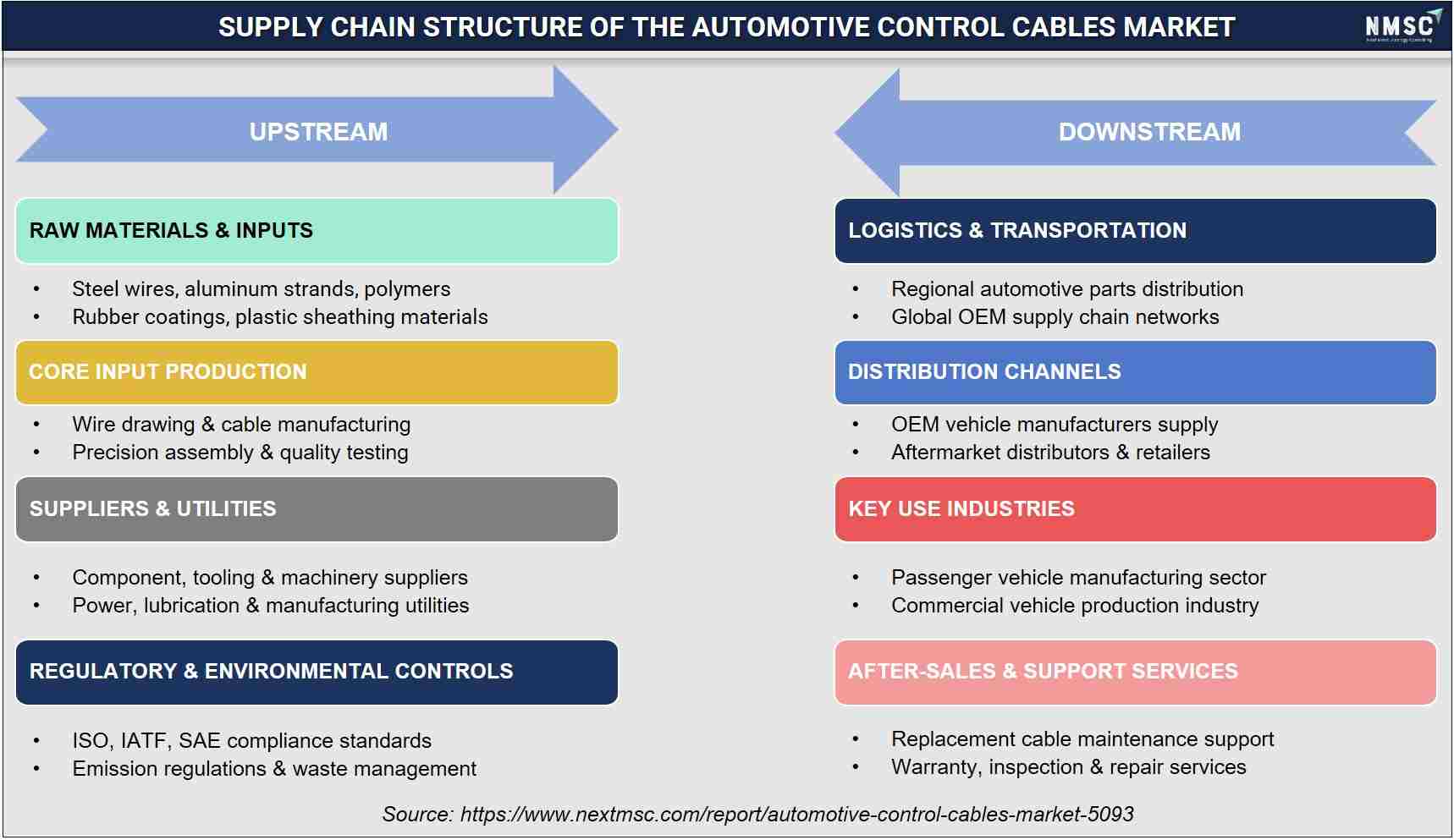
NMSC’s analysis indicates that the Automotive Control Cables market relies on an integrated supply chain extending from raw material sourcing and cable manufacturing to OEM distribution and aftermarket services. Our assessment finds that precision production processes, specialized component suppliers, and stringent quality standards are critical for performance reliability. Furthermore, established logistics networks and regulatory compliance frameworks support efficient market operations.
Regional Outlook
Geographic Performance Snapshot
|
Region |
2025 (USD Bn) |
2035 (USD Bn) |
CAGR (%) |
Key Driver |
|
Asia-Pacific |
2.1 |
2.92 |
3.4% |
Two-wheeler & commercial vehicle production, China & India OEM hubs |
|
North America |
0.96 |
1.23 |
2.8% |
Aftermarket replacement, commercial fleet demand, legacy ICE vehicles |
|
Europe |
0.91 |
1.13 |
2.4% |
Commercial vehicle cables, aftermarket OE replacement, EV port cables |
|
Latin America |
0.41 |
0.61 |
4.1% |
Growing vehicle parc, informal-to-organized aftermarket shift |
|
Middle East & Africa |
0.42 |
0.61 |
5.1% (est.) |
Rising vehicle imports, two-wheeler demand, growing aftermarket |
North America Automotive Control Cables Market
North America Automotive Control Cables Market accounts for USD 0.96 billion in 2025 and is projected to reach USD 1.23 billion by 2035 at a CAGR of 2.8%. The region is characterized by a mature vehicle parc exceeding 280 million registered light vehicles, generating consistent aftermarket cable replacement demand. OEM cable volumes are partially offset by the high penetration of electronic throttle control and electronic parking brake systems in new passenger car launches. Through our analysis, we observed that commercial vehicle and off-highway cable demand provides a structurally resilient OEM revenue base, while the growing U.S. and Canadian aftermarket for replacement cables supports stable channel revenue across the forecast period.
U.S. Automotive Control Cables Market
Based on our engagements with industry participants, the United States represents the largest single national market for Automotive Control Cables in North America, driven by the world's third-largest vehicle parc and a robust commercial vehicle fleet. NHTSA-mandated brake and safety control cable standards sustain OEM and aftermarket compliance demand. The U.S. aftermarket for replacement cables is well-organized through national parts distributors, e-commerce platforms, and franchise workshop chains. Our assessment indicates that commercial vehicle and agricultural equipment cable demand remains particularly strong across the Midwest and South, supporting domestic suppliers including Orscheln Products LLC and Tyler Madison, Inc. in high-volume replacement program participation.
Canada Automotive Control Cables Market
Through our analysis, Canada demonstrates a stable Automotive Control Cables Market, anchored by aftermarket demand from an aging light vehicle fleet and commercial vehicle cable requirements from the transportation and agricultural equipment sectors. Transport Canada vehicle safety standards align closely with U.S. NHTSA requirements, ensuring regulatory consistency for cross-border cable supply programs. The Canadian commercial vehicle segment, serving resource extraction, forestry, and long-haul transportation, maintains mechanical shift and brake cable demand at sustained volumes. Our assessment indicates that the organized automotive aftermarket through Canadian Tire and AutoSource distribution networks provides a structured channel for aftermarket cable replacement programs.
Mexico Automotive Control Cables Market
From our assessment, Mexico represents the fastest-growing Automotive Control Cables Market in North America, advancing at an estimated CAGR of 4.5% through 2035, driven by expanding vehicle production at OEM plants operated by Ford, General Motors, Volkswagen, and Stellantis. Mexico's position as a nearshoring hub for North American vehicle manufacturing is strengthening OEM cable supply requirements, with Tier 1 suppliers localizing cable assembly operations to serve these production clusters. The growing domestic vehicle parc and a formalized automotive aftermarket through NAPA and O'Reilly distribution networks are also strengthening replacement cable demand across the Mexican market.
Europe Automotive Control Cables Market
Europe Automotive Control Cables Market contributed USD 0.91 billion in 2025 and is forecast to reach USD 1.13 billion by 2035 at a CAGR of 2.4%. European OEM cable demand is under long-term structural pressure from the accelerating transition to electronic throttle control, electronic parking brakes, and power liftgate actuators across premium and mid-range passenger car platforms. However, commercial vehicle cable demand from truck, bus, and van production remains robust. Based on our market evaluation, we noticed that the European aftermarket provides an important revenue stabilizer, particularly across Western Europe where aging vehicle populations in Italy, France, Spain, and the UK sustain periodic brake, clutch, and access cable replacement volumes.
UK Automotive Control Cables Market
Based on our engagements, the United Kingdom represents a significant Automotive Control Cables Market in Europe, supported by a vehicle parc of over 40 million registered vehicles and a well-developed automotive aftermarket. The Society of Motor Manufacturers and Traders confirms sustained commercial vehicle production in the UK, driving OEM cable demand. Post-Brexit, UK automotive regulatory standards are maintained under UK GDPR and the retained Vehicle Safety Regulations. The UK aftermarket for replacement cables is served through national distributors including Euro Car Parts and GSF Car Parts. Our observation confirms that brake and clutch cable replacement demand remains particularly active in the UK's large fleet and used car segments.
Germany Automotive Control Cables Market
Through our analysis, Germany holds the largest Automotive Control Cables Market in continental Europe, anchored by the highest commercial vehicle and premium passenger car production volumes on the continent. BMW, Mercedes-Benz, Volkswagen, and Audi platforms sustain OEM cable supply requirements, albeit with progressively higher electronic actuation content in new model launches. Commercial vehicle production by MAN, Daimler Truck, and Volkswagen Commercial Vehicles maintains mechanical brake, shift, and engine control cable demand at scale. The Kraftfahrt-Bundesamt vehicle registration data confirms Germany's large domestic vehicle parc sustaining aftermarket cable replacement activity through organized distribution networks.
France Automotive Control Cables Market
From our assessment, France represents a mid-sized Automotive Control Cables Market in Europe, driven by the commercial vehicle and light van production programs of Renault, Stellantis, and Iveco. French vehicle safety standards enforced by UTAC align with EU General Safety Regulation requirements, sustaining compliance-driven cable specification across OEM platforms. The French organized automotive aftermarket through Midas, Norauto, and Feu Vert chains provides structured replacement cable demand. Our analysis shows that clutch and brake cable replacement volumes remain active across France's aging private vehicle parc, particularly in rural regions with higher per-vehicle mileage.
Italy Automotive Control Cables Market
According to our evaluation, Italy demonstrates a stable Automotive Control Cables Market, supported by Stellantis commercial vehicle and passenger car production, a large national vehicle fleet, and a well-established automotive component manufacturing ecosystem. Italy's concentration of specialty vehicle manufacturers, including CNH Industrial for agricultural and construction equipment, sustains specialized cable demand. The Italian aftermarket for replacement cables is active through organized distribution channels. Our observation indicates that Italy's vehicle parc age profile, with a high proportion of vehicles over ten years old, ensures sustained brake, clutch, and hood release cable replacement requirements across the forecast period.
Spain Automotive Control Cables Market
Based on our engagements, Spain is a meaningful Automotive Control Cables Market in Europe, anchored by vehicle assembly operations including Ford, Seat, Volkswagen, and Renault production facilities that sustain OEM cable supply programs. The Spanish vehicle parc of approximately 30 million registered vehicles supports active aftermarket cable replacement activity through organized parts chains. Spain's regulatory framework under EU General Safety Regulation mandates certified brake and safety cable performance standards across OEM and aftermarket supply channels. Our analysis indicates that light commercial vehicle and van production remains a key OEM cable demand driver for suppliers serving the Spanish market.
Sweden Automotive Control Cables Market
Through our analysis, Sweden presents a specialized Automotive Control Cables Market, characterized by premium and commercial vehicle production from Volvo Cars, Volvo Trucks, and Scania. Commercial vehicle cable programs from Volvo Trucks and Scania, serving global export markets from Swedish production facilities, sustain OEM cable demand at premium specifications. Sweden's Transport Agency enforces vehicle safety standards aligned with EU frameworks. Our observation indicates that Sweden's organized aftermarket, supported by advanced digital spare parts management systems at major fleet operators, provides a structured replacement cable demand channel for high-specification brake and control cable assemblies.
Denmark Automotive Control Cables Market
From our assessment, Denmark represents a smaller but developed Automotive Control Cables Market within Europe. Denmark's vehicle population is served primarily through aftermarket cable replacement, with no major domestic OEM production. The Danish road transport sector, including a large haulage fleet, generates commercial vehicle brake and shift cable demand from the aftermarket. Denmark's Motor Vehicle Inspection requirements enforced by the Danish Vehicle Inspection authority sustain recurring brake cable compliance replacement activity. The organized Danish aftermarket through DAFA and Bildeloplag networks provides structured distribution for replacement cable assemblies.
Finland Automotive Control Cables Market
According to our evaluation, Finland's Automotive Control Cables Market is driven primarily by aftermarket demand from a vehicle parc of approximately 3.3 million registered vehicles and a significant heavy commercial vehicle segment serving the forestry, mining, and long-haul transport sectors. Traficom, the Finnish Transport and Communications Agency, enforces vehicle safety inspection requirements that sustain periodic brake cable replacement compliance activity. Finland's commercial vehicle fleet demands mechanical shift and engine control cables in standard specification. Our analysis indicates that Finland's organized spare parts distribution through Motonet and K-Auto channels provides consistent aftermarket cable supply coverage.
Netherlands Automotive Control Cables Market
Based on our engagements, the Netherlands represents a commercially active Automotive Control Cables Market in Europe, supported by a large vehicle fleet, a major logistics and transportation sector, and its role as a European automotive parts distribution hub. The Netherlands Vehicle Authority (RDW) enforces periodic vehicle inspection requirements that sustain brake and safety cable replacement cycles. Our analysis shows that the logistics sector's large commercial vehicle fleet, operated by transport companies serving European supply chains, generates consistent mechanical shift and brake cable demand. The Dutch aftermarket is well-supplied through organized distributors connected to pan-European automotive parts logistics networks.
Rest of Europe Automotive Control Cables Market
The Rest of Europe Automotive Control Cables Market, encompassing Poland, Belgium, Switzerland, Austria, Portugal, Czech Republic, Romania, Hungary, and other European nations, collectively represents a growing revenue pool within the regional market. Poland and Czech Republic are home to expanding automotive production facilities from Volkswagen, Toyota, Hyundai, and Stellantis, creating OEM cable supply opportunities for regional suppliers. Switzerland and Austria sustain specialized aftermarket cable demand through high vehicle parc quality and organized inspection regimes. Our assessment indicates that Eastern European markets are progressively formalizing their aftermarket distribution networks, improving replacement cable accessibility and growing regional aftermarket revenue contribution.
Asia-Pacific Automotive Control Cables Market
Asia-Pacific Automotive Control Cables Market is the dominant global region, valued at USD 2.10 billion in 2025 and forecast to reach USD 2.92 billion by 2035 at a CAGR of 3.4%. The region encompasses the world's largest vehicle production clusters in China, India, Japan, South Korea, and ASEAN, collectively accounting for over 60% of global automotive output. Two-wheeler and three-wheeler production dominates cable volume intensity across India, Vietnam, Indonesia, and the Philippines. NMSC's analysis indicates that Asia-Pacific's cable market leadership is reinforced by the presence of the world's largest automotive control cable manufacturers, including Hi-Lex Corporation (Japan) and Suprajit Engineering Limited (India), within the region's supplier ecosystem.
China Automotive Control Cables Market
Based on our engagements, China represents the single largest Automotive Control Cables Market in Asia-Pacific and globally, underpinned by annual vehicle production exceeding 30 million units and the world's largest commercial vehicle fleet. The China Association of Automobile Manufacturers confirms that commercial vehicles, trucks, and buses sustain mechanical cable demand across powertrain and brake control applications. China's growing EV market is introducing Charge Port Release Cable applications while gradually reducing throttle and parking brake cable content per passenger car. Our assessment indicates that domestic Chinese cable manufacturers are intensifying competition with established international suppliers, driving pricing pressure while expanding supply capacity to serve both domestic OEM programs and export markets.
India Automotive Control Cables Market
Through our analysis, India is the fastest-growing major Automotive Control Cables Market in Asia-Pacific, advancing at an estimated CAGR of 5.8% through 2035. SIAM data confirms India's position as the world's largest two-wheeler market, generating over 20 million units annually with near-universal mechanical cable content per vehicle. Passenger car and light commercial vehicle production growth under the PLI automotive scheme further strengthens OEM cable demand. Suprajit Engineering Limited, headquartered in Bengaluru, stands as the world's largest two-wheeler cable manufacturer, with annual cable production capacity serving both domestic OEM programs and global export markets from multiple Indian manufacturing facilities.
Japan Automotive Control Cables Market
From our assessment, Japan maintains a mature Automotive Control Cables Market supported by world-class automotive OEM production from Toyota, Honda, Suzuki, Yamaha, and their extended Tier 1 supplier ecosystems. Hi-Lex Corporation, headquartered in Japan, is one of the world's leading automotive control cable manufacturers, serving global platform programs from domestic and overseas production facilities. Japan's vehicle production continues to sustain OEM cable demand, while the domestic aftermarket serves an aging vehicle parc with replacement cable requirements. Our observation indicates that Japanese cable specifications prioritize quality, corrosion resistance, and longevity, commanding premium positioning in domestic and export markets.
South Korea Automotive Control Cables Market
According to our evaluation, South Korea presents a consolidated Automotive Control Cables Market anchored by Hyundai Motor Group's vehicle production and export platform, which sustains OEM cable supply programs across passenger cars, SUVs, and commercial vehicles. Korea Automobile Manufacturers Association production statistics confirm sustained annual output supporting cable demand. South Korean cable suppliers serve Hyundai and Kia platforms globally through integrated Tier 1 supply agreements. Our analysis indicates that the progressive introduction of electronic parking brakes and throttle-by-wire systems in Hyundai's premium Genesis and EV6 platforms is moderating per-vehicle cable content growth, while commercial vehicle and aftermarket segments provide stable volume support.
Taiwan Automotive Control Cables Market
Based on our engagements, Taiwan's Automotive Control Cables Market is primarily driven by the domestic motorcycle industry and the aftermarket replacement segment serving Taiwan's vehicle parc of approximately 22 million registered vehicles. Taiwan's motorcycle production, dominated by Yamaha, Kymco, and Sanyang Industry, generates substantial OEM cable demand for throttle, brake, and clutch applications. The Taiwan Transportation Vehicle Manufacturers Association supports a structured OEM supply ecosystem. Our observation indicates that Taiwan's precision manufacturing capabilities have enabled local cable suppliers to serve export markets across Southeast Asia and Japan as qualified OEM-grade cable assembly producers.
Indonesia Automotive Control Cables Market
Through our analysis, Indonesia represents a high-growth Automotive Control Cables Market within Southeast Asia, driven by one of ASEAN's largest vehicle and two-wheeler markets. Gaikindo data confirms that Indonesia's annual two-wheeler sales consistently exceed 5 million units, each requiring a full mechanical cable complement. Indonesia's four-wheeler market, predominantly served by Toyota, Honda, Daihatsu, and Mitsubishi, sustains OEM cable programs for clutch, hood release, and parking brake systems. Our assessment indicates that Indonesia's growing vehicle parc and expanding organized aftermarket through Indomobil and local parts distributor networks are strengthening replacement cable demand in this commercially attractive emerging market.
Vietnam Automotive Control Cables Market
From our assessment, Vietnam is among the most dynamic Automotive Control Cables Markets in Southeast Asia, supported by annual two-wheeler sales exceeding 2.5 million units and a growing four-wheeler market from Honda, Toyota, Hyundai, and VinFast. Vietnam's two-wheeler market relies almost entirely on mechanical cable-controlled drivetrains, making it a high-volume OEM cable demand market. Our analysis shows that Thai Steel Cable Public Company Limited serves Vietnamese two-wheeler OEM programs through regional supply relationships, while domestic aftermarket cable distributors supply replacement needs across the country's expanding vehicle parc. Government investment in transportation infrastructure is expected to further expand the commercial vehicle segment.
Australia Automotive Control Cables Market
According to our evaluation, Australia's Automotive Control Cables Market is driven primarily by aftermarket replacement demand, following the cessation of domestic vehicle manufacturing. Australia's vehicle parc of approximately 20 million registered vehicles generates consistent cable replacement activity for aging models. The Australian Competition and Consumer Commission oversees vehicle safety recall compliance, sustaining certified replacement cable demand. Our observation indicates that commercial vehicles serving mining, agriculture, and long-haul transportation represent a high-value OEM-equivalent cable segment. Aftermarket distributors including Repco and Burson Auto Parts provide organized replacement cable supply coverage across the Australian market.
Philippines Automotive Control Cables Market
Based on our engagements, the Philippines represents a growing Automotive Control Cables Market, anchored by a large motorcycle population exceeding 7 million registered units and a commercial vehicle fleet serving public transportation. The Chamber of Automotive Manufacturers of the Philippines confirms that tricycle and motorcycle markets sustain high-volume mechanical cable demand. The Philippine aftermarket is served through organized parts distributors and informal roadside repair networks. Our analysis indicates that as the Philippines formalizes its automotive aftermarket regulatory framework under the Department of Trade and Industry, quality-certified replacement cable products will progressively capture a larger share of replacement demand.
Malaysia Automotive Control Cables Market
Through our analysis, Malaysia's Automotive Control Cables Market is supported by domestic OEM production from Perodua and Proton, a growing commercial vehicle segment, and an organized aftermarket network. Perodua, Malaysia's largest automaker, produces over 300,000 vehicles annually, sustaining domestic OEM cable supply requirements. Malaysia's Road Transport Department enforces vehicle safety standards that maintain brake and clutch cable compliance specifications. Our assessment indicates that Malaysia's organized automotive aftermarket through Berjaya Auto and domestic parts distributors provides structured replacement cable demand. The country's position as an ASEAN manufacturing hub is also attracting Tier 1 supplier investment that supports regional cable assembly production.
Rest of Asia-Pacific Automotive Control Cables Market
The Rest of Asia-Pacific Automotive Control Cables Market, encompassing Thailand, Bangladesh, Sri Lanka, Pakistan, New Zealand, and smaller Pacific economies, collectively represents a commercially significant and growing demand pool. Thailand's automotive industry, producing over 1.8 million vehicles annually for domestic and export markets, sustains OEM cable demand through Toyota, Isuzu, and Mitsubishi production programs. Bangladesh and Pakistan sustain high-volume two-wheeler and three-wheeler cable markets serviced by aftermarket assembly imports and domestic assembly. Our observation indicates that the Rest of APAC region presents expanding aftermarket opportunities as vehicle parc growth accelerates across lower-income economies with limited new OEM cable supply presence.
Middle East and Africa Automotive Control Cables Market
Middle East and Africa Automotive Control Cables Market is the fastest-growing region, advancing from USD 0.42 billion in 2025 to USD 0.61 billion by 2035 at an estimated CAGR of 5.1%. The region's growth is driven by rising vehicle import volumes, expanding two-wheeler demand, GCC fleet growth, and rapidly growing organized aftermarket distribution in Nigeria and South Africa. Our assessment indicates that Saudi Arabia and the UAE are the largest MEA markets, while Sub-Saharan African nations including Nigeria and South Africa represent the highest-growth aftermarket cable demand centers. Limited domestic cable manufacturing capacity creates import dependency, favoring established Asian cable exporters serving regional distributors.
Saudi Arabia Automotive Control Cables Market
Based on our engagements, Saudi Arabia is the largest Automotive Control Cables Market in the MEA region, driven by one of the highest vehicle ownership rates in the developing world and a large commercial vehicle fleet serving logistics, construction, and oil industry transport. The Saudi Standards, Metrology and Quality Organization enforces vehicle safety standards that sustain certified cable replacement requirements. Vision 2030's logistics sector development is expanding the commercial vehicle fleet. Our analysis indicates that Saudi Arabia's organized automotive aftermarket, served by Mohammed Yousuf Naghi Group and Al-Mansour Automotive's parts networks, provides structured replacement cable distribution across the Kingdom.
UAE Automotive Control Cables Market
Through our analysis, the UAE presents a high-per-capita Automotive Control Cables Market, supported by Dubai and Abu Dhabi's large expatriate vehicle population, a major re-export hub function for automotive parts, and a commercial vehicle fleet serving construction and logistics sectors. The Federal Transport Authority sets vehicle safety standards that sustain brake and control cable compliance. Our observation indicates that the UAE's role as a regional automotive parts re-export hub amplifies its cable market importance beyond domestic demand alone. Dubai's Jebel Ali Free Zone hosts cable component distributors serving GCC and East African aftermarket supply chains.
Egypt Automotive Control Cables Market
From our assessment, Egypt represents a growing Automotive Control Cables Market in North Africa, driven by one of Africa's largest vehicle populations and a rapidly expanding microbus and three-wheeler sector serving public transportation. The Egyptian Organization for Standardization and Quality enforces vehicle component standards. Our analysis indicates that Egypt's vehicle parc growth, fueled by local assembly operations including Stellantis and Geely, is creating structured OEM and aftermarket cable demand. The Egyptian aftermarket is served through organized parts distributors and a large informal repair sector, with import-source cables from China, India, and Turkey representing the dominant supply channels.
Israel Automotive Control Cables Market
According to our evaluation, Israel's Automotive Control Cables Market is driven primarily by aftermarket replacement demand from a vehicle parc of approximately 3.5 million registered vehicles. Israel's Standards Institution mandates vehicle safety compliance that sustains certified cable replacement requirements. Israel's high-per-capita vehicle ownership and concentrated organized aftermarket through Parts and Service Ltd. and Comet distribution networks provide structured cable replacement demand. Our observation indicates that Israeli commercial vehicle and agricultural machinery sectors sustain specialized control cable demand, with import supply primarily sourced from European and Asian manufacturers serving the Israeli automotive distribution market.
Turkey Automotive Control Cables Market
Based on our engagements, Turkey represents a significant Automotive Control Cables Market in the MEA region and a growing production hub for automotive components. Turkey's vehicle production, including models from Ford Otosan, Renault, and Hyundai, sustains domestic OEM cable demand and positions Turkey as a cable assembly export source for European markets. The Turkish Standards Institution enforces vehicle safety regulations aligned with EU frameworks. Our analysis indicates that Turkey's large domestic vehicle parc and a well-developed organized aftermarket through Otokar and regional parts distributors sustain active cable replacement demand. Turkey's cable manufacturing capabilities present an emerging competitive opportunity in regional supply chains.
Nigeria Automotive Control Cables Market
Through our analysis, Nigeria is Sub-Saharan Africa's largest Automotive Control Cables Market by volume, driven by a vehicle population dominated by aging imported used vehicles and a large motorcycle and tricycle sector serving urban transportation. Nigeria's Standards Organisation enforces basic vehicle safety compliance, though aftermarket cable quality enforcement remains limited. Our assessment indicates that Nigeria's okada motorcycle market, estimated at tens of millions of units nationally, generates very high-volume cable replacement demand, primarily
Nigeria Automotive Control Cables Market
Through our analysis, Nigeria is Sub-Saharan Africa's largest Automotive Control Cables Market by volume, driven by a vehicle population dominated by aging imported used vehicles and a large motorcycle and tricycle sector serving urban transportation. Nigeria's Standards Organisation enforces basic vehicle safety compliance, though aftermarket cable quality enforcement remains limited. Our assessment indicates that Nigeria's okada motorcycle market, estimated at tens of millions of units nationally, generates very high-volume cable replacement demand, primarily served through imports from India and China. The growing organized spare parts retail sector through Massmart and domestic parts chains is progressively improving supply chain formalization.
South Africa Automotive Control Cables Market
From our assessment, South Africa is the most developed Automotive Control Cables Market in Sub-Saharan Africa, supported by local vehicle assembly from Toyota, Volkswagen, BMW, Ford, and Isuzu, which sustains OEM cable supply programs. The National Regulator for Compulsory Specifications enforces vehicle safety standards. South Africa's organized automotive aftermarket through Midas, First National Battery, and Motus Group provides structured replacement cable distribution. Our observation indicates that commercial vehicle cable demand from the mining, agriculture, and logistics sectors provides a stable OEM-adjacent revenue base, while the established Toyota Hilux and Ford Ranger platforms generate substantial aftermarket cable replacement activity across the South African vehicle parc.
Rest of MEA Automotive Control Cables Market
The Rest of MEA Automotive Control Cables Market, comprising Kuwait, Qatar, Bahrain, Oman, Jordan, Morocco, Kenya, Ethiopia, Ghana, and other nations, collectively represents a growing and commercially important demand pool. GCC states including Kuwait, Qatar, and Bahrain sustain vehicle fleet cable demand through high vehicle ownership rates and organized aftermarket distribution. Kenya and Ethiopia represent fast-growing East African markets where motorcycle and commercial vehicle cable demand is expanding in step with vehicle parc growth. Our analysis indicates that North African markets including Morocco are developing organized automotive aftermarket infrastructure through Renault-anchored distribution channels, progressively formalizing cable replacement supply.
Latin America Automotive Control Cables Market
Latin America Automotive Control Cables Market was valued at USD 0.41 billion in 2025 and is projected to reach USD 0.61 billion by 2035 at a CAGR of 4.1%. Brazil and Mexico are the dominant cable demand markets, supported by meaningful domestic vehicle production and large vehicle populations. The region is experiencing a structural transition in aftermarket cable distribution from unorganized to organized channels, improving quality standards and market accessibility. Based on our market evaluation, we noticed that Latin America's growing motorcycle market, particularly in Brazil, Mexico, and Colombia, is reinforcing two-wheeler cable demand as a key regional growth driver through the forecast period.
Brazil Automotive Control Cables Market
Based on our engagements, Brazil is the largest Automotive Control Cables Market in Latin America, anchored by domestic vehicle production from Volkswagen, General Motors, Stellantis, and Toyota at manufacturing facilities in São Paulo State. The National Association of Motor Vehicle Manufacturers confirms annual production supporting OEM cable supply programs. Brazil's large vehicle parc and a well-developed organized aftermarket through Localfrio, Muffato, and national parts chains sustain active replacement cable demand. Our analysis indicates that Brazil's motorcycle market, one of Latin America's largest, further amplifies OEM and aftermarket cable volume requirements, with Honda Motorcycles Brazil generating significant domestic two-wheeler cable procurement.
Argentina Automotive Control Cables Market
Through our analysis, Argentina represents a mid-sized Automotive Control Cables Market in Latin America, supported by vehicle assembly operations from Toyota, Ford, General Motors, and Volkswagen, which sustain OEM cable supply programs. Argentina's vehicle registration statistics from the Asociacion de Fabricantes de Automotores confirm a domestic vehicle parc generating aftermarket cable replacement demand. Economic volatility in Argentina has historically created procurement challenges, but rising vehicle demand is expanding OEM and aftermarket cable volumes. Our observation indicates that Mercosur trade arrangements facilitate cable import supply from Brazilian and other regional sources serving the Argentine market efficiently.
Chile Automotive Control Cables Market
From our assessment, Chile's Automotive Control Cables Market is driven primarily by aftermarket demand, as Chile has no domestic vehicle manufacturing. Chile's Ministerio de Transportes y Telecomunicaciones enforces vehicle safety standards requiring certified replacement cable compliance. Our analysis indicates that Chile's vehicle parc of approximately 6 million registered vehicles generates consistent cable replacement activity through organized aftermarket distributors. The mining sector's large commercial vehicle and off-highway equipment fleet sustains specialized heavy-duty cable demand. Chile's organized parts distribution through GASCO, Salfa Corp., and Derco Auto Parts provides structured replacement cable supply coverage across the domestic market.
Colombia Automotive Control Cables Market
According to our evaluation, Colombia represents a growing Automotive Control Cables Market in Latin America, driven by rising domestic vehicle sales, a significant motorcycle market exceeding 900,000 annual unit sales, and expanding commercial vehicle demand from the logistics and mining sectors. Fenalco confirms Colombia's organized automotive trade growth. Our observation indicates that Colombia's motorcycle market, heavily concentrated in Bajaj, Hero, and Honda models, sustains high-volume OEM and aftermarket cable demand. The Colombian aftermarket for replacement cables is served through organized parts distributors and is progressively formalizing as motorcycle fleet age increases replacement activity frequency across the national market.
Rest of Latin America Automotive Control Cables Market
The Rest of Latin America Automotive Control Cables Market, encompassing Peru, Venezuela, Ecuador, Bolivia, Uruguay, Paraguay, and Central American nations, collectively represents a commercially active and growing demand pool. Peru and Ecuador sustain growing vehicle parc populations generating aftermarket cable replacement needs. Central American nations including Guatemala and Costa Rica import used vehicles from North America and Japan, creating aftermarket cable demand for aging vehicle populations. Our analysis indicates that the ongoing formalization of parts distribution in Rest of LATAM markets is progressively improving the accessibility of quality replacement cable assemblies, supporting regional aftermarket revenue growth through the forecast period.
Competitive Landscape
Competitive Dynamics and M&A Landscape
|
Key Takeaways |
Details |
|
Market Structure |
The Automotive Control Cables Market is moderately consolidated at the global level, with a small number of large-scale specialist manufacturers including Hi-Lex Corporation, Suprajit Engineering, and Kongsberg Automotive commanding significant OEM market share, alongside a broad base of regional and application-specific suppliers competing across aftermarket and niche vehicle segments. |
|
Innovation Focus |
Key innovation areas include lightweight cable materials using high-tensile steel and polymer composites, enhanced corrosion-resistant conduit coatings for harsh environments, modular sub-assembly integration for OEM just-in-time delivery, and specialized cable designs for EV charge port and interior comfort applications. |
|
M&A Activity |
The market has seen strategic acquisitions focused on expanding geographic manufacturing presence, deepening OEM platform relationships, and acquiring specialized cable engineering capabilities. Suprajit Engineering has been notably active, executing multiple acquisitions in Europe and North America to expand its global platform cable supply coverage and aftermarket catalog breadth. |
How Do Companies Compete in the Automotive Control Cables Market?
Competition in the Automotive Control Cables Market is defined by a combination of engineering precision, manufacturing scale, geographic proximity to OEM production clusters, and platform supply relationships. Market leaders compete on the basis of total cost of ownership delivered to OEM procurement through high-volume production efficiency, just-in-time delivery capability, and design engineering collaboration early in the vehicle development cycle. Our assessment indicates that mid-tier and regional suppliers compete on price flexibility, catalog breadth for aftermarket programs, and responsiveness to specialized custom cable requirements outside the scope of large standardized platform programs.
Which Kind of Companies Dominate the Automotive Control Cables Market?
The Automotive Control Cables Market is dominated by purpose-built automotive cable specialists with vertically integrated manufacturing capabilities, including wire drawing, conduit extrusion, and precision end-fitting assembly. Hi-Lex Corporation, with global manufacturing across Japan, China, India, and North America, and Suprajit Engineering Limited, the world's largest two-wheeler cable manufacturer, represent the archetypes of market-leading specialist suppliers. These companies are distinguished by their depth of OEM platform relationships, established quality certifications under IATF 16949, and the ability to support simultaneous multi-region platform programs for global vehicle manufacturers.
AI-Native Differentiation and Open Standards Drive Market Success in the Automotive Control Cables Market
While the Automotive Control Cables Market does not rely on AI-native platform differentiation in the manner of software-intensive markets, leading suppliers are increasingly deploying data analytics and digital manufacturing technologies to optimize cable assembly quality, reduce production defects, and accelerate new product development cycles. Companies including Hi-Lex and Suprajit Engineering are investing in digital production monitoring and automated quality inspection systems. Open engineering standards for cable interface specifications, promoted through OEM supplier development programs and SAE International technical standards, support interoperability and supplier qualification across global vehicle platforms.
Market Players to Opt for Merger and Acquisition Strategies to Expand Their Presence in the Automotive Control Cables Market
Merger and acquisition activity in the Automotive Control Cables Market has been strategically oriented toward geographic expansion, OEM platform diversification, and aftermarket catalog growth. Suprajit Engineering's acquisition of the Wescon Controls business and its European cable operations exemplifies the inorganic growth model employed by leading players seeking to combine engineering capabilities across global markets. Our analysis indicates that further consolidation is likely as the market bifurcates between scale-driven OEM specialists and agile aftermarket-focused suppliers, creating acquisition rationale for regional consolidators seeking complementary OEM platform exposure or aftermarket catalog depth.
Who Are the Key Market Players in the Automotive Control Cables Market?
-
Hi-Lex Corporation
-
Suprajit Engineering Limited
-
Kongsberg Automotive ASA
-
Dura Automotive Systems LLC
-
Chuo Spring Co., Ltd.
-
Thai Steel Cable Public Company Limited
-
Orscheln Products LLC
-
WR Controls Group AB
-
Küster Holding GmbH
-
Grand Rapids Controls Co., LLC
-
Safety Control Cable Ind. Co., Ltd.
-
Lexco Cable Manufacturing
-
Cablecraft Motion Controls LLC
-
Imperial Cable Industry Co., Ltd.
-
Acey Engineering Pvt. Ltd.
-
Kalpa Industries
-
Premier Auto Cables
-
Silco Automotive Solutions LLP
-
Chattarpati Automotive Systems
-
Tyler Madison, Inc.
What Are the Latest Developments in the Automotive Control Cables Industry?
|
Date |
Event |
|
April 2026 |
Aspire Biopharma Holdings, Inc. signed a binding Letter of Intent (LOI) to acquire Dura Driver Control Systems (DCS) for USD 30 million in cash. DCS, a significant automotive supplier with over USD 200 million in 2025 revenue and 11 global facilities, holds more than 310 patents and supports over 150 vehicle platforms. |
What Are the Investment Opportunities in the Automotive Control Cables Market?
Capital Inflows and Manufacturing Investment Opportunities
The Automotive Control Cables Market presents capital investment opportunities centered on manufacturing capacity expansion in proximity to high-growth OEM production clusters in India, Vietnam, Indonesia, and Morocco. Our assessment indicates that India's Production-Linked Incentive scheme for the automotive components sector provides structured government support for greenfield cable assembly investment. Suprajit Engineering's documented capital expenditure history demonstrates the value creation potential of scale-driven manufacturing investment in cost-competitive locations. Investors with exposure to the two-wheeler and commercial vehicle supply chain are particularly well-positioned to benefit from capacity investment in these high-growth geographies.
Aftermarket Infrastructure and Distribution Investment
The progressive formalization of automotive aftermarket distribution networks across Latin America, Africa, and South and Southeast Asia represents a compelling infrastructure investment opportunity for the Automotive Control Cables Market. Based on our research, we found that the shift from unorganized to organized aftermarket channels creates demand for brand-certified replacement cable programs, catalog management systems, and regional warehousing. The Automotive Parts Manufacturers' Association of India has documented sustained growth in organized aftermarket channels. Investors supporting aftermarket distributor consolidation, digital spare parts platforms, or quality certification programs for replacement cable assemblies can capture value from this structural formalization trend.
ESG and Sustainability-Linked Manufacturing
ESG considerations are increasingly relevant to Automotive Control Cables Market investment as global automotive OEMs extend sustainability requirements through their Tier 1 and Tier 2 supply chains. Our analysis shows that major automotive OEMs including Volkswagen, Toyota, and Stellantis have established supplier decarbonization programs requiring documented Scope 3 emission reductions. Cable manufacturers that invest in renewable energy procurement for manufacturing operations, adopt recycled steel wire content, and achieve IATF 16949 environmental management system certification are better positioned for preferred supplier status in OEM sourcing programs. Hi-Lex Corporation's fiscal 2025 sustainability reporting reflects the increasing materiality of ESG credentials in competitive OEM tender processes.
Private Equity and Strategic Consolidation Opportunities
The Automotive Control Cables Market's fragmented mid-tier and regional supplier base presents meaningful private equity and strategic consolidation opportunities. Our findings suggest that regional cable manufacturers serving aftermarket and niche OEM segments in Europe, North America, and Asia represent attractive acquisition targets for strategic consolidators seeking to expand platform breadth, geographic manufacturing presence, and aftermarket catalog depth. Kongsberg Automotive's diversified automotive cable exposure and WR Controls Group's specialized push-pull cable engineering capabilities illustrate the type of differentiated assets that strategic buyers are likely to prioritize in consolidation activity through the forecast period.
Key Benefits for Stakeholders
For Automotive OEMs
Automotive OEMs gain comprehensive visibility into the Automotive Control Cables Market, including detailed segmentation by cable function, cable construction, vehicle class, and sales channel. This intelligence supports component sourcing optimization, supplier benchmarking, and platform-level design planning across passenger vehicles, commercial vehicles, and two-wheelers. Our competitive landscape analysis enables OEM procurement and engineering teams to evaluate supplier capabilities, identify emerging technology trends, and align future vehicle programs with evolving market requirements and cost-efficiency objectives.
For Tier 1 Suppliers and Cable Manufacturers
Tier 1 suppliers and cable manufacturers access detailed market sizing, growth forecasts, competitive benchmarking, and regional demand analysis across the Automotive Control Cables Market. This information supports production capacity planning, geographic expansion strategies, and targeted business development initiatives with global and regional OEMs. Segment-level insights help manufacturers identify high-growth application areas, prioritize investment opportunities, and strengthen competitive positioning across both OEM and aftermarket channels.
For Aftermarket Distributors and Retailers
Aftermarket distributors and retailers gain actionable intelligence on replacement demand patterns, vehicle parc dynamics, and regional growth opportunities within the Automotive Control Cables Market. The analysis identifies the most attractive cable categories by vehicle class, application, and geography, enabling stakeholders to optimize inventory management, sourcing partnerships, and product portfolio strategies. Regional demand assessments further support channel expansion and digital distribution investments in rapidly formalizing aftermarket ecosystems.
For Private Equity and Strategic Investors
Private equity firms and strategic investors gain a structured assessment of the Automotive Control Cables Market's size, growth outlook, competitive structure, and long-term value creation opportunities. Detailed segmentation, CAGR analysis, and company-level competitive insights support acquisition screening, portfolio evaluation, and investment return modeling. The report also provides visibility into industry consolidation opportunities, regional expansion potential, and emerging demand drivers that may influence future market attractiveness and investment performance.
For Government and Regulatory Bodies
Government agencies and regulatory bodies gain evidence-based insights into the Automotive Control Cables Market, including industry structure, manufacturing trends, regional production patterns, and regulatory influences. These insights support vehicle safety standard development, domestic manufacturing promotion programs, and automotive supply chain policy formulation. Country-level analysis helps policymakers assess the impact of regulatory initiatives, industrial development strategies, and trade policies on the competitiveness of the automotive component manufacturing ecosystem.
For Academic and Research Institutions
Academic and research institutions gain access to comprehensive market assessments, segmentation analysis, technology adoption trends, and industry outlook data within the Automotive Control Cables Market. The report serves as a valuable reference for automotive engineering research, supply chain studies, manufacturing competitiveness analysis, and mobility sector transition assessments. Detailed market intelligence supports evidence-based research while providing context for evaluating the future evolution of mechanical control systems across global automotive markets.
Key Market Segments
By Cable Function
-
Powertrain Control
-
Accelerator and Throttle Cables
-
Clutch Cables
-
Shift Cables
-
Engine Stop and Choke Cables
-
-
Brake and Safety Control
-
Parking Brake Cables
-
Emergency Release Cables
-
Service Brake Cables
-
-
Access and Release Control
-
Hood Release Cables
-
Fuel Lid Release Cables
-
Trunk and Tailgate Release Cables
-
Charge Port Release Cables
-
-
Lock and Latch Control
-
Door Latch Cables
-
Door Lock Release Cables
-
Sliding Door Cables
-
Steering Column Lock Cables
-
-
Interior and Comfort Control
-
Seat Release Cables
-
Seat Adjuster Cables
-
Window Regulator Cables
-
Sunroof Cables
-
HVAC Control Cables
-
Mirror Adjuster Cables
-
-
Instrument and Auxiliary Control
-
Speedometer Cables
-
Tachometer Cables
-
Cable Drive Controls
-
Other Instrument Cables
-
-
Other Automotive Control Cables
-
Custom Push Pull Assemblies
-
Legacy Replacement Cables
-
Other
-
By Vehicle Class
-
Two Wheelers and Three Wheelers
-
Passenger Cars
-
Light Commercial Vehicles
-
Heavy Commercial Vehicles
-
Off-Highway and Special Vehicles
By Sales Channel
-
OEM
-
Tier 1 Supplier
-
Aftermarket
By Cable Construction
-
Pull Only
-
Push Pull
-
Bowden
-
Other
By Region
-
North America: U.S., Canada, and Mexico.
-
Europe: UK, Germany, France, Italy, Spain, Sweden, Denmark, Finland, the Netherlands, and the rest of Europe.
-
Asia Pacific: China, India, Japan, South Korea, Taiwan, Indonesia, Vietnam, Australia, Philippines, Malaysia and the rest of APAC.
-
Middle East & Africa (MEA): Saudi Arabia, UAE, Egypt, Israel, Turkey, Nigeria, South Africa, and the rest of MEA.
-
Latin America: Brazil, Argentina, Chile, Colombia, and the rest of LATAM.
Conclusion and Recommendations
Long-Term Outlook
The Automotive Control Cables Market is entering a period of moderate but sustained growth through 2035, underpinned by structurally durable demand from two-wheeler and commercial vehicle production in Asia-Pacific, a large and expanding aftermarket replacement cycle across aging global vehicle populations, and the emergence of new EV-driven cable applications. Our assessment indicates that the market will advance from USD 4.95 billion in 2026 to USD 6.5 billion by 2035 at a CAGR of 3.2%, reflecting a balance between incremental volume growth in developing market segments and progressive content reduction in electronically advanced OEM platforms.
Strategic Positioning Recommendations
Automotive Control Cable manufacturers should prioritize geographic diversification toward India, Vietnam, Indonesia, and key African and Latin American markets where two-wheeler and commercial vehicle production growth is structurally secured through the forecast period. Investment in aftermarket catalog depth, digital distribution capabilities, and quality certification for replacement programs will disproportionately reward suppliers as aftermarket channels formalize across emerging markets. Companies with EV platform relationships should develop specialized cable programs for charge port, seat adjuster, and interior comfort applications to offset powertrain cable content reductions in premium passenger car segments.
Investment Attractiveness
The Automotive Control Cables Market presents a moderate investment attractiveness profile characterized by stable recurring revenue from aftermarket replacement, meaningful exposure to structural growth in Asia-Pacific vehicle production, and manageable competitive intensity at the Tier 1 OEM supply level. The highest-conviction investment themes include aftermarket cable distribution consolidation in emerging markets, two-wheeler OEM supply capacity in India and Vietnam, and specialty cable programs for EV interior and access applications. Private equity investors should focus on regional specialists with deep OEM platform relationships and catalog breadth across high-volume vehicle classes.
Market Shifts and Key Risks
The most significant market shift underway is the progressive reduction of mechanical cable content in premium passenger car platforms as electronic throttle, electronic parking brake, and power actuator systems displace legacy cable applications. This shift is structurally manageable given the compensating growth from two-wheeler, commercial vehicle, and aftermarket segments but represents a meaningful long-term headwind for suppliers overly concentrated in passenger car OEM powertrain cable programs. Key risks include accelerated EV adoption displacing ICE cable demand faster than currently projected, raw material cost volatility impacting manufacturer margins, and pricing pressure from Chinese cable exporters in competitive aftermarket segments.
Growth Pathways
Organizations seeking to maximize value from the Automotive Control Cables Market should pursue a multi-horizon strategy. In the near term through 2027, prioritize OEM platform qualification for two-wheeler and commercial vehicle programs in India, Vietnam, and Indonesia to capture the highest-growth volume segments. In the mid-term from 2027 to 2031, invest in aftermarket catalog digitization, distribution network expansion in Latin America and Africa, and EV-specific cable program development for charge port and interior comfort applications. In the long term from 2031 through 2035, position for off-highway and agricultural equipment cable programs as mechanization expands across Sub-Saharan Africa and South Asia.
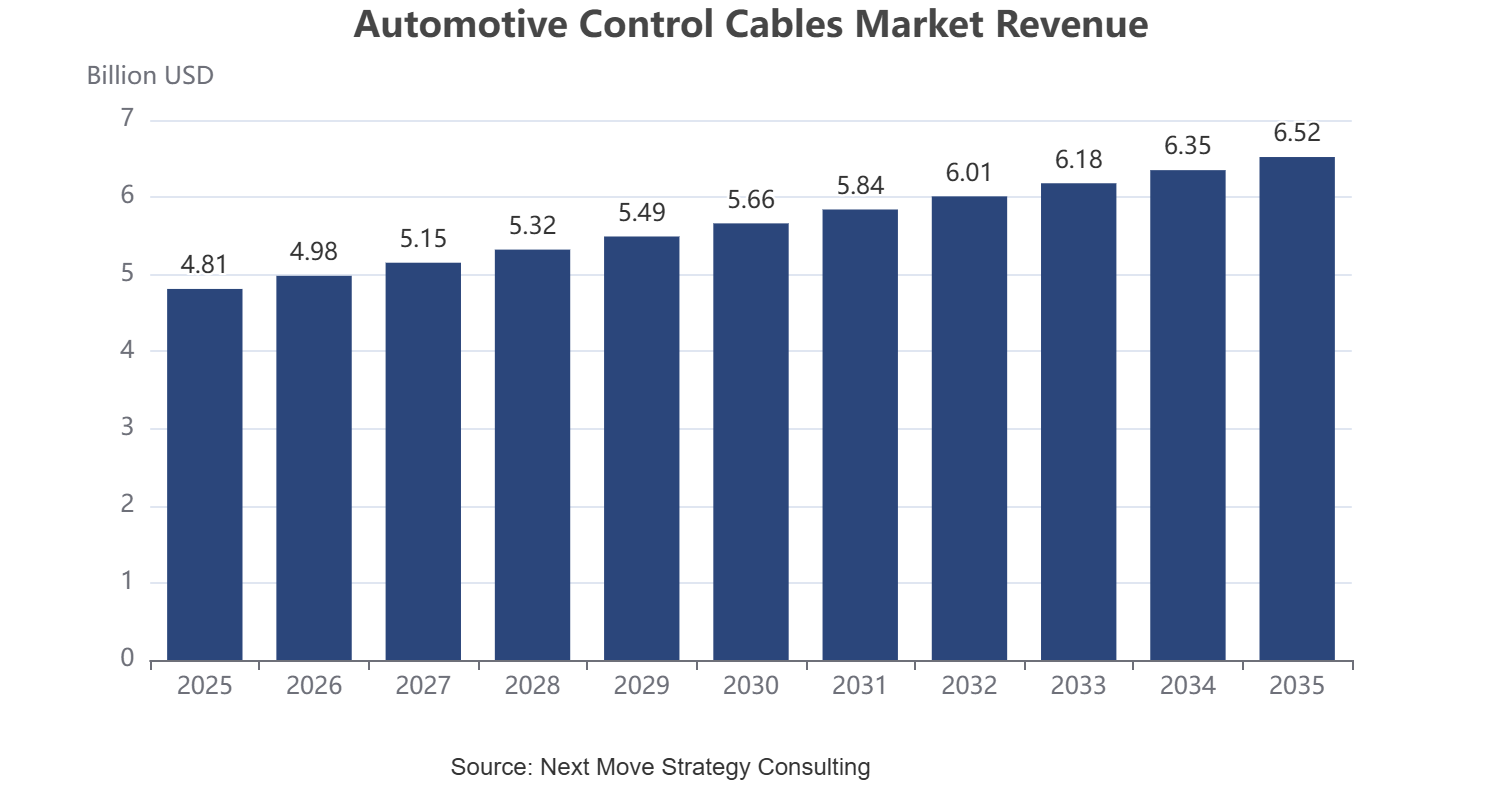
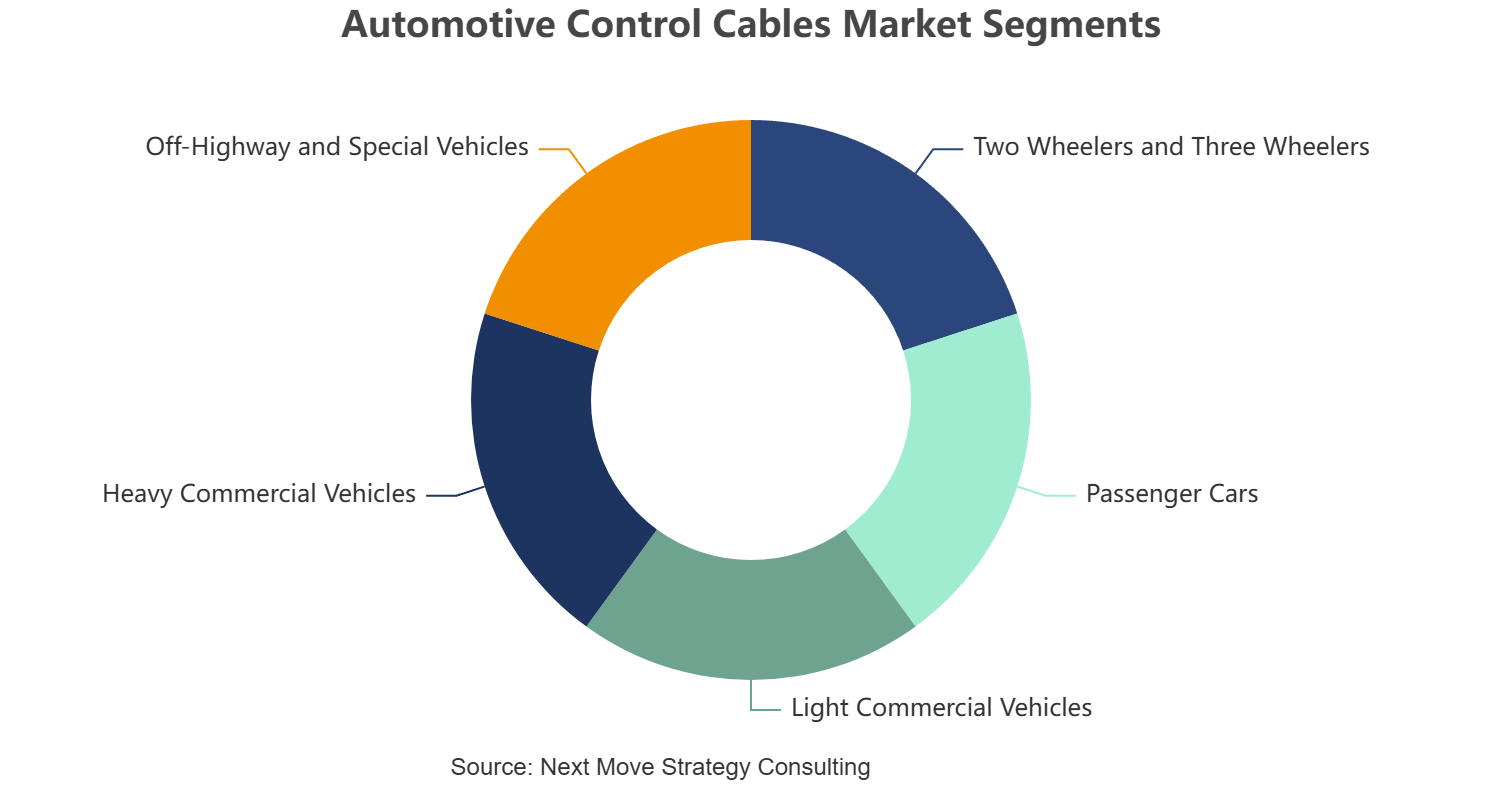
About the Author
 Saista Faiyaz
— Saista Faiyaz is Research Associate at Next Move Strategy Consulting, where she has covered consumer markets and healthcare technologies for 3 years. Her work includes primary interview review, secondary-source validation, market sizing, and structured analysis of company and industry data. She supports research by comparing evidence across sources, organizing findings into market narratives, and documenting assumptions used in analysis. Her scope includes cross-market benchmarking, and reports.
Saista Faiyaz
— Saista Faiyaz is Research Associate at Next Move Strategy Consulting, where she has covered consumer markets and healthcare technologies for 3 years. Her work includes primary interview review, secondary-source validation, market sizing, and structured analysis of company and industry data. She supports research by comparing evidence across sources, organizing findings into market narratives, and documenting assumptions used in analysis. Her scope includes cross-market benchmarking, and reports.
About the Reviewer
 Supradip Baul
— Supradip Baul is an accomplished business consultant and strategist with over a decade of rich experience in market intelligence, strategy, technology, and business transformation. His work has included rigorous qualitative and quantitative analysis across multiple industries, helping clients shape investment decisions and long-term roadmaps. Earlier in his career, he was associated with Gartner, where he contributed to industry-leading reports and market share analyses. He has worked with leading global companies and holds an MBA with a dual specialization in Marketing and Finance.
Supradip Baul
— Supradip Baul is an accomplished business consultant and strategist with over a decade of rich experience in market intelligence, strategy, technology, and business transformation. His work has included rigorous qualitative and quantitative analysis across multiple industries, helping clients shape investment decisions and long-term roadmaps. Earlier in his career, he was associated with Gartner, where he contributed to industry-leading reports and market share analyses. He has worked with leading global companies and holds an MBA with a dual specialization in Marketing and Finance.
At Next Move Strategy Consulting, we understand that insightful market research is the cornerstone of successful business decisions. That's why we employ a robust and multifaceted approach, combining various methodologies to deliver the most accurate and actionable data for our clients.

Research Landscape
We navigate the world of research with two primary approaches:
Qualitative Approach
Our qualitative research methodologies involve immersive techniques such as in-depth interviews, focus groups, and observational studies. By engaging directly with individuals and stakeholders, we uncover valuable insights that quantitative data alone may overlook.

Quantitative Research
In tandem with qualitative methodologies, NMSC leverages the power of Quantitative Research to provide a robust foundation of numerical insights. Through systematic data collection and analysis, we quantify patterns, preferences, and market trends, offering a comprehensive view of the business landscape.
Our quantitative research approach employs diverse tools, including surveys, experiments, and statistical modelling. These methodologies enable us to gather data from a large and representative sample, ensuring the statistical significance of our findings. By employing structured questionnaires and standardized data collection methods, we guarantee the reliability and validity of the information we present to our clients.
Quantitative research is particularly effective in measuring the prevalence of trends, assessing market size, and gauging the impact of various factors on consumer behavior. The numerical precision attained through this approach equips our clients with actionable insights, facilitating data-driven decision-making and strategy formulation.


Our Specialized Toolbox for Industry-Specific Market Research
We deploy a specialized arsenal of techniques tailored to meet your unique requirements. Here's a glimpse into our comprehensive toolbox:

Information Procurement
The stage entails acquiring market data or relevant information through various sources and methodologies.


Market Research Approach
We utilize both top-down and bottom-up approaches in market research analysis to achieve a comprehensive understanding of the market dynamics, leveraging the broad perspective of industry trends and macroeconomic factors alongside detailed insights from specific segments and individual companies.

Porters Five Forces Analysis
We conduct Porter's Five Forces analysis to evaluate the competitive landscape of an industry, providing us with insights into factors that affect profitability and strategic positioning.

SWOT Analysis

Forecasting
We utilize a forecasting model to predict future consumption by considering parameters like population, economics, regulations, market competition, drivers, constraints, technology, and pricing. We also employ statistical techniques such as multilinear regression, exponential smoothing, moving average, ARIMA, and Monte Carlo simulations for accurate predictions. In econometric forecasting, we analyzed short-term and long-term event impacts, attributing values based on regulatory frameworks, economic factors, and market events.





 Speak to Our Analyst