Autonomous Farming Market Size, Share, Trends and Growth Analysis, By Offering (Equipment and Services), By Autonomy Level (Assisted Autonomy, Supervised Autonomy, and Fully Autonomous), By Farm Type (Arable Farms, Horticulture Farms, Orchard Farms, Vineyard Farms, Livestock Farms, and Greenhouse Farms), By Farming Operation, By Power Source (Diesel, Electric, and Hybrid), By Deployment (OEM and Aftermarket), By Farm Size, By End User, and Region — Global Industry Report and Forecast, 2026-2035
Industry: Agriculture | Publishing Date: July 28, 2026 | Last Updated: September 30, 2026 | No of Pages: N/A | No. of Tables: N/A | No. of Figures: N/A | Format: PDF | Report Code: AG5447
What Is the Autonomous Farming Market Size?
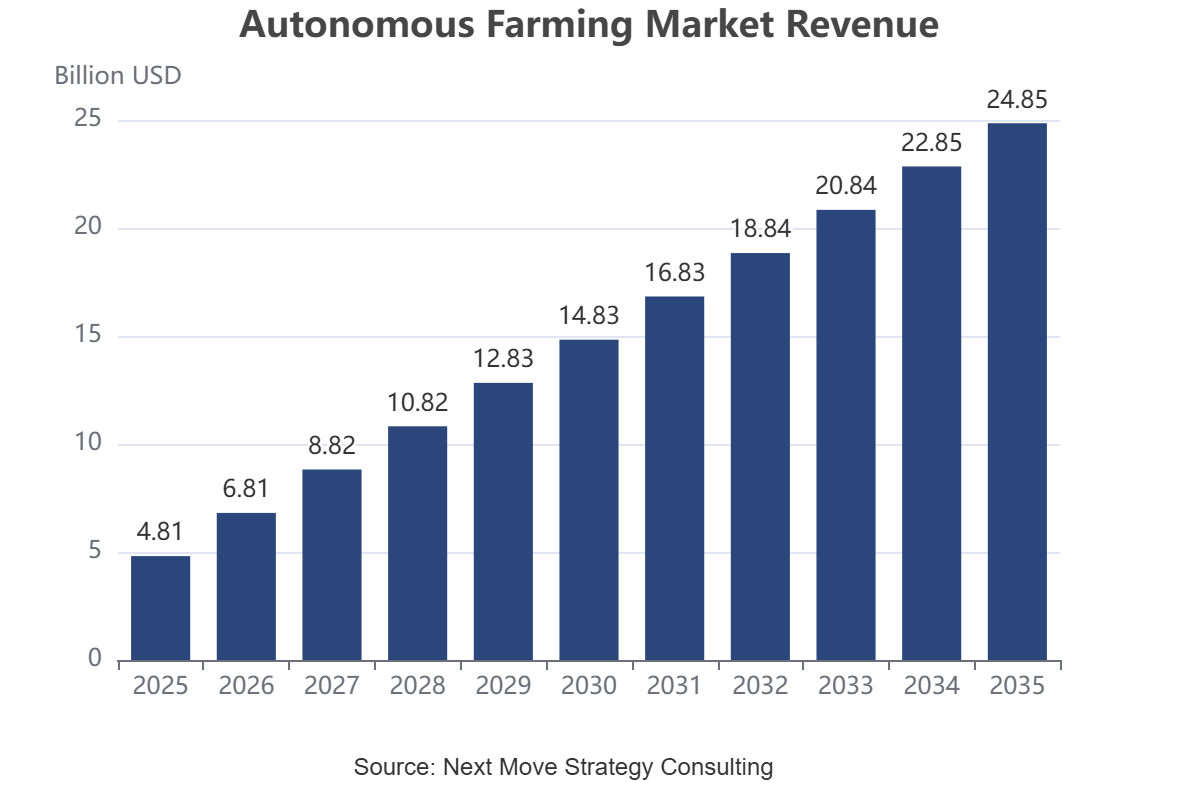
The global autonomous farming market size was valued at USD 4.81 billion in 2025 and is estimated at USD 5.60 billion in 2026, forecast to reach USD 24.85 billion by 2035, expanding at an 18.0% CAGR between 2026 and 2035. North America leads with approximately 34% share, while Equipment dominates all other offering types with approximately 82% share.
We observed that growth is broad-based across every segmentation axis, with fully autonomous systems and agricultural drones driving the dominant structural shifts through 2035.
|
Key Takeaways |
|
By Offering: Equipment held the largest share of approximately 82% (USD 3.94 Billion) in 2025; Services is the fastest-growing sub-segment at 19.4% CAGR from 2026-2035. |
|
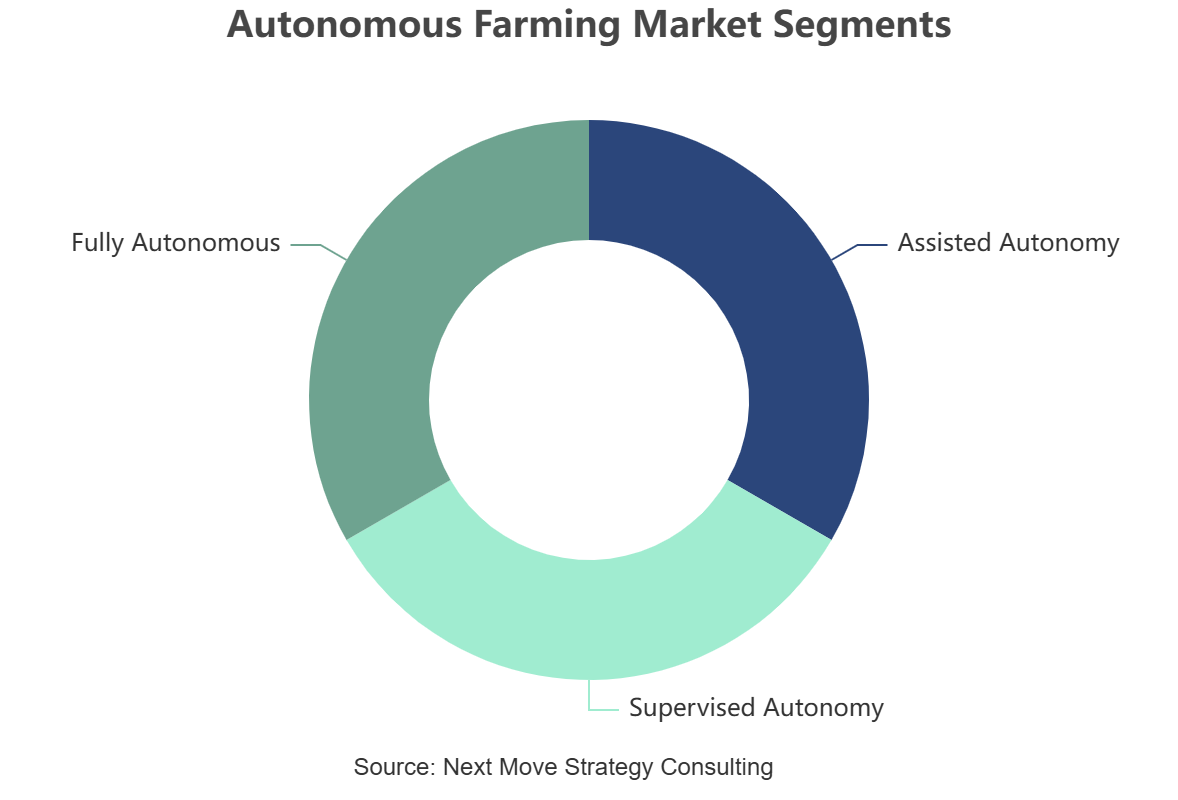
By Autonomy Level: Assisted Autonomy held the largest share of approximately 45% (USD 2.16 Billion) in 2025; Fully Autonomous is the fastest-growing sub-segment at 26.7% CAGR from 2026-2035. |
|
By Farm Type: Arable Farms held the largest share of approximately 40% (USD 1.92 Billion) in 2025; Greenhouse Farms is the fastest-growing sub-segment at 23.5% CAGR from 2026-2035. |
|
By Farming Operation: Harvesting held the largest share of approximately 24% (USD 1.15 Billion) in 2025; Weed Control is the fastest-growing sub-segment at 24.8% CAGR from 2026-2035. |
|
By Power Source: Diesel held the largest share of approximately 58% (USD 2.79 Billion) in 2025; Electric is the fastest-growing sub-segment at 23.0% CAGR from 2026-2035. |
|
By Deployment: OEM held the largest share of approximately 68% (USD 3.27 Billion) in 2025; Aftermarket is the fastest-growing sub-segment at 19.5% CAGR from 2026-2035. |
|
By Farm Size: Large Farms held the largest share of approximately 55% (USD 2.65 Billion) in 2025; Small Farms is the fastest-growing sub-segment at 20.2% CAGR from 2026-2035. |
|
By End User: Crop Producers held the largest share of approximately 52% (USD 2.50 Billion) in 2025; Government Organizations is the fastest-growing sub-segment at 20.9% CAGR from 2026-2035. |
|
Dominant Region: North America dominated with approximately 34% revenue share (USD 1.64 Billion) in 2025. |
|
Fastest-Growing Region: Asia-Pacific is expected to register the highest CAGR of 20.8% during 2026-2035. |
|
Dominant Country: U.S. led with approximately USD 1.28 Billion in 2025. |
|
Fastest-Growing Country: India is the fastest-growing country at approximately 22.9% CAGR from 2026-2035. |
Market Opportunity: The autonomous farming market is expected to create an absolute dollar opportunity of USD 19.25 billion between 2026 and 2035, presenting significant investment potential across the equipment manufacturing, precision-agriculture software, and farm-robotics service value chain.
According to Next Move Strategy Consulting analysis, equipment makers are increasingly bundling autonomy retrofit kits with subscription-based fleet-management software, a shift that favors OEMs with installed base scale over standalone robotics start-ups as labor shortages intensify through 2035.
What Does the Autonomous Farming Market Encompass?
The autonomous farming market encompasses equipment and services that enable field operations, ranging from tillage and planting to harvesting and livestock management, with reduced or no direct human operator input. Our assessment indicates that the scope spans autonomous tractors, harvesters, seeders, sprayers, drones, specialty crop robots, irrigation systems, livestock robots, and transport vehicles, supplied to crop producers, livestock producers, agricultural contractors, research institutions, and government organizations across arable, horticulture, orchard, vineyard, livestock, and greenhouse farm types. The category has evolved from GPS-guided steering assistance into fully autonomous, sensor-fused field machines, driven by persistent farm-labor shortages, rising input costs, and demand for consistent, data-driven agronomic execution.
Regulatory frameworks such as the U.S. Department of Agriculture's precision-agriculture programs and the European Union's Common Agricultural Policy digital-transition provisions shape autonomy adoption incentives, while national road-and-field safety authorities influence unmanned machine operating rules. We observed that digital agriculture technology adoption is shifting toward camera-and-LiDAR perception stacks that replace supervised, single-operator guidance with driver-optional and fully autonomous operation. Next Move Strategy Consulting's analysis indicates that this structural shift, combined with fleet-management software integration, is redefining capital-equipment purchasing criteria across the autonomous farming market.
|
Parameters |
Details |
|
Market Size in 2025 |
USD 4.81 Billion |
|
Market Size in 2026 |
USD 5.60 Billion |
|
Revenue Forecast in 2035 |
USD 24.85 Billion |
|
Growth Rate |
CAGR of 18.0% from 2026 to 2035 |
|
Analysis Period |
2025–2035 |
|
Base Year Considered |
2025 |
|
Forecast Period |
2026–2035 |
|
Market Size Estimation |
Revenue (USD Billion) |
|
Companies Profiled |
20 |
|
Countries Covered |
33 |
|
Market Share |
Available for Top 10 Companies |
Key Emerging Trends
Based on research conducted by Next Move Strategy Consulting, we found that four structural trends are reshaping product development, deployment models, and stakeholder engagement across the industry.
How Is Retrofit Autonomy Transforming Existing Tractor Fleets?
Camera-and-sensor retrofit kits are allowing farmers to add tillage and row-crop autonomy to existing tractors instead of purchasing new machines outright. We observed that John Deere's Precision Upgrades autonomy kit, made available for model-year 2020.5-and-newer 8R and 8RX tractors, lets operators "swipe to farm" and exit the cab while the system manages tillage passes. Equipment dealers are retooling service networks to install and calibrate these kits, positioning retrofit autonomy as a lower-cost entry path for large-acreage row-crop operations.
Why Are Commercial Fleet Deployments of Autonomous Tractors Accelerating?
Large-acreage operators are moving beyond pilot programs into full commercial fleet deployment of autonomous tractors. Our findings suggest that U.S. Sugar's deployment of autonomous tractors across 255,000 acres of South Florida farmland, using Autonomous Solutions' Vehicle Automation Kit and Mobius fleet-management platform, illustrates how contractors are scaling round-the-clock, remotely supervised field operations. This shift is elevating demand for fleet-orchestration software among agricultural contractors and large farm operators.
How Is Specialty Crop Robotics Expanding Beyond Row Crops?
Specialty crop robots for fruit and vegetable harvesting, and laser- and mechanical-weeding platforms, are extending autonomy beyond broadacre grain and row-crop operations into horticulture, orchard, and vineyard farms. We observed that companies such as Naio Technologies and Carbon Robotics are expanding weeding-robot fleets to address herbicide-resistance concerns and rising organic-certification demand, positioning specialty robotics as a distinct growth pool within the broader autonomous farming market.
What Role Does Electrification Play in Autonomous Farm Equipment Design?
Electric and hybrid power architectures are increasingly paired with autonomy to reduce operating costs and enable driver-optional operation on small and mid-size farms. Our analysis shows that electric autonomous tractor platforms marketed for vineyard, dairy, and row-crop use have demonstrated multi-hundred-unit deployment across several U.S. states, even as at least one prominent entrant exited the market in 2026, underscoring that capital intensity and service-network build-out remain key execution risks for electric-autonomy entrants.
Ecosystem Analysis of the Autonomous Farming Market

Based on our ecosystem assessment, we identified that equipment manufacturers, technology providers, component suppliers, regulatory bodies, agritech investors, agricultural end-users, and policymakers collectively drive innovation across the autonomous farming market. Furthermore, our industry analysis indicates that collaboration among hardware developers, AI technology providers, investors, and regulatory stakeholders accelerates precision agriculture adoption, strengthens operational efficiency, and supports sustainable farm automation.
Growth Drivers and Restraints
Growth Catalyst and Risk Assessment Matrix
|
Factors |
Type |
(+/-) % Impact on CAGR |
Geographic Relevance |
Impact Timeline |
|
Persistent farm-labor shortages |
Driver |
+3.2% |
North America, Europe |
2026–2035 |
|
Government precision-agriculture incentive programs |
Driver |
+2.4% |
North America, Europe, Asia-Pacific |
2026–2035 |
|
Rising input costs pressuring efficiency gains |
Driver |
+1.9% |
Global |
2026–2035 |
|
Advances in AI perception and LiDAR sensing |
Driver |
+2.1% |
Global |
2026–2035 |
|
Expansion of agricultural-drone spraying and scouting use |
Driver |
+1.6% |
Asia-Pacific, North America |
2026–2035 |
|
Growth of contract-farming and equipment-sharing models |
Driver |
+1.2% |
Asia-Pacific, Latin America |
2026–2032 |
|
High upfront capital cost of autonomous equipment |
Restraint |
-1.8% |
Global |
2026–2035 |
|
Regulatory uncertainty on unmanned field-machine operation |
Restraint |
-1.1% |
Europe, Asia-Pacific |
2026–2032 |
|
Connectivity gaps in rural broadband infrastructure |
Restraint |
-0.9% |
Middle East & Africa, Latin America |
2026–2035 |
What Is the Primary Growth Driver of the Autonomous Farming Market?
Persistent farm-labor shortages are the primary driver of the market. The U.S. Department of Agriculture continues to document declining hired farm-labor availability across major row-crop states, sustaining operator demand for autonomous tillage, planting, and harvesting equipment. We observed that this labor gap, reinforced by an aging farm-operator workforce, continues to anchor baseline demand for autonomous tractors and harvesters across developed agricultural economies.
How Are Government Incentive Programs Driving Autonomous Farming Market Growth?
Government precision-agriculture and digital-transition incentive programs are accelerating capital-equipment upgrades toward autonomous platforms. The European Commission's Common Agricultural Policy digital-transition provisions and the U.S. Department of Agriculture's Environmental Quality Incentives Program both extend funding support to farms adopting automation and precision technology. Our assessment indicates that this policy support, combined with falling sensor and compute costs, is compressing adoption timelines for assisted and supervised autonomy platforms across North America and Europe.
What Is Restraining Autonomous Farming Market Expansion?
High upfront capital costs for autonomous tractors, harvesters, and retrofit kits restrain adoption among small and mid-size farm operators. The U.S. Department of Agriculture's farm-income data shows that equipment-investment capacity varies sharply by farm size, limiting near-term autonomy uptake outside large-acreage operations. We found that this cost barrier is compounded by rural connectivity gaps, as reliable data links remain necessary for remote fleet supervision and software-driven autonomy features.
Segmentation Analysis
Segment Sizing: By Autonomy Level
|
Segment |
2025 (USD) |
2035 (USD) |
CAGR% (2026-2035) |
|
Assisted Autonomy |
USD 2.16 Billion |
USD 6.96 Billion |
11.9% |
|
Supervised Autonomy |
USD 1.68 Billion |
USD 8.45 Billion |
17.6% |
|
Fully Autonomous |
USD 0.97 Billion |
USD 9.44 Billion |
26.7% |
|
Total |
USD 4.81 Billion |
USD 24.85 Billion |
18.0% |
Which Autonomy Level Segment Dominates the Autonomous Farming Market?
Assisted Autonomy, encompassing GPS-guided steering and driver-supervised implement control, led the market with USD 2.16 billion in 2025, supported by its lower cost and compatibility with existing tractor fleets. We observed that Fully Autonomous systems are the fastest-growing autonomy level, expanding at a 26.7% CAGR from 2026 to 2035, as commercial deployments such as U.S. Sugar's driver-optional tractor fleet demonstrate viable round-the-clock, remotely supervised operation.
Segment Sizing: By Farm Type
|
Segment |
2025 (USD) |
2035 (USD) |
CAGR% (2026-2035) |
|
Arable Farms |
USD 1.92 Billion |
USD 8.45 Billion |
15.9% |
|
Livestock Farms |
USD 1.06 Billion |
USD 4.97 Billion |
16.8% |
|
Horticulture Farms |
USD 0.67 Billion |
USD 3.73 Billion |
18.9% |
|
Orchard Farms |
USD 0.48 Billion |
USD 2.73 Billion |
19.3% |
|
Greenhouse Farms |
USD 0.39 Billion |
USD 2.98 Billion |
23.5% |
|
Vineyard Farms |
USD 0.29 Billion |
USD 1.99 Billion |
21.9% |
|
Total |
USD 4.81 Billion |
USD 24.85 Billion |
18.0% |
Which Farm Type Segment Dominates the Autonomous Farming Market?
Arable Farms led the market with USD 1.92 billion in 2025, reflecting the scale economics of broadacre grain and row-crop operations that favor autonomous tractor and harvester adoption. We observed that Greenhouse Farms are the fastest-growing farm type, expanding at a 23.5% CAGR from 2026 to 2035, as controlled-environment operators integrate autonomous transport and monitoring robots to manage rising labor costs in enclosed growing systems.
Segment Sizing: By End User
|
Segment |
2025 (USD) |
2035 (USD) |
CAGR% (2026-2035) |
|
Crop Producers |
USD 2.50 Billion |
USD 11.93 Billion |
17.0% |
|
Livestock Producers |
USD 0.96 Billion |
USD 4.72 Billion |
17.3% |
|
Agricultural Contractors |
USD 0.87 Billion |
USD 5.47 Billion |
20.7% |
|
Research Institutions |
USD 0.29 Billion |
USD 1.49 Billion |
18.0% |
|
Government Organizations |
USD 0.19 Billion |
USD 1.24 Billion |
20.9% |
|
Total |
USD 4.81 Billion |
USD 24.85 Billion |
18.0% |
Which End User Segment Dominates the Autonomous Farming Market?
Crop Producers led the market with USD 2.50 billion in 2025, reflecting their direct ownership of autonomous tractors, seeders, and harvesters across broadacre operations. We observed that Government Organizations are the fastest-growing end user, expanding at a 20.9% CAGR from 2026 to 2035, as public research farms and extension programs deploy autonomous equipment to demonstrate labor-saving techniques to smallholder communities.
Growth Opportunities
Three forward-looking whitespace opportunities stand out for stakeholders positioning ahead of broader market adoption through 2035.
Can Autonomy-as-a-Service Unlock Small-Farm Adoption?
Subscription and pay-per-acre autonomy service models could unlock adoption among small and mid-size farms unable to justify outright equipment purchase. Agricultural contractors offering shared autonomous-fleet access stand to benefit as this mechanism lowers the capital barrier to entry for smallholder crop producers.
Can Laser Weeding Displace Herbicide-Dependent Weed Control?
Laser and mechanical weeding robots present an opportunity to displace herbicide-dependent weed control as resistance and regulatory scrutiny rise. Specialty crop growers and organic-certified horticulture operators stand to benefit from reduced chemical input costs and compliance risk.
Can Fleet-Management Software Extend Equipment Manufacturer Margins?
Bundled fleet-management and remote-supervision software presents an opportunity for equipment manufacturers to extend margins beyond one-time hardware sales. Original equipment manufacturers and large-scale agricultural contractors stand to benefit from recurring software revenue tied to autonomous fleet utilization data.
Regional Outlook
Geographic Performance Snapshot
|
Region |
2025 (USD) |
2035 (USD) |
CAGR% (2026-2035) |
Key Driver |
|
North America |
USD 1.64 Billion |
USD 7.46 Billion |
16.4% |
Large-acreage row-crop farms and commercial autonomous fleet deployments |
|
Europe |
USD 1.15 Billion |
USD 5.47 Billion |
16.9% |
Common Agricultural Policy digital-transition incentives |
|
Asia-Pacific |
USD 1.25 Billion |
USD 7.95 Billion |
20.8% |
Rural labor migration and government mechanization subsidies |
|
Middle East & Africa |
USD 0.43 Billion |
USD 2.24 Billion |
18.0% |
Water-scarce irrigation automation and Gulf agri-diversification |
|
Latin America |
USD 0.34 Billion |
USD 1.73 Billion |
18.0% |
Expanding export-oriented row-crop and livestock operations |
|
Total |
USD 4.81 Billion |
USD 24.85 Billion |
18.0% |
-- |
North America Autonomous Farming Market Outlook
North America leads the autonomous farming market with an established large-acreage row-crop base and mature dealer service networks. We observed that commercial fleet deployments, such as U.S. Sugar's autonomous tractor rollout across South Florida, demonstrate scaled, remotely supervised operation. Regulatory influence remains moderate, technology adoption is advanced, and strategic outlook favors continued OEM-led retrofit-autonomy expansion across the region's grain and specialty-crop belts.
Europe Autonomous Farming Market Outlook
Europe's autonomous farming market reflects a policy-driven landscape shaped by the Common Agricultural Policy's digital-transition and precision-agriculture funding provisions. Our findings suggest that Germany, France, and the UK are accelerating adoption of assisted and supervised autonomy platforms to offset rural labor shortages. Regulatory influence is significant, technology adoption favors retrofit kits, and strategic outlook favors suppliers with strong dealer-service coverage.
Asia-Pacific Autonomous Farming Market Outlook
Asia-Pacific is the fastest-growing autonomous farming market region, propelled by rural labor migration in China and India and expanding government mechanization subsidy programs. We found that regulatory frameworks remain less harmonized than in Europe, giving manufacturers flexibility to scale assisted-autonomy equipment rapidly. Technology adoption is accelerating as regional players expand smallholder-oriented, lower-cost autonomy kits.
Middle East & Africa Autonomous Farming Market Outlook
The autonomous farming market in Middle East & Africa is expanding as Gulf Cooperation Council economies diversify into food-security-linked agriculture and water-scarce regions adopt precision irrigation automation. Our analysis shows that Saudi Arabia and the UAE are attracting equipment investment tied to domestic food-production goals. Regulatory influence remains moderate, while technology adoption is gradually shifting toward imported autonomous irrigation and equipment systems.
Latin America Autonomous Farming Market Outlook
Latin America's autonomous farming market is supported by expanding export-oriented row-crop and livestock operations in Brazil and Argentina. We observed that regulatory frameworks are less stringent than in North America or Europe, though large agribusiness operators are piloting autonomous tractor and drone-spraying platforms. Technology adoption remains centered on assisted autonomy, with competitive intensity increasing as global equipment makers expand regional dealer networks.
U.S. Autonomous Farming Market
Based on our estimates, the U.S. marketwas valued at approximately USD 1.28 Billion in 2025 and is projected to reach USD 5.72 Billion by 2035, growing at a 16.1% CAGR from 2026 to 2035. Demand structure is shaped by large-acreage row-crop operations, high dealer-service density, and Department of Agriculture precision-agriculture funding programs. Technology penetration continues to rise, and competitive intensity remains driven by both global equipment manufacturers and regional dealers serving the country's farm operators.
Canada Autonomous Farming Market
The Canada market was valued at approximately USD 0.21 Billion in 2025 and is projected to reach USD 0.85 Billion by 2035, growing at a 14.9% CAGR from 2026 to 2035. Demand structure is shaped by expansive prairie grain farms and government farm-modernization support, mirroring U.S. autonomy adoption patterns. Technology penetration continues to rise, and competitive intensity remains driven by both global equipment manufacturers and regional dealers serving the country's farm operators.
UK Autonomous Farming Market
As per our estimate, the UK market was valued at approximately USD 0.19 Billion in 2025 and is projected to reach USD 0.72 Billion by 2035, growing at a 14.0% CAGR from 2026 to 2035. Demand structure is shaped by post-Brexit farm-labor shortages and Environmental Land Management scheme incentives for precision equipment. Technology penetration continues to rise, and competitive intensity remains driven by both global equipment manufacturers and regional dealers serving the country's farm operators.
Germany Autonomous Farming Market
According to our analysis, the Germany market was valued at approximately USD 0.28 Billion in 2025 and is projected to reach USD 1.15 Billion by 2035, growing at a 15.0% CAGR from 2026 to 2035. Demand structure is shaped by a strong domestic tractor manufacturing base and Common Agricultural Policy digital-transition funding. Technology penetration continues to rise, and competitive intensity remains driven by both global equipment manufacturers and regional dealers serving the country's farm operators.
France Autonomous Farming Market
Based on our estimates, the France market was valued at approximately USD 0.19 Billion in 2025 and is projected to reach USD 0.74 Billion by 2035, growing at a 14.4% CAGR from 2026 to 2035. Demand structure is shaped by large-scale cereal farming and government-backed agricultural-robotics research programs. Technology penetration continues to rise, and competitive intensity remains driven by both global equipment manufacturers and regional dealers serving the country's farm operators.
China Autonomous Farming Market
The China market was valued at approximately USD 0.46 Billion in 2025 and is projected to reach USD 2.95 Billion by 2035, growing at a 21.0% CAGR from 2026 to 2035. Demand structure is shaped by rapid rural labor migration and state-backed agricultural mechanization subsidy programs. Technology penetration continues to rise, and competitive intensity remains driven by both global equipment manufacturers and regional dealers serving the country's farm operators.
India Autonomous Farming Market
As per our estimate, the India market was valued at approximately USD 0.29 Billion in 2025 and is projected to reach USD 2.15 Billion by 2035, growing at a 22.9% CAGR from 2026 to 2035. Demand structure is shaped by smallholder mechanization subsidy schemes and expanding contract-farming service models. Technology penetration continues to rise, and competitive intensity remains driven by both global equipment manufacturers and regional dealers serving the country's farm operators.
Japan Autonomous Farming Market
According to our analysis, the Japan market was valued at approximately USD 0.21 Billion in 2025 and is projected to reach USD 0.98 Billion by 2035, growing at a 16.7% CAGR from 2026 to 2035. Demand structure is shaped by an aging farm-operator workforce and strong domestic precision-equipment manufacturing capability. Technology penetration continues to rise, and competitive intensity remains driven by both global equipment manufacturers and regional dealers serving the country's farm operators.
South Korea Autonomous Farming Market
Based on our estimates, the South Korea market was valued at approximately USD 0.14 Billion in 2025 and is projected to reach USD 0.68 Billion by 2035, growing at a 17.2% CAGR from 2026 to 2035. Demand structure is shaped by government rural-labor-shortage mitigation programs and rising smart-farm pilot adoption. Technology penetration continues to rise, and competitive intensity remains driven by both global equipment manufacturers and regional dealers serving the country's farm operators.
Australia Autonomous Farming Market
As per our estimate, the Australia market was valued at approximately USD 0.13 Billion in 2025 and is projected to reach USD 0.56 Billion by 2035, growing at a 15.7% CAGR from 2026 to 2035. Demand structure is shaped by large broadacre grain farms and government precision-agriculture innovation grants. Technology penetration continues to rise, and competitive intensity remains driven by both global equipment manufacturers and regional dealers serving the country's farm operators.
UAE Autonomous Farming Market
According to our analysis, the UAE market was valued at approximately USD 0.06 Billion in 2025 and is projected to reach USD 0.32 Billion by 2035, growing at a 18.4% CAGR from 2026 to 2035. Demand structure is shaped by food-security-linked investment in controlled-environment and automated irrigation agriculture. Technology penetration continues to rise, and competitive intensity remains driven by both global equipment manufacturers and regional dealers serving the country's farm operators.
Saudi Arabia Autonomous Farming Market
Based on our estimates, the Saudi Arabia market was valued at approximately USD 0.08 Billion in 2025 and is projected to reach USD 0.44 Billion by 2035, growing at a 18.8% CAGR from 2026 to 2035. Demand structure is shaped by Vision 2030-linked agricultural diversification and water-scarce automated irrigation adoption. Technology penetration continues to rise, and competitive intensity remains driven by both global equipment manufacturers and regional dealers serving the country's farm operators.
South Africa Autonomous Farming Market
As per our estimate, the South Africa market was valued at approximately USD 0.05 Billion in 2025 and is projected to reach USD 0.22 Billion by 2035, growing at a 16.0% CAGR from 2026 to 2035. Demand structure is shaped by large commercial grain and livestock farms adopting autonomous equipment amid rural labor constraints. Technology penetration continues to rise, and competitive intensity remains driven by both global equipment manufacturers and regional dealers serving the country's farm operators.
Brazil Autonomous Farming Market
The Brazil market was valued at approximately USD 0.20 Billion in 2025 and is projected to reach USD 1.05 Billion by 2035, growing at a 18.2% CAGR from 2026 to 2035. Demand structure is shaped by expansive soybean and sugarcane operations and rising precision-agriculture equipment financing. Technology penetration continues to rise, and competitive intensity remains driven by both global equipment manufacturers and regional dealers serving the country's farm operators.
Argentina Autonomous Farming Market
As per our estimate, the Argentina market was valued at approximately USD 0.08 Billion in 2025 and is projected to reach USD 0.38 Billion by 2035, growing at a 16.9% CAGR from 2026 to 2035. Demand structure is shaped by large-scale grain export operations adopting autonomous tractors despite macroeconomic volatility. Technology penetration continues to rise, and competitive intensity remains driven by both global equipment manufacturers and regional dealers serving the country's farm operators.
Supply Chain Structure of the Autonomous Farming Market

Based on our supply chain assessment, we observed that advanced components, autonomous equipment manufacturing, AI technology providers, regulatory compliance, dealer networks, procurement channels, end-use applications, and after-sales services create an integrated autonomous farming value chain. Moreover, our market evaluation highlights that seamless coordination across production, distribution, technology integration, and maintenance services improves equipment reliability, enhances agricultural productivity, and supports long-term market growth.
Competitive Landscape
We observed that the autonomous farming market features a moderately consolidated competitive landscape, with global equipment manufacturers competing alongside specialized robotics and precision-agriculture technology firms on autonomy capability, service coverage, and total cost of ownership.
|
Key Takeaways |
Description |
|
Market Structure |
Moderately consolidated; the top equipment manufacturers profiled in this report collectively account for a majority of global autonomous farming market revenue, while specialized robotics firms serve niche specialty-crop and weeding applications. |
|
Innovation Focus |
Camera-and-LiDAR perception stacks, retrofit autonomy kits, electrification, and fleet-management software integration dominate current innovation pipelines across leading suppliers. |
|
M&A Activity |
Selective consolidation and strategic partnerships, exemplified by established equipment manufacturers acquiring or partnering with autonomy-technology start-ups to accelerate perception-system deployment. |
How Do Companies Compete in the Autonomous Farming Market?
Companies compete primarily on autonomy reliability, dealer-service density, and total cost of ownership across the industry. Global equipment manufacturers such as Deere & Company and CNH Industrial N.V. leverage broad dealer networks and retrofit-kit compatibility to serve large-acreage row-crop operators, while specialized robotics firms compete on niche capability, such as laser weeding or fruit harvesting, for horticulture and specialty-crop growers underserved by broadacre equipment makers.
Which Competitive Archetypes Dominate the Autonomous Farming Market?
Two archetypes dominate the market: diversified global equipment manufacturers offering integrated autonomy across full product lines, and specialized robotics firms focused on a single crop or operation type. Deere & Company and AGCO Corporation exemplify the diversified archetype through factory-installed and retrofit autonomy kits, while Naio Technologies and Carbon Robotics exemplify the specialized archetype through weeding-robot platforms serving specialty-crop and organic growers.
How Are Companies Differentiating Through Innovation in Autonomous Farming?
Innovation and differentiation strategy increasingly center on perception-system reliability and remote fleet-supervision software. Deere & Company's Next Generation Perception system for autonomous tillage and Autonomous Solutions' Mobius fleet platform both illustrate how suppliers are combining onboard sensing with centralized monitoring to support round-the-clock, driver-optional operation. Our analysis shows that suppliers unable to demonstrate field-proven perception reliability risk exclusion from large-scale commercial fleet contracts.
What M&A and Expansion Activity Is Shaping the Autonomous Farming Market?
Mergers, acquisitions, and technology partnerships continue to consolidate autonomy capability within the industry. Equipment manufacturers have pursued minority investments and integration partnerships with electric-autonomy start-ups to accelerate time-to-market, while the 2026 exit of at least one electric-autonomous-tractor entrant illustrates how capital intensity and service-network build-out costs are reshaping which business models survive within the competitive landscape.
Key Market Players
Our assessment indicates that the following 20 companies are actively shaping product innovation, capacity expansion, and autonomy strategy within the global autonomous farming market.
-
Deere & Company
-
CNH Industrial N.V.
-
AGCO Corporation
-
Kubota Corporation
-
CLAAS KGaA mbH
-
Trimble Inc.
-
Topcon Corporation
-
Hexagon AB
-
Yanmar Holdings Co., Ltd.
-
Mahindra & Mahindra Limited
-
Ag Leader Technology, Inc.
-
DJI Technology Co., Ltd.
-
Lely Holding S.à r.l.
-
Naïo Technologies SAS
-
Carbon Robotics, Inc.
-
Monarch Tractor, Inc.
-
Ecorobotix SA
-
AgXeed B.V.
Latest Developments
|
Date |
Event |
|
November 2025 |
Kubota Corporation introduced its next-generation smart farming portfolio at Agritechnica 2025 under the theme "Smart Farming. Sized Right," highlighting the commercial expansion of the ROBOTTI robotic tool carrier, the KFAST autonomous sprayer for orchards, and its CES 2025 Best of Innovation-winning All Terrain Autonomous Tractor. |
|
November 2025 |
At Agritechnica 2025, CNH Industrial hosted its 2025 Tech Day to showcase next-generation farming solutions, featuring the debut of its R4 Autonomous Robot Family, autonomous tillage concepts, advanced Guidance Systems with LIDAR, and expanded high-speed satellite connectivity agreements with Starlink. |
|
November 2025 |
AGCO Corporation returned to Agritechnica 2025 to showcase its latest precision ag technology stack across its Fendt, Massey Ferguson, and PTx brands, highlighting the Future Zone featuring OutRun™ autonomous operating technologies and AI-driven RowPilot™ solutions |
|
January 2025 |
At CES 2025, Deere & Co. unveiled its second-generation autonomy kit and advanced autonomous machinery, including self-driving tractors, dump trucks, and commercial mowers powered by AI and 360-degree computer vision to help farms and commercial operations overcome severe labor shortages. |
Expert Insights
 "Our agriculture, construction and commercial landscaping customers all have work that must get done at certain times of the day and year, yet there is not enough available and skilled labor to do the work."
— Jahmy Hindman, Chief Technology Officer, Deere & Company
Statement made during the launch of Deere & Company's autonomous farming solutions at CES 2025, emphasizing labor shortages as a key driver for agricultural automation.
Market Interpretation
The statement underscores labor shortages as a major catalyst driving the adoption of autonomous farming technologies. With limited availability of skilled agricultural workers and increasing pressure to complete time-sensitive field operations, farmers are increasingly investing in autonomous tractors, AI-enabled machinery, and precision farming systems to improve operational efficiency and productivity. As automation technologies continue to mature, their integration into agricultural workflows is expected to accelerate, supporting the expansion of the autonomous farming market while enabling more sustainable and data-driven farming practices.
Investment Opportunities
What Capital Inflows Are Targeting the Autonomous Farming Market?
Capital inflows into the autonomous farming market are increasingly directed toward perception-system development and fleet-management software rather than hardware alone. We observed that electric-autonomy start-ups have historically attracted significant venture and strategic capital, though the 2026 wind-down of one prominent entrant highlights that investors are now favoring capital-efficient, retrofit-oriented business models over full-stack tractor manufacturing.
How Is Infrastructure Investment Supporting Autonomous Farming Deployment?
Infrastructure investment is expanding rural connectivity and dealer-service networks needed to support remote fleet supervision. Our findings suggest that equipment manufacturers are investing in dealer-technician training programs to service autonomy kits, supporting the calibration and maintenance precision required for reliable field-level perception-system performance.
What ESG Considerations Are Shaping Autonomous Farming Investment Decisions?
Environmental, social, and governance considerations are central to investment decisions, with fuel-efficiency gains, reduced pesticide drift from precision spraying, and sustainable agriculture outcomes as key criteria. The U.S. Department of Agriculture's Environmental Quality Incentives Program continues to fund automation projects tied to conservation outcomes. We found that investors increasingly favor manufacturers demonstrating measurable emissions and input-reduction benefits from autonomous operation.
Key Benefits for Stakeholders
How Does This Report Benefit Enterprise and Industry Leaders?
Enterprise and industry leaders gain access to validated segmentation, competitive benchmarking, and regional demand forecasts that support product-portfolio and dealer-network decisions across the autonomous farming industry. Our analysis shows that detailed autonomy-level, farm-type, and power-source breakdowns help manufacturers align product development with regulatory and adoption-readiness requirements across target farm segments.
How Does This Report Benefit Investors and Financial Analysts?
Investors and financial analysts benefit from consistent, single-point market size and CAGR estimates that support valuation and capital-allocation decisions across the autonomous farming market supply chain. We observed that the report's regional and segment-level growth differentials help identify which equipment categories and geographies are best positioned to capture above-market growth through 2035.
How Does This Report Benefit Technology Vendors and Product Teams?
Technology vendors and product teams gain insight into emerging design requirements, including perception-system reliability, retrofit compatibility, and fleet-management software integration, that are reshaping the industry. Our findings suggest that this analysis helps research and development teams prioritize roadmaps around the autonomy levels and farm operations gaining fastest adoption.
Key Market Segments
By Offering
-
Equipment
-
Autonomous Tractors
-
High Horsepower Tractors
-
Compact Utility Tractors
-
-
Autonomous Harvesters
-
Grain Harvesters
-
Forage Harvesters
-
Root Crop Harvesters
-
-
Autonomous Seeders
-
Precision Seeders
-
Precision Planters
-
-
Autonomous Sprayers
-
Boom Sprayers
-
Orchard Sprayers
-
-
Agricultural Drones
-
Spraying Drones
-
Scouting Drones
-
-
Specialty Crop Robots
-
Fruit Harvesting Robots
-
Vegetable Harvesting Robots
-
Mechanical Weeding Robots
-
Laser Weeding Robots
-
-
Autonomous Irrigation Systems
-
Center Pivot Systems
-
Drip Irrigation Systems
-
-
Autonomous Livestock Robots
-
Milking Robots
-
Feeding Robots
-
Manure Cleaning Robots
-
-
Autonomous Transport Vehicles
-
Grain Cart Robots
-
Bale Transport Robots
-
Field Logistics Vehicles
-
-
-
Services
-
Installation
-
Integration
-
Maintenance
-
Training
-
By Autonomy Level
-
Assisted Autonomy
-
Supervised Autonomy
-
Fully Autonomous
By Farm Type
-
Arable Farms
-
Horticulture Farms
-
Orchard Farms
-
Vineyard Farms
-
Livestock Farms
-
Greenhouse Farms
By Farming Operation
-
Land Preparation
-
Planting
-
Crop Monitoring
-
Irrigation
-
Fertilizer Application
-
Crop Protection
-
Weed Control
-
Harvesting
-
Material Transport
-
Livestock Management
By Power Source
-
Diesel
-
Electric
-
Hybrid
By Deployment
-
OEM
-
Aftermarket
By Farm Size
-
Small Farms
-
Medium Farms
-
Large Farms
By End User
-
Crop Producers
-
Livestock Producers
-
Agricultural Contractors
-
Research Institutions
-
Government Organizations
By Region
-
North America: U.S., Canada, Mexico
-
Europe: UK, Germany, France, Italy, Spain, Sweden, Denmark, Finland, Netherlands, Rest of Europe
-
Asia-Pacific: China, India, Japan, South Korea, Taiwan, Indonesia, Vietnam, Australia, Philippines, Malaysia, Rest of APAC
-
Middle East & Africa: Saudi Arabia, UAE, Egypt, Israel, Turkey, Nigeria, South Africa, Rest of MEA
-
Latin America: Brazil, Argentina, Chile, Colombia, Rest of LATAM
Conclusion and Recommendations
What Is the Long-Term Outlook for the Autonomous Farming Market?
The long-term outlook for the market remains positive, with global revenue projected to grow more than five-fold from USD 4.81 billion in 2025 to USD 24.85 billion by 2035 at an 18.0% CAGR. We observed that persistent farm-labor shortages, government precision-agriculture incentives, and fully autonomous system commercialization will continue underpinning demand across crop and livestock production through the forecast period.
What Strategic Positioning Should Autonomous Farming Suppliers Pursue?
Suppliers should prioritize retrofit-compatible autonomy kits and fleet-management software while expanding dealer-service networks to secure long-term operator contracts. Our assessment indicates that manufacturers investing early in perception-system reliability and remote-supervision capability will be best positioned to capture premium pricing within the autonomous farming market.
How Attractive Is the Autonomous Farming Market for New Investment?
The autonomous farming industry presents an attractive investment case, supported by a USD 19.25 billion absolute dollar opportunity between 2026 and 2035 and above-average growth in Asia-Pacific and fully autonomous product categories. We found that investment attractiveness is highest for manufacturers combining proven perception-system reliability with scaled dealer-service capacity, positioning them to serve both large-acreage and smallholder segments.
What Market Shifts and Key Risks Should Stakeholders Monitor?
Stakeholders should monitor capital-intensity risk in full-stack electric-autonomy business models, regulatory uncertainty on unmanned field-machine operation, and rural connectivity gaps as key risks to the autonomous farming market. Our analysis shows that the 2026 exit of at least one electric-autonomous-tractor entrant illustrates how suppliers unable to sustain service-network investment risk business-model failure despite strong initial capital raises.
What Are the Key Growth Pathways for the Autonomous Farming Market?
Key growth pathways include expanding retrofit-autonomy kit portfolios, scaling specialty-crop robotics for horticulture and orchard applications, and deepening fleet-management software penetration among agricultural contractors. Next Move Strategy Consulting's analysis indicates that suppliers pursuing these pathways while maintaining dealer-service reliability will be best positioned to capture the autonomous farming market's projected growth through 2035.
About the Author
 Saista Faiyaz
— Saista Faiyaz is Research Associate at Next Move Strategy Consulting, where she has covered consumer markets and healthcare technologies for 3 years. Her work includes primary interview review, secondary-source validation, market sizing, and structured analysis of company and industry data. She supports research by comparing evidence across sources, organizing findings into market narratives, and documenting assumptions used in analysis. Her scope includes cross-market benchmarking, and reports.
Saista Faiyaz
— Saista Faiyaz is Research Associate at Next Move Strategy Consulting, where she has covered consumer markets and healthcare technologies for 3 years. Her work includes primary interview review, secondary-source validation, market sizing, and structured analysis of company and industry data. She supports research by comparing evidence across sources, organizing findings into market narratives, and documenting assumptions used in analysis. Her scope includes cross-market benchmarking, and reports.
About the Reviewer
 Supradip Baul
— Supradip Baul is an accomplished business consultant and strategist with over a decade of rich experience in market intelligence, strategy, technology, and business transformation. His work has included rigorous qualitative and quantitative analysis across multiple industries, helping clients shape investment decisions and long-term roadmaps. Earlier in his career, he was associated with Gartner, where he contributed to industry-leading reports and market share analyses. He has worked with leading global companies and holds an MBA with a dual specialization in Marketing and Finance.
Supradip Baul
— Supradip Baul is an accomplished business consultant and strategist with over a decade of rich experience in market intelligence, strategy, technology, and business transformation. His work has included rigorous qualitative and quantitative analysis across multiple industries, helping clients shape investment decisions and long-term roadmaps. Earlier in his career, he was associated with Gartner, where he contributed to industry-leading reports and market share analyses. He has worked with leading global companies and holds an MBA with a dual specialization in Marketing and Finance.
At Next Move Strategy Consulting, we understand that insightful market research is the cornerstone of successful business decisions. That's why we employ a robust and multifaceted approach, combining various methodologies to deliver the most accurate and actionable data for our clients.

Research Landscape
We navigate the world of research with two primary approaches:
Qualitative Approach
Our qualitative research methodologies involve immersive techniques such as in-depth interviews, focus groups, and observational studies. By engaging directly with individuals and stakeholders, we uncover valuable insights that quantitative data alone may overlook.

Quantitative Research
In tandem with qualitative methodologies, NMSC leverages the power of Quantitative Research to provide a robust foundation of numerical insights. Through systematic data collection and analysis, we quantify patterns, preferences, and market trends, offering a comprehensive view of the business landscape.
Our quantitative research approach employs diverse tools, including surveys, experiments, and statistical modelling. These methodologies enable us to gather data from a large and representative sample, ensuring the statistical significance of our findings. By employing structured questionnaires and standardized data collection methods, we guarantee the reliability and validity of the information we present to our clients.
Quantitative research is particularly effective in measuring the prevalence of trends, assessing market size, and gauging the impact of various factors on consumer behavior. The numerical precision attained through this approach equips our clients with actionable insights, facilitating data-driven decision-making and strategy formulation.


Our Specialized Toolbox for Industry-Specific Market Research
We deploy a specialized arsenal of techniques tailored to meet your unique requirements. Here's a glimpse into our comprehensive toolbox:

Information Procurement
The stage entails acquiring market data or relevant information through various sources and methodologies.


Market Research Approach
We utilize both top-down and bottom-up approaches in market research analysis to achieve a comprehensive understanding of the market dynamics, leveraging the broad perspective of industry trends and macroeconomic factors alongside detailed insights from specific segments and individual companies.

Porters Five Forces Analysis
We conduct Porter's Five Forces analysis to evaluate the competitive landscape of an industry, providing us with insights into factors that affect profitability and strategic positioning.

SWOT Analysis

Forecasting
We utilize a forecasting model to predict future consumption by considering parameters like population, economics, regulations, market competition, drivers, constraints, technology, and pricing. We also employ statistical techniques such as multilinear regression, exponential smoothing, moving average, ARIMA, and Monte Carlo simulations for accurate predictions. In econometric forecasting, we analyzed short-term and long-term event impacts, attributing values based on regulatory frameworks, economic factors, and market events.





 Speak to Our Analyst