Autonomous Vehicle Insurance Market Size, Share, Trends and Growth Analysis, By Coverage Type (Product Liability Coverage, Cyber Liability Coverage, and Other Coverage Types), By Automation Level (Level 3 Conditional Automation, Level 4 High Automation, and Level 5 Full Automation), By Vehicle Application, By Distribution Channel, By End User (Individual Vehicle Owners and Fleet Operators and Mobility Providers), and Region -- Global Industry Report and Forecast, 2026–2035
Industry: BFSI | Publishing Date: August 5, 2026 | Last Updated: August 5, 2026 | No of Pages: N/A | No. of Tables: N/A | No. of Figures: N/A | Format: PDF | Report Code: BF5585
What Is the Autonomous Vehicle Insurance Market Size?
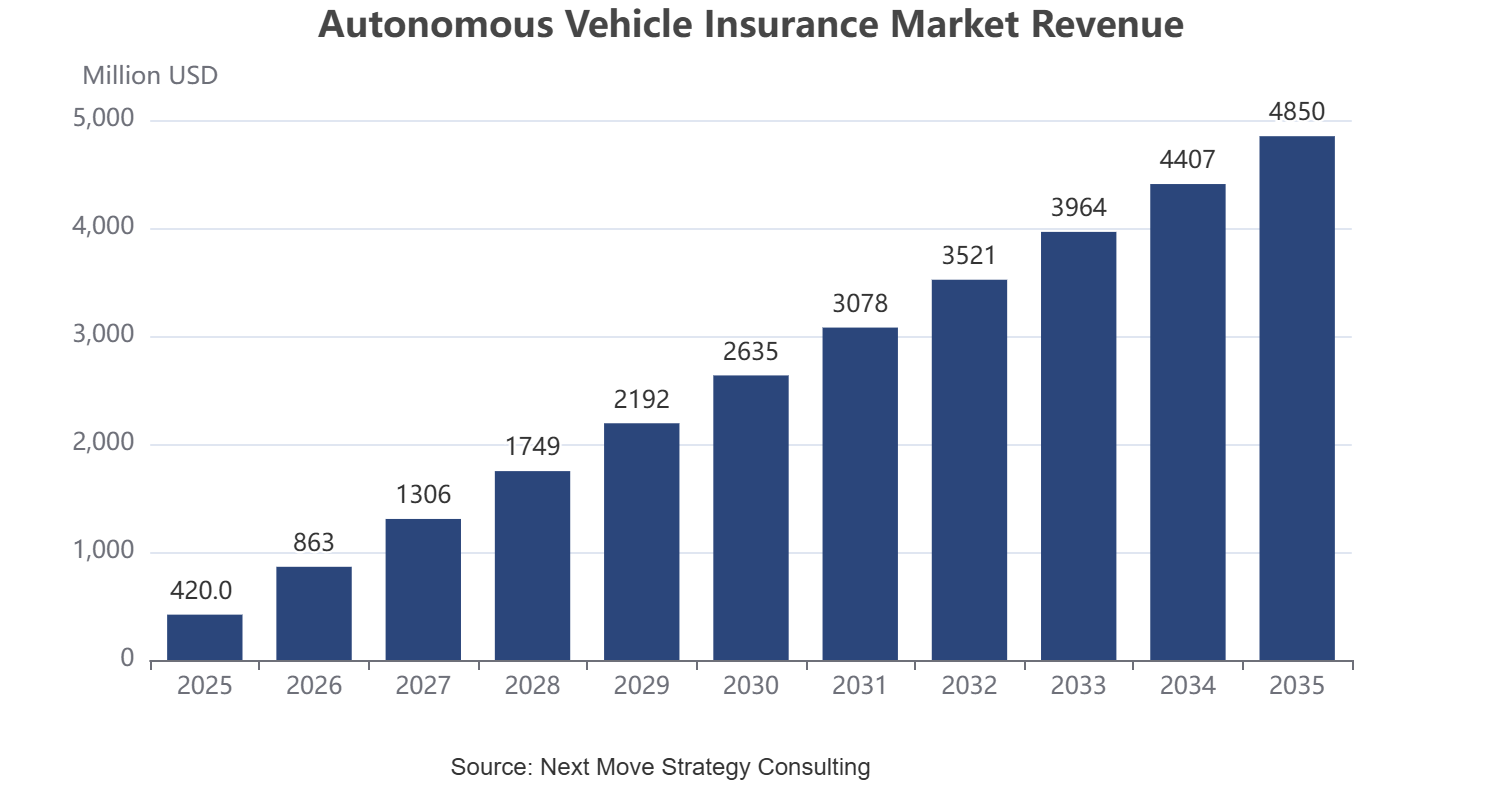
The global autonomous vehicle insurance market size was valued at USD 420.0 million in 2025 and is estimated at USD 540.0 million in 2026, forecast to reach USD 4.85 billion by 2035, expanding at a 27.6% CAGR between 2026 and 2035. North America leads with approximately a 52% share, while Fleet Operators and Mobility Providers dominate all other end users with approximately a 56% share.
We observed that growth is broad-based across every segmentation axis, with Level 5 full automation and usage-based coverage models driving the dominant structural shifts through 2035.
|
Key Takeaways |
|
By Coverage Type: Product Liability Coverage held the largest share of approximately 24% (USD 100.8 million) in 2025; Usage-Based Coverage is the fastest-growing sub-segment at 31.4% CAGR from 2026–2035. |
|
By Automation Level: Level 3 Conditional Automation held the largest share of approximately 46% (USD 193.2 million) in 2025; Level 5 Full Automation is the fastest-growing sub-segment at 40.8% CAGR from 2026–2035. |
|
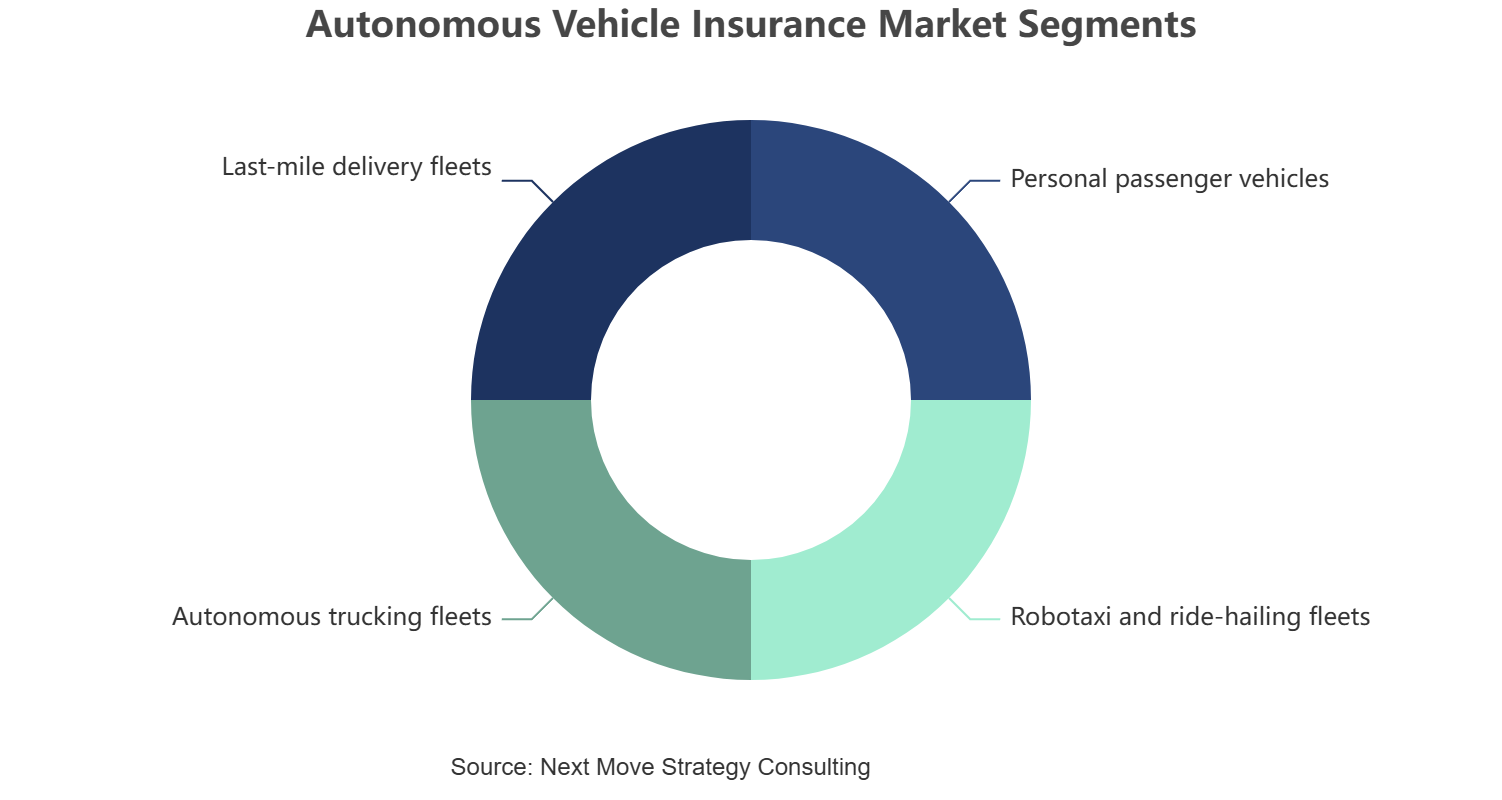
By Vehicle Application: Personal Passenger Vehicles held the largest share of approximately 38% (USD 159.6 million) in 2025; Last-Mile Delivery Fleets is the fastest-growing sub-segment at 32.2% CAGR from 2026–2035. |
|
By Distribution Channel: Traditional Carrier Partnerships held the largest share of approximately 32% (USD 134.4 million) in 2025; Insurtech Direct Platforms is the fastest-growing sub-segment at 31.1% CAGR from 2026–2035. |
|
By End User: Fleet Operators and Mobility Providers held the largest share of approximately 56% (USD 235.2 million) in 2025; Fleet Operators and Mobility Providers is also the fastest-growing sub-segment at 30.4% CAGR from 2026–2035. |
|
Dominant Region: North America dominated with approximately 52% revenue share (USD 218.4 million) in 2025. |
|
Fastest-Growing Region: Latin America is expected to register the highest CAGR of 33.5% during 2026–2035. |
|
Dominant Country: The U.S. led with approximately USD 183.5 million in 2025. |
|
Fastest-Growing Country: India is the fastest-growing country at approximately 36.1% CAGR from 2026–2035. |
Market Opportunity: The autonomous vehicle insurance market is expected to create an absolute dollar opportunity of USD 4.31 billion between 2026 and 2035, presenting significant investment potential across usage-based underwriting, robotaxi fleet risk pools, and OEM-affiliated insurance programs.
According to NMSC analysis, insurers are increasingly pairing telematics-driven pricing models with direct OEM data partnerships to differentiate risk between autonomous and human-driven miles, a shift that favors carriers with verified vehicle-data access over insurers relying solely on traditional actuarial inputs as Level 4 and Level 5 deployment scales through 2035.
What Does the Autonomous Vehicle Insurance Market Encompass?
The autonomous vehicle insurance market encompasses the liability, physical damage, cyber, and usage-based coverage products underwritten specifically for Level 3 through Level 5 automated vehicles, spanning personal passenger cars, robotaxi fleets, autonomous trucking, and last-mile delivery operations. Our assessment indicates that the scope spans OEM-affiliated underwriters, traditional carriers, insurtech platforms, and reinsurers pricing risk for autonomous vehicle operators navigating an evolving liability landscape worldwide.
Regulatory frameworks addressing automated driving liability, including U.S. National Highway Traffic Safety Administration oversight and state-level autonomous vehicle statutes, shape how insurers allocate fault between manufacturers, software providers, and vehicle occupants. We observed that technology adoption is shifting from conventional actuarial pricing toward direct vehicle telemetry integration, exemplified by Lemonade's Tesla Fleet API partnership. NMSC's analysis indicates that this structural shift, combined with expanding robotaxi commercial operations, is redefining underwriting criteria across the autonomous vehicle insurance market.
|
Field |
Details |
|
Market Size in 2025 |
USD 420 Million |
|
Market Size in 2026 |
USD 540 Million |
|
Revenue Forecast in 2035 |
USD 485 Million |
|
Growth Rate |
CAGR of 27.6% from 2026 to 2035 |
|
Analysis Period |
2025–2035 |
|
Base Year Considered |
2025 |
|
Forecast Period |
2026–2035 |
|
Market Size Estimation |
USD Million |
|
Companies Profiled |
18 |
|
Countries Covered |
38 |
|
Market Share |
Available for Top 10 Companies |
Key Emerging Trends
Based on research conducted by NMSC, we found that four structural trends are reshaping underwriting models, distribution strategy, and stakeholder engagement across the industry.
How Is Direct Vehicle Telemetry Integration Transforming Underwriting?
Direct vehicle telemetry integration is replacing generic usage-based models with pricing tied to precise autonomous-versus-manual driving data. We observed that Lemonade launched Autonomous Car insurance in January 2026 through a technical collaboration with Tesla, accessing Fleet API data to cut per-mile rates by roughly 50% for Full Self-Driving-engaged miles. Insurers are pursuing similar OEM data partnerships to differentiate risk pricing at a granularity conventional telematics could not previously achieve.
Why Is Fleet-Level Risk Pooling Gaining Traction for Robotaxi Operators?
Fleet-level risk pooling is gaining traction as robotaxi operators scale commercial deployment across multiple U.S. cities. Our findings suggest that Waymo's expansion to a sixth U.S. market in Miami, alongside continued growth in Phoenix, San Francisco, Los Angeles, and Austin, is pushing insurers toward centralized fleet risk pools rather than per-vehicle personal policies. Reinsurers are structuring dedicated capacity for commercial autonomous fleet operators to absorb concentration risk from large, geographically clustered deployments.
How Is Regulatory Scrutiny of AV Safety Claims Reshaping Product Design?
Regulatory and legal scrutiny of autonomous driving safety claims is reshaping how insurers design liability language and marketing disclosures. We observed that the U.S. National Highway Traffic Safety Administration is investigating millions of Full Self-Driving-equipped vehicles linked to reported incidents, while a 2025 Florida federal jury verdict against Tesla intensified the liability exposure debate. NMSC's analysis indicates that insurers are responding with more conservative product liability language and expanded cyber coverage riders.
How Is Generative AI Reshaping Autonomous Vehicle Underwriting Operations?
Generative AI-driven underwriting platforms are compressing policy pricing timelines for complex autonomous vehicle risk profiles. We observed that Munich Re's REALYTIX ZERO platform incorporates a generative AI Copilot function to support underwriting and product-building for emerging risk categories including autonomous vehicles. Reinsurers and primary carriers are adopting similar generative AI tools to accelerate the underwriting of novel liability scenarios involving Level 3 through Level 5 automation.
Growth Drivers and Restraints
Growth Catalyst and Risk Assessment Matrix
|
Factors |
Type |
(+/−) % Impact on CAGR |
Geographic Relevance |
Impact Timeline |
|
Robotaxi commercial fleet expansion across U.S. cities |
Driver |
+5.8% |
North America |
2026-2035 |
|
OEM-insurer data partnerships enabling telemetry-based pricing |
Driver |
+4.6% |
Global |
2026-2035 |
|
Rising Level 4 and Level 5 vehicle sales share by 2035 |
Driver |
+3.9% |
Global |
2026-2035 |
|
Reinsurer capacity buildout for autonomous fleet risk pools |
Driver |
+2.7% |
North America, Europe |
2026-2032 |
|
Autonomous trucking commercial deployment growth |
Driver |
+2.1% |
North America, Asia-Pacific |
2026-2035 |
|
Generative AI-driven underwriting automation adoption |
Driver |
+1.4% |
Global |
2026-2032 |
|
Unresolved liability allocation between OEMs and insurers |
Restraint |
-2.3% |
Global |
2026-2033 |
|
Regulatory investigations into AV safety claims |
Restraint |
-1.8% |
North America |
2026-2030 |
|
Limited historical loss data for full automation risk pricing |
Restraint |
-1.5% |
Global |
2026-2032 |
|
Slow Level 3-5 vehicle penetration outside early-adopter markets |
Restraint |
-1.1% |
Middle East & Africa, Latin America |
2026-2035 |
What Is the Primary Growth Driver of the Autonomous Vehicle Insurance Market?
Robotaxi commercial fleet expansion is the primary driver of the market. Waymo has surpassed 170 million cumulative fully driverless miles with zero serious crashes reported, and the company continued expanding into new U.S. markets including Miami in 2025. We observed that this expanding, geographically concentrated commercial fleet footprint is directly increasing demand for fleet-level liability and physical damage coverage among insurers and reinsurers serving robotaxi operators.
How Is OEM Data Access Driving Autonomous Vehicle Insurance Market Growth?
Direct OEM telemetry access is accelerating market growth by enabling insurers to price autonomous risk with unprecedented precision. Lemonade's technical collaboration with Tesla, launched in January 2026, integrates Fleet API data to distinguish full self-driving-engaged miles from manual driving. NMSC's analysis indicates that this data-access model is compressing the historical actuarial disadvantage insurers faced when pricing autonomous risk, encouraging additional carriers to pursue similar OEM partnerships.
What Is Restraining Autonomous Vehicle Insurance Market Expansion?
Unresolved liability allocation between OEMs, software providers, and insurers restrains product standardization across the market. The U.S. National Highway Traffic Safety Administration's ongoing investigation into millions of Full Self-Driving-equipped vehicles illustrates the regulatory uncertainty surrounding fault determination in automated driving incidents. We found that insurers lacking clear contractual liability frameworks with OEM partners face particular exposure, as ambiguous fault allocation complicates claims processing and reserve setting for autonomous vehicle policies.
Segmentation Analysis
Segment Sizing: By Coverage Type
|
Segment |
2025 (USD) |
2035 (USD) |
CAGR% (2026–2035) |
|
Product liability coverage |
USD 100.8 Million |
USD 970.0 Million |
25.1% |
|
Cyber liability coverage |
USD 67.2 Million |
USD 921.5 Million |
30.1% |
|
Physical damage coverage |
USD 92.4 Million |
USD 873.0 Million |
24.8% |
|
Usage-based coverage |
USD 84.0 Million |
USD 1,261.0 Million |
31.4% |
|
Passenger and third-party liability coverage |
USD 58.8 Million |
USD 630.5 Million |
26.6% |
|
Other coverage types |
USD 16.8 Million |
USD 194.0 Million |
27.6% |
|
Total |
USD 420.0 Million |
USD 4,850.0 Million |
27.6% |
Which Coverage Type Dominates the Autonomous Vehicle Insurance Market?
Product liability coverage, addressing claims arising from autonomous system malfunctions, led the market with USD 100.8 million in 2025, reflecting insurer prioritization of manufacturer and software fault exposure. Our findings suggest that Usage-Based Coverage is the fastest-growing coverage type, registering a 31.4% CAGR from 2026 to 2035, as telemetry-integrated products like Lemonade's Tesla-linked policy expand the addressable market for mileage-differentiated pricing models.
Segment Sizing: By Automation Level
|
Segment |
2025 (USD) |
2035 (USD) |
CAGR% (2026–2035) |
|
Level 3 conditional automation |
USD 193.2 Million |
USD 1,164.0 Million |
18.7% |
|
Level 4 high automation |
USD 176.4 Million |
USD 2,279.5 Million |
29.2% |
|
Level 5 full automation |
USD 50.4 Million |
USD 1,406.5 Million |
40.8% |
|
Total |
USD 420.0 Million |
USD 4,850.0 Million |
27.6% |
Which Automation Level Leads Autonomous Vehicle Insurance Market Demand?
Level 3 Conditional Automation remained the leading category within the market, reaching USD 193.2 million in 2025 on sustained demand for policies covering supervised driver-assist systems already in commercial use, closely tied to expanding ADAS adoption. Based on research conducted by NMSC, we found that Level 5 Full Automation is the fastest-growing category at a 40.8% CAGR from 2026 to 2035, reflecting Waymo's expanding driverless fleet operations and the absence of human driver oversight in claims scenarios.
Segment Sizing: By Vehicle Application
|
Segment |
2025 (USD) |
2035 (USD) |
CAGR% (2026–2035) |
|
Personal passenger vehicles |
USD 159.6 Million |
USD 1,261.0 Million |
22.4% |
|
Robotaxi and ride-hailing fleets |
USD 142.8 Million |
USD 1,746.0 Million |
28.4% |
|
Autonomous trucking fleets |
USD 84.0 Million |
USD 1,309.5 Million |
31.9% |
|
Last-mile delivery fleets |
USD 33.6 Million |
USD 533.5 Million |
32.2% |
|
Total |
USD 420.0 Million |
USD 4,850.0 Million |
27.6% |
Which Vehicle Application Leads Autonomous Vehicle Insurance Market Demand?
Personal Passenger Vehicles remained the leading application within the autonomous vehicle insurance market, valued at USD 159.6 million in 2025 on Tesla's large Full Self-Driving-equipped installed base and self-driving cars and trucks policy adoption. Our findings suggest that Last-Mile Delivery Fleets is the fastest-growing application, registering a 32.2% CAGR from 2026 to 2035, as autonomous delivery operators scale commercial deployment and require dedicated fleet liability products distinct from personal vehicle policies.
PESTEL Analysis of the Autonomous Vehicle Insurance Industry
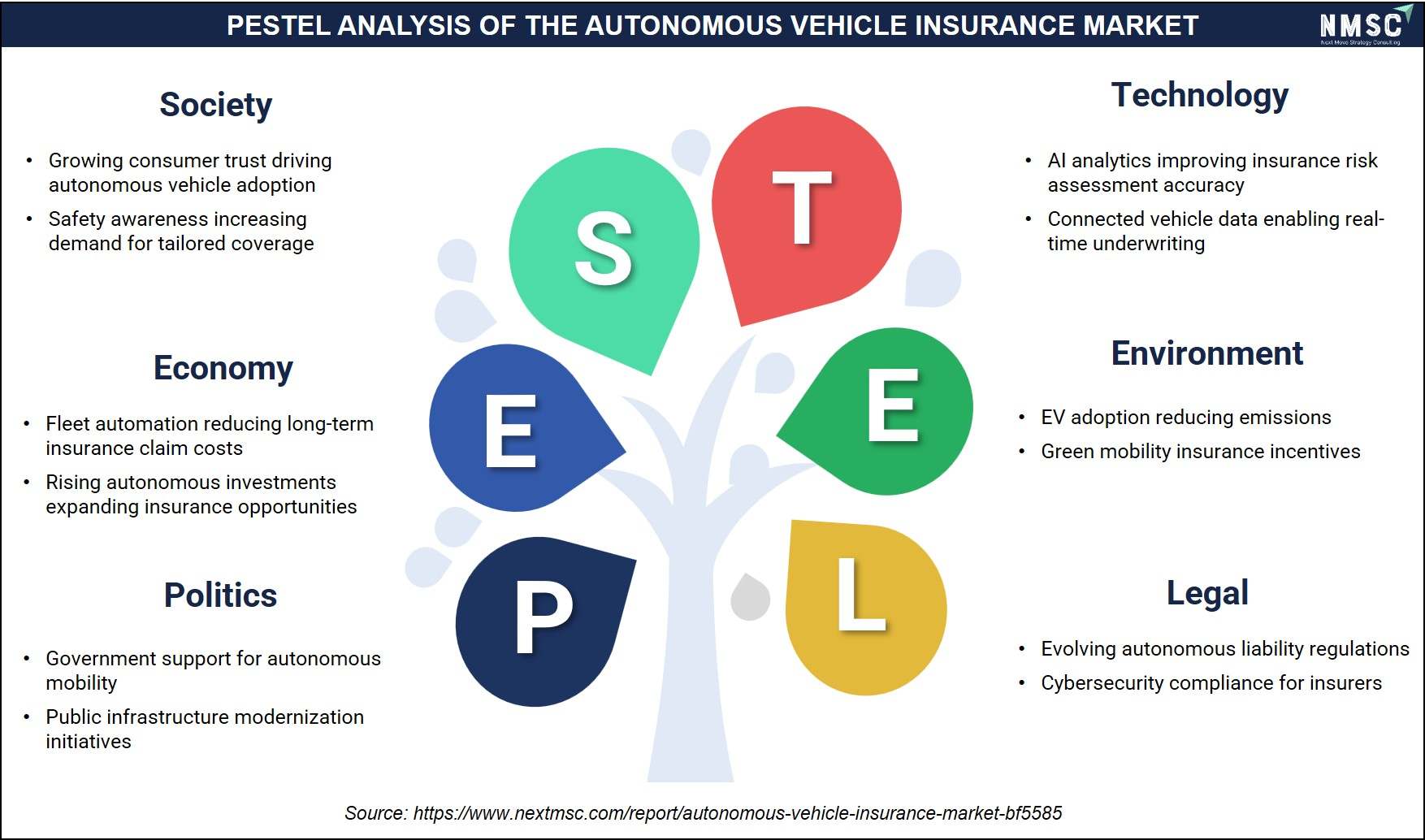
NMSC's analysis indicates that growing public trust, government support, and infrastructure modernization are accelerating autonomous vehicle adoption. Furthermore, fleet automation lowers claim costs, while AI analytics and connected data enable real-time risk assessment and underwriting accuracy. Concurrently, EV expansion drives green insurance incentives, while evolving liability regulations and cybersecurity compliance standards mandate insurers to deliver highly specialized policies across the market.
Growth Opportunities
Our analysis shows that three forward-looking opportunities stand out for stakeholders positioning within the autonomous vehicle insurance market over the 2026-2035 forecast period.
How Can OEM Data-Sharing Partnerships Unlock Precision Underwriting?
OEM data-sharing partnerships present a whitespace opportunity for insurers seeking to differentiate on pricing precision. Carriers that replicate Lemonade's Tesla Fleet API model with other automakers stand to capture share from usage-based coverage buyers, particularly personal passenger vehicle owners seeking mileage-differentiated premiums tied to verified autonomous driving data.
Where Does Autonomous Trucking Create New Demand for Fleet Underwriters?
Autonomous trucking fleet operators scaling commercial freight routes represent an underpenetrated opportunity for insurers offering dedicated commercial liability products. Underwriters that develop route-specific, cargo-aware risk models can secure long-term fleet contracts, differentiating from personal-line insurers unable to price freight-specific exposure.
How Can Cyber Liability Bundling Benefit Robotaxi Operators?
Robotaxi operators seeking comprehensive risk transfer create an opportunity for insurers bundling cyber liability with traditional physical damage and product liability coverage. Early movers that integrate sensor-failure and data-breach protection into a single fleet policy can differentiate with simplified claims administration, reducing coverage gaps for commercial autonomous fleet operators.
Regional Outlook
Geographic Performance Snapshot
|
Region |
2025 (USD) |
2035 (USD) |
CAGR% (2026–2035) |
Key Driver |
|
North America |
USD 218.4 Million |
USD 2,037.0 Million |
24.6% |
Robotaxi fleet expansion and OEM-insurer data partnerships |
|
Europe |
USD 92.4 Million |
USD 1,018.5 Million |
27.0% |
Regulatory liability frameworks and reinsurer capacity buildout |
|
Asia-Pacific |
USD 84.0 Million |
USD 1,406.5 Million |
33.0% |
Expanding domestic autonomous vehicle manufacturing and pilot programs |
|
Middle East & Africa |
USD 16.8 Million |
USD 242.5 Million |
30.8% |
Growing autonomous mobility pilot programs in Gulf markets |
|
Latin America |
USD 8.4 Million |
USD 145.5 Million |
33.5% |
Emerging telematics-based insurance adoption |
|
Total |
USD 420.0 Million |
USD 4,850.0 Million |
27.6% |
– |
North America Autonomous Vehicle Insurance Market Outlook
North America's autonomous vehicle insurance market maturity reflects the most advanced commercial robotaxi operations globally, anchored by Waymo's multi-city driverless fleet and Tesla's Full Self-Driving installed base. Regulatory influence is significant, with NHTSA safety investigations shaping product liability language. Technology adoption favors direct OEM telemetry integration following Lemonade's Tesla partnership. NMSC's analysis indicates a strategic outlook centered on continued robotaxi expansion and usage-based product proliferation through 2035.
Europe Autonomous Vehicle Insurance Market Outlook
Europe's autonomous vehicle insurance market maturity is shaped by established reinsurer engagement, with Munich Re and Swiss Re developing dedicated autonomous vehicle liability frameworks. Regulatory influence is pronounced, with national liability statutes and EU-level automated driving regulation shaping product design. Technology adoption spans early Level 3 conditional automation coverage and expanding cyber liability riders. Our assessment indicates a strategic outlook centered on reinsurer-backed capacity supporting primary carrier product launches.
Asia-Pacific Autonomous Vehicle Insurance Market Outlook
Asia-Pacific's autonomous vehicle insurance market maturity is earlier-stage but accelerating fastest globally, driven by domestic autonomous vehicle manufacturing investment in China and expanding pilot programs across Japan and South Korea. Regulatory influence is strengthening as governments formalize autonomous vehicle liability frameworks. Technology adoption is shifting toward domestically developed telemetry-based pricing models. We observed that competitive intensity is rising as regional insurers scale AV-specific products, supporting the fastest regional CAGR through 2035.
Middle East & Africa Autonomous Vehicle Insurance Market Outlook
The Middle East & Africa market remains early-stage, shaped by growing autonomous mobility pilot programs in Gulf Cooperation Council markets pursuing smart city initiatives. Regulatory influence is limited but emerging as national transport authorities begin addressing automated vehicle liability. Technology adoption centers on pilot-stage robotaxi and shuttle programs supported by global insurer partnerships. Our findings suggest a strategic outlook of steady, pilot-linked growth through the forecast period.
Latin America Autonomous Vehicle Insurance Market Outlook
Latin America's market maturity trails other regions, with demand concentrated in early telematics-based insurance adoption ahead of meaningful autonomous vehicle fleet deployment. Regulatory influence is nascent, with technology adoption favoring usage-based products offered by global insurers entering regional markets. Competitive intensity remains limited, dominated by multinational carriers with early regional presence. NMSC's analysis indicates a strategic outlook of gradual, telematics-linked growth as regional autonomous pilot programs emerge.
U.S. Autonomous Vehicle Insurance Market
Based on our estimates, the U.S. market was valued at approximately USD 183.5 million in 2025, projected to reach USD 1.65 billion by 2035 at a 24.1% CAGR. Demand structure is anchored in robotaxi fleet policies and Tesla Full Self-Driving usage-based products. Adoption levels are high, regulatory influence is significant under NHTSA oversight, technology penetration favors direct OEM data integration, and competitive intensity is elevated among insurtech entrants and traditional carriers.
Canada Autonomous Vehicle Insurance Market
The market in Canada was valued at approximately USD 27.7 million in 2025, projected to reach USD 258.0 million by 2035 at a 24.6% CAGR. Demand structure is concentrated in personal passenger vehicle policies as autonomous pilot programs expand in select provinces. Regulatory influence stems from federal transport safety guidelines aligned with U.S. frameworks. Technology penetration favors established carrier telematics platforms, with competitive intensity moderate and strategic outlook tied to continued pilot program expansion.
UK Autonomous Vehicle Insurance Market
As per our estimate, the UK autonomous vehicle insurance```html market was valued at approximately USD 23.1 million in 2025, projected to reach USD 244.0 million by 2035 at a 26.4% CAGR. Demand structure centers on Level 3 conditional automation policies amid domestic automated vehicle trial programs. Regulatory influence is substantial under national automated vehicle legislation, technology penetration spans established carriers and emerging insurtech platforms, and competitive intensity is elevated as global insurers compete for domestic trial-linked contracts.
Germany Autonomous Vehicle Insurance Market
According to our analysis, the German autonomous vehicle insurance market was valued at approximately USD 32.3 million in 2025, projected to reach USD 336.0 million by 2035 at a 26.2% CAGR. Demand structure reflects Germany's concentration of reinsurer headquarters and automotive OEM liability programs. Regulatory influence is strong, technology penetration favors reinsurer-backed product frameworks, and competitive intensity is high given Germany's role as home to Munich Re and Allianz.
France Autonomous Vehicle Insurance Market
Based on our estimates, the French autonomous vehicle insurance market was valued at approximately USD 16.6 million in 2025, projected to reach USD 173.0 million by 2035 at a 26.2% CAGR. Demand structure is supported by growing autonomous shuttle pilot programs in urban centers. Regulatory influence is significant under national transport authority oversight, technology penetration is moderate, and competitive intensity centers on established European carriers serving domestic pilot programs.
China Autonomous Vehicle Insurance Market
The market in China was valued at approximately USD 33.6 million in 2025, projected to reach USD 604.0 million by 2035 at a 34.1% CAGR. Demand structure is driven by domestic autonomous vehicle manufacturer expansion and robotaxi pilot program scaling. Regulatory influence is strengthening under national autonomous vehicle liability frameworks, technology penetration favors domestically developed telemetry platforms, and competitive intensity is rising as local insurers scale AV-specific products.
India Autonomous Vehicle Insurance Market
As per our estimate, the Indian autonomous vehicle insurance market was valued at approximately USD 10.9 million in 2025, projected to reach USD 225.0 million by 2035 at a 36.1% CAGR, the fastest among countries covered. Demand structure centers on early-stage telematics products ahead of meaningful autonomous fleet deployment. Regulatory influence is emerging, technology penetration is accelerating from a small base, and competitive intensity is increasing as domestic and global insurers establish early positioning.
Japan Autonomous Vehicle Insurance Market
According to our analysis, the Japanese autonomous vehicle insurance market was valued at approximately USD 16.8 million in 2025, projected to reach USD 253.0 million by 2035 at a 31.4% CAGR. Demand structure reflects domestic automaker autonomous vehicle programs and aging population mobility initiatives. Regulatory influence is well established, technology penetration favors proven domestic carrier telematics platforms, and competitive intensity remains concentrated among established domestic and global insurers.
South Korea Autonomous Vehicle Insurance Market
Based on our estimates, the South Korean autonomous vehicle insurance market was valued at approximately USD 12.6 million in 2025, projected to reach USD 197.0 million by 2035 at a 32.0% CAGR. Demand structure is supported by domestic automaker autonomous vehicle pilot programs and robotaxi trials. Regulatory influence is growing, technology penetration is advancing toward telemetry-based pricing, and competitive intensity centers on domestic conglomerates partnering with global reinsurers.
Australia Autonomous Vehicle Insurance Market
The market in Australia was valued at approximately USD 5.0 million in 2025, projected to reach USD 84.0 million by 2035 at a 33.1% CAGR. Demand structure is concentrated in early autonomous shuttle and mining vehicle pilot programs. Regulatory influence stems from national transport safety alignment with international standards, technology penetration favors established global carrier platforms, and competitive intensity remains moderate with global insurers serving domestic pilot programs.
UAE Autonomous Vehicle Insurance Market
As per our estimate, the UAE autonomous vehicle insurance market was valued at approximately USD 5.4 million in 2025, projected to reach USD 84.0 million by 2035 at a 31.9% CAGR. Demand structure is anchored in autonomous mobility pilot programs tied to national smart city initiatives. Regulatory influence is emerging under national transport authority programs, technology penetration favors premium global insurer platforms, and competitive intensity is elevated among global carriers pursuing Gulf pilot program contracts.
Saudi Arabia Autonomous Vehicle Insurance Market
According to our analysis, the Saudi Arabian autonomous vehicle insurance market was valued at approximately USD 6.4 million in 2025, projected to reach USD 92.0 million by 2035 at a 30.8% CAGR. Demand structure reflects growing autonomous mobility investment under national diversification and giga-project programs. Regulatory influence is emerging, technology penetration favors premium global insurer platforms, and competitive intensity is concentrated among global carriers supporting new mobility developments.
South Africa Autonomous Vehicle Insurance Market
Based on our estimates, the South African autonomous vehicle insurance market was valued at approximately USD 2.2 million in 2025, projected to reach USD 34.0 million by 2035 at a 31.8% CAGR. Demand structure is supported by early telematics-based insurance adoption ahead of autonomous fleet deployment. Regulatory influence remains limited, technology penetration is concentrated in early-stage usage-based products, and competitive intensity is centered on global insurers with regional distribution presence.
Brazil Autonomous Vehicle Insurance Market
The market in Brazil was valued at approximately USD 5.5 million in 2025, projected to reach USD 97.0 million by 2035 at a 33.8% CAGR. Demand structure is driven by rising telematics-based insurance adoption ahead of broader autonomous fleet deployment. Regulatory influence is limited but growing under emerging transport oversight. Technology penetration favors global insurer usage-based platforms, and competitive intensity centers on multinational carriers with expanding regional distribution.
Argentina Autonomous Vehicle Insurance Market
As per our estimate, Argentina's autonomous vehicle insurance market was valued at approximately USD 1.5 million in 2025, projected to reach USD 27.0 million by 2035 at a 34.1% CAGR. Demand structure is supported by nascent telematics-based insurance adoption in urban centers. Regulatory influence remains limited, technology penetration is modest, and competitive intensity is centered on multinational insurers with early-stage regional distribution serving domestic consumers.
Consumer Behavior Analysis of the Autonomous Vehicle Insurance Market
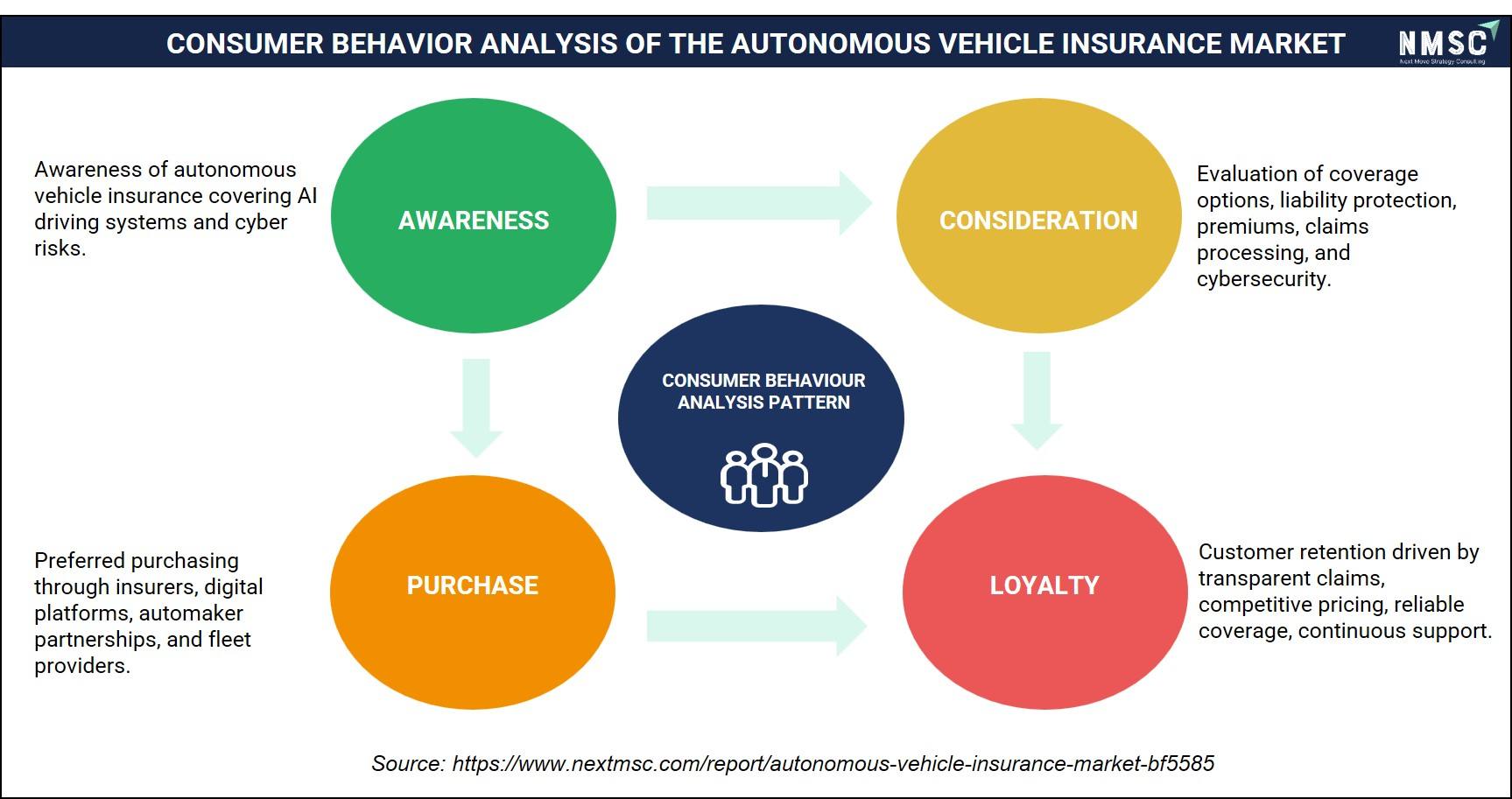
Through our market assessment, we observed that consumer journey begins with rising awareness around AI driving systems and cyber risks. Consequently, during consideration, buyers evaluate liability protection, premiums, claims efficiency, and cybersecurity capabilities. In the purchase stage, policyholders rely on digital platforms, insurers, automakers, and fleet providers, whereas long-term retention depends heavily on transparent claims processing, competitive pricing, and reliable support services.
Competitive Landscape
We observed that the autonomous vehicle insurance market features a fragmented competitive landscape, with global reinsurers and diversified primary carriers competing alongside OEM-affiliated underwriters and insurtech entrants on data access, telemetry integration, and fleet-specific underwriting capability across the industry.
Key Takeaways
|
Field |
Details |
|
Market Structure |
Fragmented; global reinsurers including Munich Re, Swiss Re, and Allianz provide backstop capacity, while OEM-affiliated underwriters and insurtech entrants such as Tesla Insurance and Lemonade compete directly on telemetry-based product design. |
|
Innovation Focus |
Direct OEM data partnerships, generative AI-driven underwriting platforms, and fleet-level risk pooling for robotaxi and autonomous trucking operators dominate current innovation pipelines. |
|
M&A Activity |
Selective technical partnerships rather than acquisitions, exemplified by Lemonade's technical collaboration with Tesla to access Fleet API telemetry data for usage-based pricing. |
How Do Companies Compete in the Autonomous Vehicle Insurance Market?
Companies compete primarily on vehicle data access, telemetry integration depth, and fleet underwriting capability across the industry. OEM-affiliated underwriters such as Tesla Insurance leverage direct vehicle data streams unavailable to third-party carriers, while diversified global insurers such as Allianz and AXA compete through reinsurance-backed capacity and established claims infrastructure serving both personal and commercial autonomous vehicle policies.
Which Competitive Archetypes Dominate the Autonomous Vehicle Insurance Market?
Two archetypes dominate the market: OEM-affiliated and insurtech underwriters offering telemetry-integrated, usage-based products, and diversified global carriers and reinsurers providing traditional liability capacity backed by decades of actuarial infrastructure. Tesla Insurance and Lemonade exemplify the telemetry-integrated archetype, while Munich Re and Allianz exemplify the diversified capacity archetype anchoring fleet and reinsurance programs.
How Are Companies Differentiating Through Innovation in Autonomous Vehicle Insurance?
Innovation and differentiation strategy increasingly center on data partnership depth and generative AI-driven underwriting automation. Lemonade's Tesla Fleet API integration and Munich Re's REALYTIX ZERO generative AI CoPilot both illustrate how insurers accelerate product development for novel autonomous risk categories. Our analysis shows that carriers unable to secure direct vehicle telemetry access risk exclusion from the fastest-growing usage-based coverage segment as OEM data partnerships become a baseline competitive requirement.
What M&A and Expansion Activity Is Shaping the Autonomous Vehicle Insurance Market?
Technical partnerships and product-level expansion continue to shape competitive positioning within the industry rather than large-scale acquisitions. Lemonade's January 2026 Tesla partnership, launched first in Arizona and expanded to Oregon within weeks, illustrates how insurtech entrants pursue rapid state-by-state geographic expansion following OEM data access agreements, while reinsurers including Swiss Re and Munich Re continue expanding dedicated autonomous vehicle underwriting frameworks.
Key Market Players
Our assessment indicates that the following 20 companies are actively shaping underwriting strategy, telemetry integration, and fleet risk capacity within the global autonomous vehicle insurance market.
-
Tesla, Inc.
-
Allianz SE
-
AXA SA
-
Zurich Insurance Group AG
-
Munich Reinsurance Company
-
Swiss Re AG
-
Chubb Limited
-
American International Group, Inc.
-
Liberty Mutual Insurance Company
-
State Farm Mutual Automobile Insurance Company
-
Berkshire Hathaway Inc.
-
The Travelers Companies, Inc.
-
Nationwide Mutual Insurance Company
-
Intact Financial Corporation
-
Root, Inc.
-
Verisk Analytics, Inc.
-
Company 19
-
Company 20
Latest Developments
We found that recent milestones within the autonomous vehicle insurance market are concentrated on telemetry-based product launches and expanding regulatory scrutiny, reflecting the industry's rapid product innovation alongside unresolved liability questions.
|
Date |
Event |
|
June 2026 |
Lemonade announced the availability of its Autonomous Car insurance in Indiana. The product provides Tesla owners a 50% discount on insurance costs for every mile driven using Tesla's Full Self-Driving (Supervised) technology. |
|
November 2025 |
Allianz Insurance Singapore expanded its autonomous vehicle coverage by providing specialized insurance for the upcoming Ai.R autonomous shuttle service in Punggol, Singapore. Developed in partnership with Grab and WeRide, the specialized insurance framework evaluates operating conditions, safety metrics, and AI decision-making systems for public transit. |
|
August 2025 |
Allianz Insurance Singapore partnered with autonomous driving technology company WeRide to insure its fully driverless Robobus at Resorts World Sentosa in Singapore. Following driverless approval from Singapore's Land Transport Authority, Allianz created a bespoke pricing framework factoring in vehicle safety, maintenance, usage, and sensor specifications. |
Expert Insights
 “Today, we're bringing Lemonade Autonomous Car to Tesla drivers in Indiana. This first-of-its-kind insurance product cuts Tesla's cost of ownership by slashing insurance prices in half for miles driven with FSD (Supervised). Tesla's safe FSD (Supervised) tech reduces the chances of getting into an accident. Our intelligent pricing models see this in the data and can pass real savings, with high precision, on to Tesla customers.”
— Shai Wininger, President and Co-Founder of Lemonade
Statement made following the expansion of Lemonade Autonomous Car insurance to Indiana.
Market Interpretation
The insight highlights the emergence of autonomous-driving-aware insurance models, in which vehicle-generated data and the use of advanced driving systems can influence risk assessment and premium pricing. As autonomous and highly automated driving technologies become more widely deployed, insurers are increasingly exploring data-driven underwriting models that differentiate between conventional driving and automated-system usage. This development may support more precise risk pricing, personalized coverage, and lower insurance costs for drivers using safety-enhancing automated driving technologies.
Investment Opportunities
What Capital Inflows Are Targeting the Autonomous Vehicle Insurance Market?
Capital inflows into the autonomous vehicle insurance market are increasingly directed toward telemetry infrastructure and OEM data partnership development. Lemonade's technical collaboration with Tesla illustrates continued strategic investment toward usage-based product capability. We observed that investors favor insurers demonstrating validated OEM data access, viewing telemetry partnership depth as a proxy for long-term competitive positioning in the fastest-growing coverage categories.
How Significant Is Infrastructure Investment in the Autonomous Vehicle Insurance Market?
Infrastructure investment tied to generative AI underwriting platforms and reinsurance capacity is a critical enabler of autonomous vehicle insurance market scalability. Munich Re's continued investment in its REALYTIX ZERO underwriting platform supports faster product development for novel autonomous risk categories. Our assessment indicates that reinsurers increasingly condition primary carrier program support on demonstrated underwriting technology sophistication for automated driving risk.
What ESG Considerations Are Shaping Autonomous Vehicle Insurance Investment?
Environmental, social, and governance considerations increasingly influence autonomous vehicle insurance investment through road safety and data governance priorities. Insurers highlighting reduced accident rates from autonomous driving, supported by Waymo's driverless safety record, align product marketing with broader road safety goals. NMSC's analysis indicates that data privacy governance around vehicle telemetry collection is becoming a meaningful factor in regulatory and investor evaluation of insurer data partnership structures.
Key Benefits for Stakeholders
How Does This Report Benefit Insurance Industry Leaders?
Insurance industry leaders gain access to validated segmentation, coverage type benchmarking, and regional regulatory analysis that supports autonomous vehicle product strategy decisions. The report's automation level and vehicle application breakdowns help executives evaluate personal, robotaxi, and commercial fleet underwriting priorities against evolving liability frameworks, supporting more informed portfolio decisions across usage-based and traditional coverage categories.
How Does This Report Benefit Investors and Financial Analysts?
Investors and financial analysts benefit from consolidated market sizing, regional growth forecasts, and competitive positioning data that inform capital allocation across the autonomous vehicle insurance value chain. The report's country-level revenue estimates and growth catalyst matrix support due diligence on OEM-affiliated underwriters, reinsurers, and insurtech platforms positioned to capture forecast demand growth through 2035.
How Does This Report Benefit Technology Vendors and Product Teams?
Technology vendors and product teams gain competitive intelligence on telemetry integration trends, generative AI underwriting adoption, and recent developments among the 18 companies profiled. This supports product roadmap decisions around OEM data partnership design, fleet risk pooling infrastructure, and cyber liability bundling aligned with the fastest-growing coverage and regional segments identified in this report.
Key Market Segments
By Coverage Type
-
Product liability coverage
-
Cyber liability coverage
-
Physical damage coverage
-
Usage-based coverage
-
Passenger and third-party liability coverage
-
Other coverage types
By Automation Level
-
Level 3 conditional automation
-
Level 4 high automation
-
Level 5 full automation
By Vehicle Application
-
Personal passenger vehicles
-
Robotaxi and ride-hailing fleets
-
Autonomous trucking fleets
-
Last-mile delivery fleets
By Distribution Channel
-
OEM-affiliated underwriters
-
Traditional carrier partnerships
-
Insurtech direct platforms
-
Reinsurance and risk pools
By End User
-
Individual vehicle owners
-
Fleet operators and mobility providers
By Region
-
North America: U.S., Canada, Mexico.
-
Europe: UK, Germany, France, Italy, Spain, Sweden, Denmark, Finland, Netherlands, Rest of Europe.
-
Asia-Pacific: China, India, Japan, South Korea, Taiwan, Indonesia, Vietnam, Australia```html , Philippines, Malaysia, Rest of APAC.
-
Middle East & Africa: Saudi Arabia, UAE, Egypt, Israel, Turkey, Nigeria, South Africa, Rest of MEA.
-
Latin America: Brazil, Argentina, Chile, Colombia, Rest of LATAM.
Conclusion & Recommendations
What Is the Long-Term Outlook for the Autonomous Vehicle Insurance Market?
The long-term outlook for the autonomous vehicle insurance market remains structurally positive, supported by a USD 4.31 billion absolute dollar opportunity between 2026 and 2035 and accelerating Level 4 and Level 5 automation deployment across robotaxi and commercial fleet categories. We found that usage-based and cyber liability coverage will continue gaining share as telemetry integration and generative AI underwriting mature into standard industry practice through the forecast period.
What Strategic Positioning Should Stakeholders Pursue?
Stakeholders should pursue strategic positioning that combines direct OEM telemetry access with reinsurer-backed fleet capacity to serve both personal and commercial autonomous vehicle segments. NMSC's analysis indicates that insurers bundling usage-based personal products with dedicated fleet risk pooling infrastructure are best positioned to capture recurring, multi-year revenue across the autonomous vehicle insurance market.
How Attractive Is the Autonomous Vehicle Insurance Market for New Investment?
The autonomous vehicle insurance industry presents an attractive investment case, supported by a USD 4.31 billion absolute dollar opportunity between 2026 and 2035 and above-average growth in Asia-Pacific and Level 5 full automation categories. We found that investment attractiveness is highest for insurers combining validated OEM data partnerships with generative AI underwriting capability, positioning them to serve both mature and emerging regional markets simultaneously.
What Market Shifts and Key Risks Should Stakeholders Monitor?
Stakeholders should monitor unresolved OEM-insurer liability allocation, regulatory investigations into AV safety claims, and limited historical loss data for full automation risk pricing as key risks to the autonomous vehicle insurance market. Our analysis shows that insurers unable to secure clear contractual liability frameworks with OEM partners risk claims processing disputes that could undermine product profitability, particularly as NHTSA scrutiny of Full Self-Driving safety claims intensifies.
What Are the Key Growth Pathways for the Autonomous Vehicle Insurance Market?
Key growth pathways include scaling OEM telemetry data partnerships, expanding fleet-level risk pooling for robotaxi and autonomous trucking operators, and deepening penetration into cyber liability and last-mile delivery coverage categories. NMSC's analysis indicates that insurers pursuing these pathways while maintaining underwriting discipline amid limited historical loss data will be best positioned to capture the autonomous vehicle insurance market's projected growth through 2035.
About the Author
 Mayurima Roy
— Mayurima Roy is Research Analyst at Next Move Strategy Consulting, where she has spent 4 years working across the firm's full industry coverage rather than a single fixed vertical. Her work centers on structured research, ongoing trend tracking, competitive assessment, and insight-led content development, translating complex market data into clear, decision-ready narratives that support informed client decision-making across diverse global industries, market sectors, and world regions every day.
Mayurima Roy
— Mayurima Roy is Research Analyst at Next Move Strategy Consulting, where she has spent 4 years working across the firm's full industry coverage rather than a single fixed vertical. Her work centers on structured research, ongoing trend tracking, competitive assessment, and insight-led content development, translating complex market data into clear, decision-ready narratives that support informed client decision-making across diverse global industries, market sectors, and world regions every day.
About the Reviewer
 Supradip Baul
— Supradip Baul is an accomplished business consultant and strategist with over a decade of rich experience in market intelligence, strategy, technology, and business transformation. His work has included rigorous qualitative and quantitative analysis across multiple industries, helping clients shape investment decisions and long-term roadmaps. Earlier in his career, he was associated with Gartner, where he contributed to industry-leading reports and market share analyses. He has worked with leading global companies and holds an MBA with a dual specialization in Marketing and Finance.
Supradip Baul
— Supradip Baul is an accomplished business consultant and strategist with over a decade of rich experience in market intelligence, strategy, technology, and business transformation. His work has included rigorous qualitative and quantitative analysis across multiple industries, helping clients shape investment decisions and long-term roadmaps. Earlier in his career, he was associated with Gartner, where he contributed to industry-leading reports and market share analyses. He has worked with leading global companies and holds an MBA with a dual specialization in Marketing and Finance.
At Next Move Strategy Consulting, we understand that insightful market research is the cornerstone of successful business decisions. That's why we employ a robust and multifaceted approach, combining various methodologies to deliver the most accurate and actionable data for our clients.

Research Landscape
We navigate the world of research with two primary approaches:
Qualitative Approach
Our qualitative research methodologies involve immersive techniques such as in-depth interviews, focus groups, and observational studies. By engaging directly with individuals and stakeholders, we uncover valuable insights that quantitative data alone may overlook.

Quantitative Research
In tandem with qualitative methodologies, NMSC leverages the power of Quantitative Research to provide a robust foundation of numerical insights. Through systematic data collection and analysis, we quantify patterns, preferences, and market trends, offering a comprehensive view of the business landscape.
Our quantitative research approach employs diverse tools, including surveys, experiments, and statistical modelling. These methodologies enable us to gather data from a large and representative sample, ensuring the statistical significance of our findings. By employing structured questionnaires and standardized data collection methods, we guarantee the reliability and validity of the information we present to our clients.
Quantitative research is particularly effective in measuring the prevalence of trends, assessing market size, and gauging the impact of various factors on consumer behavior. The numerical precision attained through this approach equips our clients with actionable insights, facilitating data-driven decision-making and strategy formulation.


Our Specialized Toolbox for Industry-Specific Market Research
We deploy a specialized arsenal of techniques tailored to meet your unique requirements. Here's a glimpse into our comprehensive toolbox:

Information Procurement
The stage entails acquiring market data or relevant information through various sources and methodologies.


Market Research Approach
We utilize both top-down and bottom-up approaches in market research analysis to achieve a comprehensive understanding of the market dynamics, leveraging the broad perspective of industry trends and macroeconomic factors alongside detailed insights from specific segments and individual companies.

Porters Five Forces Analysis
We conduct Porter's Five Forces analysis to evaluate the competitive landscape of an industry, providing us with insights into factors that affect profitability and strategic positioning.

SWOT Analysis

Forecasting
We utilize a forecasting model to predict future consumption by considering parameters like population, economics, regulations, market competition, drivers, constraints, technology, and pricing. We also employ statistical techniques such as multilinear regression, exponential smoothing, moving average, ARIMA, and Monte Carlo simulations for accurate predictions. In econometric forecasting, we analyzed short-term and long-term event impacts, attributing values based on regulatory frameworks, economic factors, and market events.





 Speak to Our Analyst