Battery Tab Welding Equipment Market Global Industry Analysis and Forecast (2026–2035)

Battery Tab Welding Equipment Market size was USD 1.39 Billion in 2025, projected to reach USD 2.61 Billion by 2035, growing at a CAGR of 6.5% from 2026 to 2035. Key drivers include expansion of lithium-ion cell manufacturing capacity, stringent weld quality requirements, and adoption of automated inline inspection, with Asia-Pacific leading the global market.

Download Free Sample PDF
Base Year (2025)
$1.39 Billion
Forecast (2035)
$2.61 Billion
CAGR (2026-2035)
6.5%
Top Region
Asia-Pacific

What Is the Battery Tab Welding Equipment Market Size?

The global Battery Tab Welding Equipment Market reached USD 1.39 Billion in 2025 and is estimated at USD 1.48 Billion in 2026, forecast to reach USD 2.61 Billion by 2035 at a CAGR of 6.5% between 2026 and 2035. Asia-Pacific leads with approximately 42% revenue share in 2025, while Resistance Spot Welding Systems is the dominant equipment type, holding approximately 47% of total market revenue.

NMSC’s analysis indicates that changes in cell formats are reshaping battery tab welding equipment requirements. Larger cylindrical cells, prismatic cells, and pouch designs present different tab geometries and foil thicknesses. These variations require controlled energy delivery, application-specific fixtures, and repeatable weld parameters. Large-scale production lines also rely on synchronized welding stations, with machine vision and process monitoring supporting weld consistency and traceability.

Battery Tab Welding Equipment Market Global Industry Analysis and Forecast (2026–2035) Revenue Forecast

Values in USD Billion

2025 $1.39 Billion
2025
2026 $1.48 Billion
2026
2027 $1.58 Billion
2027
2028 $1.68 Billion
2028
2029 $1.79 Billion
2029
2030 $1.90 Billion
2030
2031 $2.03 Billion
2031
2032 $2.16 Billion
2032
2033 $2.30 Billion
2033
2034 $2.45 Billion
2034
2035 $2.61 Billion
2035

Key Takeaways

By Equipment Type: Resistance Spot Welding Systems held the largest share, expanding from USD 0.66 Billion in 2025 to USD 1.12 Billion by 2035; Ultrasonic Welding Systems is the fastest-growing segment at an 8% CAGR from 2026–2035.

By Automation Level: Automatic Battery Tab Welders held the largest share, expanding from USD 0.62 Billion in 2025 to USD 1.00 Billion by 2035; Manual Welders is the fastest-growing segment at a 7.8% CAGR from 2026–2035.

By Battery Type: Cylindrical Cells held the largest share, expanding from USD 0.68 Billion in 2025 to USD 1.14 Billion by 2035; Pouch Cells is the fastest-growing segment at a 9% CAGR from 2026–2035.

By Application: Electric Vehicle Batteries held the largest share, expanding from USD 0.68 Billion in 2025 to USD 1.16 Billion by 2035; Consumer Electronics Batteries is the fastest-growing segment at an 8% CAGR from 2026–2035.

Dominant Region: Asia-Pacific dominated the market with approximately 42% revenue share (USD 0.58 Billion) in 2025, supported by large-scale manufacturing infrastructure, domestic battery demand, and supply-chain integration.

Fastest-Growing Region: Asia-Pacific is expected to register the highest CAGR of 8.9% during 2026–2035, driven by battery manufacturing capacity expansion and growing commercial adoption.

Dominant Country: The U.S. led the market with an estimated USD 0.31 Billion in 2025 (approximately 82% of North America), supported by battery manufacturing investment and equipment procurement.

Emerging Country Market: India represents an emerging battery tab welding equipment market within Asia-Pacific, supported by domestic battery manufacturing investments and electric vehicle production initiatives.

The battery tab welding equipment market presents an absolute dollar opportunity of USD 1.13 Billion between 2026 and 2035, expanding from USD 1.48 Billion to USD 2.61 Billion. This incremental value reflects capacity additions in cell manufacturing hubs and replacement of legacy welding systems with higher-precision platforms. Suppliers that secure qualification on next-generation cell designs can improve their position as manufacturers scale production. Long-term equipment and service relationships also support revenue visibility for equipment providers.

The competitive landscape includes specialist laser and ultrasonic welding suppliers alongside broader battery manufacturing equipment companies. Competitive positioning is shaped by process validation, line integration, service coverage, and the ability to handle different cell formats. Suppliers with documented battery tab joining capabilities compete on weld quality, cycle time, and equipment integration.

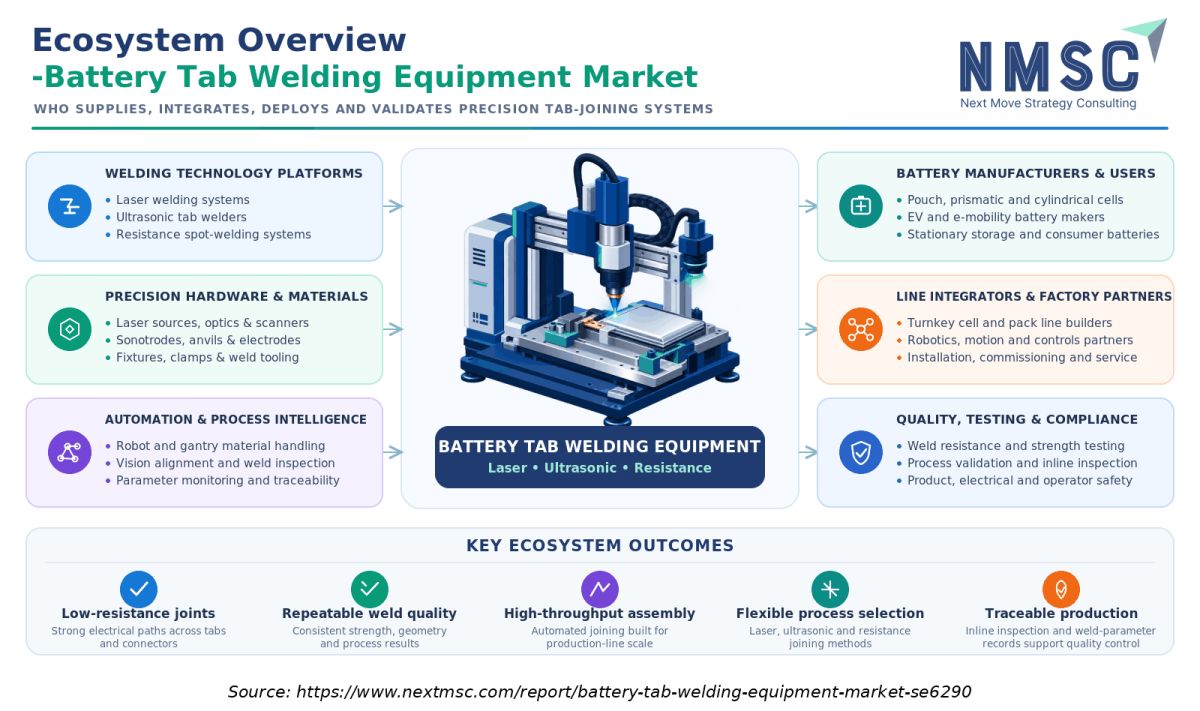
Ecosystem Analysis of the Battery Tab Welding Equipment Industry

The above infographic presents the Battery Tab Welding Equipment market ecosystem comprising welding technology providers, component suppliers, automation developers, battery manufacturers, system integrators, and quality-testing providers. Together, these stakeholders enable efficient, precise, and reliable battery tab welding operations, supporting improved battery performance, advanced manufacturing capabilities, and the growth of electric mobility and energy storage applications.

What Does the Battery Tab Welding Equipment Market Encompass?

The battery tab welding equipment market encompasses systems that join thin metal tabs from electrode foils to current collectors and terminals within lithium-ion cells. Product types include resistance spot welding systems, laser welding stations, and ultrasonic welding systems. Core technologies cover beam and pulse control, sonotrode design, fixturing, and in-line vision inspection. NMSC’s analysis indicates that these systems serve electric vehicle, energy storage, and consumer electronics battery production lines.
Design specifications emphasize low spatter, controlled heat input, and repeatable weld penetration across copper and aluminum combinations. Material innovations, including dissimilar-metal joining and thin-foil handling, influence machine and tooling configurations. Electrical safety, electromagnetic compatibility, and quality-management requirements also shape equipment design and supplier qualification.

Market Drivers & Dynamics

Interactive Dataset
Expansion of lithium-ion cell manufacturing capacity driver High New gigafactory lines require large numbers of battery tab welding equipment stations for cell tab joining Immediate
Stringent weld quality requirements for thermal safety driver High Consistent tab welds reduce internal resistance and support safety compliance in battery packs Immediate
Adoption of automated inline inspection driver Medium Vision-integrated battery tab welding equipment lowers scrap and supports traceability Medium-term
High capital cost of precision laser systems restraint High Premium laser and control modules raise entry barriers for smaller battery tab welding equipment buyers Immediate
Process qualification complexity for new cell designs restraint Medium Each new cell format requires validated battery tab welding equipment recipes before volume production Medium-term
Cyclical investment in battery capacity restraint Low Slowdowns in battery plant investment can defer battery tab welding equipment orders Long-term
Source: Next Move Strategy Consulting

Growth Drivers

What Is the Primary Growth Driver in the Battery Tab Welding Equipment Industry?

The primary catalyst for the battery tab welding equipment market is the sustained buildout of lithium-ion cell production for electric vehicles and grid storage. Each gigafactory line depends on dozens of tab welding stations operating at high throughput. Our assessment indicates that cell makers are prioritizing equipment that maintains weld consistency at elevated line speeds. This combination of capacity expansion and quality intensity creates steady demand for advanced battery tab welding equipment platforms.

How Are Industry Standards and Directives Driving the Market?

Safety and quality standards for battery systems increasingly influence procurement decisions in the battery tab welding equipment market. Electrical safety certification, electromagnetic compatibility testing, and quality management system requirements shape supplier qualification. Shenzhen Yinghe Technology, Inc. achieved comprehensive international compliance certification for its portfolio in June 2025, reflecting this pressure. Environmental directives limiting hazardous process emissions also encourage adoption of cleaner laser and ultrasonic technologies.

Growth Inhibitors

What Is Restraining the Battery Tab Welding Equipment Market?

The principal commercial restraint in the battery tab welding equipment market is the high capital cost of precision laser and control systems. Smaller battery manufacturers and emerging regional producers often struggle to finance full automation lines. Supply dependence on specialized laser sources and high-precision optics further constrains lead times and pricing stability. Suppliers responding with leasing models and phased upgrade paths are gradually easing this barrier.

What Are the Growth Opportunities?

Can Multi-Format Welding Platforms Capture High-Density Deployments?

Flexible battery tab welding equipment platforms capable of processing several cell formats on one line address a manufacturing requirement. Gigafactories operate mixed production schedules, making changeover capability valuable. Suppliers offering validated recipe libraries and modular fixtures can serve high-density deployments. Such platforms also improve equipment utilization where operators manage constrained manufacturing space.

Can Modular and Semi-Automatic Systems Expand SME Adoption?

Smaller battery producers and pilot-line operators represent a more price-sensitive customer group. Standardized semi-automatic systems, modular tooling, and phased automation can reduce initial capital requirements. Suppliers with application engineering, service support, and process-validation packages can address pilot production demand without relying on unverified cloud-platform partnerships.

Can Specialized Vertical Implementations Become Distinct Premium Markets?

Specialized applications, including high-energy-density cells and dissimilar-metal joining, require tailored process control, custom sonotrodes, and application-specific optics. Suppliers with metallurgical and process-engineering expertise can differentiate their equipment through validated joining performance. Certified solutions for these applications support differentiation beyond standard price-based competition.

Segmentation Analysis

2025 (USD Billion)
2035 (USD Billion)
Resistance Spot Welding Systems 2025: $0.66 Billion | 2035: $1.12 Billion
Resistance S
Laser Welding Systems 2025: $0.41 Billion | 2035: $0.79 Billion
Laser Weldin
Ultrasonic Welding Systems 2025: $0.32 Billion | 2035: $0.70 Billion
Ultrasonic W
Resistance Spot Welding Systems $0.66 Billion $1.12 Billion 5.4%
Laser Welding Systems $0.41 Billion $0.79 Billion 6.7%
Ultrasonic Welding Systems $0.32 Billion $0.70 Billion 8%

Which Equipment Type Segment Dominates the Market?

Resistance spot welding systems anchor the installed base of battery tab welding equipment, accounting for approximately 47% of the market and USD 0.66 billion in 2025. Manufacturers favor this architecture because it delivers repeatable joints at high throughput and aligns with existing capital procurement cycles on cell production lines. Ultrasonic welding systems, however, record the fastest trajectory at an 8% CAGR through 2035, driven by their suitability for thin foil and dissimilar metal tab joints.

2025 (USD Billion)
2035 (USD Billion)
Category A
Category B
Category C
Category D
Segment Item 2025 (USD Billion) 2035 (USD Billion) CAGR
Category A $10.0 USD Billion $40.0 USD Billion 25.0%
Category B $17.1 USD Billion $51.1 USD Billion 27.0%
Category C $24.2 USD Billion $62.2 USD Billion 17.0%
Category D $31.3 USD Billion $73.3 USD Billion 19.0%

Segment-wise data is locked

Unlock complete segment-wise numbers for By Automation Level.

Unlock Full Data
2025 (USD Billion)
2035 (USD Billion)
Category A
Category B
Category C
Category D
Segment Item 2025 (USD Billion) 2035 (USD Billion) CAGR
Category A $10.0 USD Billion $40.0 USD Billion 8.0%
Category B $17.1 USD Billion $51.1 USD Billion 26.0%
Category C $24.2 USD Billion $62.2 USD Billion 16.0%
Category D $31.3 USD Billion $73.3 USD Billion 22.0%

Segment-wise data is locked

Unlock complete segment-wise numbers for By Battery Type.

Unlock Full Data
2025 (USD Billion)
2035 (USD Billion)
Category A
Category B
Category C
Category D
Segment Item 2025 (USD Billion) 2035 (USD Billion) CAGR
Category A $10.0 USD Billion $40.0 USD Billion 18.0%
Category B $17.1 USD Billion $51.1 USD Billion 16.0%
Category C $24.2 USD Billion $62.2 USD Billion 22.0%
Category D $31.3 USD Billion $73.3 USD Billion 12.0%

Segment-wise data is locked

Unlock complete segment-wise numbers for By Application.

Unlock Full Data
2025 (USD Billion)
2035 (USD Billion)
Category A
Category B
Category C
Category D
Segment Item 2025 (USD Billion) 2035 (USD Billion) CAGR
Category A $10.0 USD Billion $40.0 USD Billion 24.0%
Category B $17.1 USD Billion $51.1 USD Billion 10.0%
Category C $24.2 USD Billion $62.2 USD Billion 8.0%
Category D $31.3 USD Billion $73.3 USD Billion 14.0%

Segment-wise data is locked

Unlock complete segment-wise numbers for By Sales Channel.

Unlock Full Data

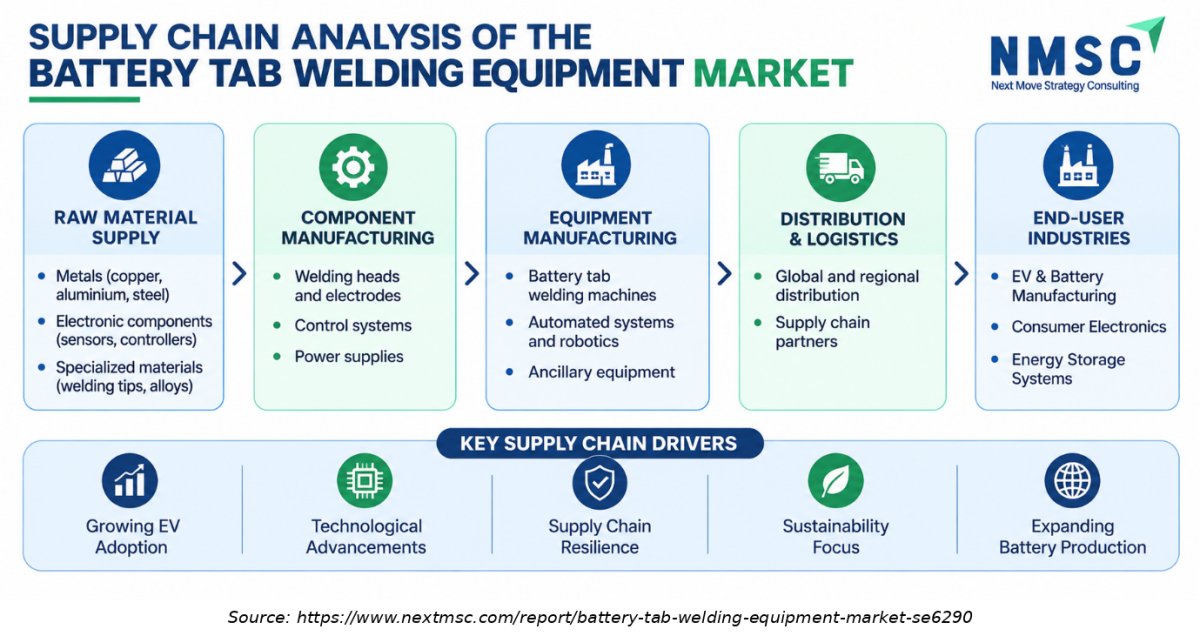
Supply Chain Analysis of the Battery Tab Welding Equipment Industry

Supply Chain Analysis of the Battery Tab Welding Equipment Industry
The above infographic maps the supply chain of the Battery Tab Welding Equipment Market, which comprises raw material suppliers, component manufacturers, equipment manufacturers, distribution and logistics providers, and end-user industries. The ecosystem is supported by advancements in battery welding technologies, growing EV adoption, regulatory support for clean energy, supply chain resilience, and increasing demand for energy storage solutions.

Growth Opportunities

NMSC’s analysis identifies structural opportunities in flexible equipment platforms, pilot-line adoption, and specialized joining applications across the Battery Tab Welding Equipment Market through 2035:

Can Multi-Format Welding Platforms Capture High-Density Deployments?

Flexible battery tab welding equipment platforms capable of processing several cell formats on one line address a manufacturing requirement. Gigafactories operate mixed production schedules, making changeover capability valuable. Suppliers offering validated recipe libraries and modular fixtures can serve high-density deployments. Such platforms also improve equipment utilization where operators manage constrained manufacturing space.
Can Modular and Semi-Automatic Systems Expand SME Adoption?
Smaller battery producers and pilot-line operators represent a more price-sensitive customer group. Standardized semi-automatic systems, modular tooling, and phased automation can reduce initial capital requirements. Suppliers with application engineering, service support, and process-validation packages can address pilot production demand without relying on unverified cloud-platform partnerships.
Can Specialized Vertical Implementations Become Distinct Premium Markets?
Specialized applications, including high-energy-density cells and dissimilar-metal joining, require tailored process control, custom sonotrodes, and application-specific optics. Suppliers with metallurgical and process-engineering expertise can differentiate their equipment through validated joining performance. Certified solutions for these applications support differentiation beyond standard price-based competition.

Regional Outlook

2025 (USD Billion)
2035 (USD Billion)
North Americ
Europe
Asia-Pacific
Latin Americ
Middle East
Region 2025 (USD Billion) 2035 (USD Billion) CAGR (%)
North America $10.0 USD Billion $40.0 USD Billion 9.0%
Europe $17.1 USD Billion $51.1 USD Billion 27.0%
Asia-Pacific $24.2 USD Billion $62.2 USD Billion 25.0%
Latin America $31.3 USD Billion $73.3 USD Billion 23.0%
Middle East & Africa $38.4 USD Billion $84.4 USD Billion 12.0%

Regional data is locked

Unlock complete regional numbers for this market.

Unlock Full Data

Competitive Landscape

The competitive landscape for battery tab welding equipment includes laser and ultrasonic welding specialists, battery manufacturing equipment suppliers, and diversified industrial automation companies. Han’s Laser Technology Industry Group, Wuhan Hymson Laser Technology, Wuxi Lead Intelligent Equipment, Shenzhen Yinghe Technology, Hitachi High-Tech Corporation, Panasonic Industry, AMADA WELD TECH, Schunk Sonosystems, and Branson (Emerson) have activities in relevant laser, battery, or joining-equipment markets. Company-level inclusion should be confirmed against product-level evidence for battery tab welding equipment.

How Do Companies Compete in the Battery Tab Welding Equipment Market?

Vendors differentiate through welding performance, process repeatability, and integration with battery-cell production systems rather than through price alone. Suppliers compete on equipment cost, delivery schedules, reliability, global service coverage, and validated process capability. Direct enterprise sales support large battery manufacturing accounts, while distributors and system integrators serve smaller customers. Lifecycle support and application engineering contribute to customer retention.

Which Competitive Archetypes Dominate the Market?

Market participants can be grouped into scale-oriented battery equipment OEMs, technology-led laser and ultrasonic welding specialists, and diversified industrial suppliers with broader automation portfolios. Component and system integrators supply welding heads, controllers, fixtures, and inspection modules to equipment manufacturers. These groups participate at different points in the value chain and serve distinct customer requirements.

What Innovation and Differentiation Strategies Are Companies Pursuing?

Competitive advantages in battery tab welding equipment depend on process know-how, validated quality data, and installed-base support. Suppliers that demonstrate repeatable weld performance across production runs strengthen their position with battery manufacturers. Engineering collaboration with cell producers supports process validation, while inspection integration and format-specific tooling create additional differentiation.

What M&A and Partnership Activity Is Shaping the Market?

Supplier expansion in the broader battery-equipment market includes acquisitions of specialized engineering businesses and the development of integrated production capabilities. Wuxi Lead’s published corporate history identifies its acquisition of Titans New Power in 2017 and ONTEC in Germany in 2022; the supplied evidence does not substantiate a separate April 2025 acquisition. These historical transactions indicate capability expansion at the broader battery-equipment level but do not establish recent consolidation specifically in battery tab welding equipment.

Key Market Players

The following companies are identified in the supplied market assessment as market participants, equipment suppliers, or adjacent technology providers; product-level participation in battery tab welding equipment requires verification:

Han's Laser Technology Industry Group Wuhan Hymson Laser Technology, Inc. Lead Intelligent Equipment, Inc. Shenzhen Yinghe Technology, Inc. Wuxi Lead Intelligent Equipment, Inc. Hitachi High-Tech Corporation Panasonic Industry, Inc. Amada Miyachi Co., Ltd. Schunk Sonosystems GmbH Branson Ultrasonics (Emerson), Inc. Lorch Schweisstechnik GmbH Cosmos Laser Technology, Inc. Chengdu Yuanxing Electronics, Inc. Shenzhen Hans Laser Equipment, Inc. Dongguan Ruiyu Automation, Inc. Suzhou Mingzhi Intelligent Technology, Inc. Jiangsu Zhongtai Laser Equipment, Inc. Hangzhou Gerui Technology, Inc. Jiangsu Haoyuan Laser Technology, Inc. Shenzhen Ruiyuan Automation Equipment, Inc.

Latest Developments

During our market evaluation, we noticed that recent commercial activities, platform introductions, and partnerships within the industry reflect the latest market developments:

Date Event
September 2026 Geely Auto Group introduced its Next-Gen Ultra Short Blade Battery, which uses Geely-developed laser-welding technology for cell tabs and covers. This is an application-side battery development, not an equipment launch or confirmed equipment purchase.

Investment Opportunities

Where Are Capital Inflows Concentrating in the Battery Tab Welding Equipment Market?

Capital expenditure in battery tab welding equipment is linked to automated production systems serving high-volume cell manufacturing. Manufacturers prioritize laser and ultrasonic platforms for thin-foil and dissimilar-metal joining applications. Investment in process control and inline inspection also supports equipment suppliers able to demonstrate repeatable weld quality and production yield.

How Is Infrastructure Investment Shaping Market Capacity?

Expansion in battery-cell manufacturing capacity increases the production base requiring tab-joining equipment. The International Energy Agency reported that global lithium-ion battery manufacturing capacity exceeded 4 TWh by the end of 2025, approximately 30% higher than in 2024. This industry-level capacity expansion supports the demand context for battery manufacturing equipment, although it does not directly quantify tab-welding equipment purchases.

What ESG Considerations Are Influencing Market Investment?

Equipment investment can be assessed against energy consumption, process yield, material efficiency, and machine lifecycle requirements. Platforms that reduce scrap, manage power use, and support maintenance and repair can address manufacturers’ operating-cost and resource-efficiency objectives. ESG claims should be linked to measurable equipment performance rather than broad corporate sustainability statements.

Key Benefits for Stakeholders

How Does This Report Benefit Industry Leaders and Enterprise Operators?

Operational executives and procurement directors gain market benchmarks that support equipment selection for battery tab welding deployments. The report maps segment performance across equipment types, automation levels, battery formats, and applications. These insights support capital planning, supplier qualification, and production-line investment decisions over the 2026–2035 horizon.

How Does This Report Benefit Investors and Financial Analysts?

Investors and financial analysts can evaluate the battery tab welding equipment market using the supplied valuation estimates. The market is projected to expand from USD 1.39 Billion in 2025 to USD 2.61 Billion by 2035. Segment-level shares and growth rates provide a framework for assessing revenue pools and competitive positioning, subject to validation of the underlying market model.

How Does This Report Benefit Technology Vendors and Solution Platform Teams?

Technology vendors can use the report to guide product planning for battery tab welding equipment. Identifying segments such as ultrasonic systems and pouch-cell applications highlights areas requiring process and tooling development. Competitive benchmarking also identifies differentiation opportunities in automation, inspection, equipment integration, and validated weld performance.

Key Market Segments Evaluated

By Equipment Type

  • Resistance Spot Welding Systems 
    • Pulse Resistance Welders
    • Capacitor Discharge Welders
  • Laser Welding Systems 
    • Fiber Laser Welders
    • Pulsed Laser Welders
  • Ultrasonic Welding Systems 
    • Single-Head Ultrasonic Welders
    • Multi-Head Ultrasonic Welders

By Automation Level

  • Automatic Battery Tab Welders 
    • Inline Production Systems
    • Standalone Automated Cells
  • Semi-Automatic Welders
  • Manual Welders

By Battery Type

  • Cylindrical Cells 
    • 18650 and 21700 Formats
    • Large-Format Cylindrical Cells
  • Prismatic Cells
  • Pouch Cells

By Application

  • Electric Vehicle Batteries 
    • Passenger EV Packs
    • Commercial EV Packs
  • Energy Storage Systems 
    • Grid-Scale ESS
    • Residential ESS
  • Consumer Electronics Batteries 
    • Smartphone and Laptop Cells
    • Power Tools Batteries

By Sales Channel

  • Direct OEM Sales 
    • Battery Manufacturer Contracts
  • Distributors and Resellers 
    • Regional Equipment Distributors
  • Aftermarket Services 
    • Maintenance and Spare Parts
    • Retrofit and Upgrades

By Region

  • North America 
    • U.S.
    • Canada
    • Mexico.
  • Europe 
    • Germany
    • Netherlands
    • UK
    • France
    • Rest of Europe.
  • Asia-Pacific 
    • Taiwan
    • China
    • South Korea
    • Japan
    • Singapore
    • Rest of APAC.
  • Latin America 
    • Brazil
    • Rest of Latin America.
  • Middle East & Africa 
    • Israel
    • UAE
    • Saudi Arabia
    • Rest of MEA.

Conclusion & Recommendations

The long-term outlook for the battery tab welding equipment market is positive, with revenue expanding from USD 1.48 Billion in 2026 to USD 2.61 Billion by 2035 at a 6.5% CAGR. Growth is supported by battery-cell manufacturing investment, demand for repeatable tab joining, and the adoption of automated inspection and process control. Asia-Pacific remains central to the outlook, supported by its stated regional market base and growth rate.

What Strategic Positioning Recommendations Does NMSC Offer?

Battery tab welding equipment vendors should prioritize recipe flexibility, weld monitoring, automated inspection, and validated process control across cylindrical, prismatic, and pouch cells. Suppliers should strengthen application engineering and regional service capabilities to support commissioning, maintenance, and production uptime. Modular fixtures and compatibility with production-line controls can help address mixed-format factories and evolving cell designs.

How Attractive Is the Battery Tab Welding Equipment Market for Investment?

The investment case is supported by the stated USD 1.13 Billion absolute growth opportunity between 2026 and 2035 and demand for specialized joining systems in battery-cell manufacturing. Asia-Pacific, at a stated 8.9% CAGR, represents the highest relative growth and the largest regional revenue base. Investment decisions should also consider equipment qualification cycles, capital intensity, and the validation status of the underlying market estimates.

What Are the Key Market Shifts and Risks in the Market?

Key market shifts include the use of laser and ultrasonic processes, greater integration of machine vision and in-line inspection, and demand for flexible tooling across cylindrical, prismatic, and pouch formats. Primary risks include high upfront equipment costs, qualification time for new cell designs, and dependence on specialist laser sources, optics, sonotrodes, and controls. Variability in battery-cell investment also affects the timing of equipment orders.

What Are the Primary Growth Pathways Through 2035?

The primary growth pathways in battery tab welding equipment include pouch-cell applications, ultrasonic welding systems, and consumer electronics battery production. Suppliers that secure long-term relationships with cell manufacturers can strengthen their position as production capacity expands. Broader international service coverage and application-specific process validation also support supplier differentiation.

FAQs

About the Author

Mayurima Roy

Mayurima Roy

Mayurima Roy is Research Analyst at Next Move Strategy Consulting, where she has spent 4 years working across the firm's full industry coverage rather than a single fixed vertical. Her work centers on structured research, ongoing trend tracking, competitive assessment, and insight-led content development, translating complex market data into clear, decision-ready narratives that support informed client decision-making across diverse global industries, market sectors, and world regions every day.

About the Reviewer

Supradip Baul

Supradip Baul

Supradip Baul is an accomplished business consultant and strategist with over a decade of rich experience in market intelligence, strategy, technology, and business transformation. His work has included rigorous qualitative and quantitative analysis across multiple industries, helping clients shape investment decisions and long-term roadmaps. Earlier in his career, he was associated with Gartner, where he contributed to industry-leading reports and market share analyses. He has worked with leading global companies and holds an MBA with a dual specialization in Marketing and Finance.

Download Free Sample

Gustaf Hummel Burstrom

GUSTAF HUMMEL BURSTROM

Founder

Revline Tools AB

Joseph and the team at Next Move Strategy Consulting have been excellent to work with, in supplying us with relevant market data and forecasts for our specific category. We had some special requirements and they were able to do a custom package to suit our needs. We would definitely recommend them to any other company needing market data and forecasts

Rishabh Jogani

RISHABH JOGANI

Strategy Analyst

Accenture Japan

We are incredibly impressed with the market report on the real estate market in India provided by Next Move Strategy Consulting. The report was thorough, insightful, and well-structured, offering deep analysis and actionable recommendations. It not only captured the current trends and dynamics but also provided a forward-looking perspective that has been invaluable for our strategic planning. Their team demonstrated exceptional professionalism, attention to detail, and a profound understanding of the industry. The data-driven insights and clarity of presentation exceeded our expectations, making complex market trends easy to understand. We highly recommend Next Move Strategy Consulting to anyone looking for reliable and comprehensive market research services. Their expertise has given us the confidence to navigate the complexities of the Indian real estate market with clarity and foresight.

Melanie Samko

MELANIE SAMKO

Director of Marketing

TOSOH BIOSCIENCE, INC.

The information provided by NMSC is incredibly valuable, thank you so much for such a excellent work. I really appreciate it. I will make sure to reference all of it, in my summary document.

Nishant Awate

NISHANT AWATE

Business Development Global Sales

Zehnder Group Deutschland GmbH

Our experience working with Next Move Strategy Consulting was positive. The team was responsive, professional, and open to incorporating our specific requirements throughout the project. The India AHU market study was comprehensive and well structured, covering market value and volume forecasts, product and application segments, and key industry trends. The inclusion of both AHU and residential MVHR market insights made the study particularly relevant for our strategic market assessment. Overall, the report provides a solid foundation for evaluating market potential, identifying priority segments, and supporting business-development decisions in India.

Ross J Mckenzie

ROSS J MCKENZIE

Business Insight Manager

Staysure Group

“Next MSC have been incredibly helpful in providing detailed & robust information on our market, alongside quantifying growth by different segments. The process to procure was simple and easy, with sample reports and regular contact to ensure we had what we needed. Succinct detail on their sources & methodologies is also greatly received, allowing transparency in this respect helps build trust in the detail you pay for. Joseph in particular was fantastic, and helped ensure efficient provision of the insight pack – thank you NMSC!”.

Custom Market Research Services

We will customize the research for you if the listed report does not fully match your requirements.

Get 30% Free Customization

Select License

This website uses cookies to ensure you get the best experience on our website. Learn more

✖