Cardiac Biomarkers Market Global Industry Analysis and Forecast (2026-2035)

The global Cardiac Biomarkers Market size was estimated at USD 32.26 billion in 2026, projected to reach USD 98.66 billion by 2035, expanding at a CAGR of 13.23% from 2026 to 2035. Key drivers include the rising global burden of acute coronary syndrome and cardiovascular disease, growing adoption of high-sensitivity troponin assays, and increasing demand for rapid biomarker-based diagnosis, with North America leading the market with approximately 40% share .

Download Free Sample PDF
Base Year (2025)
$24.88 Billion
Forecast (2035)
$98.66 Billion
CAGR (2026-2035)
13.2%
Top Country
North America

What Is the Cardiac Biomarkers Market Size?
The global cardiac biomarkers market size was valued at USD 24.88 billion in 2025 and is estimated at USD 32.26 billion in 2026, forecast to reach USD 98.66 billion by 2035, expanding at a 13.23% CAGR between 2026 and 2035. North America leads with approximately a 40% market share , while Troponins account for the largest share among test types, with approximately 52% .

We observed that growth is broad-based across every segmentation axis, with Natriuretic Peptides and Point-of-Care Testing emerging as the dominant structural shifts reshaping the cardiac biomarkers market through 2035.

Cardiac Biomarkers Market Global Industry Analysis and Forecast (2026-2035) Revenue Forecast
Values in USD Billion

2025 $24.88 Billion
2025
2026 $32.26 Billion
2026
2027 $36.53 Billion
2027
2028 $41.36 Billion
2028
2029 $46.83 Billion
2029
2030 $53.03 Billion
2030
2031 $60.04 Billion
2031
2032 $67.99 Billion
2032
2033 $76.98 Billion
2033
2034 $87.17 Billion
2034
2035 $98.66 Billion
2035

Key Takeaways

By Test Type: Troponins held the largest share of approximately 52% (USD 12.94 billion) in 2025; Natriuretic Peptides are the fastest-growing sub-segment at 16.68% CAGR from 2026–2035.

By Testing Setting: Laboratory Testing held the largest share of approximately 68% (USD 16.92 billion) in 2025; Point-of-Care Testing is the fastest-growing sub-segment at 17.93% CAGR from 2026–2035.

By Detection Method: Chemiluminescent held the largest share of approximately 44% (USD 10.95 billion) in 2025; Electrochemical is the fastest-growing sub-segment at 19.52% CAGR from 2026–2035.

By Test Format: Automated Analyzer Assay held the largest share of approximately 54% (USD 13.44 billion) in 2025; Cartridge Assay is the fastest-growing sub-segment at 16.13% CAGR from 2026–2035.

By Test Configuration: Single-Analyte Test held the largest share of approximately 63% (USD 15.67 billion) in 2025; Multi-Analyte Panel is the fastest-growing sub-segment at 17.55% CAGR from 2026–2035.

By Quantification Mode: Quantitative held the largest share of approximately 71% (USD 17.66 billion) in 2025; Semi-Quantitative is the fastest-growing sub-segment at 16.47% CAGR from 2026–2035.

By Clinical Application: Acute Coronary Syndrome held the largest share of approximately 46% (USD 11.44 billion) in 2025; Cardiovascular Risk Assessment is the fastest-growing sub-segment at 18.39% CAGR from 2026–2035.

By End User: Hospitals held the largest share of approximately 48% (USD 11.94 billion) in 2025; Ambulance and Prehospital Services is the fastest-growing sub-segment at 21.72% CAGR from 2026–2035.

Dominant Region: North America dominated with approximately 40% revenue share (USD 9.95 billion) in 2025.

Fastest-Growing Region: Middle East & Africa is expected to register the highest CAGR of 20.3% during 2026–2035.

Dominant Country: U.S. led with approximately USD 7.46 billion in 2025.

Fastest-Growing Country: Saudi Arabia is the fastest-growing country at approximately 22.8% CAGR from 2026–2035.

Market Opportunity: The cardiac biomarkers market is expected to create an absolute dollar opportunity of USD 66.40 billion between 2026 and 2035, presenting significant investment potential across the high-sensitivity troponin, natriuretic peptide, and point-of-care cardiac testing value chain.

According to NMSC analysis, we found that emergency departments and prehospital services are increasingly adopting high-sensitivity troponin assays with rapid rule-out protocols to accelerate chest pain triage decisions, a shift that favors manufacturers offering both laboratory-grade and point-of-care platforms over single-setting specialists as care pathways increasingly span hospital, ambulance, and outpatient settings through 2035.

What Does the Cardiac Biomarkers Market Encompass?
The cardiac biomarkers market encompasses diagnostic tests and assay platforms measuring troponins, natriuretic peptides, CK-MB, myoglobin, and other proteins released following cardiac injury or stress. The scope covers laboratory-based automated analyzer assays and point-of-care cartridge and lateral-flow formats used across hospitals, diagnostic laboratories, physician offices, and prehospital services within the broader in-vitro diagnostics ecosystem. It includes diagnostic tests, assay kits, reagents, and clinical instrumentation, while excluding genetic cardiovascular testing, cardiac imaging, implantable devices, and research-use-only assays. The market has evolved from CK-MB and myoglobin testing toward high-sensitivity troponin and multi-analyte platforms enabling earlier and more precise diagnosis.

Regulatory frameworks such as the U.S. FDA's 510(k) clearance pathway for in-vitro diagnostic devices and the European Union's In Vitro Diagnostic Regulation increasingly shape analytical validation and clinical performance requirements for new cardiac biomarker assays. We observed that technology adoption is shifting toward high-sensitivity troponin platforms capable of detecting smaller changes in biomarker concentration, enabling faster rule-in and rule-out decisions in emergency department settings. NMSC's analysis indicates that this structural shift, combined with expanding point-of-care and prehospital testing adoption, is redefining specification criteria across the cardiac biomarkers market.

Market Drivers & Dynamics

Interactive Dataset
Rising global burden of acute coronary syndrome and cardiovascular disease driver +4.4% Global 2026-2035
Expanding point-of-care and prehospital troponin testing adoption driver +3.2% Global 2026-2035
Growing clinical adoption of high-sensitivity troponin assays driver +2.5% North America, Europe 2026-2035
Rising heart failure prevalence driving natriuretic peptide testing demand driver +2.0% Global 2026-2035
Expanding hospital and laboratory infrastructure investment in emerging markets driver +1.5% Asia-Pacific, Middle East 2026-2035
Increasing adoption of multi-analyte cardiac panels in emergency departments driver +1.1% North America, Europe 2026-2032
Reimbursement constraints for high-sensitivity and multi-marker testing restraint -1.6% Global 2026-2032
Price competition among point-of-care assay manufacturers restraint -1.0% Asia-Pacific, Latin America 2026-2032
Assay standardization and cross-platform comparability challenges restraint -0.8% Global 2026-2035
Limited laboratory infrastructure in rural and underserved regions restraint -0.5% Middle East, Africa, Latin America 2026-2032
Source: Next Move Strategy Consulting

Growth Drivers

What Is the Primary Growth Driver of the Cardiac Biomarkers Market?

The rising global burden of acute coronary syndrome and cardiovascular disease is the primary driver of the market. The World Health Organization identifies cardiovascular disease as the leading cause of death globally, with a substantial share attributable to ischemic heart disease requiring rapid biomarker-based diagnosis. We observed that this sustained disease burden, combined with expanding emergency department chest pain visit volumes, continues to anchor baseline troponin and natriuretic peptide testing demand across hospital and point-of-care settings.

How Is High-Sensitivity Troponin Adoption Driving Market Growth?

Growing clinical adoption of high-sensitivity troponin assays is accelerating market growth as hospitals transition from conventional to next-generation testing platforms. Roche announced primary results from its TSIX Study Program in September 2025, the first global clinical study of its kind in troponin testing, enrolling more than 13,000 participants across the United States, China, Japan, and the European Union, according to the company's official disclosures. Our assessment indicates that this expanding clinical evidence base, combined with rising prognostic testing claims, is compressing adoption cycles for high-sensitivity troponin platforms among hospital laboratories.

Growth Inhibitors

What Is Restraining Cardiac Biomarkers Market Expansion?

Reimbursement constraints for high-sensitivity and multi-marker testing restrain the pace of premium assay adoption across cost-sensitive healthcare systems. Hospitals and laboratories in markets with constrained diagnostic testing budgets often continue using conventional troponin assays rather than transitioning to premium high-sensitivity or multi-analyte panel platforms. We found that this cost sensitivity disproportionately affects premium manufacturers, as price competition among point-of-care assay manufacturers continues to limit average selling price growth in developing diagnostic markets outside major healthcare systems.

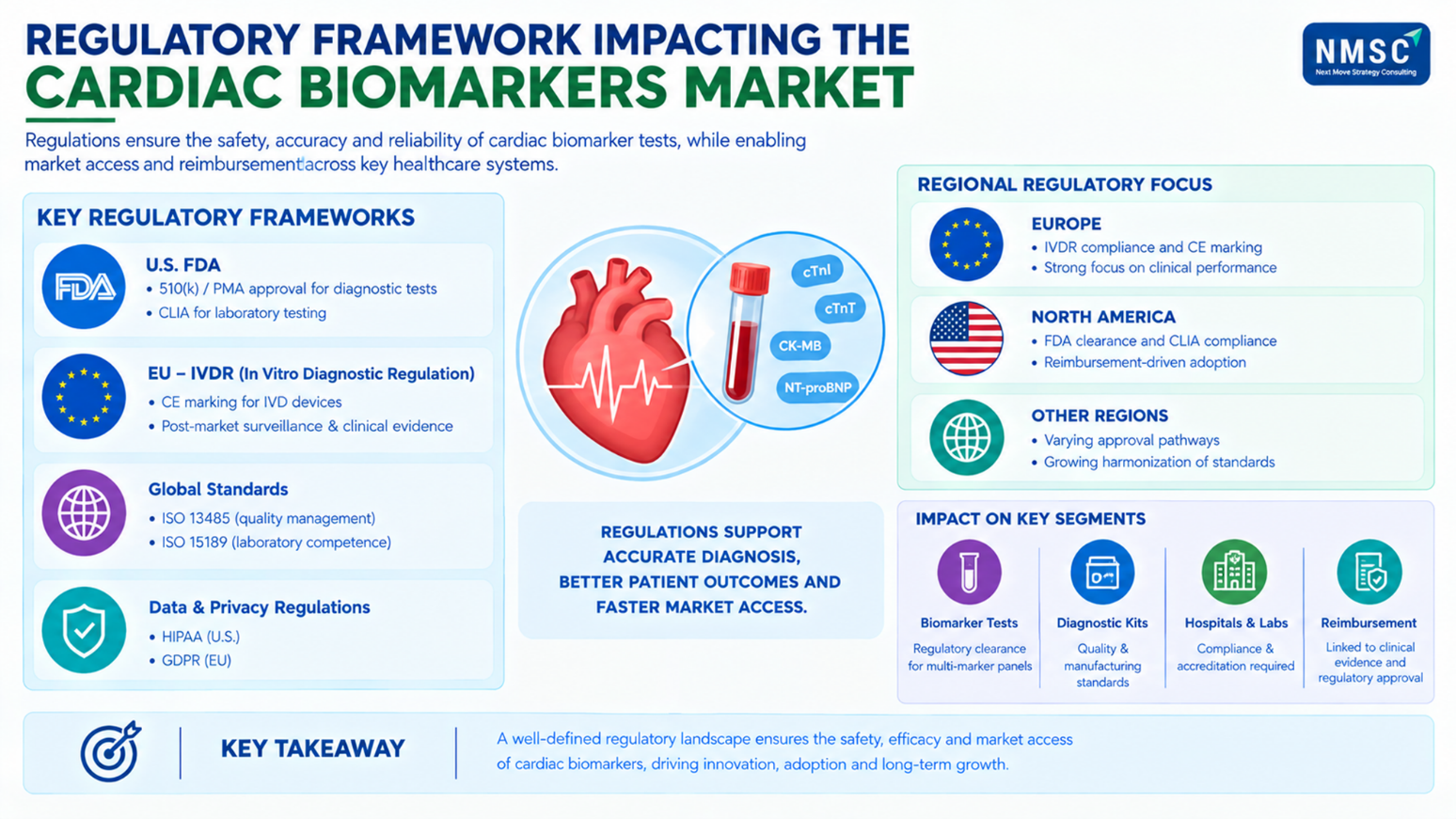
Regulatory Framework Impacting the Cardiac Biomarkers Market
The cardiac biomarkers market operates within a structured regulatory environment focused on diagnostic accuracy, patient safety, and clinical reliability. Frameworks such as U.S. FDA requirements, EU IVDR, ISO quality standards, and data privacy regulations influence product development, validation, manufacturing, and commercialization. Regulatory compliance remains essential for securing market clearance, supporting reimbursement, and expanding adoption across healthcare systems.

Segmentation Analysis

2025 (USD Billion)
2035 (USD Billion)
Troponins
Troponin I
High-Sensiti
Conventional
Troponin T
Segment Item 2025 (USD Billion) 2035 (USD Billion) CAGR
Troponins $10.0 USD Billion $40.0 USD Billion 14.0%
Troponin I $17.1 USD Billion $51.1 USD Billion 8.0%
High-Sensitivity Troponin I $24.2 USD Billion $62.2 USD Billion 14.0%
Conventional Troponin I $31.3 USD Billion $73.3 USD Billion 20.0%
Troponin T $38.4 USD Billion $84.4 USD Billion 27.0%

Segment-wise data is locked

Unlock complete segment-wise numbers for By Test Type.

Unlock Full Data

Which Test Type Dominates the Cardiac Biomarkers Market?

Troponins led the market with USD 12.94 billion in 2025, supported by their established role as the standard-of-care biomarker for diagnosing acute myocardial infarction across hospital and point-of-care settings. We observed that Natriuretic Peptides are the fastest-growing test type, expanding at a 16.68% CAGR from 2026 to 2035, as rising global heart failure prevalence drives expanding BNP and NT- proBNP testing volumes for both diagnosis and disease monitoring.

2025 (USD Billion)
2035 (USD Billion)
Laboratory T
Hospital Lab
Independent
Reference La
Point-of-Car
Segment Item 2025 (USD Billion) 2035 (USD Billion) CAGR
Laboratory Testing $10.0 USD Billion $40.0 USD Billion 25.0%
Hospital Laboratory $17.1 USD Billion $51.1 USD Billion 11.0%
Independent Diagnostic Laboratory $24.2 USD Billion $62.2 USD Billion 25.0%
Reference Laboratory $31.3 USD Billion $73.3 USD Billion 11.0%
Point-of-Care Testing $38.4 USD Billion $84.4 USD Billion 16.0%

Segment-wise data is locked

Unlock complete segment-wise numbers for By Testing Setting.

Unlock Full Data

Which Testing Setting Leads Cardiac Biomarkers Market Demand?

Laboratory Testing remained the leading testing setting within the market, valued at USD 16.92 billion in 2025 on sustained hospital and reference laboratory reliance on automated analyzer platforms for high-throughput testing. Our findings suggest that Point-of-Care Testing is the fastest-growing testing setting, registering a 17.93% CAGR from 2026 to 2035, as ambulance services, physician offices, and hospital emergency departments increasingly adopt cartridge-based platforms to accelerate treatment decisions outside centralized laboratory settings.

2025 (USD Billion)
2035 (USD Billion)
Chemilumines
Fluorescent
Colorimetric
Electrochemi
Other Detect
Segment Item 2025 (USD Billion) 2035 (USD Billion) CAGR
Chemiluminescent $10.0 USD Billion $40.0 USD Billion 27.0%
Fluorescent $17.1 USD Billion $51.1 USD Billion 9.0%
Colorimetric $24.2 USD Billion $62.2 USD Billion 19.0%
Electrochemical $31.3 USD Billion $73.3 USD Billion 17.0%
Other Detection Methods $38.4 USD Billion $84.4 USD Billion 18.0%

Segment-wise data is locked

Unlock complete segment-wise numbers for By Detection Method.

Unlock Full Data
2025 (USD Billion)
2035 (USD Billion)
Automated An
Cartridge As
Lateral-Flow
Other Test F
Segment Item 2025 (USD Billion) 2035 (USD Billion) CAGR
Automated Analyzer Assay $10.0 USD Billion $40.0 USD Billion 14.0%
Cartridge Assay $17.1 USD Billion $51.1 USD Billion 24.0%
Lateral-Flow Test $24.2 USD Billion $62.2 USD Billion 22.0%
Other Test Format $31.3 USD Billion $73.3 USD Billion 12.0%

Segment-wise data is locked

Unlock complete segment-wise numbers for By Test Format.

Unlock Full Data
2025 (USD Billion)
2035 (USD Billion)
Single-Analy
Multi-Analyt
Two-Marker P
Three-Marker
Four-or-More
Segment Item 2025 (USD Billion) 2035 (USD Billion) CAGR
Single-Analyte Test $10.0 USD Billion $40.0 USD Billion 24.0%
Multi-Analyte Panel $17.1 USD Billion $51.1 USD Billion 22.0%
Two-Marker Panel $24.2 USD Billion $62.2 USD Billion 20.0%
Three-Marker Panel $31.3 USD Billion $73.3 USD Billion 22.0%
Four-or-More Marker Panel $38.4 USD Billion $84.4 USD Billion 13.0%

Segment-wise data is locked

Unlock complete segment-wise numbers for By Test Configuration.

Unlock Full Data
2025 (USD Billion)
2035 (USD Billion)
Quantitative
Semi-Quantit
Qualitative
Segment Item 2025 (USD Billion) 2035 (USD Billion) CAGR
Quantitative $10.0 USD Billion $40.0 USD Billion 23.0%
Semi-Quantitative $17.1 USD Billion $51.1 USD Billion 9.0%
Qualitative $24.2 USD Billion $62.2 USD Billion 19.0%

Segment-wise data is locked

Unlock complete segment-wise numbers for By Quantification Mode.

Unlock Full Data
2025 (USD Billion)
2035 (USD Billion)
Acute Corona
Acute Myocar
STEMI
NSTEMI
Unstable Ang
Segment Item 2025 (USD Billion) 2035 (USD Billion) CAGR
Acute Coronary Syndrome $10.0 USD Billion $40.0 USD Billion 21.0%
Acute Myocardial Infarction $17.1 USD Billion $51.1 USD Billion 23.0%
STEMI $24.2 USD Billion $62.2 USD Billion 25.0%
NSTEMI $31.3 USD Billion $73.3 USD Billion 15.0%
Unstable Angina $38.4 USD Billion $84.4 USD Billion 16.0%

Segment-wise data is locked

Unlock complete segment-wise numbers for By Clinical Application.

Unlock Full Data

Which Clinical Application Is Most Significant in the Market?

Acute Coronary Syndrome remained the dominant clinical application across the market, reaching USD 11.44 billion in 2025 due to sustained emergency department reliance on troponin testing for suspected heart attack diagnosis. Based on research conducted by NMSC, we found that Cardiovascular Risk Assessment represents the fastest-growing clinical application at an 18.39% CAGR from 2026 to 2035, reflecting expanding prognostic testing claims that extend biomarker utility beyond acute diagnosis into longer-term risk stratification.

2025 (USD Billion)
2035 (USD Billion)
Hospitals
Independent
Reference La
Physician Of
Ambulance an
Segment Item 2025 (USD Billion) 2035 (USD Billion) CAGR
Hospitals $10.0 USD Billion $40.0 USD Billion 9.0%
Independent Diagnostic Laboratories $17.1 USD Billion $51.1 USD Billion 23.0%
Reference Laboratories $24.2 USD Billion $62.2 USD Billion 9.0%
Physician Offices and Clinics $31.3 USD Billion $73.3 USD Billion 23.0%
Ambulance and Prehospital Services $38.4 USD Billion $84.4 USD Billion 8.0%

Segment-wise data is locked

Unlock complete segment-wise numbers for By End User.

Unlock Full Data

Growth Opportunities

Our analysis shows that three forward-looking opportunities stand out for stakeholders positioning within the cardiac biomarkers market over the 2026-2035 forecast period.

How Can Prehospital Troponin Testing Unlock Value for Emergency Medical Services?

Prehospital troponin testing presents a whitespace opportunity for manufacturers serving ambulance and emergency medical services seeking to accelerate treatment decisions before hospital arrival. Vendors that commercialize rugged, rapid-turnaround point-of-care platforms stand to capture recurring device and cartridge revenue as prehospital protocols increasingly incorporate biomarker-based triage alongside traditional electrocardiogram assessment.

Where Does Multi-Analyte Panel Adoption Create New Demand?

Emergency departments seeking faster differential diagnosis for chest pain and dyspnea patients create an opportunity for manufacturers offering integrated multi-analyte cardiac panels. Vendors that develop validated two-marker and three-marker panel platforms can secure long-term hospital laboratory contracts, benefiting from reduced sequential testing time and improved emergency department throughput compared with single-analyte testing workflows.

How Can Emerging Market Laboratory Investment Benefit Assay Manufacturers?

Expanding hospital and laboratory infrastructure investment across Asia-Pacific and the Middle East represents an underpenetrated opportunity for manufacturers offering scalable automated analyzer platforms. Early movers that establish regional distribution and technical support capability can differentiate with hospital and reference laboratory customers pursuing national healthcare infrastructure expansion across underserved diagnostic markets.

Regional Outlook

2025 (USD Billion)
2035 (USD Billion)
North Americ
Europe
Asia-Pacific
Middle East
Latin Americ
Region 2025 (USD Billion) 2035 (USD Billion) CAGR (%)
North America $10.0 USD Billion $40.0 USD Billion 9.0%
Europe $17.1 USD Billion $51.1 USD Billion 27.0%
Asia-Pacific $24.2 USD Billion $62.2 USD Billion 25.0%
Middle East & Africa $31.3 USD Billion $73.3 USD Billion 23.0%
Latin America $38.4 USD Billion $84.4 USD Billion 12.0%

Regional data is locked

Unlock complete regional numbers for this market.

Unlock Full Data

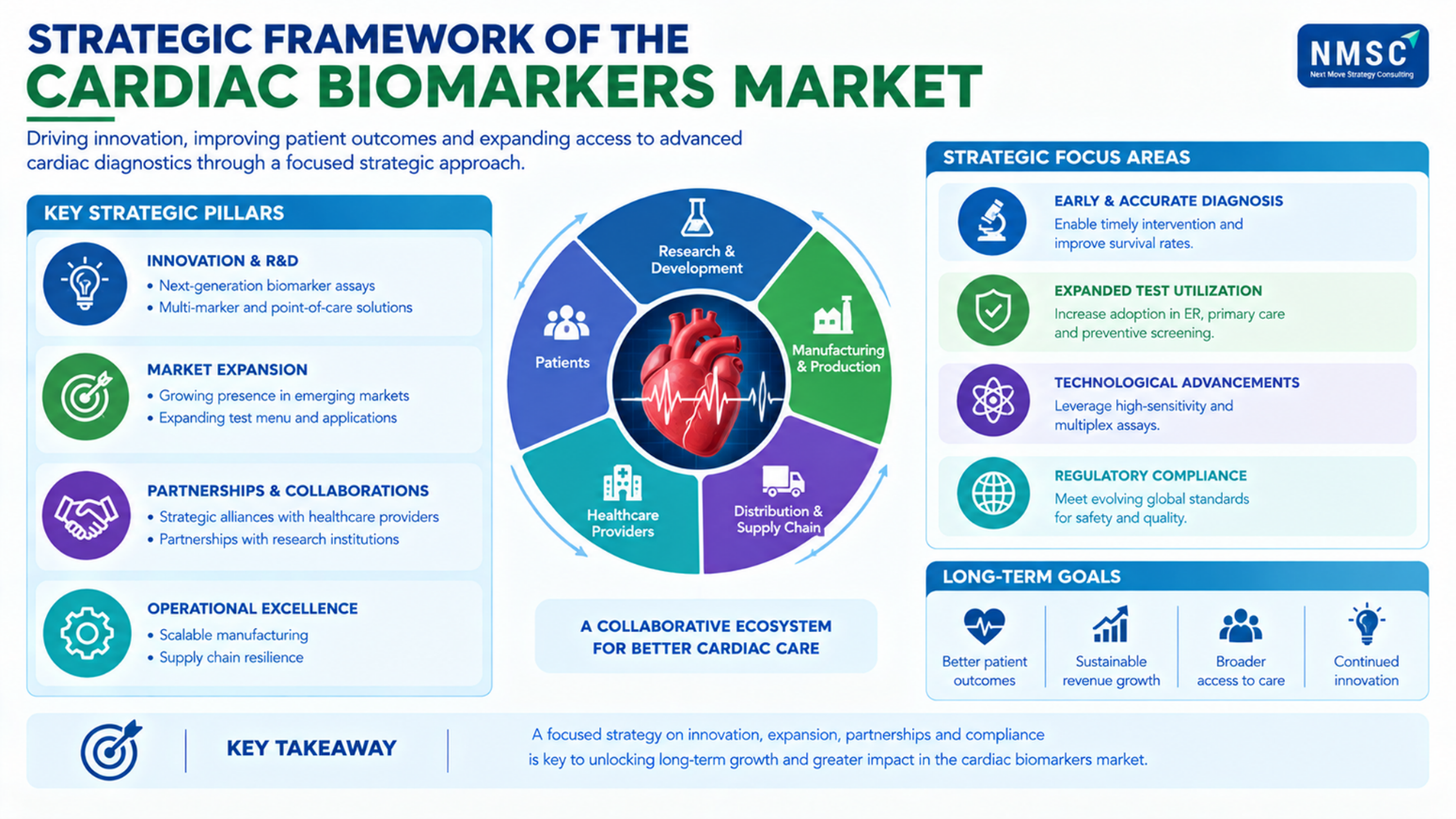
Strategic Framework of the Cardiac Biomarkers Market

Strategic Framework of the Cardiac Biomarkers Market

The cardiac biomarkers market requires a strategic approach centered on innovation, clinical utility, market expansion, and operational resilience. Investment in next-generation assays, point-of-care testing, strategic partnerships, scalable manufacturing, and regulatory compliance can strengthen competitive positioning. Expanding test utilization across emergency, primary, and preventive care settings can further improve diagnostic access, patient outcomes, and sustainable market growth.

Competitive Landscape

We observed that competitive dynamics within the cardiac biomarkers industry are increasingly shaped by clinical evidence depth, assay sensitivity performance, and point-of-care platform breadth rather than pricing alone. Field | Details Market Structure | Moderately concentrated among established in-vitro diagnostics majors, with specialized point-of-care manufacturers competing on portability and rapid turnaround. Innovation Focus | High-sensitivity troponin refinement, prognostic testing claims, multi-analyte panel development, and point-of-care platform expansion. M&A Activity | Continued clinical evidence generation and regulatory clearance expansion rather than large-scale acquisition-led consolidation among leading players. Source: www.nextmsc.com

How Do Companies Compete in the Cardiac Biomarkers Market?

Companies compete primarily on clinical evidence depth, assay analytical sensitivity, and breadth of regulatory clearances across geographies rather than price alone. Our analysis shows that Roche's TSIX Study Program, enrolling more than 13,000 participants across four major markets, illustrates how large-scale clinical validation has become a decisive competitive differentiator for high-sensitivity troponin platforms. Providers increasingly differentiate through prognostic testing claims, point-of-care platform breadth, and multi-analyte panel capability.

Which Competitive Archetypes Dominate the Cardiac Biomarkers Market?

Two competitive archetypes dominate the market: diversified in-vitro diagnostics majors offering comprehensive laboratory automation platforms alongside cardiac assay menus, and specialized point-of-care manufacturers focused on portable, rapid-turnaround testing formats. We found that companies such as Roche and Siemens Healthineers differentiate through large-scale clinical evidence generation and laboratory automation integration, while point-of-care specialists differentiate through device portability and cartridge-based assay simplicity suited to ambulance and physician office settings.

How Are Companies Differentiating Through Innovation in Cardiac Biomarkers?

Providers are differentiating through next-generation assay sensitivity, prognostic testing claims, and expanding point-of-care platform portfolios. We observed that Siemens Healthineers received FDA clearance for prognostic risk stratification claims on its Atellica IM High-Sensitivity Troponin I test, extending clinical utility beyond acute diagnosis into longer-term cardiovascular risk assessment. Competing manufacturers are similarly pursuing expanded clinical claims and multi-analyte panel development to differentiate beyond core diagnostic accuracy.

What M&A and Expansion Activity Is Shaping the Cardiac Biomarkers Market?

Expansion activity is concentrated on clinical evidence generation and regulatory clearance breadth rather than large-scale mergers and acquisitions among the market's established players. Our findings suggest that Roche's global, multi-country TSIX Study Program illustrates how leading manufacturers are prioritizing direct clinical validation investment over acquisition-led growth strategies to support next-generation assay adoption. This organic evidence-building trend illustrates how established diagnostics companies are competing on scientific credibility as much as product portfolio breadth.

Key Market Players

Our assessment indicates that the following 20 companies are actively shaping assay innovation, clinical evidence generation, and point-of-care platform expansion within the global cardiac biomarkers market.

F. Hoffmann-La Roche Ltd Abbott Laboratories Siemens Healthineers AG Beckman Coulter, Inc. QuidelOrtho Corporation bioMérieux SA DiaSorin S.p.A. Fujirebio Inc. Tosoh Corporation Sysmex Corporation Randox Laboratories Ltd Shenzhen Mindray Bio-Medical Electronics Co., Ltd. Shenzhen New Industries Biomedical Engineering Co., Ltd. Getein Biotech, Inc. Boditech Med Inc. Guangzhou Wondfo Biotech Co., Ltd. SD Biosensor, Inc. FUJIFILM Wako Pure Chemical Corporation PHC Corporation Monobind Inc.

Latest Developments

We found that recent corporate developments within the cardiac biomarkers market are concentrated on clinical evidence generation and regulatory clearance expansion.

Date Event
November 2025 QuidelOrtho received FDA 510(k) clearance for its VITROS hs Troponin I assay for quantitative cardiac troponin I measurement. The company stated that U.S. commercial rollout to VITROS laboratories would begin later in 2025, expanding its high-sensitivity cardiac testing portfolio for myocardial infarction diagnosis.
October 2025 Roche reported progress from its TSIX study program evaluating high-sensitivity Troponin T. The program is designed to establish globally applicable cardiac troponin reference limits and strengthen evidence for rapid rule-in/rule-out pathways, supporting more standardized acute myocardial infarction diagnosis across diverse patient populations.
August 2025 Mindray presented new research on its high-sensitivity cardiac troponin I assay at ADLM 2025. The company highlighted investigations into troponin complexes, acute versus chronic myocardial injury, and emergency triage, building clinical evidence around more sensitive and potentially more discriminating cardiac biomarker testing.

Investment Opportunities

What Capital Inflows Are Targeting the Cardiac Biomarkers Market?

Capital inflows into the cardiac biomarkers market are increasingly directed toward clinical evidence generation and next-generation assay development rather than manufacturing capacity alone. Roche's TSIX Study Program, enrolling more than 13,000 participants across four major markets, illustrates the scale of investment leading manufacturers are committing to clinical validation. We observed that investors favor manufacturers demonstrating expanding regulatory clearances and prognostic testing claims, viewing clinical evidence breadth as a proxy for long-term competitive positioning.

How Is Infrastructure Investment Supporting Cardiac Biomarkers Market Expansion?

Infrastructure investment in hospital laboratory automation and point-of-care device deployment continues to expand the addressable base for cardiac biomarker testing. Government-backed hospital modernization programs across Asia-Pacific and the Middle East continue to expand diagnostic laboratory capacity in previously underserved markets. Our findings suggest that manufacturers with established distribution networks and regulatory registration capability are best positioned to capture this infrastructure-linked demand as healthcare systems expand testing capacity.

What ESG Considerations Are Shaping Cardiac Biomarkers Investment Decisions?

Environmental, social, and governance considerations are increasingly central to investment decisions across the industry, with equitable diagnostic access and assay validation transparency as key criteria. The European Union's In Vitro Diagnostic Regulation increasingly informs institutional investment standards for analytical validation and clinical performance disclosure. We found that investors increasingly favor manufacturers with transparent clinical evidence and validation disclosures, treating scientific rigor as a governance indicator alongside financial performance.

Key Benefits for Stakeholders

How Does This Report Benefit Enterprise and Industry Leaders?

Enterprise and industry leaders gain access to validated segmentation, competitive benchmarking, and regional demand forecasts that support assay portfolio and manufacturing capacity decisions across the cardiac biomarkers industry. Our analysis shows that detailed test type, testing setting, and clinical application breakdowns help manufacturers align research and development priorities with diagnostic demand trends while identifying underserved segments for portfolio expansion.

How Does This Report Benefit Investors and Financial Analysts?

Investors and financial analysts benefit from consistent, single-point market size and CAGR estimates that support valuation and capital-allocation decisions across the cardiac biomarkers supply chain. We observed that the report's regional and segment-level growth differentials help identify which manufacturers are best positioned to capture above-market growth in Natriuretic Peptides and Point-of-Care Testing categories through 2035.

How Does This Report Benefit Technology Vendors and Product Teams?

Technology vendors and product teams gain insight into emerging platform requirements, including high-sensitivity assay refinement, multi-analyte panel development, and point-of-care portability, that are reshaping the industry. Our findings suggest that this analysis helps product roadmap teams prioritize development around prognostic testing claims and prehospital deployment capability increasingly required by hospital and emergency medical services procurement processes.

Key Market Segments Evaluated

By Test Type

  • Troponins
  • Natriuretic Peptides
  • CK-MB
  • Myoglobin
  • Other Cardiac Biomarkers

By Testing Setting

  • Laboratory Testing
  • Point-of-Care Testing

By Detection Method

  • Chemiluminescent
  • Fluorescent
  • Colorimetric
  • Electrochemical
  • Other Detection Methods

By Test Format

  • Automated Analyzer Assay
  • Cartridge Assay
  • Lateral-Flow Test
  • Other Test Format

By Test Configuration

  • Single-Analyte Test
  • Multi-Analyte Panel
  • Two-Marker Panel
  • Three-Marker Panel
  • Four-or-More Marker Panel

By Quantification Mode

  • Quantitative
  • Semi-Quantitative
  • Qualitative

By Clinical Application

  • Acute Coronary Syndrome
  • Heart Failure
  • Myocardial Injury Outside Acute Coronary Syndrome
  • Cardiovascular Risk Assessment
  • Other Cardiac Applications

By End User

  • Hospitals
  • Independent Diagnostic Laboratories
  • Reference Laboratories
  • Physician Offices and Clinics
  • Ambulance and Prehospital Services
  • Other Healthcare Providers

Conclusion & Recommendations

The long-term outlook for the cardiac biomarkers market remains strongly positive, with the market projected to reach USD 98.66 billion by 2035 from USD 32.26 billion in 2026, expanding at a 13.23% CAGR from 2026 to 2035 . We observed that this trajectory is anchored by durable cardiovascular disease burden and expanding point-of-care testing adoption rather than short-lived pandemic-era diagnostic demand, suggesting the current growth cycle rests on structural demand extending well beyond initial high-sensitivity troponin adoption.

What Strategic Positioning Should Cardiac Biomarkers Providers Pursue?

Providers should pursue strategic positioning around clinical evidence depth, prognostic testing claims, and point-of-care platform breadth rather than competing on core assay accuracy alone. Our assessment indicates that providers combining large-scale clinical validation with expanding regulatory clearances are best positioned to retain hospital and laboratory customers as procurement increasingly favors evidence-backed, multi-setting platforms over single-application diagnostic tools.

How Attractive Is the Cardiac Biomarkers Market for New Investment?

The cardiac biomarkers market presents high investment attractiveness given its 13.23% forecast CAGR and durable demand tied to sustained cardiovascular disease burden. We found that investment attractiveness is strongest in Natriuretic Peptides and Point-of-Care Testing categories, which are growing faster than the broader troponin and laboratory testing segments, alongside emerging-market opportunities backed by healthcare infrastructure investment in the Middle East and Asia-Pacific.

What Market Shifts and Key Risks Should Stakeholders Monitor?

Stakeholders should monitor reimbursement constraints, assay standardization challenges, and price competition among point-of-care manufacturers as key risks shaping the market. Reimbursement constraints for high-sensitivity and multi-marker testing illustrate how payer policy, rather than technology alone, increasingly determines the pace of premium assay adoption across cost-sensitive healthcare systems.

What Are the Key Growth Pathways for the Cardiac Biomarkers Market?

Key growth pathways include prehospital troponin testing expansion, multi-analyte panel development, and emerging-market laboratory infrastructure investment across Asia-Pacific and the Middle East. Our analysis shows that manufacturers expanding prognostic testing claims and point-of-care platform breadth alongside core diagnostic assays are best positioned to capture recurring, higher-margin revenue as cardiac biomarker testing procurement matures beyond initial acute diagnosis applications.

Delivered Customizations

We have successfully delivered the following deep-dive customizations:

Client Request Customization Delivered Value Adds
Historical Market Growth Analysis
  • Historical revenue and test-volume analysis of cardiac biomarkers by test type, testing setting, and end user.
  • Identifies high-growth biomarker categories and settings to prioritize for investment.
Company-Level Test Volume and Revenue Benchmarking
  • Company-level cardiac biomarker revenue and test or assay volume benchmarking by test type and detection method, based on disclosures.
  • Highlights competitor scale and positioning to guide share-gain and partnership strategy.
Cardiac Biomarker Product Portfolio Share Assessment
  • Company-level share of cardiac biomarker assay and platform offerings by test format, test configuration, and quantification mode.
  • Reveals portfolio gaps and format-level white spaces for product development.
Point-of-Care vs Central Laboratory Adoption Analysis
  • Adoption mapping of cardiac biomarker testing across point-of-care and central laboratory settings by test type, test format, and end user.
  • Guides decisions on decentralized testing investment and channel strategy.
High-Sensitivity Troponin Transition Assessment
  • Country-level analysis of high-sensitivity versus conventional troponin assay adoption, drawing on clinical guideline and regulatory status by detection method and quantification mode.
  • Pinpoints markets ready for assay upgrades and sizes the replacement opportunity.
Clinical Application Demand and Reimbursement Analysis
  • Test demand and reimbursement mapping across clinical applications such as acute myocardial infarction, heart failure, and risk stratification, by key country.
  • Prioritizes clinical use cases and countries with favorable coverage for market entry.

FAQs

About the Author

Jayanta Das

Jayanta Das

Jayanta Das is Senior Analyst at Next Move Strategy Consulting, where he has spent 4.5 years covering the firm's full industry taxonomy — spanning aerospace and defense, healthcare, BFSI, energy and power, semiconductors, and beyond — rather than one specialization. His work follows NextMSC's research model, combining data mining, analytics, and secondary research to build market sizing and forecasts behind NextMSC's 2,000-plus research reports, trusted by more than 3,000 organizations globally.

About the Reviewer

Supradip Baul

Supradip Baul

Supradip Baul is an accomplished business consultant and strategist with over a decade of rich experience in market intelligence, strategy, technology, and business transformation. His work has included rigorous qualitative and quantitative analysis across multiple industries, helping clients shape investment decisions and long-term roadmaps. Earlier in his career, he was associated with Gartner, where he contributed to industry-leading reports and market share analyses. He has worked with leading global companies and holds an MBA with a dual specialization in Marketing and Finance.

Amos Chang

AMOS CHANG

Strategy Consultant

Kardex Group

I have bought the intralogistics market reports from NMSC two times so far. Joseph and his team are always very helpful and flexible in responding to any customization requirements on the report. Their expertise in market reports really helps us steer the day-to-day business. I will definitely recommend and come back myself whenever there is a need.

Pratyush Kumar Das

PRATYUSH KUMAR DAS

Assistant Manager

Polycab India Limited

We would like to express our appreciation for the data and insights provided by nextmsc. We are very pleased with the quality and depth of the information, which has proven to be highly valuable and beneficial for our business decision-making.

Robert Sean Trevino

ROBERT SEAN TREVINO

Sr. Director, Head of Strategic Insights & Analytics

Foundation Medicine

I realized that it was a reliable source of information. These days, there are many people who are looking for authentic data, and this is one of the only sources that can offer them with what they need;

Nishant Awate

NISHANT AWATE

Business Development Global Sales

Zehnder Group Deutschland GmbH

Our experience working with Next Move Strategy Consulting was positive. The team was responsive, professional, and open to incorporating our specific requirements throughout the project. The India AHU market study was comprehensive and well structured, covering market value and volume forecasts, product and application segments, and key industry trends. The inclusion of both AHU and residential MVHR market insights made the study particularly relevant for our strategic market assessment. Overall, the report provides a solid foundation for evaluating market potential, identifying priority segments, and supporting business-development decisions in India.

Rishabh Jogani

RISHABH JOGANI

Strategy Analyst

Accenture Japan

We are incredibly impressed with the market report on the real estate market in India provided by Next Move Strategy Consulting. The report was thorough, insightful, and well-structured, offering deep analysis and actionable recommendations. It not only captured the current trends and dynamics but also provided a forward-looking perspective that has been invaluable for our strategic planning. Their team demonstrated exceptional professionalism, attention to detail, and a profound understanding of the industry. The data-driven insights and clarity of presentation exceeded our expectations, making complex market trends easy to understand. We highly recommend Next Move Strategy Consulting to anyone looking for reliable and comprehensive market research services. Their expertise has given us the confidence to navigate the complexities of the Indian real estate market with clarity and foresight.

Custom Market Research Services

We will customize the research for you if the listed report does not fully match your requirements.

Get 30% Free Customization

Select License

This website uses cookies to ensure you get the best experience on our website. Learn more

✖