Computer-Assisted Surgical Systems Market

The Computer-Assisted Surgical Systems market size was $12.91 Bn in 2025 and is projected to reach $41.18 Bn by 2035, growing at a 12.3% CAGR from 2026 to 2035

Download Free Sample PDF
Base Year (2025)
$12.91 Billion
Forecast (2035)
$41.18 Billion
CAGR (2026-2035)
12.3%
Top Region
North America

What Is the Computer-Assisted Surgical Systems Market Size?

The global Computer-Assisted Surgical Systems market size was valued at USD 12.91 billion in 2025 and is estimated at USD 14.5 billion in 2026, projected to reach USD 41.18 billion by 2035, growing at a CAGR of 12.3% from 2026 to 2035. North America led the market with an approximate 52% revenue share in 2025, while the Hardware offering segment dominated at roughly 66% share.

Our findings suggest that the following key takeaways summarize the Computer-Assisted Surgical Systems market's segment-level and geographic dynamics as of 2025.

Computer-Assisted Surgical Systems Market Revenue Forecast

Values in USD Billion

2025 $12.91 Billion
2025
2026 $14.50 Billion
2026
2027 $16.28 Billion
2027
2028 $18.28 Billion
2028
2029 $20.53 Billion
2029
2030 $23.06 Billion
2030
2031 $25.89 Billion
2031
2032 $29.08 Billion
2032
2033 $32.66 Billion
2033
2034 $36.67 Billion
2034
2035 $41.18 Billion
2035

Key Takeaways

By Offering: Hardware dominated, accounting for approximately a 66% share and generating USD 8.52 billion in 2025, projected to reach USD 23.06 billion by 2035.

By Technology: Optical Tracking dominated with approximately 32% share, generating USD 4.13 billion in 2025.

By Clinical Specialty: General Surgery dominated with approximately 24% share, generating USD 3.10 billion in 2025.

By Commercial Model: Capital Purchase dominated with approximately 48% share, generating USD 6.20 billion in 2025.

By Sales Channel: Direct Sales dominated with approximately 62% share, generating USD 8.00 billion in 2025.

By Customer Type: General Hospitals dominated with approximately 42% share, generating USD 5.42 billion in 2025.

Dominant Region: North America dominated with approximately 52% share, generating USD 6.71 billion in 2025.

Fastest-Growing Region: Asia-Pacific is expected to register the highest CAGR of 16.2% during 2026–2035.

Dominant Country: The U.S. led the market, generating USD 5.71 billion in 2025.

Fastest-Growing Country: India is expected to register the highest country-level CAGR of 20.1% during 2026–2035.

Market Opportunity: The Computer-Assisted Surgical Systems market presents an absolute dollar opportunity of approximately USD 26.68 billion between 2026 and 2035, calculated as the difference between the 2035 forecast value and the 2026 base value, an investment window favoring vendors scaling AI-guided navigation and ambulatory surgical center-ready platforms.

According to NMSC analysis, we found that the gap between rapidly expanding orthopedic robotic adoption and still-nascent ambulatory surgical center penetration is widening the addressable market for compact, procedure-based robotic platforms, even as hospital capital budgets constrain large-format multi-port system purchases.

Ecosystem Analysis of the Computer-Assisted Surgical Systems Industry

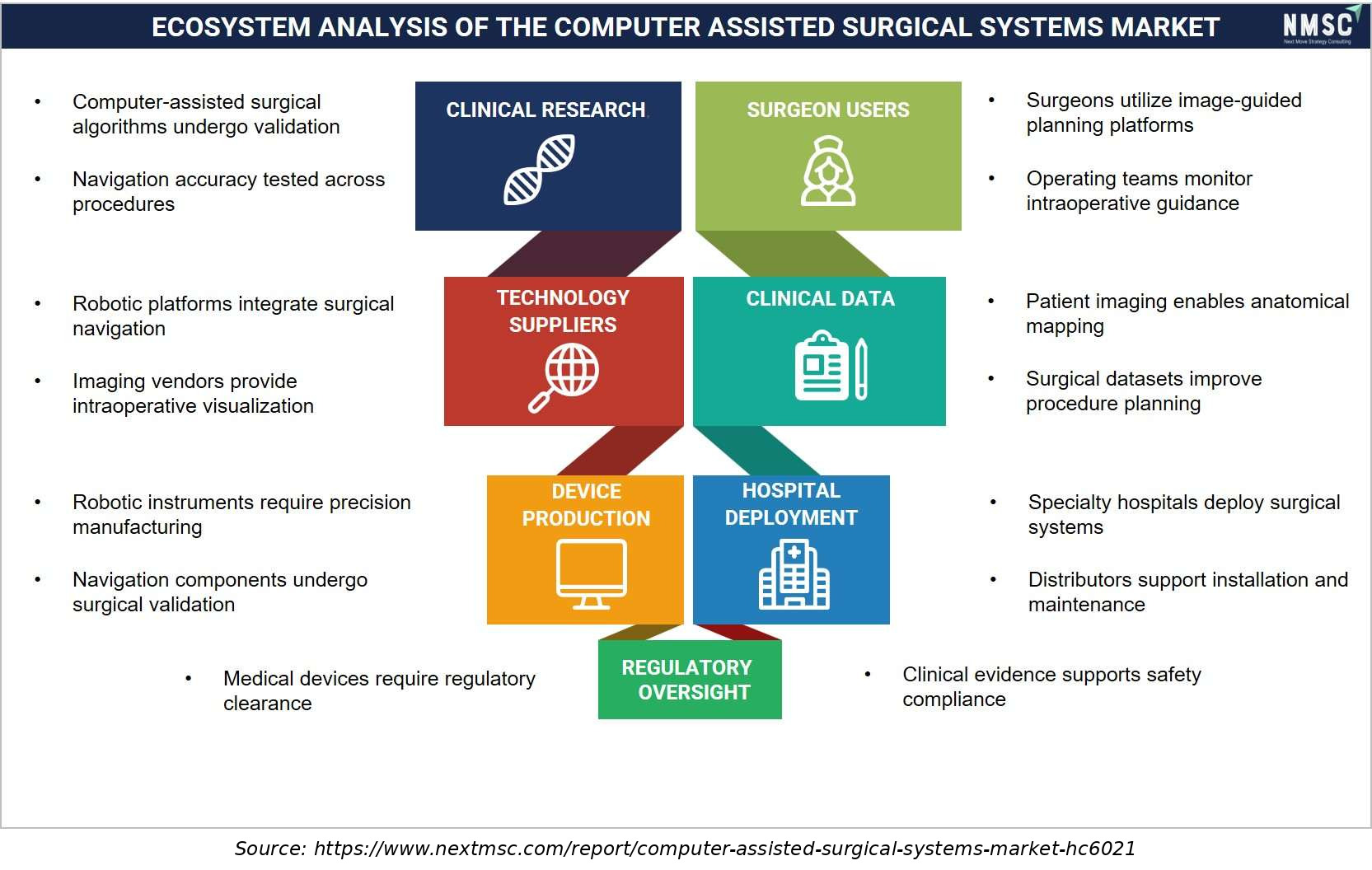
The above ecosystem analysis maps the key operational components, such as clinical research, technology suppliers, device production, clinical data, hospital deployment, regulatory oversight, and surgeon users, shaping the Computer-Assisted Surgical Systems industry. From our analysis, we observed that clinical research and technology suppliers drive innovation, while device production and clinical data ensure system precision and reliability. Hospital deployment and regulatory oversight maintain safety and compliance, whereas surgeon users represent key end-users across the market ecosystem.

What does the Computer-Assisted Surgical Systems Market Encompass?

The Computer-Assisted Surgical Systems market encompasses robotic surgical systems, surgical navigation systems, intraoperative imaging and guidance systems, tracking hardware, and associated planning, navigation, and analytics software that assist surgeons in performing minimally invasive and precision-guided procedures across orthopedic, spine, neurosurgical, and general surgery applications. We observed that the market has structurally evolved from single-purpose navigation tools toward integrated robotic platforms combining real-time imaging, AI-assisted guidance, and force feedback, as demonstrated by Intuitive Surgical's da Vinci 5 receiving FDA clearance for cardiac procedures in January 2026.
Regulatory pathways such as U.S. FDA 510(k) clearance and international certifications including the EU Medical Device Regulation continue to shape market entry timelines, with Intuitive Surgical's phased da Vinci 5 regulatory clearances across South Korea, Japan, and additional cardiac indications illustrating the incremental, geography-specific nature of surgical robotics approval. During our market evaluation, we noticed that surgical robotics adoption is accelerating fastest in orthopedic joint reconstruction, while general surgery remains the largest established procedure volume base.

Market Drivers & Dynamics

Interactive Dataset
Expanding robotic platform indications into cardiac and single-port procedures driver +3.4% North America, Europe 2026–2032
Rising orthopedic robotic adoption for joint reconstruction driver +2.8% North America, Asia-Pacific 2026–2033
Growing AI-assisted navigation and analytics software adoption driver +2.2% North America, Europe 2027–2035
Accelerating international procedure growth outside the U.S. driver +1.9% Europe, Asia-Pacific 2026–2032
Ambulatory surgical center expansion broadening addressable sites of care driver +1.4% North America 2026–2031
High upfront capital cost of multi-port robotic platforms restraint −1.9% Latin America, Africa 2026–2030
Lengthy surgeon training and credentialing requirements restraint −1.1% Global 2026–2029
Reimbursement uncertainty for emerging robotic procedure categories restraint −0.7% North America, Europe 2026–2030
Source: Next Move Strategy Consulting

Growth Drivers

What Is the Primary Growth Driver of the Computer-Assisted Surgical Systems Market?

Expanding robotic platform indications into new procedure categories, particularly cardiac and single-port surgery, is the single largest driver of market growth, as established vendors extend proven technology into historically underserved clinical domains. Intuitive Surgical's own financial disclosures report that total da Vinci and Ion procedures grew 19% in 2025, with single-port procedures growing 87% following continued indication expansion. We observed that this procedure-category expansion is compounding overall market growth beyond simple unit placement increases.

How Is Orthopedic Robotic Adoption Driving Computer-Assisted Surgical Systems Market Growth?

Rising orthopedic robotic adoption for joint reconstruction is driving the Orthopedic Surgery clinical specialty segment toward a 15.3% CAGR from 2026 to 2035, outpacing the broader market average of 12.3%. The U.S. Food and Drug Administration's medical device clearance database continues to record a steady cadence of 510(k) clearances for orthopedic navigation and robotic systems, reflecting sustained vendor investment in this clinical category. Our analysis shows that this orthopedic-specific growth is reshaping competitive priorities among hardware-focused vendors.

Growth Inhibitors

What Is Restraining Computer-Assisted Surgical Systems Market Growth?

High upfront capital cost of multi-port robotic platforms restrains adoption among smaller hospitals and price-sensitive markets, particularly across Latin America and parts of Africa where capital budgets for surgical technology remain constrained. Lengthy surgeon training and credentialing requirements also restrain the pace of new-site activation, as institutions must build proficiency before achieving full clinical and financial return on platform investment. We found that these pressures are accelerating vendor interest in procedure-based and subscription commercial models that lower the initial capital barrier.

Segmentation Analysis

2025 (USD Billion)
2035 (USD Billion)
Hardware 2025: $8.52 Billion | 2035: $23.06 Billion
Hardware
Services 2025: $2.58 Billion | 2035: $8.65 Billion
Services
Software 2025: $1.81 Billion | 2035: $9.47 Billion
Software
Hardware $8.52 Billion $23.06 Billion 10.5%
Services $2.58 Billion $8.65 Billion 12.8%
Software $1.81 Billion $9.47 Billion 18.0%

Which Offering Segment Dominates the Computer-Assisted Surgical Systems Industry?

Hardware dominates the Computer-Assisted Surgical Systems industry with approximately 66% share in 2025, valued at USD 8.52 billion, reflecting the substantial capital cost of robotic arms, navigation consoles, and intraoperative imaging equipment relative to software and services. Software is the fastest-growing offering segment at an 18.0% CAGR from 2026 to 2035, driven by AI assistance and analytics platforms such as those enabling Intuitive Surgical's da Vinci 5 procedure-replay and tissue-force measurement features introduced in 2025.

2025 (USD Billion)
2035 (USD Billion)
Optical trac
Electromagne
Magnetic nav
Vision-based
Fluoroscopy
Segment Item 2025 (USD Billion) 2035 (USD Billion) CAGR
Optical tracking $10.0 USD Billion $40.0 USD Billion 25.0%
Electromagnetic tracking $17.1 USD Billion $51.1 USD Billion 11.0%
Magnetic navigation $24.2 USD Billion $62.2 USD Billion 25.0%
Vision-based navigation $31.3 USD Billion $73.3 USD Billion 11.0%
Fluoroscopy guidance $38.4 USD Billion $84.4 USD Billion 16.0%

Segment-wise data is locked

Unlock complete segment-wise numbers for Technology.

Unlock Full Data

Which Technology Segment Leads the Computer-Assisted Surgical Systems Industry?

Optical Tracking leads the technology segmentation with approximately a 32% share in 2025 at USD 4.13 billion, reflecting its established role as the primary tracking modality across surgical navigation systems. Artificial Intelligence Guidance is the fastest-growing technology segment at a 23.9% CAGR, as vendors embed AI-driven analytics, procedure-replay, and decision-support capabilities directly into navigation and robotic platform software to improve surgical precision and workflow efficiency.

2025 (USD Billion)
2035 (USD Billion)
Orthopedic s
Joint recons
Trauma surge
Sports medic
Spine surger
Segment Item 2025 (USD Billion) 2035 (USD Billion) CAGR
Orthopedic surgery $10.0 USD Billion $40.0 USD Billion 27.0%
Joint reconstruction $17.1 USD Billion $51.1 USD Billion 9.0%
Trauma surgery $24.2 USD Billion $62.2 USD Billion 19.0%
Sports medicine $31.3 USD Billion $73.3 USD Billion 17.0%
Spine surgery $38.4 USD Billion $84.4 USD Billion 18.0%

Segment-wise data is locked

Unlock complete segment-wise numbers for Clinical Specialty.

Unlock Full Data

Which Clinical Specialty Segment Is Growing Fastest?

General Surgery leads the clinical-specialty segmentation with approximately 24% share in 2025 at USD 3.10 billion, reflecting the largest established procedure volume base for robotic and navigation-assisted surgery globally. Orthopedic Surgery is the fastest-growing specialty at a 15.3% CAGR, as joint reconstruction procedures increasingly adopt robotic guidance for implant positioning accuracy, supported by continued U.S. FDA clearances for orthopedic navigation and robotic platforms.

2025 (USD Billion)
2035 (USD Billion)
Capital purc
Lease
Procedure-ba
Subscription
Segment Item 2025 (USD Billion) 2035 (USD Billion) CAGR
Capital purchase $10.0 USD Billion $40.0 USD Billion 14.0%
Lease $17.1 USD Billion $51.1 USD Billion 24.0%
Procedure-based contract $24.2 USD Billion $62.2 USD Billion 22.0%
Subscription contract $31.3 USD Billion $73.3 USD Billion 12.0%

Segment-wise data is locked

Unlock complete segment-wise numbers for Commercial Model.

Unlock Full Data
2025 (USD Billion)
2035 (USD Billion)
Direct sales
Distributor
OEM partners
Public tende
Segment Item 2025 (USD Billion) 2035 (USD Billion) CAGR
Direct sales $10.0 USD Billion $40.0 USD Billion 24.0%
Distributor sales $17.1 USD Billion $51.1 USD Billion 22.0%
OEM partnership sales $24.2 USD Billion $62.2 USD Billion 20.0%
Public tender sales $31.3 USD Billion $73.3 USD Billion 22.0%

Segment-wise data is locked

Unlock complete segment-wise numbers for Sales Channel.

Unlock Full Data
2025 (USD Billion)
2035 (USD Billion)
Academic med
General hosp
Specialty ho
Ambulatory s
Research ins
Segment Item 2025 (USD Billion) 2035 (USD Billion) CAGR
Academic medical centers $10.0 USD Billion $40.0 USD Billion 23.0%
General hospitals $17.1 USD Billion $51.1 USD Billion 9.0%
Specialty hospitals $24.2 USD Billion $62.2 USD Billion 19.0%
Ambulatory surgical centers $31.3 USD Billion $73.3 USD Billion 13.0%
Research institutes $38.4 USD Billion $84.4 USD Billion 10.0%

Segment-wise data is locked

Unlock complete segment-wise numbers for Customer Type.

Unlock Full Data

Growth Opportunities

Beyond the core drivers shaping overall demand, three whitespace opportunities stand out for vendors positioning portfolios toward 2035.

How Can Vendors Capture Value from Ambulatory Surgical Center Expansion?

Compact, procedure-based robotic and navigation platforms designed for ambulatory surgical centers create a mechanism for vendors to capture volume from a rapidly growing site-of-care category that traditional hospital-scale systems cannot economically serve. Vendors offering flexible, lower-capital-intensity platforms are best positioned to capture this fastest-growing customer-type opportunity.

What Opportunity Exists in Cardiac Robotic Procedure Expansion?

Newly cleared cardiac indications for established robotic platforms create a mechanism for vendors to capture incremental procedure volume from a historically open-surgery-dominated specialty. Vendors with proven multi-port platforms and structured surgeon training programs are best positioned to capture this emerging cardiac-surgery opportunity as adoption scales from its current small base.

How Can Suppliers Benefit from AI-Driven Navigation Software Upsell?

AI-assisted navigation and analytics software creates a mechanism for vendors to generate recurring software revenue from an already-installed hardware base without requiring capital-intensive new platform sales. Vendors with mature software development capability are best positioned to capture this fastest-growing offering opportunity as installed-base customers upgrade software independently of hardware refresh cycles.

Regional Outlook

2025 (USD Billion)
2035 (USD Billion)
North Americ
Europe
Asia-Pacific
Middle East
Latin Americ
Region 2025 (USD Billion) 2035 (USD Billion) CAGR (%)
North America $10.0 USD Billion $40.0 USD Billion 9.0%
Europe $17.1 USD Billion $51.1 USD Billion 27.0%
Asia-Pacific $24.2 USD Billion $62.2 USD Billion 25.0%
Middle East & Africa $31.3 USD Billion $73.3 USD Billion 23.0%
Latin America $38.4 USD Billion $84.4 USD Billion 12.0%

Regional data is locked

Unlock complete regional numbers for this market.

Unlock Full Data

Regulatory Framework Impacting the Computer-Assisted Surgical Systems Industry

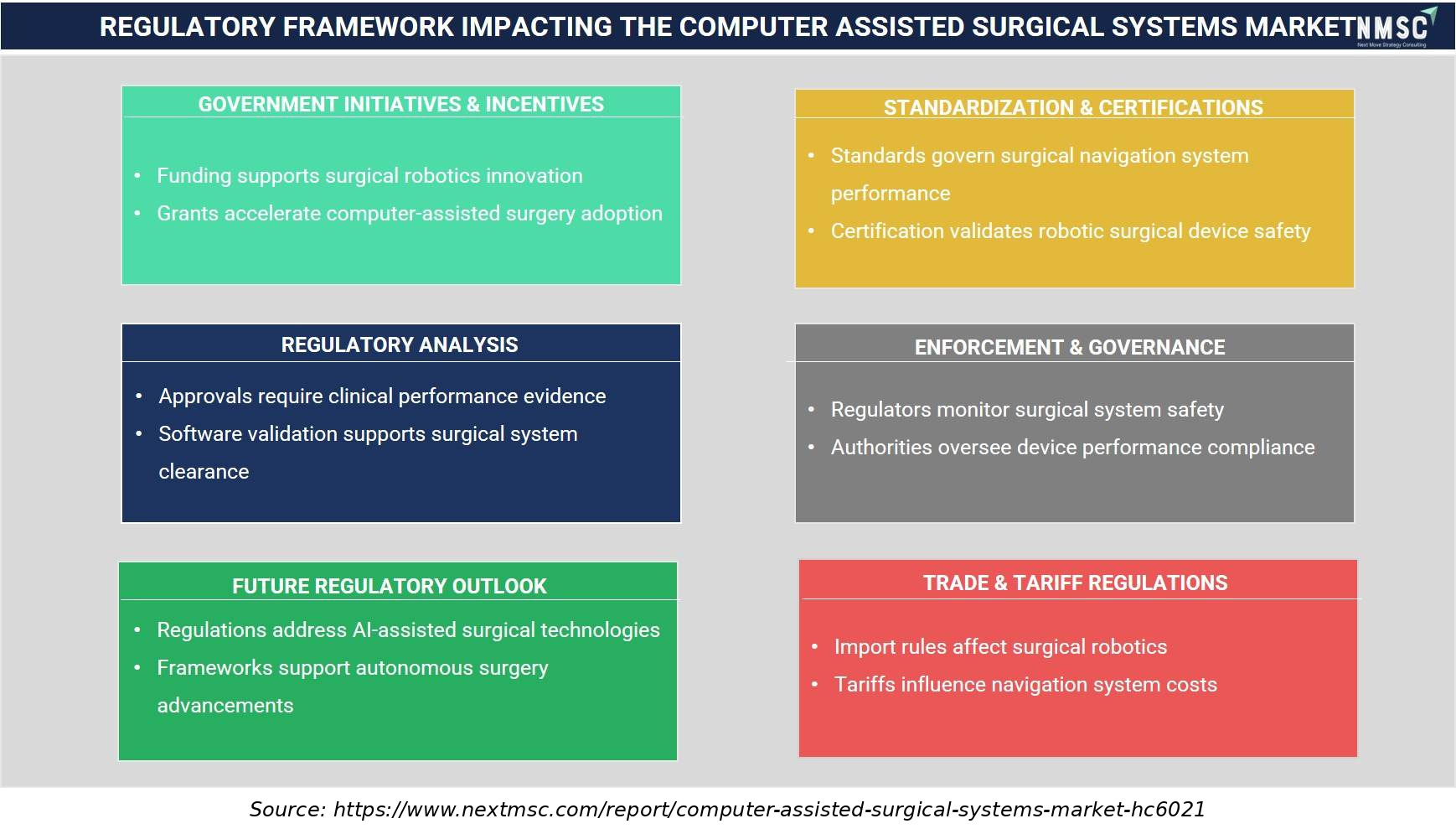
The above regulatory framework analysis maps the key regulatory components, such as government initiatives and incentives, regulatory analysis, future regulatory outlook, standardization and certifications, enforcement and governance, and trade and tariff regulations, shaping the Computer-Assisted Surgical Systems market. From our analysis, we observed that funding supports surgical robotics innovation and grants accelerate adoption, while clinical performance evidence and software validation guide regulatory approvals. Standards govern surgical navigation system performance, and certification validates robotic device safety, whereas regulators monitor system safety and authorities oversee performance compliance.

Competitive Landscape

Our assessment indicates that competitive intensity in the Computer-Assisted Surgical Systems industry is shaped by a small number of established multi-specialty robotics leaders and specialized navigation and imaging vendors competing across surgical specialties within the broader minimally invasive surgery technology industry.

Dimension Description
Market Structure Concentrated at the multi-port robotic tier around a small number of established global leaders, fragmented at the navigation and specialty-specific tier across regional and niche vendors.
Innovation Focus AI-assisted navigation software, single-port and procedure-specific robotic platforms, and expanding indications into new surgical specialties.
M&A Activity Selective technology acquisitions and clinical-specialty expansion partnerships rather than large-scale horizontal consolidation.

How Do Companies Compete in the Computer-Assisted Surgical Systems Market?

Companies compete primarily on clinical outcomes data, procedure-indication breadth, surgeon training infrastructure, and installed-base scale built over years of hospital relationships. Our analysis shows that Intuitive Surgical competes on its extensive multi-specialty indication portfolio and installed-base depth, while orthopedic-focused vendors including Stryker and Zimmer Biomet compete on joint reconstruction-specific robotic precision and implant-system integration.

Which Competitive Archetypes Dominate the Computer-Assisted Surgical Systems Industry?

Two archetypes dominate the market: multi-specialty robotic platform leaders offering broad procedure-indication portfolios, and specialty-focused vendors offering deeply integrated, procedure-specific navigation and robotic systems. Intuitive Surgical exemplifies the multi-specialty archetype through its da Vinci platform spanning general surgery, urology, gynecology, and now cardiac procedures, while Stryker exemplifies the specialty-focused archetype through its Mako orthopedic robotic system tightly integrated with its implant portfolio.

How Are Companies Differentiating Through Innovation?

Innovation and differentiation increasingly center on AI-assisted software features and procedure-indication expansion. Intuitive Surgical's more than 100 planned updates and user-experience improvements for the da Vinci 5 platform, alongside its 2025 software features enabling procedure replay and tissue-force measurement, illustrate how established vendors are embedding proprietary software capability to differentiate beyond hardware specifications alone.

What M&A and Expansion Activity Is Shaping the Computer-Assisted Surgical Systems Market?

Expansion activity is concentrated in clinical-specialty indication expansion and international regulatory clearances rather than large-format acquisitions. Intuitive Surgical's sequential regulatory clearances across South Korea, Japan, and cardiac indications for da Vinci 5 illustrate how established vendors are prioritizing organic geographic and clinical expansion over horizontal consolidation among competitors.

Key Market Players

Our assessment indicates that the following 20 companies are actively shaping robotic platform innovation, navigation technology development, and clinical-specialty expansion within the global Computer-Assisted Surgical Systems market.

Intuitive Surgical, Inc. Stryker Corporation Medtronic plc Johnson & Johnson Zimmer Biomet Holdings, Inc. Globus Medical, Inc. Smith & Nephew plc Brainlab AG MicroPort MedBot Group Co., Ltd. CMR Surgical Ltd. B. Braun SE KARL STORZ SE & Co. KG Orthofix Medical Inc. THINK Surgical, Inc. Stereotaxis, Inc. Corin Group plc ClearPoint Neuro, Inc. OrthAlign, Inc. Renishaw plc Elekta AB

Latest Developments

We found that recent regulatory clearances and product updates within the Computer-Assisted Surgical Systems market are concentrated on procedure-indication expansion and software enhancement across 2025 and 2026.

Date Event
July 2026 Johnson & Johnson received U.S. FDA marketing authorization for its Ottava robotic surgical system, marking its entry into the U.S. soft-tissue robotic surgery market.

Expert Insights

Dr. Pradeep Chowbey

Group Chairman of Max Institute of Laparoscopic, Robotic, Bariatric Surgery & GI Surgery | Max Institute

"The true success of robotic-assisted surgery lies in its potential for scale. For any innovation in medical technology to truly make a difference in patient lives, it must move beyond selective adoption in limited settings and become an integral part of everyday surgical practice."

Analyst Interpretation

The statement highlights the growing importance of scalability and broader clinical adoption in the development of the Computer-Assisted Surgical Systems Market. The transition of robotic-assisted surgery from selective use in complex procedures toward routine surgical applications is expected to expand the utilization of computer-assisted surgical platforms across hospitals and surgical specialties. Increasing investments in robotic surgery infrastructure, surgeon training, clinical collaboration, and evidence-based adoption are further supporting the integration of these systems into everyday surgical practice. As healthcare providers increasingly prioritize minimally invasive procedures, surgical precision, and improved procedural efficiency, the broader adoption of robotic-assisted technologies is expected to create significant opportunities for computer-assisted surgical system manufacturers.

Investment Opportunities

What Capital Inflows Are Targeting the Computer-Assisted Surgical Systems Market?

Capital inflows are increasingly directed toward AI-assisted software development and clinical-specialty expansion, with Intuitive Surgical continuing substantial R&D investment to support its cardiac and single-port procedure growth. We observed that investors favor vendors demonstrating validated procedure-growth trajectories and expanding regulatory clearance portfolios, viewing indication breadth as a proxy for durable, diversified revenue growth.

How Is Infrastructure Investment Supporting the Market Growth?

Infrastructure investment in surgeon training programs and hospital robotic-suite build-out continues to underwrite platform adoption across both established and emerging markets. Intuitive Surgical's structured, measured cardiac-procedure rollout, emphasizing training and education ahead of broad commercial launch, illustrates how vendors are pairing capital investment with clinical infrastructure development. Our findings suggest that vendors investing in comprehensive training ecosystems are best positioned to capture sustained procedure-volume growth through 2035.

What ESG Considerations Are Shaping Investment Decisions?

Patient access and reduced surgical trauma are central governance considerations shaping investment decisions, as minimally invasive robotic and navigation technology directly reduces recovery times and complication risk compared with open surgery. We found that investors increasingly treat demonstrated clinical outcomes data and reduced hospital-stay duration as governance indicators alongside conventional financial performance metrics when evaluating Computer-Assisted Surgical Systems vendors.

Key Benefits for Stakeholders

How Does This Report Benefit Enterprise and Industry Leaders?

Enterprise and industry leaders gain access to validated segmentation, competitive benchmarking, and regional demand forecasts that support technology-investment and clinical-specialty prioritization decisions across the Computer-Assisted Surgical Systems industry. Our analysis shows that detailed offering, technology, and clinical-specialty breakdowns help hospital and vendor product teams align strategy with the fastest-growing segments, including Artificial Intelligence Guidance and Orthopedic Surgery.

How Does This Report Benefit Investors and Financial Analysts?

Investors and financial analysts benefit from consistent, single-point market size and CAGR estimates that support valuation and capital-allocation decisions across the Computer-Assisted Surgical Systems supply chain. We observed that the report's regional and segment-level growth differentials help identify which vendors are best positioned to capture above-market growth in AI-guided navigation and Asia-Pacific expansion through 2035.

How Does This Report Benefit Technology Vendors and Product Teams?

Technology vendors and product teams gain insight into emerging design requirements, including AI-assisted navigation software, single-port platform architecture, and procedure-based commercial models, that are reshaping the industry. Our findings suggest that this analysis helps R&D teams prioritize development roadmaps around the Software offering and Ambulatory Surgical Centers customer-type segments showing the strongest above-market growth trajectories.

Key Market Segments Evaluated

Offering

  • Hardware
  • Services
  • Software

Technology

  • Optical Tracking
  • Fluoroscopy Guidance
  • Computed Tomography Guidance
  • Vision-Based Navigation
  • Electromagnetic Tracking
  • Artificial Intelligence Guidance
  • Magnetic Resonance Guidance
  • Mixed Reality Guidance
  • Magnetic Navigation

Clinical Specialty

  • General Surgery
  • Orthopedic Surgery
  • Urology
  • Gynecology
  • Spine Surgery
  • Neurosurgery
  • Cardiac Surgery
  • Thoracic Surgery
  • Ear Nose and Throat Surgery
  • Electrophysiology
  • Other Specialties

Commercial Model

  • Capital purchase
  • Lease
  • Procedure-based contract
  • Subscription contract

Sales Channel

  • Direct sales
  • Distributor sales
  • OEM partnership sales
  • Public tender sales

Customer Type

  • Academic medical centers
  • General hospitals
  • Specialty hospitals
  • Ambulatory surgical centers
  • Research institutes
  • Government hospitals

Conclusion & Recommendations

The long-term outlook for the Computer-Assisted Surgical Systems market remains strongly positive, with global revenue projected to grow more than threefold from USD 12.91 billion in 2025 to USD 41.18 billion by 2035 at a 12.3% CAGR. We observed that expanding procedure indications, orthopedic robotic adoption, and AI-assisted software will continue underpinning demand across established and emerging clinical specialties through the forecast period.

What Strategic Positioning Should Computer-Assisted Surgical Systems Vendors Pursue?

Vendors should prioritize AI-assisted navigation software and procedure-based commercial models while maintaining strong clinical-outcomes evidence to support new-indication regulatory clearances. Our assessment indicates that vendors investing early in ambulatory surgical center-ready platforms will be best positioned to capture premium growth while retaining established hospital-based installed-base relationships.

How Attractive Is the Computer-Assisted Surgical Systems Market for New Investment?

The Computer-Assisted Surgical Systems market presents an attractive investment case, supported by a USD 26.68 billion absolute dollar opportunity between 2026 and 2035 and above-average growth in Orthopedic Surgery and Artificial Intelligence Guidance. We found that investment attractiveness is highest for vendors combining proven multi-specialty procedure data with expanding software capability, positioning them to serve both established hospital demand and emerging ambulatory surgical center growth simultaneously.

What Market Shifts and Key Risks Should Stakeholders Monitor?

Stakeholders should monitor high upfront capital costs limiting adoption among price-sensitive markets, lengthy surgeon training and credentialing cycles, and reimbursement uncertainty for emerging procedure categories as key risks to the Computer-Assisted Surgical Systems market. Our analysis shows that vendors unable to demonstrate clear clinical and economic value risk slower adoption relative to better-differentiated competitors.

What Are the Key Growth Pathways for the Computer-Assisted Surgical Systems Market?

Key growth pathways include scaling AI-assisted navigation software, deepening cardiac and single-port procedure-indication expansion following Intuitive Surgical's 2026 clearances, and expanding ambulatory surgical center-ready platform offerings. Next Move Strategy Consulting's analysis indicates that vendors pursuing these pathways while maintaining rigorous clinical evidence generation will be best positioned to capture the market's projected growth through 2035.

FAQs

About the Author

Mayurima Roy

Mayurima Roy

Mayurima Roy is Research Analyst at Next Move Strategy Consulting, where she has spent 4 years working across the firm's full industry coverage rather than a single fixed vertical. Her work centers on structured research, ongoing trend tracking, competitive assessment, and insight-led content development, translating complex market data into clear, decision-ready narratives that support informed client decision-making across diverse global industries, market sectors, and world regions every day.

About the Reviewer

Supradip Baul

Supradip Baul

Supradip Baul is an accomplished business consultant and strategist with over a decade of rich experience in market intelligence, strategy, technology, and business transformation. His work has included rigorous qualitative and quantitative analysis across multiple industries, helping clients shape investment decisions and long-term roadmaps. Earlier in his career, he was associated with Gartner, where he contributed to industry-leading reports and market share analyses. He has worked with leading global companies and holds an MBA with a dual specialization in Marketing and Finance.

Download Free Sample

Diana Trejo

DIANA TREJO

Assistant Manager

Sumitomo Corporation de Mexico, S.A. de C.V.

Recently, we purchased a report on the Mexico Data Center Market from Next Move Strategy Consulting. The service has been excellent, with support that is always timely and thoroughly professional. The information provided is interesting, highly useful, and delivered with clarity. I would highly recommend NextMSC for anyone seeking insightful and dependable analysis.

Mohit Agarwal

MOHIT AGARWAL

Chief Manager

DryChem India Pvt. Ltd.

Next Move Strategy Consulting is an amazing team of consultants. We required a market study report for our investors on top priority and the team went above and beyond our expectations to deliver the same with ample supporting data within a short time span enabling us to secure the investments and keep our project timeline maintained. Their professionalism, attention to detail, and timely delivery of actionable recommendations have left a lasting impression on our organization.

Semih Kavaklioglu

SEMIH KAVAKLIOGLU

Co-Founder & Sales Manager

Decortie

I work a lot in the marketing industry and I know that research is an essential part of any campaign. I have used Market research reports for my own products and I found them to be very informative and well-researched. The team here produces insightful reports for a good price

Nishant Awate

NISHANT AWATE

Business Development Global Sales

Zehnder Group Deutschland GmbH

Our experience working with Next Move Strategy Consulting was positive. The team was responsive, professional, and open to incorporating our specific requirements throughout the project. The India AHU market study was comprehensive and well structured, covering market value and volume forecasts, product and application segments, and key industry trends. The inclusion of both AHU and residential MVHR market insights made the study particularly relevant for our strategic market assessment. Overall, the report provides a solid foundation for evaluating market potential, identifying priority segments, and supporting business-development decisions in India.

Pratyush Kumar Das

PRATYUSH KUMAR DAS

Assistant Manager

Polycab India Limited

We would like to express our appreciation for the data and insights provided by nextmsc. We are very pleased with the quality and depth of the information, which has proven to be highly valuable and beneficial for our business decision-making.

Custom Market Research Services

We will customize the research for you if the listed report does not fully match your requirements.

Get 30% Free Customization

Select License

This website uses cookies to ensure you get the best experience on our website. Learn more

✖