Elastomers Market

The elastomers market size was USD 106.50 billion in 2025, and is projected to reach USD 176.55 billion by 2035, growing at a 5.2% CAGR from 2026 to 2035.

Download Free Sample PDF
Base Year (2025)
$106.50 Billion
Forecast (2035)
$176.55 Billion
CAGR (2026-2035)
5.2%
Top Region
Asia-Pacific

What Is the Elastomers Market Size?

The elastomers market size was valued at USD 106.50 billion in 2025 and is estimated at USD 111.40 billion in 2026, forecast to reach USD 176.55 billion by 2035, expanding at a 5.2% CAGR between 2026 and 2035. Asia-Pacific leads with approximately 46% share, while Thermoset Elastomers dominate with approximately 55% share.

We observed that growth is broad-based across every segmentation axis, with thermoplastic elastomer adoption and medical and healthcare applications driving the fastest structural shifts as automotive lightweighting and recyclability requirements reshape material selection through 2035.

Elastomers Market Revenue Forecast

Values in USD Billion

2025 $106.50 Billion
2025
2026 $112.04 Billion
2026
2027 $117.86 Billion
2027
2028 $123.99 Billion
2028
2029 $130.44 Billion
2029
2030 $137.22 Billion
2030
2031 $144.36 Billion
2031
2032 $151.87 Billion
2032
2033 $159.76 Billion
2033
2034 $168.07 Billion
2034
2035 $176.55 Billion
2035

Key Takeaways

By Product Type: Thermoset Elastomers held the largest share of approximately 55% (USD 58.58 billion) in 2025; Thermoplastic Elastomers is the fastest-growing sub-segment at 6.2% CAGR from 2026–2035.

By Application: Tires and Tubes held the largest share of approximately 36% (USD 38.34 billion) in 2025; Medical and Healthcare is the fastest-growing sub-segment at 7.5% CAGR from 2026–2035.

By Processing Technology: Extrusion held the largest share of approximately 34% (USD 36.21 billion) in 2025; Injection Molding is the fastest-growing sub-segment at 6.0% CAGR from 2026–2035 .

By End-use Industry: Automotive and Transportation held the largest share of approximately 42% (USD 44.73 billion) in 2025; Healthcare is the fastest-growing sub-segment at 7.4% CAGR from 2026–2035 .

Dominant Region: Asia-Pacific dominated with approximately 46% revenue share (USD 48.99 billion) in 2025.

Fastest-Growing Region: Middle East & Africa is expected to register the highest CAGR of 7.0% during 2026–2035.

Dominant Country: China led with approximately USD 21.56 billion in 2025.

Fastest-Growing Country: India is the fastest-growing country at approximately 8.5% CAGR from 2026–2035.

Market Opportunity: The elastomers market is expected to create an absolute dollar opportunity of USD 65.15 billion between 2026 and 2035, presenting significant investment potential across specialty polymer and sustainable elastomer value chains.

According to NMSC analysis, specialty elastomer producers are increasingly directing capital toward bio-based and recyclable grades rather than commodity capacity expansion, a shift that is reshaping investment priorities and broadening elastomers market differentiation beyond price-based competition through 2035.

What Does the Elastomers Market Encompass?

The elastomers market encompasses natural and synthetic polymer materials characterized by high elasticity and the ability to return to their original shape after deformation, spanning thermoset rubber compounds and thermoplastic elastomer grades. Our assessment indicates that the scope spans the production and processing of these materials across tires and tubes, automotive components, industrial goods, footwear, construction, and medical applications. The market has evolved from predominantly natural rubber-based commodity production into a diversified portfolio of specialty synthetic grades engineered for performance requirements ranging from extreme temperature resistance to biocompatibility.
Regulatory frameworks addressing chemical safety and end-of-life recyclability increasingly shape product development, with producers expanding bio-based and recycled-content elastomer grades to meet evolving sustainability requirements. We observed that technology adoption is shifting toward thermoplastic polymer processing that enables recyclability advantages over traditional cross-linked thermoset rubber. NMSC's analysis indicates that this structural shift toward recyclable and bio-based grades is redefining competitive positioning across the market.
Market Drivers & Dynamics

Interactive Dataset
Rising automotive production and lightweighting material substitution driver +1.6% Asia-Pacific, North America 2026-2035
Expanding electric vehicle and energy storage system demand driver +1.2% Global 2026-2033
Growth in medical device and healthcare elastomer applications driver +0.9% North America, Europe 2026-2035
Rising construction sector demand for sealing and weatherproofing materials driver +0.8% Asia-Pacific, Middle East & Africa 2026-2035
Increasing demand for thermoplastic elastomers over thermoset rubber driver +0.7% Global 2026-2032
Expansion of bio-based and recycled-content elastomer grades driver +0.5% Europe, North America 2026-2033
Crude oil and feedstock price volatility affecting production cost restraint -1.1% Global 2026-2032
Intensifying chemical safety and end-of-life recyclability regulation restraint -0.8% Europe, North America 2026-2033
Production overcapacity in commodity synthetic rubber grades restraint -0.6% Asia-Pacific 2026-2031
High capital cost of specialty and bio-based elastomer production restraint -0.4% Global 2026-2032
Source: Next Move Strategy Consulting

Growth Drivers

What Is the Primary Growth Driver of the Elastomers Market?

Rising automotive production and lightweighting material substitution is the primary driver of the market. Elastomer producers continue expanding specialty grades for automotive applications, with ExxonMobil's June 2025 Vistamaxx portfolio expansion targeting automotive components alongside flexible packaging and industrial uses. We observed that this automotive-linked demand, combined with rising electric vehicle production, anchors the largest share of near-term elastomer capacity investment across major producing regions.

How Is Electric Vehicle Demand Driving Market Growth?

Electric vehicle and energy storage system growth is accelerating market growth by creating new elastomer demand for battery sealing and thermal management applications. Arkema's USD 20 million Calvert City facility expansion, announced in February 2025, was directed specifically at supporting lithium-ion battery, energy storage system, and data center cable demand. NMSC's analysis indicates that this EV-linked capacity investment is diversifying elastomer producer revenue beyond traditional automotive tire and industrial gasket applications.

Growth Inhibitors

What Is Restraining Elastomers Market Expansion?

Crude oil and feedstock price volatility restrains market expansion by creating unpredictable production costs for petroleum-derived synthetic elastomers. LANXESS AG reported a challenging market environment in its third quarter 2025 results, reflecting broader industry headwinds affecting specialty chemicals producers. We found that intensifying chemical safety and end-of-life recyclability regulations further constrain conventional thermoset rubber producers, requiring costly reformulation to meet evolving compliance requirements across European and North American markets.

What Are the Growth Opportunities?

How Can EV Battery Sealing Applications Unlock Value for Specialty Producers?

Electric vehicle battery sealing and thermal management applications present a whitespace opportunity for specialty elastomer producers seeking premium-margin, non-commodity revenue. Producers that scale dedicated EV-grade elastomer capacity can capture recurring automotive OEM supply contracts, benefiting the Automotive Components application segment as global electric vehicle production continues to expand through 2035.

Where Does Bio-Based Elastomer Fiber Create New Demand Among Apparel Brands?

Bio-based and sustainable elastomeric fiber technology creates an underpenetrated opportunity among performance apparel brands seeking lower-impact alternatives to conventional spandex. Producers that commercialize scalable sustainable fiber grades can capture new brand partnership revenue, benefiting the Footwear and Apparel end-use industry segment as consumer sustainability expectations continue to shape material sourcing decisions.

How Can Medical-Grade Elastomer Certification Benefit Healthcare Suppliers?

Medical-grade elastomer certification presents an opportunity for suppliers targeting the healthcare sector's stringent biocompatibility and purity requirements. Suppliers that achieve broad medical certification across their elastomer portfolios can capture share from generalist producers, benefiting the Medical and Healthcare application segment as device manufacturers increasingly consolidate around certified, traceable material suppliers.
Segmentation Analysis

2025 (USD Billion)
2035 (USD Billion)
Thermoset Elastomers 2025: $58.58 Billion | 2035: $89.23 Billion
Thermoset El
Thermoplastic Elastomers 2025: $47.93 Billion | 2035: $87.32 Billion
Thermoplasti
Thermoset Elastomers $58.58 Billion $89.23 Billion 4.3%
Thermoplastic Elastomers $47.93 Billion $87.32 Billion 6.2%

Which Product Type Dominates the Elastomers Market?

Thermoset Elastomers led the market with USD 58.58 billion in 2025, reflecting the breadth of established applications and irreplaceable performance characteristics of cross-linked rubber compounds in tires and industrial goods. Our findings suggest that Thermoplastic Elastomers are the fastest-growing product type, registering a 6.2% CAGR from 2026 to 2035, as recyclability and processing advantages increasingly displace thermoset rubber in automotive interior and consumer goods applications.

2025 (USD Billion)
2035 (USD Billion)
Tires and Tu
Automotive C
Industrial G
Footwear
Construction
Segment Item 2025 (USD Billion) 2035 (USD Billion) CAGR
Tires and Tubes $10.0 USD Billion $40.0 USD Billion 18.0%
Automotive Components $17.1 USD Billion $51.1 USD Billion 16.0%
Industrial Goods $24.2 USD Billion $62.2 USD Billion 22.0%
Footwear $31.3 USD Billion $73.3 USD Billion 12.0%
Construction and Building $38.4 USD Billion $84.4 USD Billion 19.0%

Segment-wise data is locked

Unlock complete segment-wise numbers for By Application.

Unlock Full Data

Which Application Segment Leads Elastomers Market Demand?

Tires and Tubes remained dominant at USD 38.34 billion in 2025, as each standard passenger vehicle tire requires approximately 7 to 8 kilograms of rubber and commercial truck tires incorporate significantly more. We found that Medical and Healthcare is the fastest-growing application at a 7.5% CAGR from 2026 to 2035, as biocompatible elastomer grades increasingly serve medical device, packaging, and surgical glove applications requiring stringent purity and performance specifications.

2025 (USD Billion)
2035 (USD Billion)
Category A
Category B
Category C
Category D
Segment Item 2025 (USD Billion) 2035 (USD Billion) CAGR
Category A $10.0 USD Billion $40.0 USD Billion 14.0%
Category B $17.1 USD Billion $51.1 USD Billion 20.0%
Category C $24.2 USD Billion $62.2 USD Billion 18.0%
Category D $31.3 USD Billion $73.3 USD Billion 24.0%

Segment-wise data is locked

Unlock complete segment-wise numbers for By Processing Technology.

Unlock Full Data
2025 (USD Billion)
2035 (USD Billion)
Automotive a
Construction
Industrial M
Consumer Goo
Electrical a
Segment Item 2025 (USD Billion) 2035 (USD Billion) CAGR
Automotive and Transportation $10.0 USD Billion $40.0 USD Billion 20.0%
Construction $17.1 USD Billion $51.1 USD Billion 18.0%
Industrial Manufacturing $24.2 USD Billion $62.2 USD Billion 12.0%
Consumer Goods $31.3 USD Billion $73.3 USD Billion 22.0%
Electrical and Electronics $38.4 USD Billion $84.4 USD Billion 25.0%

Segment-wise data is locked

Unlock complete segment-wise numbers for By End-use Industry.

Unlock Full Data

Which End-use Industry Leads Elastomers Market Demand?

Automotive and Transportation remained the leading end-use industry, valued at USD 44.73 billion in 2025, reflecting elastomers' extensive use across tires, seals, gaskets, and interior components. Our analysis shows that Healthcare is the fastest-growing end-use industry, expanding at a 7.4% CAGR from 2026 to 2035, as medical device manufacturers increasingly specify biocompatible, sterilizable elastomer grades across an expanding range of diagnostic and therapeutic devices.

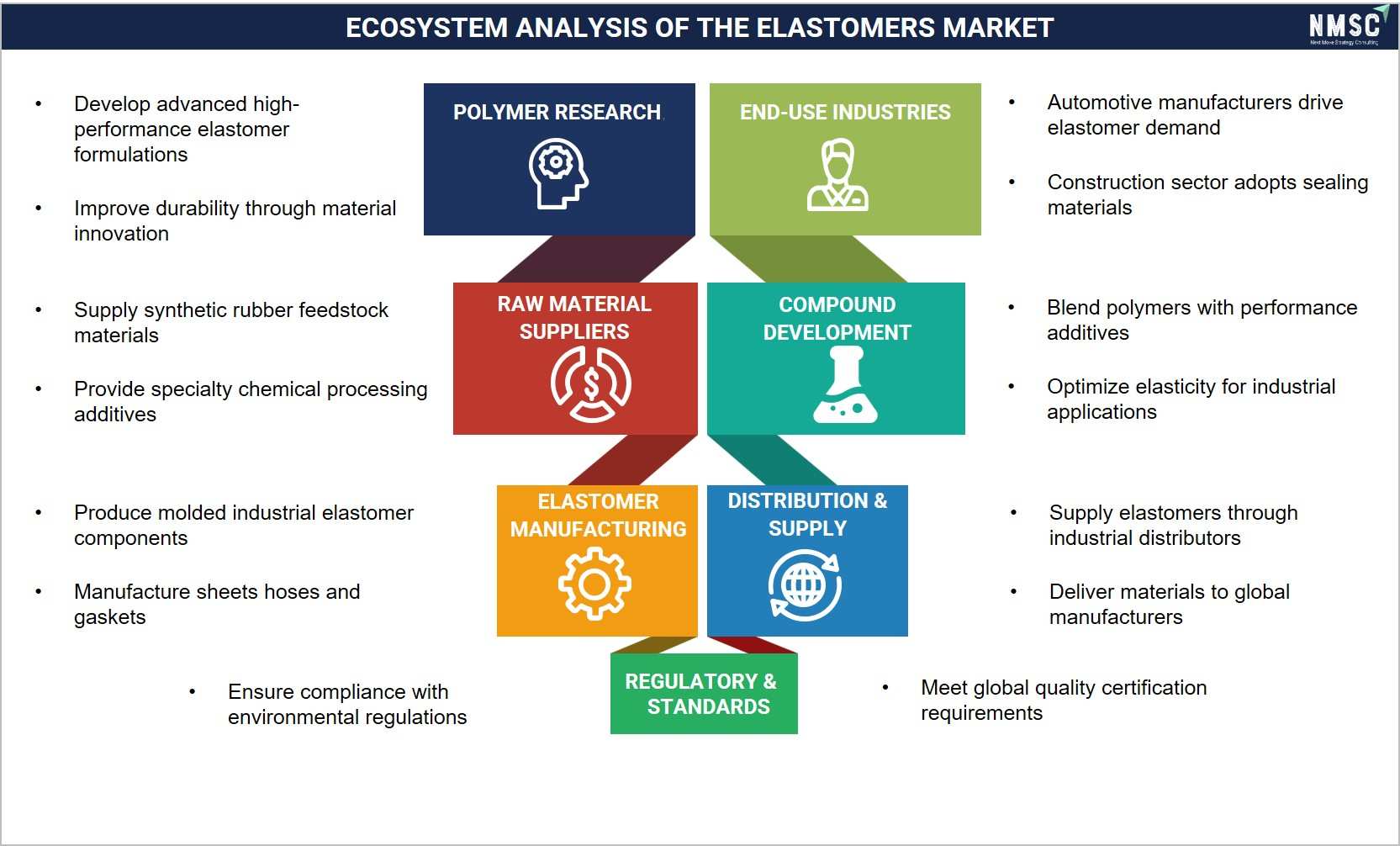
Ecosystem A nalysis of the Elastomers Industry

The above infographic presents an ecosystem analysis of the elastomers market, where advanced formulations and polymer blending are enhancing durability for automotive and construction applications. Synthetic rubber and specialty chemicals further support component manufacturing, while distribution networks serve global manufacturers. Environmental compliance and quality certifications govern operations. Looking ahead, we observed that continued innovation and regulatory alignment will remain essential for meeting performance and sustainability goals across the industry .

Growth Opportunities
Our analysis shows that three forward-looking opportunities stand out for stakeholders positioning within the elastomers industry over the 2026-2035 forecast period.

How Can EV Battery Sealing Applications Unlock Value for Specialty Producers?

Electric vehicle battery sealing and thermal management applications present a whitespace opportunity for specialty elastomer producers seeking premium-margin, non-commodity revenue. Producers that scale dedicated EV-grade elastomer capacity can capture recurring automotive OEM supply contracts, benefiting the Automotive Components application segment as global electric vehicle production continues to expand through 2035.

Where Does Bio-Based Elastomer Fiber Create New Demand Among Apparel Brands?

Bio-based and sustainable elastomeric fiber technology creates an underpenetrated opportunity among performance apparel brands seeking lower-impact alternatives to conventional spandex. Producers that commercialize scalable sustainable fiber grades can capture new brand partnership revenue, benefiting the Footwear and Apparel end-use industry segment as consumer sustainability expectations continue to shape material sourcing decisions.

How Can Medical-Grade Elastomer Certification Benefit Healthcare Suppliers?

Medical-grade elastomer certification presents an opportunity for suppliers targeting the healthcare sector's stringent biocompatibility and purity requirements. Suppliers that achieve broad medical certification across their elastomer portfolios can capture share from generalist producers, benefiting the Medical and Healthcare application segment as device manufacturers increasingly consolidate around certified, traceable material suppliers.

Ecosystem Analysis

Regional Outlook

2025 (USD Billion)
2035 (USD Billion)
Asia-Pacific
Europe
North Americ
Middle East
Latin Americ
Region 2025 (USD Billion) 2035 (USD Billion) CAGR (%)
Asia-Pacific $10.0 USD Billion $40.0 USD Billion 9.0%
Europe $17.1 USD Billion $51.1 USD Billion 27.0%
North America $24.2 USD Billion $62.2 USD Billion 25.0%
Middle East & Africa $31.3 USD Billion $73.3 USD Billion 23.0%
Latin America $38.4 USD Billion $84.4 USD Billion 12.0%

Regional data is locked

Unlock complete regional numbers for this market.

Unlock Full Data

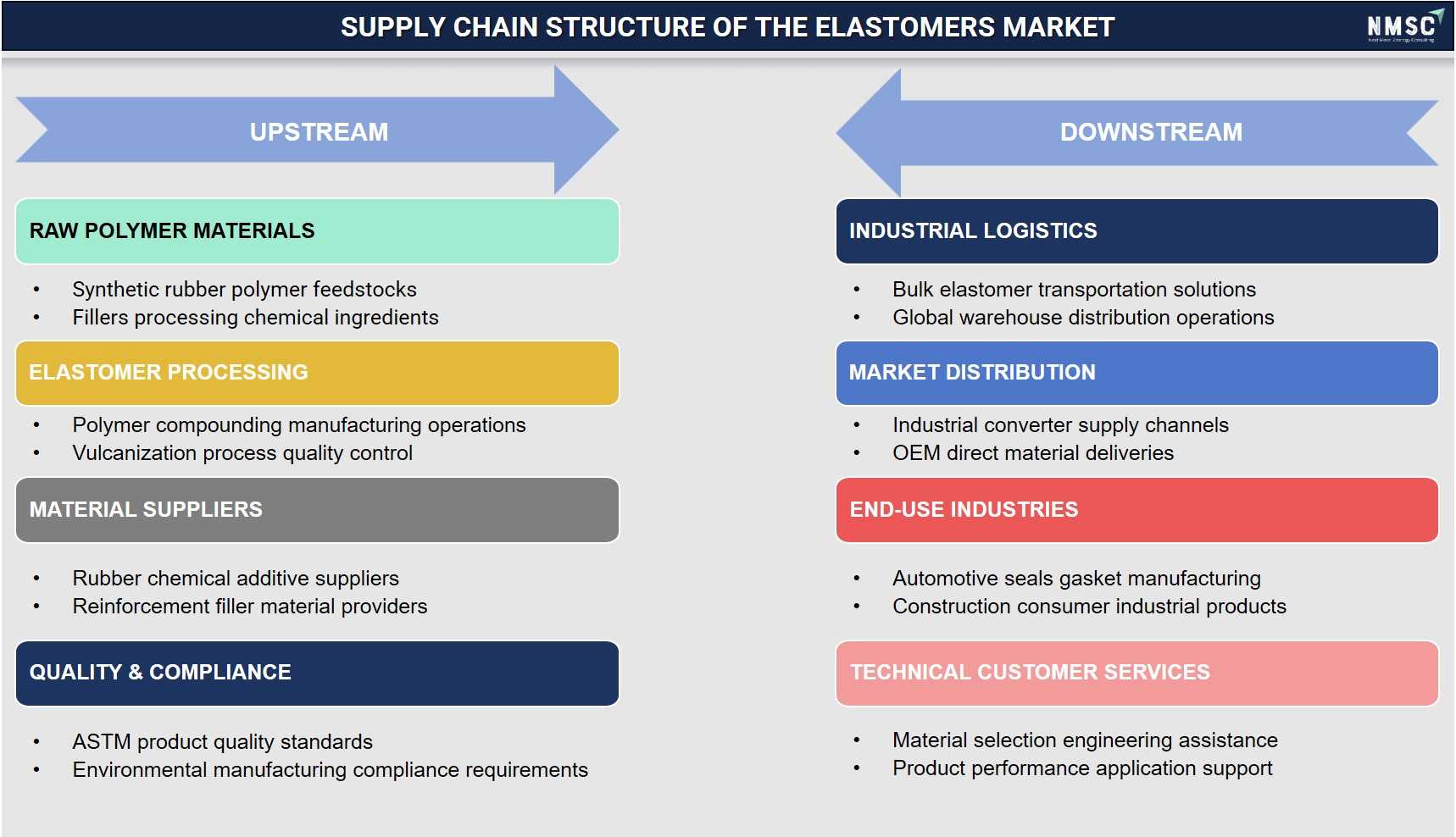
Supply Chain Structure of the Elastomers Industry

Competitive Landscape

We observed that the elastomers market features a mix of diversified integrated petrochemical majors, specialty chemicals producers, and regional synthetic rubber manufacturers competing across production scale, specialty grade innovation, and application-specific certification depth.

Dimension Description
Market Structure Moderately consolidated among diversified integrated petrochemical producers, with fragmented regional competition among specialty and commodity synthetic rubber manufacturers.
Innovation Focus Specialty performance polymers, bio-based and recyclable elastomer grades, and electric vehicle-linked material development dominate current innovation pipelines across leading producers.
M&A Activity Selective capacity expansion and production network optimization, exemplified by Arkema's Calvert City facility expansion and Celanese's Ulsan facility closure and production consolidation into China and India.

How Do Companies Compete in the Elastomers Market?

Companies compete primarily on production scale, feedstock integration, and specialty grade innovation depth across the industry. Diversified integrated petrochemical majors such as Dow Inc. and BASF SE leverage vertically integrated feedstock access to compete on cost across commodity grades, while specialty producers such as Celanese Corporation and Arkema S.A. compete on application-specific performance engineering for automotive, medical, and electronics end-use s.

Which Competitive Archetypes Dominate the Market?

Two archetypes dominate the market: diversified integrated petrochemical majors offering broad commodity and specialty elastomer portfolios, and focused specialty chemicals producers concentrated on high-performance grades. Dow Inc. and ExxonMobil Corporation exemplify the integrated archetype through feedstock-to-polymer vertical integration, while LANXESS AG and Celanese Corporation exemplify the specialty archetype through application-engineered elastomer grades for automotive, medical, and industrial customers.

How Are Companies Differentiating Through Innovation in Elastomer Materials?

Innovation and differentiation strategy increasingly center on specialty performance polymers and sustainable material substitution. ExxonMobil's expanded Vistamaxx portfolio and Celanese's sustainable spandex alternative partnership with Under Armour both address distinct performance and sustainability demands. Our analysis shows that producers unable to pair commodity scale with specialty and sustainable grade innovation risk losing share to competitors offering differentiated, higher-margin elastomer solutions.

What M&A and Expansion Activity Is Shaping the Elastomers Market?

Capacity expansion and production network optimization continue to shape competitive positioning within the industry. Arkema's February 2025 Calvert City expansion targeted EV and data center -linked demand, while Celanese's 2026 decision to close its Ulsan, South Korea facility and consolidate production into China and India illustrates how producers are optimizing manufacturing footprints to match evolving regional demand patterns and cost structures.

Key Market Players

Our assessment indicates that the following 20 companies are actively shaping production capacity, specialty grade innovation, and competitive strategy within the global elastomers market.

Dow Inc. BASF SE Exxon Mobil Corporation LANXESS AG Arkema Covestro AG DuPont de Nemours, Inc. Celanese Corporation Asahi Kasei Corporation Sumitomo Chemical Company, Limite LG Chem, Ltd Wanhua Chemical Group Co., Ltd. China Petroleum & Chemical Corporation Kumho Petrochemical Co., Ltd. TSRC Corporation JSR Corporation ZEON CORPORATION Shin-Etsu Chemical Co., Ltd. Trinseo PLC Huntsman Corporation

Latest Developments

We found that recent capacity investments and product launches within the elastomers market are concentrated on specialty grade expansion and electric vehicle-linked material development.

Date Event
June 2026 Zeon launched a subscription-based data management system specifically for elastomers R&D , enabling customers to manage and utilize experimental data more efficiently. The initiative directly supports elastomer development and accelerates formulation and material-development workflows.
May 2026 BASF launched ReducedPCF Elastollan TPU grades for footwear, sports and leisure, and cable and wire applications. The grades maintain mechanical performance while offering reduced product carbon footprints, directly expanding BASF's thermoplastic polyurethane elastomer portfolio
Feb ruary 2026 DuPont launched a new series of medical-grade, two-part liquid silicone elastomers with improved rheology and lower viscosity. The materials are designed for medical-device fabrication and enable faster, more consistent molding cycles, directly expanding the healthcare elastomers market

Expert Insights

Thomas Braig

Thomas Braig

EVP, Head of Business Entity Elastomers | Covestro

"“ We see three major trends for elastomers. There is demand for high performance, higher processing efficiency and sustainable/circular elastomers. We see increasingly rubber moving to polyurethane elastomers because of higher performance, more energy efficient processing and also lower investments needed to set up a production . ”"

Analyst Interpretation

Thestatement highlights the increasing emphasis on high-performance, process-efficient, and sustainable elastomer materials across industrial applications. NMSC's analysis indicates that elastomer manufacturers are increasingly developing polyurethane and other advanced elastomers that provide improved performance while enabling more efficient processing and lower environmental impact. The growing shift toward circular materials and higher-value elastomer solutions is expected to strengthen innovation across automotive, industrial, energy, consumer, and other demanding applications .

Investment Opportunities

What Capital Inflows Are Targeting the Elastomers Market?

Capital inflows into the elastomers market are increasingly directed toward specialty polymer capacity and electric vehicle-linked material development. Investment in specialty polymer capacity for EV, energy storage, semiconductor, and cable applications illustrates the broader capital commitment toward high-performance materials supporting the energy transition . We observed that investors favor producers demonstrating validated specialty grade commercialization, viewing premium-margin product mix as a proxy for durable competitive positioning versus commodity-focused competitors.

How Is Infrastructure Investment Supporting Elastomer Manufacturing?

Infrastructure investment is expanding specialty production capacity and optimizing manufacturing network footprints to match evolving regional demand. LANXESS's expanded U.S. rubber additives production illustrates how producers are investing in specialty chemical manufacturing capacity, while Celanese's consolidation of Ulsan production into China and India reflects broader network optimization investment across the industry.

What ESG Considerations Are Shaping Elastomers Investment Decisions?

Environmental, social, and governance considerations increasingly shape investment decisions, with emissions accountability and bio-based material sourcing as key criteria. LANXESS's recognition in the Dow Jones Best-in-Class Index and MSCI ESG ratings continues to inform investor sustainability disclosures for specialty chemicals producers. We found that investors increasingly favor producers demonstrating verifiable emissions baselines and expanding sustainable product portfolios, treating governance capability as a differentiator alongside growth metrics.

Key Benefits for Stakeholders

How Does This Report Benefit Enterprise and Industry Leaders?

Enterprise and industry leaders gain access to validated segmentation, competitive benchmarking, and regional demand forecasts that support production investment and product portfolio decisions across the elastomers industry. Our analysis shows that detailed product-type, application, and end-use breakdowns help producers align capacity planning with the fastest-growing demand areas, including thermoplastic elastomers and medical and healthcare applications.

How Does This Report Benefit Investors and Financial Analysts?

Investors and financial analysts benefit from consistent, single-point market size and CAGR estimates that support valuation and capital-allocation decisions across the specialty polymer supply chain. We observed that the report's regional and segment-level growth differentials help identify which producers and product categories are best positioned to capture above-market growth in Middle East & Africa and Thermoplastic Elastomers categories through 2035.

How Does This Report Benefit Technology Vendors and Product Teams?

Technology vendors and product teams gain insight into emerging design requirements, including specialty performance polymer engineering, bio-based material substitution, and electric vehicle-linked elastomer applications, that are reshaping the industry. Our findings suggest that this analysis helps R&D teams prioritize development roadmaps around sustainability certification and application-specific performance increasingly required by automotive and medical device customer specifications.

Key Market Segments Evaluated

By Product Type

  • Thermoset Elastomers 
    • Natural Rubber
    • Styrene Butadiene Rubber
    • Polybutadiene Rubber
    • Ethylene Propylene Diene Monomer
    • Nitrile Butadiene Rubber
    • Silicone Rubber
    • Fluoroelastomers
    • Chloroprene Rubber
    • Other Thermoset Elastomers
  • Thermoplastic Elastomers 
    • Styrenic Block Copolymers
    • Thermoplastic Polyolefins
    • Thermoplastic Polyurethanes
    • Thermoplastic Vulcanizates
    • Other Thermoplastic Elastomers

By Application

  • Tires and Tubes
  • Automotive Components
  • Industrial Goods
  • Footwear
  • Construction and Building
  • Adhesives and Sealants
  • Medical and Healthcare
  • Wire and Cable
  • Other Applications

By Processing Technology

  • Extrusion
  • Injection Molding
  • Compression Molding
  • Calendering
  • Other Processing Technologies

By End-use Industry

  • Automotive and Transportation
  • Construction
  • Industrial Manufacturing
  • Consumer Goods
  • Electrical and Electronics
  • Footwear and Apparel
  • Healthcare
  • Other Industries

By Region

  • North America 
    • U.S.
    • Canada
    • Mexico
  • Europe 
    • UK
    • Germany
    • France
    • Italy
    • Spain
    • Sweden
    • Denmark
    • Finland
    • Netherlands
    • Rest of Europe
  • Asia-Pacific 
    • China
    • India
    • Japan
    • South Korea
    • Taiwan
    • Indonesia
    • Vietnam
    • Australia
    • Philippines
    • Malaysia
    • Rest of APAC
  • Middle East & Africa 
    • Saudi Arabia
    • UAE
    • Egypt
    • Israel
    • Turkey
    • Nigeria
    • South Africa
    • Rest of MEA
  • Latin America 
    • Brazil
    • Argentina
    • Chile
    • Colombia
    • Rest of LATAM

Conclusion & Recommendations

The long-term outlook for the market remains steady and positive, with global revenue projected to grow from USD 106.50 billion in 2025 to USD 176.55 billion by 2035 at a 5.2% CAGR. We observed that sustained automotive production growth, electric vehicle-linked material demand, and expanding medical and healthcare applications will continue underpinning demand across thermoset and thermoplastic elastomer categories through the forecast period.

What Strategic Positioning Should Elastomer Suppliers Pursue?

Suppliers should prioritize specialty and sustainable elastomer grade development while expanding EV-linked and medical-grade product portfolios to capture premium-margin demand. Our assessment indicates that producers investing early in thermoplastic elastomer capacity and bio-based material substitution will be best positioned to capture above-market growth within the elastomers market.

How Attractive Is the Elastomers Market for New Investment?

The elastomers industry presents a steady, attractive investment case, supported by a USD 65.15 billion absolute dollar opportunity between 2026 and 2035 and above-average growth in Middle East & Africa and Thermoplastic Elastomers product categories. We found that investment attractiveness is highest for producers combining commodity-scale feedstock integration with differentiated specialty product portfolios, positioning them to serve both cost-sensitive and premium-performance customer segments.

What Market Shifts and Key Risks Should Stakeholders Monitor?

Stakeholders should monitor feedstock price volatility, tightening recyclability regulation, and commodity overcapacity risk as key factors shaping the elastomers market. Our analysis shows that producers unable to diversify into specialty and sustainable grades risk margin compression from persistent commodity synthetic rubber overcapacity, particularly within Asia-Pacific's highly competitive regional manufacturing base.

What Are the Key Growth Pathways for the Elastomers Market?

Key growth pathways include expanding thermoplastic elastomer capacity, scaling electric vehicle and medical-grade specialty portfolios, and deepening penetration into Middle East & Africa's petrochemical diversification-linked demand. NMSC's analysis indicates that suppliers pursuing these pathways while maintaining sustainability certification credentials will be best positioned to capture the elastomers market's projected growth through 2035.

FAQs

About the Author

Mayurima Roy

Mayurima Roy

Mayurima Roy is Research Analyst at Next Move Strategy Consulting, where she has spent 4 years working across the firm's full industry coverage rather than a single fixed vertical. Her work centers on structured research, ongoing trend tracking, competitive assessment, and insight-led content development, translating complex market data into clear, decision-ready narratives that support informed client decision-making across diverse global industries, market sectors, and world regions every day.

About the Reviewer

Supradip Baul

Supradip Baul

Supradip Baul is an accomplished business consultant and strategist with over a decade of rich experience in market intelligence, strategy, technology, and business transformation. His work has included rigorous qualitative and quantitative analysis across multiple industries, helping clients shape investment decisions and long-term roadmaps. Earlier in his career, he was associated with Gartner, where he contributed to industry-leading reports and market share analyses. He has worked with leading global companies and holds an MBA with a dual specialization in Marketing and Finance.

Download Free Sample

Ross J Mckenzie

ROSS J MCKENZIE

Business Insight Manager

Staysure Group

“Next MSC have been incredibly helpful in providing detailed & robust information on our market, alongside quantifying growth by different segments. The process to procure was simple and easy, with sample reports and regular contact to ensure we had what we needed. Succinct detail on their sources & methodologies is also greatly received, allowing transparency in this respect helps build trust in the detail you pay for. Joseph in particular was fantastic, and helped ensure efficient provision of the insight pack – thank you NMSC!”.

Gustaf Hummel Burstrom

GUSTAF HUMMEL BURSTROM

Founder

Revline Tools AB

Joseph and the team at Next Move Strategy Consulting have been excellent to work with, in supplying us with relevant market data and forecasts for our specific category. We had some special requirements and they were able to do a custom package to suit our needs. We would definitely recommend them to any other company needing market data and forecasts

Diana Trejo

DIANA TREJO

Assistant Manager

Sumitomo Corporation de Mexico, S.A. de C.V.

Recently, we purchased a report on the Mexico Data Center Market from Next Move Strategy Consulting. The service has been excellent, with support that is always timely and thoroughly professional. The information provided is interesting, highly useful, and delivered with clarity. I would highly recommend NextMSC for anyone seeking insightful and dependable analysis.

Henri Knyphausen

HENRI KNYPHAUSEN

Partner at Singulier [Ex-BCG]

Singulier

I recently engaged NEXTMSC.com for a commercial due diligence project within the intralogistics sector, and I am pleased to provide a reference based on my experience. In utilizing NEXTMSC.com's services, I found their report to offer valuable insights into market dynamics and key industry players. The initial report provided a solid foundation for our analysis. However, as we were investigating a smaller target in the market, and I had specific customization requests requiring additional research. These requests included detailed information on product portfolios of various players and sub-market sizes, both inclusive and exclusive of certain product categories. NEXTMSC.com demonstrated commendable responsiveness and agility in accommodating these customization requests. Within a timeframe of 1-2 weeks, they delivered a revised report that met our specific needs. Furthermore, they were receptive to my follow-up inquiries, ensuring clarity and understanding of the data provided. The final deliverable significantly contributed to our due diligence efforts. One of NEXTMSC.com's notable strengths lies in their qualitative research capabilities. However, for future engagements, I would recommend the inclusion of a quantified market model in Excel format. Such a model would offer the ability to conduct in-depth analyses and explore various market segments, including country-specific data and subcomponent breakdowns. Based on my positive experience, I would not hesitate to work with NEXTMSC.com again. Their responsiveness, willingness to accommodate customization requests, and commitment to delivering actionable insights make them a reliable partner for commercial research projects.

Gaurav Jaiswal

GAURAV JAISWAL

Founder & CEO

Yano Charge Private Limited

The EV Charging market research report provided by the NextMSC was exceptionally detailed and insightful. It offered a comprehensive analysis that proved to be a game-changer for our strategic planning. Truly a testament to the NextMSC’s expertise and thoroughness in EV market landscape & analysis.

Custom Market Research Services

We will customize the research for you if the listed report does not fully match your requirements.

Get 30% Free Customization

Select License

This website uses cookies to ensure you get the best experience on our website. Learn more

✖