Propylene Market Size, Share, Growth & Forecast by Grade (Polymer, Chemical, and Other), Production Route (Steam Cracking, FCC, PDH, and Other Routes), Derivative (Polypropylene, Propylene Oxide, Cumene, Acrylonitrile, Oxo Alcohols, Isopropanol, Acrylic Acid & Acrylates, Other), Sales Model (Merchant, Captive, Tolling), and Application (Packaging, Automotive, Building & Construction, Textiles & Fibers, Consumer Products, Healthcare, Electronics, Industrial, Other) — Global Analysis 2025–2035
Industry: Materials and Chemical | Latest Edition: September 30, 2026 | No of Pages: 1138 | No. of Tables: 1950 | No. of Figures: 1938 | Format: PDF | Report Code: MC4933
What is the Propylene Market Size?
The global Propylene Market was valued at USD 134.2 billion in 2025 and is projected to reach USD 140.7 billion in 2026. Sustained demand from polypropylene production, derivative expansion, and emerging economy growth in Asia are forecast to propel the market to USD 200.7 billion by 2035, advancing at a CAGR of 4.02% from 2026 to 2035. In volume terms, the market stood at 100.54 Megatons in 2025 and is expected to reach 107.92 Megatons in 2026, further expanding to 175.92 Megatons by 2035, registering a CAGR of 5.58% from 2026 to 2035. Key growth drivers include expanding packaging sector consumption, rising demand for automotive lightweighting materials, strong electronics manufacturing growth in Asia-Pacific, and robust investment in healthcare-grade propylene derivatives including medical plastics and pharmaceutical solvents.
|
Parameters |
Details |
|
Market Size in 2025 |
USD 134.2 Billion |
|
Market Size in 2026 |
USD 140.7 Billion |
|
Revenue Forecast in 2035 |
USD 200.7 Billion |
|
Growth Rate |
CAGR of 4.02% from 2026 to 2035 |
|
Volume in 2026 |
107.92 Megatons |
|
Volume in 2035 |
175.92 Megatons |
|
Volume CAGR |
CAGR of 5.58% from 2026 to 2035 |
|
Analysis Period |
2025–2035 |
|
Base Year Considered |
2025 |
|
Forecast Period |
2026–2035 |
|
Market Size Estimation |
Billion USD |
|
Companies Profiled |
20 |
|
Countries Covered |
33 |
|
Market Share |
Top 10 |
Propylene Market Overview
What Is the Propylene Market?
Propylene (also referred to as propene) is a C3 olefin and one of the most strategically important petrochemical feedstocks in the global chemical industry. Produced primarily as a co-product of steam cracking and fluid catalytic cracking, and increasingly via on-purpose routes including PDH, MTO, and CTO, propylene serves as the primary building block for polypropylene, the world's most widely consumed thermoplastic polymer. NMSC's analysis indicates that the Propylene Market encompasses production, distribution, and downstream derivative conversion across multiple grades, routes, and end-use applications spanning packaging, automotive, construction, healthcare, electronics, and textiles.
How Has the Propylene Market Evolved?
Through our market assessment, we observed that the Propylene Market has undergone multiple structural transitions since the 1970s. The first phase centered on FCC-derived co-product recovery from refinery operations. The second phase expanded through naphtha and ethane steam cracking as the petrochemical industry scaled globally. The current phase is defined by the rapid commercialization of on-purpose PDH technology, the emergence of MTO and CTO routes in China as alternatives to oil-based feedstocks, and nascent investment in bio-based propylene pathways aligned with circular economy and decarbonization strategies.
How Do Regulations Influence the Propylene Market?
From our research, we found that regulatory developments at national and regional levels have created both headwinds and structural demand shifts in the Propylene Market. The European Union's Single-Use Plastics Directive has accelerated investment in recyclable and bio-based polymer alternatives, influencing polypropylene consumption patterns. China's 14th Five-Year Plan mandates domestic petrochemical self-sufficiency, driving massive PDH and MTO capacity investment. In the U.S., EPA oversight of volatile organic compounds (VOCs) and compliance requirements under the Clean Air Act directly affect propylene plant operations and site-level capital investment decisions.
How Is Technology Adoption Expanding Across the Propylene Market?
Based on NMSC's research, we found that technology adoption across the Propylene Market is accelerating as producers invest in process efficiency, feedstock flexibility, and emission reduction. PDH technology utilizing UOP Oleflex, Lummus CATOFIN, and CB&I Star processes is being deployed at scale across China, India, and the U.S. Gulf Coast. MTO and CTO technologies are achieving commercial scale with continuous catalyst improvement cycles. Digitalized process optimization, AI-based yield maximization, and advanced data systems for energy management are increasingly being adopted across major propylene production complexes globally.
|
Key Takeaways |
|
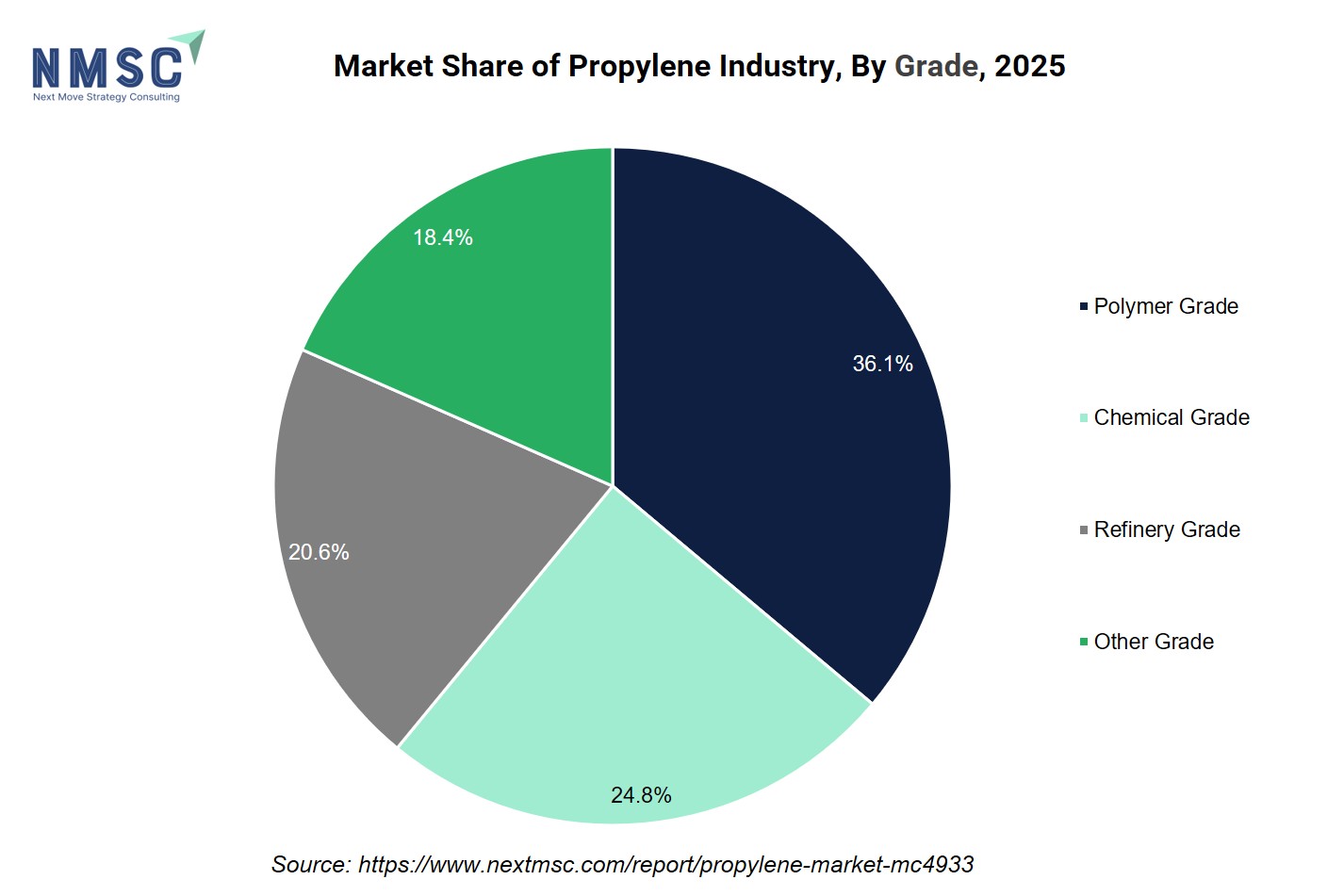
By grade, the Polymer Grade segment dominated the Propylene Market with a revenue share of 36%, valued at USD 48,445.4 million in 2025. The Chemical Grade segment is growing at a CAGR of 3.87% from 2026 to 2035, driven by rising demand for propylene oxide, acrylonitrile, and cumene in specialty chemical applications. |
|
By grade on a volume basis, Polymer Grade led with 34,425.9 kilotons in 2025, representing 34% of total volume. Other Grade is the fastest-growing volume sub-segment at a CAGR of 4.67%, reflecting expanding refinery co-product capture and niche application demand in emerging markets. |
|
By production route, Steam Cracking is the dominant production pathway with a 27.86% revenue share in 2025, generating USD 37,383.3 million. Propane Dehydrogenation (PDH) is the fastest-growing route at a CAGR of 5.22%, driven by substantial capacity additions in China, the U.S., and India. |
|
Coal to Olefins (CTO) is emerging as a strategically significant production route in the Propylene Market at a CAGR of 5.08%, with China driving capacity expansion as part of its domestic energy and chemical self-sufficiency program under the 14th Five-Year Plan. |
|
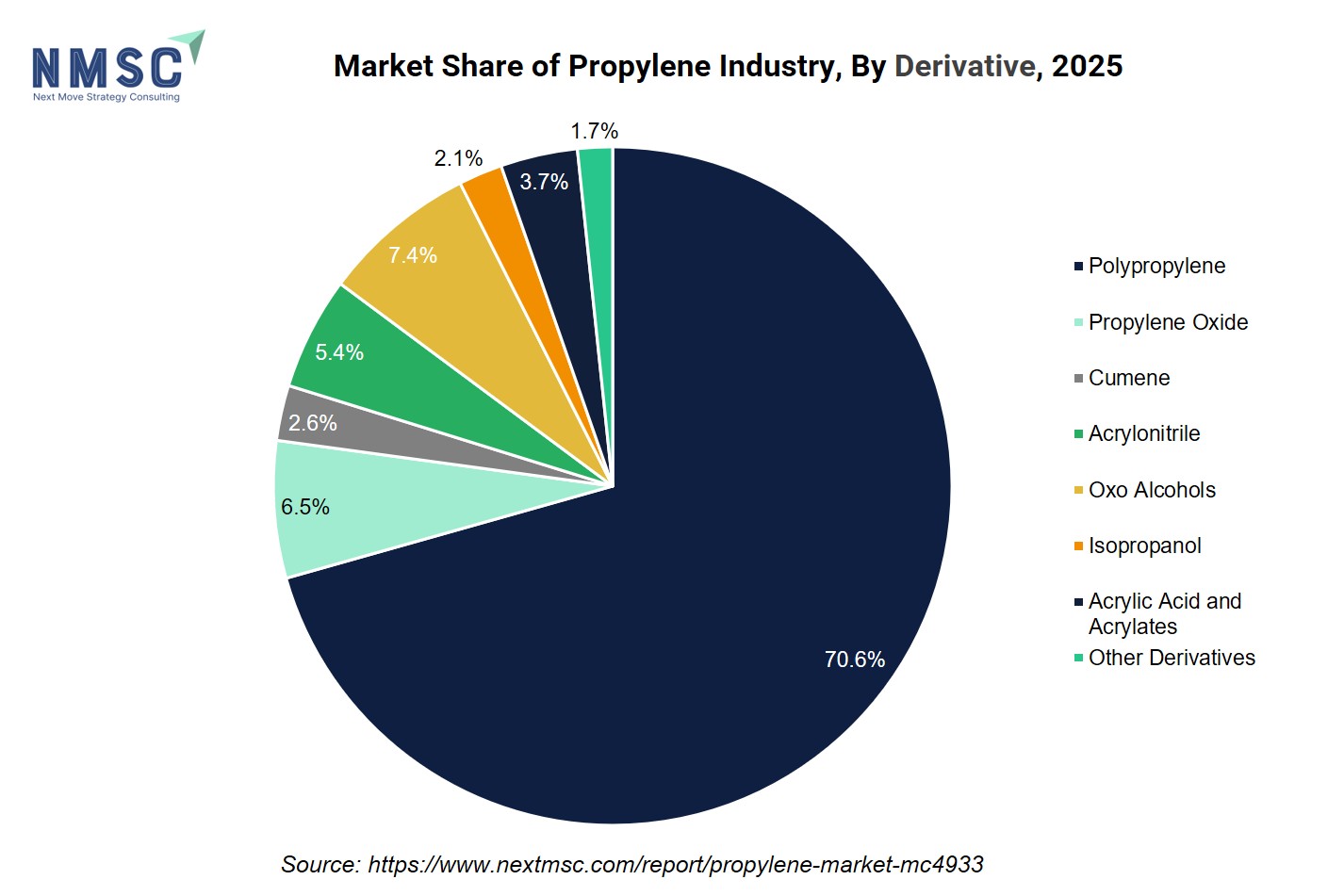
By derivative, Polypropylene dominates with a 70.62% revenue share, valued at USD 94,746.8 million in 2025. On a volume basis, Polypropylene accounts for 76.32% of total derivative consumption at 76,724.6 kilotons, driven by packaging, automotive, and construction sector demand globally. |
|
Acrylic Acid and Acrylates is the fastest-growing derivative segment at a CAGR of 3.54%, supported by rising demand for superabsorbent polymers (SAP) in hygiene products, coatings, and adhesives across North America, Europe, and Asia-Pacific. |
|
By sales model, the Captive segment holds the largest share at 38.09% of total revenue in 2025, reflecting the integration of propylene production within polypropylene and derivative manufacturing complexes. The Tolling segment is the fastest-growing at a CAGR of 4.87%, as midstream chemical companies seek flexible processing arrangements. |
|
By application, the Electronics segment is the fastest-growing application at a CAGR of 5.53% on a revenue basis and 7.15% on a volume basis, driven by demand for polypropylene-based housings, connectors, and insulation materials across consumer electronics and semiconductor equipment globally. |
|
The Healthcare application is the second fastest-growing segment at a revenue CAGR of 4.50%, driven by rising consumption of medical plastics, disinfectants, and pharmaceutical solvents derived from propylene across post-pandemic healthcare infrastructure expansion in Asia and North America. |
|
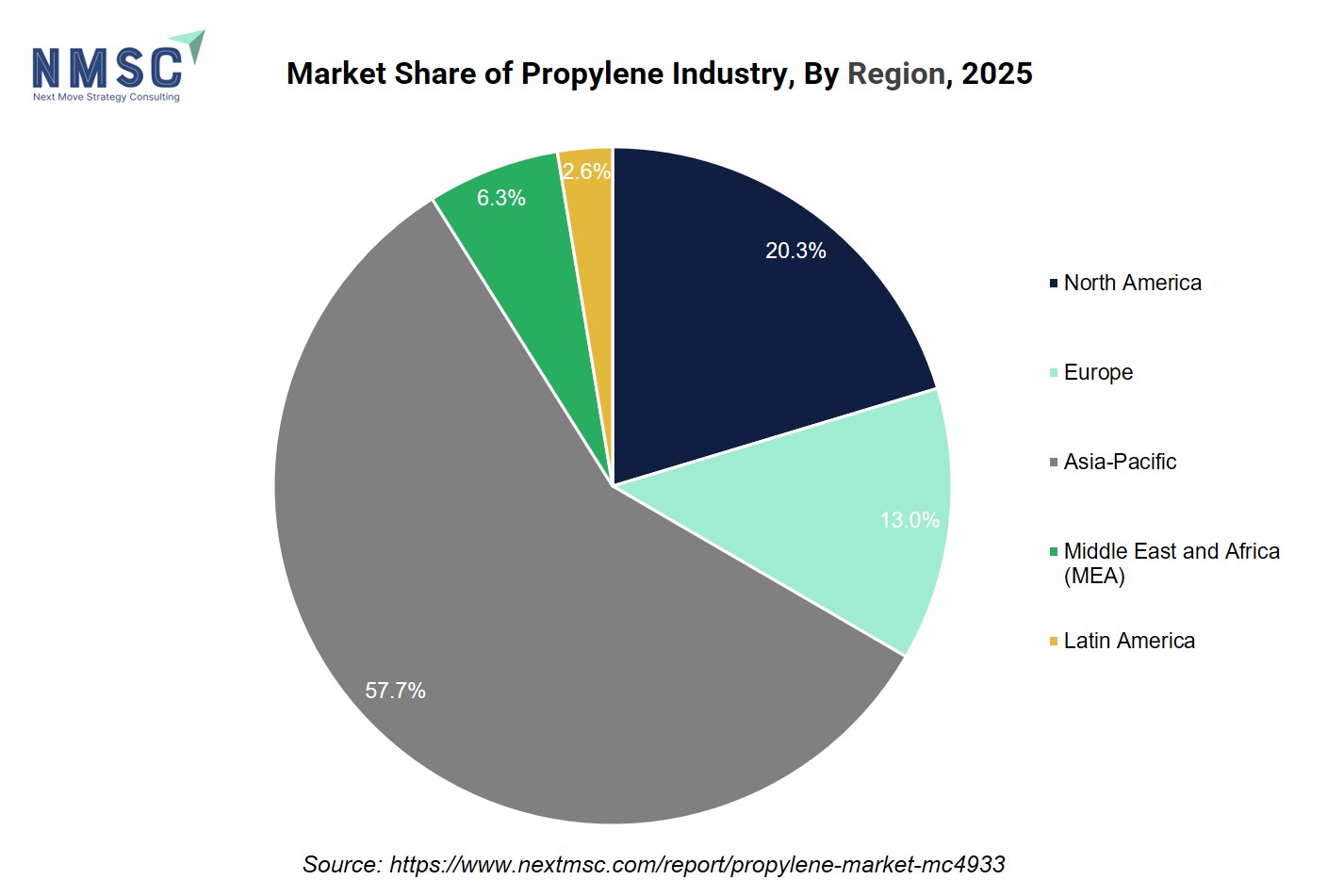
Asia-Pacific is the dominant regional market in the Propylene Market with a 57.69% revenue share and USD 77,397.0 million in 2025, projected to reach USD 129,693.0 million by 2035 at a CAGR of 5.21%, anchored by China's massive petrochemical complex expansions and India's growing polymer demand. |
|
North America holds the second-largest share at 20.35% of global revenue in 2025, driven by PDH capacity additions in the U.S. Gulf Coast, strong packaging demand, and the presence of major propylene producers such as LyondellBasell, ExxonMobil, and Chevron Phillips Chemical. |
|
China is the single largest country market in the Propylene Market, representing over 65% of Asia-Pacific revenue in 2025, underpinned by its world-leading polypropylene production capacity, coal-to-olefins infrastructure, and state-directed investment in domestic petrochemical self-sufficiency. |
|
India is the fastest-growing major national market in the Propylene Market at an estimated CAGR of 6.8% from 2026 to 2035, driven by expanding packaging demand, automotive sector growth, healthcare sector investments, and the Petroleum, Chemicals and Petrochemicals Investment Region (PCPIR) policy framework.Source: www.nextmsc.com |
Key Emerging Trends in the Propylene Market
How Is Propane Dehydrogenation (PDH) Technology Reshaping Propylene Production Economics?
From our research, we found that PDH technology is fundamentally rebalancing propylene supply economics by decoupling on-purpose propylene production from refinery and steam cracker schedules. PDH units convert low-cost propane increasingly available from U.S. shale operations and Middle Eastern LPG surpluses into high-purity polymer grade propylene, bypassing crude oil price dependence. Lummus CATOFIN and UOP Oleflex PDH process licensors have reported accelerating project pipelines across Asia and North America. PDH-derived propylene now competes directly with steam cracker-sourced volumes, improving supply reliability and supporting the polypropylene market's cost competitiveness.
How Is Bio-Based Propylene Emerging as a Sustainable Alternative in the Propylene Market?
Our assessment indicates that bio-based propylene is transitioning from an experimental pathway to a commercially evaluated option in the Propylene Market, driven by escalating ESG mandates and circular economy targets across Europe and North America. Propylene produced from bio-based feedstocks such as sugarcane ethanol (via dehydration to bio-ethanol then metathesis), glycerol from biodiesel production, and lignocellulosic biomass conversion offers a renewable carbon alternative to fossil fuel-derived propylene. TotalEnergies' bio-propylene program and Braskem's bio-based polymer investments signal growing industry commitment. The European Commission's renewable chemicals targets provide a regulatory tailwind for bio-based propylene commercialization.
How Are MTO and CTO Routes Reshaping Propylene Supply in Asia?
Through NMSC's assessment, we found that methanol-to-olefins (MTO) and coal-to-olefins (CTO) production routes are structurally transforming propylene supply in China, now representing approximately 27.9% of combined Propylene Market revenues when measured against PDH and steam cracking. These routes enable coal-abundant regions to produce ethylene and propylene without crude oil feedstock, supporting China's stated goal of petrochemical self-reliance. Major CTO operators including Shenhua, Yanchang, and Xinjiang Dunhua have scaled up capacity in line with NDRC policy support. The propylene yield optimization in MTO processes continues to improve through proprietary catalytic advances.
How Is Digitalization and Process Optimization Transforming Propylene Plant Operations?
Based on our market evaluation, we noticed that digitalization is increasingly integrated into propylene production operations, with major producers deploying real-time process simulation, AI-based predictive maintenance, and advanced process control (APC) systems to optimize propylene yield, reduce energy consumption, and minimize unplanned downtime. Shell's Smart Fields program, ExxonMobil's edge computing deployment at manufacturing sites, and Sinopec's digital twin integration across olefin crackers illustrate the sector's adoption trajectory. These technologies reduce feedstock cost per ton of propylene produced, improve operational resilience, and contribute to sustainability KPIs measured under Scope 1 and Scope 2 emissions reporting frameworks.
Ecosystem Analysis of the Propylene Market
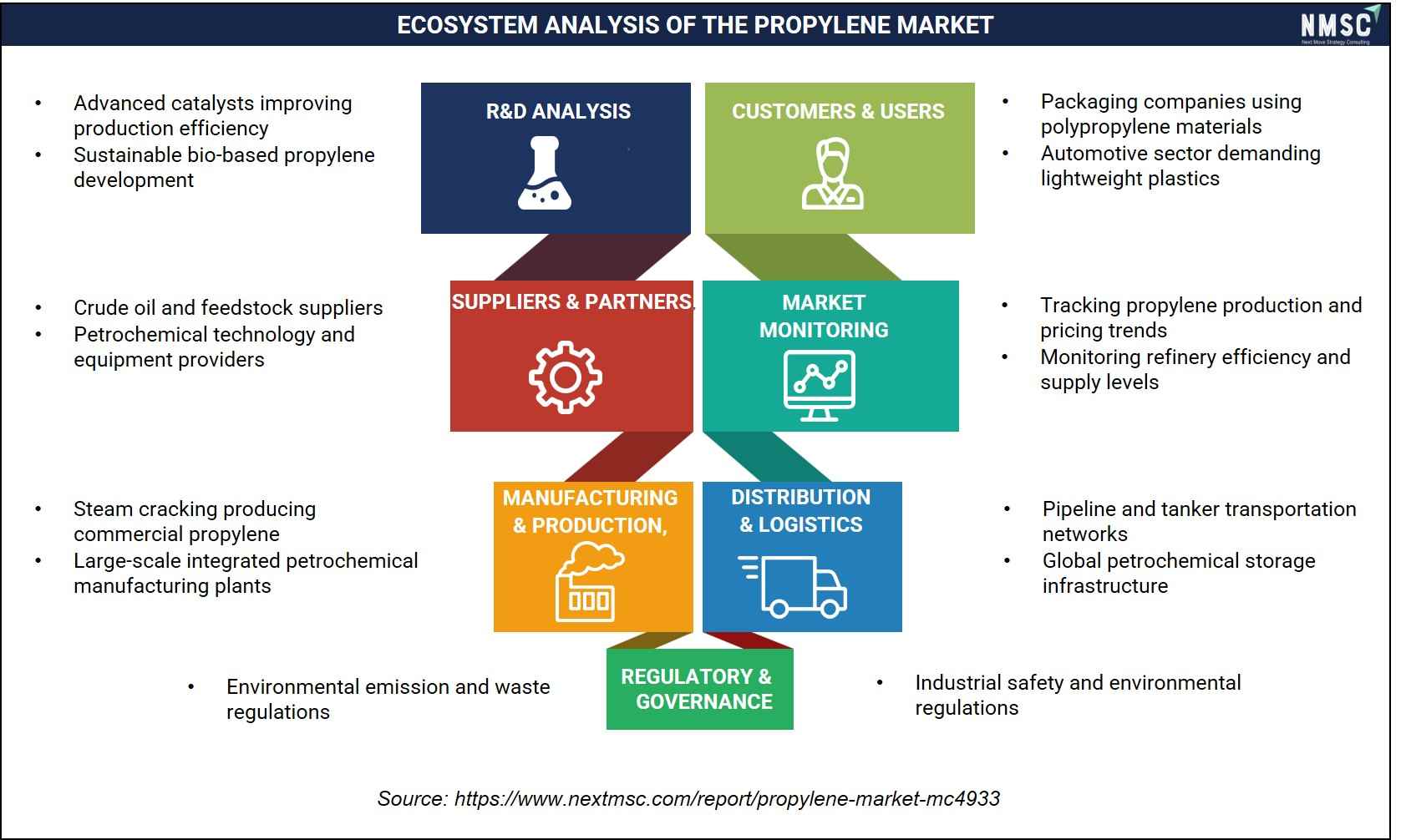
Our ecosystem assessment indicates that the propylene market is supported by continuous R&D focused on process optimization, catalyst innovation, and sustainable production technologies. Suppliers provide feedstocks and processing solutions, while manufacturers convert propylene into value-added petrochemical products. Market monitoring tracks pricing, demand, and capacity developments. Distribution networks ensure global supply, while regulatory frameworks govern environmental compliance, transportation safety, and operational standards.
What Are the Key Market Drivers, Breakthroughs, and Investment Opportunities that Will Shape the Propylene Market Industry in the Next Decade?
|
Drivers / Trends / Restraints |
(+/-) % Impact on CAGR Forecast |
Geographic Relevance |
Impact Timeline |
|
Surging Polypropylene Demand from Packaging and Healthcare |
+1.2% |
Global (led by Asia-Pacific) |
2025–2035 |
|
PDH Capacity Expansions in Asia and North America |
+0.9% |
China, U.S., India |
2025–2032 |
|
Electronics Sector Growth Driving Derivative Demand |
+0.7% |
Asia-Pacific, North America |
2025–2035 |
|
MTO and CTO Capacity Growth in China |
+0.6% |
China, Southeast Asia |
2026–2035 |
|
Healthcare Demand for Medical Plastics and Disinfectants |
+0.5% |
Global |
2025–2035 |
|
Feedstock Price Volatility (Crude Oil and Natural Gas) |
-0.8% |
Global |
Ongoing |
|
Regulatory Restrictions on Single-Use Plastics |
-0.6% |
Europe, North America |
2025–2030 |
|
Bio-Based Propylene Commercialization |
+0.5% |
Europe, North America, Asia |
2027–2035 |
|
Propylene Oxide Market Expansion for Polyurethanes |
+0.4% |
Global |
2025–2035 |
|
Southeast Asia and India Capacity Investment |
+0.4% |
India, Vietnam, Indonesia |
2026–2035 |
What Are the Growth Drivers of the Propylene Market?
How Is the Global Expansion of Polypropylene Production Driving Demand in the Propylene Market?
Polypropylene production represents the dominant downstream demand pull for the Propylene Market, accounting for 70.62% of total derivative revenue in 2025. From our research, we found that global polypropylene demand is driven by its versatility across rigid and flexible packaging, automotive components, construction materials, medical plastics, and consumer goods. The American Chemistry Council reports that polypropylene is the largest-volume polymer in North American production, with growing applications in lightweight automotive parts replacing traditional metals. Polypropylene market growth is directly correlated with macroeconomic consumption trends, urbanization, and healthcare spending across emerging economies, making it the most consequential driver of propylene feedstock demand across the forecast period.
How Is the Growing Electronics Sector Accelerating Propylene Market Consumption?
NMSC's analysis indicates that the electronics sector is the fastest-growing end-use application for propylene derivatives on a volume basis, advancing at a CAGR of 7.15% from 2026 to 2035. Propylene-derived polypropylene and specialized polymers serve critical roles in electronic component housings, connectors, printed circuit board substrates, and semiconductor equipment insulation. Asia-Pacific's dominance in global electronics manufacturing with China, South Korea, Taiwan, and Vietnam accounting for the majority of global semiconductor and consumer electronics output creates structural and growing demand for high-purity polymer grade propylene. The petrochemical feedstock supply chains serving electronics manufacturers are tightly integrated with propylene derivative production logistics across East Asia.
How Is the Healthcare Industry's Demand for Medical Plastics Driving Growth in the Propylene Market?
Based on our analysis, we found that healthcare-related propylene derivative consumption represents one of the most durable and fastest-growing demand vectors in the Propylene Market, advancing at a CAGR of 4.50% from 2026 to 2035. Polypropylene is used in syringes, IV bags, surgical instruments, diagnostic equipment housings, and pharmaceutical packaging due to its chemical inertness, sterilizability, and regulatory compliance with USP Class VI and ISO 10993 standards. Isopropanol derived from propylene serves as a critical feedstock for pharmaceutical solvents and sanitizer formulations, a category that experienced sustained demand uplift following the COVID-19 pandemic. Government health infrastructure investment across South and Southeast Asia is a structurally significant driver of healthcare-related propylene demand through 2035.
What Are the Growth Inhibitors of the Propylene Market?
How Do Feedstock Price Volatility and Supply Chain Disruptions Constrain the Propylene Market?
Feedstock cost volatility represents the most persistent structural constraint on the Propylene Market, as crude oil and natural gas price fluctuations directly affect the economics of steam cracking and FCC-derived propylene, which together account for over 40% of global supply. Our findings suggest that naphtha price swings of 15–25% within a calendar year, as documented by the U.S. Energy Information Administration, translate into significant variability in propylene production costs and downstream derivative pricing. LNG and LPG cost increases similarly affect PDH economics by raising propane feedstock costs. The polypropylene market and broader polymer supply chain absorb and transmit these upstream cost pressures, creating demand uncertainty in price-sensitive packaging and construction end markets.
How Does the Regulatory Push Against Single-Use Plastics Affect Propylene Market Growth?
Regulatory restrictions on single-use plastics in the European Union, United Kingdom, Canada, and increasingly in Asian markets represent a structural headwind for polypropylene demand growth in the Propylene Market's packaging segment. The EU Single-Use Plastics Directive, which came into full effect in 2021, restricts a range of polypropylene-containing products and mandates recycled content requirements for certain packaging categories. Our assessment indicates that while substitution occurs partially toward bio-based polypropylene and recyclable PP formats, net demand growth in the rigid packaging sub-segment is compressed in Europe by approximately 1.2 percentage points annually relative to markets with less restrictive regulatory environments, representing a meaningful drag on regional propylene market growth.
What Are the Growth Opportunities in the Propylene Market?
How Does Rising Demand for Bio-Based Propylene Create a Structural Commercial Opportunity?
Bio-based propylene is advancing toward commercial viability and creating a structurally differentiated high-value opportunity within the Propylene Market, particularly for producers serving European and North American markets with sustainability-linked procurement mandates. Our analysis shows that the Propylene Oxide Market for bio-based polyether polyols in automotive seating and construction insulation is a pull factor for certified green propylene feedstocks. Brands including IKEA, Toyota, and BMW have disclosed bio-based polymer procurement targets in their sustainability reports, creating a defined premium market for bio-propylene-derived polypropylene. The European Commission's CSRD reporting obligations strengthen corporate incentives to certify bio-based content in propylene derivative supply chains.
How Is the Expansion of the Propylene Oxide Market Creating New Revenue Streams?
The Propylene Oxide Market is a strategically significant growth opportunity for propylene derivative producers, with propylene oxide serving as the primary feedstock for polyether polyols used in polyurethane foams, propylene glycol for food and pharmaceutical applications, and glycol ethers for paints and coatings. From our research, we found that global polyurethane demand growth -driven by construction insulation and automotive seat cushion applications is creating sustained demand pull for propylene oxide production capacity expansion. The International Energy Agency has highlighted building energy efficiency retrofits as a global policy priority, indirectly supporting propylene oxide and polyurethane insulation demand. Cumene derivatives phenol and acetone similarly generate premium value streams from propylene feedstock in specialty chemical applications.
How Are Emerging Markets in South and Southeast Asia Generating Structural Growth Opportunities?
Through our market evaluation, we assessed that South and Southeast Asia represent the highest-conviction geographic growth opportunities in the Propylene Market beyond China, driven by infrastructure-led polymer demand, expanding manufacturing sectors, and government-backed petrochemical capacity investment programs. India's Petroleum, Chemicals and Petrochemicals Investment Region (PCPIR) policy has catalyzed over USD 40 billion in announced investment in propylene and polymer production capacity, per the Ministry of Petroleum and Natural Gas. Vietnam, Indonesia, and the Philippines are experiencing rapid growth in packaging consumption linked to e-commerce expansion, creating direct demand pull for polypropylene. The steam cracking market capacity additions planned in India and Vietnam through 2030 will expand domestic propylene supply and reduce import dependence across the sub-region.
How Is the Propylene Market Segmented in This Report, and What Are the Key Insights from the Segmentation Analysis?
How Do Different Propylene Grades Define Market Structure and Demand Patterns?
|
Grade |
2025 (USD Mn) |
2035 (USD Mn) |
CAGR % |
|
Polymer Grade |
48,445.4 |
81,915.1 |
5.31% |
|
Chemical Grade |
33,331.2 |
49,134.9 |
3.87% |
|
Refinery Grade |
27,689.1 |
35,814.3 |
2.51% |
|
Other Grade |
24,695.8 |
33,796.5 |
3.09% |
Based on NMSC's research, we found that the Propylene Market is segmented by grade into Polymer Grade, Chemical Grade, Refinery Grade, and Other Grade, with Polymer Grade commanding the largest revenue share at 36% and USD 48,445.4 million in 2025. Polymer Grade propylene maintains high purity levels exceeding 99.5%, suitable for direct polypropylene production in continuous gas phase and slurry polymerization processes. Chemical Grade propylene (95–99.5% purity) serves downstream cumene, acrylonitrile, oxo alcohol, and acrylic acid producers. Refinery Grade propylene (50–70% purity) is typically consumed in alkylation and oligomerization within refinery-integrated chemical complexes, while the Other Grade category captures specialized industrial and fuel-blending applications.
Which Production Technologies Are Reshaping the Propylene Market Supply Landscape?
|
Production Route |
2025 (USD Mn) |
2035 (USD Mn) |
CAGR % |
|
Steam Cracking |
37,383.3 |
52,643.5 |
3.39% |
|
Fluid Catalytic Cracking (FCC) |
16,319.5 |
20,688.4 |
2.30% |
|
Propane Dehydrogenation (PDH) |
25,154.6 |
42,199.0 |
5.22% |
|
Metathesis |
12,120.1 |
16,219.6 |
2.86% |
|
Methanol to Olefins (MTO) |
20,598.1 |
33,740.4 |
4.98% |
|
Coal to Olefins (CTO) |
16,794.0 |
27,798.6 |
5.08% |
|
Other Routes |
5,792.1 |
7,371.4 |
2.34% |
Our analysis shows that the Propylene Market is segmented by production route into Steam Cracking, Fluid Catalytic Cracking (FCC), Propane Dehydrogenation (PDH), Metathesis, Methanol to Olefins (MTO), Coal to Olefins (CTO), and Other Routes. Steam Cracking remains the largest single route at 27.86% of 2025 revenues, producing propylene as a co-product of ethylene manufacture. FCC-derived propylene from refinery operations contributes a stable 12.16% share. PDH is the fastest-growing route at 5.22% CAGR, while CTO is close behind at 5.08%, reflecting China's strategic investment in coal-based chemical production. MTO also demonstrates strong growth at 4.98% CAGR as methanol economics in coal-rich Chinese provinces support large-scale capacity.
How Do Propylene Derivatives Define the Downstream Value Architecture of the Propylene Market?
|
Derivative |
2025 (USD Mn) |
2035 (USD Mn) |
CAGR % |
|
Polypropylene |
94,746.8 |
146,919.2 |
4.40% |
|
Propylene Oxide |
8,766.6 |
12,142.0 |
3.22% |
|
Cumene |
3,534.7 |
4,599.7 |
2.57% |
|
Acrylonitrile |
7,224.9 |
9,953.9 |
3.16% |
|
Oxo Alcohols |
9,931.7 |
13,347.3 |
2.91% |
|
Isopropanol |
2,801.2 |
3,900.4 |
3.28% |
|
Acrylic Acid and Acrylates |
4,926.7 |
7,033.3 |
3.54% |
|
Other Derivatives |
2,229.0 |
2,764.8 |
2.07% |
From our assessment, we observed that the Propylene Market's derivative landscape is dominated by Polypropylene, which captures 70.62% of total revenue and 76.32% of total volume in 2025. Polypropylene's sub-segments include Homo PP and Copolymer PP (Random and Block variants), with block copolymer grades expanding in automotive and construction applications. Propylene Oxide is the second-largest derivative by strategic importance, serving as the base for polyether polyols, propylene glycol, and glycol ethers. Acrylonitrile feedstock for acrylic fibers, ABS, and nitrile rubber holds a 5.39% revenue share. Acrylic Acid and Acrylates, at a 3.54% CAGR, represents the fastest-growing derivative category driven by SAP demand in hygiene products and adhesives applications globally.
How Do Merchant, Captive, and Tolling Models Shape Propylene Market Commercialization Strategies?
|
Sales Model |
2025 (USD Mn) |
2035 (USD Mn) |
CAGR % |
|
Merchant |
43,409.1 |
65,763.6 |
4.16% |
|
Captive |
51,103.5 |
70,610.4 |
3.20% |
|
Tolling |
39,649.0 |
64,286.8 |
4.87% |
Through our market assessment, we observed that the Propylene Market is segmented by sales model into Merchant, Captive, and Tolling arrangements, with the Captive model holding the largest revenue share at 38.09% in 2025. Captive propylene is consumed internally within integrated petrochemical complexes, particularly polypropylene and propylene oxide plants, reducing market price exposure for large producers. Merchant propylene is sold on spot and contract markets, representing 32.36% of revenue and serving independent derivative producers and smaller converters. The Tolling model, at 29.55% share, is growing at the fastest CAGR of 4.87%, reflecting midstream chemical companies' preference for fee-based processing arrangements that separate feedstock risk from conversion services.
Which Application Sectors Are Driving the Highest Value Creation in the Propylene Market?
|
Application |
2025 (USD Mn) |
2035 (USD Mn) |
CAGR % |
|
Packaging |
14,377.2 |
21,126.7 |
3.84% |
|
Automotive |
16,337.8 |
24,364.2 |
3.99% |
|
Building & Construction |
17,067.6 |
25,058.3 |
3.83% |
|
Textiles and Fibers |
15,844.8 |
22,547.6 |
3.50% |
|
Consumer Products |
15,885.6 |
22,732.8 |
3.56% |
|
Healthcare |
17,295.9 |
27,068.1 |
4.50% |
|
Electronics |
19,880.9 |
34,330.8 |
5.53% |
|
Industrial Applications |
14,116.4 |
19,426.8 |
3.15% |
|
Other Applications |
3,355.3 |
4,005.6 |
1.68% |
Based on our market evaluation, we noticed that the Propylene Market's application landscape spans nine key sectors, with Electronics emerging as both the largest revenue contributor at 14.82% and the fastest-growing application at a CAGR of 5.53% on a revenue basis. Healthcare is the second fastest-growing segment at 4.50% CAGR. Building and Construction holds the second-largest revenue share at 12.72%, serving insulation, pipes and fittings, and architectural coatings through propylene-derived polymers. Automotive applications account for 12.18% of revenue, leveraging polypropylene's lightweighting benefits to meet fuel efficiency targets. Packaging, textiles, and consumer products together represent approximately 34% of total application revenue, forming the stable foundation of aggregate propylene consumption demand.
Regional Outlook
Geographic Performance Snapshot
|
Region |
2025 (USD Bn) |
2035 (USD Bn) |
CAGR (%) |
Key Driver |
|
North America |
27.3 |
34.7 |
2.34% |
PDH expansions, packaging and automotive demand |
|
Europe |
17.5 |
20.8 |
1.62% |
Automotive lightweighting, circular economy regulation |
|
Asia-Pacific |
77.4 |
129.7 |
5.21% |
MTO/CTO expansion, polypropylene demand surge |
|
Middle East & Africa |
8.5 |
11.1 |
2.69% |
FCC integration, refinery-grade propylene output |
|
Latin America |
3.5 |
4.3 |
2.07% |
Packaging growth, Braskem derivative expansion |
North America Propylene Market
Through our analysis, North America held a 20.35% share of the global Propylene Market in 2025, generating USD 27,299.8 million. The region is driven by strong polypropylene demand from packaging, automotive, and healthcare sectors, supported by competitive propane feedstock pricing from Permian Basin and Marcellus Shale operations enabling PDH economics. U.S. Gulf Coast propylene infrastructure, including pipeline networks, storage, and derivative cracker integration, provides a competitive cost advantage. Regulatory influences from the EPA Clean Air Act and U.S. sustainability mandates are encouraging investment in lower-emission propylene production technologies across the region.
U.S. Propylene Market
Based on our engagements with industry stakeholders, the United States is the largest propylene market in North America and the second-largest nationally after China. The U.S. market benefits from world-scale PDH plants operated by LyondellBasell, ExxonMobil, and Chevron Phillips Chemical, alongside integrated FCC and steam cracker propylene from major Gulf Coast refineries and crackers. The U.S. Energy Information Administration documents extensive propylene pipeline infrastructure connecting producers to polypropylene, propylene oxide, and acrylonitrile consumers. Federal investment in manufacturing competitiveness and chemical sector export programs further supports U.S. propylene production capacity expansion through the forecast horizon.
Canada Propylene Market
According to our evaluation, Canada contributes a significant share of North American propylene market revenue, with demand concentrated in Ontario and Alberta petrochemical clusters. Canadian polypropylene consumption is linked to automotive parts manufacturing in Ontario, packaging in major population centers, and agricultural film demand. The country's propylene supply relies significantly on imported volumes from the U.S. Gulf Coast and limited domestic production from Alberta refinery FCC units. Environmental regulations under Canada's Clean Fuel Standard are creating modest incentives for bio-based propylene research among Canadian chemical producers aligned with federal clean growth mandates.
Mexico Propylene Market
From our assessment, Mexico is the fastest-growing Propylene Market in North America, supported by expanding manufacturing activity in automotive, electronics, and packaging sectors concentrated in Monterrey, Saltillo, and the Bajio industrial region. PEMEX operates FCC units producing refinery-grade propylene, though domestic supply is insufficient to meet growing polypropylene converter demand, resulting in sustained import dependence from U.S. Gulf Coast producers. Mexico's T-MEC (USMCA) framework facilitates cross-border propylene and polypropylene trade. Government investment in PEMEX refinery upgrades under Mexico's Energia para el Bienstar program has the potential to modestly increase domestic propylene output through 2030.
Europe Propylene Market
Through our analysis, Europe accounted for 13.03% of the global Propylene Market with USD 17,487.4 million in 2025, advancing at a CAGR of 1.62%, the slowest regional growth rate reflecting the impact of elevated energy costs, regulatory plastics restrictions, and petrochemical plant rationalization. The European market is structurally driven by automotive lightweighting, packaging converter demand, and specialty chemical derivative consumption. BASF, LyondellBasell, INEOS, and Borealis operate major European propylene and polypropylene assets. The EU Fit for 55 climate package and REACH chemical regulation continue to shape investment decisions, with some producers relocating capacity to lower-cost regions or investing in bio-based propylene pathways.
UK Propylene Market
Based on our engagements, the United Kingdom accounts for a significant share of European propylene market revenue, with key demand segments in packaging conversion, automotive components, and construction materials. Post-Brexit, the UK operates under its own REACH equivalent framework managed by the Health and Safety Executive (HSE). INEOS, one of Europe's largest propylene producers, is headquartered in the UK and operates propylene and derivative assets at Grangemouth, Scotland. The UK government's 2023 Critical Minerals and Chemicals strategy provides context for ongoing investment in downstream chemical value chains connected to propylene derivative production.
Germany Propylene Market
According to our evaluation, Germany is the largest propylene market in Europe, benefiting from a world-class automotive and chemical manufacturing base that drives structural polymer demand. BASF's Verbund site in Ludwigshafen integrates propylene production, cracker operations, and multiple derivative conversion units at unprecedented scale. LyondellBasell and Borealis operate significant polypropylene assets in Germany. The German Federal Environment Agency (Umweltbundesamt) regulates chemical plant emissions, influencing compliance investment in propylene crackers. Energy transition pressures from the Energiewende have elevated propylene production costs relative to Asian competitors, but deep automotive sector integration sustains demand resilience.
France Propylene Market
From our assessment, France is the second-largest European propylene market, driven by packaging, construction, and specialty chemical derivative demand. TotalEnergies operates major steam cracking and propylene production assets at Gonfreville and Lavera, supplying integrated downstream polypropylene and derivative units. The French government's France 2030 industrial reindustrialization plan includes green chemistry investment support relevant to bio-based propylene development. France's stringent environmental regulation under the ICPE framework governs propylene plant operations, driving investment in emission control systems and process safety improvements at major production complexes.
Italy Propylene Market
Based on NMSC's research, Italy's propylene market is anchored by automotive, packaging, and textile fiber applications, with major polypropylene production assets operated by LyondellBasell at Ferrara and Mozzanica. ENI's refinery network provides FCC-derived propylene to the Italian petrochemical complex. Italy's petrochemical sector has faced structural challenges from energy cost escalation and competition from Asian imports, leading to selective capacity rationalization. The Italian government's PNRR (National Recovery and Resilience Plan) includes chemical sector digitalization investments that may improve propylene derivative plant operational efficiency in the medium term.
Spain Propylene Market
Through our analysis, Spain's propylene market is driven by packaging, agriculture film, and construction applications. Repsol operates integrated refinery-FCC and polypropylene units at Puertollano and Tarragona, providing domestic propylene supply. The Tarragona petrochemical park is the largest chemical production cluster in Spain, hosting significant propylene and derivative conversion capacity. Spain's National Energy and Climate Plan includes targets for reducing industrial carbon emissions, influencing investment in propylene production efficiency. Growth in Spain's packaging export sector and agricultural film demand provides stable demand support for domestic propylene consumption through the forecast period.
Sweden Propylene Market
From our assessment, Sweden represents a smaller but technologically advanced propylene market, with demand primarily concentrated in packaging and specialty applications. Borealis operates its Stenungsund petrochemical complex in Sweden, producing ethylene and propylene from steam cracking as feedstocks for polyolefin downstream production. Sweden's progressive circular economy legislation and high recycled plastics content targets are influencing polypropylene demand patterns, with increasing emphasis on mechanically recycled and chemically recycled propylene-based products. The Swedish Energy Agency's electrification programs for industrial decarbonization include the petrochemical sector.
Denmark Propylene Market
According to our evaluation, Denmark has a relatively small propylene market primarily serving packaging and consumer product applications. The country does not operate major propylene production assets domestically and relies on imports from neighboring Nordic countries and the broader European propylene pipeline network. Denmark's government has set ambitious climate neutrality targets under the Danish Climate Act, creating incentives for bio-based propylene adoption in domestic polymer production. The Kalundborg symbiosis industrial ecosystem illustrates Denmark's approach to industrial resource efficiency, a model increasingly relevant to propylene derivative supply chain integration.
Finland Propylene Market
Based on our engagements, Finland's propylene market is characterized by demand from packaging, construction, and industrial applications. Neste, Finland's energy company, is a global leader in renewable feedstock processing and has strategic interest in bio-propylene pathways aligned with its broader renewable chemicals strategy. Finland's forest-based bioeconomy also intersects with propylene chemistry through bio-based acrylics and coatings. The Finnish government's industrial decarbonization programs support R&D investment in renewable propylene feedstocks, positioning Finland as an early-mover market for bio-based propylene integration in downstream conversion applications.
Netherlands Propylene Market
From our assessment, the Netherlands is a strategically significant propylene market hub due to the Rotterdam port complex, which serves as the primary European import and distribution gateway for propylene and polypropylene derivatives. LyondellBasell's large-scale polypropylene production complex at Maasvlakte and Botlek in Rotterdam integrates propylene receipt and polymer conversion at one of the world's largest petrochemical ports. Shell's Moerdijk chemical complex also produces propylene oxide and downstream derivatives from propylene feedstock. The Port of Rotterdam Authority's sustainability transition programs include chemical tanker electrification and green hydrogen integration, relevant to future propylene logistics.
Rest of Europe Propylene Market
Based on NMSC's research, the Rest of Europe segment encompasses Poland, Czech Republic, Hungary, Romania, Belgium, Austria, and other European nations contributing to regional propylene demand. Poland's expanding automotive and packaging manufacturing base supports growing polypropylene consumption. Belgium's Antwerp port cluster hosts significant propylene and chemical derivative processing infrastructure, with INEOS and BASF operating assets in the region. Eastern European markets are generally import-dependent for propylene volumes, receiving supply through the European pipeline network and marine terminals along the Rhine-Scheldt corridor.
Asia-Pacific Propylene Market
Through our analysis, Asia-Pacific is the dominant regional Propylene Market, accounting for 57.69% of global revenue at USD 77,397.0 million in 2025 and forecast to reach USD 129,693.0 million by 2035 at a CAGR of 5.21%. The region's market leadership is driven by China's massive petrochemical complex buildout, India's growing polymer consumption, Southeast Asia's manufacturing-led packaging demand, and Japan and South Korea's advanced automotive and electronics industries. MTO, CTO, and PDH technologies are all at commercial scale in Asia-Pacific, diversifying the regional propylene supply base beyond traditional FCC and steam cracking routes that previously dominated.
China Propylene Market
From our research, we found that China is the world's largest Propylene Market and the primary driver of global market growth through 2035. China's propylene supply base spans steam cracking, FCC, PDH, MTO, and CTO routes, with the latter two representing a globally unique capability. State-owned enterprises including Sinopec, PetroChina, and Shenhua Energy operate world-scale propylene and polypropylene complexes across eastern and central China. The NDRC's 14th Five-Year Plan for the Petrochemical Industry explicitly targets propylene production capacity expansion to reduce import reliance, with dozens of new PDH units approved or under construction as of 2025.
India Propylene Market
Based on our engagements, India is the fastest-growing major national market in the Propylene Market, driven by expanding polypropylene demand from packaging, automotive, and healthcare sectors, and underpinned by the PCPIR policy framework managed by the Ministry of Petroleum and Natural Gas. Reliance Industries operates India's largest integrated propylene and polypropylene complex at Jamnagar, serving domestic markets and exporting derivative volumes to Southeast Asia. HPCL-Mittal Energy, ONGC Petro, and BPCL also contribute refinery-FCC propylene volumes. India's CAGR in propylene consumption is estimated at approximately 6.8% through 2035, supported by continued urbanization, FMCG packaging growth, and automotive production expansion.
Japan Propylene Market
According to our evaluation, Japan is a mature Propylene Market characterized by high-value automotive, electronics, and specialty chemical derivative consumption rather than volume growth. Japanese companies including Mitsubishi Chemical, Mitsui Chemicals, and Sumitomo Chemical produce propylene through integrated steam cracker operations and on-purpose routes, serving technically demanding downstream converters. Japan's Basic Plan for Science, Technology and Innovation emphasizes green chemistry, prompting significant corporate investment in bio-based propylene and chemical recycling of polypropylene. The automotive sector's EV transition is modestly reshaping propylene derivative demand patterns as under-the-hood PP applications shift toward lighter structural composites.
South Korea Propylene Market
From our assessment, South Korea is a significant Propylene Market driven by its world-class petrochemical and automotive industries. LG Chem and Lotte Chemical operate major NCC (naphtha cracking center) complexes that produce propylene alongside ethylene at the Daesan and Yeosu petrochemical industrial complexes. Korea's advanced electronics manufacturing — Samsung, SK Hynix, LG Electronics — creates structural demand for high-specification propylene-derived polymer and packaging materials. The Korean government's Carbon Neutral 2050 strategy includes green chemistry mandates influencing propylene production investment, with LG Chem and Lotte Chemical committing to circular propylene and bio-based polymer development programs.
Taiwan Propylene Market
Based on our engagements, Taiwan operates a concentrated petrochemical cluster at Kaohsiung and Mailiao (Formosa Petrochemical Corporation's complex) that produces significant propylene volumes supporting polypropylene and downstream derivative production. Formosa Petrochemical Corporation is one of Asia's largest naphtha cracker operators, integrating propylene and ethylene supply to its polymer and chemical affiliates. Taiwan's sophisticated electronics manufacturing sector creates consistent demand for specialty propylene-derived polymers used in semiconductor equipment and consumer electronics components. Regulatory oversight from the Environmental Protection Administration governs propylene plant emissions, influencing compliance investment decisions.
Indonesia Propylene Market
Through our analysis, Indonesia is among Southeast Asia's fastest-growing propylene and polymer markets, driven by its large and growing population, expanding packaged food sector, and government-led manufacturing investment programs. Pertamina, Indonesia's national oil company, operates FCC units at Balongan and other refinery locations producing propylene, while downstream polypropylene converters largely rely on imported propylene and resin from regional suppliers. The Indonesian government's Making Indonesia 4.0 industrial strategy includes downstream petrochemical investment incentives. Indonesia's large agricultural packaging and consumer goods industries represent a structurally durable demand base for polypropylene through 2035.
Vietnam Propylene Market
According to our evaluation, Vietnam is one of the most dynamic growth markets for propylene derivatives in Southeast Asia, fueled by its rapidly expanding electronics manufacturing sector (Samsung, LG, Intel plants), packaging industry, and consumer goods production. Vietnam has limited domestic propylene production capacity, relying significantly on imports from South Korea, Taiwan, and the Middle East to supply downstream polypropylene converters. The Vietnamese government's national petrochemical development strategy targets domestic propylene capacity investment, with the Nghi Son Refinery complex operating FCC units contributing to propylene availability. Electronics sector demand for engineering polymers derived from propylene is Vietnam's fastest-growing propylene consumption driver.
Australia Propylene Market
From our assessment, Australia's Propylene Market is characterized by import dependence for propylene supply following the closure of Qenos's domestic propylene production at Altona, with downstream polypropylene and derivative demand met primarily through imports from Asia. Packaging, automotive aftermarket, and construction applications drive stable domestic demand. Australia's National Plastics Plan 2021 and packaging stewardship programs are influencing demand patterns toward recyclable PP grades. The Clean Energy Finance Corporation's industrial decarbonization mandate creates an emerging commercial interest in bio-based propylene pathways among Australian chemical importers and downstream converters with sustainability procurement commitments.
Philippines Propylene Market
Based on our engagements, the Philippines is an emerging propylene market driven by growing packaging, consumer goods, and construction sectors supported by rapid urbanization and a large population base. The country has limited domestic propylene production and relies on imports from China, South Korea, and Taiwan to supply local polypropylene and derivative converters. The Board of Investment (BOI) of the Philippines has designated petrochemical and polymer manufacturing as a preferred investment activity, offering fiscal incentives for propylene derivative production capacity investments. E-commerce growth is a structurally significant driver of propylene-derived packaging consumption in the Philippines market.
Malaysia Propylene Market
Through our analysis, Malaysia is a strategically positioned Propylene Market within ASEAN, benefiting from PETRONAS-operated propylene production from steam crackers and FCC units at Kerteh and Gebeng petrochemical complexes. The ASEAN-China FTA facilitates import flows from cost-competitive Chinese suppliers. Malaysia's automotive, electronics, and packaging industries create stable and growing derivative demand. The Malaysian government's New Industrial Master Plan 2030 includes downstream petrochemical value chain investment as a priority, with specific incentives for specialty propylene derivative production aligned with high-tech electronics and medical device manufacturing sectors.
Rest of APAC Propylene Market
From NMSC's assessment, the Rest of Asia-Pacific segment includes Pakistan, Bangladesh, Thailand, Singapore, New Zealand, and other emerging markets contributing to regional propylene demand. Thailand's petrochemical cluster at Map Ta Phut, operated by PTT Global Chemical and SCG Chemicals, produces propylene and downstream polypropylene at commercial scale, serving ASEAN packaging and automotive demand. Singapore's jurong island chemical hub serves as a trading and logistics hub for propylene in Southeast Asia. Pakistan and Bangladesh represent high-growth frontier markets for polypropylene import demand driven by textile packaging, consumer goods, and agricultural film sectors.
Middle East and Africa (MEA) Propylene Market
Based on our analysis, the Middle East and Africa contributed 6.31% of global propylene market revenue at USD 8,471.6 million in 2025, growing at a CAGR of 2.69%. The region's market is driven by refinery-integrated FCC-derived propylene in the Middle East, supported by large hydrocarbon reserves and government-mandated downstream diversification strategies. SABIC, ADNOC, and other national chemical companies produce propylene from integrated refinery-petrochemical complexes. Sub-Saharan Africa is an early-stage market characterized by import-dependent polypropylene consumption in packaging and consumer goods, with limited domestic propylene production infrastructure outside of South Africa and Nigeria.
Saudi Arabia Propylene Market
Based on our engagements, Saudi Arabia is the largest Propylene Market in the Middle East, anchored by SABIC's world-scale integrated petrochemical complexes at Al-Jubail and Yanbu, which produce propylene, polypropylene, and a range of downstream derivatives. Saudi Aramco's SATORP and Ras Tanura refineries contribute FCC-derived propylene to the domestic supply chain. The Saudi Vision 2030 industrial diversification program explicitly targets downstream chemical value chain expansion, with propylene derivative investment forming a core pillar of the National Industrial Development and Logistics Program (NIDLP). SABIC's commitment to carbon footprint reduction per ton of propylene produced supports long-term ESG positioning.
UAE Propylene Market
According to our evaluation, the UAE Propylene Market is driven by ADNOC's Ruwais petrochemical complex, which integrates propylene production with polypropylene and ethylene oxide derivative conversion. ADNOC Polymers and Borouge (a joint venture with Borealis) represent the UAE's primary propylene value chain, producing high-value specialty polypropylene grades for automotive, pipe, and engineering applications. The UAE's Economic Diversification strategy prioritizes advanced manufacturing and chemistry, supporting propylene-intensive industrial sectors. The Abu Dhabi National Energy Company's decarbonization targets include reducing per-unit emissions from propylene production through catalyst improvements and energy efficiency investments.
Egypt Propylene Market
From our assessment, Egypt's Propylene Market is driven by expanding packaging, construction, and consumer goods sectors connected to its large and growing population. Egyptian Propylene and Polypropylene Company (EPPC) operates a dedicated propylene and polypropylene production complex at Port Said, providing domestic supply to packaging and industrial converters. Egypt's National Petroleum Authority oversees propylene-related refinery operations. Government investment in packaging-intensive food processing and pharmaceutical manufacturing sectors is creating sustainable demand growth for propylene derivatives in Egypt through the forecast horizon.
Israel Propylene Market
Based on NMSC's research, Israel is a small but technologically sophisticated propylene market serving specialty chemical, agricultural, and medical device applications. The country imports propylene and polypropylene volumes from European and Middle Eastern producers. Israel's advanced agri-tech sector uses propylene-derived irrigation pipes and agricultural films, while the medical device manufacturing cluster in the northern Galilee region consumes propylene-grade polymers for device housings and packaging. The Israel Innovation Authority supports bio-based propylene research as part of its green chemistry innovation mandate.
Turkey Propylene Market
Through our analysis, Turkey is the largest Propylene Market in the Rest of MEA sub-region, anchored by its substantial polypropylene fiber and film production industry serving domestic and export markets in Europe and the Middle East. Petkim operates steam crackers producing propylene at Aliaga, Izmir, while several private downstream converters consume propylene for packaging, automotive, and textile fiber applications. Turkey's Organized Industrial Zones (OIZ) host significant propylene derivative production capacity. The Turkish government's industrial strategy emphasizes domestic polymer production expansion to reduce dependence on propylene and polypropylene imports from Asia.
Nigeria Propylene Market
According to our evaluation, Nigeria represents the largest emerging Propylene Market in Sub-Saharan Africa, with the Dangote Integrated Refinery at Lekki operational from 2024 expected to produce refinery-grade propylene from its FCC unit, potentially serving as a domestic feedstock source for future downstream polymer investment. Nigeria's packaging, consumer goods, and agricultural sectors currently depend entirely on imported propylene derivatives. The Nigerian government's Nigeria Industrial Revolution Plan includes petrochemical value chain development as a priority, with propylene-based polymer production identified as a downstream opportunity from planned refinery expansion.
South Africa Propylene Market
From our assessment, South Africa is the most developed Propylene Market in Sub-Saharan Africa, anchored by Sasol's integrated coal-to-chemicals operations at Secunda, which produce propylene alongside ethylene and other petrochemicals from coal-derived syngas. Sasol distributes propylene to domestic polypropylene converters and exports volumes to regional African markets. Safripol, a subsidiary of Röhm and Haas (now part of Dow network), produces polypropylene from propylene feedstock for packaging and industrial applications. South Africa's propylene market faces structural challenges from Sasol's decarbonization commitments, which are driving investment in alternative fuel and chemical production pathways with lower coal dependence.
Rest of MEA Propylene Market
Through our analysis, the Rest of MEA segment encompasses Kuwait, Oman, Qatar, Bahrain, and Sub-Saharan African nations beyond South Africa and Nigeria. Kuwait Petroleum Corporation and Equate Petrochemical produce propylene from cracker and FCC operations at the Shuaiba Industrial Area. Qatar's Ras Laffan Industrial City houses QAPCO's propylene and LDPE production, with propylene export volumes serving Asian markets. Oman Oil and LNG Oman's downstream investment programs include propylene derivative capacity. Across the African continent, import-dependent markets in Kenya, Ghana, Ethiopia, and Tanzania are experiencing growth in polypropylene packaging consumption tied to food sector formalization and urbanization trends.
Latin America Propylene Market
Based on our engagements, Latin America accounted for 2.61% of the global Propylene Market with USD 3,505.8 million in 2025, growing at a CAGR of 2.07% from 2026 to 2035. The region's market is anchored by Brazil, which hosts Braskem — Latin America's largest integrated polypropylene producer — and supported by growing demand in Argentina, Chile, and Colombia from packaging, construction, and agricultural sectors. Energy subsidy reforms in multiple countries and trade policy uncertainty influence propylene import costs, while the Mercosur free trade framework facilitates intra-regional polymer trade. ESG-aligned propylene derivative demand is emerging among multinational packaged goods companies operating in the region.
Brazil Propylene Market
From our research, we found that Brazil is by far the dominant Propylene Market in Latin America, with Braskem S.A. operating the largest integrated propylene and polypropylene production network in the southern hemisphere. Braskem's crackers at Camaçari (Bahia), Triunfo (Rio Grande do Sul), and Mauá (São Paulo) process propane, ethane, and naphtha feedstocks to produce propylene for internal polypropylene conversion and merchant market supply. Braskem's bio-based polypropylene program using sugarcane ethanol as a feedstock — the Green PP initiative — represents a globally unique demonstration of bio-propylene commercialization. Brazilian packaging and agricultural film sectors drive stable domestic propylene demand.
Argentina Propylene Market
According to our evaluation, Argentina's Propylene Market is served primarily by imports and limited domestic refinery FCC production. YPF's Luján de Cuyo refinery produces small volumes of refinery-grade propylene integrated with its downstream petrochemical operations. Argentina's packaging, construction, and agricultural sectors consume propylene derivatives, with polypropylene pipe and agricultural film among the largest application categories. Economic volatility, including exchange rate fluctuations and import restriction policies, creates structural uncertainty in Argentina's propylene and polymer supply chains, making import substitution through domestic production development a recurring government policy objective.
Chile Propylene Market
Based on our engagements, Chile is a small but stable Propylene Market primarily served by imports from Brazil, Argentina, and Asia. ENAP (Empresa Nacional del Petróleo) operates refineries in Concón and Biobío that produce limited volumes of refinery-grade propylene integrated with petrochemical co-product recovery. Chile's packaging, mining equipment, and consumer goods sectors drive domestic polypropylene consumption. The Chilean government's economic transformation agenda includes industrial chemistry development, with propylene-derived polymer applications relevant to mining equipment linings and industrial components being an area of commercial interest for downstream converters.
Colombia Propylene Market
Through our analysis, Colombia is an emerging Propylene Market with growing demand driven by its expanding packaging, construction, and consumer goods sectors connected to economic growth and urbanization. Ecopetrol operates refinery operations at Barrancabermeja that produce limited petrochemical feedstocks including some propylene co-products from refinery operations. Colombia's polypropylene demand is primarily met through imports from Brazil and Asia. The government's Productive Transformation Program and growing FDI in manufacturing are creating a more favorable environment for downstream propylene derivative investment in Colombia, with packaging and construction applications as the primary demand anchors.
Rest of Latin America Propylene Market
Based on NMSC's research, the Rest of Latin America includes Peru, Ecuador, Bolivia, Venezuela, Uruguay, Paraguay, Central American nations, and Caribbean markets. Venezuela's propylene market has contracted significantly due to economic disruption and petrochemical industry degradation at PEQUIVEN's facilities. Peru, Ecuador, and Central American markets rely on propylene derivative imports from Brazil, Colombia, and Asia to serve packaging and consumer goods converters. Agricultural polypropylene applications particularly woven PP bags for coffee, quinoa, cacao, and grain packaging represent a structurally consistent demand category across smaller Latin American markets through the forecast period.
Strategic Framework of the Propylene Market
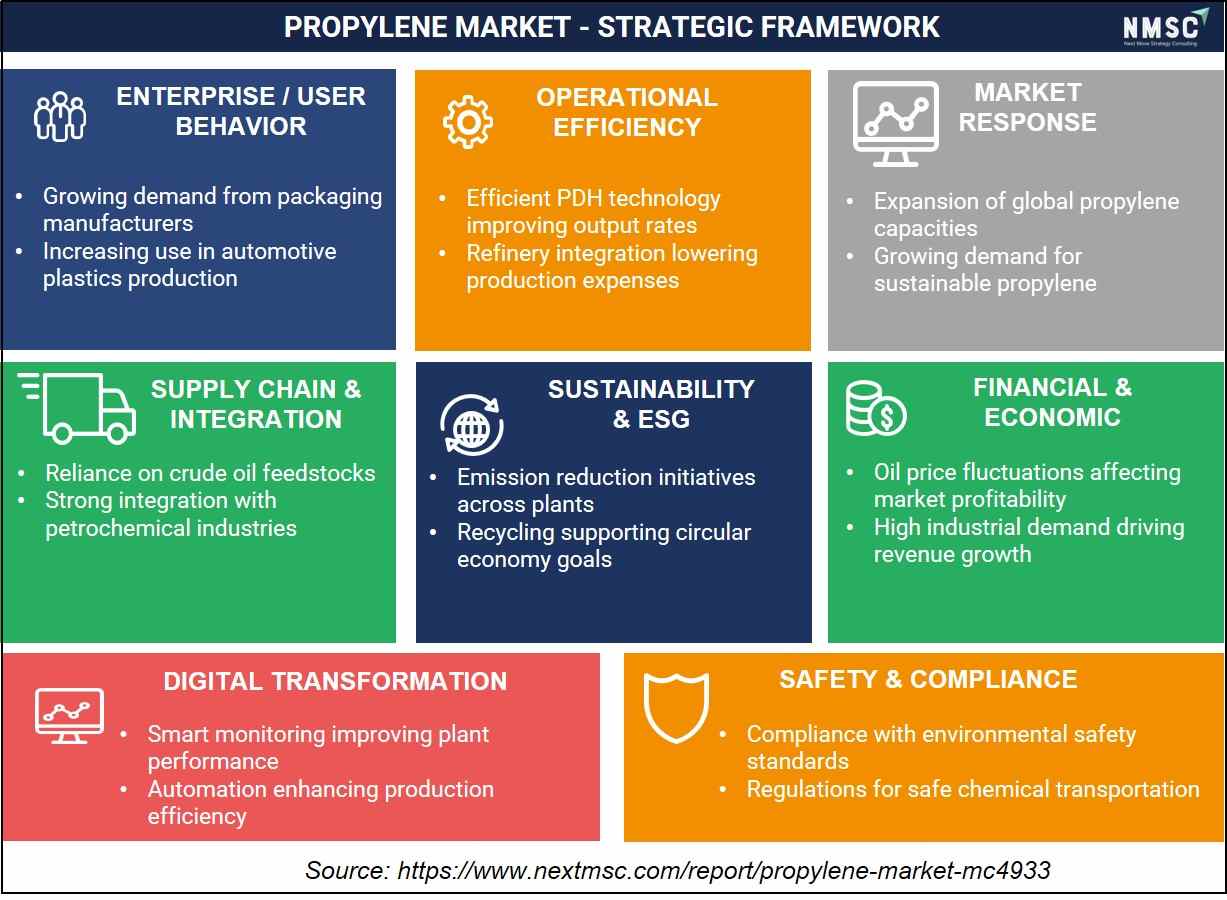
Our strategic assessment indicates that the propylene market is driven by strong demand from packaging, automotive, construction, and consumer goods industries. Operational efficiency improvements through PDH technology and refinery integration enhance competitiveness. Sustainability initiatives, recycling programs, and digital monitoring systems support long-term growth. Meanwhile, environmental regulations, feedstock price volatility, and expanding global production capacities continue shaping market development strategies.
Competitive Landscape
Competitive Dynamics and M&A Landscape
|
Key Takeaways |
Details |
|
Market Structure |
The Propylene Market features multi-tiered competition among global petrochemical majors (Sinopec, LyondellBasell, ExxonMobil), national oil companies (PetroChina, Reliance, Saudi Aramco via SABIC), and regional specialists, each competing on production cost, feedstock access, geographic presence, and derivative integration depth. |
|
Innovation Focus |
Innovation centers on propane dehydrogenation (PDH) process efficiency, bio-based propylene pathways, on-purpose production via MTO and CTO routes, and digitalized plant operations. Leading players are investing in catalyst development, carbon capture for steam crackers, and circular economy integration to align with ESG mandates. |
|
M&A Activity |
Strategic M&A is accelerating around PDH asset acquisitions, derivative integration through polypropylene capacity investments, and geographic expansion into high-growth markets in Southeast Asia and the Middle East. Private capital is also flowing into bio-based propylene startups and propylene oxide derivative complexes. |
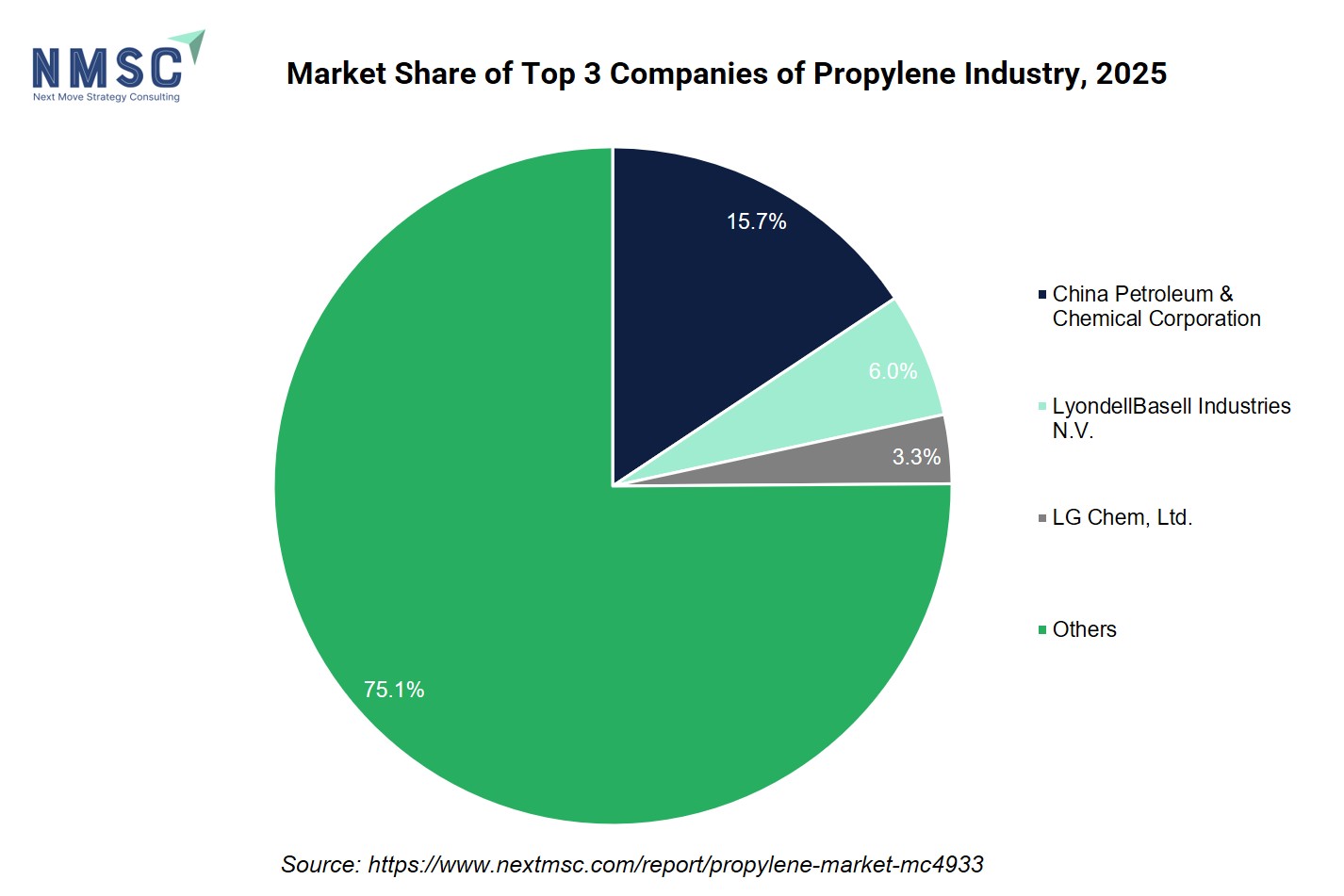
For the latest market share analysis and in-depth report on Propylene Industry insights, you can buy our latest report: Access the Report
How Do Companies Compete in the Propylene Market?
The Propylene Market is characterized by multi-tiered competition among global petrochemical majors, national oil companies, and regional independent producers. Competition occurs across production cost efficiency (driven by feedstock access and process technology), geographic market coverage, derivative integration depth, and sustainability credentials. Global majors including LyondellBasell, ExxonMobil, and Sinopec compete on scale economics and derivative margin capture. National oil companies including PetroChina, Reliance, SABIC, and ADNOC benefit from government-backed feedstock advantages and domestic market protection. Regional players such as Braskem, Formosa Petrochemical, and Lotte Chemical compete on geographic positioning and application-specific downstream integration.
Which Kind of Companies Dominate the Propylene Market?
Three distinct categories of companies dominate the Propylene Market. First, global integrated petrochemical majors including LyondellBasell Industries, ExxonMobil, Dow, Shell, and TotalEnergies leverage world-scale steam cracker and PDH assets to supply propylene to integrated polypropylene and derivative units. Second, national oil company-backed producers including China Petroleum and Chemical Corporation (Sinopec), PetroChina, Reliance Industries, SABIC, and PTT Global Chemical benefit from domestic energy policy support, state capital access, and captive domestic market positioning. Third, independent on-purpose propylene producers leveraging PDH and MTO technologies are a growing category, particularly in China and South Korea, competing on propylene purity and supply reliability for polymer-grade applications.
AI-Native Differentiation and Open Standards Drive Market Success in the Propylene Market
Innovation focus in the Propylene Market centers on PDH process catalyst improvements, bio-based propylene route commercialization, and digitalized production optimization. Companies investing in AI-based process control, predictive maintenance, and real-time energy optimization are achieving measurable cost reductions per ton of propylene produced. Open industry standards for carbon accounting, circular polymer certification, and supply chain traceability are differentiating players in European and North American markets where corporate sustainability mandates influence procurement decisions. Vendors that embed verifiable low-carbon credentials into propylene supply chains are commanding pricing premiums and securing long-term off-take agreements with sustainability-committed polymer converters.
Market Players to Opt for Merger and Acquisition Strategies to Expand Their Presence in the Propylene Market
Mergers and acquisitions are reshaping the Propylene Market's competitive structure, with strategic logic centered on PDH asset acquisition, derivative integration, and geographic diversification into high-growth markets. Private equity capital is flowing into mid-scale PDH facilities in the U.S. and Asia. Sinopec and PetroChina have engaged in domestic acquisition and capacity consolidation strategies aligned with China's petrochemical policy rationalization. International joint ventures for polypropylene and propylene oxide capacity, such as Borealis's Borouge partnership with ADNOC, illustrate horizontal integration strategies. INEOS's acquisition of propylene pipeline and storage infrastructure in the U.S. Gulf Coast strengthens its merchant market positioning in the North American propylene supply chain.
Key Market Players in the Propylene Market
-
China Petroleum and Chemical Corporation (Sinopec)
-
LyondellBasell Industries N.V.
-
Mitsubishi Chemical Group Corporation
- PetroChina Company Limited
-
Reliance Industries Limited
-
INEOS Group Limited
-
TotalEnergies S.E.
-
Saudi Basic Industries Corporation (SABIC)
-
Chevron Phillips Chemical Company LLC
-
Formosa Petrochemical Corporation
-
Dow Inc.
-
Advanced Petrochemical Company
-
Braskem S.A.
-
PTT Global Chemical Public Company Limited
-
Lotte Chemical Corporation
-
Mitsui Chemicals, Inc.
-
Borealis GmbH
-
Shell plc
What Are the Latest Developments in the Propylene Market Industry?
|
Date |
Event |
|
October 2025 |
Borealis upgraded its Integra recycling facility in Belgium with Borcycle advanced mechanical recycling technology, increasing production of high-quality recycled polypropylene and strengthening circular feedstock integration across the plastics value chain |
|
September 2025 |
China introduced a national plan targeting average annual growth exceeding 5% across its petrochemical and chemical industries during 2025–2026. The policy prioritizes expansion of high-end petrochemical products, including advanced polyolefins, alongside industrial innovation and chemical cluster development. The initiative supports continued investment across the propylene and polypropylene value chain. |
|
April 2025 |
LyondellBasell approved a major expansion project at its Channelview Complex near Houston, Texas, to increase propylene production capacity by approximately 400,000 metric tons annually. |
|
December 2024 |
LG Chem extended its joint development agreement with Gevo to accelerate commercialization of bio-propylene using Gevo’s Ethanol-to-Olefins (ETO) technology. |
What Are the Investment Opportunities in the Propylene Market?
Capital Inflows and Venture Activity
The Propylene Market continues to attract significant institutional and strategic capital, with investment concentrated in PDH capacity expansion, bio-based propylene R&D, and downstream polypropylene asset acquisitions. Our findings suggest that announced PDH project investments across China, India, and the United States exceeded USD 12 billion collectively in 2024 and 2025, reflecting producer confidence in long-cycle demand for on-purpose polymer grade propylene. U.S. Department of Energy loan program authority has been applied to support domestic chemical manufacturing competitiveness, including propylene-derivative production facilities aligned with industrial policy objectives. Private equity interest in mid-scale PDH facilities and propylene storage and pipeline infrastructure is increasing as secondary market transaction volumes for petrochemical assets grow.
Infrastructure Investment
Propylene infrastructure investment is a critical enabling layer for market growth, encompassing pipeline networks, marine terminal propylene refrigerated storage, and cracker-to-derivative conversion complexes. NMSC's analysis indicates that the U.S. Gulf Coast propylene pipeline system is undergoing capacity expansion by multiple operators to accommodate new PDH and cracker propylene volumes. Saudi Arabia's Ras Al-Khair industrial city and India's PCPIR zones are receiving multi-billion dollar infrastructure investment in propylene and derivative capacity. The International Energy Agency's petrochemical investment tracking data confirms that Asia accounts for over 60% of global planned petrochemical infrastructure capital expenditure through 2030, with propylene infrastructure as a core component.
ESG and Sustainable Propylene Investment
Environmental, Social, and Governance (ESG) considerations are reshaping propylene investment decisions globally. Carbon intensity reduction per ton of propylene produced is now a disclosed metric among major European and North American producers under GHG Protocol and TCFD frameworks. SABIC's sustainability reporting discloses specific propylene production carbon intensity targets, while LyondellBasell and Borealis have announced carbon-neutral polypropylene pilot programs. Bio-based propylene investment from TotalEnergies and Braskem attracts green bond financing aligned with ICMA Green Bond Principles. The EU Taxonomy Regulation's petrochemical criteria are increasingly influencing European investor allocation to propylene production assets, with lower-emission facilities commanding preferential financing rates.
Digital Transformation Investment
Digital transformation is an emerging investment category in the Propylene Market, with major producers allocating capital to AI-based process optimization, digital twin deployment, and industrial internet of things (IIoT) sensor networks at propylene production facilities. Sinopec and Shell have both publicly disclosed digital plant programs that include propylene cracker yield optimization systems. These investments improve propylene yield per unit of feedstock, reduce unplanned maintenance costs, and lower energy consumption per ton produced. The U.S. Department of Energy's Industrial Efficiency and Decarbonization Office provides grant support for energy efficiency projects at chemical plants, including propylene production facilities implementing advanced process control and AI-based optimization technologies.
Private Equity and Strategic M&A Activity
Private equity and strategic M&A activity in the Propylene Market is concentrated around PDH facility acquisitions, polypropylene asset consolidation, and bio-chemistry startup investments. Industrial investment firms are acquiring mid-scale PDH facilities in China's secondary cities where smaller state-owned producers are rationalizing assets. In North America, strategic buyers from Asia and the Middle East are acquiring propylene and polypropylene infrastructure positions, recognizing long-term supply chain positioning value. Our assessment indicates that bio-based propylene startups working on catalytic routes from bio-ethanol or lignocellulosic feedstocks are beginning to attract venture capital and corporate venture investment from major propylene producers seeking option value on long-term decarbonized supply chains.
Key Benefits for Stakeholders
For Propylene Producers and Petrochemical Companies
Propylene producers and petrochemical companies gain comprehensive, production-route-level market intelligence enabling capital allocation decisions across PDH, steam cracking, MTO, CTO, and bio-based propylene investment options. Our segmentation by grade, derivative, and sales model provides producers with evidence-based frameworks for evaluating captive versus merchant market optimization strategies. Regional and country-level demand forecasts enable capacity planning aligned with high-growth geographic markets. Competitive landscape analysis supports acquisition screening and partnership evaluation in derivative integration opportunities.
For Downstream Polymer and Chemical Converters
Downstream polymer converters and derivative chemical producers gain structured intelligence on propylene supply dynamics, grade-specific demand trends, and derivative market growth trajectories through 2035. Application-level analysis across packaging, automotive, healthcare, and electronics enables converters to align product development and capacity investment with end-market growth vectors. Competitive landscape and M&A analysis identifies potential supply chain integration partners and competitor positioning shifts, enabling strategic procurement and business development planning with analytical rigor.
For Investors and Financial Analysts
Investors and financial analysts access data-driven assessment of the Propylene Market's growth trajectory, segment-level CAGR analysis, regional revenue forecasts, and competitive dynamics through 2035. The derivative-level revenue forecast enables portfolio construction targeting high-growth subsegments including polypropylene, acrylic acid, and isopropanol derivatives. Company profiles of all 20 covered market participants, combined with latest development tracking, provide an early-signal intelligence framework for identifying acquisition targets, capacity expansion leaders, and at-risk incumbents within the global Propylene Market landscape.
For Government and Regulatory Bodies
Government agencies and industrial policy authorities gain structured assessment of how national propylene capacity policies, petrochemical investment incentive frameworks, and plastics regulation are influencing the Propylene Market's competitive dynamics and regional trade flows. Country-level insights provide policymakers with evidence-based perspectives on propylene supply security, domestic derivative value chain development, and trade policy implications. The regulatory analysis across EU plastics directives, U.S. EPA standards, and Asian industrial policy frameworks supports informed decision-making on propylene-related industrial strategy.
Key Market Segments
By Grade
-
Polymer Grade
-
Chemical Grade
-
Refinery Grade
-
Other Grade
By Production Route
-
Steam Cracking
-
Fluid Catalytic Cracking (FCC)
-
Propane Dehydrogenation (PDH)
-
Metathesis
-
Methanol to Olefins (MTO)
-
Coal to Olefins (CTO)
-
Other Routes
By Derivative
-
Polypropylene
-
Homo PP
-
Copolymer PP
-
Random
-
Block
-
-
-
Propylene Oxide
-
Polyether Polyols
-
Propylene Glycol
-
Glycol Ethers
-
-
Cumene
-
Phenol
-
Acetone
-
-
Acrylonitrile
-
Acrylic Fibers
-
ABS
-
Nitrile Rubber
-
-
Oxo Alcohols
-
n-Butanol
-
Isobutanol
-
2-Ethylhexanol
-
-
Isopropanol
-
Solvents
-
Pharma
-
Sanitizers
-
-
Acrylic Acid and Acrylates
-
SAP
-
Coatings
-
Adhesives
-
-
Other Derivatives
By Sales Model
-
Merchant
-
Captive
-
Tolling
By Application
-
Packaging
-
Rigid Packaging
-
Flexible Packaging
-
-
Automotive
-
Interior Components
-
Exterior Components
-
Under-the-hood Parts
-
-
Building and Construction
-
Insulation
-
Pipes and Fittings
-
Architectural Coatings
-
-
Textiles and Fibers
-
Apparel Fibers
-
Industrial Fibers
-
-
Consumer Products
-
Appliances
-
Household Goods
-
Personal Care
-
-
Healthcare
-
Medical Plastics
-
Disinfectants
-
Pharma Solvents
-
-
Electronics
-
Electronic Components
-
Equipment Housings
-
-
Industrial Applications
-
Industrial Solvents
-
Lubricants
-
Industrial Coatings and Adhesives
-
Other Industrial End Uses
-
-
Other Applications
By Region
-
North America: U.S., Canada, and Mexico
-
Europe: UK, Germany, France, Italy, Spain, Sweden, Denmark, Finland, the Netherlands, and the Rest of Europe
-
Asia-Pacific: China, India, Japan, South Korea, Taiwan, Indonesia, Vietnam, Australia, Philippines, Malaysia, and the Rest of APAC
-
Middle East and Africa (MEA): Saudi Arabia, UAE, Egypt, Israel, Turkey, Nigeria, South Africa, and the Rest of MEA
-
Latin America: Brazil, Argentina, Chile, Colombia, and the Rest of LATAM
Conclusion and Recommendations
Long-Term Outlook
The Propylene Market is entering a decade defined by geographic demand redistribution toward Asia, production route diversification led by PDH and MTO, and nascent commercialization of bio-based alternatives. The market is forecast to grow from USD 140.7 billion in 2026 to USD 200.7 billion by 2035, at a CAGR of 4.02%. From our analysis, this growth reflects the compounding of polymer demand growth across packaging, electronics, healthcare, and automotive applications with structural capacity investment cycles that are already contracted or under construction. Volume growth at 5.58% CAGR outpaces revenue growth, reflecting pricing dynamics in competitive commodity propylene segments moderated by high-value derivative market premiums.
Strategic Positioning Recommendations
Propylene producers should prioritize PDH capacity investment in markets with competitive propane feedstock access, particularly the U.S. Gulf Coast and India's western coast, where propane logistics and derivative converter demand intersect. Bio-based propylene investment should be positioned for commercial scale by 2028–2030 to align with European regulatory timelines and corporate sustainability procurement mandates. Derivative integration — particularly into polypropylene, propylene oxide, and acrylic acid — provides margin protection against commodity propylene pricing cycles. Digital transformation investment in AI-based process optimization offers measurable ROI in yield improvement and energy cost reduction that is increasingly a competitive differentiator in cost-driven propylene markets.
Investment Attractiveness
The Propylene Market represents an attractive long-cycle investment environment underpinned by durable polymer demand growth, diversifying production route economics, and derivative market premiums in healthcare, electronics, and specialty chemical applications. Our assessment indicates that the highest-conviction investment themes include PDH capacity additions (5.22% CAGR production route), Electronics application demand (5.53% revenue CAGR), Healthcare derivatives (4.50% CAGR), and bio-based propylene commercialization as an emerging premium segment. Investors should monitor PDH facility secondary market transactions, polypropylene converter acquisition opportunities in Southeast Asia, and corporate venture investments by major propylene producers into circular and bio-based chemistry startups through 2028.
Market Shifts and Key Risks
The most significant structural market shift underway is China's transition from an import-dependent propylene consumer to a net-export competitor through PDH, MTO, and CTO capacity additions, which will pressure producer margins in Asian propylene spot markets. The bio-based and circular propylene shift, while currently sub-scale, will accelerate from 2027 onward as European regulatory mandates and corporate sustainability commitments create binding demand for certified renewable propylene derivatives. Key risks include crude oil price volatility compressing steam cracker propylene economics, geopolitical disruption of propylene trade flows in the Middle East or Taiwan Strait, escalating plastics regulation reducing polypropylene market growth in Europe, and competition from alternative lightweight materials in automotive applications constraining polypropylene demand.
Growth Pathways
Organizations seeking to maximize value from the Propylene Market should pursue a three-horizon strategy. In the near term (2025–2027), prioritize PDH feedstock position, polypropylene capacity optimization, and derivative diversification toward healthcare and electronics applications. In the mid-term (2027–2031), invest in bio-based propylene pilot production, digital plant transformation, and geographic expansion into Southeast Asia and India to capture structural demand growth. In the long term (2031–2035), position for circular propylene integration — chemical recycling of polypropylene back to propylene monomer — as a premium value stream that aligns with Extended Producer Responsibility (EPR) frameworks emerging across Europe, North America, and major Asian markets.
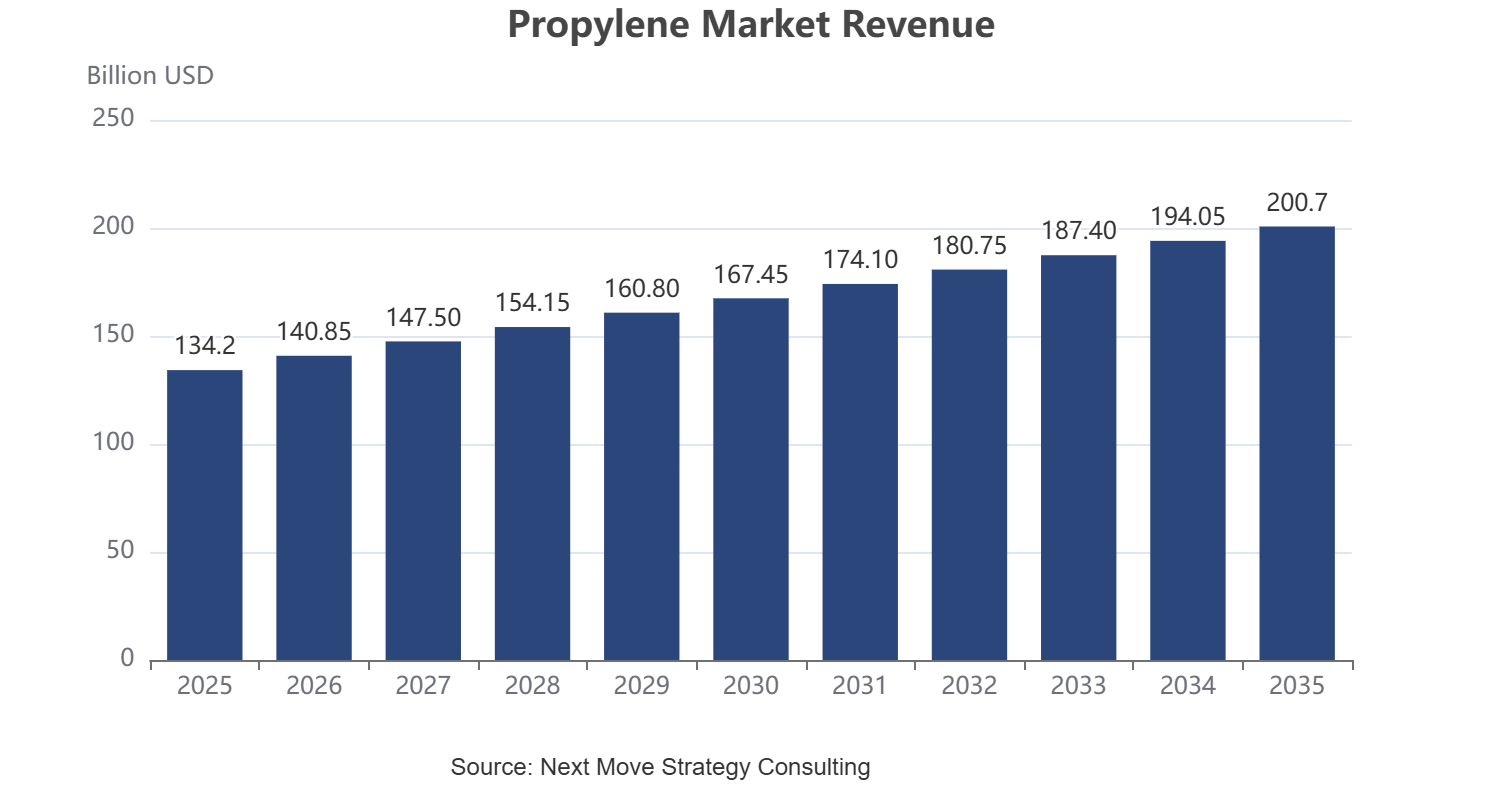
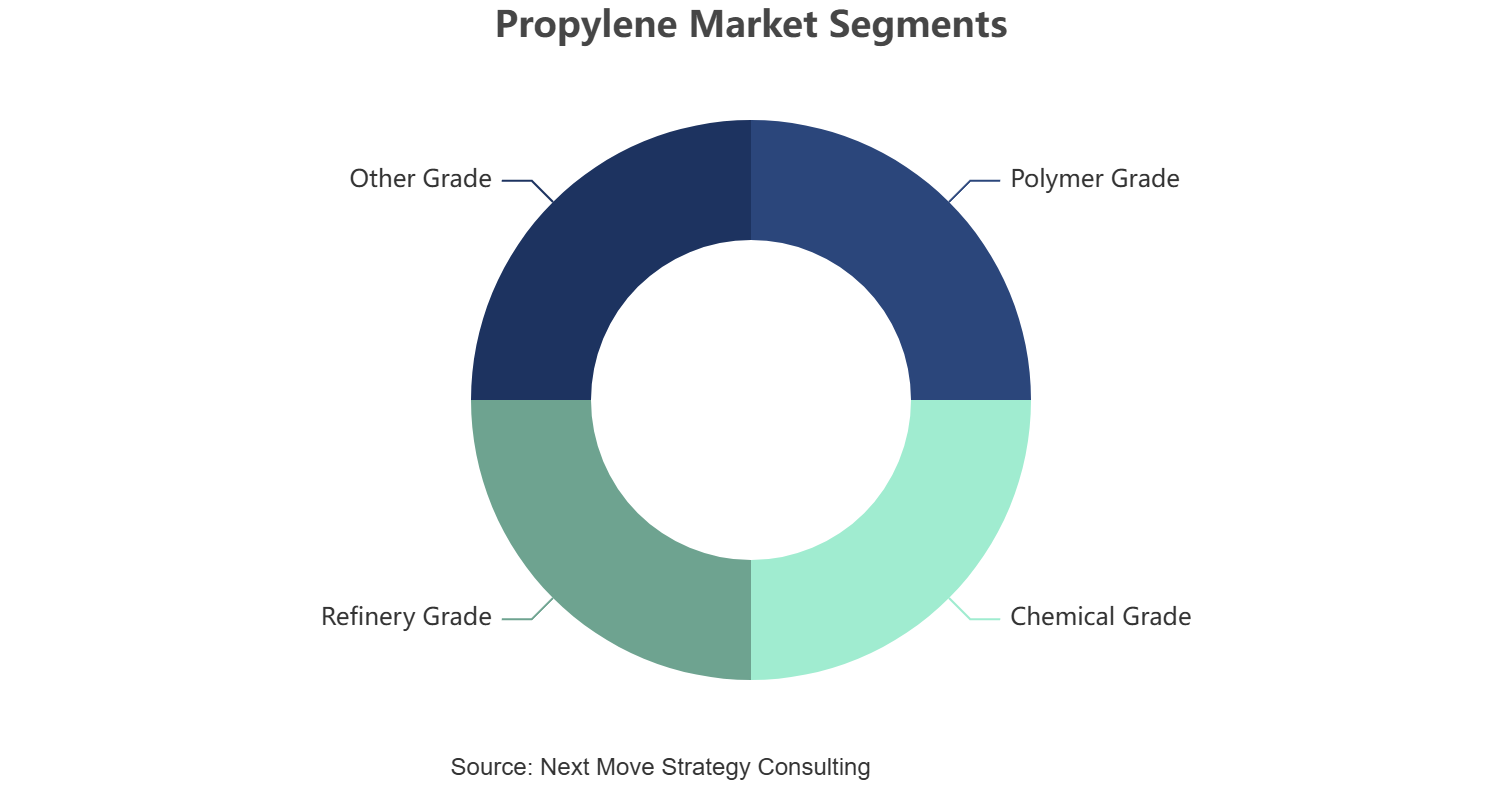
About the Author
 Saista Faiyaz
— Saista Faiyaz is Research Associate at Next Move Strategy Consulting, where she has covered consumer markets and healthcare technologies for 3 years. Her work includes primary interview review, secondary-source validation, market sizing, and structured analysis of company and industry data. She supports research by comparing evidence across sources, organizing findings into market narratives, and documenting assumptions used in analysis. Her scope includes cross-market benchmarking, and reports.
Saista Faiyaz
— Saista Faiyaz is Research Associate at Next Move Strategy Consulting, where she has covered consumer markets and healthcare technologies for 3 years. Her work includes primary interview review, secondary-source validation, market sizing, and structured analysis of company and industry data. She supports research by comparing evidence across sources, organizing findings into market narratives, and documenting assumptions used in analysis. Her scope includes cross-market benchmarking, and reports.
About the Reviewer
 Supradip Baul
— Supradip Baul is an accomplished business consultant and strategist with over a decade of rich experience in market intelligence, strategy, technology, and business transformation. His work has included rigorous qualitative and quantitative analysis across multiple industries, helping clients shape investment decisions and long-term roadmaps. Earlier in his career, he was associated with Gartner, where he contributed to industry-leading reports and market share analyses. He has worked with leading global companies and holds an MBA with a dual specialization in Marketing and Finance.
Supradip Baul
— Supradip Baul is an accomplished business consultant and strategist with over a decade of rich experience in market intelligence, strategy, technology, and business transformation. His work has included rigorous qualitative and quantitative analysis across multiple industries, helping clients shape investment decisions and long-term roadmaps. Earlier in his career, he was associated with Gartner, where he contributed to industry-leading reports and market share analyses. He has worked with leading global companies and holds an MBA with a dual specialization in Marketing and Finance.
At Next Move Strategy Consulting, we understand that insightful market research is the cornerstone of successful business decisions. That's why we employ a robust and multifaceted approach, combining various methodologies to deliver the most accurate and actionable data for our clients.

Research Landscape
We navigate the world of research with two primary approaches:
Qualitative Approach
Our qualitative research methodologies involve immersive techniques such as in-depth interviews, focus groups, and observational studies. By engaging directly with individuals and stakeholders, we uncover valuable insights that quantitative data alone may overlook.

Quantitative Research
In tandem with qualitative methodologies, NMSC leverages the power of Quantitative Research to provide a robust foundation of numerical insights. Through systematic data collection and analysis, we quantify patterns, preferences, and market trends, offering a comprehensive view of the business landscape.
Our quantitative research approach employs diverse tools, including surveys, experiments, and statistical modelling. These methodologies enable us to gather data from a large and representative sample, ensuring the statistical significance of our findings. By employing structured questionnaires and standardized data collection methods, we guarantee the reliability and validity of the information we present to our clients.
Quantitative research is particularly effective in measuring the prevalence of trends, assessing market size, and gauging the impact of various factors on consumer behavior. The numerical precision attained through this approach equips our clients with actionable insights, facilitating data-driven decision-making and strategy formulation.


Our Specialized Toolbox for Industry-Specific Market Research
We deploy a specialized arsenal of techniques tailored to meet your unique requirements. Here's a glimpse into our comprehensive toolbox:

Information Procurement
The stage entails acquiring market data or relevant information through various sources and methodologies.


Market Research Approach
We utilize both top-down and bottom-up approaches in market research analysis to achieve a comprehensive understanding of the market dynamics, leveraging the broad perspective of industry trends and macroeconomic factors alongside detailed insights from specific segments and individual companies.

Porters Five Forces Analysis
We conduct Porter's Five Forces analysis to evaluate the competitive landscape of an industry, providing us with insights into factors that affect profitability and strategic positioning.

SWOT Analysis

Forecasting
We utilize a forecasting model to predict future consumption by considering parameters like population, economics, regulations, market competition, drivers, constraints, technology, and pricing. We also employ statistical techniques such as multilinear regression, exponential smoothing, moving average, ARIMA, and Monte Carlo simulations for accurate predictions. In econometric forecasting, we analyzed short-term and long-term event impacts, attributing values based on regulatory frameworks, economic factors, and market events.





 Speak to Our Analyst