Fabric Detergent Market

Fabric detergent market size was USD 76.20 Bn in 2025 and is projected to reach USD 113.80 Bn by 2035, growing at a 4.1% CAGR from 2026 to 2035 worldwide.

Download Free Sample PDF
Base Year (2025)
$76.20 Billion
Forecast (2035)
$113.80 Billion
CAGR (2026-2035)
4.1%
Top Region
Asia-Pacific

What Is the Fabric Detergent Market Size?

The global fabric detergent sector size was valued at USD 76.20 billion in 2025 and is estimated at USD 79.30 billion in 2026, forecast to reach USD 113.80 billion by 2035, expanding at a 4.1% CAGR between 2026 and 2035. Asia-Pacific leads with approximately 44% share, while Liquid Detergent dominates all other product forms with approximately 42% share.

We observed that growth is broad-based across every segmentation axis, with unit-dose pods and e-commerce distribution driving the dominant structural shifts through 2035.

Fabric Detergent Market Revenue Forecast

Values in USD Billion

2025 $76.20 Billion
2025
2026 $79.32 Billion
2026
2027 $82.58 Billion
2027
2028 $85.96 Billion
2028
2029 $89.49 Billion
2029
2030 $93.16 Billion
2030
2031 $96.97 Billion
2031
2032 $100.95 Billion
2032
2033 $105.09 Billion
2033
2034 $109.40 Billion
2034
2035 $113.80 Billion
2035

Key Takeaways

By Product Form: Liquid Detergent held the largest share of approximately 42% (USD 32.00 billion) in 2025; Unit-Dose Pods and Tablets are the fastest-growing sub-segment at 9.3% CAGR from 2026–2035.

By Distribution Channel: Supermarkets and Hypermarkets held the largest share of approximately 48% (USD 36.58 billion) in 2025; E-Commerce is the fastest-growing sub-segment at 11.0% CAGR from 2026–2035.

By Application: Residential Laundry held the largest share of approximately 74% (USD 56.39 billion) in 2025; Commercial and Institutional Laundry is the fastest-growing sub-segment at 6.0% CAGR from 2026–2035.

By Wash Method: Machine Wash held the largest share of approximately 72% (USD 54.86 billion) in 2025; Machine Wash is also the fastest-growing sub-segment at 5.2% CAGR from 2026–2035.

By End User: Household Consumers held the largest share of approximately 77% (USD 58.67 billion) in 2025; Commercial Laundry Service Providers is the fastest-growing sub-segment at 6.0% CAGR from 2026–2035.

Dominant Region: Asia-Pacific dominated with approximately 44% revenue share (USD 33.53 billion) in 2025.

Fastest-Growing Region: Asia-Pacific is expected to register the highest CAGR of 5.1% during 2026–2035.

Dominant Country: China led with approximately USD 13.75 billion in 2025.

Fastest-Growing Country: India is the fastest-growing country at approximately 7.2% CAGR from 2026–2035.

Market Opportunity: The fabric detergent sector is expected to create an absolute dollar opportunity of USD 34.50 billion between 2026 and 2035, presenting significant investment potential across unit-dose pod manufacturing, cold-water enzyme formulation, and e-commerce distribution infrastructure.

According to NMSC analysis, multinational manufacturers are increasingly pairing proprietary enzyme licensing with sustainability-focused packaging redesign to defend premium pricing against private-label competition, a shift that favors brand-portfolio leaders over single-category regional producers as retailer and consumer demand for concentrated, low-dose formats accelerates through 2035.

What Does the Fabric Detergent Market Encompass?

The fabric detergent sector encompasses the manufacture and sale of liquid, powder, unit-dose pod and tablet, and bar detergent products formulated to clean textiles across residential, commercial, and industrial laundry applications. Our assessment indicates that the scope spans multinational consumer packaged goods manufacturers, regional detergent producers, and private-label suppliers serving household consumers and commercial laundry service providers within the broader fabric care and home care ecosystem worldwide.
Regulatory frameworks addressing phosphate content, microplastic restrictions, and biodegradability standards shape formulation strategy, with the EU Green Deal driving accelerated adoption of plant-derived surfactants and recyclable packaging across Europe. We observed that technology adoption is shifting toward cold-water enzymatic formulations and concentrated unit-dose formats that reduce packaging volume and shipping weight. NMSC's analysis indicates that this structural shift, combined with expanding e-commerce distribution and rising private-label competition, is redefining manufacturer prioritization across the fabric detergent sector.

Competitive Landscape

We observed that the fabric detergent market features a moderately concentrated competitive landscape, with multinational consumer packaged goods leaders competing alongside strong regional producers and expanding private-label suppliers on enzyme innovation, brand portfolio strength, and sustainability credentials across the industry.

Dimension Description
Market Structure Moderately concentrated at the premium tier; Procter & Gamble, Unilever, and Henkel collectively command approximately 60% of global market share, while regional producers and expanding private-label suppliers serve price-sensitive and localized demand.
Innovation Focus Cold-water enzymatic formulations, unit-dose pod expansion, and sustainable packaging redesign dominate current innovation pipelines across leading multinational manufacturers.
M&A Activity Active portfolio restructuring, exemplified by Reckitt Benckiser's divestiture of its Essential Homecare unit and Henkel's sale of its North American laundry brands to First Quality Enterprises.

How Do Companies Compete in the Fabric Detergent Market?

Companies compete primarily on enzyme innovation, brand portfolio strength, and sustainability credentials across the industry. Multinational leaders such as Procter & Gamble and Unilever leverage proprietary enzyme licensing and extensive brand portfolios to command premium retail positioning, while regional producers such as RSPL Group and Nice Group compete through cost efficiency and localized distribution reach serving price-sensitive consumer segments.

Which Competitive Archetypes Dominate the Fabric Detergent Industry?

Two archetypes dominate the market: multinational premium brand leaders investing heavily in formulation research and sustainability positioning, and regional value-tier producers competing on price and localized distribution. Procter & Gamble and Henkel exemplify the premium multinational archetype, while RSPL Group and Fabrica de Jabon La Corona exemplify the regional value-tier archetype serving domestically price-sensitive consumer bases.

How Are Companies Differentiating Through Innovation in Fabric Detergent Technology?

Innovation and differentiation strategy increasingly center on energy-efficient formulation and convenience-driven packaging. Henkel's cold-water enzymatic formulation launch and Unilever's Wonder Wash 15-minute wash cycle innovation both illustrate how multinational leaders pursue technical differentiation beyond basic cleaning claims. Our analysis shows that manufacturers unable to demonstrate credible formulation innovation risk losing premium shelf positioning as private-label and value-tier alternatives close the performance gap.

What M&A and Expansion Activity Is Shaping the Fabric Detergent Market?

Portfolio restructuring and targeted expansion continue to shape competitive positioning within the industry. Advent International's July 2025 agreement to acquire a majority stake in Reckitt's Essential Homecare unit and First Quality Enterprises' 2025 takeover of Henkel's North American brands both illustrate how multinational leaders are streamlining portfolios toward higher-margin categories, while Church & Dwight's November 2025 Ohio plant expansion demonstrates continued organic capacity investment.

Key Market Players

Our assessment indicates that the following 17 companies are actively shaping formulation strategy, brand portfolio management, and regional manufacturing capacity within the global fabric detergent market.

The Procter & Gamble Company Unilever PLC Henkel AG & Co. KGaA Church & Dwight Co., Inc. Reckitt Benckiser Group plc Kao Corporation Lion Corporation The Clorox Company S. C. Johnson & Son, Inc. Colgate-Palmolive Company LG H&H Co., Ltd. RSPL Group Pvt. Ltd. Jyothy Labs Limited Godrej Consumer Products Limited Nice Group Co., Ltd. Blue Moon Group Holdings Limited Fábrica de Jabón La Corona, S.A. de C.V.

Market Drivers & Dynamics

Interactive Dataset
Rising washing machine penetration in developing economies driver +1.4% Asia-Pacific, Latin America 2026-2035
Expanding e-commerce distribution infrastructure driver +1.1% Global 2026-2033
Growing demand for unit-dose and concentrated formats driver +0.9% North America, Europe 2026-2035
Rising urbanization and hygiene awareness in emerging markets driver +0.7% Asia-Pacific, Middle East & Africa 2026-2035
Premiumization through enzyme and cold-water technology driver +0.5% North America, Europe 2026-2032
Regulatory tightening on phosphates and microplastics restraint -0.6% Europe, North America 2026-2033
Intensifying private-label and value-tier price competition restraint -0.5% Global 2026-2035
Raw material and surfactant input cost volatility restraint -0.4% Global 2026-2032
Market maturity limiting volume growth in developed regions restraint -0.3% North America, Europe 2026-2035
Source: Next Move Strategy Consulting

Growth Drivers

What Is the Primary Growth Driver of the Fabric Detergent Market?

Rising washing machine penetration in developing economies is the primary driver of the market. Government economic development data across Asia-Pacific consistently shows household appliance ownership rising alongside per capita income growth, directly expanding the addressable population for machine-wash detergent formats. We observed that this structural shift, reinforced by continued urbanization across India and Southeast Asia, continues to anchor volume growth as more households transition from hand-wash bar detergent to machine-compatible liquid and powder formats.

How Is E-Commerce Expansion Driving Fabric Detergent Market Growth?

E-commerce expansion is accelerating market growth by providing manufacturers direct access to convenience-seeking consumers and enabling subscription-based replenishment models. Unilever's February 2025 rollout of its Wonder Wash liquid detergent across 20 global markets, engineered specifically for 15-minute wash cycles, became the company's fastest-growing home-care innovation. NMSC's analysis indicates that this digital-first launch strategy, combined with expanding online grocery penetration, is compressing the time-to-scale for new product introductions.

Growth Inhibitors

What Is Restraining Fabric Detergent Market Expansion?

Intensifying private-label and value-tier price competition restrains premium brand pricing power across the market. First Quality Enterprises' 2025 acquisition of Henkel's North American laundry brands illustrates how value-tier consolidation is expanding the competitive base challenging established multinational leaders. We found that manufacturers reliant solely on brand equity without corresponding formulation or sustainability differentiation face particular exposure, as price-sensitive consumers increasingly substitute toward private-label alternatives in mature, slow-growth markets.

What Are the Growth Opportunities?

How Can Cold-Water Enzyme Licensing Unlock Premium Differentiation?

Cold-water enzyme licensing presents a whitespace opportunity for manufacturers seeking to defend premium pricing against private-label competition. Companies that commercialize validated, energy-efficient enzymatic formulations stand to capture share from cost-conscious consumers who still prioritize cleaning performance, differentiating premium liquid and unit-dose product lines from value-tier alternatives.

Where Does Direct-to-Consumer Subscription Create New Demand for Manufacturers?

Subscription-based replenishment models represent an underpenetrated opportunity for manufacturers seeking recurring revenue outside traditional retail relationships. Companies that scale direct-to-consumer digital channels can secure predictable demand visibility, differentiating from competitors solely dependent on retailer negotiation cycles and promotional pricing pressure.

How Can Institutional Laundry Contracts Benefit Bulk Supply Manufacturers?

Hospitality, healthcare, and textile rental operators seeking reliable bulk supply create an opportunity for manufacturers offering dedicated institutional product lines. Early movers that secure long-term wholesale supply contracts can capture recurring, high-volume revenue, differentiating from retail-focused competitors exposed to greater price and promotional volatility.

Consumer Behavior Analysis of the Fabric Detergent Industry

Consumer Behavior Analysis of the Fabric Detergent Industry

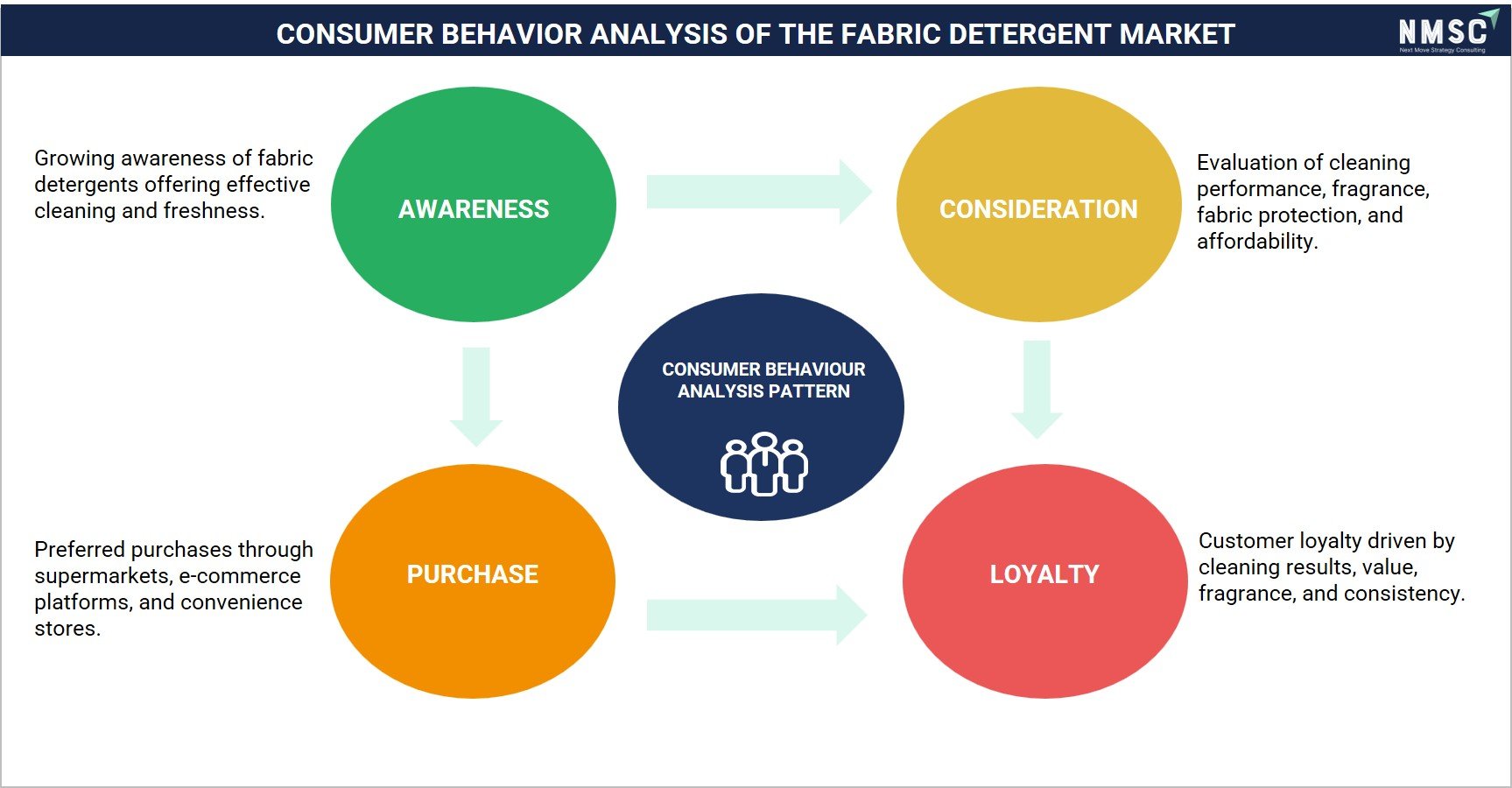
The above infographic presents a consumer behavior analysis of the fabric detergent market, mapping the journey from awareness to loyalty. Consumers are increasingly aware of detergents that offer effective cleaning and freshness, leading them to evaluate cleaning performance, fragrance, fabric protection, and affordability before purchasing through supermarkets, e-commerce platforms, or convenience stores. Loyalty is reinforced by consistent cleaning results, value, and preferred fragrance. Looking ahead, we observed that product performance and brand trust remain central to sustaining repeat purchases and long-term consumer engagement across the market.

Segmentation Analysis

2025 (USD Billion)
2035 (USD Billion)
Liquid detergent 2025: $32.00 Billion | 2035: $45.52 Billion
Liquid deter
Powder detergent 2025: $22.86 Billion | 2035: $25.04 Billion
Powder deter
Unit-dose pods and tablets 2025: $15.24 Billion | 2035: $35.28 Billion
Unit-dose po
Bar detergent 2025: $6.10 Billion | 2035: $7.96 Billion
Bar detergen
Liquid detergent $32.00 Billion $45.52 Billion 3.5%
Powder detergent $22.86 Billion $25.04 Billion 0.6%
Unit-dose pods and tablets $15.24 Billion $35.28 Billion 9.3%
Bar detergent $6.10 Billion $7.96 Billion 2.5%

Which Product Form Dominates the Fabric Detergent Market?

Liquid Detergent led the market with USD 32.00 billion in 2025, reflecting sustained consumer preference for dosing flexibility and effective performance across both machine and hand-wash applications. Our findings suggest that Unit-Dose Pods and Tablets is the fastest-growing product form, registering a 9.3% CAGR from 2026 to 2035, as manufacturers including Church & Dwight expand dedicated production capacity to meet rising demand for convenient, pre-measured formats.

2025 (USD Billion)
2035 (USD Billion)
Supermarkets
E-commerce
Convenience
Wholesale an
Segment Item 2025 (USD Billion) 2035 (USD Billion) CAGR
Supermarkets and hypermarkets $10.0 USD Billion $40.0 USD Billion 25.0%
E-commerce $17.1 USD Billion $51.1 USD Billion 19.0%
Convenience and drug stores $24.2 USD Billion $62.2 USD Billion 25.0%
Wholesale and institutional supply $31.3 USD Billion $73.3 USD Billion 19.0%

Segment-wise data is locked

Unlock complete segment-wise numbers for By Distribution Channel.

Unlock Full Data

Which Distribution Channel Leads Fabric Detergent Market Sales?

Supermarkets and Hypermarkets remained the leading distribution channel within the market, reaching USD 36.58 billion in 2025 as large-format retail continues anchoring bulk household purchasing across mature and developing markets alike, supported by broader detergent category shelf space. Based on research conducted by NMSC, we found that E-Commerce is the fastest-growing channel at an 11.0% CAGR from 2026 to 2035, reflecting expanding online grocery penetration and manufacturer-direct subscription replenishment models.

2025 (USD Billion)
2035 (USD Billion)
Residential
Commercial a
Industrial l
Segment Item 2025 (USD Billion) 2035 (USD Billion) CAGR
Residential laundry $10.0 USD Billion $40.0 USD Billion 18.0%
Commercial and institutional laundry $17.1 USD Billion $51.1 USD Billion 16.0%
Industrial laundry $24.2 USD Billion $62.2 USD Billion 22.0%

Segment-wise data is locked

Unlock complete segment-wise numbers for By Application.

Unlock Full Data

Which Application Leads Fabric Detergent Market Demand?

Residential Laundry remained the leading application within the market, valued at USD 56.39 billion in 2025 on sustained household consumption across both developed and emerging economies. Our findings suggest that Commercial and Institutional Laundry is the fastest-growing application, registering a 6.0% CAGR from 2026 to 2035, as hospitality, healthcare, and textile rental service providers expand operations and increasingly favor bulk institutional supply contracts over retail purchasing.

2025 (USD Billion)
2035 (USD Billion)
Machine wash
Hand wash
Segment Item 2025 (USD Billion) 2035 (USD Billion) CAGR
Machine wash $10.0 USD Billion $40.0 USD Billion 23.0%
Hand wash $17.1 USD Billion $51.1 USD Billion 25.0%

Segment-wise data is locked

Unlock complete segment-wise numbers for By Wash Method.

Unlock Full Data
2025 (USD Billion)
2035 (USD Billion)
Household co
Commercial l
Segment Item 2025 (USD Billion) 2035 (USD Billion) CAGR
Household consumers $10.0 USD Billion $40.0 USD Billion 26.0%
Commercial laundry service providers $17.1 USD Billion $51.1 USD Billion 16.0%

Segment-wise data is locked

Unlock complete segment-wise numbers for By End User.

Unlock Full Data

Growth Opportunities

Our analysis shows that three forward-looking opportunities stand out for stakeholders positioning within the fabric detergent sector over the 2026-2035 forecast period.

How Can Cold-Water Enzyme Licensing Unlock Premium Differentiation?

Cold-water enzyme licensing presents a whitespace opportunity for manufacturers seeking to defend premium pricing against private-label competition. Companies that commercialize validated, energy-efficient enzymatic formulations stand to capture share from cost-conscious consumers who still prioritize cleaning performance, differentiating premium liquid and unit-dose product lines from value-tier alternatives.

Where Does Direct-to-Consumer Subscription Create New Demand for Manufacturers?

Subscription-based replenishment models represent an underpenetrated opportunity for manufacturers seeking recurring revenue outside traditional retail relationships. Companies that scale direct-to-consumer digital channels can secure predictable demand visibility, differentiating from competitors solely dependent on retailer negotiation cycles and promotional pricing pressure.

How Can Institutional Laundry Contracts Benefit Bulk Supply Manufacturers?

Hospitality, healthcare, and textile rental operators seeking reliable bulk supply create an opportunity for manufacturers offering dedicated institutional product lines. Early movers that secure long-term wholesale supply contracts can capture recurring, high-volume revenue, differentiating from retail-focused competitors exposed to greater price and promotional volatility.

Ecosystem Analysis

Regional Outlook

2025 (USD Billion)
2035 (USD Billion)
North Americ
Europe
Asia-Pacific
Middle East
Latin Americ
Region 2025 (USD Billion) 2035 (USD Billion) CAGR (%)
North America $10.0 USD Billion $40.0 USD Billion 9.0%
Europe $17.1 USD Billion $51.1 USD Billion 27.0%
Asia-Pacific $24.2 USD Billion $62.2 USD Billion 25.0%
Middle East & Africa $31.3 USD Billion $73.3 USD Billion 23.0%
Latin America $38.4 USD Billion $84.4 USD Billion 12.0%

Regional data is locked

Unlock complete regional numbers for this market.

Unlock Full Data

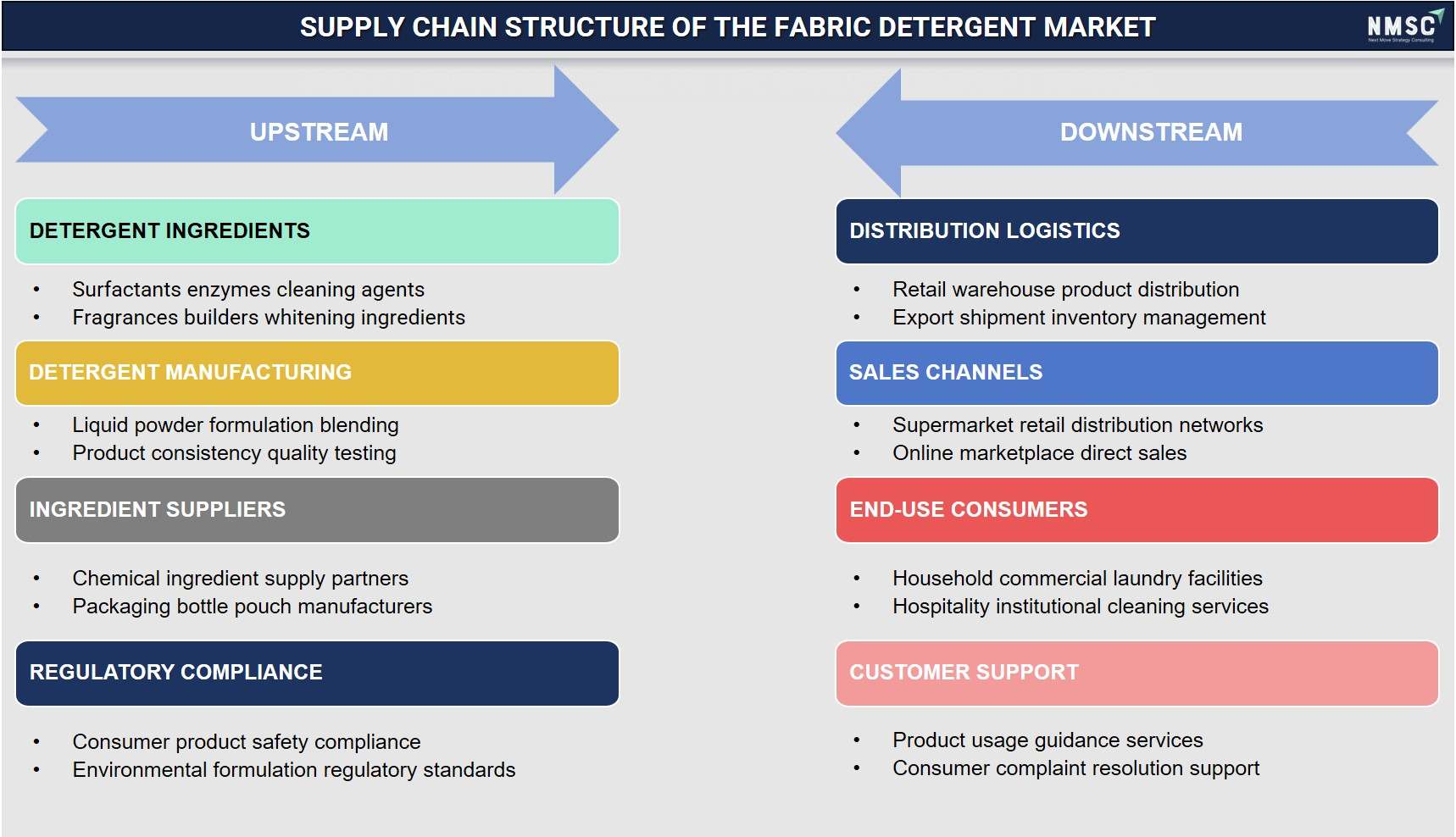
Supply Chain Structure of the Fabric Detergent Industry

Latest Developments

We found that recent milestones within the fabric detergent market are concentrated on formulation innovation and portfolio restructuring, reflecting the industry's balance between technical differentiation and competitive consolidation.

Date Event
July 2026 Lion announced two improved Acron laundry detergent formulations: Soft & Smooth Care and Sweat & Sebum Deep Clean Care, scheduled for nationwide launch in September 2026. The products target delicate-fabric protection, sweat/sebum removal, odor control, and improved fabric finish, directly strengthening Lion's position in fabric detergents.

April 2025 Henkel introduced more concentrated formulas and updated packaging across its All, Persil, and Snuggle liquid laundry products. The initiative increased detergent concentration per dose while reducing bottle size, directly enhancing the performance and format of products within the market.
Expert Insights

Saurav Palit

Saurav Palit

Head of Smart Cleaning & Washing at Henkel Consumer Brands | Henkel

"“Detergent, machine, sensors, algorithms – everything must work together perfectly. That’s why we not only collaborate across disciplines internally but also form external partnerships with various industries. We are creating a kind of washing ecosystem.”"

Analyst Interpretation

The statement highlights the shift of the Fabric Detergent Market toward intelligent, targeted, and connected laundry-care solutions. NMSC's analysis indicates that detergent innovation is increasingly moving beyond conventional formulations toward systems that integrate chemistry with smart washing technologies. Connected machines, automated dosing, sensor-based load analysis, and formulation optimization are expected to improve cleaning performance while reducing detergent, water, and energy consumption, creating new opportunities for high-performance fabric detergent products.

Investment Opportunities

What Capital Inflows Are Targeting the Fabric Detergent Industry?

Capital inflows into the fabric detergent market are increasingly directed toward formulation research and unit-dose manufacturing capacity. Henkel's USD 70 million Connecticut research center and Church & Dwight's USD 28 million Ohio plant expansion illustrate continued strategic capital deployment toward both innovation and production scale. We observed that investors favor manufacturers demonstrating validated enzyme technology and format innovation, viewing these as proxies for sustained premium pricing power.

How Significant Is Infrastructure Investment in the Fabric Detergent Industry?

Infrastructure investment tied to unit-dose production lines and e-commerce fulfillment capability is a critical enabler of fabric detergent market scalability. Church & Dwight's dedicated power pack production line addition illustrates the manufacturing infrastructure investment required to meet shifting format demand. Our assessment indicates that manufacturers increasingly condition capacity expansion decisions on confirmed retailer shelf commitments and e-commerce distribution partnerships.

What ESG Considerations Are Shaping Fabric Detergent Investment?

Environmental, social, and governance considerations directly shape fabric detergent investment through biodegradability, packaging, and energy-efficiency priorities. Henkel, Unilever, and Reckitt's investments in recyclable packaging and plant-derived surfactants directly respond to EU Green Deal sustainability mandates. NMSC's analysis indicates that cold-water formulation technology, which reduces household energy consumption during washing, is increasingly framed as a consumer-facing sustainability benefit that supports both regulatory compliance and premium brand positioning.

Key Benefits for Stakeholders

How Does This Report Benefit Consumer Packaged Goods Industry Leaders?

Consumer packaged goods industry leaders gain access to validated segmentation, product form benchmarking, and regional regulatory analysis that supports fabric detergent portfolio strategy decisions. The report's product form and distribution channel breakdowns help executives evaluate liquid, powder, and unit-dose investment priorities against evolving retail and e-commerce dynamics, supporting more informed decisions across premium and value-tier product lines.

How Does This Report Benefit Investors and Financial Analysts?

Investors and financial analysts benefit from consolidated market sizing, regional growth forecasts, and competitive positioning data that inform capital allocation across the fabric detergent value chain. The report's country-level revenue estimates and growth catalyst matrix support due diligence on multinational leaders, regional producers, and private-label suppliers positioned to capture forecast demand growth through 2035.

How Does This Report Benefit Technology Vendors and Product Teams?

Technology vendors and product teams gain competitive intelligence on enzyme formulation trends, packaging sustainability requirements, and recent developments among the 17 companies profiled. This supports product roadmap decisions around cold-water technology, unit-dose format expansion, and e-commerce-optimized packaging aligned with the fastest-growing product form and regional segments identified in this report.

Key Market Segments Evaluated

By Product Form

  • Liquid detergent
  • Powder detergent
  • Unit-dose pods and tablets
  • Bar detergent

By Distribution Channel

  • Supermarkets and hypermarkets
  • E-commerce
  • Convenience and drug stores
  • Wholesale and institutional supply

By Application

  • Residential laundry
  • Commercial and institutional laundry
  • Industrial laundry

By Wash Method

  • Machine wash
  • Hand wash

By End User

  • Household consumers
  • Commercial laundry service providers

By Region

  • North America 
    • U.S.
    • Canada
    • Mexico.
  • Europe 
    • UK
    • Germany
    • France
    • Italy
    • Spain
    • Sweden
    • Denmark
    • Finland
    • Netherlands
    • Rest of Europe.
  • Asia-Pacific 
    • China
    • India
    • Japan
    • South Korea
    • Taiwan
    • Indonesia
    • Vietnam
    • Australia
    • Philippines
    • Malaysia
    • Rest of APAC.
  • Middle East & Africa 
    • Saudi Arabia
    • UAE
    • Egypt
    • Israel
    • Turkey
    • Nigeria
    • South Africa
    • Rest of MEA.
  • Latin America 
    • Brazil
    • Argentina
    • Chile
    • Colombia
    • Rest of LATAM.

Conclusion & Recommendations

The long-term outlook for the fabric detergent market remains structurally positive, supported by a USD 34.50 billion absolute dollar opportunity between 2026 and 2035 and sustained washing machine penetration growth across emerging economies. We found that Liquid Detergent will continue commanding the largest revenue share while Unit-Dose Pods and Tablets gain disproportionate share as convenience-driven format innovation reshapes purchasing patterns through the forecast period.

What Strategic Positioning Should Stakeholders Pursue?

Stakeholders should pursue strategic positioning that combines proprietary enzyme innovation with expanding e-commerce and unit-dose capability to defend premium pricing against private-label competition. NMSC's analysis indicates that manufacturers bundling formulation differentiation with sustainability-linked packaging are best positioned to capture durable, premium-tier revenue across the fabric detergent market.

How Attractive Is the Fabric Detergent Market for New Investment?

The fabric detergent industry presents a moderately attractive investment case, supported by a USD 34.50 billion absolute dollar opportunity between 2026 and 2035 and above-average growth in Asia-Pacific and unit-dose product categories. We found that investment attractiveness is highest for manufacturers combining validated formulation technology with strong regional distribution reach, positioning them to capture both premiumization in developed markets and volume growth in emerging economies.

What Market Shifts and Key Risks Should Stakeholders Monitor?

Stakeholders should monitor intensifying private-label competition, regulatory tightening on phosphates and microplastics, and market maturity constraining volume growth in developed regions as key risks to the fabric detergent market. Our analysis shows that manufacturers unable to demonstrate credible formulation and sustainability differentiation risk losing shelf space to private-label alternatives, particularly following recent portfolio consolidation activity among established brand owners.

What Are the Key Growth Pathways for the Fabric Detergent Industry?

Key growth pathways include scaling unit-dose and concentrated format production, expanding e-commerce and subscription-based distribution, and deepening penetration into commercial and institutional laundry contracts. NMSC's analysis indicates that manufacturers pursuing these pathways while maintaining formulation innovation investment will be best positioned to capture the fabric detergent market's projected growth through 2035.

FAQs

About the Author

Mayurima Roy

Mayurima Roy

Mayurima Roy is Research Analyst at Next Move Strategy Consulting, where she has spent 4 years working across the firm's full industry coverage rather than a single fixed vertical. Her work centers on structured research, ongoing trend tracking, competitive assessment, and insight-led content development, translating complex market data into clear, decision-ready narratives that support informed client decision-making across diverse global industries, market sectors, and world regions every day.

About the Reviewer

Supradip Baul

Supradip Baul

Supradip Baul is an accomplished business consultant and strategist with over a decade of rich experience in market intelligence, strategy, technology, and business transformation. His work has included rigorous qualitative and quantitative analysis across multiple industries, helping clients shape investment decisions and long-term roadmaps. Earlier in his career, he was associated with Gartner, where he contributed to industry-leading reports and market share analyses. He has worked with leading global companies and holds an MBA with a dual specialization in Marketing and Finance.

Download Free Sample

Gustaf Hummel Burstrom

GUSTAF HUMMEL BURSTROM

Founder

Revline Tools AB

Joseph and the team at Next Move Strategy Consulting have been excellent to work with, in supplying us with relevant market data and forecasts for our specific category. We had some special requirements and they were able to do a custom package to suit our needs. We would definitely recommend them to any other company needing market data and forecasts

Henri Knyphausen

HENRI KNYPHAUSEN

Partner at Singulier [Ex-BCG]

Singulier

I recently engaged NEXTMSC.com for a commercial due diligence project within the intralogistics sector, and I am pleased to provide a reference based on my experience. In utilizing NEXTMSC.com's services, I found their report to offer valuable insights into market dynamics and key industry players. The initial report provided a solid foundation for our analysis. However, as we were investigating a smaller target in the market, and I had specific customization requests requiring additional research. These requests included detailed information on product portfolios of various players and sub-market sizes, both inclusive and exclusive of certain product categories. NEXTMSC.com demonstrated commendable responsiveness and agility in accommodating these customization requests. Within a timeframe of 1-2 weeks, they delivered a revised report that met our specific needs. Furthermore, they were receptive to my follow-up inquiries, ensuring clarity and understanding of the data provided. The final deliverable significantly contributed to our due diligence efforts. One of NEXTMSC.com's notable strengths lies in their qualitative research capabilities. However, for future engagements, I would recommend the inclusion of a quantified market model in Excel format. Such a model would offer the ability to conduct in-depth analyses and explore various market segments, including country-specific data and subcomponent breakdowns. Based on my positive experience, I would not hesitate to work with NEXTMSC.com again. Their responsiveness, willingness to accommodate customization requests, and commitment to delivering actionable insights make them a reliable partner for commercial research projects.

Gaurav Jaiswal

GAURAV JAISWAL

Founder & CEO

Yano Charge Private Limited

The EV Charging market research report provided by the NextMSC was exceptionally detailed and insightful. It offered a comprehensive analysis that proved to be a game-changer for our strategic planning. Truly a testament to the NextMSC’s expertise and thoroughness in EV market landscape & analysis.

Kevin Coker

KEVIN COKER

Founder, CEO and Board Diector

Proxima Clinical Research

I have been using Next MSC reports for product positioning in a new geography for a long time. They have by far the best reports I have found and the price is reasonable too!

Robert Sean Trevino

ROBERT SEAN TREVINO

Sr. Director, Head of Strategic Insights & Analytics

Foundation Medicine

I realized that it was a reliable source of information. These days, there are many people who are looking for authentic data, and this is one of the only sources that can offer them with what they need;

Custom Market Research Services

We will customize the research for you if the listed report does not fully match your requirements.

Get 30% Free Customization

Select License

This website uses cookies to ensure you get the best experience on our website. Learn more

✖