Singapore Fabric Care Market By Product Type (Fabric Detergents, Fabric Softeners/Conditioners, Stain Removers/Bleach, Sanitizer, and Other Products), By Form (Liquid, Powder, Unit Dose, Sheet & Wipe, Spray), By Nature (Conventional, Eco-friendly/Organic) By Price Tier (Value, Mid-range, Premium), By Distribution Channel [Online (Marketplaces, Brand e-commerce, Quick Commerce) and Offline] By End-User (Residential, Commercial, Others) – Opportunity Analysis & Industry Forecast, 2025–2030
Industry: Materials and Chemical | Latest Edition: September 30, 2026 | No of Pages: 154 | No. of Tables: 49 | No. of Figures: 43 | Format: PDF | Report Code: MC4567
Industry Outlook
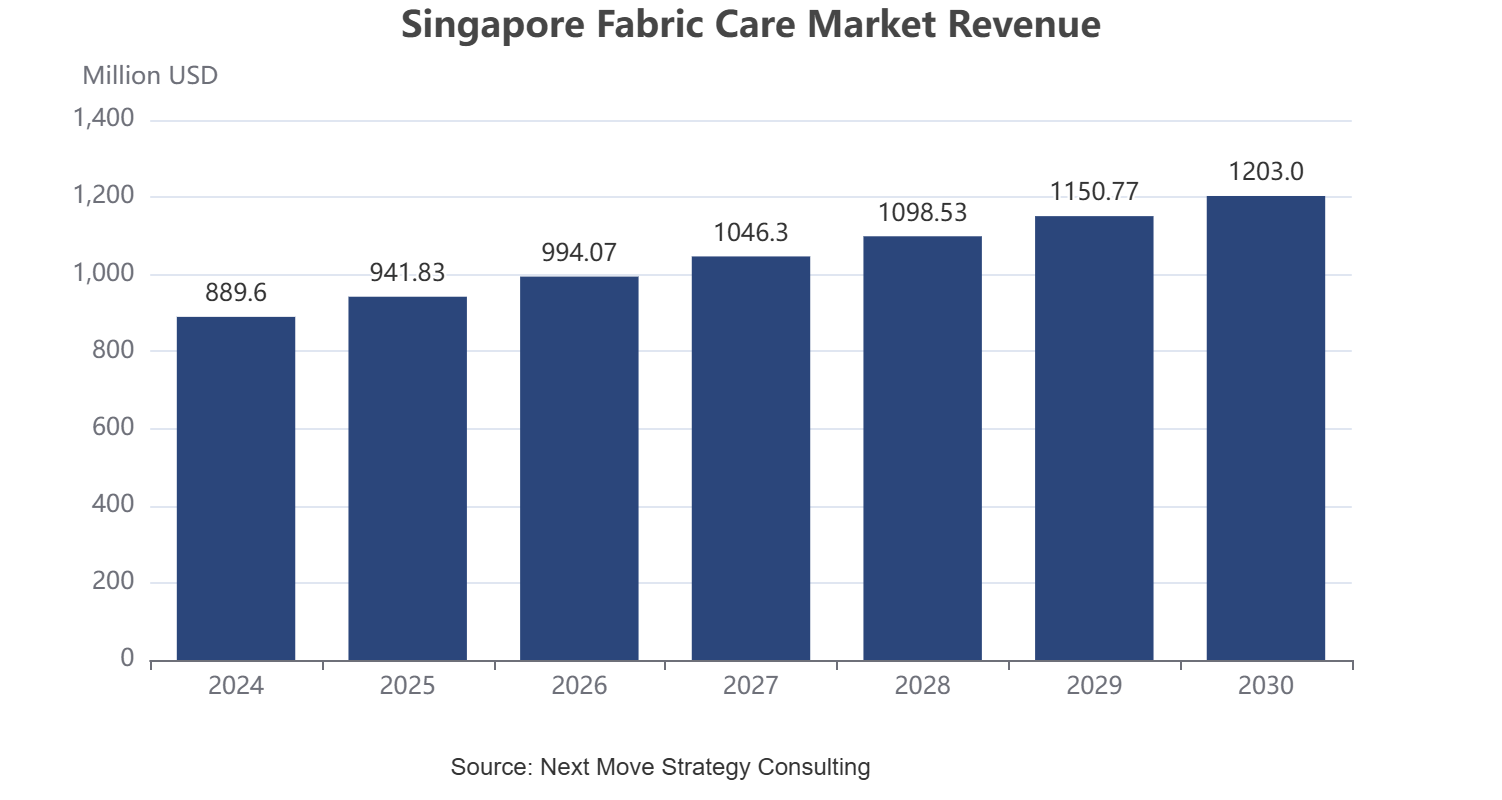
The Singapore Fabric Care Market was valued at USD 889.6 million in 2024 and is projected to grow to USD 970.2 million in 2025. The market is expected to reach USD 1203.0 million by 2030, registering a CAGR of 4.40% from 2025 to 2030.
The fabric care market in Singapore continues to grow steadily, supported by a strong consumer focus on hygiene, premiumization, and sustainability. High urban density, advanced retail infrastructure, and increasing digital shopping adoption are reshaping product access and engagement. Consumers are shifting toward eco-friendly and high-performance formulations, while premium and specialized products are gaining traction among urban households. Despite competitive pressures from international and regional brands, innovation and sustainability-focused marketing are driving category growth. The market remains competitive yet dynamic, with companies leveraging digital platforms and product innovation to meet evolving lifestyle and environmental demands.
Increasing Environmental Awareness and Government-Led Sustainability Drives the Fabric Care Market Growth
Increasing environmental awareness and government-led sustainability initiatives are significantly shaping Singapore’s fabric care market. Consumers are becoming more mindful of the ecological impact of their daily choices, favoring biodegradable, low-water, and plant-based detergents that align with the nation’s green living goals. Manufacturers are actively innovating with phosphate-free and concentrated formulations, recyclable or refillable packaging, and transparent ingredient labeling to meet these expectations. The surge in demand for eco-certified and low-carbon footprint products underscores the shift toward responsible consumption. This evolving preference not only strengthens consumer trust and brand loyalty but also offers long-term competitive advantages for companies embracing sustainability at the core of their operations.
Rapid Innovation in Product Technology Boosts the Market Growth
Rapid innovation in product technology is revolutionizing Singapore’s fabric care industry. Major brands are leveraging scientific advancements to create next-generation detergents featuring multi-functional cleaning, fragrance retention, and enhanced fabric care. The adoption of enzyme-rich and micro-encapsulated formulations has improved stain removal, color longevity, and softness while maintaining fabric integrity. The popularity of unit-dose pods, quick-dissolving sheets, and eco-efficient liquid concentrates reflects consumers’ preference for convenience and performance. Moreover, the introduction of sanitizing and all-in-one laundry solutions addresses heightened hygiene concerns in urban households. These ongoing advancements not only meet evolving lifestyle demands but also enable brands to maintain market relevance and differentiation in Singapore’s competitive premium care segment.
Sustainability and Innovation Create Lucrative Growth Opportunities in the Singapore Fabric Care Market
Singapore’s strong national commitment to sustainability and the circular economy opens substantial opportunities for fabric care companies. Manufacturers are developing eco-certified detergents, refillable and concentrated formats, and biodegradable fabric softeners that appeal to environmentally responsible consumers. The growing adoption of smart packaging, subscription-based laundry solutions, and digital retail integration allows brands to enhance engagement and improve consumer convenience. Additionally, the demand for specialty and hypoallergenic products tailored for sensitive skin is expanding the premium segment. By combining advanced cleaning technologies with verifiable sustainability credentials, companies tap into Singapore’s tech-savvy, eco-conscious market. This dual focus on innovation and responsibility positions leading players for long-term competitive success.
Sustainability and Product Diversification Create Growth Opportunities in the Singapore Fabric Care Market
The increasing emphasis on sustainable living and innovation is unlocking significant growth opportunities in Singapore’s fabric care market. As consumers become more environmentally conscious, there is rising demand for biodegradable detergents, plant-based softeners, and water-efficient or concentrated laundry solutions that align with eco-friendly lifestyles. Companies are also expanding into specialized segments with anti-allergen detergents, color-care formulations, and fabric protection products tailored to Singapore’s humid climate. Moreover, innovative delivery formats such as detergent sheets, refill pouches, and subscription-based laundry services are gaining traction among tech-savvy and convenience-driven consumers. By integrating sustainability with advanced product performance, brands strengthen market penetration, enhance customer loyalty, and establish long-term growth in Singapore’s competitive and eco-aware marketplace.
Competitive Landscape
The market players operating in the Singapore fabric care industry include Reckitt Benckiser Group plc, Unilever Limited, Kao Corporation, S. C. Johnson & Son, Inc., Lion Corporation, Colgate Palmolive, Wipro Consumer Care & Lighting Ltd., Patanjali Ayurved Limited, Modicare, Amway Corp., Croda International Plc, BASF SE, Clariant AG, Solvay SA, and Novonesis.
Singapore Fabric Care Market Key Segments
By Product Type
-
Fabric Detergent
-
General Purpose
-
Baby Laundry Detergent
-
Delicate Laundry Detergent
-
-
Fabric Softeners/Conditioners
-
Stain Removers/Bleach
-
Sanitizer
-
Other Products
By Form
-
Liquid
-
Powder
-
Unit Dose
-
Pods
-
Sachets
-
-
Sheet & Wipe
-
Spray
By Nature
-
Conventional
-
Eco-friendly / Organic
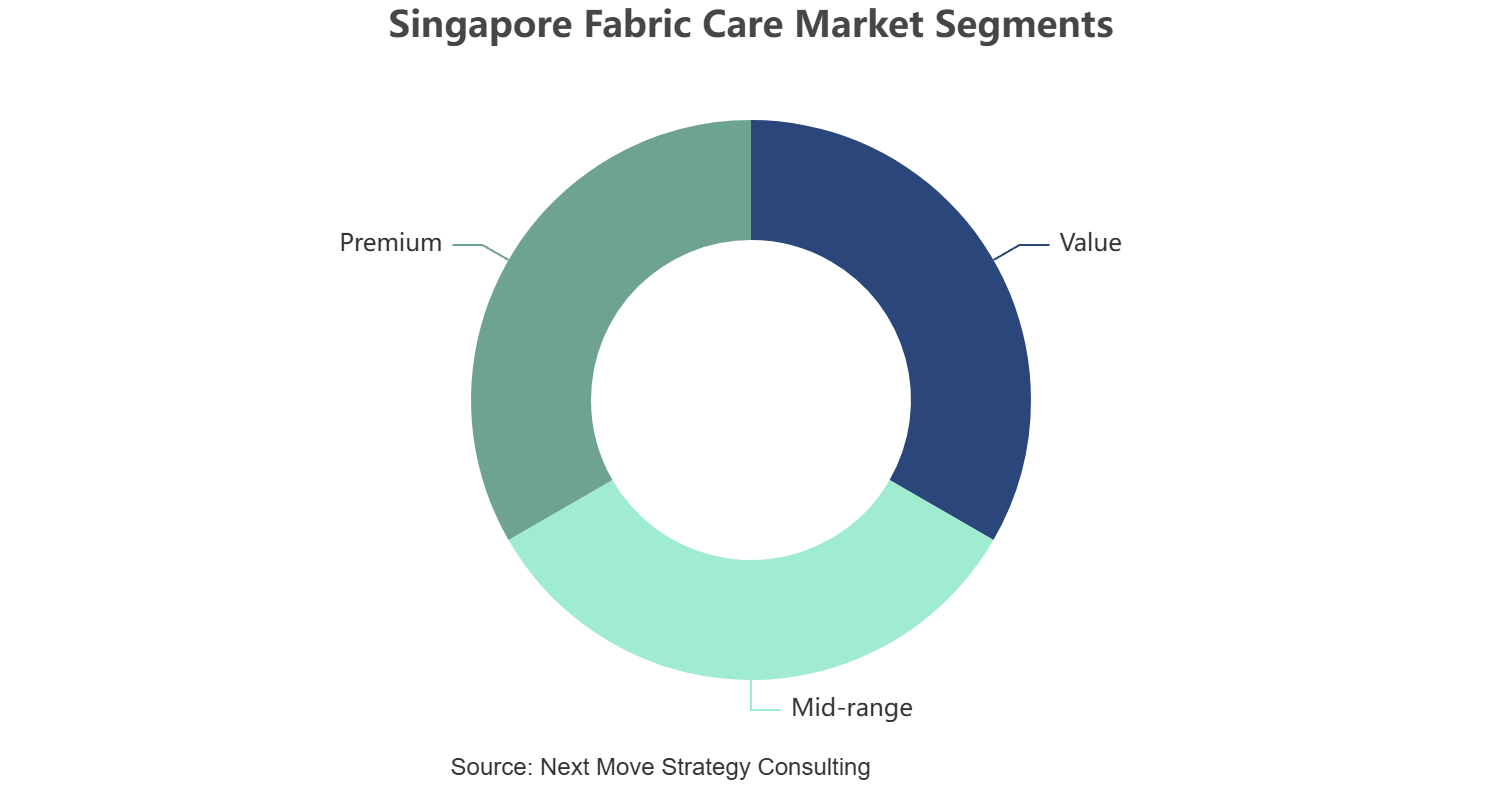
By Price Tier
-
Value
-
Mid-range
-
Premium
By Distribution Channel
-
Online
-
Marketplaces
-
Brand e com
-
Quick Commerce
-
-
Offline
-
Supermarkets
-
Hypermarkets
-
Department Stores
-
By End-User
-
Residential
-
Commercial
-
Others
Key Players
-
Kao Corporation
-
Novonesis
-
S. C. Johnson & Son, Inc.
-
Modicare
-
Lion Corporation
-
Patanjali Ayurved Limited
-
Amway Corp.
-
Croda International Plc
-
Colgate Palmolive
-
BASF SE
-
Wipro Consumer Care & Lighting Ltd.
-
Clariant AG
-
Solvay SA
Report Scope and Segmentation
|
Parameters |
Details |
|
Market Size in 2025 |
USD 970.2 Million |
|
Revenue Forecast in 2030 |
USD 1203.0 Million |
|
Growth Rate |
CAGR of 4.40% from 2025 to 2030 |
|
Analysis Period |
2024–2030 |
|
Base Year Considered |
2024 |
|
Forecast Period |
2025–2030 |
|
Market Size Estimation |
Million (USD) |
|
Growth Factors |
|
|
Companies Profiled |
15 |
|
Market Share |
Available for 10 companies |
|
Customization Scope |
Free customization (equivalent up to 80 working hours of analysts) after purchase. Addition or alteration to country, regional, and segment scope. |
|
Pricing and Purchase Options |
Avail customized purchase options to meet your exact research needs. |
About the Author
 Tushmi Dutta
— Tushmi Dutta is a focused researcher specializing in detailed analysis and insight-driven research across diverse business landscapes. She supports strategic initiatives through structured data interpretation, thorough validation, and clear communication of findings that aid informed decision-making. With a strong interest in writing, she enjoys presenting research insights in an engaging and accessible manner. Beyond work, she enjoys traveling, reading, painting, and continuously learning new skills that contribute to her creative and professional growth.
Tushmi Dutta
— Tushmi Dutta is a focused researcher specializing in detailed analysis and insight-driven research across diverse business landscapes. She supports strategic initiatives through structured data interpretation, thorough validation, and clear communication of findings that aid informed decision-making. With a strong interest in writing, she enjoys presenting research insights in an engaging and accessible manner. Beyond work, she enjoys traveling, reading, painting, and continuously learning new skills that contribute to her creative and professional growth.
About the Reviewer
 Supradip Baul
— Supradip Baul is an accomplished business consultant and strategist with over a decade of rich experience in market intelligence, strategy, technology, and business transformation. His work has included rigorous qualitative and quantitative analysis across multiple industries, helping clients shape investment decisions and long-term roadmaps. Earlier in his career, he was associated with Gartner, where he contributed to industry-leading reports and market share analyses. He has worked with leading global companies and holds an MBA with a dual specialization in Marketing and Finance.
Supradip Baul
— Supradip Baul is an accomplished business consultant and strategist with over a decade of rich experience in market intelligence, strategy, technology, and business transformation. His work has included rigorous qualitative and quantitative analysis across multiple industries, helping clients shape investment decisions and long-term roadmaps. Earlier in his career, he was associated with Gartner, where he contributed to industry-leading reports and market share analyses. He has worked with leading global companies and holds an MBA with a dual specialization in Marketing and Finance.
At Next Move Strategy Consulting, we understand that insightful market research is the cornerstone of successful business decisions. That's why we employ a robust and multifaceted approach, combining various methodologies to deliver the most accurate and actionable data for our clients.

Research Landscape
We navigate the world of research with two primary approaches:
Qualitative Approach
Our qualitative research methodologies involve immersive techniques such as in-depth interviews, focus groups, and observational studies. By engaging directly with individuals and stakeholders, we uncover valuable insights that quantitative data alone may overlook.

Quantitative Research
In tandem with qualitative methodologies, NMSC leverages the power of Quantitative Research to provide a robust foundation of numerical insights. Through systematic data collection and analysis, we quantify patterns, preferences, and market trends, offering a comprehensive view of the business landscape.
Our quantitative research approach employs diverse tools, including surveys, experiments, and statistical modelling. These methodologies enable us to gather data from a large and representative sample, ensuring the statistical significance of our findings. By employing structured questionnaires and standardized data collection methods, we guarantee the reliability and validity of the information we present to our clients.
Quantitative research is particularly effective in measuring the prevalence of trends, assessing market size, and gauging the impact of various factors on consumer behavior. The numerical precision attained through this approach equips our clients with actionable insights, facilitating data-driven decision-making and strategy formulation.


Our Specialized Toolbox for Industry-Specific Market Research
We deploy a specialized arsenal of techniques tailored to meet your unique requirements. Here's a glimpse into our comprehensive toolbox:

Information Procurement
The stage entails acquiring market data or relevant information through various sources and methodologies.


Market Research Approach
We utilize both top-down and bottom-up approaches in market research analysis to achieve a comprehensive understanding of the market dynamics, leveraging the broad perspective of industry trends and macroeconomic factors alongside detailed insights from specific segments and individual companies.

Porters Five Forces Analysis
We conduct Porter's Five Forces analysis to evaluate the competitive landscape of an industry, providing us with insights into factors that affect profitability and strategic positioning.

SWOT Analysis

Forecasting
We utilize a forecasting model to predict future consumption by considering parameters like population, economics, regulations, market competition, drivers, constraints, technology, and pricing. We also employ statistical techniques such as multilinear regression, exponential smoothing, moving average, ARIMA, and Monte Carlo simulations for accurate predictions. In econometric forecasting, we analyzed short-term and long-term event impacts, attributing values based on regulatory frameworks, economic factors, and market events.





 Speak to Our Analyst