Gold Bullion & ETF Market

Gold bullion & ETF market size was USD 9.56 trillion in 2025, and is projected to reach USD 20.91 trillion by 2035, growing at an 8.3% CAGR from 2026–2035.

Download Free Sample PDF
Base Year (2025)
$9.56 Trillion
Forecast (2035)
$20.91 Trillion
CAGR (2026-2035)
8.3%
Top Region
Asia-Pacific

What Is the Gold Bullion & ETF Market Size?

The global gold bullion & ETF market size was valued at USD 9.56 trillion in 2025 and is estimated at USD 10.24 trillion in 2026, forecast to reach USD 20.91 trillion by 2035, expanding at an 8.3% CAGR between 2026 and 2035. Asia-Pacific leads with approximately a 34% share, while Physical Gold Bullion dominates all other product types with approximately a 78% share.

We observed that growth is broad-based across every segmentation axis, with central bank reserve accumulation and digital investment platform adoption driving the dominant structural shifts through 2035.

Gold Bullion & ETF Market Revenue Forecast

Values in USD Trillion

2025 $9.56 Trillion
2025
2026 $10.35 Trillion
2026
2027 $11.21 Trillion
2027
2028 $12.14 Trillion
2028
2029 $13.15 Trillion
2029
2030 $14.24 Trillion
2030
2031 $15.43 Trillion
2031
2032 $16.71 Trillion
2032
2033 $18.09 Trillion
2033
2034 $19.59 Trillion
2034
2035 $20.91 Trillion
2035

Key Takeaways

By Product Type: Physical Gold Bullion held the largest share of approximately 78% (USD 7.46 trillion) in 2025; Gold Exchange-Traded Products are the fastest-growing sub-segment at 11.2% CAGR from 2026–2035.

By Buyer Type: Official Institutions held the largest share of approximately 32% (USD 3.06 trillion) in 2025; Family Offices are the fastest-growing sub-segment at 11.8% CAGR from 2026–2035.

By Distribution Channel: Banking Channel held the largest share of approximately 30% (USD 2.87 trillion) in 2025; Digital Investment Platform is the fastest-growing sub-segment at 13.2% CAGR from 2026–2035.

By Revenue Stream: Bullion Premium held the largest share of the revenue stream category in 2025; Fund Management Fee is the fastest-growing sub-segment through 2035 on expanding gold exchange-traded product assets under management.

By Custody Model: Allocated Custody held the largest share of the custody model category in 2025; Exchange Custody is the fastest-growing sub-segment through 2035 on rising exchange-traded product adoption.

Dominant Region: Asia-Pacific dominated with approximately 34% market-value share (USD 3.25 trillion) in 2025.

Fastest-Growing Region: Middle East & Africa is expected to register the highest CAGR of 11.4% during 2026–2035.

Dominant Country: The U.S. led with approximately USD 2.00 trillion in 2025.

Fastest-Growing Country: Argentina is the fastest-growing country at approximately 12.1% CAGR from 2026–2035.

Market Opportunity: The gold bullion & ETF market is expected to create an absolute dollar opportunity of USD 10.67 trillion between 2026 and 2035, presenting significant investment potential across central bank reserve diversification, retail bullion, and gold exchange-traded product value chains.

According to Next Move Strategy Consulting analysis, central banks are increasingly treating gold as a strategic reserve allocation independent of short-term price movements, a shift that decouples sovereign accumulation from Western exchange-traded fund flow cycles, as reserve managers continue purchasing during price declines to advance long-run tonnage targets rather than reacting to quarterly performance through 2035.

What Does the Gold Bullion & ETF Market Encompass?

The gold bullion & ETF market encompasses physical gold bars, coins, and vaulted holdings alongside physically backed and derivative-based exchange-traded products that provide investors, institutions, and central banks with gold price exposure, forming the investment-grade segment of the broader gold market. Our assessment indicates that the scope spans retail investors, high-net-worth individuals, family offices, institutional investors, and official institutions accessing gold through banking, dealer, brokerage, and digital investment channels. The category has evolved from primarily physical bar and coin holdings into a diversified structure combining vaulted bullion with liquid, exchange-listed investment products.
Regulatory frameworks such as central bank reserve management mandates and exchange-traded product listing requirements shape allocation and product structuring decisions across the industry. We observed that technology adoption is shifting toward digital investment platforms that enable fractional bullion ownership and allocated gold accounts alongside conventional exchange-traded funds. Next Move Strategy Consulting's analysis indicates that this structural shift, combined with record central bank accumulation, is redefining demand composition across the gold bullion & ETF market.

Market Drivers & Dynamics

Interactive Dataset
Record central bank gold reserve accumulation driver +2.4% Global 2026–2035
Structural de-dollarization and reserve diversification trend driver +2.1% Asia-Pacific, Middle East & Africa 2026–2035
Rising digital investment platform adoption for fractional bullion ownership driver +1.6% North America, Asia-Pacific 2026–2033
Growing exchange-traded product assets under management driver +1.4% North America, Europe 2026–2035
Elevated safe-haven demand amid geopolitical uncertainty driver +1.2% Global 2026–2032
Record 12-year-high retail bar and coin buying driver +0.9% Asia-Pacific, North America 2026–2033
Price volatility from divergent ETF and sovereign flow cycles restraint −1.1% North America, Europe 2026–2035
Storage and insurance costs limiting large-scale retail physical holdings restraint −0.6% Global 2026–2035
Currency and interest rate policy shifts affecting opportunity cost of holding gold restraint −0.5% Global 2026–2032
Source: Next Move Strategy Consulting

Growth Drivers

What Is the Primary Growth Driver of the Gold Bullion & ETF Market?

Record central bank gold reserve accumulation is the primary driver of the market. The World Gold Council reported that central banks purchased 863 tonnes in 2025, remaining historically elevated, while first-half 2026 sovereign accumulation reached approximately 533 tonnes across the first two quarters. We observed that this structural demand, reinforced by the broader de-dollarization trend documented in the European Central Bank's June 2026 reserve composition findings, continues to anchor baseline demand for Physical Gold Bullion among Official Institutions.

How Is Exchange-Traded Product Growth Driving Gold Bullion & ETF Market Growth?

Exchange-traded product growth is accelerating market expansion toward liquid, publicly listed investment vehicles. The World Gold Council reported that global gold ETF holdings grew 801 tonnes in 2025, the second strongest year on record, while U.S.-listed ETFs alone added 437 tonnes, pushing U.S. holdings to a record 2,019 tonnes valued at approximately USD 280 billion. Our assessment indicates that this shift, combined with rising digital investment platform adoption, is expanding the Gold Exchange-Traded Products segment's addressable investor base.

Growth Inhibitors

What Is Restraining Gold Bullion & ETF Market Expansion?

Price volatility arising from divergent exchange-traded fund and sovereign flow cycles restrains predictable investment planning for retail and institutional investors. Storage and insurance costs further limit large-scale physical bullion holdings among retail investors compared with allocated custody or exchange-traded alternatives. We found that this volatility and cost pressure is concentrating growth toward custody models and product structures that reduce direct physical handling burden while preserving gold price exposure.

Segmentation Analysis

2025 (USD Trillion)
2035 (USD Trillion)
Physical Gold Bullion 2025: $7.46 Trillion | 2035: $15.06 Trillion
Physical Gol
Gold Exchange-Traded Products 2025: $2.10 Trillion | 2035: $5.85 Trillion
Gold Exchang
Physical Gold Bullion $7.46 Trillion $15.06 Trillion 7.3%
Gold Exchange-Traded Products $2.10 Trillion $5.85 Trillion 11.2%

Which Product Type Dominates the Gold Bullion & ETF Market?

Physical Gold Bullion led the market with USD 7.46 trillion in 2025, supported by sustained central bank reserve accumulation and record retail bar and coin buying. We observed that Gold Exchange-Traded Products is the fastest-growing product type, expanding at an 11.2% CAGR from 2026 to 2035, as global gold ETF holdings grew 801 tonnes in 2025 according to the World Gold Council, with U.S.-listed funds alone reaching a record USD 280 billion in assets under management.

2025 (USD Trillion)
2035 (USD Trillion)
Retail Inves
High-net-wor
Family Offic
Institutiona
Official Ins
Segment Item 2025 (USD Trillion) 2035 (USD Trillion) CAGR
Retail Investors $10.0 USD Trillion $40.0 USD Trillion 25.0%
High-net-worth Individuals $17.1 USD Trillion $51.1 USD Trillion 11.0%
Family Offices $24.2 USD Trillion $62.2 USD Trillion 25.0%
Institutional Investors $31.3 USD Trillion $73.3 USD Trillion 11.0%
Official Institutions $38.4 USD Trillion $84.4 USD Trillion 16.0%

Segment-wise data is locked

Unlock complete segment-wise numbers for By Buyer Type.

Unlock Full Data

Which Buyer Type Leads Gold Bullion & ETF Market Demand?

Official Institutions remained the leading buyer type within the market, valued at USD 3.06 trillion in 2025, given record sovereign gold accumulation documented across successive World Gold Council quarterly reports. Our findings suggest that Family Offices is the fastest-growing buyer type, registering an 11.8% CAGR from 2026 to 2035, as multi-generational wealth structures increasingly allocate to gold for diversification and long-run currency debasement protection alongside traditional Official Institutions and Institutional Investors.

2025 (USD Trillion)
2035 (USD Trillion)
Direct Sales
Authorized D
Banking Chan
Financial Ad
Brokerage Pl
Segment Item 2025 (USD Trillion) 2035 (USD Trillion) CAGR
Direct Sales $10.0 USD Trillion $40.0 USD Trillion 27.0%
Authorized Dealer Network $17.1 USD Trillion $51.1 USD Trillion 9.0%
Banking Channel $24.2 USD Trillion $62.2 USD Trillion 19.0%
Financial Advisor Channel $31.3 USD Trillion $73.3 USD Trillion 17.0%
Brokerage Platform $38.4 USD Trillion $84.4 USD Trillion 18.0%

Segment-wise data is locked

Unlock complete segment-wise numbers for By Distribution Channel.

Unlock Full Data

Which Distribution Channel Leads Gold Bullion & ETF Market Sales?

Banking Channel remained the leading distribution channel within the market, valued at USD 2.87 trillion in 2025, given established banking relationships with institutional and official institution buyers. Our analysis shows that Digital Investment Platform is the fastest-growing distribution channel, registering a 13.2% CAGR from 2026 to 2035, as retail and high-net-worth individual investors increasingly access fractional and allocated gold ownership through mobile and web-based investment applications.

2025 (USD Trillion)
2035 (USD Trillion)
Bullion Prem
Fund Managem
Storage Fee
Trading Spre
Financing In
Segment Item 2025 (USD Trillion) 2035 (USD Trillion) CAGR
Bullion Premium $10.0 USD Trillion $40.0 USD Trillion 14.0%
Fund Management Fee $17.1 USD Trillion $51.1 USD Trillion 24.0%
Storage Fee $24.2 USD Trillion $62.2 USD Trillion 22.0%
Trading Spread $31.3 USD Trillion $73.3 USD Trillion 12.0%
Financing Income $38.4 USD Trillion $84.4 USD Trillion 27.0%

Segment-wise data is locked

Unlock complete segment-wise numbers for By Revenue Stream.

Unlock Full Data
2025 (USD Trillion)
2035 (USD Trillion)
Physical Del
Allocated Cu
Unallocated
Exchange Cus
Segment Item 2025 (USD Trillion) 2035 (USD Trillion) CAGR
Physical Delivery $10.0 USD Trillion $40.0 USD Trillion 24.0%
Allocated Custody $17.1 USD Trillion $51.1 USD Trillion 22.0%
Unallocated Custody $24.2 USD Trillion $62.2 USD Trillion 20.0%
Exchange Custody $31.3 USD Trillion $73.3 USD Trillion 22.0%

Segment-wise data is locked

Unlock complete segment-wise numbers for By Custody Model.

Unlock Full Data

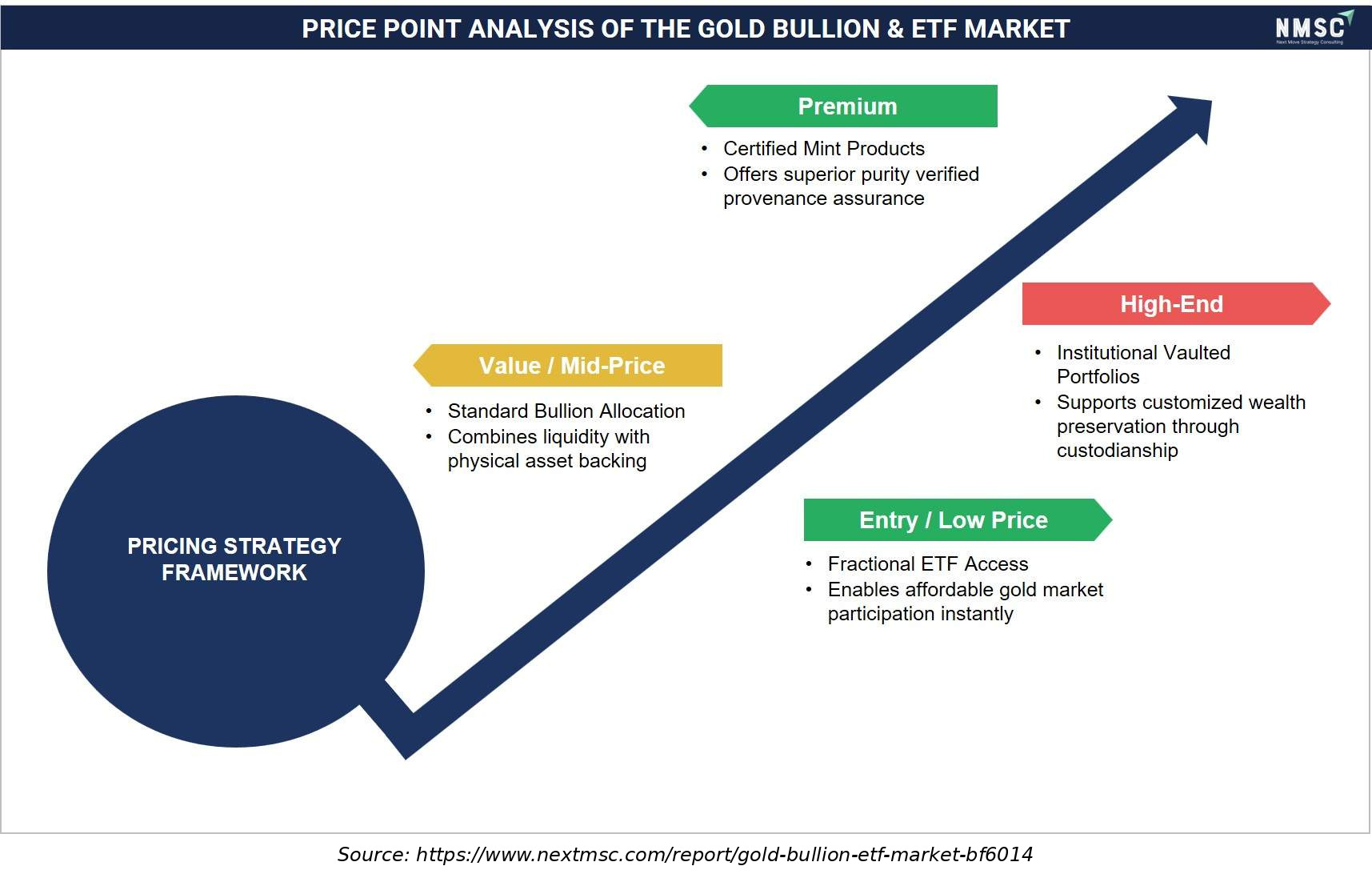
Price Point Analysis of the Gold Bullion & ETF Industry

Price Point Analysis of the Gold Bullion & ETF Industry
The above infographic presents a price point analysis of the gold bullion and ETF market, outlining a tiered pricing strategy across entry, value, premium, and high-end segments. Entry-level products cater to first-time investors with fractional ownership options, while value and premium tiers offer larger allocations and enhanced liquidity. Further, high-end offerings target institutional investors seeking physical delivery and custom vaulting services. Looking ahead, we observed that this tiered approach effectively addresses diverse investor profiles and risk appetites across the global gold market.

Growth Opportunities

Our analysis shows that three forward-looking opportunities stand out for stakeholders positioning within the gold bullion & ETF market over the 2026–2035 forecast period.

How Can Digital Fractional Ownership Unlock Value for Platform Providers?

Digital fractional ownership presents a whitespace opportunity for platform providers seeking to capture retail investors priced out of full bar or coin purchases. Providers that scale allocated fractional gold accounts stand to capture recurring transaction and custody fee revenue as digital investment platforms grow at the fastest rate among all distribution channels through 2035.

Where Does Family Office Reserve Diversification Create New Revenue for Wealth Managers?

Family offices represent an underpenetrated opportunity for wealth managers offering structured gold allocation alongside broader precious metals diversification strategies. Wealth managers that develop dedicated allocated custody and reporting infrastructure for family offices can capture premium advisory fee revenue as this buyer type registers the fastest growth among all buyer categories.

How Can Sovereign Advisory Services Benefit Refiners and Custodians?

Central banks and sovereign wealth funds represent an underpenetrated opportunity for refiners and custodians offering dedicated reserve management advisory and secure storage services. Firms that expand sovereign-grade allocated custody capacity can secure long-term custody agreements with reserve managers pursuing structural reserve diversification, particularly across emerging market central banks accelerating gold accumulation.

Regional Outlook

2025 (USD Trillion)
2035 (USD Trillion)
Asia-Pacific
North Americ
Europe
Middle East
Latin Americ
Region 2025 (USD Trillion) 2035 (USD Trillion) CAGR (%)
Asia-Pacific $10.0 USD Trillion $40.0 USD Trillion 9.0%
North America $17.1 USD Trillion $51.1 USD Trillion 27.0%
Europe $24.2 USD Trillion $62.2 USD Trillion 25.0%
Middle East & Africa $31.3 USD Trillion $73.3 USD Trillion 23.0%
Latin America $38.4 USD Trillion $84.4 USD Trillion 12.0%

Regional data is locked

Unlock complete regional numbers for this market.

Unlock Full Data

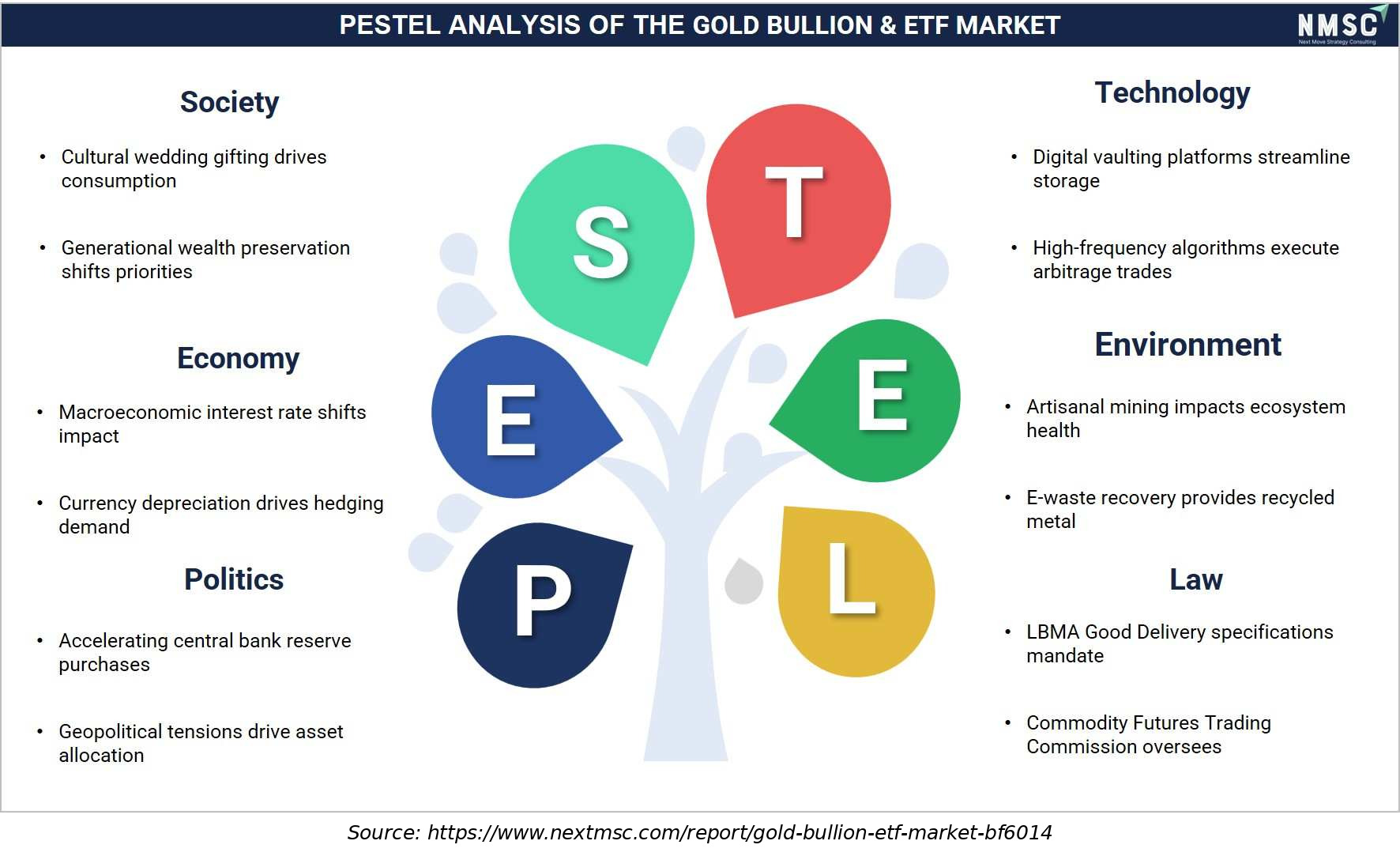
PESTEL Analysis of the Gold Bullion & ETF Industry

PESTEL Analysis of the Gold Bullion & ETF Industry
The above infographic presents a PESTEL analysis of the gold bullion and ETF market, wherein central bank reserve purchases and commodity trading regulations are shaping institutional participation. Cultural and seasonal demand, particularly from wedding-related gifting, continues to drive consumption, while macroeconomic factors such as currency depreciation and interest rate shifts influence hedging behavior. Further, digital vaulting platforms and algorithmic trading are modernizing storage and execution efficiency. Looking ahead, we observed that these intersecting factors will continue to shape price dynamics and investor participation across the global gold market.

Competitive Landscape

We observed that the gold bullion & ETF market features a moderately consolidated competitive landscape, with global refiners and mints competing alongside diversified asset managers on custody scale and product breadth. Key Takeaways

Dimension Description
Market Structure Moderately consolidated; the top companies profiled in this report collectively account for a majority of global gold bullion & ETF market value, while numerous regional dealers and mints serve niche physical bullion demand.
Innovation Focus Digital fractional ownership platforms, allocated custody infrastructure, and exchange-traded product structuring dominate current innovation pipelines across leading providers.
M&A Activity Selective portfolio and custody capacity expansion among refiners and asset managers, reflecting sustained demand growth rather than large-scale consolidation activity.

How Do Companies Compete in the Gold Bullion & ETF Market?

Companies compete primarily on custody scale, refining capacity, and product breadth across the industry. Global refiners and mints such as Valcambi and MKS PAMP leverage established production and vaulting infrastructure to serve institutional and official institution buyers, while asset managers such as State Street Global Advisors and BlackRock compete on exchange-traded product liquidity, expense ratios, and fund scale for retail and institutional investors.

Which Competitive Archetypes Dominate the Gold Bullion & ETF Market?

Two archetypes dominate the market: global refiners and sovereign mints offering physical bullion production and vaulting infrastructure, and diversified asset managers offering exchange-traded product access. Valcambi and MKS PAMP exemplify the physical bullion archetype through refining and fabrication scale, while State Street Global Advisors and BlackRock exemplify the exchange-traded product archetype through fund liquidity and distribution reach.

How Are Companies Differentiating Through Innovation in Gold Bullion & ETF?

Innovation and differentiation strategy increasingly center on digital access and allocated custody transparency. Digital investment platforms enabling fractional, allocated gold ownership illustrate how providers differentiate through expanded retail accessibility beyond traditional dealer networks. Our analysis shows that providers unable to demonstrate transparent, verifiable custody risk exclusion from increasingly discerning retail and institutional investor shortlists amid record 2025 and 2026 demand.

What M&A and Expansion Activity Is Shaping the Gold Bullion & ETF Market?

Capacity expansion and custody infrastructure investment continue to shape competitive positioning within the industry more than large-scale consolidation. Refiners and mints continue to expand vaulting and fabrication capacity to meet record 2025 and 2026 demand, while exchange-traded fund sponsors continue to scale product offerings following the second-strongest year on record for global gold ETF holdings growth.

Key Market Players

Our assessment indicates that the following 20 companies are actively shaping refining capacity, custody infrastructure, and product innovation within the global gold bullion & ETF market.

Valcambi SA MKS PAMP SA Gold Corporation (The Perth Mint) Heraeus Precious Metals GmbH Rand Refinery (Pty) Ltd Metalor Technologies SA Royal Canadian Mint The Royal Mint Limited United States Mint State Street Global Advisors Trust Company BlackRock, Inc. DWS Group GmbH & Co. KGaA Invesco Ltd. abrdn plc WisdomTree, Inc. Sprott Inc. A-Mark Precious Metals, Inc. Umicore SA StoneX Group Inc. Galmarley Ltd (BullionVault)

Latest Developments

We found that recent developments within the gold bullion & ETF market are concentrated on record central bank purchases and exchange-traded fund inflows, reflecting sustained structural demand across both sovereign and investor channels.

Date Event
April 2026 Central banks added a net 244 tonnes of gold in the first quarter of 2026.
January 2026 Central banks purchased a net 863 tonnes of gold in 2025, while global gold ETF holdings grew 801 tonnes, the second strongest year on record, according to the World Gold Council.

Investment Opportunities

What Capital Inflows Are Targeting the Gold Bullion & ETF Industry?

Capital inflows into the gold bullion & ETF market are increasingly directed toward exchange-traded product structuring and digital custody infrastructure. Record 2025 global ETF inflows of 801 tonnes, including 437 tonnes added by U.S.-listed funds alone, illustrate the scale of capital committed to liquid, exchange-listed gold exposure. We observed that investors favor providers demonstrating transparent, verifiable allocated custody, viewing custody integrity as a proxy for long-term investor trust and asset retention.

How Is Infrastructure Investment Supporting Gold Bullion & ETF Market Growth?

Vaulting and custody infrastructure investment is expanding to support record central bank and institutional demand. Sustained sovereign accumulation, reaching approximately 533 tonnes across the first two quarters of 2026 alone, illustrates the scale of infrastructure required to securely store and manage growing reserve holdings. Our findings suggest that refiners and custodians are investing in expanded vault capacity across North America, Europe, and Asia-Pacific to accommodate rising institutional and sovereign demand.

What ESG Considerations Are Shaping Gold Bullion & ETF Investment Decisions?

Governance considerations are increasingly central to investment decisions across the industry, with responsible sourcing certification and custody transparency as key criteria. Refiners' adherence to responsible gold sourcing standards illustrates supplier response to sustainability-focused institutional procurement. We found that investors increasingly favor providers with certified, chain-of-custody-verified sourcing, treating it as a governance indicator alongside allocated custody transparency and audit practices.

Key Benefits for Stakeholders

How Does This Report Benefit Enterprise and Industry Leaders?

Enterprise and industry leaders gain access to validated segmentation, competitive benchmarking, and regional demand forecasts that support sourcing and portfolio decisions across the gold bullion & ETF industry. Our analysis shows that detailed product type, buyer type, and distribution channel breakdowns help procurement and product teams align specifications with regulatory and custody requirements while identifying underserved segments for portfolio expansion.

How Does This Report Benefit Investors and Financial Analysts?

Investors and financial analysts benefit from consistent, single-point market size and CAGR estimates that support valuation and capital-allocation decisions across the gold bullion & ETF supply chain. We observed that the report's regional and segment-level growth differentials help identify which providers are best positioned to capture above-market growth in the Middle East & Africa and digital investment platform categories through 2035.

How Does This Report Benefit Technology Vendors and Product Teams?

Technology vendors and product teams gain insight into emerging platform requirements, including digital fractional ownership, allocated custody transparency, and exchange-traded product structuring, that are reshaping the industry. Our findings suggest that this analysis helps product teams prioritize development roadmaps around custody verification and digital accessibility increasingly required by retail, institutional, and official institution buyer expectations.

Key Market Segments Evaluated

By Product Type

  • Physical Gold Bullion 
    • Bars
      • Cast Bars
      • Minted Bars
      • CombiBars
      • Other Investment Bars
    • Coins
      • Bullion Coins
      • Legal Tender Bullion Coins
      • Fractional Bullion Coins
      • Other Investment Coins
    • Vaulted Gold
      • Allocated Gold
      • Unallocated Gold
  • Gold Exchange-Traded Products 
    • Physically Backed Products
      • Exchange-Traded Funds
      • Exchange-Traded Commodities
      • Exchange-Traded Trusts
    • Derivative-Based Products
      • Futures-Based Products
      • Synthetic Products
    • Leveraged Products
      • Leveraged Long Products
      • Leveraged Inverse Products

By Buyer Type

  • Retail Investors
  • High-net-worth Individuals
  • Family Offices
  • Institutional Investors
  • Official Institutions

By Distribution Channel

  • Direct Sales
  • Authorized Dealer Network
  • Banking Channel
  • Financial Advisor Channel
  • Brokerage Platform
  • Digital Investment Platform

By Revenue Stream

  • Bullion Premium
  • Fund Management Fee
  • Storage Fee
  • Trading Spread
  • Financing Income

By Custody Model

  • Physical Delivery
  • Allocated Custody
  • Unallocated Custody
  • Exchange Custody

By Region

  • North America (U.S., Canada, Mexico)
  • Europe (UK, Germany, France, Italy, Spain, Sweden, Denmark, Finland, Netherlands, Rest of Europe)
  • Asia-Pacific (China, India, Japan, South Korea, Taiwan, Indonesia, Vietnam, Australia, Philippines, Malaysia, Rest of APAC)
  • Middle East & Africa (Saudi Arabia, UAE, Egypt, Israel, Turkey, Nigeria, South Africa, Rest of MEA)
  • Latin America (Brazil, Argentina, Chile, Colombia, Rest of LATAM)

Conclusion & Recommendations

The long-term outlook remains highly favorable, with the market expected to expand from USD 10.24 trillion in 2026 to USD 20.91 trillion by 2035 at an 8.3% CAGR. We observed that this trajectory rests on record central bank accumulation, structural reserve diversification, and expanding exchange-traded product assets under management that together sustain demand across the forecast period.

What Strategic Positioning Should Stakeholders Pursue?

Stakeholders should pursue diversified positioning across physical bullion custody and exchange-traded product structuring to capture demand from both sovereign and retail investor segments. Our assessment indicates that providers integrating transparent allocated custody with digital accessibility, following the pattern of record 2025 and 2026 central bank and ETF demand, are best positioned to secure long-term institutional and retail contracts across the gold bullion & ETF market.

How Attractive Is the Gold Bullion & ETF Market for New Investment?

The gold bullion & ETF industry presents a highly attractive investment case, supported by a USD 10.67 trillion absolute dollar opportunity between 2026 and 2035 and above-average growth in Middle East & Africa and family office buyer categories. We found that investment attractiveness is highest for providers combining physical bullion custody scale with exchange-traded product distribution reach, positioning them to serve both sovereign and retail buyer segments simultaneously.

What Market Shifts and Key Risks Should Stakeholders Monitor?

Stakeholders should monitor price volatility from divergent exchange-traded fund and sovereign flow cycles, storage and insurance cost pressure, and currency and interest rate policy shifts as key risks to the gold bullion & ETF market. Our analysis shows that providers unable to demonstrate cost-efficient, transparent custody risk losing investor allocations to competitors with proven digital and allocated custody infrastructure, particularly as retail investors increasingly compare custody costs across providers.

What Are the Key Growth Pathways for the Gold Bullion & ETF Market?

Key growth pathways include scaling digital fractional ownership platforms, expanding family office and institutional advisory services, and deepening sovereign custody infrastructure. Next Move Strategy Consulting's analysis indicates that providers pursuing these pathways while maintaining core physical bullion refining and vaulting capability will be best positioned to capture the gold bullion & ETF market's projected growth through 2035.

FAQs

About the Author

Mayurima Roy

Mayurima Roy

Mayurima Roy is Research Analyst at Next Move Strategy Consulting, where she has spent 4 years working across the firm's full industry coverage rather than a single fixed vertical. Her work centers on structured research, ongoing trend tracking, competitive assessment, and insight-led content development, translating complex market data into clear, decision-ready narratives that support informed client decision-making across diverse global industries, market sectors, and world regions every day.

About the Reviewer

Supradip Baul

Supradip Baul

Supradip Baul is an accomplished business consultant and strategist with over a decade of rich experience in market intelligence, strategy, technology, and business transformation. His work has included rigorous qualitative and quantitative analysis across multiple industries, helping clients shape investment decisions and long-term roadmaps. Earlier in his career, he was associated with Gartner, where he contributed to industry-leading reports and market share analyses. He has worked with leading global companies and holds an MBA with a dual specialization in Marketing and Finance.

Download Free Sample

Ross J Mckenzie

ROSS J MCKENZIE

Business Insight Manager

Staysure Group

“Next MSC have been incredibly helpful in providing detailed & robust information on our market, alongside quantifying growth by different segments. The process to procure was simple and easy, with sample reports and regular contact to ensure we had what we needed. Succinct detail on their sources & methodologies is also greatly received, allowing transparency in this respect helps build trust in the detail you pay for. Joseph in particular was fantastic, and helped ensure efficient provision of the insight pack – thank you NMSC!”.

Rishabh Jogani

RISHABH JOGANI

Strategy Analyst

Accenture Japan

We are incredibly impressed with the market report on the real estate market in India provided by Next Move Strategy Consulting. The report was thorough, insightful, and well-structured, offering deep analysis and actionable recommendations. It not only captured the current trends and dynamics but also provided a forward-looking perspective that has been invaluable for our strategic planning. Their team demonstrated exceptional professionalism, attention to detail, and a profound understanding of the industry. The data-driven insights and clarity of presentation exceeded our expectations, making complex market trends easy to understand. We highly recommend Next Move Strategy Consulting to anyone looking for reliable and comprehensive market research services. Their expertise has given us the confidence to navigate the complexities of the Indian real estate market with clarity and foresight.


Semih Kavaklioglu

SEMIH KAVAKLIOGLU

Co-Founder & Sales Manager

Decortie

I work a lot in the marketing industry and I know that research is an essential part of any campaign. I have used Market research reports for my own products and I found them to be very informative and well-researched. The team here produces insightful reports for a good price

Gaurav Jaiswal

GAURAV JAISWAL

Founder & CEO

Yano Charge Private Limited

The EV Charging market research report provided by the NextMSC was exceptionally detailed and insightful. It offered a comprehensive analysis that proved to be a game-changer for our strategic planning. Truly a testament to the NextMSC’s expertise and thoroughness in EV market landscape & analysis.

Kishu Kanda

KISHU KANDA

Strategy Analyst

Accenture

We purchased the AI Consumer Market Report from this company. Not only did they customize the report to meet our specific requirements, but they also showed great flexibility in accommodating our budget. The report we received fully met our expectations. Additionally, they provided prompt and thorough responses to both our pre-purchase and follow-up questions. We look forward to working with this company again in the future.

Custom Market Research Services

We will customize the research for you if the listed report does not fully match your requirements.

Get 30% Free Customization

Select License

This website uses cookies to ensure you get the best experience on our website. Learn more

✖