Robo-Advisory Market Size, Share, Trends and Growth Analysis, By Advisory Type (Pure Robo-Advisory, Hybrid Robo-Advisory), By Provider Type (Fintech-Native, Bank and Brokerage-Led, Asset Manager-Led, Other Provider Types), By Account Type, By End User (Retail Investors, High Net Worth Individuals, Institutional Investors), By Region — Global Industry Report and Forecast, 2026–2035
Industry: BFSI | Publishing Date: August 11, 2026 | Last Updated: August 11, 2026 | No of Pages: N/A | No. of Tables: N/A | No. of Figures: N/A | Format: PDF | Report Code: BF5659
What Is the Robo-Advisory Market Size?
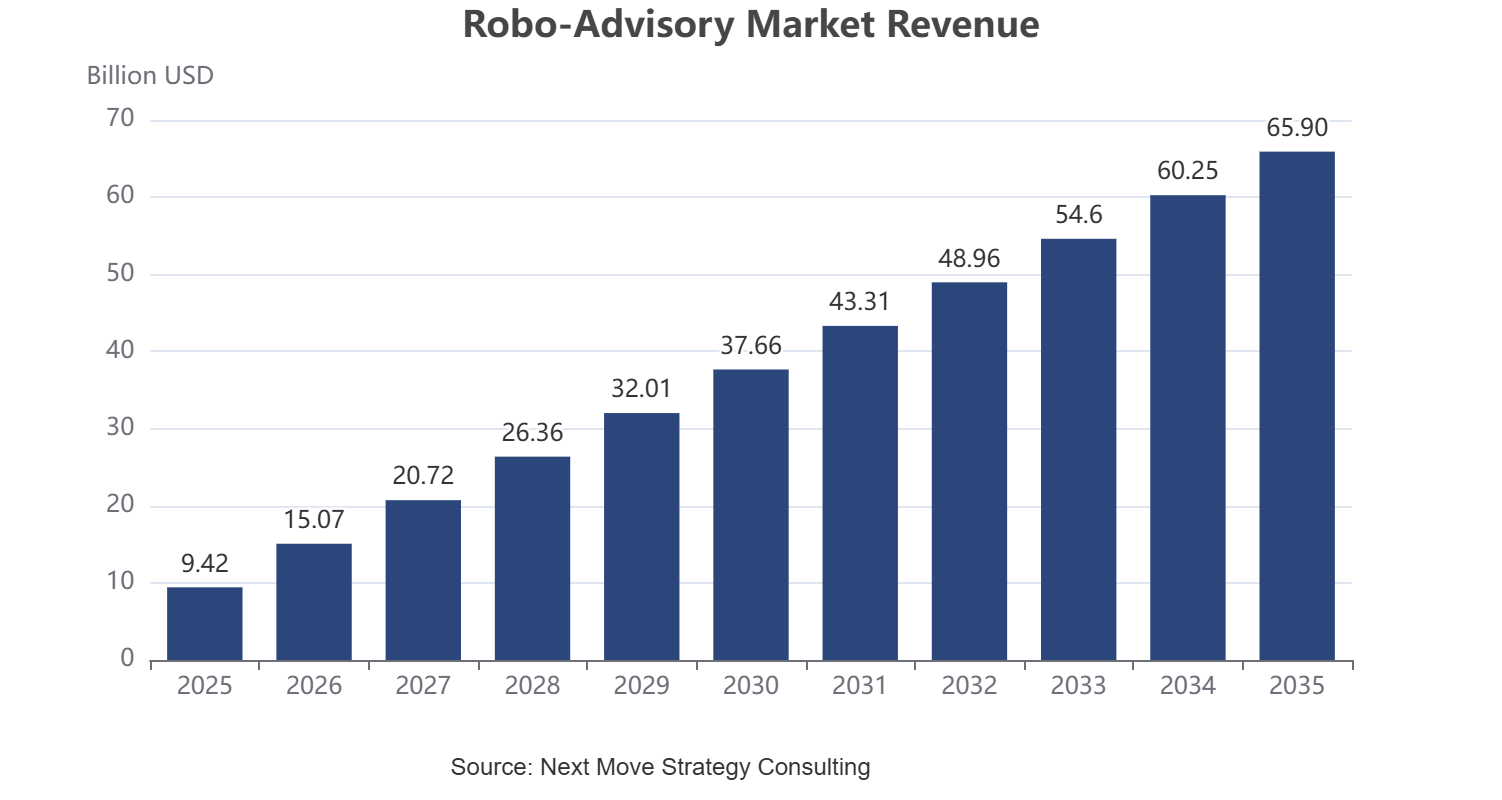
The global Robo-Advisory Market size was valued at USD 9.42 billion in 2025, estimated at USD 11.34 billion in 2026, and forecast to reach USD 65.90 billion by 2035 at a 21.6% CAGR from 2026 to 2035. North America led with approximately a 51% share, and Pure Robo-Advisory dominated with nearly a 65% share in 2025.
We observed that adoption is accelerating across retail and high-net-worth segments as algorithm-driven portfolio construction, tax-loss harvesting, and low-cost fee structures displace traditional advisory models throughout the forecast period.
|
Key Takeaways |
|
By Advisory Type: Pure Robo-Advisory held the largest share of approximately 65% (USD 6.10 billion) in 2025; Hybrid Robo-Advisory is the fastest-growing sub-segment at 26.4% CAGR from 2026–2035. |
|
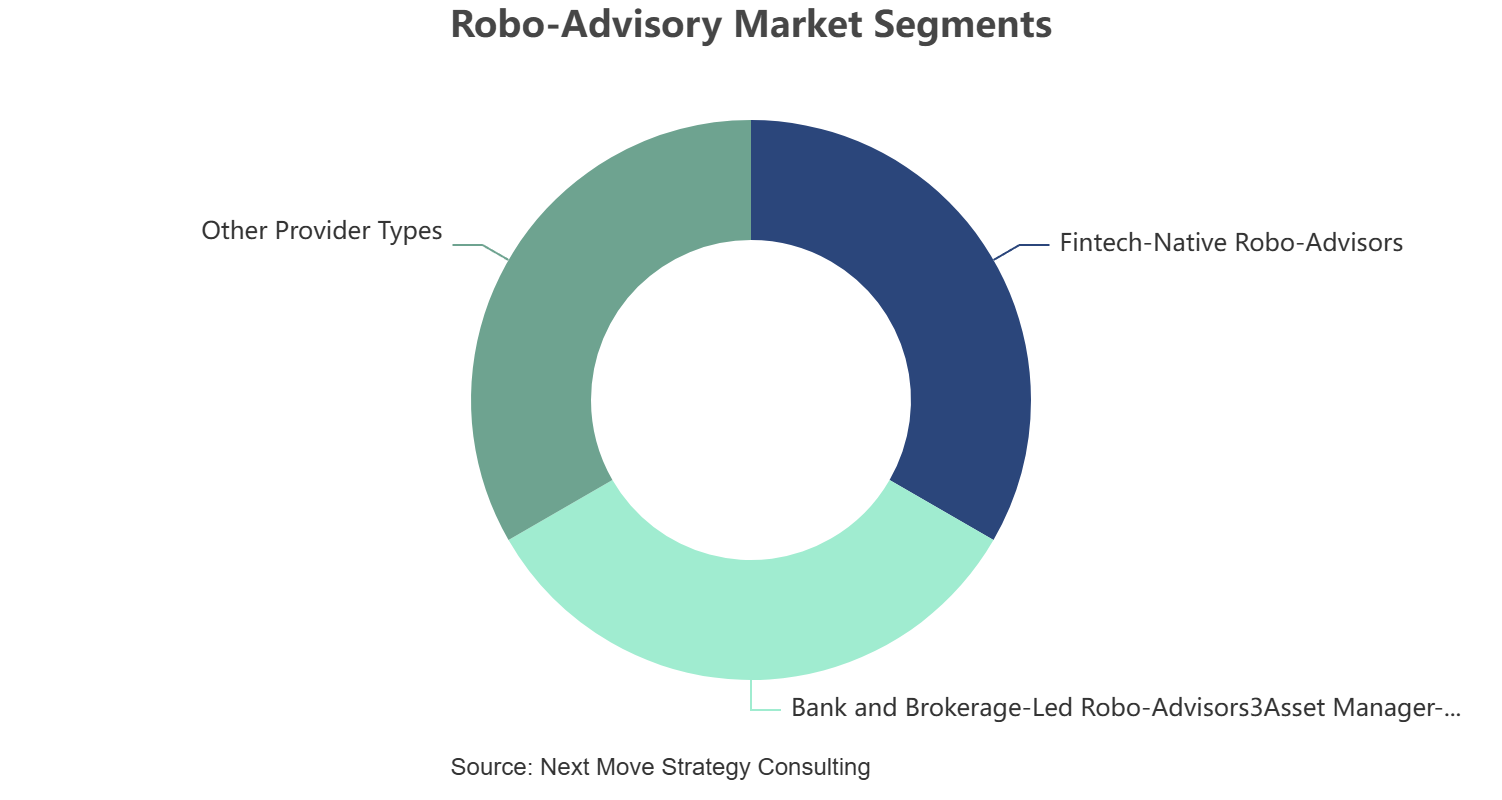
By Provider Type: Fintech-Native Robo-Advisors held the largest share of approximately 43% (USD 4.05 billion) in 2025; Asset Manager-Led Robo-Advisors is the fastest-growing sub-segment at 27.4% CAGR from 2026–2035. |
|
By Account Type: Individual Taxable Accounts held the largest share of approximately 49% (USD 4.60 billion) in 2025; Retirement Accounts is the fastest-growing sub-segment at 25.6% CAGR from 2026–2035. |
|
By End User: Retail Investors held the largest share of approximately 67% (USD 6.35 billion) in 2025; High Net Worth Individuals is the fastest-growing sub-segment at 27.1% CAGR from 2026–2035. |
|
Dominant Region: North America dominated with approximately 51% revenue share (USD 4.85 billion) in 2025. |
|
Fastest-Growing Region: Asia-Pacific is expected to register the highest CAGR of 30.3% during 2026–2035. |
|
Dominant Country: The U.S. led with approximately USD 4.05 billion in 2025. |
|
Fastest-Growing Country: India is the fastest-growing country at approximately 35.4% CAGR from 2026–2035. |
Market Opportunity: The Robo-Advisory Market is expected to create an absolute dollar opportunity of USD 54.56 billion between 2026 and 2035, presenting significant capital-allocation potential for platform operators, asset managers, and technology vendors investing in automated advisory infrastructure.
According to NMSC analysis, hybrid robo-advisory platforms that combine algorithmic portfolio management with on-demand human financial planner access are capturing a disproportionate share of net new assets from investors transitioning out of traditional full-service wealth management relationships.
Robo-Advisory Market Overview
What Does the Robo-Advisory Market Encompass?
The Robo-Advisory Market encompasses algorithm-driven investment advisory platforms that construct, rebalance, and manage diversified portfolios of exchange-traded funds and other securities with minimal human intervention. Our analysis shows that the market has evolved from standalone direct-to-consumer fintech applications launched in the early 2010s into an embedded capability offered by brokerages, banks, and asset managers seeking to retain mass-affluent and next-generation clients. Coverage spans pure digital advisory, hybrid human-assisted models, goal-based investing tools, automated tax-loss harvesting, and direct indexing capabilities delivered through web and mobile interfaces.
Regulatory oversight shapes platform design and marketing practices across covered geographies. In the United States, the Securities and Exchange Commission’s Investment Advisers Act fiduciary standard and Marketing Rule govern disclosure and performance claims, while the Financial Conduct Authority’s Consumer Duty and the European Securities and Markets Authority’s MiFID II suitability requirements apply across Europe. We found that artificial intelligence-enabled portfolio personalization, natural language financial planning assistants, and open banking data integration are accelerating platform differentiation, with providers increasingly layering conversational advice tools atop core rebalancing and tax-optimization engines.
|
Parameter |
Details |
|
Market Size in 2025 |
USD 9.42 Billion |
|
Market Size in 2026 |
USD 11.34 Billion |
|
Revenue Forecast in 2035 |
USD 65.90 Billion |
|
Growth Rate |
CAGR of 21.6% from 2026 to 2035 |
|
Analysis Period |
2025–2035 |
|
Base Year Considered |
2025 |
|
Forecast Period |
2026–2035 |
|
Market Size Estimation |
USD Billion |
|
Companies Profiled |
20 |
|
Countries Covered |
38 |
|
Market Share |
Available for Top 10 Companies |
Key Emerging Trends in the Robo-Advisory Market
Based on research conducted by NMSC, we found that four structural trends are reshaping product development, distribution, and competitive strategy within the Robo-Advisory Market.
How Is Artificial Intelligence Reshaping Robo-Advisory Portfolio Personalization?
Generative and predictive artificial intelligence models are transforming portfolio personalization beyond static risk-questionnaire allocations. We observed that providers are integrating large language model-based planning assistants to interpret unstructured financial goals and translate them into dynamic asset allocation adjustments. SEC examination priorities published through 2026 flag AI-enabled advisory tools for heightened marketing-claim scrutiny, requiring platforms to substantiate performance and capability statements. Stakeholders including brokerage-led and fintech-native providers are affected as compliance documentation requirements expand alongside personalization ambitions.
Why Is Direct Indexing Gaining Traction Within Robo-Advisory Platforms?
Direct indexing, which replicates benchmark exposure through individually held securities rather than pooled funds, is expanding within premium robo-advisory tiers. Our findings suggest that fractional-share execution and falling trading costs have made direct indexing viable at lower account minimums than previously required. Wealthfront’s S&P 500 Direct and Nasdaq-100 Direct offerings, disclosed in company product materials, illustrate this transformation toward customizable, tax-optimized index replication. The approach enables security-level tax-loss harvesting, benefiting tax-sensitive high-net-worth and mass-affluent stakeholders alike.
How Is Cash Management Integration Transforming Robo-Advisory Client Retention?
Robo-advisory providers are bundling high-yield cash management accounts with core investment advisory products to deepen client relationships and diversify revenue beyond advisory fees. We observed that Wealthfront’s Cash Account and Treasury Money Market Fund, launched in late 2025 per company filings, exemplify this bundled-platform transformation. Betterment and Schwab Intelligent Portfolios have pursued comparable integrations. Stakeholders benefit through consolidated household balance-sheet visibility, while providers capture interchange and net-interest-margin revenue that offsets fee compression across the core advisory business.
What Role Does Hybrid Human-Digital Advice Play in Robo-Advisory Expansion?
Hybrid models pairing algorithmic portfolio management with on-demand certified financial planner access are reshaping competitive positioning as pure-digital economics compress. Based on research conducted by NMSC, we found that Schwab discontinued its Intelligent Portfolios Premium human-advice tier in 2026 industry reporting, underscoring the difficulty of profitably serving mass-affluent clients with dedicated planner access. Betterment Premium and Empower Personal Wealth continue investing in hybrid tiers, indicating that stakeholders view blended advice as essential to retaining clients as balances grow beyond digital-only comfort thresholds.
Ecosystem Analysis of the Robo-Advisory Industry
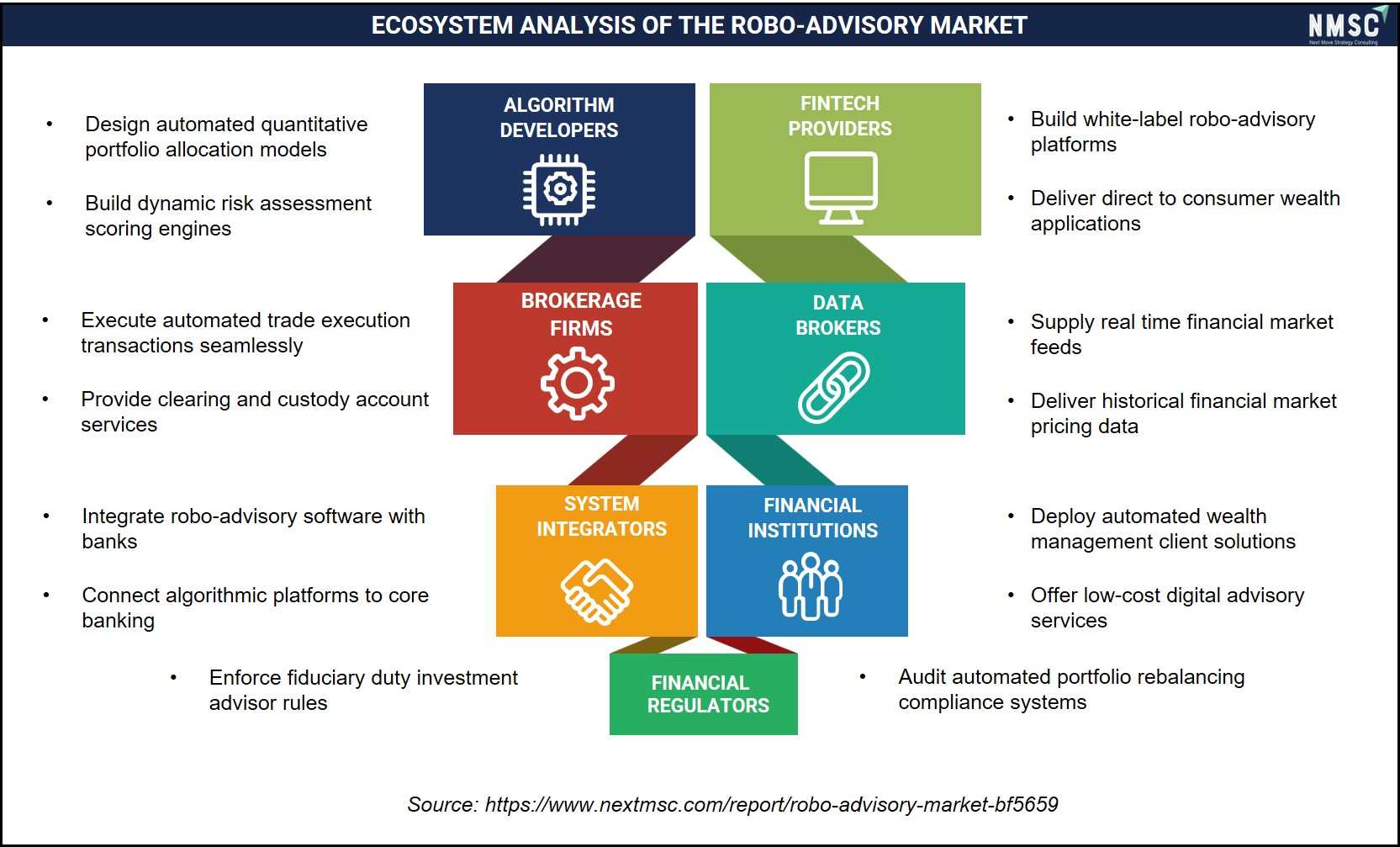
NMSC’s analysis indicates that the Robo-Advisory Market operates within an ecosystem connecting algorithm developers, fintech providers, brokerage firms, and data brokers. System integrators link algorithmic platforms with core banking, allowing financial institutions to deploy low-cost digital advisory solutions. Ultimately, financial regulators enforce fiduciary duty investment rules and audit automated rebalancing compliance systems, ensuring secure, transparent asset management.
Growth Drivers and Restraints
|
Factors |
Type |
(+/−) % Impact on CAGR |
Geographic Relevance |
Impact Timeline |
|
Rising adoption of low-cost passive investing among retail investors |
Driver |
+3.2% |
Global |
2026-2035 |
|
Expanding smartphone and open banking penetration enabling account onboarding |
Driver |
+2.6% |
Global |
2026-2035 |
|
Growing integration of AI-based financial planning and goal-setting tools |
Driver |
+2.4% |
North America, Europe |
2026-2035 |
|
Increasing mass-affluent wealth accumulation among millennial and Gen Z investors |
Driver |
+2.1% |
North America, Asia-Pacific |
2026-2035 |
|
Bank and brokerage bundling of robo-advisory with core deposit accounts |
Driver |
+1.8% |
North America, Europe |
2026-2035 |
|
Expanding retirement-account digitization and auto-enrollment mandates |
Driver |
+1.5% |
North America, Europe |
2026-2035 |
|
Rising fiduciary and suitability regulatory compliance costs |
Restraint |
-1.6% |
North America, Europe |
2026-2035 |
|
Persistent investor preference for human advice at higher balance tiers |
Restraint |
-1.3% |
Global |
2026-2035 |
|
Fee compression amid intensifying price competition among providers |
Restraint |
-1.1% |
North America, Europe |
2026-2035 |
|
Data privacy and cybersecurity compliance burden under evolving regulation |
Restraint |
-0.9% |
Global |
2026-2035 |
What Is the Primary Growth Driver of the Robo-Advisory Market?
Rising adoption of low-cost, algorithm-driven passive investing among retail investors is the primary driver of the Robo-Advisory Market. The U.S. Securities and Exchange Commission’s Form ADV database shows a sustained rise in the number of SEC-registered internet-based investment advisers over the past decade. We found that fee-conscious investors are consolidating brokerage, cash management, and retirement accounts onto unified digital platforms, reinforcing demand for automated portfolio construction across the forecast period.
How Is Artificial Intelligence Driving Robo-Advisory Market Growth?
Artificial intelligence-enabled portfolio personalization and natural language planning tools are accelerating the Robo-Advisory Market growth by widening the addressable client base beyond simple goal-based questionnaires. Our assessment indicates that the SEC’s Division of Examinations has flagged AI-driven advisory claims as a 2026 priorities-report focus area, reflecting the technology’s growing centrality to platform differentiation. Providers layering AI-based tax optimization and dynamic rebalancing atop core advisory engines are capturing incremental net new assets from competitors relying on static allocation models.
What Is Restraining Robo-Advisory Market Expansion?
Rising fiduciary and Marketing Rule compliance costs restrain margin expansion across the Robo-Advisory Market. The SEC’s Division of Examinations Risk Alert of December 2025 identified widespread deficiencies in testimonials, endorsements, and third-party ratings disclosures among registered investment advisers, requiring costly compliance remediation. Persistent investor preference for human advice at higher balance tiers, evidenced by Schwab’s 2026 discontinuation of its Intelligent Portfolios Premium human-advice offering, further restrains pure-digital platform economics beyond the mass-market segment.
Growth Opportunities
Our analysis shows that three forward-looking opportunities stand out for stakeholders positioning within the Robo-Advisory Market over the 2026–2035 forecast period.
How Can Direct Indexing Unlock Value for High-Net-Worth Clients?
Direct indexing platforms that replicate benchmark exposure through individually held, tax-lossable securities present a whitespace opportunity for providers serving High Net Worth Individuals seeking personalized tax management without full-service advisory fees. Fintech-Native and Asset Manager-Led providers extending direct indexing below traditional six-figure minimums stand to capture assets migrating from separately managed accounts and legacy brokerage relationships throughout the forecast period.
Where Does Retirement-Account Auto-Enrollment Create New Robo-Advisory Demand?
Workplace retirement-account digitization and auto-enrollment mandates across covered geographies create an underpenetrated opportunity for Bank and Brokerage-Led Robo-Advisors to capture Retirement Accounts at the point of employer plan setup. Providers integrating robo-advisory default options into retirement plan architecture can secure durable, low-churn asset flows that compound over multi-decade client tenures.
How Can Embedded Advisory APIs Benefit Institutional Distribution Partners?
Embedded robo-advisory application programming interfaces licensed to banks, insurers, and neobanks without proprietary advisory infrastructure create a business-to-business-to-consumer opportunity for Asset Manager-Led and Fintech-Native providers. Institutional Investors and distribution partners benefit from white-labeled portfolio construction engines that accelerate time-to-market for digital wealth offerings while providers monetize technology licensing beyond direct-to-consumer advisory fees.
Segmentation Analysis
Segment Sizing: By Advisory Type
Which Advisory Type Segment Dominates the Robo-Advisory Market?
|
Segment |
2025 (USD) |
2035 (USD) |
CAGR% (2026–2035) |
|
Pure Robo-Advisory |
USD 6.10 Billion |
USD 38.50 Billion |
22.7% |
|
Hybrid Robo-Advisory |
USD 3.32 Billion |
USD 27.40 Billion |
26.4% |
|
Total |
USD 9.42 Billion |
USD 65.90 Billion |
21.6% |
Pure Robo-Advisory, encompassing goal-based investing platforms and direct indexing products delivered without dedicated human advisor access, led the market with USD 6.10 billion in 2025, supported by low minimum balances and flat-fee pricing that appeal to first-time investors. We observed that Hybrid Robo-Advisory, which layers certified financial planner access atop algorithmic management, is the fastest-growing sub-segment at a 26.4% CAGR from 2026 to 2035 as balances scale and clients seek periodic human validation of automated recommendations.
Segment Sizing: By Provider Type
Which Provider Type Leads Robo-Advisory Market Demand?
|
Segment |
2025 (USD) |
2035 (USD) |
CAGR% (2026–2035) |
|
Fintech-Native Robo-Advisors |
USD 4.05 Billion |
USD 24.80 Billion |
22.3% |
|
Bank and Brokerage-Led Robo-Advisors |
USD 3.15 Billion |
USD 22.90 Billion |
24.7% |
|
Asset Manager-Led Robo-Advisors |
USD 1.55 Billion |
USD 13.70 Billion |
27.4% |
|
Other Provider Types |
USD 0.67 Billion |
USD 4.50 Billion |
23.6% |
|
Total |
USD 9.42 Billion |
USD 65.90 Billion |
21.6% |
Fintech-Native Robo-Advisors remained the leading provider type within the market, valued at USD 4.05 billion in 2025 on the strength of established platforms such as Betterment and Wealthfront that built brand trust ahead of incumbent competitors. Our analysis shows that Asset Manager-Led Robo-Advisors are the fastest-growing provider category at a 27.4% CAGR from 2026 to 2035, as traditional fund managers embed automated advice into existing distribution relationships to defend assets under management against fintech disintermediation.
Segment Sizing: By End User
Which End User Segment Leads Robo-Advisory Market Adoption?
|
Segment |
2025 (USD) |
2035 (USD) |
CAGR% (2026–2035) |
|
Retail Investors |
USD 6.35 Billion |
USD 39.80 Billion |
22.6% |
|
High Net Worth Individuals |
USD 2.15 Billion |
USD 18.60 Billion |
27.1% |
|
Institutional Investors |
USD 0.92 Billion |
USD 7.50 Billion |
26.2% |
|
Total |
USD 9.42 Billion |
USD 65.90 Billion |
21.6% |
Retail Investors accounted for the largest end user share within the Robo-Advisory Market, reaching USD 6.35 billion in 2025 as mass-market fee sensitivity and mobile-first onboarding continue to favor automated platforms over traditional brokerage relationships. We found that High Net Worth Individuals represent the fastest-growing end-user segment at a 27.1% CAGR from 2026 to 2035, reflecting rising adoption of hybrid and direct indexing offerings among clients seeking tax-efficient scale without the cost of dedicated wealth managers.
Regional Outlook
Geographic Performance Snapshot
|
Region |
2025 (USD) |
2035 (USD) |
CAGR% (2026–2035) |
Key Driver |
|
North America |
USD 4.85 Billion |
USD 28.90 Billion |
21.9% |
Deep brokerage integration and mature SEC-regulated advisory infrastructure |
|
Europe |
USD 2.10 Billion |
USD 14.20 Billion |
23.7% |
MiFID II suitability rules and expanding neobank-led digital advice distribution |
|
Asia-Pacific |
USD 1.55 Billion |
USD 16.80 Billion |
30.3% |
Rising smartphone-based retail investing and expanding fintech licensing regimes |
|
Middle East & Africa |
USD 0.52 Billion |
USD 3.65 Billion |
24.2% |
Sovereign wealth diversification and expanding digital banking infrastructure |
|
Latin America |
USD 0.40 Billion |
USD 2.35 Billion |
21.7% |
Growing mass-affluent participation and expanding mobile brokerage penetration |
|
Total |
USD 9.42 Billion |
USD 65.90 Billion |
21.6% |
— |
North America Robo-Advisory Market Outlook
North America leads the Robo-Advisory Market with an established base of SEC-registered internet investment advisers and deep integration between robo-advisory products and incumbent brokerage platforms. We observed that bundled cash management, retirement account digitization, and direct indexing offerings from Fidelity, Schwab, and Vanguard reinforce incumbent scale advantages over standalone fintech entrants. Regulatory clarity under the Investment Advisers Act and continued Marketing Rule enforcement activity support platform accountability, while rising mass-affluent wealth accumulation among younger investors sustains above-average absolute dollar growth through 2035.
Europe Robo-Advisory Market Outlook
Europe’s market reflects a mature but regulation-intensive landscape shaped by MiFID II suitability requirements and the UK Financial Conduct Authority’s Consumer Duty standard. Our analysis shows that bank-led and asset manager-led providers dominate distribution given established client trust relationships, while independent fintech entrants such as Moneyfarm and Scalable Capital compete on fee transparency and portfolio customization. Continued harmonization of pan-European digital advice regulation and growing retail investor participation support steady, if moderate, regional growth relative to Asia-Pacific.
Asia-Pacific Robo-Advisory Market Outlook
Asia-Pacific is the fastest-growing Robo-Advisory Market region, propelled by rapid smartphone-based retail investing adoption in China and India and expanding fintech licensing regimes across Singapore and Australia. We found that Singapore-based providers including Endowus, StashAway, and Syfe have built regional scale by combining robo-advisory with central provident fund and pension account integration. Rising middle-class wealth accumulation, government-backed financial inclusion initiatives, and expanding open banking frameworks position the region for the market’s highest CAGR through 2035.
Middle East & Africa Robo-Advisory Market Outlook
The Robo-Advisory Market in Middle East & Africa is expanding as Gulf Cooperation Council economies diversify into fintech and wealth management infrastructure supporting sovereign diversification strategies. We observed that regulatory sandboxes established by the UAE’s Securities and Commodities Authority and Saudi Arabia’s Capital Market Authority are enabling licensed digital advisory entrants to launch alongside incumbent bank-led wealth platforms. Expanding smartphone penetration and a growing young, digitally native investor base support steady adoption despite a comparatively nascent regulatory and distribution infrastructure.
Latin America Robo-Advisory Market Outlook
Latin America’s Robo-Advisory Market is supported by growing mass-affluent participation in Brazil and Argentina and expanding mobile brokerage infrastructure across the region. Our assessment indicates that Brazil’s Comissão de Valores Mobiliários has clarified digital investment adviser registration requirements, supporting formalization of the fintech-led advisory segment. Currency volatility and comparatively lower per-capita investable assets constrain near-term absolute market size relative to other regions, though rising financial inclusion initiatives support continued expansion through the forecast period.
U.S. Robo-Advisory Market
Based on our estimates, the U.S. market was valued at approximately USD 4.05 billion in 2025 and is projected to reach USD 24.90 billion by 2035, growing at a 22.4% CAGR. Demand structure is concentrated among mass-affluent and retirement-account holders, with adoption levels among the highest globally given deep smartphone brokerage penetration. SEC oversight anchors regulatory influence, while competitive intensity remains high among fintech-native, bank-led, and asset manager-led providers pursuing consolidated account relationships.
Canada Robo-Advisory Market
The Robo-Advisory Market in Canada reached roughly USD 0.62 billion in 2025 and is forecast to hit USD 3.85 billion by 2035 at a 22.5% CAGR. Demand structure mirrors U.S. patterns, with retirement and taxable account digitization driving adoption. Canadian Securities Administrators oversight shapes regulatory influence, and technology penetration benefits from high smartphone banking adoption, though competitive intensity remains lower given a smaller number of licensed domestic providers.
UK Robo-Advisory Market
As per our estimate, the UK market stood at about USD 0.68 billion in 2025, advancing toward USD 3.35 billion by 2035 at a 19.4% CAGR. Demand is driven by ISA and pension account digitization, with adoption levels benefiting from Financial Conduct Authority Consumer Duty requirements that raise platform accountability standards. Technology penetration is high among younger investors, while competitive intensity remains elevated across bank-led and independent fintech providers.
Germany Robo-Advisory Market
According to our analysis, Germany’s market was valued near USD 0.52 billion in 2025 and is set to reach USD 2.65 billion by 2035, expanding at a 20.0% CAGR. Demand is supported by rising ETF-based retail savings plan adoption, with BaFin regulatory oversight shaping suitability and disclosure requirements. Technology penetration continues rising among digitally native savers, and competitive intensity is increasing as Scalable Capital and bank-led incumbents expand product tiers.
France Robo-Advisory Market
Based on our estimates, France’s market reached approximately USD 0.38 billion in 2025, projected to climb to USD 1.85 billion by 2035 at a 19.2% CAGR. Demand structure centers on Plan d’Epargne en Actions tax-advantaged accounts, with Autorité des Marchés Financiers oversight shaping regulatory influence. Adoption levels remain moderate relative to the UK and Germany, though rising fintech penetration among younger investors supports steady technology adoption and growing competitive intensity.
China Robo-Advisory Market
The market in China stood at roughly USD 0.55 billion in 2025 and is forecast to reach USD 6.55 billion by 2035, registering a 31.7% CAGR. Demand is fueled by rapid mobile brokerage adoption and government-supported wealth management pilot programs, with China Securities Regulatory Commission oversight shaping licensing requirements for digital advisory entrants. Technology penetration is exceptionally high, and competitive intensity is rising as domestic platforms expand automated advisory offerings alongside global entrants.
India Robo-Advisory Market
As per our estimate, India’s market was valued at about USD 0.30 billion in 2025, projected to reach USD 4.60 billion by 2035 at a 35.4% CAGR, the fastest among covered countries. Demand structure benefits from Securities and Exchange Board of India-supported digital investment adviser registration and rapidly expanding smartphone-based retail participation. Technology penetration and competitive intensity are both rising quickly as domestic fintech entrants scale alongside global platform expansion into the market.
Japan Robo-Advisory Market
According to our analysis, Japan’s market reached close to USD 0.28 billion in 2025 and is expected to hit USD 2.20 billion by 2035, growing at a 25.7% CAGR. Demand is supported by Financial Services Agency-backed Nippon Individual Savings Account reforms encouraging retail investment participation among historically savings-oriented households. Technology penetration is accelerating among younger and mid-career investors, while competitive intensity remains moderate given a comparatively concentrated domestic brokerage landscape.
South Korea Robo-Advisory Market
Based on our estimates, South Korea’s market stood at approximately USD 0.18 billion in 2025, forecast to reach USD 1.55 billion by 2035 at a 27.0% CAGR. Demand structure reflects Financial Services Commission-supported robo-advisory testbed licensing that has accelerated platform approvals since program inception. Technology penetration is high given widespread smartphone banking adoption, and competitive intensity continues rising as domestic securities firms expand automated advisory product lines.
Australia Robo-Advisory Market
The market in Australia reached about USD 0.15 billion in 2025 and is projected to reach USD 1.05 billion by 2035, expanding at a 24.1% CAGR. Demand is closely tied to Australian Securities and Investments Commission-regulated superannuation account digitization, supporting adoption among retirement savers. Technology penetration benefits from high smartphone banking usage, while competitive intensity remains moderate given a comparatively small number of licensed digital advice providers.
UAE Robo-Advisory Market
As per our estimate, the UAE market was valued at USD 0.14 billion in 2025, projected to reach USD 1.15 billion by 2035 at a 26.4% CAGR. Demand structure benefits from Dubai Financial Services Authority and Securities and Commodities Authority regulatory sandboxes supporting licensed digital advisory entrants. Technology penetration is elevated given high smartphone banking adoption among expatriate and domestic investors, and competitive intensity is rising as regional banks expand automated wealth offerings.
Saudi Arabia Robo-Advisory Market
According to our analysis, Saudi Arabia’s market reached roughly USD 0.16 billion in 2025 and is expected to hit USD 1.30 billion by 2035, growing at a 26.2% CAGR. Demand is supported by Capital Market Authority-backed Vision 2030 financial sector development initiatives encouraging retail investment participation. Technology penetration continues rising alongside national digital banking expansion, while competitive intensity is increasing as licensed fintech entrants join established bank-led wealth platforms.
South Africa Robo-Advisory Market
Based on our estimates, South Africa’s market stood at about USD 0.09 billion in 2025, forecast to reach USD 0.62 billion by 2035 at a 23.9% CAGR. Demand structure reflects Financial Sector Conduct Authority oversight of licensed discretionary investment managers extending into digital advisory models. Technology penetration is rising steadily among urban retail investors, and competitive intensity remains moderate given a comparatively concentrated domestic asset management industry.
Brazil Robo-Advisory Market
The market in Brazil reached approximately USD 0.20 billion in 2025 and is projected to reach USD 1.25 billion by 2035, registering a 22.6% CAGR. Demand is fueled by Comissão de Valores Mobiliários-clarified digital investment adviser registration requirements and expanding mobile brokerage penetration among mass-affluent households. Technology adoption is accelerating quickly, while competitive intensity is increasing as domestic fintech platforms scale alongside international entrants.
Argentina Robo-Advisory Market
As per our estimate, Argentina’s market was valued at near USD 0.08 billion in 2025, projected to reach USD 0.42 billion by 2035 at a 20.2% CAGR. Demand structure remains constrained by currency volatility, though Comisión Nacional de Valores-supported formalization of digital advisory registration is encouraging gradual adoption. Technology penetration is rising among urban retail investors, and competitive intensity remains limited given a comparatively small number of licensed domestic providers.
Consumer Behavior Analysis of the Robo-Advisory Industry
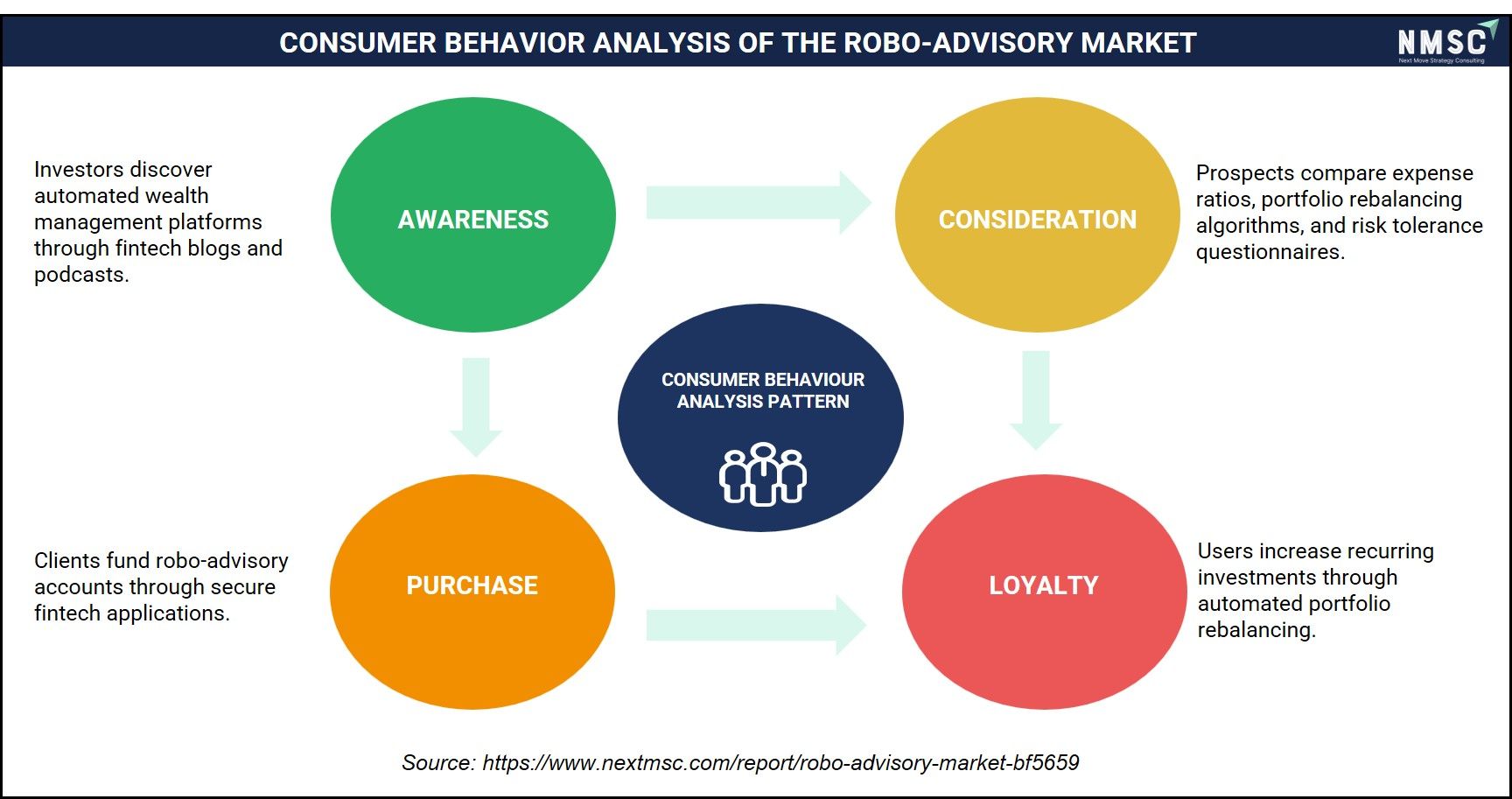
In our observation, the consumer journey in the Robo-Advisory Market begins when investors discover automated wealth platforms through fintech blogs and podcasts. Consequently, prospects evaluate expense ratios, rebalancing algorithms, and risk questionnaires during consideration. Accounts are funded via secure fintech applications, while long-term client loyalty is sustained as users increase recurring investments through automated portfolio rebalancing.
Competitive Landscape
Competitive Dynamics and M&A Landscape
|
Dimension |
Description |
|
Market Structure |
Moderately consolidated; the top 10 companies profiled in this report account for a majority of platform-level assets under management, with fintech-native and bank-led providers each holding meaningful share. |
|
Innovation Focus |
Direct indexing, AI-driven portfolio personalization, and bundled cash management integration, alongside automated tax-loss harvesting and hybrid human-advisor access tiers. |
|
M&A Activity |
Selective platform consolidation and distribution partnerships, exemplified by JPMorgan Chase’s integration of Nutmeg into its UK digital wealth offering. |
How Do Companies Compete in the Robo-Advisory Market?
Companies compete primarily on advisory fee levels, account minimums, tax-optimization capability, and breadth of bundled banking features across the industry. Global players such as Vanguard and Fidelity leverage proprietary low-cost fund families to underprice standalone fintech entrants, while independent providers differentiate through user experience, direct indexing customization, and cash account yield. Pricing strategies increasingly bundle advisory, cash management, and lending products to raise switching costs and defend client retention.
Which Competitive Archetypes Dominate the Robo-Advisory Industry?
Two archetypes dominate the market: diversified financial institutions offering robo-advisory as an embedded retention tool within broader brokerage and banking relationships, and independent fintech-native specialists competing purely on automated advisory economics. We found that diversified institutions benefit from lower client acquisition costs given existing account relationships, while fintech-native specialists compete on faster product innovation cycles, including direct indexing and AI-driven planning tools that larger incumbents are slower to deploy at scale.
How Are Companies Differentiating Through Innovation in Robo-Advisory Platforms?
Innovation and differentiation strategy increasingly center on artificial intelligence-enabled portfolio personalization and expanded direct indexing access. Wealthfront’s S&P 500 Direct and Nasdaq-100 Direct products, introduced per company disclosures, extend tax-optimized customization to a broader client base than traditional separately managed accounts. Geographic expansion strategies favor licensing partnerships in Asia-Pacific and Middle East markets over direct market entry, reducing regulatory approval timelines while preserving core technology ownership.
What M&A and Expansion Activity Is Shaping the Market?
Mergers, acquisitions, and distribution partnerships continue to consolidate digital advisory capabilities within the industry. JPMorgan Chase’s integration of Nutmeg into its UK digital wealth ecosystem, disclosed through company communications, illustrates how diversified banks are absorbing fintech-native advisory technology rather than building in-house. Pricing strategies among acquirers typically preserve acquired platforms’ lower fee structures during integration, reflecting the competitive importance of headline advisory cost in client acquisition and retention.
Key Market Players
Our assessment indicates that the following 20 companies are actively shaping product innovation, distribution partnerships, and pricing strategy within the Robo-Advisory Market.
-
The Vanguard Group, Inc.
-
The Charles Schwab Corporation
-
Fidelity Investments (FMR LLC)
-
Betterment LLC
-
Wealthfront Corporation
-
Empower Personal Wealth, LLC
-
Morgan Stanley
-
Bank of America Corporation
-
Wells Fargo & Company
-
SoFi Technologies, Inc.
-
JPMorgan Chase & Co.
-
Interactive Brokers Group, Inc.
-
Acorns Grow Incorporated
-
Ellevest, Inc.
-
M1 Holdings Inc.
-
Moneyfarm Ltd
-
Scalable Capital GmbH
-
Endowus Pte. Ltd.
-
StashAway Pte. Ltd.
-
Syfe Pte. Ltd.
Latest Developments
We found that recent developments within the Robo-Advisory Market are concentrated on bundled cash management expansion, direct indexing rollout, and heightened regulatory examination of AI-enabled advisory claims, reflecting the industry’s transition toward scaled, diversified digital wealth platforms.
|
Date |
Event |
|
March 2026 |
Betterment announced the launch of its AI-Enabled Account Recommender, an intelligent capability that helps users identify the most suitable investment and savings accounts based on their financial goals and circumstances. |
|
May 2025 |
Betterment acquired Rowboat Advisors, a provider of advanced portfolio management software specializing in direct indexing, tax optimization, and customized rebalancing. The acquisition integrates Rowboat’s proprietary software into Betterment Advisor Solutions, enhancing automated portfolio customization and tax-efficient investing features for independent registered investment advisors. |
Expert Insights
 “Betterment’s founding principle was that technology could expand access to wealth-building tools and financial advice, and AI is the most powerful expression of that thesis yet. Incorporating AI into our platform strengthens our ability to deliver sophisticated personalization at scale to retail customers and unlocks new value for them.”
— Sarah Levy, CEO of Betterment
Statement made during Betterment’s launch of the AI-Enabled Account Recommender as part of its enterprise AI strategy.
Market Interpretation
The statement reflects the growing evolution of the Robo-Advisory Market toward AI-powered hyper-personalization and intelligent financial guidance. NMSC’s analysis indicates that robo-advisory platforms are increasingly leveraging artificial intelligence to deliver personalized investment recommendations, optimize portfolio management, and enhance customer engagement at scale. Our findings suggest that the integration of AI-driven advisory capabilities with automated wealth management platforms is becoming a key competitive differentiator, enabling providers to improve customer experiences, expand digital financial inclusion, and accelerate the adoption of next-generation robo-advisory services.
Investment Opportunities
What Capital Inflows Are Targeting the Robo-Advisory Market?
Capital inflows into the Robo-Advisory Market are increasingly directed toward direct indexing infrastructure, artificial intelligence-based planning tools, and bundled cash management capacity. Wealthfront’s public listing preparation, disclosed through its confidential SEC submission, reflects broader investor appetite for scaled, profitable digital advisory platforms. Private capital continues flowing into regional specialists across Asia-Pacific and Europe as diversified institutions seek acquisition targets to accelerate embedded advisory capability.
How Is Infrastructure Investment Supporting Robo-Advisory Platform Scaling?
Infrastructure investment is expanding cloud-based portfolio rebalancing capacity and open banking data integration to support growing account volumes across covered geographies. We observed that providers are prioritizing application programming interface infrastructure enabling white-labeled distribution to bank and insurer partners lacking proprietary advisory technology, reducing the capital intensity of geographic and channel expansion relative to direct-to-consumer customer acquisition.
What ESG Considerations Are Shaping Robo-Advisory Investment Decisions?
Environmental, social, and governance considerations increasingly influence portfolio construction menus, with providers expanding low-cost ESG-screened exchange-traded fund options within default and elective portfolio tiers. Our findings suggest that regulatory disclosure expectations under the European Union’s Sustainable Finance Disclosure Regulation are shaping how European providers label and market ESG-oriented portfolio options, requiring documented methodology behind sustainability-related investment claims.
Key Benefits for Stakeholders
How Does This Report Benefit Enterprise and Industry Leaders?
Enterprise and industry leaders gain access to validated segmentation, competitive benchmarking, and regional demand forecasts that support product roadmap and distribution-partnership decisions within the Robo-Advisory Market. The report’s country-level sizing and growth-driver analysis inform market-entry sequencing and capital-allocation priorities across the 38 countries covered, enabling leaders to benchmark platform performance against verified competitor positioning and regulatory developments.
How Does This Report Benefit Investors and Financial Analysts?
Investors and financial analysts benefit from consistent, single-point market size and CAGR estimates that support valuation and capital-allocation decisions across the Robo-Advisory Market supply chain. Segment-level and regional forecasts, combined with validated competitive landscape analysis, provide a defensible basis for comparing public and private platform operators against addressable market growth trajectories through 2035.
How Does This Report Benefit Technology Vendors and Product Teams?
Technology vendors and product teams gain insight into emerging platform requirements, including direct indexing infrastructure, artificial intelligence-based planning tools, and bundled cash management integration, that are reshaping competitive positioning across the industry. Segmentation analysis by advisory type, provider type, and account type helps technology teams prioritize product development investment against the fastest-growing demand pockets identified in this report.
Key Market Segments
By Advisory Type
-
Pure Robo-Advisory
-
Goal-Based Investing Platforms
-
Direct Indexing Platforms
-
-
Hybrid Robo-Advisory
-
Robo Plus Human Advisor Platforms
-
Robo-Assisted Wealth Management Platforms
-
By Provider Type
-
Fintech-Native Robo-Advisors
-
Bank and Brokerage-Led Robo-Advisors
-
Asset Manager-Led Robo-Advisors
-
Other Provider Types
By Account Type
-
Individual Taxable Accounts
-
Retirement Accounts
-
Trust and Custodial Accounts
-
Other Account Types
By End User
-
Retail Investors
-
Millennial and Gen Z Investors
-
Mass Affluent Investors
-
-
High Net Worth Individuals
-
Institutional Investors
By Region
-
North America: U.S., Canada, Mexico
-
Europe: UK, Germany, France, Italy, Spain, Sweden, Denmark, Finland, Netherlands, Rest of Europe
-
Asia-Pacific: China, India, Japan, South Korea, Taiwan, Indonesia, Vietnam, Australia,Philippines, Malaysia, Rest of APAC
-
Middle East & Africa: Saudi Arabia, UAE, Egypt, Israel, Turkey, Nigeria, South Africa, Rest of MEA
-
Latin America: Brazil, Argentina, Chile, Colombia, Rest of LATAM
Conclusion and Recommendations
What Is the Long-Term Outlook for the Robo-Advisory Market?
The long-term outlook for the market remains positive, with global revenue projected to grow nearly sevenfold from USD 9.42 billion in 2025 to USD 65.90 billion by 2035 at a 21.6% CAGR. We observed that sustained retail and high-net-worth adoption, combined with expanding institutional and embedded-distribution channels, supports durable double-digit growth well beyond the initial fintech-adoption phase that characterized the market’s first decade.
What Strategic Positioning Should Robo-Advisory Providers Pursue?
Providers should prioritize hybrid advisory tiers and direct indexing expansion while pursuing bundled cash management and lending integration to raise client switching costs. Our assessment indicates that platforms combining algorithmic efficiency with selective human touchpoints are best positioned to retain clients as account balances scale beyond digital-only comfort thresholds, particularly within the fastest-growing High Net Worth Individuals segment.
How Attractive Is the Market for New Investment?
The Robo-Advisory industry presents an attractive investment case, supported by a USD 54.56 billion absolute dollar opportunity between 2026 and 2035 and above-average growth in Asia-Pacific and institutional investors’ demand pockets. Scaled incumbents with existing distribution and capital-light technology licensing models offer differentiated risk-return profiles for investors evaluating exposure to the broader digital wealth management theme.
What Market Shifts and Key Risks Should Stakeholders Monitor?
Stakeholders should monitor tightening Marketing Rule enforcement, fee compression from intensifying price competition, and persistent investor preference for human advice at higher balance tiers as key risks to the Robo-Advisory Market. Regulatory scrutiny of artificial intelligence-enabled advisory claims, highlighted in 2026 SEC examination priorities, represents an emerging compliance risk that could raise operating costs across fintech-native and diversified provider archetypes alike.
What Are the Key Growth Pathways for the Robo-Advisory Market?
Key growth pathways include expanding direct indexing access to mass-affluent clients, scaling embedded advisory application programming interface licensing to bank and insurer partners, and deepening penetration into retirement-account digitization across Asia-Pacific and Latin America. Providers pursuing these pathways alongside disciplined compliance investment are best positioned to capture a disproportionate share of the market’s absolute dollar opportunity through 2035.
About the Author
 Mayurima Roy
— Mayurima Roy is Research Analyst at Next Move Strategy Consulting, where she has spent 4 years working across the firm's full industry coverage rather than a single fixed vertical. Her work centers on structured research, ongoing trend tracking, competitive assessment, and insight-led content development, translating complex market data into clear, decision-ready narratives that support informed client decision-making across diverse global industries, market sectors, and world regions every day.
Mayurima Roy
— Mayurima Roy is Research Analyst at Next Move Strategy Consulting, where she has spent 4 years working across the firm's full industry coverage rather than a single fixed vertical. Her work centers on structured research, ongoing trend tracking, competitive assessment, and insight-led content development, translating complex market data into clear, decision-ready narratives that support informed client decision-making across diverse global industries, market sectors, and world regions every day.
About the Reviewer
 Supradip Baul
— Supradip Baul is an accomplished business consultant and strategist with over a decade of rich experience in market intelligence, strategy, technology, and business transformation. His work has included rigorous qualitative and quantitative analysis across multiple industries, helping clients shape investment decisions and long-term roadmaps. Earlier in his career, he was associated with Gartner, where he contributed to industry-leading reports and market share analyses. He has worked with leading global companies and holds an MBA with a dual specialization in Marketing and Finance.
Supradip Baul
— Supradip Baul is an accomplished business consultant and strategist with over a decade of rich experience in market intelligence, strategy, technology, and business transformation. His work has included rigorous qualitative and quantitative analysis across multiple industries, helping clients shape investment decisions and long-term roadmaps. Earlier in his career, he was associated with Gartner, where he contributed to industry-leading reports and market share analyses. He has worked with leading global companies and holds an MBA with a dual specialization in Marketing and Finance.
At Next Move Strategy Consulting, we understand that insightful market research is the cornerstone of successful business decisions. That's why we employ a robust and multifaceted approach, combining various methodologies to deliver the most accurate and actionable data for our clients.

Research Landscape
We navigate the world of research with two primary approaches:
Qualitative Approach
Our qualitative research methodologies involve immersive techniques such as in-depth interviews, focus groups, and observational studies. By engaging directly with individuals and stakeholders, we uncover valuable insights that quantitative data alone may overlook.

Quantitative Research
In tandem with qualitative methodologies, NMSC leverages the power of Quantitative Research to provide a robust foundation of numerical insights. Through systematic data collection and analysis, we quantify patterns, preferences, and market trends, offering a comprehensive view of the business landscape.
Our quantitative research approach employs diverse tools, including surveys, experiments, and statistical modelling. These methodologies enable us to gather data from a large and representative sample, ensuring the statistical significance of our findings. By employing structured questionnaires and standardized data collection methods, we guarantee the reliability and validity of the information we present to our clients.
Quantitative research is particularly effective in measuring the prevalence of trends, assessing market size, and gauging the impact of various factors on consumer behavior. The numerical precision attained through this approach equips our clients with actionable insights, facilitating data-driven decision-making and strategy formulation.


Our Specialized Toolbox for Industry-Specific Market Research
We deploy a specialized arsenal of techniques tailored to meet your unique requirements. Here's a glimpse into our comprehensive toolbox:

Information Procurement
The stage entails acquiring market data or relevant information through various sources and methodologies.


Market Research Approach
We utilize both top-down and bottom-up approaches in market research analysis to achieve a comprehensive understanding of the market dynamics, leveraging the broad perspective of industry trends and macroeconomic factors alongside detailed insights from specific segments and individual companies.

Porters Five Forces Analysis
We conduct Porter's Five Forces analysis to evaluate the competitive landscape of an industry, providing us with insights into factors that affect profitability and strategic positioning.

SWOT Analysis

Forecasting
We utilize a forecasting model to predict future consumption by considering parameters like population, economics, regulations, market competition, drivers, constraints, technology, and pricing. We also employ statistical techniques such as multilinear regression, exponential smoothing, moving average, ARIMA, and Monte Carlo simulations for accurate predictions. In econometric forecasting, we analyzed short-term and long-term event impacts, attributing values based on regulatory frameworks, economic factors, and market events.





 Speak to Our Analyst