India Elevator and Escalator Market

India Elevator and Escalator Market size was USD 3.35 Billion in 2025, projected to reach USD 7.80 Billion by 2035, growing at a CAGR of 8.62% from 2026 to 2035. Key drivers include rapid high-rise residential and commercial construction, expanding metro rail and airport infrastructure, and rising urbanization .

Download Free Sample PDF
Base Year (2025)
$3.35 Billion
Forecast (2035)
$7.80 Billion
CAGR (2026-2035)
8.6%
Top Region

What Is the India Elevator and Escalator Market Size?

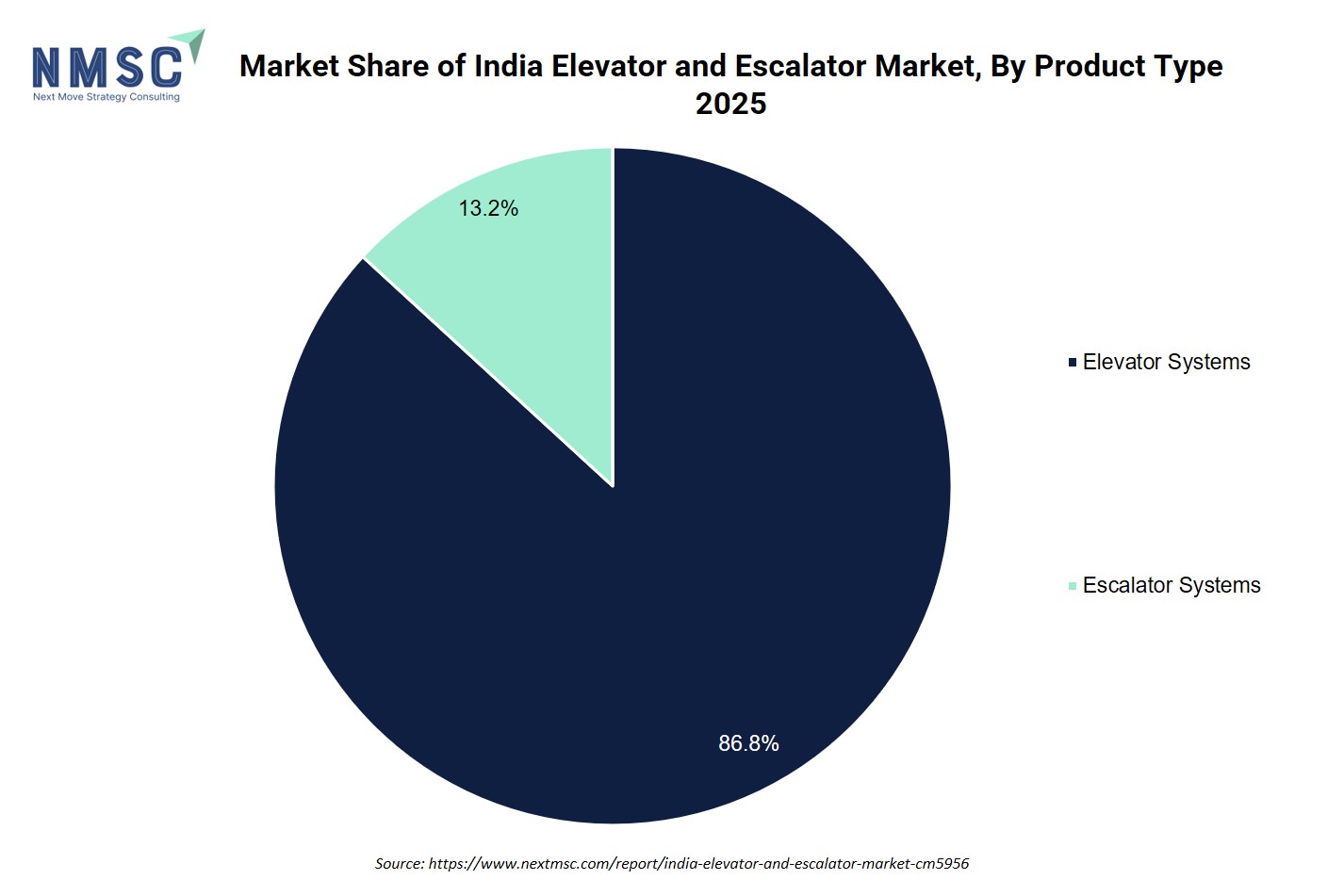
The India elevator and escalator market size was valued at USD 3.35 billion in 2025 and is estimated at USD 3.71 billion in 2026, forecast to reach USD 7.80 billion by 2035, expanding at an 8.62% CAGR between 2026 and 2035. Elevator Systems dominate all other product types with approximately 87% share, anchored by sustained high-rise residential and commercial construction activity across major metropolitan markets.

We observed that Growth is broad-based across the major segmentation dimensions, with Escalator Systems and Transit and Infrastructure emerging as the fastest-growing categories through 2035 .

India Elevator and Escalator Market Revenue Forecast

Values in USD Billion

2025 $3.35 Billion
2025
2026 $3.64 Billion
2026
2027 $3.95 Billion
2027
2028 $4.29 Billion
2028
2029 $4.66 Billion
2029
2030 $5.07 Billion
2030
2031 $5.50 Billion
2031
2032 $5.98 Billion
2032
2033 $6.49 Billion
2033
2034 $7.05 Billion
2034
2035 $7.80 Billion
2035

Key Takeaways

By Product Type: Elevator Systems held the largest share of approximately 87% (USD 2,911.55 Million) in 2025; Escalator Systems is the fastest-growing sub-segment at 12.68% CAGR from 2026–2035.

By Revenue Stream: New Equipment held the largest share of approximately 67% (USD 2,241.26 Million) in 2025; Modernization is the fastest-growing sub-segment, with a 12.24% CAGR from 2026–2035.

By Operational Speed: Medium Speed Systems held the largest share of approximately 40% (USD 1,330.61 Million) in 2025; High Speed Systems is the fastest-growing sub-segment, with a 12.00% CAGR from 2026–2035.

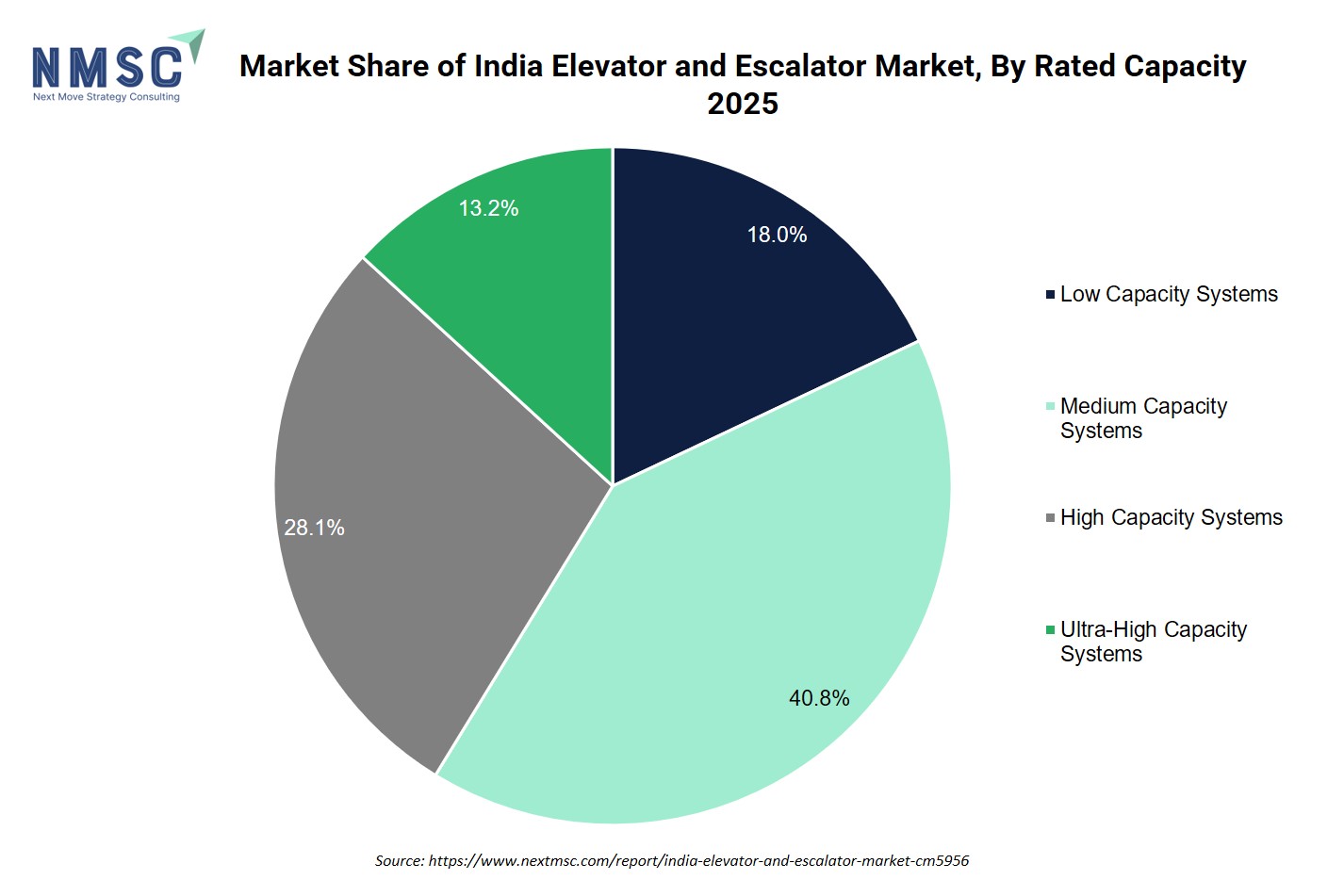
By Rated Capacity: Medium Capacity Systems held the largest share of approximately 41% (USD 1,367.77 Million) in 2025; High Capacity Systems is the fastest-growing sub-segment at 10.65% CAGR from 2026–2035.

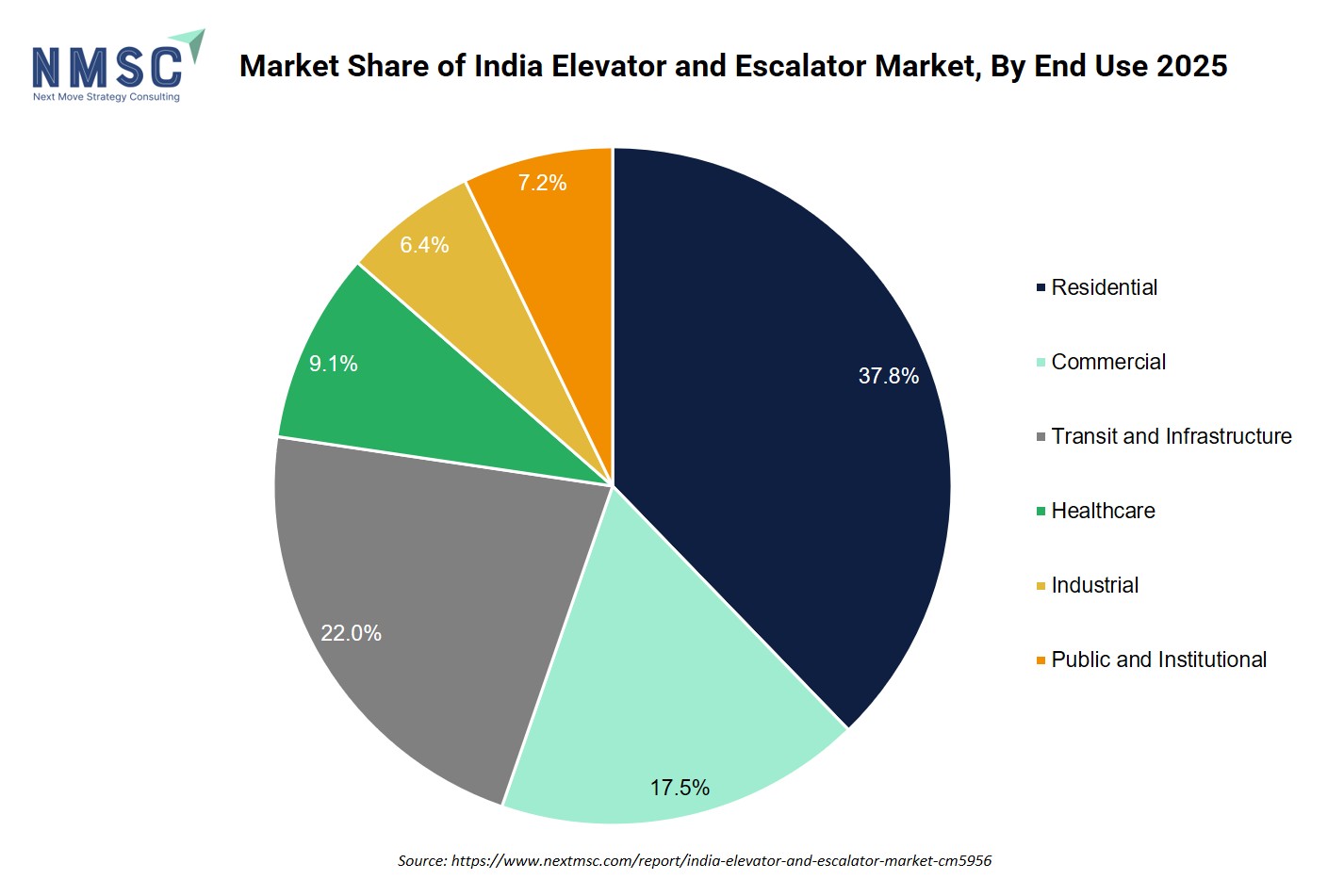
By End Use: Residential held the largest share of approximately 38% (USD 1,266.40 Million) in 2025; Transit and Infrastructure is the fastest-growing sub-segment at 11.32% CAGR from 2026–2035.

Market Opportunity: The India elevator and escalator market is expected to create an absolute dollar opportunity of USD 4.09 billion between 2026 and 2035, creating substantial revenue and investment opportunities across the metro rail, airport, and high-rise residential vertical transportation value chain.

According to NMSC analysis, we found that developers and public agencies are increasingly specifying connected, IoT-enabled elevator and escalator systems with predictive maintenance capability at the design stage rather than retrofitting monitoring technology later, a shift that favors manufacturers with integrated digital service platforms over installation-only vendors as maintenance and modernization revenue streams gain share through 2035.

What Does the India Elevator and Escalator Market Encompass?

The India elevator and escalator market encompasses the manufacturing, installation, modernization, and maintenance of passenger elevators, freight and service elevators, special purpose elevators, escalators, and moving walkways deployed across residential, commercial, transit, healthcare, industrial, and institutional buildings. Our assessment indicates that the scope spans new equipment sales alongside recurring modernization and maintenance revenue streams supplied to developers, building owners, facility managers, public agencies, and contractors, positioning the category within the broader India real estate and infrastructure development ecosystem. Leading manufacturers are increasingly integrating connectivity, remote monitoring, and predictive-maintenance capabilities into elevator and escalator platforms .

We observed thattechnology adoption is shifting toward machine-room-less traction systems and destination-control technologies. These solutions can improve space utilization, operational efficiency, and passenger flow in high-traffic buildings . NMSC's analysis indicates that this structural shift, combined with expanding metro rail and airport infrastructure investment, is redefining specification criteria across the India elevator and escalator market.

Market Drivers & Dynamics

Interactive Dataset
Rapid high-rise residential and commercial construction activity driver +3.6% Pan-India 2026-2035
Sustained metro rail and airport infrastructure investment driver +2.8% Metropolitan Cities 2026-2035
Rising demand for modernization of aging elevator installations driver +2.1% Pan-India 2026-2035
Growing adoption of IoT-enabled predictive maintenance systems driver +1.7% Metropolitan Cities 2026-2032
Expanding smart city and affordable housing government initiatives driver +1.4% Tier-I and Tier-II Cities 2026-2035
Rising demand for home elevators in villa and low-rise residences driver +1.0% Metropolitan Cities 2026-2032
High upfront capital costs restraining Tier-II and Tier-III adoption restraint -1.5% Tier-II and Tier-III Cities 2026-2032
Fragmented state-level safety regulation compliance costs restraint -1.0% Pan-India 2026-2035
Shortage of skilled technicians for installation and maintenance restraint -0.7% Pan-India 2026-2032
Price competition from unorganized regional manufacturers restraint -0.5% Tier-II and Tier-III Cities 2028-2035
Source: Next Move Strategy Consulting

Growth Drivers

What Is the Primary Growth Driver of the India Elevator and Escalator Market?

Rapid high-rise residential and commercial construction activity is the primary driver of the market. India's Ministry of Housing and Urban Affairs continues to support large-scale urban housing development through national mission programs directed at expanding formal housing stock in metropolitan and Tier-I cities. We observed that this sustained construction pipeline, combined with rising vertical density in land-constrained metropolitan markets, continues to support baseline elevator and escalator demand across residential and commercial developments.

How Is Metro Rail Infrastructure Investment Driving Market Growth?

Sustained government investment in metro rail and airport infrastructure is accelerating market growth toward large-volume escalator and moving walkway procurement. India's Ministry of Housing and Urban Affairs continues to oversee metro rail expansion across multiple Indian cities under active development, generating multi-year public procurement contracts for vertical transportation equipment. Our assessment indicates that this sustained public infrastructure pipeline, combined with expanding airport capacity investment, is compressing procurement cycles for transit-focused escalator manufacturers.

Growth Inhibitors

What Is Restraining India Elevator and Escalator Market Expansion?

High upfront capital costs restrain the pace of elevator and escalator adoption across Tier-II and Tier-III cities where construction budgets remain more constrained than in metropolitan markets. Developers in smaller cities may prioritize lower-cost elevator configurations over premium connected traction platforms to manage overall project costs . We found that this cost sensitivity disproportionately affects premium manufacturers, as price competition from unorganized regional players continues to limit average selling price growth in developing urban markets outside major metropolitan centers.

What Are the Growth Opportunities?

How Can Modernization Services Unlock Value in Aging Building Stock?

Modernization and retrofit services present a whitespace opportunity for manufacturers serving India's growing base of elevators installed during earlier construction cycles now approaching end-of-life mechanical components. Vendors that commercialize structured modernization packages stand to capture recurring, higher-margin revenue as building owners prioritize safety upgrades and energy efficiency improvements over full equipment replacement.

Where Does Tier-II and Tier-III City Expansion Create New Demand?

Tier-II and Tier-III cities undergoing rapid vertical densification represent an underpenetrated opportunity for manufacturers offering cost-optimized elevator and escalator products. Vendors that develop value-engineered platforms tailored to smaller-city construction budgets can secure long-term distribution partnerships, benefiting from expanding formal housing and commercial development beyond the metropolitan markets that have historically driven category demand.

How Can Predictive Maintenance Platforms Benefit Facility Managers?

Facility managers overseeing large commercial and institutional portfolios represent an underpenetrated opportunity for providers offering integrated, multi-brand predictive maintenance platforms. Early movers that build vendor-agnostic monitoring capability can differentiate with facility manager and public agency customers pursuing centralized visibility across mixed-brand elevator and escalator fleets spanning multiple properties.

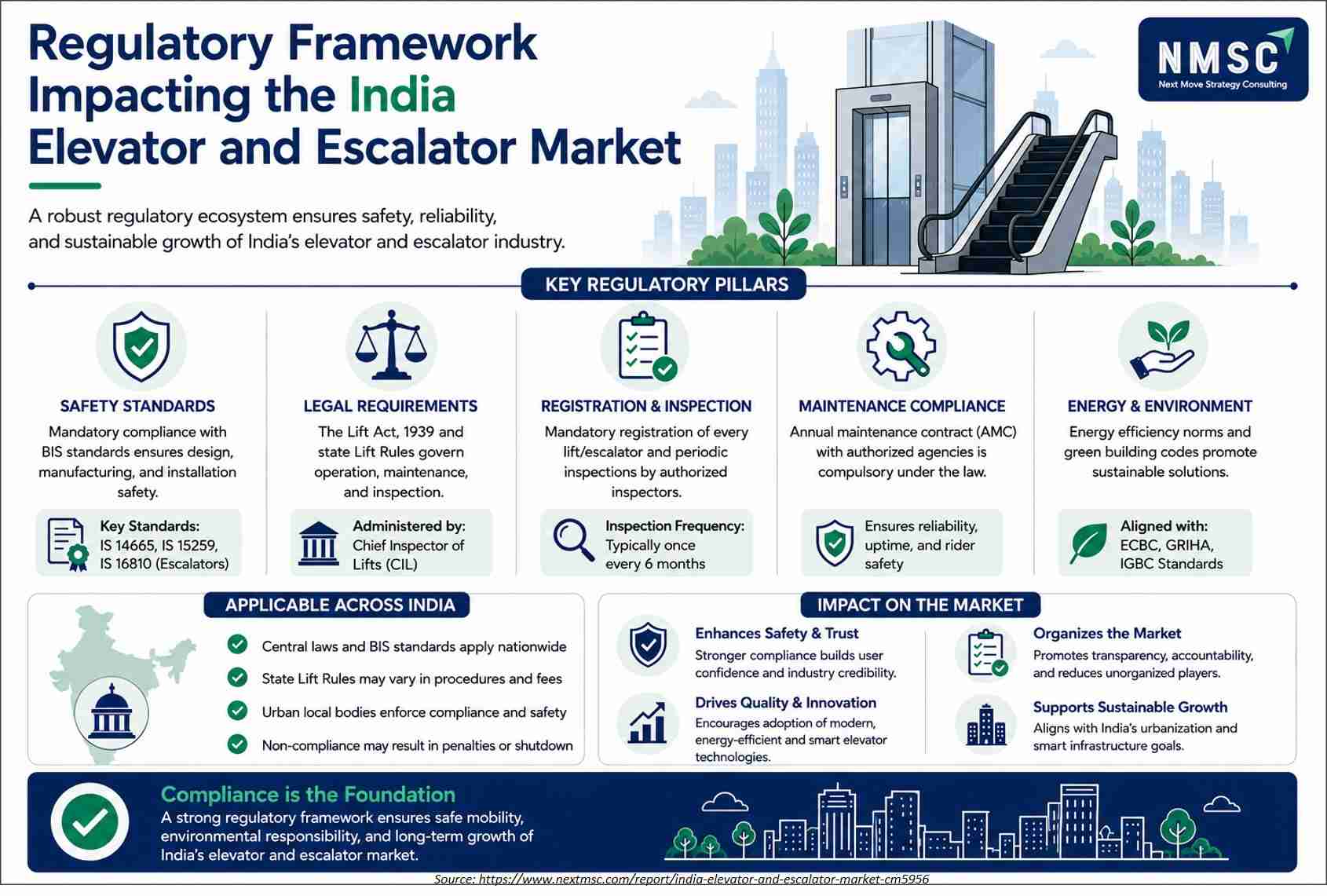
Regulatory Framework Impacting the India Elevator and Escalator Market

India’s regulatory framework combines Bureau of Indian Standards requirements and guidance with state-specific lift and escalator legislation, licensing, inspection, and maintenance provisions. Applicable requirements vary by jurisdiction and installation type. Increasing emphasis on energy efficiency and compliance is also encouraging manufacturers and service providers to adopt safer, smarter, and more sustainable vertical mobility solutions.

Segmentation Analysis

2025 (USD Billion)
2035 (USD Billion)
Elevator Systems 2025: $2,911.55 Billion | 2035: $6,306.78 Billion
Elevator Sys
Escalator Systems 2025: $441.82 Billion | 2035: $1,496.26 Billion
Escalator Sy
Elevator Systems $2,911.55 Billion $6,306.78 Billion 7.84%
Escalator Systems $441.82 Billion $1,496.26 Billion 12.68%

Which Product Type Dominates the India Elevator and Escalator Market?

Elevator Systems led the market with USD 2,911.55 million in 2025, supported by sustained demand for passenger, freight, and special purpose elevators across high-rise residential, commercial, and institutional buildings nationwide. We observed that Escalator Systems is the fastest-growing product type, expanding at a 12.68% CAGR from 2026 to 2035, as metro rail expansion, airport capacity additions, and large-format retail development accelerate demand for high-throughput vertical transportation equipment.

2025 (USD Billion)
2035 (USD Billion)
New Equipmen
Modernizatio
Maintenance
Segment Item 2025 (USD Billion) 2035 (USD Billion) CAGR
New Equipment $10.0 USD Billion $40.0 USD Billion 15.0%
Modernization $17.1 USD Billion $51.1 USD Billion 21.0%
Maintenance and Repair $24.2 USD Billion $62.2 USD Billion 23.0%

Segment-wise data not detailed in this view

Unlock complete segment-wise numbers for By Revenue Stream.

Unlock Full Data
2025 (USD Billion)
2035 (USD Billion)
Low Speed Sy
Medium Speed
High Speed S
Segment Item 2025 (USD Billion) 2035 (USD Billion) CAGR
Low Speed Systems $10.0 USD Billion $40.0 USD Billion 24.0%
Medium Speed Systems $17.1 USD Billion $51.1 USD Billion 26.0%
High Speed Systems $24.2 USD Billion $62.2 USD Billion 24.0%

Segment-wise data not detailed in this view

Unlock complete segment-wise numbers for By Operational Speed.

Unlock Full Data
2025 (USD Billion)
2035 (USD Billion)
Low Capacity Systems 2025: $602.42 Billion | 2035: $1,047.00 Billion
Low Capacity
Medium Capacity Systems 2025: $1,367.77 Billion | 2035: $3,063.37 Billion
Medium Capac
High Capacity Systems 2025: $940.46 Billion | 2035: $2,638.46 Billion
High Capacit
Ultra-High Capacity Systems 2025: $442.72 Billion | 2035: $1,054.21 Billion
Ultra-High C
Low Capacity Systems $602.42 Billion $1,047.00 Billion 5.45%
Medium Capacity Systems $1,367.77 Billion $3,063.37 Billion 8.20%
High Capacity Systems $940.46 Billion $2,638.46 Billion 10.65%
Ultra-High Capacity Systems $442.72 Billion $1,054.21 Billion 8.87%

Which Rated Capacity Segment Leads Market Demand?

Medium Capacity Systems remained the leading rated capacity segment within the market, valued at USD 1,367.77 million in 2025 on sustained demand for standard passenger elevators serving typical residential and commercial occupancy loads. Our findings suggest that High Capacity Systems is the fastest-growing rated capacity segment, registering a 10.65% CAGR from 2026 to 2035, as high-rise commercial developments, hospitals, and transit facilities increasingly specify higher-capacity systems to manage peak passenger and freight volumes.

2025 (USD Billion)
2035 (USD Billion)
Residential 2025: $1,266.40 Billion | 2035: $2,712.20 Billion
Residential
Commercial 2025: $587.81 Billion | 2035: $1,206.82 Billion
Commercial
Transit and Infrastructure 2025: $738.97 Billion | 2035: $2,206.91 Billion
Transit and
Healthcare 2025: $305.76 Billion | 2035: $745.87 Billion
Healthcare
Industrial 2025: $214.04 Billion | 2035: $388.90 Billion
Industrial
Public and Institutional 2025: $240.38 Billion | 2035: $542.34 Billion
Public and I
Residential $1,266.40 Billion $2,712.20 Billion 7.72%
Commercial $587.81 Billion $1,206.82 Billion 7.26%
Transit and Infrastructure $738.97 Billion $2,206.91 Billion 11.32%
Healthcare $305.76 Billion $745.87 Billion 9.13%
Industrial $214.04 Billion $388.90 Billion 5.93%
Public and Institutional $240.38 Billion $542.34 Billion 8.28%

Which End Use Segment Is Most Significant in the Market?

Residential remained the dominant end use across the market, reaching USD 1,266.40 million in 2025 due to sustained high-rise apartment and villa construction across metropolitan and Tier-I cities. Based on research conducted by NMSC, we found that Transit and Infrastructure represents the fastest-growing end use at an 11.32% CAGR from 2026 to 2035, reflecting sustained government investment in metro rail, airport, and bus terminal capacity expansion across major Indian urban markets .

2025 (USD Billion)
2035 (USD Billion)
Developers
Building Own
Facility Man
Public Agenc
Contractors
Segment Item 2025 (USD Billion) 2035 (USD Billion) CAGR
Developers $10.0 USD Billion $40.0 USD Billion 22.0%
Building Owners $17.1 USD Billion $51.1 USD Billion 12.0%
Facility Managers $24.2 USD Billion $62.2 USD Billion 14.0%
Public Agencies $31.3 USD Billion $73.3 USD Billion 12.0%
Contractors $38.4 USD Billion $84.4 USD Billion 15.0%

Segment-wise data not detailed in this view

Unlock complete segment-wise numbers for By Buyer Type.

Unlock Full Data

Growth Opportunities

Our analysis shows that three forward-looking opportunities stand out for stakeholders positioning within the India elevator and escalator market over the 2026-2035 forecast period.

How Can Modernization Services Unlock Value in Aging Building Stock?

Modernization and retrofit services present a whitespace opportunity for manufacturers serving India's growing base of elevators installed during earlier construction cycles now approaching end-of-life mechanical components. Vendors that commercialize structured modernization packages stand to capture recurring, higher-margin revenue as building owners prioritize safety upgrades and energy efficiency improvements over full equipment replacement.

Where Does Tier-II and Tier-III City Expansion Create New Demand?

Tier-II and Tier-III cities undergoing rapid vertical densification represent an underpenetrated opportunity for manufacturers offering cost-optimized elevator and escalator products. Vendors that develop value-engineered platforms tailored to smaller-city construction budgets can secure long-term distribution partnerships, benefiting from expanding formal housing and commercial development beyond the metropolitan markets that have historically driven category demand.

How Can Predictive Maintenance Platforms Benefit Facility Managers?

Facility managers overseeing large commercial and institutional portfolios represent an underpenetrated opportunity for providers offering integrated, multi-brand predictive maintenance platforms. Early movers that build vendor-agnostic monitoring capability can differentiate with facility manager and public agency customers pursuing centralized visibility across mixed-brand elevator and escalator fleets spanning multiple properties.

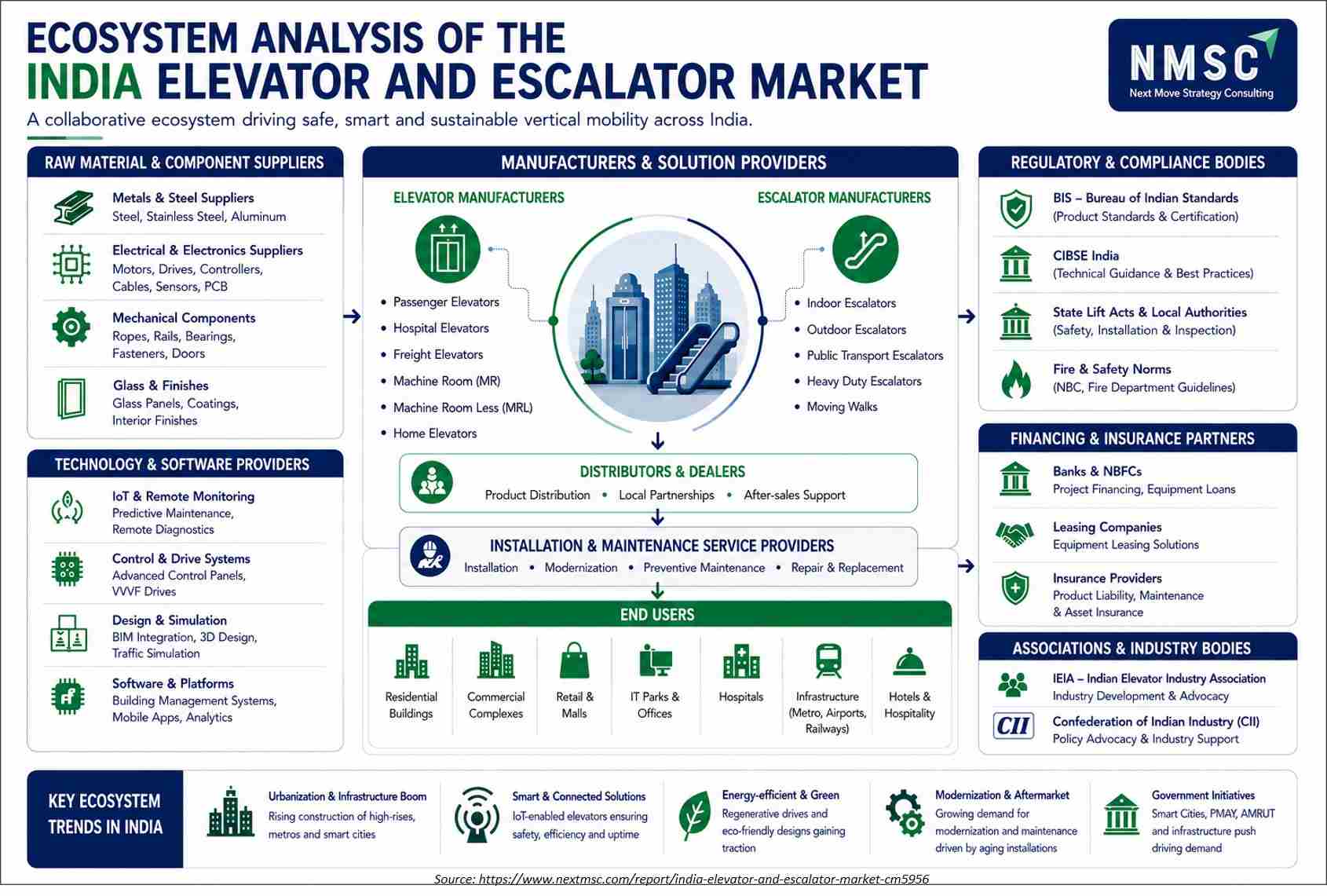
Ecosystem Analysis of the India Elevator and Escalator Market

The India elevator and escalator market comprises a broad ecosystem of component suppliers, technology providers, manufacturers, distributors, installation and maintenance companies, regulators, financial institutions, and end users. Collaboration across these participants supports product development, deployment, modernization, and after-sales services. Urbanization, smart infrastructure projects, digital monitoring, and rising modernization requirements continue to strengthen ecosystem opportunities.

Competitive Landscape

NMSC analysis indicates that competitive differentiation is increasingly shaped by digital service capability, local manufacturing depth, and after-sales network reach alongside pricing . Key Takeaways Field | Details Market Structure | Moderately fragmented, with multinational majors competing alongside established domestic manufacturers across price-differentiated product tiers. Innovation Focus | IoT-enabled connectivity, machine-room-less traction systems, destination control technology, and compact home elevator platforms. M&A Activity | Limited large-scale consolidation; growth concentrated in organic capacity expansion and local manufacturing investment by multinational entities. Source: www.nextmsc.com

Dimension Description
Market Structure Moderately fragmented, with multinational majors competing alongside established domestic manufacturers across price-differentiated product tiers.
Innovation Focus IoT-enabled connectivity, machine-room-less traction systems, destination control technology, and compact home elevator platforms.
M&A Activity Limited large-scale consolidation; growth concentrated in organic capacity expansion and local manufacturing investment by multinational entities.

How Do Companies Compete in the India Elevator and Escalator Market?

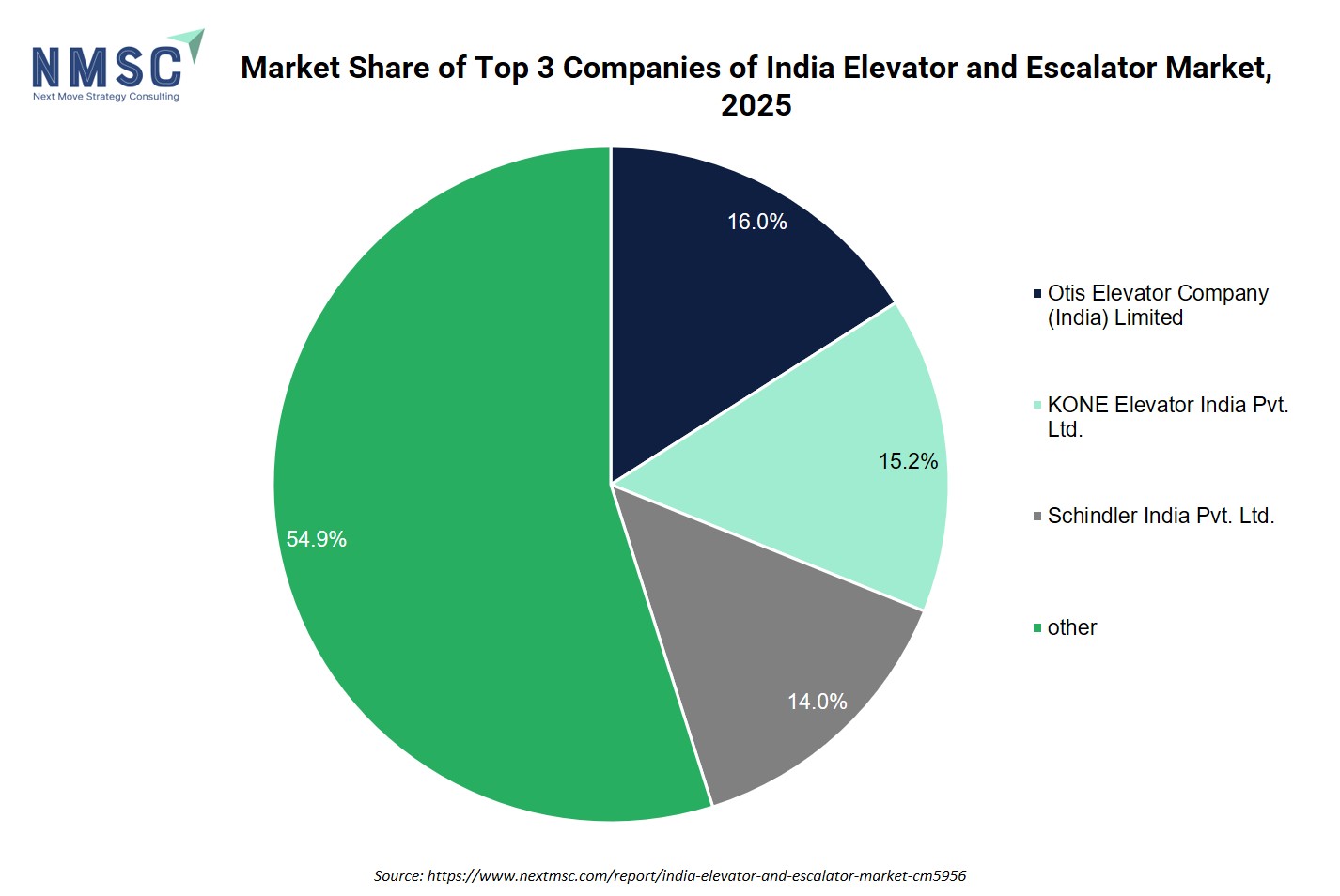
Companies compete primarily on after-sales service network density, digital monitoring capability, and delivery reliability for large-scale infrastructure projects rather than price alone. Our analysis shows that multinational manufacturers including Otis, KONE, and Schindler continue to expand connected elevator platforms with cloud-based monitoring across Indian installations. Providers increasingly differentiate through localized manufacturing capacity, faster project turnaround, and integrated maintenance contracts bundled with new equipment sales.

Which Competitive Archetypes Dominate the India Elevator and Escalator Market?

Two competitive archetypes dominate the market: multinational manufacturers offering globally standardized, technology-forward platforms backed by extensive service networks, and domestic manufacturers such as Johnson Lifts and City Lift offering cost-competitive products tailored to Indian construction budgets and specifications. We found that multinational players differentiate through digital service ecosystems and premium high-rise capability, while domestic manufacturers differentiate through broad service networks and value-engineered pricing for Tier-II and Tier-III city projects.

How Are Companies Differentiating Through Innovation in Vertical Transportation?

Providers are differentiating through connected elevator platforms, destination control technology, and compact residential products extending category reach beyond traditional applications. We observed that Schindler India offers destination-control technology designed to improve elevator traffic handling and passenger flow , while TK Elevator India has introduced a dedicated home elevator solution for villas and multi-storey residences. Competing manufacturers are similarly expanding energy-efficient and high-speed product lines to differentiate across specialty applications.

What Expansion and Investment Activity Is Shaping the India Elevator and Escalator Market ?

Expansion activity is concentrated on organic local manufacturing capacity investment rather than large-scale mergers and acquisitions among the market's established players. Our findings indicate that KONE has strengthened its technology and testing capabilities at its Sriperumbudur facility, while Hybon Elevators has announced investment to expand research and production capabilities . This organic capacity-building trend illustrates how both multinational and domestic manufacturers are prioritizing direct investment in Indian production infrastructure over acquisition-led growth strategies.

Key Market Players

Our assessment indicates that the following 15 companies are actively shaping product innovation, service network expansion, and manufacturing capacity within the India elevator and escalator market.

Otis Elevator Company (India) Limited KONE Elevator India Pvt. Ltd. Schindler India Pvt. Ltd. Johnson Lifts Pvt. Ltd. TK Elevator India Pvt. Ltd. Fujitec India Pvt. Ltd. Hyundai Elevator & Movement Technologies Ltd. Mitsubishi Elevator India Private Limited Hitachi Lift India Pvt. Ltd. City Lift (India) Ltd. Hybon Elevators and Escalators Pvt. Ltd. ESCON Elevators Pvt. Ltd. Nibav Lifts Private Limited EROS GROUP Sigma Gearless Pvt. Ltd.

Latest Developments

We found that recent corporate developments within the India elevator and escalator market are concentrated on connected product launches and local manufacturing capacity expansion.

Date Event
July 2026 Hitachi, Hitachi Lift India, and GlobalLogic launched the BuilMirai Experience Center in Noida, centered on HMAX for Buildings. The hub combines building data, domain expertise, and AI to demonstrate connected building management. It strengthens India’s market for smart elevator lifecycle services and positions India as a strategic building-solutions hub.
February 2026 Fujitec secured 451 escalator and moving-walk orders for Chennai Metro Corridors 3 and 5, covering 54 stations, including 34 underground and 20 elevated. Following its earlier 239-elevator order, the combined project reaches 690 vertical-transport units. This strengthens Fujitec’s public-transit presence and supports India’s expanding metro infrastructure.
November 2025 Fujitec received its largest-ever India order, 698 elevators for a large residential development by Signature Global in Gurgaon. The project follows a 538-unit 2023 order from the same developer, while Fujitec plans to more than double local production capacity by FY2026. It reinforces residential demand and localized supply capabilities.
October 2025 Otis India secured a contract with My Home Group to supply 169 high-speed elevators for three luxury residential developments in Hyderabad, including the 234-meter My Home 99. The order expands Otis’ presence in premium housing and demonstrates growing demand for high-speed, reliability-focused elevator systems in India’s urban high-rise segment.
July 2025 Nibav Lifts launched its Series V pneumatic home elevator in India, featuring automated doors, personalized design elements, illuminated interiors, and a screwless design. The launch targets modern residential applications with compact, air-driven technology. It supports expansion of India’s home-lift segment, particularly where limited space and minimal structural changes influence purchasing.

Investment Opportunities

What Capital Inflows Are Targeting the India Elevator and Escalator Market?

Capital inflows into the India elevator and escalator market are increasingly directed toward local manufacturing capacity and digital service platform development rather than distribution infrastructure alone. Hybon Elevators and Escalators Pvt. Ltd. has announced capital investment to expand research and development and production capacity, reflecting sustained domestic manufacturer investment in the category. Manufacturers with diversified revenue across new equipment, modernization, and maintenance may offer greater revenue visibility to investors because service contracts can generate recurring income.

How Is Infrastructure Investment Supporting Market Expansion?

Infrastructure investment in metro rail, airport, and public transit capacity continues to expand the addressable base for large-volume escalator and moving walkway procurement. India's Ministry of Housing and Urban Affairs continues to oversee metro rail network expansion across multiple Indian cities, generating sustained multi-year public procurement pipelines.

What ESG Considerations Are Shaping Investment Decisions?

Environmental, social, and governance considerations are increasingly central to investment decisions across the industry, with energy efficiency and passenger safety as key criteria. Alignment with Bureau of Indian Standards safety codes and state-level lift safety acts increasingly informs institutional investment standards for elevator and escalator manufacturers. Safety compliance and energy efficiency can increasingly influence investment assessments as vertical-transportation companies face greater expectations around operational safety and resource efficiency .

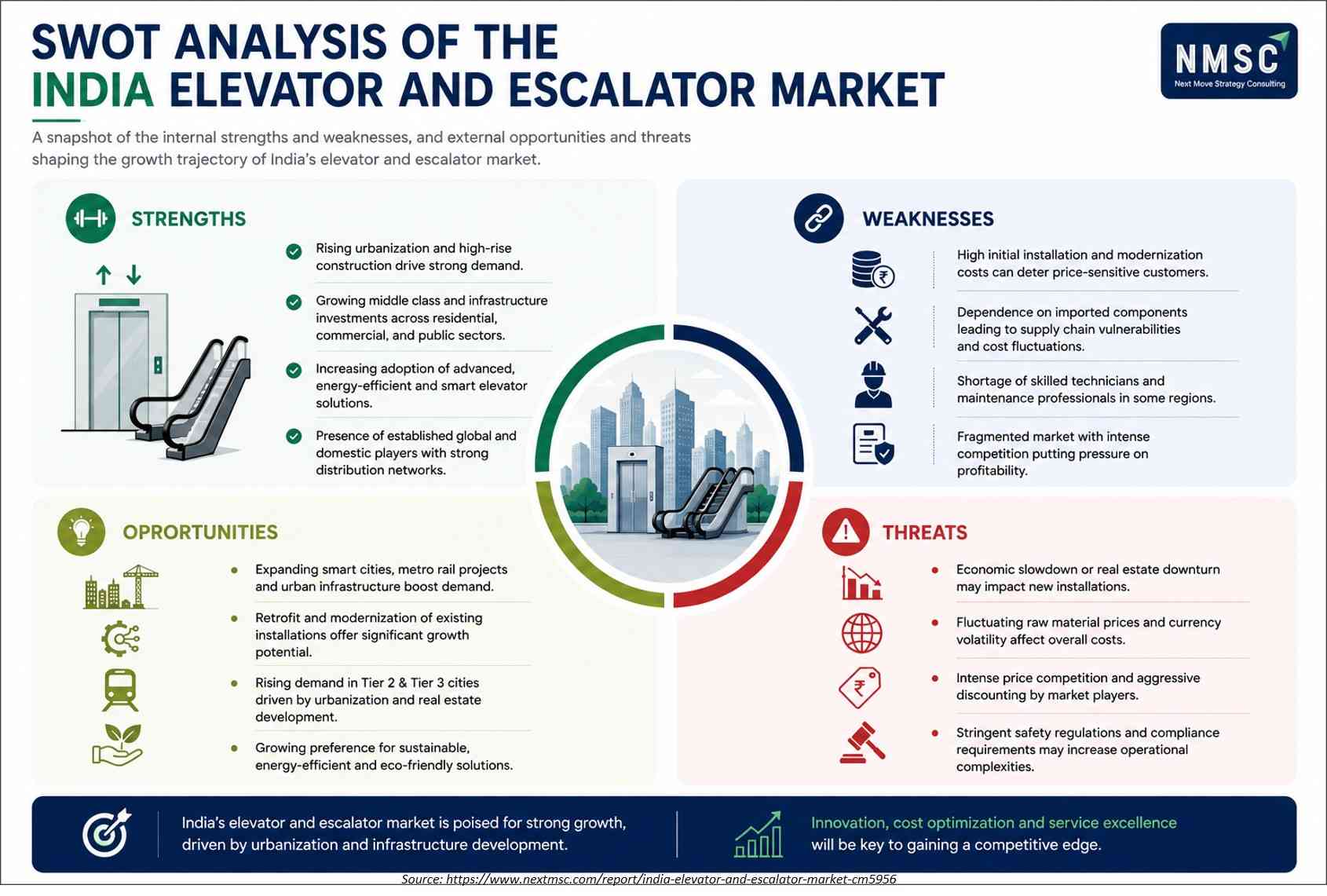
SWOT Analysis

This SWOT view highlights structural strengths, strategic gaps, expansion headroom, and external risks shaping outcomes in the India Elevator and Escalator Market.

Strengths

Rising urbanization and high-rise construction drive strong demand.
Growing middle class and infrastructure investments across residential, commercial, and public sectors.
Increasing adoption of advanced, energy-efficient and smart elevator solutions.
Presence of established global and domestic players with strong distribution networks.

Weaknesses

High initial installation and modernization costs can deter price-sensitive customers.
Dependence on imported components leading to supply chain vulnerabilities and cost fluctuations.
Shortage of skilled technicians and maintenance professionals in some regions.
Fragmented market with intense competition putting pressure on profitability.

Opportunities

Expanding smart cities, metro rail projects and urban infrastructure boost demand.
Retrofit and modernization of existing installations offer significant growth potential.
Rising demand in Tier 2 & Tier 3 cities driven by urbanization and real estate development.
Growing preference for sustainable, energy-efficient and eco-friendly solutions.

Threats

Economic slowdown or real estate downturn may impact new installations.
Fluctuating raw material prices and currency volatility affect overall costs.
Intense price competition and aggressive discounting by market players.
Stringent safety regulations and compliance requirements may increase operational complexities.

Key Benefits for Stakeholders

How Does This Report Benefit Enterprise and Industry Leaders?

Enterprise and industry leaders gain access to detailed segmentation , competitive benchmarking, and demand forecasts that support product portfolio and manufacturing capacity decisions across the India elevator and escalator industry. Our analysis shows that detailed product type, rated capacity, and end use breakdowns help manufacturers align sourcing and production strategy with construction and infrastructure demand trends while identifying underserved segments for portfolio expansion.

How Does This Report Benefit Investors and Financial Analysts?

Investors and financial analysts benefit from consistent market size and CAGR estimates that support valuation and capital-allocation decisions across the India elevator and escalator supply chain. We observed that the report's segment-level growth differentials help identify which manufacturers are best positioned to capture above-market growth in Escalator Systems and Transit and Infrastructure categories through 2035.

How Does This Report Benefit Technology Vendors and Product Teams?

Technology vendors and product teams gain insight into emerging platform requirements, including IoT-enabled connectivity, destination control technology, and compact residential product formats, that are reshaping the industry. Our findings suggest that this analysis helps product roadmap teams prioritize development around predictive maintenance and digital service capability increasingly required by developer and facility manager procurement processes.

Key Market Segments Evaluated

By Product Type

  • Elevator Systems
  • Escalator Systems

By Revenue Stream

  • New Equipment
  • Modernization
  • Maintenance and Repair

By Operational Speed

  • Low Speed Systems
  • Medium Speed Systems
  • High Speed Systems

By Rated Capacity

  • Low Capacity Systems
  • Medium Capacity Systems
  • High Capacity Systems
  • Ultra-High Capacity Systems

By End Use

  • Residential
  • Commercial
  • Transit and Infrastructure
  • Healthcare
  • Industrial
  • Public and Institutional

By Buyer Type

  • Developers
  • Building Owners
  • Facility Managers
  • Public Agencies
  • Contractors

Conclusion & Recommendations

The long-term outlook for the India elevator and escalator market remains strongly positive, with revenue projected to grow from USD 3.35 billion in 2025 to USD 7.80 billion by 2035 at an 8.62% CAGR. We observed that this trajectory is anchored by durable urbanization-linked construction demand and expanding public infrastructure investment rather than short-lived project cycles, suggesting the current growth trajectory rests on structural demand extending well beyond individual metropolitan development booms.

What Strategic Positioning Should Elevator and Escalator Providers Pursue?

Providers should pursue strategic positioning around digital service capability, local manufacturing depth, and modernization portfolio breadth rather than competing on new equipment pricing alone. Our assessment indicates that providers combining connected product platforms with strong after-sales service networks are best positioned to retain developer and facility manager customers as procurement increasingly favors integrated lifecycle service relationships over one-time equipment purchases.

How Attractive Is the India Elevator and Escalator Market for New Investment?

The India elevator and escalator market presents high investment attractiveness given its 8.62% forecast CAGR and durable demand tied to sustained urbanization and infrastructure investment. We found that investment attractiveness is strongest in Escalator Systems and Transit and Infrastructure categories, which are growing faster than the broader elevator and residential segments, alongside modernization services benefiting from India's expanding base of aging elevator installations.

What Market Shifts and Key Risks Should Stakeholders Monitor?

Stakeholders should monitor high upfront capital costs, fragmented state-level safety regulation, and skilled technician shortages as key risks shaping the market. Price competition from unorganized regional manufacturers illustrates how cost sensitivity, rather than technology alone, continues to influence procurement decisions across Tier-II and Tier-III cities where construction budgets remain more constrained than in metropolitan markets.

What Are the Key Growth Pathways for the India Elevator and Escalator Market?

Key growth pathways include modernization service expansion, Tier-II and Tier-III city penetration, and predictive maintenance platform development for facility manager customers. Our analysis shows that manufacturers expanding digital service capability and value-engineered product lines alongside core elevator and escalator equipment are best positioned to capture recurring, higher-margin revenue as India's vertical transportation market matures beyond initial installation-driven demand.

FAQs

About the Author

Mayurima Roy

Mayurima Roy

Mayurima Roy is Research Analyst at Next Move Strategy Consulting, where she has spent 4 years working across the firm's full industry coverage rather than a single fixed vertical. Her work centers on structured research, ongoing trend tracking, competitive assessment, and insight-led content development, translating complex market data into clear, decision-ready narratives that support informed client decision-making across diverse global industries, market sectors, and world regions every day.

About the Reviewer

Supradip Baul

Supradip Baul

Supradip Baul is an accomplished business consultant and strategist with over a decade of rich experience in market intelligence, strategy, technology, and business transformation. His work has included rigorous qualitative and quantitative analysis across multiple industries, helping clients shape investment decisions and long-term roadmaps. Earlier in his career, he was associated with Gartner, where he contributed to industry-leading reports and market share analyses. He has worked with leading global companies and holds an MBA with a dual specialization in Marketing and Finance.

Download Free Sample

Mohit Agarwal

MOHIT AGARWAL

Chief Manager

DryChem India Pvt. Ltd.

Next Move Strategy Consulting is an amazing team of consultants. We required a market study report for our investors on top priority and the team went above and beyond our expectations to deliver the same with ample supporting data within a short time span enabling us to secure the investments and keep our project timeline maintained. Their professionalism, attention to detail, and timely delivery of actionable recommendations have left a lasting impression on our organization.

Ross J Mckenzie

ROSS J MCKENZIE

Business Insight Manager

Staysure Group

“Next MSC have been incredibly helpful in providing detailed & robust information on our market, alongside quantifying growth by different segments. The process to procure was simple and easy, with sample reports and regular contact to ensure we had what we needed. Succinct detail on their sources & methodologies is also greatly received, allowing transparency in this respect helps build trust in the detail you pay for. Joseph in particular was fantastic, and helped ensure efficient provision of the insight pack – thank you NMSC!”.

Henri Knyphausen

HENRI KNYPHAUSEN

Partner at Singulier [Ex-BCG]

Singulier

I recently engaged NEXTMSC.com for a commercial due diligence project within the intralogistics sector, and I am pleased to provide a reference based on my experience. In utilizing NEXTMSC.com's services, I found their report to offer valuable insights into market dynamics and key industry players. The initial report provided a solid foundation for our analysis. However, as we were investigating a smaller target in the market, and I had specific customization requests requiring additional research. These requests included detailed information on product portfolios of various players and sub-market sizes, both inclusive and exclusive of certain product categories. NEXTMSC.com demonstrated commendable responsiveness and agility in accommodating these customization requests. Within a timeframe of 1-2 weeks, they delivered a revised report that met our specific needs. Furthermore, they were receptive to my follow-up inquiries, ensuring clarity and understanding of the data provided. The final deliverable significantly contributed to our due diligence efforts. One of NEXTMSC.com's notable strengths lies in their qualitative research capabilities. However, for future engagements, I would recommend the inclusion of a quantified market model in Excel format. Such a model would offer the ability to conduct in-depth analyses and explore various market segments, including country-specific data and subcomponent breakdowns. Based on my positive experience, I would not hesitate to work with NEXTMSC.com again. Their responsiveness, willingness to accommodate customization requests, and commitment to delivering actionable insights make them a reliable partner for commercial research projects.

Gustaf Hummel Burstrom

GUSTAF HUMMEL BURSTROM

Founder

Revline Tools AB

Joseph and the team at Next Move Strategy Consulting have been excellent to work with, in supplying us with relevant market data and forecasts for our specific category. We had some special requirements and they were able to do a custom package to suit our needs. We would definitely recommend them to any other company needing market data and forecasts

Rishabh Jogani

RISHABH JOGANI

Strategy Analyst

Accenture Japan

We are incredibly impressed with the market report on the real estate market in India provided by Next Move Strategy Consulting. The report was thorough, insightful, and well-structured, offering deep analysis and actionable recommendations. It not only captured the current trends and dynamics but also provided a forward-looking perspective that has been invaluable for our strategic planning. Their team demonstrated exceptional professionalism, attention to detail, and a profound understanding of the industry. The data-driven insights and clarity of presentation exceeded our expectations, making complex market trends easy to understand. We highly recommend Next Move Strategy Consulting to anyone looking for reliable and comprehensive market research services. Their expertise has given us the confidence to navigate the complexities of the Indian real estate market with clarity and foresight.

Custom Market Research Services

We will customize the research for you if the listed report does not fully match your requirements.

Get 30% Free Customization

Select License

This website uses cookies to ensure you get the best experience on our website. Learn more

✖