Indonesia Intralogistics Market by Component (Hardware (AS/RS (Unit-Load, Mini-Load, VLMs, Carousel), Industrial Robots, Mobile Robots (AGV, and AMR), Conveyor Systems, Sortation Systems, Software (WMS, TMS, Yard Management, and Others) and Services), and by End User (Retail and E-commerce, Automotive, Food and Beverage, Pharmaceuticals, Aviation, Logistics, Semiconductor & Electronics, Consumer Goods, Others) –Opportunity Analysis and Industry Forecast, 2025–2030
Industry: Construction & Manufacturing | Latest Edition: September 30, 2026 | No of Pages: 75 | No. of Tables: 50 | No. of Figures: 21 | Format: PDF | Report Code: CM1060
Indonesia Intralogistics Market Overview
Indonesia Intralogistics Market size was valued at USD 456.91 million in 2024 and is projected to grow to USD 523.21 million by 2025. Additionally, the industry is expected to continue its growth trajectory, reaching USD 894.84 million by 2030, with a CAGR of 11.3% from 2025 to 2030. Also, in terms of volume, the market size was 14.52 thousand units in 2024, and is projected to reach 17.10 thousand units by 2025. Additionally, the industry is expected to continue its growth trajectory, reaching 32.51 thousand units by 2030, with a CAGR of 13.7% from 2025 to 2030.
Indonesia ranks sixth in the Asia Pacific intralogistics market and shows strong growth potential due to robust government investment in automation and the rapid expansion of its EV and automotive industries. The government's Industry 4.0 roadmap, backed by substantial funding, is driving the adoption of technologies such as ASRS, robotics, and smart inventory systems across manufacturing and logistics. The country’s aggressive EV goals, supported by policy incentives and local production targets, further fuel demand for efficient intralogistics to support complex supply chains. However, a shortage of skilled labour capable of operating advanced systems remains a major challenge. Still, the integration of AI in logistics presents significant opportunities, enabling smarter, scalable operations that overcome many structural barriers.
Government Investment Accelerates Indonesia Intralogistics Market Growth
Indonesia holds the sixth-highest position in the Asia Pacific intralogistics market, and records the sixth-highest CAGR from 2025 to 2030. Its growth is primarily fuelled by significant government investment in industrial automation and a rapidly expanding automotive industry, especially in electric vehicles (EVs). The Indonesian government is playing a pivotal role in accelerating intralogistics adoption by supporting digital transformation across manufacturing and logistics. In 2024, the Ministry of Industry allocated approximately USD 150 million to advance Industry 4.0 initiatives under the Making Indonesia 4.0 roadmap, to increase manufacturing’s GDP contribution to 20% by 2030. These initiatives include financial incentives and support for smart factory technologies, such as automated storage and retrieval systems (ASRS), robotics, and intelligent inventory systems. As a result, industrial facilities are increasingly integrating scalable intralogistics technologies to boost supply chain efficiency, optimize warehouse operations, and enhance productivity.
Automotive and EV Sector Fuels Intralogistics Expansion
Indonesia’s ambitious EV strategy further accelerates intralogistics market progress. The country aims to deploy 2 million electric cars and 12 million electric two-wheelers by 2030, leveraging its 42% share of global nickel reserves to become a major EV battery production hub. Policies such as reducing VAT to 1% for EVs with 40% local content and eliminating import duties for manufacturers establishing local production facilities by 2026 have spurred EV demand. The surge in EV sales, particularly after import policy reforms in May 2024, underscores the growing need for advanced intralogistics systems. These solutions enable just-in-time manufacturing, support the handling of specialized EV components, and ensure reliable logistics across complex, rapidly scaling production networks.
Technical Skills Shortage Restrains Intralogistics Automation
Despite the momentum, a critical restraint to the intralogistics market in Indonesia is the shortage of skilled labour required to manage and maintain advanced automation systems. While the government is driving investment in automation technologies, the lack of technical expertise slows adoption rates and limit the effectiveness of implemented systems, particularly for small- and mid-sized enterprises.
Integration of Artificial Intelligence Unlocks Key Opportunities for the Market
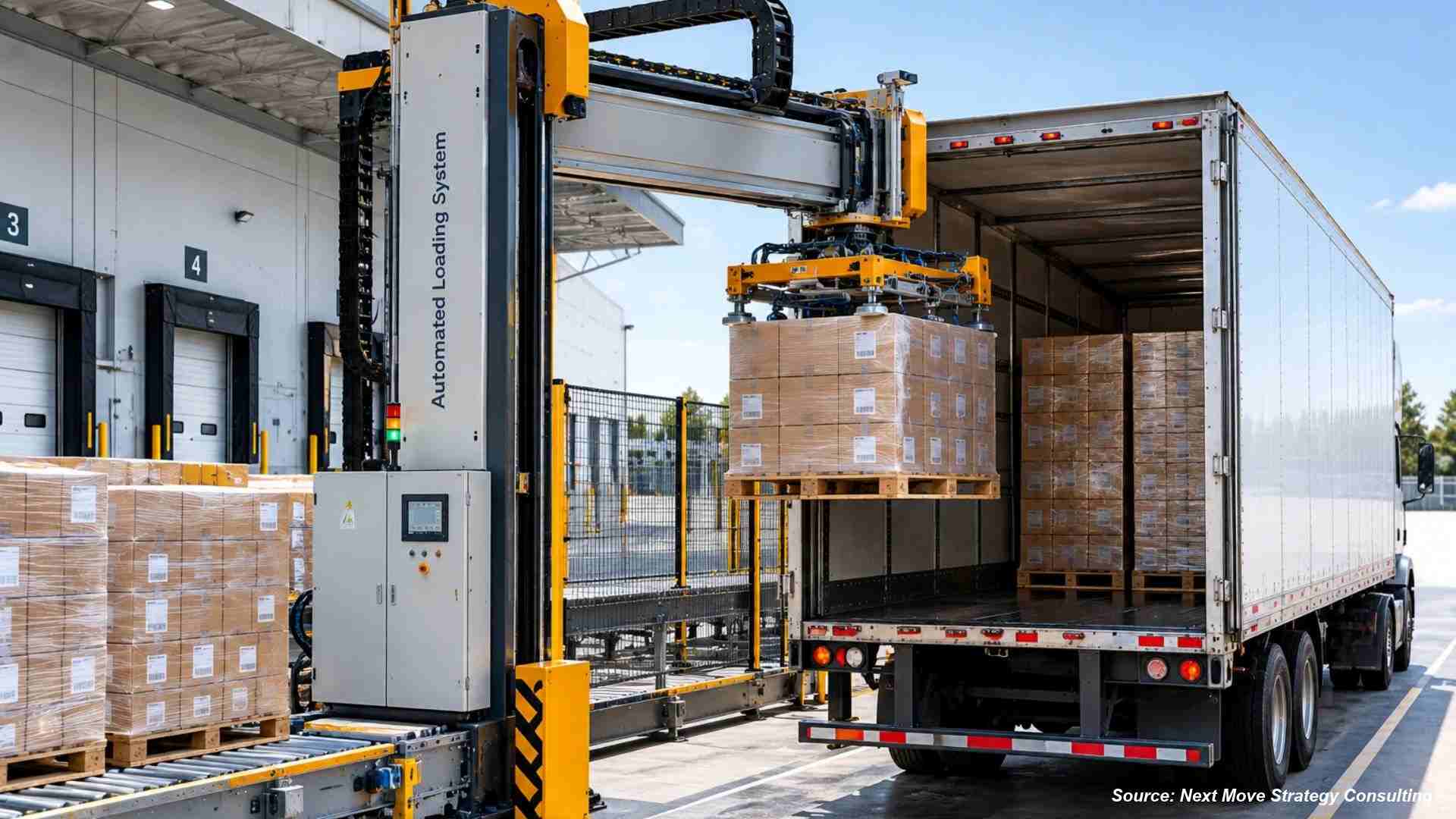
The integration of artificial intelligence (AI) into intralogistics is rapidly becoming a major catalyst for Indonesia intralogistics market expansion, fundamentally reshaping warehouse operations and significantly enhancing efficiency. AI-powered industrial robots are now capable of autonomously navigating complex environments to perform core tasks such as picking, packing, and sorting, reducing reliance on manual labour. A prime example is Nimble Robotics, which secured USD 106 million in Series C funding in October 2024, led by FedEx, achieving a USD 1 billion valuation. The company’s implementation of fully autonomous warehouses, featuring general-purpose AI robots capable of adapting to real-time operational changes, highlights the transformative potential of AI. As this technology continues to enhance scalability, flexibility, and cost-efficiency, it is poised to play a pivotal role in driving the future growth of the intralogistics market.
Competitive Landscape
The market players operating in the Indonesia intralogistics industry include Midea Group, SSI Schäfer, Swisslog, Honeywell International Inc., KION Group (Dematic), PT Teknindo Cipta Internasional, Siemens AG, Bowe Intralogistics, Vanderlande Industries B.V., Hanel Corporation, Murata Machinery (Muratec), Jungheinrich, Stechoq Robotics Indonesia, Kardex Group, and PT GMI (Global Machinery Indonesia)., and others.
Indonesia Intralogistics Market Key Segments
By Component
-
Hardware
-
Automated Storage and Retrieval Systems (AS/RS)
-
Unit-Load AS/RS
-
Mini-Load AS/RS
-
Vertical Lift Modules (VLMs)
-
Carousel AS/RS
-
-
Conveyor Systems
-
Pallet Jacks & Stackers
-
Shuttle Systems
-
Industrial Robots
-
Sortation Systems
-
Mobile Robots
-
Automated Guided Vehicle (AGV)
-
Autonomous Mobile Robot (AMR)
-
-
-
Software
-
Warehouse Management System (WMS)
-
Transportation Management System (TMS)
-
Yard Management Software
-
Inventory Management Software
-
Labor Management Software
-
Other Software
-
-
Service
By Automation Level
-
Manual
-
Semi-Automated
-
Fully Automated
By End-User
-
Retail and E-commerce
-
Automotive
-
Food and Beverage
-
Pharmaceuticals
-
Aviation
-
Logistics
-
Semiconductor & Electronics
-
Consumer Goods
-
Other End Users
Key Players
-
Midea Group
-
SSI Schafer
-
Swisslog
-
PT Teknindo Cipta Internasional
-
Siemens AG
-
Bowe Intralogistics
-
Vanderlande Industries B.V
-
Hanel Corporation
-
Murata Machinery (Muratec)
-
Jungheinrich
-
Stechoq Robotics Indonesia
-
Kardex group
-
PT GMI (Global Machinery Indonesia)
Report Scope and Segmentation
|
Parameters |
Details |
|
Market Size in 2025 |
USD 523.21 million |
|
Market Volume in 2025 |
17.10 thousand units |
|
Revenue Forecast in 2030 |
USD 894.84 million |
|
Volume Forecast in 2030 |
32.51 thousand units |
|
Value Growth Rate |
CAGR of 11.3% from 2025 to 2030 |
|
Volume Growth Rate |
CAGR of 13.7% from 2025 to 2030 |
|
Analysis Period |
2024–2030 |
|
Base Year Considered |
2024 |
|
Forecast Period |
2025–2030 |
|
Market Size Estimation |
Million (USD) |
|
Market Volume Estimation |
Thousand Units |
|
Growth Factors |
|
|
Companies Profiled |
15 |
|
Market Share |
Available for 10 companies |
|
Customization Scope |
Free customization (equivalent up to 80 working hours of analysts) after purchase. Addition or alteration to country, regional, and segment scope. |
|
Pricing and Purchase Options |
Avail customized purchase options to meet your exact research needs. |


About the Author
 Ridip Gogoi
— Ridip Gogoi is a Research Associate at Next Move Strategy Consulting, where he supports cross-vertical market research and analysis across multiple industry sectors, with four years of experience. His work includes market analysis, data validation, secondary research, and insight development, helping structure evidence into clear findings for business and strategy decisions. He contributes to research quality checks and reporting, with a focus on consistency, source review, and clarity accuracy.
Ridip Gogoi
— Ridip Gogoi is a Research Associate at Next Move Strategy Consulting, where he supports cross-vertical market research and analysis across multiple industry sectors, with four years of experience. His work includes market analysis, data validation, secondary research, and insight development, helping structure evidence into clear findings for business and strategy decisions. He contributes to research quality checks and reporting, with a focus on consistency, source review, and clarity accuracy.
About the Reviewer
 Supradip Baul
— Supradip Baul is an accomplished business consultant and strategist with over a decade of rich experience in market intelligence, strategy, technology, and business transformation. His work has included rigorous qualitative and quantitative analysis across multiple industries, helping clients shape investment decisions and long-term roadmaps. Earlier in his career, he was associated with Gartner, where he contributed to industry-leading reports and market share analyses. He has worked with leading global companies and holds an MBA with a dual specialization in Marketing and Finance.
Supradip Baul
— Supradip Baul is an accomplished business consultant and strategist with over a decade of rich experience in market intelligence, strategy, technology, and business transformation. His work has included rigorous qualitative and quantitative analysis across multiple industries, helping clients shape investment decisions and long-term roadmaps. Earlier in his career, he was associated with Gartner, where he contributed to industry-leading reports and market share analyses. He has worked with leading global companies and holds an MBA with a dual specialization in Marketing and Finance.
At Next Move Strategy Consulting, we understand that insightful market research is the cornerstone of successful business decisions. That's why we employ a robust and multifaceted approach, combining various methodologies to deliver the most accurate and actionable data for our clients.

Research Landscape
We navigate the world of research with two primary approaches:
Qualitative Approach
Our qualitative research methodologies involve immersive techniques such as in-depth interviews, focus groups, and observational studies. By engaging directly with individuals and stakeholders, we uncover valuable insights that quantitative data alone may overlook.

Quantitative Research
In tandem with qualitative methodologies, NMSC leverages the power of Quantitative Research to provide a robust foundation of numerical insights. Through systematic data collection and analysis, we quantify patterns, preferences, and market trends, offering a comprehensive view of the business landscape.
Our quantitative research approach employs diverse tools, including surveys, experiments, and statistical modelling. These methodologies enable us to gather data from a large and representative sample, ensuring the statistical significance of our findings. By employing structured questionnaires and standardized data collection methods, we guarantee the reliability and validity of the information we present to our clients.
Quantitative research is particularly effective in measuring the prevalence of trends, assessing market size, and gauging the impact of various factors on consumer behavior. The numerical precision attained through this approach equips our clients with actionable insights, facilitating data-driven decision-making and strategy formulation.


Our Specialized Toolbox for Industry-Specific Market Research
We deploy a specialized arsenal of techniques tailored to meet your unique requirements. Here's a glimpse into our comprehensive toolbox:

Information Procurement
The stage entails acquiring market data or relevant information through various sources and methodologies.


Market Research Approach
We utilize both top-down and bottom-up approaches in market research analysis to achieve a comprehensive understanding of the market dynamics, leveraging the broad perspective of industry trends and macroeconomic factors alongside detailed insights from specific segments and individual companies.

Porters Five Forces Analysis
We conduct Porter's Five Forces analysis to evaluate the competitive landscape of an industry, providing us with insights into factors that affect profitability and strategic positioning.

SWOT Analysis

Forecasting
We utilize a forecasting model to predict future consumption by considering parameters like population, economics, regulations, market competition, drivers, constraints, technology, and pricing. We also employ statistical techniques such as multilinear regression, exponential smoothing, moving average, ARIMA, and Monte Carlo simulations for accurate predictions. In econometric forecasting, we analyzed short-term and long-term event impacts, attributing values based on regulatory frameworks, economic factors, and market events.





 Speak to Our Analyst