Lithium-Ion Battery Separator Market Global Industry Analysis and Forecast (2026–2035)

The global Lithium-Ion Battery Separator Market size was valued at USD 6.89 billion in 2025 and is estimated at USD 7.85 billion in 2026, forecast to reach USD 26.55 billion by 2035, expanding at a 14.5% CAGR between 2026 and 2035. Asia-Pacific leads with approximately 74% share, while Electric Vehicles dominate all other application segments with approximately 72% share.

Download Free Sample PDF
Base Year (2025)
$6.89 Billion
Forecast (2035)
$26.55 Billion
CAGR (2026-2035)
14.5%
Top Region
Asia-Pacific

What Is the Lithium-Ion Battery Separator Market Size?

The global lithium-ion battery separator market size was valued at USD 6.89 billion in 2025 and is estimated at USD 7.85 billion in 2026, projected to reach USD 26.55 billion by 2035, growing at a CAGR of 14.5% from 2026 to 2035. Asia-Pacific led the market with an approximate 74% revenue share in 2025, while the Electric Vehicles application segment dominated at roughly 72% share.

Our findings suggest that the following key takeaways summarize the lithium-ion battery separator market's segment-level and geographic dynamics as of 2025.

Lithium-Ion Battery Separator Market Global Industry Analysis and Forecast (2026–2035) Revenue Forecast

Values in USD Billion

2025 $6.89 Billion
2025
2026 $7.85 Billion
2026
2027 $8.99 Billion
2027
2028 $10.29 Billion
2028
2029 $11.78 Billion
2029
2030 $13.49 Billion
2030
2031 $15.45 Billion
2031
2032 $17.69 Billion
2032
2033 $20.25 Billion
2033
2034 $23.19 Billion
2034
2035 $26.55 Billion
2035

Key Takeaways

By Manufacturing Process: Wet Process held the largest share, expanding from USD 4.69 billion in 2025 to USD 19.65 billion by 2035, representing approximately 68% share; Wet Process is also the fastest-growing sub-segment at 15.4% CAGR from 2026–2035.

By Coating: Coated Separators held the largest share, accounting for approximately 58% of the market with USD 4.00 billion in 2025; Coated Separators is also the fastest-growing sub-segment at 16.6% CAGR from 2026–2035.

By Application: Electric Vehicles held the largest share, accounting for approximately 72% of the market with USD 4.96 billion in 2025; Energy Storage Systems is the fastest-growing sub-segment at 19.7% CAGR from 2026–2035.

By Material Type: PE/PP Multilayer Separators held the largest share, accounting for approximately 44% of the market with USD 3.03 billion in 2025; Ceramic-Coated Separators is the fastest-growing sub-segment at 18.9% CAGR from 2026–2035.

By Battery Chemistry: NMC and NCA Batteries held the largest share, accounting for approximately 54% of the market with USD 3.72 billion in 2025; LFP Batteries is the fastest-growing sub-segment at 18.1% CAGR from 2026–2035.

Dominant Region: Asia-Pacific dominated with approximately 74% revenue share in 2025.

Fastest-Growing Region: North America is expected to register the highest CAGR of 17.5% during 2026–2035.

Dominant Country: China led the market with USD 3.06 billion in 2025.

Fastest-Growing Country: India is the fastest-growing country at a CAGR of 23.0% during 2026–2035.

Market Opportunity: The lithium-ion battery separator market presents an absolute dollar opportunity of approximately USD 18.70 billion between 2026 and 2035, calculated as the difference between the 2035 forecast value and the 2026 base value, an investment window favoring manufacturers scaling ceramic-coated wet-process capacity outside China.

According to NMSC analysis, we found that the gap between announced North American gigafactory capacity and qualified local separator supply is widening the addressable market for regionally manufactured, ceramic-coated separators, even as Chinese overcapacity continues to compress global average selling prices.

What does the Lithium-Ion Battery Separator Market Encompass?

The lithium-ion battery separator industry encompasses the thin, porous polyolefin and ceramic-coated membranes placed between the anode and cathode of lithium-ion cells to prevent short circuits while allowing ion transport, spanning electric vehicle, consumer electronics, energy storage, and industrial applications. We observed that the market has structurally evolved from uncoated dry-process polyethylene films toward ceramic-coated, wet-process separators offering superior thermal-shutdown performance, as demonstrated by Semcorp's December 2025 memorandum of understanding with Arkema to co-develop high-performance PVDF binders for ceramic-coated separators.

Regulatory frameworks such as the U.S. Inflation Reduction Act's Section 45X production credits continue to lower the cost hurdle for domestic separator manufacturing, while cell makers' qualification processes shape which suppliers can serve large-format gigafactory programs. During our market evaluation, we noticed that the energy storage system segment is scaling adoption fastest as grid-scale battery deployment accelerates, while China continues to dominate global manufacturing capacity.

Market Drivers & Dynamics

Interactive Dataset
Global gigafactory capacity build-out and EV sales growth driver +5.2% Asia-Pacific, North America, Europe 2026–2032
Rising ceramic-coated separator adoption for safety compliance driver +3.4% Global 2026–2035
Grid-scale energy storage system deployment acceleration driver +2.8% North America, Asia-Pacific 2026–2033
U.S. Section 45X production credits supporting domestic manufacturing driver +1.9% North America 2026–2030
Shift toward LFP battery chemistry requiring distinct separator specifications driver +1.4% Asia-Pacific, North America 2026–2032
Chinese manufacturing overcapacity compressing average selling prices restraint −2.4% Asia-Pacific, Global 2026–2029
High capital intensity of wet-process separator manufacturing restraint −1.3% North America, Europe 2026–2031
Long cell-maker qualification cycles slowing new-supplier entry restraint −0.8% Global 2026–2030
Source: Next Move Strategy Consulting

Growth Drivers

What Is the Primary Growth Driver of the Market?

Global gigafactory capacity build-out is the single largest driver of separator demand, as every gigawatt-hour of new cell capacity requires substantial separator film volume. Panasonic Energy began mass production at its Kansas plant in July 2025, while CATL is targeting production at Debrecen, Hungary by early 2026, both directly converting into steady separator pull-through. We observed that this capacity-linked demand base provides multi-year volume visibility for suppliers with qualified gigafactory relationships.

How Is Energy Storage System Deployment Driving Separator Market Growth?

Rising grid-scale battery energy storage deployment is driving the Energy Storage Systems application segment toward a 19.7% CAGR from 2026 to 2035, outpacing the broader market average of 14.5%. The International Energy Agency's EV Battery Materials Report documents that global battery-electric vehicle sales exceeded 17 million units in 2024, with parallel stationary storage capacity additions further tightening separator supply. Our analysis shows that this dual EV-and-storage demand base is broadening the separator market beyond automotive cyclicality.

Growth Inhibitors

What Is Restraining Lithium-Ion Battery Separator Market Growth?

Chinese manufacturing overcapacity restrains average selling prices industry-wide, as leading Chinese producers' aggressive capacity expansion has outpaced near-term demand growth in several product categories. High capital intensity of wet-process manufacturing also restrains new-entrant participation, as validated, multi-plant production capability typically requires years of qualification with major cell makers before securing meaningful offtake volume. We found that these pressures weigh most heavily on smaller regional suppliers lacking diversified geographic manufacturing footprints.

What Are the Growth Opportunities?

How Can Manufacturers Capture Value from Regional Reshoring Contracts?

Reshoring initiatives tied to Section 45X production credits and gigafactory localization create a mechanism for manufacturers to capture long-term, government-supported North American supply contracts. Suppliers with confirmed regional manufacturing capacity, such as Asahi Kasei's Ontario facility and ENTEK's Indiana campus, stand to benefit most from this policy-anchored reshoring opportunity.

What Opportunity Exists in LFP-Specific Separator Supply Agreements?

The distinct separator specifications required for LFP battery chemistry create a mechanism for suppliers to secure dedicated, multi-year Tier-1 supply agreements as cell makers diversify beyond nickel-based chemistries. Suppliers with proven LFP-qualified separator technology are best positioned to capture this fastest-growing chemistry-aligned opportunity.

How Can Suppliers Benefit from Energy Storage System Demand Diversification?

Grid-scale energy storage deployment creates a mechanism for separator suppliers to diversify revenue beyond cyclical automotive demand, capturing volume from utility and industrial-scale battery projects. Suppliers with validated stationary-storage separator specifications are best positioned to capture this fastest-growing application segment as renewable grid integration accelerates.

Segmentation Analysis

2025 (USD Billion)
2035 (USD Billion)
Wet Process 2025: $4.69 Billion | 2035: $19.65 Billion
Wet Process
Dry Process 2025: $2.21 Billion | 2035: $6.90 Billion
Dry Process
Wet Process $4.69 Billion $19.65 Billion 15.4%
Dry Process $2.21 Billion $6.90 Billion 12.1%

Which Manufacturing Process Segment Dominates the Market?

Wet Process separators dominate the market with approximately a 68% share in 2025, valued at USD 4.69 billion, reflecting cell makers' preference for the thinner, more uniform films that wet-process extrusion enables for automotive-grade applications. Wet Process is also the fastest-growing manufacturing method at a 15.4% CAGR from 2026 to 2035, as suppliers including Yunnan Energy New Material and Shenzhen Senior Technology Material continue expanding wet-process capacity to serve growing EV and energy storage demand.

2025 (USD Billion)
2035 (USD Billion)
Coated separ
Uncoated sep
Segment Item 2025 (USD Billion) 2035 (USD Billion) CAGR
Coated separators $10.0 USD Billion $40.0 USD Billion 25.0%
Uncoated separators $17.1 USD Billion $51.1 USD Billion 11.0%

Segment-wise data is locked

Unlock complete segment-wise numbers for By Coating.

Unlock Full Data

Which Coating Segment Is Growing Fastest?

Coated Separators lead the coating segmentation with approximately a 58% share in 2025 at USD 4.00 billion, reflecting rising safety-certification requirements across automotive battery applications. Coated Separators are also the fastest-growing segment at a 16.6% CAGR, driven by ceramic and PVDF-coating innovation such as the Semcorp-Arkema collaboration, which is expanding coated-separator qualification for higher-energy-density, longer-range electric vehicle applications.

2025 (USD Billion)
2035 (USD Billion)
Electric veh
Energy stora
Consumer ele
Industrial a
Segment Item 2025 (USD Billion) 2035 (USD Billion) CAGR
Electric vehicles $10.0 USD Billion $40.0 USD Billion 27.0%
Energy storage systems $17.1 USD Billion $51.1 USD Billion 9.0%
Consumer electronics $24.2 USD Billion $62.2 USD Billion 19.0%
Industrial and power tools $31.3 USD Billion $73.3 USD Billion 17.0%

Segment-wise data is locked

Unlock complete segment-wise numbers for By Application.

Unlock Full Data

Which Application Segment Leads the Lithium-Ion Battery Separator Market?

Electric Vehicles lead the application segmentation with approximately 72% share in 2025 at USD 4.96 billion, anchored by global gigafactory capacity additions and continued growth in battery-electric vehicle sales. Energy Storage Systems is the fastest-growing application segment at a 19.7% CAGR, as grid-scale battery deployment accelerates alongside renewable generation build-out, creating a second major demand pillar for separator manufacturers beyond automotive applications.

2025 (USD Billion)
2035 (USD Billion)
PE/PP multil
Ceramic-coat
Nonwoven fib
Segment Item 2025 (USD Billion) 2035 (USD Billion) CAGR
PE/PP multilayer separators $10.0 USD Billion $40.0 USD Billion 14.0%
Ceramic-coated separators $17.1 USD Billion $51.1 USD Billion 24.0%
Nonwoven fiber-based separators $24.2 USD Billion $62.2 USD Billion 22.0%

Segment-wise data is locked

Unlock complete segment-wise numbers for By Material Type.

Unlock Full Data
2025 (USD Billion)
2035 (USD Billion)
NMC and NCA
LFP batterie
Other batter
Segment Item 2025 (USD Billion) 2035 (USD Billion) CAGR
NMC and NCA batteries $10.0 USD Billion $40.0 USD Billion 24.0%
LFP batteries $17.1 USD Billion $51.1 USD Billion 22.0%
Other battery chemistries $24.2 USD Billion $62.2 USD Billion 20.0%

Segment-wise data is locked

Unlock complete segment-wise numbers for By Battery Chemistry.

Unlock Full Data

Porter’s Five Forces Analysis of the Lithium-Ion Battery Separator Industry

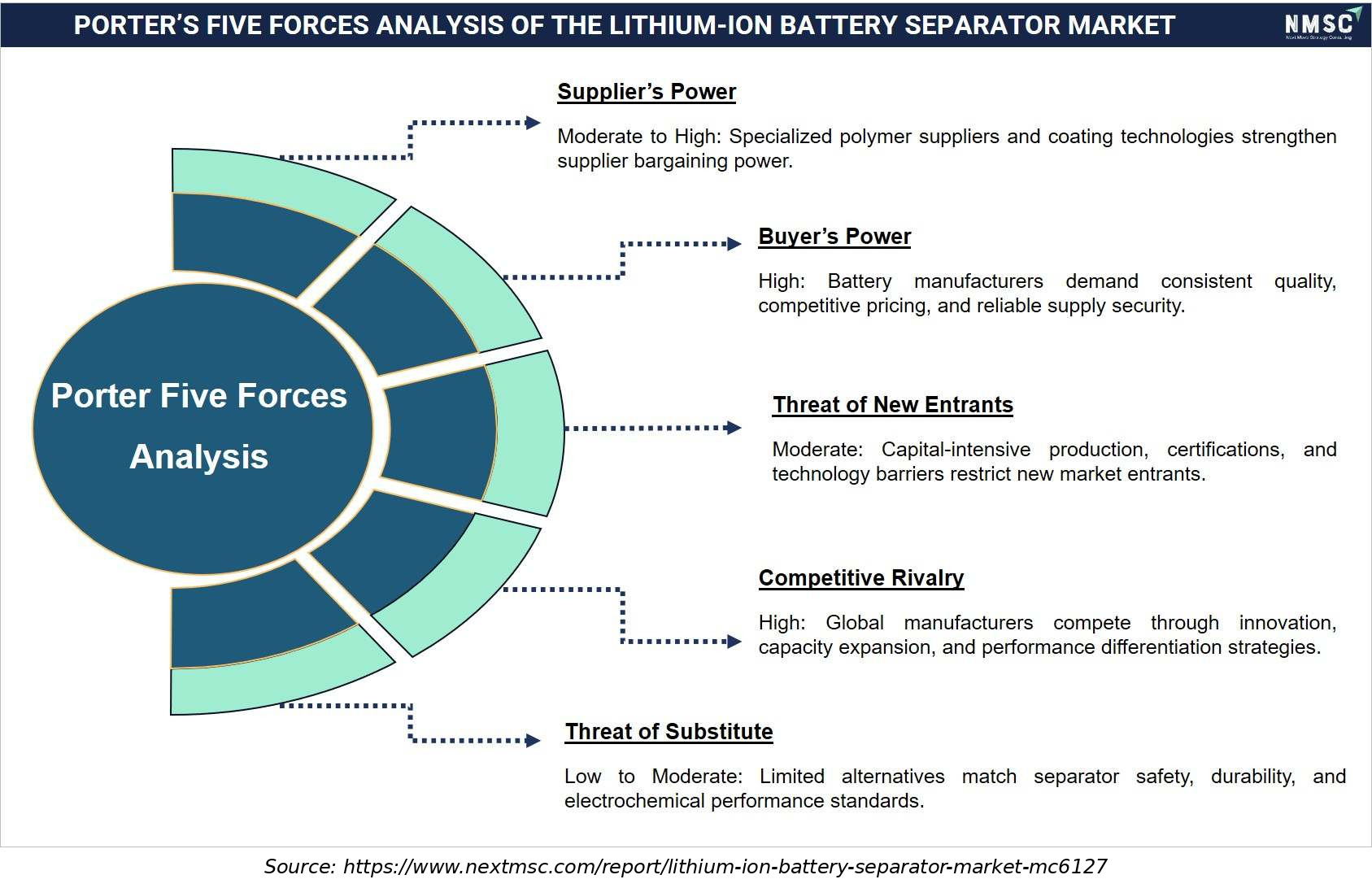
The above infographic presents a Porter's Five Forces analysis of the lithium-ion battery separator market, where supplier power is influenced by specialized material availability. At the same time, buyer power is high as battery manufacturers demand consistent quality, competitive pricing, and reliable supply. The threat of new entrants is low, constrained by technology barriers and high capital requirements, though competitive rivalry is intense among global manufacturers competing through innovation, capacity expansion, and performance differentiation. Looking ahead, we observed that the threat of substitutes stays low to moderate, as limited alternatives can match separator safety, durability, and electrochemical performance standards.

Growth Opportunities

Beyond the core drivers shaping overall demand, three whitespace opportunities stand out for separator manufacturers positioning portfolios toward 2035.

How Can Manufacturers Capture Value from Regional Reshoring Contracts?

Reshoring initiatives tied to Section 45X production credits and gigafactory localization create a mechanism for manufacturers to capture long-term, government-supported North American supply contracts. Suppliers with confirmed regional manufacturing capacity, such as Asahi Kasei's Ontario facility and ENTEK's Indiana campus, stand to benefit most from this policy-anchored reshoring opportunity.

What Opportunity Exists in LFP-Specific Separator Supply Agreements?

The distinct separator specifications required for LFP battery chemistry create a mechanism for suppliers to secure dedicated, multi-year Tier-1 supply agreements as cell makers diversify beyond nickel-based chemistries. Suppliers with proven LFP-qualified separator technology are best positioned to capture this fastest-growing chemistry-aligned opportunity.

How Can Suppliers Benefit from Energy Storage System Demand Diversification?

Grid-scale energy storage deployment creates a mechanism for separator suppliers to diversify revenue beyond cyclical automotive demand, capturing volume from utility and industrial-scale battery projects. Suppliers with validated stationary-storage separator specifications are best positioned to capture this fastest-growing application segment as renewable grid integration accelerates.

Regional Outlook

2025 (USD Billion)
2035 (USD Billion)
North Americ
Europe
Asia-Pacific
Middle East
Latin Americ
Region 2025 (USD Billion) 2035 (USD Billion) CAGR (%)
North America $10.0 USD Billion $40.0 USD Billion 9.0%
Europe $17.1 USD Billion $51.1 USD Billion 27.0%
Asia-Pacific $24.2 USD Billion $62.2 USD Billion 25.0%
Middle East & Africa $31.3 USD Billion $73.3 USD Billion 23.0%
Latin America $38.4 USD Billion $84.4 USD Billion 12.0%

Regional data is locked

Unlock complete regional numbers for this market.

Unlock Full Data

Supply Chain of the Lithium-Ion Battery Separator Industry

Supply Chain of the Lithium-Ion Battery Separator Industry
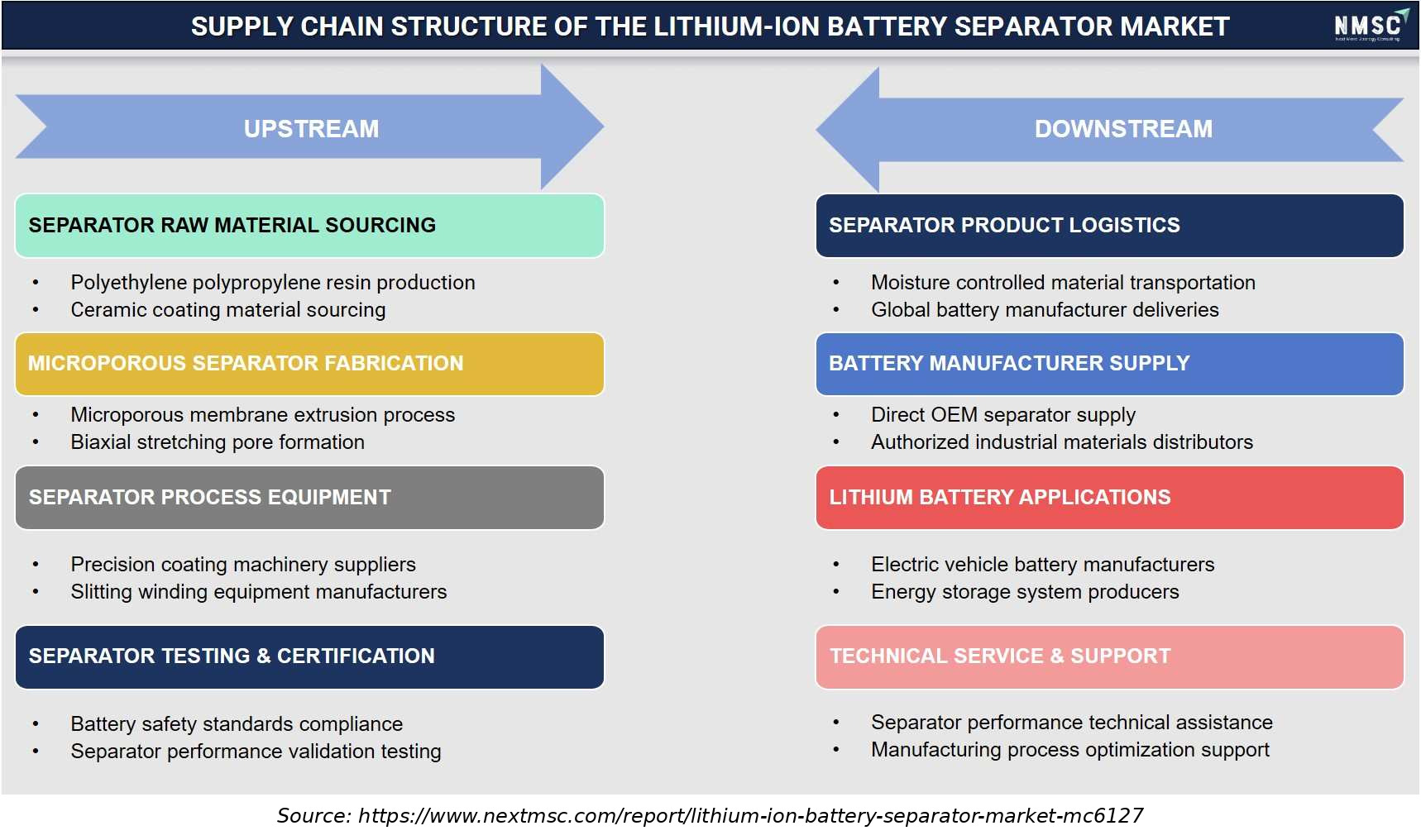
The above infographic presents the supply chain structure of the lithium-ion battery separator market, segmented into upstream and downstream activities. Upstream begins with polyethylene and polypropylene resin sourcing, along with ceramic coating materials, which move into microporous membrane extrusion and biaxial stretching for pore formation. Precision coating and slitting equipment support fabrication, while separator testing and certification ensure compliance with battery safety standards. Moving downstream, moisture-controlled logistics enable global delivery to battery manufacturers through direct OEM supply and authorized distributors. End-use applications include electric vehicles and energy storage systems. Looking ahead, we observed that technical assistance and process optimization support ensure performance reliability and manufacturing efficiency across the market.

Competitive Landscape

Our assessment indicates that competitive intensity in the lithium-ion battery separator market is shaped by a small group of Asian manufacturers controlling the majority of global capacity, alongside Western specialists serving regionally qualified supply chains within the broader battery materials industry.

Dimension Description
Market Structure Highly concentrated, with Yunnan Energy New Material, Asahi Kasei, SK IE Technology, Semcorp, and Toray collectively controlling the majority of global qualified capacity.
Innovation Focus Ceramic and PVDF coating chemistry, wet-process film uniformity, and LFP-specific separator specifications.
M&A Activity Strategic supply agreements and joint-venture manufacturing partnerships rather than large-scale horizontal consolidation.

How Do Companies Compete in the Lithium-Ion Battery Separator Market?

Companies compete primarily on film uniformity, thermal-shutdown performance, multi-plant manufacturing consistency, and long-standing cell-maker qualification relationships built over years of supply history. Our analysis shows that Yunnan Energy New Material and Semcorp compete on manufacturing scale and cost competitiveness from concentrated Chinese production, while Asahi Kasei and Toray compete on proprietary coating technology and established Western and Japanese cell-maker relationships.

Which Competitive Archetypes Dominate the Market?

Two archetypes dominate the market: large-scale Chinese manufacturers competing on production volume and cost efficiency, and established Japanese, Korean, and Western suppliers competing on proprietary coating technology and long-standing automotive qualification. Yunnan Energy New Material exemplifies the scale-driven archetype through its dominant Chinese manufacturing capacity, while Asahi Kasei exemplifies the technology-differentiated archetype through its Celgard and Hipore proprietary separator platforms.

How Are Companies Differentiating Through Innovation?

Innovation and differentiation increasingly center on advanced ceramic and polymer coating chemistry that improves thermal-shutdown performance without compromising ionic conductivity. Semcorp's collaboration with Arkema on high-performance PVDF binders and SK IE Technology's LFP-specific supply qualification with Gotion High-Tech both illustrate how suppliers are embedding proprietary chemistry expertise to differentiate beyond commodity polyolefin film production.

What M&A and Expansion Activity Is Shaping the Lithium-Ion Battery Separator Market?

Expansion activity is concentrated in joint-venture manufacturing facilities and long-term supply agreements rather than large-format acquisitions. Asahi Kasei's joint-venture separator plant with Honda in Ontario and SK IE Technology's long-term supply agreement with Gotion High-Tech both illustrate how suppliers are securing demand visibility through direct partnerships with automakers and cell makers rather than horizontal consolidation among separator producers.

Key Market Players

Our assessment indicates that the following companies are actively shaping manufacturing capacity, coating technology innovation, and cell-maker supply relationships within the global lithium-ion battery separator market.

Yunnan Energy New Material Co., Ltd. Asahi Kasei Corporation SK IE Technology Co., Ltd. Shenzhen Senior Technology Material Co., Ltd. Toray Industries, Inc. Sinoma Science and Technology Co., Ltd. W-Scope Corporation UBE Corporation Sumitomo Chemical Co., Ltd. ENTEK International LLC Freudenberg Group Ahlstrom Oyj Hollingsworth and Vose Company Mitsubishi Chemical Group Corporation Company 15

Latest Developments

We found that recent capacity expansions and supply agreements within the lithium-ion battery separator market are concentrated on North American reshoring, coating technology partnerships, and chemistry-specific qualification across 2025 and 2026.

Date Event
July 2025 Asahi Kasei and Toyota Tsusho established a strategic partnership to supply Hipore™ wet-process lithium-ion battery separators for automotive batteries in North America. Under a capacity rights agreement, Asahi Kasei Battery Separator America will prioritize the supply of coated Hipore™ separators to Toyota Tsusho America from its Charlotte, North Carolina facility, beginning in mid-2027.

Investment Opportunities

What Capital Inflows Are Targeting the Lithium-Ion Battery Separator Market?

Capital inflows are increasingly directed toward regionally qualified, ceramic-coated manufacturing capacity, with ENTEK International's Indiana campus representing a capital commitment of approximately USD 1.5 billion. We observed that investors favor suppliers demonstrating confirmed offtake agreements with automakers or cell makers, viewing qualified supply relationships as a proxy for durable, multi-year revenue visibility.

How Is Infrastructure Investment Supporting Market Growth?

Infrastructure investment tied to Section 45X production tax credits continues to underwrite domestic separator manufacturing capacity across North America. Asahi Kasei's Ontario joint venture with Honda and ENTEK's Indiana campus both illustrate how policy-supported capital is converting into a confirmed regional manufacturing footprint. Our findings suggest that suppliers with early-mover regional capacity are best positioned to capture this policy-anchored investment flow through 2035.

What ESG Considerations Are Shaping Investment Decisions?

Supply-chain resilience and reduced manufacturing concentration are central governance considerations shaping investment decisions, as the separator market's historical concentration in a small number of Asian facilities creates single-point-of-failure risk for global EV production. We found that investors increasingly treat geographic manufacturing diversification as a governance indicator alongside conventional environmental and labor compliance metrics when evaluating separator supplier partnerships.

Key Benefits for Stakeholders

How Does This Report Benefit Enterprise and Industry Leaders?

Enterprise and industry leaders gain access to validated segmentation, competitive benchmarking, and regional demand forecasts that support supplier-qualification and capacity-investment decisions across the lithium-ion battery separator industry. Our analysis shows that detailed manufacturing process, coating, and application breakdowns help procurement teams align sourcing strategy with the fastest-growing segments, including Energy Storage Systems and Coated Separators.

How Does This Report Benefit Investors and Financial Analysts?

Investors and financial analysts benefit from consistent, single-point market size and CAGR estimates that support valuation and capital-allocation decisions across the lithium-ion battery separator supply chain. We observed that the report's regional and segment-level growth differentials help identify which suppliers are best positioned to capture above-market growth in North American reshoring and ceramic-coated technology through 2035.

How Does This Report Benefit Technology Vendors and Product Teams?

Technology vendors and product teams gain insight into emerging design requirements, including ceramic and PVDF coating chemistry, LFP-specific specifications, and multi-plant manufacturing consistency, that are reshaping the industry. Our findings suggest that this analysis helps R&D teams prioritize development roadmaps around the Coated Separators and LFP Batteries segments showing the strongest above-market growth trajectories.

Key Market Segments Evaluated

By Manufacturing Process

  • Wet Process
  • Dry Process

By Coating

  • Coated Separators
  • Uncoated Separators

By Application

  • Electric Vehicles
  • Energy Storage Systems
  • Consumer Electronics
  • Industrial and Power Tools

By Material Type

  • PE/PP multilayer separators
  • Ceramic-coated separators
  • Nonwoven fiber-based separators

By Battery Chemistry

  • NMC and NCA batteries
  • LFP batteries
  • Other battery chemistries

Conclusion & Recommendations

The long-term outlook for the lithium-ion battery separator market remains strongly positive, with global revenue projected to grow more than threefold from USD 6.89 billion in 2025 to USD 26.55 billion by 2035 at a 14.5% CAGR. We observed that gigafactory capacity build-out, ceramic-coating adoption, and energy storage system deployment will continue underpinning demand across electric vehicle and stationary storage applications through the forecast period.

What Strategic Positioning Should Separator Manufacturers Pursue?

Manufacturers should prioritize ceramic-coated wet-process technology and multi-plant manufacturing consistency while pursuing regionally diversified capacity to capture reshoring-linked demand. Our assessment indicates that suppliers investing early in LFP-specific separator qualification will be best positioned to capture premium supply agreements while retaining access to policy-supported North American and European manufacturing incentives.

How Attractive Is the Lithium-Ion Battery Separator Market for New Investment?

The lithium-ion battery separator market presents an attractive investment case, supported by a USD 18.70 billion absolute dollar opportunity between 2026 and 2035 and above-average growth in North America and Energy Storage Systems applications. We found that investment attractiveness is highest for manufacturers combining proven wet-process manufacturing scale with confirmed cell-maker offtake agreements, positioning them to serve both mature Asian demand and emerging regional reshoring growth simultaneously.

What Market Shifts and Key Risks Should Stakeholders Monitor?

Stakeholders should monitor Chinese manufacturing overcapacity compressing global pricing, high capital intensity limiting new-entrant participation, and long cell-maker qualification cycles as key risks to the lithium-ion battery separator market. Our analysis shows that manufacturers unable to demonstrate validated multi-plant consistency risk losing the largest standardized gigafactory contracts to better-qualified competitors.

What Are the Key Growth Pathways for the Lithium-Ion Battery Separator Market?

Key growth pathways include scaling ceramic-coated wet-process capacity, deepening LFP-specific supply agreements following precedents such as the SK IE Technology-Gotion partnership, and expanding regionally diversified manufacturing footprints to serve reshoring-linked gigafactory demand. Next Move Strategy Consulting's analysis indicates that manufacturers pursuing these pathways while maintaining cost discipline against Chinese overcapacity will be best positioned to capture the market's projected growth through 2035.

FAQs

About the Author

Mayurima Roy

Mayurima Roy

Mayurima Roy is Research Analyst at Next Move Strategy Consulting, where she has spent 4 years working across the firm's full industry coverage rather than a single fixed vertical. Her work centers on structured research, ongoing trend tracking, competitive assessment, and insight-led content development, translating complex market data into clear, decision-ready narratives that support informed client decision-making across diverse global industries, market sectors, and world regions every day.

About the Reviewer

Supradip Baul

Supradip Baul

Supradip Baul is an accomplished business consultant and strategist with over a decade of rich experience in market intelligence, strategy, technology, and business transformation. His work has included rigorous qualitative and quantitative analysis across multiple industries, helping clients shape investment decisions and long-term roadmaps. Earlier in his career, he was associated with Gartner, where he contributed to industry-leading reports and market share analyses. He has worked with leading global companies and holds an MBA with a dual specialization in Marketing and Finance.

Download Free Sample

Amos Chang

AMOS CHANG

Strategy Consultant

Kardex Group

I have bought the intralogistics market reports from NMSC two times so far. Joseph and his team are always very helpful and flexible in responding to any customization requirements on the report. Their expertise in market reports really helps us steer the day-to-day business. I will definitely recommend and come back myself whenever there is a need.

Robert Sean Trevino

ROBERT SEAN TREVINO

Sr. Director, Head of Strategic Insights & Analytics

Foundation Medicine

I realized that it was a reliable source of information. These days, there are many people who are looking for authentic data, and this is one of the only sources that can offer them with what they need;

Rishabh Jogani

RISHABH JOGANI

Strategy Analyst

Accenture Japan

We are incredibly impressed with the market report on the real estate market in India provided by Next Move Strategy Consulting. The report was thorough, insightful, and well-structured, offering deep analysis and actionable recommendations. It not only captured the current trends and dynamics but also provided a forward-looking perspective that has been invaluable for our strategic planning. Their team demonstrated exceptional professionalism, attention to detail, and a profound understanding of the industry. The data-driven insights and clarity of presentation exceeded our expectations, making complex market trends easy to understand. We highly recommend Next Move Strategy Consulting to anyone looking for reliable and comprehensive market research services. Their expertise has given us the confidence to navigate the complexities of the Indian real estate market with clarity and foresight.

Diana Trejo

DIANA TREJO

Assistant Manager

Sumitomo Corporation de Mexico, S.A. de C.V.

Recently, we purchased a report on the Mexico Data Center Market from Next Move Strategy Consulting. The service has been excellent, with support that is always timely and thoroughly professional. The information provided is interesting, highly useful, and delivered with clarity. I would highly recommend NextMSC for anyone seeking insightful and dependable analysis.

Pratyush Kumar Das

PRATYUSH KUMAR DAS

Assistant Manager

Polycab India Limited

We would like to express our appreciation for the data and insights provided by nextmsc. We are very pleased with the quality and depth of the information, which has proven to be highly valuable and beneficial for our business decision-making.

Custom Market Research Services

We will customize the research for you if the listed report does not fully match your requirements.
Get 30% Free Customization

Select License

This website uses cookies to ensure you get the best experience on our website. Learn more

✖