Lumber Equipment Market Size, Share, Trends and Growth Analysis, By Equipment Type (Sawmill Machinery, Planing and Molding Equipment, Drying and Kiln Equipment, Material Handling and Sorting Equipment), By Automation Level (Manual Systems, Semi-Automatic Systems, Fully Automatic Systems), By Sales Channel (Direct Sales and Distributor and Dealer Channel), By End User (Commercial Sawmills, Integrated Wood Products Manufacturers, others ) and Region — Global Industry Report and Forecast, 2026–2035
Industry: Construction & Manufacturing | Publishing Date: August 8, 2026 | Last Updated: August 8, 2026 | No of Pages: N/A | No. of Tables: N/A | No. of Figures: N/A | Format: PDF | Report Code: CM5643
What Is the Lumber Equipment Market Size?
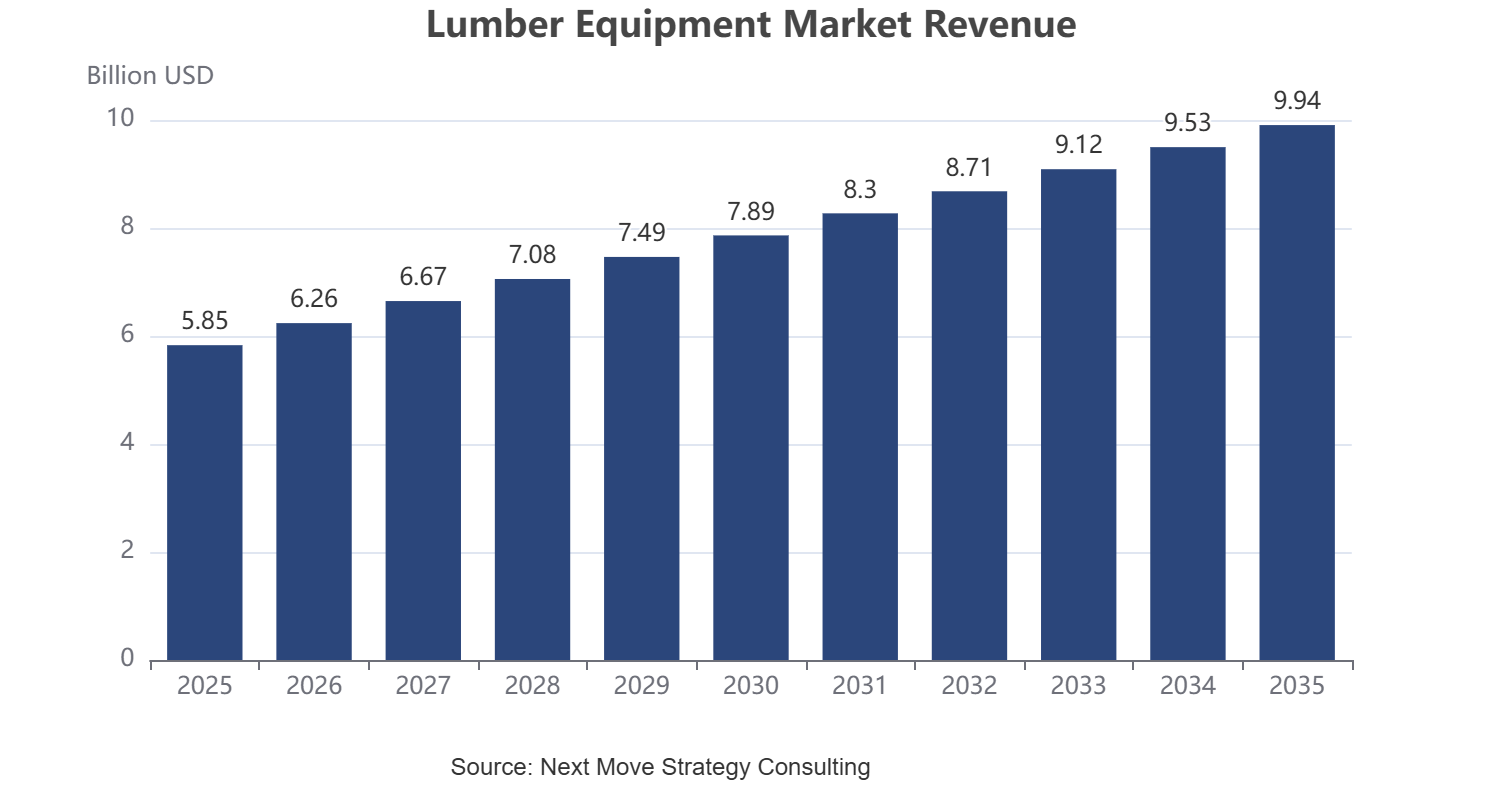
The global Lumber Equipment Industry size was valued at USD 5.85 Billion in 2025 and is estimated at USD 6.19 Billion in 2026, forecast to reach USD 9.94 Billion by 2035, expanding at a 5.4% CAGR between 2026 and 2035. North America leads with approximately 34% share, while Sawmill Machinery dominates all other equipment type categories with approximately 42% share.
We observed that growth remains steady and capital-cycle-driven rather than disruptive, with sawmill automation upgrades and drying capacity expansion driving the dominant structural shifts through 2035 across a mature, consolidating supplier base.
|
Key Takeaways |
|
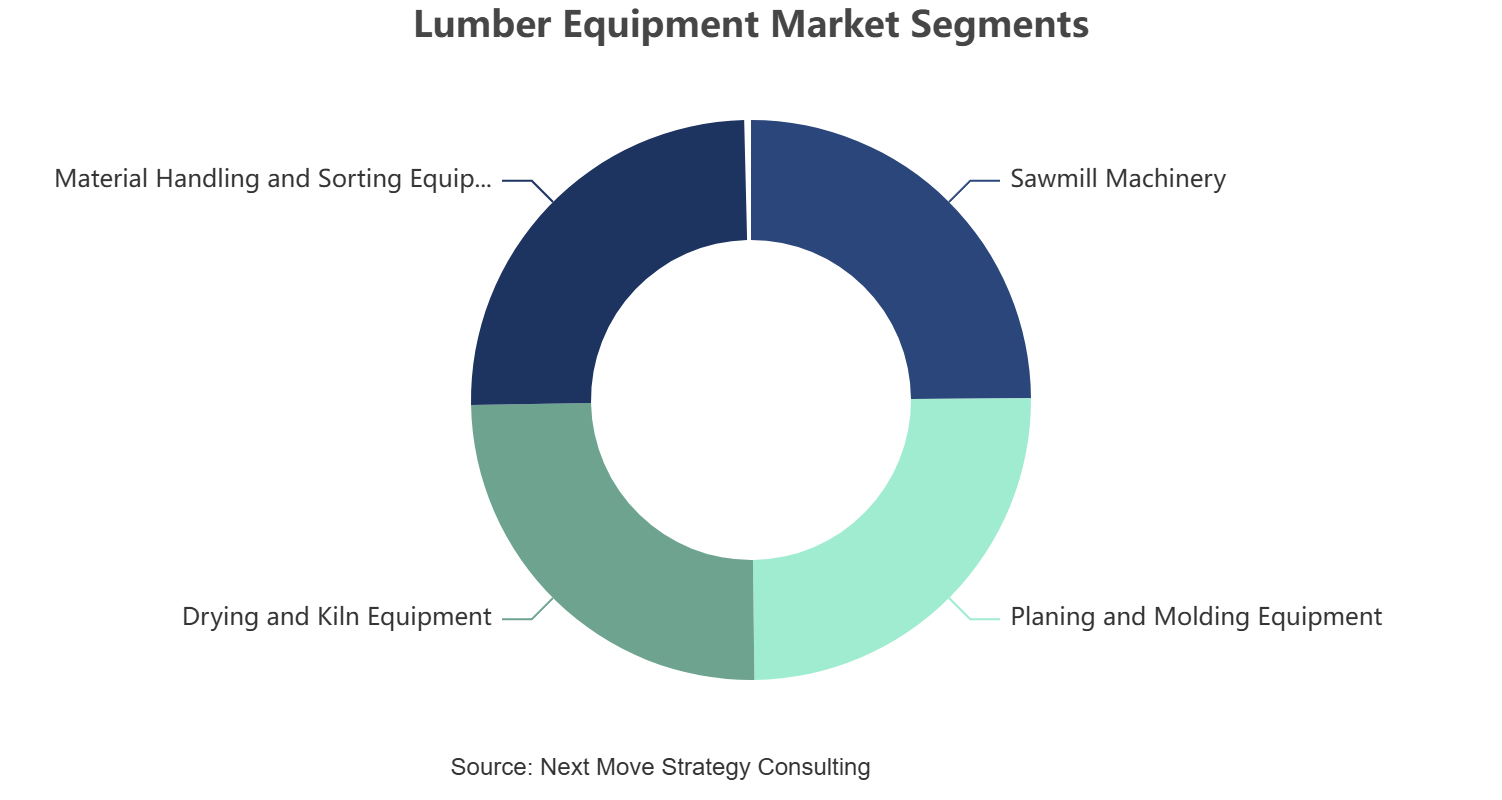
By Equipment Type: Sawmill Machinery held the largest share of approximately 42% (USD 2.4570 billion) in 2025; Drying and Kiln Equipment is the fastest-growing sub-segment at 6.8% CAGR from 2026–2035. |
|
By Automation Level: Semi-Automatic Systems held the largest share of approximately 48% (USD 2.8080 billion) in 2025; Fully Automatic Systems is the fastest-growing sub-segment at 7.2% CAGR from 2026–2035. |
|
By Sales Channel: Direct Sales held the largest share of approximately 56% (USD 3.2760 billion) in 2025; Distributor and Dealer Channel is the fastest-growing sub-segment at approximately 6.0% CAGR from 2026–2035. |
|
By End User: Commercial Sawmills held the largest share of approximately 61% (USD 3.5685 billion) in 2025; Independent and Portable Mill Operators is the fastest-growing sub-segment at approximately 6.9% CAGR from 2026–2035. |
|
Dominant Region: North America dominated with approximately 34% revenue share (USD 1.9890 billion) in 2025. |
|
Fastest-Growing Region: Asia-Pacific is expected to register the highest CAGR of 7.4% during 2026–2035. |
|
Dominant Country: U.S. led with approximately USD 1.4040 billion in 2025. |
|
Fastest-Growing Country: India is the fastest-growing country at approximately 8.6% CAGR from 2026–2035. |
Market Opportunity: The Lumber Equipment Market is expected to create an absolute dollar opportunity of USD 3.75 Billion between 2026 and 2035, presenting investment potential across sawmill automation retrofits, drying capacity expansion, and material handling optimization systems.
According to NMSC analysis, sawmill operators are increasingly consolidating capital equipment purchases around fewer, full-line original equipment manufacturers capable of servicing sawline, planing, and drying systems together rather than sourcing separately, a shift that favors vertically integrated suppliers such as Comact and USNR as mill consolidation continues through 2035.
What Does the Lumber Equipment Sector Encompass?
The Lumber Equipment encompasses the machinery and systems used to convert raw logs into finished lumber products, spanning sawmill machinery, planing and molding equipment, drying and kiln systems, and material handling and sorting equipment supplied to commercial sawmills, independent and portable mill operators, and integrated wood products manufacturers. Our assessment indicates that the scope covers original equipment manufacturers supplying capital machinery and control systems, excluding forestry harvesting equipment such as feller bunchers, which fall outside the lumber processing value chain this report addresses.
The industry has evolved from largely mechanical, operator-dependent sawline configurations toward increasingly automated, sensor-driven systems that optimize log yield and reduce timber waste. Regulatory frameworks such as U.S. Forest Service timber harvest guidelines and sustainable forestry certification standards continue to shape raw material availability and, in turn, mill investment cycles. We observed that technology adoption is shifting toward AI-enabled industrial automation and optimization software layered onto traditional sawmill hardware. NMSC's analysis indicates that this structural shift, combined with post-pandemic mill consolidation, is redefining capital equipment sourcing criteria across the Lumber Equipment Industry.
|
Parameter |
Details |
|
Market Size in 2025 |
USD 5.85 Billion |
|
Market Size in 2026 |
USD 6.19 Billion |
|
Revenue Forecast in 2035 |
USD 9.94 Billion |
|
Growth Rate |
CAGR of 5.4% from 2026 to 2035 |
|
Analysis Period |
2025–2035 |
|
Base Year Considered |
2025 |
|
Forecast Period |
2026–2035 |
|
Market Size Estimation |
Revenue (USD Billion) |
|
Companies Profiled |
18 |
|
Countries Covered |
38 |
|
Market Share |
Available for Top 10 Companies |
Key Emerging Trends
Based on research conducted by NMSC, we found that four structural trends are reshaping technology adoption, supplier consolidation, and stakeholder engagement across the industry.
How Is AI-Enabled Sawline Optimization Transforming Mill Yield?
AI-enabled sawline optimization is transforming mill operations by maximizing lumber yield and reducing timber waste through real-time scanning and cutting decisions. We observed that USNR launched an AI-enabled automated saw line improving cutting precision and increasing throughput efficiency for large-scale industrial sawmill operations. Mill operators are positioning yield-optimization software as the primary differentiator separating modern, data-driven sawlines from legacy, operator-judgment-based cutting systems.
Why Is Supplier Consolidation Reshaping Original Equipment Manufacturer Positioning?
Supplier consolidation and rebranding are reshaping how original equipment manufacturers position themselves within the value chain. Our findings suggest that BID Group rebranded as Comact in September 2024, unifying its wood processing equipment brands under a single identity to reinforce its position as a premier OEM following a century of operation since its 1924 founding. This trend reflects broader industry consolidation as full-line suppliers seek to simplify customer relationships across sawline, planing, and drying equipment categories.
How Is Energy-Efficient Drying Technology Gaining Adoption?
Energy-efficient drying and kiln technology is gaining adoption as mills seek to reduce energy costs associated with lumber moisture reduction, historically among the most energy-intensive stages of production. Our analysis shows that Nordic and Central European kiln manufacturers, including Valutec and Mühlböck, continue advancing heat-recovery and biomass energy-integrated drying systems that reduce reliance on fossil fuel-based heat sources. This trend reflects rising mill-level energy cost sensitivity amid broader industrial energy price volatility.
What Role Does Mill Consolidation Play in Equipment Demand Patterns?
Ongoing consolidation among commercial sawmill operators is concentrating equipment demand among fewer, larger buyers with greater capital budgets. Canadian lumber shipments fell 5.1% in 2025 amid a turbulent year for the sector, with Canfor losing its position as the second-largest North American lumber producer during the period. This trend reflects a broader restructuring in which surviving, larger mill operators increasingly favor comprehensive, full-line equipment upgrades over incremental machinery replacement.
Growth Drivers and Restraints
Growth Catalyst and Risk Assessment Matrix
|
Factors |
Type |
(+/-) % Impact on CAGR |
Geographic Relevance |
Impact Timeline |
|
Residential and commercial construction demand recovery |
Driver |
+2.1% |
North America, Europe |
2026–2035 |
|
AI-enabled sawline yield optimization adoption |
Driver |
+1.6% |
North America, Europe |
2026–2032 |
|
Rising Asia-Pacific wood products manufacturing capacity |
Driver |
+1.4% |
Asia-Pacific |
2026–2035 |
|
Mill consolidation driving full-line equipment upgrades |
Driver |
+1.1% |
North America |
2026–2032 |
|
Energy-efficient drying and kiln technology adoption |
Driver |
+0.8% |
Europe, North America |
2026–2032 |
|
Declining North American lumber shipment volumes |
Restraint |
-1.4% |
North America |
2026–2030 |
|
High capital cost of full sawline replacement |
Restraint |
-1.1% |
Global |
2026–2032 |
|
Availability of used and refurbished sawmill machinery |
Restraint |
-0.9% |
North America, Europe |
2026–2035 |
|
Strict forest harvest regulations limiting raw material supply |
Restraint |
-0.7% |
North America, Europe |
2026–2035 |
|
Competition for timber from pulp, paper, and bioenergy sectors |
Restraint |
-0.5% |
Global |
2026–2032 |
What Is the Primary Growth Driver of the Lumber Equipment Market?
Residential and commercial construction demand recovery is the primary driver of the market. The U.S. Census Bureau reported new residential construction spending trends that directly influence sawn lumber demand and, in turn, mill capital equipment investment cycles. We observed that this construction-linked demand, combined with continued replacement-cycle investment among surviving sawmill operators, continues to anchor baseline equipment demand across mature North American and European markets.
How Is AI-Enabled Sawline Optimization Driving Market Growth?
AI-enabled sawline optimization is accelerating equipment upgrade cycles as mill operators seek to improve lumber recovery rates from increasingly constrained timber supply. USNR's automated saw line technology, designed to improve cutting precision and reduce timber waste, illustrates how yield-focused innovation is compelling operators to replace legacy equipment ahead of typical replacement schedules. Our assessment indicates that this technology-driven upgrade cycle is partially offsetting broader demand softness tied to declining lumber shipment volumes.
What Is Restraining Lumber Equipment Market Expansion?
Declining North American lumber shipment volumes restrain the pace of new equipment investment, as reduced sawn lumber output directly limits mill operators' capital expenditure capacity. Canadian lumber shipments fell 5.1% in 2025 amid a turbulent year for the sector, a decline that constrains near-term equipment replacement budgets even as automation-driven upgrades continue. We found that the availability of used and refurbished industrial machinery through resellers further limits new equipment sales, particularly for less frequently used portable sawmill units.
PESTEL Analysis of the Lumber Equipment Market
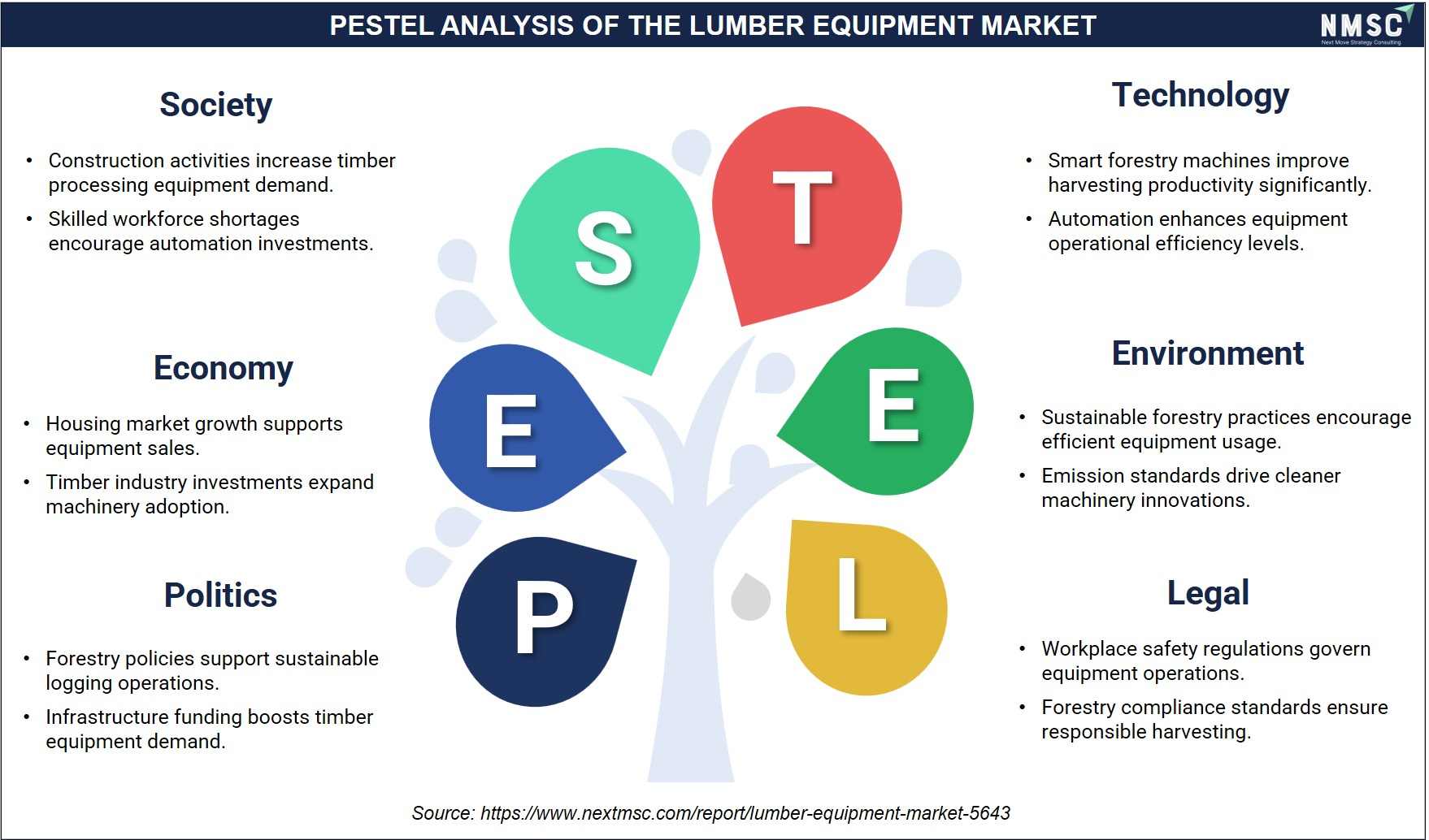
This analysis highlights key external drivers shaping the global lumber equipment industry. Growth is driven by expanding construction, housing demand, and supportive forestry policies. Meanwhile, labor shortages, stringent emission standards, and workplace safety compliance accelerate investments in smart, automated, and eco-friendly machinery to ensure sustainable, high-efficiency timber processing.
Segmentation Analysis
Segment Sizing: By Equipment Type
|
Segment |
2025 (USD) |
2035 (USD) |
CAGR% (2026–2035) |
|
Sawmill Machinery |
USD 2.4570 Billion |
USD 3.9930 Billion |
5.3% |
|
Planing and Molding Equipment |
USD 1.4625 Billion |
USD 2.3140 Billion |
5.1% |
|
Drying and Kiln Equipment |
USD 1.1700 Billion |
USD 2.1880 Billion |
6.8% |
|
Material Handling and Sorting Equipment |
USD 0.7605 Billion |
USD 1.4450 Billion |
6.9% |
|
Total |
USD 5.85 Billion |
USD 9.94 Billion |
5.4% |
Which Equipment Type Segment Dominates the Market?
Sawmill Machinery, encompassing headrigs, edgers, trimmers, and sawline control systems, led the market with USD 2.4570 billion in 2025, reflecting its position as the core capital investment category for any commercial mill operation. We observed that Drying and Kiln Equipment is the fastest-growing equipment type, expanding at a 6.8% CAGR from 2026 to 2035, as mills prioritize energy-efficient moisture reduction systems amid rising industrial energy costs and tightening lumber quality specifications.
Segment Sizing: By Automation Level
|
Segment |
2025 (USD) |
2035 (USD) |
CAGR% (2026–2035) |
|
Semi-Automatic Systems |
USD 2.8080 Billion |
USD 4.4980 Billion |
5.2% |
|
Fully Automatic Systems |
USD 2.1060 Billion |
USD 4.0770 Billion |
7.2% |
|
Manual Systems |
USD 0.9360 Billion |
USD 1.3650 Billion |
4.1% |
|
Total |
USD 5.85 Billion |
USD 9.94 Billion |
5.4% |
Which Automation Level Leads the Market Demand?
Semi-Automatic Systems remained the leading automation category within the market, valued at USD 2.8080 billion in 2025 as many mid-sized commercial sawmills continue operating hybrid configurations that combine automated cutting with operator oversight. Our findings suggest that Fully Automatic Systems is the fastest-growing category, registering a 7.2% CAGR from 2026 to 2035, as large-scale operators adopt AI-enabled machine vision and scanning technology to maximize yield from increasingly constrained timber supply.
Segment Sizing: By End User
|
Segment |
2025 (USD) |
2035 (USD) |
CAGR% (2026–2035) |
|
Commercial Sawmills |
USD 3.5685 Billion |
USD 5.8455 Billion |
5.4% |
|
Integrated Wood Products Manufacturers |
USD 1.5210 Billion |
USD 2.5350 Billion |
5.6% |
|
Independent and Portable Mill Operators |
USD 0.7605 Billion |
USD 1.5595 Billion |
6.9% |
|
Total |
USD 5.85 Billion |
USD 9.94 Billion |
5.4% |
Which End User Segment Is Most Widely Served in the Lumber Equipment Market?
Commercial Sawmills remained the dominant end user across the market, reaching USD 3.5685 billion in 2025 due to their scale-driven capital equipment budgets and reliance on full-line original equipment manufacturers such as Comact and USNR. Based on research conducted by NMSC, we found that Independent and Portable Mill Operators is the fastest-growing end user at a 6.9% CAGR from 2026 to 2035, reflecting rising demand for accessible, mid-range portable sawmill equipment among smaller regional and artisan-scale wood processors.
Growth Opportunities
Our analysis shows that three forward-looking opportunities stand out for stakeholders positioning within the Lumber Equipment Market over the 2026-2035 forecast period.
How Can Retrofit Automation Packages Unlock Value for Mid-Size Mills?
Modular, retrofit-friendly automation packages present a whitespace opportunity to bring AI-enabled yield optimization within reach of mid-size commercial sawmills that cannot justify full sawline replacement. Vendors that package scanning and optimization software onto existing hardware stand to capture recurring upgrade revenue across the Commercial Sawmills segment as operators seek incremental efficiency gains without full capital replacement cycles.
Where Does Asia-Pacific Capacity Expansion Create New Equipment Demand?
Asia-Pacific wood products manufacturers expanding processing capacity represent an underpenetrated opportunity for full-line equipment suppliers accustomed to mature North American and European markets. Vendors that adapt product lines to regional timber species and mid-range capital budgets can capture long-term contracts with the wood processing segment as regional manufacturing capacity continues expanding faster than in established markets.
How Can Energy-Efficient Drying Systems Benefit Cost-Constrained Operators?
Cost-constrained mill operators facing rising industrial energy prices represent an opportunity for suppliers offering heat-recovery and biomass-integrated drying systems. Early movers that secure validated energy-cost-reduction outcomes can differentiate with the Drying and Kiln Equipment segment as operators increasingly prioritize total operating cost over upfront equipment price through the forecast period.
Regional Outlook
Geographic Performance Snapshot
|
Region |
2025 (USD) |
2035 (USD) |
CAGR% (2026–2035) |
Key Driver |
|
North America |
USD 1.9890 Billion |
USD 3.2340 Billion |
5.2% |
Mill consolidation and sawline automation upgrades |
|
Europe |
USD 1.5210 Billion |
USD 2.4630 Billion |
5.1% |
Energy-efficient drying technology adoption |
|
Asia-Pacific |
USD 1.2870 Billion |
USD 2.6320 Billion |
7.4% |
Expanding wood products manufacturing capacity |
|
Middle East & Africa |
USD 0.6435 Billion |
USD 0.9520 Billion |
4.0% |
Gradual construction sector demand growth |
|
Latin America |
USD 0.4095 Billion |
USD 0.6570 Billion |
4.8% |
Growing wood products export capacity |
|
Total |
USD 5.85 Billion |
USD 9.94 Billion |
5.4% |
— |
North America
North America leads the Lumber Equipment Market, anchored by a mature, consolidating sawmill base and the concentration of leading original equipment manufacturers including Comact, USNR, and Wood-Mizer headquartered regionally. We observed that ongoing mill consolidation following declining lumber shipment volumes is concentrating equipment demand among fewer, larger operators favoring full-line automation upgrades. Regulatory influence from forest harvest guidelines remains significant, and strategic outlook favors continued AI-enabled sawline optimization adoption.
Europe
Europe's market reflects a mature, efficiency-focused landscape shaped by rising industrial energy costs and established regional kiln and drying technology suppliers. Our findings suggest that Germany, Austria, and Sweden host globally significant equipment manufacturers including Weinig, Linck, and Valutec that continue advancing energy-recovery drying systems. Technology adoption favors resource-efficient, sustainability-oriented equipment, supported by strong regional forestry certification standards.
Asia-Pacific
Asia-Pacific is the fastest-growing region, propelled by expanding wood products manufacturing capacity in China and India alongside rising domestic construction demand. We found that regulatory frameworks remain less harmonized than in Europe, giving regional manufacturers flexibility to scale processing capacity rapidly. Technology adoption is accelerating as regional operators increasingly import automated sawmill machinery from established North American and European suppliers to modernize newly built processing facilities.
Middle East & Africa
The Lumber Equipment Market in the Middle East & Africa remains comparatively small, supported by gradual construction sector demand growth in the UAE and Saudi Arabia. Our analysis shows that regional wood processing capacity remains limited given constrained domestic timber supply, with most finished lumber imported rather than locally processed. Regulatory influence remains minimal, and technology adoption is gradually improving through partnerships with established international equipment suppliers.
Latin America
Latin America's market is supported by growing wood products export capacity in Brazil and Argentina. We observed that regulatory frameworks around sustainable forestry are increasingly influential regionally, shaping equipment specifications for certified timber processing. Technology adoption remains centered on core sawmill machinery, with competitive intensity increasing as regional processors partner with global equipment suppliers to expand export-oriented production capacity.
U.S.
Based on our estimates, the U.S. market was valued at approximately USD 1.4040 billion in 2025 and is projected to reach USD 2.2790 billion by 2035, growing at a 5.2% CAGR. Demand is anchored by continued mill consolidation and rising adoption of AI-enabled sawline optimization technology. Technology penetration favors automated scanning and cutting systems, and competitive intensity remains high among established domestic equipment manufacturers serving large commercial sawmill operators.
Canada
The market in Canada reached roughly USD 0.5850 billion in 2025 and is forecast to hit USD 0.9550 billion by 2035 at a 5.3% CAGR. Demand structure reflects the country's globally significant softwood lumber export base and Comact's domestic headquarters presence in Quebec. Technology penetration is advanced, with competitive intensity high given the concentration of leading equipment original equipment manufacturers operating regionally despite recent shipment volume declines.
UK
As per our estimate, the UK market stood at about USD 0.2340 billion in 2025, advancing toward USD 0.3745 billion by 2035 at a 5.1% CAGR. Demand is driven by steady construction-linked lumber processing needs and reliance on imported equipment from continental European suppliers. Regulatory influence from forestry certification standards is significant, and competitive intensity remains moderate given the absence of a UK-headquartered major equipment manufacturer.
Germany
According to our analysis, Germany's market was valued near USD 0.4095 billion in 2025 and is set to reach USD 0.6605 billion by 2035, expanding at a 5.1% CAGR. Demand structure benefits from Germany's position as home to Weinig and Dieffenbacher, both globally significant wood processing equipment manufacturers. Regulatory influence from EU forestry and energy efficiency standards is notable, while technology penetration favors advanced planing and drying equipment.
France
Based on our estimates, France's market reached approximately USD 0.2340 billion in 2025, projected to climb to USD 0.3735 billion by 2035 at a 5.0% CAGR. Demand is supported by France's steady domestic wood products manufacturing base and construction-linked lumber processing needs. Regulatory influence from French and EU forestry policy is notable, and competitive intensity remains moderate given reliance on both domestic and imported German and Austrian equipment.
China
The market in China stood at roughly USD 0.4680 billion in 2025 and is forecast to reach USD 1.0140 billion by 2035, registering a 7.6% CAGR. Demand is fueled by expanding domestic wood products manufacturing capacity and rising construction sector consumption. Regulatory influence is increasing gradually around timber sourcing traceability, and technology penetration is accelerating through imported automated equipment from established international suppliers.
India
As per our estimate, India's market was valued at about USD 0.1287 billion in 2025, projected to reach USD 0.2865 billion by 2035 at an 8.6% CAGR, the fastest among covered countries. Demand structure reflects India's expanding construction sector and growing domestic wood products processing capacity. Regulatory influence remains developing, while technology penetration is rising quickly as processors adopt semi-automated sawmill equipment to modernize traditionally manual operations.
Japan
According to our analysis, Japan's market reached close to USD 0.1930 billion in 2025 and is expected to hit USD 0.3070 billion by 2035, growing at a 5.0% CAGR. Demand is supported by Japan's precision-engineered wood products manufacturing heritage and steady replacement-cycle equipment investment. Regulatory influence is well established, technology penetration is advanced among large processors, and competitive intensity remains moderate among established domestic and imported equipment suppliers.
South Korea
Based on our estimates, South Korea's market stood at approximately USD 0.1029 billion in 2025, forecast to reach USD 0.1985 billion by 2035 at a 6.9% CAGR. Demand structure benefits from South Korea's growing wood products import processing and construction sector demand. Technology penetration is advancing steadily, and competitive intensity remains moderate amid gradual equipment modernization among regional processors.
Australia
The Lumber Equipment Market in Australia reached about USD 0.0772 billion in 2025 and is projected to reach USD 0.1400 billion by 2035, expanding at a 6.6% CAGR. Demand is supported by Australia's domestic softwood plantation processing base and steady construction sector consumption. Regulatory influence stems from national forestry management standards, while technology penetration favors imported automated sawmill equipment amid moderate competitive intensity.
UAE
As per our estimate, the UAE market was valued near USD 0.1030 billion in 2025, projected to reach USD 0.1490 billion by 2035 at a 3.9% CAGR. Demand structure is shaped by the UAE's construction-driven import demand for finished lumber rather than significant domestic timber processing capacity. Regulatory influence remains limited, and competitive intensity is minimal given the small scale of regional wood processing operations.
Saudi Arabia
According to our analysis, Saudi Arabia's market reached roughly USD 0.0965 billion in 2025 and is expected to hit USD 0.1435 billion by 2035, growing at a 4.1% CAGR. Demand is driven by Vision 2030-linked construction sector growth requiring processed lumber, though domestic processing capacity remains limited. Regulatory influence remains developing, and technology penetration is confined largely to a small number of processing facilities.
South Africa
Based on our estimates, South Africa's market stood at about USD 0.1287 billion in 2025, forecast to reach USD 0.1985 billion by 2035 at a 4.4% CAGR. Demand structure reflects South Africa's established domestic forestry and sawmilling base serving regional Southern African markets. Regulatory influence stems from national forestry management standards, and technology penetration remains moderate among established regional sawmill operators.
Brazil
The market in Brazil reached approximately USD 0.2223 billion in 2025 and is projected to reach USD 0.3665 billion by 2035, registering a 5.1% CAGR. Demand is underpinned by Brazil's significant wood products export sector and expanding plantation forestry base. Regulatory influence stems from sustainable forestry certification requirements, technology penetration favors mid-range automated sawmill equipment, and competitive intensity remains moderate among regional and multinational equipment suppliers.
Argentina
As per our estimate, Argentina's market was valued near USD 0.0819 billion in 2025, projected to reach USD 0.1245 billion by 2035 at a 4.3% CAGR. Demand structure is supported by steady domestic wood products processing despite macroeconomic volatility. Regulatory influence remains limited, technology penetration is modest, and competitive intensity is centered on a small number of regional distributors serving national sawmill operators.
Competitive Landscape
We observed that the Lumber Equipment Market features a moderately consolidated competitive landscape, with full-line North American and European original equipment manufacturers competing alongside specialized regional suppliers on automation depth and aftermarket service capability.
Key Takeaways
|
Dimension |
Description |
|
Market Structure |
Moderately consolidated; full-line suppliers including Comact, USNR, and Dieffenbacher compete alongside specialized European kiln and drying manufacturers such as Valutec and Mühlböck, while regional players including Kara Makina and Ledinek Engineering serve localized markets. |
|
Innovation Focus |
AI-enabled sawline yield optimization, energy-efficient drying technology, and integrated control systems dominate current innovation pipelines across leading suppliers. |
|
M&A Activity |
Selective consolidation, exemplified by BID Group's September 2024 rebrand to Comact and its subsequent acquisition of Select Sawmill Inc. to expand aftermarket service capability. |
How Do Companies Compete in the Lumber Equipment Market?
Companies compete primarily on full-line equipment breadth, automation capability, and aftermarket service depth across the industry. Full-line suppliers such as Comact and USNR leverage integrated sawline, planing, and drying offerings to serve large commercial mill operators, while specialized manufacturers including Valutec and Mühlböck compete on advanced drying technology depth for operators upgrading specific process stages rather than entire mills.
Which Competitive Archetypes Dominate the Market?
Two archetypes dominate the market: full-line original equipment manufacturers offering integrated sawline-to-drying solutions, and specialized process-stage manufacturers competing on deep technical expertise within a single equipment category. Comact and USNR exemplify the full-line archetype through comprehensive wood processing portfolios, while Valutec and Mühlböck exemplify the specialized archetype through concentrated drying and kiln technology expertise.
How Are Companies Differentiating Through Innovation in Lumber Equipment?
Innovation and differentiation strategy increasingly center on AI-enabled yield optimization and energy-efficient process technology. USNR's automated saw line technology, designed to improve cutting precision and reduce timber waste, illustrates how suppliers are embedding software-driven optimization into traditionally mechanical equipment categories. Our analysis shows that suppliers unable to demonstrate credible digital twin-enabled yield optimization capability risk losing differentiation against more technology-forward full-line competitors.
What M&A and Expansion Activity Is Shaping the Lumber Equipment Market?
Consolidation and rebranding activity continue to reshape competitive positioning within the industry. Comact's September 2024 rebrands from BID Group, following its acquisition of Select Sawmill Inc. to expand aftermarket forestry equipment service capability, illustrates how full-line suppliers pursue both brand consolidation and targeted acquisitions to strengthen customer relationships across the equipment lifecycle.
Key Market Players
Our assessment indicates that the following companies represent the verified set of original equipment manufacturers actively shaping product innovation, capacity expansion, and aftermarket service strategy within the global Lumber Equipment Market; 18 companies met this report's verified eligibility criteria.
-
Comact Inc.
-
USNR, LLC
-
Dieffenbacher GmbH Maschinen- und Anlagenbau
-
Michael Weinig AG
-
LINCK Holzverarbeitungstechnik GmbH
-
Springer Maschinenfabrik GmbH
-
Wood-Mizer LLC
-
Valutec AB
-
Mühlböck Holztrocknungsanlagen GmbH
-
HewSaw Machines Inc.
-
Storti S.p.A.
-
Veisto Oy
-
Salem Equipment, Inc.
-
Baxley Equipment Co., Inc.
-
Corley Manufacturing Company
-
Kockums Industri AB
-
Kara Makina Sanayi ve Ticaret A.Ş.
-
Ledinek Engineering d.o.o.
Latest Developments
We found that recent developments within the Lumber Equipment Market are concentrated on supplier consolidation and AI-enabled automation launches, reflecting the industry's broader modernization and consolidation trajectory.
|
Date |
Event |
|
April 2025 |
Wood-Mizer expanded its portable sawmill portfolio with the launch of the LX30, designed for entry-level and small-scale lumber producers. The new equipment improves accessibility to efficient lumber processing through enhanced cutting performance, simplified operation, and cost-effective wood production. |
Investment Opportunities
What Capital Inflows Are Targeting the Lumber Equipment Market?
Capital inflows into the Lumber Equipment Market remain concentrated among established, well-capitalized full-line suppliers rather than new market entrants, reflecting the industry's mature, capital-intensive nature. We observed that private equity-backed USNR continues integrating prior acquisitions such as Timber Automation, LLC to expand yield optimization capabilities. Investors favor suppliers demonstrating durable aftermarket service revenue over pure new-equipment sales given lumber demand's cyclicality.
How Is Infrastructure Investment Supporting Lumber Equipment Manufacturing?
Infrastructure investment is expanding equipment manufacturing and testing capacity among leading suppliers. Our findings suggest that Comact's continued operations across its Quebec manufacturing base, alongside its Select Sawmill Inc. acquisition expanding service infrastructure, reflect targeted investment in both production and aftermarket support capacity. This scale of investment helps suppliers maintain responsiveness to mill operators' upgrade and maintenance needs.
What ESG Considerations Are Shaping Lumber Equipment Investment Decisions?
Environmental, social, and governance considerations in the Lumber Equipment Market center on sustainable forestry sourcing and energy-efficient processing technology. Equipment suppliers increasingly align product development with sustainable forestry certification requirements that shape mill operators' raw material sourcing and, in turn, equipment specifications. We found that investors increasingly favor suppliers demonstrating measurable energy efficiency gains in drying and kiln technology as mill-level energy costs draw greater scrutiny.
Key Benefits for Stakeholders
How Does This Report Benefit Mill Operators and Industry Leaders?
Mill operators and industry leaders gain access to validated segmentation, competitive benchmarking, and regional demand forecasts that support capital equipment sourcing decisions across the Lumber Equipment industry. Our analysis shows that detailed equipment type, automation level, and end user breakdowns help procurement teams align vendor selection with yield optimization requirements and full-line service needs while identifying underserved segments for capacity expansion.
How Does This Report Benefit Investors and Financial Analysts?
Investors and financial analysts benefit from consistent, single-point market size and CAGR estimates that support valuation and capital-allocation decisions across the Lumber Equipment supply chain. We observed that the report's regional and segment-level growth differentials help identify which suppliers and geographies are best positioned to capture above-market growth in Asia-Pacific and drying equipment categories through 2035.
How Does This Report Benefit Technology Vendors and Product Teams?
Technology vendors and product teams gain insight into emerging design requirements, including AI-enabled yield optimization, energy-recovery drying systems, and integrated sawline control architecture, that are reshaping the industry. Our findings suggest that this analysis helps R&D teams prioritize development roadmaps around validated efficiency outcomes increasingly required by mill operator procurement processes amid constrained timber supply.
Key Market Segments
By Equipment Type
-
Sawmill Machinery
-
Planing and Molding Equipment
-
Drying and Kiln Equipment
-
Material Handling and Sorting Equipment
By Automation Level
-
Manual Systems
-
Semi-Automatic Systems
-
Fully Automatic Systems
By Sales Channel
-
Direct Sales
-
Distributor and Dealer Channel
By End User
-
Commercial Sawmills
-
Integrated Wood Products Manufacturers
-
Independent and Portable Mill Operators
By Region
-
North America: U.S., Canada, Mexico
-
Europe: UK, Germany, France, Italy, Spain, Sweden, Denmark, Finland, Netherlands, Rest of Europe
-
Asia-Pacific: China, India, Japan, South Korea, Taiwan, Indonesia, Vietnam, Australia, Philippines, Malaysia, Rest of APAC
-
Middle East & Africa: Saudi Arabia, UAE, Egypt, Israel, Turkey, Nigeria, South Africa, Rest of MEA
-
Latin America: Brazil, Argentina, Chile, Colombia, Rest of LATAM
Supply Chain Structure of the Lumber Equipment Market
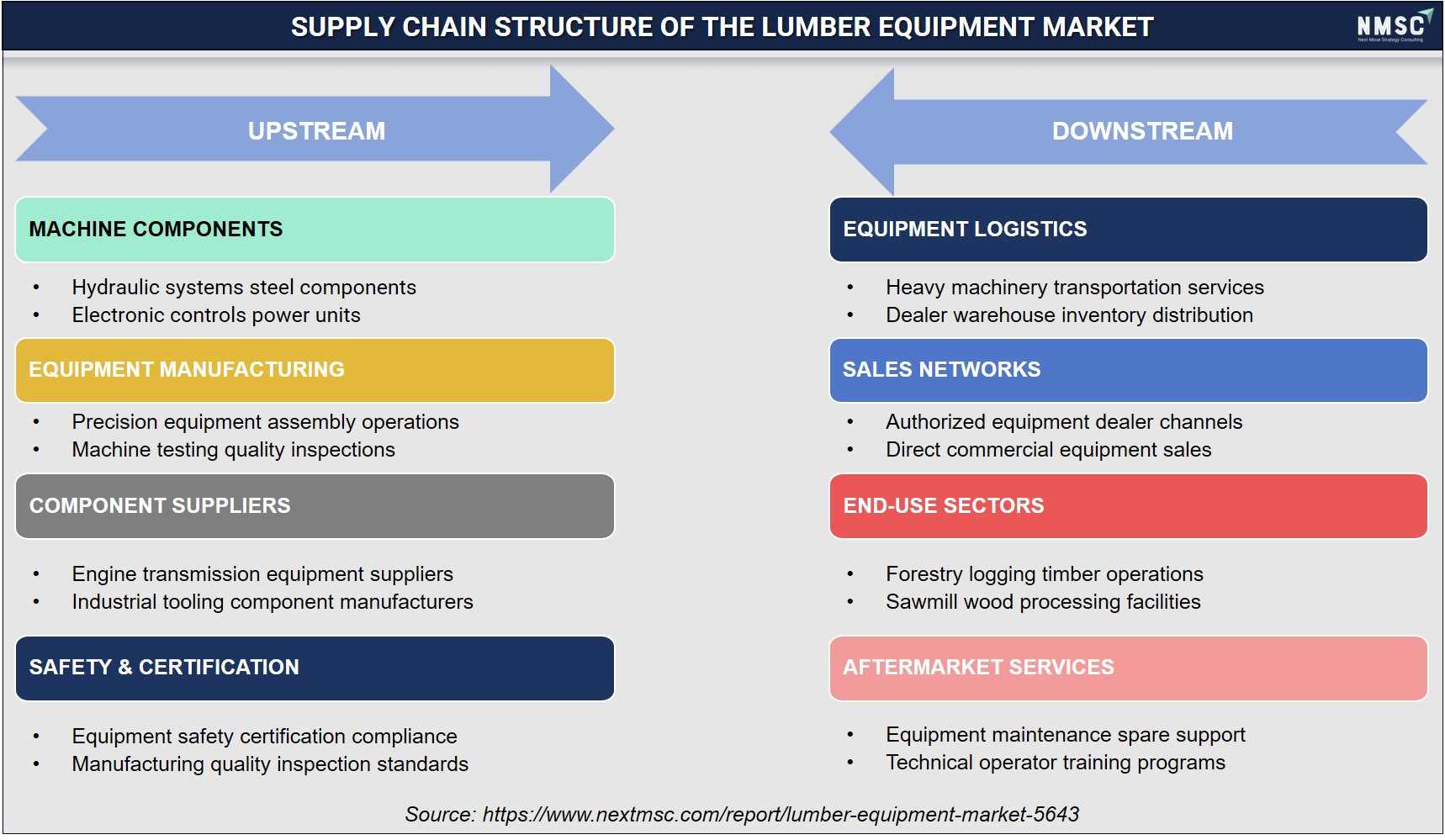
The above infographic presents the supply chain structure of the lumber equipment market, segmented into upstream and downstream activities. Hydraulic systems, steel components, engines, and electronic controls are sourced and assembled into precision equipment through rigorous manufacturing and quality inspections. On the other hand, downstream, heavy machinery logistics and dealer networks enable distribution to forestry, logging, and sawmill operations. Looking ahead, we observed that aftermarket services, including maintenance support and operator training, remain essential for sustaining equipment performance and customer satisfaction across the industry.
Conclusion and Recommendations
What Is the Long-Term Outlook for the Lumber Equipment Market?
The long-term outlook for the market remains steady, with global revenue projected to expand from USD 5.85 Billion in 2025 to USD 9.94 Billion by 2035 at a 5.4% CAGR. We observed that construction-linked demand recovery, AI-enabled sawline optimization, and Asia-Pacific manufacturing capacity expansion will continue underpinning demand across Sawmill Machinery and Drying and Kiln Equipment categories through the forecast period, even as North American shipment volumes remain pressured.
What Strategic Positioning Should Lumber Equipment Suppliers Pursue?
Suppliers should prioritize full-line equipment integration and AI-enabled yield optimization capability to secure long-term commercial sawmill contracts. Our assessment indicates that manufacturers investing early in energy-efficient drying technology and modular retrofit automation packages will be best positioned to capture premium pricing within the Lumber Equipment Market as mill operators increasingly favor comprehensive, single-vendor solutions.
How Attractive Is the Market for New Investment?
The Lumber Equipment industry presents a moderately attractive, capital-cycle-driven investment case, supported by a USD 3.75 Billion absolute dollar opportunity between 2026 and 2035 and above-average growth in Asia-Pacific and Drying and Kiln Equipment categories. We found that investment attractiveness is highest for suppliers combining full-line automation capability with durable aftermarket service revenue, positioning them to weather cyclical lumber demand fluctuations.
What Market Shifts and Key Risks Should Stakeholders Monitor?
Stakeholders should monitor declining North American lumber shipment volumes, the availability of used and refurbished equipment, and strict forest harvest regulations limiting raw material supply as key risks to the Lumber Equipment Market. Our analysis shows that suppliers unable to demonstrate measurable yield and energy efficiency gains risk losing contract share to competitors as mill operators scrutinize capital expenditure more closely amid cyclical demand pressure.
What Are the Key Growth Pathways for the Lumber Equipment Market?
Key growth pathways include expanding AI-enabled sawline optimization portfolios, scaling energy-efficient drying technology, and deepening penetration into Asia-Pacific capacity expansion. NMSC's analysis indicates that suppliers pursuing these pathways while maintaining full-line service capability and aftermarket support depth will be best positioned to capture the Lumber Equipment Market's projected growth through 2035.
About the Author
 Mayurima Roy
— Mayurima Roy is Research Analyst at Next Move Strategy Consulting, where she has spent 4 years working across the firm's full industry coverage rather than a single fixed vertical. Her work centers on structured research, ongoing trend tracking, competitive assessment, and insight-led content development, translating complex market data into clear, decision-ready narratives that support informed client decision-making across diverse global industries, market sectors, and world regions every day.
Mayurima Roy
— Mayurima Roy is Research Analyst at Next Move Strategy Consulting, where she has spent 4 years working across the firm's full industry coverage rather than a single fixed vertical. Her work centers on structured research, ongoing trend tracking, competitive assessment, and insight-led content development, translating complex market data into clear, decision-ready narratives that support informed client decision-making across diverse global industries, market sectors, and world regions every day.
About the Reviewer
 Supradip Baul
— Supradip Baul is an accomplished business consultant and strategist with over a decade of rich experience in market intelligence, strategy, technology, and business transformation. His work has included rigorous qualitative and quantitative analysis across multiple industries, helping clients shape investment decisions and long-term roadmaps. Earlier in his career, he was associated with Gartner, where he contributed to industry-leading reports and market share analyses. He has worked with leading global companies and holds an MBA with a dual specialization in Marketing and Finance.
Supradip Baul
— Supradip Baul is an accomplished business consultant and strategist with over a decade of rich experience in market intelligence, strategy, technology, and business transformation. His work has included rigorous qualitative and quantitative analysis across multiple industries, helping clients shape investment decisions and long-term roadmaps. Earlier in his career, he was associated with Gartner, where he contributed to industry-leading reports and market share analyses. He has worked with leading global companies and holds an MBA with a dual specialization in Marketing and Finance.
At Next Move Strategy Consulting, we understand that insightful market research is the cornerstone of successful business decisions. That's why we employ a robust and multifaceted approach, combining various methodologies to deliver the most accurate and actionable data for our clients.

Research Landscape
We navigate the world of research with two primary approaches:
Qualitative Approach
Our qualitative research methodologies involve immersive techniques such as in-depth interviews, focus groups, and observational studies. By engaging directly with individuals and stakeholders, we uncover valuable insights that quantitative data alone may overlook.

Quantitative Research
In tandem with qualitative methodologies, NMSC leverages the power of Quantitative Research to provide a robust foundation of numerical insights. Through systematic data collection and analysis, we quantify patterns, preferences, and market trends, offering a comprehensive view of the business landscape.
Our quantitative research approach employs diverse tools, including surveys, experiments, and statistical modelling. These methodologies enable us to gather data from a large and representative sample, ensuring the statistical significance of our findings. By employing structured questionnaires and standardized data collection methods, we guarantee the reliability and validity of the information we present to our clients.
Quantitative research is particularly effective in measuring the prevalence of trends, assessing market size, and gauging the impact of various factors on consumer behavior. The numerical precision attained through this approach equips our clients with actionable insights, facilitating data-driven decision-making and strategy formulation.


Our Specialized Toolbox for Industry-Specific Market Research
We deploy a specialized arsenal of techniques tailored to meet your unique requirements. Here's a glimpse into our comprehensive toolbox:

Information Procurement
The stage entails acquiring market data or relevant information through various sources and methodologies.


Market Research Approach
We utilize both top-down and bottom-up approaches in market research analysis to achieve a comprehensive understanding of the market dynamics, leveraging the broad perspective of industry trends and macroeconomic factors alongside detailed insights from specific segments and individual companies.

Porters Five Forces Analysis
We conduct Porter's Five Forces analysis to evaluate the competitive landscape of an industry, providing us with insights into factors that affect profitability and strategic positioning.

SWOT Analysis

Forecasting
We utilize a forecasting model to predict future consumption by considering parameters like population, economics, regulations, market competition, drivers, constraints, technology, and pricing. We also employ statistical techniques such as multilinear regression, exponential smoothing, moving average, ARIMA, and Monte Carlo simulations for accurate predictions. In econometric forecasting, we analyzed short-term and long-term event impacts, attributing values based on regulatory frameworks, economic factors, and market events.





 Speak to Our Analyst