Measuring and Control Instrument Market Global Industry Analysis and Forecast (2026-2035 )

The global Measuring and Control Instrument Market is valued at USD 989.29 Billion in 2026 and is projected to reach USD 1,752.29 Billion by 2035, growing at a CAGR of 6.56% from 2026 to 2035. Key growth factors include AI infrastructure build-out, increasing demand for precision measurement and validation, and the convergence of instrumentation with optimization software, with software-enabled solutions and automation supporting market expansion.

Download Free Sample PDF
Base Year (2025)
$989.29 Billion
Forecast (2035)
$1,752.29 Billion
CAGR (2026-2035)
6.6%
Top Country
Asia-Pacific

What Is the Measuring and Control Instrument Market Size?

The global measuring and control instrument market size was valued at USD 904.52 billion in 2025 and is estimated at USD 989.29 billion in 2026, forecast to reach USD 1,752.29 billion by 2035 at a 6.56% CAGR between 2026 and 2035. Asia-Pacific leads with approximately 37% share, while Measuring Instruments account for roughly 65% of 2025 revenue, reflecting the breadth of process, analytical, electrical, and metrology instrumentation captured under that category.

The figures below summarize the segment and regional patterns detailed throughout this report, drawn from the segmentation and regional data presented in the sections that follow.

Measuring and Control Instrument Market Global Industry Analysis and Forecast (2026-2035 ) Revenue Forecast

Values in USD Billion

2025 $904.52 Billion
2025
2026 $989.29 Billion
2026
2027 $1,054.19 Billion
2027
2028 $1,123.34 Billion
2028
2029 $1,197.03 Billion
2029
2030 $1,275.56 Billion
2030
2031 $1,359.24 Billion
2031
2032 $1,448.40 Billion
2032
2033 $1,543.42 Billion
2033
2034 $1,644.66 Billion
2034
2035 $1,752.29 Billion
2035

Key Takeaways

By Product Type: Measuring Instruments held the largest share of approximately 65% (USD 588.44 billion) in 2025; Control Instruments is the fastest-growing category at 7.24% CAGR from 2026–2035.

By Technology: Wired Digital Technology held the largest share of approximately 56% (USD 506.53 billion) in 2025; Wireless Digital Technology is the fastest-growing technology at 10.94% CAGR from 2026–2035.

By End User Industry: Process Industries held the largest share of approximately 37% (USD 334.67 billion) in 2025; Environmental and Public Sector is the fastest-growing industry at 13.98% CAGR from 2026–2035.

By Transaction Type: New Sales held the largest share of approximately 47% (USD 425.13 billion) in 2025; Retrofit and Upgrade Sales is the fastest-growing transaction type at 10.67% CAGR from 2026–2035.

By Sales Channel: Direct Sales held the largest share of approximately 35% (USD 316.58 billion) in 2025; E-commerce Sales is the fastest-growing channel at 18.62% CAGR from 2026–2035.

Dominant Region: Asia-Pacific dominated with approximately 37% revenue share (USD 334.67 billion) in 2025.

Fastest-Growing Region: Middle East & Africa is expected to register the highest CAGR of 13.39% during 2026–2035.

Dominant Country: U.S. led with approximately USD 178.50 billion in 2025.

Fastest-Growing Country: Saudi Arabia is the fastest-growing country at approximately 12.94% CAGR from 2026–2035.

What Does the Measuring and Control Instrument Market Encompass?

The measuring and control instrument market encompasses devices and systems that sense, quantify, and regulate physical, chemical, and electrical parameters across industrial, laboratory, and infrastructure environments. Measuring Instruments span process variables such as pressure, temperature, flow, and level, alongside electrical, analytical, metrology, and environmental measurement categories, while Control Instruments cover programmable logic controllers, distributed control systems, safety instrumented systems, and final control elements such as valves and actuators. Our assessment indicates that this scope excludes consumer-grade measurement devices and building-automation-only sensors that fall outside industrial and laboratory use cases.
Legal metrology and product-safety regulation shape this market more directly than most industrial categories, because measurement accuracy has direct financial and safety consequences. The European Union's Measuring Instruments Directive, most recently amended by Directive (EU) 2026/706 in March 2026 to bring electric vehicle charging equipment, hydrogen refuelling stations, and compressed gas dispensers into scope, illustrates how regulators are actively extending certification requirements to new instrument categories rather than leaving them unregulated. We observed that this regulatory expansion, combined with accelerating wireless and AI-enabled instrumentation adoption, is reshaping which product categories require formal type-approval before commercial sale.

Market Drivers & Dynamics

Interactive Dataset
AI infrastructure build-out driving semiconductor and electronics test demand driver +1.4% North America, Asia-Pacific 2026–2035
Brownfield wireless retrofit adoption reducing installation cost barriers driver +1.1% North America, Europe 2026–2033
Expanding legal metrology certification scope under revised EU rules driver +0.8% Europe 2026–2032
Process industry capital investment in energy transition infrastructure driver +0.9% Middle East & Africa, Asia-Pacific 2026–2035
Life sciences and diagnostics laboratory capacity expansion driver +0.7% North America, Asia-Pacific 2026–2033
Software and analytics attach rates lifting per-installation revenue driver +0.6% Global 2027–2035
Extended qualification cycles for safety-critical instrumentation restraint −0.8% North America, Europe 2026–2031
Semiconductor and precision component supply constraints restraint −0.6% Global 2026–2029
Price competition from lower-cost Asian instrumentation manufacturers restraint −0.5% Europe, North America 2026–2033
Source: Next Move Strategy Consulting

Growth Drivers

What Is the Primary Growth Driver of the Measuring and Control Instrument Market?

AI infrastructure build-out is an important growth driver, particularly for semiconductor, electronics, and high-speed test and measurement applications. Keysight Technologies' fiscal year 2025 annual report states that wireline revenue grew to a new record as AI workload scaling drove redesigns across compute , networking, interconnects, memory, and power, with the company's physical-layer test and protocol emulation solutions playing an essential role across the expanding AI supply chain. This matters because it is a genuinely new demand source layered on top of established process-industry instrumentation spending, not a substitute for it, which is why overall market growth is accelerating rather than merely shifting between existing end uses.

How Is Software and Systems Convergence Driving Measuring and Control Instrument Market Growth?

Vendors bundling instrumentation with optimization software are converting one-time equipment sales into recurring revenue relationships, which compounds market value beyond unit shipment growth alone. Emerson Electric Co. reported fiscal 2025 net sales of USD 18,016 million, up 3%, with underlying growth led by its Software and Control group following the AspenTech buy-in and National Instruments integration. Because software-attached instrumentation commands higher lifetime value per installation than hardware sold alone, this shift is lifting overall market revenue growth even in end markets where physical unit volumes are growing more slowly.

Growth Inhibitors

What Is Restraining Measuring and Control Instrument Market Growth?

Extended qualification cycles for safety-critical instrumentation slow how quickly new products reach revenue-generating deployment, particularly in process industries governed by functional-safety standards. A newly developed pressure transmitter or safety instrumented system component must complete certification testing before a plant operator will specify it for a hazardous-area installation, a process that can take longer than the underlying technology development itself. This restraint disproportionately affects control instrument categories subject to safety certification, compared with general-purpose measurement instruments that face lighter qualification burdens, which is why Control Instruments still trail Measuring Instruments in absolute 2025 revenue despite growing faster.

What Are the Growth Opportunities?

How Can AI Data Center Validation Unlock Value for Test Instrument Suppliers?

AI data center build-out requires physical-layer test and interconnect validation instrumentation at a scale and speed existing electronics manufacturing did not demand. Suppliers that develop validated, high-speed protocol emulation and optical test platforms stand to capture recurring revenue as hyperscale operators qualify next-generation compute and networking hardware ahead of deployment.

Where Does Retrofit Instrumentation Create Underserved Demand?

Brownfield process plants running instrumentation installed before wireless protocols matured represent an underpenetrated opportunity for suppliers offering drop-in wireless retrofit sensors. Suppliers that package wireless pressure, temperature, and vibration instruments with minimal engineering redesign can secure incremental digitalization budgets that plant operators would not allocate to a full network overhaul.

How Can Environmental Compliance Instrumentation Benefit Public Sector Suppliers?

Expanding emissions monitoring and air quality regulation is converting environmental measurement from a project-based purchase into a recurring compliance requirement. Suppliers that build dedicated government and municipal sales channels for continuous emissions and ambient air monitoring systems can convert the Environmental and Public Sector segment's 13.98% CAGR into durable, budget-funded contract revenue distinct from cyclical industrial capital spending.

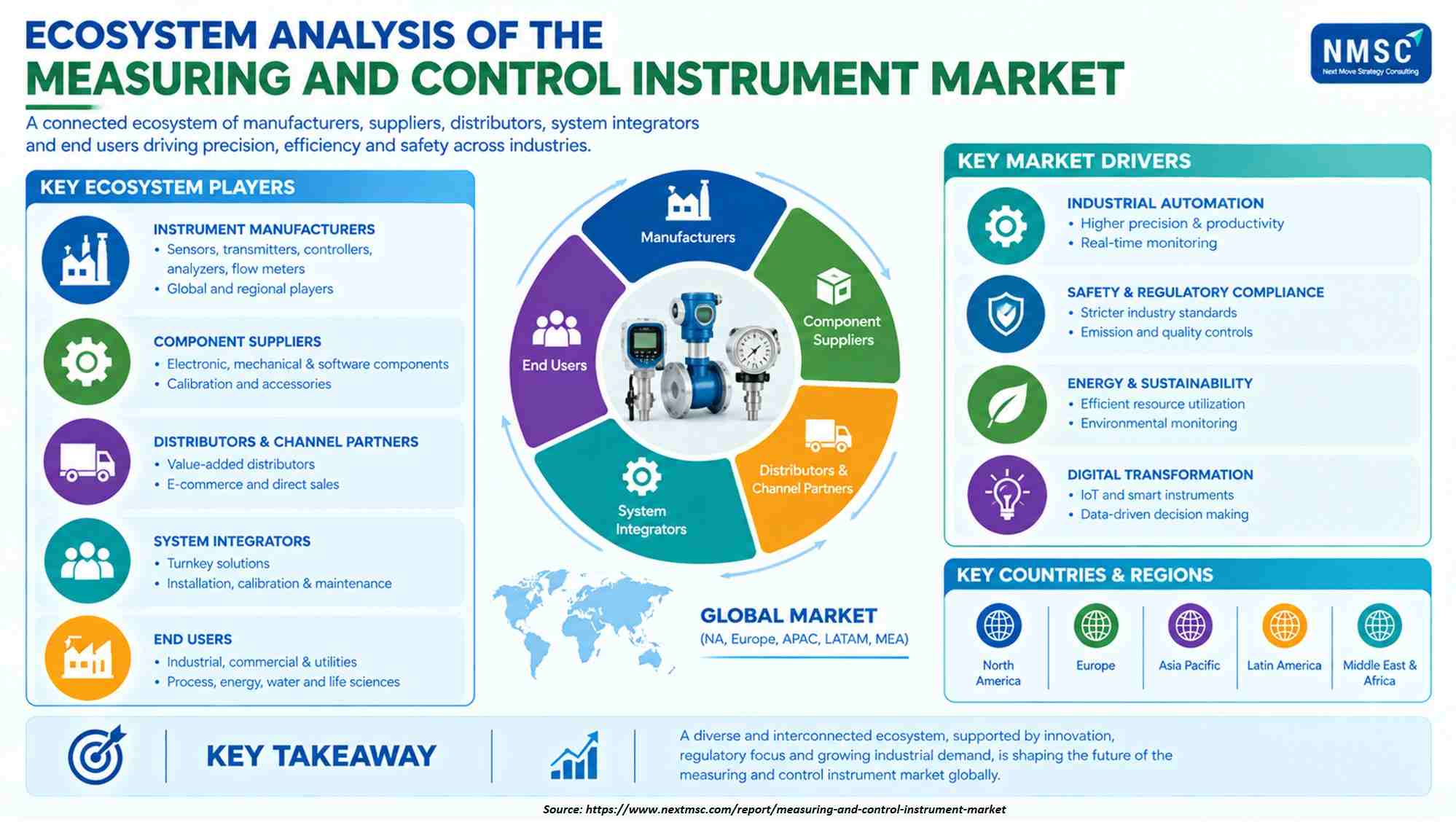
Ecosystem Analysis of the Measuring and Control Instrument Market

The measuring and control instrument market operates through an interconnected ecosystem of instrument manufacturers, component suppliers, distributors, system integrators, and industrial end users. Demand is supported by industrial automation, regulatory compliance, energy efficiency, and digital transformation. Increasing adoption of smart instruments, real-time monitoring, and data-driven control systems is reshaping procurement and deployment across major industries.

Segmentation Analysis

2025 (USD Billion)
2035 (USD Billion)
Measuring In
Process Meas
Pressure Ins
Temperature
Flow Instrum
Segment Item 2025 (USD Billion) 2035 (USD Billion) CAGR
Measuring Instruments $10.0 USD Billion $40.0 USD Billion 23.0%
Process Measurement Instruments $17.1 USD Billion $51.1 USD Billion 25.0%
Pressure Instruments $24.2 USD Billion $62.2 USD Billion 19.0%
Temperature Instruments $31.3 USD Billion $73.3 USD Billion 17.0%
Flow Instruments $38.4 USD Billion $84.4 USD Billion 22.0%

Segment-wise data is locked

Unlock complete segment-wise numbers for By Product Type.

Unlock Full Data

Which Product Type Dominates the Measuring and Control Instrument Market?

Measuring Instruments led the market with USD 588.44 billion in 2025 because the category spans process measurement, electrical and electronic measurement, analytical, physical property, metrology, and environmental instrumentation, a broader installed base than Control Instruments covers. Control Instruments is the faster-growing category, expanding at a 7.24% CAGR through 2035, as distributed control system upgrades and safety instrumented system deployments accompany the plant modernization projects tracked under Emerson's Control Systems and Software segment. The gap between the two categories is narrowing because control-layer software and systems, not sensor volume, increasingly define competitive differentiation among process automation suppliers.

2025 (USD Billion)
2035 (USD Billion)
Analog Techn
Wired Digita
Wireless Dig
Segment Item 2025 (USD Billion) 2035 (USD Billion) CAGR
Analog Technology $10.0 USD Billion $40.0 USD Billion 16.0%
Wired Digital Technology $17.1 USD Billion $51.1 USD Billion 22.0%
Wireless Digital Technology $24.2 USD Billion $62.2 USD Billion 16.0%

Segment-wise data is locked

Unlock complete segment-wise numbers for By Technology.

Unlock Full Data

Which Technology Is Growing Fastest in the Measuring and Control Instrument Market?

Wired Digital Technology remained the dominant technology at USD 506.53 billion in 2025, reflecting decades of installed fieldbus and Ethernet-based instrumentation across process plants built before wireless protocols matured. Wireless Digital Technology is growing at a 10.94% CAGR, the fastest of the three technologies, because it removes the cabling cost that has historically limited retrofit instrumentation projects in brownfield facilities. Analog Technology is nearly flat at a 0.49% CAGR, a sign that legacy analog instrumentation is being phased out through replacement rather than expanded, consistent with the digital migration documented across major suppliers' product roadmaps.

2025 (USD Billion)
2035 (USD Billion)
Process Indu
Oil and Gas
Chemicals an
Pharmaceutic
Food and Bev
Segment Item 2025 (USD Billion) 2035 (USD Billion) CAGR
Process Industries $10.0 USD Billion $40.0 USD Billion 20.0%
Oil and Gas $17.1 USD Billion $51.1 USD Billion 26.0%
Chemicals and Petrochemicals $24.2 USD Billion $62.2 USD Billion 24.0%
Pharmaceuticals and Biotechnology $31.3 USD Billion $73.3 USD Billion 26.0%
Food and Beverage $38.4 USD Billion $84.4 USD Billion 9.0%

Segment-wise data is locked

Unlock complete segment-wise numbers for By End User Industry.

Unlock Full Data

Which End User Industry Leads Measuring and Control Instrument Market Demand?

Process Industries remained the largest end user at USD 334.67 billion in 2025, anchored by oil and gas, chemicals, and pharmaceuticals operations that require continuous pressure, temperature, flow, and level monitoring across hazardous, tightly regulated environments. Environmental and Public Sector is the fastest-growing end user at a 13.98% CAGR, expanding from a comparatively small 2025 base as emissions monitoring, air quality measurement, and government environmental compliance programs mature into recurring instrumentation budgets rather than one-time regulatory projects. Life Sciences and Research follows closely at a 9.45% CAGR as diagnostic and analytical laboratory capacity expands alongside rising pharmaceutical and biotechnology research investment.

2025 (USD Billion)
2035 (USD Billion)
New Sales
Replacement
Retrofit and
Segment Item 2025 (USD Billion) 2035 (USD Billion) CAGR
New Sales $10.0 USD Billion $40.0 USD Billion 13.0%
Replacement Sales $17.1 USD Billion $51.1 USD Billion 27.0%
Retrofit and Upgrade Sales $24.2 USD Billion $62.2 USD Billion 9.0%

Segment-wise data is locked

Unlock complete segment-wise numbers for By Transaction Type.

Unlock Full Data
2025 (USD Billion)
2035 (USD Billion)
Direct Sales
Distributor
System Integ
OEM Sales
E-commerce S
Segment Item 2025 (USD Billion) 2035 (USD Billion) CAGR
Direct Sales $10.0 USD Billion $40.0 USD Billion 24.0%
Distributor Sales $17.1 USD Billion $51.1 USD Billion 10.0%
System Integrator Sales $24.2 USD Billion $62.2 USD Billion 8.0%
OEM Sales $31.3 USD Billion $73.3 USD Billion 14.0%
E-commerce Sales $38.4 USD Billion $84.4 USD Billion 13.0%

Segment-wise data is locked

Unlock complete segment-wise numbers for By Sales Channel.

Unlock Full Data

Growth Opportunities

Our analysis shows that three forward-looking opportunities stand out for stakeholders positioning within the measuring and control instrument market over the 2026-2035 forecast period.

How Can AI Data Center Validation Unlock Value for Test Instrument Suppliers?

AI data center build-out requires physical-layer test and interconnect validation instrumentation at a scale and speed existing electronics manufacturing did not demand. Suppliers that develop validated, high-speed protocol emulation and optical test platforms stand to capture recurring revenue as hyperscale operators qualify next-generation compute and networking hardware ahead of deployment.

Where Does Retrofit Instrumentation Create Underserved Demand?

Brownfield process plants running instrumentation installed before wireless protocols matured represent an underpenetrated opportunity for suppliers offering drop-in wireless retrofit sensors. Suppliers that package wireless pressure, temperature, and vibration instruments with minimal engineering redesign can secure incremental digitalization budgets that plant operators would not allocate to a full network overhaul.

How Can Environmental Compliance Instrumentation Benefit Public Sector Suppliers?

Expanding emissions monitoring and air quality regulation is converting environmental measurement from a project-based purchase into a recurring compliance requirement. Suppliers that build dedicated government and municipal sales channels for continuous emissions and ambient air monitoring systems can convert the Environmental and Public Sector segment's 13.98% CAGR into durable, budget-funded contract revenue distinct from cyclical industrial capital spending.

Regional Outlook

2025 (USD Billion)
2035 (USD Billion)
Asia-Pacific
North Americ
Europe
Latin Americ
Middle East
Region 2025 (USD Billion) 2035 (USD Billion) CAGR (%)
Asia-Pacific $10.0 USD Billion $40.0 USD Billion 9.0%
North America $17.1 USD Billion $51.1 USD Billion 27.0%
Europe $24.2 USD Billion $62.2 USD Billion 25.0%
Latin America $31.3 USD Billion $73.3 USD Billion 23.0%
Middle East & Africa $38.4 USD Billion $84.4 USD Billion 12.0%

Regional data is locked

Unlock complete regional numbers for this market.

Unlock Full Data

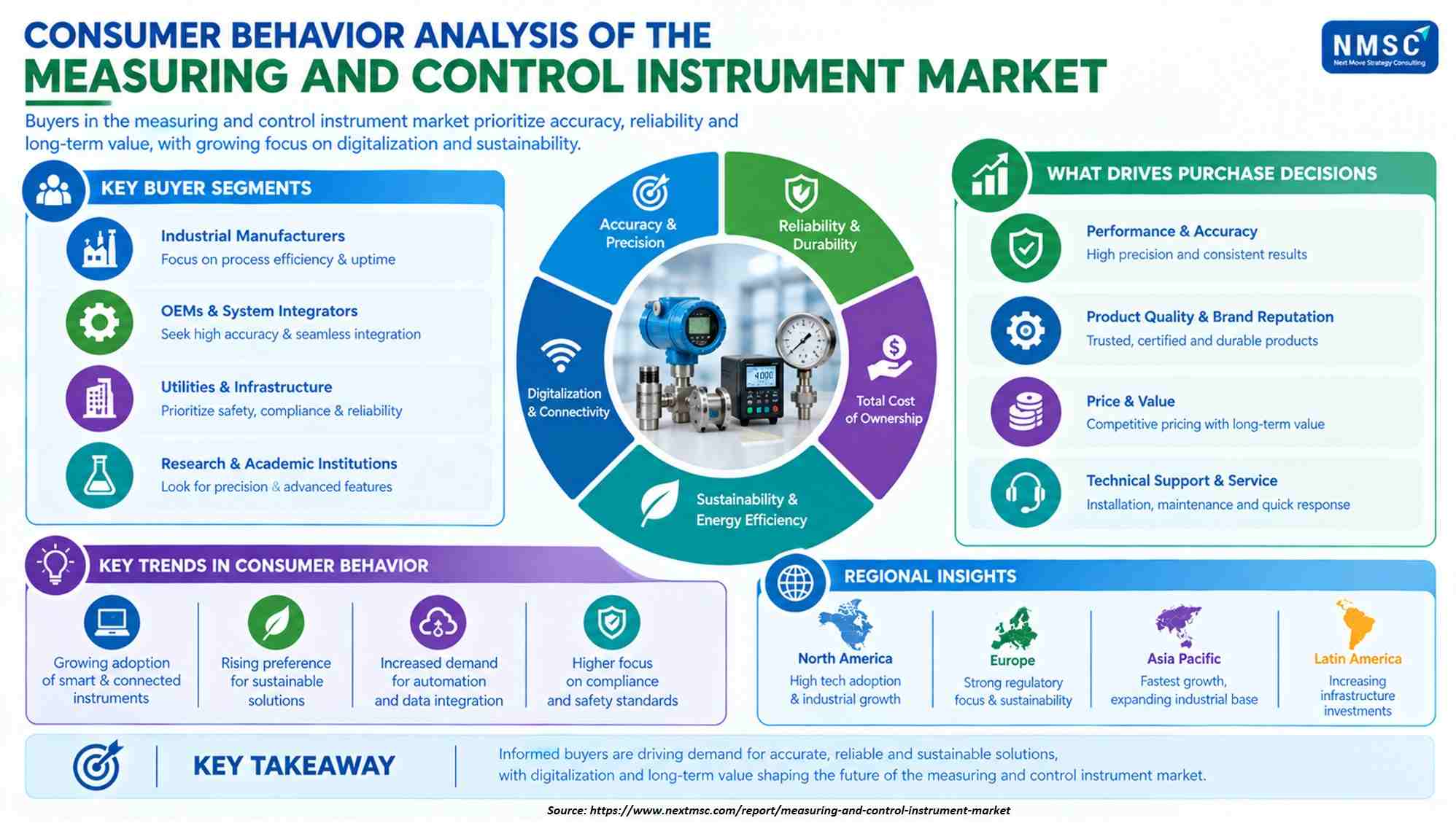
Consumer Behavior Analysis of the Measuring and Control Instrument Market

Purchasing decisions in the measuring and control instrument market are primarily influenced by accuracy, reliability, product quality, total cost of ownership, and technical support. Industrial buyers increasingly prioritize connected and automated solutions that support operational efficiency and regulatory compliance. Regional differences reflect varying levels of technology adoption, industrial development, infrastructure investment, and sustainability requirements.

Competitive Landscape

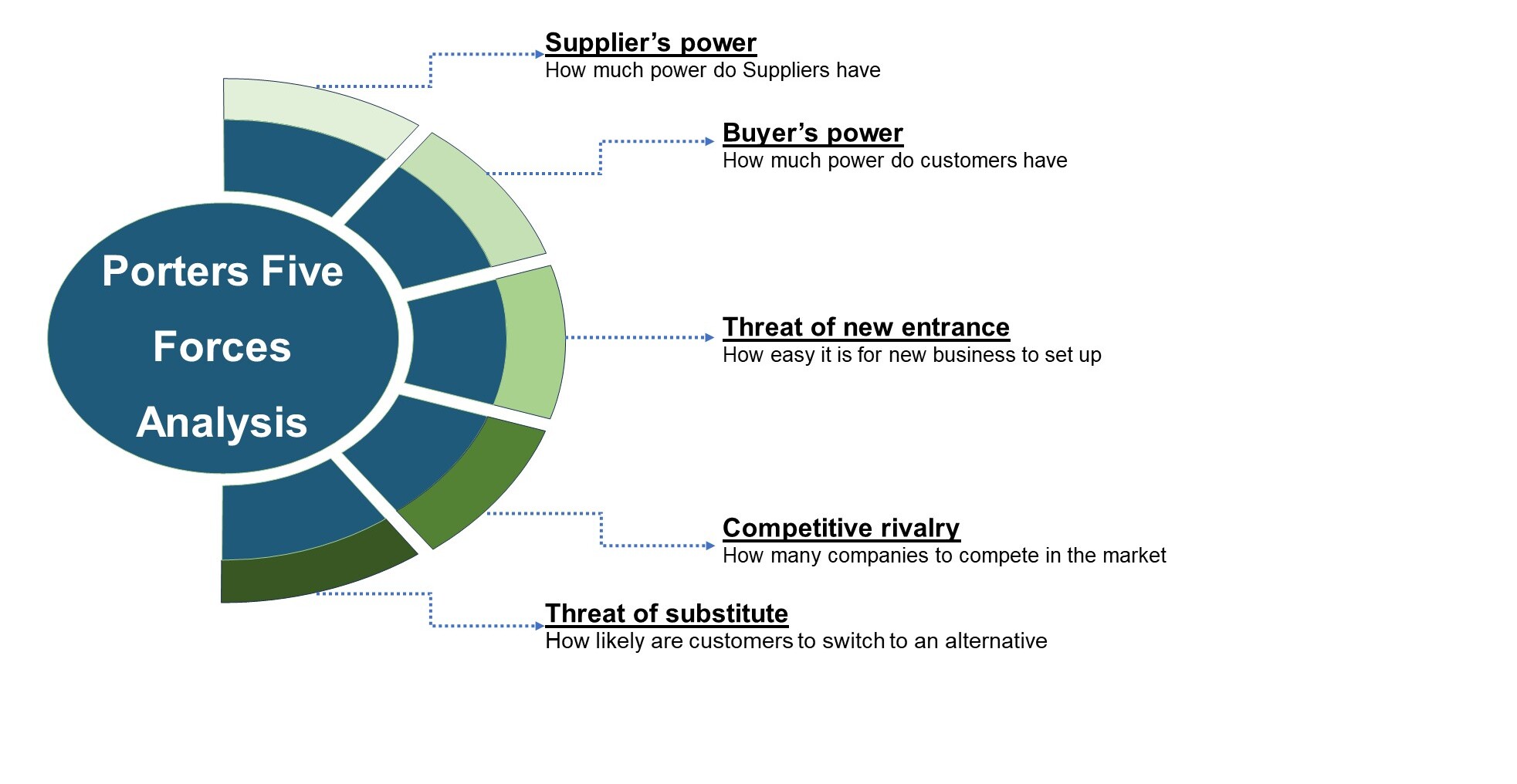
We observed that the measuring and control instrument market features a moderately consolidated competitive landscape, with diversified industrial automation conglomerates competing alongside specialized analytical, metrology, and test-and-measurement manufacturers.

Dimension Description
Market Structure Moderately consolidated; Siemens, Emerson, Honeywell, ABB, and Schneider Electric maintain the broadest process automation and control system footprints, while specialized manufacturers including Keysight, Agilent, and Shimadzu compete on category-specific analytical and test instrument depth.
Innovation Focus AI-enabled test and measurement platforms, wireless retrofit instrumentation, and software-integrated asset optimization dominate current investment priorities across leading suppliers.
M&A Activity Active portfolio consolidation, exemplified by Emerson's completed buy-in of AspenTech in March 2025 and Keysight's fiscal 2025 acquisitions of Spirent Communications, Synopsys' Optical Solutions Group, and Ansys' PowerArtist RTL business.

How Do Companies Compete in the Measuring and Control Instrument Market?

Companies compete primarily on measurement precision, systems integration depth, and breadth of software-attached analytics across the industry. Diversified conglomerates such as Siemens and Emerson leverage combined hardware, control system, and optimization software portfolios to serve large process industry accounts, while specialized manufacturers including Keyence and Mettler-Toledo compete on category-specific precision, such as machine vision inspection or laboratory weighing, where deep application expertise outweighs the value of a broader product line.

Which Competitive Archetypes Dominate the Measuring and Control Instrument Market?

Two archetypes dominate the market: diversified process automation conglomerates offering integrated measurement, control, and software portfolios, and specialized instrument manufacturers focused on a single measurement discipline. Siemens and ABB exemplify the diversified archetype through combined control systems and instrumentation offerings spanning multiple industries, while Advantest and Shimadzu exemplify the specialized archetype, concentrating on semiconductor test and analytical instrumentation respectively rather than pursuing broad industrial automation coverage.

How Are Companies Differentiating Through Innovation in Measuring and Control Instruments?

Innovation and differentiation strategy increasingly center on AI-enabled test platforms and software-integrated instrumentation rather than incremental hardware accuracy improvements alone. Keysight's fiscal 2025 acquisitions strengthened its physical-layer test and optical design verification capability specifically for AI data center validation, while Emerson's AspenTech integration embeds asset optimization software directly into its measurement and control portfolio. Our analysis shows that suppliers unable to demonstrate credible software and AI-enabled differentiation risk losing share to competitors bundling analytics with hardware.

What M&A and Expansion Activity Is Shaping the Measuring and Control Instrument Market?

Strategic acquisitions targeting adjacent measurement and software capability continue to reshape supplier portfolios within the industry. Emerson's March 2025 completion of its AspenTech buy-in, following its earlier acquisition of National Instruments, illustrates a deliberate strategy of combining measurement hardware with optimization and test software under one portfolio. Keysight's parallel fiscal 2025 acquisitions of Spirent Communications, Synopsys' Optical Solutions Group, and Ansys' PowerArtist RTL business illustrate how test and measurement suppliers are similarly consolidating adjacent design-verification capability to serve AI infrastructure customers.

Key Market Players

Our assessment indicates that the following 20 companies are actively shaping product innovation, portfolio consolidation, and go-to-market strategy within the global measuring and control instrument market.

Siemens AG Emerson Electric Co. Honeywell International Inc. Schneider Electric SE ABB Ltd Thermo Fisher Scientific Inc. Yokogawa Electric Corporation Endress+Hauser AG Rockwell Automation, Inc. Keyence Corporation Danaher Corporation Hexagon AB AMETEK, Inc. Mettler-Toledo International Inc. Agilent Technologies, Inc. Shimadzu Corporation Keysight Technologies, Inc. Advantest Corporation SICK AG Ralliant Corporation

Latest Developments

We found that recent product launches and instrumentation innovations within the measuring and control instrument market are focused on expanding measurement capabilities, industrial automation, and laboratory analysis.

Date Event
Sep 2026 ABB launched the PFM 20 Ex dust monitoring device for hazardous and harsh industrial environments. The instrument provides certified dust detection down to 7.5 mg/m³ and meets ATEX Zone 22 requirements, expanding ABB’s portfolio across continuous emission monitoring, dust measurement, gas-flow measurement, and portable hydrocarbon detection applications.
Sep 2026 SICK introduced the SensingCam SEC200, a camera-based reader designed for reliable 1D and 2D code identification in logistics and industrial applications. The solution combines sensing, code reading, connectivity, and simplified configuration, supporting automated identification, traceability, process monitoring, and inspection requirements across increasingly automated production environments.
Sep 2026 Hexagon launched ENSPEC, a professional-grade bridge coordinate measuring machine for EMEA manufacturers. The CMM offers eight measuring volumes ranging from 600 × 800 × 600 mm to 1,200 × 3,000 × 1,000 mm and integrates PC-DMIS software, targeting manufacturers bringing dimensional measurement in-house or expanding existing quality operations.
Sep 2026 Agilent launched the Cary 635 FTIR spectrometer, a compact analytical instrument designed for laboratory infrared analysis. The company positioned the system around high performance, reliability, simplified operation, and space efficiency, addressing laboratories seeking accurate measurements while reducing training requirements, user error, operating complexity, and overall instrument footprint.

Investment Opportunities

What Capital Inflows Are Targeting the Measuring and Control Instrument Market?

Capital inflows are increasingly directed toward software-integrated measurement platforms rather than standalone hardware development. Emerson's approximately USD 7.2 billion AspenTech buy-in and Keysight's fiscal 2025 acquisitions of Spirent Communications and design-verification assets from Synopsys and Ansys illustrate sustained strategic investment in combining measurement hardware with software and analytics capability. We observed that investors favor suppliers demonstrating successful acquisition integration, using disclosed cost-synergy targets such as Emerson's USD 200 million run-rate figure as a proxy for execution quality.

How Is Infrastructure Investment Supporting Measuring and Control Instrument Demand?

Infrastructure investment is expanding instrumentation demand across two distinct channels: AI data center build-out in North America and Asia-Pacific, and petrochemical and energy transition capacity expansion across the Middle East. Our findings suggest that Gulf Cooperation Council economic diversification programs are driving sustained process instrumentation procurement, supporting the region's above-average forecast growth rate through 2035.

What ESG Considerations Are Shaping Measuring and Control Instrument Investment Decisions?

Environmental, social, and governance considerations are increasingly relevant to investment decisions, with emissions monitoring and legal metrology compliance cited as key criteria. The European Union's Directive (EU) 2026/706 explicitly extends measurement certification to hydrogen refuelling and electric vehicle charging equipment, tying regulatory compliance directly to energy transition infrastructure. We found that investors increasingly favor suppliers with instrumentation certified for these emerging categories, treating early compliance as a governance-linked differentiator ahead of the directive's phased application through 2028.

Key Benefits for Stakeholders

How Does This Report Benefit Enterprise and Industry Leaders?

Enterprise and industry leaders gain access to validated segmentation, competitive benchmarking, and regional demand forecasts that support product-portfolio and channel-investment decisions across the measuring and control instrument industry. Our analysis shows that detailed product type, technology, and end user industry breakdowns help commercial and engineering teams align investment with wireless retrofit and AI-linked test demand while identifying underserved end user industries for portfolio expansion.

How Does This Report Benefit Investors and Financial Analysts?

Investors and financial analysts benefit from consistent, single-point market size and CAGR estimates that support valuation and capital-allocation decisions across the measuring and control instrument supply chain. We observed that the report's regional and segment-level growth differentials, such as the gap between Middle East & Africa's 13.39% CAGR and North America's 4.82% CAGR, help identify where above-market growth is concentrated rather than assuming uniform expansion across the industry.

How Does This Report Benefit Technology Vendors and Product Teams?

Technology vendors and product teams gain insight into emerging AI-enabled test, wireless retrofit, and software-integration requirements that are reshaping the industry. Our findings suggest that this analysis helps R&D teams prioritize development roadmaps around AI data center validation and brownfield wireless retrofit capability, the two demand sources growing fastest relative to the market's overall 6.56% CAGR.

Key Market Segments Evaluated

By Product Type

  • Measuring Instruments 
    • Process Measurement Instruments
      • Pressure Instruments
      • Temperature Instruments
      • Flow Instruments
      • Level Instruments
      • Density Instruments
      • Viscosity Instruments
      • Moisture and Humidity Instruments
    • Electrical and Electronic Measurement Instruments
      • Multimeters
      • Oscilloscopes
      • Signal Generators
      • Spectrum Analyzers
      • Network Analyzers
      • Power Quality Analyzers
      • Electrical Safety Testers
      • Data Acquisition Instruments
    • Analytical Instruments
      • Chromatography Instruments
      • Mass Spectrometry Instruments
      • Spectroscopy Instruments
      • Elemental Analysis Instruments
      • Materials Analysis Instruments
      • Electrochemical Analysis Instruments
      • Particle Analysis Instruments
    • Physical Property Instruments
      • Weighing Instruments
      • Force and Torque Instruments
      • Material Testing Instruments
    • Metrology and Inspection Instruments
      • Coordinate Measuring Machines
      • Optical Metrology Instruments
      • Surface Metrology Instruments
      • Form and Position Measurement Instruments
      • Machine Vision Inspection Instruments
    • Environmental Measurement Instruments
      • Air Quality Instruments
      • Gas Detection Instruments
      • Emissions Monitoring Instruments
      • Acoustic Measurement Instruments
      • Vibration Measurement Instruments
  • Control Instruments 
    • Controllers
      • Programmable Logic Controllers
      • Process Controllers
      • Motion Controllers
    • Control Systems
      • Distributed Control Systems
      • SCADA Systems
      • Safety Instrumented Systems
    • Final Control Instruments
      • Control Valves
      • Actuators
      • Valve Positioners
      • Variable Speed Drives
    • Indication and Recording Instruments

By Technology

  • Analog Technology
  • Wired Digital Technology
  • Wireless Digital Technology

By Transaction Type

  • New Sales
  • Replacement Sales
  • Retrofit and Upgrade Sales

By End User Industry

  • Process Industries 
    • Oil and Gas
    • Chemicals and Petrochemicals
    • Pharmaceuticals and Biotechnology
    • Food and Beverage
    • Mining and Metals
    • Pulp and Paper
    • Water and Wastewater
  • Energy and Utilities 
    • Power Generation
    • Power Transmission and Distribution
    • Renewable Energy
    • Energy Storage
  • Discrete Manufacturing 
    • Automotive
    • Aerospace and Defence
    • Machinery and Equipment
    • Electronics and Semiconductors
    • Consumer Products
  • Life Sciences and Research 
    • Clinical Diagnostics
    • Analytical Laboratories
    • Academic Research
    • Government Research
  • Infrastructure and Buildings 
    • Commercial Buildings
    • Industrial Buildings
    • Data Centers
    • Transportation Infrastructure
  • Environmental and Public Sector 
    • Environmental Monitoring
    • Occupational Safety
    • Government Monitoring

By Sales Channel

  • Direct Sales
  • Distributor Sales
  • System Integrator Sales
  • OEM Sales
  • E-commerce Sales

By Region

  • North America 
    • U.S.
    • Canada
    • Mexico
  • Europe 
    • UK
    • Germany
    • France
    • Italy
    • Spain
    • Sweden
    • Denmark
    • Finland
    • Netherlands
    • Rest of Europe
  • Asia-Pacific 
    • China
    • India
    • Japan
    • South Korea
    • Taiwan
    • Indonesia
    • Vietnam
    • Australia
    • Philippines
    • Malaysia
    • Rest of APAC
  • Middle East & Africa 
    • Saudi Arabia
    • UAE
    • Egypt
    • Israel
    • Turkey
    • Nigeria
    • South Africa
    • Rest of MEA
  • Latin America 
    • Brazil
    • Argentina
    • Chile
    • Colombia
    • Rest of LATAM

Conclusion & Recommendations

The long-term outlook for the market remains positive, with global revenue projected to grow from USD 904.52 billion in 2025 to USD 1,752.29 billion by 2035. The market is projected to grow at a CAGR of 6.56% from 2026 to 2035. We observed that AI infrastructure validation demand, wireless retrofit adoption, and Middle Eastern petrochemical capacity expansion will continue underpinning growth through the forecast period, layered on top of the process industry replacement demand that has traditionally anchored this market.

What Strategic Positioning Should Measuring and Control Instrument Suppliers Pursue?

Suppliers should prioritize software-integrated measurement platforms while pursuing wireless retrofit capability to serve both new AI-linked demand and existing brownfield installed bases. Our assessment indicates that suppliers investing early in disciplined acquisition integration, following the model of Emerson's disclosed cost-synergy achievement, will be best positioned to capture premium enterprise adoption within the measuring and control instrument market.

How Attractive Is the Measuring and Control Instrument Market for New Investment?

The measuring and control instrument industry presents an attractive investment case, supported by a USD 763.00 billion absolute dollar opportunity between 2026 and 2035 and above-average growth in Middle Eastern and wireless technology categories. We found that investment attractiveness is highest for suppliers combining AI-linked test capability with established process industry distribution, positioning them to serve both electronics and industrial customer segments simultaneously.

What Market Shifts and Key Risks Should Stakeholders Monitor?

Stakeholders should monitor extended safety certification timelines, semiconductor component supply constraints, and price competition from lower-cost Asian manufacturers as key risks to the measuring and control instrument market. Our analysis shows that suppliers unable to shorten qualification cycles for safety-critical control instruments risk losing share to competitors with faster certification pathways, particularly as revised European measurement standards expand the categories requiring formal approval.

What Are the Key Growth Pathways for the Measuring and Control Instrument Market?

Key growth pathways include expanding AI data center validation instrumentation, scaling wireless retrofit offerings for brownfield process plants, and deepening environmental and public sector compliance instrumentation penetration. NMSC's analysis indicates that suppliers pursuing these pathways while maintaining disciplined software integration will be best positioned to capture the measuring and control instrument market's projected growth through 2035.

Delivered Customizations

We have successfully delivered the following deep-dive customizations:

Client Request Customization Delivered Value Adds
Historical Market & Sales Analysis
  • Historical revenue and shipment analysis of measuring and control instruments by product type, technology, and end user industry.
  • Identifies high-growth product and technology segments to prioritize for investment.
Company-Level Product Share Analysis
  • Manufacturer-wise share across instrument categories such as flow, temperature, pressure, level, and analytical instruments.
  • Reveals competitor strengths and white-space product categories for portfolio positioning.
Country-Level Import-Export Assessment
  • Country-wise import and export analysis of measuring and control instruments using HS-code trade data.
  • Highlights sourcing hubs, trade dependencies, and export-led expansion opportunities.
Smart vs Conventional Instrument Adoption Mapping
  • Adoption analysis of analog, digital, wireless, and IoT-enabled instruments by end user industry and product type.
  • Guides technology roadmap and targeting of industries shifting to smart instrumentation.
End User Industry Demand Prioritization
  • Demand analysis across process, discrete, energy, water, pharma, and food industries using industrial capex and plant-investment indicators.
  • Ranks end user industries by demand potential to focus sales and account strategy.
Channel and Transaction Model Benchmarking
  • Comparison of OEM versus aftermarket transactions and direct, distributor, and online sales channels by region and product type.
  • Optimizes go-to-market mix and aftermarket revenue strategy.

FAQs

About the Author

Mihul Sharma

Mihul Sharma

Mihul Sharma is Research Associate at Next Move Strategy Consulting, where he has covered technology, industrial, and healthcare markets for 3 years. His work applies structured business research, market analysis, and secondary-source review to assess market trends, competitive developments, and growth opportunities. He supports report development by fully synthesizing industry data, company information, and market signals into concise findings for strategy and investment-focused research teams.

About the Reviewer

Supradip Baul

Supradip Baul

Supradip Baul is an accomplished business consultant and strategist with over a decade of rich experience in market intelligence, strategy, technology, and business transformation. His work has included rigorous qualitative and quantitative analysis across multiple industries, helping clients shape investment decisions and long-term roadmaps. Earlier in his career, he was associated with Gartner, where he contributed to industry-leading reports and market share analyses. He has worked with leading global companies and holds an MBA with a dual specialization in Marketing and Finance.

Download Free Sample

Nishant Awate

NISHANT AWATE

Business Development Global Sales

Zehnder Group Deutschland GmbH

Our experience working with Next Move Strategy Consulting was positive. The team was responsive, professional, and open to incorporating our specific requirements throughout the project. The India AHU market study was comprehensive and well structured, covering market value and volume forecasts, product and application segments, and key industry trends. The inclusion of both AHU and residential MVHR market insights made the study particularly relevant for our strategic market assessment. Overall, the report provides a solid foundation for evaluating market potential, identifying priority segments, and supporting business-development decisions in India.

Gaurav Jaiswal

GAURAV JAISWAL

Founder & CEO

Yano Charge Private Limited

The EV Charging market research report provided by the NextMSC was exceptionally detailed and insightful. It offered a comprehensive analysis that proved to be a game-changer for our strategic planning. Truly a testament to the NextMSC’s expertise and thoroughness in EV market landscape & analysis.

Semih Kavaklioglu

SEMIH KAVAKLIOGLU

Co-Founder & Sales Manager

Decortie

I work a lot in the marketing industry and I know that research is an essential part of any campaign. I have used Market research reports for my own products and I found them to be very informative and well-researched. The team here produces insightful reports for a good price

Mohit Agarwal

MOHIT AGARWAL

Chief Manager

DryChem India Pvt. Ltd.

Next Move Strategy Consulting is an amazing team of consultants. We required a market study report for our investors on top priority and the team went above and beyond our expectations to deliver the same with ample supporting data within a short time span enabling us to secure the investments and keep our project timeline maintained. Their professionalism, attention to detail, and timely delivery of actionable recommendations have left a lasting impression on our organization.

Rishabh Jogani

RISHABH JOGANI

Strategy Analyst

Accenture Japan

We are incredibly impressed with the market report on the real estate market in India provided by Next Move Strategy Consulting. The report was thorough, insightful, and well-structured, offering deep analysis and actionable recommendations. It not only captured the current trends and dynamics but also provided a forward-looking perspective that has been invaluable for our strategic planning. Their team demonstrated exceptional professionalism, attention to detail, and a profound understanding of the industry. The data-driven insights and clarity of presentation exceeded our expectations, making complex market trends easy to understand. We highly recommend Next Move Strategy Consulting to anyone looking for reliable and comprehensive market research services. Their expertise has given us the confidence to navigate the complexities of the Indian real estate market with clarity and foresight.

Custom Market Research Services

We will customize the research for you if the listed report does not fully match your requirements.

Get 30% Free Customization

Select License

This website uses cookies to ensure you get the best experience on our website. Learn more

✖