Data Center Colocation Market By Type {Retail (Single, Half & Full Cabinets, Caged Space, Custom Suites), Wholesale (Private Suites, Dedicated Space, Large-Scale)}, By Infrastructure (Hardware, Software, Services), By Data Center Rating (Tier I, Tier II, Tier III, Tier IV), By Server Rack Density (<10kW, 10–19kW, 20–29kW, 30–39kW, 40–49kW, >50kW), By End User (Cloud Service Providers, Network Providers, Managed Service Providers, Enterprises – Global Analysis & Forecast, 2025–2035
Industry: ICT & Media | Latest Edition: September 30, 2026 | No of Pages: 658 | No. of Tables: 892 | No. of Figures: 886 | Format: PDF | Report Code: IC3169
Industry Outlook
The global Data Center Colocation Market size was valued at USD 76.87 billion in 2025 and is expected to reach USD 93.90 billion by 2026. Looking ahead, the industry is projected to expand significantly, reaching USD 256.49 billion by 2035, registering a CAGR of 11.81% from 2026 to 2035.
The data center colocation market is experiencing sustained expansion as enterprises seek scalable, cost-efficient infrastructure to support cloud adoption, data-intensive workloads, and digital transformation initiatives. Organizations are increasingly shifting from owned facilities to third-party colocation providers to optimize capital expenditure, improve reliability, and access high-density power and cooling capabilities. Growing demand for hybrid IT architectures, edge computing, and low-latency connectivity is reshaping facility design and geographic deployment strategies. Advances in energy-efficient cooling, renewable power integration, and intelligent infrastructure management are redefining operational standards and influencing provider differentiation. At the same time, heightened focus on data sovereignty, cybersecurity, and regulatory compliance is driving demand for certified, regionally distributed colocation facilities. Providers offering interconnected ecosystems, flexible capacity, and sustainability-aligned operations are well positioned to capture long-term growth across global markets.
What Are the Key Trends in the Data Center Colocation Market?
How Is Explosive Enterprise Data Growth Redefining Colocation Utilization Models?
Accelerating enterprise digital transformation is fundamentally reshaping colocation utilization patterns. Rising data generation from IoT deployments, cloud-native applications, and advanced analytics is driving sustained growth in storage- and compute-intensive workloads. Many enterprises are increasingly favouring colocation over captive data center builds due to capital discipline, faster time-to-market, and the need for elastic scalability. Industry analysis indicates that enterprise data growth is outpacing the ability of in-house infrastructure to expand efficiently. As a result, colocation facilities are evolving from static space-and-power offerings into flexible infrastructure platforms, supporting higher utilization rates, mixed workload densities, and rapid capacity expansion through modular design and dynamic power allocation.
How Are Edge and Latency-Sensitive Workloads Expanding the Regional Colocation Footprint??
The growth of latency-sensitive applications is driving a structural shift toward more distributed colocation deployments. Technologies such as 5G, real-time AI inference, AR/VR, autonomous systems, and interactive digital services require compute resources to be positioned closer to end users to meet performance thresholds. This is expanding demand beyond centralized hyperscale campuses toward regional and edge-oriented colocation facilities, located in secondary and tertiary markets. Industry insights, including commentary from major operators, indicate rising enterprise and network-provider interest in regional sites that balance low latency with interconnection density. Consequently, the addressable data center colocation market is broadening geographically, with providers increasingly standardizing regional facility designs to scale efficiently.
How Is Growing Global Data Center Capacity Demand Influencing Colocation Expansion Strategies?
Rising global demand for data center capacity, driven by cloud migration, AI-intensive workloads, and enterprise digitalization, is reshaping how colocation providers plan and execute expansion. Disclosures from leading operators show sustained growth in capacity reservations and forward pipelines, signaling long-term confidence in demand visibility. In response, providers are accelerating new builds, expanding multi-campus developments, and increasingly relying on modular and prefabricated construction to compress delivery timelines and reduce execution risk. However, higher rack densities and tightening power availability are altering expansion economics. Capacity planning is therefore shifting toward phased development models, scalable electrical architectures, and energy-efficient cooling designs that are deployed incrementally as power becomes available. This approach allows operators to balance speed-to-market with capital discipline, grid constraints, and long-term operational resilience in an increasingly power-constrained environment.
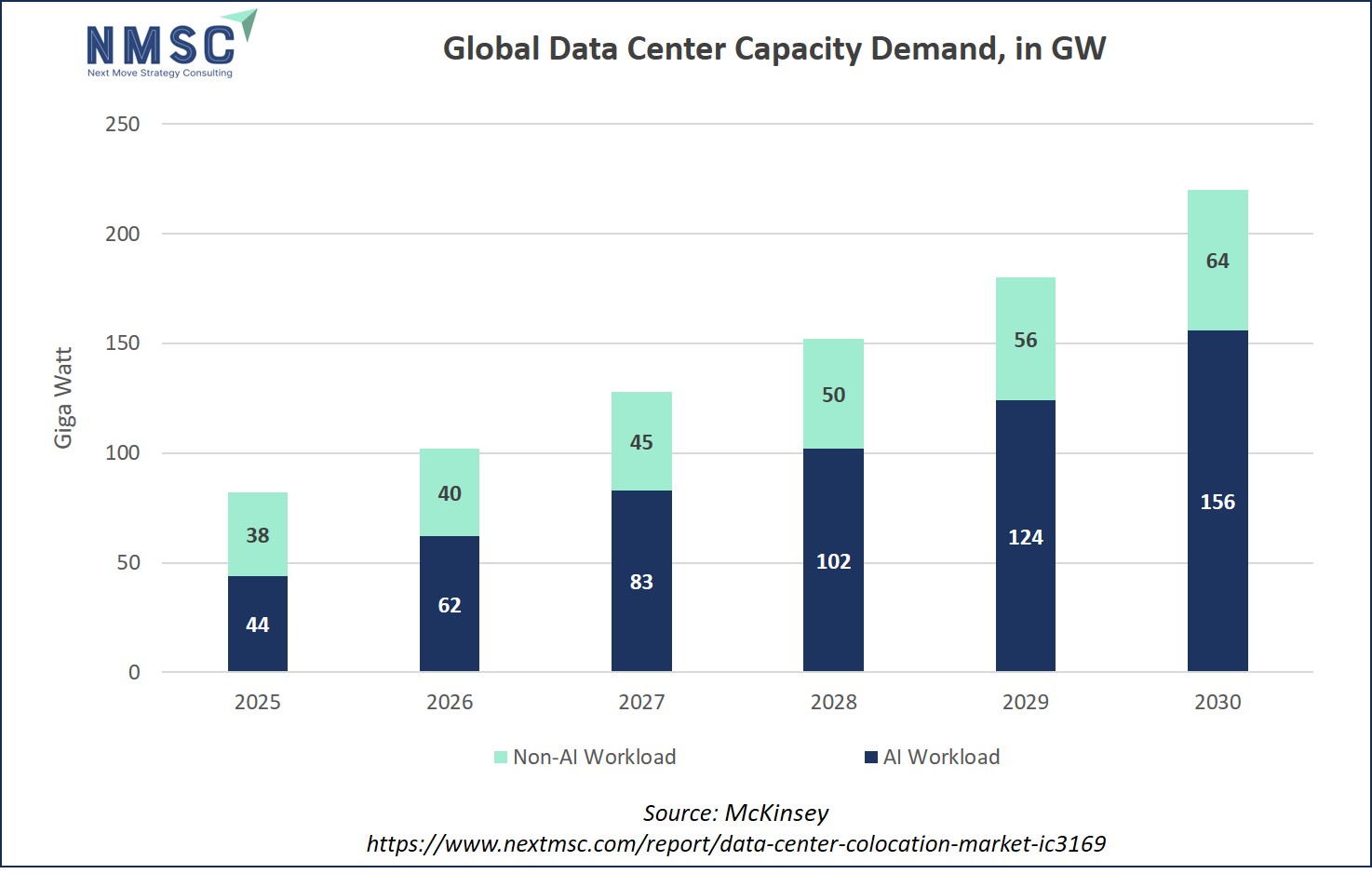
The chart shows global data center capacity demand rising from 2025 to 2030, with AI workloads growing and representing the dominant share of incremental demand. For the market, this trajectory underscores a substantial expansion opportunity as hyperscalers and enterprises seek third party facilities that deliver high density racks, robust power availability, and advanced liquid cooling solutions tailored to AI training and inference clusters. As non AI workloads also expand steadily, colocation providers that flexibly mix traditional enterprise hosting with AI optimized capacity, while securing long term power contracts and low carbon energy sources, will be best positioned to capture this multi year uplift in demand.
What Are the Key Market Drivers, Breakthroughs, And Investment Opportunities That Will Shape the Data Center Colocation Industry in the Next Decade?
The data center colocation market is being propelled by structural growth in digital services, accelerating enterprise cloud migration, and continued hyperscaler expansion. These secular drivers are translating into rising demand across both retail colocation, serving enterprises, networks, and managed service providers, and large-scale wholesale and build-to-suit deployments anchored by cloud and AI operators. Institutional capital is actively financing platform expansion and geographic scale, while governments, utilities, and grid operators contend with power availability and permitting constraints. These supply-side frictions are creating localized capacity shortages, differentiated pricing dynamics, and heightened competition for power-secured sites.
At the same time, advances in cooling technologies, modular construction, and on-site energy and storage are shortening deployment cycles and improving operating efficiency. Despite these gains, grid capacity and interconnection approval timelines remain the most significant constraints on rapid expansion. Strategically, colocation providers that pair speed-to-market with credible sustainability commitments and flexible commercial structures are best positioned to capture premium demand from AI-driven and edge-oriented workloads.
Growth Drivers:
How Is AI and Hyperscale Compute Demand Accelerating High-Density Colocation Adoption?
The rapid scaling of AI workloads and hyperscale infrastructure is materially accelerating demand for high-density colocation capacity. Training and inference for large language models, generative AI, and advanced analytics rely on GPU and accelerator-heavy architectures that require far higher rack densities and power loads than traditional enterprise IT. This shift is compelling colocation providers to invest in advanced cooling solutions, including direct liquid and immersion cooling, alongside upgraded power distribution and high-capacity interconnection. Recent industry reports indicate that hyperscale’s are securing multi-megawatt, long-duration colocation contracts in major global metropolitan areas. Providers that deliver scalable, high-density environments quickly are benefiting from stronger utilization, longer contract tenures, and improved revenue visibility.
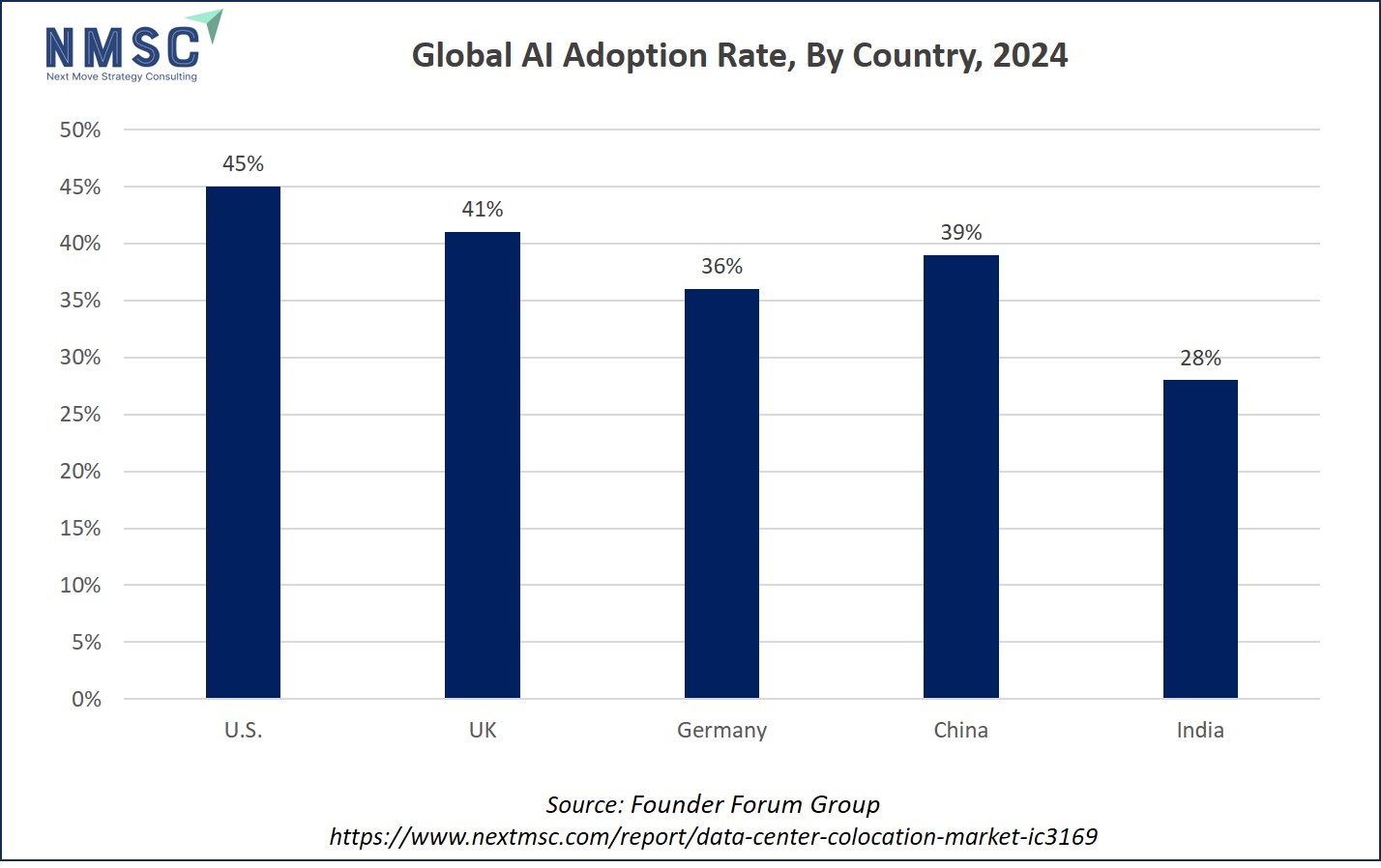
The chart shows that AI adoption in 2024 is highest in the U.S., followed by the UK, China, Germany, and India, highlighting a strong concentration of AI mature enterprises in major digital economies. For the market, these adoption levels signal where demand for AI optimized colocation capacity, supporting GPU clusters, high density racks, and low latency interconnects, is likely to scale fastest, particularly around hyperscale and large enterprise hubs in the U.S., UK, and China. As India and Germany continue to close the AI adoption gap, colocation providers in these markets have an opportunity to differentiate by offering scalable, power dense facilities and rich connectivity ecosystems that support enterprises transitioning from traditional hosting to AI driven workloads.
How Is Cloud and Hybrid-Cloud Adoption Strengthening Demand for Carrier-Neutral Colocation?
Enterprise adoption of cloud and hybrid-cloud architectures continues to structurally reinforce demand for carrier-neutral colocation facilities. Organizations increasingly blend on-premises infrastructure with multiple public cloud platforms to optimize performance, compliance, resilience, and cost. Colocation data centers serve as critical interconnection hubs, enabling low-latency, secure connectivity between enterprises, cloud providers, networks, and managed service partners. As hybrid IT strategies mature, enterprises are using colocation to centralize interconnection, reduce dependency on single vendors, and enhance operational continuity. Industry disclosures consistently highlight colocation’s role in supporting hybrid architectures and multi-cloud access. This positions carrier-neutral colocation as foundational digital infrastructure, sustaining long-term demand across enterprises, cloud providers, and service operators.
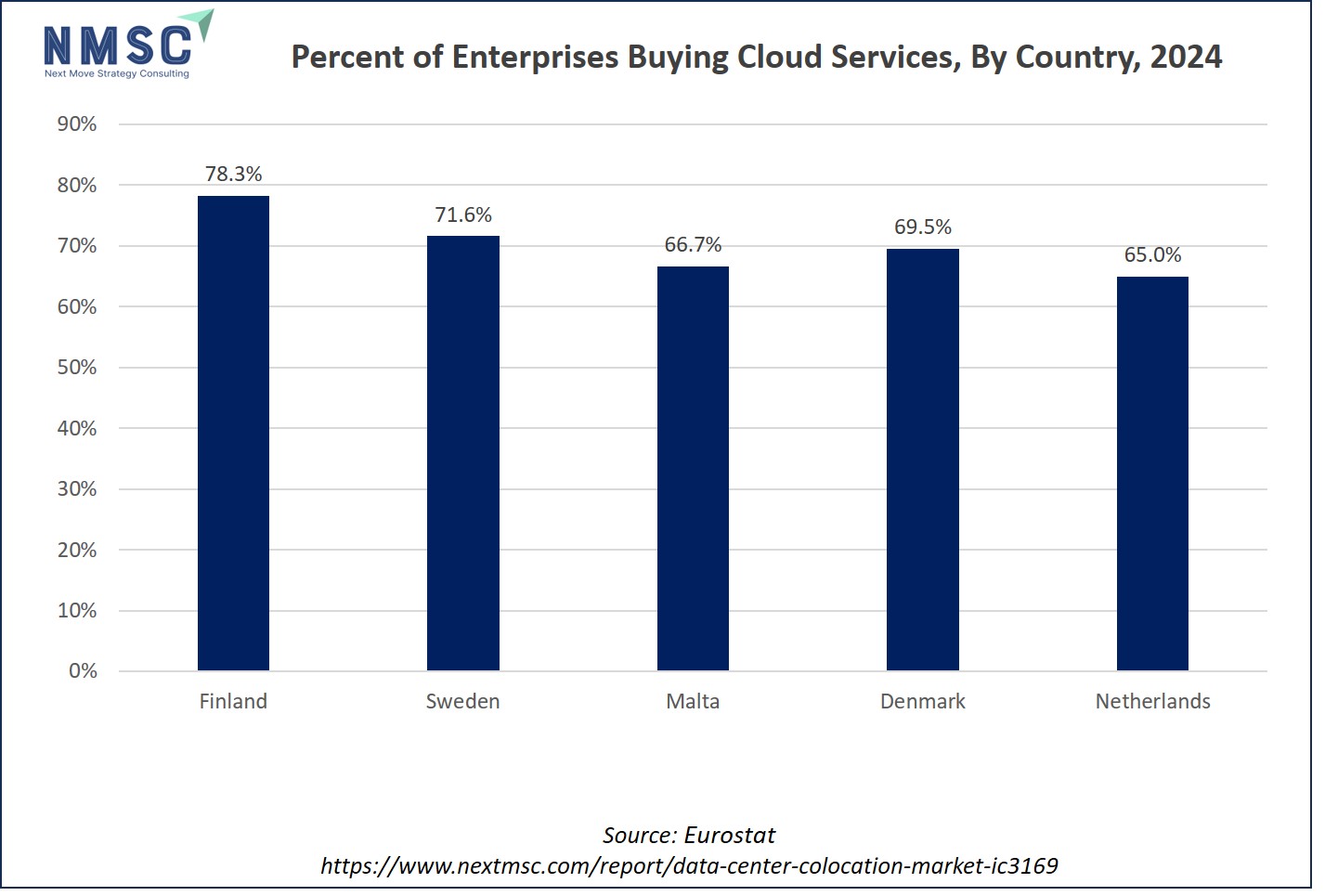
The chart shows that cloud service penetration among enterprises is very high in leading European economies, ranging the Netherlands to Finland, with Sweden, Denmark, and Malta also above two thirds adoption. For the data center colocation market, this level of cloud usage indicates strong underlying demand for third party infrastructure to host public cloud on ramps, edge nodes, and hybrid IT environments that enterprises rely on to access cloud services with low latency and high reliability. Colocation providers in such cloud mature markets are well positioned to benefit from continued enterprise offloading of on premise data centers, as customers seek carrier neutral facilities offering dense connectivity to hyperscale clouds, SaaS providers, and regional networks.
Growth Inhibitors:
How Are Power Availability and Permitting Delays Constraining Colocation Expansion?
Power availability has emerged as a primary bottleneck for colocation expansion, particularly for high-density facilities. Grid capacity constraints, extended interconnection queues, and localized permitting delays are materially lengthening development timelines and increasing execution risk. Analyses from U.S. Department of Energy, linked institutions highlight a surge in multi-hundred-megawatt connection requests, overwhelming utility planning cycles and extending approval processes. In markets requiring new generation or major transmission upgrades, project economics shift unpredictably due to rising capex and uncertain timelines. As a result, operators must embed power and permitting risk into site underwriting, adopt phased build strategies, and engage early with utilities and regulators to preserve development optionality and protect returns.
Growth Opportunities:
How Is Integrated Energy and Storage Platforms Creating a Defensible Commercial Moat for Colocation Operators?
Integrated energy strategies are becoming a differentiated investment opportunity in the data center colocation market. Operators that combine long-term power purchase agreements, on-site generation, battery storage, and participation in virtual power plants partially bypass grid constraints while offering customers assured, low-carbon energy supply. IEA projections indicate renewable sources will meet a significant share of incremental data center power demand, reinforcing the value of controllable energy stacks. Providers able to guarantee energy attributes, price stability, and load flexibility command pricing premiums and reduce financing risk by improving project bankability. Investment in energy-as-a-service models and storage-backed infrastructure thus offers a scalable pathway to margin expansion and stronger customer retention.
How Is the Data Center Colocation Market Segmented in This Report, And What Are the Key Insights from the Segmentation Analysis?
By Type Insights
Is Retail or Wholesale Colocation Dominating the Market in 2025?
Based on type, the data center colocation market is segmented into retail colocation and wholesale colocation.
In 2025, wholesale colocation dominates in terms of incremental capacity additions and capital deployment, driven by hyperscalers and large enterprises signing long-term, multi-megawatt build-to-suit contracts. These commitments underpin institutional investment flows and accelerate campus-scale developments. However, retail colocation remains structurally important, supporting diversified enterprise, network, and managed service workloads while generating higher-margin interconnection and cross-connect revenues. The market dynamic indicates that wholesale drives headline growth and balance-sheet scale, whereas retail stabilizes cash flows and enhances margin resilience. Operators with hybrid retail–wholesale portfolios are best positioned to balance near-term revenue certainty with long-duration contracted returns.
By Infrastructure Insights
Is Hardware, Software, or Services the Dominant Revenue Stream in 2025?
Based on infrastructure, the data center colocation market is segmented into hardware, software, and services.
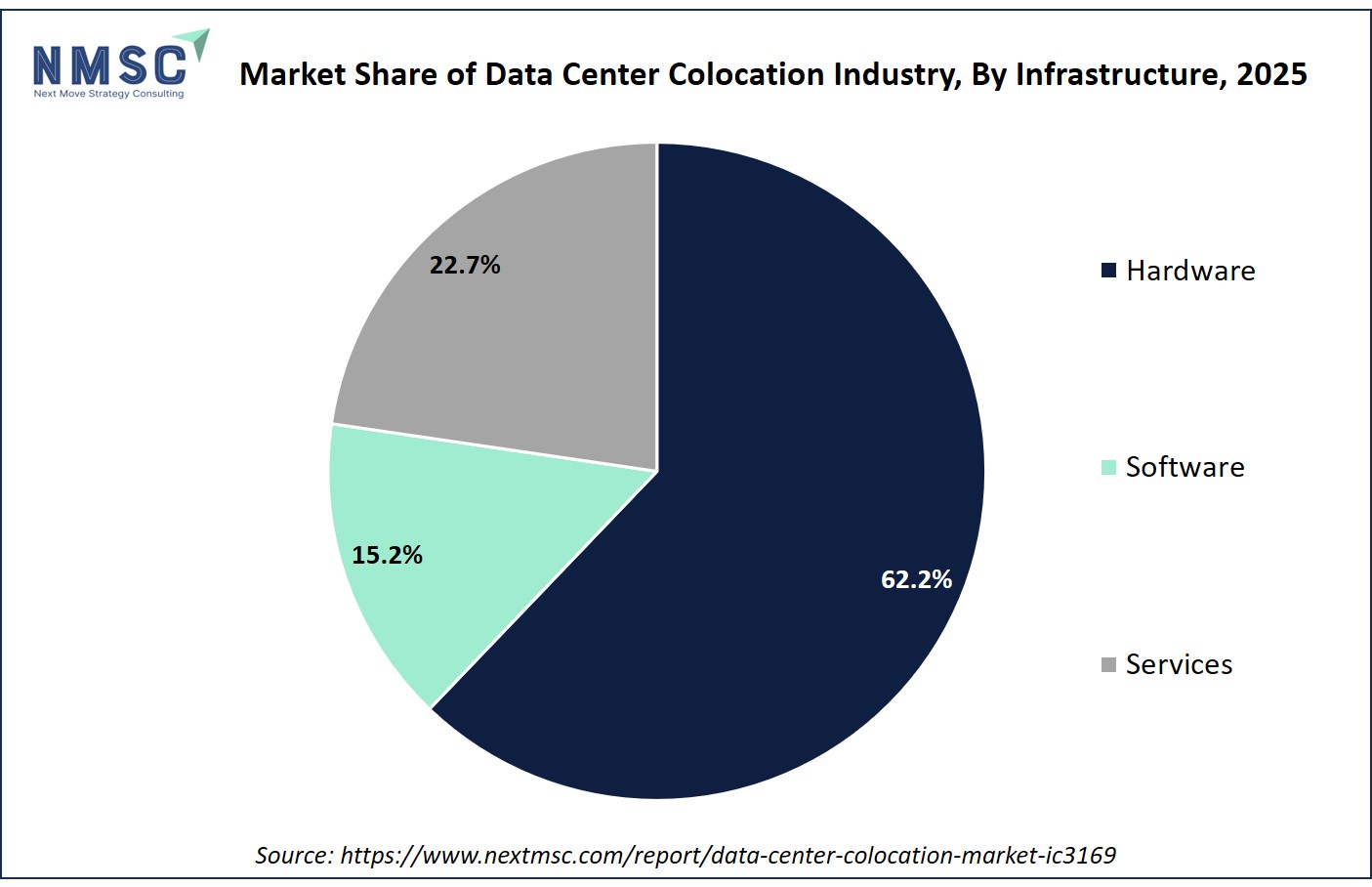
For colocation providers in 2025, recurring revenue from core infrastructure, space, power, and connectivity continues to represent the largest share of reported revenue. Hardware-intensive assets such as power distribution and cooling underpin this base, while software platforms for monitoring and automation remain a smaller but fast-growing layer. Services, including installation, cross-connects, and managed operations, are increasingly bundled to lift average revenue per customer. Although infrastructure rentals dominate today, the fastest incremental growth is occurring in value-added services and operational software, reinforcing the strategic importance of modular service monetization alongside core capacity.
By Data Center Rating Insights
Are Tier III Facilities the Practical Sweet Spot in 2025?
Based on data center rating, the data center colocation market is segmented into Tier I, Tier II, Tier III, and Tier IV.
Tier III facilities remain the practical standard for most customers in 2025, offering an optimal balance between availability, redundancy, and total cost of ownership. Enterprises, carriers, and regulated industries typically select Tier III designs to meet uptime and compliance requirements without incurring the significantly higher capital and operating costs of Tier IV. Hyperscalers pursue customized resiliency architectures rather than strict tier definitions. Rising construction and power costs further reinforce Tier III as the default product. Operators that standardize modular Tier III deployments while offering selective higher-resiliency customization address broad demand efficiently.
By End User Insights
Are Cloud and Managed Service Providers the Primary End Users in 2025?
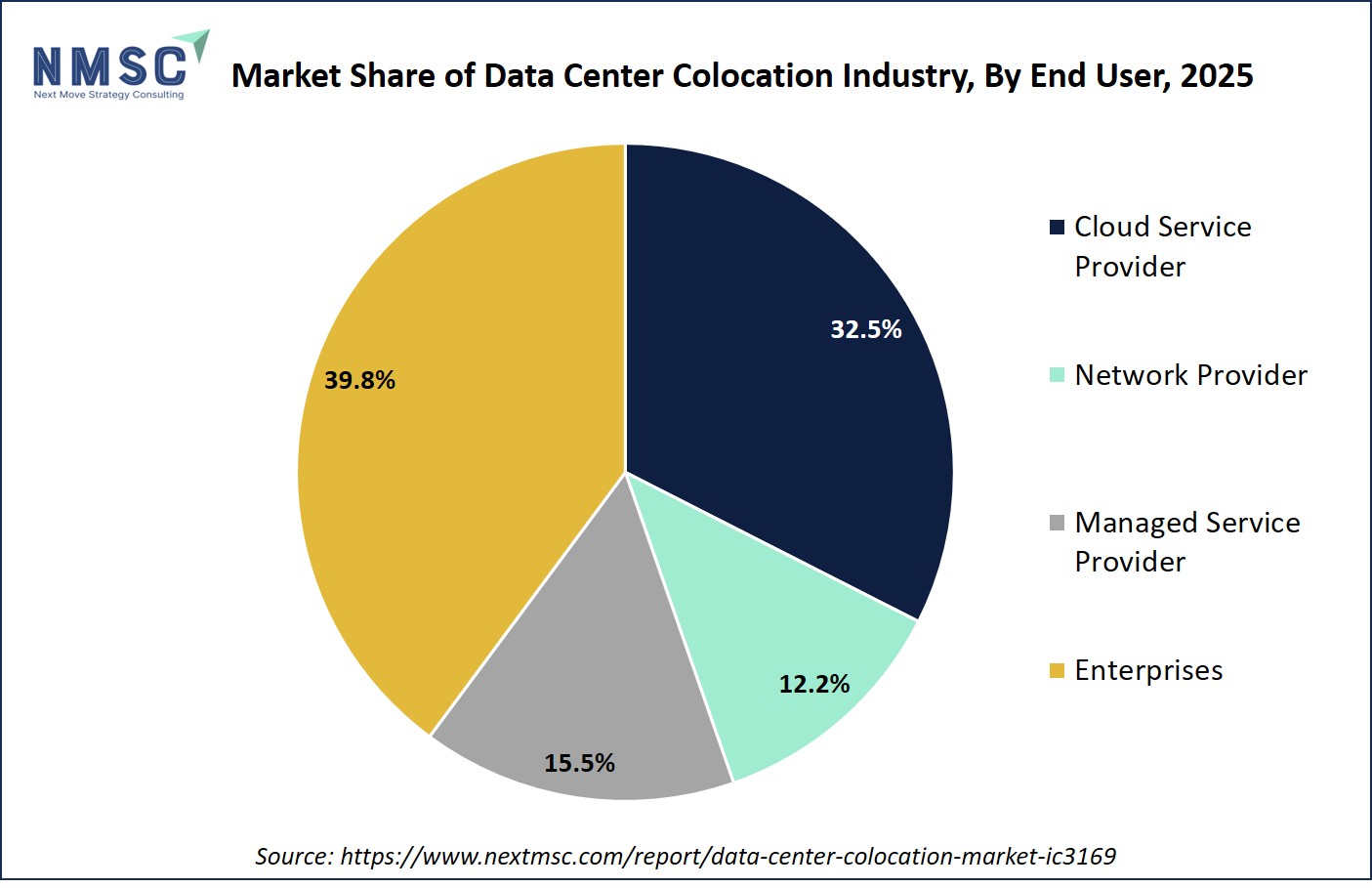
Based on end user, the data center colocation market is segmented into cloud service providers, network providers, managed service providers, and enterprises.
Cloud service providers and hyperscalers are the dominant end users for wholesale colocation capacity in 2025, accounting for a significant share of new build-to-suit pipelines. Their long-term commitments anchor large campus developments and drive overall data center colocation market expansion. However, enterprises and managed service providers remain central to retail colocation demand, particularly for interconnection-rich environments and hybrid IT architectures. This dual demand profile requires operators to support both large, customized multi-megawatt deployments and smaller, fast-provisioned retail offerings. Platforms that effectively serve both segments maximize utilization, cross-connect density, and revenue durability.
Regional Outlook
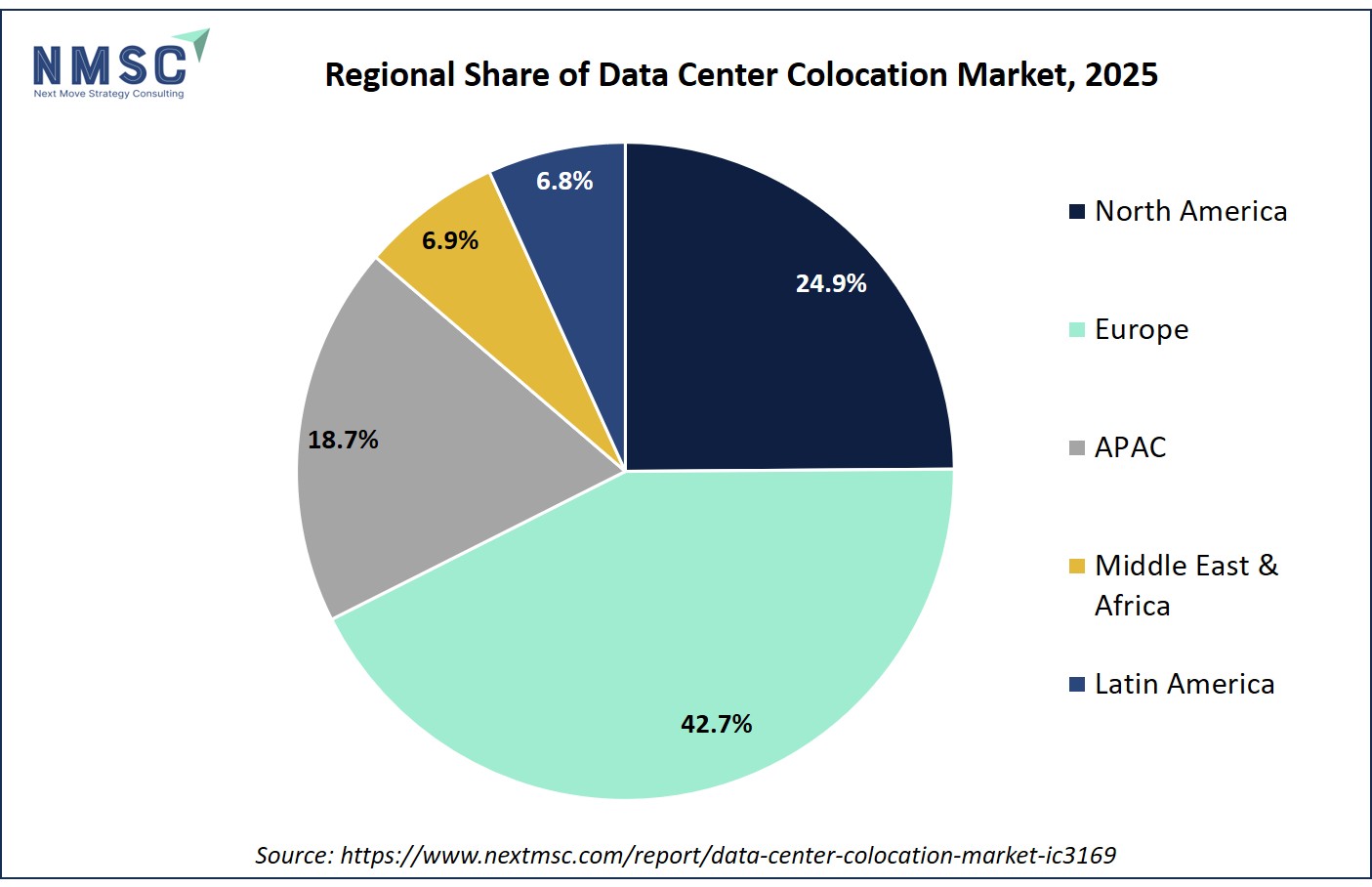
The data center colocation market is geographically studied across North America, Europe, Asia Pacific, Middle East & Africa, and Latin America and each region is further studied across countries.
Data Center Colocation Market in North America
North America remains the largest and most active data center colocation market globally, anchored by dense metro footprints in Northern Virginia, Silicon Valley, Dallas and Chicago. The region combines robust hyperscaler project pipelines, sustained institutional capital inflows, and sophisticated enterprise demand for interconnection and hybrid-cloud architectures. However, local supply dynamics vary materially by utility territory, and grid constraints plus permitting complexity frequently determine campus economics and go/no-go decisions. Successful operators are those who secure early utility partnerships, structure staged modular campuses, and offer flexible commercial terms tied to staged power delivery. In this environment, differentiated energy strategies, rapid permitting playbooks, and integrated sustainability credentials materially improve site economics and tenancy prospects.
Data Center Colocation Market in the United States
The United States blends major hyperscaler build-to-suit requirements with a large and diverse retail-colo ecosystem serving enterprises, network operators and managed-service providers. Studies and utility filings document surging multi-hundred-megawatt interconnection requests in key regions, producing extended queue times and heightened regulatory scrutiny. U.S. operators are responding by prioritizing modular, repeatable builds, deploying on-site energy storage and securing long-term PPAs to mitigate grid risk and stabilize economics. Market leadership will accrue to firms that navigate local permitting processes, design staged power delivery, and align expansion with utility capacity roadmaps. Those operators that institutional investors back for disciplined, power-secured growth are best positioned to capture sustained demand.
Data Center Colocation Market in Canada
Canada’s data center colocation market is expanding selectively, driven by competitive wholesale power in certain provinces, increasing cloud and enterprise adoption, and a pronounced preference for local data residency. Key investment corridors cluster in Ontario, Quebec and British Columbia, where lower-carbon energy mixes and attractive power pricing support long-duration commitments. Canadian operators differentiate through provincial PPA access, direct utility partnerships, and compliance with provincial regulatory regimes. Site selection emphasizes proximity to renewable generation and transmission robustness. Given the country’s geography and interprovincial variability, successful entrants combine local-market expertise with cross-border customer support to serve North American workflows and sovereign-data requirements efficiently.
Data Center Colocation Market in Europe
Europe’s data center colocation market is defined by high regulatory complexity, intense sustainability scrutiny, and concentrated interconnection demand in hubs such as London, Frankfurt, Amsterdam and Paris. Operators face permitting and grid challenges that are addressed through aggregated renewable procurement, corporate PPA structures, and investment in on-site energy solutions. Customers increasingly prioritize providers with jurisdictional certainty, compliance certifications, and transparent carbon accounting. Expansion strategies that pair scalable modular design with strong local partnerships and regulatory engagement win enterprise and cloud tenancy. In addition, the EU’s policy focus on decarbonization and energy security is creating differentiated value for providers with credible green-energy guarantees and robust resilience planning.
Data Center Colocation Market in the United Kingdom
The UK remains a leading European data center colocation market share, anchored by London’s financial and cloud ecosystems while seeing incremental edge and campus development in secondary regions. Planning and energy constraints are pushing selective capacity outward from core urban centers, increasing the importance of latency-flexible offerings and regional interconnection. Enterprise and cloud customers show preference for providers that combine green-energy sourcing with flexible commercial terms and strong on-ramps to major cloud platforms. Operators that offer rapid provisioning, verified sustainability attributes, and resilient connectivity into London’s ecosystem will capture both enterprise workloads and hyperscaler edge requirements as demand diversifies across the UK.
Data Center Colocation Market in Germany
Germany presents robust demand underpinned by industrial, enterprise and hyperscaler use cases, with Frankfurt standing out as a global interconnection hub. German customers prioritize energy efficiency, regulatory compliance and strong utility engagement, leading operators to pursue certified green-energy contracts and close coordination with grid operators. The commercial model emphasizes long-term anchored leases, measured PUE performance, and rigorous environmental reporting. Expansion in Germany requires navigating regional permitting regimes and reconciling industrial load needs with national energy transition objectives. Providers that integrate energy flexibility, certified renewables and industrial connectivity into their value propositions will be best placed to secure large campus projects and long-duration tenancy.
Data Center Colocation Market in France
France’s data center colocation market demand concentrates around Paris and selected regional nodes, driven by financial services, public-sector digitalization and multinational enterprise footprints. Local policy incentives that favor decarbonized power and data-sovereignty create favorable conditions for compliant colocation offerings. Operators that provide certified low-carbon hosting, regional data-residency guarantees, and robust compliance support gain traction with both public and private customers. Given centralized demand patterns, success in France depends on securing strategic sites with strong transmission links and while demonstrating rapid permitting and community engagement capabilities. Providers that align commercial structures with national energy and data-governance priorities capture significant market share.
Data Center Colocation Market in Italy
Italy’s data center colocation market is at a more nascent stage relative to northern Europe, with Milan emerging as the principal growth center for enterprise and cloud demand. Expansion opportunities are concentrated among operators that bridge telco partnerships, local cloud access, and enterprise colocation services. Energy solutions and strategic alliances with telecommunications providers accelerate uptake among corporate customers. Given fragmented demand outside Milan, viable rollouts require careful site economics, strong utility engagement and localized sales channels. Providers that offer modular solutions, rapid time-to-service, and integration with regional network fabrics are likely to capture enterprise workloads and foster competitive advantages in Italy’s developing market.
Data Center Colocation Market in Spain
Spain is evolving as a regional colocation hub anchored by Madrid and Barcelona, supported by cross-border connectivity projects and expanding cloud investments. Growth opportunities hinge on coordination with grid operators, pragmatic energy procurement strategies, and leveraging lower-cost industrial zones. Service demand is fueled by enterprise modernization, cloud adoption and regional content-delivery needs. Providers that deliver reliable interconnection, flexible power arrangements and regional disaster-recovery options will attract multinational enterprises and content platforms. Sustainable energy sourcing and robust planning permissions are essential to ensure scalable expansion and competitive placement within Iberia and southern Europe.
Data Center Colocation Market in the Nordics
The Nordic countries present an attractive proposition for colocation owing to abundant low-carbon power, cool ambient climate and stable regulatory environments. These attributes favor hyperscalers and regulated data workloads seeking sustainability-aligned hosting and operational cost advantages. Nordic operators monetize green energy through certified carbon-free hosting options and long-term renewable contracts. The region also supports edge and DR footprints for European customers seeking low-latency, low-carbon alternatives. To succeed, providers must demonstrate credible decarbonization roadmaps, reliable transmission capacity and seamless integration with European network backbones to serve multinational tenancy and sustainability-conscious customers.
Data Center Colocation Market in the Asia-Pacific
Asia-Pacific displays heterogeneous maturity across markets: Singapore, Tokyo and Sydney host established hyperscale campuses while emerging markets exhibit rapid retail colocation uptake. The region’s growth is driven by mobile-first consumption, e-commerce scale, and hyperscaler regionalization. Power reliability, regulatory frameworks and spectrum of local incentives vary widely, so successful providers adapt to each jurisdiction’s energy mix and permitting realities. Edge-oriented deployments are accelerating in secondary cities to meet latency-sensitive requirements. Operators that combine regional scale with local regulatory expertise, flexible energy procurement, and strong carrier-neutral interconnection will capture both hyperscaler and enterprise adoption across APAC.
Data Center Colocation Market in China
China operates a large, centrally coordinated data infrastructure ecosystem where domestic cloud providers and telcos are dominant tenants and strategic partners. Foreign participation is constrained by regulatory and data-localization requirements, necessitating local partnerships or JV structures for international operators. The market emphasizes integrated service bundles, close alignment with national industrial plans, and compliance with evolving cybersecurity and cross-border data transfer rules. Operators that build strong relationships with local cloud providers, secure compliant site approvals, and align with national energy objectives are best positioned to scale in China’s unique colocation environment.
Data Center Colocation Market in Japan
Japan’s data center colocation market is resilient and mature, led by Tokyo and Osaka hubs that serve high-availability enterprise and cloud workloads. Japan benefits from stable utility infrastructure and high standards for reliability, making it conducive to both retail and wholesale deployments. Japanese customers value precision in service delivery, rigorous SLAs, and integration with local network fabrics. Expansion strategies typically emphasize redundancy, earthquake-resilient design, and strong local partnerships. Providers that deliver certified reliability, modular scalability and deep integration into domestic carrier networks capitalize on Japan’s steady demand for premium colocation services.
Data Center Colocation Market in India
India is among the fastest-growing data center colocation market globally, with strong demand concentrated in Mumbai, Delhi NCR and Hyderabad driven by cloud adoption, mobile services and digital economy growth. The addressable market for edge and regional colocation is substantial but fragmented by state-level regulations and variable power infrastructure. Successful entrants must navigate site-selection complexity, secure pragmatic PPAs, and design modular builds that address local load characteristics. Providers that partner with domestic telcos and hyperscalers, offer rapid deployment options, and craft tailored commercial models will capture significant market share amid India’s rapid digitalization.
Data Center Colocation Market in South Korea
South Korea’s dense urban centers and advanced digital economy support strong colocation demand, frequently led by telco-led campuses and enterprise colocation needs. Land scarcity and urban power constraints shape development models toward higher-density designs and innovative cooling approaches. Korean operators and customers emphasize low-latency connectivity, integration with 5G networks, and robust service-level guarantees. Successful strategies combine urban colocation footprints with suburban or regional campuses where power and space enable larger-scale deployments. Providers that align with carrier ecosystems and offer flexible, high-density product tiers meet Korea’s evolving requirements.
Data Center Colocation Market in Taiwan
Taiwan’s colocation activity is closely linked to semiconductor industry dynamics, high-performance computing demand, and regional interconnectivity. The market serves both enterprise hosting and specialized HPC workloads that require low-latency access to manufacturing and research clusters. Operators must balance demand for performance with constrained land and energy resources, emphasizing efficient cooling, high-quality power and secure network connectivity. Partnerships with local carriers and integration into regional fiber routes are essential. Providers that offer tailored solutions for HPC and mission-critical enterprise applications will gain competitive traction in Taiwan’s strategic landscape.
Data Center Colocation Market in Indonesia
Indonesia presents an emerging colocation opportunity as cloud adoption and digital services expand across the archipelago, with capacity concentrated primarily in Jakarta. Growth is limited by grid reliability, permitting complexity and land constraints, making local partnerships and modular edge strategies critical. Providers that deploy rapid-deploy modular facilities, partner with telcos for carrier-neutral access, and secure local utility agreements capture early market share. Tailored commercial models that accommodate local demand patterns and phased power access help de-risk investments. Indonesia’s long-term potential is significant for edge and retail colo if operators overcome near-term infrastructure constraints.
Data Center Colocation Market in Australia
Australia’s data center colocation market is anchored by Sydney and Melbourne and characterized by strong hyperscale and enterprise demand, with architectural choices influenced by energy procurement and latency considerations for trans-Pacific connectivity. Operators that secure renewable PPAs, offer validated modular builds, and provide robust network interconnection to Asia and North America attract global cloud and enterprise tenants. Given Australia’s geographic isolation, resilient supply chains for critical infrastructure and tested modular deployment methodologies are differentiators. Providers that demonstrate credible sustainability credentials and rapid time-to-service capture enterprise confidence and long-term tenancy.
Data Center Colocation Market in Latin America
Latin America’s data center colocation market is fragmented, with major hubs in Brazil, Chile and select Caribbean nodes. Investment is growing as cloud adoption and digital services expand, but development is constrained by uneven power infrastructure, regulatory fragmentation, and currency volatility. Local partnerships, tailored contract structures, and pragmatic energy strategies are important for scaling. Providers that align offerings with regional carrier-neutral interconnection, supported by strong local channel partnerships and flexible commercial terms, succeed. Opportunities are strongest where governments invest in digital infrastructure and where multinational customers seek regional resilience and localized cloud access.
Data Center Colocation Market in the Middle East & Africa
The Middle East is seeing substantial colocation investment tied to hyperscale projects and sovereign cloud initiatives, particularly in Gulf Cooperation Council markets with strong fiscal capacity. Africa is at an earlier adoption stage, with accelerating demand concentrated in South Africa, Kenya and coastal hubs. Across both regions, backbone connectivity and energy availability are principal constraints; government partnerships and special economic zones facilitate large projects. Operators that partner with national initiatives, provide modular and resilient designs, and structure energy-secured offerings capture strategic opportunities as regional digitalization accelerates.
Competitive Landscape
Which Companies Dominate the Data Center Colocation Industry and How Do They Compete?
The data center colocation market comprises public REITs, global platform operators, and regional specialists. Public REITs and major private platforms report recurring revenue models combining space, power, and interconnection, supported by institutional financing due to capital intensity. Competitive dynamics focus on scale to service hyperscalers, rack-density capabilities, interconnection ecosystems, and energy procurement strategies. Operators differentiate through geographic footprint, sustainability credentials, and rapid provisioning, with optimal combinations enabling longer, higher-value contracts and favorable financing. Primary filings indicate record bookings and substantial equity injections into hyperscale-oriented platforms in 2024–2025, reflecting investor confidence in the structural growth of high-density colocation and the increasing strategic importance of energy and interconnection differentiation.
Market Dominated by Data Center Colocation Giants and Specialists
Large incumbents such as Equinix, Digital Realty, NTT, China Telecom, and KDDI command significant shares in premium, interconnection-rich metro markets, while specialized regional providers and hyperscale-focused platforms capture build-to-suit wholesale demand. This dual structure creates a segmented market in which interconnection leaders and campus-scale developers coexist and frequently collaborate via joint ventures. Public filings and press releases reveal capital partnerships and JV arrangements designed to accelerate campus delivery and distribute construction risk. For investors, the combination of platform scale, differentiated energy strategies, and strategic alliances constitutes the primary axis of competition, with firms securing both recurring revenue from enterprise tenants and long-term growth through hyperscaler-focused infrastructure expansion.
Innovation and Adaptability Drive Market Success
Technical innovation, particularly in cooling, modular construction, and integrated energy management, serves as a key competitive differentiator. Operators deploying modular pods and energy-management software accelerate revenue realization while lowering operating costs, enabling higher margins and faster contractions for hyperscale tenants. Industry advisories and filings increasingly reference immersion-cooling pilots and energy-as-a-service models as market differentiators. Firms that standardize modular engineering and formalize energy integration into repeatable commercial offerings translate technical innovation directly into market advantage. The ability to quickly deploy high-density racks with sustainable energy solutions positions providers to meet hyperscaler demand while capturing premium pricing and investor confidence.
Market Players to Opt for Merger & Acquisition Strategies to Expand Their Presence
M&A and large equity financings are critical tools for scaling footprints and funding multi-megawatt campus builds. Recent press releases highlight multi-billion-dollar equity raises and targeted acquisitions by major platforms to accelerate North American and EMEA expansion. Notable examples include Vantage Data Centers’ equity infusions and Digital Realty’s European campus acquisitions, illustrating capital-driven scaling strategies. Strategic M&A enables rapid market entry, aggregation of local permits, and faster customer acquisition, particularly when organic development is slowed by permitting delays or grid constraints. By combining financial resources with local market expertise, operators expand capacity, diversify risk, and secure long-term contracts with hyperscalers and enterprise tenants, reinforcing competitive advantage in high-density data center colocation market.
List of Key Data Center Colocation Companies
-
Equinix
-
Digital Realty
-
NTT DATA Group Corporation
-
China Telecom
-
KDDI Corp (Telehouse)
-
GDS Services Ltd.
-
Iron Mountain, Inc.
-
Vantage Data Centers
-
Global Switch
-
Cologix
-
21Vianet Group, Inc.
-
Coresite
-
EdgeConneX Inc.
What are the Latest Key Industry Developments?
-
October 2025 - KDDI Corporation broke ground on the new Telehouse West Two data centre at its existing London Docklands campus, the most connected data centre campus in Europe.
-
September 2025 - Vantage Data Centers Secures USD 1.6 bn Investment in APAC Platform from GIC and ADIA. This Investment supports accelerated expansion in APAC, including the acquisition of a hyperscale data center campus in Johor, Malaysia, strengthening Vantage’s position as a market leader in Asia Pacific.
-
April 2025 - QTS Submits Plans to Expand Upcoming Dallas Data Center Campus. Expansion includes the addition of two new buildings at the Mason Road location.
-
April 2025 - Iron Mountain Incorporated, the US-based global information management and data centre services company, completed the full acquisition of Indian data centre provider Web Werks India Pvt Ltd.
-
November 2024 - Cologix expands central Ohio footprint with land acquisition for new AI-ready 800MW data center campus.
What Are the Key Factors Influencing Investment Analysis & Opportunities in the Data Center Colocation Market?
Institutional demand for digital infrastructure remains robust, supported by large equity injections and green-linked financings that reflect investor confidence in long-term yield potential. Core valuation drivers include recurring revenue coverage ratios, signed build-to-suit backlogs, and energy procurement risk. Investment hotspots are concentrated in metros with scalable power and dense fiber ecosystems, such as Northern Virginia, Northern California, Seoul, Frankfurt, and Mumbai. Key considerations for investors are the ability to underwrite staged power delivery, secure long-term PPAs or energy-storage agreements, and demonstrate ESG compliance to reduce WACC through green financing. Public filings and major equity deal in 2024–2025 indicate sustained capital inflows where operators mitigate energy and permitting risk, providing defensible growth opportunities in high-density and hyperscaler-oriented data center colocation market.
Key Benefits for Stakeholders:
Next Move Strategy Consulting (NMSC) presents a comprehensive analysis of the data center colocation market trends, covering historical trends from 2020 through 2025 and offering detailed forecasts through 2035. Our study examines the market at regional and country levels, providing quantitative projections and insights into key growth drivers, challenges, and investment opportunities across all major data center colocation services segments.
Investors gain predictable, recurring revenue streams, long-term lease visibility, and diversified exit options via REIT issuance, strategic sales, or joint-venture recapitalizations. Enterprise customers benefit from rapid scalability, dense interconnection ecosystems, and outsourced compliance and resiliency capabilities, avoiding the capex burden of captive data centers. Utilities and governments receive large-scale investment inflows that fund grid modernization, though they must manage local distribution impacts. Across stakeholders, collaboration on energy procurement and permitting reduces project risk and accelerates value creation. Providers offering transparent energy attribution and staged power delivery convert sustainability commitments into pricing premiums, enhanced tenant stickiness, and lower churn, aligning commercial and environmental objectives.
Report Scope:
|
Parameters |
Details |
|
Market Size in 2026 |
USD 93.90 Billion |
|
Revenue Forecast in 2035 |
USD 256.49 Billion |
|
Growth Rate |
CAGR of 11.81% from 2026 to 2035 |
|
Analysis Period |
2025–2035 |
|
Base Year Considered |
2025 |
|
Forecast Period |
2026–2035 |
|
Market Size Estimation |
Billion (USD) |
|
Growth Factors |
|
|
Companies Profiled |
15 |
|
Countries Covered |
33 |
|
Market Share |
Available for 10 companies |
|
Customization Scope |
Free customization (equivalent to up to 80 analyst-working hours) after purchase. Addition or alteration to country, regional & segment scope. |
|
Pricing and Purchase Options |
Avail customized purchase options to meet your exact research needs. |
|
Approach |
In-depth primary and secondary research; proprietary databases; rigorous quality control and validation measures. |
|
Analytical Tools |
Porter's Five Forces, SWOT, value chain, and Harvey ball analysis to assess competitive intensity, stakeholder roles, and relative impact of key factors. |
Key Market Segments
By Type
-
Retail Colocation
-
Single Cabinets
-
Half Cabinets
-
Full Cabinets
-
Caged Space
-
Custom Suites
-
-
Wholesale Colocation
-
Private Data Center Suites
-
Dedicated Data Center Space
-
Large-Scale Colocation
-
By Infrastructure
-
Hardware
-
IT Hardware
-
Servers
-
Storage Systems
-
Networking Equipment
-
-
Power Infrastructure Hardware
-
Uninterruptible Power Supplies (UPS)
-
Generators
-
Automatic Transfer Switches
-
Power Distribution Units (PDUs)
-
-
Mechanical Infrastructure Hardware
-
Computer-Room Air Conditioners (CRAC/CRA Units)
-
Chillers
-
Racks
-
Cable Management Systems
-
-
Safety & Security Hardware
-
Fire Suppression Systems
-
Physical Security Systems (CCTV, access controls)
-
-
-
Software
-
DCIM & Monitoring
-
Automation & Orchestration
-
Backup & Disaster Recovery
-
Security Software
-
Virtualization Software
-
Analytics & Reporting Software
-
Other Software
-
-
Services
-
Planning & Professional Services
-
Site & Building Design
-
System/Infrastructure Engineering
-
Professional Advisory (compliance, energy audits)
-
-
Integration & Deployment Services
-
Electrical & Mechanical Installation
-
Commissioning & Acceptance Testing
-
-
Operation & Support Services
-
Preventive & Corrective Maintenance
-
Facilities Management / Remote Monitoring
-
Support Services (helpdesk, onsite SLA support)
-
-
Hosting & Managed Services
-
Colocation & Cloud Hosting Services
-
Virtual/Private Hosting Platforms
-
-
By Data Center Rating
-
Tier I
-
Tier II
-
Tier III
-
Tier IV
By Server Rack Density
-
<10kW
-
10–19kW
-
20–29kW
-
30–39kW
-
40–49kW
-
50kW
By End User
-
Cloud Service Provider
-
Network Provider
-
Managed Service Provider
-
Enterprises
-
IT and Telecommunication
-
Healthcare
-
BFSI
-
Retail & E-commerce
-
Media and Entertainment
-
Government
-
Energy
-
Other Enterprises
Geographical Breakdown
-
North America: U.S., Canada, and Mexico.
-
Europe: U.K., Germany, France, Italy, Spain, Sweden, Denmark, Finland, Netherlands, and rest of Europe.
-
Asia Pacific: China, India, Japan, South Korea, Taiwan, Indonesia, Vietnam, Australia, Philippines, Malaysia and rest of APAC.
-
Middle East & Africa (MEA): Saudi Arabia, UAE, Egypt, Israel, Turkey, Nigeria, South Africa, and rest of MEA.
-
Latin America: Brazil, Argentina, Chile, Colombia, and rest of LATAM
Conclusion & Recommendations
Our report equips stakeholders, industry participants, investors, and consultants with actionable intelligence to capitalize on data center colocation’s transformative potential. By combining robust data-driven analysis with strategic frameworks, NMSC’s data center colocation market Report serves as an indispensable resource for navigating the evolving landscape. The data center colocation market offers a structurally attractive investment case, driven by AI and hyperscaler capacity expansion, ongoing enterprise cloud adoption, and demand for neutral, interconnection-dense facilities. Energy availability and permitting constraints remain the primary operational risks; operators that combine modular, scalable builds with integrated energy procurement and storage secure differentiated pricing power. Executives and investors should prioritize staged, modular development, obtain long-term commitments for high-density racks, and leverage energy-backed financing to mitigate supply risk. This approach aligns technical scalability with financial resilience, creating defensible competitive advantages in a market characterized by high capital intensity and accelerating digital workloads.
For executives and investors, the key to capitalizing on these trends lies in identifying high-potential segments, investing in R&D for innovative data center colocation solutions, and fostering strategic partnerships to expand market reach. Executing standardized modular design playbooks to shorten time-to-revenue. Pursuing strategic JV/M&A in high-demand metro hubs to accelerate presence.


About the Author
 Ridip Gogoi
— Ridip Gogoi is a Research Associate at Next Move Strategy Consulting, where he supports cross-vertical market research and analysis across multiple industry sectors, with four years of experience. His work includes market analysis, data validation, secondary research, and insight development, helping structure evidence into clear findings for business and strategy decisions. He contributes to research quality checks and reporting, with a focus on consistency, source review, and clarity accuracy.
Ridip Gogoi
— Ridip Gogoi is a Research Associate at Next Move Strategy Consulting, where he supports cross-vertical market research and analysis across multiple industry sectors, with four years of experience. His work includes market analysis, data validation, secondary research, and insight development, helping structure evidence into clear findings for business and strategy decisions. He contributes to research quality checks and reporting, with a focus on consistency, source review, and clarity accuracy.
About the Reviewer
 Supradip Baul
— Supradip Baul is an accomplished business consultant and strategist with over a decade of rich experience in market intelligence, strategy, technology, and business transformation. His work has included rigorous qualitative and quantitative analysis across multiple industries, helping clients shape investment decisions and long-term roadmaps. Earlier in his career, he was associated with Gartner, where he contributed to industry-leading reports and market share analyses. He has worked with leading global companies and holds an MBA with a dual specialization in Marketing and Finance.
Supradip Baul
— Supradip Baul is an accomplished business consultant and strategist with over a decade of rich experience in market intelligence, strategy, technology, and business transformation. His work has included rigorous qualitative and quantitative analysis across multiple industries, helping clients shape investment decisions and long-term roadmaps. Earlier in his career, he was associated with Gartner, where he contributed to industry-leading reports and market share analyses. He has worked with leading global companies and holds an MBA with a dual specialization in Marketing and Finance.
At Next Move Strategy Consulting, we understand that insightful market research is the cornerstone of successful business decisions. That's why we employ a robust and multifaceted approach, combining various methodologies to deliver the most accurate and actionable data for our clients.

Research Landscape
We navigate the world of research with two primary approaches:
Qualitative Approach
Our qualitative research methodologies involve immersive techniques such as in-depth interviews, focus groups, and observational studies. By engaging directly with individuals and stakeholders, we uncover valuable insights that quantitative data alone may overlook.

Quantitative Research
In tandem with qualitative methodologies, NMSC leverages the power of Quantitative Research to provide a robust foundation of numerical insights. Through systematic data collection and analysis, we quantify patterns, preferences, and market trends, offering a comprehensive view of the business landscape.
Our quantitative research approach employs diverse tools, including surveys, experiments, and statistical modelling. These methodologies enable us to gather data from a large and representative sample, ensuring the statistical significance of our findings. By employing structured questionnaires and standardized data collection methods, we guarantee the reliability and validity of the information we present to our clients.
Quantitative research is particularly effective in measuring the prevalence of trends, assessing market size, and gauging the impact of various factors on consumer behavior. The numerical precision attained through this approach equips our clients with actionable insights, facilitating data-driven decision-making and strategy formulation.


Our Specialized Toolbox for Industry-Specific Market Research
We deploy a specialized arsenal of techniques tailored to meet your unique requirements. Here's a glimpse into our comprehensive toolbox:

Information Procurement
The stage entails acquiring market data or relevant information through various sources and methodologies.


Market Research Approach
We utilize both top-down and bottom-up approaches in market research analysis to achieve a comprehensive understanding of the market dynamics, leveraging the broad perspective of industry trends and macroeconomic factors alongside detailed insights from specific segments and individual companies.

Porters Five Forces Analysis
We conduct Porter's Five Forces analysis to evaluate the competitive landscape of an industry, providing us with insights into factors that affect profitability and strategic positioning.

SWOT Analysis

Forecasting
We utilize a forecasting model to predict future consumption by considering parameters like population, economics, regulations, market competition, drivers, constraints, technology, and pricing. We also employ statistical techniques such as multilinear regression, exponential smoothing, moving average, ARIMA, and Monte Carlo simulations for accurate predictions. In econometric forecasting, we analyzed short-term and long-term event impacts, attributing values based on regulatory frameworks, economic factors, and market events.





 Speak to Our Analyst