Middle Office Outsourcing Market Global Industry Analysis and Forecast (2026–2035)

Middle Office Outsourcing Market size was USD 9.44 Billion in 2025, projected to reach USD 28.81 Billion by 2035, growing at a CAGR of 10.6% from 2026 to 2035. Key drivers include growing regulatory complexity and compliance burden on financial institutions, the shift toward cost-efficient outsourcing models by institutional investors, and rapid expansion of digital assets and private capital requiring specialist processing capabilities, with North America leading the market.

Download Free Sample PDF
Base Year (2025)
$9.44 Billion
Forecast (2035)
$28.81 Billion
CAGR (2026-2035)
10.6%
Top Region
North America

What Is the Middle Office Outsourcing Market Size?

The global Middle Office Outsourcing Market size reached USD 9.44 Billion in 2025 and is estimated at USD 11.27 Billion in 2026, forecast to reach USD 28.81 Billion by 2035 at a CAGR of 10.6% between 2026 and 2035. North America leads with approximately 47.8% revenue share, while Trade Operations is the dominant service offering at approximately 37.1% share in 2025.

Our findings suggest that escalating regulatory mandates, cost-containment imperatives among institutional investors, and accelerating technology-driven process modernization are simultaneously reshaping demand across all middle office outsourcing service lines.

Middle Office Outsourcing Market Global Industry Analysis and Forecast (2026–2035) Revenue Forecast

Values in USD Billion

2025 $9.44 Billion
2025
2026 $11.27 Billion
2026
2027 $12.46 Billion
2027
2028 $13.79 Billion
2028
2029 $15.25 Billion
2029
2030 $16.86 Billion
2030
2031 $18.65 Billion
2031
2032 $20.63 Billion
2032
2033 $22.81 Billion
2033
2034 $25.23 Billion
2034
2035 $28.81 Billion
2035

Key Takeaways

By Service Offering: Trade Operations held the largest share, expanding from USD 3.50 Billion in 2025 to USD 9.60 Billion by 2035; Risk and Compliance Operations is the fastest-growing sub-segment at 15.8% CAGR from 2026–2035.

By Engagement Scope: Component Outsourcing held the largest share, expanding from USD 6.89 Billion in 2025 to USD 19.20 Billion by 2035; Full Middle Office Outsourcing is the fastest-growing sub-segment at 15.9% CAGR from 2026–2035.

By Asset Class: Equities held the largest share at approximately 24% in 2025; Digital Assets is the fastest-growing sub-segment given rapid institutional adoption and regulatory framework development from 2026–2035.

By End User: Asset Managers held the largest share at approximately 32% in 2025; Family Offices is the fastest-growing end-user category driven by rapid AUM growth and demand for scalable operating models from 2026–2035.

Dominant Region: North America dominated with approximately 47.8% revenue share in 2025, anchored by the U.S. asset management and institutional investor outsourcing ecosystem.

Fastest-Growing Region: Middle East & Africa is expected to register the highest regional CAGR of 17.6% from 2026–2035.

Dominant Country: The U.S. led the global market at approximately USD 3.82 Billion in 2025, underpinned by its deep institutional investor base and established outsourcing culture.

Fastest-Growing Country: UAE is the fastest-growing covered country at an estimated 18.2% CAGR from 2026–2035, supported by financial-center development and expanding institutional investment activity.

The Middle Office Outsourcing Market presents an absolute investment opportunity of approximately USD 17.54 Billion between 2026 and 2035, the difference between the 2035 forecast of USD 28.81 Billion and the 2026 estimate of USD 11.27 Billion, establishing middle office outsourcing as a high-conviction allocation within the financial services technology and operations investment universe.

According to NMSC analysis, the convergence of full middle office outsourcing mandates among mid-sized asset managers and the rapid buildout of specialist platforms for private capital and digital asset servicing is creating a structural demand shift that traditional in-house operating models cannot efficiently absorb at scale.

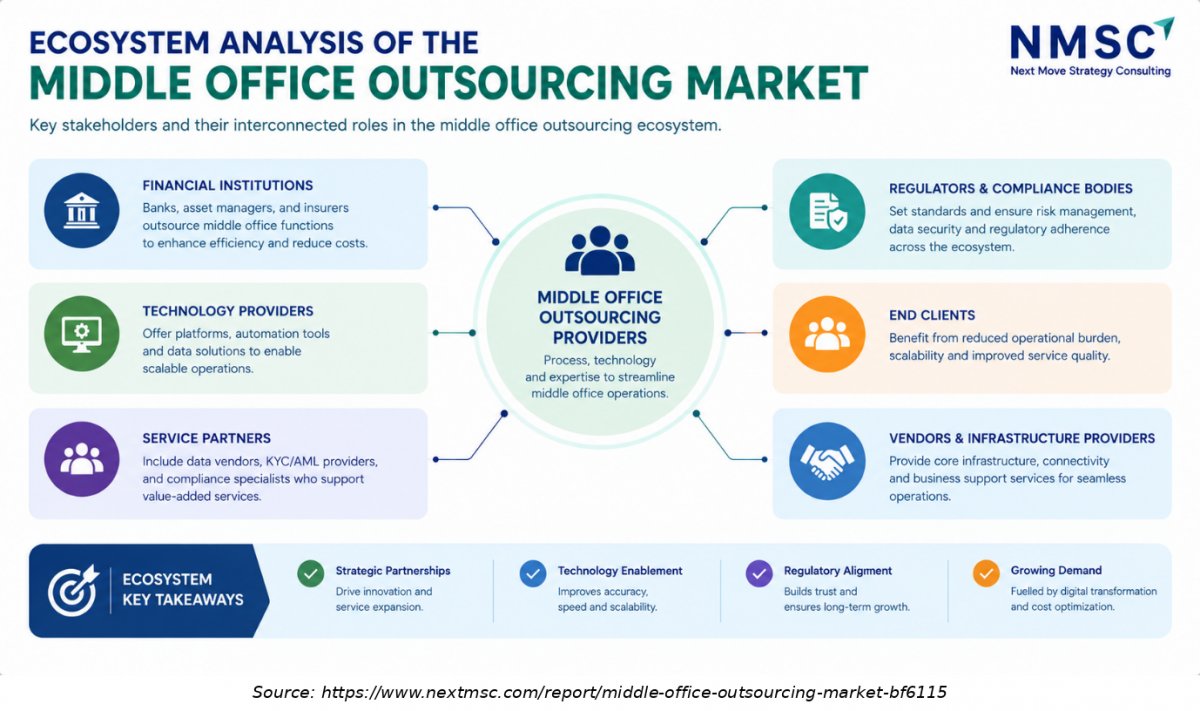
Ecosystem Analysis of the Middle Office Outsourcing Industry

The above infographic presents an ecosystem analysis of the Middle Office Outsourcing Market, mapping its interconnected structure with authoritative clarity. It identifies key stakeholders including financial institutions, technology providers, service partners, regulators, end clients, and infrastructure vendors. The analysis demonstrates that strategic partnerships, technology enablement, and regulatory alignment collectively drive innovation, trust, and long-term market growth.

What Does the Middle Office Outsourcing Market Encompass?

The Middle Office Outsourcing Market covers the delegation of investment operations functions, spanning trade capture and confirmation, position and transaction maintenance, reconciliation and valuation, portfolio performance measurement, risk and compliance operations, and cash and collateral management, from institutional financial firms to specialist third-party service providers. The market serves asset managers, asset owners, insurance companies, banks, non-bank broker-dealers, wealth managers, family offices, market infrastructure firms, and other institutional financial firms across all major asset classes. We observed that the market has evolved from selective function outsourcing toward comprehensive digital transformation of the entire investment operations value chain.

Regulatory drivers, including EMIR and SFTR in Europe, SEC Rule 15c3-3 and Dodd-Frank in the U.S., and MAS regulations in Asia-Pacific, have materially increased operational complexity and compliance reporting obligations for institutional investors, accelerating outsourcing adoption. Our analysis shows that technology adoption across the middle office outsourcing value chain is progressing along three converging pathways: API-driven real-time data integration with execution venues, cloud-native service delivery replacing legacy on-premises infrastructure, and AI-assisted automation of exception management and reconciliation workflows that previously required large manual processing teams.

Market Parameters

Parameter Details
Market Size in 2025 USD 9.44 Billion
Market Size in 2026 USD 11.27 Billion
Revenue Forecast in 2035 USD 28.81 Billion
Growth Rate CAGR of 10.6% from 2026 to 2035
Analysis Period 2025–2035
Base Year Considered 2025
Forecast Period 2026–2035
Market Size Estimation USD Billion
Companies Profiled 20
Countries Covered 38
Market Share Available for Top 10 Companies
Source: www.nextmsc.com

Market Drivers & Dynamics

Interactive Dataset
Escalating regulatory complexity and post-trade reporting obligations driver +2.8% Global 2026–2035
Cost-containment and technology investment constraints at institutional investors driver +2.3% North America, Europe 2026–2033
Expansion of private capital, digital assets, and multi-asset portfolios driver +1.9% Global 2026–2035
AI, RPA, and cloud-native platform modernization among service providers driver +1.4% North America, Asia-Pacific 2026–2032
Growth of mid-tier asset managers and family offices outsourcing operations driver +1.1% Global 2027–2035
T+1 settlement cycle adoption increasing straight-through processing urgency driver +0.8% North America, Europe 2026–2030
Operational and reputational risk of data security breaches at providers restraint −1.3% Global 2026–2035
Vendor concentration risk and limited provider diversification at scale restraint −0.7% Global 2026–2032
High transition and integration costs constraining in-sourcing to outsourcing migration restraint −0.5% Europe, Asia-Pacific 2026–2030
Source: Next Move Strategy Consulting

Growth Drivers

What Is the Primary Growth Driver in the Middle Office Outsourcing Market?

The primary growth driver is escalating regulatory complexity and post-trade reporting obligations placed on institutional financial firms globally. The SEC's adoption of T+1 settlement in 2024 for U.S. equity markets compressed trade operations processing windows, directly accelerating demand for automated outsourced middle office capabilities that cannot be replicated cost-effectively through in-house teams. Concurrently, ESMA's SFTR and EMIR Refit reporting requirements in Europe have increased the volume and granularity of position and transaction data that institutions must reconcile and report daily, creating structural demand for specialist risk management and reconciliation outsourcing services with built-in regulatory reporting capability.

How Is the Growth of Private Capital and Digital Assets Driving Middle Office Outsourcing Market Growth?

Our analysis shows that institutional allocation to private capital strategies, including private equity, infrastructure debt, private credit, and private real estate, has expanded AUM significantly, with global private market AUM growing at high single-digit rates annually based on industry-derived estimates from fund manager disclosures and ILPA reporting frameworks. Each additional private capital mandate requires specialist loan administration, illiquid asset valuation, complex waterfall processing, and NAV reporting capabilities that most in-house operations teams lack. This gap in specialist capability makes private capital a structural driver for full middle office outsourcing mandates, particularly among newer asset managers entering private markets for the first time.

Growth Inhibitors

What Is Restraining the Middle Office Outsourcing Market?

Operational and reputational risk of data security breaches at third-party service providers remains the primary restraint, with an estimated −1.3% impact on CAGR as institutional clients weigh the cybersecurity implications of centralizing sensitive position, transaction, and client data within outsourced operating environments. High-profile data incidents at financial services technology providers have increased due diligence requirements and contractual data protection standards, extending sales cycles and raising provider compliance costs. Digital risk management frameworks and third-party oversight expectations from regulators, including the FCA and SEC, further add to provider compliance overhead, creating barriers to entry for smaller outsourcing specialists.

What Are the Growth Opportunities?

Can Private Capital and Digital Asset Servicing Unlock Premium Mandate Value?

Providers building specialist processing capability for private equity waterfall calculations, private credit loan administration, infrastructure NAV production, and digital asset position reconciliation can access a structurally underserved segment of institutional clients migrating into alternative strategies for the first time. These mandates command premium per-account pricing relative to traditional equity or fixed income servicing, directly benefiting specialist providers in the Full Middle Office Outsourcing and Private Capital asset class segments.

Does ESG and Sustainable Investment Reporting Create New Outsourcing Demand?

ESG data collection, portfolio carbon footprint reporting, and sustainability-related disclosures are increasing data and reporting requirements for some institutional investors, including obligations under the EU Sustainable Finance Disclosure Regulation and emerging ISSB-aligned reporting frameworks. Providers offering integrated investment-data and sustainability-reporting modules within existing middle office platforms can capture demand from asset managers, insurers, and asset owners seeking to streamline data collection and reporting processes.

Can Mid-Market Asset Manager Growth Drive Full Outsourcing Mandate Volume?

The global proliferation of boutique and mid-sized asset managers, particularly in Asia-Pacific and the Middle East, launching with insufficient operational scale to justify in-house middle office investment is creating a structural pipeline of first-time full outsourcing mandates. Providers offering standardized, rapid-onboarding full middle office platforms priced at accessible per-account rates can capture this segment before it invests in in-house systems, directly benefiting the Full Middle Office Outsourcing engagement scope segment and the Asset Manager end-user category.

Segmentation Analysis

2025 (USD Billion)
2035 (USD Billion)
Trade Operations 2025: $3.50 Billion | 2035: $9.60 Billion
Trade Operat
Investment Data Operations 2025: $1.90 Billion | 2035: $5.50 Billion
Investment D
Reconciliation and Valuation 2025: $1.60 Billion | 2035: $4.90 Billion
Reconciliati
Portfolio Performance and Reporting 2025: $1.22 Billion | 2035: $4.20 Billion
Portfolio Pe
Risk and Compliance Operations 2025: $0.72 Billion | 2035: $2.81 Billion
Risk and Com
Cash and Collateral Operations 2025: $0.50 Billion | 2035: $1.80 Billion
Cash and Col
Trade Operations $3.50 Billion $9.60 Billion 11.2%
Investment Data Operations $1.90 Billion $5.50 Billion 11.5%
Reconciliation and Valuation $1.60 Billion $4.90 Billion 12.1%
Portfolio Performance and Reporting $1.22 Billion $4.20 Billion 13.6%
Risk and Compliance Operations $0.72 Billion $2.81 Billion 15.8%
Cash and Collateral Operations $0.50 Billion $1.80 Billion 14.4%

Which Service Offering Segment Leads the Middle Office Outsourcing Market?

Trade Operations is the dominant service offering at USD 3.50 Billion in 2025, approximately 37.1% of total market revenue, reflecting the high transaction volume and processing complexity that outsourced trade capture, matching, confirmation, and settlement monitoring functions absorb for institutional clients across equities, fixed income, and derivatives. Risk and Compliance Operations is the fastest-growing segment at 15.8% CAGR, driven by escalating prudential and conduct regulation that makes internal compliance operations increasingly expensive. We found that AI data management capabilities within Investment Data Operations are accelerating outsourcing adoption as providers automate pricing data management, position maintenance, and data validation workflows.

2025 (USD Billion)
2035 (USD Billion)
Component Ou
Single-Funct
Multi-Functi
Full Middle
Segment Item 2025 (USD Billion) 2035 (USD Billion) CAGR
Component Outsourcing $10.0 USD Billion $40.0 USD Billion 23.0%
Single-Function Outsourcing $17.1 USD Billion $51.1 USD Billion 13.0%
Multi-Function Outsourcing $24.2 USD Billion $62.2 USD Billion 23.0%
Full Middle Office Outsourcing $31.3 USD Billion $73.3 USD Billion 13.0%

Segment-wise data is locked

Unlock complete segment-wise numbers for By Engagement Scope.

Unlock Full Data
2025 (USD Billion)
2035 (USD Billion)
Equities
Fixed Income
Money Market
Foreign Exch
Listed Deriv
Segment Item 2025 (USD Billion) 2035 (USD Billion) CAGR
Equities $10.0 USD Billion $40.0 USD Billion 13.0%
Fixed Income Securities $17.1 USD Billion $51.1 USD Billion 15.0%
Money Markets $24.2 USD Billion $62.2 USD Billion 21.0%
Foreign Exchange $31.3 USD Billion $73.3 USD Billion 11.0%
Listed Derivatives $38.4 USD Billion $84.4 USD Billion 12.0%

Segment-wise data is locked

Unlock complete segment-wise numbers for By Asset Class.

Unlock Full Data
2025 (USD Billion)
2035 (USD Billion)
Asset Manage
Asset Owners
Insurance Co
Banks
Non-Bank Bro
Segment Item 2025 (USD Billion) 2035 (USD Billion) CAGR
Asset Managers $10.0 USD Billion $40.0 USD Billion 26.0%
Asset Owners $17.1 USD Billion $51.1 USD Billion 16.0%
Insurance Companies $24.2 USD Billion $62.2 USD Billion 18.0%
Banks $31.3 USD Billion $73.3 USD Billion 8.0%
Non-Bank Broker-Dealers $38.4 USD Billion $84.4 USD Billion 23.0%

Segment-wise data is locked

Unlock complete segment-wise numbers for End User.

Unlock Full Data

Growth Opportunities

Three high-priority whitespace opportunities represent the most compelling forward-looking growth pathways within the Middle Office Outsourcing Market through 2035.

Can Private Capital and Digital Asset Servicing Unlock Premium Mandate Value?

Providers building specialist processing capability for private equity waterfall calculations, private credit loan administration, infrastructure NAV production, and digital asset position reconciliation can access a structurally underserved segment of institutional clients migrating into alternative strategies for the first time. These mandates command premium per-account pricing relative to traditional equity or fixed income servicing, directly benefiting specialist providers in the Full Middle Office Outsourcing and Private Capital asset class segments.

Does ESG and Sustainable Investment Reporting Create New Outsourcing Demand?

ESG data collection, portfolio carbon footprint reporting, and sustainability-related disclosures are increasing data and reporting requirements for some institutional investors, including obligations under the EU Sustainable Finance Disclosure Regulation and emerging ISSB-aligned reporting frameworks. Providers offering integrated investment-data and sustainability-reporting modules within existing middle office platforms can capture demand from asset managers, insurers, and asset owners seeking to streamline data collection and reporting processes.

Can Mid-Market Asset Manager Growth Drive Full Outsourcing Mandate Volume?

The global proliferation of boutique and mid-sized asset managers, particularly in Asia-Pacific and the Middle East, launching with insufficient operational scale to justify in-house middle office investment is creating a structural pipeline of first-time full outsourcing mandates. Providers offering standardized, rapid-onboarding full middle office platforms priced at accessible per-account rates can capture this segment before it invests in in-house systems, directly benefiting the Full Middle Office Outsourcing engagement scope segment and the Asset Manager end-user category.

Regional Outlook

2025 (USD Billion)
2035 (USD Billion)
North Americ
Europe
Asia-Pacific
Latin Americ
Middle East
Region 2025 (USD Billion) 2035 (USD Billion) CAGR (%)
North America $10.0 USD Billion $40.0 USD Billion 9.0%
Europe $17.1 USD Billion $51.1 USD Billion 27.0%
Asia-Pacific $24.2 USD Billion $62.2 USD Billion 25.0%
Latin America $31.3 USD Billion $73.3 USD Billion 23.0%
Middle East & Africa $38.4 USD Billion $84.4 USD Billion 12.0%

Regional data is locked

Unlock complete regional numbers for this market.

Unlock Full Data

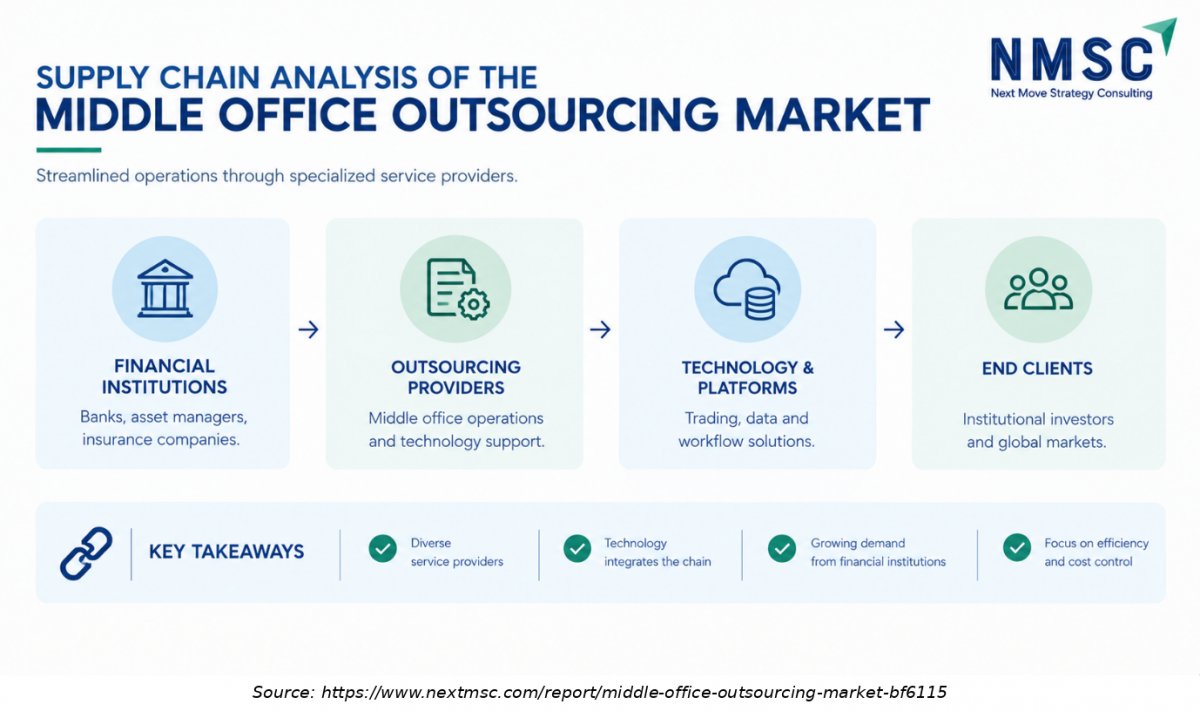
Supply Chain Analysis of the Middle Office Outsourcing Industry

Supply Chain Analysis of the Middle Office Outsourcing Industry
The above infographic presents a supply chain analysis of the Middle Office Outsourcing Market, detailing its structure with authoritative clarity. It traces four key stages from financial institutions and outsourcing providers to technology platforms and end clients. Key takeaways emphasize that diverse service providers, integrated technology, and growing demand from financial institutions collectively drive operational efficiency and cost control.

Competitive Landscape

Our assessment indicates that the competitive landscape is moderately concentrated at the top tier, with global custodian banks commanding the largest integrated mandate share, while specialist technology-led providers and IT-services firms compete on cost efficiency, platform scalability, and specific asset class expertise.

How Do Companies Compete in the Middle Office Outsourcing Market?

Competition operates across three dimensions: depth of integrated service coverage spanning trade operations through performance reporting and risk compliance, strength of proprietary technology platforms enabling automation and real-time data access for institutional clients, and commercial pricing flexibility across both asset-based fee structures and fixed operational cost arrangements. During our market evaluation, we noticed that providers with integrated custody and middle office platforms, notably BNY Mellon, State Street, and JPMorgan, generate structural competitive advantages through data continuity across the investment operations value chain that point-solution providers cannot replicate.

Which Competitive Archetypes Dominate the Middle Office Outsourcing Industry?

Three distinct archetypes shape the competitive field. Global custodian banks, including BNY Mellon, State Street, Citigroup, JPMorgan, and Northern Trust, dominate full middle office mandates through integrated securities servicing suites. Technology-led specialists such as SS&C Technologies, SEI Investments, and Linedata Services compete on platform flexibility and multi-asset processing capability across component and full outsourcing mandates. IT-services firms including TCS, Capgemini, Cognizant, Wipro, and Genpact compete on cost efficiency and scalable delivery for institutions seeking technology-enabled operational transformation at lower per-unit cost structures.

What Innovation and Differentiation Strategies Shape the Competitive Dynamic?

We found that AI-driven automation of exception management and settlement fail resolution is emerging as a primary innovation differentiator, with leading providers including SS&C Technologies and State Street embedding intelligent automation across trade matching, cash reconciliation, and data validation workflows. Portfolio Performance and Reporting is a second innovation frontier, where real-time attribution and customizable client reporting platforms, supported by generative AI for natural-language report generation, are enabling providers to differentiate on institutional client experience beyond pure operational accuracy metrics.

What M&A Activity Has Characterized the Middle Office Outsourcing Market?

M&A in the Middle Office Outsourcing Market has been driven by strategic acquisitions of alternatives servicing platforms, data management technology firms, and front-to-back technology providers that extend the coverage of existing service offerings. SS&C Technologies' history of platform acquisitions, BNY Mellon's strategic technology investments, and Royal Bank of Canada's expansion of its investor services business illustrate the dominant acquisition themes: broadening asset class servicing coverage, building proprietary technology moats, and expanding geographic delivery capacity across Asia-Pacific and the Middle East.
Key Market Players

Based on research conducted by NMSC, we found that the following 20 companies represent the leading participants across global custodian banking, specialist technology platforms, fund administration, and IT-services-led delivery in the Middle Office Outsourcing Market.

The Bank of New York Mellon Corporation Citigroup Inc. State Street Corporation JPMorgan Chase & Co. Northern Trust Corporation BNP Paribas S.A. SS&C Technologies Holdings, Inc. Société Générale S.A. CACEIS S.A. SEI Investments Company Royal Bank of Canada Apex Group Ltd. Accenture plc Tata Consultancy Services Limited Capgemini SE Cognizant Technology Solutions Corporation Wipro Limited Genpact Limited The Citco Group Limited Linedata Services S.A.

Latest Developments

We observed that 2025–2026 has seen sustained product development, platform expansion, and strategic partnership activity among leading Middle Office Outsourcing Market participants, with AI automation integration and private capital servicing capability as the primary development themes.

Date Event
August 2026 Citi Investor Services won a USD 380 billion full middle-office mandate from Aegon Asset Management. The expanded scope includes full Investment Book of Record services, trade management, settlement, and performance measurement through Aladdin Accounting.
March 2026 Apex Group joined BlackRock’s Aladdin Provider Network and introduced an outsourced operating model for private credit managers. The solution integrates Apex’s middle-office operations, loan servicing, and fund administration with Aladdin, enabling managers to retain their technology environment while outsourcing operational workflows.
January 2026 Jupiter Fund Management entered a multi-year agreement with BNY that includes outsourcing its middle-office operations and consolidating offshore back-office services.

Expert Insights

Ryan Burns

Ryan Burns

Head of Global Fund Services, Americas | Northern Trust

"“The complexity of the middle office is increasing, and asset managers need advanced expertise and technology to expand their operations.”"

Analyst Interpretation

The statement highlights the rising complexity of investment operations as a key factor supporting demand for middle office outsourcing services. Asset managers managing diverse investment strategies and asset classes increasingly require specialized operational expertise, scalable technology, data management, risk and performance analytics, reconciliation, and transaction-management capabilities. Outsourcing these functions enables investment firms to access such capabilities without building and maintaining the full operational infrastructure internally, supporting the expansion of scalable and technology-enabled middle office operating models.

Market Interpretation

The statement highlights the rising complexity of investment operations as a key factor supporting demand for middle office outsourcing services. Asset managers managing diverse investment strategies and asset classes increasingly require specialized operational expertise, scalable technology, data management, risk and performance analytics, reconciliation, and transaction-management capabilities. Outsourcing these functions enables investment firms to access such capabilities without building and maintaining the full operational infrastructure internally, supporting the expansion of scalable and technology-enabled middle office operating models.

Investment Opportunities

Where Are the Highest-Return Capital Inflows Concentrated in Middle Office Outsourcing?

Capital inflows are concentrating in three areas: proprietary technology platform development for private capital and digital asset servicing, cloud-native middle office infrastructure modernization at global custodian banks, and build-out of Asia-Pacific and Middle East delivery capability among global providers. Private equity investment in specialist alternatives administration and fund technology platforms has been sustained and active through 2024–2025, reflecting investor conviction in the structural AUM migration toward alternative assets that creates recurring, high-margin middle office outsourcing demand at scale.

What Infrastructure Investment Is Required to Scale Middle Office Outsourcing Delivery?

Scaling the Middle Office Outsourcing Market requires investment across four infrastructure layers: cloud-native, API-connected processing platforms capable of handling real-time trade data from global execution venues; operational delivery centers in cost-efficient jurisdictions with deep financial services talent pools; cybersecurity and operational resilience infrastructure meeting FCA, SEC, and ECB third-party oversight standards; and AI data management platforms that automate data validation, reconciliation exception resolution, and regulatory report production at institutional data volume and accuracy standards.

How Are ESG Considerations Influencing Investment Decisions in Middle Office Outsourcing?

Our findings suggest that ESG factors are beginning to shape institutional client vendor selection in middle office outsourcing, as asset managers and asset owners subject to SFDR and SEC ESG disclosure requirements scrutinize whether outsourcing providers themselves operate to high environmental and governance standards. Providers demonstrating strong data stewardship, transparent operational governance, and supply chain responsibility frameworks are better positioned to win institutional mandates from investors with formal vendor ESG due diligence processes, while the ability to support clients' own ESG reporting obligations through integrated sustainability data modules is becoming a commercial differentiator in provider selection.

Key Benefits for Stakeholders

How Does This Report Benefit Institutional Financial Firms and Operations Leaders?

Institutional financial firms and chief operating officers gain precise market sizing across all service offerings, engagement scope, asset class, and end-user segmentation axes, enabling evidence-based outsourcing strategy decisions and vendor selection mandates. The report's Growth Catalyst & Risk Assessment Matrix and restraint analysis support make-versus-buy assessments across trade operations, reconciliation, performance reporting, and risk compliance functions, while country-level sizing and CAGR data inform geographic expansion sequencing for firms building or rationalizing multi-jurisdictional outsourced operating models.

What Value Do Investors and Financial Analysts Derive from This Analysis?

Investors and financial analysts access the report's USD 17.54 Billion absolute market opportunity quantification, segment-level CAGR data across six segmentation axes, and competitive archetype analysis distinguishing global custodian banks, specialist technology platforms, and IT-services delivery models by revenue profile and growth trajectory. The 2026–2035 forecast horizon, driven by regulatory complexity, alternatives AUM growth, and RaaS-equivalent commercial model expansion, provides the fundamental analytical basis for portfolio construction, target screening, and due diligence processes in financial technology and financial services outsourcing investment.

How Do Technology Vendors and Product Teams Benefit from This Market Report?

Technology vendors and product teams use the report's segmentation analysis — covering By Service Offering, By Engagement Scope, By Asset Class, and By End User — to identify whitespace opportunities in underserved segments such as digital asset servicing, private capital processing, and family office operations outsourcing. The competitive landscape analysis, innovation focus mapping, and M&A activity review provide product roadmap context for positioning AI automation, cloud-native delivery, and private capital servicing capabilities against the incumbent vendor set across North American, European, and Asia-Pacific institutional client markets through 2035.

Key Market Segments Evaluated

By Service Offering

  • Trade Operations
  • Trade Capture
  • Trade Enrichment
  • Trade Matching
  • Trade Affirmation
  • Trade Confirmation
  • Block Trade Allocation
  • Account-Level Trade Allocation
  • Settlement Monitoring
  • Settlement Exception and Fail Management
  • Commission Processing
  • Fee Processing
  • Market Charge Processing
  • Investment Data Operations
  • Position Maintenance
  • Transaction Maintenance
  • Pricing Data Management
  • Data Validation
  • Data Remediation
  • Reconciliation and Valuation
  • Cash Reconciliation
  • Position Reconciliation
  • Transaction Reconciliation
  • Valuation and Price Control
  • P&L Control
  • Portfolio Performance and Reporting
  • Portfolio Analytics
  • Performance Measurement
  • Reporting
  • Internal Reporting
  • Client Reporting
  • Risk and Compliance Operations
  • Cash and Collateral Operations

By Engagement Scope

  • Single-Function Outsourcing
  • Multi-Function Outsourcing

By Asset Class

  • Bank Loans
  • Private Credit
  • Private Capital
  • Private Equity
  • Private Real Estate
  • Infrastructure
  • Other Private Assets
  • Digital Assets
  • Structured Products
  • Multi-Asset

By Region

  • North America 
    • U.S.
    • Canada
    • Mexico
  • Europe 
    • UK
    • Germany
    • France
    • Italy
    • Spain
    • Sweden
    • Denmark
    • Finland
    • Netherlands
    • Rest of Europe
  • Asia-Pacific 
    • China
    • India
    • Japan
    • South Korea
    • Taiwan
    • Indonesia
    • Vietnam
    • Australia
    • Philippines
    • Malaysia
    • Rest of APAC
  • Middle East & Africa 
    • Saudi Arabia
    • UAE
    • Egypt
    • Israel
    • Turkey
    • Nigeria
    • South Africa
    • Rest of MEA
  • Latin America 
    • Brazil
    • Argentina
    • Chile
    • Colombia
    • Rest of LATAM

Conclusion & Recommendations

What Is the Long-Term Outlook for the Middle Office Outsourcing Market?

The long-term outlook for the Middle Office Outsourcing Market is structurally positive, expanding from USD 11.27 Billion in 2026 to USD 28.81 Billion by 2035 at a 10.6% CAGR. We observed that this growth reflects durable, regulatory-driven, and complexity-driven demand rather than discretionary technology spending cycles, positioning the market as a resilient allocation within the broader financial services technology investment landscape. Sustained private capital AUM growth, T+1 settlement adoption, and ESG reporting mandates will reinforce demand across all service offering segments through the forecast horizon.

What Strategic Positioning Do We Recommend?

Our assessment indicates that providers should prioritize three strategic actions: building integrated private capital and digital asset servicing capability to capture the fastest-growing mandate categories, developing cloud-native platform architectures that enable rapid client onboarding and operating cost scalability, and investing in AI-driven automation across exception management and reconciliation workflows to structurally lower per-account processing costs and protect margins against pricing pressure in commoditizing trade operations segments.

How Attractive Is the Middle Office Outsourcing Market for Investment?
Investment attractiveness is highest in Asia-Pacific at 15.0% CAGR and the Middle East & Africa at 17.6% CAGR, while North America provides the largest absolute revenue base at USD 13.28 Billion by 2035. NMSC's analysis indicates that full middle office outsourcing mandates and private capital servicing platforms offer superior revenue quality, through AUM-linked recurring fee structures, relative to transactional component outsourcing contracts, making integrated mandate providers and alternatives-specialist platforms the highest-quality investment targets within the market.

What Are the Key Market Shifts and Risks?

Key risks include data security breach exposure at concentrated third-party providers, the primary restraint at an estimated −1.3% CAGR impact, and vendor concentration risk as leading custodian banks collectively serve a large proportion of institutional AUM, creating systemic operational interdependency. Our analysis shows that regulatory-driven increases in third-party oversight obligations under frameworks including DORA in Europe and OCC guidance in the U.S. will require providers to invest heavily in compliance infrastructure, potentially compressing margins and raising barriers to entry for smaller specialists.

What Are the Primary Growth Pathways Through 2035?

Primary growth pathways include full middle office outsourcing mandate capture among mid-sized asset managers entering private capital and digital asset strategies; ESG and sustainability reporting outsourcing as a high-growth adjacent service line; and Asia-Pacific market entry and expansion as regional institutional AUM growth accelerates outsourcing acceptance. We found that companies combining integrated technology platforms, specialist asset class expertise, and regulatory compliance infrastructure across multiple jurisdictions are best positioned to capture a disproportionate share of the USD 17.54 Billion absolute investment opportunity in the Middle Office Outsourcing Market between 2026 and 2035.

FAQs

About the Author

Mayurima Roy

Mayurima Roy

Mayurima Roy is Research Analyst at Next Move Strategy Consulting, where she has spent 4 years working across the firm's full industry coverage rather than a single fixed vertical. Her work centers on structured research, ongoing trend tracking, competitive assessment, and insight-led content development, translating complex market data into clear, decision-ready narratives that support informed client decision-making across diverse global industries, market sectors, and world regions every day.

About the Reviewer

Supradip Baul

Supradip Baul

Supradip Baul is an accomplished business consultant and strategist with over a decade of rich experience in market intelligence, strategy, technology, and business transformation. His work has included rigorous qualitative and quantitative analysis across multiple industries, helping clients shape investment decisions and long-term roadmaps. Earlier in his career, he was associated with Gartner, where he contributed to industry-leading reports and market share analyses. He has worked with leading global companies and holds an MBA with a dual specialization in Marketing and Finance.

Download Free Sample

Henri Knyphausen

HENRI KNYPHAUSEN

Partner at Singulier [Ex-BCG]

Singulier

I recently engaged NEXTMSC.com for a commercial due diligence project within the intralogistics sector, and I am pleased to provide a reference based on my experience. In utilizing NEXTMSC.com's services, I found their report to offer valuable insights into market dynamics and key industry players. The initial report provided a solid foundation for our analysis. However, as we were investigating a smaller target in the market, and I had specific customization requests requiring additional research. These requests included detailed information on product portfolios of various players and sub-market sizes, both inclusive and exclusive of certain product categories. NEXTMSC.com demonstrated commendable responsiveness and agility in accommodating these customization requests. Within a timeframe of 1-2 weeks, they delivered a revised report that met our specific needs. Furthermore, they were receptive to my follow-up inquiries, ensuring clarity and understanding of the data provided. The final deliverable significantly contributed to our due diligence efforts. One of NEXTMSC.com's notable strengths lies in their qualitative research capabilities. However, for future engagements, I would recommend the inclusion of a quantified market model in Excel format. Such a model would offer the ability to conduct in-depth analyses and explore various market segments, including country-specific data and subcomponent breakdowns. Based on my positive experience, I would not hesitate to work with NEXTMSC.com again. Their responsiveness, willingness to accommodate customization requests, and commitment to delivering actionable insights make them a reliable partner for commercial research projects.

Gaurav Jaiswal

GAURAV JAISWAL

Founder & CEO

Yano Charge Private Limited

The EV Charging market research report provided by the NextMSC was exceptionally detailed and insightful. It offered a comprehensive analysis that proved to be a game-changer for our strategic planning. Truly a testament to the NextMSC’s expertise and thoroughness in EV market landscape & analysis.

Gustaf Hummel Burstrom

GUSTAF HUMMEL BURSTROM

Founder

Revline Tools AB

Joseph and the team at Next Move Strategy Consulting have been excellent to work with, in supplying us with relevant market data and forecasts for our specific category. We had some special requirements and they were able to do a custom package to suit our needs. We would definitely recommend them to any other company needing market data and forecasts

Diana Trejo

DIANA TREJO

Assistant Manager

Sumitomo Corporation de Mexico, S.A. de C.V.

Recently, we purchased a report on the Mexico Data Center Market from Next Move Strategy Consulting. The service has been excellent, with support that is always timely and thoroughly professional. The information provided is interesting, highly useful, and delivered with clarity. I would highly recommend NextMSC for anyone seeking insightful and dependable analysis.

Mohit Agarwal

MOHIT AGARWAL

Chief Manager

DryChem India Pvt. Ltd.

Next Move Strategy Consulting is an amazing team of consultants. We required a market study report for our investors on top priority and the team went above and beyond our expectations to deliver the same with ample supporting data within a short time span enabling us to secure the investments and keep our project timeline maintained. Their professionalism, attention to detail, and timely delivery of actionable recommendations have left a lasting impression on our organization.

Custom Market Research Services

We will customize the research for you if the listed report does not fully match your requirements.

Get 30% Free Customization

Select License

This website uses cookies to ensure you get the best experience on our website. Learn more

✖