Middle East and Africa Travel Insurance Market By Age Group (Generation X, Millennials, & Others), By Income Level (Low, Middle, & High-Income), By Coverage Type (Medical & Health, Trip Protection Coverage, & Others), By Distributional Channel (Insurance Companies, Banks, & Others), By Underwriting (Standard Underwriting, Simplified Issue, & Others), By End-User (Leisure & Holiday, Pilgrimage & Religious Travelers, & Others) – Analysis & Forecast, 2026–2035
Industry: BFSI | Latest Edition: September 18, 2026 | No of Pages: 518 | No. of Tables: 250 | No. of Figures: 236 | Format: PDF | Report Code: BF4772
Middle East and Africa Travel Insurance Market Size & Forecast
|
Parameters |
Details |
|
Market Size in 2026 |
USD 1.62 Billion |
|
Revenue Forecast in 2035 |
USD 5.90 Billion |
|
Growth Rate |
CAGR of 15.5% from 2026 to 2035 |
|
Analysis Period |
2025–2035 |
|
Base Year Considered |
2025 |
|
Forecast Period |
2026–2035 |
|
Market Size Estimation |
Billion (USD) |
|
Countries Covered |
7 |
|
Companies Profiled |
15 |
|
Market Share |
Available for 10 companies |
Industry Outlook
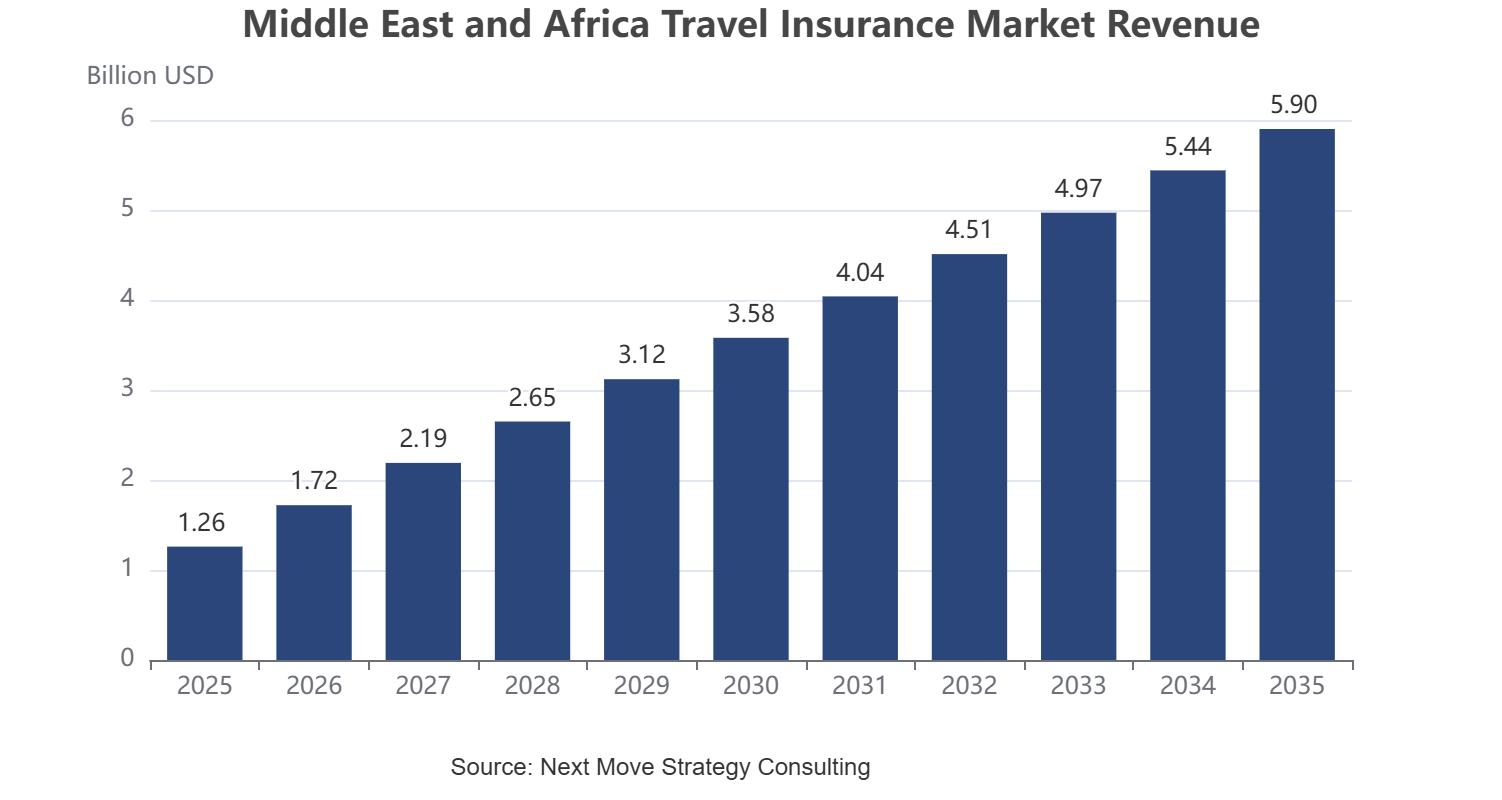
The Middle East and Africa Travel Insurance Market size was valued at USD 1.26 billion in 2025 and is expected to reach USD 1.62 billion by 2026. Looking ahead, the industry is projected to expand significantly, reaching USD 5.90 billion by 2035, registering a CAGR of 15.5% from 2026 to 2035.
What are the Key Market Drivers, Breakthroughs, and Investment Opportunities that will Shape the Middle East and Africa Travel Insurance Market in the Next Decade?
Growth Catalyst & Risk Assessment Matrix
|
DRIVERS / TRENDS / RESTRAINTS |
(+/-) % IMPACT ON CAGR FORECAST |
GEOGRAPHIC RELEVANCE |
IMPACT TIMELINE |
|
Rapid expansion of outbound leisure travel driven by enhanced air connectivity through Gulf aviation hubs |
+1.28% |
GCC countries including UAE, Saudi Arabia, and Qatar with outbound global travel corridors |
Short to medium term (1–3 years) |
|
Increasing visa-linked travel insurance requirements mandating coverage for international travel approvals |
+1.14% |
GCC outbound travelers and African travelers to Europe and North America |
Short to medium term (1–3 years) |
|
Growing regional and international air connectivity improving accessibility for leisure and business travel |
+1.07% |
Middle-East aviation hubs and key African airline networks |
Short to medium term (1–3 years) |
|
Low insurance penetration and limited financial inclusion across several African economies constraining voluntary adoption |
-0.81% |
Sub-Saharan Africa and underdeveloped insurance markets across MEA |
Medium term (2–4 years) |
|
Expansion of Sharia-compliant (Takaful) travel insurance supporting culturally aligned product adoption |
+0.92% |
Saudi Arabia, UAE, Malaysia-linked MEA insurance corridors, and Muslim-majority African nations |
Medium to long term (2–5 years) |
From our market analysis, we noticed that the Middle East and Africa travel insurance market is primarily driven by the rapid expansion of outbound leisure travel, supported by rising air connectivity through major Gulf aviation hubs, which is significantly enhancing international mobility across the region. This demand is further reinforced by increasing visa-linked insurance requirements for travel to Europe and North America, making travel insurance a necessary compliance component for cross-border movement. However, low insurance penetration across several African economies continues to restrict voluntary adoption and limit broader market depth. At the same time, we observed growing development of Sharia-compliant travel insurance products across Muslim-majority markets, expanding culturally aligned coverage options. Collectively, these dynamics are shaping a gradually evolving market with strong untapped growth potential.
Growth Drivers:
How is Rapid Expansion of Outbound Leisure Travel Through Gulf Aviation Hubs Driving the Market?
The rapid expansion of outbound leisure travel, enabled by strengthening air connectivity through Gulf aviation hubs, is a major structural driver of travel insurance demand in the Middle East and Africa travel insurance market region. The development of world-class transit networks and enhanced flight connectivity has significantly improved accessibility to long-haul international destinations. Based on our assessment, we observed that this increased mobility is encouraging more frequent leisure travel, particularly among middle- and high-income populations seeking global tourism experiences. As travel frequency rises, so does the need for comprehensive insurance coverage that protects against medical emergencies, trip disruptions, and travel uncertainties. Insurers are responding by offering more flexible, digitally accessible products tailored to high-mobility travelers, thereby supporting sustained market expansion across outbound travel corridors.
How are Visa-Linked Insurance Requirements Strengthening the Middle East and Africa Travel Insurance Market Adoption?
We observed that increasing visa-linked insurance requirements for travel to regions such as Europe and North America are acting as a strong regulatory driver for market adoption in the Middle East & Africa region. These mandatory requirements ensure that travelers obtain travel insurance as a prerequisite for visa approval, thereby creating consistent baseline demand. Such regulatory frameworks not only drive immediate policy uptake but also enhance awareness of travel-related risks among first-time international travelers. Over time, this contributes to behavioural normalisation, where insurance becomes an integral part of travel preparation. Additionally, insurers are leveraging this mandatory entry point to offer enhanced coverage options, improving product penetration and value creation across outbound travel segments.
How is Growing Regional Air Connectivity Supporting Middle East and Africa Travel Insurance Market Insurance Demand?
The expanding regional and international air connectivity is significantly supporting travel insurance demand across the Middle East & Africa. Increasing investments in aviation infrastructure, coupled with the strategic positioning of Gulf carriers as global transit hubs, have made long-distance travel more accessible and affordable. Further, this improved connectivity is encouraging both leisure and business travel, thereby expanding the addressable market for insurance providers. As travelers undertake more complex and multi-leg journeys, demand for comprehensive coverage that includes medical emergencies, flight disruptions, and baggage protection is increasing. This structural improvement in connectivity is therefore reinforcing long-term growth momentum in the travel insurance ecosystem.
Growth Inhibitor:
How Does Low Insurance Penetration in African Economies Limit Market Expansion?
In our observation, low insurance penetration across several African economies continues to be a key structural restraint on Middle East and Africa travel insurance market growth. Limited financial inclusion, low awareness of insurance products, and constrained distribution networks collectively hinder voluntary adoption of travel insurance. Our findings suggest that many travelers in these regions rely heavily on informal risk management practices or opt out of insurance altogether due to affordability concerns and lack of perceived necessity. This results in a market that is largely dependent on mandatory insurance requirements rather than organic demand. As a consequence, insurers face challenges in achieving deep market penetration and must invest in awareness-building, simplified products, and alternative digital distribution models to expand reach.
Growth Opportunity:
How is the Expansion of Takaful Travel Insurance Creating New Market Opportunities?
NMSC's assessment indicates that the growth of Sharia-compliant (Takaful) travel insurance products is creating a significant opportunity across Muslim-majority markets in the Middle East & Africa region. These offerings are aligned with Islamic financial principles, making them culturally and religiously acceptable to a large consumer base. Our analysis shows that increasing demand for ethical and faith-based financial solutions is encouraging insurers to develop dedicated Takaful travel insurance products that offer transparency, risk-sharing structures, and compliance with Sharia guidelines. This segment is particularly relevant in regions with strong outbound travel activity, where travelers seek both international coverage and religious compliance. As a result, Takaful insurance is emerging as a key growth avenue, expanding inclusivity and enhancing overall market penetration.
PESTEL Analysis of the Middle East and Africa Travel Insurance Market
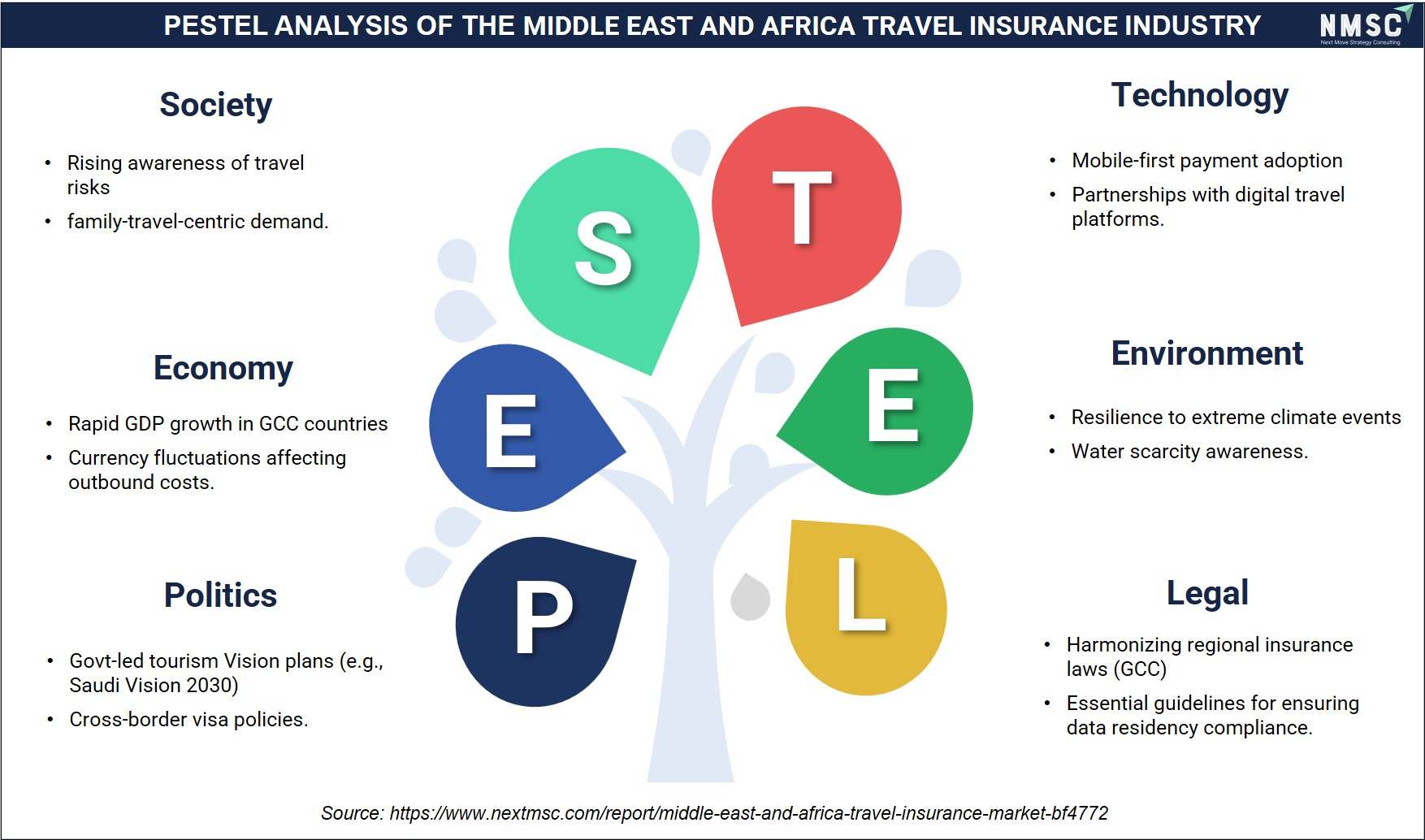
The infographic applies a PESTEL framework to uncover the macro-environmental factors influencing the Middle East and Africa travel insurance market. Politically, varying government stability and visa policies create a complex operating landscape, while economic conditions such as fluctuating oil prices and currency risks affect both insurer costs and consumer spending. Social trends, including rising outbound travel from GCC nations, are reshaping demand. Technological advancements are enabling digital claims and mobile distribution, yet environmental concerns and fragmented legal frameworks across jurisdictions continue to pose distinct challenges for market growth.
Which Country is Dominating the Middle East and Africa Travel Insurance Industry?
South Africa dominates the current Middle East and Africa travel insurance market due to its comparatively advanced financial services sector and higher penetration of formal insurance products. Industry analysis suggests that South African travelers exhibit stronger awareness of travel-related risks, including medical emergencies, trip cancellations, and cross-border disruptions, which drives consistent demand for comprehensive coverage. The country's relatively high outbound travel activity within the African region and to Europe, North America, and Asia further strengthens policy uptake. In addition, a well-established middle class with access to international travel opportunities supports sustained insurance adoption across both leisure and business segments.
Also, South Africa's leadership is reinforced by a mature insurance regulatory framework and strong participation from both domestic and global insurers. Digital distribution channels, including online travel platforms, banking partnerships, and embedded insurance offerings, have significantly improved accessibility and policy penetration. Furthermore, higher healthcare costs abroad compared to domestic levels encourage travelers to secure medical coverage before departure. Compared to other MEA countries, South Africa benefits from stronger financial literacy, better infrastructure, and more developed insurance ecosystems, enabling it to maintain the largest share of the regional travel insurance market in 2025.
Which Country is Set to Witness the Fastest Growth?
Nigeria is set to witness the highest growth in the Middle East and Africa travel insurance market by 2035, driven by its rapidly expanding young population and increasing participation in international travel. Our market analysis suggests that rising urbanisation, improving income levels, and a growing middle class are significantly boosting outbound travel for education, business, and leisure purposes. As more Nigerians travel abroad, awareness of financial risks such as medical emergencies, visa requirements, and trip disruptions is steadily increasing, strengthening the need for structured travel insurance solutions. Additionally, the country's large diaspora network further supports frequent cross-border movement, reinforcing long-term demand growth.
Nigeria's digital financial ecosystem is a key accelerator of travel insurance adoption. The rapid expansion of mobile banking, fintech platforms, and online travel booking services is making insurance products more accessible to first-time buyers. Furthermore, insurers are increasingly offering affordable, micro-duration, and mobile-integrated policies tailored to price-sensitive consumers. Compared to more mature MEA markets like South Africa, Nigeria remains significantly underpenetrated, creating substantial headroom for expansion. This combination of demographic advantage, digital transformation, and untapped insurance potential positions Nigeria as the fastest-growing market in the region by 2035.
How is the Middle East and Africa Travel Insurance Industry segmented in this report, and what are the key insights from the segmentation analysis?
By Policy Delivery Mode Insights
How does Policy Delivery Mode Influence Adoption in the Middle East and Africa Travel Insurance Market?
Based on policy delivery mode, the Middle East and Africa travel insurance market is segmented into online, offline, and hybrid.
Based on our research, we found that in the Middle East and Africa, the travel insurance market is increasingly shaped by the balance between digital accessibility and traditional trust-based interactions. Online channels are gaining strong momentum, driven by rising smartphone penetration and the growing use of digital travel booking platforms, enabling quick policy issuance and real-time customisation. As this digital shift progresses, offline channels continue to play a critical role, particularly in markets with lower digital literacy or stronger reliance on in-person advisory, where agents and brokers facilitate trust and product understanding. Bridging these two, hybrid models are emerging as a key growth enabler, combining digital convenience with human support through assisted platforms and call-based services. NMSC's findings suggest that insurers are strategically investing in hybrid ecosystems to expand reach while maintaining customer confidence across diverse market maturity levels.
By Value Tier Insights
How Are Tiered Insurance Plans Shaping Customer Segmentation in the Middle East and Africa Travel Insurance Market?
Based on value tier, the Middle East and Africa travel insurance market is segmented into basic/economy plans, standard plans, premium plans, and elite/platinum plans.
Our assessment indicates that the Middle East and Africa travel insurance market is increasingly structured around differentiated pricing and coverage depth, reflecting varied affordability levels and risk expectations among travelers. Basic/economy plans serve as the entry point, appealing to price-sensitive travelers by offering essential coverage with limited benefits, aligned with visa requirements or short-duration trips. On the other hand, standard plans strike a balance between affordability and protection, incorporating broader medical and trip-related coverage, making them suitable for a wider customer base. As coverage expectations increase, premium plans cater to travelers seeking higher limits, added flexibility, and enhanced service features such as faster claims processing. At the top end, elite/platinum plans target high-net-worth individuals with comprehensive, global coverage and concierge-level services. Therefore, this tiered structure is enabling insurers to optimize both market penetration and revenue diversification.
Competitive Landscape
The Middle East and Africa travel insurance industry is characterised by a developing yet increasingly competitive structure, supported by the presence of regional insurers, global insurance providers, and Sharia-compliant (Takaful) operators. Our analysis indicates that the market remains relatively fragmented, with growth driven by rising outbound travel from Gulf countries, improving air connectivity, and increasing awareness of travel-related medical and financial risks. Regulatory requirements, including visa-linked insurance mandates for travel to Europe and North America, are further strengthening policy adoption, while digital distribution through airlines, travel agencies, and fintech platforms is gradually enhancing accessibility across the region.
Strategic Developments:
-
September 2025 – Starr appointed Hassan El Kaissi as Regional President for the Middle East, based in Dubai. This leadership change is designed to scale Starr's commercial P&C and travel-related lines across the region.
Key Players of the Middle East and Africa Travel Insurance Market
-
AXA Partners
-
AIG Travel Guard
-
Zurich Insurance Group
-
Tokio Marine HCC
-
Gulf Insurance Group
-
Tawuniya
-
Al Rajhi Takaful
-
Abu Dhabi National Insurance Company
-
Sukoon Insurance
-
Old Mutual
-
Discovery Limited
-
Santam
-
Hollard Group
Overall, competition in the Middle East and Africa travel insurance market is evolving toward product customisation, digital integration, and the expansion of Takaful-based insurance offerings to meet diverse consumer preferences. Key players such as Allianz Partners, AXA Partners, Tawuniya, Al Rajhi Takaful, Abu Dhabi National Insurance Company, Sukoon Insurance, and others are strengthening their market presence through strategic partnerships, embedded insurance models, and improved claims management capabilities. Insurers with strong regional networks, regulatory alignment, and culturally tailored product portfolios are better positioned to capture growing demand. Consequently, innovation in distribution, compliance, and customer-centric offerings will remain central to sustaining competitive advantage across the Middle East and Africa travel insurance market.
SWOT Analysis of the Middle East and Africa Travel Insurance Market
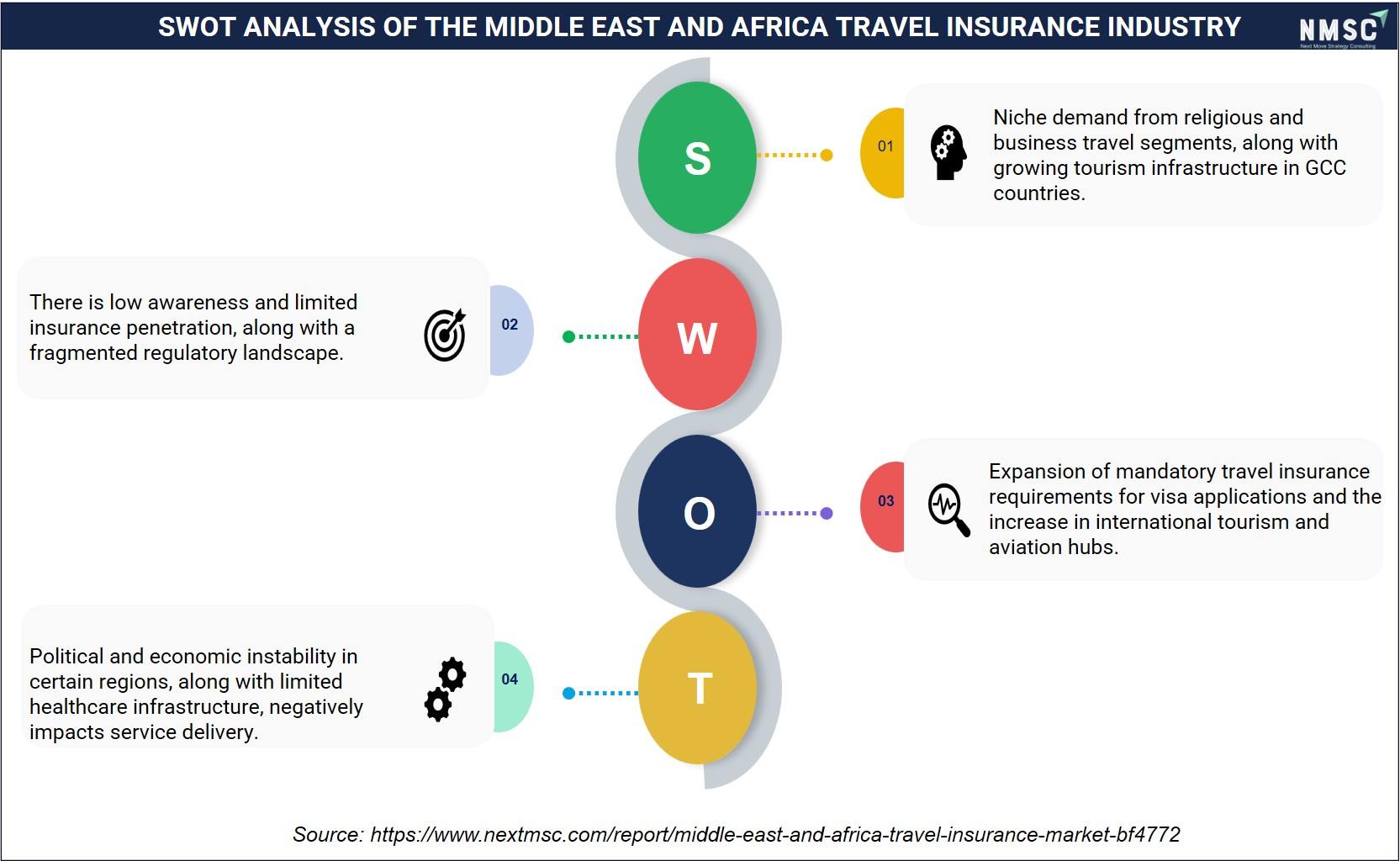
The infographic above provides a concise SWOT analysis of the Middle East and Africa travel insurance market. On the positive side, the market benefits from niche demand linked to religious and business travel, alongside growing tourism infrastructure in GCC countries. However, progress is constrained by low consumer awareness, limited insurance penetration, and inconsistent regulations across the region. Encouragingly, mandatory travel insurance for visas and expanding aviation hubs open new opportunities. Yet, political instability and weak healthcare infrastructure in certain areas remain serious threats to reliable service delivery.
Middle East and Africa Travel Insurance Market Key Segments
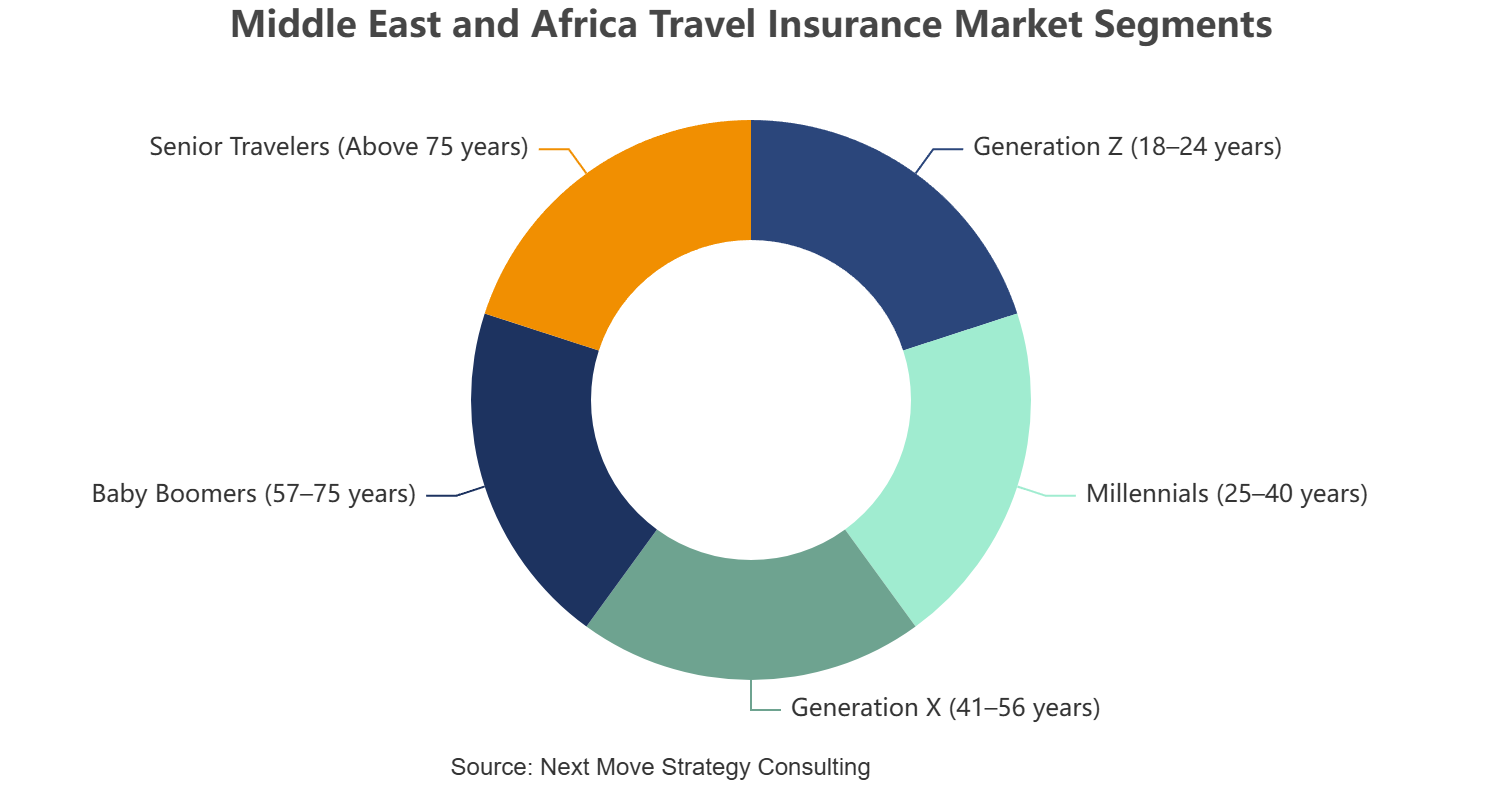
By Age Group
-
Generation Z (18–24 years)
-
Millennials (25–40 years)
-
Generation X (41–56 years)
-
Baby Boomers (57–75 years)
-
Senior Travelers (Above 75 years)
By Income Level
-
Low-Income Travelers
-
Middle-Income Travelers
-
High-Income Travelers
By Traveler Structure
-
Solo Travelers
-
Couple Travelers
-
Family Travelers
-
Group Travelers
By Coverage Type
-
Medical & Health Coverage
-
Emergency Medical Treatment
-
Hospitalization
-
Medical Evacuation & Repatriation
-
-
Trip Protection Coverage
-
Trip Cancellation
-
Trip Interruption
-
Trip Delay
-
Missed Connections
-
-
Asset & Document Protection Coverage
-
Baggage & Personal Belongings
-
Loss of Travel Documents
-
-
Personal Accident Coverage
-
Accidental Death & Dismemberment (AD&D)
-
Permanent / Temporary Disability
-
-
Liability Coverage
-
Personal Liability
-
Legal Expenses Abroad
-
By Days Of Coverage
-
Single-Trip Insurance
-
Short Duration (1–7 days)
-
Medium Duration (8–30 days)
-
Long Duration (31–90 days)
-
Extended Duration (91–180 days)
-
-
Multi-Trip Insurance
-
Annual Multi-Trip
-
Frequent Business Travel Plans
-
By Geographic Scope
-
Domestic Travel
-
International Travel
By Distribution Channel
-
Direct Sales by Insurance Companies
-
Bancassurance (Banks & NBFCs)
-
Airline & Travel Booking Platforms
-
Online Insurance Aggregators & Comparison Websites
-
Travel Agents & Tour Operators
By Sales Model
-
Standalone Travel Insurance
-
Bundled Travel Insurance
By Underwriting
-
Standard Underwriting
-
Simplified Issue
-
Fully Underwritten
-
Guaranteed Issue
By Pricing Mechanism
-
Age-Based Pricing
-
Destination-Based Pricing
-
Duration-Based Pricing
-
Risk-Based Pricing
By Policy Delivery Mode
-
Online
-
Offline
-
Hybrid
By Value Tier
-
Basic/Economy Plans
-
Standard Plans
-
Premium Plans
-
Elite/Platinum Plans
By End-User
-
Leisure & Holiday Travelers
-
Business Travelers
-
Education / Student Travelers
-
Pilgrimage & Religious Travelers
-
Adventure & Sports Travelers
-
Medical Tourism Travelers
-
Family & Group Travelers
By Region
-
Saudi Arabia
-
UAE
-
Egypt
-
Israel
-
Turkey
-
Nigeria
-
South Africa
Key Benefits for Stakeholders:
Next Move Strategy Consulting (NMSC) presents a comprehensive analysis of the Middle East and Africa travel insurance market trends, covering historical trends from 2020 through 2025 and offering detailed forecasts through 2035. Our study examines the market at regional and country levels, providing quantitative projections and insights into key growth drivers, challenges, and investment opportunities across all major travel insurance segments.
From our assessment of the Middle East and Africa travel insurance market, we noticed a structurally expanding landscape supported by rising outbound travel and evolving regulatory frameworks. We found that investors benefit from early-stage market penetration opportunities, growing demand across the Gulf and select African economies, and increasing adoption of digital distribution channels that enhance revenue visibility. Customers gain essential financial protection against medical and travel-related uncertainties, particularly for international journeys with higher risk exposure. Policymakers, in our view, benefit from improved consumer protection standards, stronger insurance awareness, and a more formalised risk-sharing ecosystem that supports broader financial stability.
|
Parameters |
Details |
|
Customization Scope |
Free customization (equivalent to up to 80 analyst-working hours) after purchase. |
|
Pricing and Purchase Options |
Avail customized purchase options to meet your exact research needs. |
|
Approach |
In-depth primary and secondary research; proprietary databases; rigorous quality control and validation measures. |
|
Analytical Tools |
Porter's Five Forces, SWOT, value chain, and Harvey ball analysis to assess competitive intensity, stakeholder roles, and relative impact of key factors. |
About the Author
 Mayurima Roy
— Mayurima Roy is Research Analyst at Next Move Strategy Consulting, where she has spent 4 years working across the firm's full industry coverage rather than a single fixed vertical. Her work centers on structured research, ongoing trend tracking, competitive assessment, and insight-led content development, translating complex market data into clear, decision-ready narratives that support informed client decision-making across diverse global industries, market sectors, and world regions every day.
Mayurima Roy
— Mayurima Roy is Research Analyst at Next Move Strategy Consulting, where she has spent 4 years working across the firm's full industry coverage rather than a single fixed vertical. Her work centers on structured research, ongoing trend tracking, competitive assessment, and insight-led content development, translating complex market data into clear, decision-ready narratives that support informed client decision-making across diverse global industries, market sectors, and world regions every day.
About the Reviewer
 Supradip Baul
— Supradip Baul is an accomplished business consultant and strategist with over a decade of rich experience in market intelligence, strategy, technology, and business transformation. His work has included rigorous qualitative and quantitative analysis across multiple industries, helping clients shape investment decisions and long-term roadmaps. Earlier in his career, he was associated with Gartner, where he contributed to industry-leading reports and market share analyses. He has worked with leading global companies and holds an MBA with a dual specialization in Marketing and Finance.
Supradip Baul
— Supradip Baul is an accomplished business consultant and strategist with over a decade of rich experience in market intelligence, strategy, technology, and business transformation. His work has included rigorous qualitative and quantitative analysis across multiple industries, helping clients shape investment decisions and long-term roadmaps. Earlier in his career, he was associated with Gartner, where he contributed to industry-leading reports and market share analyses. He has worked with leading global companies and holds an MBA with a dual specialization in Marketing and Finance.
At Next Move Strategy Consulting, we understand that insightful market research is the cornerstone of successful business decisions. That's why we employ a robust and multifaceted approach, combining various methodologies to deliver the most accurate and actionable data for our clients.

Research Landscape
We navigate the world of research with two primary approaches:
Qualitative Approach
Our qualitative research methodologies involve immersive techniques such as in-depth interviews, focus groups, and observational studies. By engaging directly with individuals and stakeholders, we uncover valuable insights that quantitative data alone may overlook.

Quantitative Research
In tandem with qualitative methodologies, NMSC leverages the power of Quantitative Research to provide a robust foundation of numerical insights. Through systematic data collection and analysis, we quantify patterns, preferences, and market trends, offering a comprehensive view of the business landscape.
Our quantitative research approach employs diverse tools, including surveys, experiments, and statistical modelling. These methodologies enable us to gather data from a large and representative sample, ensuring the statistical significance of our findings. By employing structured questionnaires and standardized data collection methods, we guarantee the reliability and validity of the information we present to our clients.
Quantitative research is particularly effective in measuring the prevalence of trends, assessing market size, and gauging the impact of various factors on consumer behavior. The numerical precision attained through this approach equips our clients with actionable insights, facilitating data-driven decision-making and strategy formulation.


Our Specialized Toolbox for Industry-Specific Market Research
We deploy a specialized arsenal of techniques tailored to meet your unique requirements. Here's a glimpse into our comprehensive toolbox:

Information Procurement
The stage entails acquiring market data or relevant information through various sources and methodologies.


Market Research Approach
We utilize both top-down and bottom-up approaches in market research analysis to achieve a comprehensive understanding of the market dynamics, leveraging the broad perspective of industry trends and macroeconomic factors alongside detailed insights from specific segments and individual companies.

Porters Five Forces Analysis
We conduct Porter's Five Forces analysis to evaluate the competitive landscape of an industry, providing us with insights into factors that affect profitability and strategic positioning.

SWOT Analysis

Forecasting
We utilize a forecasting model to predict future consumption by considering parameters like population, economics, regulations, market competition, drivers, constraints, technology, and pricing. We also employ statistical techniques such as multilinear regression, exponential smoothing, moving average, ARIMA, and Monte Carlo simulations for accurate predictions. In econometric forecasting, we analyzed short-term and long-term event impacts, attributing values based on regulatory frameworks, economic factors, and market events.





 Speak to Our Analyst