Mobile Credentials Market Global Industry Analysis and Forecast (2026–2035)

Mobile Credentials Market size was USD 6.7 Billion in 2025, projected to reach USD 20.63 Billion by 2035, growing at a CAGR of 11.9% from 2026 to 2035. Key drivers include migration from physical cards to smartphone credentials, demand for multi-factor facility authentication, expansion of credit union and insurance branch networks, with North America leading the global market.

Download Free Sample PDF
Base Year (2025)
$6.70 Billion
Forecast (2035)
$20.63 Billion
CAGR (2026-2035)
11.9%
Top Region
North America

What Is the Mobile Credentials Market Size?

The global mobile credentials market reached USD 6.7 Billion in 2025 and is estimated at USD 7.5 Billion in 2026, forecast to reach USD 20.63 Billion by 2035 at a CAGR of 11.9% between 2026 and 2035. North America leads with approximately 34% revenue share in 2025, while Mobile Credential Software & Platforms is the dominant product type, holding approximately 50% of total market revenue.

Our assessment indicates that technological shifts in mobile credentials are reshaping hardware design across the BFSI estate. Ultra-thin contactless modules, tamper-resistant secure elements, and multi-factor biometric verification are being integrated into branch doors, vault access points, and employee badges. Operational efficiency is improving as financial institutions consolidate legacy access systems into unified provisioning platforms. Higher credential issuance volumes, standardized formats, and reduced reliance on physical access cards can lower per-user deployment costs while improving access management and auditability.

Mobile Credentials Market Global Industry Analysis and Forecast (2026–2035) Revenue Forecast

Values in USD Billion

2025 $6.70 Billion
2025
2026 $7.50 Billion
2026
2027 $8.39 Billion
2027
2028 $9.39 Billion
2028
2029 $10.51 Billion
2029
2030 $11.76 Billion
2030
2031 $13.16 Billion
2031
2032 $14.72 Billion
2032
2033 $16.48 Billion
2033
2034 $18.44 Billion
2034
2035 $20.63 Billion
2035

Key Takeaways

By Product Type: Mobile Credential Software & Platforms held the largest share, expanding from USD 3.34 Billion in 2025 to USD 8.17 Billion by 2035; Services & Integration is the fastest-growing at 16.56% CAGR from 2026–2035.

By Application: Commercial Office Access held the largest share, expanding from USD 2.87 Billion in 2025 to USD 7.28 Billion by 2035; Residential & Multifamily is the fastest-growing at 16.97% CAGR from 2026–2035.

By End User: Enterprises held the largest share, expanding from USD 2.83 Billion in 2025 to USD 7.33 Billion by 2035; Property Managers is the fastest-growing at 15.49% CAGR from 2026–2035.

By Distribution Channel: Direct Institutional Sales held the largest share, expanding from USD 2.84 Billion in 2025 to USD 6.81 Billion by 2035; Digital & Cloud Subscription is the fastest-growing at 15.21% CAGR from 2026–2035.

Dominant Region: North America dominated the market with approximately 34% revenue share (USD 2.27 Billion) in 2025, anchored by mature commercial infrastructure, early institutional adoption of advanced platforms, and high concentrations of leading technology vendors.

Fastest-Growing Region: Asia-Pacific is expected to register the highest CAGR of 15.14% during 2026–2035, driven by rapid infrastructure expansion, massive public programs, and expanding commercial adoption across high-density markets.

Dominant Country: The U.S. led the market with an estimated USD 1.72 Billion in 2025 (~76% of North America), supported by extensive commercial adoption, dense vendor presence, and early technology deployment.

Fastest-Growing Country: India is among the fastest-growing major countries, with its market projected to expand from USD 0.40 Billion in 2026 to USD 1.64 Billion by 2035 at a CAGR of approximately 16.97%, driven by rapid operational modernization, supportive public programs, and expanding commercial infrastructure rollouts.

The mobile credentials market presents an absolute opportunity of USD 13.13 billion between 2026 and 2035, moving from USD 7.5 billion to USD 20.63 billion. This expansion reflects the scale of unmigrated physical access infrastructure across retail banking networks, regional credit unions, and insurance headquarters. Replacement of legacy proximity-card readers and key-fob systems creates a sustained hardware refresh cycle. Moreover, the convergence of identity verification and facility entry through smartphone credentials expands the addressable spending opportunity across traditional physical security budgets.

Competitive consolidation in mobile credentials is accelerating as access control specialists and identity providers pursue scale. HID Global Corporation, ASSA ABLOY AB, and Allegion PLC are expanding reader portfolios and cloud-independent provisioning tools through partnerships with banking technology integrators. OEM collaborations are increasingly focused on shared secure element sourcing and standardized reader firmware. These alliances strengthen supply chain depth, allowing manufacturers to secure [semiconductor](https: //www.nextmsc.com/report/semiconductor-market) allocations and maintain production continuity for high-volume branch and campus deployments.

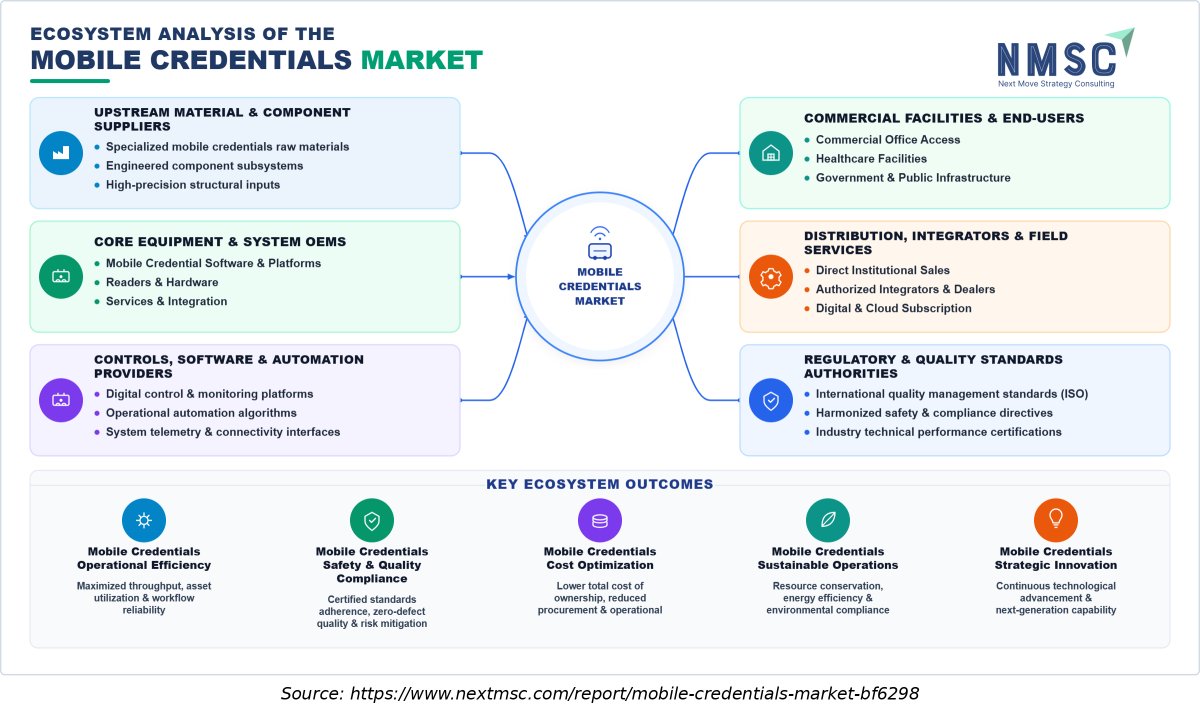
Ecosystem Analysis of the Mobile Credentials Industry

The above infographic presents the Mobile Credentials market ecosystem in a structured format, focusing on six core stakeholder groups: upstream material & component suppliers, core equipment & system OEMs, controls, software & automation providers, commercial facilities & end-users, distribution, integrators & field services, regulatory & quality standards authorities. It shows how these participants support operations while contributing to operational efficiency, safety, cost optimization, sustainability, and technological innovation across diverse operating environments.

What Does the Mobile Credentials Market Encompass?

The mobile credentials market encompasses smartphone-based access tokens, secure element applets, reader hardware, and the provisioning platforms that issue and revoke them. Credential technologies include Bluetooth low energy credentials, near field communication credentials, and hybrid models supporting ultra-wideband ranging for hands-free entry. Core technologies span hardware security modules, public key infrastructure, and biometric template matching. Within BFSI environments, these components secure branch doors, cash processing rooms, server facilities, and staff authentication points across retail and institutional networks.

Design specifications in mobile credentials center on tamper-resistant enclosures, operating temperature tolerance, and read range calibration suited to glass-fronted branch interiors. Material innovations include corrosion-resistant metal housings and low-power antenna substrates that maintain signal integrity near reinforced vault doors. Security assurance requirements can include Common Criteria evaluations for applicable secure elements and FIPS 140-3 validation for cryptographic modules. These requirements support secure credential management, while interoperability specifications such as Aliro address communication between mobile devices and access-control readers. Financial institutions may include applicable cryptographic validation, product security evaluations, and interoperability requirements in their procurement criteria before approving mobile credential solutions for enterprise deployment.

Market Drivers & Dynamics

Interactive Dataset
Migration from Physical Cards to Smartphone Credentials driver High Replacing plastic and proximity cards with smartphone tokens reduces issuance costs and lost credential incidents across branch networks Immediate
Demand for Multi-Factor Facility Authentication driver High Banks require combined possession and biometric verification for vault, server room, and cash handling access points Immediate
Modernization of Financial Institution Facilities driver Medium Growing regional footprints create new deployment sites requiring scalable mobile access infrastructure Medium-term
Legacy Reader Hardware Replacement Costs restraint High Institutions with extensive installed proximity readers face substantial capital outlays to upgrade to near field communication hardware Immediate
Device Fragmentation Across Smartphone Models restraint Medium Inconsistent near field communication and secure element implementations complicate reader compatibility testing Medium-term
Employee Device Ownership Policies restraint Low Some institutions restrict personal phones for credentials, requiring alternative hardware tokens for select staff Long-term
Source: Next Move Strategy Consulting

Growth Drivers

What Is the Primary Growth Driver in the Mobile Credentials Market?

The primary catalyst in mobile credentials is the sustained displacement of physical access media across BFSI facilities. Banks and insurers are retiring plastic badges and key fobs in favor of encrypted tokens stored on employee smartphones. This transition lowers replacement logistics and eliminates card stock inventory. Institutions also gain real-time revocation capability, which strengthens control over departing staff and contractors. Together these operational advantages anchor the market trajectory toward USD 20.63 billion by 2035.

How Are Industry Standards and Directives Driving the Mobile Credentials Market?

Security assurance requirements and interoperability standards are influencing mobile credential adoption. FIPS 140-3 establishes security requirements for cryptographic modules, while Common Criteria evaluations provide assurance for applicable information technology products. The Connectivity Standards Alliance released Aliro 1.0 on February 26, 2026, introducing an interoperability specification for mobile and digital access credentials. These developments can reduce proprietary integration barriers and support multi-vendor access-control deployments. Such standards reduce vendor lock-in and encourage banks to commit to multi-supplier deployments with confidence.

Growth Inhibitors

What Is Restraining the Mobile Credentials Market?

Within the mobile credentials market, the principal commercial restraint is the cost of replacing installed proximity and magnetic stripe readers across large branch networks. Institutions operating hundreds of sites must budget for hardware swaps, cabling adjustments, and integration testing before realizing operational savings. Supply constraints for secure element chips can also extend procurement timelines during periods of semiconductor tightness. Budget cycles within banking and insurance organizations often prioritize core technology investments, which can delay access control modernization programs.

What Are the Growth Opportunities?

Can Multi-Credential Platforms Capture High-Density Deployments?

Within the mobile credentials market, unified platforms that combine mobile, physical, and biometric credentials offer banks a single provisioning environment for dense urban campuses. RightCrowd introduced RightCrowd Pass in August 2026 to unify these credential types within one platform. Such consolidation allows security teams to manage thousands of users across headquarters and data centers from a single console. High-density facilities with complex access hierarchies represent a meaningful volume opportunity for suppliers offering this integration depth.

How Is Mid-Tier and Regional Facility Adoption Unlocking New Mobile Credentials Market Volume?
Regional credit unions, community banks, and insurance agencies are beginning to adopt mobile credentials as affordable provisioning tools mature. These smaller institutions often lack dedicated security departments, making cloud-independent and simplified credential platforms especially attractive. Migration tools such as the Aliro migration credential introduced by Safetrust in September 2026 help operators move away from proprietary systems. Broadening adoption across secondary facilities expands total deployment volume without relying solely on large enterprise contracts.

Can Specialized Vertical Implementations Become Distinct Premium Markets?

Within the mobile credentials market, specialized BFSI applications such as vault access, cash logistics facilities, and trading floor entry demand higher assurance levels than standard office access. Vendors offering hardened credentials with enhanced biometric binding and tamper-evident hardware can command premium pricing in these segments. Dedicated certification programs for financial infrastructure create differentiation opportunities for suppliers willing to invest in compliance documentation. These premium niches may generate disproportionate margin contribution relative to their share of total unit volume.

Segmentation Analysis

2025 (USD Billion)
2035 (USD Billion)
Mobile Credential Software & Platforms 2025: $3.34 Billion | 2035: $3.74 Billion
Mobile Crede
Readers & Hardware 2025: $2.15 Billion | 2035: $2.41 Billion
Readers & Ha
Services & Integration 2025: $1.21 Billion | 2035: $1.35 Billion
Services & I
Mobile Credential Software & Platforms $3.34 Billion $3.74 Billion USD 8.17 Billion
Readers & Hardware $2.15 Billion $2.41 Billion USD 7.1 Billion
Services & Integration $1.21 Billion $1.35 Billion USD 5.36 Billion

Which Product Type Segment Dominates the Mobile Credentials Market?

The installed base of readers, credentials, and back-end management software forms the capital foundation of the mobile credentials market. Mobile Credential Software & Platforms commands roughly 50% of revenue, equal to USD 3.34 billion in 2025, because organizations buy recurring platform licenses that anchor long-term operational control. Services & Integration, meanwhile, advances at a 16.56% CAGR through 2035, as enterprises require specialists to connect legacy door hardware with modern credential ecosystems.

2025 (USD Billion)
2035 (USD Billion)
Commercial O
Corporate Ca
Coworking Sp
Healthcare F
Hospital Sta
Segment Item 2025 (USD Billion) 2035 (USD Billion) CAGR
Commercial Office Access $10.0 USD Billion $40.0 USD Billion 18.0%
Corporate Campuses $17.1 USD Billion $51.1 USD Billion 16.0%
Coworking Spaces $24.2 USD Billion $62.2 USD Billion 22.0%
Healthcare Facilities $31.3 USD Billion $73.3 USD Billion 12.0%
Hospital Staff Access $38.4 USD Billion $84.4 USD Billion 19.0%

Segment-wise data is locked

Unlock complete segment-wise numbers for By Application.

Unlock Full Data
2025 (USD Billion)
2035 (USD Billion)
Enterprises
Large Enterp
SMEs
Government A
Federal
Segment Item 2025 (USD Billion) 2035 (USD Billion) CAGR
Enterprises $10.0 USD Billion $40.0 USD Billion 26.0%
Large Enterprises $17.1 USD Billion $51.1 USD Billion 16.0%
SMEs $24.2 USD Billion $62.2 USD Billion 18.0%
Government Agencies $31.3 USD Billion $73.3 USD Billion 8.0%
Federal $38.4 USD Billion $84.4 USD Billion 23.0%

Segment-wise data is locked

Unlock complete segment-wise numbers for By End User.

Unlock Full Data
2025 (USD Billion)
2035 (USD Billion)
Direct Insti
Enterprise C
Government T
Authorized I
Systems Inte
Segment Item 2025 (USD Billion) 2035 (USD Billion) CAGR
Direct Institutional Sales $10.0 USD Billion $40.0 USD Billion 25.0%
Enterprise Contracts $17.1 USD Billion $51.1 USD Billion 19.0%
Government Tenders $24.2 USD Billion $62.2 USD Billion 25.0%
Authorized Integrators & Dealers $31.3 USD Billion $73.3 USD Billion 19.0%
Systems Integrators $38.4 USD Billion $84.4 USD Billion 20.0%

Segment-wise data is locked

Unlock complete segment-wise numbers for By Distribution Channel.

Unlock Full Data

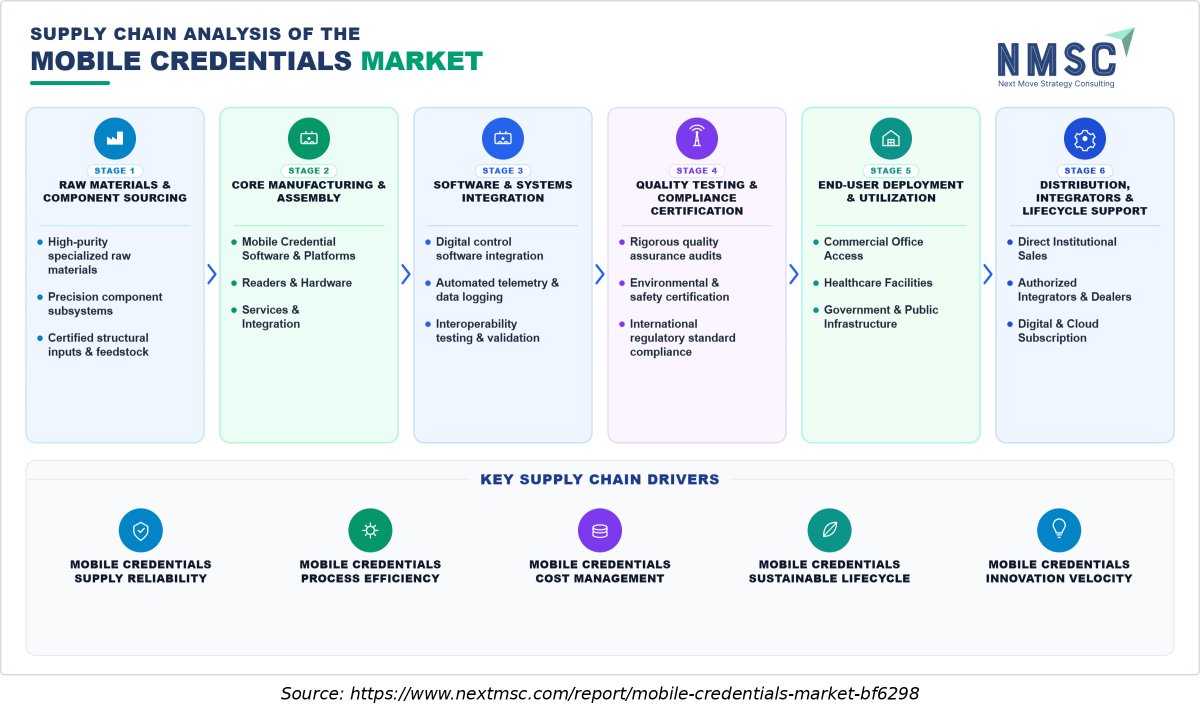
Supply Chain Analysis of the Mobile Credentials Industry

Supply Chain Analysis of the Mobile Credentials Industry

Growth Opportunities

Our analysis shows that three structural whitespace opportunities are positioned to generate disproportionate commercial returns in the Mobile Credentials Market through 2035:
Can Multi-Credential Platforms Capture High-Density Deployments?

Within the mobile credentials market, unified platforms that combine mobile, physical, and biometric credentials offer banks a single provisioning environment for dense urban campuses. RightCrowd introduced RightCrowd Pass in August 2026 to unify these credential types within one platform. Such consolidation allows security teams to manage thousands of users across headquarters and data centers from a single console. High-density facilities with complex access hierarchies represent a meaningful volume opportunity for suppliers offering this integration depth.

How Is Mid-Tier and Regional Facility Adoption Unlocking New Mobile Credentials Market Volume?

Regional credit unions, community banks, and insurance agencies are beginning to adopt mobile credentials as affordable provisioning tools mature. These smaller institutions often lack dedicated security departments, making cloud-independent and simplified credential platforms especially attractive. Migration tools such as the Aliro migration credential introduced by Safetrust in September 2026 help operators move away from proprietary systems. Broadening adoption across secondary facilities expands total deployment volume without relying solely on large enterprise contracts.

Can Specialized Vertical Implementations Become Distinct Premium Markets?

Within the mobile credentials market, specialized BFSI applications such as vault access, cash logistics facilities, and trading floor entry demand higher assurance levels than standard office access. Vendors offering hardened credentials with enhanced biometric binding and tamper-evident hardware can command premium pricing in these segments. Dedicated certification programs for financial infrastructure create differentiation opportunities for suppliers willing to invest in compliance documentation. These premium niches may generate disproportionate margin contribution relative to their share of total unit volume.

Regional Outlook

2025 (USD Billion)
2035 (USD Billion)
North Americ
Europe
Asia-Pacific
Latin Americ
Middle East
Region 2025 (USD Billion) 2035 (USD Billion) CAGR (%)
North America $10.0 USD Billion $40.0 USD Billion 9.0%
Europe $17.1 USD Billion $51.1 USD Billion 27.0%
Asia-Pacific $24.2 USD Billion $62.2 USD Billion 25.0%
Latin America $31.3 USD Billion $73.3 USD Billion 23.0%
Middle East & Africa $38.4 USD Billion $84.4 USD Billion 12.0%

Regional data is locked

Unlock complete regional numbers for this market.

Unlock Full Data

Competitive Landscape

The competitive structure of the mobile credentials market is moderately concentrated, with established access control manufacturers holding significant installed base advantages. HID Global Corporation, ASSA ABLOY AB, Allegion PLC, dormakaba Holding AG, and Honeywell International Inc. compete alongside specialized providers such as Identiv, Inc., Brivo, Inc., and Latch, Inc. Competition increasingly centers on interoperability, platform openness, and the ability to bridge existing reader infrastructure with smartphone-based credentials.

How Do Companies Compete in the Mobile Credentials Market?

Within the mobile credentials market, vendors differentiate primarily through platform breadth, security certifications, and integration depth with building management and identity systems. Pricing strategies vary between perpetual hardware bundles offered through authorized integrators and recurring cloud subscriptions sold directly to property owners. Distribution advantage rests on integrator networks and institutional sales teams, while newer entrants pursue digital-first onboarding to reach multifamily and small commercial operators.

Which Competitive Archetypes Dominate the Mobile Credentials Market?

Market participants fall into three archetypes. Full-stack access control manufacturers such as HID Global Corporation and ASSA ABLOY AB supply readers, credentials, and management software together. Diversified security conglomerates including Honeywell International Inc. and Johnson Controls International PLC integrate mobile credentials into broader building security portfolios. Cloud-native specialists such as Brivo, Inc., Latch, Inc., and Identiv, Inc. focus on subscription platforms and rapid deployment for distributed property portfolios.

What Innovation and Differentiation Strategies Are Companies Pursuing?

Sustainable advantage in this market stems from entrenched installed bases, certified security credentials, and long-term integrator relationships that raise switching costs. Companies that embed mobile credentials within wider access ecosystems create recurring revenue streams that resist commoditization. Open standards participation and proven interoperability with third-party systems further strengthen the position of vendors able to sustain customer trust over multi-year deployment cycles.

What M&A and Partnership Activity Is Shaping the Market?

Within the mobile credentials market, consolidation activity reflects efforts to combine identity, credential, and access control capabilities into unified platforms. Recent transactions show acquirers seeking to broaden connectivity across identity providers and access systems rather than pursuing standalone hardware. Such deals indicate that scale, software depth, and interoperability now carry greater strategic value than traditional reader manufacturing capacity alone.

Key Market Players

Based on research conducted by NMSC, the following 20 companies represent the validated leadership set across Mobile Credentials Market developers, manufacturers, and solution providers:

HID Global Corporation ASSA ABLOY AB Allegion PLC dormakaba Holding AG Honeywell International Inc. Johnson Controls International PLC Motorola Solutions, Inc. Identiv, Inc. Brivo, Inc. Latch, Inc. Openpath Security, Inc. Kisi, Inc. Genetec Inc. Lenel Systems International, Inc. Gallagher Group Limited Nedap N.V STid S.A.S Suprema Inc. Vanderbilt Industries, Inc. Wavelynx Technologies Corporation

Latest Developments

During our market evaluation, we noticed that recent commercial activities, platform introductions, and partnerships within the industry reflect the latest market developments:

Date Event
September 2026 Safetrust introduced an Aliro migration credential designed to move enterprises beyond proprietary access control systems.
February 2026 The Connectivity Standards Alliance released the Aliro 1.0 specification, a unified communication protocol and credential standard for access control interoperability.

Expert Insights

Tobin Richardson

Tobin Richardson

President and CEO | Connectivity Standards Alliance

"Aliro is solving the fragmentation that has held back digital key adoption, replacing it with a single interoperability standard built through Alliance Member collaboration."

Analyst Interpretation

By replacing fragmented proprietary digital key implementations with a single interoperable standard backed by Apple, Google, and Samsung wallet integration, Aliro lowers integration costs and time-to-market for manufacturers and integrators, which should accelerate consumer and enterprise adoption of smartphone-based mobile credentials.

Investment Opportunities

Where Are Capital Inflows Concentrating in the Mobile Credentials Market?

Within the mobile credentials market, capital allocation is gravitating toward software platforms and interoperability capabilities rather than standalone reader hardware. Recent strategic transactions show acquirers pursuing identity integration and unified credential management to deliver recurring revenue. Investment in cloud subscription architecture also supports the faster expansion of digital delivery models across commercial and residential portfolios.

How Is Infrastructure Investment Shaping Market Capacity?

Within the mobile credentials market, operational capacity expansion focuses on secure cloud hosting, credential issuance systems, and integrator training networks that support large-scale deployments. Manufacturers are extending support infrastructure to serve multifamily and healthcare facilities that require rapid onboarding. Such investments strengthen the ability of providers to manage high credential volumes without compromising service continuity.

What ESG Considerations Are Influencing Market Investment?

Environmental considerations increasingly favor mobile credentials because they reduce the physical production and disposal of plastic key cards and fobs. Energy-efficient reader designs and low-power wireless communication lower operational energy consumption across large facility portfolios. Security compliance and data protection requirements further shape investment, as buyers evaluate providers on certified encryption and responsible data handling.

Key Benefits for Stakeholders

How Does This Report Benefit Industry Leaders and Enterprise Operators?

Operational executives and procurement directors gain empirical benchmarks for evaluating mobile credential deployments across facility types. The segmentation analysis clarifies where installed base strength and integration demand converge. Forecasts through 2035 support capital planning decisions for upgrading legacy access control environments.

How Does This Report Benefit Investors and Financial Analysts?

The market is projected to expand from USD 6.7 billion in 2025 to USD 20.63 billion by 2035, providing a clear valuation framework. Analysts can assess the USD 13.13 billion absolute growth opportunity between 2026 and 2035 alongside recurring revenue characteristics. Comparative regional and channel data helps investors identify segments with favorable margin and expansion profiles.

How Does This Report Benefit Technology Vendors and Solution Platform Teams?

Product teams can prioritize roadmap investments toward the fastest-growing segments, including services integration and cloud subscription models. Competitive benchmarking highlights where interoperability and platform openness create differentiation. Insight into residential and multifamily adoption helps vendors target emerging customer groups with tailored offerings.

Key Market Segments Evaluated

By Product Type

  • Mobile Credential Software & Platforms 
    • Cloud-Managed Credential Platforms
    • Wallet Provisioning SDKs
  • Readers & Hardware 
    • NFC Readers
    • BLE Readers
    • UWB Readers
  • Services & Integration 
    • Installation & Commissioning
    • Managed Access Services

By Application

  • Commercial Office Access 
    • Corporate Campuses
    • Coworking Spaces
  • Healthcare Facilities 
    • Hospital Staff Access
    • Clinical Area Control
  • Government & Public Infrastructure 
    • Transit Access
    • Municipal Buildings
  • Residential & Multifamily 
    • Apartment Entry
    • Smart Building Amenities

By End User

  • Enterprises
  • Large Enterprises
  • SMEs
  • Government Agencies 
    • Federal
    • State & Local
  • Healthcare Providers 
    • Hospitals
    • Clinics
  • Property Managers 
    • Commercial Real Estate
    • Residential Property Management

By Distribution Channel

  • Direct Institutional Sales 
    • Enterprise Contracts
    • Government Tenders
  • Authorized Integrators & Dealers
  • Systems Integrators
  • Security Dealers
  • Digital & Cloud Subscription 
    • SaaS Access Licensing
    • Pay-Per-Credential Models

By Region

  • North America 
    • U.S.
    • Canada
    • Mexico.
  • Europe 
    • UK
    • Germany
    • France
    • Italy
    • Rest of Europe.
  • Asia-Pacific 
    • China
    • India
    • Japan
    • South Korea
    • Australia
    • Rest of APAC.
  • Latin America 
    • Brazil
    • Argentina
    • Colombia
    • Rest of Latin America.
  • Middle East & Africa 
    • UAE
    • Saudi Arabia
    • South Africa
    • Rest of MEA.

Conclusion & Recommendations

What Is the Long-Term Outlook for the Mobile Credentials Market?

The long-term outlook for the mobile credentials market is strongly positive, with revenue expanding from USD 7.5 billion in 2026 to USD 20.63 billion by 2035 at an 11.9% CAGR. Growth is underpinned by durable commercial demand expansion, the structural shift toward high-performance specialized solutions, and continuous technological innovation across core operational workflows. Interoperability standards and cloud delivery are expected to sustain adoption momentum throughout the forecast period.

What Strategic Positioning Recommendations Does NMSC Offer?

Market participants should prioritize interoperability with open credential standards to reduce customer switching friction. OEMs and distributors can capture high-growth demand by bundling mobile credential platforms with integrator-led installation and lifecycle services. Targeting multifamily and property management customers through subscription pricing offer a path to recurring revenue and durable competitive advantage.

How Attractive Is the Mobile Credentials Market for Investment?

Investment attractiveness is high, supported by the USD 13.13 billion absolute growth opportunity between 2026 and 2035 identified in this analysis. Recurring software and subscription revenue models improve margin visibility relative to hardware-only businesses. Demand drivers including workplace security modernization and smartphone-based access preferences reinforce the long-term commercial case for capital deployment.

What Are the Key Market Shifts and Risks in the Mobile Credentials Market?

The principal structural shift is the movement from proprietary access ecosystems toward interoperable credential standards that allow multi-vendor operation. Vendors dependent on closed platforms face rising risk of displacement as buyers demand flexibility. Execution risks also include integration complexity with legacy reader infrastructure and the need to maintain certified security performance as credential volumes grow.

What Are the Primary Growth Pathways Through 2035?

Services & Integration, Residential & Multifamily, and Digital & Cloud Subscription represent the most consequential growth pathways within the mobile credentials market. Capturing a disproportionate share of the USD 13.13 billion absolute growth opportunity requires strengthening integrator networks and cloud onboarding capabilities. Vendors that align product roadmaps with these pathways can secure durable revenue expansion through 2035.

Delivered Customizations

We have successfully delivered the following deep-dive customizations:

Client Request Customization Delivered Value Adds
Historical Mobile Credential Revenue Analysis
  • Historical revenue and unit-shipment analysis of mobile credential hardware, reader, and software products by product type, 2019 to latest year, with forecast baseline.
  • Establishes the growth baseline and identifies which product types are scaling fastest to prioritize investment and capacity planning.
Company-Level Product Share Analysis
  • Company-wise share of mobile credential revenue across readers, credential management software, and cloud access platforms, based on annual reports and disclosed segment data.
  • Shows competitive positioning by product type, highlighting share gaps and partnership or acquisition targets.
Country-Level Trade Assessment of Access Control Components
  • Country-wise import and export analysis of access control readers, smart cards, and related electronic components using HS-code trade data from UN Comtrade and WITS.
  • Reveals sourcing concentration and export hubs, supporting supply-chain risk management and manufacturing location decisions.
Wallet Compatibility and Reader Readiness Mapping
  • Mapping of installed reader compatibility with NFC, Bluetooth Low Energy, and UWB mobile credential standards, and smartphone wallet integration across major device platforms.
  • Identifies the share of existing reader base that can support mobile credentials without hardware replacement, guiding retrofit-led sales targeting.
End-User Vertical Adoption Opportunity Assessment
  • Adoption-stage and opportunity sizing for mobile credentials across commercial office, healthcare, hospitality, multifamily residential, and government facilities, using public building and procurement data.
  • Prioritizes end-user verticals and facility types with the highest near-term conversion potential for targeted go-to-market plans.
Distribution Channel Economics and Recurring Revenue Analysis
  • Comparison of direct, integrator, and distributor channel economics, and the share of recurring subscription versus one-time license revenue, based on disclosed company financials.
  • Quantifies the margin and recurring-revenue impact of each channel, informing channel strategy, pricing models, and partner selection.

FAQs

About the Author

Mayurima Roy

Mayurima Roy

Mayurima Roy is Research Analyst at Next Move Strategy Consulting, where she has spent 4 years working across the firm's full industry coverage rather than a single fixed vertical. Her work centers on structured research, ongoing trend tracking, competitive assessment, and insight-led content development, translating complex market data into clear, decision-ready narratives that support informed client decision-making across diverse global industries, market sectors, and world regions every day.

About the Reviewer

Supradip Baul

Supradip Baul

Supradip Baul is an accomplished business consultant and strategist with over a decade of rich experience in market intelligence, strategy, technology, and business transformation. His work has included rigorous qualitative and quantitative analysis across multiple industries, helping clients shape investment decisions and long-term roadmaps. Earlier in his career, he was associated with Gartner, where he contributed to industry-leading reports and market share analyses. He has worked with leading global companies and holds an MBA with a dual specialization in Marketing and Finance.

Download Free Sample

Henri Knyphausen

HENRI KNYPHAUSEN

Partner at Singulier [Ex-BCG]

Singulier

I recently engaged NEXTMSC.com for a commercial due diligence project within the intralogistics sector, and I am pleased to provide a reference based on my experience. In utilizing NEXTMSC.com's services, I found their report to offer valuable insights into market dynamics and key industry players. The initial report provided a solid foundation for our analysis. However, as we were investigating a smaller target in the market, and I had specific customization requests requiring additional research. These requests included detailed information on product portfolios of various players and sub-market sizes, both inclusive and exclusive of certain product categories. NEXTMSC.com demonstrated commendable responsiveness and agility in accommodating these customization requests. Within a timeframe of 1-2 weeks, they delivered a revised report that met our specific needs. Furthermore, they were receptive to my follow-up inquiries, ensuring clarity and understanding of the data provided. The final deliverable significantly contributed to our due diligence efforts. One of NEXTMSC.com's notable strengths lies in their qualitative research capabilities. However, for future engagements, I would recommend the inclusion of a quantified market model in Excel format. Such a model would offer the ability to conduct in-depth analyses and explore various market segments, including country-specific data and subcomponent breakdowns. Based on my positive experience, I would not hesitate to work with NEXTMSC.com again. Their responsiveness, willingness to accommodate customization requests, and commitment to delivering actionable insights make them a reliable partner for commercial research projects.

Ross J Mckenzie

ROSS J MCKENZIE

Business Insight Manager

Staysure Group

“Next MSC have been incredibly helpful in providing detailed & robust information on our market, alongside quantifying growth by different segments. The process to procure was simple and easy, with sample reports and regular contact to ensure we had what we needed. Succinct detail on their sources & methodologies is also greatly received, allowing transparency in this respect helps build trust in the detail you pay for. Joseph in particular was fantastic, and helped ensure efficient provision of the insight pack – thank you NMSC!”.

Robert Sean Trevino

ROBERT SEAN TREVINO

Sr. Director, Head of Strategic Insights & Analytics

Foundation Medicine

I realized that it was a reliable source of information. These days, there are many people who are looking for authentic data, and this is one of the only sources that can offer them with what they need;

Diana Trejo

DIANA TREJO

Assistant Manager

Sumitomo Corporation de Mexico, S.A. de C.V.

Recently, we purchased a report on the Mexico Data Center Market from Next Move Strategy Consulting. The service has been excellent, with support that is always timely and thoroughly professional. The information provided is interesting, highly useful, and delivered with clarity. I would highly recommend NextMSC for anyone seeking insightful and dependable analysis.

Kishu Kanda

KISHU KANDA

Strategy Analyst

Accenture

We purchased the AI Consumer Market Report from this company. Not only did they customize the report to meet our specific requirements, but they also showed great flexibility in accommodating our budget. The report we received fully met our expectations. Additionally, they provided prompt and thorough responses to both our pre-purchase and follow-up questions. We look forward to working with this company again in the future.

Custom Market Research Services

We will customize the research for you if the listed report does not fully match your requirements.

Get 30% Free Customization

Select License

This website uses cookies to ensure you get the best experience on our website. Learn more

✖