Mulching Materials Market

Mulching materials market size was USD 6.85 billion in 2025, set to reach USD 13.29 billion by 2035 at a 6.8% CAGR from 2026 to 2035, per this report.

Download Free Sample PDF
Base Year (2025)
$6.85 Billion
Forecast (2035)
$13.29 Billion
CAGR (2026-2035)
6.8%
Top Region
North America

What Is the Mulching Materials Market Size?
The global mulching materials market size was valued at USD 6.85 billion in 2025 and is estimated at USD 7.35 billion in 2026, forecast to reach USD 13.29 billion by 2035, expanding at a 6.8% CAGR between 2026 and 2035. North America leads with approximately 35% share, while Organic Mulch dominates all other material types with approximately 52% share.

We observed that growth is broad-based across every segmentation axis, with biodegradable polymer films and online retail channels driving the dominant structural shifts through 2035.

Mulching Materials Market Revenue Forecast
Values in USD Billion

2025 $6.85 Billion
2025
2026 $7.35 Billion
2026
2027 $7.85 Billion
2027
2028 $8.38 Billion
2028
2029 $8.95 Billion
2029
2030 $9.56 Billion
2030
2031 $10.21 Billion
2031
2032 $10.91 Billion
2032
2033 $11.65 Billion
2033
2034 $12.44 Billion
2034
2035 $13.29 Billion
2035

Key Takeaways

By Material Type: Organic Mulch held the largest share of approximately 52% (USD 3.56 billion) in 2025; Biodegradable Polymer Mulch is the fastest-growing sub-segment at 14.4% CAGR from 2026–2035.

By Application: Agriculture held the largest share of approximately 48% (USD 3.29 billion) in 2025; Playground and Recreational Surfacing is the fastest-growing sub-segment at 9.5% CAGR from 2026–2035.

By Form: Loose Mulch held the largest share of approximately 48% (USD 3.29 billion) in 2025; Mulch Film and Sheet is the fastest-growing sub-segment at 12.8% CAGR from 2026–2035.

By Distribution Channel: Retail and Garden Centers held the largest share of approximately 36% (USD 2.47 billion) in 2025; Online Retail is the fastest-growing sub-segment at 14.8% CAGR from 2026–2035.

By End User: Commercial Farmers held the largest share of approximately 44% (USD 3.01 billion) in 2025; Homeowners and Retail Consumers is the fastest-growing sub-segment at 11.2% CAGR from 2026–2035.

By Packaging Type: Bulk Mulch held the largest share of approximately 62% (USD 4.25 billion) in 2025; Bagged Mulch is the fastest-growing sub-segment at 9.8% CAGR from 2026–2035.

Dominant Region: North America dominated with approximately 35% revenue share (USD 2.40 billion) in 2025.

Fastest-Growing Region: Asia-Pacific is expected to register the highest CAGR of 9.1% during 2026–2035.

Dominant Country: U.S. led with approximately USD 1.87 billion in 2025.

Fastest-Growing Country: India is the fastest-growing country at approximately 11.6% CAGR from 2026–2035.

Market Opportunity: The mulching materials market is expected to create an absolute dollar opportunity of USD 5.94 billion between 2026 and 2035, presenting significant investment potential across biodegradable polymer film production and online distribution infrastructure.

According to NMSC analysis, manufacturers are increasingly certifying mulch films against soil-biodegradability standards to meet tightening agricultural plastic regulations, a shift that favors diversified biopolymer producers with certified product portfolios over conventional polyethylene film converters as growers face mounting pressure to reduce plastic residue accumulation through 2035.

What Does the Mulching Materials Market Encompass?
The mulching materials market encompasses organic, inorganic, and biodegradable polymer materials applied as a protective ground layer to retain soil moisture, suppress weeds, and regulate soil temperature across agriculture, landscaping, and recreational surfacing applications. Our assessment indicates that the scope spans loose bark and wood mulch, plastic and rubber mulch, and certified biodegradable mulch films distributed through retail garden centers, agricultural cooperatives, and direct sales channels. The category has evolved from simple organic ground cover into an engineered, regulation-compliant discipline, driven by soil health awareness, water conservation mandates, and plastic residue concerns.
Regulatory frameworks, including the European Union's Fertilizing Products Regulation 2019/1009 governing soil-biodegradability of mulch films, shape product certification and material selection. We observed that technology adoption is shifting from conventional, non-biodegradable polyethylene film toward certified soil-biodegradable polymer blends that eliminate post-harvest film removal. NMSC's analysis indicates that this structural shift, combined with rising online retail penetration, is redefining product design criteria across the mulching materials market.

Market Drivers & Dynamics

Interactive Dataset
Rising adoption of soil-biodegradable mulch film certification driver +2.1% Europe, Global 2026–2035
Expanding commercial farming and horticultural crop production driver +1.8% Asia-Pacific, Global 2026–2035
Growing water conservation and soil moisture retention needs driver +1.6% Middle East & Africa, Global 2026–2035
Rising online retail penetration for bagged consumer mulch driver +1.4% North America, Global 2026–2032
Municipal playground safety standards favoring rubber mulch driver +1.1% North America, Europe 2026–2032
Government-backed sustainable agriculture and soil health programs driver +1.3% Asia-Pacific, Europe 2026–2035
Plastic residue accumulation restricting conventional film use restraint −1.2% Europe, Global 2026–2035
Price volatility in polymer feedstock and raw material costs restraint −0.9% Global 2026–2032
Limited farmer awareness of biodegradable mulch benefits restraint −0.7% Latin America, MEA 2026–2030
Source: Next Move Strategy Consulting

Growth Drivers

What Is the Primary Growth Driver of the Mulching Materials Market?

Rising adoption of soil-biodegradable mulch film certification is the primary driver of the market. The Food and Agriculture Organization continues to document that global agricultural plastic consumption exceeds 12.5 million tonnes. We observed that this regulatory and environmental pressure, reinforced by expanding sustainable agriculture initiatives, continues to anchor baseline demand for certified biodegradable polymer mulch products across developed and emerging markets alike.

How Is Commercial Farming Expansion Driving Mulching Materials Market Growth?

Expanding commercial farming and horticultural crop production is accelerating market growth toward high-value fruit, vegetable, and berry cultivation applications. National agricultural statistics agencies across major producing countries continue to report rising horticultural acreage requiring soil moisture and temperature regulation. Our assessment indicates that this expansion, combined with government-backed crop productivity initiatives, is compressing adoption timelines for engineered mulch products across Asia-Pacific and Latin America.

Growth Inhibitors

What Is Restraining Mulching Materials Market Expansion?

Plastic residue accumulation restrains broader adoption of conventional, non-biodegradable mulch film in regulated markets. The European Commission continues to document that only about 24% of agricultural plastic waste is recycled across the European Union, with soil contamination cited as a primary barrier to collection. We found that smaller regional film converters face particular exposure, as limited biopolymer formulation capability constrains their ability to meet tightening soil-biodegradability certification requirements.

Price Point Analysis of the Mulching Materials Market

Price Point Analysis of the Mulching Materials Market

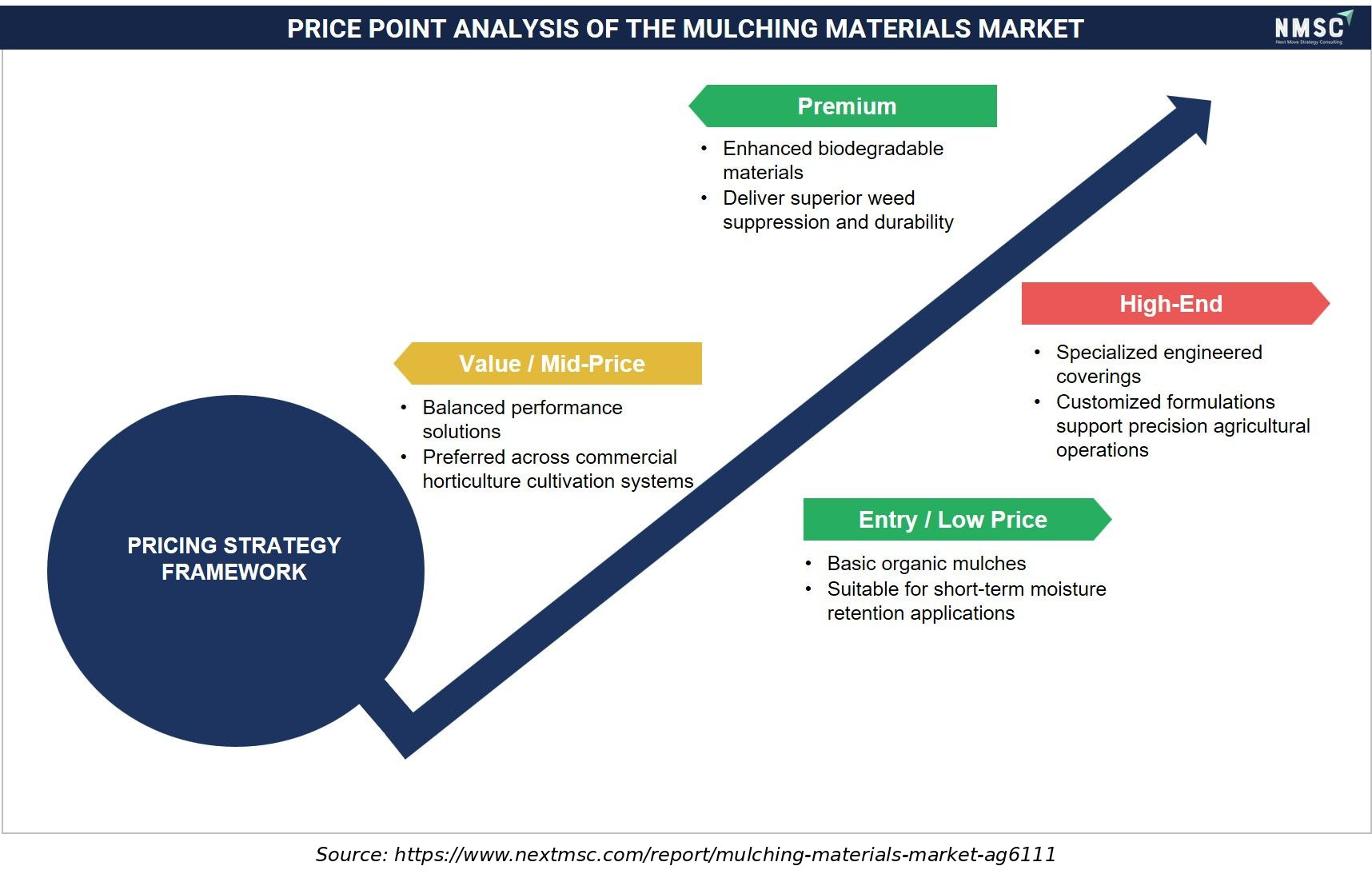
The mulching materials market offers products across entry, value, premium, and high-end price tiers, reflecting differences in material quality, durability, performance, and sustainability attributes. Entry-level options address cost-conscious agricultural users, while mid-priced products balance functionality and affordability. Premium and high-end materials target applications requiring enhanced performance, specialized properties, and longer service life.

Segmentation Analysis

2025 (USD Billion)
2035 (USD Billion)
Organic Mulch 2025: $3.56 Billion | 2035: $6.11 Billion
Organic Mulc
Inorganic Mulch 2025: $2.33 Billion | 2035: $3.72 Billion
Inorganic Mu
Biodegradable Polymer Mulch 2025: $0.96 Billion | 2035: $3.46 Billion
Biodegradabl
Organic Mulch $3.56 Billion $6.11 Billion 5.4%
Inorganic Mulch $2.33 Billion $3.72 Billion 4.5%
Biodegradable Polymer Mulch $0.96 Billion $3.46 Billion 14.4%

Which Material Type Segment Dominates the Mulching Materials Market?

Organic Mulch led the market with USD 3.56 billion in 2025, supported by widespread use of bark, wood, and straw mulch across residential landscaping and traditional farming applications worldwide. We observed that Biodegradable Polymer Mulch is the fastest-growing material type, expanding at a 14.4% CAGR from 2026 to 2035, as certified soil-biodegradable films gain regulatory approval and commercial-scale production capacity across Europe and Asia.

2025 (USD Billion)
2035 (USD Billion)
Agriculture
Row Crop Far
Horticulture
Fruit and Vi
Landscaping
Segment Item 2025 (USD Billion) 2035 (USD Billion) CAGR
Agriculture $10.0 USD Billion $40.0 USD Billion 18.0%
Row Crop Farming $17.1 USD Billion $51.1 USD Billion 16.0%
Horticulture and Vegetable Farming $24.2 USD Billion $62.2 USD Billion 22.0%
Fruit and Vineyard Cultivation $31.3 USD Billion $73.3 USD Billion 12.0%
Landscaping and Gardening $38.4 USD Billion $84.4 USD Billion 19.0%

Segment-wise data is locked

Unlock complete segment-wise numbers for By Application.

Unlock Full Data

Which Application Leads Mulching Materials Market Demand?

Agriculture remained the leading application, valued at USD 3.29 billion in 2025 on the strength of sustained row crop, horticulture, and vineyard cultivation demand for weed suppression and moisture retention. Based on research conducted by NMSC, we found that Playground and Recreational Surfacing is the fastest-growing application at a 9.5% CAGR from 2026 to 2035, reflecting expanding municipal investment in certified recycled rubber safety surfacing.

2025 (USD Billion)
2035 (USD Billion)
Loose Mulch
Mulch Film a
Mulch Mats a
Pelletized M
Segment Item 2025 (USD Billion) 2035 (USD Billion) CAGR
Loose Mulch $10.0 USD Billion $40.0 USD Billion 17.0%
Mulch Film and Sheet $17.1 USD Billion $51.1 USD Billion 11.0%
Mulch Mats and Discs $24.2 USD Billion $62.2 USD Billion 9.0%
Pelletized Mulch $31.3 USD Billion $73.3 USD Billion 15.0%

Segment-wise data is locked

Unlock complete segment-wise numbers for By Form.

Unlock Full Data
2025 (USD Billion)
2035 (USD Billion)
Direct Sales
Retail and G
Online Retai
Agricultural
Segment Item 2025 (USD Billion) 2035 (USD Billion) CAGR
Direct Sales $10.0 USD Billion $40.0 USD Billion 25.0%
Retail and Garden Centers $17.1 USD Billion $51.1 USD Billion 19.0%
Online Retail $24.2 USD Billion $62.2 USD Billion 25.0%
Agricultural Cooperatives and Distributors $31.3 USD Billion $73.3 USD Billion 19.0%

Segment-wise data is locked

Unlock complete segment-wise numbers for By Distribution Channel.

Unlock Full Data

Which Distribution Channel Leads Mulching Materials Market Reach?

Retail and Garden Centers remained the leading distribution channel, valued at USD 2.47 billion in 2025, on the strength of established consumer relationships within lawn and garden retail networks that enable convenient, seasonal mulch purchasing. Our findings suggest that Online Retail is the fastest-growing distribution channel, registering a 14.8% CAGR from 2026 to 2035, as e-commerce platforms expand bulky-item delivery capability for homeowner consumers.

2025 (USD Billion)
2035 (USD Billion)
Commercial F
Landscaping
Municipal an
Homeowners a
Segment Item 2025 (USD Billion) 2035 (USD Billion) CAGR
Commercial Farmers $10.0 USD Billion $40.0 USD Billion 26.0%
Landscaping Contractors $17.1 USD Billion $51.1 USD Billion 16.0%
Municipal and Government Bodies $24.2 USD Billion $62.2 USD Billion 18.0%
Homeowners and Retail Consumers $31.3 USD Billion $73.3 USD Billion 8.0%

Segment-wise data is locked

Unlock complete segment-wise numbers for By End User.

Unlock Full Data
2025 (USD Billion)
2035 (USD Billion)
Bagged Mulch
Bulk Mulch
Segment Item 2025 (USD Billion) 2035 (USD Billion) CAGR
Bagged Mulch $10.0 USD Billion $40.0 USD Billion 15.0%
Bulk Mulch $17.1 USD Billion $51.1 USD Billion 17.0%

Segment-wise data is locked

Unlock complete segment-wise numbers for By Packaging Type.

Unlock Full Data

Growth Opportunities

Our analysis shows that three forward-looking opportunities stand out for stakeholders positioning within the mulching materials market over the 2026–2035 forecast period.

How Can Certified Biodegradable Films Unlock Regulated European Farm Revenue?

Certified soil-biodegradable mulch film presents a whitespace opportunity for manufacturers seeking to serve European Union farmers facing tightening plastic residue regulations. Vendors that commercialize EN 17033-certified biopolymer films stand to capture recurring contracts as national agricultural authorities phase out conventional polyethylene mulch, particularly among horticulture and vineyard cultivation end users.

Where Does Precision Irrigation Integration Create Product Whitespace?

Mulch products engineered to complement drip and precision irrigation systems represent an underpenetrated opportunity for manufacturers targeting water-scarce growing regions. Vendors that co-develop mulch specifications with irrigation equipment providers can secure long-term supply agreements among commercial farmers pursuing integrated soil moisture management across the Middle East and Latin America.

How Can Recycled Rubber Surfacing Unlock Municipal Safety Contracts?

Municipalities and school districts upgrading playground safety infrastructure create an opportunity for certified recycled rubber mulch producers. Early movers that secure IPEMA certification and consistent tire-derived feedstock supply can differentiate with government and educational institution customers pursuing long-term, low-maintenance recreational surfacing contracts.

Regional Outlook

2025 (USD Billion)
2035 (USD Billion)
North Americ
Europe
Asia-Pacific
Latin Americ
Middle East
Region 2025 (USD Billion) 2035 (USD Billion) CAGR (%)
North America $10.0 USD Billion $40.0 USD Billion 9.0%
Europe $17.1 USD Billion $51.1 USD Billion 27.0%
Asia-Pacific $24.2 USD Billion $62.2 USD Billion 25.0%
Latin America $31.3 USD Billion $73.3 USD Billion 23.0%
Middle East & Africa $38.4 USD Billion $84.4 USD Billion 12.0%

Regional data is locked

Unlock complete regional numbers for this market.

Unlock Full Data

Competitive Landscape

We observed that the mulching materials market features a moderately fragmented competitive landscape, with global polymer manufacturers competing alongside regional organic mulch producers and specialized rubber recyclers on certification, distribution reach, and cost efficiency.

Dimension Description
Market Structure Moderately fragmented; the top companies profiled in this report collectively account for a meaningful share of global mulching materials revenue, while numerous regional bark, wood, and rubber producers serve localized demand.
Innovation Focus Soil-biodegradability certification, climate-adapted biopolymer formulations, and recycled rubber processing dominate current innovation pipelines across leading manufacturers.
M&A Activity Selective capacity expansion and product portfolio broadening, exemplified by BASF SE's continued expansion of its ecovio biodegradable mulch film portfolio into new climate zones.

How Do Companies Compete in the Mulching Materials Market?

Companies compete primarily on certification credibility, material durability, and distribution reach across the industry. Global polymer manufacturers such as BASF SE and Novamont S.p.A. leverage biopolymer research capability to serve regulated European farming customers, while regional specialists such as Al-Pack Enterprises Ltd. and Agriplast Tech India Pvt. Ltd. compete on localized distribution depth and price competitiveness in their home markets.

Which Competitive Archetypes Dominate the Mulching Materials Market?

Two archetypes dominate the market: global biopolymer and plastic film manufacturers offering certified, regulation-compliant products, and regional organic or rubber mulch specialists focused on localized landscaping and recreational demand. BASF SE and Berry Global Inc. exemplify the diversified archetype through multi-country film production, while Scotts Miracle-Gro Company and Liberty Tire Recycling Holdco, LLC exemplify the specialized archetype serving consumer retail and playground surfacing demand.

How Are Companies Differentiating Through Innovation in Mulching Materials?

Innovation and differentiation strategy increasingly center on certified soil-biodegradability and climate-adapted formulations. Novamont S.p.A.'s Mater-Bi certification under EU Fertilizer Regulation 2019/1009 and BASF SE's ecovio M 2351 expansion into Asia and Latin America both extend certified biodegradable film into new regulatory and climate contexts. Our analysis shows that manufacturers unable to demonstrate credible biodegradability certification risk exclusion from increasingly regulated European procurement.

What M&A and Expansion Activity Is Shaping the Mulching Materials Market?

Capacity expansion and product portfolio broadening continue to reshape capability within the industry. BASF SE's 2025 expansion of its ecovio biodegradable mulch film portfolio into new climate zones broadened its addressable market beyond Europe, while Novamont S.p.A. continues to extend Mater-Bi certification credentials to support growing demand from European farmers facing tightening plastic residue regulations.

Key Market Players

Our assessment indicates that the following 20 companies are actively shaping product innovation, certification strategy, and distribution expansion within the global mulching materials market.

Berry Global Inc. BASF SE Novamont S.p.A. Plastika Kritis S.A. Kingfa Sci. & Tech. Co., Ltd. RKW SE Grupo Armando Álvarez, S.A. Ginegar Plastic Products Ltd. Barbier S.A.S. Al-Pack Enterprises Ltd. Agriplast Tech India Pvt. Ltd. Iris Polymers Industries Pvt. Ltd. Trioplast Industrier AB CRH plc Scotts Miracle-Gro Company Liberty Tire Recycling Holdco, LLC Genan A/S American Excelsior Company Profile Products LLC Melcourt Industries Ltd. (leading UK bark and organic mulch specialist)

Supply Chain Structure of the Mulching Materials Market

Supply Chain Structure of the Mulching Materials Market

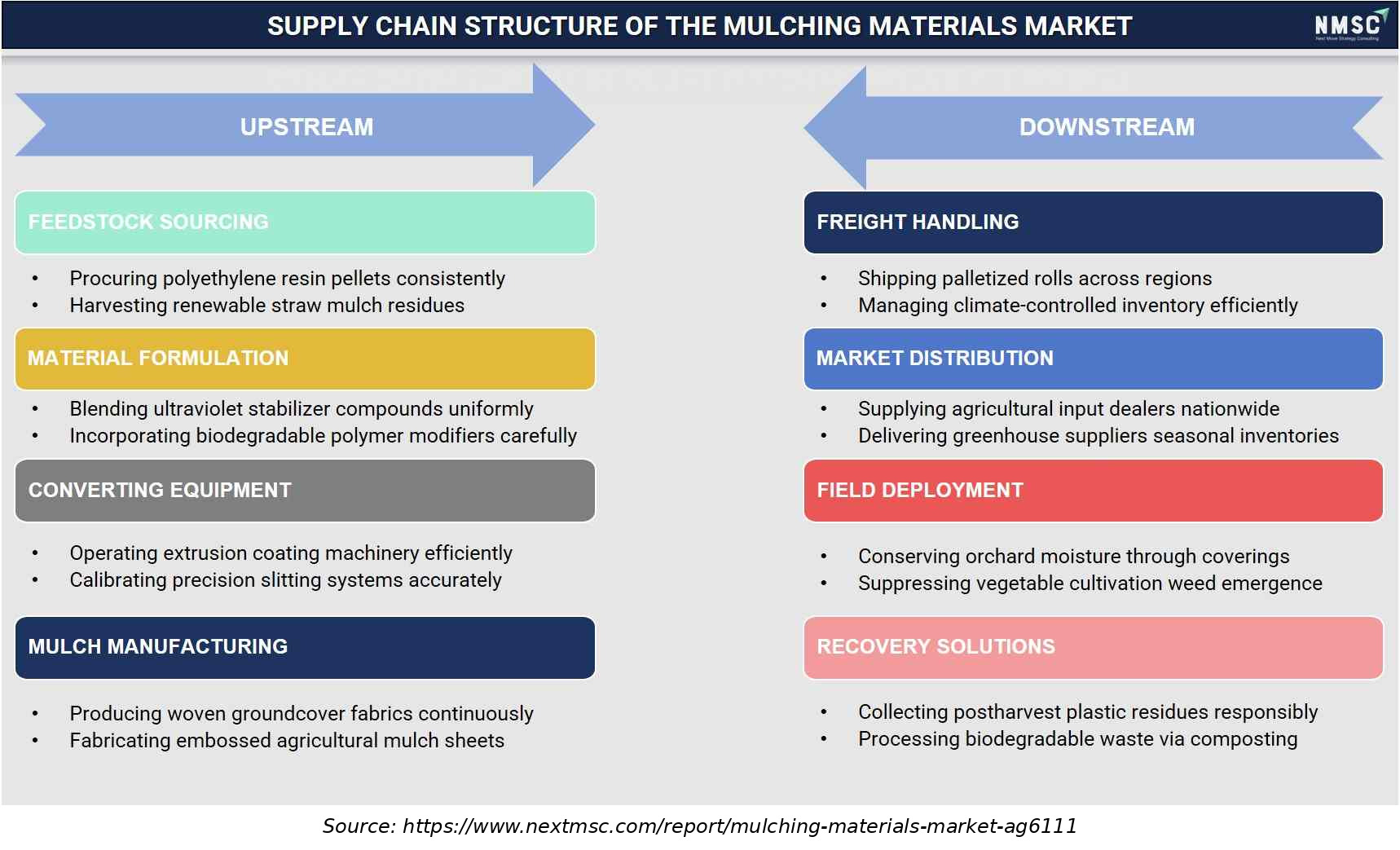
The mulching materials supply chain covers feedstock sourcing, material formulation, converting, manufacturing, freight handling, distribution, field deployment, and recovery. Manufacturers rely on consistent access to polymer resins, renewable residues, and processing inputs to maintain production. Agricultural distributors support seasonal availability, while recovery and composting activities increasingly contribute to responsible material management and circularity.

Latest Developments

We found that recent developments within the mulching materials market are concentrated on biodegradability certification, geographic portfolio expansion, and regulatory compliance, reflecting the industry's accelerating shift toward certified sustainable products.

Date Event
November 2025 Novamont S.p.A. obtained certification of conformity with EU Fertilizer Regulation 2019/1009 for its Mater-Bi mulch film, classifying it as an inorganic soil improver.
February 2025 BASF SE introduced certified industrial compostable ecovio 60 IA 1552 clips, complementing its biopolymer portfolio for sustainable agriculture and food production.

Investment Opportunities

What Capital Inflows Are Targeting the Mulching Materials Market?

Capital inflows into the mulching materials market are increasingly directed toward certified biopolymer production capacity and recycled rubber processing infrastructure. BASF SE and Novamont S.p.A. continue to invest in expanding certified soil-biodegradable film capacity to meet growing European and export demand. We observed that investors favor manufacturers demonstrating credible regulatory certification and multi-region production scale.

How Is Infrastructure Investment Supporting Mulching Materials Delivery?

Infrastructure investment is expanding production capacity and distribution networks to support mulching materials delivery at scale. Our findings suggest that tire recycling companies continue to invest in granulation capacity to supply certified rubber mulch for playground and landscaping applications. Manufacturers are prioritizing regional production facilities and logistics partnerships to reduce transportation costs for bulky, low-value-density mulch products.

What ESG Considerations Are Shaping Mulching Materials Investment Decisions?

Environmental, social, and governance considerations are central to investment decisions across the industry, with plastic residue reduction and soil health as key environmental criteria. Novamont S.p.A.'s Mater-Bi certification under EU Fertilizer Regulation 2019/1009 reflects systematic integration of environmental compliance into product development. We found that investors increasingly scrutinize manufacturers' biodegradability certification and recycled content sourcing as governance indicators alongside production efficiency.

Key Benefits for Stakeholders

How Does This Report Benefit Enterprise and Industry Leaders?

Enterprise and industry leaders gain access to validated segmentation, competitive benchmarking, and regional demand forecasts that support product design and distribution sourcing decisions across the mulching materials industry. Our analysis shows that detailed material type, application, and distribution channel breakdowns help procurement teams align product specifications with regulatory and sustainability requirements while identifying underserved categories for portfolio expansion.

How Does This Report Benefit Investors and Financial Analysts?

Investors and financial analysts benefit from consistent, single-point market size and CAGR estimates that support valuation and capital-allocation decisions across the mulching materials market supply chain. We observed that the report's regional and segment-level growth differentials help identify which manufacturers are best positioned to capture above-market growth in biodegradable polymer and online retail categories through 2035.

How Does This Report Benefit Technology Vendors and Product Teams?

Technology vendors and product teams gain insight into emerging design requirements, including soil-biodegradability certification, climate-adapted compostable plastic formulations, and recycled rubber processing, that are reshaping the industry. Our findings suggest that this analysis helps research and development teams prioritize roadmaps around certification and material innovation increasingly required by regulator and distributor procurement processes.

Key Market Segments Evaluated

By Material Type

  • Organic Mulch 
    • Bark and Wood Mulch
    • Straw and Hay Mulch
    • Compost and Leaf Mulch
    • Coir and Coconut Fiber Mulch
  • Inorganic Mulch 
    • Plastic Film Mulch
    • Rubber Mulch
    • Gravel and Stone Mulch
  • Biodegradable Polymer Mulch 
    • Starch-Based Mulch Film
    • PLA-Based Mulch Film

By Application

  • Agriculture 
    • Row Crop Farming
    • Horticulture and Vegetable Farming
    • Fruit and Vineyard Cultivation
  • Landscaping and Gardening 
    • Residential Landscaping
    • Commercial Landscaping
  • Playground and Recreational Surfacing
  • Erosion Control

By Form

  • Loose Mulch
  • Mulch Film and Sheet
  • Mulch Mats and Discs
  • Pelletized Mulch

By Distribution Channel

  • Direct Sales
  • Retail and Garden Centers
  • Online Retail
  • Agricultural Cooperatives and Distributors

By End User

  • Commercial Farmers
  • Landscaping Contractors
  • Municipal and Government Bodies
  • Homeowners and Retail Consumers

By Packaging Type

  • Bagged Mulch
  • Bulk Mulch

By Region

  • North America 
    • U.S.
    • Canada
    • Mexico.
  • Europe 
    • UK
    • Germany
    • France
    • Italy
    • Spain
    • Sweden
    • Denmark
    • Finland
    • Netherlands
    • Rest of Europe.
  • Asia-Pacific 
    • China
    • India
    • Japan
    • South Korea
    • Taiwan
    • Indonesia
    • Vietnam
    • Australia
    • Philippines
    • Malaysia
    • Rest of APAC.
  • Middle East & Africa 
    • Saudi Arabia
    • UAE
    • Egypt
    • Israel
    • Turkey
    • Nigeria
    • South Africa
    • Rest of MEA.
  • Latin America 
    • Brazil
    • Argentina
    • Chile
    • Colombia
    • Rest of LATAM.

Conclusion & Recommendations

The long-term outlook for the mulching materials market remains constructive, supported by expanding commercial farming, tightening plastic residue regulation, and rising water conservation priorities. NMSC's analysis indicates that the market's expansion from USD 6.85 billion in 2025 to USD 13.29 billion by 2035 reflects structural, durable demand rather than short-term cyclical growth, positioning the industry for sustained expansion through the forecast period.

What Strategic Positioning Should Manufacturers Pursue?

Manufacturers should prioritize soil-biodegradability certification and climate-adapted product formulations to differentiate from conventional polyethylene film converters. Our assessment indicates that producers combining certified biopolymer capability with multi-region production scale will be best positioned to capture premium European and export-oriented agricultural contracts within the mulching materials market's regulated segments.

How Attractive Is the Mulching Materials Market for New Investment?

The mulching materials industry presents an attractive investment case, supported by a USD 5.94 billion absolute dollar opportunity between 2026 and 2035 and above-average growth in Asia-Pacific and biodegradable polymer categories. We found that investment attractiveness is highest for manufacturers combining certified biodegradability credentials with scaled production infrastructure, positioning them to serve both regulated European and cost-sensitive emerging markets simultaneously.

What Market Shifts and Key Risks Should Stakeholders Monitor?

Stakeholders should monitor plastic residue regulation, polymer feedstock price volatility, and limited farmer awareness of biodegradable alternatives as key risks to the mulching materials market. Our analysis shows that manufacturers unable to certify products against tightening soil-biodegradability standards risk losing European contracts to competitors with established regulatory credentials, particularly as enforcement intensifies.

What Are the Key Growth Pathways for the Mulching Materials Market?

Key growth pathways include expanding certified biodegradable film production, scaling online retail distribution for bagged consumer mulch, and deepening penetration into municipal playground surfacing contracts. NMSC's analysis indicates that manufacturers pursuing these pathways while maintaining cost discipline in conventional organic mulch categories will be best positioned to capture the mulching materials market's projected growth through 2035.

FAQs

About the Author

Mihul Sharma

Mihul Sharma

Mihul Sharma is Research Associate at Next Move Strategy Consulting, where he has covered technology, industrial, and healthcare markets for 3 years. His work applies structured business research, market analysis, and secondary-source review to assess market trends, competitive developments, and growth opportunities. He supports report development by fully synthesizing industry data, company information, and market signals into concise findings for strategy and investment-focused research teams.

About the Reviewer

Supradip Baul

Supradip Baul

Supradip Baul is an accomplished business consultant and strategist with over a decade of rich experience in market intelligence, strategy, technology, and business transformation. His work has included rigorous qualitative and quantitative analysis across multiple industries, helping clients shape investment decisions and long-term roadmaps. Earlier in his career, he was associated with Gartner, where he contributed to industry-leading reports and market share analyses. He has worked with leading global companies and holds an MBA with a dual specialization in Marketing and Finance.

Download Free Sample

Kevin Coker

KEVIN COKER

Founder, CEO and Board Diector

Proxima Clinical Research

I have been using Next MSC reports for product positioning in a new geography for a long time. They have by far the best reports I have found and the price is reasonable too!

Pratyush Kumar Das

PRATYUSH KUMAR DAS

Assistant Manager

Polycab India Limited

We would like to express our appreciation for the data and insights provided by nextmsc. We are very pleased with the quality and depth of the information, which has proven to be highly valuable and beneficial for our business decision-making.

Henri Knyphausen

HENRI KNYPHAUSEN

Partner at Singulier [Ex-BCG]

Singulier

I recently engaged NEXTMSC.com for a commercial due diligence project within the intralogistics sector, and I am pleased to provide a reference based on my experience. In utilizing NEXTMSC.com's services, I found their report to offer valuable insights into market dynamics and key industry players. The initial report provided a solid foundation for our analysis. However, as we were investigating a smaller target in the market, and I had specific customization requests requiring additional research. These requests included detailed information on product portfolios of various players and sub-market sizes, both inclusive and exclusive of certain product categories. NEXTMSC.com demonstrated commendable responsiveness and agility in accommodating these customization requests. Within a timeframe of 1-2 weeks, they delivered a revised report that met our specific needs. Furthermore, they were receptive to my follow-up inquiries, ensuring clarity and understanding of the data provided. The final deliverable significantly contributed to our due diligence efforts. One of NEXTMSC.com's notable strengths lies in their qualitative research capabilities. However, for future engagements, I would recommend the inclusion of a quantified market model in Excel format. Such a model would offer the ability to conduct in-depth analyses and explore various market segments, including country-specific data and subcomponent breakdowns. Based on my positive experience, I would not hesitate to work with NEXTMSC.com again. Their responsiveness, willingness to accommodate customization requests, and commitment to delivering actionable insights make them a reliable partner for commercial research projects.

Melanie Samko

MELANIE SAMKO

Director of Marketing

TOSOH BIOSCIENCE, INC.

The information provided by NMSC is incredibly valuable, thank you so much for such a excellent work. I really appreciate it. I will make sure to reference all of it, in my summary document.

Gaurav Jaiswal

GAURAV JAISWAL

Founder & CEO

Yano Charge Private Limited

The EV Charging market research report provided by the NextMSC was exceptionally detailed and insightful. It offered a comprehensive analysis that proved to be a game-changer for our strategic planning. Truly a testament to the NextMSC’s expertise and thoroughness in EV market landscape & analysis.

Custom Market Research Services

We will customize the research for you if the listed report does not fully match your requirements.

Get 30% Free Customization

Select License

This website uses cookies to ensure you get the best experience on our website. Learn more

✖