Natural and Organic Personal Care Products Market

Natural and organic personal care products market size was USD 24.80 billion in 2025, projected to reach USD 66.65 billion by 2035 at a 10.4% CAGR up to 2035

Download Free Sample PDF
Base Year (2025)
$24.80 Billion
Forecast (2035)
$66.65 Billion
CAGR (2026-2035)
10.4%
Top Region
North America

What Is the Natural and Organic Personal Care Products Market Size?

The global natural and organic personal care products market size was valued at USD 24.80 billion in 2025 and is estimated at USD 27.35 billion in 2026, forecast to reach USD 66.65 billion by 2035, expanding at a 10.4% CAGR between 2026 and 2035. North America leads with approximately 36% share, while Skin Care dominates all other product categories with approximately 38% share.

We observed that the growth is broad-based across every segmentation axis, with ingredient transparency and expanding direct-to-consumer distribution driving the dominant structural shifts through 2035.

Natural and Organic Personal Care Products Market Revenue Forecast

Values in USD Billion

2025 $24.80 Billion
2025
2026 $27.38 Billion
2026
2027 $30.23 Billion
2027
2028 $33.37 Billion
2028
2029 $36.84 Billion
2029
2030 $40.67 Billion
2030
2031 $44.90 Billion
2031
2032 $49.57 Billion
2032
2033 $54.73 Billion
2033
2034 $60.42 Billion
2034
2035 $66.65 Billion
2035

Key Takeaways

By Product Category: Skin Care held the largest share of approximately 38% (USD 9.42 billion) in 2025; Sun Care is the fastest-growing sub-segment at 16.87% CAGR from 2026–2035.

By Ingredient Positioning: Natural held the largest share of approximately 42% (USD 10.42 billion) in 2025; Clean Beauty is the fastest-growing sub-segment at 15.49% CAGR from 2026–2035.

By Price Positioning: Mass Market held the largest share of approximately 55% (USD 13.64 billion) in 2025; Luxury is the fastest-growing sub-segment at 15.49% CAGR from 2026–2035.

By Distribution Channel: Third-party E-commerce held the largest share of approximately 24% (USD 5.95 billion) in 2025; Brand-owned E-commerce is the fastest-growing sub-segment at 14.76% CAGR from 2026–2035.

By Consumer Type: Women held the largest share of approximately 58% (USD 14.38 billion) in 2025; Men is the fastest-growing sub-segment at 12.67% CAGR from 2026–2035.

Dominant Region: North America dominated with approximately 36% revenue share (USD 8.93 billion) in 2025.

Fastest-Growing Region: Asia-Pacific is expected to register the highest CAGR of 13.18% during 2026–2035.

Dominant Country: U.S. led with approximately USD 6.07 billion in 2025.

Fastest-Growing Country: India is the fastest-growing country at approximately 16.3% CAGR from 2026–2035.

Market Opportunity: The natural and organic personal care products industry is expected to create an absolute dollar opportunity of USD 39.30 billion between 2026 and 2035, presenting significant investment potential across the clean-label, ingredient-transparent beauty value chain.

According to NMSC analysis, specialist natural and organic brands are increasingly pairing digital-first, direct-to-consumer distribution with expanded Ayurvedic and botanical formulation research, a shift that favors companies with established founder-led brand equity over private-label entrants as ingredient transparency becomes a baseline consumer expectation through 2035.

This base-year estimate is directionally consistent with the broader range of market sizing and growth trajectories reported across public company disclosures and industry trade publications covering the clean and natural beauty category, though the precise scope and segmentation applied here are unique to this report.

What Does the Natural and Organic Personal Care Products Market Encompass?

The natural and organic personal care products market encompasses skin care, hair care, bath and shower, oral care, and other personal care formulations positioned around certified organic, natural, botanical, or clean beauty ingredient claims. Our assessment indicates that the scope spans mass market, premium, and luxury price tiers supplied through direct-to-consumer, e-commerce, specialty beauty, and traditional retail channels to babies and children, men, women, and unisex consumer segments across skin, hair, oral, and fragrance care categories worldwide.

Regulatory frameworks such as the U.S. Food and Drug Administration's cosmetic labeling guidance and the European Commission's cosmetics regulation shape ingredient disclosure and organic claim substantiation requirements, while third-party certification bodies increasingly define credible natural and organic positioning. We observed that technology adoption is shifting toward direct-to-consumer digital platforms that allow specialist brands to build customer relationships without dependence on traditional retail intermediaries.

NMSC's analysis indicates that this structural shift, combined with expanding ingredient transparency expectations, is redefining competitive positioning across the natural and organic personal care products market report.

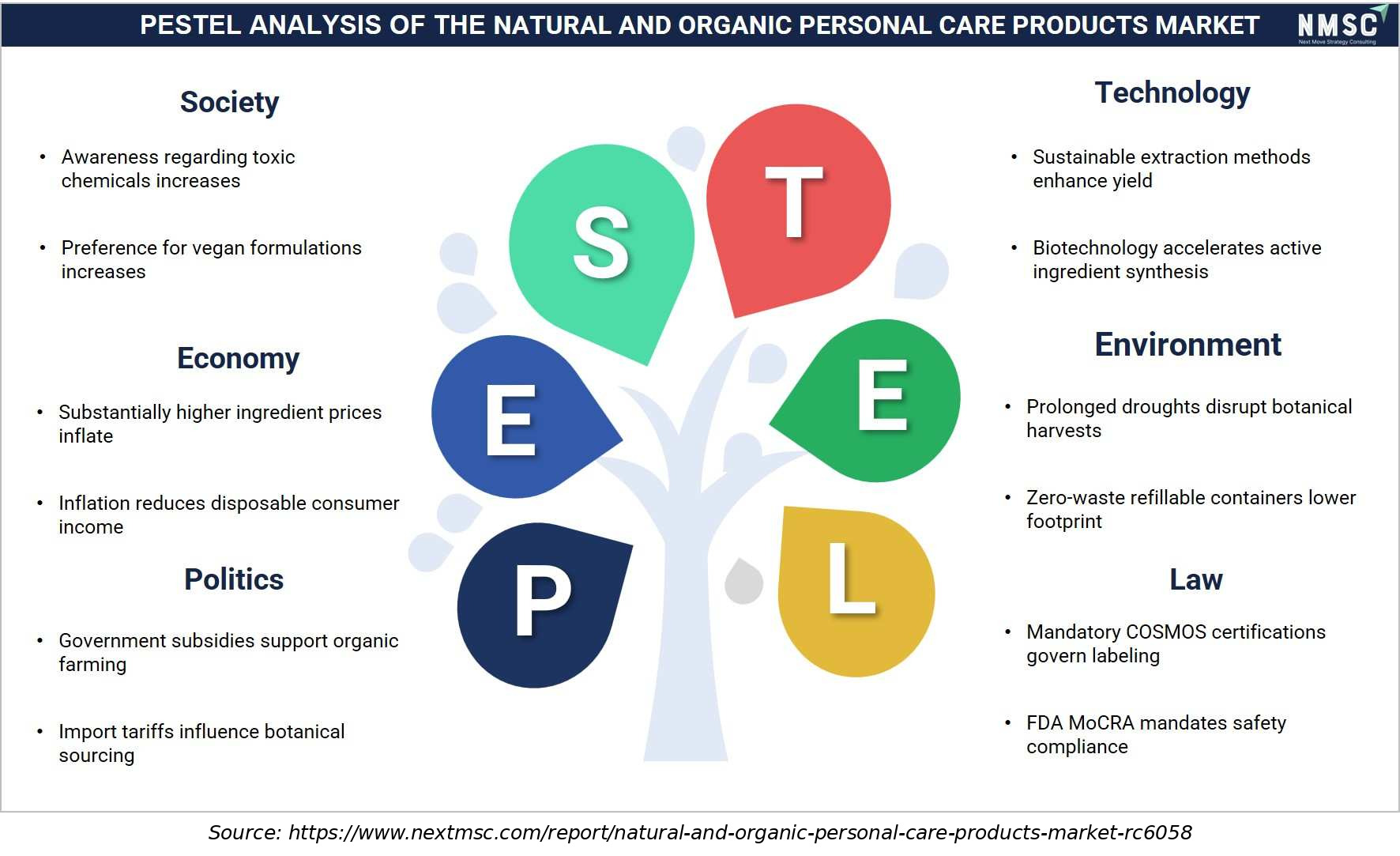
PESTEL Analysis of the Natural and Organic Personal Care Products Market

PESTEL Analysis of the Natural and Organic Personal Care Products Market
PESTEL analysis highlights the external factors shaping the natural and organic personal care products market. Evolving sustainability regulations, clean-label consumer preferences, economic conditions, technological innovation, environmental priorities, and stricter product safety standards collectively influence product development, sourcing strategies, market expansion, and competitive positioning across global and regional markets.

Market Drivers & Dynamics

Interactive Dataset
Rising consumer preference for chemical-free, clean-label formulations driver +2.7% Global 2026-2035
Expanding direct-to-consumer and e-commerce distribution infrastructure driver +2.2% Global 2026-2035
Growing demand for Ayurvedic and botanical ingredient innovation in Asia-Pacific driver +1.7% Asia-Pacific 2026-2035
Increasing regulatory scrutiny of synthetic ingredients in conventional cosmetics driver +1.3% North America, Europe 2026-2032
Expanding sustainable and refillable packaging adoption driver +1.0% Europe, North America 2026-2035
Rising disposable income supporting premium and luxury natural beauty adoption driver +0.9% Asia-Pacific, Middle East & Africa 2026-2035
High input costs for certified organic ingredient sourcing restraint -1.2% Global 2026-2035
Intensifying competition from mainstream conglomerates launching natural sub-brands restraint -1.0% Global 2026-2035
Financial instability among legacy specialist retailers following recent restructurings restraint -0.7% Europe 2026-2032
Source: Next Move Strategy Consulting

Growth Drivers

What Is the Primary Growth Driver of the Natural and Organic Personal Care Products Market?

Rising consumer preference for chemical-free, clean-label formulations is the primary driver of the market. Consumer-facing guidance referenced by the U.S. Food and Drug Administration's cosmetic labeling framework highlights growing public interest in ingredient transparency, prompting expanded voluntary disclosure practices among personal care manufacturers. We observed that this consumer shift, combined with expanding direct-to-consumer distribution capability, continues to anchor sustained double-digit revenue growth for pure-play natural and organic personal care brands relative to conventional mass-market alternatives.

How Is Expanding E-commerce Distribution Driving Market Growth?

Expanding direct-to-consumer and e-commerce distribution infrastructure is accelerating market growth by lowering the barrier for specialist natural and organic brands to reach global consumers without dependence on traditional retail placement. We found that Honasa Consumer Limited's digital-first growth strategy, which preceded its November 2023 public listing, demonstrates the scalability of e-commerce-led brand building within this market. Our assessment indicates that this distribution shift, combined with rising social media-driven product discovery, is compressing the time required for emerging natural beauty brands to achieve national and international scale.

Growth Inhibitors

What Is Restraining Natural and Organic Personal Care Products Market Expansion?

High input costs for certified organic ingredient sourcing restrain broader market expansion, as verified organic supply chains require more extensive certification, traceability, and premium raw material sourcing than conventional alternatives. Financial restructuring at The Body Shop International Limited, which entered UK administration in February 2024 before its September 2024 acquisition by Auréa Group, illustrates the operational pressure facing legacy specialist retailers balancing premium positioning with cost discipline.

We found that these cost pressures, combined with intensifying competition from mainstream conglomerates, are moderating margin expansion among pure-play natural and organic brands.

Segmentation Analysis

2025 (USD Billion)
2035 (USD Billion)
Skin Care 2025: $9.42 Billion | 2035: $23.33 Billion
Skin Care
Hair Care 2025: $4.96 Billion | 2035: $12.00 Billion
Hair Care
Bath and Shower 2025: $2.48 Billion | 2035: $6.00 Billion
Bath and Sho
Color Cosmetics 2025: $1.98 Billion | 2035: $6.00 Billion
Color Cosmet
Fragrance 2025: $1.49 Billion | 2035: $4.67 Billion
Fragrance
Oral Care 2025: $1.24 Billion | 2035: $3.33 Billion
Oral Care
Deodorants and Antiperspirants 2025: $0.99 Billion | 2035: $2.67 Billion
Deodorants a
Sun Care 2025: $0.74 Billion | 2035: $3.33 Billion
Sun Care
Shaving and Beard Care 2025: $0.50 Billion | 2035: $2.00 Billion
Shaving and
Intimate Care 2025: $0.50 Billion | 2035: $2.00 Billion
Intimate Car
Other Personal Care 2025: $0.50 Billion | 2035: $1.33 Billion
Other Person
Skin Care $9.42 Billion $23.33 Billion 9.40%
Hair Care $4.96 Billion $12.00 Billion 9.12%
Bath and Shower $2.48 Billion $6.00 Billion 9.12%
Color Cosmetics $1.98 Billion $6.00 Billion 11.86%
Fragrance $1.49 Billion $4.67 Billion 12.32%
Oral Care $1.24 Billion $3.33 Billion 10.41%
Deodorants and Antiperspirants $0.99 Billion $2.67 Billion 10.41%
Sun Care $0.74 Billion $3.33 Billion 16.87%
Shaving and Beard Care $0.50 Billion $2.00 Billion 15.49%
Intimate Care $0.50 Billion $2.00 Billion 15.49%
Other Personal Care $0.50 Billion $1.33 Billion 10.41%

Which Product Category Dominates the Natural and Organic Personal Care Products Market?

Skin Care led the market with USD 9.42 billion in 2025, supported by sustained face and body care product innovation and its broad applicability across ingredient positioning and price tiers. We observed that Sun Care is the fastest-growing product category, expanding at a 16.87% CAGR from 2026 to 2035, as consumers increasingly seek reef-safe, mineral-based sunscreen formulations free of chemical UV filters restricted in several coastal jurisdictions.

2025 (USD Billion)
2035 (USD Billion)
Certified Or
Natural
Botanical an
Clean Beauty
Other Claims
Segment Item 2025 (USD Billion) 2035 (USD Billion) CAGR
Certified Organic $10.0 USD Billion $40.0 USD Billion 12.0%
Natural $17.1 USD Billion $51.1 USD Billion 22.0%
Botanical and Herbal $24.2 USD Billion $62.2 USD Billion 8.0%
Clean Beauty $31.3 USD Billion $73.3 USD Billion 10.0%
Other Claims $38.4 USD Billion $84.4 USD Billion 17.0%

Segment-wise data is locked

Unlock complete segment-wise numbers for By Ingredient Positioning.

Unlock Full Data

Which Ingredient Positioning Segment Leads Natural and Organic Personal Care Products Market Demand?

Natural remained the leading ingredient positioning, valued at USD 10.42 billion in 2025 on its broader applicability across price tiers relative to more strictly defined certified organic claims. Our findings suggest that Clean Beauty is the fastest-growing ingredient positioning, registering a 15.49% CAGR from 2026 to 2035, as brands increasingly market formulations around excluded ingredient lists rather than single-certification claims, appealing to a wider base of ingredient-conscious consumers.

2025 (USD Billion)
2035 (USD Billion)
Mass Market
Premium
Luxury
Segment Item 2025 (USD Billion) 2035 (USD Billion) CAGR
Mass Market $10.0 USD Billion $40.0 USD Billion 15.0%
Premium $17.1 USD Billion $51.1 USD Billion 17.0%
Luxury $24.2 USD Billion $62.2 USD Billion 11.0%

Segment-wise data is locked

Unlock complete segment-wise numbers for By Price Positioning.

Unlock Full Data
2025 (USD Billion)
2035 (USD Billion)
Direct to Co
Brand-owned
Third-party
Supermarkets
Pharmacies a
Segment Item 2025 (USD Billion) 2035 (USD Billion) CAGR
Direct to Consumer $10.0 USD Billion $40.0 USD Billion 25.0%
Brand-owned E-commerce $17.1 USD Billion $51.1 USD Billion 19.0%
Third-party E-commerce $24.2 USD Billion $62.2 USD Billion 25.0%
Supermarkets and Hypermarkets $31.3 USD Billion $73.3 USD Billion 19.0%
Pharmacies and Drugstores $38.4 USD Billion $84.4 USD Billion 20.0%

Segment-wise data is locked

Unlock complete segment-wise numbers for By Distribution Channel.

Unlock Full Data

Which Distribution Channel Is the Fastest-Growing in the Natural and Organic Personal Care Products Market?

Third-party e-commerce remained the largest distribution channel, valued at USD 5.95 billion in 2025, reflecting the reach and discovery advantages of established online marketplaces for specialist beauty brands. Based on research conducted by NMSC, we found that Brand-owned E-commerce represents the fastest-growing distribution channel at a 14.76% CAGR from 2026 to 2035, driven by brands prioritizing direct customer data ownership and subscription-based repeat purchase models.

2025 (USD Billion)
2035 (USD Billion)
Babies and C
Men
Women
Unisex
Segment Item 2025 (USD Billion) 2035 (USD Billion) CAGR
Babies and Children $10.0 USD Billion $40.0 USD Billion 12.0%
Men $17.1 USD Billion $51.1 USD Billion 22.0%
Women $24.2 USD Billion $62.2 USD Billion 24.0%
Unisex $31.3 USD Billion $73.3 USD Billion 10.0%

Segment-wise data is locked

Unlock complete segment-wise numbers for By Consumer Type.

Unlock Full Data

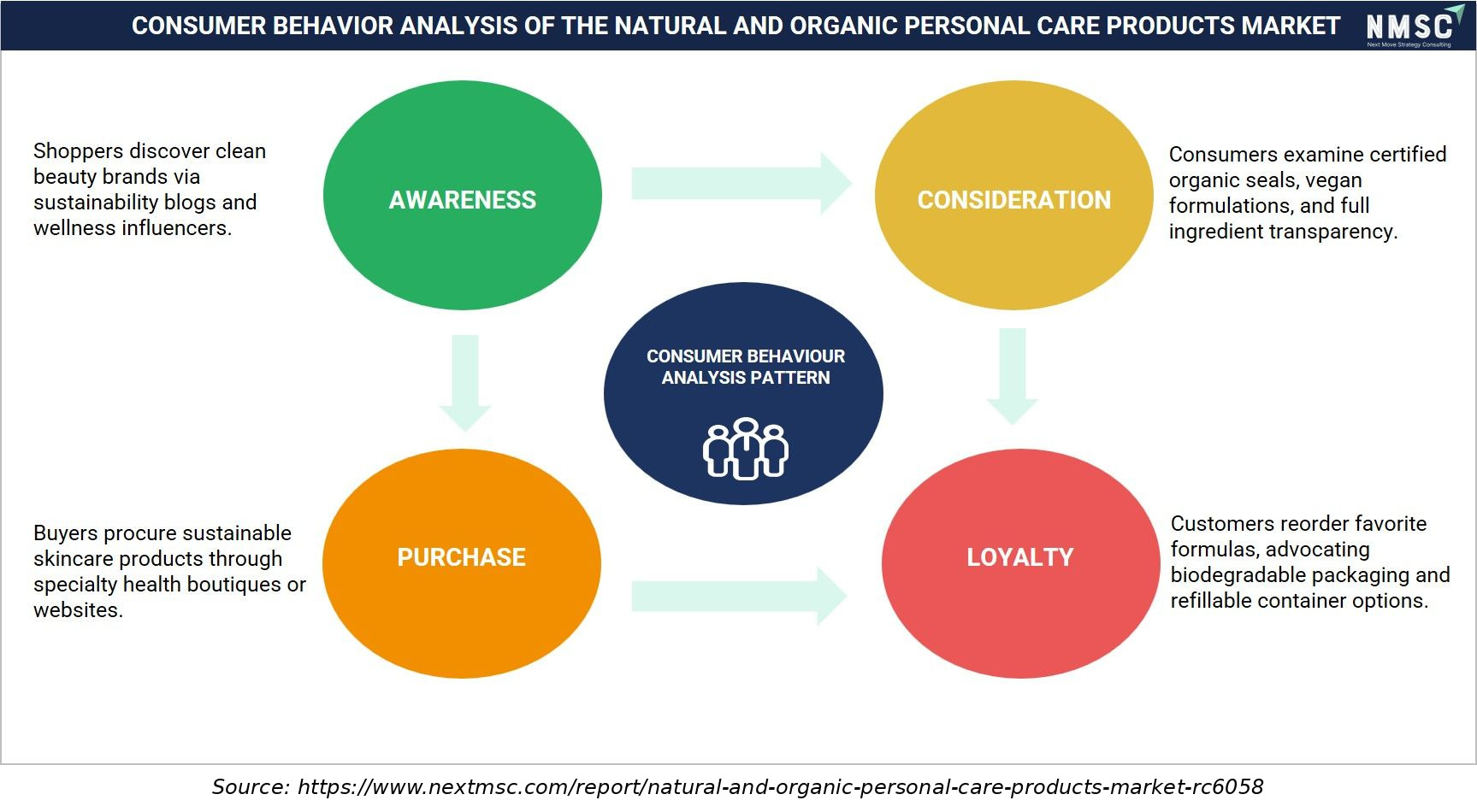
Consumer Behavior Analysis of the Natural Organic Personal Care Products Market

Consumer Behavior Analysis of the Natural Organic Personal Care Products Market

Consumer purchasing decisions are increasingly driven by ingredient transparency, sustainability, product certifications, and brand credibility. Buyers typically progress from awareness through digital education to careful product evaluation, purchase, and long-term loyalty. Demand for eco-friendly packaging, ethical sourcing, and proven product efficacy continues to shape purchasing patterns and strengthen brand differentiation in the market.

Growth Opportunities

Our analysis shows that three forward-looking opportunities stand out for stakeholders positioning within the natural and organic personal care products market over the 2026–2035 forecast period.

How Can Ayurvedic Brand Expansion Unlock Value in Western Markets?

Ayurvedic and botanical brand expansion into North American and European markets presents a whitespace opportunity for companies with established herbal formulation expertise. Brands such as Himalaya Global Holdings that pair validated traditional ingredient science with Western regulatory compliance stand to capture premium-positioned shelf space as Western consumers increasingly seek differentiated natural ingredient stories beyond conventional botanical claims.

Where Does Refillable Packaging Create New Retail Partnerships?

Refillable and low-waste packaging formats represent an underpenetrated opportunity for specialty beauty retailers and brand-owned stores seeking sustainability-driven differentiation. Companies that scale in-store refill infrastructure can secure long-term customer loyalty and repeat purchase behavior, benefiting from reduced packaging costs and stronger alignment with tightening European packaging waste regulations.

How Can Men's Grooming Expansion Benefit Natural Personal Care Brands?

Growing male consumer interest in natural personal care products creates an opportunity for brands to extend clean-label formulations beyond traditionally women-focused skin care and hair care lines. Early movers that develop validated, gender-neutral or men-specific natural grooming lines can capture incremental market share in a consumer segment still underserved relative to mainstream men's grooming brands dominated by conventional formulations.

Regional Outlook

2025 (USD Billion)
2035 (USD Billion)
North Americ
Europe
Asia-Pacific
Middle East
Latin Americ
Region 2025 (USD Billion) 2035 (USD Billion) CAGR (%)
North America $10.0 USD Billion $40.0 USD Billion 9.0%
Europe $17.1 USD Billion $51.1 USD Billion 27.0%
Asia-Pacific $24.2 USD Billion $62.2 USD Billion 25.0%
Middle East & Africa $31.3 USD Billion $73.3 USD Billion 23.0%
Latin America $38.4 USD Billion $84.4 USD Billion 12.0%

Regional data is locked

Unlock complete regional numbers for this market.

Unlock Full Data

Competitive Landscape

Our analysis shows that the competitive landscape is shaped by founder-led specialist brands leveraging ingredient heritage and direct-to-consumer distribution to compete against mainstream conglomerate natural sub-brands across the industry.

Dimension Description
Dimension Assessment
Market Structure The market remains moderately fragmented, with the top 10 companies accounting for an estimated 46% of 2025 revenue (an NMSC industry-derived estimate; see the methodology note) amid continued entry of digital-first specialist brands.
Innovation Focus Innovation centers on Ayurvedic and botanical formulation science, ingredient transparency certification, and refillable, low-waste packaging systems.
M&A Activity Ownership restructuring continues to reshape competitive positioning, exemplified by Auréa Group's September 2024 acquisition of The Body Shop International Limited out of UK administration.

How Do Companies Compete in the Natural and Organic Personal Care Products Market?

Companies compete primarily on ingredient sourcing credibility, certification breadth, and depth of direct-to-consumer digital engagement with ingredient-conscious shoppers. We observed that founder-led brands with authentic sustainability narratives are increasingly favored by consumers over private-label natural lines, as brand heritage and transparent sourcing practices remain difficult for new entrants to replicate quickly.

Which Competitive Archetypes Dominate the Natural and Organic Personal Care Products Market?

Three competitive archetypes dominate: heritage certified organic specialists such as Weleda and WALA Heilmittel that combine decades of formulation expertise with strict certification standards; digital-first direct-to-consumer brands such as Honasa Consumer and The Honest Company that scale through social media and e-commerce; and diversified direct selling conglomerates such as Natura Cosméticos and Oriflame that combine natural positioning with extensive distributor networks.

Our assessment indicates that these newer entrants appear to be gaining share more quickly, consistent with generally lower customer acquisition costs relative to legacy retail-dependent competitors.

How Are Companies Differentiating Through Innovation?

Manufacturers are differentiating through Ayurvedic and botanical ingredient research, third-party non-toxic certification, and expanding refillable packaging infrastructure. We found that Himalaya Global Holdings' decades of herbal formulation research and Honasa Consumer's MADE SAFE-certified Mamaearth brand exemplify two distinct innovation strategies converging on the same consumer demand for validated, transparent natural formulations. Continued investment in ingredient traceability technology is likely to remain an important innovation battleground through 2035.

What M&A and Geographic Expansion Activity Is Shaping the Market?

Ownership restructuring continues to reshape competitive positioning, with Auréa Group's September 2024 acquisition of The Body Shop International Limited exemplifying the trend of specialized turnaround investors acquiring distressed heritage natural beauty brands. Geographic expansion is concentrated in Asia-Pacific, where digital-first brands such as Honasa Consumer are scaling domestic market share before pursuing international distribution partnerships to extend Ayurvedic and botanical product lines beyond South Asia.

Key Market Players

Our assessment identifies the following companies, ranked by market-specific revenue and scale of operations, as the leading participants shaping the natural and organic personal care products market through 2026.

Natura Cosméticos S.A. L'Occitane International S.A. Laboratoires de Biologie Végétale Yves Rocher S.A. Oriflame Holding AG Weleda AG Honasa Consumer Limited The Honest Company, Inc. Himalaya Global Holdings Ltd. All-One God Faith, Inc. Laboratoires Expanscience WALA Heilmittel GmbH Laverana GmbH & Co. KG The Body Shop International Limited KORRES S.A. Natural Products Neal's Yard Remedies Limited Pacifica Beauty LLC Juice Beauty, Inc. Aubrey Organics, Inc. Acorelle SAS Mádara Cosmetics AS

Latest Developments

We observed the following verified developments shaping competitive positioning across the natural and organic personal care products market.

Date Event
Jan 2026 MÁDARA Cosmetics AS introduced the Botanic Niacinamide Alternative 5-in-1 Serum, reinforcing its innovation in naturally derived active skincare ingredients.
Nov 2025 Laverana GmbH & Co. KG (lavera) received the GREEN BRAND Germany certification again, recognizing its long-standing commitment to certified natural cosmetics and sustainability.
May 2025 Neal's Yard Remedies Limited introduced a vegan version of its iconic Wild Rose Beauty Balm, strengthening its certified natural skincare range.

Expert Insights

Emily Cameron

Co-founder & Creative Director | Ffern

"Thinking about the environment and sustainability has always been front of mind. Since we work with natural ingredients and the rhythm of the seasons, it just feels intuitive to ensure that we keep our impact as low as possible—after all, the seasons depend on us treading lightly."

Analyst Interpretation

The statement highlights the growing emphasis on sustainably sourced botanical ingredients and environmentally responsible production practices within the natural and organic personal care industry. As consumers increasingly prioritize products made with naturally derived ingredients and low environmental impact, brands are integrating regenerative sourcing, seasonal formulations, and sustainable manufacturing into their business strategies. This trend may strengthen demand for premium natural and organic skincare products while encouraging greater investment in transparent and eco-conscious supply chains.

Investment Opportunities

How Are Capital Inflows Shaping the Natural and Organic Personal Care Products Market?

Growth and private equity capital continues to flow into specialist natural and organic beauty brands, with Honasa Consumer Limited's November 2023 public listing and Auréa Group's September 2024 acquisition of The Body Shop International Limited both reflecting active investor interest in the category. We observed that investors are increasingly favoring digital-first brands with proven unit economics over legacy retail-dependent specialists carrying higher fixed-cost structures.

What Infrastructure Investment Is Required to Scale Natural and Organic Personal Care Products Market Coverage?

Scaling natural and organic personal care coverage requires sustained investment in certified organic supply chain traceability, refillable packaging infrastructure, and direct-to-consumer fulfillment logistics. Our findings suggest that brands pursuing international expansion increasingly require regional regulatory compliance and localized ingredient sourcing partnerships to meet varying organic certification standards across North American, European, and Asian markets.

What ESG Considerations Are Relevant to Natural and Organic Personal Care Products Market Investment?

Environmental, Social, and Governance considerations center on sustainable ingredient sourcing, cruelty-free and vegan formulation practices, and reduced packaging waste through refillable systems. We observed that ingredient traceability and ethical sourcing transparency are becoming differentiating governance factors for consumer goods investors evaluating natural and organic beauty brands. Social considerations also extend to fair-trade sourcing partnerships that support smallholder farming communities supplying botanical raw materials.

Key Benefits for Stakeholders

How Does This Report Benefit Beauty Industry Leaders?

Beauty industry leaders gain a structured view of ingredient positioning, distribution channel dynamics, and competitive positioning across competing natural and organic personal care brands. Our analysis shows that benchmarking data on product category, price positioning, and consumer type segmentation supports more informed portfolio investment decisions aligned with evolving consumer demand, while regional regulatory insights help companies anticipate certification requirements across major markets.

How Does This Report Benefit Investors and Financial Analysts?

Investors and financial analysts gain access to segmentation-level revenue forecasts, competitive positioning analysis, and identified whitespace opportunities across the natural and organic personal care products market. We found that the report's regional and country-level growth projections support portfolio allocation decisions, while the competitive landscape section clarifies which archetypes are best positioned to capture long-term consumer spending through 2035.

How Does This Report Benefit Technology Vendors and Product Teams?

Technology vendors and product teams gain visibility into segmentation trends, emerging distribution channel demand, and regional regulatory drivers that inform product development and go-to-market prioritization. Our findings suggest that granular data on ingredient positioning, distribution channel, and consumer type demand helps brand teams align development investment with the fastest-growing sub-segments, particularly brand-owned e-commerce and clean beauty positioning.

Key Market Segments Evaluated

By Product Category

  • Skin Care 
    • Face Care
      • Cleansers
      • Toners
      • Moisturizers
      • Serums and Treatments
      • Face Masks
    • Body Care
      • Body Lotions
      • Body Creams
      • Body Oils
      • Body Scrubs
    • Hand Care
    • Foot Care
    • Lip Care
      • Lip Balms
      • Lip Treatments
  • Hair Care 
    • Shampoo
    • Conditioner
    • Hair Treatments
    • Hair Masks
    • Styling Products
    • Scalp Care
  • Bath and Shower 
    • Bar Soap
    • Body Wash
    • Shower Gel
    • Bath Additives
  • Oral Care 
    • Toothpaste
    • Mouthwash
    • Tooth Powder
    • Other Oral Care
  • Deodorants and Antiperspirants 
    • Stick Deodorants
    • Roll-on Deodorants
    • Spray Deodorants
    • Cream Deodorants
  • Color Cosmetics 
    • Face Cosmetics
    • Eye Cosmetics
    • Lip Cosmetics
    • Nail Cosmetics
  • Fragrance 
    • Eau de Parfum
    • Eau de Toilette
    • Body Mist
    • Perfume Oils
    • Solid Fragrances
  • Shaving and Beard Care 
    • Shaving Creams
    • Aftershave Products
    • Beard Care
  • Sun Care 
    • Sunscreens
    • After-sun Products
    • Self-tanning Products
  • Intimate Care 
    • Cleansers
    • Moisturizers
    • Wipes
  • Other Personal Care 
    • Hand Sanitizers
    • Personal Care Wipes
    • Miscellaneous Personal Care Products

By Ingredient Positioning

  • Certified Organic
  • Natural
  • Botanical and Herbal
  • Clean Beauty
  • Other Claims

By Price Positioning

  • Mass Market
  • Premium
  • Luxury

By Distribution Channel

  • Direct to Consumer
  • Brand-owned E-commerce
  • Third-party E-commerce
  • Supermarkets and Hypermarkets
  • Pharmacies and Drugstores
  • Specialty Beauty Stores
  • Direct Selling
  • Professional Salons and Spas
  • Other Retail Channels

By Consumer Type

  • Babies and Children
  • Men
  • Women
  • Unisex

By Region

  • North America 
    • U.S.
    • Canada
    • Mexico.
  • Europe 
    • UK
    • Germany
    • France
    • Italy
    • Spain
    • Sweden
    • Denmark
    • Finland
    • Netherlands
    • Rest of Europe.
  • Asia-Pacific 
    • China
    • India
    • Japan
    • South Korea
    • Taiwan
    • Indonesia
    • Vietnam
    • Australia
    • Philippines
    • Malaysia
    • Rest of APAC.
  • Middle East & Africa 
    • Saudi Arabia
    • UAE
    • Egypt
    • Israel
    • Turkey
    • Nigeria
    • South Africa
    • Rest of MEA.
  • Latin America 
    • Brazil
    • Argentina
    • Chile
    • Colombia
    • Rest of LATAM.

Conclusion & Recommendations

The long-term outlook remains strongly positive, with the market projected to nearly triple from USD 27.35 billion in 2026 to USD 66.65 billion by 2035 at a 10.4% CAGR. Our analysis shows that these structural shifts are likely to continue supporting broad-based growth across nearly every segmentation axis through the forecast period.

What Strategic Positioning Recommendations Apply to Manufacturers?

Manufacturers should pursue direct-to-consumer digital distribution paired with transparent, certifiable ingredient sourcing to meet consumer expectations for authenticity. We observed that brands combining founder-led heritage narratives with scalable e-commerce infrastructure appear well positioned to defend premium pricing power as mainstream conglomerates continue launching competing natural sub-brands across price tiers.

How Attractive Is the Natural and Organic Personal Care Products Market for New Investment?

The natural and organic personal care products industry presents an attractive investment case, supported by a USD 39.30 billion absolute dollar opportunity between 2026 and 2035 and above-average growth in Asia-Pacific and clean beauty ingredient positioning. We found that investment attractiveness is highest for companies combining validated ingredient science with scalable digital distribution, positioning them to serve both established North American and emerging Asia-Pacific markets simultaneously.

What Market Shifts and Key Risks Should Stakeholders Monitor?

Stakeholders should monitor high certified organic ingredient sourcing costs, intensifying competition from mainstream conglomerate natural sub-brands, and financial instability risk among legacy specialist retailers as key risks to the market. Our analysis shows that brands unable to sustain cost-competitive certified organic supply chains risk losing shelf space to lower-cost natural positioning alternatives, particularly within price-sensitive mass market retail channels.

What Are the Key Growth Pathways for the Natural and Organic Personal Care Products Market?

Key growth pathways include expanding Ayurvedic and botanical brand distribution into Western markets, scaling brand-owned e-commerce and subscription models, and advancing refillable packaging partnerships with specialty retailers. NMSC's analysis indicates that suppliers pursuing these pathways while maintaining certified ingredient transparency appear best positioned to capture the natural and organic personal care products market's projected growth through 2035.

FAQs

About the Author

Mihul Sharma

Mihul Sharma

Mihul Sharma is Research Associate at Next Move Strategy Consulting, where he has covered technology, industrial, and healthcare markets for 3 years. His work applies structured business research, market analysis, and secondary-source review to assess market trends, competitive developments, and growth opportunities. He supports report development by fully synthesizing industry data, company information, and market signals into concise findings for strategy and investment-focused research teams.

About the Reviewer

Supradip Baul

Supradip Baul

Supradip Baul is an accomplished business consultant and strategist with over a decade of rich experience in market intelligence, strategy, technology, and business transformation. His work has included rigorous qualitative and quantitative analysis across multiple industries, helping clients shape investment decisions and long-term roadmaps. Earlier in his career, he was associated with Gartner, where he contributed to industry-leading reports and market share analyses. He has worked with leading global companies and holds an MBA with a dual specialization in Marketing and Finance.

Download Free Sample

Nishant Awate

NISHANT AWATE

Business Development Global Sales

Zehnder Group Deutschland GmbH

Our experience working with Next Move Strategy Consulting was positive. The team was responsive, professional, and open to incorporating our specific requirements throughout the project. The India AHU market study was comprehensive and well structured, covering market value and volume forecasts, product and application segments, and key industry trends. The inclusion of both AHU and residential MVHR market insights made the study particularly relevant for our strategic market assessment. Overall, the report provides a solid foundation for evaluating market potential, identifying priority segments, and supporting business-development decisions in India.

Robert Sean Trevino

ROBERT SEAN TREVINO

Sr. Director, Head of Strategic Insights & Analytics

Foundation Medicine

I realized that it was a reliable source of information. These days, there are many people who are looking for authentic data, and this is one of the only sources that can offer them with what they need;

Pratyush Kumar Das

PRATYUSH KUMAR DAS

Assistant Manager

Polycab India Limited

We would like to express our appreciation for the data and insights provided by nextmsc. We are very pleased with the quality and depth of the information, which has proven to be highly valuable and beneficial for our business decision-making.

Gaurav Jaiswal

GAURAV JAISWAL

Founder & CEO

Yano Charge Private Limited

The EV Charging market research report provided by the NextMSC was exceptionally detailed and insightful. It offered a comprehensive analysis that proved to be a game-changer for our strategic planning. Truly a testament to the NextMSC’s expertise and thoroughness in EV market landscape & analysis.

Semih Kavaklioglu

SEMIH KAVAKLIOGLU

Co-Founder & Sales Manager

Decortie

I work a lot in the marketing industry and I know that research is an essential part of any campaign. I have used Market research reports for my own products and I found them to be very informative and well-researched. The team here produces insightful reports for a good price

Custom Market Research Services

We will customize the research for you if the listed report does not fully match your requirements.

Get 30% Free Customization

Select License

This website uses cookies to ensure you get the best experience on our website. Learn more

✖