North America Agriculture Robots Market By Type (Unmanned Aerial Vehicles (UAVs), Milking Robots, Driverless Tractors, Automated Harvest Robots, and Others), By Farming Type (Indoor Farming, Outdoor Farming, and Indoor & Outdoor), and By Application (Aerial Monitoring & Scouting, Dairy & Livestock Automation, Field Operations, Harvest Management, and Others): Opportunity Analysis & Industry Forecast, 2025–2035
Industry: Agriculture | Latest Edition: August 18, 2026 | No of Pages: 261 | No. of Tables: 106 | No. of Figures: 98 | Format: PDF | Report Code: AG615
Market Size & Forecast
|
Parameters |
Details |
|
Market Size in 2025 |
USD 4.35 Billion |
|
Market Size in 2026 |
USD 5.79 Billion |
|
Revenue Forecast in 2035 |
USD 30.86 Billion |
|
Growth Rate |
CAGR of 20.44% from 2026 to 2035 |
|
Market Volume in 2025 |
30 Thousand Units |
|
Market Volume in 2026 |
44 Thousand Units |
|
Volume Forecast in 2035 |
387 Thousand Units |
|
Growth Rate (Volume) |
CAGR of 27.29% from 2026 to 2035 |
|
Analysis Period |
2025–2035 |
|
Base Year Considered |
2025 |
|
Forecast Period |
2026–2035 |
|
Market Size Estimation |
Billion (USD) |
|
Companies Profiled |
15 |
|
Market Share |
Available for 10 Companies |
Industry Outlook
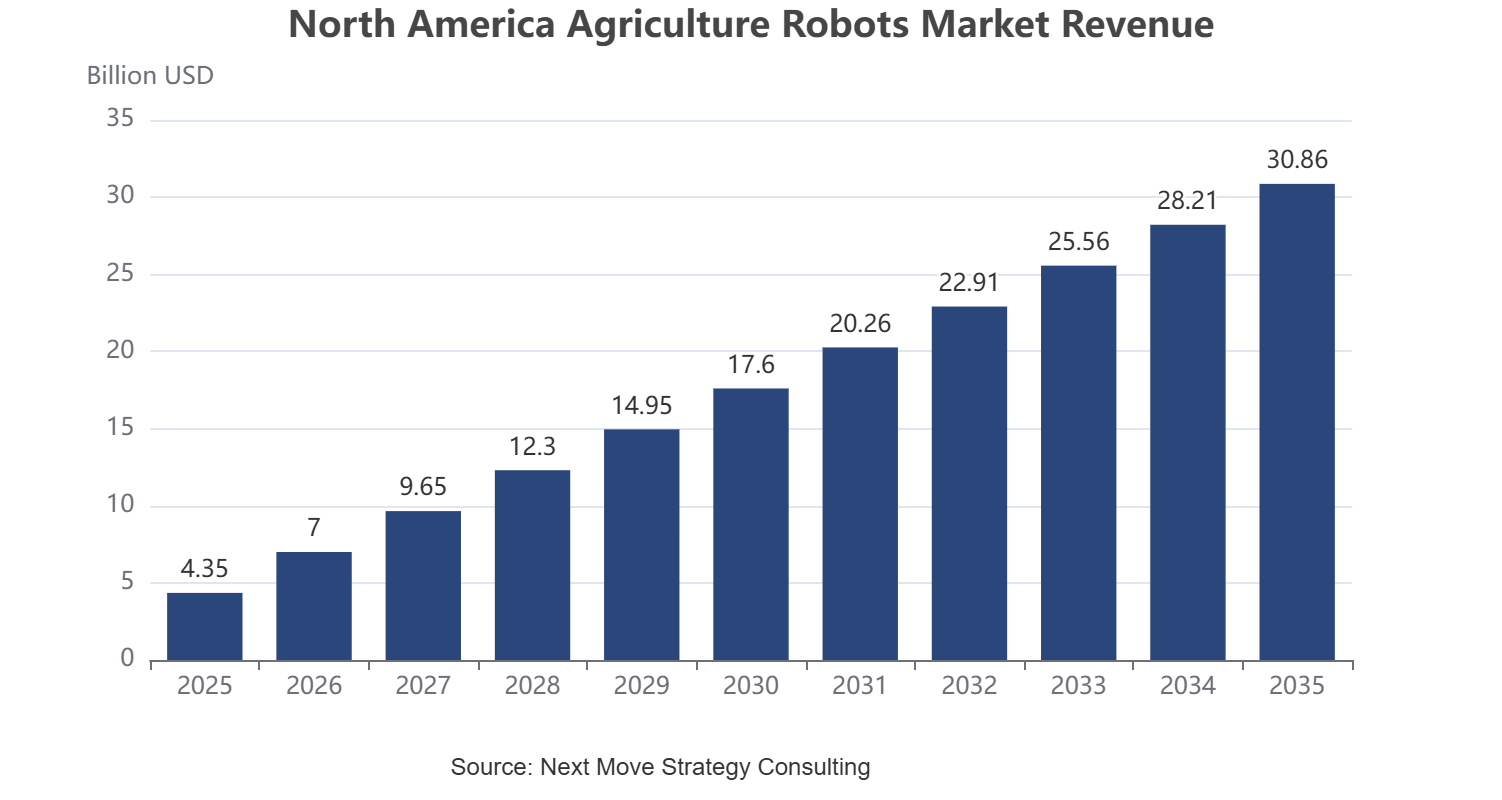
The North America Agriculture Robots Market was valued at USD 4.35 billion in 2025 and is expected to reach USD 5.79 billion in 2026. Driven by escalating farm labor shortages, accelerating agricultural automation programs across the United States and Canada, and growing integration of artificial intelligence into autonomous farming platforms, the market is projected to reach USD 30.86 billion by 2035, advancing at a CAGR of 20.44% from 2026 to 2035. In volume terms, the market was estimated at 30 thousand units in 2025 and is projected to increase from 44 thousand units in 2026 to 387 thousand units by 2035, registering a CAGR of 27.29% during the forecast period.
Ecosystem Analysis of the North America Agriculture Robots Market
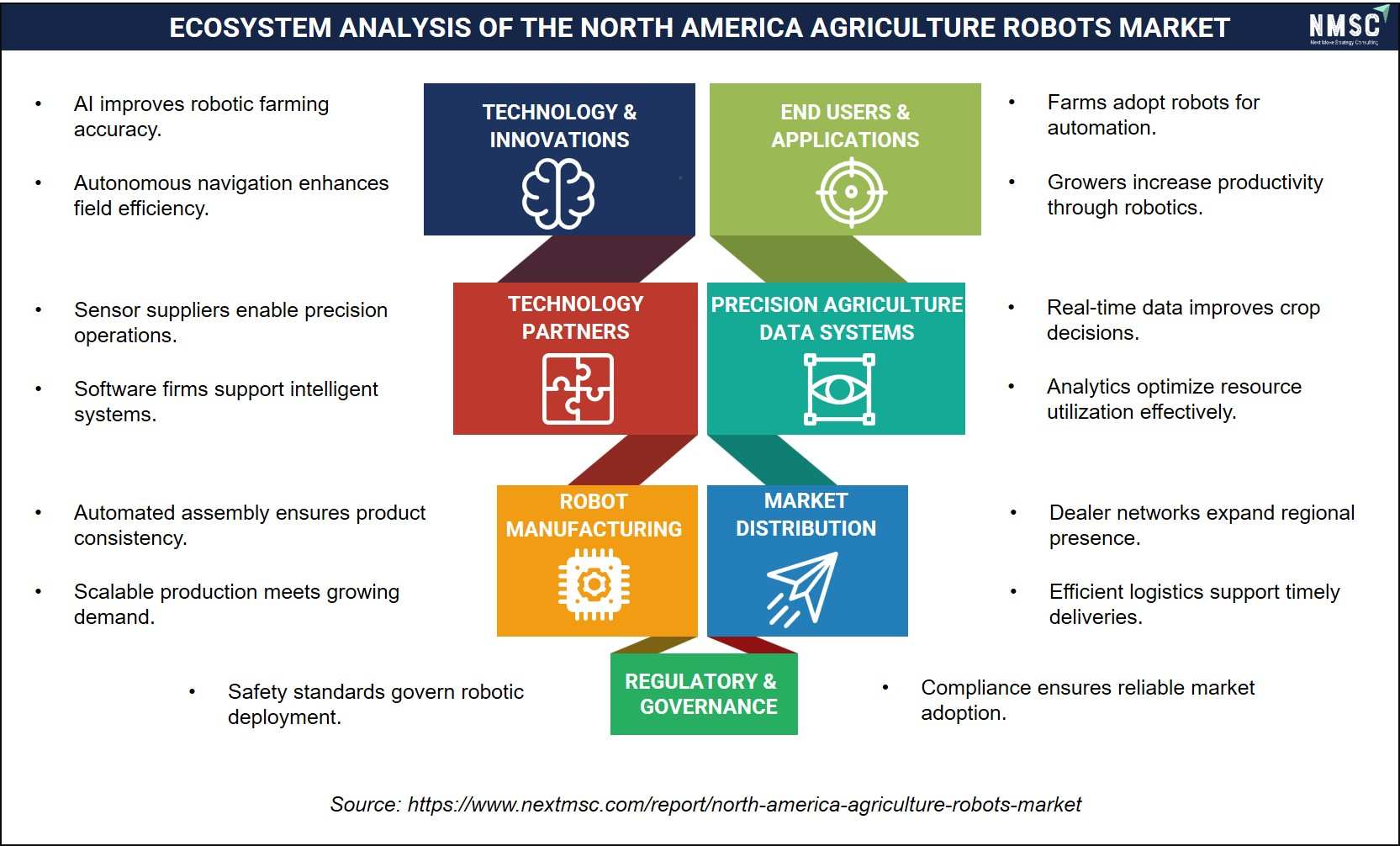
The ecosystem analysis highlights North America’s well-established agricultural robotics value chain, supported by advanced AI technologies, precision agriculture platforms, leading equipment manufacturers, and extensive distribution networks. Strong collaboration among technology providers, research institutions, and agricultural enterprises, combined with supportive regulatory frameworks and smart farming initiatives, accelerates innovation, strengthens commercial deployment, and promotes widespread adoption of agricultural robots across the region.
What Are the Key Growth Catalysts, Inhibitors, and Opportunities Shaping the North America Agriculture Robots Market?
Growth Catalyst & Risk Assessment Matrix
|
Drivers / Trends / Restraints |
(+/–) % Impact on CAGR Forecast |
Geographic Relevance |
Impact Timeline |
|
Persistent farm labor shortages continue to accelerate deployment of autonomous agricultural robots. |
+2.50% |
North America |
Short to medium term (1–4 years) |
|
Increasing deployment of precision agriculture technologies is driving demand for robotic farming solutions. |
+1.90% |
North America |
Medium term (2–5 years) |
|
Large commercial farms are investing heavily in automation to improve productivity and reduce operating costs. |
+2.10% |
North America |
Medium to long term (3–7 years) |
|
High upfront investment and maintenance costs limit adoption among smaller farms. |
-1.70% |
North America |
Short to medium term (1–4 years) |
|
Development of fully autonomous harvesting and crop management systems presents significant growth potential. |
+1.80% |
North America |
Medium term (2–5 years) |
The North America Agriculture Robots Market is shaped by a dynamic interplay of growth catalysts, restraints, and strategic opportunities that collectively define the competitive trajectory of the industry. Persistent labor shortages, widespread adoption of precision agriculture technologies, and robust commercial farm investment in automation are the primary forces driving market expansion. However, high capital expenditure requirements continue to constrain adoption among smaller farming operations. The emergence of fully autonomous harvesting and crop management systems simultaneously presents transformative growth opportunities across the forecast horizon.
Growth Driver
How Are Persistent Farm Labor Shortages Accelerating Adoption of Autonomous Agricultural Robots across North America?
The persistent shortage of agricultural labor across North America has emerged as one of the most critical structural challenges confronting the farming sector. Declining rural workforce availability, rising seasonal labor costs, and immigration policy constraints are compelling farm operators of all scales to invest in autonomous robotic systems. Agricultural robots provide consistent, scalable labor alternatives that effectively address workforce gaps across planting, harvesting, and monitoring operations. This structural imperative continues to serve as the most significant near-term demand catalyst for the North America Agriculture Robots Market throughout the forecast period.
How Is Increasing Deployment of Precision Agriculture Technologies Driving Demand for Robotic Farming Solutions in North America?
The widespread deployment of precision agriculture technologies across North American farms is fundamentally reshaping how agricultural operations manage resources and optimize yields. Integration of GPS guidance systems, IoT sensors, and AI-powered analytics with robotic platforms enables real-time data acquisition and evidence-based decision-making across all field operations. Robotic systems equipped with precision agriculture capabilities deliver measurable improvements in input efficiency, crop health monitoring, and irrigation management. This convergence of smart farming technologies and robotics is reinforcing market growth by expanding the functional utility of autonomous systems across diverse North American agricultural environments.
How Are Large Commercial Farms Investing Heavily in Automation to Improve Productivity and Reduce Operating Costs?
Large commercial farming enterprises across North America are significantly increasing their capital allocation toward agricultural automation, recognizing robotics as a critical lever for productivity enhancement and cost reduction. Corporate agri-businesses operating at scale are deploying autonomous tractor fleets, robotic harvest systems, and precision spraying platforms to optimize labor utilization and minimize input wastage. Strategic investments in farm management software integration further amplify the operational returns of robotic systems. This sustained capital commitment from large commercial farm operators is directly stimulating demand and accelerating innovation across the North America Agriculture Robots Market.
Growth Inhibitor:
How Do High Upfront Investment and Maintenance Costs Limit Adoption of Agricultural Robots among Smaller Farms in North America?
Despite compelling operational benefits, the high upfront cost of agricultural robotic systems remains a formidable adoption barrier, particularly for small and medium-sized farming operations across North America. Capital expenditure requirements for advanced robotic platforms, encompassing procurement, installation, system integration, and ongoing maintenance, routinely exceed financial thresholds viable for smaller enterprises. Limited access to affordable agricultural financing and insufficient government subsidy coverage further exacerbate adoption challenges. This economic constraint disproportionately affects farms operating on narrow profit margins, limiting broader market penetration and creating a bifurcation in technology adoption rates across the region.
Growth Opportunity:
How Does the Development of Fully Autonomous Harvesting and Crop Management Systems Present Significant Growth Potential for the North America Agriculture Robots Market?
The development of fully autonomous harvesting and crop management systems represents one of the most transformative growth opportunities available within the North America Agriculture Robots Market. Specialty crops such as fruits, vegetables, and berries have historically required intensive manual labor for delicate picking and handling operations, creating acute vulnerability to workforce shortages. Advanced autonomous systems incorporating computer vision, soft-grip robotics, and machine learning algorithms are increasingly capable of replicating complex manual actions. Deployment of such solutions across orchards, vineyards, and berry farms offers substantial revenue potential and addressable market expansion throughout the 2026–2035 forecast period.
Which Country is Dominating the North America Agriculture Robots Market?
Our comprehensive market assessment indicates that the United States holds the dominant share in the North America Agriculture Robots Market, supported by its highly mechanized agricultural sector, widespread adoption of precision farming technologies, and substantial investments in agricultural automation. The country benefits from the presence of leading agricultural equipment manufacturers, advanced AI and robotics capabilities, and a well-developed digital agriculture ecosystem. Growing adoption of autonomous tractors, robotic harvesting systems, precision spraying equipment, agricultural drones, and AI-powered crop monitoring technologies, coupled with increasing labor shortages and strong government support for smart farming initiatives, reinforces the United States’ position as the leading market for agriculture robots in North America.
Which Country is Set to Witness the Fastest Growth?
Based on our assessment of agricultural modernization trends and technology investments, Mexico is projected to witness the fastest growth in the North America Agriculture Robots Market during the forecast period. Rising labor shortages, increasing investments in precision agriculture, and growing adoption of automated farming technologies are driving demand for agricultural robots across the country. Expanding commercial farming operations, increasing deployment of robotic harvesting, precision spraying, and autonomous field monitoring solutions, coupled with government initiatives promoting agricultural productivity and sustainable farming practices, are expected to accelerate market expansion. Continued investments in agri-tech innovation and digital farming infrastructure are anticipated to further strengthen Mexico’s growth trajectory throughout the forecast period.
How Is the North America Agriculture Robots Market Segmented in This Report, and What Are the Key Insights from the Segmentation Analysis?
By Type
Which Robot Type Is Driving the Greatest Revenue Growth across the North America Agriculture Robots Market?
The North America Agriculture Robots Market by type is segmented into Unmanned Aerial Vehicles (UAVs), Milking Robots, Driverless Tractors, Automated Harvest Robots, and Others.
Among all robot types, Unmanned Aerial Vehicles (UAVs) and Automated Harvest Robots are emerging as the fastest-growing categories, driven by expanding use cases in crop monitoring, pesticide application, and precision harvesting across North American farmlands. Driverless Tractors maintain a strong revenue contribution given their broad applicability across field operations, while Milking Robots continue to gain adoption as dairy automation intensifies across the United States and Canada. The diversification of robotic platforms across functional categories is expanding addressable market segments and supporting sustained revenue growth throughout the forecast period.
By Application
Which Application Segment Holds the Largest Share of the North America Agriculture Robots Market Revenue?
By application, the North America Agriculture Robots Market is segmented into Aerial Monitoring & Scouting, Dairy & Livestock Automation, Field Operations, Harvest Management, and Others.
Field Operations represents a dominant application segment, encompassing plowing, seeding, field farming, and soil and irrigation management activities that benefit significantly from robotic automation across North American agricultural landscapes. Aerial Monitoring & Scouting is also experiencing strong growth, driven by UAV-enabled crop protection, weed control, and weather tracking capabilities. Harvest Management is emerging as a high-priority segment as intensifying labor shortages accelerate demand for automated picking and collection systems. Dairy & Livestock Automation, including milking and dairy management, continues to exhibit steady growth supported by expanding precision livestock technologies.
Key Segments
By Type
-
Unmanned Aerial Vehicles (UAVs)
-
Milking Robots
-
Driverless Tractors
-
Automated Harvest Robots
-
Others
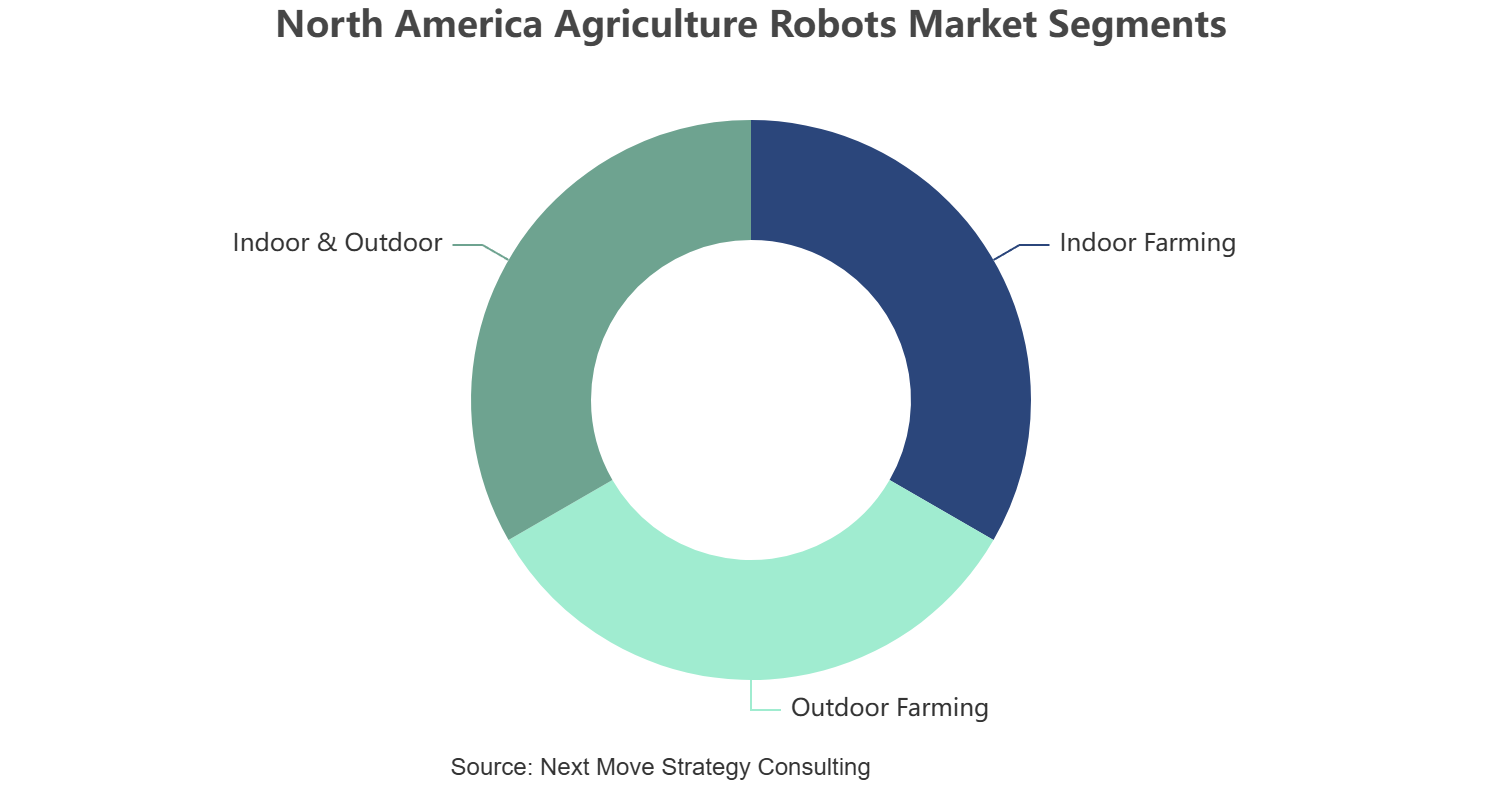
By Farming Type
-
Indoor Farming
-
Outdoor Farming
-
Indoor & Outdoor
By Application
-
Aerial Monitoring & Scouting
-
Crop Protection & Weed Control
-
Crop Scouting & Monitoring
-
Weather Tracking
-
Inventory Management
-
-
Dairy & Livestock Automation
-
Milking
-
Dairy Management
-
Shepherding and Herding
-
-
Field Operations
-
Plowing
-
Seeding
-
Field Farming
-
Soil & Irrigation Management
-
-
Harvest Management
-
Others
Competitive Landscape
The North America Agriculture Robots Market features a highly competitive landscape characterized by a mix of established multinational corporations, specialized agri-tech innovators, and emerging technology startups. Market participants are actively investing in research and development, strategic partnerships, and product diversification to strengthen their competitive positioning. The convergence of robotics, artificial intelligence, and precision agriculture is driving rapid product evolution, with companies competing on the basis of automation capabilities, cost efficiency, scalability, and seamless integration with existing farm management and data ecosystems.
Strategic Developments:
-
March 2026 - Solinftec announced a 243% increase in U.S. acreage, deployment of 100+ Solix autonomous robots, and showcased its next-generation Solix platform and commercial autonomous Refill Station at Commodity Classic 2026.
-
September 2025 - DeLaval and John Deere expanded the Milk Sustainability Center to additional countries and added dsm-firmenich as a strategic partner, strengthening connected dairy automation solutions used by North American dairy farms.
Key Players
-
John Deere
-
CNH Industrial
-
Kubota Corporation
-
Carbon Robotics, Inc.
-
Solinftec Participacoes S.A.
-
Monarch Tractor
-
GUSS Automation
-
Farm-ng Inc.
-
Verdant Robotics, Inc.
-
Burro (Augean Robotics, Inc.)
-
DeLaval Holding AB
-
GEA Group AG
-
BouMatic LLC
-
Ecorobotix SA
-
XAG Co., Ltd.
The competitive landscape of the North America Agriculture Robots Market includes global agricultural machinery leaders such as John Deere, CNH Industrial, and Kubota Corporation, which leverage extensive distribution networks to deploy scalable automation solutions. DeLaval Holding AB, GEA Group AG, and BouMatic LLC dominate dairy and livestock automation segments. Carbon Robotics, Inc., Verdant Robotics, Inc., and Ecorobotix SA advance precision weeding and crop management innovation. Monarch Tractor, Farm-ng Inc., and GUSS Automation compete in the autonomous tractor segment, while XAG Co., Ltd., Burro (Augean Robotics, Inc.), and Solinftec Participacoes S.A. expand the competitive landscape through innovative UAV and field automation platforms.
Consumer Behavior Analysis of the North America Agriculture Robots Market
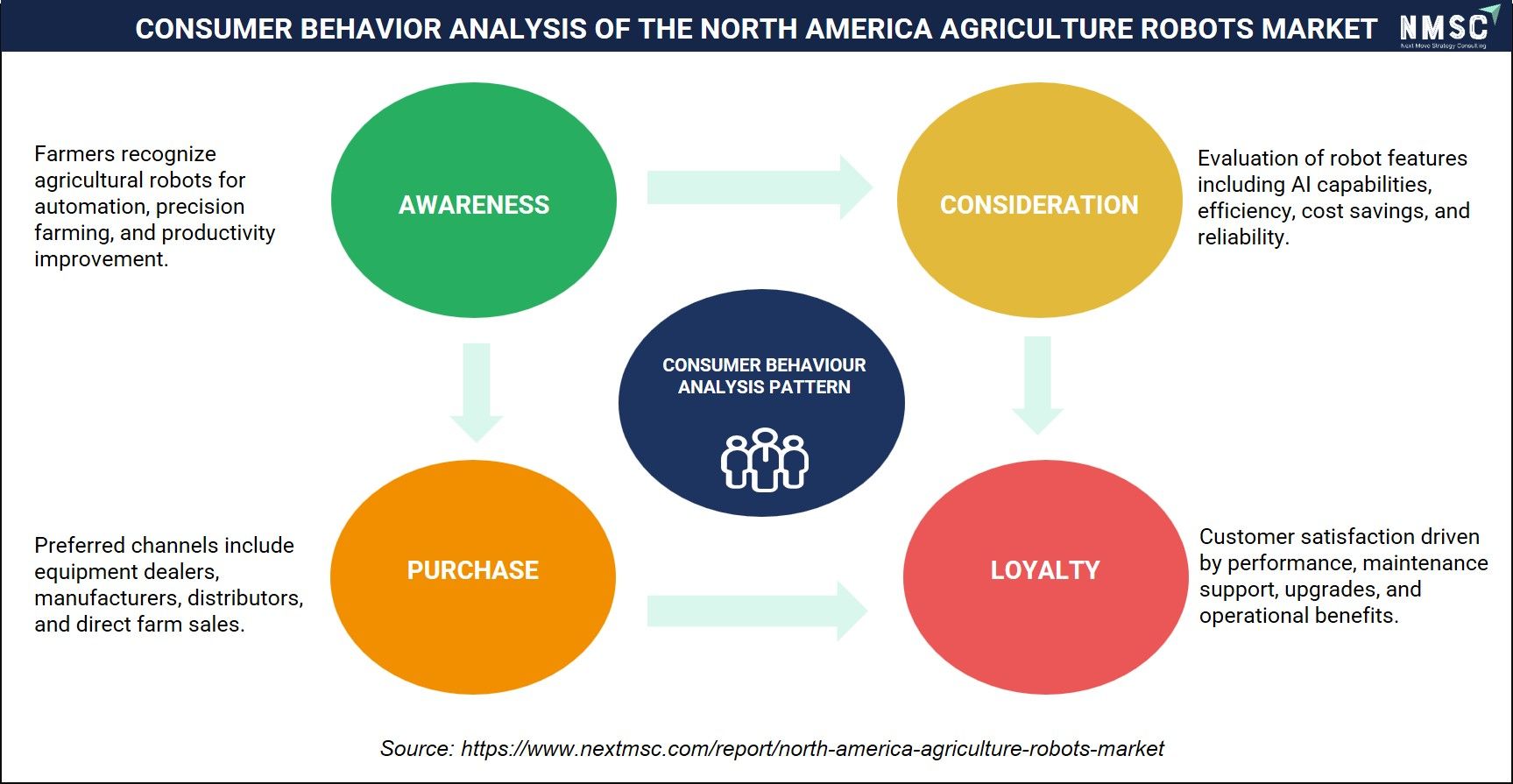
The consumer behavior analysis illustrates how North American farmers progress from awareness to long-term loyalty when adopting agricultural robots. Purchasing decisions are influenced by AI-enabled automation, precision farming capabilities, operational efficiency, and return on investment. Equipment dealers, manufacturers, distributors, and direct sales channels facilitate procurement, while reliable technical support, software upgrades, and consistent field performance drive customer retention and repeat adoption.
Key Benefits for Stakeholders
This report delivers comprehensive market intelligence for stakeholders across the North America Agriculture Robots Market, enabling informed strategic decision-making. Industry participants, including manufacturers, technology developers, and agricultural enterprises, benefit from detailed segmentation analysis, competitive benchmarking, and growth opportunity identification. Investors and venture capital firms gain access to rigorous market sizing and revenue forecasting data spanning the 2026–2035 forecast period, facilitating accurate investment evaluation and portfolio management in the rapidly evolving agricultural automation sector.
Policymakers and regulatory bodies can leverage the report’s insights to develop evidence-based frameworks that support sustainable agricultural automation adoption across North America. Research institutions and academic organizations benefit from the report’s comprehensive analysis of market trends, innovation trajectories, and technology adoption patterns. The customizable nature of the report’s segmentation structure enables stakeholders to tailor analytical outputs to specific regional, product, or application requirements, enhancing the relevance and applicability of market intelligence across diverse organizational and operational contexts.
|
Parameters |
Details |
|
Customization Scope |
Free customization (equivalent to up to 80 analyst-working hours) after purchase. |
|
Pricing and Purchase Options |
Avail customized purchase options to meet your exact research needs. |
|
Approach |
In-depth primary and secondary research; proprietary databases; rigorous quality control and validation measures. |
|
Analytical Tools |
Porter’s Five Forces, SWOT, value chain, and Harvey ball analysis to assess competitive intensity, stakeholder roles, and relative impact of key factors. |
Conclusion
The North America Agriculture Robots Market is poised for exceptional growth, underpinned by persistent labor shortages, advancing precision agriculture technologies, and robust commercial farm investment in automation. With revenue projected to grow from USD 5.79 billion in 2026 to USD 30.86 billion by 2035 at a CAGR of 20.44%, the market presents compelling opportunities across robotic platforms, applications, and geographies. Competitive dynamics continue to intensify as established multinational players and emerging innovators collaborate to deliver specialized autonomous solutions, positioning North America as a global leader in agricultural robotics throughout the forecast period.
About the Author
 Mihul Sharma
— Mihul Sharma is Research Associate at Next Move Strategy Consulting, where he has covered technology, industrial, and healthcare markets for 3 years. His work applies structured business research, market analysis, and secondary-source review to assess market trends, competitive developments, and growth opportunities. He supports report development by fully synthesizing industry data, company information, and market signals into concise findings for strategy and investment-focused research teams.
Mihul Sharma
— Mihul Sharma is Research Associate at Next Move Strategy Consulting, where he has covered technology, industrial, and healthcare markets for 3 years. His work applies structured business research, market analysis, and secondary-source review to assess market trends, competitive developments, and growth opportunities. He supports report development by fully synthesizing industry data, company information, and market signals into concise findings for strategy and investment-focused research teams.
About the Reviewer
 Supradip Baul
— Supradip Baul is an accomplished business consultant and strategist with over a decade of rich experience in market intelligence, strategy, technology, and business transformation. His work has included rigorous qualitative and quantitative analysis across multiple industries, helping clients shape investment decisions and long-term roadmaps. Earlier in his career, he was associated with Gartner, where he contributed to industry-leading reports and market share analyses. He has worked with leading global companies and holds an MBA with a dual specialization in Marketing and Finance.
Supradip Baul
— Supradip Baul is an accomplished business consultant and strategist with over a decade of rich experience in market intelligence, strategy, technology, and business transformation. His work has included rigorous qualitative and quantitative analysis across multiple industries, helping clients shape investment decisions and long-term roadmaps. Earlier in his career, he was associated with Gartner, where he contributed to industry-leading reports and market share analyses. He has worked with leading global companies and holds an MBA with a dual specialization in Marketing and Finance.
At Next Move Strategy Consulting, we understand that insightful market research is the cornerstone of successful business decisions. That's why we employ a robust and multifaceted approach, combining various methodologies to deliver the most accurate and actionable data for our clients.

Research Landscape
We navigate the world of research with two primary approaches:
Qualitative Approach
Our qualitative research methodologies involve immersive techniques such as in-depth interviews, focus groups, and observational studies. By engaging directly with individuals and stakeholders, we uncover valuable insights that quantitative data alone may overlook.

Quantitative Research
In tandem with qualitative methodologies, NMSC leverages the power of Quantitative Research to provide a robust foundation of numerical insights. Through systematic data collection and analysis, we quantify patterns, preferences, and market trends, offering a comprehensive view of the business landscape.
Our quantitative research approach employs diverse tools, including surveys, experiments, and statistical modelling. These methodologies enable us to gather data from a large and representative sample, ensuring the statistical significance of our findings. By employing structured questionnaires and standardized data collection methods, we guarantee the reliability and validity of the information we present to our clients.
Quantitative research is particularly effective in measuring the prevalence of trends, assessing market size, and gauging the impact of various factors on consumer behavior. The numerical precision attained through this approach equips our clients with actionable insights, facilitating data-driven decision-making and strategy formulation.


Our Specialized Toolbox for Industry-Specific Market Research
We deploy a specialized arsenal of techniques tailored to meet your unique requirements. Here's a glimpse into our comprehensive toolbox:

Information Procurement
The stage entails acquiring market data or relevant information through various sources and methodologies.


Market Research Approach
We utilize both top-down and bottom-up approaches in market research analysis to achieve a comprehensive understanding of the market dynamics, leveraging the broad perspective of industry trends and macroeconomic factors alongside detailed insights from specific segments and individual companies.

Porters Five Forces Analysis
We conduct Porter's Five Forces analysis to evaluate the competitive landscape of an industry, providing us with insights into factors that affect profitability and strategic positioning.

SWOT Analysis

Forecasting
We utilize a forecasting model to predict future consumption by considering parameters like population, economics, regulations, market competition, drivers, constraints, technology, and pricing. We also employ statistical techniques such as multilinear regression, exponential smoothing, moving average, ARIMA, and Monte Carlo simulations for accurate predictions. In econometric forecasting, we analyzed short-term and long-term event impacts, attributing values based on regulatory frameworks, economic factors, and market events.





 Speak to Our Analyst