PARP Inhibitors Market Global Industry Analysis and Forecast (2026–2035)

The global PARP Inhibitors Market is estimated at USD 12.29 Billion in 2026 and is projected to reach USD 30.42 Billion by 2035, growing at a CAGR of 10.6% from 2026 to 2035. Growth is driven by expanding cancer indications, combination therapies, and increasing biomarker testing.

Download Free Sample PDF
Base Year (2025)
$12.29 Billion
Forecast (2035)
$30.42 Billion
CAGR (2026-2035)
10.6%
Top Region
North America

What Is the PARP Inhibitors Market Size?
The global PARP inhibitors market size reached USD 10.28 Billion in 2025 and is estimated at USD 12.29 Billion in 2026, forecast to reach USD 30.42 Billion by 2035 at a CAGR of 10.6% between 2026 and 2035. North America leads with an approximate 48% share, while PARP1/2 Inhibitors dominate the drug class segment at approximately 82% share in 2025.

We observed that expanding homologous recombination repair biomarker testing is broadening the eligible patient pool for PARP inhibitor therapy across ovarian, breast, prostate, and pancreatic cancers, sustaining demand even as first-generation agents face growing regional and generic competitive pressure in select geographies.

PARP Inhibitors Market Global Industry Analysis and Forecast (2026–2035) Revenue Forecast

Values in USD Billion

2025 $10.28 Billion
2025
2026 $12.29 Billion
2026
2027 $13.59 Billion
2027
2028 $15.03 Billion
2028
2029 $16.63 Billion
2029
2030 $18.39 Billion
2030
2031 $20.34 Billion
2031
2032 $22.49 Billion
2032
2033 $24.88 Billion
2033
2034 $27.52 Billion
2034
2035 $30.42 Billion
2035

Key Takeaways

By Drug Class: PARP1/2 Inhibitors held the largest share, expanding from USD 8.43 billion in 2025 to USD 23.12 billion by 2035; Next-Generation PARP Inhibitors is the fastest-growing sub-segment at 14.2% CAGR from 2026–2035.

By Cancer Indication: Ovarian Cancer held the largest share, expanding from USD 4.93 billion in 2025 to USD 12.17 billion by 2035; Prostate Cancer is the fastest-growing sub-segment at 15.2% CAGR from 2026–2035.

By End User: Hospitals and Cancer Treatment Centers held the largest share, expanding from USD 6.68 billion in 2025 to USD 17.64 billion by 2035; Specialty and Retail Pharmacies is the fastest-growing sub-segment at 13.0% CAGR from 2026–2035.

Dominant Region: North America dominated with approximately 48% revenue share in 2025.

Fastest-Growing Region: Asia-Pacific is expected to register the highest CAGR of 15.2% during 2026–2035.

Dominant Country: The U.S. led the market, anchored by concentrated Lynparza and Talzenna prescribing and deep homologous recombination repair testing infrastructure.

Fastest-Growing Country: India is the fastest-growing country, supported by expanding oncology infrastructure and rising genetic testing access.

The market presents an absolute investment opportunity of approximately USD 18.13 Billion between 2026 and 2035, calculated as the difference between the 2035 forecast of USD 30.42 Billion and the 2026 base of USD 12.29 Billion, positioning next-generation selective PARP inhibitors and combination regimens as a high-conviction category for oncology drug developers and specialty pharmacy investors.

According to NMSC analysis, the segment's momentum stems from the convergence of expanding treatment-line indications with combination regimens pairing PARP inhibitors alongside androgen receptor pathway inhibitors and anti-angiogenic agents, which is extending duration of therapy and total addressable spend per patient well beyond original maintenance-only positioning.

What does the PARP Inhibitors Market Encompass?

The PARP inhibitors market covers oral small-molecule poly polymerase inhibitors used as monotherapy and combination therapy across ovarian, breast, prostate, and pancreatic cancers, alongside companion diagnostic testing, treatment planning, and specialty pharmacy dispensing services delivered through hospitals, cancer treatment centers, and specialty pharmacies. We observed that the market has evolved from a narrow BRCA-mutated maintenance therapy niche into a broader homologous recombination repair-directed treatment class as clinical indications have expanded into unselected and combination-therapy patient populations.
Our findings suggest that regulatory pathways emphasizing companion diagnostic co-approval are structurally shaping commercial access, as agencies increasingly require validated BRCA and homologous recombination repair mutation testing before prescribing. Technology adoption trends toward next-generation, selective PARP-trapping inhibitors are further improving tolerability profiles relative to first-generation agents, supporting continued combination-regimen expansion across androgen receptor pathway inhibitor and anti-angiogenic co-therapies in both originator and licensed commercial models.

Market Drivers & Dynamics

Interactive Dataset
Expanding clinical indications for PARP inhibitor combination regimens driver +3.2% North America, Europe 2026–2035
Rising homologous recombination repair and BRCA biomarker testing adoption driver +2.4% Global 2026–2032
Confirmatory trial-driven conversion of accelerated approvals to full approvals driver +1.6% North America 2026–2030
China domestic PARP inhibitor development and reimbursement inclusion driver +1.3% Asia-Pacific 2026–2035
Expansion of specialty pharmacy distribution for oral oncology therapies driver +1.1% North America, Europe 2026–2033
Generic and regionally developed PARP inhibitor competition in price-sensitive markets restraint −1.3% Asia-Pacific, Latin America 2026–2035
High treatment cost limiting adoption in low reimbursement-coverage markets restraint −1.0% Middle East & Africa, Latin America 2026–2035
Hematologic toxicity and myelosuppression management burden restraint −0.6% Global 2026–2031
Reimbursement restrictions for unselected non-HRR mutated patient populations restraint −0.5% North America, Europe 2026–2032
Source: Next Move Strategy Consulting

Growth Drivers

Growth Inhibitors

Segmentation Analysis

2025 (USD Billion)
2035 (USD Billion)
PARP1/2 Inhibitors 2025: $8.43 Billion | 2035: $23.12 Billion
PARP1/2 Inhi
Next-Generation PARP Inhibitors 2025: $1.85 Billion | 2035: $7.30 Billion
Next-Generat
PARP1/2 Inhibitors $8.43 Billion $23.12 Billion 9.7%
Next-Generation PARP Inhibitors $1.85 Billion $7.30 Billion 14.2%

Which Drug Class Dominates the PARP Inhibitors Market?

2025 (USD Billion)
2035 (USD Billion)
Ovarian Canc
Breast Cance
Prostate Can
Pancreatic C
Other Solid
Segment Item 2025 (USD Billion) 2035 (USD Billion) CAGR
Ovarian Cancer $10.0 USD Billion $40.0 USD Billion 19.0%
Breast Cancer $17.1 USD Billion $51.1 USD Billion 17.0%
Prostate Cancer $24.2 USD Billion $62.2 USD Billion 23.0%
Pancreatic Cancer $31.3 USD Billion $73.3 USD Billion 13.0%
Other Solid Tumours $38.4 USD Billion $84.4 USD Billion 26.0%

Segment-wise data is locked

Unlock complete segment-wise numbers for By Cancer Indication.

Unlock Full Data

Which Cancer Indication Leads and Which Grows Fastest?

2025 (USD Billion)
2035 (USD Billion)
Hospitals an
Specialty an
Others (Acad
Segment Item 2025 (USD Billion) 2035 (USD Billion) CAGR
Hospitals and Cancer Treatment Centers $10.0 USD Billion $40.0 USD Billion 26.0%
Specialty and Retail Pharmacies $17.1 USD Billion $51.1 USD Billion 16.0%
Others (Academic and Research Institutes) $24.2 USD Billion $62.2 USD Billion 18.0%

Segment-wise data is locked

Unlock complete segment-wise numbers for By End User.

Unlock Full Data

Which End User Leads and Which Grows Fastest?

2025 (USD Billion)
2035 (USD Billion)
Maintenance
Combination
Monotherapy
Segment Item 2025 (USD Billion) 2035 (USD Billion) CAGR
Maintenance Therapy $10.0 USD Billion $40.0 USD Billion 11.0%
Combination Therapy $17.1 USD Billion $51.1 USD Billion 25.0%
Monotherapy $24.2 USD Billion $62.2 USD Billion 23.0%

Segment-wise data is locked

Unlock complete segment-wise numbers for By Treatment Line.

Unlock Full Data
2025 (USD Billion)
2035 (USD Billion)
Hospital Pha
Retail Pharm
Online and S
Segment Item 2025 (USD Billion) 2035 (USD Billion) CAGR
Hospital Pharmacies $10.0 USD Billion $40.0 USD Billion 25.0%
Retail Pharmacies $17.1 USD Billion $51.1 USD Billion 19.0%
Online and Specialty Pharmacies $24.2 USD Billion $62.2 USD Billion 25.0%

Segment-wise data is locked

Unlock complete segment-wise numbers for By Distribution Channel.

Unlock Full Data

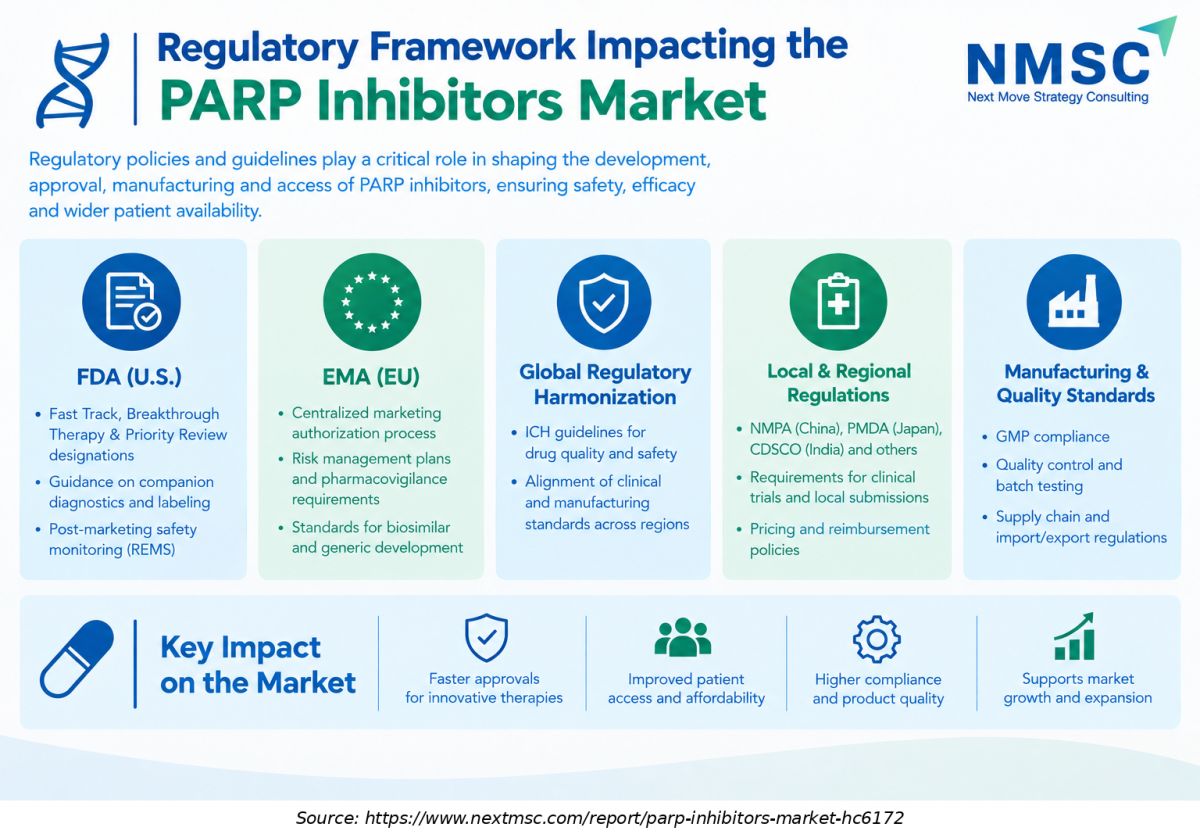
Regulatory Framework Impacting the PARP Inhibitors Market

The Regulatory Framework infographic for the PARP Inhibitors Market highlights key requirements covering drug approval, clinical trials, patient safety, labelling, manufacturing standards, companion diagnostics, and post-market surveillance. It illustrates how regulatory frameworks influence the development, approval, and adoption of PARP inhibitor therapies.

Growth Opportunities

Our analysis shows that three whitespace opportunities stand out for PARP inhibitor developers and licensees positioning ahead of 2035 demand.

Can Expanded Prostate Cancer Combination Indications Unlock New Patient Volume?

Manufacturers that expand PARP inhibitor combination indications for metastatic castration-resistant prostate cancer, building on TALAPRO-2 and TRITON3 confirmatory data, can capture patient volume previously reserved for chemotherapy-based regimens, benefiting the Prostate Cancer indication segment as combination-therapy treatment lines continue moving earlier in the treatment pathway.

Does Next-Generation Selective PARP Inhibitor Development Create Value in Price-Sensitive Markets?

Developers that advance selective, next-generation PARP inhibitors with improved tolerability and regional manufacturing scale, following the fuzuloparib and pamiparib model, can capture rising reimbursement-driven demand in Asia-Pacific markets, benefiting the Next-Generation PARP Inhibitors segment as national reimbursement catalogue inclusion continues expanding patient access.

Can Specialty Pharmacy Distribution Expansion Improve Access for Maintenance Therapy Patients?

Companies that expand specialty pharmacy distribution networks and patient support programs can capture rising demand from long-duration maintenance therapy patients managing oral PARP inhibitor regimens at home, benefiting the Specialty and Retail Pharmacies end-user segment as outpatient management of stable, chronic-course ovarian and breast cancer patients continue to grow.

Regional Outlook

2025 (USD Billion)
2035 (USD Billion)
North Americ
Asia-Pacific
Europe
Latin Americ
Middle East
Region 2025 (USD Billion) 2035 (USD Billion) CAGR (%)
North America $10.0 USD Billion $40.0 USD Billion 9.0%
Asia-Pacific $17.1 USD Billion $51.1 USD Billion 27.0%
Europe $24.2 USD Billion $62.2 USD Billion 25.0%
Latin America $31.3 USD Billion $73.3 USD Billion 23.0%
Middle East & Africa $38.4 USD Billion $84.4 USD Billion 12.0%

Regional data is locked

Unlock complete regional numbers for this market.

Unlock Full Data

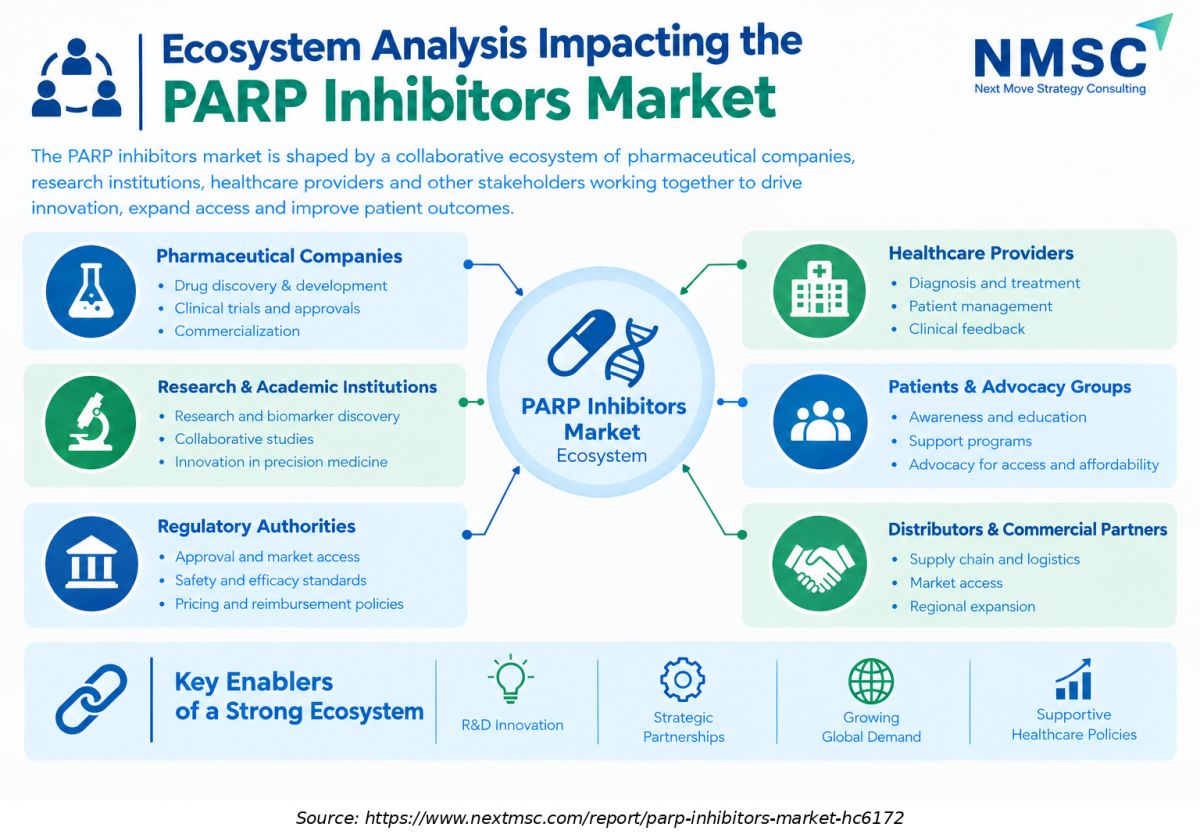
Ecosystem Analysis

The Ecosystem Analysis infographic for the PARP Inhibitors Market highlights key stakeholders including pharmaceutical companies, biotechnology firms, research institutions, clinical trial organizations, diagnostic providers, oncologists, hospitals, regulatory bodies, and patients. It illustrates their interconnected roles across drug development, clinical research, diagnosis, treatment, and patient care.

Competitive Landscape

Our assessment indicates that the competitive landscape spans diversified oncology originators, licensed regional commercialization partners, and China-based domestic PARP inhibitor developers, each competing on clinical indication breadth, combination-regimen depth, and companion diagnostic and reimbursement access. Key Takeaways How Do Companies Compete in the PARP Inhibitors Market Industry? Companies compete primarily on clinical indication breadth across ovarian, breast, prostate, and pancreatic cancers, depth of combination-regimen clinical evidence supporting full regulatory approval, and strength of companion diagnostic and national reimbursement relationships. Our findings suggest that originators with confirmatory trial-backed combination indications hold a structural advantage over single indication competitors, since prescribers increasingly favour agents with the broadest validated treatment-line evidence.

Dimension Description
Dimension Assessment
Market Structure Highly consolidated; a small set of originator and licensed-partner companies hold the substantial majority of Market Share, led by an integrated combination-therapy leader alongside established regional and China-domestic specialists
Innovation Focus Expanded combination-regimen indications, confirmatory trial-driven full approval conversions, next-generation selective PARP inhibitor development, and China-domestic reimbursement-focused commercialization
M&A Activity Selective asset transfers and licensing arrangements, including Clovis Oncology's 2023 bankruptcy-driven sale of Rubraca rights to pharma& Schweiz GmbH, rather than large-scale consolidation among established manufacturers

How Do Companies Compete in the PARP Inhibitors Market Industry?

Companies compete primarily on clinical indication breadth across ovarian, breast, prostate, and pancreatic cancers, depth of combination-regimen clinical evidence supporting full regulatory approval, and strength of companion diagnostic and national reimbursement relationships. Our findings suggest that originators with confirmatory trial-backed combination indications hold a structural advantage over single indication competitors, since prescribers increasingly favour agents with the broadest validated treatment-line evidence.

Which Competitive Archetypes Dominate the PARP Inhibitors Market?

Diversified oncology originators such as AstraZeneca and Pfizer dominate through combination-regimen leadership spanning multiple tumour types and treatment lines, while licensed regional partners including Merck & Co. and Zai Lab differentiate through territory-specific commercialization and distribution depth. China-based domestic developers such as Jiangsu Hengrui Pharmaceuticals and Be One Medicines compete on localized manufacturing, national reimbursement inclusion, and price-competitive positioning underserved by multinational originators.

What Innovation and Differentiation Strategies Define Competitive Positioning?

We observed that innovation strategy increasingly centers on confirmatory trial evidence generation to convert accelerated approvals into full approvals, as demonstrated by rucaparib's December 2025 regulatory conversion, alongside development of selective next-generation agents offering improved tolerability. Differentiation increasingly depends on breadth of combination-therapy partnerships with androgen receptor pathway inhibitors and anti-angiogenic agents rather than standalone monotherapy positioning.

Key Market Players

Our assessment identifies eight companies that meet NMSC's verification criteria for direct development, production, or branded commercialization rights in the PARP inhibitors market as of 2026, presented in ranked order by verifiable market-specific revenue or commercialization scale.

AstraZeneca plc GSK plc Pfizer Inc. Merck & Co., Inc. Jiangsu Hengrui Pharmaceuticals Co., Ltd. Zai Lab Limited BeOne Medicines Ltd. Pharma& Schweiz GmbH

Latest Developments

We found that recent regulatory and commercial developments continue to expand approved PARP inhibitor indications and reinforce combination-therapy positioning across major markets.

Date Event
July 2026 Pfizer announced FDA Priority Review of its supplemental application for TALZENNA plus XTANDI in HRR gene-altered metastatic castration-sensitive prostate cancer
December 2025 Zai Lab announced renewal of ZEJULA (niraparib) in China’s 2025 National Reimbursement Drug List for maintenance treatment of adults with platinum-sensitive first-line and recurrent ovarian cancer

Expert Insights

Gerhardt Attard

MD, PhD, FRCP, John Black Charitable Foundation Endowed Chair in Urological Cancer Research | University College London

"This is the first study to show efficacy for PARP inhibition and androgen receptor pathway inhibition in metastatic castration-sensitive prostate cancer."

Analyst Interpretation

The statement reflects expansion of PARP inhibitor use into earlier stages of prostate cancer and into combination regimens with androgen-receptor pathway therapies. This development broadens the potential therapeutic applications of PARP inhibition and supports continued research into combination approaches for tumours carrying homologous-recombination-repair alterations.

Investment Opportunities

How Are Capital Inflows Supporting PARP Inhibitor Development?

Capital inflows continue supporting PARP inhibitor development through combination-trial investment and confirmatory study funding required to convert accelerated approvals into full approvals. AstraZeneca and Pfizer's continued Phase III investment in combination regimens, evidenced by the TALAPRO-2 and TRITON3 confirmatory trials, reflects sustained originator capital commitment toward expanding validated treatment-line indications across prostate and other solid tumour types.

What Infrastructure Investment Is Needed to Support Market Growth?

Infrastructure investment in homologous recombination repair and BRCA biomarker testing capacity remains essential to supporting market growth, particularly in Asia-Pacific and Latin America markets where formal genetic testing infrastructure continues to scale. Industry-derived estimates suggest that expanding companion diagnostic laboratory networks and specialty pharmacy distribution capacity will be necessary to fully capture rising combination-therapy demand across emerging markets through 2035.

How Do ESG Considerations Shape Investment in the PARP Inhibitors Market?

Environmental, Social, and Governance considerations increasingly shape investment decisions through expanded patient access programs and reimbursement equity initiatives in lower-income markets. We observed that national reimbursement catalogue inclusion in China and Vision 2030-linked healthcare investment in Saudi Arabia reflect governance aligned efforts to broaden equitable access to PARP inhibitor therapy beyond concentrated high income market availability.

Key Benefits for Stakeholders

How Does This Report Benefit Oncology Drug Developers and Industry Leaders?

This report benefits oncology drug developers and industry leaders by providing validated market sizing, segmentation, and competitive intelligence needed to prioritize combination-regimen indication expansion and companion diagnostic partnerships. Our analysis, data, and forecasts support strategic resource allocation decisions across drug class, cancer indication, and regional investment priorities through the 2026–2035 forecast period.

How Does This Report Benefit Investors and Financial Analysts?

This report benefits investors and financial analysts by quantifying the absolute dollar investment opportunity and CAGR trajectory across drug class, cancer indication, and regional segments, supporting informed capital allocation decisions. Our findings on competitive landscape structure and M&A activity, including the Clovis Oncology-to-pharma& asset transfer, provide strategic context for evaluating originator and licensed-partner investment risk.

How Does This Report Benefit Specialty Pharmacy and Diagnostic Technology Vendors?

This report benefits specialty pharmacy and companion diagnostic technology vendors by identifying the fastest-growing end-user and regional segments where distribution and testing infrastructure investment will generate the highest returns. Our regional analysis and country-level insights support strategic market-entry sequencing for vendors expanding homologous recombination repair testing and specialty dispensing capacity into Asia-Pacific and Latin America markets.

Key Market Segments Evaluated

By Drug Class

  • PARP1/2 Inhibitors 
    • Olaparib
    • Niraparib
    • Talazoparib
    • Rucaparib
  • Next-Generation PARP Inhibitors 
    • Fuzuloparib
    • Pamiparib
    • Others

By Cancer Indication

  • Ovarian Cancer
  • Breast Cancer
  • Prostate Cancer
  • Pancreatic Cancer
  • Other Solid Tumours

By Treatment Line

  • Maintenance Therapy
  • Combination Therapy
  • Monotherapy

By Distribution Channel

  • Hospital Pharmacies
  • Retail Pharmacies
  • Online and Specialty Pharmacies

By End User

  • Hospitals and Cancer Treatment Centers
  • Specialty and Retail Pharmacies
  • Others (Academic and Research Institutes)

By Region

  • North America 
    • U.S.
    • Canada
    • Mexico.
  • Europe 
    • UK
    • Germany
    • France
    • Italy
    • Spain
    • Sweden
    • Denmark
    • Finland
    • Netherlands
    • Rest of Europe.
  • Asia-Pacific 
    • China
    • India
    • Japan
    • South Korea
    • Taiwan
    • Indonesia
    • Vietnam
    • Australia
    • Philippines
    • Malaysia
    • Rest of APAC.
  • Middle East & Africa 
    • Saudi Arabia
    • UAE
    • Egypt
    • Israel
    • Turkey
    • Nigeria
    • South Africa
    • Rest of MEA.
  • Latin America 
    • Brazil
    • Argentina
    • Chile
    • Colombia
    • Rest of LATAM.

Conclusion & Recommendations

The long-term outlook for the PARP inhibitors market remains favourable through 2035, supported by expanding combination-regimen indications, confirmatory trial-driven full approval conversions, and growing homologous recombination repair biomarker testing infrastructure. We expect Next-Generation PARP Inhibitors and Prostate Cancer indications to continue outpacing overall market growth as selective agents and combination regimens mature across both originator and China-domestic developer portfolios.

What Strategic Positioning Should Companies Pursue?

Companies should pursue strategic positioning that prioritizes combination-regimen clinical evidence generation and companion diagnostic partnership depth over standalone monotherapy differentiation. Our assessment indicates that originators building the broadest validated treatment-line portfolio across ovarian, breast, prostate, and pancreatic cancers will sustain competitive advantage as reimbursement and prescribing decisions increasingly favour agents with the most extensive confirmatory trial evidence base.

How Attractive Is the Market for New Investment?

The market presents strong investment attractiveness given its 10.6% forecast CAGR and USD 18.13 Billion absolute opportunity between 2026 and 2035, concentrated in Next-Generation PARP Inhibitors and Prostate Cancer indication segments. Industry-derived estimates suggest that Asia-Pacific offers the highest risk-adjusted growth potential given its 15.2% regional CAGR, though originators must navigate generic and domestic competitive pressure in price-sensitive reimbursement environments.

What Market Shifts and Key Risks Should Stakeholders Monitor?

Stakeholders should monitor the shift toward China-domestic PARP inhibitor development as a structural risk to originator revenue in price-sensitive Asia-Pacific markets, alongside generic competitive pressure affecting first-generation agents. We observed that reimbursement restrictions for unselected non-HRR mutated patient populations in North America and Europe also represent a persistent risk to unconstrained volume growth across combination-regimen indications.

What Are the Key Growth Pathways Through 2035?

Key growth pathways through 2035 include continued combination-regimen indication expansion in prostate and pancreatic cancers, next-generation selective PARP inhibitor development targeting improved tolerability, and deepened specialty pharmacy distribution for long-duration maintenance therapy patients. Our findings suggest that companies combining broad confirmatory trial evidence with expanding companion diagnostic and reimbursement access will capture the largest share of forecast market growth.

FAQs

About the Author

Mayurima Roy

Mayurima Roy

Mayurima Roy is Research Analyst at Next Move Strategy Consulting, where she has spent 4 years working across the firm's full industry coverage rather than a single fixed vertical. Her work centers on structured research, ongoing trend tracking, competitive assessment, and insight-led content development, translating complex market data into clear, decision-ready narratives that support informed client decision-making across diverse global industries, market sectors, and world regions every day.

About the Reviewer

Supradip Baul

Supradip Baul

Supradip Baul is an accomplished business consultant and strategist with over a decade of rich experience in market intelligence, strategy, technology, and business transformation. His work has included rigorous qualitative and quantitative analysis across multiple industries, helping clients shape investment decisions and long-term roadmaps. Earlier in his career, he was associated with Gartner, where he contributed to industry-leading reports and market share analyses. He has worked with leading global companies and holds an MBA with a dual specialization in Marketing and Finance.

Download Free Sample

Amos Chang

AMOS CHANG

Strategy Consultant

Kardex Group

I have bought the intralogistics market reports from NMSC two times so far. Joseph and his team are always very helpful and flexible in responding to any customization requirements on the report. Their expertise in market reports really helps us steer the day-to-day business. I will definitely recommend and come back myself whenever there is a need.

Gustaf Hummel Burstrom

GUSTAF HUMMEL BURSTROM

Founder

Revline Tools AB

Joseph and the team at Next Move Strategy Consulting have been excellent to work with, in supplying us with relevant market data and forecasts for our specific category. We had some special requirements and they were able to do a custom package to suit our needs. We would definitely recommend them to any other company needing market data and forecasts

Nishant Awate

NISHANT AWATE

Business Development Global Sales

Zehnder Group Deutschland GmbH

Our experience working with Next Move Strategy Consulting was positive. The team was responsive, professional, and open to incorporating our specific requirements throughout the project. The India AHU market study was comprehensive and well structured, covering market value and volume forecasts, product and application segments, and key industry trends. The inclusion of both AHU and residential MVHR market insights made the study particularly relevant for our strategic market assessment. Overall, the report provides a solid foundation for evaluating market potential, identifying priority segments, and supporting business-development decisions in India.

Kishu Kanda

KISHU KANDA

Strategy Analyst

Accenture

We purchased the AI Consumer Market Report from this company. Not only did they customize the report to meet our specific requirements, but they also showed great flexibility in accommodating our budget. The report we received fully met our expectations. Additionally, they provided prompt and thorough responses to both our pre-purchase and follow-up questions. We look forward to working with this company again in the future.

Gaurav Jaiswal

GAURAV JAISWAL

Founder & CEO

Yano Charge Private Limited

The EV Charging market research report provided by the NextMSC was exceptionally detailed and insightful. It offered a comprehensive analysis that proved to be a game-changer for our strategic planning. Truly a testament to the NextMSC’s expertise and thoroughness in EV market landscape & analysis.

Custom Market Research Services

We will customize the research for you if the listed report does not fully match your requirements.

Get 30% Free Customization

Select License

This website uses cookies to ensure you get the best experience on our website. Learn more

✖