Solar Panel Recycling Market Global Industry Analysis and Forecast (2026–2035)

The global Solar Panel Recycling Market size was valued at USD 390.0 million in 2025 and is estimated at USD 425.0 million in 2026, forecast to reach USD 1,150.0 million by 2035, expanding at an 11.4% CAGR from 2026 to 2035. Key drivers include rising early-generation utility-scale panel decommissioning volumes and advancing high-purity silicon and silver recovery technologies, supported by expanding extended producer responsibility regulations and increasing end-of-life panel volumes, with Europe leading the global market.

Download Free Sample PDF
Base Year (2025)
$390.0 Million
Forecast (2035)
$1,150.0 Million
CAGR (2026-2035)
11.4%
Top Region
Europe

What Is the Solar Panel Recycling Market Size?

The global solar panel recycling market size was valued at USD 390.0 million in 2025 and is estimated at USD 425.0 million in 2026, forecast to reach USD 1,150.0 million by 2035, expanding at an 11.4% CAGR between 2026 and 2035. Europe leads with approximately 42% share, while Mechanical Recycling dominates all other process segments with approximately 56% share.

We observed that growth is broad-based across every segmentation axis, with chemical recycling adoption and utility-scale decommissioning volume driving the dominant structural shifts through 2035.

Solar Panel Recycling Market Global Industry Analysis and Forecast (2026–2035) Revenue Forecast
Values in USD Million

2025 $390.0 Million
2025
2026 $434.5 Million
2026
2027 $484.0 Million
2027
2028 $539.2 Million
2028
2029 $600.6 Million
2029
2030 $669.1 Million
2030
2031 $745.4 Million
2031
2032 $830.3 Million
2032
2033 $925.0 Million
2033
2034 $1,030.5 Million
2034
2035 $1,150.0 Million
2035

Key Takeaways

By Process: Mechanical Recycling held the largest share of approximately 56% (USD 218.4 million) in 2025; Chemical Recycling is the fastest-growing sub-segment at 17.4% CAGR from 2026–2035.

By Panel Type: Crystalline Silicon Panels held the largest share of approximately 86% (USD 335.4 million) in 2025; Thin-Film Panels is the fastest-growing sub-segment at 14.9% CAGR from 2026–2035.

By Recycling Source: End-of-Life Decommissioning held the largest share of the recycling source category in 2025; End-of-Life Decommissioning is also the fastest-growing sub-segment through 2035 as early-generation installed capacity reaches end of warranty life.

By Material Recovered: Glass held the largest share of the material recovered category in 2025 by recovered mass; Silicon and Metals is the fastest-growing sub-segment through 2035 on rising high-value material extraction technology adoption.

By Application: Utility-Scale Solar held the largest share of approximately 52% (USD 202.8 million) in 2025; Utility-Scale Solar is also the fastest-growing sub-segment at 13.1% CAGR from 2026–2035.

Dominant Region: Europe dominated with approximately 42% revenue share (USD 163.8 million) in 2025.

Fastest-Growing Region: Asia-Pacific is expected to register the highest CAGR of 14.1% during 2026–2035.

Dominant Country: U.S. led with approximately USD 62.4 million in 2025.

Fastest-Growing Country: India is the fastest-growing country at approximately 20.6% CAGR from 2026–2035.

Market Opportunity: The solar panel recycling market is expected to create an absolute dollar opportunity of USD 725.0 million between 2026 and 2035, presenting significant investment potential across the utility-scale decommissioning, material recovery, and circular supply chain value chain.

According to Next Move Strategy Consulting analysis, dedicated recyclers are increasingly signing multi-year recycling services agreements directly with utility-scale solar asset owners rather than relying on spot volume, a shift that favors high-throughput, high-recovery-rate operators over conventional bulk glass-and-frame recyclers as early-generation installed capacity approaches end-of-warranty decommissioning through 2035.

What Does the Solar Panel Recycling Market Encompass?
The solar panel recycling market encompasses mechanical, thermal, and chemical recovery processes that extract glass, aluminum, silicon, and precious metals from end-of-life, defective, and manufacturing-scrap photovoltaic modules, forming a downstream circular economy segment of the broader solar photovoltaic market. Our assessment indicates that the scope spans crystalline silicon and thin-film panel types collected from utility-scale, commercial and industrial, and residential installations. The category has evolved from low-value bulk glass and frame recovery into high-value silicon and precious metal extraction as recovery technology matures.
Regulatory frameworks such as extended producer responsibility mandates and hazardous waste handling requirements for cadmium telluride thin-film modules shape collection and processing obligations across regulated markets. We observed that technology adoption is shifting toward chemical and thermal extraction processes capable of recovering high-purity silicon and silver rather than bulk glass and aluminum alone. Next Move Strategy Consulting's analysis indicates that this structural shift, combined with rising utility-scale decommissioning volume, is redefining processing economics across the market.

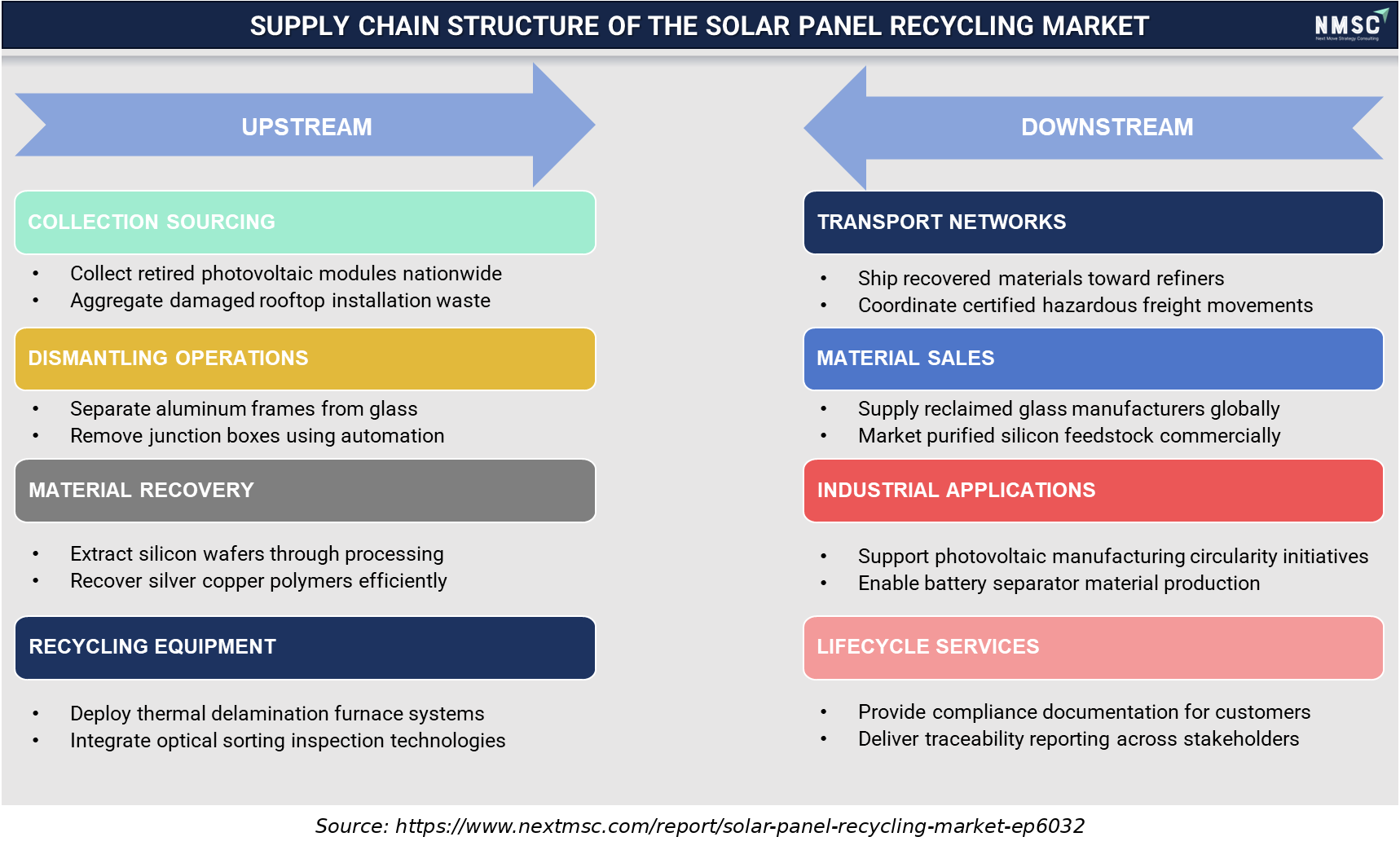
Supply Chain Structure of the Solar Panel Recycling Market
Supply Chain Structure of the Solar Panel Recycling Market
The solar panel recycling market supply chain begins with collecting end-of-life photovoltaic (PV) modules from residential, commercial, and utility-scale installations. Recyclers then dismantle panels and recover valuable materials such as glass, silicon, aluminium, copper, and silver using advanced processing technologies. The recovered materials are transported to manufacturers and refiners for reuse in new industrial applications, while lifecycle services ensure regulatory compliance, material traceability, and support circular economy initiatives.

Market Drivers & Dynamics

Interactive Dataset
Rising early-generation utility-scale panel decommissioning volume driver +2.4% Europe, North America 2026–2035
Expanding extended producer responsibility regulation driver +2.1% Europe 2026–2035
Growing high-purity silicon and silver recovery technology adoption driver +1.8% Europe, North America 2026–2033
Increasing long-term recycling services agreements with asset owners driver +1.6% North America, Europe 2026–2035
Rising Asia-Pacific installed base approaching end-of-life driver +1.9% Asia-Pacific 2027–2035
Expanding high-throughput dedicated recycling facility capacity driver +1.2% North America, Europe 2026–2033
High processing cost relative to landfill disposal in unregulated markets restraint −1.3% Asia-Pacific, Latin America 2026–2035
Limited collection infrastructure in emerging markets restraint −0.8% Latin America, Middle East & Africa 2026–2032
Cadmium telluride hazardous waste handling compliance costs restraint −0.5% North America 2026–2035
Source: Next Move Strategy Consulting

Growth Drivers

What Is the Primary Growth Driver of the Solar Panel Recycling Market?

Rising early-generation utility-scale panel decommissioning volume is the primary driver of the market. Panels installed during the early 2010s solar deployment wave are approaching typical 25 to 30 year operational lifespans, generating growing end-of-life volume. We observed that this structural demand, reinforced by expanding extended producer responsibility regulation across Europe, continues to anchor baseline utility-scale and commercial and industrial recycling demand.

How Is High-Purity Recovery Technology Driving Solar Panel Recycling Market Growth?
High-purity silicon and silver recovery technology is accelerating market growth toward higher-value chemical and thermal processing routes. ROSI's industrial recycling line at its Alpes facility, capable of recovering high-purity materials from end-of-life panels, illustrates the scale of technology investment entering the market. Our assessment indicates that this shift, combined with SOLARCYCLE's 2026 high-throughput Georgia facility, is compressing the cost gap between recycling and conventional disposal.

Growth Inhibitors

What Is Restraining Solar Panel Recycling Market Expansion?

High processing cost relative to landfill disposal in unregulated markets restrains broader recycling adoption outside jurisdictions with extended producer responsibility mandates. Limited collection infrastructure in emerging markets further constrains volume aggregation needed for economically viable processing. We found that this cost and infrastructure barrier is concentrating near-term recycling volume in Europe and North America, where regulatory mandates and asset owner sustainability commitments offset the cost differential versus disposal.

Segmentation Analysis

2025 (USD Million)
2035 (USD Million)
Mechanical Recycling 2025: $218.4 Million | 2035: $552.0 Million
Mechanical R
Thermal Recycling 2025: $109.2 Million | 2035: $310.5 Million
Thermal Recy
Chemical Recycling 2025: $62.4 Million | 2035: $287.5 Million
Chemical Rec
Mechanical Recycling $218.4 Million $552.0 Million 9.8%
Thermal Recycling $109.2 Million $310.5 Million 11.2%
Chemical Recycling $62.4 Million $287.5 Million 17.4%

Which Process Segment Dominates the Solar Panel Recycling Market?

Mechanical Recycling led the market with USD 218.4 million in 2025, supported by its established role as the lowest-cost entry point for glass, aluminum frame, and junction box separation across most recycling facilities. We observed that Chemical Recycling is the fastest-growing process segment, expanding at a 17.4% CAGR from 2026 to 2035, as recyclers including ROSI scale high-purity silicon and silver extraction capacity to capture higher-value recovered materials.

2025 (USD Million)
2035 (USD Million)
Crystalline
Thin-Film Pa
Cadmium Tell
Copper Indiu
Segment Item 2025 (USD Million) 2035 (USD Million) CAGR
Crystalline Silicon Panels $10.0 USD Million $40.0 USD Million 25.0%
Thin-Film Panels $17.1 USD Million $51.1 USD Million 11.0%
Cadmium Telluride Panels $24.2 USD Million $62.2 USD Million 25.0%
Copper Indium Gallium Selenide Panels $31.3 USD Million $73.3 USD Million 11.0%

Segment-wise data is locked

Unlock complete segment-wise numbers for By Panel Type.

Unlock Full Data

Which Panel Type Leads Solar Panel Recycling Market Demand?

Crystalline Silicon Panels remained the leading panel type within the market, valued at USD 335.4 million in 2025 given their dominant share of cumulative global installed photovoltaic capacity. Our findings suggest that Thin-Film Panels are the fastest-growing panel type, registering a 14.9% CAGR from 2026 to 2035, as cadmium telluride module volumes from manufacturers including First Solar reach end-of-life and require specialized hazardous material handling and recovery processes.

2025 (USD Million)
2035 (USD Million)
End-of-Life
Manufacturin
Warranty and
Segment Item 2025 (USD Million) 2035 (USD Million) CAGR
End-of-Life Decommissioning $10.0 USD Million $40.0 USD Million 27.0%
Manufacturing Scrap $17.1 USD Million $51.1 USD Million 9.0%
Warranty and Defective Returns $24.2 USD Million $62.2 USD Million 19.0%

Segment-wise data is locked

Unlock complete segment-wise numbers for By Recycling Source.

Unlock Full Data
2025 (USD Million)
2035 (USD Million)
Glass
Silicon
Metals
Other Materi
Segment Item 2025 (USD Million) 2035 (USD Million) CAGR
Glass $10.0 USD Million $40.0 USD Million 14.0%
Silicon $17.1 USD Million $51.1 USD Million 24.0%
Metals $24.2 USD Million $62.2 USD Million 22.0%
Other Materials $31.3 USD Million $73.3 USD Million 12.0%

Segment-wise data is locked

Unlock complete segment-wise numbers for By Material Recovered.

Unlock Full Data
2025 (USD Million)
2035 (USD Million)
Utility-Scal
Commercial a
Residential
Segment Item 2025 (USD Million) 2035 (USD Million) CAGR
Utility-Scale Solar $10.0 USD Million $40.0 USD Million 24.0%
Commercial and Industrial Solar $17.1 USD Million $51.1 USD Million 22.0%
Residential Solar $24.2 USD Million $62.2 USD Million 20.0%

Segment-wise data is locked

Unlock complete segment-wise numbers for By Application.

Unlock Full Data

Which Application Segment Leads Solar Panel Recycling Volume?

Utility-Scale Solar remained the leading application within the market, valued at USD 202.8 million in 2025 given the concentrated volume generated by large-scale solar farm decommissioning and repowering projects. Our analysis shows that Utility-Scale Solar is also the fastest-growing application segment, registering a 13.1% CAGR from 2026 to 2035, as contracted recycling services agreements, exemplified by SOLARCYCLE's 2025 agreement with RWE Clean Energy, concentrate volume growth in large-scale decommissioning projects.

2025 (USD Million)
2035 (USD Million)
North Americ
Canada
Mexico)
Europe (UK
Germany
Segment Item 2025 (USD Million) 2035 (USD Million) CAGR
North America (U.S. $10.0 USD Million $40.0 USD Million 23.0%
Canada $17.1 USD Million $51.1 USD Million 9.0%
Mexico) $24.2 USD Million $62.2 USD Million 19.0%
Europe (UK $31.3 USD Million $73.3 USD Million 13.0%
Germany $38.4 USD Million $84.4 USD Million 10.0%

Segment-wise data is locked

Unlock complete segment-wise numbers for By Region.

Unlock Full Data

Growth Opportunities

Our analysis shows that three forward-looking opportunities stand out for stakeholders positioning within the market over the 2026–2035 forecast period.

How Can High-Purity Silicon Reclamation Unlock Value for Chemical Recyclers?

High-purity silicon and silver reclamation presents a whitespace opportunity for chemical recyclers seeking to supply reclaimed material back into module manufacturing supply chains. Recyclers that replicate ROSI's industrial-scale high-purity recovery model stand to capture premium pricing as module manufacturers seek certified recycled-content silicon and silver to meet sustainability and supply chain resilience commitments.

Where Does Utility-Scale Decommissioning Contracting Create New Revenue for Dedicated Recyclers?

Utility-scale asset owners planning repowering and decommissioning represent an underpenetrated opportunity for dedicated recyclers offering contracted, high-volume processing capacity. Recyclers that replicate SOLARCYCLE's 2025 RWE Clean Energy agreement model stand to capture recurring, multi-year contracted revenue as early-generation utility-scale installations approach end-of-warranty decommissioning across major solar-producing markets.

How Can Manufacturer Take-Back Partnerships Benefit Thin-Film Recycling Specialists?

Thin-film module manufacturers represent an underpenetrated opportunity for recycling specialists offering cadmium telluride-compliant hazardous material handling capability. Recyclers that secure manufacturer take-back program partnerships, following the pattern of First Solar's established recycling infrastructure, can differentiate with module producers pursuing extended producer responsibility compliance ahead of tightening thin-film disposal regulation.

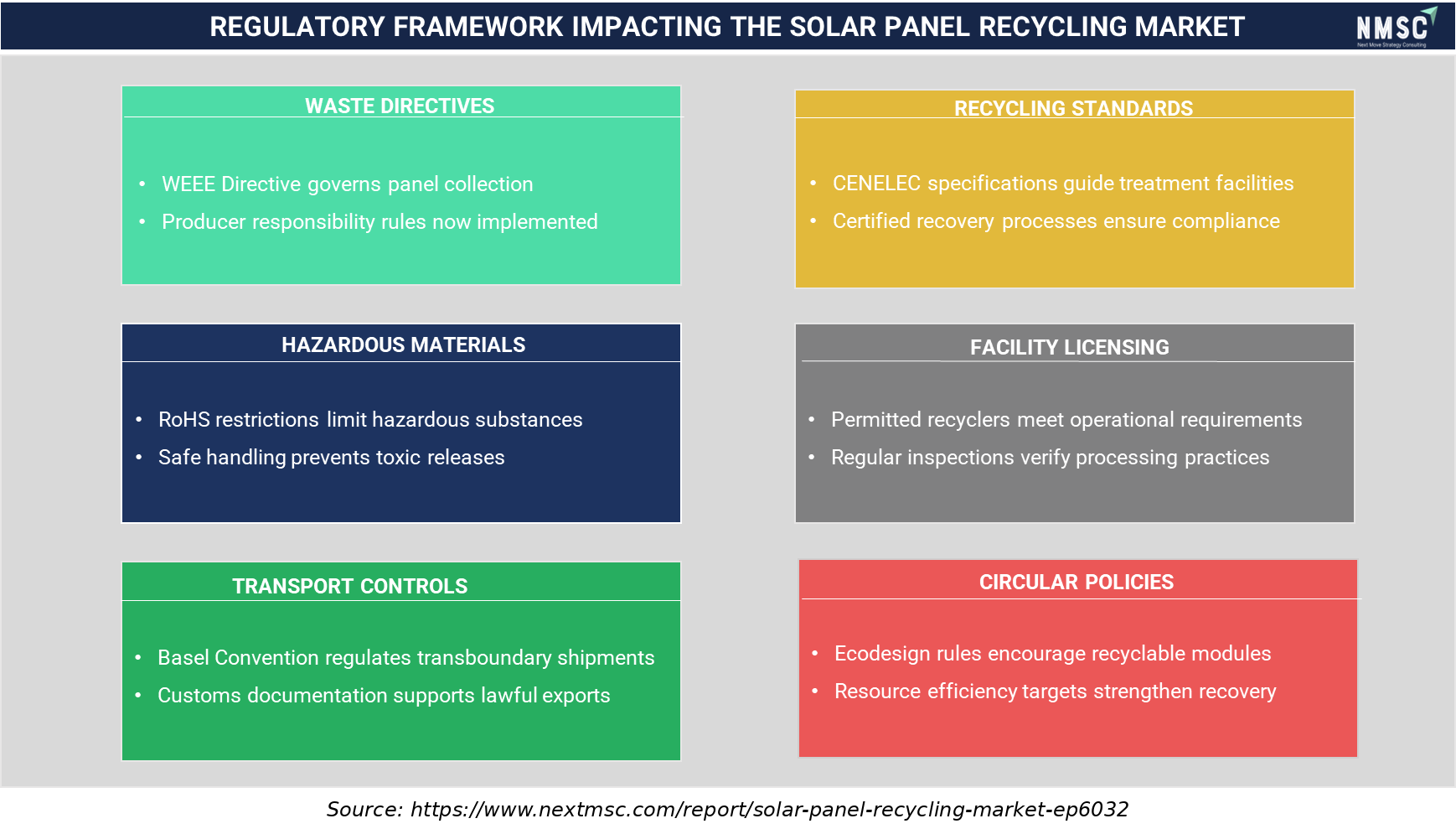
Regulatory Framework Impacting the Solar Panel Recycling Market

The market is shaped by regulations governing electronic waste management, hazardous material handling, recycling standards, transportation, and circular economy policies. Frameworks such as the WEEE Directive, RoHS, Basel Convention, and ecodesign requirements encourage responsible collection, safe processing, high material recovery rates, and compliant cross-border movement of end-of-life photovoltaic modules, fostering sustainable recycling infrastructure and resource efficiency.

Regional Outlook

2025 (USD Million)
2035 (USD Million)
Europe
Asia-Pacific
North Americ
Latin Americ
Middle East
Region 2025 (USD Million) 2035 (USD Million) CAGR (%)
Europe $10.0 USD Million $40.0 USD Million 9.0%
Asia-Pacific $17.1 USD Million $51.1 USD Million 27.0%
North America $24.2 USD Million $62.2 USD Million 25.0%
Latin America $31.3 USD Million $73.3 USD Million 23.0%
Middle East & Africa $38.4 USD Million $84.4 USD Million 12.0%

Regional data is locked

Unlock complete regional numbers for this market.

Unlock Full Data

Competitive Landscape

We observed that the market features a fragmented, emerging competitive landscape, with diversified environmental services majors competing alongside dedicated PV recycling specialists on recovery-rate performance and processing scale. Key Takeaways

Dimension Description
Market Structure Fragmented; the top companies profiled in this report collectively account for a meaningful share of global solar panel recycling market revenue, while numerous regional processors serve niche collection and bulk recycling demand.
Innovation Focus High-purity silicon and silver recovery, high-throughput facility scaling, and contracted decommissioning services dominate current innovation pipelines across leading recyclers.
M&A Activity Selective capacity expansion and strategic partnerships, exemplified by SOLARCYCLE's May 2025 Recycling Services Agreement with RWE Clean Energy, reflecting contracted-volume growth rather than large-scale consolidation.

How Do Companies Compete in the Solar Panel Recycling Market?

Companies compete primarily on recovery-rate performance, processing scale, and contracted volume security across the industry. Diversified environmental services majors such as Veolia and SUEZ leverage broad waste management infrastructure to serve multinational utility-scale clients, while dedicated PV recycling specialists such as SOLARCYCLE and ROSI compete on high-purity material recovery technology and manufacturer or asset owner take-back partnerships.

Which Competitive Archetypes Dominate the Solar Panel Recycling Market?

Two archetypes dominate the market: diversified environmental services majors offering broad, multi-waste-stream processing infrastructure, and dedicated PV recycling specialists focused exclusively on high-value photovoltaic material recovery. Veolia and SUEZ exemplify the diversified archetype through combined waste management and PV recycling capability, while SOLARCYCLE and ROSI exemplify the specialist archetype through purpose-built, high-recovery-rate processing technology.

How Are Companies Differentiating Through Innovation in Solar Panel Recycling?

Innovation and differentiation strategy increasingly center on high-purity material recovery and facility throughput scale. ROSI's industrial-scale high-purity recovery line and SOLARCYCLE's 2026 Georgia facility, recovering approximately 96 percent of panel value, illustrate how leading recyclers differentiate through measurable recovery-rate performance. Our analysis shows that recyclers unable to demonstrate high-purity, high-recovery-rate processing risk exclusion from utility-scale asset owner and manufacturer take-back program shortlists.

What M&A and Expansion Activity Is Shaping the Solar Panel Recycling Market?

Contracted service agreements and facility expansion continue to shape competitive positioning within the industry more than large-scale consolidation. SOLARCYCLE's May 2025 Recycling Services Agreement with RWE Clean Energy and its 2026 Georgia facility expansion illustrate how dedicated recyclers are securing contracted volume ahead of capacity buildout, while manufacturer-operated programs including First Solar's continue to expand collection infrastructure globally.

Key Market Players

Our assessment indicates that the following 20 companies are actively shaping recovery technology, processing capacity, and collection infrastructure within the global solar panel recycling market.

First Solar, Inc. Veolia Environnement SA SUEZ S.A. SOLARCYCLE, Inc. ROSI Reiling GmbH & Co. KG Sims Limited (Sims Lifecycle Services) SK tes (part of SK ecoplant Co., Ltd.) We Recycle Solar Rinovasol Global Services B.V. Reclaim PV Recycling Pty Ltd PV Industries Pty Ltd SILCONTEL LTD Etavolt Pte. Ltd. The Retrofit Companies, Inc. Cleanlites Recycling, Inc. Envaris GmbH Tozero GmbH Silrec Corporation NPC Incorporated

Latest Developments

We found that recent developments within the solar panel recycling market are concentrated on facility expansion and contracted service agreements, reflecting the industry's shift from pilot-scale to industrial-scale processing capacity.

Date Event
September 2024 Canadian Solar partnered with SOLARCYCLE to provide cradle-to-cradle recycling services for end-of-life photovoltaic (PV) modules in the U.S. The collaboration enables customers to bundle solar panel recycling with new module purchases, promoting a circular economy and reducing PV waste.

Investment Opportunities

What Capital Inflows Are Targeting the Solar Panel Recycling Market?

Capital inflows into the solar panel recycling market are increasingly directed toward high-purity recovery technology and high-throughput facility construction. ROSI's 2025 and 2026 fundraising to build its Spain facility illustrates the scale of capital committed to expanding high-purity silicon and silver recovery capacity. We observed that investors favor recyclers demonstrating contracted, multi-year volume commitments, viewing agreements such as SOLARCYCLE's RWE Clean Energy contract as a proxy for long-term revenue visibility.

How Is Infrastructure Investment Supporting Solar Panel Recycling Capacity?

Infrastructure investment is expanding high-throughput processing capacity to support rising utility-scale decommissioning demand. SOLARCYCLE's 2026 Georgia facility, scaling toward 5 gigawatts of annual processing capacity, exemplifies the scale of capital committed to industrial-scale recycling infrastructure. Our findings suggest that recyclers are investing in automated separation and chemical extraction capacity to support both crystalline silicon and thin-film module processing across North America, Europe, and Asia-Pacific.

What ESG Considerations Are Shaping Solar Panel Recycling Investment Decisions?

Environmental considerations are central to investment decisions across the industry, with recovery-rate transparency and circular supply chain integration as key criteria. First Solar's documented 90 percent-plus material recovery rate illustrates the scale of verification now expected of manufacturer take-back programs. We found that investors increasingly favor recyclers with certified, high-recovery-rate processing, treating it as a governance indicator alongside hazardous material handling compliance.

Key Benefits for Stakeholders

How Does This Report Benefit Enterprise and Industry Leaders?

Enterprise and industry leaders gain access to validated segmentation, competitive benchmarking, and regional demand forecasts that support sourcing and portfolio decisions across the solar panel recycling industry. Our analysis shows that detailed process, panel type, and application breakdowns help procurement teams align specifications with regulatory and recovery-rate requirements while identifying underserved segments for portfolio expansion.

How Does This Report Benefit Investors and Financial Analysts?

Investors and financial analysts benefit from consistent, single-point market size and CAGR estimates that support valuation and capital-allocation decisions across the solar panel recycling supply chain. We observed that the report's regional and segment-level growth differentials help identify which recyclers are best positioned to capture above-market growth in Asia-Pacific and chemical recycling categories through 2035.

How Does This Report Benefit Technology Vendors and Product Teams?

Technology vendors and product teams gain insight into emerging processing requirements, including high-purity chemical extraction, automated mechanical separation, and thin-film hazardous material handling, that are reshaping the industry. Our findings suggest that this analysis helps R&D teams prioritize development roadmaps around recovery-rate improvement and contracted-volume processing capability increasingly required by utility-scale asset owner and manufacturer specifications.

Key Market Segments Evaluated

By Process

  • Mechanical Recycling
  • Thermal Recycling
  • Chemical Recycling

By Panel Type

  • Crystalline Silicon Panels
  • Thin-Film Panels

By Recycling Source

  • End-of-Life Decommissioning
  • Manufacturing Scrap
  • Warranty and Defective Returns

By Material Recovered

  • Glass
  • Silicon
  • Metals
  • Other Materials

By Application

  • Utility-Scale Solar
  • Commercial and Industrial Solar
  • Residential Solar

By Region

  • North America (U.S.
  • Canada
  • Mexico)
  • Europe (UK
  • Germany
  • France
  • Italy
  • Spain
  • Sweden
  • Denmark
  • Finland
  • Netherlands
  • Rest of Europe)
  • Asia-Pacific (China
  • India
  • Japan
  • South Korea
  • Taiwan
  • Indonesia
  • Vietnam
  • Australia
  • Philippines
  • Malaysia
  • Rest of APAC)
  • Middle East & Africa (Saudi Arabia
  • UAE
  • Egypt
  • Israel
  • Turkey
  • Nigeria
  • South Africa
  • Rest of MEA)
  • Latin America (Brazil
  • Argentina
  • Chile
  • Colombia
  • Rest of LATAM)

Conclusion & Recommendations

The long-term outlook remains favorable, with the market expected to expand from USD 425.0 million in 2026 to USD 1,150.0 million by 2035 at an 11.4% CAGR. We observed that this trajectory rests on rising early-generation panel decommissioning volume, expanding high-purity recovery technology adoption, and growing extended producer responsibility regulation that together sustain demand across the forecast period.

What Strategic Positioning Should Stakeholders Pursue?

Stakeholders should pursue high-recovery-rate, contracted-volume strategies combined with high-purity chemical extraction capability to compete against conventional bulk disposal alternatives. Our assessment indicates that recyclers integrating contracted asset owner agreements with high-purity recovery technology, following the pattern of SOLARCYCLE's RWE Clean Energy agreement and ROSI's Alpes facility, are best positioned to secure long-term utility-scale and manufacturer contracts across the solar panel recycling market.

How Attractive Is the Solar Panel Recycling Market for New Investment?

The solar panel recycling industry presents an attractive investment case, supported by a USD 725.0 million absolute dollar opportunity between 2026 and 2035 and above-average growth in Asia-Pacific and chemical recycling categories. We found that investment attractiveness is highest for recyclers combining high-purity recovery technology with contracted utility-scale volume, positioning them to serve both premium material recovery and high-volume decommissioning buyer segments simultaneously.

What Market Shifts and Key Risks Should Stakeholders Monitor?

Stakeholders should monitor high processing cost relative to landfill disposal in unregulated markets, limited collection infrastructure in emerging economies, and cadmium telluride hazardous waste handling compliance costs as key risks to the solar panel recycling market. Our analysis shows that recyclers unable to demonstrate cost-competitive, high-recovery-rate processing risk losing volume to conventional disposal, particularly within markets lacking extended producer responsibility mandates.

What Are the Key Growth Pathways for the Solar Panel Recycling Market?

Key growth pathways include scaling high-purity silicon and silver recovery capacity, expanding contracted utility-scale decommissioning agreements, and deepening thin-film hazardous material processing capability. Next Move Strategy Consulting's analysis indicates that recyclers pursuing these pathways while maintaining core mechanical processing efficiency will be best positioned to capture the solar panel recycling market's projected growth through 2035.

FAQs

About the Author

Liza Phukan

Liza Phukan

Liza Phukan is Research Associate at Next Move Strategy Consulting, where she has covered emerging industries and market research across sectors for 3.5 years. Her work includes analyzing industry developments, validating market data, and developing structured business content from research findings. She uses secondary research and data-validation practices to turn complex market information into clear decision-useful market analysis for business audiences and support report development and B2B.

About the Reviewer

Supradip Baul

Supradip Baul

Supradip Baul is an accomplished business consultant and strategist with over a decade of rich experience in market intelligence, strategy, technology, and business transformation. His work has included rigorous qualitative and quantitative analysis across multiple industries, helping clients shape investment decisions and long-term roadmaps. Earlier in his career, he was associated with Gartner, where he contributed to industry-leading reports and market share analyses. He has worked with leading global companies and holds an MBA with a dual specialization in Marketing and Finance.

Download Free Sample

Gustaf Hummel Burstrom

GUSTAF HUMMEL BURSTROM

Founder

Revline Tools AB

Joseph and the team at Next Move Strategy Consulting have been excellent to work with, in supplying us with relevant market data and forecasts for our specific category. We had some special requirements and they were able to do a custom package to suit our needs. We would definitely recommend them to any other company needing market data and forecasts

Semih Kavaklioglu

SEMIH KAVAKLIOGLU

Co-Founder & Sales Manager

Decortie

I work a lot in the marketing industry and I know that research is an essential part of any campaign. I have used Market research reports for my own products and I found them to be very informative and well-researched. The team here produces insightful reports for a good price

Nishant Awate

NISHANT AWATE

Business Development Global Sales

Zehnder Group Deutschland GmbH

Our experience working with Next Move Strategy Consulting was positive. The team was responsive, professional, and open to incorporating our specific requirements throughout the project. The India AHU market study was comprehensive and well structured, covering market value and volume forecasts, product and application segments, and key industry trends. The inclusion of both AHU and residential MVHR market insights made the study particularly relevant for our strategic market assessment. Overall, the report provides a solid foundation for evaluating market potential, identifying priority segments, and supporting business-development decisions in India.

Pratyush Kumar Das

PRATYUSH KUMAR DAS

Assistant Manager

Polycab India Limited

We would like to express our appreciation for the data and insights provided by nextmsc. We are very pleased with the quality and depth of the information, which has proven to be highly valuable and beneficial for our business decision-making.

Rishabh Jogani

RISHABH JOGANI

Strategy Analyst

Accenture Japan

We are incredibly impressed with the market report on the real estate market in India provided by Next Move Strategy Consulting. The report was thorough, insightful, and well-structured, offering deep analysis and actionable recommendations. It not only captured the current trends and dynamics but also provided a forward-looking perspective that has been invaluable for our strategic planning. Their team demonstrated exceptional professionalism, attention to detail, and a profound understanding of the industry. The data-driven insights and clarity of presentation exceeded our expectations, making complex market trends easy to understand. We highly recommend Next Move Strategy Consulting to anyone looking for reliable and comprehensive market research services. Their expertise has given us the confidence to navigate the complexities of the Indian real estate market with clarity and foresight.

Custom Market Research Services

We will customize the research for you if the listed report does not fully match your requirements.

Get 30% Free Customization

Select License

This website uses cookies to ensure you get the best experience on our website. Learn more

✖