
Central Solar Inverter Market Size, Share, Trends and Growth Analysis, By Product Type (Standalone Central Inverters, Modular Central Inverters, and Skid Mounted Central Inverters), By Power Rating (Up to 500 kW, Above 500 kW to 1 MW, Above 1 MW to 2 MW, Above 2 MW to 3 MW, and Above 3 MW), By Output Voltage, By Cooling, By Grid Type, By Installation, By Application, By Sales Channel, By End User, and Region — Global Industry Report and Forecast, 2026–2035
Industry: Energy & Power | Publishing Date: July 24, 2026 | Last Updated: September 30, 2026 | No of Pages: N/A | No. of Tables: N/A | No. of Figures: N/A | Format: PDF | Report Code: EP5375
What Is the Central Solar Inverter Market Size?
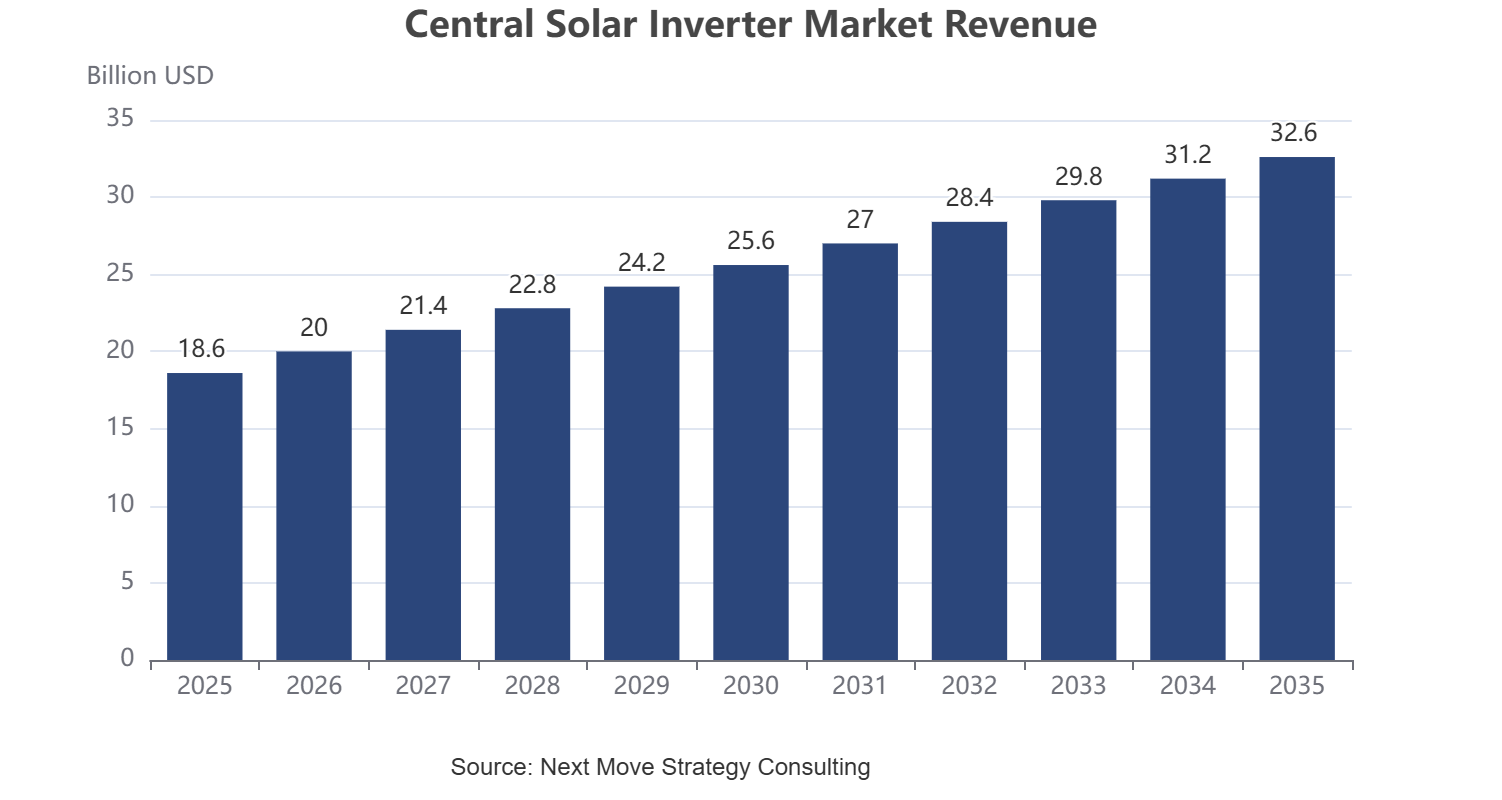
The global central solar inverter market size was valued at USD 18.6 billion in 2025 and is estimated at USD 18.3 billion in 2026, forecast to reach USD 32.6 billion by 2035, expanding at a 6.6% CAGR between 2026 and 2035. Asia-Pacific leads with approximately 54% share, while Utility Scale dominates all other applications with approximately 62% share.
We observed that the 2026 dip reflects near-term trade policy and project-timing disruptions, after which sustained utility-scale solar buildout drives renewed expansion across every region through 2035.
|
Key Takeaways |
|
By Product Type: Standalone Central Inverters held the largest share of approximately 45% (USD 8.37 billion) in 2025; Skid Mounted Central Inverters is the fastest-growing sub-segment at 12.9% CAGR from 2026–2035. |
|
By Power Rating: Above 1 MW to 2 MW held the largest share of approximately 30% (USD 5.58 billion) in 2025; Above 3 MW is the fastest-growing sub-segment at 12.6% CAGR from 2026–2035. |
|
By Output Voltage: Medium Voltage held the largest share of approximately 78% (USD 14.51 billion) in 2025; Low Voltage is the fastest-growing sub-segment at 7.9% CAGR from 2026–2035. |
|
By Cooling: Air Cooled held the largest share of approximately 68% (USD 12.65 billion) in 2025; Liquid Cooled is the fastest-growing sub-segment at 10.9% CAGR from 2026–2035. |
|
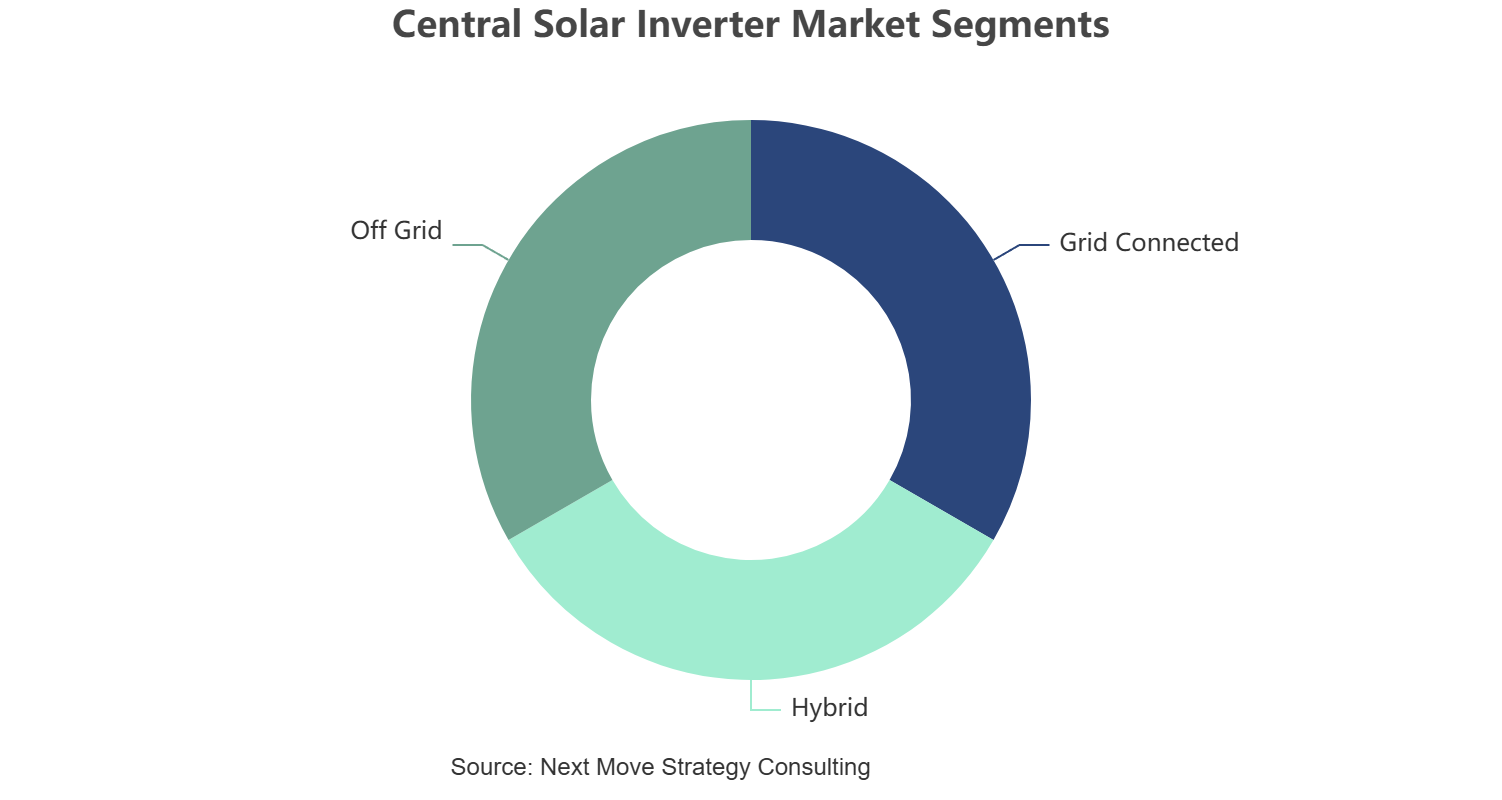
By Grid Type: Grid Connected held the largest share of approximately 88% (USD 16.37 billion) in 2025; Hybrid is the fastest-growing sub-segment at 11.5% CAGR from 2026–2035. |
|
By Installation: New Installation held the largest share of approximately 74% (USD 13.76 billion) in 2025; Replacement Installation is the fastest-growing sub-segment at 9.1% CAGR from 2026–2035. |
|
By Application: Utility Scale held the largest share of approximately 62% (USD 11.53 billion) in 2025; Agrivoltaics is the fastest-growing sub-segment at 13.8% CAGR from 2026–2035. |
|
By Sales Channel: EPC held the largest share of approximately 52% (USD 9.67 billion) in 2025; Direct Sales is the fastest-growing sub-segment at 8.0% CAGR from 2026–2035. |
|
By End User: Independent Power Producers held the largest share of approximately 48% (USD 8.93 billion) in 2025; Commercial Facilities is the fastest-growing sub-segment at 9.7% CAGR from 2026–2035. |
|
Dominant Region: Asia-Pacific dominated with approximately 54% revenue share (USD 10.04 billion) in 2025. |
|
Fastest-Growing Region: Middle East & Africa is expected to register the highest CAGR of 12.1% during 2026–2035. |
|
Dominant Country: China led with approximately USD 4,821 million in 2025. |
|
Fastest-Growing Country: Saudi Arabia is the fastest-growing country at approximately 13.9% CAGR from 2026–2035. |
Market Opportunity: The central solar inverter market is expected to create an absolute dollar opportunity of USD 14.3 billion between 2026 and 2035, presenting significant investment potential across liquid-cooled, medium-voltage, and utility-scale hybrid inverter platforms.
According to Next Move Strategy Consulting analysis, the near-term 2025-to-2026 revenue dip reflects a temporary pause in project financing tied to trade policy uncertainty, after which manufacturers with regionalized production footprints are positioned to capture disproportionate share of the renewed 2026–2035 growth cycle.
What Does the Central Solar Inverter Market Encompass?
The central solar inverter market encompasses standalone, modular, and skid mounted power conversion systems that convert direct current from utility-scale photovoltaic arrays into grid-compliant alternating current across low and medium voltage architectures. We observed that the scope spans independent power producers, utilities, commercial and industrial facilities, and government entities sourcing air cooled and liquid cooled inverters through direct sales, EPC contractor, and distributor channels for utility scale, commercial and industrial, floating solar, and agrivoltaic installations. The category has evolved from single-cabinet designs into modular, containerized architectures supporting multi-megawatt power blocks as project sizes have scaled.
Regulatory frameworks such as the U.S. Section 301 tariff actions on imported inverters and grid code compliance standards administered by regional transmission operators shape sourcing, certification, and domestic content requirements across the industry. Our assessment indicates that technology adoption is shifting toward liquid cooled, higher power density skid mounted platforms and hybrid grid-forming functionality that supports battery storage integration. Next Move Strategy Consulting's analysis indicates that this structural shift, combined with regionalized manufacturing investment, is redefining supplier selection criteria across the central solar inverter market.
|
Parameter |
Details |
|
Market Size in 2025 |
USD 18.6 Billion |
|
Market Size in 2026 |
USD 18.3 Billion |
|
Revenue Forecast in 2035 |
USD 32.6 Billion |
|
Growth Rate |
CAGR of 6.6% from 2026 to 2035 |
|
Analysis Period |
2025–2035 |
|
Base Year Considered |
2025 |
|
Forecast Period |
2026–2035 |
|
Market Size Estimation |
USD Billion |
|
Companies Profiled |
19 |
|
Countries Covered |
33 |
|
Market Share |
Available for Top 10 Companies |
Key Emerging Trends
Based on research conducted by Next Move Strategy Consulting, we found that four structural trends are reshaping product design, manufacturing footprint, and stakeholder engagement across the industry.
How Is Manufacturing Regionalization Reshaping Supply Chains?
Manufacturing regionalization is reshaping central solar inverter supply chains as producers respond to trade policy incentives favoring domestic content. We observed that SMA Solar Technology AG partnered with Tennessee-based Create Energy in September 2025 to manufacture Sunny Highpower PEAK3 inverters at a Portland facility, leveraging domestic content incentives, while Sungrow Power Supply announced plans in February 2026 to open its first European factory. This dual-track expansion is reducing single-region manufacturing concentration across the industry.
Why Is Liquid Cooling Gaining Adoption in High Power Density Units?
Liquid cooling is gaining adoption as project developers demand higher power density inverters within smaller footprints for multi-megawatt utility-scale blocks. Our findings suggest that liquid cooled architectures improve thermal management and extend component lifespan compared with conventional air-cooled designs, supporting sustained output in high-ambient-temperature installation sites. Leading manufacturers are prioritizing liquid cooled skid mounted platforms to serve above-3-megawatt utility projects across desert and tropical regions.
How Is Lifecycle Assessment Certification Influencing Procurement Decisions?
Lifecycle assessment certification is increasingly influencing utility and independent power producer procurement decisions. We observed that SMA Solar Technology AG's Sunny Central UP inverter completed an independent lifecycle assessment conducted by the Fraunhofer Institute for Building Physics and certified by DEKRA Assurance Services in November 2024, documenting environmental impact from raw material extraction through end-of-life. Manufacturers with verified sustainability credentials are gaining preference among developers pursuing environmental, social, and governance-aligned project financing.
What Role Does Hybrid Grid-Forming Functionality Play in Storage Integration?
Hybrid grid-forming functionality is playing a growing role as utility-scale solar projects increasingly co-locate with battery energy storage systems. Based on research conducted by Next Move Strategy Consulting, we found that grid-forming central inverters capable of supporting islanded and hybrid operation are becoming standard specifications for new utility procurement tenders. This capability is positioning hybrid-capable inverter platforms as the fastest-growing grid type segment through 2035.
Pestel Analysis Of The Central Solar Inverter Market
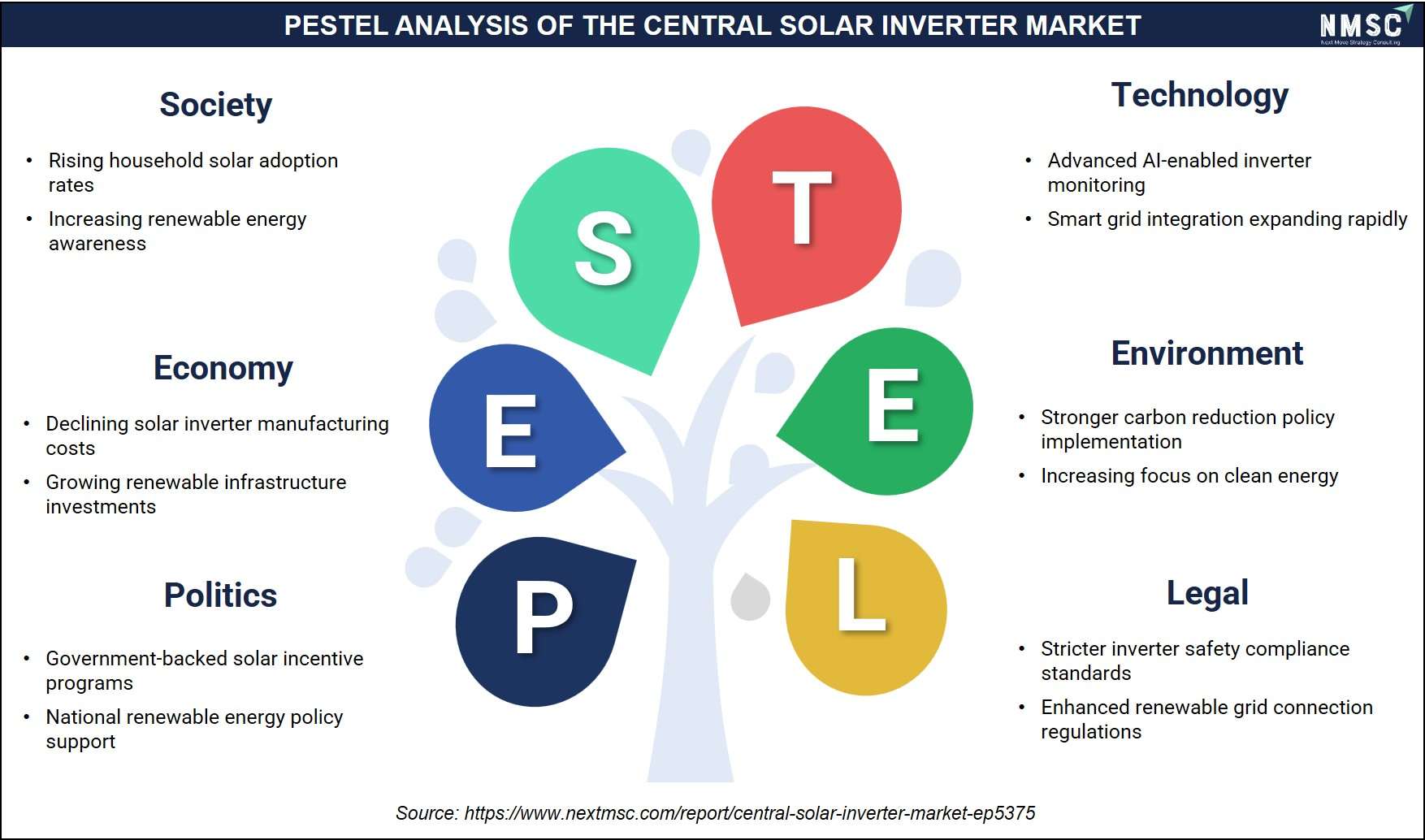
The PESTEL analysis highlights the major external factors influencing the Central Solar Inverter Market. Political support for renewable energy, economic investments in utility-scale solar projects, social demand for clean energy, technological advancements in high-efficiency and grid-forming inverters, environmental decarbonization goals, and evolving regulatory standards collectively shape market growth, innovation, competitive dynamics, and long-term industry development across global solar energy markets.
Growth Drivers and Restraints
Growth Catalyst and Risk Assessment Matrix
|
Factors |
Type |
(+/−) % Impact on CAGR |
Geographic Relevance |
Impact Timeline |
|
Expanding utility-scale solar project pipelines |
Driver |
+2.8% |
Global |
2026–2035 |
|
Manufacturing regionalization under domestic content incentives |
Driver |
+1.5% |
North America, Europe |
2026–2032 |
|
Rising battery storage co-location requiring hybrid grid-forming inverters |
Driver |
+1.3% |
Global |
2026–2035 |
|
Middle East giga-scale solar project buildout |
Driver |
+1.7% |
Middle East & Africa |
2026–2035 |
|
Shift toward liquid cooled, higher power density platforms |
Driver |
+0.9% |
Global |
2026–2032 |
|
Aging inverter fleet replacement cycle |
Driver |
+0.8% |
North America, Europe |
2026–2035 |
|
U.S. Section 301 tariffs and trade policy uncertainty |
Restraint |
−1.2% |
North America |
2026–2028 |
|
Grid code fragmentation across regional transmission operators |
Restraint |
−0.7% |
Global |
2026–2032 |
|
Extended project financing timelines amid interest rate volatility |
Restraint |
−0.6% |
Global |
2026–2030 |
What Is the Primary Growth Driver of the Central Solar Inverter Market?
Expanding utility-scale solar project pipelines remain the primary driver of the market. Wood Mackenzie's global inverter manufacturing ranking for the first half of 2025 placed Chinese manufacturers Huawei and Sungrow at the top of the industry, reflecting sustained utility-scale procurement volume concentrated in Asia-Pacific. We observed that this pipeline strength is supporting continued capacity investment among leading central inverter manufacturers despite near-term trade policy headwinds.
How Is Manufacturing Regionalization Driving Market Growth?
Manufacturing regionalization is driving growth by aligning inverter production with domestic content incentives tied to national renewable energy policy. We found that SMA Solar Technology AG's September 2025 partnership with Create Energy to manufacture inverters in Tennessee directly supports eligibility for U.S. Inflation Reduction Act domestic content incentives. Our assessment indicates that this regionalization pattern is reinforcing North America's position as a growing manufacturing and demand hub through 2035.
What Is Restraining Central Solar Inverter Market Expansion?
U.S. Section 301 tariff actions and broader trade policy uncertainty restrain near-term market expansion, contributing to the projected decline from USD 18.6 billion in 2025 to USD 18.3 billion in 2026. Industry-derived estimates indicate that project developers delayed a portion of planned utility-scale procurement during this period pending clarity on tariff classification for imported inverter components. We found that manufacturers with established regional production, including TMEIC Corporation Americas following its 2024 Houston headquarters relocation, faced comparatively less disruption than import-dependent competitors.
Segmentation Analysis
Segment Sizing: By Product Type
|
Segment |
2025 (USD) |
2035 (USD) |
CAGR% (2026–2035) |
|
Standalone Central Inverters |
USD 8.37 Billion |
USD 11.08 Billion |
3.4% |
|
Modular Central Inverters |
USD 7.44 Billion |
USD 13.37 Billion |
6.9% |
|
Skid Mounted Central Inverters |
USD 2.79 Billion |
USD 8.15 Billion |
12.9% |
|
Total |
USD 18.60 Billion |
USD 32.60 Billion |
6.6% |
Which Product Type Segment Dominates the Central Solar Inverter Market?
Standalone Central Inverters led the market with USD 8.37 billion in 2025, supported by their established role in conventional utility-scale power plant designs. We observed that Skid Mounted Central Inverters is the fastest-growing product type, expanding at a 12.9% CAGR from 2026 to 2035, as project developers favor pre-integrated, containerized power blocks that reduce on-site installation time for multi-megawatt utility projects.
Segment Sizing: By Power Rating
|
Segment |
2025 (USD) |
2035 (USD) |
CAGR% (2026–2035) |
|
Up to 500 kW |
USD 1.49 Billion |
USD 1.63 Billion |
1.2% |
|
Above 500 kW to 1 MW |
USD 2.79 Billion |
USD 3.26 Billion |
1.9% |
|
Above 1 MW to 2 MW |
USD 5.58 Billion |
USD 7.82 Billion |
4.0% |
|
Above 2 MW to 3 MW |
USD 5.21 Billion |
USD 9.78 Billion |
7.4% |
|
Above 3 MW |
USD 3.53 Billion |
USD 10.11 Billion |
12.6% |
|
Total |
USD 18.60 Billion |
USD 32.60 Billion |
6.6% |
Which Power Rating Segment Leads Market Demand?
Above 1 MW to 2 MW remained the leading power rating segment, valued at USD 5.58 billion in 2025, reflecting its widespread use across mid-scale utility installations. Our findings suggest that Above 3 MW is the fastest-growing power rating, registering a 12.6% CAGR from 2026 to 2035, as developers increasingly specify mega-inverters for gigawatt-scale solar parks to reduce per-watt balance-of-system costs.
Segment Sizing: By Application
|
Segment |
2025 (USD) |
2035 (USD) |
CAGR% (2026–2035) |
|
Utility Scale |
USD 11.53 Billion |
USD 17.93 Billion |
5.2% |
|
C&I |
USD 3.72 Billion |
USD 5.87 Billion |
5.4% |
|
Floating Solar |
USD 1.67 Billion |
USD 4.56 Billion |
12.0% |
|
Agrivoltaics |
USD 0.93 Billion |
USD 2.93 Billion |
13.8% |
|
Other Utility Applications |
USD 0.74 Billion |
USD 1.30 Billion |
6.6% |
|
Total |
USD 18.60 Billion |
USD 32.60 Billion |
6.6% |
Which Application Segment Dominates the Central Solar Inverter Market?
Utility Scale remained the leading application, reaching USD 11.53 billion in 2025, as national grid operators and independent power producers continued large-scale solar capacity additions. Based on research conducted by Next Move Strategy Consulting, we found that Agrivoltaics is the fastest-growing application, expanding at a 13.8% CAGR from 2026 to 2035, as dual-use land agreements combining agriculture and solar generation gain regulatory support across multiple regions.
Growth Opportunities
Our analysis shows that three forward-looking opportunities stand out for stakeholders positioning within the central solar inverter market over the 2026–2035 forecast period.
How Can Liquid Cooled Platforms Unlock Value in Mega-Scale Projects?
Liquid cooled central inverter platforms present a whitespace opportunity for manufacturers serving gigawatt-scale utility projects in high-ambient-temperature regions. Suppliers that commercialize validated liquid cooled skid mounted units above 3 MW stand to capture recurring procurement contracts as independent power producers prioritize power density and thermal reliability over conventional air-cooled designs.
Where Does Middle East Giga-Project Buildout Create New Demand?
Giga-scale solar project development across Saudi Arabia and the UAE represents an underpenetrated opportunity for central inverter suppliers with regional manufacturing or service presence. Manufacturers that establish local support infrastructure ahead of competitors can capture long-term procurement contracts tied to national renewable energy transformation programs through 2035.
How Can Hybrid Grid-Forming Inverters Benefit Storage-Integrated Developers?
Developers co-locating battery energy storage with utility-scale solar create an opportunity for suppliers offering hybrid, grid-forming central inverter platforms. Early movers that complete grid operator qualification for islanded and hybrid operation modes can secure design-in positions with storage-integrated project developers ahead of anticipated tender requirements across North America and Europe.
Supply Chain Structure Of The Central Solar Inverter Market
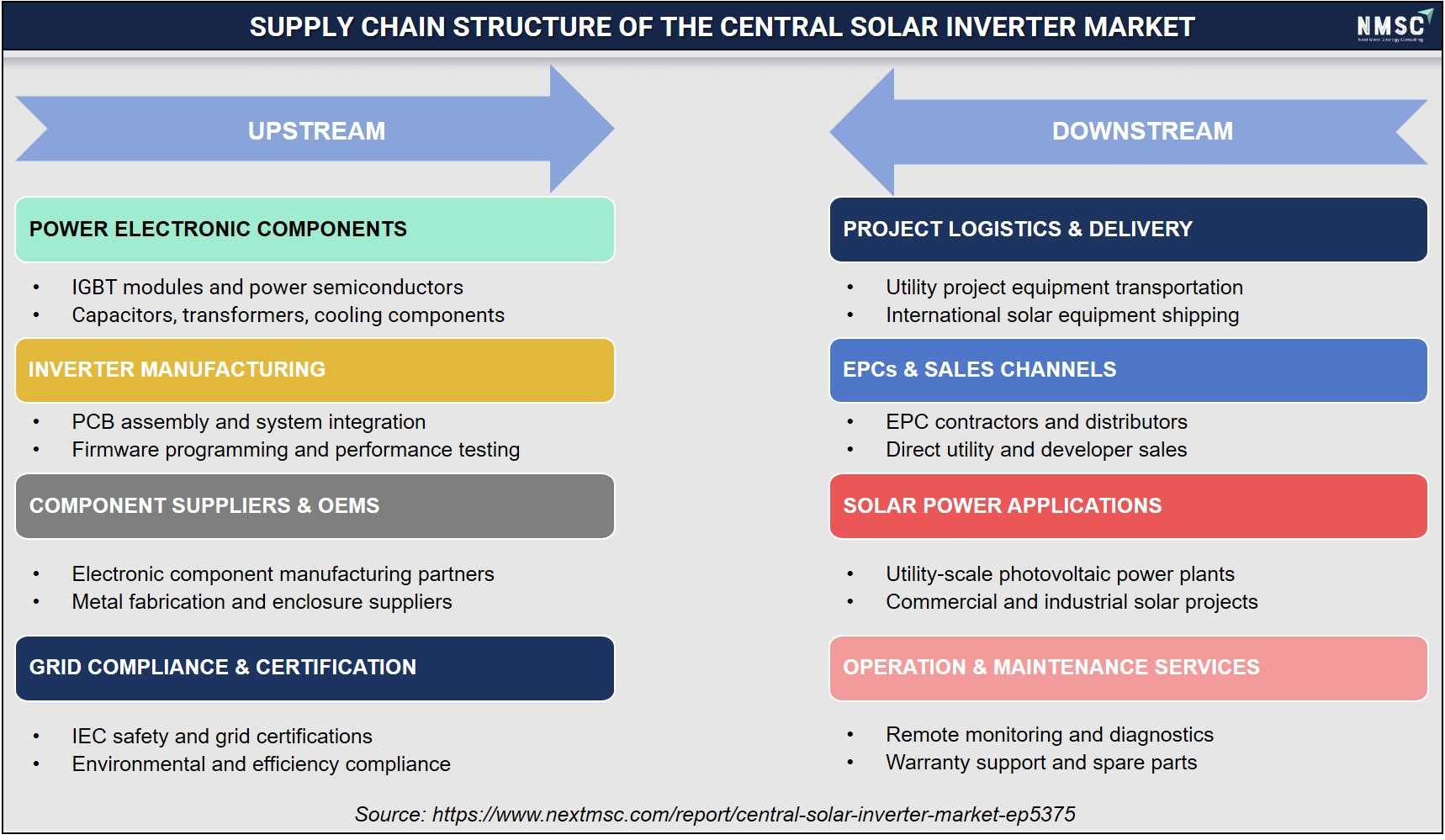
The supply chain structure of the Central Solar Inverter Market encompasses upstream activities such as power electronic component manufacturing, inverter production, OEM partnerships, and regulatory certification, followed by downstream processes including project logistics, EPC distribution, utility-scale solar deployment, and operation and maintenance services. Efficient coordination across the value chain ensures reliable product delivery, system performance, regulatory compliance, and long-term operational efficiency.
Regional Outlook
Geographic Performance Snapshot
|
Region |
2025 (USD) |
2035 (USD) |
CAGR% (2026–2035) |
Key Driver |
|
North America |
USD 3.72 Billion |
USD 6.19 Billion |
6.0% |
Domestic content incentives and reshored manufacturing capacity |
|
Europe |
USD 2.60 Billion |
USD 4.24 Billion |
5.8% |
Grid modernization and utility-scale solar tender programs |
|
Asia-Pacific |
USD 10.04 Billion |
USD 16.30 Billion |
5.7% |
China and India utility-scale solar capacity expansion targets |
|
Middle East & Africa |
USD 1.30 Billion |
USD 3.59 Billion |
12.1% |
Giga-scale national solar project buildout in Saudi Arabia and the UAE |
|
Latin America |
USD 0.93 Billion |
USD 2.28 Billion |
10.7% |
Expanding utility-scale solar tenders in Brazil and Argentina |
|
Total |
USD 18.60 Billion |
USD 32.60 Billion |
6.6% |
— |
North America Central Solar Inverter Market Outlook
North America's central solar inverter market reflects a manufacturing landscape reshaped by domestic content incentives under the Inflation Reduction Act. We observed that SMA Solar Technology AG and TMEIC Corporation Americas have both expanded or relocated regional operations since 2024 to strengthen domestic supply. Technology adoption favors hybrid, grid-forming inverters supporting storage co-location, and strategic outlook remains positive despite near-term tariff-related project delays.
Europe Central Solar Inverter Market Outlook
Europe's market reflects steady utility-scale tender activity supported by national grid modernization programs. Our findings suggest that Germany anchors regional demand given its established utility-scale solar base, while SMA Solar Technology AG's continued lifecycle assessment certification work signals rising emphasis on verified sustainability credentials. Technology adoption is advancing toward liquid cooled platforms, and competitive intensity remains high among established European and Asian suppliers.
Asia-Pacific Central Solar Inverter Market Outlook
Asia-Pacific is the dominant region in the central solar inverter market, anchored by China's and India's large-scale utility solar capacity targets. We found that Chinese manufacturers Sungrow Power Supply and TBEA maintain leading regional production scale, while Indian utility-scale tenders continue to expand demand. Technology adoption is advancing across modular and skid mounted platforms, and regulatory frameworks continue to favor domestic manufacturing participation in public tenders.
Middle East & Africa Central Solar Inverter Market Outlook
The Middle East & Africa is the fastest-growing region, propelled by giga-scale national solar project programs in Saudi Arabia and the UAE. Our analysis shows that these programs are driving sustained demand for high-power-rating, medium-voltage central inverters suited to large desert installations. Regulatory frameworks remain centrally coordinated through national utility procurement processes, and technology adoption favors liquid cooled platforms suited to high-ambient-temperature operating conditions.
Latin America Central Solar Inverter Market Outlook
Latin America's market is supported by expanding utility-scale solar tenders in Brazil and Argentina. We observed that regulatory frameworks remain less harmonized than in North America or Europe, though national auction programs continue to attract international inverter suppliers. Technology adoption remains centered on established standalone and modular platforms, with competitive intensity increasing as global manufacturers expand regional distributor partnerships.
U.S. Central Solar Inverter Market
Based on our estimates, the U.S. market was valued at approximately USD 3,050 million in 2025 and is projected to reach USD 4,800 million by 2035, growing at a 5.4% CAGR. Demand is anchored by utility-scale solar and battery storage co-location projects across the Southwest and Texas. Technology penetration favors hybrid grid-forming inverters and domestically manufactured units, and competitive intensity is high among SMA Solar Technology, TMEIC Corporation Americas, GE Vernova, and Power Electronics serving national utility and independent power producer customers.
Canada Central Solar Inverter Market
The market in Canada reached roughly USD 446 million in 2025 and is forecast to hit USD 867 million by 2035 at a 7.9% CAGR. Demand structure mirrors U.S. utility-scale project patterns, supported by provincial renewable procurement programs. Technology penetration is rising as EPC contractors specify higher power rating units for large solar parks, with competitive intensity moderate given reliance on cross-border supply from U.S.-based manufacturers.
UK Central Solar Inverter Market
As per our estimate, the UK market stood at about USD 573 million in 2025, advancing toward USD 890 million by 2035 at a 5.2% CAGR. Demand is driven by utility-scale solar tenders under national renewable energy auction programs. Regulatory influence remains significant under grid code compliance requirements, technology penetration favors medium-voltage grid-connected units, and competitive intensity remains steady among established European and Asian suppliers.
Germany Central Solar Inverter Market
According to our analysis, Germany's market was valued near USD 859 million in 2025 and is set to reach USD 1,356 million by 2035, expanding at a 5.4% CAGR. Demand structure benefits from Germany's mature utility-scale solar installation base and strong domestic manufacturing presence led by SMA Solar Technology. Regulatory influence from national grid codes is notable, and technology penetration favors lifecycle-assessment-certified, sustainability-verified inverter platforms.
France Central Solar Inverter Market
Based on our estimates, France's market reached approximately USD 521 million in 2025, projected to climb to USD 805 million by 2035 at a 5.2% CAGR. Demand is supported by expanding utility-scale solar auction volumes under national renewable energy targets. Regulatory influence from EU grid code harmonization is notable, and competitive intensity remains moderate given the concentration of European suppliers serving domestic utility customers.
China Central Solar Inverter Market
The market in China stood at roughly USD 4,821 million in 2025 and is forecast to reach USD 6,846 million by 2035, registering a 4.2% CAGR. Demand is fueled by the world's largest utility-scale solar installation base and a dense cluster of domestic manufacturers, including Sungrow Power Supply, Sineng Electric, and TBEA. Regulatory influence supports domestic manufacturing participation, technology penetration is advanced across modular and skid mounted platforms, and competitive intensity remains the highest of any covered country.
India Central Solar Inverter Market
As per our estimate, India's market was valued at about USD 1,607 million in 2025, projected to reach USD 3,423 million by 2035 at a 9.0% CAGR, the fastest among Asia-Pacific countries covered. Demand structure reflects the government's national solar mission targets, which continue to drive utility-scale tender volume. Regulatory influence remains significant under approved manufacturer listing requirements, while technology penetration is rising quickly as international and domestic suppliers expand local production.
Japan Central Solar Inverter Market
According to our analysis, Japan's market reached close to USD 1,004 million in 2025 and is expected to hit USD 1,467 million by 2035, growing at a 4.5% CAGR. Demand is supported by a mature utility-scale solar base and continued replacement of aging installed inverter fleets. Regulatory influence is well established, technology penetration is advanced across grid-connected and hybrid platforms, and competitive intensity remains high among established domestic and international manufacturers.
South Korea Central Solar Inverter Market
Based on our estimates, South Korea's market stood at approximately USD 804 million in 2025, forecast to reach USD 1,141 million by 2035 at a 4.2% CAGR. Demand structure benefits from national renewable energy portfolio standards supporting utility-scale solar development. Technology penetration is steady, with hybrid and liquid cooled platforms gaining gradual adoption, and competitive intensity remains moderate amid a mix of domestic and international suppliers.
Australia Central Solar Inverter Market
The market in Australia reached about USD 603 million in 2025 and is projected to reach USD 978 million by 2035, expanding at a 5.7% CAGR. Demand is supported by large-scale renewable energy zone development and continued utility-scale solar farm expansion. Regulatory influence stems from national electricity market grid connection standards, while technology penetration favors medium-voltage, high-power-rating units suited to large regional installations.
UAE Central Solar Inverter Market
As per our estimate, the UAE market was valued near USD 391 million in 2025, projected to reach USD 1,004 million by 2035 at an 11.3% CAGR. Demand structure is shaped by national giga-scale solar project programs such as large utility parks near Abu Dhabi. Regulatory influence remains centrally coordinated through national utility procurement, and technology penetration is advancing quickly toward liquid cooled, high-power-rating platforms suited to desert conditions.
Saudi Arabia Central Solar Inverter Market
According to our analysis, Saudi Arabia's market reached roughly USD 521 million in 2025 and is expected to hit USD 1,650 million by 2035, growing at a 13.9% CAGR, the fastest among all covered countries. Demand is driven by national giga-scale solar development programs tied to economic diversification goals. Regulatory influence is developing under national energy authority guidelines, and technology penetration is advancing rapidly as international suppliers scale regional project support.
South Africa Central Solar Inverter Market
Based on our estimates, South Africa's market stood at about USD 182 million in 2025, forecast to reach USD 466 million by 2035 at an 11.2% CAGR. Demand structure reflects a developing utility-scale solar procurement program addressing national electricity supply constraints. Regulatory influence remains moderate, technology penetration is gradually improving, and competitive intensity is limited given reliance on international suppliers routing shipments through regional distributors.
Brazil Central Solar Inverter Market
The market in Brazil reached approximately USD 512 million in 2025 and is projected to reach USD 1,187 million by 2035, registering a 10.0% CAGR. Demand is underpinned by Brazil's expanding utility-scale solar auction program and growing independent power producer investment. Regulatory influence stems from national electricity regulatory agency oversight, technology penetration favors established standalone and modular platforms, and competitive intensity remains moderate among regional distributors.
Argentina Central Solar Inverter Market
As per our estimate, Argentina's market was valued near USD 167 million in 2025, projected to reach USD 456 million by 2035 at a 12.0% CAGR. Demand structure is supported by steady utility-scale renewable energy investment despite macroeconomic volatility. Regulatory influence remains limited, technology penetration is modest, and competitive intensity is centered on a small number of regional distributors partnering with global inverter manufacturers.
Competitive Landscape
We observed that the competitive landscape remains moderately consolidated, with a handful of large Chinese, European, and Japanese manufacturers supplying a majority of global utility-scale inverter capacity alongside a broader base of regional specialists.
|
Category |
Assessment |
|
Market Structure |
Moderately consolidated; leading Chinese and European manufacturers hold combined majority global share, supported by regional specialists in India, Japan, and Latin America |
|
Innovation Focus |
Liquid cooled high power density platforms, hybrid grid-forming functionality, lifecycle assessment certification, and skid mounted containerized architectures |
|
M&A Activity |
Manufacturing footprint restructuring and recapitalization reshaping Western positioning, including FIMER's 2025 recapitalization and Sungrow's planned European factory |
How Do Companies Compete in the Central Solar Inverter Market?
Companies compete primarily on power conversion efficiency, grid code compliance breadth, and the ability to guarantee reliable performance across large utility-scale installations. We found that long-term supply agreements tied to national utility tenders increasingly anchor competitive positioning. Pricing strategies remain closely tied to power electronics component costs, pushing larger manufacturers toward vertical integration into semiconductor supply to protect margin stability.
Which Competitive Archetypes Dominate the Central Solar Inverter Market?
Two archetypes dominate the central solar inverter market: high-volume Chinese manufacturers that compete on scale, cost, and in-house component manufacturing, and specialty European and Japanese manufacturers that compete on grid-forming functionality, certified sustainability credentials, and regional service networks. Our analysis shows that differentiation increasingly centers on liquid cooled, high power density platforms alongside verified lifecycle assessment data that appeals to environmental, social, and governance-focused developers.
How Are Companies Differentiating Through Innovation?
Leading suppliers are differentiating through proprietary hybrid grid-forming control software, liquid cooling systems, and independently certified lifecycle assessment data. During our market evaluation, we noticed that several manufacturers are simultaneously investing in skid mounted containerized designs and expanded power ratings above 3 MW, positioning themselves to serve the largest utility-scale and giga-project tenders rather than competing solely on conventional standalone cabinet designs.
What M&A and Geographic Expansion Activity Is Reshaping the Market?
Geographic expansion and manufacturing footprint restructuring are reshaping competitive positioning across Western and Middle Eastern markets. We observed that Sungrow Power Supply announced plans for its first European factory in February 2026, SMA Solar Technology partnered with Create Energy for U.S. domestic manufacturing in September 2025, and FIMER completed a 2025 recapitalization to re-establish competitive positioning after prior restructuring.
Key Market Players
Our assessment indicates that the following companies represent the leading suppliers shaping competitive dynamics across the central solar inverter market.
-
Sungrow Power Supply Co., Ltd.
-
Sineng Electric Co., Ltd.
-
Power Electronics España, S.L.
-
FIMER S.p.A.
-
TBEA Co., Ltd.
-
Toshiba Mitsubishi-Electric Industrial Systems Corporation (TMEIC)
-
Gamesa Electric S.A.U.
-
Chint Power Systems Co., Ltd.
-
Hitachi Hi-Rel Power Electronics Private Limited
-
Delta Electronics, Inc.
-
Fuji Electric Co., Ltd.
-
KACO new energy GmbH
-
Kehua Data Co., Ltd.
-
Hopewind Electric Co., Ltd.
-
Santerno S.p.A.
-
Statcon Energiaa Pvt. Ltd.
-
GE Vernova Inc.
Latest Developments
We found that recent manufacturing, certification, and product announcements underscore the pace of change across the central solar inverter supply chain.
|
Date |
Event |
|
June 2024 |
SMA Solar launched and commercially introduced its Sunny Central FLEX platform, a next-generation central inverter solution designed specifically for utility-scale solar PV plants. The modular platform integrates PV, battery storage, and hydrogen applications, enabling easier grid connection, improved grid-forming capabilities, and future-ready utility-scale renewable energy projects. This directly advances the Central Solar Inverter Market by introducing a more flexible and scalable central inverter architecture for large solar power plants. |
Investment Opportunities
Where Are Capital Inflows Concentrated in the Central Solar Inverter Market?
Capital inflows are concentrated in regionalized manufacturing capacity and giga-scale project supply agreements. We observed that SMA Solar Technology's Tennessee manufacturing partnership and Sungrow's planned European factory represent significant private capital commitments announced since 2025. This pattern reflects continued investment confidence in utility-scale solar demand despite the near-term 2025-to-2026 revenue dip tied to trade policy uncertainty.
How Is Infrastructure Investment Expanding Manufacturing Capacity?
Infrastructure investment is expanding manufacturing capacity across both established Asian production bases and emerging Western and European sites. We found that FIMER's 2025 recapitalization and Sungrow's European factory announcement reflect a dual-track expansion pattern spanning legacy manufacturing hubs and new regional footholds, positioning suppliers to serve increasingly regionalized procurement requirements through 2035.
What ESG Considerations Are Shaping Central Solar Inverter Investment?
Environmental, social, and governance considerations are increasingly shaping investment decisions as developers seek independently verified sustainability data. Our findings suggest that SMA Solar Technology's Fraunhofer Institute and DEKRA-certified lifecycle assessment sets a benchmark that investors and utility customers are beginning to expect across the industry, favoring manufacturers that can document verified emissions and material sourcing data over less transparent regional alternatives.
Key Benefits for Stakeholders
How Does This Report Benefit Enterprise and Industry Leaders?
Enterprise and industry leaders gain a structured view of segment-level demand across product type, power rating, application, sales channel, and end user, supported by Next Move Strategy Consulting's forecasts through 2035. Our analysis shows that this data enables capacity planning decisions, helping manufacturers prioritize investment in the fastest-growing segments, including skid mounted and liquid cooled platforms, ahead of competitors.
How Does This Report Benefit Investors and Financial Analysts?
Investors and financial analysts benefit from validated market sizing, regional growth differentials, and competitive landscape analysis that inform capital allocation decisions. We found that the report's country-level revenue breakdowns and CAGR projections support comparative evaluation of expansion opportunities across North America, Europe, Asia-Pacific, the Middle East & Africa, and Latin America, strengthening due diligence on inverter-related investment targets.
How Does This Report Benefit Technology Vendors and Product Teams?
Technology vendors and product teams gain insight into emerging trends, including liquid cooling adoption, hybrid grid-forming functionality, and lifecycle assessment certification. Our assessment indicates that this analysis helps product teams prioritize research and development roadmaps toward the power ratings and cooling technologies showing the strongest forecast growth, improving alignment between innovation investment and evolving utility procurement specifications.
Key Market Segments
By Product Type
-
Standalone Central Inverters
-
Modular Central Inverters
-
Skid Mounted Central Inverters
By Power Rating
-
Up to 500 kW
-
Above 500 kW to 1 MW
-
Above 1 MW to 2 MW
-
Above 2 MW to 3 MW
-
Above 3 MW
By Output Voltage
-
Low Voltage
-
Medium Voltage
By Cooling
-
Air Cooled
-
Liquid Cooled
By Grid Type
-
Grid Connected
-
Hybrid
-
Off Grid
By Installation
-
New Installation
-
Replacement Installation
By Application
-
Utility Scale
-
C&I
-
Floating Solar
-
Agrivoltaics
-
Other Utility Applications
By Sales Channel
-
Direct Sales
-
EPC
-
Distributors
By End User
-
Independent Power Producers
-
Utilities
-
Commercial Facilities
-
Industrial Facilities
-
Government
By Region
-
North America: U.S., Canada, Mexico
-
Europe: UK, Germany, France, Italy, Spain, Sweden, Denmark, Finland, Netherlands, Rest of Europe
-
Asia-Pacific: China, India, Japan, South Korea, Taiwan, Indonesia, Vietnam, Australia, Philippines, Malaysia, Rest of APAC
-
Middle East & Africa: Saudi Arabia, UAE, Egypt, Israel, Turkey, Nigeria, South Africa, Rest of MEA
-
Latin America: Brazil, Argentina, Chile, Colombia, Rest of LATAM
Conclusion and Recommendations
What Is the Long-Term Outlook for the Central Solar Inverter Market?
The long-term outlook remains positive, with the market projected to expand from USD 18.3 billion in 2026 to USD 32.6 billion by 2035 at a 6.6% CAGR, following a temporary 2025-to-2026 dip tied to trade policy uncertainty. Our assessment indicates that this growth will be increasingly diversified across liquid cooled, hybrid, and higher power rating platforms as utility-scale solar deployment continues to scale across every major region through 2035.
What Strategic Positioning Should Suppliers Pursue?
Suppliers should pursue regionalized manufacturing positioning that aligns production with domestic content incentives in North America and emerging European capacity. We found that companies establishing local manufacturing or service presence ahead of giga-scale Middle Eastern project tenders are best positioned to secure long-term supply contracts with national utilities and independent power producers navigating regional sourcing requirements.
How Attractive Is the Market for New Investment?
The market presents solid investment attractiveness given its 6.6% forecast CAGR and the rapid expansion of giga-scale Middle Eastern solar programs. Our findings suggest that investors focusing on liquid cooled high power density platforms, hybrid grid-forming functionality, and regionalized manufacturing capacity stand to benefit from above-market growth relative to the broader central solar inverter category.
What Are the Key Market Shifts and Risks?
Key shifts include the transition toward skid mounted, liquid cooled architectures and hybrid grid-forming functionality supporting storage co-location. We observed that principal risks include continued trade policy volatility, grid code fragmentation across regional transmission operators, and extended project financing timelines, all of which could slow the pace of the industry's near-term recovery if unresolved.
What Are the Primary Growth Pathways Through 2035?
Primary growth pathways include scaling liquid cooled high power density inverters, expanding hybrid grid-forming capability for storage-integrated projects, and deepening regionalized manufacturing footprints. Based on research conducted by Next Move Strategy Consulting, we found that suppliers combining these three pathways with expanded Middle Eastern and North American capacity are best positioned to capture the USD 14.3 billion absolute dollar opportunity created between 2026 and 2035.
About the Author
 Liza Phukan
— Liza Phukan is Research Associate at Next Move Strategy Consulting, where she has covered emerging industries and market research across sectors for 3.5 years. Her work includes analyzing industry developments, validating market data, and developing structured business content from research findings. She uses secondary research and data-validation practices to turn complex market information into clear decision-useful market analysis for business audiences and support report development and B2B.
Liza Phukan
— Liza Phukan is Research Associate at Next Move Strategy Consulting, where she has covered emerging industries and market research across sectors for 3.5 years. Her work includes analyzing industry developments, validating market data, and developing structured business content from research findings. She uses secondary research and data-validation practices to turn complex market information into clear decision-useful market analysis for business audiences and support report development and B2B.
About the Reviewer
 Supradip Baul
— Supradip Baul is an accomplished business consultant and strategist with over a decade of rich experience in market intelligence, strategy, technology, and business transformation. His work has included rigorous qualitative and quantitative analysis across multiple industries, helping clients shape investment decisions and long-term roadmaps. Earlier in his career, he was associated with Gartner, where he contributed to industry-leading reports and market share analyses. He has worked with leading global companies and holds an MBA with a dual specialization in Marketing and Finance.
Supradip Baul
— Supradip Baul is an accomplished business consultant and strategist with over a decade of rich experience in market intelligence, strategy, technology, and business transformation. His work has included rigorous qualitative and quantitative analysis across multiple industries, helping clients shape investment decisions and long-term roadmaps. Earlier in his career, he was associated with Gartner, where he contributed to industry-leading reports and market share analyses. He has worked with leading global companies and holds an MBA with a dual specialization in Marketing and Finance.
At Next Move Strategy Consulting, we understand that insightful market research is the cornerstone of successful business decisions. That's why we employ a robust and multifaceted approach, combining various methodologies to deliver the most accurate and actionable data for our clients.

Research Landscape
We navigate the world of research with two primary approaches:
Qualitative Approach
Our qualitative research methodologies involve immersive techniques such as in-depth interviews, focus groups, and observational studies. By engaging directly with individuals and stakeholders, we uncover valuable insights that quantitative data alone may overlook.

Quantitative Research
In tandem with qualitative methodologies, NMSC leverages the power of Quantitative Research to provide a robust foundation of numerical insights. Through systematic data collection and analysis, we quantify patterns, preferences, and market trends, offering a comprehensive view of the business landscape.
Our quantitative research approach employs diverse tools, including surveys, experiments, and statistical modelling. These methodologies enable us to gather data from a large and representative sample, ensuring the statistical significance of our findings. By employing structured questionnaires and standardized data collection methods, we guarantee the reliability and validity of the information we present to our clients.
Quantitative research is particularly effective in measuring the prevalence of trends, assessing market size, and gauging the impact of various factors on consumer behavior. The numerical precision attained through this approach equips our clients with actionable insights, facilitating data-driven decision-making and strategy formulation.


Our Specialized Toolbox for Industry-Specific Market Research
We deploy a specialized arsenal of techniques tailored to meet your unique requirements. Here's a glimpse into our comprehensive toolbox:

Information Procurement
The stage entails acquiring market data or relevant information through various sources and methodologies.


Market Research Approach
We utilize both top-down and bottom-up approaches in market research analysis to achieve a comprehensive understanding of the market dynamics, leveraging the broad perspective of industry trends and macroeconomic factors alongside detailed insights from specific segments and individual companies.

Porters Five Forces Analysis
We conduct Porter's Five Forces analysis to evaluate the competitive landscape of an industry, providing us with insights into factors that affect profitability and strategic positioning.

SWOT Analysis

Forecasting
We utilize a forecasting model to predict future consumption by considering parameters like population, economics, regulations, market competition, drivers, constraints, technology, and pricing. We also employ statistical techniques such as multilinear regression, exponential smoothing, moving average, ARIMA, and Monte Carlo simulations for accurate predictions. In econometric forecasting, we analyzed short-term and long-term event impacts, attributing values based on regulatory frameworks, economic factors, and market events.





 Speak to Our Analyst