Special Mission Aircraft Market Global Industry Analysis and Forecast (2026-2035)

Special Mission Aircraft Market size was USD 19 Billion in 2025, projected to reach USD 33.12 Billion by 2035, growing at a CAGR of 5.53% from 2026 to 2035. Key drivers include rising defense budget allocations for ISR platforms, accelerating uncrewed aircraft adoption across NATO and Indo-Pacific nations, and growing demand for persistent maritime patrol capabilities, with North America leading the market.

Download Free Sample PDF
Base Year (2025)
$19.00 Billion
Forecast (2035)
$33.12 Billion
CAGR (2026-2035)
5.5%
Top Region
North America

What Is the Special Mission Aircraft Market Size?

The global Special Mission Aircraft Market size reached USD 19 Billion in 2025 and is estimated at USD 20.41 Billion in 2026, forecast to reach USD 33.12 Billion by 2035 at a CAGR of 5.53% between 2026 and 2035. North America holds an approximate 38% share in 2025 while New-Build Mission Aircraft dominates the product type segment with approximately 63% share.

We observed that accelerating procurement of medium-altitude long-endurance and high-altitude long-endurance uncrewed aircraft systems across NATO and Five Eyes nations is meaningfully compressing the previous dominance of manned fixed-wing platforms, signaling a structural composition shift within the market that will intensify through 2035.

Special Mission Aircraft Market Global Industry Analysis and Forecast (2026-2035) Revenue Forecast

Values in USD Billion

2025 $19.00 Billion
2025
2026 $20.05 Billion
2026
2027 $21.16 Billion
2027
2028 $22.33 Billion
2028
2029 $23.56 Billion
2029
2030 $24.87 Billion
2030
2031 $26.24 Billion
2031
2032 $27.69 Billion
2032
2033 $29.23 Billion
2033
2034 $30.84 Billion
2034
2035 $33.12 Billion
2035

Key Takeaways

By Product Type: New-Build Mission Aircraft held the largest share, expanding from USD 11.97 billion in 2025 to USD 19.87 billion by 2035; Existing-Aircraft Conversion is the fastest-growing product type at 6.6% CAGR from 2026–2035, reaching USD 13.25 billion by 2035.

By Mission Type: Intelligence, Surveillance and Reconnaissance (ISR) held the largest share, expanding from USD 5.70 billion in 2025 to USD 9.23 billion by 2035; Electronic Warfare and Signals Intelligence is the fastest-growing mission type at 7.1% CAGR from 2026–2035.

By End User: Defense held the largest share, expanding from USD 14.06 billion in 2025 to USD 23.19 billion by 2035; Commercial and Industrial Operators is the fastest-growing end user at 8.3% CAGR from 2026–2035.

Dominant Region: North America dominated with approximately 38% revenue share in 2025, equivalent to USD 7.22 billion.

Fastest-Growing Region: Asia-Pacific is expected to register the highest CAGR of 7.2% during 2026–2035.

Dominant Country: The U.S. led the market, anchored by large-scale defense ISR, AEW&C, and special operations aviation procurement.

Fastest-Growing Country: India is the fastest-growing country, supported by its Defence Acquisition Procedure and expanding indigenous aerospace capability.

The Special Mission Aircraft Market presents an absolute investment opportunity of approximately USD 12.71 Billion between 2026 and 2035, calculated as the difference between the 2035 forecast of USD 33.12 Billion and the 2026 estimate of USD 20.41 Billion, underscoring the strategic case for sustained capital commitment across uncrewed systems, electronic warfare platforms, and mission-conversion programs.

According to NMSC analysis, the convergence of artificial intelligence-enabled sensor fusion with multi-domain operational doctrine is accelerating the pace at which allied defense ministries are retiring legacy manned ISR platforms in favor of integrated crewed–uncrewed teaming architectures, a trend that is disproportionately benefiting systems integrators with certified open-architecture mission systems.

Ecosystem Analysis of the Special Mission Aircraft Industry

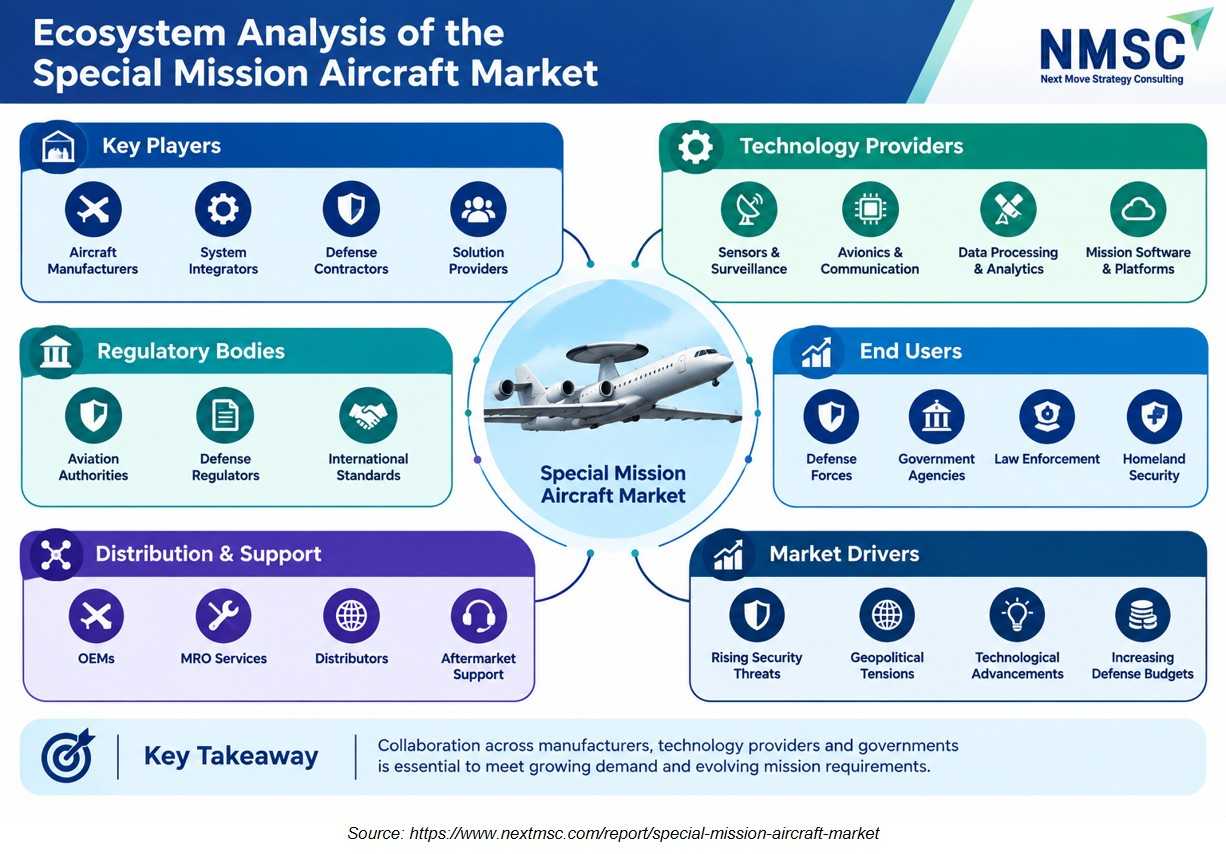
The above infographic provides a detailed ecosystem analysis of the special mission aircraft market, mapping out key players, technology providers, and regulatory bodies. It highlights the critical role of end users, such as defense forces and law enforcement, while identifying major market drivers like rising security threats and increasing defense budgets. Supported by distribution and MRO services, the ecosystem relies on continuous technological advancement. Ultimately, the key takeaway emphasizes that collaboration across manufacturers, tech providers, and governments is essential to meet evolving mission requirements.

What does the Special Mission Aircraft Market Encompass?

The Special Mission Aircraft Market covers purpose-designed and converted fixed-wing aircraft, rotary-wing aircraft, and uncrewed aerial systems configured to execute non-combat operational missions for defense, government, law enforcement, commercial, and scientific end users. The market value chain spans airframe manufacture, mission-system integration, sensor and avionics supply, ground-support infrastructure, and long-term maintenance, repair, and overhaul services associated with dedicated mission configurations rather than standard commercial or air-superiority applications.

Structurally, the market has evolved from a predominantly manned fixed-wing ISR and maritime patrol discipline into a diversified multi-domain capability space shaped by the proliferation of MALE and HALE UAS, the integration of directed-energy weapons and advanced electronic warfare suites into converted business-jet and narrow-body platforms, and the adoption of open mission-system architectures mandated by major defense procurement regulations including the U.S. Department of Defense's Better Buying Power directives. Regulatory frameworks such as STANAG 4671 airworthiness standards and national procurement regulations in NATO member states, India's Defence Acquisition Procedure, and Japan's Medium-Term Defense Program govern platform qualification, export licensing, and operational certification across the market.

Market Drivers & Dynamics

Interactive Dataset
Rising defense budget allocations for ISR and surveillance platforms across NATO and Indo-Pacific nations driver +1.8% Global 2026–2035
Accelerating procurement of MALE and HALE UAS for persistent surveillance and maritime patrol driver +1.4% North America, Europe, Asia-Pacific 2026–2033
Growing demand for electronic warfare, SIGINT, and AEW&C platform modernization driver +0.9% North America, Europe, Middle East & Africa 2026–2032
Expansion of homeland security and coast-guard ISR requirements in emerging economies driver +0.7% Asia-Pacific, Latin America, MEA 2026–2035
Increasing adoption of existing-aircraft conversion for mid-tier market cost efficiency driver +0.5% Global 2026–2031
Geopolitical tensions driving autonomous multi-domain ISR architecture investment driver +0.4% North America, Europe, Asia-Pacific 2026–2035
Lengthy acquisition cycles and platform certification timelines constraining delivery schedules restraint −1.0% Global 2026–2032
Export-control restrictions (ITAR/EAR) limiting platform proliferation in emerging markets restraint −0.6% Middle East & Africa, Latin America, Asia-Pacific 2026–2035
Fiscal consolidation and defense-budget pressures in Western Europe restraint −0.4% Europe 2026–2030
Source: Next Move Strategy Consulting

Growth Drivers

What Is the Primary Growth Driver in the Special Mission Aircraft Market?

The primary growth driver is rising defense budget allocations for ISR and surveillance platforms across NATO and Indo-Pacific nations. The U.S. Department of Defense FY2025 budget request, published by the Office of the Under Secretary of Defense (Comptroller), allocated USD 41.7 Million specifically to the Unmanned ISR procurement line under USSOCOM's Defense-Wide procurement account, reflecting the sustained institutional commitment to uncrewed surveillance capabilities even within a constrained overall discretionary environment.

How Is Geopolitical Competition Driving Special Mission Aircraft Market Growth?

Our analysis shows that escalating geopolitical competition in the Indo-Pacific and Eastern Europe is directly expanding procurement requirements for AEW&C, maritime patrol, and electronic warfare platforms beyond traditional Five Eyes and NATO demand centers. Industry-derived estimates indicate that Asia-Pacific defense ministries collectively initiated or expanded over a dozen special mission aircraft acquisition programs between 2023 and 2025, with ISR and maritime patrol representing the highest volume of procurement activity by platform count across this region.

Growth Inhibitors

What Is Restraining the Special Mission Aircraft Market?

We found that the primary restraint is the combination of extended platform certification timelines and export-control regimes that slow market access in high-growth emerging economies. STANAG 4671 airworthiness certification and national regulatory qualification processes typically extend MALE UAS program schedules by 18 to 36 months relative to manned platform conversion programs. Additionally, U.S. International Traffic in Arms Regulations and Export Administration Regulations constrain allied and partner-nation access to specific sensor and communications payloads, fragmenting addressable market scope for leading U.S. systems integrators.

What Are the Growth Opportunities?

Can Open Mission-Systems Architecture Unlock Rapid Payload Refresh Programs?

Integrators that standardize on government-mandated open mission-systems architectures can capture accelerated payload refresh program awards as defense ministries cycle through electronic warfare and sensor suites independently of airframe replacement, benefiting the Electronic Warfare and SIGINT mission type and existing-aircraft conversion product type simultaneously across NATO and Five Eyes procurement pipelines.

Does Persistent Maritime UAS Patrol Create a New Commercial Operator Segment?

Commercial maritime and energy operators seeking cost-efficient exclusive economic zone monitoring are beginning to procure MALE UAS on managed-service models, creating a recurring revenue opportunity for operators and integrators that can achieve civilian airspace certification, benefiting the Commercial and Industrial Operators end-user segment and Maritime Patrol mission type as STANAG 4671-certified platforms gain regulatory approval for unsegregated airspace operations.

Can AI-Enabled Sensor Fusion Platforms Accelerate Mid-Tier Nation Procurement?

Mid-tier defense nations that lack indigenous special mission aircraft programs represent the highest untapped demand pool for turnkey converted platforms equipped with AI-enabled sensor fusion. Companies offering fully integrated mission-system packages on proven commercial airframes can address this market without the multi-year certification risk of new-build programs, benefiting the Existing-Aircraft Conversion product type and ISR mission type as emerging economies expand persistent surveillance mandates.

Segmentation Analysis

2025 (USD Billion)
2035 (USD Billion)
New-Build Mission Aircraft 2025: $11.97 Billion | 2035: $19.87 Billion
New-Build Mi
Existing-Aircraft Conversion 2025: $7.03 Billion | 2035: $13.25 Billion
Existing-Air
New-Build Mission Aircraft $11.97 Billion $19.87 Billion 5.1%
Existing-Aircraft Conversion $7.03 Billion $13.25 Billion 6.6%

Which Product Type Dominates the Special Mission Aircraft Market?

New-Build Mission Aircraft leads with USD 11.97 Billion in 2025, expanding to USD 19.87 Billion by 2035, reflecting the continued centrality of purpose-designed platforms to high-end defense ISR, AEW&C, and special operations mission requirements. Existing-Aircraft Conversion is the fastest-growing product type at a 6.6% CAGR as mid-tier defense and homeland security agencies accelerate cost-efficient integration of commercial airframe derivatives with mission-specific sensor suites.

2025 (USD Billion)
2035 (USD Billion)
Intelligence
Surveillance
Overland Sur
Persistent S
Border Surve
Segment Item 2025 (USD Billion) 2035 (USD Billion) CAGR
Intelligence $10.0 USD Billion $40.0 USD Billion 17.0%
Surveillance and Reconnaissance $17.1 USD Billion $51.1 USD Billion 11.0%
Overland Surveillance $24.2 USD Billion $62.2 USD Billion 17.0%
Persistent Surveillance $31.3 USD Billion $73.3 USD Billion 15.0%
Border Surveillance $38.4 USD Billion $84.4 USD Billion 16.0%

Segment-wise data is locked

Unlock complete segment-wise numbers for By Mission Type.

Unlock Full Data

Which Mission Type Leads and Which Grows Fastest?

ISR leads mission-type demand at USD 5.70 Billion in 2025, growing to USD 9.23 Billion by 2035, reflecting persistent priority given to overland, border, and persistent surveillance across both high-intensity defense and homeland security operator categories. Electronic Warfare and Signals Intelligence is the fastest-growing mission type at a 7.1% CAGR, as allied defense ministries invest in dedicated SIGINT and electronic attack platforms to counter the proliferation of advanced integrated air defense systems in contested operational environments.

2025 (USD Billion)
2035 (USD Billion)
Defense
Homeland Sec
Civil Govern
Emergency Ma
Public Healt
Segment Item 2025 (USD Billion) 2035 (USD Billion) CAGR
Defense $10.0 USD Billion $40.0 USD Billion 26.0%
Homeland Security and Law Enforcement $17.1 USD Billion $51.1 USD Billion 16.0%
Civil Government $24.2 USD Billion $62.2 USD Billion 18.0%
Emergency Management Agencies $31.3 USD Billion $73.3 USD Billion 8.0%
Public Health and Medical Services $38.4 USD Billion $84.4 USD Billion 23.0%

Segment-wise data is locked

Unlock complete segment-wise numbers for By End User.

Unlock Full Data

Which End User Dominates and Which Is Fastest-Growing?

Defense dominates at USD 14.06 Billion in 2025, reflecting the market's foundational dependence on government defense appropriations for platform procurement and sustainment. Commercial and Industrial Operators is the fastest-growing end-user segment at an 8.3% CAGR, as air medical operators, resource and energy survey operators, and specialised aviation service providers increasingly deploy certified MALE UAS and converted fixed-wing platforms for civilian surveillance, environmental monitoring, and infrastructure inspection missions.

Growth Opportunities

Our analysis shows that three whitespace opportunities are positioned to generate disproportionate value for manufacturers, systems integrators, and investors through 2035 in the Special Mission Aircraft Market.

Can Open Mission-Systems Architecture Unlock Rapid Payload Refresh Programs?

Integrators that standardize on government-mandated open mission-systems architectures can capture accelerated payload refresh program awards as defense ministries cycle through electronic warfare and sensor suites independently of airframe replacement, benefiting the Electronic Warfare and SIGINT mission type and existing-aircraft conversion product type simultaneously across NATO and Five Eyes procurement pipelines.

Does Persistent Maritime UAS Patrol Create a New Commercial Operator Segment?

Commercial maritime and energy operators seeking cost-efficient exclusive economic zone monitoring are beginning to procure MALE UAS on managed-service models, creating a recurring revenue opportunity for operators and integrators that can achieve civilian airspace certification, benefiting the Commercial and Industrial Operators end-user segment and Maritime Patrol mission type as STANAG 4671-certified platforms gain regulatory approval for unsegregated airspace operations.

Can AI-Enabled Sensor Fusion Platforms Accelerate Mid-Tier Nation Procurement?

Mid-tier defense nations that lack indigenous special mission aircraft programs represent the highest untapped demand pool for turnkey converted platforms equipped with AI-enabled sensor fusion. Companies offering fully integrated mission-system packages on proven commercial airframes can address this market without the multi-year certification risk of new-build programs, benefiting the Existing-Aircraft Conversion product type and ISR mission type as emerging economies expand persistent surveillance mandates.

Regional Outlook

2025 (USD Billion)
2035 (USD Billion)
North Americ
Europe
Asia-Pacific
Middle East
Latin Americ
Region 2025 (USD Billion) 2035 (USD Billion) CAGR (%)
North America $10.0 USD Billion $40.0 USD Billion 9.0%
Europe $17.1 USD Billion $51.1 USD Billion 27.0%
Asia-Pacific $24.2 USD Billion $62.2 USD Billion 25.0%
Middle East & Africa $31.3 USD Billion $73.3 USD Billion 23.0%
Latin America $38.4 USD Billion $84.4 USD Billion 12.0%

Regional data is locked

Unlock complete regional numbers for this market.

Unlock Full Data

Regulatory Framework Impacting the Special Mission Aircraft Industry

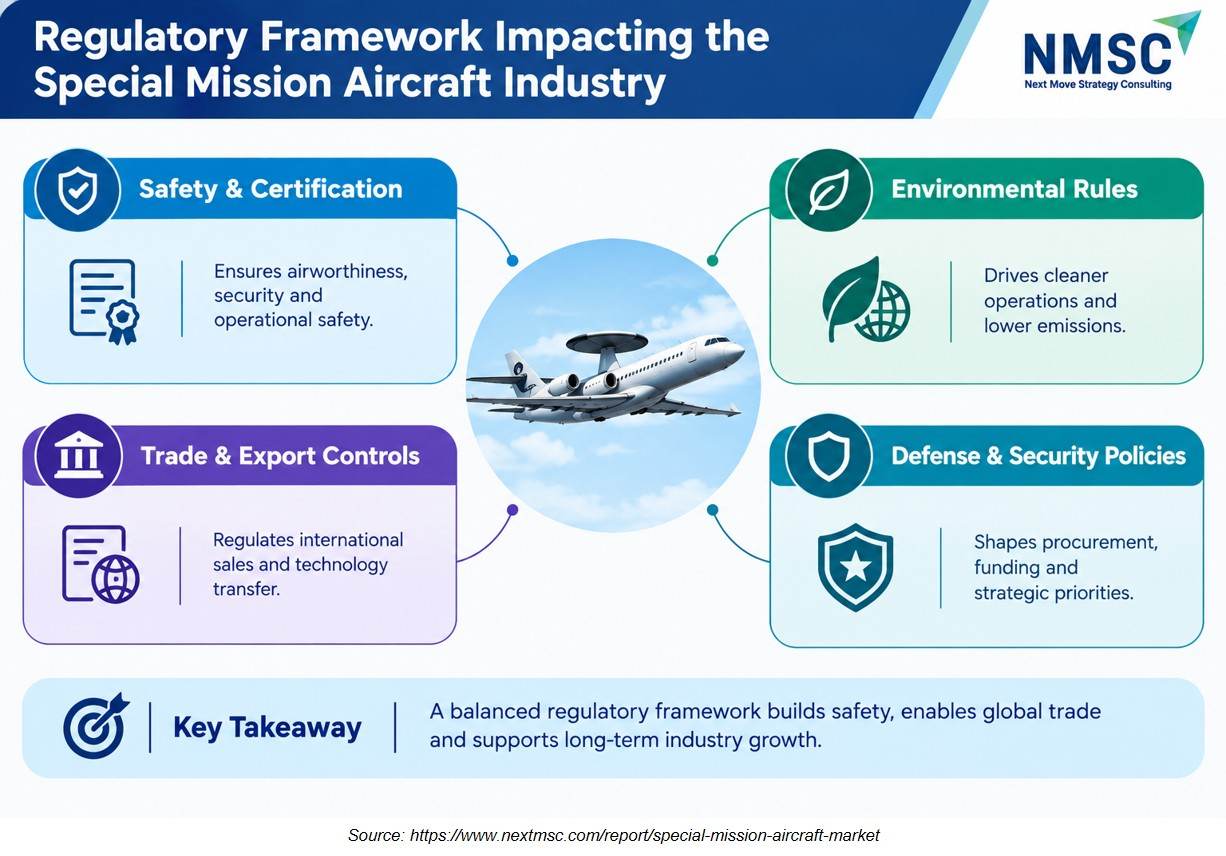
The above infographic outlines the regulatory framework impacting the special mission aircraft industry, highlighting four key areas of governance. It illustrates how safety certifications ensure operational airworthiness, while environmental rules drive cleaner operations. Furthermore, the analysis details how trade and export controls regulate international technology transfer, and defense policies shape strategic procurement and funding. Ultimately, the key takeaway emphasizes that a balanced regulatory framework is essential for building safety, enabling global trade, and supporting long-term industry growth.

Competitive Landscape

Our assessment indicates that the Special Mission Aircraft Market Industry is moderately consolidated at the platform-integrator tier, with a small number of diversified aerospace and defense majors holding the largest share of program-of-record positions, while a broader mid-tier of mission-systems integrators and regional manufacturers compete intensely on conversion programs, sensor payloads, and emerging UAS architectures. Key Takeaways

Dimension Description
Market Structure Moderately consolidated; top 10 companies hold the majority of market share, led by integrated platform primes alongside specialized UAS manufacturers and mission-systems integrators
Innovation Focus Crewed–uncrewed teaming, AI-enabled sensor fusion, open mission-systems architecture, low-observable EW platforms, and multi-domain maritime patrol payloads
M&A Activity Selective capability acquisitions targeting mission-systems software, UAS airworthiness certification, and ISR sensor integration rather than large-scale platform-company consolidation

How Do Companies Compete in the Special Mission Aircraft Market Industry?

Companies compete primarily on mission-system integration depth, airworthiness certification breadth across platform classes, and the strength of their government program-of-record relationships. Our findings suggest that vendors holding certified open-architecture mission systems hold a structural advantage over single-platform competitors, as defense ministries increasingly pursue multi-platform ISR architectures that require sensor interoperability and rapid software refresh capability rather than proprietary vendor lock-in.

Which Competitive Archetypes Dominate the Special Mission Aircraft Market?

Diversified prime contractors such as The Boeing Company and Northrop Grumman Corporation dominate through integrated airframe, mission-system, and sustainment ecosystems across multiple mission categories. Specialized UAS manufacturers including General Atomics Aeronautical Systems represent a distinct archetype competing on endurance, certification, and multi-payload flexibility for persistent ISR and maritime patrol applications. Mission-systems integrators such as L3Harris Technologies and Elbit Systems differentiate on sensor suite depth and rapid conversion program execution for mid-tier defense customers.

What Innovation and Differentiation Strategies Are Companies Pursuing?

We observed that leading companies are investing in AI-enabled sensor fusion, autonomous mission management, and open-architecture payload integration to capture preference among defense ministries pursuing multi-domain ISR capabilities. Differentiation increasingly rests on demonstrated crewed–uncrewed teaming interoperability and the ability to certify platforms under both military airworthiness standards and civilian STANAG 4671 frameworks, enabling dual-use commercial and defense market access within a single platform investment.

What M&A and Partnership Activity Is Shaping the Special Mission Aircraft Market?

Recent activity favors organic capability enhancement and strategic teaming agreements over large-scale acquisitions, exemplified by Boeing's June 2025 successful flight trial of MQ-28 Ghost Bat teaming with the E-7A Wedgetail platform. Our analysis shows that established platform primes are prioritizing crewed–uncrewed teaming program investments alongside sensor-fusion software partnerships rather than acquiring mission-systems integrators outright, reflecting the preference for flexible collaborative architectures over vertically integrated legacy platform models.

Key Market Players

Based on research conducted by NMSC, the following companies represent the validated set of leading participants across new-build mission aircraft, existing-aircraft conversion, uncrewed systems, and mission-system integration.

The Boeing Company Lockheed Martin Corporation Airbus SE Northrop Grumman Corporation General Atomics Aeronautical Systems, Inc. Leonardo S.p.A. Saab AB Embraer S.A. Israel Aerospace Industries Ltd. L3Harris Technologies, Inc. Textron Aviation Inc. Elbit Systems Ltd. Dassault Aviation S.A. Bombardier Inc. Sierra Nevada Corporation De Havilland Aircraft of Canada Limited Turkish Aerospace Industries, Inc. Korea Aerospace Industries, Ltd. Pilatus Aircraft Ltd Hindustan Aeronautics Limited

Latest Developments

We found that recent corporate and program activity reflects continued investment in AEW&C modernization, MALE UAS proliferation, and crewed–uncrewed teaming demonstrations within the Special Mission Aircraft Market.

Date Event
September 2026 France’s DGA received the development aircraft and first two Falcon 2000LXS Albatros aircraft under the AVSIMAR maritime surveillance and intervention program.
July 2026 Saab received an order for two GlobalEye airborne early warning and control aircraft from a Middle Eastern customer, valued at SEK 10.1 billion, with deliveries scheduled for 2030.
February 2026 India’s Ministry of Defence signed a ₹2,312 crore contract with Hindustan Aeronautics Limited (HAL) for eight Dornier 228 aircraft and Operational Role Equipment for the Indian Coast Guard.
April 2025 L3Harris and Air Tractor delivered the first missionized OA-1K Skyraider II aircraft to the U.S. Air Force Special Operations Command.

Expert Insights

Éric Martel

Éric Martel

President and CEO | Bombardier

"“Amid rising geopolitical tensions, this aircraft is the go-to choice for governments seeking to modernize their capabilities, with the reliability and performance to support the most demanding missions.”"

Analyst Interpretation

NMSC's analysis indicates that this perspective directly supports the growing importance of fleet modernization and mission-specific aircraft capabilities across defense forces. NMSC’s analysis indicates that evolving security requirements are accelerating demand for platforms that combine long endurance, reliability, advanced sensors, and mission-specific systems within modernized aircraft architectures. The increasing adoption of specialized platforms for airborne early warning, surveillance, intelligence, and other demanding defense missions is strengthening procurement opportunities for aircraft manufacturers, mission-system integrators, and specialized modification providers.

Investment Opportunities

Where Are Capital Inflows Concentrating in the Special Mission Aircraft Market?

Capital is concentrating in MALE and HALE UAS production capacity, AEW&C platform modernization programs, and AI-enabled mission-system software integration, reflected in the U.S. Air Force's USD 2.56 Billion E-7A Wedgetail contract and sustained USSOCOM Unmanned ISR procurement allocations of USD 41.7 Million in FY2025. These investments signal durable institutional capital commitment to multi-domain awareness platforms that simultaneously serve ISR, AEW&C, and electronic warfare mission categories.

How Is Infrastructure Investment Shaping Long-Term Capacity?

Our findings suggest that infrastructure investment is shifting toward open-architecture mission-system integration facilities and MALE UAS production lines that can support rapid variant-specific customization for diverse allied customer requirements. This shift favors manufacturers with certified production infrastructure capable of concurrent platform builds across multiple national customer configurations, as evidenced by Boeing's simultaneous production of E-7A aircraft for the Royal Air Force, U.S. Air Force, and Royal Australian Air Force within overlapping program schedules.

What ESG Considerations Are Influencing Investment Decisions in the Special Mission Aircraft Market?

Environmental, Social, and Governance considerations in this market center on fuel-efficient mission-platform transitions and responsible export-license governance for dual-use surveillance technologies. We found that investors increasingly favor companies demonstrating compliance with multilateral export-control frameworks and transparent reporting on mission-system end-use monitoring, particularly for military drone and UAS platforms subject to Missile Technology Control Regime and Wassenaar Arrangement controls in target export markets.

Key Benefits for Stakeholders

How Does This Report Benefit Defense Industry Leaders and Platform Manufacturers?

Defense industry leaders and platform manufacturers gain segment-level revenue forecasts and CAGR benchmarks across product type, mission type, and end-user axes, enabling program-investment and market-entry decisions grounded in the same 2025–2035 figures applied consistently throughout this analysis. Our regional growth differentials and country-level market sizing further support bid strategy, offset-agreement structuring, and industrial-partnership targeting decisions.

How Does This Report Benefit Investors and Financial Analysts?

Investors and financial analysts gain a reconciled market-sizing model, competitive-landscape assessment, and named-company development tracking that supports valuation and capital-allocation decisions across both publicly listed and privately held special mission aircraft manufacturers and systems integrators. The Growth Catalyst & Risk Assessment Matrix quantifies driver and restraint impact on CAGR, directly aiding scenario analysis for defense-sector portfolio positioning.

How Does This Report Benefit Government and Defense Procurement Authorities?

Government procurement authorities and defense ministry acquisition professionals gain visibility into which mission-type and end-user segments, such as Electronic Warfare & SIGINT and Commercial & /*Industrial Operators*/, are growing fastest, informing where to prioritize capability investment, industrial-base development, and international program cooperation through 2035. The competitive landscape section further identifies which archetypes and differentiation strategies are defining program-of-record success across allied procurement environments.

Key Market Segments Evaluated

By Product Type

  • New-Build Mission Aircraft 
    • Manned Fixed-Wing Aircraft
      • Light Turboprop Class
      • Regional Turboprop Class
      • Regional Jet Class
      • Business Jet Class
      • Narrow-Body Jet Class
      • Wide-Body Jet Class
      • Purpose-Built Military Transport Class
      • Other Fixed-Wing Class
    • Manned Rotary-Wing Aircraft
      • Light Helicopter Class
      • Medium Helicopter Class
      • Heavy Helicopter Class
    • Uncrewed Aircraft
      • Tactical UAS
      • Medium-Altitude Long-Endurance UAS
      • High-Altitude Long-Endurance UAS
      • Uncrewed Rotary-Wing Aircraft
      • Other Uncrewed Aircraft
  • Existing-Aircraft Conversion 
    • Manned Fixed-Wing Aircraft
      • Light Turboprop Class
      • Regional Turboprop Class
      • Regional Jet Class
      • Business Jet Class
      • Narrow-Body Jet Class
      • Wide-Body Jet Class
      • Purpose-Built Military Transport Class
      • Other Fixed-Wing Class
    • Manned Rotary-Wing Aircraft
      • Light Helicopter Class
      • Medium Helicopter Class
      • Heavy Helicopter Class
    • Uncrewed Aircraft
      • Tactical UAS
      • Medium-Altitude Long-Endurance UAS
      • High-Altitude Long-Endurance UAS
      • Uncrewed Rotary-Wing Aircraft
      • Other Uncrewed Aircraft

By Mission Type

  • Intelligence, Surveillance and Reconnaissance 
    • Overland Surveillance
    • Persistent Surveillance
    • Border Surveillance
    • Reconnaissance
  • Maritime Patrol and Anti-Submarine Warfare 
    • Maritime Surveillance
    • Anti-Submarine Warfare
    • Exclusive Economic Zone Monitoring
    • Fisheries and Illegal-Activity Monitoring
  • Airborne Early Warning and Control 
    • Airborne Early Warning
    • Airborne Battle Management
    • Airspace Surveillance
  • Electronic Warfare and Signals Intelligence 
    • Signals Intelligence
    • Electronic Intelligence
    • Communications Intelligence
    • Electronic Support
    • Electronic Attack
  • Command, Control and Communications 
    • Command and Control
    • Communications Relay
    • Strategic Communications
  • Airlift and Aerial Refuelling 
    • Tactical Transport
    • Special Operations Transport
    • Airborne Refuelling
    • Humanitarian Airlift
  • Search and Rescue and Emergency Response 
    • Search and Rescue
    • Medical Evacuation
    • Firefighting
    • Disaster Response
  • Special Operations and Personnel Recovery 
    • Special Operations Support
    • Personnel Recovery
    • Special Operations Mobility
  • Government and VIP Transport 
    • Government Transport
    • VIP Transport
  • Scientific and Environmental Missions 
    • Atmospheric Research
    • Geological Survey
    • Environmental Monitoring
    • Pollution Monitoring
  • Flight Test and Range Support 
    • Flight Test
    • Calibration
    • Range Instrumentation
    • Telemetry
  • Other Special Missions

By End User

  • Defense
  • Homeland Security and Law Enforcement
  • Civil Government 
    • Emergency Management Agencies
    • Public Health and Medical Services
    • Environmental Authorities
    • Transportation Authorities
  • Commercial and Industrial Operators 
    • Air Medical Operators
    • Resource and Energy Survey Operators
    • Specialised Aviation Operators
    • Research and Academic Institutions

By Region

  • North America 
    • U.S.
    • Canada
    • Mexico
  • Europe 
    • UK
    • Germany
    • France
    • Italy
    • Spain
    • Sweden
    • Denmark
    • Finland
    • Netherlands
    • Rest of Europe
  • Asia-Pacific 
    • China
    • India
    • Japan
    • South Korea
    • Taiwan
    • Indonesia
    • Vietnam
    • Australia
    • Philippines
    • Malaysia
    • Rest of APAC
  • Middle East & Africa 
    • Saudi Arabia
    • UAE
    • Egypt
    • Israel
    • Turkey
    • Nigeria
    • South Africa
    • Rest of MEA
  • Latin America 
    • Brazil
    • Argentina
    • Chile
    • Colombia
    • Rest of LATAM

Conclusion & Recommendations

The long-term outlook is structurally positive, with the market expanding from USD 20.41 Billion in 2026 to USD 33.12 Billion by 2035 at a 5.53% CAGR, underpinned by durable defense appropriation commitments and an accelerating uncrewed systems adoption trajectory. We observed that this growth trajectory is supported by persistent geopolitical competition, expanding maritime surveillance mandates, and the maturation of AI-enabled sensor fusion technologies that are collectively sustaining platform refresh and new-build demand across all five covered regions.

What Strategic Positioning Do We Recommend in the Special Mission Aircraft Market?

Our assessment indicates that manufacturers and integrators should prioritize open-architecture mission-system certification and crewed–uncrewed teaming capability to capture the fastest-growing Electronic Warfare & SIGINT and MALE UAS demand pools. Companies without established open-architecture integration infrastructure should pursue teaming agreements with certified mission-system vendors rather than standalone platform strategies, given the market's clear transition toward software-defined, upgradeable capability architectures over fixed-payload proprietary systems.

How Attractive Is the Special Mission Aircraft Market for Investment?

Investment attractiveness is highest in Asia-Pacific given its superior 7.2% CAGR, while North America offers the largest absolute revenue base at USD 7.22 Billion in 2025. We found that Electronic Warfare & SIGINT, Existing-Aircraft Conversion, and Commercial & Industrial Operators represent the three highest-growth sub-categories, offering investors exposure to above-market CAGR trajectories and recurring mission-system software revenue streams that complement traditional hardware procurement cycles.

What Are the Key Market Shifts and Risks?

Key risks include export-control constraints limiting platform proliferation in emerging markets, extended STANAG 4671 certification timelines compressing MALE UAS market access windows, and fiscal consolidation in Western Europe constraining new-build program commitments. Our analysis shows that companies failing to establish civilian airspace certification for their MALE UAS platforms risk being excluded from the rapidly growing commercial maritime monitoring and environmental surveillance segments as civil aviation authorities tighten UAS integration requirements.

What Are the Primary Growth Pathways Through 2035?

Primary growth pathways include crewed–uncrewed teaming integration, AI-enabled persistent maritime and border surveillance, and existing-aircraft conversion for mid-tier defense and commercial operators. We observed that companies combining certified open-architecture mission systems with competitive conversion program execution and allied-nation industrial-partnership structures are best positioned to capture disproportionate share of the USD 12.71 Billion absolute investment opportunity created between 2026 and 2035.

FAQs

About the Author

Mayurima Roy

Mayurima Roy

Mayurima Roy is Research Analyst at Next Move Strategy Consulting, where she has spent 4 years working across the firm's full industry coverage rather than a single fixed vertical. Her work centers on structured research, ongoing trend tracking, competitive assessment, and insight-led content development, translating complex market data into clear, decision-ready narratives that support informed client decision-making across diverse global industries, market sectors, and world regions every day.

About the Reviewer

Supradip Baul

Supradip Baul

Supradip Baul is an accomplished business consultant and strategist with over a decade of rich experience in market intelligence, strategy, technology, and business transformation. His work has included rigorous qualitative and quantitative analysis across multiple industries, helping clients shape investment decisions and long-term roadmaps. Earlier in his career, he was associated with Gartner, where he contributed to industry-leading reports and market share analyses. He has worked with leading global companies and holds an MBA with a dual specialization in Marketing and Finance.

Kevin Coker

KEVIN COKER

Founder, CEO and Board Diector

Proxima Clinical Research

I have been using Next MSC reports for product positioning in a new geography for a long time. They have by far the best reports I have found and the price is reasonable too!

Kishu Kanda

KISHU KANDA

Strategy Analyst

Accenture

We purchased the AI Consumer Market Report from this company. Not only did they customize the report to meet our specific requirements, but they also showed great flexibility in accommodating our budget. The report we received fully met our expectations. Additionally, they provided prompt and thorough responses to both our pre-purchase and follow-up questions. We look forward to working with this company again in the future.

Semih Kavaklioglu

SEMIH KAVAKLIOGLU

Co-Founder & Sales Manager

Decortie

I work a lot in the marketing industry and I know that research is an essential part of any campaign. I have used Market research reports for my own products and I found them to be very informative and well-researched. The team here produces insightful reports for a good price

Nishant Awate

NISHANT AWATE

Business Development Global Sales

Zehnder Group Deutschland GmbH

Our experience working with Next Move Strategy Consulting was positive. The team was responsive, professional, and open to incorporating our specific requirements throughout the project. The India AHU market study was comprehensive and well structured, covering market value and volume forecasts, product and application segments, and key industry trends. The inclusion of both AHU and residential MVHR market insights made the study particularly relevant for our strategic market assessment. Overall, the report provides a solid foundation for evaluating market potential, identifying priority segments, and supporting business-development decisions in India.

Mohit Agarwal

MOHIT AGARWAL

Chief Manager

DryChem India Pvt. Ltd.

Next Move Strategy Consulting is an amazing team of consultants. We required a market study report for our investors on top priority and the team went above and beyond our expectations to deliver the same with ample supporting data within a short time span enabling us to secure the investments and keep our project timeline maintained. Their professionalism, attention to detail, and timely delivery of actionable recommendations have left a lasting impression on our organization.

Custom Market Research Services

We will customize the research for you if the listed report does not fully match your requirements.

Get 30% Free Customization

Select License

This website uses cookies to ensure you get the best experience on our website. Learn more

✖