Turning Machine Market Size, Share, Trends and Growth Analysis, By New Equipment (Conventional Lathes, CNC Turning Centres, Multi-Tasking Machines, Multi-Spindle Automatic Lathes, Special Purpose Turning Machines, Swiss-Type Automatic Lathes, and Other New Turning Machines), By Buyer Type, By Sales Channel, By Automation Level, By End Use Industry, and Region – Global Industry Report and Forecast, 2026–2035
What Is the Turning Machine Market Size?
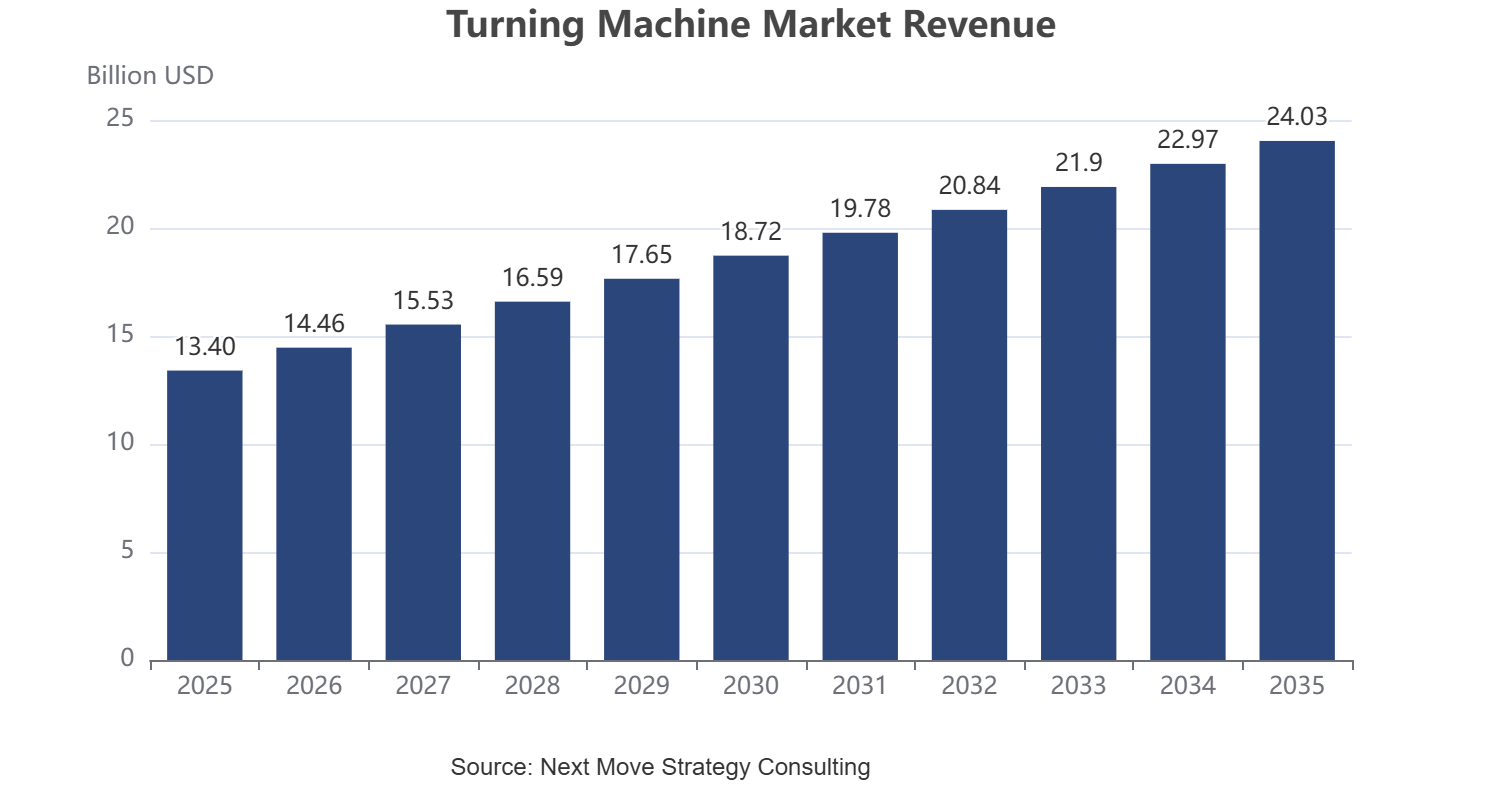
The global turning machine market size was valued at USD 13.40 billion in 2025 and is estimated at USD 14.20 billion in 2026, forecast to reach USD 24.03 billion by 2035, expanding at a 6.0% CAGR between 2026 and 2035. Asia-Pacific leads with approximately 44% share, while CNC Turning Centres dominates all new equipment types with approximately 46% share.
We observed that growth is broad-based across every segmentation axis, with robot-loaded automation and electronics and semiconductor end use driving the sharpest structural shifts through 2035.
|
Key Takeaways |
|
By New Equipment: CNC Turning Centres held the largest share of approximately 46% (USD 6.16 billion) in 2025; Multi-Tasking Machines is the fastest-growing sub-segment at 8.4% CAGR from 2026-2035. |
|
By Buyer Type: Job Shops held the largest share of approximately 32% (USD 4.29 billion) in 2025; OEMs is the fastest-growing sub-segment at 7.9% CAGR from 2026-2035. |
|
By Sales Channel: Indirect Sales held the largest share of approximately 58% (USD 7.77 billion) in 2025; Direct Sales is the fastest-growing sub-segment at 6.5% CAGR from 2026-2035. |
|
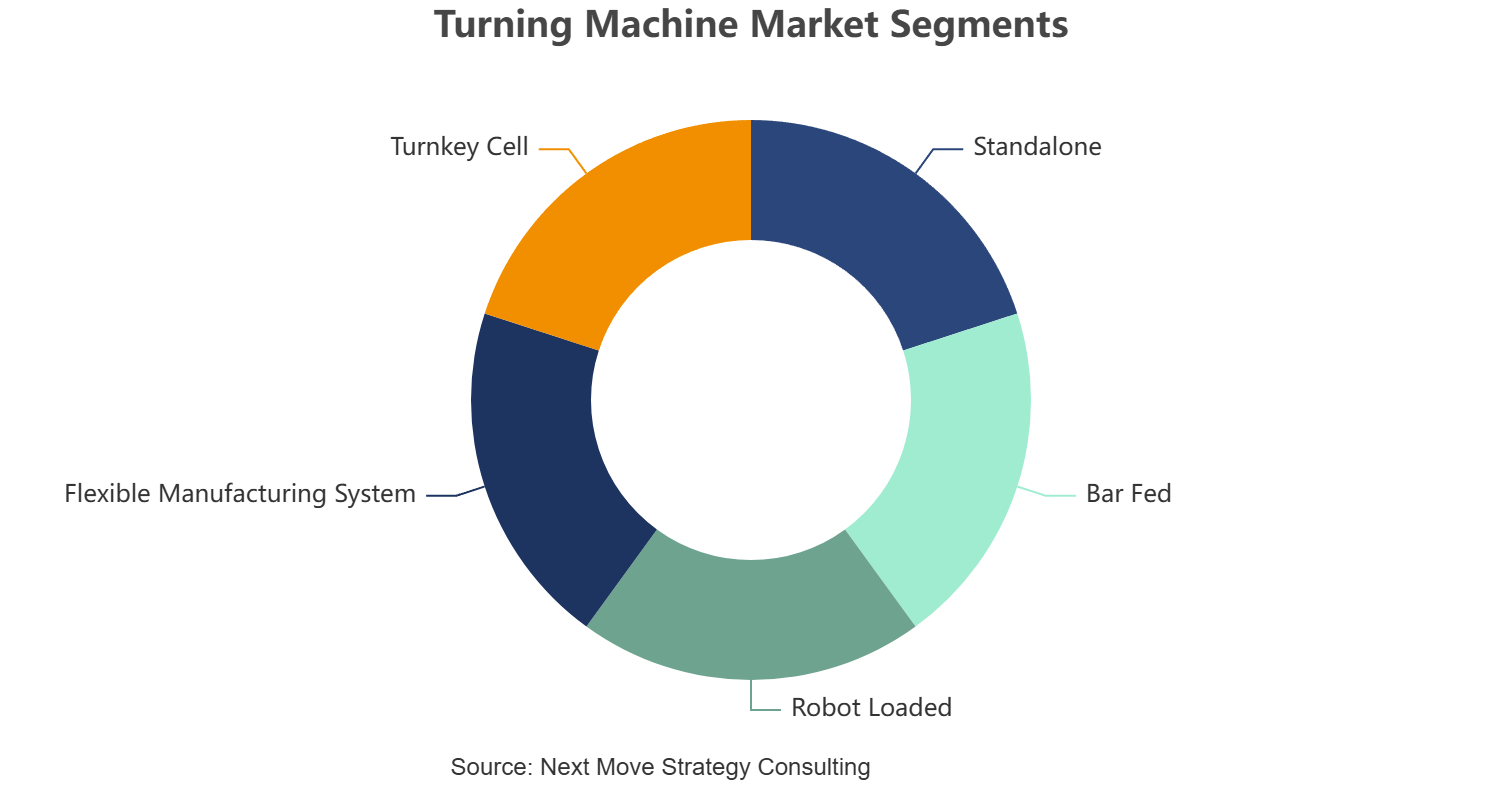
By Automation Level: Standalone held the largest share of approximately 38% (USD 5.09 billion) in 2025; Robot Loaded is the fastest-growing sub-segment at 10.2% CAGR from 2026-2035. |
|
By End Use Industry: Automotive held the largest share of approximately 29% (USD 3.89 billion) in 2025; Electronics and Semiconductors is the fastest-growing sub-segment at 11.6% CAGR from 2026-2035. |
|
Dominant Region: Asia-Pacific dominated with approximately 44% revenue share (USD 5.90 billion) in 2025. |
|
Fastest-Growing Region: Middle East & Africa is expected to register the highest CAGR of 7.7% during 2026-2035. |
|
Dominant Country: China led with approximately USD 2.36 billion in 2025. |
|
Fastest-Growing Country: India is the fastest-growing country at approximately 9.8% CAGR from 2026-2035. |
Market Opportunity: The turning machine market is expected to create an absolute dollar opportunity of USD 9.83 billion between 2026 and 2035, presenting significant investment potential across robot-loaded automation cells, multi-tasking machine platforms, and semiconductor-linked precision turning capacity.
According to Next Move Strategy Consulting analysis, machine tool builders are increasingly bundling robotic loading and multi-axis capability into standard turning platforms rather than offering automation as an aftermarket option, a shift that favors vendors able to deliver integrated, factory-tested automation cells over standalone machine suppliers as labor-constrained job shops scale capacity through 2035.
What Does the Turning Machine Market Encompass?
The market encompasses conventional lathes, CNC turning centres, multi-tasking machines, multi-spindle automatic lathes, special purpose turning machines, and Swiss-type automatic lathes used to remove material from rotating workpieces to produce precision cylindrical, conical, and complex-profile parts. Our assessment indicates that the scope spans new equipment sold to job shops, contract manufacturers, OEMs, and Tier 1 suppliers through direct and indirect sales channels, supplied at automation levels ranging from standalone operation to fully integrated flexible manufacturing systems. This category sits alongside related metal-cutting equipment such as the CNC Drilling Machine market while remaining distinct in its rotational, lathe-based material removal process.
The category has evolved from standalone conventional lathes into highly automated, multi-axis turning centres integrated with robotic loading and digital monitoring. We observed that DMG Mori reported record first-quarter orders of JPY 155.4 billion for its fiscal year 2026, alongside a JPY 1 billion investment with the University of Tokyo to establish a Machining Transformation Research Center combining digital twins and physical AI for integrated process prediction. Next Move Strategy Consulting's analysis indicates that this shift toward data-driven, automated turning operations, combined with labor availability constraints across major manufacturing economies, is redefining capital equipment selection criteria across the turning machine market.
Trade policy and regional manufacturing incentives increasingly shape the industry's competitive landscape. Japanese machine tool makers including Okuma, DMG Mori, and Yamazaki Mazak are expanding U.S. operations and broadening local services to ease the impact of tariffs while capturing demand tied to the current administration's push to revive domestic manufacturing. We observed that technology adoption is shifting toward robot-loaded and turnkey automation cells, as labor-constrained job shops and contract manufacturers prioritize unattended and lights-out operation over purely manual turning capacity.
|
Field |
Details |
|
Market Size in 2025 |
USD 13.40 Billion |
|
Market Size in 2026 |
USD 14.20 Billion |
|
Revenue Forecast in 2035 |
USD 24.03 Billion |
|
Growth Rate |
CAGR of 6.0% from 2026 to 2035 |
|
Analysis Period |
2025-2035 |
|
Base Year Considered |
2025 |
|
Forecast Period |
2026-2035 |
|
Market Size Estimation |
USD Billion |
|
Companies Profiled |
20 |
|
Countries Covered |
33 |
|
Market Share |
Available for Top 10 Companies |
Key Emerging Trends in the Turning Machine Market
Based on research conducted by Next Move Strategy Consulting, we found that four structural trends are reshaping equipment design, buyer requirements, and manufacturer strategy across the industry.
How Is Robotic Automation Transforming Turning Machine Operations?
Machine tool builders are increasingly bundling robotic loading directly into turning platforms rather than treating automation as an aftermarket addition. We observed that labor-constrained job shops and contract manufacturers are prioritizing unattended, lights-out turning capacity to offset skilled machinist shortages. This trend connects directly to the broader growth of the Industrial Robotics category, as turning machine builders integrate robotic arms and bar feeders as standard configurations rather than optional upgrades.
Why Is Digital Twin and Physical AI Integration Gaining Manufacturer Investment?
Turning machine builders are investing in digital twin and physical AI capability to predict and visualize machining processes before production begins. DMG Mori's collaboration with the University of Tokyo, backed by a JPY 1 billion investment to establish a Machining Transformation Research Center, exemplifies this shift toward combining Digital Twin simulation with physical AI to advance integrated process prediction spanning cutting, grinding, and additive manufacturing. This trend is elevating software and simulation capability alongside traditional mechanical precision as a purchasing criterion.
How Is Trade Policy Reshaping Regional Manufacturing Footprints?
Tariff policy under the current U.S. administration is prompting Japanese machine tool makers to expand domestic American production and service capacity. Okuma, DMG Mori, and Yamazaki Mazak are broadening U.S. operations to win clients and ease the impact of tariffs, while Haas Automation is completing a 2.4 million square foot expansion in Henderson, Nevada, expected to double the company's production output by early 2027. Our findings suggest that this reshoring trend is redistributing manufacturing capacity investment toward North America.
Why Is Multi-Tasking Machine Adoption Accelerating Among Precision Buyers?
Multi-tasking machines that combine turning, milling, and other operations on a single platform are gaining share as manufacturers seek to reduce part handling and setup time. We observed that IMTS 2026, organized by AMT-The Association for Manufacturing Technology, placed particular emphasis on multitasking, multifunction, and hybrid manufacturing equipment among its planned exhibits. Our analysis shows that this shift toward consolidated, multi-process platforms is most pronounced among aerospace and medical device manufacturers requiring complex, tight-tolerance geometries.
PESTEL Analysis of the Turning Machine Market
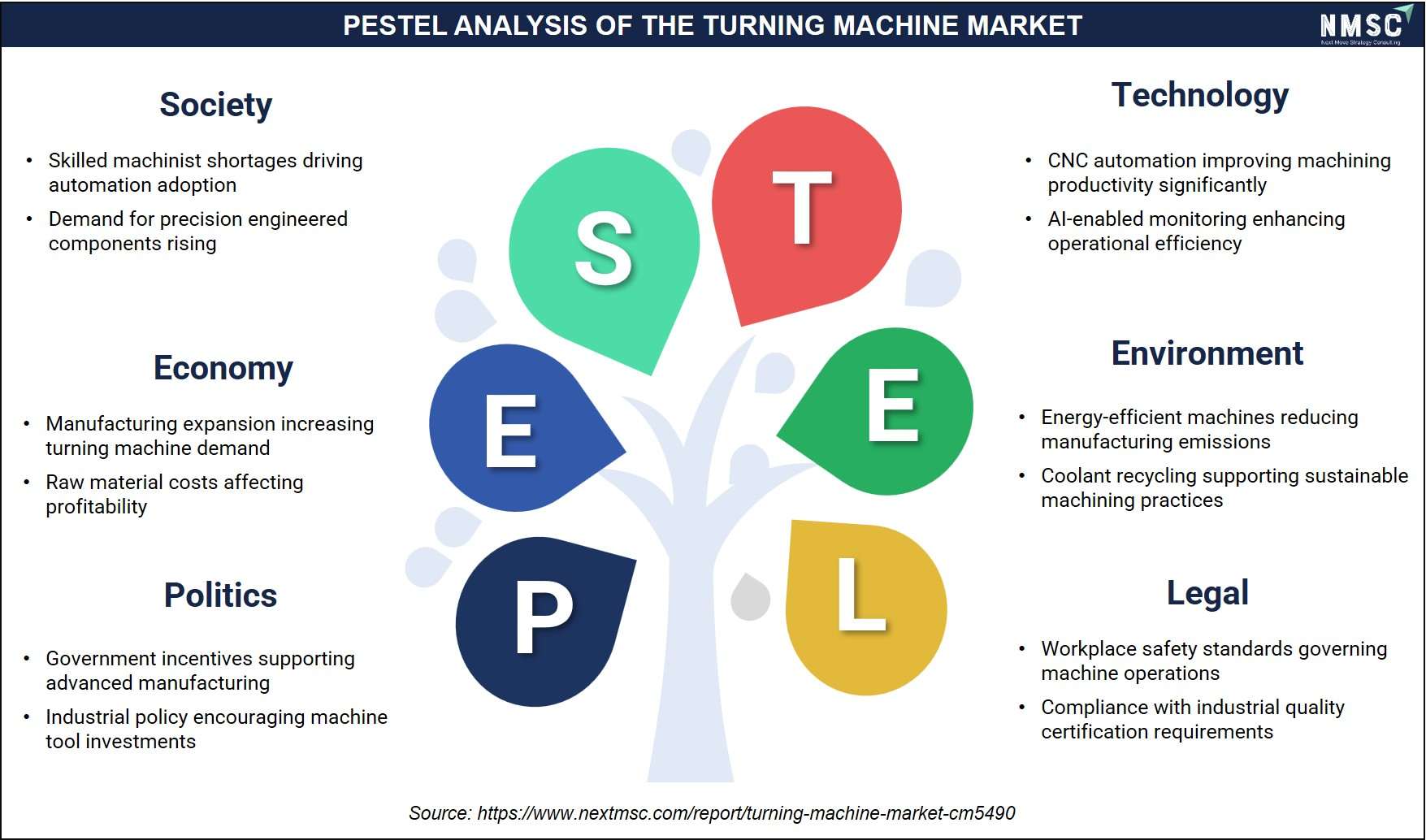
The image presents a PESTEL analysis of the Market, highlighting the external factors shaping industry growth. Political policies, economic conditions, social demand for skilled manufacturing, technological advancements in CNC automation, environmental sustainability initiatives, and evolving legal regulations collectively influence market dynamics, investment decisions, production efficiency, and the adoption of advanced turning machine technologies across global manufacturing industries.
Growth Drivers and Restraints
Growth Catalyst and Risk Assessment Matrix
|
Factors |
Type |
(+/-) % Impact on CAGR |
Geographic Relevance |
Impact Timeline |
|
Labor shortages accelerating robot-loaded automation adoption |
Driver |
+1.4% |
North America, Europe, Asia-Pacific |
2026-2035 |
|
Semiconductor and electronics fabrication capacity expansion |
Driver |
+1.1% |
North America, Asia-Pacific |
2026-2032 |
|
Reshoring and tariff-driven North American capacity investment |
Driver |
+0.9% |
North America |
2026-2030 |
|
Growth of multi-tasking and hybrid manufacturing platforms |
Driver |
+0.7% |
Global |
2026-2032 |
|
Rising aerospace and defense precision component demand |
Driver |
+0.6% |
North America, Europe, Asia-Pacific |
2026-2035 |
|
Digital twin and process simulation adoption among manufacturers |
Driver |
+0.4% |
Global |
2027-2032 |
|
Cyclical capital expenditure slowdowns in automotive manufacturing |
Restraint |
-0.6% |
Global |
2026-2029 |
|
High upfront cost of automated, multi-axis turning platforms |
Restraint |
-0.4% |
Latin America, Middle East & Africa |
2026-2030 |
|
Extended equipment lead times affecting capacity planning |
Restraint |
-0.3% |
Global |
2026-2028 |
What Is the Primary Growth Driver of the Turning Machine Market?
Labor shortages accelerating robot-loaded automation adoption is the primary driver of the market. DMG Mori's fiscal year 2026 first-quarter results showed record orders of JPY 155.4 billion, with the company extending warranty periods on turning spindles and tool posts to five years starting from April 2026 shipments, reflecting sustained capital investment confidence. We observed that this order momentum, combined with the Robot Loaded automation segment's 10.2% CAGR, continues to anchor equipment upgrade demand among labor-constrained job shops and contract manufacturers.
How Is Semiconductor Capacity Expansion Driving Turning Machine Market Growth?
Semiconductor and electronics fabrication capacity expansion is accelerating demand for precision turning equipment used in chip manufacturing tooling and components. Major fabrication facility construction projects collectively exceeding USD 100 billion are embedding hundreds of CNC-machined production cells, directly supporting the Electronics and Semiconductors end-use segment's 11.6% CAGR through 2035. Our assessment indicates that this fabrication buildout, concentrated in North America and Asia-Pacific, is compressing procurement timelines for high-precision, tight-tolerance turning capacity.
What Is Restraining Turning Machine Market Expansion?
Cyclical capital expenditure slowdowns in automotive manufacturing restrain steady market growth, given the sector's continued position as the largest end-use industry. Industry commentary on the machine tool cycle notes that orders fell during 2023 to 2024 amid a slowdown in capital investment, particularly in China, before signs of bottoming out and recovery became clear entering 2025 and 2026. We found that this cyclicality, combined with the high upfront cost of automated multi-axis platforms, particularly affects smaller job shops without access to flexible equipment financing.
Segmentation Analysis
Segment Sizing: By New Equipment
|
Segment |
2025 (USD) |
2035 (USD) |
CAGR% (2026-2035) |
|
Conventional Lathes |
USD 1.072 Billion |
USD 1.202 Billion |
1.2% |
|
CNC Turning Centres |
USD 6.164 Billion |
USD 10.573 Billion |
5.5% |
|
Multi-Tasking Machines |
USD 2.144 Billion |
USD 4.806 Billion |
8.4% |
|
Multi-Spindle Automatic Lathes |
USD 1.474 Billion |
USD 2.403 Billion |
5.0% |
|
Special Purpose Turning Machines |
USD 1.206 Billion |
USD 2.403 Billion |
7.1% |
|
Swiss-Type Automatic Lathes |
USD 0.938 Billion |
USD 1.922 Billion |
7.4% |
|
Other New Turning Machines |
USD 0.402 Billion |
USD 0.721 Billion |
6.0% |
|
Total |
USD 13.40 Billion |
USD 24.03 Billion |
6.0% |
Which New Equipment Segment Dominates the Turning Machine Market?
CNC Turning Centres led the market with USD 6.164 billion in 2025, reflecting the category's position as the default choice for precision, repeatable turning operations across job shops and contract manufacturers. We observed that Multi-Tasking Machines is the fastest-growing equipment segment, expanding at an 8.4% CAGR from 2026 to 2035, as aerospace and medical device manufacturers increasingly consolidate turning, milling, and other operations onto single platforms to reduce part handling and setup time.
Segment Sizing: By Automation Level
|
Segment |
2025 (USD) |
2035 (USD) |
CAGR% (2026-2035) |
|
Standalone |
USD 5.092 Billion |
USD 6.248 Billion |
2.1% |
|
Bar Fed |
USD 3.216 Billion |
USD 5.287 Billion |
5.1% |
|
Robot Loaded |
USD 2.546 Billion |
USD 6.728 Billion |
10.2% |
|
Flexible Manufacturing System |
USD 1.474 Billion |
USD 3.364 Billion |
8.6% |
|
Turnkey Cell |
USD 1.072 Billion |
USD 2.403 Billion |
8.4% |
|
Total |
USD 13.40 Billion |
USD 24.03 Billion |
6.0% |
Which Automation Level Is Growing Fastest in the Turning Machine Market?
Standalone remained the leading automation level, valued at USD 5.092 billion in 2025, reflecting continued demand for manually loaded turning machines among smaller job shops and low-volume production environments. Based on research conducted by Next Move Strategy Consulting, we found that Robot Loaded is the fastest-growing automation level, expanding at a 10.2% CAGR from 2026 to 2035, as labor-constrained manufacturers prioritize unattended operation and machine tool builders bundle robotic loading into standard turning platforms.
Segment Sizing: By End Use Industry
|
Segment |
2025 (USD) |
2035 (USD) |
CAGR% (2026-2035) |
|
Automotive |
USD 3.886 Billion |
USD 5.647 Billion |
4.2% |
|
Aerospace and Defence |
USD 2.010 Billion |
USD 4.325 Billion |
8.9% |
|
General Machinery |
USD 2.278 Billion |
USD 3.604 Billion |
5.2% |
|
Medical Devices |
USD 0.938 Billion |
USD 1.922 Billion |
8.3% |
|
Electronics and Semiconductors |
USD 1.340 Billion |
USD 3.604 Billion |
11.6% |
|
Energy |
USD 0.804 Billion |
USD 1.442 Billion |
6.7% |
|
Construction and Mining |
USD 0.670 Billion |
USD 1.202 Billion |
6.7% |
|
Die and Mold |
USD 0.804 Billion |
USD 1.442 Billion |
6.7% |
|
Consumer Goods |
USD 0.402 Billion |
USD 0.481 Billion |
2.0% |
|
Other Industries |
USD 0.268 Billion |
USD 0.361 Billion |
3.4% |
|
Total |
USD 13.40 Billion |
USD 24.03 Billion |
6.0% |
Which End Use Industry Leads Turning Machine Market Demand?
Automotive remained the leading end-use industry, valued at USD 3.886 billion in 2025, reflecting sustained demand for precision-turned drivetrain, engine, and chassis components across global vehicle production. Our findings suggest that Electronics and Semiconductors is the fastest-growing end-use industry, expanding at an 11.6% CAGR from 2026 to 2035, as fabrication facility construction projects exceeding USD 100 billion in the United States alone drive demand for precision-turned tooling and components used in Semiconductor Manufacturing Equipment production lines.
Growth Opportunities
Our analysis shows that three forward-looking opportunities stand out for stakeholders positioning within the market over the 2026-2035 forecast period.
How Can Integrated Automation Cells Unlock Value for Job Shops?
Factory-integrated, robot-loaded turning cells present a whitespace opportunity for builders serving labor-constrained job shops and contract manufacturers. Vendors that ship pre-configured, turnkey automation rather than requiring separate robot integration stand to capture recurring equipment upgrade cycles as smaller shops seek unattended operation without dedicated automation engineering staff.
Where Does Semiconductor Fabrication Buildout Create New Demand?
Precision turning capacity supporting semiconductor fabrication tooling represents an underpenetrated opportunity as major chip fabrication construction projects scale across North America and Asia-Pacific. Machine tool builders that deliver validated, ultra-tight-tolerance turning platforms can secure long-term supply relationships with equipment manufacturers, benefiting from recurring capital equipment revenue tied to fabrication capacity expansion.
How Can Digital Twin Simulation Benefit Aerospace and Medical Device Manufacturers?
Digital twin and process simulation capability creates an opportunity for machine tool builders serving aerospace and medical device manufacturers requiring complex, tight-tolerance geometries. Early movers that integrate simulation-validated process prediction into multi-tasking platforms can differentiate with buyers pursuing first-pass-yield improvements, particularly as certification and traceability requirements intensify across regulated end-use industries.
Supply Chain Structure of the Turning Machine Market
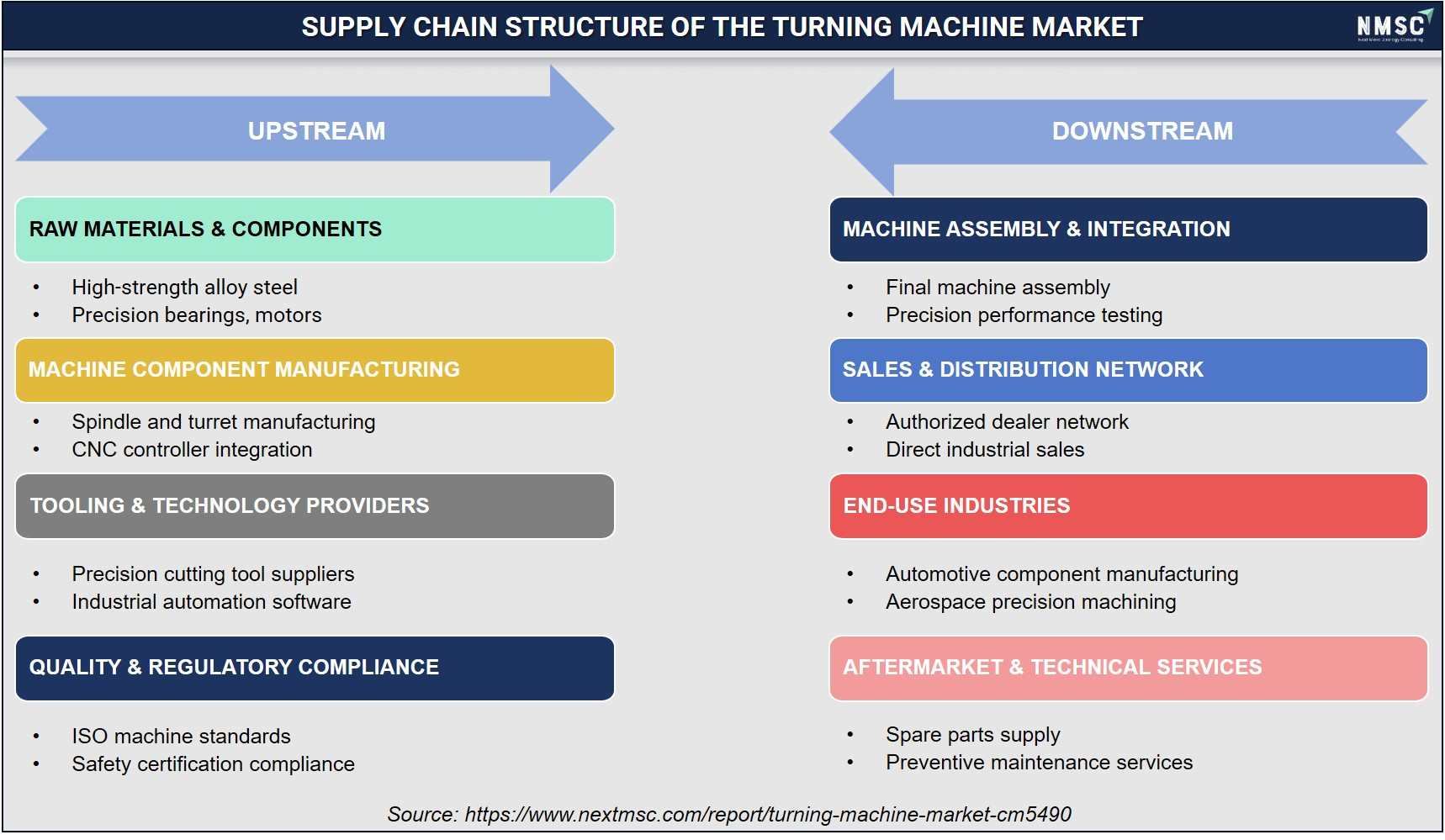
The image illustrates the supply chain structure of the Market, spanning upstream suppliers to downstream end users. It covers raw material sourcing, machine component manufacturing, tooling and automation providers, quality compliance, machine assembly, distribution channels, end-use industries, and aftermarket services. This interconnected value chain supports efficient production, product quality, technological innovation, and reliable maintenance across the global turning machine industry.
Regional Outlook
Geographic Performance Snapshot
|
Region |
2025 (USD) |
2035 (USD) |
CAGR% (2026-2035) |
Key Driver |
|
North America |
USD 2.680 Billion |
USD 5.287 Billion |
7.0% |
Reshoring investment and semiconductor fabrication capacity expansion |
|
Europe |
USD 3.484 Billion |
USD 5.527 Billion |
4.7% |
Precision automotive and aerospace component manufacturing base |
|
Asia-Pacific |
USD 5.896 Billion |
USD 10.573 Billion |
6.0% |
Large domestic machine tool production and electronics manufacturing |
|
Middle East & Africa |
USD 0.804 Billion |
USD 1.682 Billion |
7.7% |
Expanding industrial diversification and localized manufacturing programs |
|
Latin America |
USD 0.536 Billion |
USD 0.961 Billion |
6.0% |
Growing automotive and general machinery manufacturing investment |
|
Total |
USD 13.40 Billion |
USD 24.03 Billion |
6.0% |
-- |
North America Turning Machine Market Outlook
North America's market is expanding on reshoring investment and semiconductor fabrication capacity growth, with Haas Automation's 2.4 million square foot Henderson, Nevada expansion expected to double the company's production output. We observed that Japanese machine tool makers including Okuma, DMG Mori, and Yamazaki Mazak are broadening U.S. operations to ease the impact of tariffs while capturing demand from the region's manufacturing revival. Technology adoption is accelerating fastest among electronics and semiconductor buyers, with strategic outlook favoring builders that establish domestic production and service capacity.
Europe Turning Machine Market Outlook
Europe's market benefits from a deep precision automotive and aerospace component manufacturing base, anchored by German and Swiss machine tool builders. Our assessment indicates that mature industrial buyers are prioritizing multi-tasking and automated platforms to offset skilled machinist shortages across the region's manufacturing hubs. Strategic outlook favors vendors offering strong local service networks alongside automation integration capability for enterprises managing complex, certified aerospace supply chains.
Asia-Pacific Turning Machine Market Outlook
Asia-Pacific leads the market with the largest concentration of domestic machine tool production and electronics manufacturing capacity globally. We found that Japanese builders including DMG Mori, Yamazaki Mazak, and Okuma continue to anchor premium turning technology development from the region, while China's machine tool sector shows signs of order recovery following a 2023 to 2024 capital investment slowdown. Technology adoption is accelerating fastest among electronics and semiconductor buyers, with strategic outlook favoring builders with established regional service networks.
Middle East & Africa Turning Machine Market Outlook
The Middle East and Africa market is the fastest-growing region, expanding on industrial diversification programs and localized manufacturing initiatives across the Gulf states. Our findings suggest that national industrial strategy programs are creating first-generation demand for precision turning capacity among energy and general machinery buyers. Regulatory influence remains developing, with strategic outlook favoring builders partnering with regional distributors to support buyers building manufacturing capability from a low equipment base.
Latin America Turning Machine Market Outlook
Latin America's market is growing alongside expanding automotive and general machinery manufacturing investment across Brazil and Argentina. We observed that regional automotive supply chain expansion is driving demand for precision turning capacity among contract manufacturers and Tier 1 suppliers. Technology adoption remains concentrated in standalone and bar-fed automation levels given limited in-region robotic integration capacity, with strategic outlook favoring vendors offering flexible equipment financing suited to the region's mid-market buyers.
United States Turning Machine Market Outlook
Based on our estimates, the United States turning machine market was valued at approximately USD 1.90 billion in 2025 and is projected to reach USD 3.75 billion by 2035, expanding at a 7.0% CAGR. Demand structure is concentrated among aerospace, defense, and semiconductor buyers, with adoption level rising as Haas Automation's Henderson, Nevada facility nears completion. Competitive intensity is elevated, with the U.S. hosting a majority of the market's leading automation-focused builders and precision job shops.
Canada Turning Machine Market Outlook
The market in Canada was valued at approximately USD 0.51 billion in 2025 and is projected to reach USD 0.99 billion by 2035, expanding at a 6.8% CAGR. Demand structure is anchored by automotive and general machinery manufacturers serving integrated North American supply chains. Regulatory influence remains closely coordinated with U.S. trade policy, and strategic outlook favors builders extending U.S. distribution relationships into Canadian contract manufacturing capacity.
United Kingdom Turning Machine Market Outlook
As per our estimate, the United Kingdom market was valued at approximately USD 0.91 billion in 2025 and is projected to reach USD 1.44 billion by 2035, expanding at a 4.7% CAGR. Demand structure is led by aerospace and defense buyers with established precision manufacturing supply chains. Technology penetration remains strong given the UK's aerospace component manufacturing base, and strategic outlook favors vendors with established local service and calibration support.
Germany Turning Machine Market Outlook
According to our analysis, the German market was valued at approximately USD 1.15 billion in 2025 and is projected to reach USD 1.82 billion by 2035, expanding at a 4.7% CAGR. Demand structure is concentrated among automotive and general machinery manufacturers pursuing automated, multi-axis turning platforms. Regulatory influence from German and EU industrial standards shapes vendor selection, and strategic outlook favors builders headquartered domestically given the country's deep machine tool manufacturing heritage.
France Turning Machine Market Outlook
Based on our estimates, the French turning machine market was valued at approximately USD 0.63 billion in 2025 and is projected to reach USD 1.00 billion by 2035, expanding at a 4.7% CAGR. Demand structure spans aerospace and general machinery buyers navigating national industrial competitiveness initiatives. Technology adoption is growing steadily among mid-market manufacturers, and strategic outlook favors vendors partnering with regional distributors and system integrators.
China Turning Machine Market Outlook
The market in China was valued at approximately USD 2.36 billion in 2025 and is projected to reach USD 4.23 billion by 2035, expanding at a 6.0% CAGR. Demand structure is dominated by domestic electronics, automotive, and general machinery manufacturers operating at scale. Competitive intensity features strong domestic machine tool production alongside imported premium Japanese and German equipment, and strategic outlook favors builders capable of navigating China's distinct industrial policy environment.
India Turning Machine Market Outlook
As per our estimate, the Indian turning machine market was valued at approximately USD 0.71 billion in 2025 and is projected to reach USD 1.69 billion by 2035, the fastest-growing country in this report at a 9.8% CAGR. Demand structure is led by automotive and general machinery manufacturers as India's component supply chains scale to serve both domestic and export markets. Technology adoption is accelerating rapidly as contract manufacturers invest in CNC turning centres to replace conventional lathe capacity.
Japan Turning Machine Market Outlook
According to our analysis, the Japanese turning machine market was valued at approximately USD 1.24 billion in 2025 and is projected to reach USD 2.11 billion by 2035, expanding at a 6.1% CAGR. Demand structure is concentrated among precision automotive, electronics, and general machinery manufacturers served by the world's leading domestic machine tool builders. Regulatory influence remains moderate, and strategic outlook favors builders leveraging deep domestic supply chain integration and export-oriented production capacity.
South Korea Turning Machine Market Outlook
Based on our estimates, the South Korean turning machine market was valued at approximately USD 0.83 billion in 2025 and is projected to reach USD 1.61 billion by 2035, expanding at a 6.8% CAGR. Demand structure is led by electronics, semiconductor, and automotive manufacturers scaling automated turning capacity. Competitive intensity is rising as domestic builders including DN Solutions expand automation-integrated product lines, and strategic outlook favors vendors supporting both domestic and export-focused manufacturers.
Australia Turning Machine Market Outlook
The market in Australia was valued at approximately USD 0.24 billion in 2025 and is projected to reach USD 0.41 billion by 2035, expanding at a 5.5% CAGR. Demand structure spans mining equipment, energy, and general machinery buyers with extensive maintenance and replacement part manufacturing needs. Technology penetration is moderate relative to other Asia-Pacific markets, and strategic outlook favors vendors with established local distributor and service networks.
UAE Turning Machine Market Outlook
As per our estimate, the UAE turning machine market was valued at approximately USD 0.24 billion in 2025 and is projected to reach USD 0.50 billion by 2035, expanding at a 7.6% CAGR. Demand structure is concentrated among energy and general machinery buyers driving national industrial diversification initiatives. Competitive intensity is rising as global builders establish regional distributor partnerships, and strategic outlook favors platforms supporting Arabic-language interfaces and regional service requirements.
Saudi Arabia Turning Machine Market Outlook
According to our analysis, the Saudi Arabian turning machine market was valued at approximately USD 0.21 billion in 2025 and is projected to reach USD 0.46 billion by 2035, expanding at an 8.1% CAGR. Demand structure is driven by Vision 2030-linked industrial diversification programs across energy and manufacturing sectors. Technology adoption is accelerating as domestic manufacturing capacity expands, and strategic outlook favors vendors partnering with domestic distributors for large-scale industrial deployments.
South Africa Turning Machine Market Outlook
Based on our estimates, the South African turning machine market was valued at approximately USD 0.10 billion in 2025 and is projected to reach USD 0.20 billion by 2035, expanding at a 7.0% CAGR. Demand structure is led by mining equipment and general machinery manufacturers serving as the region's industrial adoption leaders. Regulatory influence remains developing, and strategic outlook favors vendors extending European distributor relationships to support South African buyers.
Brazil Turning Machine Market Outlook
The market in Brazil was valued at approximately USD 0.25 billion in 2025 and is projected to reach USD 0.44 billion by 2035, expanding at a 5.8% CAGR. Demand structure is concentrated among automotive and general machinery manufacturers serving South America's largest vehicle production base. Technology penetration continues to rise as domestic supply chain investment expands, and strategic outlook favors vendors offering Portuguese-language support and flexible equipment financing.
Argentina Turning Machine Market Outlook
As per our estimate, the Argentine turning machine market was valued at approximately USD 0.09 billion in 2025 and is projected to reach USD 0.16 billion by 2035, expanding at a 5.8% CAGR. Demand structure spans automotive and general machinery enterprises adopting CNC turning capacity amid a gradually recovering industrial base. Competitive intensity remains modest relative to Brazil, and strategic outlook favors vendors entering through regional distributor partnerships and multi-country Latin American sales motions.
Competitive Landscape
We observed that the turning machine market features a moderately consolidated competitive landscape, with Japanese, German, and Korean builders competing on precision, automation integration, and regional service depth.
Key Takeaways
|
Dimension |
Description |
|
Market Structure |
Moderately consolidated; the top companies profiled in this report collectively account for a significant share of global turning machine revenue, while numerous specialist Swiss-type and special purpose builders serve niche precision applications. |
|
Innovation Focus |
Robot-loaded automation, digital twin process simulation, and multi-tasking platform expansion dominate current innovation pipelines across leading vendors. |
|
M&A Activity |
Continued capacity investment and regional expansion rather than large-scale consolidation, exemplified by Haas Automation's Henderson, Nevada facility and Japanese builders' expanding U.S. operations. |
How Do Companies Compete in the Turning Machine Market?
Companies compete primarily on precision, automation integration depth, and regional service network reach across the industry. Japanese builders including DMG Mori, Yamazaki Mazak, and Okuma leverage deep domestic supply chain integration and global technical centers to serve precision-intensive automotive and aerospace buyers, while Haas Automation competes on value-oriented pricing and domestic U.S. production scale to serve job shops and smaller contract manufacturers.
Which Competitive Archetypes Dominate the Turning Machine Market?
Two archetypes dominate the market: premium Japanese and German builders offering high-precision, automation-integrated platforms, and value-oriented builders competing on price and domestic production scale. DMG Mori, Yamazaki Mazak, and Okuma exemplify the premium archetype through advanced CNC control systems and thermal stability technologies, while Haas Automation exemplifies the value archetype through its position as the largest machine tool builder in the western world by unit volume.
How Are Companies Differentiating Through Innovation in Turning Machines?
Innovation and differentiation strategy increasingly center on digital twin simulation and extended equipment reliability. DMG Mori's Machining Transformation Research Center with the University of Tokyo and its extension of turning spindle warranties to five years from April 2026 shipments both illustrate this shift toward data-driven reliability engineering. Our analysis shows that vendors unable to demonstrate credible automation integration and process simulation capability risk losing share among aerospace and semiconductor buyers demanding first-pass-yield improvements.
What M&A and Expansion Activity Is Shaping the Turning Machine Market?
Capacity expansion and regional footprint investment continue to reshape the industry more than large-scale consolidation. Haas Automation's 2.4 million square foot Henderson, Nevada facility, expected to double the company's production output by early 2027, and Japanese builders' broadening U.S. service operations both reflect a strategic response to tariff policy and reshoring demand. Our findings suggest that this capacity investment activity reflects builders' confidence in sustained North American manufacturing capital expenditure growth.
Key Market Players
Our assessment indicates that the following 20 companies are actively shaping product innovation, automation integration, and regional capacity strategy within the global turning machine market.
-
Okuma Corporation
-
Haas Automation, Inc.
-
DN Solutions Co., Ltd.
-
INDEX-Werke GmbH & Co. KG
-
EMAG GmbH & Co. KG
-
Citizen Machinery Co., Ltd.
-
Tsugami Corporation
-
Tornos SA
-
Star Micronics Co., Ltd.
-
Nakamura-Tome Precision Industry Co., Ltd.
-
JTEKT Corporation
-
Fuji Machine Mfg. Co., Ltd.
-
Komatsu NTC Ltd.
-
Murata Machinery, Ltd.
-
Hwacheon Machinery Co., Ltd.
-
SMEC Co., Ltd.
-
General Technology Group Dalian Machine Tool Co., Ltd.
-
Shenyang Machine Tool Co., Ltd.
Latest Developments
We found that recent product launches and capacity investments within the turning machine market are concentrated on automation integration and North American manufacturing expansion, reflecting the industry's broader response to labor constraints and trade policy.
|
Date |
Event |
|
March 2026 |
DMG MORI launched the NLX 2500|700 2nd Generation CNC turning center, featuring enhanced machine rigidity, improved thermal stability, automation compatibility, and digital integration for high-precision turning applications. This strengthens its portfolio for automotive, aerospace, and precision manufacturing customers |
Investment Opportunities
What Capital Inflows Are Targeting the Turning Machine Market?
Capital inflows into the turning machine market are increasingly directed toward North American production capacity and automation integration. Haas Automation's Henderson, Nevada facility, a USD 327 million investment expected to double production output, illustrates the scale of capital committed to domestic manufacturing capacity. We observed that investors and equipment buyers favor builders demonstrating durable order backlogs, consistent with DMG Mori's record first-quarter fiscal year 2026 orders of JPY 155.4 billion.
How Is Infrastructure Investment Supporting Turning Machine Market Scaling?
Infrastructure investment is expanding both machine tool production capacity and end-user fabrication capability to support growing precision manufacturing demand. Major semiconductor fabrication facility construction projects collectively exceeding USD 100 billion are embedding hundreds of CNC-machined production cells, extending demand into related capital equipment categories including Wafer Handling Robots that support automated fabrication environments alongside precision turning capacity.
What ESG Considerations Are Shaping Turning Machine Investment Decisions?
Environmental, social, and governance considerations are gaining relevance across the industry as energy efficiency and workforce safety become differentiating criteria for capital equipment buyers. We found that automated, robot-loaded turning cells reduce operator exposure to rotating machinery hazards while improving energy efficiency through optimized spindle utilization, positioning automation investment as both a productivity and workplace safety improvement that aligns with buyers' broader ESG disclosure commitments.
Key Benefits for Stakeholders
How Does This Report Benefit Enterprise and Industry Leaders?
Enterprise and industry leaders gain access to validated segmentation, competitive benchmarking, and regional demand forecasts that support capital equipment procurement decisions across the turning machine industry. Our analysis shows that detailed new equipment, automation level, and end-use industry breakdowns help operations and manufacturing leaders align equipment selection with production strategy while identifying underserved automation categories, such as robot-loaded turning cells, for near-term capital investment.
How Does This Report Benefit Investors and Financial Analysts?
Investors and financial analysts benefit from consistent, single-point market size and CAGR estimates that support valuation and capital-allocation decisions across the turning machine market's builder landscape. We observed that the report's regional and segment-level growth differentials help identify which equipment categories, including multi-tasking machines and robot-loaded automation, are best positioned to capture above-market growth through 2035.
How Does This Report Benefit Technology Vendors and Product Teams?
Technology vendors and product teams gain insight into emerging buyer requirements, including robotic loading integration, digital twin process simulation, and multi-tasking platform consolidation, that are reshaping the industry. Our findings suggest that this analysis helps product teams prioritize development roadmaps around automation and semiconductor-linked precision capability that are increasingly decisive in capital equipment procurement processes.
Key Market Segments
By New Equipment
-
Conventional Lathes
-
Engine Lathes
-
Toolroom Lathes
-
-
CNC Turning Centres
-
Horizontal Turning Centres
-
2-Axis
-
Multi-Axis
-
-
Vertical Turning Centres
-
-
Multi-Tasking Machines
-
Horizontal
-
Vertical
-
-
Multi-Spindle Automatic Lathes
-
Cam Controlled
-
CNC
-
-
Special Purpose Turning Machines
-
Crankshaft Machines
-
Camshaft Machines
-
Wheel Turning Machines
-
Transfer Lines
-
Other Dedicated Systems
-
-
Swiss-Type Automatic Lathes
-
Other New Turning Machines
By Buyer Type
-
Job Shops
-
Contract Manufacturers
-
OEMs
-
Tier 1 Suppliers
-
Captive Plants
-
Other Buyers
By Sales Channel
-
Direct Sales
-
Indirect Sales
-
Dealers
-
Distributors
-
Agents
-
System Integrators
-
By Automation Level
-
Standalone
-
Bar Fed
-
Robot Loaded
-
Flexible Manufacturing System
-
Turnkey Cell
By End Use Industry
-
Automotive
-
Aerospace and Defence
-
General Machinery
-
Medical Devices
-
Electronics and Semiconductors
-
Energy
-
Construction and Mining
-
Die and Mold
-
Consumer Goods
-
Other Industries
By Region
-
North America: U.S., Canada, Mexico.
-
Europe: UK, Germany, France, Italy, Spain, Sweden, Denmark, Finland, Netherlands, Rest of Europe.
-
Asia-Pacific: China, India, Japan, South Korea, Taiwan, Indonesia, Vietnam, Australia, Philippines, Malaysia, Rest of APAC.
-
Middle East & Africa: Saudi Arabia, UAE, Egypt, Israel, Turkey, Nigeria, South Africa, Rest of MEA.
-
Latin America: Brazil, Argentina, Chile, Colombia, Rest of LATAM
Conclusion & Recommendations
What Is the Long-Term Outlook for the Turning Machine Market?
The long-term outlook for the turning machine market is positive, with the industry forecast to expand from USD 14.20 billion in 2026 to USD 24.03 billion by 2035. Our assessment indicates that this growth will be driven by robot-loaded automation adoption and semiconductor-linked precision demand, tempered by the cyclical nature of automotive capital expenditure. Vendors that scale automation-integrated platforms are best positioned to capture the market's long-term trajectory.
What Strategic Positioning Should Vendors Pursue?
Vendors should pursue strategic positioning around integrated automation and digital process simulation rather than standalone mechanical precision alone. Next Move Strategy Consulting's analysis indicates that builders combining robot-loaded platforms, digital twin capability, and extended reliability warranties will differentiate most clearly as buyers evaluate total cost of ownership over unit price. Strategic capacity investment in North America will further strengthen builders' positioning against tariff-related cost pressure.
How Attractive Is the Turning Machine Market for New Investment?
The turning machine industry presents a moderately attractive investment case, supported by a USD 9.83 billion absolute dollar opportunity between 2026 and 2035 and above-average growth in Middle East & Africa and Electronics and Semiconductors categories. We found that investment attractiveness is highest for vendors combining robot-loaded automation capability with semiconductor-linked precision manufacturing, positioning them to serve both labor-constrained job shops and complex fabrication equipment buyers simultaneously.
What Market Shifts and Key Risks Should Stakeholders Monitor?
Stakeholders should monitor cyclical automotive capital expenditure slowdowns, high upfront automation costs, and extended equipment lead times as key risks to the turning machine market. Our analysis shows that vendors unable to demonstrate clear automation and reliability differentiation risk losing share as buyers increasingly evaluate total cost of ownership, particularly among smaller job shops without access to flexible equipment financing.
What Are the Key Growth Pathways for the Turning Machine Market?
Key growth pathways include expanding robot-loaded automation portfolios, scaling semiconductor-linked precision manufacturing capability, and deepening North American production capacity. Next Move Strategy Consulting's analysis indicates that vendors pursuing these pathways while maintaining cost competitiveness in standalone and conventional equipment categories will be best positioned to capture the turning machine market's projected growth through 2035.
About the Author
 Liza Phukan is Research Associate at Next Move Strategy Consulting, where she has covered emerging industries and market research across sectors for 3.5 years. Her work includes analyzing industry developments, validating market data, and developing structured business content from research findings. She uses secondary research and data-validation practices to turn complex market information into clear decision-useful market analysis for business audiences and support report development and B2B.
About the Reviewer
 Supradip Baul is an accomplished business consultant and strategist with over a decade of rich experience in market intelligence, strategy, technology, and business transformation. His work has included rigorous qualitative and quantitative analysis across multiple industries, helping clients shape investment decisions and long-term roadmaps. Earlier in his career, he was associated with Gartner, where he contributed to industry-leading reports and market share analyses. He has worked with leading global companies and holds an MBA with a dual specialization in Marketing and Finance.
At Next Move Strategy Consulting, we understand that insightful market research is the cornerstone of successful business decisions. That's why we employ a robust and multifaceted approach, combining various methodologies to deliver the most accurate and actionable data for our clients.

Research Landscape
We navigate the world of research with two primary approaches:
Qualitative Approach
Our qualitative research methodologies involve immersive techniques such as in-depth interviews, focus groups, and observational studies. By engaging directly with individuals and stakeholders, we uncover valuable insights that quantitative data alone may overlook.

Quantitative Research
In tandem with qualitative methodologies, NMSC leverages the power of Quantitative Research to provide a robust foundation of numerical insights. Through systematic data collection and analysis, we quantify patterns, preferences, and market trends, offering a comprehensive view of the business landscape.
Our quantitative research approach employs diverse tools, including surveys, experiments, and statistical modelling. These methodologies enable us to gather data from a large and representative sample, ensuring the statistical significance of our findings. By employing structured questionnaires and standardized data collection methods, we guarantee the reliability and validity of the information we present to our clients.
Quantitative research is particularly effective in measuring the prevalence of trends, assessing market size, and gauging the impact of various factors on consumer behavior. The numerical precision attained through this approach equips our clients with actionable insights, facilitating data-driven decision-making and strategy formulation.


Our Specialized Toolbox for Industry-Specific Market Research
We deploy a specialized arsenal of techniques tailored to meet your unique requirements. Here's a glimpse into our comprehensive toolbox:

Information Procurement
The stage entails acquiring market data or relevant information through various sources and methodologies.


Market Research Approach
We utilize both top-down and bottom-up approaches in market research analysis to achieve a comprehensive understanding of the market dynamics, leveraging the broad perspective of industry trends and macroeconomic factors alongside detailed insights from specific segments and individual companies.

Porters Five Forces Analysis
We conduct Porter's Five Forces analysis to evaluate the competitive landscape of an industry, providing us with insights into factors that affect profitability and strategic positioning.

SWOT Analysis

Forecasting
We utilize a forecasting model to predict future consumption by considering parameters like population, economics, regulations, market competition, drivers, constraints, technology, and pricing. We also employ statistical techniques such as multilinear regression, exponential smoothing, moving average, ARIMA, and Monte Carlo simulations for accurate predictions. In econometric forecasting, we analyzed short-term and long-term event impacts, attributing values based on regulatory frameworks, economic factors, and market events.





 Speak to Our Analyst