3D Cell Culture Market: Why Regulators Are Betting on Organoids | NextMSC
Introduction
On September 21, 2026, the U.S. Food and Drug Administration issued a final rule that replaces animal-testing terminology across its regulations with the broader term “nonclinical,” a category that expressly lists cell-based assays, organ chips, computer modeling and bioprinting next to animal studies, according to the Regulatory Affairs Professionals Society (RAPS). The same day, the National Institutes of Health announced five initiatives to move biomedical research toward human-based methods. For suppliers of spheroids, organoids and microphysiological systems, the 3D cell culture market now operates under written regulatory language that names their products as acceptable routes to safety evidence.
According to Next Move Strategy Consulting’s 3D Cell Culture Market report, the global 3D cell culture market was valued at USD 1.83 billion in 2023 and is projected to reach USD 5.34 billion by 2030, growing at a CAGR of 16.4% from 2024 to 2030. That is an addition of USD 3.51 billion in seven years. This article tests that trajectory against the last six months: a rule rewrite in Washington, a roadmap in Brussels, three acquisitions that bundle human cell models into larger workflows, and quarterly results from the largest laboratory-tools supplier.
For More Information: Download FREE Sample on 3D Cell Culture Market Report
Animal-Testing Rules Rewritten: How Regulators and Dealmakers Are Rebuilding the 3D Cell Culture Market
FDA’s Final Rule and NIH’s Five Initiatives: September 21, 2026
The FDA rule is narrower than its headlines suggest, and that precision matters for investors. RAPS reported that the agency replaced animal-testing terminology with “nonclinical tests” and “nonclinical studies,” defined to cover in vitro, in silico and in chemico methods, cell-based assays, organ chips, computer modeling, bioprinting, nonhuman in vivo tests and animal studies. The rule does not prohibit animal testing, and the agency stated that it does not change evidentiary standards or add costs for drugmakers. It takes effect on February 4, 2027, with comments due by December 7, 2026.
Acting FDA Commissioner Kyle Diamantas said, as reported by RAPS on September 21, 2026, “Our goal is not to replace one rigid approach with another.” NextMSC primary research and analysis reads the definitional change as a reduction in the cost of proposing a 3D model to a review division. A sponsor assembling a liver spheroid or tumoroid package no longer has to argue that its data sit outside the standard nonclinical file, although acceptance will still be decided study by study.
On the same day, the National Institutes of Health announced five initiatives. The most relevant to 3D culture is the Bio Genesis Autonomous Human Biology Laboratory at the NIH Clinical Center, aligned with the NIH Standardized Organoid Modeling Center. NIH described a closed-loop platform combining standardized human organoid models, robotics and artificial intelligence, so that data from each experiment informs the next. NIH also committed more than USD 88 million to 10 construction projects in nine states, announced a Qu-SAFE Challenge with more than USD 7 million in prizes for quantum-enabled sensing in new approach methodologies such as organ-on-a-chip devices, and is recruiting grant reviewers with human-based science expertise.
NIH Director Jay Bhattacharya, M.D., Ph.D., said in the agency’s September 21, 2026 release that NIH is “building the scientific infrastructure needed to develop, validate, and scale technologies.” The release states no budget, timeline or opening date for the Bio Genesis laboratory, so it is a forward indicator rather than a current revenue source.
The European Commission’s Roadmap: 22 Actions Across 15 Regulatory Domains
On June 1, 2026, the European Commission adopted its Roadmap towards phasing out animal testing for chemical safety assessments, published as Communication C(2026) 3497. It sets out 22 actions under three pillars across 15 legislative domains, including industrial chemicals, pesticides, biocides, pharmaceuticals and food and feed additives. The Commission recorded that more than 15 million animals were used for regulatory testing in the European Union between 2015 and 2023, almost 40% of them in chemical safety assessments.
The roadmap widens the buyer base beyond pharmaceuticals. Manufacturers of industrial chemicals, crop-protection products and food additives have historically sat outside the 3D culture customer pool, and the Commission describes its actions as commitments with timings and milestones. NextMSC primary research and analysis expects the effect to show first in tissue models with well-defined toxicological endpoints, such as skin and eye, where the UK Home Office recorded zero irritation procedures in 2025.
Consolidation: Bruker and MIMETAS, Transpharmation and OrganoTherapeutics, Revvity and Human Cell Design
On August 12, 2026, European Biotechnology reported that Bruker is acquiring a majority stake in MIMETAS, the Leiden-based organ-on-a-chip developer whose OrganoPlate platform runs microfluidic tissue cultures in formats compatible with standard high-throughput laboratories. MIMETAS keeps its brand and management, and financial terms were not disclosed. Bruker adds proteomics, metabolomics, NMR, spatial biology and preclinical imaging, and the companies intend to link these into integrated workflows. Bruker CEO Frank H. Laukien said, as quoted by European Biotechnology on August 12, 2026, “Human physiology-relevant tissue and disease models are becoming increasingly important.”
On October 28, 2026, Transpharmation Ltd., a preclinical contract research organization focused on neuroscience, pain and metabolic disease, announced the acquisition of OrganoTherapeutics SARL, a University of Luxembourg spin-off whose human stem cell-derived brain organoid and assembloid models cover Parkinson’s disease, Huntington’s disease and amyotrophic lateral sclerosis. OrganoTherapeutics continues as a subsidiary, and terms were not disclosed. Transpharmation Chief Executive Officer Dr. Mark Duxon said in the release that he sees a clear future for non-animal models offered alongside the company’s preclinical pharmacology.
On September 9, 2026, Revvity announced an agreement to acquire Human Cell Design, whose EndoC-βH5 human pancreatic beta cell model serves diabetes and obesity research. Closing is expected in the fourth quarter of 2026, and terms were not disclosed. The release does not describe the models as three-dimensional, so the deal is adjacent evidence: an assay vendor paying for human-relevant cell models it can pair with its HTRF, AlphaLISA and ATPlite assays.
NMSC Strategic Perspective: Why Workflow Ownership Will Decide Share in the 3D Cell Culture Market
NextMSC primary research and analysis reads the three transactions as one pattern. Each acquirer bought a producer of human tissue or cell models and attached it to something it already sold: Bruker’s analytical instruments, Revvity’s assay chemistry and Transpharmation’s in vivo pharmacology contracts. A spheroid or organoid sold alone is a consumable with a reproducibility burden on the buyer. The same model sold inside a validated workflow, with imaging, assays and data analysis, becomes a platform that a regulatory team can defend in a submission.
The NextMSC report segments the 3D cell culture market by technology into scaffold-based systems, scaffold-free systems, microfluidics-based systems, magnetic levitation and others, and names Thermo Fisher Scientific, Corning, Lonza, Merck, ReproCELL, InSphero AG and Promega among the key players. The Bruker and MIMETAS transaction gives the microfluidics-based segment a named platform acquirer. The principal restraint NextMSC identifies is the high cost of equipment, specialized media and reagents. Bundled workflows spread that cost across assays and analysis, but they also give integrators pricing power, a trade-off procurement teams should weigh before committing to one vendor’s ecosystem.
Section Summary:
Three acquisitions and two government actions in the last six months show demand moving from standalone models to regulated, integrated workflows.
-
The FDA rule, effective February 4, 2027, places cell-based assays, organ chips and bioprinting within nonclinical studies.
-
NIH’s September 21, 2026 package pairs standardized organoid production with robotics and artificial intelligence.
-
The European Commission roadmap extends demand to chemicals, pesticides and food additives across 15 legislative domains.
-
Bruker, Transpharmation and Revvity each attached human cell models to an existing instrument, CRO or assay franchise.
Industry Impact Analysis
Animal-Use Baselines: What the UK Home Office Statistics Mean for the 3D Cell Culture Market
The UK Home Office published its annual statistics on July 9, 2026. A total of 2.54 million regulated scientific procedures on living animals were carried out in Great Britain in 2025, down from 2.64 million in 2024 and the lowest total under the Animals (Scientific Procedures) Act 1986. Experimental procedures accounted for 1.32 million, or 52%, and creation and breeding for 1.22 million, or 48%. Mice were used in 56% of experimental procedures, fish in 16%, birds in 10%, rats in 9%, other species in 8% and specially protected species in 1%.
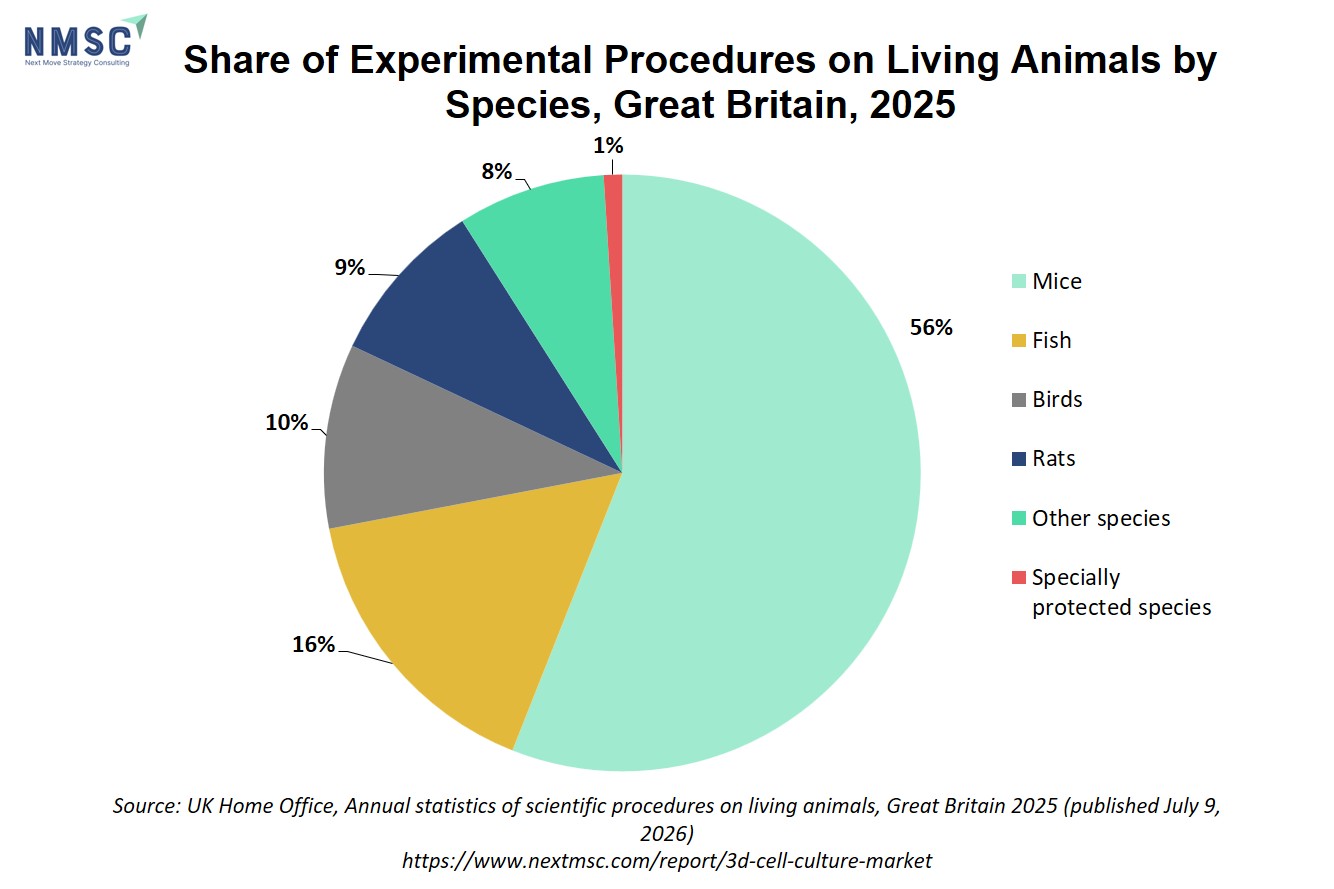
The UK Home Office statistics for 2025, published on July 9, 2026, record that 56% of experimental procedures used mice, 16% fish, 10% birds, 9% rats, 8% other species and 1% specially protected species (cats, dogs, horses and non-human primates). The shares describe experimental procedures on living animals in Great Britain and exclude creation and breeding procedures. The Home Office notes that 2025 is the first year in which birds were used in more experimental procedures than rats.
Replacement is already measurable in defined endpoints. The Home Office recorded zero procedures in 2025 for skin irritation, eye irritation, pharmacopoeial pyrogen testing and ascites-based monoclonal antibody production, and its Replacing animals in science strategy of November 2025 targets validated alternatives for skin irritation, eye irritation and skin sensitisation testing by the end of 2026. Basic research accounted for 54% of experimental procedures and regulatory testing for 19%, so demand divides between safety models that regulators must accept and disease models that academic laboratories can adopt without a regulatory gate. Because mice dominate, NextMSC primary research and analysis identifies the mouse study as the primary substitution target for organoids and spheroids.
Tool Vendors: Thermo Fisher Scientific’s Third Quarter and the Base Beneath the 3D Cell Culture Market
Thermo Fisher Scientific reported third-quarter 2026 results on October 21, 2026. Revenue rose 9% to USD 12.14 billion, including 6% organic growth, and Life Sciences Solutions recorded USD 2,719 million against USD 2,588 million a year earlier. The release gives no organoid-specific revenue, so these figures indicate the health of the research-tools base rather than the size of 3D culture sales. Specialty Diagnostics was the only segment to decline, at USD 1,098 million against USD 1,174 million.
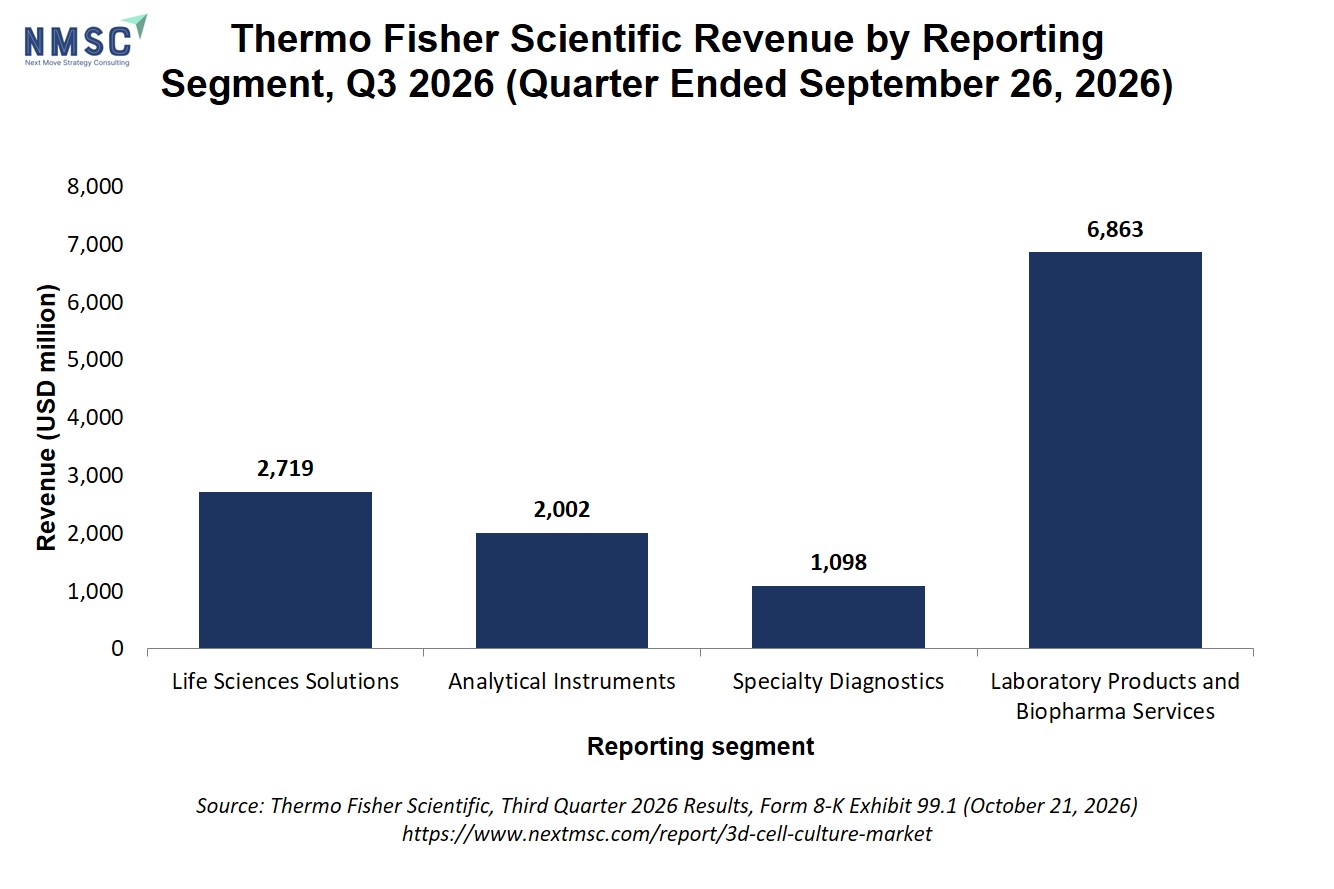
Thermo Fisher Scientific's third-quarter 2026 earnings release, dated October 21, 2026, reports segment revenue for the quarter ended September 26, 2026: Life Sciences Solutions USD 2,719 million, Analytical Instruments USD 2,002 million, Specialty Diagnostics USD 1,098 million and Laboratory Products and Biopharma Services USD 6,863 million. Intersegment eliminations of USD 546 million are not charted, and consolidated revenue was USD 12,137 million. The release does not report 3D cell culture revenue separately.
Laboratory Products and Biopharma Services, the largest segment, rose from USD 5,970 million to USD 6,863 million, an increase of USD 893 million. NextMSC primary research and analysis treats these results as context for the 3D cell culture market rather than evidence of it, because no segment isolates spheroid, organoid or microfluidic revenue. They do show that laboratory spending held through a quarter in which the Bruker, Revvity, FDA and NIH announcements were made.
Constraints: Cost, Validation and Standardization
Three constraints temper the momentum. Cost comes first: NextMSC identifies equipment, specialized media and reagents as the main barrier to wider adoption. Validation comes second: the FDA rule leaves evidentiary standards unchanged, so each model must still earn acceptance for a defined context of use. Standardization comes third, and the NIH Bio Genesis laboratory is designed to address it by testing clinically driven questions in reproducible human biological systems.
Section Summary:
Replacement of animal use is real but partial, and tool-vendor demand has held steady.
-
The UK recorded 2.54 million procedures in 2025, the lowest total under the 1986 Act, with mice at 56% of experimental procedures.
-
Zero skin irritation and eye irritation procedures show that replacement succeeds first where endpoints are well defined.
-
Thermo Fisher Scientific’s Life Sciences Solutions revenue reached USD 2,719 million in the third quarter of 2026.
-
Cost, validation and standardization remain the three constraints on adoption.
Pros and Cons of Recent Market Developments
|
Pros |
Cons |
|
The FDA rule names cell-based assays, organ chips and bioprinting within nonclinical studies, lowering the vocabulary barrier for 3D models. |
The rule does not prohibit animal testing or change evidentiary standards, so each model still needs study-specific acceptance. |
|
The European Commission roadmap covers 15 legislative domains, extending demand to chemicals, pesticides and food additives. |
A roadmap is a policy plan, and validation work will determine how fast non-pharmaceutical buyers commit budgets. |
|
NIH’s Bio Genesis laboratory targets reproducible human organoid data. |
NIH states no budget, timeline or opening date for it. |
|
Bruker, Transpharmation and Revvity link human cell models to instruments, CRO services and assays. |
None disclosed deal terms, which prevents valuation benchmarking. |
|
Thermo Fisher Scientific’s Life Sciences Solutions revenue rose USD 131 million year on year. |
The release has no 3D culture breakout, and Specialty Diagnostics declined. |
Key Data & Statistics
Regulatory and Funding Milestones, June to September 2026
|
Event |
Date |
Quantified Detail |
|
European Commission animal-testing roadmap |
June 1, 2026 |
22 actions; 15 legislative domains |
|
UK Home Office statistics for 2025 |
July 9, 2026 |
2.54 million procedures, down from 2.64 million |
|
NIH human-based research initiatives |
September 21, 2026 |
More than USD 88 million for 10 projects; more than USD 7 million in prizes |
|
FDA final rule on nonclinical terminology |
September 21, 2026 |
Effective February 4, 2027; comments due December 7, 2026 |
Transactions and Earnings Datapoints, August to October 2026
|
Company |
Date |
Datapoint |
|
Bruker and MIMETAS |
August 12, 2026 |
Majority stake; terms not disclosed |
|
Revvity and Human Cell Design |
September 9, 2026 |
Closing expected in the fourth quarter of 2026 |
|
Thermo Fisher Scientific |
October 21, 2026 |
Revenue USD 12.14 billion, up 9% |
|
Transpharmation and OrganoTherapeutics |
October 28, 2026 |
Brain organoid models; terms not disclosed |
Future Outlook & Forecast
The Road to USD 5.34 Billion: What Sustains a 16.4% CAGR in the 3D Cell Culture Market
According to NextMSC primary research and analysis, the global 3D cell culture market is projected to reach USD 5.34 billion by 2030 from USD 1.83 billion in 2023, a CAGR of 16.4% over 2024 to 2030. NextMSC attributes the trajectory to rising chronic disease prevalence, increased healthcare research and development investment, advances in 3D culture technology and a growing focus on drug discovery, and identifies the integration of stem cell research with organ-on-chip technology as a growth opportunity. Three developments from the last six months map directly onto those drivers.
1. Regulatory vocabulary and public funding. The FDA rule, the NIH package and the European Commission roadmap converge on one message: human-relevant models belong in the nonclinical toolkit. Public money follows, with more than USD 88 million committed to construction projects and more than USD 7 million offered in prizes on September 21, 2026.
2. Workflow integration through acquisition. Bruker, Revvity and Transpharmation placed human cell models inside instrument, assay and contract research franchises. NextMSC primary research and analysis expects further bolt-on transactions, because established suppliers hold customer relationships that standalone model developers lack.
3. Resilient laboratory spending. Thermo Fisher Scientific’s 6% organic growth in the third quarter of 2026 shows that customer spending on laboratory products and services kept growing, and 3D workflows draw on the same laboratory supply chain.
Regional and Segment Outlook
NextMSC regional analysis identifies North America as the largest region, a position expected to continue through the forecast period, and Asia-Pacific as a region expected to record significant growth. NextMSC segments the market by application into stem cell research, drug discovery and development, tissue engineering and regenerative medicine, neuroscience and others, and by end user into academic and research institutes, clinical and diagnostic laboratories, and pharmaceutical and biotechnology companies. NextMSC does not publish segment-level values on its report page, so no segment shares are asserted here.
Four dated events will test the forecast. The FDA comment period closes on December 7, 2026. Revvity expects to close its Human Cell Design acquisition in the fourth quarter of 2026. The UK strategy’s end-of-2026 target for validated alternatives will show whether replacement can be completed for defined endpoints. The FDA rule takes effect on February 4, 2027, although RAPS noted that significant adverse comments would lead the agency to withdraw the direct final rule and proceed with its companion proposal.
Section Summary:
NextMSC projects the 3D cell culture market to reach USD 5.34 billion by 2030 at a CAGR of 16.4%, supported by regulation, integration and resilient tools spending.
-
The forecast adds USD 3.51 billion to the USD 1.83 billion base-year value between 2023 and 2030.
-
North America is the largest region, and Asia-Pacific is expected to record significant growth.
-
December 7, 2026 and February 4, 2027 are the next regulatory checkpoints for the FDA rule.
Next Steps for Stakeholders
For C-Level Executives and Laboratory Leaders
Rebuild the nonclinical evidence plan around the FDA definition. Map each development program to the studies where a spheroid, organoid or organ-chip dataset could supplement or replace an animal study, and decide before December 7, 2026 whether to file comments.
Treat vendor selection as workflow selection. Ask each supplier for lot-to-lot reproducibility data, an imaging and assay compatibility roadmap, and contract terms that protect access to formats after any ownership change.
Budget for hybrid evidence. The FDA rule does not eliminate animal studies, and the UK still recorded 2.54 million procedures in 2025. Fund parallel animal and human-relevant datasets until a model is accepted for its intended use.
For Institutional Investors
Treat undisclosed deal terms as an information gap. Bruker, Revvity and Transpharmation did not disclose prices. Track the filings and earnings disclosures that follow, starting with Revvity’s expected fourth-quarter 2026 closing.
Follow public funding and CRO convergence. NIH’s reviewer recruitment and Bio Genesis laboratory will shape which organoid proposals receive grants, and Transpharmation’s move shows a CRO extending from in vivo pharmacology into organoid models. Peers with similar service mixes face the same choice.
Favor suppliers that lower cost per model. Automation, standardized matrices and integrated analysis address the high setup and maintenance cost that NextMSC identifies as the principal restraint on the 3D cell culture market.
Conclusion
The 3D cell culture market has entered a new regulatory phase. The FDA rule, the NIH package of September 21, 2026 and the European Commission roadmap of June 1, 2026 place human-relevant models inside the nonclinical toolkit, while Bruker, Revvity and Transpharmation show strategic buyers paying to own them. The limits are equally clear: animal testing is not prohibited, evidentiary standards are unchanged and deal values were not disclosed.
According to NextMSC primary research and analysis, the market is projected to reach USD 5.34 billion by 2030 at a CAGR of 16.4% from 2024 to 2030. Stakeholders who align evidence plans, vendor choices and capital allocation with these shifts will be better placed to capture that growth.
About the Author
 Sanyukta Deb
— Sanyukta Deb is Digital Marketing Team Lead at Next Move Strategy Consulting, where she has led content strategy and technical SEO for the firm's B2B market research publications for over 2 years. Her editorial process translates NextMSC's primary and secondary research — spanning technology, industrial, and consumer sectors — into commercial narratives, backed by search-intent, keyword, and competitive analysis. She brings 5 years of overall experience in digital marketing and content strategy.
About the Reviewer
 Debashree Dey
— Debashree Dey is Assistant Manager at Next Move Strategy Consulting, where she supports cross-vertical market content and communications across diverse industries for 6 years. Her professional background includes senior content writing, communications, and published manuscript authorship, with experience developing audience-focused business narratives and maintaining clear, consistent messaging. Her role supports research-led content development and editorial quality across NextMSC publications.














Add Comment