Cancer Gene Therapy Market: 8 Breakthroughs Reshaping Oncology in 2026

Introduction
Cancer remains one of the most formidable public health challenges of the modern era. According to the World Health Organization, cancer accounted for nearly 10 million deaths in 2024 — approximately one in every six deaths globally. In the United States alone, the National Cancer Institute projects approximately 2,114,850 new cancer cases and 626,140 cancer deaths in 2026 — figures that underscore the urgent and unrelenting demand for more effective, targeted, and durable treatment modalities.
Against this backdrop, the Cancer Gene Therapy Market has emerged as one of the most transformative and fastest-growing segments in global healthcare. By harnessing the power of genetic engineering — through CAR-T cell therapies, oncolytic virotherapy, gene transfer, and genome editing — cancer gene therapy is fundamentally redefining what is possible in oncology. According to Next Move Strategy Consulting (NMSC), the global cancer gene therapy market is projected to reach USD 558.24 billion by 2030, registering a CAGR of 32.6% during the forecast period 2020–2030. This extraordinary growth trajectory reflects a convergence of scientific breakthroughs, regulatory modernization, and surging institutional investment that is reshaping the global oncology landscape in 2026.
For More Information: Download FREE Sample on Cancer Gene Therapy Market Report
Operation TrialBlazer and the 2026 Regulatory Revolution Accelerating the Cancer Gene Therapy Market
A Watershed Moment for Gene Therapy Development
The cancer gene therapy market entered a defining regulatory inflection point in mid-2026, marked by a series of landmark actions from the U.S. Food and Drug Administration (FDA), the European Medicines Agency (EMA), and the UK's Medicines and Healthcare products Regulatory Agency (MHRA) — collectively signaling a global commitment to accelerating patient access to advanced oncology therapies.
FDA's Operation TrialBlazer: In June 2026, the FDA announced a comprehensive set of actions under "Operation TrialBlazer" — a Health and Human Services initiative designed to accelerate and modernize clinical development across both early and late stages, from the Investigational New Drug (IND) phase through pivotal trials. Key measures introduced include an Expedited IND Pilot Program enabling rolling submission processes, a Phase 1 IND Navigator providing centralized regulatory guidance, updated phase-appropriate Chemistry, Manufacturing, and Controls (CMC) requirements, and greater flexibility in evidentiary requirements for late-stage trials — including the possibility that one high-quality pivotal trial combined with confirmatory evidence may be sufficient for approval in certain cases.
FDA Draft Guidance on Genome Editing Gene Therapy: Simultaneously, the FDA issued a draft guidance titled "Leveraging Prior Knowledge in the Development of Human Gene Therapy Products Incorporating Genome Editing" — providing recommendations for incorporating existing scientific knowledge into the development of genome editing gene therapy products. The guidance emphasizes the potential to utilize prior knowledge, including publicly available scientific information and platform-based knowledge derived from similar technologies, to reduce redundant data generation and accelerate regulatory review timelines. The comment deadline is September 1, 2026.
FDA Draft Guidance on Oncology Nonclinical Safety Studies: The FDA also issued a draft guidance titled "Oncology Pharmaceuticals: Streamlined Nonclinical Safety Studies for Biologics and Conjugated Products" — providing recommendations for a streamlined, science- and risk-based approach to general toxicology studies for oncology biologics. The guidance highlights that traditional testing requirements can be reduced, modified, or replaced based on existing data, mechanistic understanding, and prior regulatory experience — directly reducing development timelines and costs for cancer gene therapy developers. The comment deadline is July 30, 2026.
FDA Draft Guidance on Safety Assessment of Genome Editing: The FDA also issued a draft guidance on "Safety Assessment of Genome Editing in Human Gene Therapy Products Using Next-Generation Sequencing" — with a public consultation deadline of July 14, 2026 — establishing updated standards for characterizing off-target effects in genome-edited cancer gene therapy products.
EMA Committee for Advanced Therapies (CAT) Rules of Procedure: On June 10, 2026, the EMA's CAT issued an official regulatory-procedural guideline establishing the governance, structure, and operational framework of the Committee — grounded in Regulation (EC) No 1394/2007 on Advanced Therapy Medicinal Products (ATMPs). The document defines the roles and responsibilities of the Chair, Vice-Chair, rapporteurs, and the EMA Secretariat, alongside procedures for appointments, voting, and conflict-of-interest management — providing greater regulatory predictability for cancer gene therapy developers seeking EU market authorization.
MHRA-FDA Liaison Programme: The MHRA and the FDA announced a new liaison programme to strengthen their long-standing regulatory partnership, introducing dedicated, reciprocal liaison officer roles within each organization. The programme focuses on innovative medicines, medical devices, and emerging technologies including artificial intelligence — with the explicit aim of enabling faster, more coordinated responses to emerging regulatory challenges in the gene and cell therapy space.
ASGCT Q2 2026 Pipeline Report: According to the American Society of Gene & Cell Therapy (ASGCT) Q2 2026 Quarterly Landscape Report — produced in partnership with Citeline — regulatory approvals rebounded with eight new gene, cell, and RNA therapies in Q2 2026 alone. mRNA-encoded CAR-T innovation accelerated, matching all of 2025's new entrants in a single quarter. Dealmaking and early-stage investment reached their strongest levels in the past year. The gene therapy pipeline grew across all stages except pre-registration, reaching 2,217 programs.
NMSC Strategic Perspective: The Regulatory Tailwind Driving Market Expansion
From Next Move Strategy Consulting's analytical standpoint, the convergence of FDA's Operation TrialBlazer, the genome editing draft guidances, the EMA CAT procedural framework, and the MHRA-FDA liaison programme represents the most comprehensive regulatory modernization effort in the history of cancer gene therapy. These actions collectively reduce the time, cost, and uncertainty associated with bringing cancer gene therapies to market — directly supporting the market's extraordinary 32.6% CAGR trajectory through 2030.
NMSC's analysis indicates that the FDA's shift toward accepting one high-quality pivotal trial with confirmatory evidence — rather than requiring traditional dual-trial designs — is particularly significant for cancer gene therapy developers, where patient populations are often small, rare, and difficult to recruit. This regulatory flexibility, combined with the streamlined nonclinical safety guidance for oncology biologics, is expected to compress development timelines by 12–24 months for a meaningful proportion of pipeline programs.
The ASGCT Q2 2026 data — showing 8 new approvals in a single quarter and a pipeline of 2,217 programs — confirms that the cancer gene therapy market is transitioning from a niche, experimental modality to a mainstream oncology treatment paradigm. North America's regulatory leadership, combined with Asia-Pacific's rapidly expanding clinical trial infrastructure, positions the global cancer gene therapy market for sustained, accelerating growth through the forecast period.
Section Summary:
The first half of 2026 has delivered the most consequential regulatory developments in cancer gene therapy history, with the FDA, EMA, and MHRA collectively modernizing the approval framework for advanced oncology therapies.
-
FDA's Operation TrialBlazer (June 2026) introduces expedited IND pathways, rolling submissions, and flexible evidentiary standards for cancer gene therapy approvals.
-
FDA issued three draft guidances on genome editing gene therapy and oncology nonclinical safety studies — all open for public comment in mid-2026.
-
ASGCT Q2 2026 report confirms 8 new gene, cell, and RNA therapy approvals in a single quarter, with the pipeline reaching 2,217 programs.
-
EMA CAT Rules of Procedure (June 10, 2026) and the MHRA-FDA liaison programme are enhancing regulatory predictability and cross-border coordination for cancer gene therapy developers.
Industry Impact Analysis
The Global Cancer Burden: Fueling Unprecedented Demand for Gene Therapy
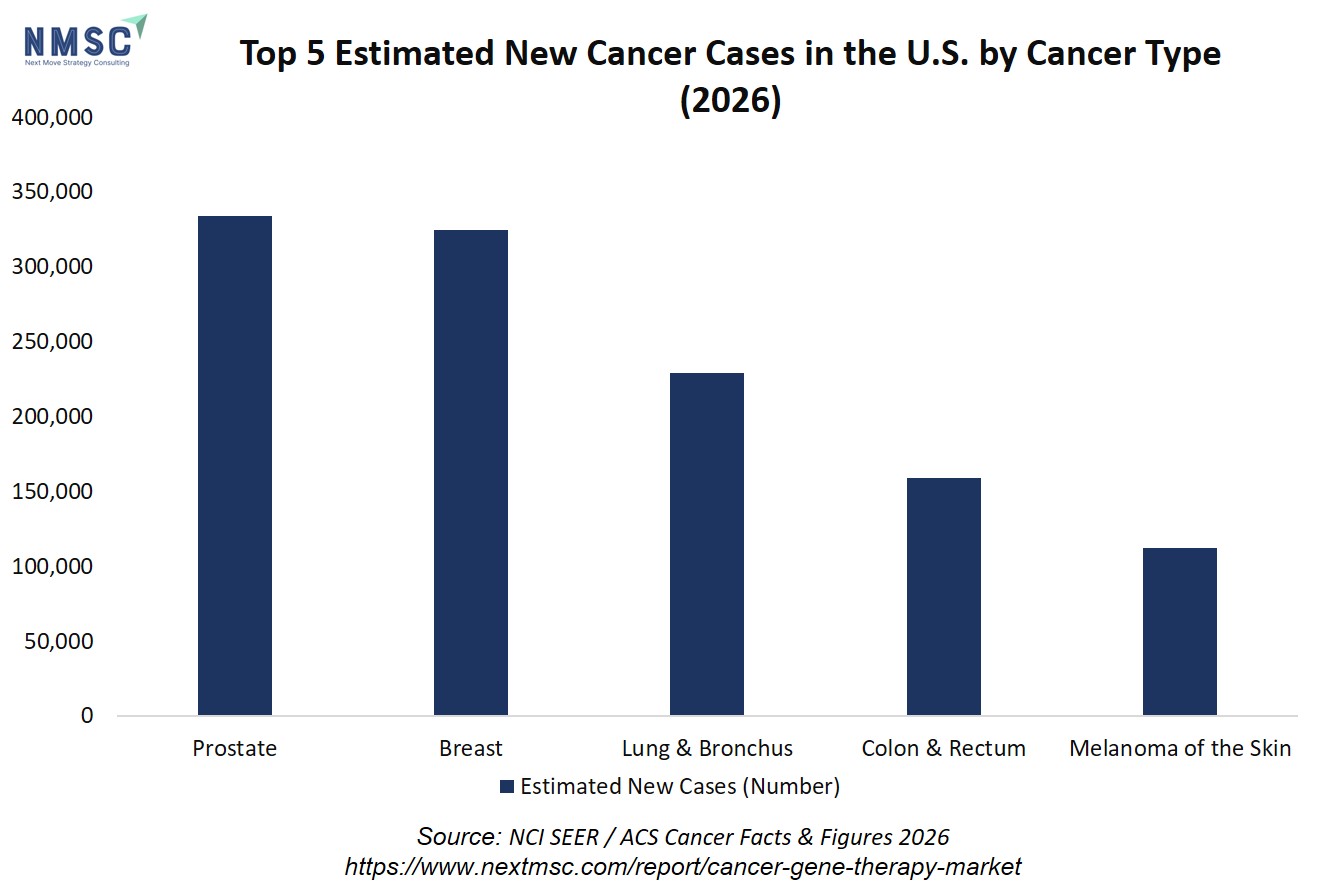
The scale of the global cancer burden is the fundamental demand driver for the cancer gene therapy market. According to GLOBOCAN 2024 estimates published in the American Cancer Society's flagship journal, there were an estimated 20.6 million new cancer cases worldwide and 9.8 million cancer deaths in 2024. In the United States, the American Cancer Society projected 2,041,910 new cancer cases and 618,120 cancer deaths in 2025. These figures are projected to increase to 2,114,850 new cases and 626,140 deaths in 2026 — representing a year-over-year increase that underscores the inadequacy of conventional treatment modalities alone.
CAR-T Cell Therapy: From Last-Line to First-Line Treatment
The most transformative development in the cancer gene therapy market is the rapid advancement of CAR-T cell therapies from last-line salvage treatments to second-line and potentially first-line treatment options. A peer-reviewed systematic review published in PMC (Iglesias-Lopez et al., 2026) — based on regulatory data from the FDA and EMA — confirms that 14 cell gene therapies have been approved globally (12 in the US, 11 in the EU) as of December 2024, with all receiving orphan drug designation and over 80% benefiting from expedited development pathways such as FDA Breakthrough Therapy, RMAT designation, and EU PRIME.
The approved cancer-focused cell gene therapies include Kymriah (tisagenlecleucel) for B-cell ALL and large B-cell lymphoma, Yescarta (axicabtagene ciloleucel) for large B-cell lymphoma, Tecartus (brexucabtagene autoleucel) for mantle cell lymphoma and B-cell ALL, Breyanzi (lisocabtagene maraleucel) for large B-cell lymphoma, Abecma (idecabtagene vicleucel) for multiple myeloma, and Carvykti (ciltacabtagene autoleucel) for multiple myeloma — all representing the CAR-T cell therapy segment of the cancer gene therapy market.
In 2026, the ASGCT confirmed the FDA approval of Tudriqev — an oncolytic immunotherapy for advanced melanoma — representing a significant milestone for the oncolytic virotherapy segment of the cancer gene therapy market.
FDA's 2025 Cancer Drug Approvals: A Record Year for Oncology Innovation
The FDA's CDER approved 46 novel drugs in 2025 — a record-setting year for pharmaceutical innovation. Among the most significant cancer-related approvals with direct relevance to the cancer gene therapy market were: Komzifti (ziftomenib) for relapsed or refractory acute myeloid leukemia with NPM1 mutation (November 2025); Modeyso (dordaviprone) for diffuse midline glioma with H3 K27M mutation (August 2025); Hyrnuo (sevabertinib) for HER2-mutated non-small cell lung cancer (November 2025); Emrelis (telisotuzumab vedotin-tllv) for c-Met overexpressing NSCLC (May 2025); and Lynozyfic (linvoseltamab-gcpt) for relapsed or refractory multiple myeloma (July 2025). These approvals reflect the broader oncology innovation ecosystem within which cancer gene therapy is advancing.
Manufacturing Complexity and Quality Challenges
A critical industry impact factor identified in the peer-reviewed literature is the manufacturing complexity inherent to cancer gene therapy products. The Iglesias-Lopez et al. (2026) systematic review — published in Therapeutic Innovation & Regulatory Science — found that the most common quality objections raised during EU marketing authorization applications for cell gene therapies concerned manufacturing comparability (19% of major objections) and potency assay validation (25% of major objections). In the US, the most common FDA review issues included process validation (13%), specifications and justification of specifications (18%), analytical procedures and validation (16%), and stability data (11.5%).
The median time from submission to approval is approximately 10 months (IQR 8–11) in the EU and 8 months (IQR 7–10.7) in the US for cell gene therapies — reflecting the impact of expedited review pathways on approval timelines.
The CoGenT Global Pilot: Harmonizing International Regulatory Review
A landmark international regulatory initiative with direct implications for the cancer gene therapy market is the FDA-EMA Collaboration on Gene Therapies (CoGenT) Global Pilot — designed to explore concurrent submission and collaborative review of gene therapy applications with ICH regulatory partners including Japan, Canada, and Switzerland. This initiative aims to reduce redundant submissions, align CMC and nonclinical issues earlier in development, and accelerate patient access across multiple jurisdictions simultaneously.
Section Summary:
The cancer gene therapy market is being driven by an unprecedented convergence of global cancer burden, regulatory modernization, CAR-T cell therapy advancement, and international regulatory harmonization.
-
Global cancer burden reached 20.6 million new cases and 9.8 million deaths in 2024, with U.S. projections rising to 2,114,850 new cases and 626,140 deaths in 2026.
-
14 cell gene therapies have been approved globally (12 in the US, 11 in the EU) as of December 2024, with all receiving orphan designation and over 80% benefiting from expedited pathways.
-
FDA approved 46 novel drugs in 2025, including multiple targeted oncology therapies directly relevant to the cancer gene therapy ecosystem.
-
The FDA-EMA CoGenT Global Pilot is advancing international regulatory harmonization, reducing redundant submissions and accelerating multi-jurisdictional approvals.
Key 2025–2026 Regulatory Milestones Impacting the Cancer Gene Therapy Market
|
Regulatory Action |
Authority |
Date / Period |
Relevance to Cancer Gene Therapy |
|
Operation TrialBlazer — Expedited IND Pilot, Phase 1 Navigator, Flexible Pivotal Trial Standards |
FDA (USA) |
June 2026 |
Reduces IND timelines; enables rolling submissions; allows single pivotal trial approval in select cases |
|
Draft Guidance: Leveraging Prior Knowledge in Genome Editing Gene Therapy |
FDA (USA) |
June 2026 (Comment deadline: September 1, 2026) |
Enables use of prior platform knowledge to reduce redundant data generation for CRISPR-based cancer therapies |
|
Draft Guidance: Safety Assessment of Genome Editing Using Next-Generation Sequencing |
FDA (USA) |
June 2026 (Comment deadline: July 14, 2026) |
Establishes updated standards for characterizing off-target effects in genome-edited cancer gene therapy products |
|
Draft Guidance: Streamlined Nonclinical Safety Studies for Oncology Biologics |
FDA (USA) |
June 2026 (Comment deadline: July 30, 2026) |
Reduces animal testing requirements and development costs for cancer gene therapy biologics |
|
Draft Guidance: Master Protocols for Drug and Biological Product Development |
FDA (USA) |
June 2026 (Comment deadline: August 24, 2026) |
Supports basket, umbrella, and platform trial designs for cancer gene therapy — enabling multi-indication development under a single protocol |
|
CAT Rules of Procedure (Governance Framework for ATMPs) |
EMA (EU) |
June 10, 2026 |
Provides regulatory clarity and governance transparency for EU ATMP approvals including cancer gene therapies |
|
MHRA-FDA Liaison Programme |
MHRA (UK) & FDA (USA) |
June 2026 |
Strengthens UK-US regulatory alignment; facilitates faster coordinated responses to cancer gene therapy challenges |
|
ASGCT Q2 2026: 8 New Gene, Cell & RNA Therapy Approvals |
ASGCT / Citeline |
Q2 2026 |
Confirms accelerating regulatory throughput; pipeline reaches 2,217 programs; mRNA-encoded CAR-T matches all of 2025's new entrants in one quarter |
|
FDA Approval of Tudriqev (Oncolytic Immunotherapy for Advanced Melanoma) |
FDA (USA) |
2026 |
First oncolytic immunotherapy approval for melanoma; validates oncolytic virotherapy segment of cancer gene therapy market |
|
ICH E6 (R3) Annex 2 (Good Clinical Practice) Adopted at Step 4 |
ICH (International) |
June 2–3, 2026 (Rio de Janeiro Assembly) |
Advances global GCP harmonization for cancer gene therapy clinical trials across ICH member jurisdictions |
Future Outlook & Forecast
NMSC Market Projections and Strategic Implications
According to Next Move Strategy Consulting, the global cancer gene therapy market is projected to grow from USD 16.50 billion in 2019 to USD 558.24 billion by 2030, at a CAGR of 32.6% during the forecast period 2020–2030. This extraordinary growth trajectory — among the highest of any healthcare market segment — reflects the convergence of scientific breakthroughs, regulatory modernization, and the sheer scale of unmet medical need in oncology.
North America is expected to maintain its dominant market position throughout the forecast period, driven by the presence of major industry players including Bluebird bio, Merck, Adaptimmune, GlaxoSmithKline, and Celgene; a well-established healthcare infrastructure with specialized oncology practitioners; advanced technological development at the product front; and higher adoption rates of cancer gene therapy treatments. The FDA's Operation TrialBlazer and the series of genome editing draft guidances issued in June 2026 will further reinforce North America's position as the global epicenter of cancer gene therapy innovation and approval.
Asia-Pacific is expected to demonstrate substantial growth throughout the forecast period, driven by increasing consumer awareness of cancer gene therapy, growing government initiatives, improvement in healthcare infrastructure, and the untapped market opportunities offered by emerging economies including China, India, South Korea, and Taiwan. China's established gene therapy regulatory framework and its growing domestic CAR-T cell therapy industry — including Shanghai Sunway Biotech and Shenzhen SiBiono GeneTech — position the region as a critical growth engine for the global cancer gene therapy market.
Looking ahead, several structural trends will define the cancer gene therapy market through 2030 and beyond:
-
Allogeneic "Off-the-Shelf" CAR-T Therapies: The shift from autologous to allogeneic CAR-T cell therapies — using a single donor source to treat multiple patients — represents the most significant manufacturing and commercial opportunity in the cancer gene therapy market. Allogeneic therapies eliminate the 3-week average manufacturing timeline associated with autologous CAR-T, dramatically improving scalability and patient access.
-
In Vivo Gene Editing and CRISPR-Based Therapies: The approval of Casgevy (exagamglogene autotemcel) — the world's first CRISPR/Cas9-based therapy — has opened the door to a new generation of in vivo gene editing approaches that deliver genetic corrections directly to patients, bypassing the complex ex vivo manufacturing process. This modality holds particular promise for solid tumor indications that have historically been resistant to CAR-T cell therapy.
-
mRNA-Encoded CAR-T Innovation: The ASGCT Q2 2026 report confirms that mRNA-encoded CAR-T innovation accelerated dramatically in Q2 2026, matching all of 2025's new entrants in a single quarter. This modality offers significant manufacturing advantages over viral vector-based approaches and is expected to become a major growth driver for the cancer gene therapy market through 2030.
-
TCR-T Cell Therapies for Solid Tumors: T-cell receptor (TCR)-based therapies — which can target tumor-specific sequences within a cell — are advancing as the next frontier for treating solid tumors, which represent the vast majority of cancer cases but have historically been resistant to CAR-T cell therapy. The FDA approval of Tecelra (afami-cel) for synovial sarcoma in 2024 validated this approach, and multiple TCR-T programs are advancing through the pipeline.
-
AI-Driven Manufacturing Optimization: Artificial intelligence is being applied to optimize CAR-T cell manufacturing processes — reducing production variability, improving potency assay validation, and accelerating the comparability assessments that represent the leading cause of regulatory delays in cancer gene therapy development.
-
Decentralized Manufacturing: The shift toward decentralized manufacturing — producing cancer gene therapies at or near the patient treatment site — is being actively explored by regulators and developers as a means of improving patient access to autologous treatments. The EMA's Quality Innovation Group is currently developing a Q&A guideline to address comparability requirements for decentralized manufacturing sites.
Section Summary:
The cancer gene therapy market is on an extraordinary growth trajectory through 2030, supported by regulatory modernization, pipeline expansion, and transformative scientific advances in CAR-T, CRISPR, and TCR-T cell therapy.
-
NMSC projects the global cancer gene therapy market to reach USD 558.24 billion by 2030, at a CAGR of 32.6% (2020–2030).
-
North America will maintain market leadership, while Asia-Pacific will register the fastest growth driven by government initiatives and expanding healthcare infrastructure.
-
Allogeneic CAR-T, mRNA-encoded CAR-T, and in vivo CRISPR-based therapies represent the three most transformative growth vectors for the cancer gene therapy market through 2030.
-
AI-driven manufacturing optimization and decentralized production models will be critical enablers of market scalability and patient access.
Next Steps for Stakeholders
For C-level executives, investors, and strategic decision-makers operating in or adjacent to the cancer gene therapy market, the following priorities are recommended:
-
Engage Proactively with FDA's Operation TrialBlazer Framework: Manufacturers and developers should immediately assess how the Expedited IND Pilot Program, Phase 1 IND Navigator, and flexible pivotal trial standards can be applied to their cancer gene therapy pipeline programs. Early engagement with the FDA through available designations — RMAT, Breakthrough Therapy, and Fast Track — remains the most effective strategy for accelerating approval timelines.
-
Submit Comments on FDA Draft Guidances Before Deadlines: The three FDA draft guidances issued in June 2026 — on genome editing gene therapy, safety assessment using next-generation sequencing, and streamlined oncology nonclinical safety studies — represent a critical opportunity for industry stakeholders to shape the regulatory framework that will govern cancer gene therapy development for the next decade. Comment deadlines range from July 14 to September 1, 2026.
-
Prioritize Manufacturing Comparability and Potency Assay Development: Given that manufacturing comparability (19% of EU major objections) and potency assay validation (25% of EU major objections) are the leading causes of regulatory delays in cancer gene therapy approvals, manufacturers should invest in early-stage quality-by-design principles, comprehensive comparability assessments, and validated potency assays — ideally before initiating Phase II clinical trials.
-
Develop a Multi-Jurisdictional Regulatory Strategy: The FDA-EMA CoGenT Global Pilot and the MHRA-FDA liaison programme create new opportunities for concurrent multi-jurisdictional submissions. Developers should work with regulatory affairs teams to design submission strategies that leverage these harmonization initiatives — reducing the time and cost of achieving market authorization in the US, EU, and UK simultaneously.
-
Invest in Allogeneic and mRNA-Encoded CAR-T Platforms: The ASGCT Q2 2026 data confirms that mRNA-encoded CAR-T innovation is accelerating at an unprecedented pace. Investors and strategic partners should prioritize companies with allogeneic and mRNA-based CAR-T platforms — which offer superior scalability, manufacturing efficiency, and commercial potential compared to autologous viral vector-based approaches.
-
Monitor and Engage with Asia-Pacific Regulatory Developments: China's domestic cancer gene therapy industry — anchored by companies such as Shanghai Sunway Biotech and Shenzhen SiBiono GeneTech — is expanding rapidly. Multinational developers should invest in regional regulatory compliance infrastructure and consider strategic partnerships with local manufacturers to access the Asia-Pacific market, which NMSC identifies as the fastest-growing regional segment.
Conclusion
The cancer gene therapy market stands at the most consequential inflection point in its history. The convergence of FDA's Operation TrialBlazer, four landmark draft guidances on genome editing and oncology biologics, the EMA CAT governance framework, the MHRA-FDA liaison programme, and the ASGCT Q2 2026 confirmation of 8 new approvals in a single quarter collectively signal that cancer gene therapy has crossed the threshold from experimental modality to mainstream oncology treatment paradigm.
The global cancer burden — 20.6 million new cases and 9.8 million deaths in 2024, rising to 2,114,850 new U.S. cases projected in 2026 — provides an inexorable demand foundation for this market. According to Next Move Strategy Consulting, the global cancer gene therapy market is projected to reach USD 558.24 billion by 2030, at a CAGR of 32.6% — a trajectory that reflects both the scale of unmet medical need and the extraordinary pace of scientific and regulatory progress.
For stakeholders across the value chain — from developers and manufacturers to investors and policymakers — the strategic imperative is clear: engage proactively with the evolving regulatory framework, invest in manufacturing quality and scalability, and position for the allogeneic and mRNA-encoded CAR-T revolution that is already underway.
About the Author
 Sanyukta Deb
— Sanyukta Deb is Digital Marketing Team Lead at Next Move Strategy Consulting, where she has led content strategy and technical SEO for the firm's B2B market research publications for over 2 years. Her editorial process translates NextMSC's primary and secondary research — spanning technology, industrial, and consumer sectors — into commercial narratives, backed by search-intent, keyword, and competitive analysis. She brings 5 years of overall experience in digital marketing and content strategy.
Sanyukta Deb
— Sanyukta Deb is Digital Marketing Team Lead at Next Move Strategy Consulting, where she has led content strategy and technical SEO for the firm's B2B market research publications for over 2 years. Her editorial process translates NextMSC's primary and secondary research — spanning technology, industrial, and consumer sectors — into commercial narratives, backed by search-intent, keyword, and competitive analysis. She brings 5 years of overall experience in digital marketing and content strategy.
About the Reviewer
 Debashree Dey
— Debashree Dey is Assistant Manager at Next Move Strategy Consulting, where she supports cross-vertical market content and communications across diverse industries for 6 years. Her professional background includes senior content writing, communications, and published manuscript authorship, with experience developing audience-focused business narratives and maintaining clear, consistent messaging. Her role supports research-led content development and editorial quality across NextMSC publications.
Debashree Dey
— Debashree Dey is Assistant Manager at Next Move Strategy Consulting, where she supports cross-vertical market content and communications across diverse industries for 6 years. Her professional background includes senior content writing, communications, and published manuscript authorship, with experience developing audience-focused business narratives and maintaining clear, consistent messaging. Her role supports research-led content development and editorial quality across NextMSC publications.


















Add Comment