5 Powerful Maritime Patrol Aircraft Trends Reshaping Naval Defense in 2026
Introduction
The global Maritime domain has never been more contested, and the Maritime Patrol Aircraft Market stands at the center of a sweeping defense realignment. From the Arctic waters surrounding Greenland to the disputed shipping lanes of the South China Sea, nations are accelerating the procurement of advanced maritime patrol aircraft (MPA) to assert sovereignty, counter submarine threats, and protect critical maritime trade infrastructure.
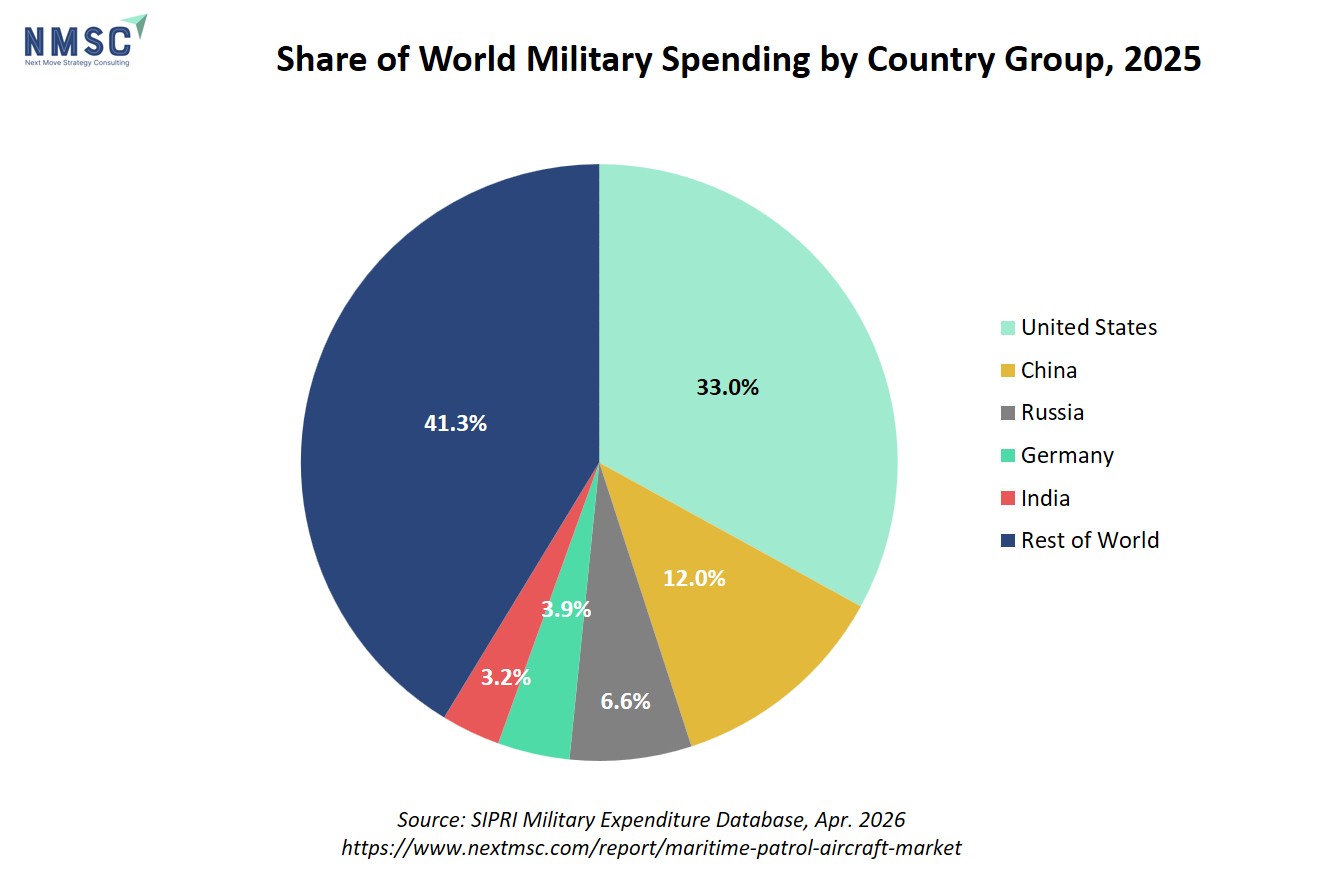
In 2025, global military expenditure reached USD 2,887 billion — the 11th consecutive year of increase — with Europe recording its sharpest annual rise since 1953 and Asia and Oceania posting its fastest growth since 2009, according to the Stockholm International Peace Research Institute (SIPRI). This structural surge in defense budgets is directly translating into accelerated MPA procurement programs across NATO allies, Indo-Pacific partners, and emerging maritime powers. According to Next Move Strategy Consulting (NMSC), the global maritime patrol aircraft market was valued at USD 18.4 billion in 2023 and is forecast to reach USD 26.1 billion by 2030, at a CAGR of 5.1% from 2024 to 2030. For defense industry executives, institutional investors, and strategic policymakers, understanding the forces driving this expansion is a matter of operational and competitive urgency.
For More Information: Download FREE Sample on Maritime Patrol Aircraft Market Report
The Forces Rewriting the Maritime Patrol Aircraft Market in 2026
A Cascade of High-Value Contracts Signals Structural Demand
The most consequential development for the maritime patrol aircraft market in 2026 has been a cascade of high-value procurement contracts and platform modernization programs that collectively signal durable, long-cycle demand for advanced MPA capabilities.
In June 2026, the U.S. Navy awarded Boeing a USD 880 million indefinite-delivery/indefinite-quantity contract for the procurement, modernization, and sustainment of P-8A Poseidon aircrew and maintenance training systems — covering new training device development, integration, testing, delivery, and installation across naval air stations in the United States, United Kingdom, Australia, Germany, Norway, South Korea, New Zealand, Canada, and Singapore. This single contract underscores the P-8A Poseidon's status as the de facto global standard for maritime patrol and anti-submarine warfare, with its operational footprint now spanning 12 countries.
In July 2026, Boeing received an additional USD 213 million contract modification from the U.S. Naval Air Systems Command to support the reconfiguration of four P-8A Multi-mission Maritime aircraft previously procured by a Foreign Military Sales customer, modifying the aircraft configuration to meet the customer's specific operational requirements. Also in July 2026, Denmark confirmed the acquisition of two Boeing P-8A Poseidon maritime patrol aircraft to strengthen surveillance around the Faroe Islands and Greenland, with Defence Minister Jeppe Bruus stating that the aircraft would help Denmark meet NATO capability targets in anti-submarine warfare.
Trend 1: NATO's Rearmament Drive Is Generating Unprecedented MPA Demand
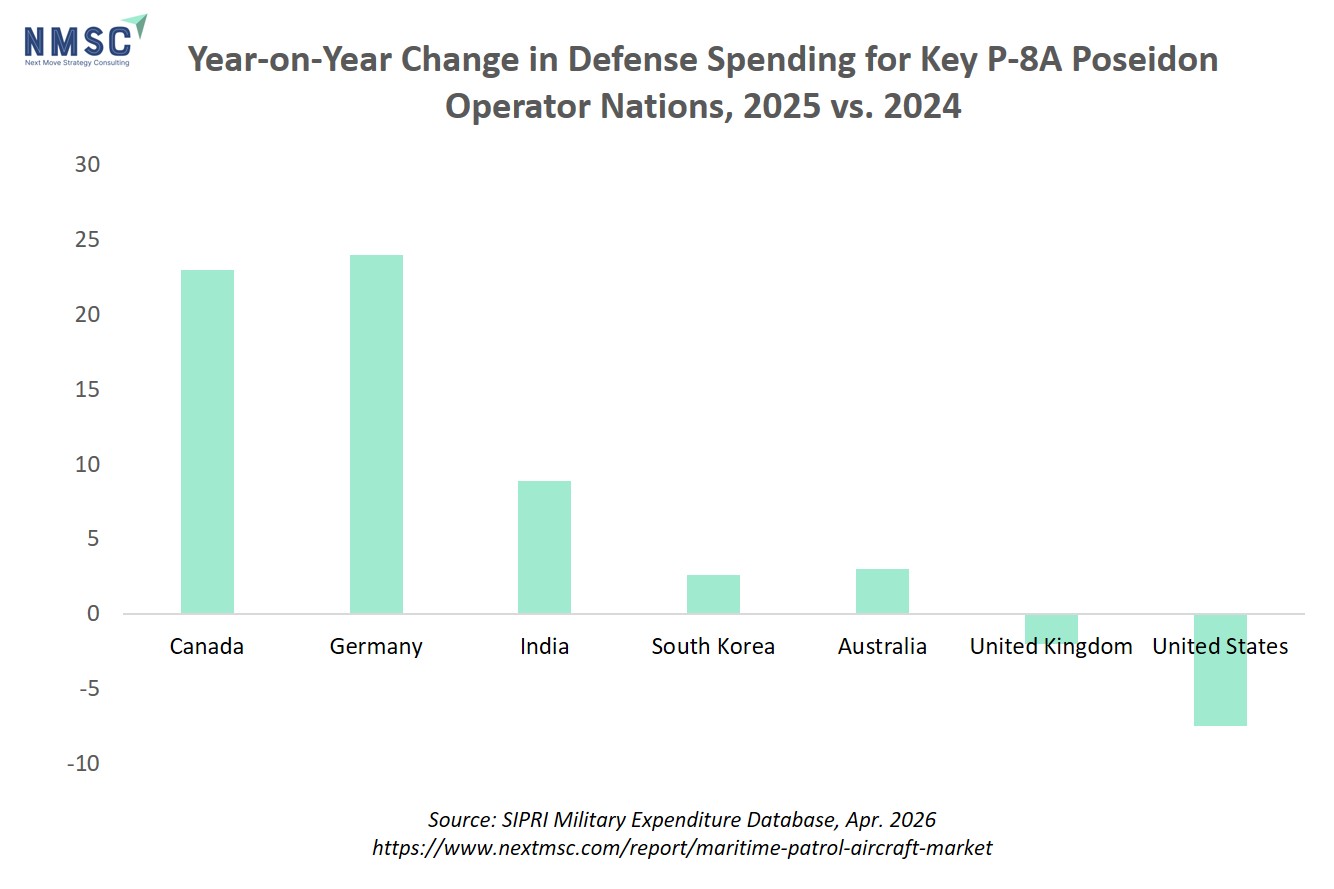
The 29 European NATO members spent a combined total of USD 559 billion on defense in 2025, with 22 of them meeting or exceeding the 2.0% of GDP spending threshold. Germany — now the largest military spender among European NATO members — increased its defense expenditure by 24% year-on-year to USD 114 billion in 2025, surpassing the 2.0% of GDP threshold for the first time since 1990. Spain increased its military spending by 50% to USD 40.2 billion, also crossing the 2.0% GDP threshold for the first time since 1994.
This rearmament wave is directly fueling MPA procurement. In May 2026, Breaking Defense reported that the U.S. Navy's FY27 budget request includes 12 new P-8A aircraft for just over USD 4.2 billion — resuming procurement after pauses in FY25 and FY26 — with the Navy designating FY27 as the last planned year of production and final aircraft delivery expected in the first quarter of FY32. The same budget request includes more than USD 381 million for aircraft modifications, including radar upgrades and structural improvements.
Trend 2: Platform Modernization Is Extending MPA Operational Lifecycles
The maritime patrol aircraft market is not solely driven by new-build procurement — platform modernization programs are generating substantial and recurring revenue streams for prime contractors. In April 2026, the U.S. Naval Air Systems Command (NAVAIR) announced that the P-8A Poseidon Increment 3 Block 2 had reached initial operating capability. The Increment 3 Block 2 updates include new airframe racks, radome, antennas, sensors, wiring, a new combat systems suite, a wideband satellite communication system, and an anti-submarine warfare signals intelligence capability.
Rear Admiral Michael Wosje, air warfare director, described the upgrade as enhancing "Naval Aviation's Maritime Intelligence, Surveillance, Reconnaissance, and Targeting capabilities — the eyes of the Fleet," aligning with the Chief of Naval Operations' Fighting Instructions and the Golden Fleet Initiative. This modernization paradigm — extending the operational relevance of existing platforms through sensor, avionics, and mission system upgrades — is a defining characteristic of the current MPA market cycle and represents a durable revenue opportunity for defense electronics and systems integration firms.
Trend 3: Europe Is Developing Sovereign MPA Capabilities
Beyond procurement of U.S.-origin platforms, European nations are investing in the development of sovereign maritime patrol aircraft capabilities. France's Defence Procurement Agency (Direction Générale de l'Armement) has signed a contract with Airbus Defence and Space, in partnership with Thales, for a risk-assessment study of the future maritime patrol aircraft programme — the A321 MPA, a militarized version of the Airbus A321XLR designed to replace the French Navy's fleet of Atlantique 2 aircraft by the 2030–2040 timeframe. The 24-month study aims to prepare for the development and production launch of the programme at the end of 2026, refining economic and industrial conditions and guiding technical choices for sensor integration, including latest-generation active antenna radar, acoustic systems, electronic warfare, magnetic anomaly detection, and anti-ship missile compatibility.
Trend 4: Asia-Pacific Geopolitical Tensions Are Accelerating Regional MPA Investment
Military expenditure in Asia and Oceania totalled USD 681 billion in 2025, an 8.1% increase over 2024 — the largest annual rise in the region since 2009. China increased its military spending by 7.4% to USD 336 billion — its 31st consecutive year-on-year increase. Japan's military expenditure rose by 9.7% to USD 62.2 billion, equivalent to 1.4% of GDP — the highest share since 1958. Taiwan's military spending rose by 14% to USD 18.2 billion, the largest annual increase since at least 1988.
These spending increases are directly linked to escalating maritime tensions. Reuters reported in August 2026 that China stated it drove away Philippine vessels in a fresh South China Sea incident, with China claiming Philippine aircraft had intruded into airspace over Scarborough Shoal — a development that underscores the persistent demand for MPA capabilities across the Indo-Pacific.
Trend 5: Unmanned and Autonomous Systems Are Expanding the MPA Mission Envelope
The maritime patrol aircraft market is being structurally expanded by the integration of unmanned aerial systems (UAS) into maritime surveillance and anti-submarine warfare missions. The MQ-9B SeaGuardian — developed by General Atomics — represents the leading autonomous maritime patrol platform, offering extended endurance capabilities that enable prolonged missions over vast maritime areas while collecting real-time intelligence, surveillance, and reconnaissance data. Germany's order of eight MQ-9B SeaGuardian drones to augment its P-8A Poseidon fleet exemplifies the emerging hybrid MPA force structure — combining crewed long-range patrol aircraft with autonomous persistent surveillance platforms to maximize maritime domain awareness at reduced operational cost.
NMSC Strategic Perspective: Geopolitical Realignment as a Structural Market Catalyst
From Next Move Strategy Consulting's analytical standpoint, the maritime patrol aircraft market is entering a period of structurally elevated demand that is qualitatively different from previous procurement cycles. The simultaneous rearmament of European NATO members, the accelerating military modernization of Indo-Pacific powers, and the resumption of U.S. P-8A production in FY27 collectively represent a convergence of demand signals that will sustain MPA market growth well beyond the current forecast period.
NMSC's assessment identifies three specific dynamics that will define the competitive landscape through 2030: first, the P-8A Poseidon's entrenched position as the global MPA standard will continue to generate substantial modification, sustainment, and training system revenue for Boeing and its supply chain partners; second, Europe's pursuit of sovereign MPA capabilities — exemplified by France's A321 MPA programme — will create a new competitive axis between U.S.-origin and European-developed platforms; and third, the integration of autonomous maritime surveillance systems will expand the total addressable market for MPA-related technologies beyond traditional airframe procurement into sensors, mission systems, data links, and AI-enabled analytics. Against this backdrop, NMSC's forecast of a USD 26.1 billion market by 2030 reflects a sector underpinned by durable geopolitical demand rather than cyclical defense budget fluctuations.
Section Summary: The maritime patrol aircraft market in 2026 is being driven by a convergence of NATO rearmament, Indo-Pacific military modernization, high-value U.S. Navy procurement contracts, European sovereign capability development, and the expanding role of autonomous maritime surveillance systems.
Key Takeaways:
-
The U.S. Navy awarded Boeing over USD 1 billion in P-8A-related contracts in June–July 2026 alone, spanning training system modernization and aircraft reconfiguration.
-
Global military expenditure reached USD 2,887 billion in 2025 — the 11th consecutive annual increase — with Europe up 14% and Asia and Oceania up 8.1%, per SIPRI.
-
Denmark's July 2026 acquisition of two P-8A Poseidon aircraft reflects NATO's accelerating maritime surveillance capability build-up in the Arctic.
-
France's A321 MPA programme signals Europe's strategic intent to develop sovereign maritime patrol aircraft capabilities independent of U.S.-origin platforms.
Industry Impact Analysis
The U.S. Defense Budget: Resuming P-8A Production After a Two-Year Pause
The U.S. Navy's FY27 budget request to resume P-8A procurement — after pausing in both FY25 and FY26 — carries significant implications for the maritime patrol aircraft market's supply chain and production economics. The request for 12 aircraft at USD 4.2 billion represents a unit cost of approximately USD 350 million per aircraft, reflecting the platform's advanced mission systems integration. With FY27 designated as the last planned production year, the market will transition from new-build revenue to a sustained modification, upgrade, and sustainment cycle — a shift that favors defense electronics firms, systems integrators, and maintenance, repair, and overhaul (MRO) providers over airframe manufacturers.
Maritime Piracy and Trade Security: Structural Demand Drivers
The International Maritime Bureau recorded an increase in maritime piracy and armed robbery incidents from 115 in 2022 to 120 in 2023, reinforcing the operational case for advanced maritime patrol aircraft across both naval and coast guard applications. According to the U.S. Department of Transportation, total global shipments of goods by water reached 914 million tons in 2023 and are expected to reach 1,238 million tons by 2050 — a trajectory that will require commensurate expansion of maritime surveillance and enforcement capabilities.
India's Defense Modernization: A High-Growth MPA Procurement Market
India — the world's fifth largest military spender in 2025 — increased its defense expenditure by 8.9% to USD 92.1 billion, driven by ongoing border tensions and a strategic imperative to expand maritime domain awareness across the Indian Ocean Region. India's existing fleet of P-8I Neptune aircraft — the export variant of the P-8A Poseidon — positions Boeing as the primary beneficiary of India's continued MPA investment, while also creating opportunities for domestic defense manufacturers under India's Make in India defense procurement framework.
The Arctic Dimension: A New Strategic Theater for MPA Operations
Denmark's acquisition of two P-8A Poseidon aircraft specifically to strengthen surveillance around the Faroe Islands and Greenland introduces a new strategic theater for MPA operations: the Arctic. With U.S. President Donald Trump having repeatedly called for U.S. control of Greenland and his administration accusing Denmark of insufficient Arctic safeguarding, the acquisition carries both operational and geopolitical significance. The Arctic is emerging as a critical new demand driver for MPA capabilities, as melting sea ice opens new shipping routes and creates new vectors for submarine and surface vessel activity requiring persistent aerial surveillance.
Key Industry Players: Strategic Moves Shaping the Competitive Landscape
-
Boeing (June–July 2026): Secured over USD 1 billion in P-8A-related contracts, including the USD 880 million training systems modernization IDIQ and the USD 213 million FMS reconfiguration contract, reinforcing its dominant position in the global MPA market.
-
Airbus Defence and Space (2026): Advancing the A321 MPA programme in partnership with Thales under a French DGA risk-assessment study contract, targeting a development and production launch at the end of 2026 and fleet entry by the 2030–2040 timeframe.
-
Lockheed Martin: Continues to support MPA mission systems integration and anti-submarine warfare technology development across multiple allied naval programs.
-
Leonardo S.p.A.: Maintains a significant presence in European MPA sensor systems and mission electronics, particularly for radar and electro-optical systems integration.
-
Kawasaki Heavy Industries: Supports Japan's indigenous P-1 maritime patrol aircraft program, which is gaining strategic relevance as Japan's defense spending reaches its highest GDP share since 1958.
Key Takeaways:
-
The U.S. Navy's FY27 budget designates 12 new P-8A aircraft at USD 4.2 billion, with FY27 as the last planned production year — signaling a market transition toward modification and sustainment revenue.
-
India's 8.9% defense spending increase to USD 92.1 billion in 2025 positions it as one of the highest-growth MPA procurement markets in the Indo-Pacific.
-
Denmark's P-8A acquisition for Arctic surveillance reflects a new and expanding strategic theater for maritime patrol aircraft operations.
-
Airbus's A321 MPA programme represents the most significant European sovereign MPA development initiative in a generation, with a production launch targeted for end-2026.
Pros and Cons of Recent Market Developments
|
Recent Development |
Pros |
Cons |
|
U.S. Navy FY27 Request for 12 P-8A Aircraft (USD 4.2B) |
Sustains Boeing's production line; reinforces P-8A as the global MPA standard; generates allied procurement follow-on demand |
FY27 designated as last production year, creating a revenue cliff for airframe manufacturing post-2032; procurement pause in FY25–FY26 created supply chain disruption |
|
Boeing USD 880M P-8A Training Systems IDIQ (June 2026) |
Generates long-cycle sustainment revenue across 12 allied nations; strengthens interoperability within the P-8A global fleet |
Sole-source contract structure limits competitive market dynamics; training system dependency on Boeing creates vendor lock-in for allied operators |
|
Denmark's P-8A Acquisition for Arctic Surveillance (July 2026) |
Opens the Arctic as a new MPA demand theater; strengthens NATO's northern flank surveillance capability |
Geopolitical sensitivity around Greenland may complicate basing and operational agreements; limited to two aircraft, constraining persistent coverage of vast Arctic maritime zones |
|
Airbus A321 MPA Programme (France) |
Advances European sovereign MPA capability; leverages proven A321XLR commercial airframe for cost efficiency and availability |
Long development timeline (production launch targeted end-2026, fleet entry 2030–2040); competes with established P-8A in the European export market |
|
P-8A Increment 3 Block 2 Reaching IOC (April 2026) |
Significantly enhances anti-submarine warfare and ISR capabilities; extends operational relevance of existing P-8A fleets |
Upgrade complexity and cost may strain allied defense budgets; integration of new combat systems introduces cybersecurity and software sustainment risks |
|
Surge in Global Military Spending (SIPRI 2025) |
Creates a broad, multi-regional demand environment for MPA procurement; reduces budget constraint risk for allied procurement programs |
Risk of defense budget transparency erosion as NATO members blur boundaries between military and security-related expenditures; inflationary pressures on defense procurement costs |
Future Outlook & Forecast for the Maritime Patrol Aircraft Market
Market Size and Growth Trajectory
According to Next Move Strategy Consulting's proprietary research, the global maritime patrol aircraft market is forecast to grow to USD 26.1 billion by 2030, at a CAGR of 5.1% over the 2024–2030 forecast period. This growth is underpinned by three primary structural drivers: the changing geopolitical landscape driving demand for modernized and interoperable MPA fleets, the expansion of global maritime trade requiring enhanced surveillance and enforcement capabilities, and the introduction of autonomous patrol vehicles extending the mission envelope of traditional MPA operations.
The Autonomous MPA Frontier: MQ-9B SeaGuardian and Beyond
The introduction of autonomous maritime patrol vehicles such as the MQ-9B SeaGuardian is expected to create significant future growth opportunities within the broader MPA market. These platforms offer extended endurance capabilities that enable prolonged missions over vast maritime areas while collecting real-time data to enhance situational awareness, facilitating more effective monitoring and response to maritime threats. The convergence of crewed MPA platforms with autonomous wingmen and persistent UAS surveillance assets will define the next generation of maritime domain awareness architecture.
U.S. Congressional Defense Spending: A Structural Tailwind Through 2027
SIPRI notes that spending approved by the U.S. Congress for 2026 has risen to over USD 1 trillion — a substantial increase from 2025 — and could rise further to USD 1.5 trillion in 2027 if President Trump's latest budget proposal is accepted. This trajectory creates a powerful structural tailwind for the maritime patrol aircraft market, as elevated U.S. defense budgets historically catalyze allied procurement decisions and Foreign Military Sales activity.
Regional Outlook
-
North America will maintain its dominant position in the maritime patrol aircraft market, supported by the U.S. Navy's FY27 P-8A procurement resumption, ongoing platform modernization programs, and Canada's existing fleet of 14 P-8A aircraft procured for Arctic and coastal surveillance.
-
Europe will be the fastest-growing regional market in the near term, driven by NATO rearmament, Germany's 24% defense spending surge, and France's A321 MPA sovereign development programme.
-
Asia-Pacific will sustain strong growth momentum, driven by South China Sea tensions, Japan's historic defense spending expansion, Taiwan's 14% military budget increase, and India's Indian Ocean Region maritime security imperatives.
-
Rest of World (Middle East, Africa, Latin America) will see incremental MPA demand growth, driven by maritime piracy concerns, coastline surveillance requirements, and expanding naval modernization programs in the Gulf Cooperation Council states.
Section Summary: The maritime patrol aircraft market's future is defined by a sustained geopolitical demand environment, the transition from new-build to sustainment-led revenue in the P-8A program, the emergence of autonomous maritime surveillance platforms, and accelerating regional procurement across Europe and Asia-Pacific. NMSC's forecast of USD 26.1 billion by 2030 reflects a market anchored in structural security imperatives rather than discretionary defense spending.
Key Takeaways:
-
The global maritime patrol aircraft market is forecast to reach USD 26.1 billion by 2030 at a CAGR of 5.1%, according to Next Move Strategy Consulting.
-
U.S. Congressional defense spending is projected to exceed USD 1 trillion in 2026 and potentially reach USD 1.5 trillion in 2027, creating a powerful procurement tailwind for MPA programs.
-
Autonomous maritime patrol platforms such as the MQ-9B SeaGuardian will expand the total addressable market beyond traditional airframe procurement into sensors, mission systems, and AI-enabled analytics.
-
Europe is positioned as the fastest-growing regional MPA market in the near term, driven by NATO rearmament and sovereign capability development initiatives.
Next Steps for Stakeholders
For C-Suite Executives at Defense Primes and MPA Manufacturers:
1. Accelerate sustainment and MRO capability investment ahead of the P-8A production end. With FY27 designated as the last planned P-8A production year, the commercial center of gravity in the MPA market will shift decisively toward modification, upgrade, and sustainment services by the early 2030s. Defense primes and Tier 1 suppliers should be building MRO capacity, long-term parts supply agreements, and digital sustainment platforms now to capture this transition.
2. Position for the European sovereign MPA opportunity. France's A321 MPA programme — targeting a production launch at end-2026 — represents the most significant new MPA platform development in Europe in decades. Sensor systems integrators, avionics suppliers, and mission systems developers should be engaging with Airbus Defence and Space and Thales at the earliest stage of the programme definition process to secure workshare.
3. Develop Arctic-specific MPA capability offerings. Denmark's acquisition of P-8A aircraft for Greenland and Faroe Islands surveillance is the leading indicator of a broader Arctic MPA demand wave. Firms that can offer cold-weather operational enhancements, extended-range sensor packages, and Arctic-optimized mission systems will be positioned to capture a growing and strategically significant market segment.
4. Invest in autonomous-crewed teaming integration. The hybrid MPA force structure — combining crewed P-8A-class aircraft with autonomous MQ-9B-class platforms — is becoming the operational standard across leading naval powers. Defense technology firms that can deliver seamless data fusion, mission coordination, and AI-enabled threat classification across crewed and autonomous platforms will command premium positioning in the next MPA procurement cycle.
For Institutional Investors and Capital Allocators:
1. Prioritize defense primes with diversified MPA revenue streams. Boeing's combination of new-build production, training systems, FMS reconfiguration, and sustainment contracts across 12 allied nations exemplifies the revenue diversification model that will sustain earnings through the post-production transition. Evaluate MPA-exposed defense equities on the basis of sustainment backlog depth, not just new-build order flow.
2. Monitor European defense budget execution as a leading indicator. Germany's 24% defense spending increase and Spain's 50% surge in 2025 represent budget commitments that will translate into MPA procurement decisions over the 2026–2030 period. Track European parliamentary defense budget approvals and NATO capability target compliance as forward indicators of MPA contract flow.
3. Assess Indo-Pacific MPA supply chain exposure. Japan, India, Australia, and Taiwan are all increasing defense spending at historically elevated rates. Defense electronics, sensor systems, and mission software firms with established supply chain relationships in these markets are positioned to benefit from a sustained Indo-Pacific MPA procurement cycle through 2030 and beyond.
Conclusion
The maritime patrol aircraft market in 2026 is operating in one of the most favorable demand environments in its history. The convergence of NATO rearmament at historically unprecedented rates, Indo-Pacific military modernization driven by persistent geopolitical tensions, the resumption of U.S. P-8A production in FY27, Europe's pursuit of sovereign MPA capabilities, and the expanding role of autonomous maritime surveillance platforms has created a structural demand environment that will sustain market growth well beyond the current forecast horizon.
According to Next Move Strategy Consulting, the global maritime patrol aircraft market is forecast to reach USD 26.1 billion by 2030, at a CAGR of 5.1% — a trajectory anchored in the irreducible strategic imperative of maritime domain awareness in an era of intensifying great-power competition. For defense industry executives, institutional investors, and strategic policymakers, the message is unambiguous: the maritime patrol aircraft market is not a cyclical defense spending story — it is a structural security investment that will define naval capability competition for the next decade.
About the Author
 Sanyukta Deb
— Sanyukta Deb is Digital Marketing Team Lead at Next Move Strategy Consulting, where she has led content strategy and technical SEO for the firm's B2B market research publications for over 2 years. Her editorial process translates NextMSC's primary and secondary research — spanning technology, industrial, and consumer sectors — into commercial narratives, backed by search-intent, keyword, and competitive analysis. She brings 5 years of overall experience in digital marketing and content strategy.
About the Reviewer
 Debashree Dey
— Debashree Dey is Assistant Manager at Next Move Strategy Consulting, where she supports cross-vertical market content and communications across diverse industries for 6 years. Her professional background includes senior content writing, communications, and published manuscript authorship, with experience developing audience-focused business narratives and maintaining clear, consistent messaging. Her role supports research-led content development and editorial quality across NextMSC publications.














Add Comment