Hypersonic Weapons Market: Global Arms Race Accelerates | NextMSC
Introduction
The global hypersonic weapons market has entered a decisive operational phase — one defined not by laboratory demonstrations, but by combat-employed glide vehicles, multi-billion-dollar fielding contracts, and a widening gap between nations that have deployed these systems and those still working to close the distance. According to Next Move Strategy Consulting's Hypersonic Weapons Market report, the global hypersonic weapons market was valued at USD 10.41 billion in 2025 and is projected to reach USD 34.10 billion by 2035, growing at a CAGR of 14.09% from 2026 to 2035. The market is estimated at USD 11.88 billion in 2026, reflecting sustained government investment across the United States, China, Russia, and an expanding cohort of emerging-capability nations.
The strategic urgency driving this growth is no longer theoretical. Russia has struck targets in Ukraine with its Oreshnik intermediate-range missile — twice, in November 2024 and January 2026 — and Iran employed its Fattah-2 glide vehicle against Israeli targets in early 2026. In December 2025, the Pentagon formally assessed that China now fields the world's leading hypersonic missile arsenal. Against this backdrop, the United States is accelerating its own programs — awarding a USD 1.356 billion contract to Lockheed Martin in April 2026 for the Conventional Prompt Strike system — while simultaneously confronting the reality that no fielded Western air or missile defense can reliably intercept a maneuvering hypersonic glide vehicle in the glide phase.
For More Information: Download FREE Sample on Hypersonic Weapons Market Report
The Hypersonic Arms Race Moves from Test Ranges to Battlefields
Combat Deployment Redefines the Competitive Landscape
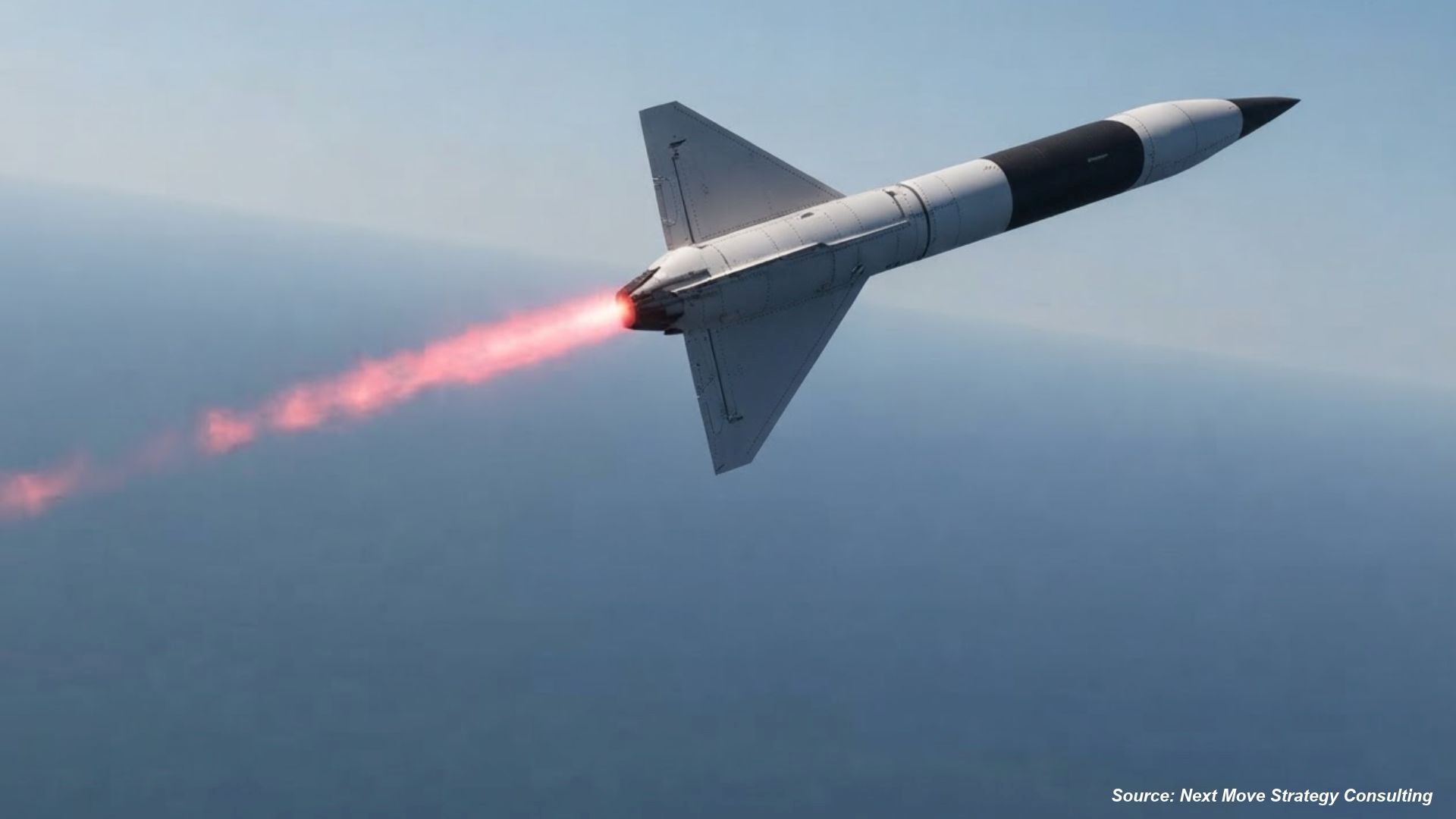
The most consequential shift in the hypersonic weapons market over the past twelve months is the transition from test-range validation to operational and combat use. Russia's Oreshnik, which U.S. officials describe as derived from the RS-26 Rubezh, carries multiple maneuvering warheads and has been used in two demonstrated strikes against Ukraine, delivering inert submunitions in both instances to demonstrate penetration capability rather than destroy hardened targets. Moscow announced the system's deployment to Belarus in December 2025. Russia's ship-launched Zircon — a scramjet credited with speeds near Mach 8 and a range of approximately 1,000 kilometers — was also employed against Ukraine in 2024.
China's hypersonic arsenal is broader and more layered. The DF-17 medium-range ballistic missile, mated to a hypersonic glide vehicle capable of "extreme maneuvers" during flight, is deployed against targets across the First Island Chain. The Pentagon's December 2025 report confirmed that the DF-27 — with a range of 5,000 to 8,000 kilometers — is fielded and can reach Guam, Hawaii, and in its longest profiles the U.S. West Coast, including an anti-ship variant. The air- and ship-launched YJ-21 completes a family of systems built to hold carrier strike groups at risk. China's September 3, 2025 Victory Day Parade — commemorating the 80th anniversary of the end of World War II — publicly displayed the DF-17 and DF-26D in the conventional weapons formation, alongside the first-ever simultaneous showcase of land-, sea-, and air-launched nuclear systems, marking a milestone in China's nuclear triad development.
Iran's Fattah-2 became a test case in early 2026. Tehran claims the missile — described as a glide vehicle able to alter course on reentry — penetrated Israeli and U.S.-supplied defenses, including Arrow and Terminal High Altitude Area Defense batteries, during strikes that began in late February 2026. While independent battle-damage assessment remains limited, the episode confirmed that a dense, layered defense network could not guarantee interception of a maneuvering glide threat.
Türkiye Enters the Hypersonic Club
On July 22, 2025, Roketsan unveiled the Tayfun Block-4 at the IDEF 2025 International Defense Industry Fair in Istanbul — Türkiye's first indigenously developed hypersonic ballistic missile. Weighing over 7 tons, the system is capable of exceeding Mach 5 and striking targets at approximately 800 kilometers range. Roketsan CEO Murat Ikinci stated that the system is "designed to meet the long-range strike requirements of the Turkish Armed Forces" and is capable of destroying strategic targets including air defense systems, command and control centers, and military hangars. The Tayfun Block-4's debut expands the hypersonic club beyond the established great powers, signaling that Mach 5+ strike capability is no longer the exclusive domain of the United States, Russia, and China — a development with direct implications for NATO's southern flank and Middle Eastern security architectures.
NMSC Strategic Perspective: Why the Offense-Defense Inversion Drives Market Expansion
According to Next Move Strategy Consulting's proprietary research and analysis, the hypersonic weapons market's 14.09% CAGR through 2035 is structurally anchored in a dynamic that distinguishes it from virtually every other defense technology segment: the offense-defense inversion. Unlike conventional missile markets where defense investment tracks offense investment in a relatively balanced cycle, hypersonic glide vehicles have outpaced defensive countermeasures by a margin that is now operationally demonstrated rather than merely theoretical.
NMSC's analysis identifies three reinforcing mechanisms that sustain this growth trajectory. First, the interception problem specific to the glide phase — where a boost-glide vehicle maneuvers along a shallow, shifting trajectory at speeds above Mach 5, flying below the reach of exo-atmospheric interceptors and inside the reaction window of most terminal systems — compresses warning time and denies defenders a stable firing solution. This structural advantage of offense over defense creates persistent demand for offensive hypersonic capability among nations seeking to maintain credible deterrence or strike options. Second, the iterative testing cycle enabled by reusable hypersonic test platforms is shortening development timelines across multiple programs simultaneously, meaning that the number of nations approaching operational capability is expanding faster than defensive architectures can mature. Third, the combat use of these systems by Russia and Iran has removed the last layer of strategic ambiguity about their operational effectiveness, accelerating procurement decisions in nations that had previously treated hypersonic investment as a long-term research priority.
NMSC's segment analysis further indicates that Hypersonic Glide Vehicles (HGVs) lead market momentum, driven by their maneuverable re-entry capability and ability to evade advanced missile defense systems. Air-launched systems dominate near-term deployment due to their flexibility and compatibility with existing fighter and bomber fleets, while sea-launched variants — particularly submarine-based platforms — are gaining strategic importance as second-strike credibility frameworks are reinforced globally.
Section Summary:
The hypersonic weapons market has crossed a threshold from developmental competition to operational deployment, with Russia, China, and Iran demonstrating combat or near-combat use of glide vehicles that current Western defenses cannot reliably intercept.
-
Russia's Oreshnik is an intermediate-range ballistic missile that Russia has used against Ukraine, including strikes in November 2024 and January 2026. Its use should not be presented as the first combat record of a hypersonic glide vehicle.
-
China's DF-27 (range: 5,000–8,000 km) was confirmed fielded by the Pentagon in December 2025, extending hypersonic threat coverage to Hawaii and the U.S. West Coast.
-
Türkiye's Tayfun Block-4 (Mach 5+, ~800 km range), unveiled at IDEF 2025, expands the hypersonic-capable nation count beyond the traditional great-power triad.
-
NMSC's proprietary analysis identifies the offense-defense inversion — where offensive glide vehicles structurally outpace defensive interceptors — as the primary structural driver of the market's 14.09% CAGR through 2035.
Industry Impact Analysis
The U.S. Fielding Gap and the Industrial Response
The United States has invested more than USD 12 billion in its Long-Range Hypersonic Weapon (LRHW), designated Dark Eagle, since 2018 — yet as of September 2026, it has not fully fielded a combat-ready hypersonic battery. The U.S. Army was expected to establish its first ground-launched Dark Eagle battery in the third quarter of 2025. That milestone was missed. The Government Accountability Office's Weapon Systems Annual Assessment, released in July 2026, confirmed the Army had yet to field the weapon's first battery — including missiles — when reviewed earlier in the year. The first battery is now expected to come online more than two years later than its initial goal, with the second battery delayed until at least the second quarter of fiscal year 2027 due to missile delivery delays of at least six months.
The Navy's Conventional Prompt Strike (CPS) program — which shares the Common Hypersonic Glide Body with Dark Eagle — is on track to field on a Zumwalt-class destroyer in 2027, slipped from 2025 due to testing and funding challenges. Ingalls Shipbuilding completed at-sea testing of the USS Zumwalt in January 2026 following an extensive modernization that installed four large-diameter launch tubes, each capable of housing three CPS missiles, giving the destroyer a total capacity of 12 hypersonic missiles.
In April 2026, the U.S. Navy awarded Lockheed Martin a USD 1.356 billion contract modification under contract N00030-22-C-1025 to advance production and integration of the CPS system, with work scheduled through September 30, 2032. The contract funds engineering development, systems integration, long-lead material procurement, advanced testing, and specialized tooling — signaling the program's transition from developmental testing into large-scale operational fielding. In June 2026, the Navy awarded Lockheed Martin Space an additional USD 83 million contract modification to procure additional hypersonic missiles for the Army.
The Air Force is moving with greater urgency. Its Hypersonic Attack Cruise Missile (HACM) — built by Raytheon and designed to be carried by an F-15 — is on track for its first flight test in 2026, with procurement planned to begin in fiscal year 2027. The Air-Launched Rapid Response Weapon (ARRW), a boost-glide missile developed by Lockheed Martin for the B-52 Stratofortress, was revived in the 2026 budget after being halted in 2023. The Air Force is doubling production rates of both programs, with a planned investment of USD 1.8 billion across the five-year Future Years Defense Program.
On August 10, 2026, Lockheed Martin and Albany Engineered Composites announced a teaming agreement to scale production of hypersonic weapons, addressing the composite materials supply chain that has been a persistent bottleneck across multiple programs.
Budget Dynamics: A Recalibration, Not a Retreat
The U.S. Department of Defense's FY2026 budget request for hypersonic weapons was USD 3.9 billion, down from USD 6.9 billion in FY2025 — a 43% reduction that generated significant commentary. However, the Congressional Research Service's July 2026 report clarified that the FY2027 budget submission requested USD 37.9 billion in discretionary and mandatory procurement and research, development, test and evaluation funding for offensive and defensive hypersonic warfare programs combined, of which USD 5.4 billion was requested specifically for the CPS, HACM, and LRHW programs. This figure encompasses the Golden Dome homeland missile defense initiative, for which the FY2026 budget included a USD 25 billion initial investment, and the Glide Phase Interceptor program — accelerated in April 2026 but not expected to reach operational status before approximately 2031.
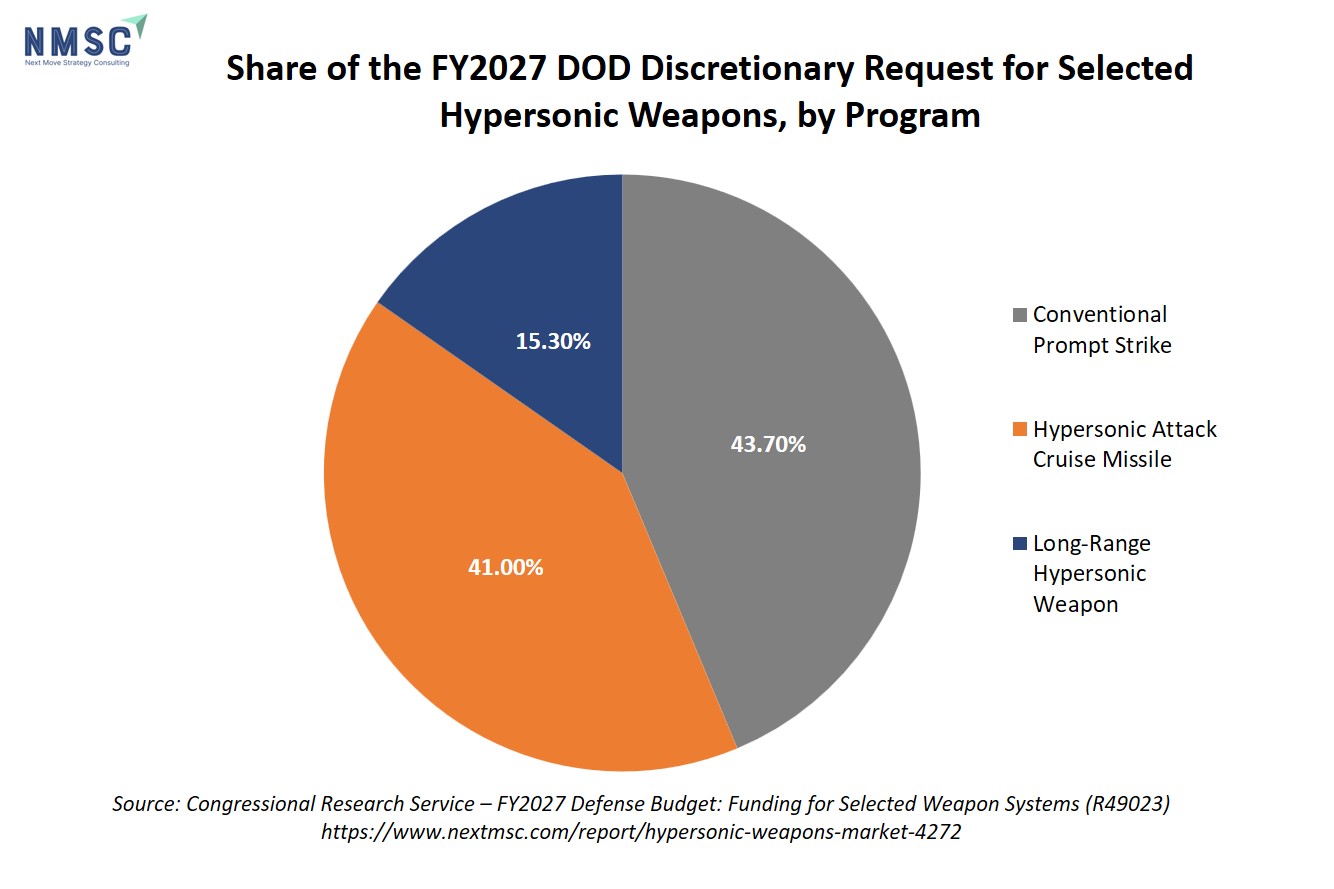
The broader context is a U.S. national defense budget that crossed USD 1 trillion in fiscal year 2026 — a more than 17% increase — following the passage of appropriations acts and a budget reconciliation act that provided USD 152.3 billion for the Pentagon. The Missile Defense Agency's hypersonic defense efforts, including the Glide Phase Interceptor, received USD 185 million through normal appropriations plus an additional USD 2.2 billion in classified reconciliation spending.
The Interception Problem and the Golden Dome Wager
The Congressional Budget Office estimated in May 2026 that the Golden Dome homeland missile defense initiative — designed to track and engage hypersonic threats — could cost approximately USD 1.2 trillion over twenty years. The Glide Phase Interceptor, developed by Northrop Grumman with Japan to engage glide vehicles from Aegis ships, faces a preliminary design review in 2028 and is not expected to reach operational status before approximately 2031. The Space Force missile warning and tracking constellation in low-earth orbit — intended to provide the tracking data needed to cue interceptors — received USD 1.7 billion through appropriations, with a further USD 7.2 billion pending approval through reconciliation. However, the GAO noted in a January 2026 report that the constellation had "yet to demonstrate the development of timely, actionable, and accurate two-dimensional tracks on orbit and three-dimensional tracks on the ground needed to counter hypersonic and other evolving threats."
Section Summary:
The industry impact of the current hypersonic weapons environment is defined by a simultaneous acceleration of offensive programs and a defensive architecture that remains years from operational readiness.
-
The U.S. Army's Dark Eagle battery is more than two years behind its original fielding schedule; the Navy's CPS program has slipped to 2027 deployment on the USS Zumwalt.
-
The USD 1.356 billion Lockheed Martin CPS contract (April 2026) marks the program's transition from developmental testing to large-scale operational production.
-
The U.S. FY2026 defense budget exceeded USD 1 trillion — a 17%+ increase — with USD 2.2 billion in classified reconciliation funds directed to hypersonic defense programs including the Glide Phase Interceptor.
-
The Golden Dome initiative, estimated at USD 1.2 trillion over 20 years by the CBO, represents the largest single defensive investment in hypersonic countermeasures globally, but its key interceptor component is not expected before 2031.
Pros and Cons of Recent Market Developments
|
Recent Development |
Pros |
Cons |
|
U.S. Navy USD 1.356B Lockheed Martin CPS Contract (April 2026) |
Transitions CPS from R&D to sustained production; establishes a multi-service glide body supply chain; extends U.S. hypersonic strike reach to Zumwalt-class destroyers and Virginia-class submarines |
Work extends through September 2032, meaning full operational capability remains years away; GAO flagged limited missile availability for testing as a risk to fielding timelines |
|
U.S. FY2026 Defense Budget Exceeding USD 1 Trillion |
Provides USD 2.2B in classified reconciliation funds for hypersonic defense; funds Golden Dome initial investment at USD 25B; enables doubling of HACM and ARRW production rates |
FY2026 hypersonic weapons development request fell 43% from FY2025 (USD 3.9B vs. USD 6.9B); budget execution problems cited by appropriators across multiple missile defense programs |
|
Russia's Oreshnik Combat Deployment (November 2024 & January 2026) |
Provides real-world performance data on maneuvering glide vehicle behavior under operational conditions; validates boost-glide architecture at intermediate range |
Demonstrates that a maneuvering glide vehicle can penetrate current Western air defenses; raises crisis instability risks by compressing decision timelines for adversaries |
|
China's DF-27 Fielding (Pentagon-confirmed, December 2025) |
Confirms China's ability to hold Guam, Hawaii, and U.S. West Coast at risk with conventional hypersonic strike; accelerates U.S. and allied investment in countermeasures |
Extends hypersonic threat coverage to the U.S. homeland for the first time with a conventional (non-nuclear) maneuvering glide vehicle; anti-ship variant threatens carrier strike group survivability |
|
Roketsan Tayfun Block-4 Debut at IDEF 2025 (July 2025) |
Expands the hypersonic-capable nation count; strengthens Türkiye's deterrence posture within NATO and regional security frameworks; demonstrates indigenous propulsion and guidance capability |
Adds a new vector of hypersonic proliferation; complicates arms control frameworks that were already struggling to address U.S.-Russia-China tripolarity |
|
Lockheed Martin & Albany Engineered Composites Teaming Agreement (August 2026) |
Addresses composite materials supply chain bottleneck that has delayed multiple programs; enables production rate scaling for both Dark Eagle and CPS |
Teaming agreements at this stage indicate that industrial base constraints remain unresolved; scaling composite production for hypersonic thermal protection systems is technically complex and time-intensive |
|
Golden Dome Initiative (USD 1.2T CBO estimate over 20 years) |
Establishes a comprehensive homeland missile defense architecture that addresses hypersonic, ballistic, and cruise missile threats simultaneously |
CBO's USD 1.2 trillion cost estimate over 20 years raises fiscal sustainability questions; the Glide Phase Interceptor — its primary hypersonic countermeasure — is not expected before 2031, leaving a multi-year defensive gap |
Key Data & Statistics
Global Hypersonic Weapons Programs — Key Operational & Development Milestones (2025–2026)
|
Country / Program |
System |
Status (as of October 2026) |
Key Specification |
|
United States — Army |
Dark Eagle (LRHW) |
First battery activated December 2025; full fielding with missiles delayed to 2026–2027 |
Peak speed: Mach 17+; Range: 1,725+ miles |
|
United States — Navy |
Conventional Prompt Strike (CPS) |
USD 1.356B contract awarded April 2026; IOC on USS Zumwalt targeted for 2027 |
Boost-glide; Mach 5+; 12 missiles per Zumwalt-class destroyer |
|
United States — Air Force |
Hypersonic Attack Cruise Missile (HACM) |
First flight test targeted for 2026; procurement from FY2027 |
Air-launched; F-15 compatible; scramjet-powered |
|
United States — Air Force |
Air-Launched Rapid Response Weapon (ARRW) |
Revived in FY2026 budget; production rates being doubled |
Boost-glide; B-52 Stratofortress launched |
|
Russia |
Oreshnik |
Combat-deployed; struck Ukraine November 2024 and January 2026 |
Multiple maneuvering warheads; intermediate-range |
|
Russia |
Avangard |
Operational since 2019; deployed on SS-19 ICBMs |
Mach 20+; nuclear-armed HGV |
|
Russia |
Zircon |
Combat-used against Ukraine in 2024 |
Scramjet; ~Mach 8; ~1,000 km range |
|
China |
DF-17 |
Operationally deployed; displayed at September 2025 Victory Day Parade |
Medium-range; HGV; extreme in-flight maneuverability |
|
China |
DF-27 |
Fielded; confirmed by Pentagon December 2025 |
Range: 5,000–8,000 km; anti-ship variant |
|
China |
YJ-21 |
Operational; air- and ship-launched |
Anti-ship hypersonic ballistic missile |
|
Türkiye |
Tayfun Block-4 |
Unveiled at IDEF 2025, July 22, 2025 |
Mach 5+; ~800 km range; 7,200 kg |
|
United States (Defense) |
Glide Phase Interceptor |
Accelerated April 2026; preliminary design review 2028 |
Northrop Grumman; Aegis-launched; IOC ~2031 |
Future Outlook & Forecast
From Prototype Competition to Production-Scale Deterrence
According to Next Move Strategy Consulting's proprietary research and analysis, the hypersonic weapons market is projected to expand from USD 11.88 billion in 2026 to USD 34.10 billion by 2035, at a CAGR of 14.09%. This trajectory is underpinned by three structural forces that NMSC's model identifies as durable through the forecast period.
-
Propulsion maturity reaching inflection. NMSC's analysis of propulsion subsystem datasets and defense laboratory test briefings identifies a clear shift toward advanced scramjet and combined-cycle engine architectures capable of sustained Mach 5+ operation. Improvements in high-temperature materials, advanced cooling channels, and inlet management systems are extending operational duration and range without proportional increases in system mass — a combination that directly expands the addressable market for air-launched hypersonic cruise missiles, where platform integration constraints have historically limited payload weight.
-
Guidance precision enabling new mission categories. NMSC's benchmarking, supported by simulation data and defense laboratory collaboration, indicates that next-generation guidance systems integrating sensor fusion, adaptive control algorithms, and high-bandwidth onboard processing are achieving substantially higher targeting accuracy compared with legacy architectures. This precision improvement is opening tactical strike and anti-ship mission categories to hypersonic platforms that were previously limited to strategic deterrence roles — broadening the procurement base beyond strategic commands to include naval and tactical air forces.
-
Reusable test platforms compressing development cycles. The U.S. Department of Defense's support for multiple successful missions involving reusable hypersonic vehicles — including platforms developed by Stratolaunch — during 2024–2025 demonstrates that iterative flight testing with reusable platforms enables faster turnaround between successive flights and significantly higher data acquisition per test campaign. This reusability-driven approach is shortening development timelines across multiple national programs simultaneously, meaning that the number of nations approaching operational capability will continue to expand through the forecast period.
The Asia-Pacific region is identified by NMSC as the fastest-growing and most strategically competitive market, led by China, India, Japan, and South Korea. China maintains a leading position through large-scale prototyping, domestic propulsion and guidance programs, and extensive flight-testing infrastructure. Japan and South Korea are prioritizing precision guidance and integrated testing within allied defense frameworks, while India is advancing indigenous propulsion technologies through national defense laboratories. North America retains market leadership, anchored by the U.S. multi-service hypersonic program portfolio and a strong ecosystem of prime contractors and government laboratories.
The Congressional Research Service's May 2026 update confirms that the DOD is pursuing both boost-glide systems and scramjet-powered cruise missiles, with the Navy, Army, and Air Force each maintaining distinct hypersonic programs. Unlike Russia and China, the United States is not known to be developing HGVs for use with nuclear warheads — a constraint that requires greater accuracy and makes U.S. systems more technically challenging to develop, but also positions them for broader conventional strike applications.
Section Summary:
The hypersonic weapons market's path to USD 34.10 billion by 2035 is supported by converging propulsion, guidance, and testing advances that are simultaneously shortening development cycles and expanding the mission envelope of hypersonic platforms.
-
NMSC's proprietary analysis projects a 14.09% CAGR through 2035, driven by scramjet propulsion maturity, AI-enabled guidance precision, and the expansion of hypersonic capability from strategic deterrence into tactical strike and anti-ship mission categories.
-
Asia-Pacific is the fastest-growing region, with China's DF-27 fielding and India's indigenous propulsion programs representing the two most consequential near-term developments.
-
Reusable test platforms — validated through U.S. DoD-supported Stratolaunch missions in 2024–2025 — are compressing development timelines across multiple national programs, accelerating the expansion of the hypersonic-capable nation count.
-
The U.S. FY2027 budget request of USD 37.9 billion for offensive and defensive hypersonic warfare programs combined signals that government investment will remain the primary demand driver through the forecast period, with procurement contracts replacing R&D as the dominant spending category.
Next Steps for Stakeholders
For Defense Ministries and Government Procurement Agencies:
The Pentagon's December 2025 assessment that China fields the world's leading hypersonic missile arsenal — combined with Russia's combat use of the Oreshnik and Zircon — establishes a clear capability benchmark against which national programs must be measured. Procurement agencies should prioritize closing the gap between test-validated and operationally fielded systems, with particular attention to the supply chain constraints — composite materials, specialized tooling, and contractor staffing continuity — that have delayed the U.S. Dark Eagle program by more than two years. The Glide Phase Interceptor's 2031 IOC timeline means that defensive hypersonic countermeasures will not be available for at least five years; interim investments in space-based tracking and early warning infrastructure are the most actionable near-term defensive measure.
For Defense Prime Contractors and System Integrators:
The Lockheed Martin–Albany Engineered Composites teaming agreement (August 2026) illustrates the critical importance of securing composite materials supply chains before production rate demands peak. Primes that have not yet established dedicated hypersonic thermal protection system supply chains face the same bottleneck that delayed Dark Eagle. The Air Force's decision to double HACM and ARRW production rates — with USD 1.8 billion committed across the five-year FYDP — signals that air-launched hypersonic systems will be the highest-volume procurement category through the late 2020s, making F-15 and B-52 integration expertise a near-term competitive differentiator.
For Strategic Investors and Defense-Focused Capital Allocators:
NMSC's proprietary analysis identifies the most compelling investment opportunities in firms with proprietary hypersonic propulsion technologies, advanced thermal protection materials, and integrated systems engineering expertise. The market's 14.09% CAGR through 2035 is structurally supported by government budget commitments that are multi-year and bipartisan — the FY2026 defense budget exceeding USD 1 trillion passed with broad congressional support. Investors should note that the FY2027 request of USD 37.9 billion for hypersonic warfare programs represents a step-change from prior years, and that the transition from R&D to procurement contracts — exemplified by the USD 1.356 billion CPS modification — creates more predictable revenue streams for established primes. Emerging hypersonic propulsion specialists and reusable test platform developers represent higher-risk, higher-return opportunities as the market transitions from prototype validation to production-scale deployment.
For Allied Nations and Multilateral Defense Frameworks:
The Glide Phase Interceptor's joint development structure between the United States and Japan — with Northrop Grumman as prime contractor — provides a template for allied nations seeking to contribute to hypersonic defense without bearing the full cost of independent development. Nations in the 1,000–3,000 km range segment — where NMSC's analysis identifies the highest near-term operational adoption — should evaluate whether their current air defense architectures can provide any meaningful intercept probability against maneuvering glide vehicles, and plan procurement accordingly.
Conclusion
The hypersonic weapons market has moved decisively beyond the phase where its growth could be attributed to speculative future demand. Russia has fired hypersonic glide vehicles in combat. China has fielded a system capable of reaching the U.S. West Coast. Türkiye has joined the hypersonic club with an indigenously developed Mach 5+ missile. The United States, despite more than USD 12 billion invested in Dark Eagle, is still working to field its first combat-ready battery — a gap that is driving the urgency, and the budget commitments, that underpin the market's 14.09% CAGR through 2035.
According to Next Move Strategy Consulting's proprietary research and analysis, the global hypersonic weapons market will reach USD 34.10 billion by 2035, expanding from USD 11.88 billion in 2026. The structural drivers — propulsion maturity, guidance precision, reusable test platforms, and the irreversible offense-defense inversion — are durable across the forecast period. For defense ministries, prime contractors, and strategic investors, the central question is no longer whether hypersonic weapons will define the next generation of strategic competition, but which organizations will be positioned to supply, integrate, and defend against them when the production-scale phase arrives.
About the Author
 Sanyukta Deb
— Sanyukta Deb is Digital Marketing Team Lead at Next Move Strategy Consulting, where she has led content strategy and technical SEO for the firm's B2B market research publications for over 2 years. Her editorial process translates NextMSC's primary and secondary research — spanning technology, industrial, and consumer sectors — into commercial narratives, backed by search-intent, keyword, and competitive analysis. She brings 5 years of overall experience in digital marketing and content strategy.
Sanyukta Deb
— Sanyukta Deb is Digital Marketing Team Lead at Next Move Strategy Consulting, where she has led content strategy and technical SEO for the firm's B2B market research publications for over 2 years. Her editorial process translates NextMSC's primary and secondary research — spanning technology, industrial, and consumer sectors — into commercial narratives, backed by search-intent, keyword, and competitive analysis. She brings 5 years of overall experience in digital marketing and content strategy.
About the Reviewer
 Debashree Dey
— Debashree Dey is Assistant Manager at Next Move Strategy Consulting, where she supports cross-vertical market content and communications across diverse industries for 6 years. Her professional background includes senior content writing, communications, and published manuscript authorship, with experience developing audience-focused business narratives and maintaining clear, consistent messaging. Her role supports research-led content development and editorial quality across NextMSC publications.
Debashree Dey
— Debashree Dey is Assistant Manager at Next Move Strategy Consulting, where she supports cross-vertical market content and communications across diverse industries for 6 years. Her professional background includes senior content writing, communications, and published manuscript authorship, with experience developing audience-focused business narratives and maintaining clear, consistent messaging. Her role supports research-led content development and editorial quality across NextMSC publications.

















Add Comment