5 Powerful WealthTech Market Trends Reshaping Digital Finance in 2026

Introduction
The global financial services landscape is undergoing a structural transformation, and the WealthTech market sits at the very center of it. Driven by the convergence of artificial intelligence, cloud-native infrastructure, tokenization, and evolving regulatory frameworks, digital wealth management is no longer a peripheral innovation — it is rapidly becoming the industry's primary operating model.
In May 2026, the United States government issued Executive Order 14405, formally directing federal financial regulators to streamline regulatory processes and remove barriers that impede fintech firms from integrating with traditional financial institutions. This landmark policy shift, combined with accelerating AI adoption and a growing global middle class seeking accessible investment solutions, has created a powerful tailwind for the WealthTech market. According to Next Move Strategy Consulting (NMSC), the global WealthTech Market is projected to grow from USD 22.99 billion in 2025 to USD 71.59 billion by 2030, at a compound annual growth rate (CAGR) of 25.5%. For institutional investors, C-suite executives, and strategic decision-makers, understanding the forces driving this expansion is no longer optional — it is a competitive imperative.
For More Information: Download FREE Sample on WealthTech Market Report
The Forces Rewriting the WealthTech Market Playbook in 2026
A Landmark Regulatory Shift Sets the Stage
The most consequential development for the WealthTech market in the first half of 2026 was the signing of Executive Order 14405 by President Donald J. Trump on May 19, 2026. Titled Integrating Financial Technology Innovation into Regulatory Frameworks, the order mandates that each federal financial regulator — including the SEC, FDIC, CFPB, and OCC — conduct a comprehensive review of existing regulations within 90 days to identify and remove barriers that prevent fintech firms from partnering with federally regulated institutions.
The executive order explicitly covers investment management, brokerage services, digital asset-related services, and blockchain-based services — all core pillars of the WealthTech ecosystem. Critically, it also directs the Federal Reserve to evaluate expanding direct access to Reserve Bank payment accounts for non-bank financial companies, including those engaged in digital assets and novel financial activities. This represents a fundamental recalibration of the regulatory environment — one that could dramatically lower the cost of compliance and market entry for WealthTech providers.
Trend 1: AI-Augmented Advisory Is Redefining the Advisor's Role
Artificial intelligence has moved from a supplementary tool to a strategic operating backbone across the WealthTech sector. As of 2025, 52% of financial institutions were using generative AI, up from 40% in 2023, according to industry adoption data. Furthermore, the Federal Reserve's own monitoring data indicates that approximately 18% of all U.S. firms had formally adopted AI as of year-end 2025, with financial services among the leading adopters.
According to MSCI's 2026 Wealth Trends survey, 95% of wealth management firms expect to increase their AI investment, yet only 27% believe the wealth segment is currently leading other financial services sectors in AI deployment — signaling a significant runway for competitive differentiation. Oliver Wyman's 2026 wealth management outlook describes this shift as the emergence of the "AI-augmented advisor" — a model in which AI handles prospecting, portfolio design, planning, and service execution, while human advisors focus exclusively on high-stakes, emotionally complex client decisions.
Trend 2: Tokenization Is Restructuring Cash and Asset Economics
Tokenization of financial assets — including cash, private equity, and real estate — is transitioning from a theoretical concept to an operational reality. Oliver Wyman identifies tokenized cash as a transformative force that is repricing cash economics, enabling clients to hold yield until the precise moment of expenditure through on-chain cash and atomic settlement mechanisms. The winning model, according to the firm, treats cash as two distinct products: a premium deposit with immediacy and lending linkage, and a tokenized cash sleeve that accrues yield in real time and can smart-route payments through a hybrid TradFi-DeFi wallet.
Trend 3: Embedded Wealth Is Expanding the Distribution Frontier
Wealth management is migrating out of traditional branch environments and standalone applications, embedding itself within payroll platforms, e-commerce wallets, super-apps, and corporate ecosystems. For many upper-affluent and high-net-worth clients, the first investing touchpoint is now a workplace plan, a brokerage embedded within a banking application, or a wealth product integrated into a partner platform. This structural shift is compelling WealthTech providers to design modular, API-first products and advice journeys that can be white-labelled or co-branded across third-party ecosystems.
Trend 4: Deal Activity Reflects Selective Capital Deployment
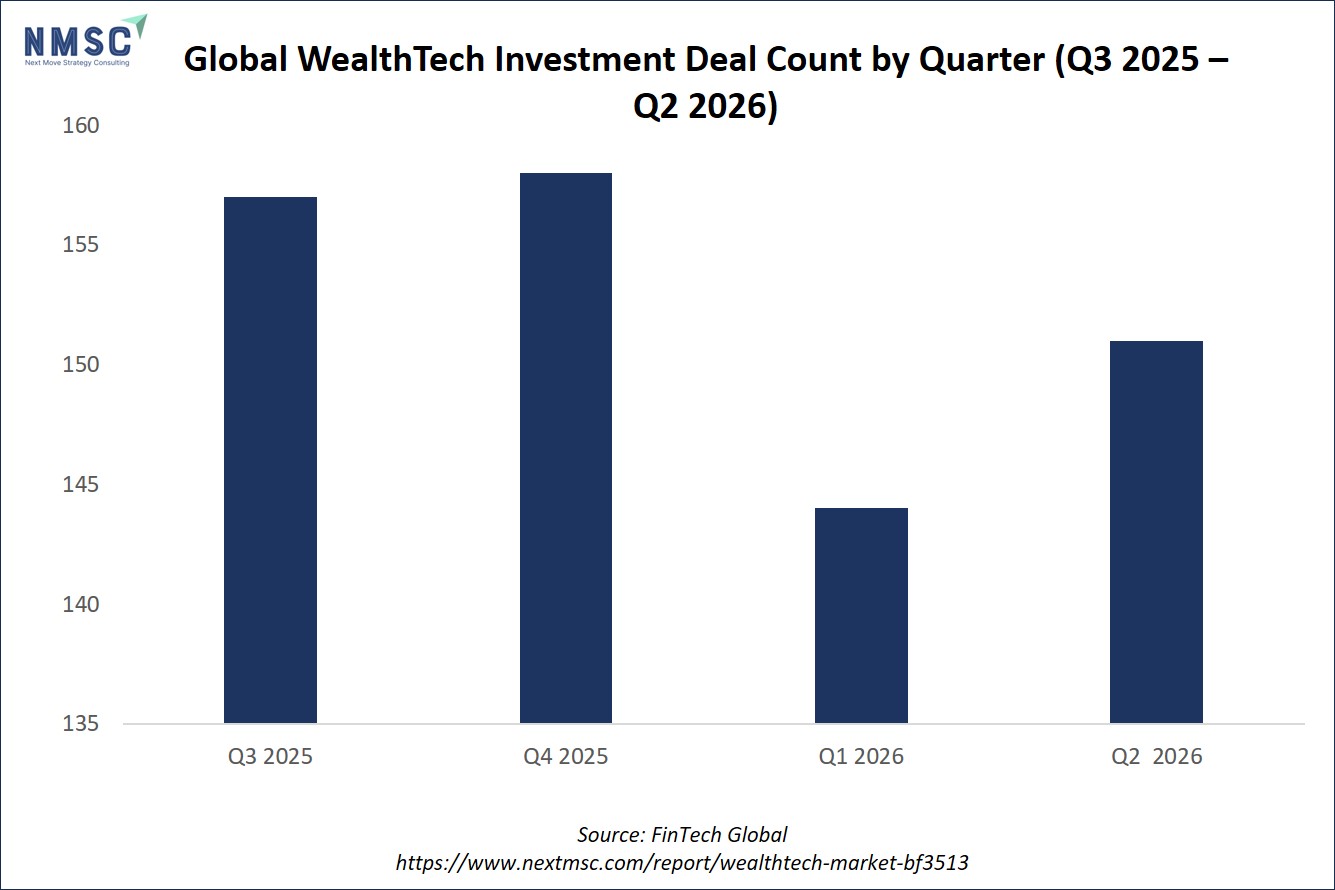
Global WealthTech recorded 213 deals in Q2 2026, down 7% from 230 transactions in Q1 2026, but up 10% from 193 deals recorded in Q2 2025, reflecting a market that is consolidating rather than contracting. The United States maintained its position as the dominant WealthTech hub, accounting for 54% of all global deals in Q2 2026. U.S. WealthTech companies raised USD 557.8 million across 91 deals in Q2 2026, though this represented a 41% decline in funding from the USD 948.9 million recorded in Q1 2026, largely attributable to a reduction in large-ticket deals exceeding USD 100 million.
Trend 5: Rising Disposable Incomes Are Expanding the Investor Base
A structural expansion of the global investor base is underway, underpinned by rising disposable incomes. According to the U.S. Bureau of Economic Analysis (BEA), disposable personal income rose by USD 61.0 billion (0.3%) in 2025, while personal consumption expenditures also increased by USD 69.9 billion (0.3%). This rise in household financial capacity is directly expanding the addressable market for WealthTech platforms, particularly among first-time investors and the mass-affluent segment seeking affordable, digitally accessible wealth management solutions.
NMSC Strategic Perspective: Regulatory Liberalization as a Structural Catalyst
From Next Move Strategy Consulting's analytical standpoint, Executive Order 14405 represents one of the most consequential regulatory developments for the WealthTech market in recent years. By directing federal regulators to actively facilitate fintech-bank partnerships and streamline charter application processes, the order effectively lowers the structural barriers that have historically constrained WealthTech firms from scaling within the regulated financial system.
NMSC's assessment is that this regulatory liberalization will accelerate three specific market dynamics: first, an increase in strategic partnerships between established WealthTech platforms and federally insured depository institutions; second, a broader adoption of digital asset-integrated wealth management products as regulatory clarity improves; and third, a compression of compliance costs for emerging WealthTech entrants, enabling a new wave of specialized, niche-focused platforms to achieve commercial viability. Combined with the market's projected CAGR of 25.5% through 2030, this regulatory tailwind positions the WealthTech sector for a period of accelerated structural growth rather than cyclical expansion.
Section Summary: The WealthTech market in 2026 is being shaped by a convergence of regulatory reform, AI maturation, tokenization, and expanding investor demographics. The U.S. government's formal commitment to fintech integration signals a durable shift in the operating environment for digital wealth management providers.
Key Takeaways:
-
Executive Order 14405 (May 2026) mandates regulatory review across all federal financial regulators to facilitate fintech-bank integration, directly benefiting WealthTech providers.
-
52% of financial institutions were using generative AI as of 2025, with 95% of wealth management firms planning to increase AI investment.
-
Global WealthTech deal volume rose 10% year-over-year in Q2 2026, with the U.S. commanding 54% of all transactions.
-
Rising disposable incomes and a growing global middle class are structurally expanding the addressable market for digital wealth management platforms.
Industry Impact Analysis
Regulatory Reform: Lowering Barriers, Raising Competition
The implications of Executive Order 14405 extend well beyond compliance simplification. By directing the Federal Reserve to evaluate direct access to Reserve Bank payment accounts for non-bank financial companies — including those engaged in digital assets — the order opens a pathway for WealthTech firms to operate with a level of financial infrastructure access previously reserved for chartered banks. This has profound implications for the competitive dynamics of the sector: incumbent financial institutions will face intensified competition from agile, technology-native WealthTech firms that can now access payment rails and regulatory licenses more efficiently.
Deloitte's 2026 Investment Management Regulatory Outlook notes that the regulatory environment for investment management shifted quickly and significantly in 2025, with 2026 expected to bring further action on digital asset integration and fintech collaboration frameworks. For WealthTech firms, this creates both an opportunity and an obligation: those that proactively align their compliance architecture with the evolving regulatory framework will be positioned to capture market share from slower-moving incumbents.
ESG Integration: Europe's Regulatory Mandate Drives Platform Evolution
In Europe, the WealthTech market is being shaped by a distinct regulatory imperative: the integration of Environmental, Social, and Governance (ESG) criteria into investment platforms. Stricter EU regulations on sustainable finance and growing investor preference for socially responsible portfolios are compelling WealthTech providers to embed ESG analytics and reporting capabilities into their core offerings. Advanced AI-powered tools are enabling these platforms to assess companies' sustainability performance and deliver tailored investment recommendations aligned with EU sustainability directives, attracting both retail and institutional clients.
Asia-Pacific: Mobile-First Adoption Accelerates Market Penetration
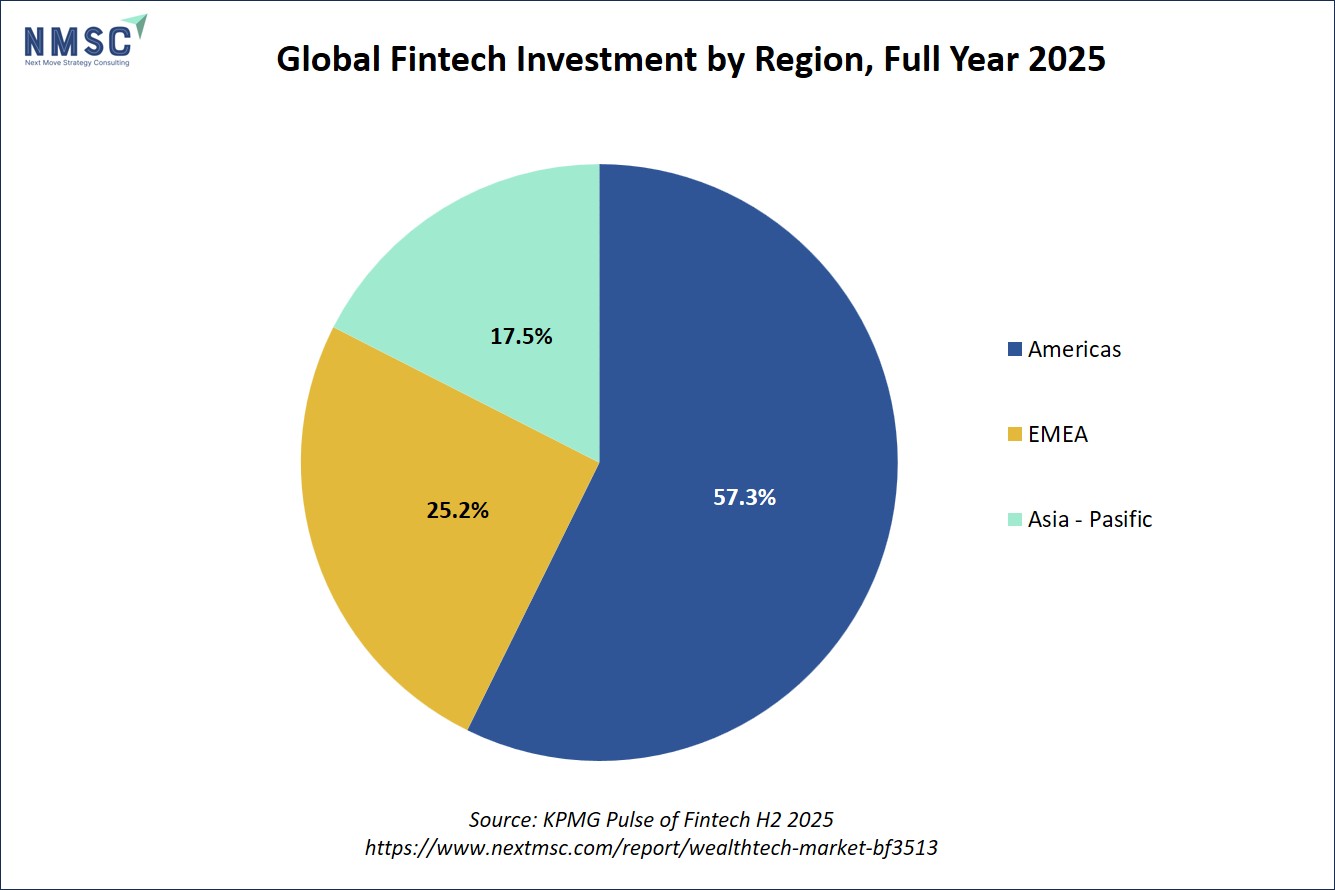
The Asia-Pacific region represents one of the most dynamic growth frontiers for the WealthTech market. Rapid expansion of the middle-class population, high smartphone penetration, and a mobile-first approach to financial services are accelerating the adoption of digital investment platforms across the region. The combination of rising disposable incomes and evolving lifestyle aspirations is creating a large, underserved investor base that WealthTech platforms are uniquely positioned to serve through low-cost, scalable digital solutions.
Cybersecurity: The Critical Constraint on Adoption
Despite the sector's strong growth trajectory, cybersecurity and data privacy concerns remain a material constraint on WealthTech adoption. Rising incidents of online fraud, phishing, and identity theft are creating hesitancy among potential users, particularly in regions with less mature cybersecurity infrastructure. Weaver's 2026 market risk insights note that AI adoption, digital asset volatility, and evolving SEC examination priorities are among the top risk factors for asset managers, underscoring the need for robust security and regulatory technology investment.
Strategic Moves by Key Industry Players
The competitive landscape of the WealthTech market is being actively reshaped through strategic product launches, acquisitions, and platform integrations:
-
SS&C Technologies (August 2025) enhanced its Black Diamond Wealth Platform, integrating portfolio management, reporting, and advisor workflow automation into a unified ecosystem designed to improve operational efficiency for financial advisors and wealth managers.
-
BlackRock (June 2025) expanded the reach of its Aladdin investment management platform through strategic collaborations and technology integration initiatives, providing advanced analytics and portfolio risk management tools for institutional and wealth management clients globally.
-
FIS (June 2025) partnered with leading payment and banking technology providers to expand digital payment infrastructure and embedded finance capabilities for banking institutions.
-
Fiserv (December 2024) launched integrated digital financial planning and payment processing technologies designed to support digital transformation across financial institutions.
Section Summary: The WealthTech market's industry impact in 2026 is being driven by regulatory liberalization in the U.S., ESG mandates in Europe, mobile-first adoption in Asia-Pacific, and strategic platform consolidation by major players. Cybersecurity remains the sector's most significant structural risk.
Key Takeaways:
-
Executive Order 14405 is expected to accelerate fintech-bank partnerships and compress compliance costs for WealthTech entrants.
-
ESG integration is becoming a regulatory requirement in Europe, compelling WealthTech platforms to embed sustainability analytics into their core offerings.
-
Asia-Pacific's mobile-first, middle-class expansion represents one of the highest-growth opportunity zones for WealthTech providers.
-
Cybersecurity investment — particularly in identity verification, fraud prevention, and compliance automation — is a non-negotiable operational priority for market participants.
WealthTech Market – Key Industry Statistics, 2025–2026
|
Metric |
Value |
Period |
Source |
|
Global WealthTech Market Size |
USD 22.99 Billion |
2025 |
Next Move Strategy Consulting |
|
Global WealthTech Market Forecast |
USD 71.59 Billion |
2030 |
Next Move Strategy Consulting |
|
WealthTech Market CAGR |
25.5% |
2025–2030 |
Next Move Strategy Consulting |
|
Global WealthTech Deals (Q2 2026) |
213 Deals |
Q2 2026 |
FinTech Global |
|
U.S. Share of Global WealthTech Deals |
54% |
Q2 2026 |
FinTech Global |
|
U.S. WealthTech Funding (Q2 2026) |
USD 557.8 Million |
Q2 2026 |
FinTech Global |
|
Financial Institutions Using Generative AI |
52% |
2025 |
Vention / Industry Data |
|
Wealth Firms Planning to Increase AI Investment |
95% |
2026 |
MSCI |
|
U.S. Firms with Formal AI Adoption |
~18% |
Year-end 2025 |
Federal Reserve |
|
Investment Adviser AUM Growth |
+22.3% (to USD 176.8 Trillion) |
2025 |
Investment Adviser Association |
|
U.S. Disposable Personal Income Growth |
+USD 61.0 Billion (+0.3%) |
2025 |
U.S. Bureau of Economic Analysis |
Future Outlook & Forecast for the WealthTech Market
Market Size and Growth Trajectory
According to Next Move Strategy Consulting's proprietary research, the global WealthTech market is on a trajectory of sustained, high-velocity growth. Valued at USD 18.32 billion in 2024, the market reached USD 22.99 billion in 2025 and is forecast to reach USD 71.59 billion by 2030, representing a CAGR of 25.5% over the 2025–2030 forecast period. This growth is underpinned by three primary structural drivers: rising demand for digital financial services, growing preference for personalized investment solutions, and the expanding wealth of the global middle class.
AI and Machine Learning: The Dominant Technology Vector
The integration of AI and machine learning into WealthTech platforms is expected to be the single most consequential technology trend through 2030. AI-powered algorithms are enabling predictive investment insights, real-time risk assessments, and hyper-personalized portfolio recommendations at scale — capabilities that are increasingly becoming table stakes rather than differentiators. As natural language processing, sentiment analysis, and behavioral finance capabilities mature, WealthTech platforms will be able to deliver increasingly sophisticated advisory experiences to both retail and institutional investors.
Private Markets: The Next Frontier for WealthTech Platforms
Oliver Wyman identifies private markets as a significant, underutilized growth lever for the wealth management industry, with allocations currently stuck in the single digits to low teens for most client segments. Regulatory shifts enabling broader distribution, the proliferation of evergreen and semi-liquid fund structures, and growing product supply are opening private market access to a wider range of investors — a development that WealthTech platforms are uniquely positioned to facilitate through digital suitability engines, model portfolios, and liquidity management tools.
Regional Outlook
-
North America will continue to lead the WealthTech market, supported by advanced digital infrastructure, a tech-savvy investor population, and the regulatory tailwinds created by Executive Order 14405.
-
Europe will be shaped by ESG regulatory mandates and the EU's sustainable finance directives, driving demand for compliance-integrated WealthTech solutions.
-
Asia-Pacific will emerge as the fastest-growing regional market, driven by middle-class expansion, mobile-first financial adoption, and rising disposable incomes across India, China, and Southeast Asia.
-
Rest of World (Latin America, Middle East, Africa) will benefit from financial inclusion initiatives, expanding internet connectivity, and the proliferation of affordable smartphones enabling first-time investor participation.
Section Summary: The WealthTech market's future is defined by AI-driven personalization, private market democratization, regulatory liberalization, and regional diversification. NMSC's forecast of a USD 71.59 billion market by 2030 reflects a sector that is transitioning from early-stage disruption to mainstream financial infrastructure.
Key Takeaways:
-
The global WealthTech market is projected to grow at a CAGR of 25.5% from 2025 to 2030, reaching USD 71.59 billion, according to Next Move Strategy Consulting.
-
AI and machine learning will be the dominant technology investment priority for WealthTech platforms through 2030.
-
Private market democratization — enabled by digital suitability engines and semi-liquid fund structures — represents a significant untapped revenue opportunity for WealthTech providers.
-
Asia-Pacific is positioned to be the fastest-growing regional market, driven by mobile-first adoption and middle-class wealth expansion.
Next Steps for Stakeholders
For C-Suite Executives at WealthTech Firms:
-
Prioritize AI governance frameworks now. With 95% of wealth management firms planning to increase AI investment, the competitive advantage will shift to those who can deploy AI responsibly, with robust algorithmic oversight, bias controls, and transparent client disclosures. Establish a dedicated AI governance function before regulatory mandates compel it.
-
Leverage Executive Order 14405 as a strategic entry point. The 90-day regulatory review window mandated by the executive order creates a defined timeline for WealthTech firms to engage with federal regulators, submit commentary, and position themselves for accelerated partnership approvals with federally insured institutions. Legal and regulatory affairs teams should be mobilized immediately.
-
Build modular, API-first architecture for embedded distribution. The shift toward embedded wealth management requires platforms to be designed for interoperability. Firms that invest in API-first infrastructure today will be positioned to capture distribution through third-party ecosystems — payroll platforms, super-apps, and corporate portals — without sacrificing suitability or compliance controls.
-
Develop a private markets capability with institutional-grade suitability tools. As private market access expands to mass-affluent and retail investor segments, WealthTech platforms that can deliver professionally managed private market exposure — with integrated suitability engines, liquidity management, and advisor education — will command significant pricing power and client retention advantages.
For Institutional Investors and Capital Allocators:
-
Focus capital on platforms with demonstrable AI integration and revenue-generating use cases. The decline in large-ticket WealthTech deals in Q2 2026 reflects a market maturing toward profitability discipline. Prioritize investments in platforms where AI is driving measurable improvements in client acquisition, retention, and assets under management growth — not merely operational cost reduction.
-
Monitor the regulatory implementation timeline of Executive Order 14405. The 90-day and 180-day regulatory review milestones will create identifiable inflection points for WealthTech valuations. Firms that secure early partnership approvals or charter applications under the streamlined framework will represent high-conviction investment opportunities.
-
Assess Asia-Pacific exposure as a structural growth allocation. The region's combination of rising disposable incomes, mobile-first financial adoption, and an underserved investor base creates a compelling long-term growth thesis for WealthTech platforms with localized product offerings and regulatory compliance capabilities.
Conclusion
The WealthTech market in 2026 is not experiencing incremental evolution — it is undergoing a fundamental restructuring of how wealth is created, managed, and distributed. The convergence of AI-augmented advisory, tokenized asset infrastructure, embedded distribution models, and a landmark regulatory shift in the form of Executive Order 14405 has created a structural environment in which digital wealth management platforms are positioned to displace traditional financial intermediaries at scale.
According to Next Move Strategy Consulting, the global WealthTech market is forecast to expand from USD 22.99 billion in 2025 to USD 71.59 billion by 2030, at a CAGR of 25.5% — a trajectory that reflects not merely technological adoption, but a wholesale transformation of the financial services operating model. For institutional investors, strategic executives, and market participants, the imperative is clear: those who align their capital, technology, and regulatory strategy with the forces reshaping the WealthTech market today will be the ones defining its competitive landscape tomorrow.
About the Author
 Sanyukta Deb
— Sanyukta Deb is Digital Marketing Team Lead at Next Move Strategy Consulting, where she has led content strategy and technical SEO for the firm's B2B market research publications for over 2 years. Her editorial process translates NextMSC's primary and secondary research — spanning technology, industrial, and consumer sectors — into commercial narratives, backed by search-intent, keyword, and competitive analysis. She brings 5 years of overall experience in digital marketing and content strategy.
Sanyukta Deb
— Sanyukta Deb is Digital Marketing Team Lead at Next Move Strategy Consulting, where she has led content strategy and technical SEO for the firm's B2B market research publications for over 2 years. Her editorial process translates NextMSC's primary and secondary research — spanning technology, industrial, and consumer sectors — into commercial narratives, backed by search-intent, keyword, and competitive analysis. She brings 5 years of overall experience in digital marketing and content strategy.
About the Reviewer
 Debashree Dey
— Debashree Dey is Assistant Manager at Next Move Strategy Consulting, where she supports cross-vertical market content and communications across diverse industries for 6 years. Her professional background includes senior content writing, communications, and published manuscript authorship, with experience developing audience-focused business narratives and maintaining clear, consistent messaging. Her role supports research-led content development and editorial quality across NextMSC publications.
Debashree Dey
— Debashree Dey is Assistant Manager at Next Move Strategy Consulting, where she supports cross-vertical market content and communications across diverse industries for 6 years. Her professional background includes senior content writing, communications, and published manuscript authorship, with experience developing audience-focused business narratives and maintaining clear, consistent messaging. Her role supports research-led content development and editorial quality across NextMSC publications.

















Add Comment