What slows nonprofit revenue behind the scenes

Behind every donation, invoice, or point-of-sale purchase that fails to go through sits a piece of payment infrastructure that either worked or didn't. That's as true for a small nonprofit chasing a recurring gift as it is for a retailer processing a Tuesday-afternoon rush of contactless taps. Increasingly, that infrastructure is mobile. According to Next Move Strategy Consulting's Mobile Payment Market analysis, the global mobile payment market was valued at USD 83.39 billion in 2022 and is projected to reach USD 201.39 billion by 2030, growing at a CAGR of 13.5% from 2023 to 2030.
Organizations that treat payment processing as a back-office afterthought tend to learn its cost the hard way. A closer look at payment processing for nonprofits shows how failed transactions, expired cards on recurring gifts, and fragmented reconciliation quietly erode revenue that a fundraising report never captures. The same dynamic plays out at far larger scale across retail, travel, and B2B commerce, which is why payment infrastructure has moved from an IT ticket to a boardroom topic and why the mobile payment market itself has become one of the more consequential technology categories to track.
Why Mobile Payment Adoption Keeps Accelerating
Two structural forces sit underneath the market's growth. The first is sheer device reach: GSMA projected 7.5 billion smartphone connections by 2025, accounting for roughly four in five mobile connections worldwide, while global internet users grew from 4.80 billion in July 2021 to 5.19 billion in July 2023. The second is the convergence of fintech and digital banking mobile wallets, banking apps, and services such as PayPal, Venmo, and Google Pay now sit on top of the same rails that move payroll, remittances, and merchant settlements, using NFC, QR codes, and biometric authentication to secure the transaction.
Security concerns remain the market's clearest headwind. Even with encryption and biometric authentication layered on top of mobile payment systems, data-breach risk continues to weigh on adoption in more cautious segments of the market, which is one reason fraud-prevention spending is rising in parallel with payment volume (more on that below).
Regionally, growth is no longer concentrated in a handful of wealthy markets. The GSMA's State of the Industry Report on Mobile Money 2026 found that more than USD 2 trillion moved through mobile money wallets globally in 2025 a threshold that took the industry only four years to reach after first crossing USD 1 trillion. Sub-Saharan Africa alone accounted for an estimated 66% of that global transaction value, with East Africa ($806 billion) and West Africa ($498 billion) driving the bulk of it, while Southeast Asia and South Asia posted the fastest growth in new active accounts.
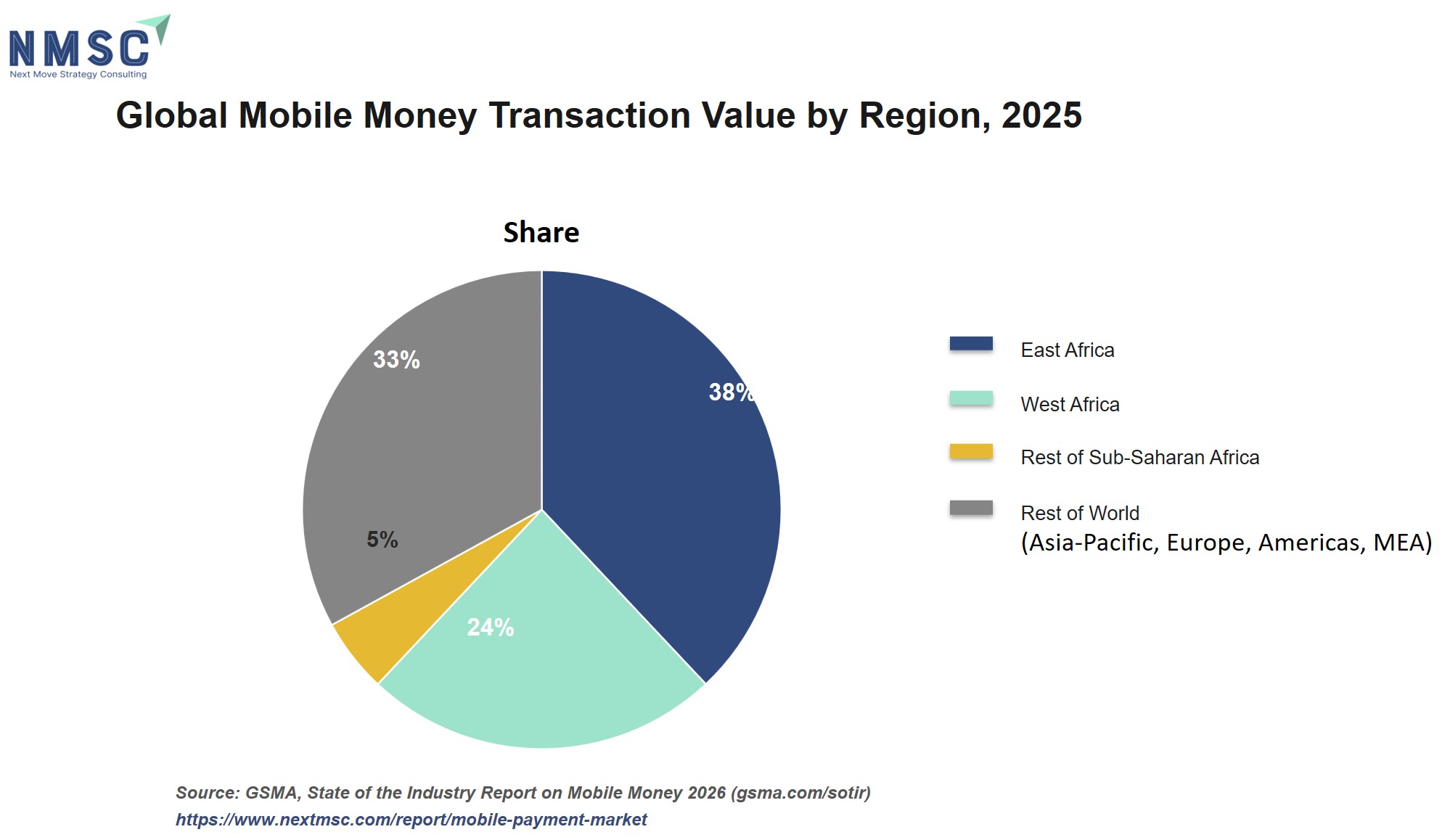
In short: mobile payment growth is now being driven as much by account-to-account rails in emerging markets as by card-linked wallets in mature ones, and the two growth stories increasingly intersect through cross-border interoperability deals (see below).
-
Smartphone and internet penetration remain the base-layer growth driver
-
Fintech/digital-banking convergence is pulling more transaction types onto mobile rails
-
Data-breach and security concerns are the market's most-cited restraint
-
Sub-Saharan Africa, not North America or Europe, now represents the largest single share of mobile money value
Industry Leader Moves: How the Biggest Players Are Repositioning
Next Move Strategy Consulting's Mobile Payment Market report tracks eleven key players Alphabet (Google), Alibaba, Amazon, Apple, PayPal, Visa, Tencent (WeChat), Mastercard, Samsung, Block, and American Express and the last two quarters have been unusually active across nearly all of them.
Cross-border interoperability is the clearest shared theme. In May 2026, Tencent's cross-border platform TenPay Global partnered with PayPal World timed to APEC 2026, hosted by China in Shenzhen so that U.S. PayPal users can scan Weixin Pay merchant QR codes across China without opening a local account or downloading WeChat; Tencent paired the launch with a 90-day fee waiver for new international cardholders and 16-language in-app payment guidance. That announcement followed UnionPay's February 2026 expansion of WeChat Pay compatibility to 29 foreign e-wallets across 12 countries, up from 25 a month earlier. Visa is chasing the same interoperability goal from a different angle: its June 2026 "Visa Pay" expansion made local wallets usable across borders in Hong Kong, South Korea, Taiwan, and Vietnam, and in September 2026 Visa partnered with India's PhonePe to launch Tap to Pay, Cross-Border Scan to Pay, and a hardware-free "Smart Accept" tool for micro-merchants at Global Fintech Fest 2026 PhonePe's first integration of all three Visa capabilities at once.
Agentic and stablecoin-based commerce moved from pilot to product. Mastercard's June 2026 launch of Agent Pay for Machines extended its existing Agent Pay framework to autonomous, machine-to-machine transactions, settling across cards, bank accounts, and stablecoins, with more than 30 launch partners including Stripe, Coinbase, Ant International, and Cloudflare. Visa has built a parallel stack for agent-mediated commerce, converting stablecoin balances to card-network authorizations at the point an AI agent needs to pay a merchant that doesn't accept crypto directly. This is arguably the most structurally significant shift in the competitive landscape: two of the market's payment-rail incumbents are now racing to become the default settlement layer for AI-agent-initiated purchases rather than just human-initiated ones.
Wallet utility keeps expanding beyond the checkout screen. Samsung Wallet added Brazil's Pix rail in May 2026, giving it native support for both of the world's largest account-to-account payment schemes (Pix and India's UPI) and extending its "A2A strategy" beyond card-linked payments. American Express and Apple, in July 2026, launched a feature letting U.S. card members redeem Membership Rewards points directly inside Apple Pay's checkout flow a small feature with an outsized signal, since it ties loyalty-program economics directly to the mobile wallet rather than a separate rewards portal. Alphabet's Google Wallet and Alibaba's Alipay+ have both continued expanding biometric fraud-detection features and cross-border merchant acceptance networks respectively, reinforcing that even the largest platforms see wallet stickiness as a fraud-and-trust problem as much as a features problem.
On the merchant-acceptance side, Block and Amazon are building outward from their existing bases. Block's Neighborhoods network which connects square sellers with Cash App customers added 30,000 sellers by August 2026, nearly 10 times its size in June, while an April 2026 partnership with Uber launched Cash App Pay as an in-app payment option and extended Block's restaurant-operations tools globally. Amazon, meanwhile, has continued layering real-time payment options, AI-driven fraud management, and wallet interoperability into its own checkout and embedded-finance stack across its marketplace and partner merchant network.
Read together, these moves point in one direction: the competitive battle in mobile payments is no longer primarily about acquiring new users, but about who controls the interoperability layer between wallets, currencies, and increasingly autonomous software agents.
Industry Impact key takeaways:
-
Cross-border wallet interoperability (PayPal–Tencent, Visa–PhonePe, UnionPay) is now a bigger competitive battleground than domestic wallet share
-
Mastercard and Visa are both building agentic-commerce settlement rails, treating AI agents as a new class of payer
-
Loyalty and rewards economics (Amex–Apple Pay) are migrating directly into the mobile wallet
-
Merchant-side network effects (Block's Neighborhoods, Amazon's embedded finance) are becoming as important as consumer-side wallet adoption
Industry Leader Moves at a Glance — Mobile Payment Market
|
Company |
Recent Move |
When |
Source |
|
PayPal Holdings |
Strategic reorganization into three business units (Checkout & PayPal, Consumer Financial Services & Venmo, Payment Services & Crypto); new CEO Enrique Lores |
April 2026 |
PayPal / SEC 8-K |
|
Tencent (WeChat / Weixin Pay) |
TenPay Global–PayPal World integration lets U.S. PayPal users pay at Weixin Pay merchants in China via QR code |
May 2026 |
Tencent newsroom |
|
Visa |
Visa Pay smartphone-based merchant acceptance live in Hong Kong, South Korea, Taiwan, Vietnam; PhonePe Tap to Pay / Cross-Border QR launch |
June–Sept 2026 |
Visa Corporate Newsroom |
|
Mastercard |
Launch of Agent Pay for Machines for autonomous, stablecoin- and card-settled machine payments |
June 2026 |
Mastercard Newsroom |
|
Samsung Electronics |
Samsung Wallet adds Pix (Brazil) support alongside existing UPI (India) integration |
May 2026 |
Samsung Developer Blog |
|
American Express / Apple |
"Use Pay with Points with Apple Pay" lets Amex members redeem Membership Rewards inside Apple Pay checkout |
July 2026 |
American Express / Business Wire |
|
Block, Inc. |
Neighborhoods network reaches 30,000 additional sellers (~10x growth since June); Uber partnership launches Cash App Pay |
April–Aug 2026 |
Block Press Room |
|
Alphabet (Google) |
Google Wallet/Pay expanded biometric authentication, AI fraud detection, and digital-identity integration internationally |
Feb 2026 |
NMSC Mobile Payment Market report |
|
Alibaba Group |
Alipay+ expanded merchant acceptance and e-wallet partnerships across Asia-Pacific and Europe |
Jan 2026 |
NMSC Mobile Payment Market report |
|
Amazon.com |
Expanded embedded-finance checkout, real-time payment options, and AI fraud management across marketplace and partners |
Dec 2025 |
NMSC Mobile Payment Market report |
|
Apple Inc. |
Expanded Apple Pay/Wallet transit integration, installment payments, and merchant loyalty tools in North America and Europe |
Nov 2025 |
NMSC Mobile Payment Market report |
The Real-Time Payments Race
If there is a single opportunity area tying these company-level moves together, it is real-time payments (RTP) instant, mobile-first transfers that bypass card rails entirely. Examples include India's UPI, Brazil's Pix, Mexico's CoDi, and the U.S. Federal Reserve's FedNow, launched in July 2023 with 41 banks and 15 service providers at launch, including JPMorgan Chase, Bank of New York Mellon, and US Bancorp.
Adoption across these systems is wildly uneven. India's UPI processed roughly 228.3 billion transactions in 2025, making it the largest real-time payment system in the world by transaction count and giving India close to half of all global real-time retail payment volume. Brazil's Pix processed 63.4 billion transactions in 2024, a volume that on its own exceeded the country's combined credit- and debit-card transactions by roughly 80%. The Eurozone's SEPA Instant scheme, settled via the ECB's TIPS platform, processed 1.355 billion transactions in 2024 orders of magnitude smaller, reflecting slower consumer-side adoption even where the infrastructure exists. FedNow, by contrast, is still an early-stage, largely bank-to-bank rail rather than a consumer payment habit.
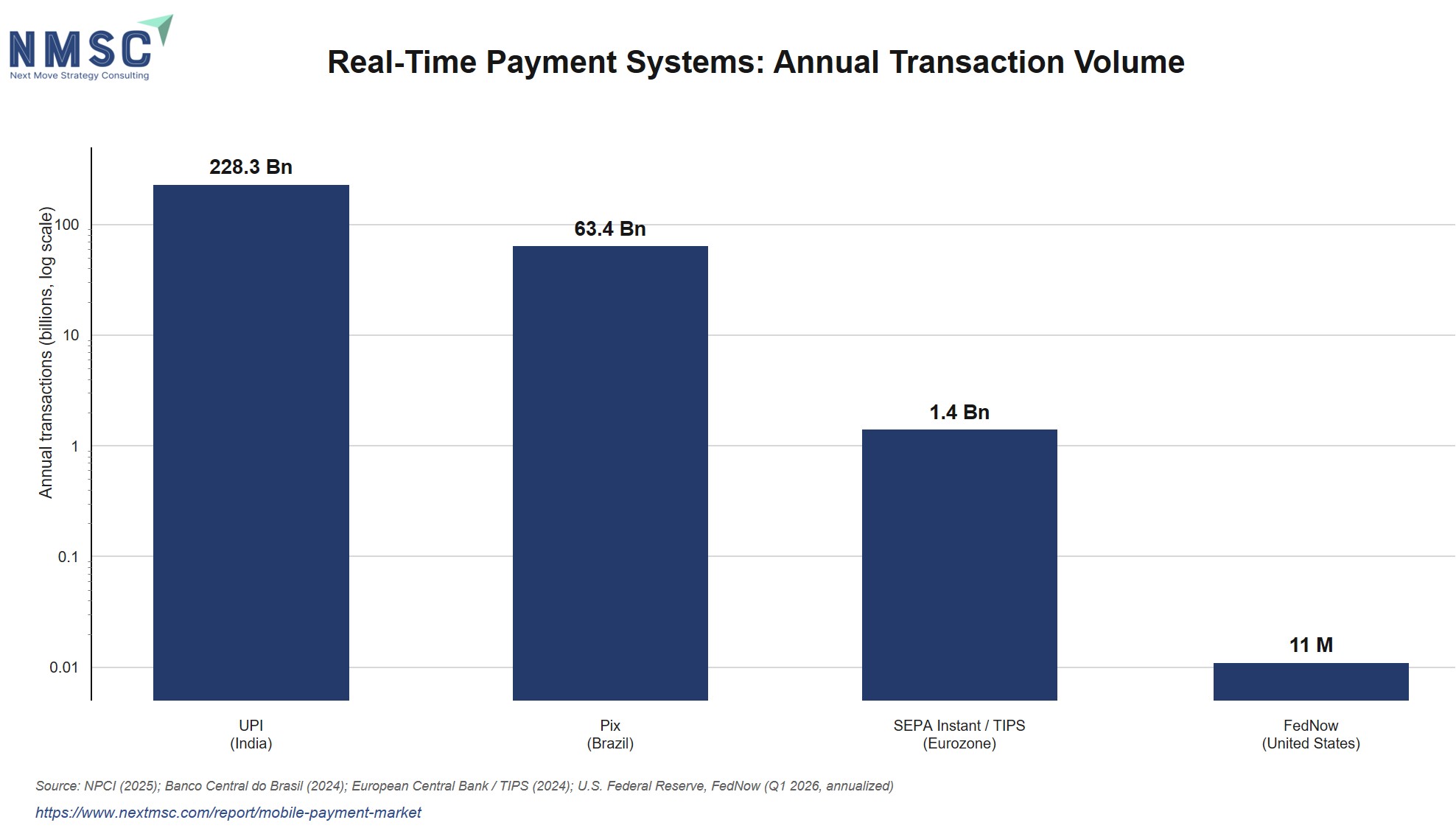
The gap matters commercially. Where an RTP scheme reaches near-universal consumer adoption, as in India and Brazil, it displaces card volume outright rather than simply adding a new payment option which is precisely why Visa, Mastercard, PayPal, and Tencent are all racing to plug their own networks into these rails rather than compete against them head-on.
Security and Trust: The Make-or-Break Variable
None of this growth is resilient without fraud controls that scale with transaction volume. This is one reason the fraud detection and prevention market which covers mobile fraud, identity fraud, and payment-fraud detection specifically is expanding in close step with mobile payments themselves, as financial institutions and mobile payment providers layer AI-driven monitoring, biometric authentication, and behavioral analytics on top of existing rails. For organizations still running manual reconciliation or fragmented payment stacks, that gap is exactly where the "invisible labor" and hidden revenue loss described earlier tends to concentrate.
Future Outlook
Three trends look likely to define the next stage of the mobile payment market. First, real-time payment schemes will keep expanding beyond their home markets, with more Visa- and Mastercard-style bridges connecting local A2A rails to global card networks rather than replacing them outright. Second, agentic commerce AI agents transacting on a consumer's or business's behalf is moving from framework announcements (Mastercard Agent Pay, Visa's agent-to-card conversion layer) toward live volume, which will force a new layer of consent and identity verification into mobile payment infrastructure. Third, wallet providers will keep competing on utility rather than payments alone, bundling travel documents, loyalty points, and government IDs (as Samsung's Trips feature and Amex's Apple Pay rewards integration both illustrate) to increase the switching cost of leaving a given wallet.
Future Outlook key takeaways:
-
Cross-border RTP interoperability, not new market entry, is the next competitive frontier
-
Agentic, stablecoin-settled commerce is moving from pilot to production across Visa and Mastercard
-
Wallet "stickiness" is increasingly built on non-payment utility (travel, identity, loyalty)
-
Fraud-prevention investment will track payment-volume growth closely through the forecast period
Conclusion
The mobile payment market's growth to a projected USD 201.39 billion by 2030 is not simply a story about more people tapping their phones to pay. It's a story about which companies control the connective tissue between wallets, currencies, and payment rails and increasingly, between humans and the AI agents transacting on their behalf. For any organization whose revenue depends on completed transactions, from global retailers to nonprofits collecting recurring donations, the quality of that underlying infrastructure is no longer a technical detail. It is the growth lever.
Download Free Sample of NMSC's full Mobile Payment Market report for detailed segment-level data, regional forecasts, and company profiles.
About the Author
 Sanyukta Deb
— Sanyukta Deb is Digital Marketing Team Lead at Next Move Strategy Consulting, where she has led content strategy and technical SEO for the firm's B2B market research publications for over 2 years. Her editorial process translates NextMSC's primary and secondary research — spanning technology, industrial, and consumer sectors — into commercial narratives, backed by search-intent, keyword, and competitive analysis. She brings 5 years of overall experience in digital marketing and content strategy.
Sanyukta Deb
— Sanyukta Deb is Digital Marketing Team Lead at Next Move Strategy Consulting, where she has led content strategy and technical SEO for the firm's B2B market research publications for over 2 years. Her editorial process translates NextMSC's primary and secondary research — spanning technology, industrial, and consumer sectors — into commercial narratives, backed by search-intent, keyword, and competitive analysis. She brings 5 years of overall experience in digital marketing and content strategy.
About the Reviewer
 Debashree Dey
— Debashree Dey is Assistant Manager at Next Move Strategy Consulting, where she supports cross-vertical market content and communications across diverse industries for 6 years. Her professional background includes senior content writing, communications, and published manuscript authorship, with experience developing audience-focused business narratives and maintaining clear, consistent messaging. Her role supports research-led content development and editorial quality across NextMSC publications.
Debashree Dey
— Debashree Dey is Assistant Manager at Next Move Strategy Consulting, where she supports cross-vertical market content and communications across diverse industries for 6 years. Her professional background includes senior content writing, communications, and published manuscript authorship, with experience developing audience-focused business narratives and maintaining clear, consistent messaging. Her role supports research-led content development and editorial quality across NextMSC publications.
















Add Comment